




Abstract
Abstract
Stabilization treatment of soil is considered a cost-effective option for reducing the mobility and availability of heavy metal contaminants. To date, only a few studies have focused on simultaneous stabilization of Pb, Zn, and Cd with highly effective amendments for Pb/Zn smelter-contaminated soils. In the present study, six amendments, including red mud (RM), pulverized fuel ash (PFA), shell powder (SP), CaCO3 (CC), Na2S (SS), and sulfur, were investigated for their ability to stabilize heavy metals in soils. After evaluating stabilization effectiveness of each single amendment with the toxicity characteristic leaching procedure (TCLP), three composite amendments, CA1 (2:1 SS:RM), CA2 (2:1:1 SS:RM:SP), and CA3 (2:1:1 SS:RM:PFA), were formed and applied to Pb/Zn smelter-contaminated soils. Treatment with 7% of any composite amendment resulted in a >90% reduction in Pb, Zn, and Cd concentrations in TCLP extracts of two contaminated soils. The same treatment also reduced the amount of bioaccessible Pb, Zn, and Cd by >21% in two soils according to simple bioaccessibility extraction testing. Compared to nonstabilized soil, the three composite amendments effectively transformed Pb, Zn, and Cd from acid-soluble to more stable soil fractions. These results indicate that these composites are highly effective amendments for stabilization of multiple heavy metals in Pb/Zn smelter-contaminated soils.
Introduction
P
Human exposure to Pb can cause neurological disorders, such as memory deterioration, prolonged reaction times, reduced cognitive ability, and kidney damage, and children have a higher risk for Pb-associated health issues (Tang et al., 2009). Long-term exposure to low levels of Cd may also result in adverse health effects, including damage to kidney, lung, bone, cardiovascular system, liver, and reproductive system (Honma et al., 2016). In contrast, Zn is an essential element required by almost all living systems; however, excessive levels in plants that are consumed can be toxic, especially to humans (Douay et al., 2013). Although heavy metal can accumulate in plants growing in contaminated soil, excess transfer of these metals into the food chain is thought to be controlled by a “soil–plant barrier.” However, this barrier fails when metal concentrations reach critical limits (Zheng et al., 2007; Cai et al., 2009).
To control the emission of Pb and Zn in industrial pollutants, China issued emission standards in 2010 (GB 25466-2010), which limit the levels of emitted Pb, Zn, and Cd to 0.5, 1.5, and 0.5 mg/L, respectively, in discharged wastewater. In 2018, the Chinese government released contamination risk control standards for developmental land (Pb, 400–800 mg/kg; Cd, 20–65 mg/kg; GB 36600-2018) and agricultural land with different pH's (Pb, 70–240 mg/kg; Zn, 200–300 mg/kg; Cd, 0.3–0.8 mg/kg; GB 15168-2018). When the content of heavy metal in soil is higher than the risk control standard, the risk is unacceptable, and strict management and control action should be carried out. These standards are aimed at restricting the release of Pb, Zn, Cd, and other pollutants into the environment.
For Pb/Zn smelter-contaminated soil, stabilization treatment is considered a cost-effective and feasible option for reducing the mobility and availability of heavy metals (Friesl et al., 2006; Derakhshan et al., 2017). While many studies have investigated stabilization of Pb, Zn, and Cd in contaminated soils (Jang and Kim, 2000; Brown et al., 2005; Bertocchi et al., 2006; Cao et al., 2009, 2013; Lee et al., 2009; Tica et al., 2011; Zhou et al., 2017), few have focused on highly effective methods for their simultaneous stabilization (Basta et al., 2001; Friesl et al., 2006; Friesl-Hanl et al., 2009) in Pb/Zn smelter-contaminated soils. Thus, better pollution control and remediation strategies for Pb/Zn smelter-contaminated soils are required.
Numerous stabilization amendments for heavy metals in soils have been proposed and found to be effective, including alkaline materials (e.g., lime, sulfurizing agents, MgO) (Liu et al., 2015; Sanderson et al., 2015; Zhou et al., 2017), phosphate compounds (e.g., phosphate rocks, phosphate-based salts) (Cao et al., 2013; Zhang et al., 2015), industrial residues (e.g., red mud [RM], pulverized fuel ash [PFA]) (Terzano et al., 2005; Feigl et al., 2012), and biomass materials (e.g., shell powder [SP], bone char) (Moon et al., 2013; Siebers and Leinweber, 2013). In the present study, six amendments, RM, PFA, SP, CaCO3 (CC), Na2S (SS), and sulfur (S), were evaluated for their ability to stabilize Pb, Zn, and Cd in smelter-contaminated soils. After determining the stabilization potential of each, the effectiveness of composites of those amendments was also assessed with Pb/Zn smelter-contaminated soils. The results of the present study will help guide the selection and application of stabilization amendments in and around Pb/Zn smelter-contaminated soils.
Materials and Methods
Soils and amendments
Samples of original soil were collected in May 2016 from the surface layer (depth, 0.5–20 cm) of the background soil in Zhuzhou city (soil-Z) (Hunan province, China; N 27°52′59.4″, E 113°03′57.9″); the upper 0–20 cm of soil layer from land around Zhuzhou Smelter in Zhuzhou city (soil-ZS) (N 27°52′26.6″, E 113°04′24.5″); and Northwest Lead and Zinc Smelter in Baiyin city (soil-BS) (Gansu province, China; N 36°33′17.16″, E 104°12′44.92″). These sites were selected because Zhuzhou and Baiyin city are well-known bases of Pb/Zn mining and smelting with about 60 years of production history in central and northwest China, respectively (Zang et al., 2017). The two sampling sites were typical areas suitable for the investigation of remediation of soils polluted by heavy metals around a Pb/Zn smelter.
Soil samples were air-dried, crushed, homogenized, and then passed through a 2-mm sieve. The concentrations of Pb, Zn, and Cd in soil-Z were 66, 122, and 0.5 mg/kg, respectively. Because these concentrations are far below contamination risk screening values for developmental land in China (GB36600-2018), soil-Z was considered uncontaminated. A description of the method for analyzing heavy metals in soil can be found in the Analytical Methods section. To meet the study objectives, artificially contaminated soil (soil-ZA) was prepared by adding Pb(NO3)2, Zn(NO3)2, and Cd(NO3)2 to soil-Z and allowing it to equilibrate for 3 weeks at room temperature with 50–70% field moisture capacity. Select physical and chemical properties of soil-ZA, soil-ZS, and soil-BS are presented in Table 1.
Mean values ± standard deviations.
Organic matter.
Cation exchange capacity.
Artificially prepared soil.
Soil around Zhuzhou Smelter.
Soil around Northwest Lead and Zinc Smelter.
TCLP, toxicity characteristic leaching procedure.
Six soil amendments were selected for use in the present study: RM (CHALCO Shangdong Co., Ltd., Shangdong, China), PFA (Beijing Electric Power Pulverized Fuel Ash Industry Co., Beijing, China), SP (Qianyang Shuangxing Shell Powder Processing Plant, Liaoning, China), CC, SS, and S (Sinopharm Chemical Reagent Co., Ltd., Beijing, China). RM is a byproduct of bauxite processing, while PFA is a byproduct of power industries and coal burning (Liu et al., 2014; Yao et al., 2014). RM, PFA, and SP were all in powder form with an average particle diameter <150 μm. The chemical compositions of RM, PFA, and SP were obtained by X-ray fluorescence (MAGIX-PW2403; PANalytical, EA Almelo, Holland) and are shown in Table 2. CC, SS, ST, and S were all analytical-grade reagents. The heavy metal concentrations were low in RM (Pb, 9.7 mg/kg; Zn, 15.5 mg/kg; Cd, 0.12 mg/kg), PFA (Pb, 8.4 mg/kg; Zn, 20.6 mg/kg; Cd, 0.19 mg/kg), and SP (Pb, 2.9 mg/kg; Zn, 0.94 mg/kg; Cd, <0.01 mg/kg), and do not cause secondary pollution.
Mean values ± standard deviations.
Chemical composition was presented in the form of oxides.
The mass loss rate of the amendment was calcined at 950°C for 30 min.
PFA, pulverized fuel ash; RM, red mud; SP, shell powder.
Stabilization treatment
Each of the six single amendments were used to stabilize Pb, Zn, and Cd in soil-ZA to determine their effectiveness. In the stabilization test, 200 g of soil was placed in a stainless steel mixing bowl and mixed with 2%, 5%, 7%, and 10% (w/w) of each amendment and 30% (w/w) deionized water. After mixing thoroughly with an electronic mixer at 140 ± 5 rpm for 15 min to achieve homogeneity, the mixtures were placed in a polypropylene box (10 × 10 × 8 cm) with a cover and incubated at 25°C with 95% relative humidity for 7 days (Cao et al., 2013; Zhang et al., 2015). Each concentration of each amendment was tested in each soil three times.
After determining the stabilization effectiveness of each of the six amendments alone with soil-ZA, three cost-effective composite amendments, CA1 (2:1 SS:RM), CA2 (2:1:1 SS:RM:SP), and CA3 (2:1:1 SS:RM:PFA), were prepared and tested with soil-ZS and soil-BS around the Pb/Zn smelter. The stabilization testing procedure for composite amendments was the same as that for single amendments; 200 g of soil was mixed for 10 min with preweighted 2%, 5%, 7%, and 10% (w/w) composite amendments at a water-to-total solid ratio of 0.3. Samples were placed in a polypropylene box (10 × 10 × 8 cm) and incubated in a curing chamber at 25°C with 95% relative humidity for 7 days.
Toxicity characteristic leaching procedure
Stabilization effectiveness was evaluated by measuring the change in leached heavy metal concentrations in soils using the toxicity characteristic leaching procedure (TCLP) (USEPA, 1992). Briefly, 20 g of soil was mixed with 400 g of leaching fluid (acetic acid buffer; pH = 4.93 ± 0.02) in a high-density polyethylene bottle at 30 rpm at 25°C for 18 h. Then, the mixture was centrifuged at 1,409 rpm for 15 min and the supernatant filtered through a 0.45-μm Millipore membrane (ϕ = 47 mm). The concentrations of Pb, Zn, and Cd in the filtrate were analyzed by inductively coupled plasma mass spectrometry. TCLP was conducted three times for each sample.
Simple bioaccessibility extraction test
The simple bioaccessibility extraction test (SBET) can be used to determine the level of trace element exposure to the environment within the human stomach (USEPA, 2007). The content of bioaccessible heavy metals (Pb, Cu, Zn, Cd, Hg, etc.) in soils has been determined by SBET previously (Cao et al., 2009; Zia et al., 2011). Here, 2.0 g of soil (particle size <25 μm) was extracted with 200 mL of glycine solution (0.4 M; pH = 1.50 ± 0.05). Sample mixtures were rotated end-over-end for 1 h at 30 rpm and 37°C, before measuring their pH; if the pH of samples was not between 1.0 and 2.0, the procedure was repeated. After completing the extraction, the solution mixture was immediately filtered through a 0.45-μm Millipore filter. All filtrates were stored at 4°C and analyzed by inductively coupled plasma mass spectrometry within 7 days. The bioaccessibility of Pb, Zn, and Cd was expressed as a mass percentage of the amount of each metal extracted by SBET to the total amount of each metal originally present in the soil. All extractions were conducted in triplicate.
Speciation analysis
The three-stage sequential extraction procedure used herein was proposed by the European Community Bureau of Reference (BCR) and has been widely applied to assess potential metal mobility for various solid samples, including sediment, soil, sludge, and particulate matter (Passos et al., 2010; Mahanta and Bhattacharyya, 2011; Zhang et al., 2015). Nominal extracted fractions of heavy metals by the European Community BCR have included an acid-soluble fraction (AS) that is exchangeable or associated with carbonate, a reducible fraction (RD) associated with Fe-Mn oxides, an oxidizable fraction (OX) associated with organic matter and sulfides, and a residual fraction (RS) associated with the crystalline structure of minerals. The sequential extraction procedure was conducted as described by Passos et al. (2010).
Analytical methods
Soil pH measurement was conducted in a 1:1 (w/w) soil:water suspension using a glass pH electrode (Delta 320; Mettler Toledo, Greifensee, Switzerland). Soil cation exchange capacity, organic matter, and heavy metal concentration were determined as previously described (Zhang et al., 2015). The heavy metal content was analyzed by digesting the soil with HNO3–HClO4–HF and then subjecting it to inductively coupled plasma mass spectrometry (model 7500; Agilent, Santa Clara) (Zhang et al., 2015). The size distribution of amendment particles was measured using a laser diffraction instrument (Mastersizer 2000; Malvern, United Kingdom). The surface area of each amendment was determined using a surface area analyzer (Nova 4200e; Quantachrome, Boynton Beach) through standard N2-adsorption/desorption techniques. The surface morphologies of amended samples were characterized with a field-emission scanning electron microscope (Hitachi S4800, Ibraraki, Japan).
Quality control
Soil samples were air-dried, passed through a 2-mm sieve, and a representative sample was obtained by quartering. Ultrapure-grade acids were used for digestion; all other reagents were of analytical grade. Laboratory plastic and glassware was conditioned in 10% HNO3 for 24 h and rinsed repeatedly with deionized water before use. All solutions were prepared freshly with Milli-Q UltraPure water (18.3 MΩ cm). Before starting analysis of test samples, recovery experiments were conducted with soil samples at 0.5 and 1.0 mg/kg. Recoveries were 96–103% Pb, 95–101% Cd, and 99–106% Zn, all of which were within the acceptable ranges specified by USEPA Method 3051A. The limits of detection for Pb, Zn, and Cd were 2, 5, and 2 ng/g, respectively. The quality control procedure consisted of reagent blanks, duplicate samples, and referenced soil samples. All experiments were prepared in three replicates, and the relative standard deviations of all examination indices were <8%. The reliability of the analyses as determined by referent soil (GBW07405; National Standard Detection Research Center, Beijing, China) was ±4% for Pb, ±5% for Mn and Zn, and ±3% for Cd. The total concentration of heavy metals in soil was used to assess the recovery of metal by sequential extraction. The recovery of heavy metals (sum of four fractions/total concentration) ranged from 90% to 106%.
Results and Discussion
Effects of single amendments on TCLP-leached heavy metals
TCLP-leached concentrations of Pb, Zn, and Cd in soil-ZA stabilized by each of the six single amendments are shown in Fig. 1. Except for S, the other five amendments effectively decreased the concentrations of Pb, Zn, and Cd in TCLP extracts as follows: SS > PFA > SP > RM ≈ CC. The concentration of Pb, Zn, and Cd in TCLP extracts was reduced as each amendment dosage increased from 2% to 10%. The concentration of TCLP-extractable Pb, Zn, and Cd decreased by 85.3%, 88.9%, and 97.9%, respectively, when 2% SS was added. As the dosage of SS reached 10%, Pb, Zn, and Cd concentrations were reduced in TCLP extract by >99.9%. The dominant stabilization mechanism of Pb, Zn, and Cd by SS was via sulfidation reactions; heavy metal ions (Pb2+, Zn2+, and Cd2+) reacted with S2− to form insoluble metal sulfides (Kuchar et al., 2006). The solubility product constant of PbS (8.0 × 10⁻²⁸), ZnS (1.6 × 10⁻²⁴), and CdS (3.6 × 10⁻²⁹) was sufficiently low; so high stabilization efficiency was obtained for Pb, Zn, and Cd in soil when SS was used as a stabilization amendment.

TCLP-extractable Pb, Zn, and Cd concentrations in soil-ZA stabilized by different amendments. Error bars represent SD (n = 3). Each amendment was added into soil with amendment-to-soil ratio of 2%, 5%, 7%, and 10%, respectively, and then water was added into solid with water-to-solid ratio of 30%. The mixed grout was cured at room temperature, 95% relative humidity for 7 days. CC, calcium carbonate; CK, original soil; PFA, pulverized fuel ash; RM, red mud; S, sulfur; SD, standard deviation; SP, shell powder; SS, sodium sulfide; TCLP, toxicity characteristic leaching procedure.
Concentration of TCLP-extractable Pb (54.1 mg/L in original soil), Zn (289.3 mg/L in original soil), and Cd (0.4 mg/L in original soil) ranged from 24.3 to 29.3 mg/L for Pb, 109.5–131.9 mg/L for Zn, and 0.1–0.2 mg/L for Cd with the addition of 2–10% PFA. The stabilization efficiency of Pb, Zn, and Cd was 45.8–55.1%, 53.2–61.1%, and 51.0–66.3%, respectively, as the amount of PFA increased from 2% to 10% (Fig. 1). These results were likely due to the fact that the physical structure of PFA consists of hollow spheres (Fig. 2) with a specific surface area of 0.8 m2/g that are capable of adsorbing heavy metals (Yao et al., 2014). Additionally, PFA is a low-cost, cementitious binder that can solidify heavy metals in soils due to its alkalinity (pH = 10.32) as increasing the soil pH causes precipitation of heavy metal ions (Terzano et al., 2005). Oxidized functional groups SiO2 and Al2O3 are present on the surface of PFA, and the functional groups have a high affinity toward heavy metal ions.
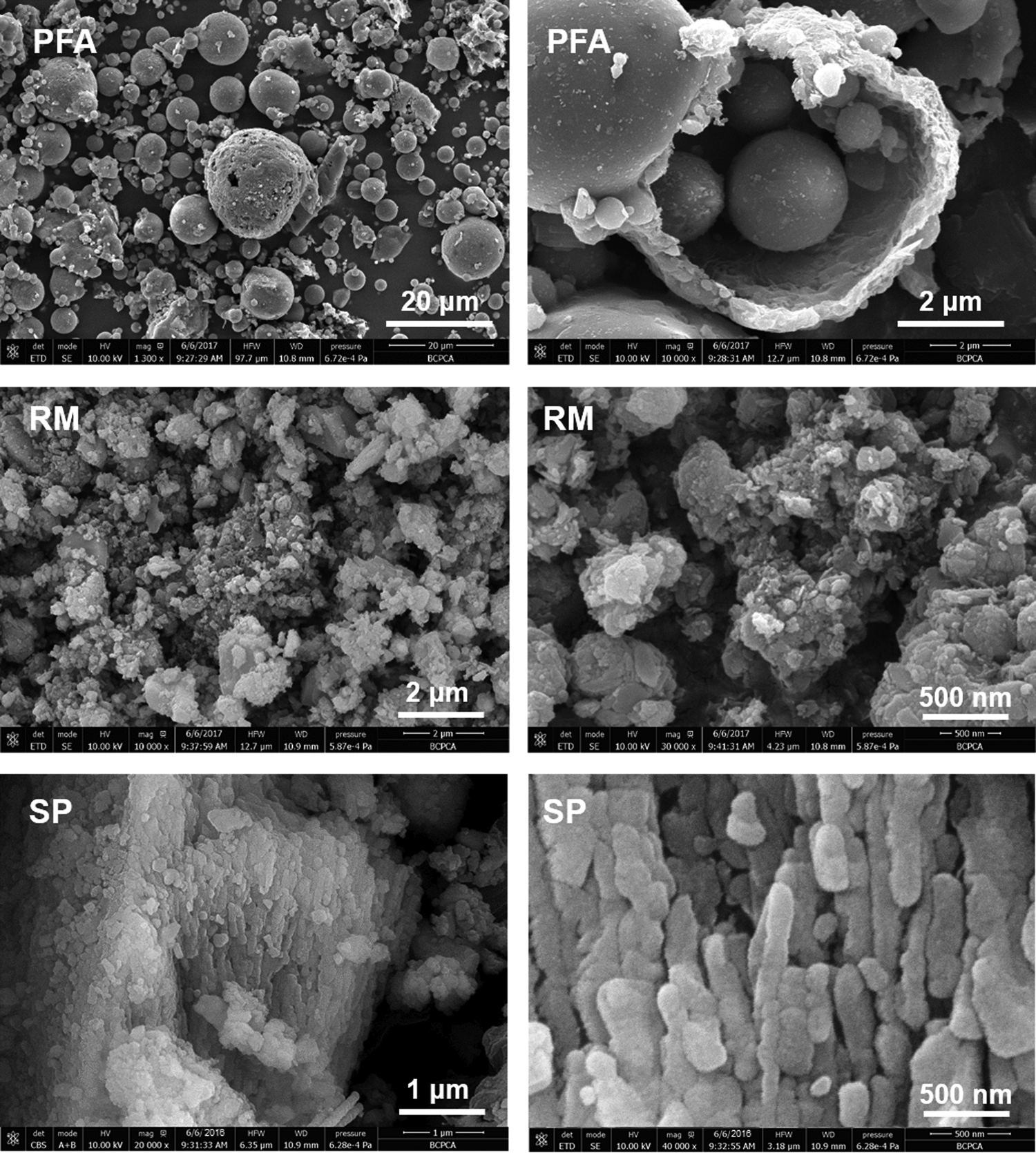
SEM image of PFA, RM, and SP under different magnifications.
Concentration of Pb, Zn, and Cd in TCLP extracts decreased by 80.9%, 40.9%, and 42.8%, respectively, in soil-ZA treated with 10% RM (Fig. 1). Similar stabilization effectiveness was found by Feigl et al. (2012) and Friesl et al. (2004), who demonstrated decreases in the mobility of Zn and Cd in RM-treated soils up to 94% and 91%, respectively, depending on soil type and pollution levels. The surface of RM particles carries a significant negative charge due to a large amount of OH− groups present on RM particles; therefore, heavy metal ions in soil are readily adsorbed and complexed by RM. As with PFA, RM has an alkaline pH (9.57), making it a suitable amendment for surface precipitation of heavy metals (Hua et al., 2017). Structurally, RM has relatively loose microstructures and high porosity, and RM particles easily agglomerate (Fig. 2). The RM particles were extremely fine, and the proportion of particles with <7.49 μm particle size was 90% according to the particle size distribution. RM is adsorbent, with a large specific surface area (1.4 m2/g), making it suitable for remediation of heavy metals in polluted soil. Additionally, the oxide components (Fe2O3, Al2O3, and TiO2) on the surface of RM have a high chemisorption capacity for heavy metals (Liu et al., 2011).
For 2–10% SP treatment, the concentrations of TCLP-leached Pb (54.1 mg/L in original soil), Zn (289.3 mg/L in original soil), and Cd (0.4 mg/L in original soil) in soil-ZA were reduced by 6.1–48.4, 65.5–191.4, and 0.1–0.3 mg/L, respectively, and the concentration of TCLP-extractable heavy metal decreased as SP dosage increased (Fig. 1). Treatment of soil-ZA with 2–10% CC, Pb, Zn, and Cd concentrations decreased by 3.3–40.6, 53.1–135.8, and 0.1–0.2 mg/L, respectively (Fig. 1). SP is composed of about 95% (w/w) calcite interleaved with layers of about 5% (w/w) viscoelastic proteins (Ok et al., 2011). The dissolved Ca2+ and CO32− of calcite in SP resulted in higher levels of OH− formation in the soil solution, which reacted with heavy metal ions to form precipitates (Moon et al., 2013). Exchange of cationic Ca2+ of calcite in SP with heavy divalent ions plays an important role in heavy metal stabilization. The irregular surface and porous structure of SP characterized by scanning electron microscopy (Fig. 2) showed a large surface area for the adsorption of heavy metals. In general, the reduction of TCLP extractability of heavy metals was greater with SP versus CC treatment, demonstrating that SP was more effective at stabilizing Pb, Zn, and Cd in soil.
Application of composite amendments to Pb/Zn smelter-contaminated soils
The three cost-effective composite amendments applied to soil-ZS and soil-BS were CA1 (2:1 SS:RM), CA2 (2:1:1 SS: RM:SP), and CA3 (2:1:1 SS:RM:PFA). The stability of Pb, Zn, and Cd in soil-ZA varied in response to the composite amendment treatments as follows: SS > PFA > SP > RM ≈ CC > S; SS exhibited the strongest simultaneous stability of Pb, Zn, and Cd.
Leached Pb, Zn, and Cd
The concentrations of Pb, Zn, and Cd in TCLP extracts from soil samples are shown in Fig. 3. All of the composite amendments showed a high capacity for stabilization of Pb, Zn, and Cd in soil-ZS and soil-BS. For 2–10% CA1 treatment, the TCLP-extractable Pb, Zn, and Cd concentrations decreased by 72.5–98.9%, 62.2–99.9%, and 82.1–99.9%, respectively, in soil-ZS and by 8.7–99.9%, 38.1–97.9%, and 38.9–100%, respectively, in soil-BS compared with untreated soil. CA2 treatments (2–10%) reduced Pb, Zn, and Cd in TCLP extracts by 77.7–99.4%, 76.1–99.8%, and 89.2–99.9%, respectively, in soil-ZS and by 14.2–100%, 47.7–99.7%, and 67.5–100%, respectively, in soil-BS. The stability of heavy metals after 2–10% CA3 treatment was similar to that of CA1 and CA2, with 75.5–99.8%, 68.7–99.9%, and 85.4–99.9% reduction of Pb, Zn, and Cd, respectively, occurring in soil-ZS and 6.2–100%, 33.8–98.3%, and 43.7–100% reductions, respectively, in soil-BS (Fig. 3). All of the composite amendments showed a strong capacity for stabilizing heavy metals in soil samples. Addition of 5% CA1–CA3 enhanced Pb, Zn, and Cd stability simultaneously by >90% in soil-ZS, while 7% composite application enhanced stability by >90% in soil-BS.
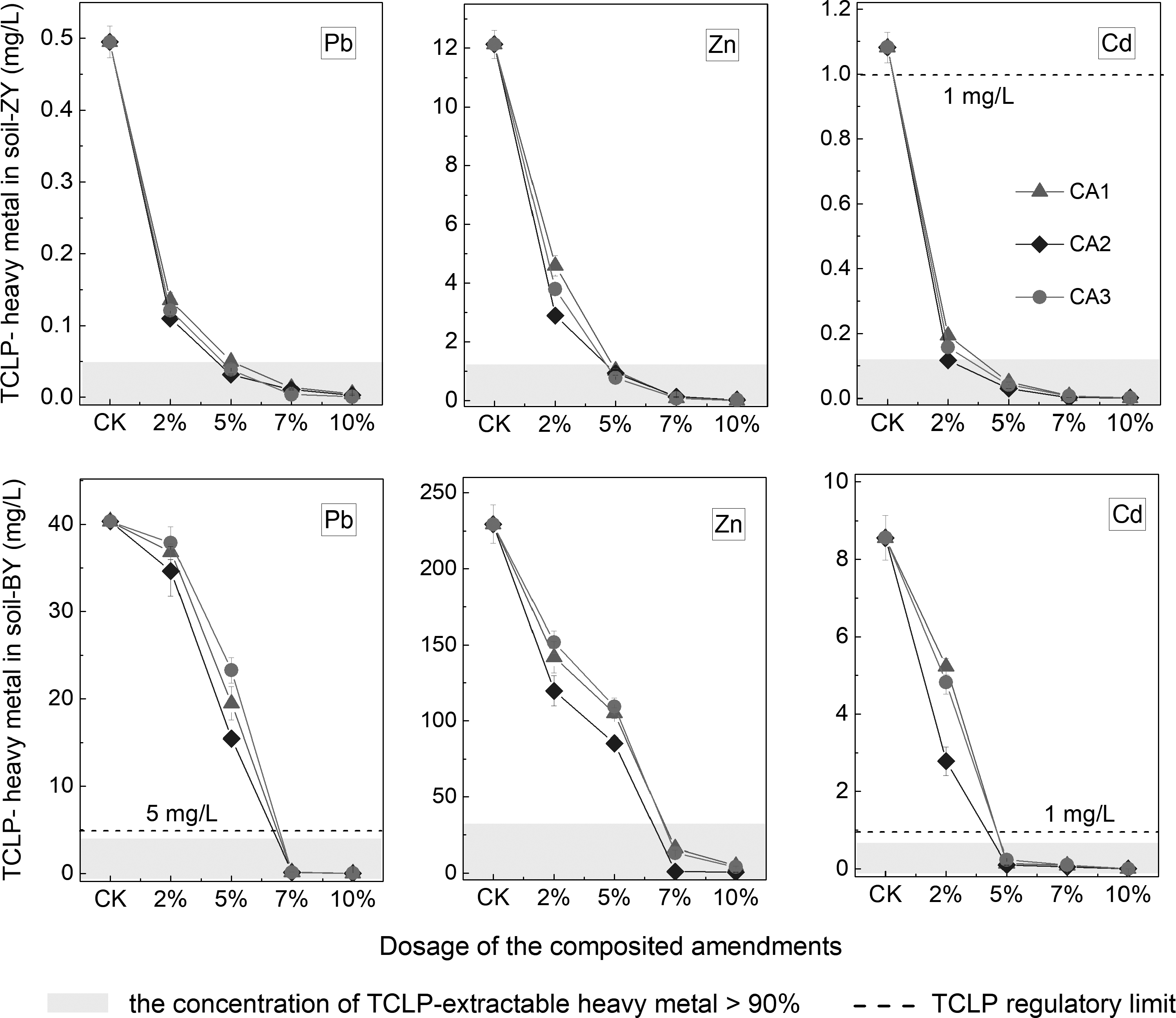
TCLP-extractable Pb, Zn, and Cd concentrations in soil-ZS and soil-BS stabilized by three composite amendments. Error bars represent SD (n = 3). CA1, SS:RM = 2:1; CA2, SS:RM: SP = 2:1:1; CA3, SS:RM:PFA = 2:1:1.
Bioaccessibility of Pb, Zn, and Cd
Concentrations of Pb (0.2%), Zn (1.4%), and Cd (4.7%) extracted by TCLP from soil-ZS were lower than that in SBET extracts (Pb, 17.3%; Zn, 8.1%; Cd, 14.0%); similar results were observed with soil-BS. The SBET leach liquor (pH = 1.50) was more acidic than that of TCLP (pH = 4.93), which caused greater heavy metal release. The bioaccessibility of Pb (1–91%) and Cd (5–99%) in soil has been shown to vary widely depending on soil type (Cao et al., 2009). With 7% CA1–CA3 treatment, the bioaccessibility of Pb, Zn, and Cd decreased by 34.3–44.3%, 36.8–47.4%, and 39.6–47.6% in soil-ZS, respectively, and by 25.0–32.3%, 29.6–40.0%, and 21.0–22.9%, respectively, in soil-BS (Fig. 4). The reductions in bioaccessible heavy metal content produced by CA1–CA3 were relatively similar, which is consistent with TCLP extraction results. The reduction of bioaccessible Pb, Zn, and Cd content is mainly attributed to the formation of insoluble heavy metal sulfides (Liu et al., 2015) and hydroxides, as well as adsorption by the composites. It should be noted, however, that glycine in the SBET fluid could react with Pb2+ and Cd2+ ions to form electrochemically labile complexes (Zhou et al., 2017), which could underestimate Pb and Cd bioaccessibility.

Bioaccessibility of Pb, Zn, and Cd in soils stabilized by composite amendments. Error bars represent SD (n = 3).
Chemical speciation changes
Non-RS (sum of AS, RD, and OX) of Pb, Zn, and Cd in the original soil-ZS sample was 55.9%, 57.6%, and 59.7%, respectively, while that in the original soil-BS sample was 70.9%, 61.4%, and 65.6%, respectively (Fig. 5). Since nonresidual heavy metals are more bioaccessible and mobile than the RS (Zhang et al., 2015), the heavy metals in soil-ZS were less mobile than those in soil-BS, which is consistent with TCLP extraction data showing a lower leachability for heavy metals in soil-BS versus soil-ZS. As expected, addition of 7% CA1–CA3 to soil-ZS caused a 12.0%, 17.3–22.2%, and 19.5–24.4% decrease in the levels of AS-Pb, AS-Zn, and AS-Cd, respectively (Fig. 5). These results indicate that all three composite amendments can reduce the mobility and bioaccessibility of Pb, Zn, and Cd in soil. Application of CA1–CA3 caused the pH of soil-ZS to increase from 7.9 to 11.6–11.9. An increase in pH of 4 units can lead to a significant decrease in the amount of acid-soluble heavy metals by surface adsorption and precipitation, which indicates the stabilized soil can resist acid rain. These results were consistent with those of TCLP extraction (Zhou et al., 2017).

Chemical fractions of heavy metals in soils stabilized by composite amendments.
CA1–CA3 also increased the levels of RD-Pb, RD-Zn, and RD-Cd by 1.5–3.5%, 3.3–4.0%, and 2.2%, respectively (Fig. 5). The oxidizing groups (e.g., Fe2O3, Al2O3) on the surface of RM have a high chemisorption affinity for heavy metal ions. Heavy metal ions present in soil migrate to the surface of these oxides and diffuse into their crystal lattices, effectively transferring the heavy metals from the AS to the OX fraction (Garau et al., 2007). Present results showed that the amount of OX-Pb, OX-Zn, and OX-Cd in composite amendment-stabilized soil-ZS increased by 1.5–3.5%, 3.3–4.0%, and 3.0%, respectively (Fig. 5).
Sulfide precipitates of heavy metals (PbS, ZnS, and CdS) formed when mixing soil with the composite amendments, which led to reducible heavy metal fraction that was associated with increased sulfides. CA1–CA3 significantly reduced the amount of RS-Pb, RS-Zn, and RS-Cd in soil-ZS by 5.6–8.2%, 8.9–13.8%, and 14.4–19.2%, respectively; similar results were obtained for soil-BS. Treatment of heavy metal-contaminated soil with 7% CA1–CA3 effectively decreased the amount of leached Pb, Zn, and Cd through transformation from acid-soluble to more stable fractions.
Conclusions
The present study demonstrated that three composite amendments (CA1, CA2, and CA3) were effective for simultaneous stabilization of Pb, Zn, and Cd in Pb/Zn smelter-contaminated soils. Treatment with 7% CA1–CA3 showed a strong capacity to stabilize heavy metals, reducing the concentrations of Pb, Zn, and Cd by >90% in TCLP extracts, >21% in SBET extracts, and >12% in AS fractions of two contaminated soils. Therefore, application of any of these three composite amendments on or around Pb/Zn smelter-contaminated soils could decrease the amount of heavy metals leached into the surrounding environment through transformation from acid-soluble to more stable soil fractions. The current results provide important technical information that supports further development of stabilization procedures for Pb/Zn smelter-contaminated soils. However, further research is needed to verify the long-term stabilization performance of these composite amendments under field conditions.
Footnotes
Acknowledgments
This work was supported by the National High Technology Research and Development Program of China (No. 2012AA101402) and the National Natural Science Foundation of China (No. 41071165).
Author Disclosure Statement
No competing financial interests exist.