




Abstract
Abstract
For the first time, functionalized zero-valent iron/walnut shell composite (CS-WS-NZVI) was prepared by immobilizing zero-valent iron nanoparticles within walnut shell (WS) modifying with chitosan using liquid phase reduction method. Activity of CS-WS-NZVI was investigated using tetracycline (TC) as target pollutant. Batch experiments were carried out to determinate the effect of reactant concentration, pH value, solution temperature, and competitive anions. Results show that TC could be removed by physical adsorption and chemical reduction on CS-WS-NZVI in a short time with high removal rates (more than 99.02%) at the optimal experiment conditions. Then, scanning electron microscopy analysis reveals that nanoscale zero-valent iron (NZVI) was distributed dispersedly on CS-WS-NZVI without being oxidized, and the mean particle size was 30–100 nm. Characterization results of X-ray diffraction and Fourier transforms infrared spectra of CS-WS-NZVI revealed that the iron nanoparticles were successfully loaded on the surface of WS. LC-MS analysis of the treated solution showed that degradation products were mainly derived from TC after losses of some groups from the ring, and the CS-WS-NZVI can absorb both TC and its degradation products. Furthermore, degradation of TC using CS-WS-NZVI was found to follow the two-parameter pseudo-first order decay kinetics model. Overall, our results indicated that CS-WS-NZVI might be a promising functional material for TC wastewater remediation.
Introduction
A
At present, a plenty of WS are still burnt out or thrown off every year in the world, which not only waste resources but also pollute the environment. In previous studies, WS has been successfully used for the removal of single-component aqueous solutions (Safinejad et al., 2017). According to other research, WS can be used to treat heavy metal ions due to its low-cost, large specific surface area, rough surface morphology, and green nontoxic characteristics. Even so, further studies on the reuse and its removal ability of WS for pollutants are still needed.
In our study, we provide a simply liquid-phase method for immobilization of NZVI onto WS and modification of NZVI by CS. WS has numbers of carboxyl group, carbonyl, and phenolic hydroxy group (Yang et al., 2016). Previous studies have revealed incorporating of amino groups on the CS to NZVI (Liu et al., 2010). Therefore, we used WS as support material of NZVI to decrease the agglomeration of NZVI particles. CS was used to improve the stability of NZVI particles and increase the availability of surface reactive sites for CS-WS. Furthermore, the as-prepared CS-WS-NZVI provides with more accessible reactive sites for reduction of TC than the sole NZVI or WS. The effects of some parameter (including initial concentration of TC, solution temperature, ionic strength, NZVI dosage, pH, and contact time) were investigated; kinetics for TC removal with CS-WS-NZVI was also evaluated. The physicochemical properties of CS-WS-NZVI were characterized by scanning electron microscopy (SEM), X-ray diffraction (XRD), energy dispersive spectroscopy (EDS), Fourier transform infrared spectra (FTIR), and X-ray photoelectron spectroscopy (XPS). Eventually, experiments were performed to detect the possible degradation products and pathways of TC by CS-WS-NZVI using liquid chromatograph-mass spectrometer (LC-MS).
Materials and Methods
Chemicals
TC (≥98% assay, molecular weight: 444.43) and WS were crushed into powder before experiments (100–150 mesh, 106–150 μm). The composition of WS is shown in Supplementary Table S1. Ferrous sulfate heptahydrate (FeSO4·7H2O, AR), potassium borohydride (KBH4, AR), echanol, acetone, NaOH, HCl, and other reagents were purchased from Sinopham Chemical Reagent Co. Ltd. All chemicals, unless otherwise mentioned, were used as received without further purification.
Preparation of CS-WS-NZVI
CS-WS-NZVI particles were synthesized using liquid-phase reduction method. First, 1.0 g WS and 0.01 g CS were added into the 50 mL of deionized water, thoroughly mixed, and allowed to soak for 24 h at 60°C in the oven. Then, the products (CS-WS) obtained were dried at 45°C for 4 h. A measure of 2.56 g FeSO4·7H2O was dissolved in 100 mL deionized water. Then, 1.0 g CS-WS was added into the FeSO4 solution and stirred for 1 h at room temperature. After intensive mixing, 100 mL 1.56 mol/L KBH4 was added dropwise into the mixture solution. The solution was continuously stirred for 30 min when delivering all of the KBH4 solution. The solid precipitation was subsequently washed with deionized water and absolute ethanol. All reactions were conducted in an anaerobic glove box under the protection of N2. The unsupported pristine NZVI and WS-NZVI were prepared in a similar way without addition of CS-WS (CS and WS) and CS, respectively. The Schematic illustration of the synthesis procedure CS-WS-NZVI composites is shown in Fig. 1.
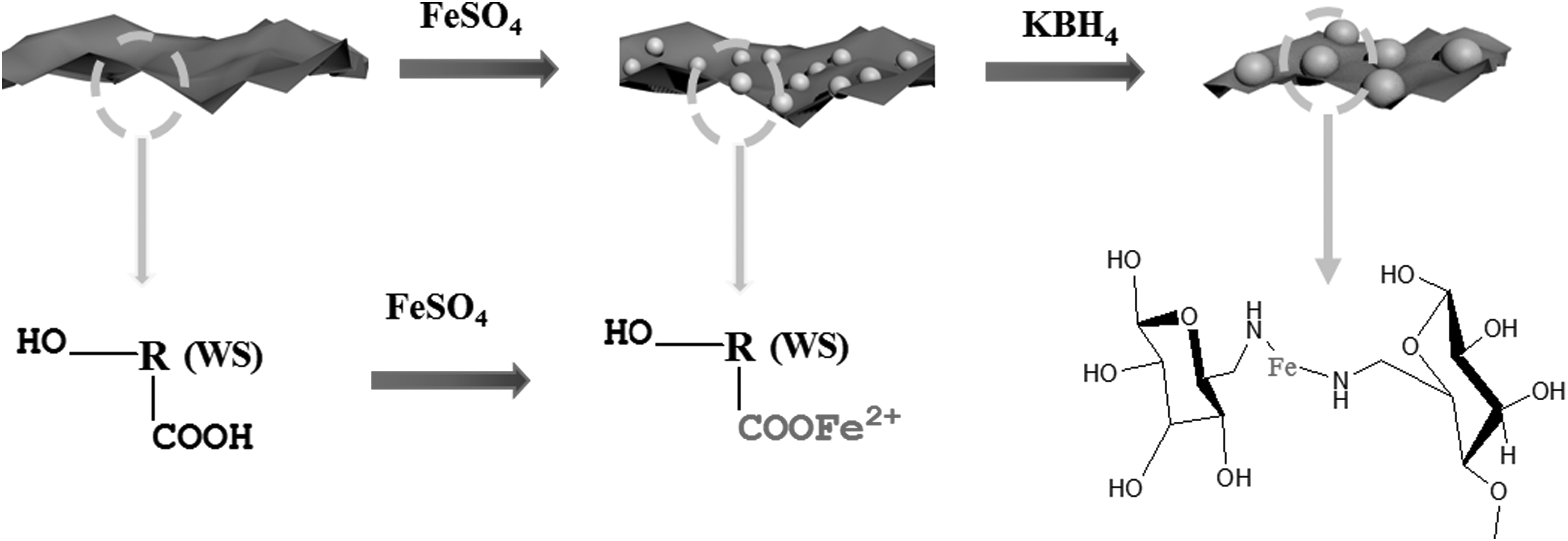
Schematic illustration of synthesis procedure CS-WS-NZVI composites. CS, chitosan; NZVI, nanoscale zero-valent iron; WS, walnut shell.
Characterization
Morphological analysis of CS-WS-NZVI, WS-NZVI, and NZVI was performed using a SEM (JEOL, Ltd.). FTIR (Bruker Vertex 70) and XPS were used to reveal the surface chemical structure and composition of WS and WS-NZVI particles. The crystal structure of the CS-WS-NZVI was characterized by XRD (D/max2200 X-ray diffractometer with Ni-filtered Cu Kα radiation operating at an accelerating voltage of 45 kV). The elemental composition of the as-prepared CS-WS-NZVI was analyzed using energy dispersive spectroscopy (EDS, IE300X) attached to the SEM.
Batch experiments
TC stock solutions (TC 1 g/L) were freshly prepared for each batch test. All experiments were carried out in 250 mL conical flask. A certain amount of CS-WS-NZVI was introduced into conical flask with 100 mL TC solution (200 mg/L) under aerobic conditions at room temperature. The pH of reaction solution was adjusted by HCL (0.1 M) or NaOH (0.1 M). At selected time intervals, 5 mL of solution was collected by disposable syringes and filtered through 0.45 μm membranes for TC residue analysis. All experiments were conducted in triplicate. The removal efficiency of TC was calculated as follows:
where C0 (mg/L) is the initial concentration of TC, and C (mg/L) is the concentration of TC at reaction time t (minutes). Concentrations of aforementioned solution were measured with ultraviolet-visible (UV-vis) detector at 355 nm.
Results and Discussion
Characterization of synthesized CS-WS-NZVI
FTIR of WS and WS-NZVI are shown in Supplementary Fig. S1. For WS, the characteristic bands were observed at 3,700/cm (ν-OH), 3,140/cm (ν-CH), and the bands at about 1,630/cm, attributed to in-plane C = O stretching vibration of aromatics (Yang et al., 2016; Ashrafi et al., 2017). The bands in the range of 1,000–1,500/cm were mainly due to C-OH stretching and OH bending vibrations, indicating the hydroxyl groups (-OH) and carboxylate groups (-COOH) on the surface of WS, which is able to form complexes with Fe2+ (Bikousi et al., 2015). In addition, comparing with the spectra of WS and WS-NZVI, the bands at 995 and 945/cm were the bending characteristic bands for hydroxyl groups of ferric hydroxyl (FeOOH). The bands at 820/cm can be attributed to iron oxides on the surface, as Fe0 was partially oxidized. It can be concluded that the surface functional groups were changed obviously. All these variations showed a convincing evidence of the nano zero-valent iron loaded on WS.
Morphology of WS, NZVI, WS-NZVI, and CS-WS-NZVI is shown in Fig. 2. As can be seen in Fig. 2a, the WS had irregular rough structure with a veined surface due to the composition of WS (Supplementary Table S1). The veined surface can provide more surface area to attract iron or other ions to the WS. It can be observed from Fig. 2b that a chain-like and aggregated structure (the particle size of NZVI ranges between 30 and 100 nm) (Mu et al., 2017) was formed because of its natural magnetism, and NZVI was also covered by the passivation layer on the surface, which was also observed in other studies (Liu et al., 2012; Kuang et al., 2013; Wang et al., 2016). Figure 2c shows a large number of nano zero-valent iron particles attached on the surface of the WS, indicating that the WS as a support material can effectively support NZVI particles. However, it can be seen that NZVI was obviously agglomerated on the surface of WS-NZVI. For the above question, as shown in Fig. 2d, NZVI was uniformly distributed on the surface of CS-WS-NZVI after being modified by CS. The existence of NZVI with CS provided enhanced resistance against the particle aggregation through the electrostatic repulsion and steric hindrance (Liu et al., 2016). Therefore, the difference in material morphology indicated that CS modification of NZVI was beneficial for improving NZVI loading and dispersion onto WS, hence enhancing the reactivity of CS-WS-NZVI composites. The presence of element Fe signal in EDS spectrum of as-prepared CS-WS-NZVI (Fig. 2d) illustrates the successful synthesis and immobilization of NZVI on the WS.

SEM images of WS
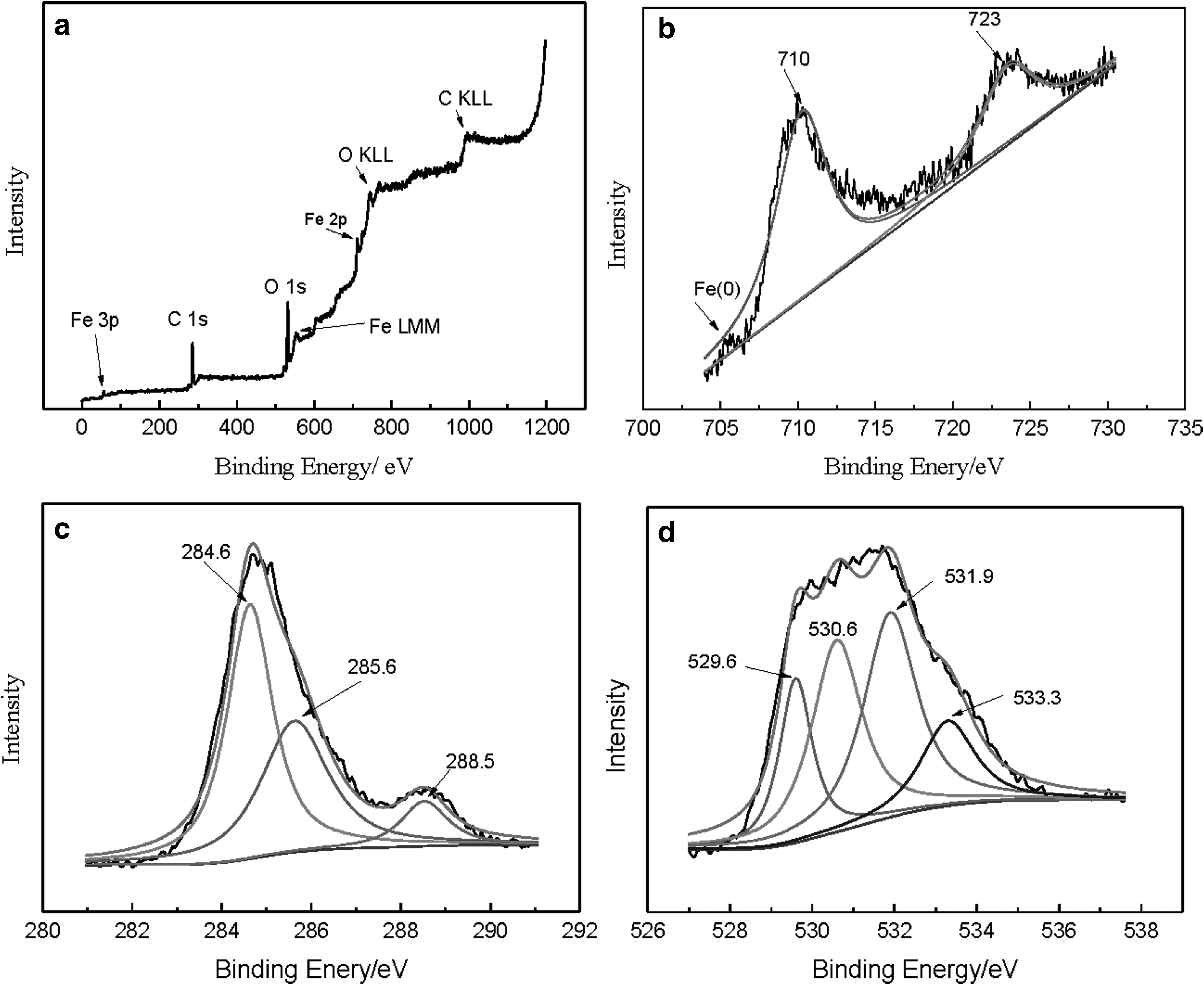
To further clarify the components and surface groups of CS-WS-NZVI, XPS analysis was carried out. As demonstrated in the overall XPS spectrum (Fig. 3a), CS-WS-NZVI is mainly composed of the Fe, C, and O elements. C1s is divided into peaks at about 284.6, 285.6, and 288.6 eV in Fig. 3c, which are attributed to C═C—C, C—O, and O═C—O groups, respectively. This indicates large numbers of hydroxyl and carboxyl, which are coincident with the FTIR results (Supplementary Fig. S2). In Fig. 3b, Fe0 was observed at Fe2p1/2 = 706.7 eV, and two peaks at 723 and 710 eV demonstrate that the surface of Fe0 nanoparticles was covered with iron oxides (Jia et al., 2016), which were produced by iron corrosion during the operational process. Figure 3d is O 1s XPS survey scan. The characteristic peaks appearing on 529.6, 530.6, 531.9, and 533.3 eV correspond to Fe═O, FeOOH,—OH, and O═C—O species, respectively. XPS analysis of peaks at 531.9 and 533.3 eV further prove the existence of hydroxyl and carboxylate groups on the surfaces of WS. This result is in agreement with previous report (Altun and Pehlivan, 2012). The modification of WS with citric acid can improve carboxyl content and higher cross-linking with positively charged metal ions. Therefore, this indirectly demonstrates that carboxyl groups exist in WS.
XRD patterns of freshly synthesized NZVI, CS-WS-NZVI, and WS (Fig. 4) indicate that CS-WS-NZVI composites mainly appeared in the Fe0 state, as demonstrated by the basic reflection at 2-theta 44.8°. In addition, the signals of bcc α-Fe0 (characteristic peaks at 44.8°and 82.6°) were detected obviously for NZVI. For WS, the broad peak reveals the existence of an amorphous phase of WS, and the peak at 34.7°, 21.6°, and 16.5° due to the WS mainly consists of cellulose, lignin, and hemicellulose (Su et al., 2016a). It is confirmed that the hydrous oxides are noncrystalline minerals. All of the above confirmed that NZVI was successfully loaded on the surface of WS powder. Identical corresponding peaks were not detected in the sample before reaction (Shi et al., 2011; Wang et al., 2016).

XRD patterns of WS, NZVI, and CS-WS-NZVI. XRD, X-ray diffraction.
Activity comparison of WS, NZVI, WS-NZVI, and CS-WS-NZVI
Figure 5a shows the removal of TC in aqueous solution using WS, NZVI, WS-NZVI, and CS-WS-NZVI under the same external conditions. It can be seen that the removal efficiencies follow the order of CS-WS-NZVI > WS-NZVI > NZVI > WS. TC removal efficiency with bare NZVI was slow and inefficient, possibly due to the aggregation and oxidation of iron articles (Xia et al., 2014; Chen et al., 2016). In addition, WS can absorb a certain number of TC due to interactions between TC molecules and oxygen-containing functional groups on the surfaces of WS. However, just only a part of TC was removed by WS (18.72%) at 70 min. The main reason is that organic compounds could be no easily absorbed onto hydrophilic surfaces of WS. However, 99.02% and 82.10% of TC were removed from the solution within 1 h using CS-WS-NZVI and WS-NZVI, respectively. Therefore, we proposed the synergistic effect in this TC removal system as follows: (1) CS could enhance stability of NZVI particles and increase the availability of surface reactive sites for CS-WS. Furthermore, the dispersion of NZVI particles improved the immobilization of NZVI on WS, which provides CS-WS-NZVI with more accessible reactive sites for reduction of TC compared with the aggregated NZVI; (2) WS can absorb a certain amount of TC which facilitated the mass transfer of TC in NZVI surface and accelerated the reduction rate of TC in the supported NZVI systems (Wang et al., 2015); and (3) CS can absorb a certain number of TC by surface protonation (Caroni et al., 2012). Therefore, the removal efficiency followed the order of CS-WS-NZVI > WS-NZVI > NZVI > WS.
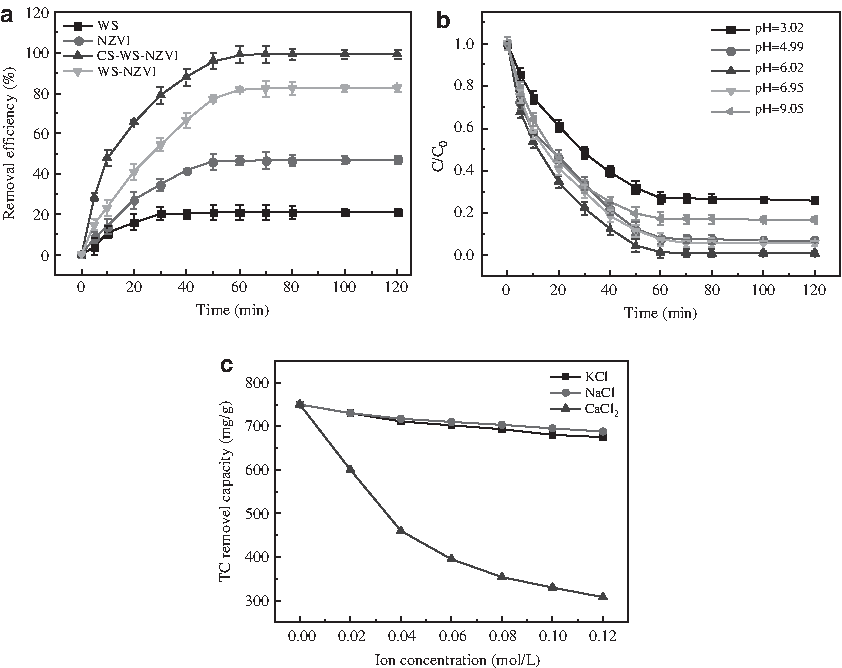
Effect of different reaction conditions
Effect of pH on TC removal was studied because pH value is found to play an important role on adsorbent and target pollutant during the adsorption reaction (Luna et al., 2015). In Fig. 5b, the initial pH was adjusted to 3.02, 4.99, 6.02, 6.95, and 9.08, respectively. The removal efficiency in different pH is in this sequence: pH 6 > pH 7 > pH 5 > pH 9 > pH 3. Ninety-four percent and 99.02% of TC was removed when pH was decreased to 6.95 and 6.02, respectively. The pH 6 is most appropriate pH for TC removal. The reasons may be that: (1) the strong acid can react with the iron inducing Fe3+ rather than iron (hydroxyl) oxide. But the Fe3+ cannot remove TC from the acid environment (Dong et al., 2017). (2) When pH value is higher than 7, NZVI surface tends to be passivated with iron hydroxide and the predominant TC species while NZVI surface is negative, due to the electrostatic repulsion. TC is easier to be removed under alkaline conditions, but more effective under weak acidic conditions.
The effect of initial TC concentration on TC removal was examined in range of 200–350 mg/L at pH 6. As shown in Supplementary Fig. S2a, the maximum removal efficiency of TC was 99.02% when the initial concentration was 200 mg/L, while at the initial concentration of 350 mg/L, only 81.20% TC was removed. Obviously, the removal efficiency of TC decreased as the initial concentration increased. For our experiment, the competition of target contaminants for the available reactive sites on CS-WS-NZVI surface is increased with increasing the initial concentration of TC, and the adsorption effect by the CS-WS-NZVI was found to be very stable with hardly any fluctuations. Thereby, the removal rate of TC was reduced.
TC removal was also found to be affected by solution temperature. As shown in Supplementary Fig. S2b, the removal rate of TC was 44.30%, 99.02%, and 99.40% at 288 K, 298 K, and 308 K, respectively. As shown in Table 1, the reaction rate constants were 0.0437–0.0565/min, when the solution temperature was changed from 288 K to 308 K. It can be seen that the removal rate of TC by CS-WS-NZVI was increased as the solution temperature was increased, indicating that TC removal was more favorable at higher temperatures. The reasonable explanation is that the diffusion and mobility of TC molecules from the liquid phase transfer to the surface of CS-WS-NZVI were increased, leading to the higher reaction rate of TC removal.
Fitted Data for Removal of Tetracycline By CS-WS-NZVI Using a Two-Parameter Pseudo-First-Order Decay Kinetics Model
CS, chitosan; NZVI, nanoscale zero-valent iron; WS, walnut shell.
Moreover, competitive cationic and ionic strength also have impact on the removal capacity. As shown in Fig. 5c, with an increase in salt concentration from 0.01 to 0.12 M, the TC removal is reduced by 8.3%, 10.0%, and 58.9% for NaCl, KCl, and CaCl2, respectively. NaCl and KCl had low effect on the TC removal. However, the high concentration CaCl2 would decrease the TC removal capacity. Similar results were also reported in other studies. The cations that existed might have competitive effect and lead to a reduction of adsorption capacity with the TC molecule on the surface of CS-WS-NZVI (Wessels et al., 1998; Fu et al., 2015; Zhang et al., 2015). It might be just that the Ca2+ has bigger hydrated radius and occupies more adsorption sites compared with Na+ and K+. So, a great deal of cations that existed has stronger inhibition effects on the removal of TC.
Reaction kinetics and mechanism of TC with CS-WS-NZVI
Reaction kinetics
Previous studies indicated that the reaction of pollutants with NZVI could be described by a first-order or pseudo-first-order kinetics (Wang et al., 2014; Li et al., 2017). However, the removal of TC by CS-WS-NZVI was a heterogeneous reaction occurring on the surface of nanoparticles. A two-parameter pseudo-first-order decay model, where the residual nonreactive TC had been taken into consideration (Lin et al., 2012; Yang et al., 2014; Wang et al., 2016), was used to describe the reaction kinetics:
where Ct is the TC concentration (mg/L) in solution at reaction time t; Cultimate stands for the concentration of nonreactive TC (mg/L) in solution at infinite time; C0 is the initial concentration of TC (mg/L); and k denotes the reaction rate constant for each test.
As shown in Table 1, the two-parameter pseudo-first-order decay model has relatively high R2 values for correlation of TC adsorption kinetics data. Also, there is a little deviation between the experiment and theoretical adsorption capacity, indicating the model fit to the experimental data well. The values of Cultimate and k calculated are given in Table 1. A decrease of Cultimate with high k indicates that the TC can be effectively removed by CS-WS-NZVI. The k value decreased with the increase of initial TC concentration, indicating that higher initial TC concentration would restrain the removal of TC. k Value increased with the increase of reaction temperature. In addition, the k values and removal capacity of TC at pH 6.02 are the highest than it at other pH.
Analysis of degradation products
By-products of TC degraded by CS-WS-NZVI were qualitatively determined by LC-MS. Figure 6 presents the LC-MS spectra of TC, supernatant samples, and the dissolved sample. The data of mass spectrum of these samples were similar because the degradation products adsorbed on the surface of CS-WS-NZVI were the same as the degradation products in treated solution (Chen et al., 2011; Fu et al., 2015). In other words, CS-WS-NZVI can absorb not only TC but also the degradation products. The MS responses of sample TC, supernatant samples, and the dissolved sample were similar, mainly 443 (m/z). However, three anions with m/z of 270.2, 330.4, and 389.5 were mainly in the MS of the supernatant and the dissolved sample, revealing that the main intermediates with m/z of 270.2, 330.4, and 389.5 are generated during reaction. Based on LC-MS results, the main degradation products and process of TC by NZVI are proposed in Table 2. The product 1 with m/z of 389.5 was originated from loss of N-methyl and amino group because of the low bond energy of N-C and the loss of hydroxyl group (Dalmázio et al., 2007). From the data, it can be found that the product 2 (m/z 330.4) and product 3 (m/z 270.2) were produced. The degradation product 1 resulted in the formation of product 2 through the loss of amino group and hydroxyl group. Then, product 3 was generated with the degradation of product 2 due to the loss of carbonyl group and formyl group (Chen et al., 2011).

Mass spectra of TC, supernatant samples, and the dissolved sample.
Degradation Products of Tetracycline by CS-WS-NZVI
Mechanism of TC with CS-WS-NZVI
The degradation pathway has not changed, which is consistent with results of Yang et al. (2014; Shi et al., 2015). Corresponding course of reaction can be represented as follows:
Because the removal of TC by NZVI is a surface-mediated process (Xia et al., 2012; Hussain et al., 2017), it can be preliminarily inferred that the degradation pathways of TC with CS-WS-NZVI are also a surface-mediated process and involve several steps as follows: (1) TC molecules were adsorbed on the surface of CS-WS-NZVI, such as Equation (3); (2) chemical reaction induced by electrons or H* species through the oxidation of NZVI with H2O/H*. As shown in Fig. 7, the main fragmentations probably resulted from loss of ammonia, carbonyl group, hydroxyl group, dimethyl amino group, and water [Eqs. (3) and (5)]; (3) intermediate products desorb from reactive surface, and (4) diffusion of products from reactive CS-WS-NZVI surface into bulk solution. In a word, the degradation of TC using CS-WS-NZVI involved physical adsorption and chemical reduction.

Conceptual model of TC removal process by CS-WS-NZVI.
Conclusions
CS-WS-NZVI was prepared by loading NZVI onto WS powder modified by CS. The activity of CS-WS-NZVI was investigated for removal of TC from aqueous solutions. The performances of batch experiments under various conditions indicate that CS-WS-NZVI had superior removal ability toward TC over the range of 200.0–350.0 mg/L. And pH and temperature are significant factors affecting the removal efficiency of TC by CS-WS-NZVI. The temperature of 288 K and 298 K had superior removal ability to TC, and the removal of TC is more effective in acidic and neutral pH. The results obtained from SEM, XRD, and FTIR analysis revealed that NZVI on CS-WS-NZVI was better protected against aggregating and being oxidized. The synergistic effect between WS, CS, and NZVI is essential for improving TC removal efficiency. The degradation of TC using CS-WS-NZVI involved physical adsorption and chemical reduction and followed the two-parameter pseudo-first-order decay kinetics model. LC-MS analysis showed that the degradation products were mainly derived from TC after the losses of some groups from the ring. The data of MS spectra indicated that CS-WS-NZVI can absorb not only TC but also the degradation products.
Footnotes
Acknowledgment
This research is supported by the National Nature Science Foundation of China (NSFC, Nos. 51368025 and 51068011).
Author Disclosure Statement
No competing financial interests exist.
References
Supplementary Material
Please find the following supplemental material available below.
For Open Access articles published under a Creative Commons License, all supplemental material carries the same license as the article it is associated with.
For non-Open Access articles published, all supplemental material carries a non-exclusive license, and permission requests for re-use of supplemental material or any part of supplemental material shall be sent directly to the copyright owner as specified in the copyright notice associated with the article.
