




Abstract
Abstract
Environmental engineers and environmental public health professionals need to integrate engineering fundamentals with impact on society and human health to improve the environment. Often, addressing complex environmental challenges involves working on interdisciplinary teams. A new course titled “Engineering Design for Environmental Health” integrates health concerns into the engineering design process. Junior and senior year undergraduates and graduate students from both disciplines are challenged to apply their background knowledge in an interdisciplinary setting. Prerequisites include calculus, general chemistry, and enrollment in a major of either civil/environmental engineering or environmental health sciences or graduate standing, or permission of instructor. Students justify design choices that may affect financial, performance, health, and other factors related to engineered systems. Skills-based learning allows students to apply knowledge in new ways. This course is intended to complement traditional environmental risk assessment courses by incorporating the design component. The course fulfills competencies for both Accreditation Board for Engineering and Technology (ABET) and Council on Education for Public Health (CEPH). A survey indicated that the majority of students in the initial offering felt that the course met the stated learning objectives, and future improvements are discussed.
Introduction
E
Curriculum in both environmental engineering and public health includes a rigorous and intensive course load, and students should emerge with important but different skill sets. Skills from both areas are required to tackle our modern, complex problems in a changing world (Jonassen et al., 2006). For instance, building design requires interdisciplinary collaboration from many fields to ensure healthy, efficient buildings (Sagun et al., 2001). In fact, the National Academy of Sciences, National Academy of Engineering, and Institute of Medicine published a report calling for additional integration of interdisciplinary educational opportunities for both undergraduate and graduate students (NAS et al., 2005).
Often, addressing environmental issues requires working on interdisciplinary teams, and students today need a skill set that includes additional skills such as communication and teamwork. In fact, both Accreditation Board for Engineering and Technology (ABET) and Council on Education for Public Health (CEPH) describe the need for competency related to teamwork and communication. Incorporation of interdisciplinary work during university studies can also improve engineering student attitudes toward this type of work (Bassus et al., 2014). Integration of collaborative teamwork into courses has also been demonstrated to improve learning, student knowledge base, and student interest (Hersam et al., 2004). Students also need to understand the implications of their future professional design choices.
I have developed a new course at The Ohio State University to prepare both our engineering and public health students for interdisciplinary work. It also provides a basic level of background knowledge in both disciplines. This technical elective is available to junior/senior undergraduate students and graduate students, in both civil and environmental engineering and in public health. Skill development focuses on some specific engineering fundamentals and additional skills such as communication. The goals of the course were designed to prepare students with skills they need in the future. This was done while considering ABET and CEPH competencies, the benefits of project-based learning on teams (Hersam et al., 2004; Tohidi and Tarokh, 2006; Wiek et al., 2014; Han et al., 2015), and in response to a report to encourage educators to develop interdisciplinary course content for students (NAS et al., 2005). Feedback from faculty in both disciplines was also integrated into the course design.
Goals of the course are as follows, with specific learning objectives listed under each goal:
Discuss the impact of design choices on human health Incorporate health constraints into the design process Quantify the health impact of design decisions Calculate and explain the meaning of measures used in epidemiological studies including odds ratios, relative risk, sensitivity, specificity, quality-adjusted life years (QALY), and disability-adjusted life years (DALY) Conduct quantitative analysis in various media (soil, water, air) and specialties (building design, occupational health) Define typical exposures and exposure routes associated with soil, water, air, building design, and occupational health Calculate the health impact associated with design decisions in soil, water, air, building design, and occupational health Work on interdisciplinary teams to accomplish a common goal Communicate (written) in an effective and quantitative way to people outside your discipline and to the public Contribute skills and specialized knowledge to an interdisciplinary project in a team setting Apply design skills in complex engineered systems Design a complex engineered system Justify your design decisions and explain the balance between financial, health, performance, and other factors
The course description is as follows:
Students in this course will learn how to incorporate health information into the engineering design process. This material complements risk assessment by focusing on the design of engineering systems. We will discuss balancing financial, health, performance, and other considerations. Quantitative analysis will be conducted in soil, water, air, buildings, and occupational health scenarios. Health information will be discussed including exposure, dose, and statistical analysis. We will also cover interdisciplinary team work and communication. This course will include a field trip to a campus building as well as a design project.
This course complements other traditional courses such as environmental risk assessment. Some similar material is covered, but with an emphasis on the quantitative components of risk assessment and the application to design. With this foundation, students are then able to utilize this information to improve engineered systems.
The course fulfills competencies for both ABET and CEPH. CEPH competencies will vary by program, such as Master of Public Health. The list of ABET competencies that this course fulfills with their corresponding letters is below:
an ability to apply knowledge of mathematics, science, and engineering; an ability to design a system, component, or process to meet desired needs within realistic constraints such as economic, environmental, social, political, ethical, health and safety, manufacturability, and sustainability; an ability to function on multidisciplinary teams; an ability to identify, formulate, and solve engineering problems; an understanding of professional and ethical responsibility; an ability to communicate effectively; the broad education necessary to understand the impact of engineering solutions in a global, economic, environmental, and societal context; a knowledge of contemporary issues; an ability to use the techniques, skills, and modern engineering tools necessary for engineering practice.
Skills-Based Learning
This course uses a project-based learning approach to encourage development of design skills (Wiek et al., 2014; Han et al., 2015). We devote considerable time to both understanding the implications of decisions and being able to justify a final design based on financial, performance, health, and other factors.
Environmental health concepts
The first third of the course covers quantitative material from environmental health sciences and risk assessment. This includes interpretation of epidemiological studies, measuring chemical and microbial exposures in the environment, exposure modes (inhalation, ingestion, oral), basic human toxicology, dose, and related statistics (variability and uncertainty).
Students are expected to develop skills related to interpretation of epidemiological studies that may be necessary in future work to understand how their professional design choices impact human health. After discussing the components of epidemiological articles, students are expected to find appropriate information from tables and be able to calculate measures such as odds ratios, relative risk, sensitivity, specificity, QALY, and DALY. Students read a case–control and a cohort study and are able to discuss the differences between the study types. This section of the course also covers the fundamental aspects of quantitative environmental risk assessment. There is an emphasis on understanding and reporting variability and uncertainty, and using these concepts in design. Student learning is assessed in homework assignments and an exam.
Engineering concepts and design work
The middle third of the course focuses on calculations in various environmental systems. The main focus is on the indoor environment and ventilation. We also cover soil, outdoor air, occupational health, drinking water, wastewater, and emerging concerns such as nanoparticles and climate change. We discuss design throughout these topics. For instance, in the occupational health lectures we cover material from the Prevention through Design national initiative from The National Institute for Occupational Safety and Health (NIOSH). We discuss specific examples of how enhanced design can decrease workplace injury as well as reduce costs. For example, we cover the implementation of the use of roof anchors on buildings to improve worker safety for window washers. Student learning on the basic concepts is initially assessed in homework assignments and then by exam.
A major component of this course is the completion of the final design project. The premise of the project is that a company is rapidly expanding and requires more office space for 15 more office workers. There is an empty storage area available with no windows and that is not currently connected to the forced air building ventilation system. A separate air handling system would need to be installed. Students need to design the ventilation system for the room using CONTAM software developed by the National Institute of Standards and Technology (NIST) (Dols and Polidoro, 2015). First, students discover that without a ventilation system the CO2 levels would rise to levels of acute concern. Next, students are able to use the software to adjust ventilation rates and consider costs at various levels. They need to consider costs associated with the air handling system and costs associated with lost productivity if employees are exposed to elevated CO2 concentrations (Satish et al., 2012). Students need to discuss tradeoffs during the design process and be able to justify their decisions. Engineering students may lead the work related to the calculations in the project, and public health students should also be able to complete the required calculations by this point in the course. The public health students may be able to provide additional context for the health implications of the elevated CO2 levels and how those levels may affect worker productivity. The engineering students will also have the background knowledge available to put the results into context. In this way, students are able to interact as they might on a project team after graduation. Students from both disciplines need to understand the entire project, and can provide expertise in their given area.
Communication, teamwork, and justification
The final third of this class allows students to use their new knowledge to see how engineering design can be used to improve environmental health. We emphasize development of skills related to communication and teamwork to correspond to competency needs identified by ABET and CEPH. We go on a field trip to a LEED certified campus building to observe features that have been incorporated for occupant health and energy savings. The building managers can also discuss occupational hazards that arise during building maintenance, and how we can consider designing out these hazards.
Next, the students are given the opportunity to think about design in a building. The students conduct a case study on hospital design and choose a design feature that will improve patient or employee health. In class, we discuss various features that may be important in hospital design to improve patient health. Background information is provided in lecture, including scientific literature on the topic (Reiling et al., 2008; Sadatsafavi et al., 2016; Yoder et al., 2012). Student discussion is also facilitated. We discuss specific examples related to cost savings and benefits of features such as single-occupancy rooms (Sadatsafavi et al., 2016). We also discuss the Healthier Hospitals Initiative, a coalition of major healthcare organizations with the goal to improve health and sustainability of the healthcare system. Students write a short article justifying the inclusion of the selected design feature in an imaginary hospital. The students are asked to provide justification for the cost of their design feature by calculating the cost of the new feature and cost savings through improved health, decreased length of stay, or fewer workers compensation claims.
Next, we implement an active-learning approach for students to gain experience with justification. Using the design features from their article, students are then sorted into groups with other students who have described similar features. The students then choose a group leader to participate in a fishbowl exercise where the group leaders stand before the class and argue for the implementation of their design feature to the two students selected as hospital directors. Only one feature can be chosen.
Evaluation
Verbal comments I have received include “I really enjoy the scope of this course. Most engineering problems are highly specific, but the work in this course allows me to think about broader implications.”
Before administering the final exam, I asked the students to fill out an anonymous survey that was approved by the Institutional Review Board at The Ohio State University. The goal of this survey was to assess whether students believed that the course had met the learning objectives. Of the 22 students in the class, 21 (95%) agreed to participate in the survey. They were asked to rank whether the course had met the learning objectives on a scale of 1–10 (completely disagree to completely agree). Overall, students from the first semester of this course felt that it met the learning objectives (Fig. 1). The top 2 objectives that students felt the course best met were “I learned how to calculate the health impact associated with design decisions in soil, water, air, building design, & occupational health” and “I learned how to quantify the health impact of design decisions.” The course objective that could most use improvement in future course offerings was “I learned how to design a complex system.” Student comments included “I believe the strength of this course was in bringing the engineering and public health approaches together, providing a big-picture for what we have already learned in our individual disciplines.” One student mentioned that they appreciated the communication focus of the course. Student suggestions for improvement noted that there was a large amount of material covered in the course, and that learning the software was difficult.
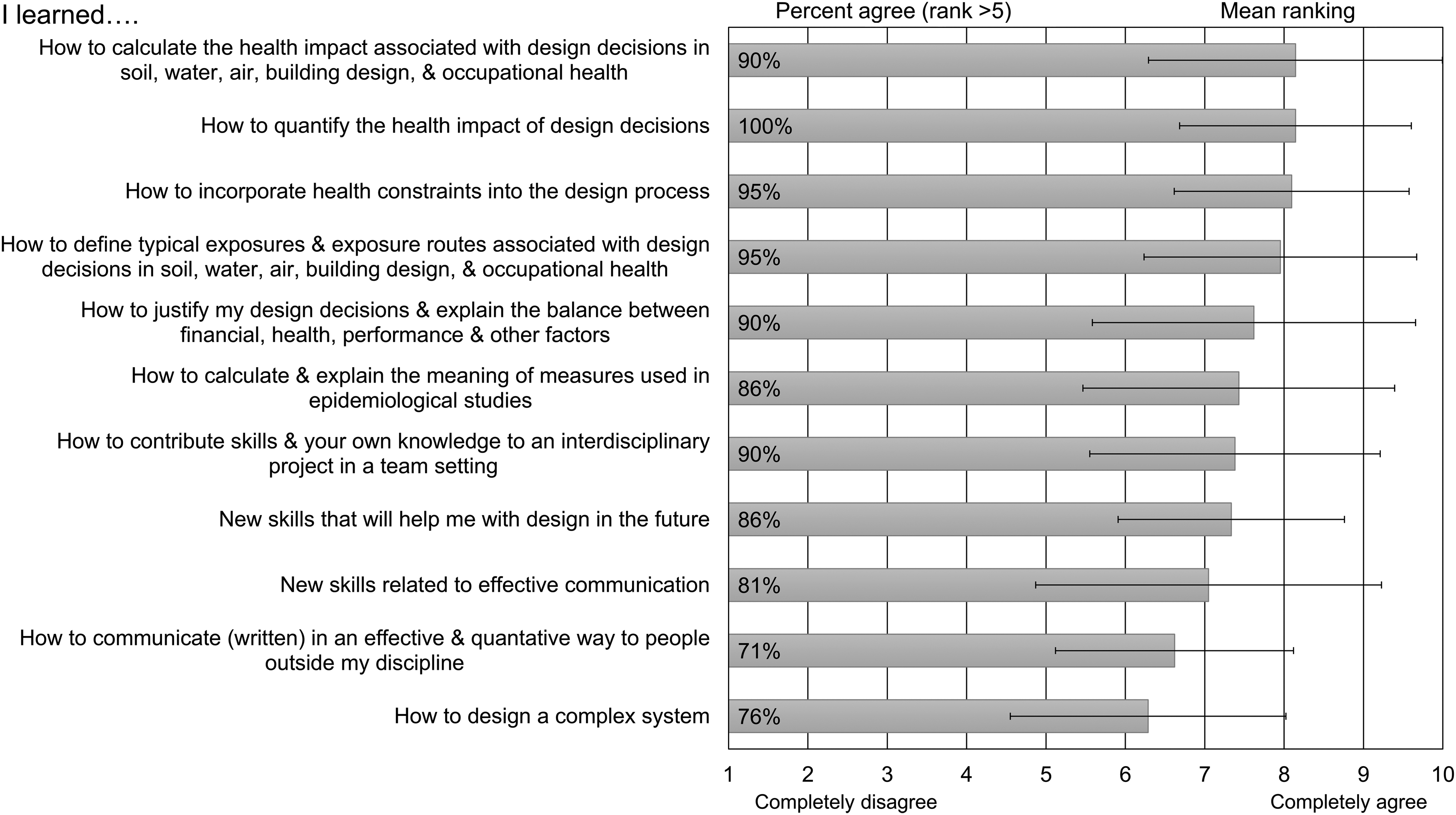
Survey results from the first semester of the course. A total of 21 of 22 students (95%) responded if they felt the course met the stated learning objectives on a scale of 1 (completely disagree) to 10 (completely agree). We report the mean and standard deviation of the rankings, and the percent of students that agreed that the objective was met (rank >5).
Future improvements to the course will include addressing the two concerns in the sentence above. The amount of material covered in the course will be refined to remove any extraneous topics and instead incorporate more example problems in other areas. For instance, material related to wastewater and drinking water will be removed because it is covered elsewhere in the curriculum. Instead, this time will be replaced by focusing more intensely on concepts such as mass balance approaches to problem solving. I will also incorporate “Health in All Policies” framework throughout the course (Rudolph et al., 2013). The goal of this tool is to ensure that decision makers are aware of the health implications of various decisions in other sectors including housing, energy, and others. Additionally, I plan to discontinue use of the Computational Fluid Dynamics component of the CONTAM software and focus only on the mass balance modeling component. This component is easier for students to use and they will still receive adequate design experience.
Conclusion
This course integrates environmental health concepts with engineering design to provide students the opportunity to understand how their professional design choices may affect the health of the public. Overall, the first semester of this course demonstrated that students gained skills related to design, understanding health impact, and communication. Ideally, these skills will prepare students to tackle complex challenges in their future work and function well on interdisciplinary teams.
Footnotes
Author Disclosure Statement
No competing financial interests exist.