




Abstract
Abstract
Antibiotics and antibiotic resistance genes (ARGs), which are regarded as emerging environmental contaminants due to their potential threat to human health and ecological systems, cannot be effectively removed from sewage by most conventional wastewater treatment plants. As an environmental-friendly and cost-efficient technology, subsurface wastewater infiltration systems (SWISs) can reduce the concentration of conventional pollutants significantly. However, the performance of SWISs on antibiotics and ARGs' removal is totally unknown. Therefore, we constructed a pilot-scale aerobic SWIS, and investigated its removal ability on antibiotics and ARGs while the system was operated for as long as 29 months at a hydraulic loading rate of 0.5 m3/(m2 · day). Results showed that 14 antibiotics and 12 target genes were detected in influents, with total concentrations of 416–9642.15 ng/L for antibiotics and (1.32 ± 0.19) × 107 to (2.21 ± 0.18) × 108 copies/mL for ARGs. After being treated by the SWIS, total antibiotics and ARGs in effluents declined by 92.46–99.73% and 99.92–100%, respectively. In terms of the removal mechanism, biodegradation was considered as the primary contribution and substrate adsorption as the secondary contribution. Our findings indicated that the upgraded SWIS could be an attractive technology for domestic sewage treatment in dealing with emerging contaminants, such as antibiotics and ARGs.
Introduction
Antibiotics are widely used in human medicine and farm animals for the purpose of infection prevention, disease treatment, and growth promotion (Le-Minh et al., 2010). It was estimated that up to 1.62 × 10⁵ tons of antibiotics had been consumed in China in 2013 (Zhang et al., 2015). Most of the used antibiotics enter the environment through urine and feces (Tran et al., 2016). Hence, various antibiotics have been detected in many different environmental compartments, including ground water (Yao et al., 2017), hospital effluents (Kümmerer, 2009), wastewater treatment plant (WWTP) effluents (Luo et al., 2014), sludge (Radjenović et al., 2009), soil (Hu et al., 2010), sediments (Ying et al., 2017), and even in drinking water (Watkinson et al., 2009). As an example, up to 2,001 ng/L of sulfonamide and 3,866 ng/L of quinolone were detected in secondary effluent from a sewage treatment plant in Beijing, China (Xu et al., 2015).
Residual antibiotics in the environment could exert selection pressure on microorganisms, which leads to the issue of antibiotic resistance and antibiotic resistance genes (ARGs) (D'Costa et al., 2006; Su et al., 2017). The ARGs are a sustaining threat to human health for their capacity to undergo horizontal transfer among microbes (Pruden et al., 2006; Li et al., 2017; Song et al., 2018). According to the G20 Leaders' Communique of 2016 and 2017, antibiotics resistance poses a serious threat to public health, growth, and global stability (G20 Summit, 2016, 2017). Therefore, the residual antibiotics and ARGs in environment have been regarded as emerging environmental contaminants (Pruden et al., 2006; Barnes et al., 2008; Yang et al., 2011; Li et al., 2017). Unfortunately, antibiotics and ARGs were not efficiently eliminated by most conventional WWTPs (Radjenović et al., 2009; Luo et al., 2014; Tran et al., 2016; Su et al., 2017; Hu et al., 2018). Furthermore, most of the domestic sewage from rural areas or small villages (especially in developing countries) is discharged to the environment without any treatment, resulting in potential environment and/or health problems (Li et al., 2011; Yang et al., 2016). Consequently, it is necessary to find a feasible and effective solution for emerging environmental contaminants such as antibiotics and ARGs, alongside conventional pollutant removal from domestic sewage.
To combat antibiotics and ARGs, many studies have been carried out (Luo et al., 2014; Chen et al., 2016; Ben et al., 2017; Li et al., 2017; Barancheshme and Munir, 2018; Song et al., 2018). For example, Luo et al. (2014) reported that membrane bioreactors (MBRs) showed better performance than conventional activated sludge (CAS) on the removal of 21 target antimicrobials, with removal rates ranging from 33.1% to 99.9%. Barancheshme and Munir (2018) reviewed the different treatment strategies for ARGs' removal, such as anaerobic and/or aerobic treatment reactors, constructed wetlands, and disinfection. They found that a wide range of removal efficiency for ARGs can be achieved depending on the type of genes present and the treatment processes used. For instance, the removal rate of floR (82.8–94.6%) was higher than sul2 (47.2–79.1%) in constructed wetlands, and chlorination was more effective than ultraviolet irradiation and ozonation in the inactivation of sul1, tetG, and Int1 (Zhuang et al., 2015). However, there are gaps that need to be further investigated, including large-scale and long-term operation, wide classes of antibiotics or ARGs, operating on inexpensive costs, and convenient management.
Subsurface wastewater infiltration systems (SWISs) are an example of ecological wastewater treatment technologies. They purify wastewater mostly by packed substrate adsorption and the metabolism of microbes attached on the matrix, integrating physical, chemical, and biological processes (Zhang et al., 2005; Li et al., 2011). Its performance depends on design parameters, such as substrate composition, system structure, operation mode, hydraulic loading rate (HLR), etc. (Zhang et al., 2005; Yang et al., 2016; Pan et al., 2017). Recently, SWISs have been widely used to treat rainfall and domestic wastewater, due to their excellent performance on organic pollutants and ammonium nitrogen (NH4+–N) removal, low construction, and operation costs (Zhang et al., 2005; Hatt et al., 2007; Mckinley and Siegrist, 2010; Yang et al., 2016). In the United States, SWISs are the most commonly used onsite wastewater treatment systems, and they serve 25% population (Officer of Water, Office of Research and Development, U.S. Environmental Protection Agency, 2002). However, their removal ability for antibiotics and ARGs is totally unknown.
Accordingly, we designed and built a pilot-scale SWIS, filled with river sand, and operated in the intermittent mode to improve its permeability and oxidative conditions, respectively. The objectives of this study focused on identifying the abilities of SWISs in antibiotics and ARGs' removal and on achieving conventional wastewater quality parameters (i.e., chemical oxygen demand [COD], NH4+–N levels, turbidity, etc.). Additionally, the possible removal mechanisms of antibiotics and ARGs within the SWIS were discussed. According to our best knowledge and after a careful review of existing information, this is the first report on the removal of antibiotics and ARGs in domestic sewage by a SWIS.
Materials and Methods
Structure and components of pilot-scale system
The pilot-scale SWIS was located in the campus of Guangzhou Institute of Geochemistry, constructed in a 1.2 m3 (1 × 1 × 1.2 m) square antiseepage cement pool (Fig. 1A). The pool was filled with filter media to a height of 1.2 m, consisting of five layers (Fig. 1B). The distribution layer, redistribution layer, and drainage layer—composed of coarse gravels (grain size 1–3 cm) at a height of 6 cm—were parallelly distributed in a vertical direction in the SWIS at upper, middle, and bottom sections, respectively. Two sand filter layers, packed with coarse sand (effective size d10 = 0.35 mm and d80 = 1.2 mm, and uniformity coefficient [K80] = d80/d10 = 3.38), were located among the distribution layer, redistribution layer, and drainage layer.
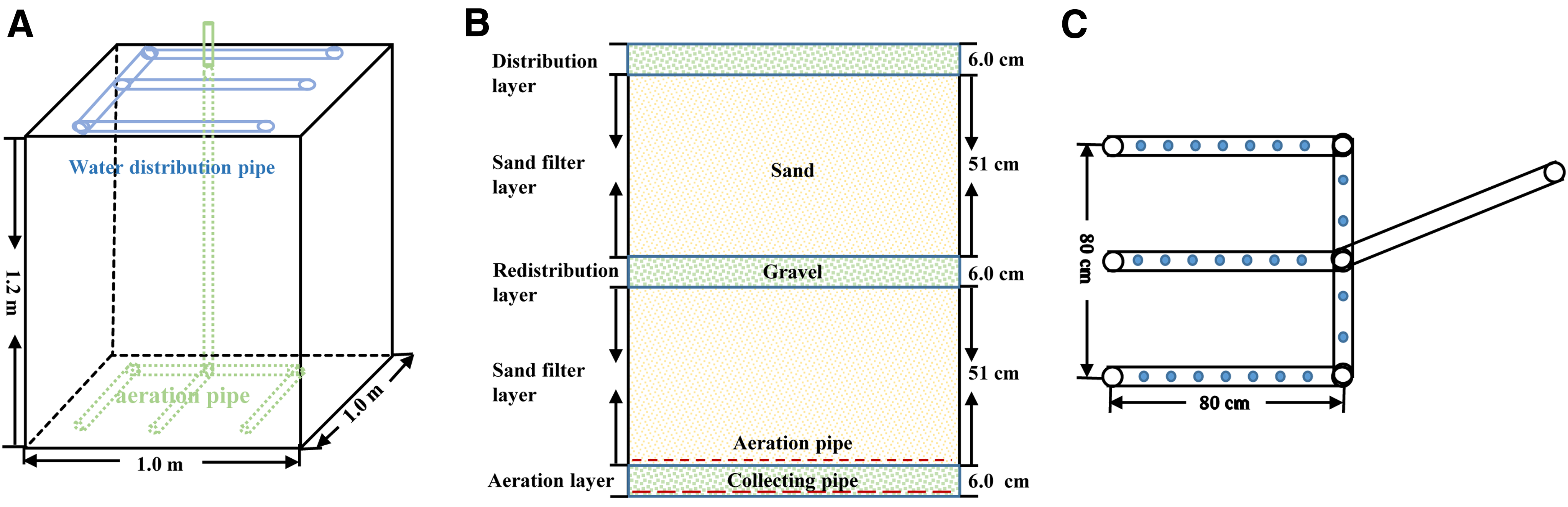
Design of subsurface wastewater infiltration system (SWIS). (
Influent pipe was laid on the distribution layer (i.e., on the top of the system), forming a vertical view image appearing like the capital letter “E” (width = 80 cm, length = 80 cm, diameter [Φ] = 4 cm) (Fig. 1C). Several holes (Φ = 0.6 cm) were drilled at intervals of 10 cm on the pipe for water distribution. The aeration pipe (with holes broadside, Fig. 1C) was located on the top of the drainage layer to aerate the system, whereas a collecting pipe was on the bottom of the drainage layer.
Operation parameters
The system was run at an intermittent mode, with eight cycles per day. Taking an integral cycle (180 min) as an example (Supplementary Table S1), the blower worked from 0 to 10 min and 91 to 105 min, and the sewage from the campus was pumped into the system from 11 to 30 min. Accordingly, eight alternate wetting and drying periods were formed for the system within 24 h.
Manipulation of the SWIS was divided into two stages (Supplementary Table S2), that is, stage 1 and stage 2. The first 14 days were regarded as the startup period (stage 1), at an HLR of 0.16 m3/(m2 · day). Stage 2 was set as the operation period, at an HLR of 0.50 m3/(m2 · day), from the 15th day to the end of the experiment. The SWIS was operated from April 2014 to December 2016.
Sample collection
To determine the performance of the SWIS, influent and effluent water samples were collected occasionally to monitor the concentration of COD, NH4+–N, and total nitrogen (TN). For analysis of antibiotics, 1 L water samples were collected and stored into precleaned amber glass bottles, followed by an addition of 50 mL methanol (analytical reagent). After that, the pH was modulated to 3 using 4 M H2SO4. For the analysis of ARGs, 0.5 L of sewage and 20 L of effluent were collected and stored separately in polypropylene sterile bottle. The water samples for analysis of antibiotics and ARGs were sampled during the last 4 months of our study and after more than 2 years of SWIS operation, specifically on September 9 (T1, 892th day), October 11 (T2, 924th day), November 15 (T3, 959th day), and December 20, (T4, 994th day) of 2016.
To detect the concentrations of antibiotics and ARGs in substrates, the filter was excavated at the end of the experiment. For analysis of antibiotics, the filters of different layers were equally collected in a 1-L brown glass jar. For analysis of the ARGs, the filter samples were collected into 50-mL sterile jars. One gram of sodium azide was added to each substrate sample to restrain microbial activity. Then, all samples were stored at 4°C before analysis and processed within 48 h. Filter samples were freeze-dried, grinded, sieved by a 60-mesh sieve, and stored in a refrigerator at −20°C until extraction (Chen et al., 2016).
Chemical analysis
Common water quality parameters
Dissolved oxygen (DO), pH, and temperature were measured immediately after sampling by a portable multiparameter meter (Orion 5-star; Thermo). COD, NH4+–N, total phosphorus (TP), and turbidity were determined according to the Chinese standard methods, GB-11914-89, HJ 535-2009, GB-11893-89, and GB-13200-91, respectively. TN was measured using a TOC/TN analyzer (TOC-VCPH; Shimadzu, Japan).
Analysis of antibiotics
In this research, 50 antibiotics of different classes were selected according to the method developed by Zhou et al. (2012). In summary, water samples were filtered using 70-mm glass fiber filters (Whatman GF/F), and then the filtered water samples were extracted by solid-phase extraction method with Oasis HLB cartridges (6 mL, 500 mg). The substrate samples were extracted by ultrasonic-assisted extraction with solvents (acetonitrile and citric acid buffer), and purified with SAX–HLB cartridges. The extracted antibiotic compounds were analyzed using rapid-resolution liquid chromatography–tandem mass spectrometry (RRLC–MS/MS) in multiple reaction monitoring mode (Zhou et al., 2012). The RRLC–MS/MS equipment used in the analysis, was an Agilent Liquid Chromatography 1200 series RRLC system coupled to an Agilent 6460 triple quadrupole MS equipped with an electrospray ionization source (Agilent, Palo Alto, CA). Quantification of the target compounds was conducted using the internal standard method. Quality assurance and control was conducted on the samples to assess potential sample contamination. Laboratory blank was also detected. Detailed information about the analytical method can be found in the Supplementary Data (Supplementary Fig. S1) and a previous study (Zhou et al., 2012).
DNA extraction and ARG measurement
DNA extraction and ARG measurement methods can be referred to the reference (Su et al., 2014). The steps for DNA extraction and ARG analysis are briefly described as follows.
DNA extraction and purification
A total of 0.2 L of influent and 6 L of effluent water samples, respectively, were filtered through a sterile membrane filter (Φ = 0.45 μm) with vacuum filtration equipment. Then, the membrane filter was removed, cut into pieces, and transferred into the tube carefully provided by the Power Soil DNA Isolation Kit (MoBio Laboratories). The DNA extraction process followed the instructions provided by the manufacturer.
About 10 g of uniform substrate samples were used to extract total DNA. Around 0.85% of aseptic saline was utilized to wash each copy of the substrate samples to remove all its microorganisms. Thereafter, the obtained solution was used to extract DNA as described above. Finally, DNA was further purified using the DNA Spin Kit (Tiangen Biotech, China) to minimize PCR inhibition.
ARG quantification
Real-time quantitative PCR (qPCR), and external reference methods were used to quantify the 12 target genes, including 2 integrase genes (int1 and int2), 2 macrolide resistance genes (ereA and ermB), 2 sulfonamide resistance genes (sul1and sul2), 2 quinolone resistance genes (qnrD and qnrS), 2 chloramphenicol resistance genes (cmlA and floR), and 2 tetracycline resistance genes (tetG and tetO). The 16S rRNA gene was also examined to quantify the total bacterial load. The special primers and external reference methods used in this study are listed in Supplementary Table S3. The ViiA 7 Real-Time PCR System (ABI), using the SYBR Green qPCR Kit (TaKaRa, Japan), was used to quantitatively measure the abundance of the target genes. Both positive and negative controls (Milli-Q water) were included in each run. In total, 40 cycles were used to improve the chances of product formation from low initial template concentrations. A 20-μL PCR reaction solution was employed: 2× THUNDERBIRD SYBR® qPCR Mix 10 μL, 0.05 mM each primer 0.08 μL, 50× ROX reference dye 0.04 L, template DNA 2 μL (DNA <80 ng), and distilled water 7.8 μL (DNase I treated). The qPCR tests were run on an Applied Biosystems 7500 Fast Real-Time PCR System (ABI). The qPCR programs for quantification of ARGs were as follows: initial denaturation step for 1 min at 95°C, 40 PCR cycles (95°C for 15 s, 55°C for 30 s, and 72°C for 30 s), and a final step for melting curve. Calibration curves were generated using plasmids carrying target genes. The external reference method was used to calculate the copy number of ARGs, with the square of related coefficient (r2) of the standard curve >0.99, and amplification efficiency ranging between 95% and 110%.
Data analysis
Basic data analysis was performed with Microsoft Excel 2013 (Microsoft Corp., Redmond, WA) to obtain averages and standard deviations of concentrations with target contaminants, and figures were prepared using CorelDRAW X7 (Corel Corp., Ottawa, Canada). All samples used for antibiotics and ARG analyses were measured in triplicate, and results are shown as a mean ± standard deviation.
Result and Discussion
Removal of conventional pollutants
As shown in Table 1, the average pH of the effluent was 3.93 ± 0.67, which was much lower than that in the influent (7.51 ± 0.12). The decline of aqueous pH can be attributed to the nitrification process in the SWIS (Fig. 2A; Yang et al., 2016). DO in effluent was 6.71 ± 0.68 mg/L, which was much higher than that in influent (0.31 ± 0.25 mg/L), implying that there is an aerobic environment in the system (Table 1). Average removal rates of NH4+–N and COD were up to 98.81% and 88.29% (Fig. 2), respectively, although the HLR was 6–12 times higher than that in previous studies (Zhang et al., 2005; Li et al., 2011, 2012). The concentrations of turbidity in influent and effluent were 22.39 ± 2.91 and 0.49 ± 0.20 nephelometric turbidity unit (NTU), respectively, with a removal rate of 97.81% (Table 1). However, the average removal rate of TN was 13.56% (Table 1) as the result of carbon source shortage, which agreed with our previous study (Yang et al., 2016). TP concentration in effluent was 1.16 ± 0.41 mg/L, which was higher than the limitation of Class 1A (0.5 mg/L) according to the Discharge Standard of Pollutants for Municipal Wastewater Treatment Plant in China (GB18918-2002). This suggests that further treatment should be performed to promote phosphorus removal.
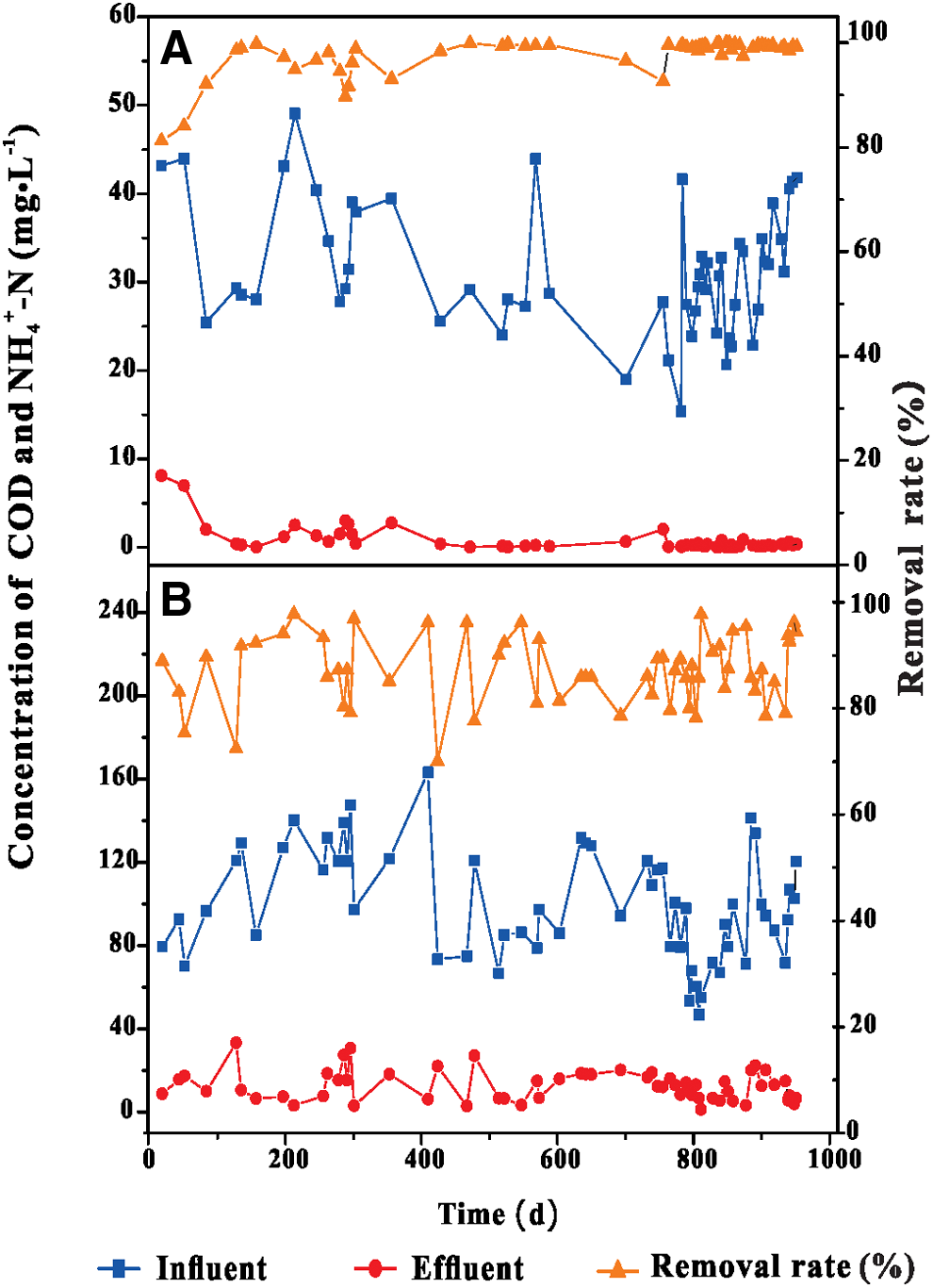
Concentrations and removal rates of NH4+–N
Influent and Effluent Parameters of Subsurface Wastewater Infiltration System (Hydraulic Loading Rate = 0.5 m3/[m2· Day])
Mean ± standard deviation.
DO, dissolved oxygen; COD, chemical oxygen demand; NH4+−N, ammonium nitrogen; TN, total nitrogen; TP, total phosphorus; Tur, turbidity; NTU, nephelometric turbidity unit.
Occurrence and removal of antibiotics by SWIS
Among the 50 target antibiotics, 14 of them were detected in influents. These antibiotics included three macrolides (MLs: erythomycin–H2O [ETM–H2O]; roxithromycin [RTM]; clarithromycin [CTM]), three fluoroquinolones (FQs: ofloxacin, [OFX]; norfloxacin [NFX]; enrofloxacin [EFX]), five sulfonamides (SAs: sulfamethoxazole [SMX]; sulfadiazine [SDZ]; sulfamethazine [SMZ]; sulfameter [SM]; sulfamonomethoxine [SMM]), one lincosamide (lincomycin [LIN]), one tetracycline (oxytetracycline [OTC]), and trimethoprim (TMP) (Fig. 3 and Supplementary Table S4). The total concentrations of the detected antibiotics in influents varied from 416 to 9642.15 ng/L, and the concentrations of each detected antibiotic ranged from below detectable levels (not detected [ND]) to 9388.8 ng/L, with monthly variation. For the substrate samples, only trace ETM–H2O, NFX, OFX, EFX, and TMP were detected, with concentrations of 4.19 ± 0.35, 1.27 ± 0.24, 3.19 ± 0.34, 1.19 ± 0.22, and 1.03 ± 0.17 ng/g, respectively (Table 2).
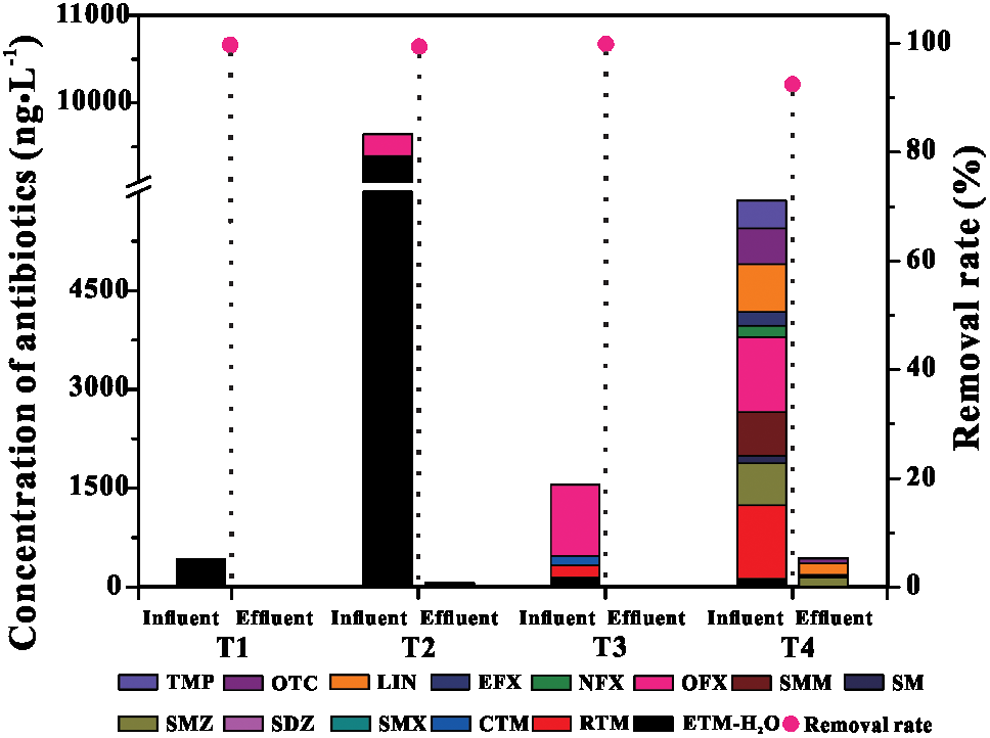
Concentrations and removal rate of total antibiotics in the SWIS.
Concentrations of Antibiotics and Target Genes in Substrate Samples from Subsurface Wastewater Infiltration System
Mean ± standard deviation (n = 3).
ETM–H2O, erythomycin–H2O; NFX, norfloxacin; OFX, ofloxacin; EFX, enrofloxacin; TMP, trimethoprim.
MLs, especially ETM–H2O, were the dominant compounds (above 95.66%, Fig. 3 and Supplementary Table S4) in T1 and T2 influent, which agreed with results from other regions of China (Yang et al., 2011; Zhou et al., 2013; Chen et al., 2016), but differ to those from Spain (Dinh et al., 2017). Comparably, the concentration of other antibiotics ranged from ND to 247.67 ng/L and occupied up to 2.56% of the total antibiotics. It has been proposed that the different concentrations of antibiotics in wastewater was caused by the different prescription and consumption patterns in different regions (Miao et al., 2004). However, FQs comprised most of the total antibiotics in T3 sample (Fig. 3 and Supplementary Table S4), with a percentage of 69.47%. Other detected antibiotics were MLs, which occupied 30.53% of the total antibiotics. Unexpectedly, all six kinds of antibiotics were detected in T4 influent, and the fluctuations in the concentration for each antibiotic were smaller than in other samples (Fig. 3 and Supplementary Table S4). The possible reason for this might be that more antibiotics were used in December than other months in the studied region (Miao et al., 2004; Gao et al., 2012).
After being treated by the SWIS, the concentrations of all detected antibiotics declined greatly. For each antibiotic, the removal rates by SWIS were above 75.72% (except for SMX in the T2 sampling time, which had a removal rate of 16.75%) (Supplementary Table S4). The different removal efficiencies of antibiotics may be attributed to their varied physicochemical properties, such as chemical structure, functional groups, and hydrophobicities (Luo et al., 2014; Yu et al., 2018). As shown in Fig. 3, the removal rates of total antibiotics by the SWIS ranged from 92.46% to 99.7%, which was much better than other wastewater treatment technologies, including constructed wetland (12.6–85.5%) (Hijosa-Valsero et al., 2011; Dong et al., 2016), stabilization ponds (31.6–49.6%) (Dong et al., 2016), activated carbon (AC) sludge (34.1–87%) (Li et al., 2011; Gao et al., 2012; Dong et al., 2016), and micropower biofilm (20.4–53.8%) (Dong et al., 2016). Therefore, the present results demonstrated that the SWIS could be a promising technology for the treatment of domestic sewage to remove antibiotics. However, further investigation is required to clarify the SWIS removal mechanism and its ability for different classes of antibiotics with relatively balanced concentrations.
Table 3 shows the comparison of the occurrence of antibiotics in influent and effluent from the SWIS and other techniques of sewage treatment, such as AC, MBR, oxidation ditch (OD), and aerated lagoons and seepage cells (ALS). The AC process was listed separately because it is the dominant sewage treatment process worldwide, whereas the other methods were ranked together. As shown in Supplementary Table S4, removal efficiencies were above 91.45% for 10 kinds of antibiotics. Specifically, the removal efficiency of TMP was 97.91% in our system. This was much higher than that in AC, MBR, ALS, and OD, which had a removal rate of 16.7–85% (Table 3) (Karthikeyan and Meyer, 2006; Watkinson et al., 2007; Tran et al., 2016). Noteworthy, the removal rate of LIN in our study was 75.72%, although the concentrations of LIN in influent was 10 times higher than that in previous studies (Table 3) (Watkinson et al., 2007; Tran et al., 2016). Comparably, the removal rates were 11% and 62.1% for AC and MBR, respectively (Watkinson et al., 2007; Tran et al., 2016). The enhanced removal of LIN might be ascribed to the strong nitrification process in our system (Fig. 2A; Rattier et al., 2014). Accordingly, it can be concluded that the SWIS used in this study had a better performance than other techniques with regard to the removal of antibiotics listed in Table 3.
Comparison of Occurrence of Antibiotics in Influent and Effluent Samples with Different Technologies
Unit: ng/L.
ND, not detected; NR, not retrieved; MBR, membrane bioreactor; OD, oxidation ditch; MF/RO, microfiltration/reserve osmosis; ALS, aerated lagoons and seepage cells; HFCW, horizontal flow constructed wetland.
This remarkable performance of antibiotic removal might be enhanced by the matrix in the SWIS, where the substrate acts not only as the filter but also as biocarriers. For example, the MBRs filled with sponge–plastic biocarriers can remove more SDZ and SMZ (up to 19% and 23%, respectively) than a conventional aerobic submerged MBR (Yu et al., 2018). Similarly, adding a moving bed biofilm reactor process before MBR treatment has been found to enhance micropollutant elimination (Luo et al., 2014). It is suggested that biocarrier-attached growth progress can cultivate complex redox conditions within the biofilm, which improves the stability of treatment performance (Yu et al., 2018). In the present study, the substrate served as the dominant biocarrier filling the SWIS. It might contribute to the enhanced biodegradation of antibiotics compared with AC, MBR, OD, and ALS. Moreover, intermittent aeration may be the favorable condition for antibiotic removal since it creates an alternate atmosphere, including aerobiotic, anoxic, and anaerobic environments, within the SWIS (Yang et al., 2016).
Abundance and removal of ARGs in SWIS
Ten target ARGs (i.e., two sulfonamide resistance genes [sul1 and sul2], two tetracycline resistance genes [tetO and tetG], two quinolone resistance genes [qnrD and qnrS], two chloramphenicol resistance genes [cmlA and floR], and two macrolide resistance genes [ereA and ermB]), two integrase genes (int1 and int2), and 16S rRNA were positively detected in both water and substrate samples (Fig. 4; Table 2 and Supplementary Tables S5 and S6). Among the five classes of target ARGs in the influent, sulfonamide resistance genes and chloramphenicol resistance genes were the most abundant, followed by macrolide resistance genes. Tetracycline resistance genes and quinolone resistance genes were the least abundant. In general, the concentrations of all target ARGs in influents varied from (2.61 ± 0.18) × 107 (T1) to (3.69 ± 0.37) × 108 copies/mL (T4) (Fig. 4 and Supplementary Table S5).
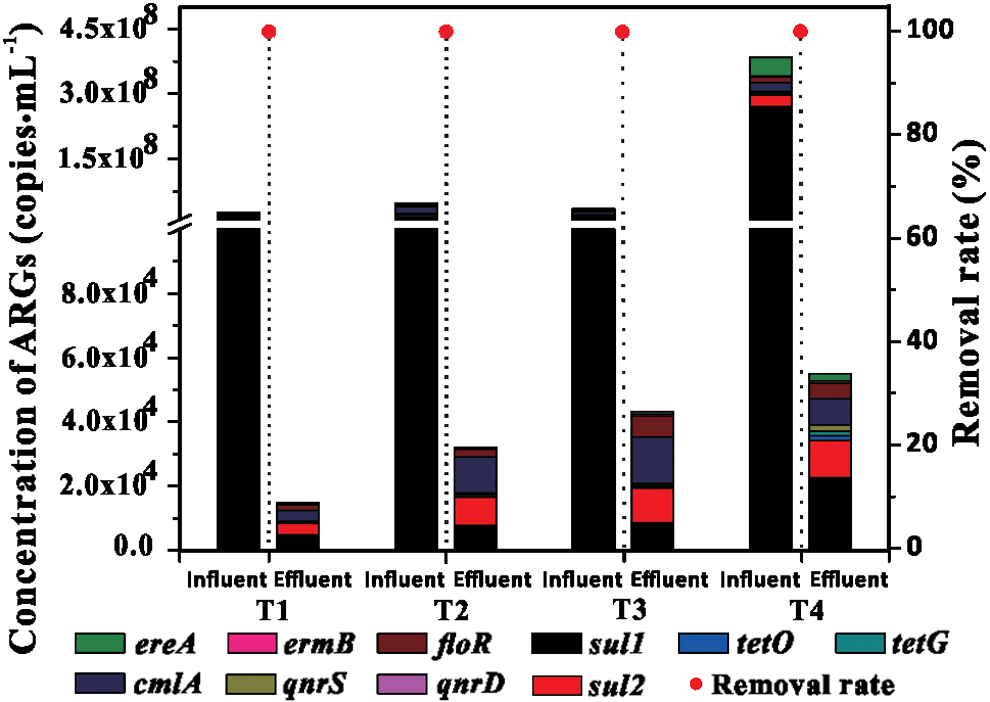
Abundance of ARGs and total removal rate in SWIS. ARG, antibiotic resistance gene.
Aqueous removal rates of ARGs were rather high in the SWIS. All target ARGs were significantly reduced by three to four orders of magnitude from the influent to the effluent. The removal rates of ΣARGs by the SWIS were as high as 99.88% (Fig. 4 and Supplementary Table S5). The removal efficiencies of ARGs by the SWIS were evidently better than other wastewater treatment technologies such as constructed wetlands and an anaerobic digestion system (Zhang et al., 2009; Xu et al., 2015; Ju et al., 2016; Song et al., 2018). Furthermore, previous studies have also shown that conventional WWTPs were important reservoirs of various ARGs (Smalla and Sobecky, 2002; Lapara et al., 2011: Ben et al., 2017), and the WWTPs can accelerate ARGs' exchange and spread (Schlüter et al., 2007; Song et al., 2018). In addition, as an essential part of SWISs, the substrates are not likely to be disposed to environment until the system is collapsed. Therefore, the present study suggests that the SWIS can be used as an effective and friendly treatment facility for the treatment of domestic sewage to remove ARGs.
The target genes were also positively detected in the substrate samples (Table 2), with concentrations ranging from (3.43 ± 0.87) × 104 to (2.69 ± 0.56) × 108 copies/g, suggesting ARGs could be adsorbed by substrates in the SWIS. The biological process plays a complex role in ARGs' removal as it may lead to ARGs transmission, proliferation, and production even while it is involved in ARGs degradation (Ghosh and Lapara, 2007; Diehl and LaPara, 2010; Guo et al., 2014; Yang et al., 2014). In a lab-scale experiment with two vertical flow constructed wetland systems, Liu et al. (2013) found that the two systems significantly decreased the concentrations of target antibiotics and tetracycline resistance genes in swine wastewater, but their removal efficiencies correlated with the wetland medium and structure. However, further study is required to understand the influence of substrate on the ARGs' removal ability of SWISs.
Mechanisms of antibiotics and ARGs' removal
In biological wastewater treatment processes, sorption and biodegradation are regarded as the dominant mechanisms for the removal of antibiotics, whereas volatilization, hydrolysis, oxidation, and photodegradation can be ignored (Gao et al., 2012; Shao et al., 2013; Luo et al., 2014; Cheng et al., 2018). Specifically, previous studies have illustrated that MLs were removed mainly by sorption and biodegradation at moderate rate in AC, OD, and MBR (Watkinson et al., 2007; Tran et al., 2016; Hu et al., 2018). For example, the elimination rates of RTM varied from 51.3% to 73.8% in CAS and MBR (Tran et al., 2016). Comparably, all MLs (ETM–H2O, RTM, and CTM) were almost removed in our system (Fig. 3; Table 3 and Supplementary Table S4), implying excellent biodegradation and/or adsorption of MLs occurred in the SWIS. Since no RTM and CTM were observed in the substrate, biodegradation should be the only pathway for RTM and CTM removal. Under WWTP conditions (pH of 6–8), sorption was suggested to be the predominant mechanism of FQs removal due to its ionization states as zwitterion and cation (Golet et al., 2003; Zhou et al., 2013). In our SWIS, more than 96.4% of FQs were eliminated from the solution, whereas small amounts of NFX, OFX, and EFX were detected in the substrate, implying that most of the FQs were removed through biodegradation. For the removal mechanism of SAs, it has been suggested that either sorption (Tadkaew et al., 2011) or biodegradation (Ingerslev and Halling-Sørensen, 2010) was the control process in activated sludge systems. Most of the time, more than 76.83% of SAs (except SMX in T2) had been removed from the effluent in our study (Table 3 and Supplementary Table S4). On the other hand, no SAs were detected in the substrate (Table 2), indicating that SMX, SDZ, SMZ, SM, and SMM were predominately removed by biodegradation, These agreed with the results found by Ingerslev and Halling-Sørensen. (2010). Additionally, the removal rates were 75.72%, 87.25%, and 97.91% for LIN, OTC, and TMP in the T4 effluent, whereas trace amounts of TMP was detected in the substrate, suggesting these antibiotics can also be degraded by the SWIS. Theoretically, volatilization, hydrolysis, oxidation, and nitrification may also degrade antibiotics, but their contribution can be ignored (Ingerslev and Halling-Sørensen, 2010; Gao et al., 2012; Shao et al., 2013; Luo et al., 2014; Cheng et al., 2018). In general, antibiotics could be eliminated through the processes of biodegradation and sorption by the SWIS, with the former as the dominant pathway.
It is believed that adsorption, biodegradation, and plant uptake are the main mechanisms of ARGs' removal in constructed wetlands (Chen et al., 2016). Considering its similar operation principles, efficient aqueous removal rates, and the presence of ARGs in substrate of both constructed wetlands and SWISs, we proposed that ARGs were eliminated through substrate adsorption and biodegradation since there was no plant in our experiment. Taking a bulk density of 1,400 kg/m3 for all substrate materials, the calculated ARGs' mass in the substrate was 128–8,170 times higher than that inputted from the effluent per cycle. Although the mass and composition of ARGs may change with biological activities (Auerbach et al., 2007; Chen et al., 2016), this calculation suggests that adsorption by the substrate and/or attached biofilm is very important for ARGs' removal in SWISs. Currently, it is difficult to identify the contributions of adsorption and biodegradation for ARGs' removal in our system.
Future applications
Treatment of domestic sewage and wastewater is vital to public health and supplying clean water. As mentioned previously, different kinds of antibiotics have been detected in many environmental media, especially in the sewage. Unfortunately, antibiotics and ARGs cannot be effectively removed from the sewage by most conventional WWTPs. Since the SWIS developed herein showed satisfying removal ability for conventional contaminations, antibiotics, and ARGs, it can be used as a perfect onsite wastewater treatment system. Currently, more than 700 wastewater treatment facilities have been constructed in China based on a design similar to that of our system. In the United States, onsite wastewater treatment systems serve 25% of the population, with SWISs as the most commonly used technology (Officer of Water, Office of Research and Development, U.S. Environmental Protection Agency, 2002). Once all the SWISs in the United States upgrade according to our design, it will markedly improve environment quality and reduce the threat of antibiotics and ARGs to human health. Furthermore, SWISs can be used as an enhanced technology to treat the effluent containing antibiotics and ARGs or as a comprehensive solution to tackle the severe problem of global antimicrobial resistance.
Conclusions
A pilot-scale aerobic SWIS—with periodic operation, micropower aeration, and a double substrate structure—was constructed and operated for as long as 33 months. Continuous monitoring proved that the removal of NH4+–N, COD, and NTU in this system was satisfactory, with average removal rates of 98.81%, 88.29%, and 97.81%, respectively. Moreover, the SWIS had an excellent removal performance for antibiotics and ARGs in domestic wastewater, with a total removal rate of 92.46–99.7% and 99.93–100%, respectively. Biodegradation and substrate adsorption contributed to the reduction of antibiotics and ARGs in SWIS. Biodegradation was the dominant pathway, especially for the removal of antibiotics. This study demonstrated that our upgraded SWIS is a promising technology for domestic sewage that can simultaneously remove conventional contaminations and emerging pollutants, such as antibiotics and ARGs. In the future, further study is required to understand the removal ability of the SWIS for other emerging pollutants in wastewater.
Footnotes
Acknowledgments
The authors are grateful for the financial support from the Science and Technology Planning Project of Guangdong Province (No. 2017B020236003, 2017B030314175), the Science and Technology Planning Project of Guangzhou (No. 201604020017), and the “One–Three–Five” programs of Guangzhou Institute of Geochemistry, Chinese Academy of Sciences (No. 135PY201604). This is contribution No. IS-2663 from GIGCAS.
Author Disclosure Statement
No competing financial interests exist.

References
Supplementary Material
Please find the following supplemental material available below.
For Open Access articles published under a Creative Commons License, all supplemental material carries the same license as the article it is associated with.
For non-Open Access articles published, all supplemental material carries a non-exclusive license, and permission requests for re-use of supplemental material or any part of supplemental material shall be sent directly to the copyright owner as specified in the copyright notice associated with the article.
