




Abstract
Abstract
A simple precipitation-calcination method was used to successfully prepare palygorskite (PAL)/CuO composite catalyst. As-prepared PAL/CuO composites were characterized by X-ray diffractions, transmission electron microscopy, X-ray photoelectron spectroscopy, and UV-vis diffused reflectance spectra. Photocatalytic activities of PAL/CuO composites were evaluated by the Cr(VI) reduction efficiency in the presence of tartaric acid under the illumination of visible light. Compared with a single component of PAL or CuO, the PAL/CuO composite catalyst showed outstanding photocatalytic performance, and Cr(VI) was completely reduced within 30 min. Effects of test parameters, such as initial pH, catalyst loading, and concentrations of tartaric acid, on the reduction efficiency of Cr(VI) have also been investigated. It is worth mentioning that the as-synthesized PAL/5.9CuO catalyst shows good reusability and can be effective in a wide range of pH (3–9) with quite high catalytic performance.
Introduction
With the development of industries and civilization, a large number of pollutants have been discharged into the environment. Compared with most organic pollutants, heavy metals, being not biodegradable and easy to enrich in living tissues, are particularly problematic. Hexavalent chromium (Cr(VI)) is known to be toxic, mutagenic, and carcinogenic, causing serious health problems, such as pulmonary congestions, liver damage, vomiting, and diarrhea (Barrera-Díaz et al., 2012; Wang et al., 2016). Worldwide authorities and international organizations, such as Canada, China, and the WHO, have limited the maximum concentration of Cr(VI) to no more than 0.05 mg/L in drinking water (Dong and Zhang, 2013; Wang et al., 2016). It is well known that all of Cr(VI) species (Cr2O72−, H2CrO4, HCrO4−, and CrO42−) are soluble and mobile in water and soil, which makes a direct precipitation removal infeasible (Marinho et al., 2016; Xu et al., 2016). On the other hand, trivalent chromium (Cr(III)) is less toxic and readily precipitated out of solution in the form of Cr(OH)3. Therefore, to deal with Cr(VI) contaminated water, it is necessary to reduce Cr(VI) to Cr(III), and then precipitate and separate from the aqueous media (Wang et al., 2010; Lu et al., 2016).
There are some disadvantages in the current chemical reduction method. Excessive reducing agents are often required; in addition, they may cause the problems of secondary pollution and subsequent disposal. Although electrochemical treatment is a clean technique, the cost of the direct electrical reduction process is very expensive and about seven times higher than that of the chemical reduction method, which makes the large-scale industrial applications impractical (Zhang et al., 2015; Liu et al., 2016). Thus, increasing attention has been paid to the photocatalytic reduction method, which is low-cost and more effective, and will not cause any secondary pollution (Liu et al., 2012; Xu et al., 2013, 2015, 2017; Xu et al., 2016). When photocatalysts adsorb photons with energies higher than the bandgap of the semiconductor, electron (e−)-hole (h+) pairs are generated, and then they separate and migrate to the surface of photocatalysts. Finally, chemical reduction reactions between electrons and Cr(VI) occur. When small molecular weight organic acids (SOAs) were added in the reaction systems, the photocatalytic reduction rates of Cr(VI) were accelerated significantly (Jiang et al., 2012; Li et al., 2015). In such reaction systems, the complexes formation between valence-variable transition metal ions and SOAs on the surface of catalysts is a key factor for the reduction of Cr(VI), which can be transformed to stronger reductants and shuttle electrons from SOAs to Cr(VI) through a metal-ligand-charge-transfer (MLCT) pathway. Consequently, the reduction rates of Cr(VI) are significantly increased.
Palygorskite (PAL), composed of a talc-like 2:1 phyllosilicate ribbon structure and widely distributed in the world, is a natural one-dimensional nanorod-like clay mineral with a theoretical formula of Si8Mg8O20(OH)2(H2O)4 · 4H2O (Murray, 2000; Bouna et al., 2011). In the light of its inherent advantages, such as abundant resources, higher stability, plentiful peculiar pore structure, low cost, and eco-friendliness, PAL has been developed as a promising adsorption material for removing organic pollutants and heavy metal ions (Rusmin et al., 2015; Wang et al., 2015; Leal et al., 2017). PAL was also used as an inert, suitable, and excellent supporting matrix to immobilize catalysts on its surface for environmental remediation (Xi et al., 2014; Yang et al., 2016). Catalytic performance was significantly increased due to the resistance to aggregation and dispersion of active components. Further, supported catalysis was considered to be a “green” chemistry process because of low preparation cost and easy recycling of catalysts.
Recently, Cu2+ and CuO were found to catalyze the reduction of Cr(VI) by SOAs under simulated solar light (Li et al., 2015; Xu et al., 2016). Nevertheless, few studies have focused on the photocatalytic reduction of Cr(VI) over PAL modified by CuO. Therefore, this work was motivated to prepare PAL/CuO composite catalysts through a simple precipitation-calcination method, to decrease the preparation cost, and to expect to achieve better catalytic performance. These nanocomposite materials were characterized by X-ray diffraction (XRD), transmission electron microscope (TEM), X-ray photoelectron spectroscopy (XPS), and UV-vis diffused reflectance spectra (UV-vis DRS) techniques. In addition, the catalytic properties of the PAL/CuO composites were investigated by reducing Cr(VI) under the irradiation of visible light in the presence of tartaric acid.
Materials and Methods
Composite catalysts preparation
The original PAL was purchased from Jiangsu Jiuchuan Nano-material Technology Co., Ltd. (Jiangsu, P.R. China). All other reagents were of analytical grade and used without further purification.
Four PAL/CuO composites, with the different content of CuO, were prepared by a precipitation-calcination method with the following steps: (1) 0.8000 g PAL was dispersed in 50 mL solution containing the required mass of CuCl2·2H2O (with the PAL/CuO mass ratio of 2:1, 4:1, 8:1, and 16:1) under magnetic stirring for 24 h. (2) Then, 50 mL 2.0 M NaOH solution was pumped into the dispersion just described at the rate of 4 rpm. (3) After additional stirring for 15 min, the obtained suspension was centrifugally separated; the solid-phase samples were washed several times with absolute ethanol and deionized water, and they were finally dried at 80°C for 6 h. (4) Finally, the precursors were calcined at 500°C for 6 h. The resulting samples were denoted as PAL/33CuO, PAL/20CuO, PAL/11CuO, and PAL/5.9CuO, respectively. For comparison, pure CuO was synthesized by the same process.
Characterization and analysis
Crystallinity of the samples was characterized by a Bruker D8 Advance instrument with Cu–Kα radiation (λ = 1.5406 Å) at a scanning rate of 4 min−1 in the 2θ range of 5–60°. The morphology and nano-micro structure of samples were observed by using a JEM-2010F transmission electron microscope (TEM, JEOL) at the acceleration voltage of 80.0 kV. XPS was carried out by using an OMICRON Nanotechnology, Germany. A curve-fitting program, XPS Peak 41, was used to remove nonlinear background from the XPS spectra and fit the high-resolution spectra of Fe 2p and Cu 2p. UV-vis DRS were recorded with a UV-vis spectrophotometer (Cary 300) equipped with an integrating sphere. The Mott-Schottky analysis was performed at a Zahner electrochemical workstation.
Photocatalytic reduction of Cr(VI)
Photocatalytic reduction of Cr(VI) was executed in a PCX50A Discover multichannel photocatalytic reaction system (Beijing Perfectlight Science and Technology Co., Ltd., Beijing, China) equipped with a magnetic stirrer (400 rpm). A 5-W LED white lamp was used as a source of visible light (the wavelengths from 380 to 800 nm), and the average light intensity was 1.0 mW cm−2. For typical photocatalytic run, 0.0200-g catalyst was ultrasonically dispersed in 50-mL aqueous mixed solution of 10 mM tartaric acid (Tar) and 100 μM K2Cr2O7. The initial pH value of the dispersion was adjusted with 0.1 M NaOH and HCl. Before illumination, the dispersion was magnetically stirred in the dark for 0.5 h to ensure the establishment of adsorption-desorption equilibrium on catalyst surfaces. At appropriate time intervals, ∼2-mL dispersion was taken out by using a syringe and immediately filtered through a 0.45-μm filter membrane to remove catalysts. Diphenylcarbazide colorimetric method was used to determine the Cr(VI) concentration of the filtrate. The Cr(VI) reduction efficiency was calculated by Equation (1):
where C0 and Ct were the concentrations of Cr(VI) in μM at initial time and after irradiation at t time, respectively. All experiments in this study were performed in duplicate.
Results and Discussion
Photocatalytic properties of prepared PAL/CuO composites
Catalytic properties of PAL/CuO composites were evaluated by the reduction efficiency of Cr(VI) under the irradiation of simulated solar light and in the presence of tartaric acid. As can be seen from Fig. 1A, the Cr(VI) reduction efficiency was only 15% in the absence of catalyst after irradiating for 60 min, which suggested that tartaric acid alone appeared a weak capability for reducing Cr(VI). When tartaric acid was catalyzed by CuO and PAL, the Cr(VI) reduction efficiencies increased to 50% and 61%, respectively, within 60 min. However, when CuO was deposited over PAL, the PAL/5.9CuO composite showed superior catalytic properties. A negligible reduction of Cr(VI) was observed in the presence of PAL/5.9CuO but without tartaric acid after irradiation of 60 min. A similar phenomenon can also be observed in the absence of light irradiation, which implied that the concentration decrease of Cr(VI) was due to photocatalytic reduction, not by adsorption. To better understand the importance of interfacial interaction between PAL and CuO on the reduction efficiency of Cr(VI), PAL (0.0188 g) and CuO (0.0012 g, 5.9%) were directly added into the solution of Cr(VI) and tartaric acid under other identical reaction conditions. Cr(VI) was reduced only 57% after 60 min, whereas 100% Cr(VI) reduction efficiency was achieved after 30 min over PAL/5.9CuO composite. This result suggests that the synergy effect between PAL and CuO can efficiently contribute to the reduction of Cr(VI), whereas this effect cannot be obtained by simply mixing PAL with CuO.
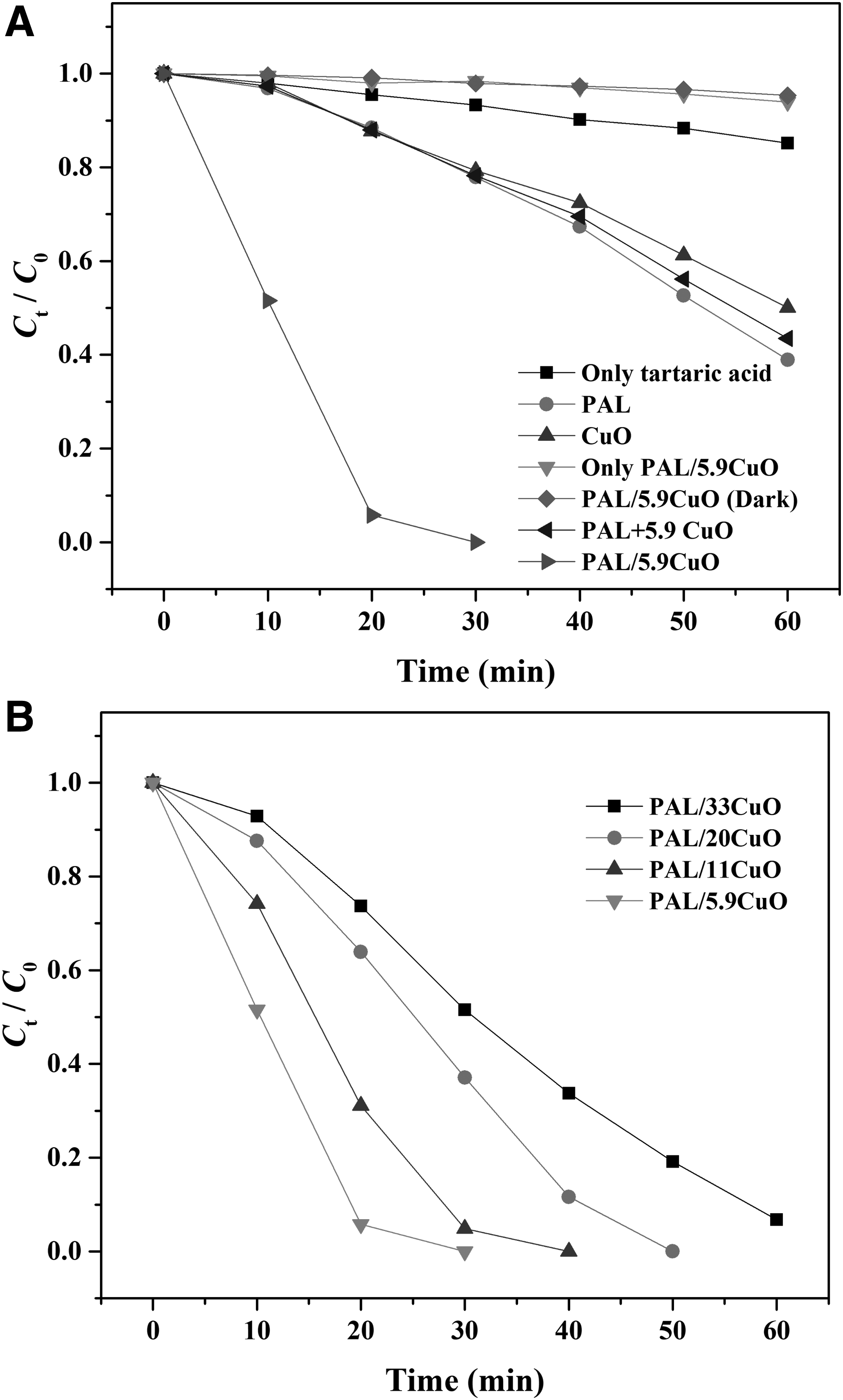
To achieve an optimal photocatalytic performance for the reduction of Cr(VI), it is important to control the loading of CuO over PAL. Figure 1B shows the photocatalytic activity of PAL/CuO composites with different mass fractions of CuO under visible light irradiation. As shown in Fig. 1B, the Cr(VI) reduction efficiency of 93% was achieved over PAL/33CuO after 60 min, whereas Cr(VI) was completely reduced by tartaric acid over PAL/20CuO and PAL/11CuO after 50 and 40 min, respectively. The prepared sample of PAL/5.9CuO showed the best photocatalytic performance. The kinetic constant (k) of PAL/5.9CuO for Cr(VI) catalytic reduction was calculated to be 3.3 μM min−1, which was more than twice that of CuO prepared by the microwave-ultrasonication method (Xu et al., 2016). Comparisons of kinetic constants to other catalysts are also listed in Table 1. Obviously, the PAL/5.9CuO composite synthesized in this work exhibited quite good visible light catalytic activity.
Comparison of Kinetic Constant to Other Catalysts
PAL, palygorskite.
Characterization of PAL/5.9CuO composite
As shown in Fig. 2A, the XRD pattern of original PAL and copper oxide samples matched the diffraction of pure Si8Mg8O20(OH)2(H2O)4·4H2O (JCPDS card No. 29-0855) and CuO (JCPDS card No. 45-0937) very well, respectively, and peaks of impurity cannot be detected. It can be observed that no significant peaks of CuO were present in the XRD pattern of PAL/5.9CuO composite, and that the diffraction peaks of Si8Mg8O20(OH)2(H2O)4·4H2O phase become slightly broader with CuO introduced in the composite. However, a small amount of CuO could be detected by the XPS technique, which was shown in Fig. 2B. The main and satellite peak positions of Cu 2p3/2 and Cu 2p1/2 were in good agreement with a previous report (Kumar et al., 2015; Xu et al., 2016). Further, Fig. 2C showed the XPS results of Fe 2p binding energy. The presence of a small amount of iron impurity also made a contribution to the photocatalytic activity of PAL/5.9CuO composite (Xu et al., 2017).
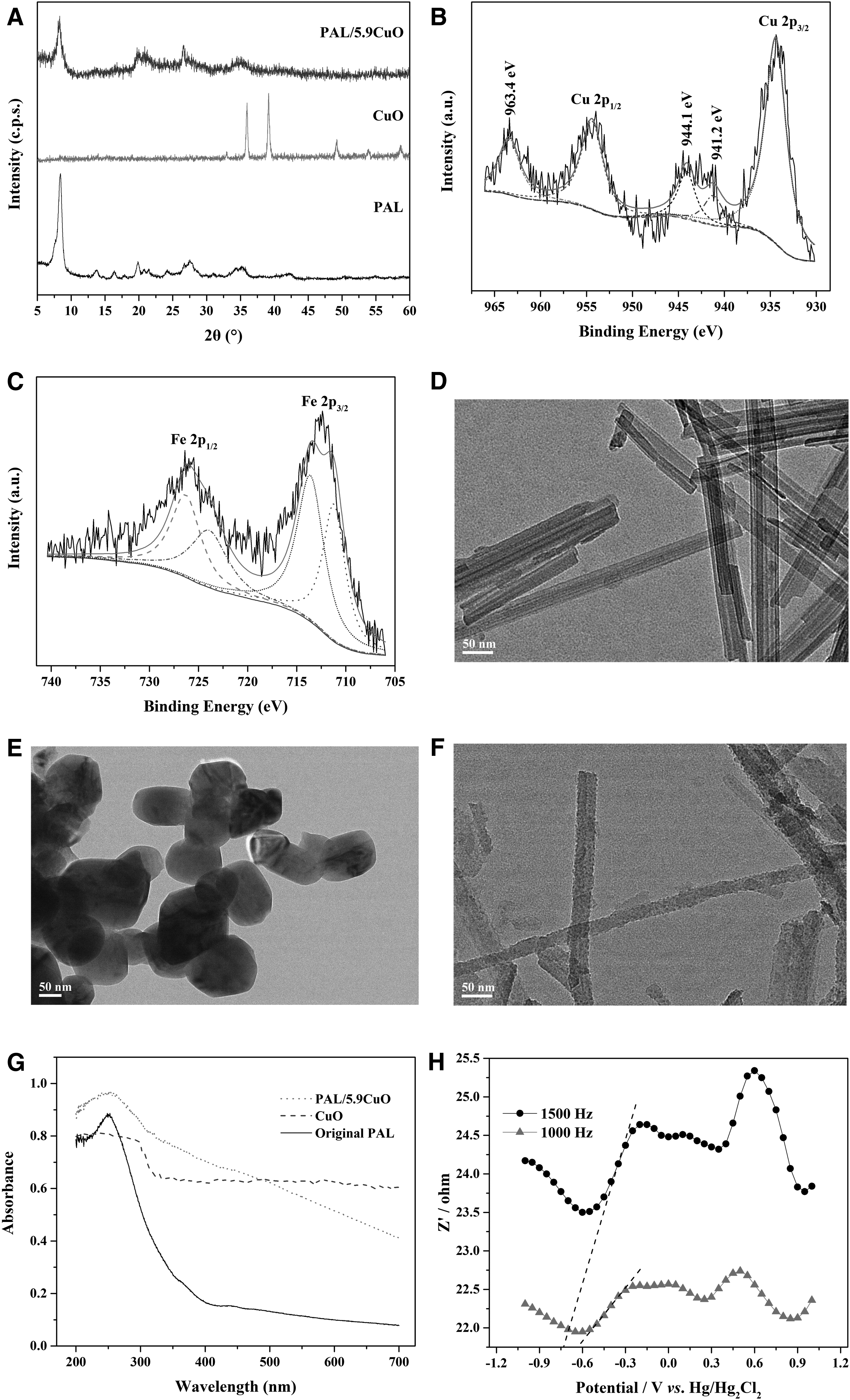
XRD patterns of original PAL, CuO, and PAL/5.9CuO
Figure 2D–F showed the TEM images of original PAL, CuO, and PAL/5.9CuO, respectively. It could be seen that PAL was characterized by fibrous microstructure morphology and a smooth surface, whereas CuO was characterized by about 150-nm spherical particles. The TEM image of PAL/5.9CuO composite clearly showed the rough surface of fibrous microstructure, which implied that the very small CuO particles were immobilized on the surface of PAL fibers. PAL fibers served as the heterogeneous nuclei for the growth of CuO. Therefore, the growing up of CuO particles was decentralized and inhibited during the synthesis of the composite. The dispersive small-sized CuO particles can provide more photoreactive sites for the reduction of Cr(VI).
Optical absorption properties of the original PAL, CuO, and PAL/5.9CuO were characterized by UV-vis DRS, as shown in Fig. 2G. In the test wavelength range of 400–700 nm, black copper oxide powders showed strong visible light absorption, whereas original gray PAL showed weak visible light absorption. Due to the loading of CuO on PAL surface, the PAL/5.9CuO composite exhibited enhanced light absorption at the whole test wavelength range, which displayed synergies of composite materials and greatly benefited the photocatalytic reduction of Cr(VI). Mott-Sckottky measurements of the PAL/5.9CuO composite are shown in Fig. 2H. The potential of PAL/5.9CuO was approximately −0.7 V versus Hg/Hg2Cl2 at pH 6.8, corresponding to approximately −0.43 V versus NHE at pH 6.8, which is more negative than the Cr(VI)/Cr(III) potential (+0.51 V vs. NHE) (Shen et al., 2014; Liang et al., 2015a, 2015b). Therefore, it is thermodynamically permissible for reducing Cr(VI) to Cr(III).
Suggested mechanism for Cr(VI) reduction over PAL/5.9CuO composite
Recent studies have focused on the photocatalytic performance of Fe(III) or Cu(II) on the Cr(VI) reduction by organic acids (Sun et al., 2009; Xu et al., 2013, 2015, 2017; Xu et al., 2016). The rapid reduction of Cr(VI) is mainly due to the generated stronger reductants such as Fe(II), Cu(I), or CO2• radicals when reaction solution is exposed to simulated solar light. These intermediate products facilitate fast reduction of Cr(VI) (Li et al., 2015; Xu et al., 2016, 2017). To confirm the key role and formation of Cu(I) and Fe(II) in the photocatalytic reduction of Cr(VI), the XPS test of PAL/5.9CuO after photocatalytic reduction Cr(VI) by tartaric acid was made. As shown in Fig. 3A, the peaks at 933.3 eV and 953.2 eV were attributed to Cu(I) 2p3/2 and Cu(I) 2p1/2, respectively, and other peaks were attributed to Cu(II) (Xu et al., 2016). Figure 3B showed the presence of Fe(II) (711.2 eV and 724.2 eV) and Fe(III) (713.9 eV and 726.7 eV) species (Xu et al., 2017). Both Fe and Cu displayed two kinds of surface species, which is a considerable feature of the photocatalytic process for Cr(VI) reduction in the Fe(III)/SOAs system (Marinho et al., 2016; Xu et al., 2017). Therefore, the suggested photocatalytic cycle consists of (1) formation of Fe(III)-Tar or Cu(II)-Tar photochemical active complexes between tartaric acid and Fe(III) or Cu(II) on the surface of composite catalyst; (2) photochemical active complex absorbance of light to produce Fe(II), Cu(I), and radicals through an MLCT pathway; (3) fast reduction of Cr(VI) by intermediate reductants; and (4) reformation of photochemical active complexes as follows [Eqs. (2)–(8)].

High-resolution XPS spectra of Cu 2p
where “≡” signified the surface of PAL/5.9CuO composites.
Effects of test conditions on Cr(VI) reduction efficiency
As shown in Fig. 4A, the effect of initial suspension pH on Cr(VI) reduction efficiency was present as a function of reaction time in the range of 3.0–9.0. In the heterogeneous catalysis system, the effects of initial pH on the Cr(VI) reduction efficiency were complicated. First, the electrode potential of Cr(VI)/Cr(III) decreased with the increase of solution pH, which declined the thermodynamic driving force of Cr(VI) reduction. Second, the Cr(VI) reduction reaction needed enough H+ according to Equations (9)–(11).

Influence of test parameters on the photocatalytic reduction efficiency of Cr(VI) (100 μM Cr(VI) and irradiation of a 5-W LED white lamp). Initial pH
Less amount of H+ in the higher pH suspension is not conducive to the reaction just mentioned. Third, Cr(OH)3 would be formed on the surface of catalysts when pH values of solution were higher than 5.5 (Marinho et al., 2016), which might cover the active sites of catalysts, suppress the formation of Fe(III)-Tar and Cu(II)-Tar, and, thus, decrease the Cr(VI) reduction efficiency. Finally, initial suspension pH will influence the surface charge properties of the catalyst. Generally speaking, the surface of the catalyst is positively charged at low pH, whereas it is negatively charged at high pH. The main existing species of Cr(VI) and tartaric acid (
Effect of catalyst (PAL/5.9CuO) concentration on the Cr(VI) photocatalytic reduction was evaluated by using four dosages of 200, 400, 800, and 1600 mg/L. As shown in Fig. 4B, the reduction efficiency of Cr(VI) increased when the catalyst dosage increased from 200 to 1600 mg/L, which was due to more adsorption and active sites on the catalyst surface. However, the increase of Cr(VI) reduction rate was not significant for the catalyst dosage of 800 and 1600 mg/L. Higher dosages of catalysts caused the reaction solution to be turbid (screening effect) (Xu et al., 2013, 2016), which prevented irradiation from permeating the reaction solution and decreased the photocatalytic reduction rate of Cr(VI).
Figure 4C showed the effect of the initial concentration of tartaric acid on the Cr(VI) reduction efficiency over as-prepared PAL/5.9CuO. The Cr(VI) reduction rates increased with the increase of tartaric acid concentration from 5 to 40 mM. At the maximum tartaric acid concentration of 40 mM, Cr(VI) was completely reduced within 20 min, which indicated that tartaric acid was one of the most important roles played in the Cr(VI) photocatalytic reduction process. The increase of tartaric acid concentration was beneficial to the formation of more ≡Cu(II)-Tar or ≡Fe(III)-Tar complex as shown in Equation (2), which facilitated the rapid reduction of Cr(VI). Further, more tartaric acid radicals could be generated from photolysis of tartaric acid as shown in Equation (4), which also promoted the rapid reduction of Cr(VI).
The reusability of PAL/5.9CuO catalyst was evaluated by five successive recycling tests for the reduction of Cr(VI) by tartaric acid under visible light irradiation, as displayed in Fig. 4D. After each experiment, the catalyst was directly separated and applied to the next cycle without any other post-treatment. After 5 cycles of repeated use, the photocatalytic performance of PAL/5.9CuO was not significantly deteriorated, and 91% of Cr(VI) was reduced after 30 min. The result indicates that the stability of the as-prepared PAL/5.9CuO catalyst is fairly good, which is cost-effective because the catalyst does not have to be replaced over a relatively long period.
Conclusions
To sum up, active CuO was supported on an inexpensive PAL surface through a simple precipitation-calcination method, which could greatly reduce the cost of catalyst preparation. The composite denoted as PAL/5.9CuO exhibited outstanding photocatalytic properties for the Cr(VI) reduction by tartaric acid. Hexavalent chromium (100 μM) was 100% reduced by 10 mM tartaric acid over PAL/5.9CuO photocatalyst (400 mg/L) under visible light irradiation and pH = 3.0 after 30 min. In the test range, low pH solution, high concentrations of catalyst loading, and tartaric acid favored the catalytic reduction of Cr(VI). The as-prepared PAL/5.9CuO composite catalyst could be of great prospects for an industrial application to remove Cr(VI) from contaminated wastewater due to its good stability, high efficiency, and effectiveness in a quite wide pH range.
Footnotes
Acknowledgments
This study was financially supported by the National Natural Science Foundation of China (21607012) and the Special Fund for Agro-scientific Research in the Public Interest (201503121). The authors would like to thank Prof. Wenzhong Wang, Ms. Dongping Chu, and Ms. Lihui Zhou for their excellent technical assistance.
Author Disclosure Statement
No competing financial interests exist.