




Abstract
Abstract
Pharmaceutical and personal care products (PPCPs) are a class of diverse emerging environmental contaminants threatening water safety and public health. Transition metal dichalcogenides (TMDCs) nanosheets are emerging semiconductor materials that have been studied in different fields, such as catalysis, batteries, photodetectors, and environmental sensors. In this study, the adsorption of selected PPCPs, such as erythromycin, 17β-estradiol, and triclosan, on emerging TMDCs, molybdenum disulfide (MoS2) and tungsten disulfide (WS2), has been investigated. The primary objective was to evaluate the adsorption capacity of PPCPs on MoS2 and WS2 in Milli-Q water and synthetic surface water and to explore the interaction mechanisms governing the adsorption. Results showed that adsorption efficiency of MoS2 and WS2 per unit surface area was higher than that of conventional adsorbents, especially for erythromycin, the adsorption efficiency of which by MoS2 and WS2 was 40–800 times higher than that of activated carbon. WS2 showed higher adsorption capacities for both triclosan (9.02 vs. 4.41 mg/g) and erythromycin (190.31 vs. 57.10 mg/g) than MoS2, and similar adsorption performance for 17β-estradiol (4.53 vs. 4.37 mg/g). Natural organic matter (humic acid) was found to reduce the adsorption capacity of erythromycin, 17β-estradiol, and triclosan significantly, through competing adsorption sites. Effects of ionic strength were found to enhance the triclosan adsorption 6.3 times by MoS2 and 3.8 times by WS2 whereas they reduced the adsorption of erythromycin by 35.6% for MoS2 and 89% for WS2. The primary adsorption mechanism of PPCPs by MoS2 and WS2 is the hydrophobic effect. For triclosan, in addition, electrostatic interaction may be involved in the adsorption. Aggregation of hydrophobic MoS2 and WS2 nanosheets reduced the available sites for PPCPs adsorption, which lowered the adsorption capacity. The ability to utilize visible light to produce reactive oxygen species gave MoS2 and WS2 the potential to regenerate under visible light, which will reduce cost of operation.
Introduction
A
Thousands of PPCPs have been reported to be used for human or animal medical applications, and they can enter the environment through various pathways (Luo et al., 2014). Many PPCPs are persistent in the natural environment and wastewater treatment plants (Jelić et al., 2012). Even at a low concentration, persistent PPCPs can still cause environmental and ecological problems (Daughton and Ternes, 1999; Martín-Díaz et al., 2009; Boxall et al., 2012; Galus et al., 2013). Therefore, the removal of PPCPs from contaminated water is vital for water safety and public health.
Adsorption is an important treatment technology that is applicable at low pollutant levels, and it is suitable for both batch and continuous treatment processes (Ali and Gupta, 2006). Other advantages include ease of operation, less waste generation, the possibility of regeneration and reuse, and low capital cost (Mohanty et al., 2006). However, due to energy and/or chemical consumption and the difficulty in their regeneration, there have been attempts to utilize novel low-cost, naturally occurring adsorbents to remove trace organic and inorganic contaminants from water and wastewater (Behera et al., 2010).
Nanotechnology provides opportunities to enhance water treatment efficiency. Few layered or single-layered transition metal dichalcogenides (TMDCs) have attracted attention recently due to their large surface areas and unique chemical properties of nanosheets compared with bulk materials. TMDC nanomaterials molybdenum disulfide (MoS2) and tungsten disulfide (WS2) are composed of three atom layers stacked together through van der Waals interactions (Geim and Grigorieva, 2013). They are excellent adsorbents that are applied in many situations. For example, MoS2 was used for oil contaminant adsorption on the water surface, including vegetable oil, cooking oil, engine oil diesel, and gasoline (Song et al., 2015). MoS2-based aerogel was used as both a sensor and an adsorbent for heavy metal treatment (Zhi et al., 2016).
Moreover, the low band gaps of MoS2 (1.29 eV) and WS2 (1.9 eV) make them potential photocatalysts for harvesting visible light for water treatment (Mak et al., 2010; Zhao et al., 2012). Liu et al. (2016) reported their study on applying vertically aligned MoS2 nanofilms utilizing visible light to generate reactive oxygen species for water disinfection. The MoS2/TiO2 materials can degrade 100% Rhodamine B in 20 min under the light irrigation (Zhou et al., 2013). WS2 can also produce hydroxyl radicals under light irradiation (Sang et al., 2015). Therefore, TMDCs have great potential to be used in water treatment as adsorbents with self-regeneration ability utilizing visible light.
To date, there is no study on the adsorption of PPCPs by TMDC nanomaterials. For the first time, the ability of MoS2 and WS2 for adsorption of three selected PPCPs (17β-estradiol, triclosan, and erythromycin) under environmentally relevant conditions (Milli-Q water, synthetic surface water with and without natural organic matter [NOM]) has been investigated. The 17β-estradiol is one of the most commonly detected endocrine-disruption chemicals in natural waters (Sumpter et al., 2014). Triclosan has been produced in large quantities, is extensively used in consumer products as an antimicrobial agent, and is highly toxic to certain aquatic organisms (Behera et al., 2010). Erythromycin has been widely used in food-producing animals and humans and is frequently detected as an organic pollutant in U.S. streams (Kim et al., 2004). The possible mechanisms of adsorption of selected PPCPs by MoS2 and WS2 were also discussed.
Experimental Protocols
Materials and chemicals
17β-Estradiol, triclosan, and erythromycin were purchased from Sigma-Aldrich. MoS2 [molybdenum (VI) sulfide, 99% (metal basis) −325 Mesh Powder], and WS2 [tungsten (IV) sulfide, powder] were purchased from Sigma Aldrich. Methanol and acetonitrile (HPLC grade, 0.2 microns filtered) were purchased from Fisher Scientific. The stock solutions of 17β-estradiol, triclosan, and erythromycin at the concentration of 150 mg/L were prepared by dissolving solid powders in methanol–water solution (96:4). These stock solutions were stored in a refrigerator at 4°C. Dilute standards were prepared on a daily basis by dilution of the stock solutions with methanol.
Preparation of MoS2 and WS2 nanosheets
MoS2 and WS2 powders were dispersed in Milli-Q water at 1 g/L and sonicated in an ultra-sonication bath (Ultrasonic bath, CPX 2800; Fisher® Scientific, Pittsburgh, PA) for 4 h. Then, the supernatant was collected for size and zeta-potential measurements.
Characterization of MoS2 and WS2
MoS2 and WS2 hydrodynamic diameter, and zeta potential were measured with a ZetaSizer Nano ZS (Malvern Instruments, Worcestershire, United Kingdom), using well-established techniques (details are provided in Supplementary Data). Scanning electron microscope (SEM) images of MoS2 and WS2 were taken with the Quanta™ SEM (Thermo Fisher Scientific, OR) to get the information about the surface morphology of MoS2 and WS2 nanoparticles. Brunauer Emmett Teller surface area is determined by using five-point nitrogen adsorption with the TriStar 3000 BET surface area analyzer (Micromeritics Instrument Corporation, Norcross, GA).
LC/MS analysis
Concentrations of 17β-estradiol, triclosan, and erythromycin were quantified by LC/MS (Agilent 6120 Series Quadrupole LC/MS System). Fifteen to 50 μL of the sample was injected into an Agilent 1200 HPLC for separation on a C18 column (100 × 2.1 mm, 5 μm particle size). Negative mode monitoring is used for 17β-estradiol (m/z = 269) and triclosan (m/z = 286.8), and positive mode monitoring is used for erythromycin (m/z = 369). Instrumental parameters were set as follows: nebulizer pressure 40 PSI, drying gas flow rate 9 L/min, drying gas temperature 325°C, capillary voltage 3,500 V, and skimmer voltage −15 V. Quantification was based on an eight-point calibration curve. The limits of determination by this method with a signal-to-noise ratio of 3:1 of the mass chromatogram for the sample solution were 1, 0.5, and 10 ng/mL for 17β-estradiol, erythromycin, and triclosan, respectively.
Adsorption experiments
Adsorption experiments were carried out in Milli-Q water, synthetic surface water without NOM, and synthetic surface water with 10 mg/L NOM. Synthetic surface water was prepared by following the recipes mentioned in a previously published study (Chowdhury et al., 2013). Overall, 16.5 mg MgCl2, 8.3 mg MgSO4, 3 mg KHCO3, 19.3 mg NaHCO3, and 33 mg CaCO3 were dissolved in 1 L Deionized water to prepare synthetic surface water. Suwannee River Humic Acid Standard II (International Humic Substances Society) has been used as NOM. In the adsorption kinetic study, the concentration ranges of MoS2 and WS2 were from 50 to 800 mg/L. Then, 17β-estradiol, triclosan, and erythromycin stock solution were injected into the flask containing dispersed MoS2 and WS2 to achieve target concentration.
The pH of all experiment was adjusted to around 7 by using 1 mM to 0.1 M HCl and NaOH to maintain the consistency. Samples were taken at 1, 3, 6, 12, and 24 h. All samples were centrifuged at 12,500 rpm for 10 min before transferring them into sample vials. Then, the concentrations of PPCPs were determined by LC-MS. In the adsorption isotherm study, initial PPCPs (triclosan, 17β-estradiol, and erythromycin) concentrations varied from 200 μg/L to 4 mg/L. TMDCs and PPCPs were mixed in teflon-lined screw cap 250 mL amber glass bottles. The concentrations of TMDCs were prepared from 50 to 400 mg/L.
All bottles were mixed on a rotary shaker at 350 rpm for 72 h, which was long enough to reach equilibrium through previous batch adsorption experiments. Then, 1.5 mL of samples was taken from bottles and centrifuged for 10 min at 12,500 rpm before transferring into sample vials for further analysis with LC/MS. All experiments were conducted at least three times.
Adsorption data of PPCPs onto MoS2 and WS2 were fitted to the Langmuir [Eq. (1)] and Freundlich isotherm models [Eq. (2)] (Adamson and Klerer, 1977):
where Ce (mg/L) is the equilibrium concentration of the solution, qe (mg/g) is the equilibrium adsorption capacity, qm (mg/g) is the maximum adsorption capacity according to the Langmuir model, KL (L/mg) is the adsorption equilibrium constant for the Langmuir model, and KF (mg1-n Ln g−1) and n are the constants associated with the adsorption capacity and adsorption intensity for the Freundlich model. All fitting isotherm parameters are listed in Table 1.
Isotherm Parameters for the Langmuir and Freundlich Models on Adsorption of Triclosan at Room Temperature
MoS2, molybdenum disulfide; NOM, natural organic matter; WS2, tungsten disulfide.
Results and Discussion
Characterization of MoS2 and WS2 nanosheets
Size and zeta-potential results are shown in Fig. 1. The particle sizes of both MoS2 and WS2 in the supernatant are 350 to 500 nm (Fig. 1). MoS2 has a smaller particle size than WS2. The average particle sizes of MoS2 and WS2 are 344 ± 49 nm and 495 ± 59 nm, respectively. Both MoS2 and WS2 show negative zeta potential (Fig. 1). The average values of zeta potentials of MoS2 and WS2 are −26.92 ± 3.09 mV and −37.10 ± 8.95 mV, respectively. The zeta potential of MoS2 and WS2 agrees with other reports (Lu et al., 2017). The particle sizes and zeta potential remained almost consistent under different water systems, including Milli-Q water (O), synthetic surface water with NOM (SN), and synthetic surface water without NOM (S).
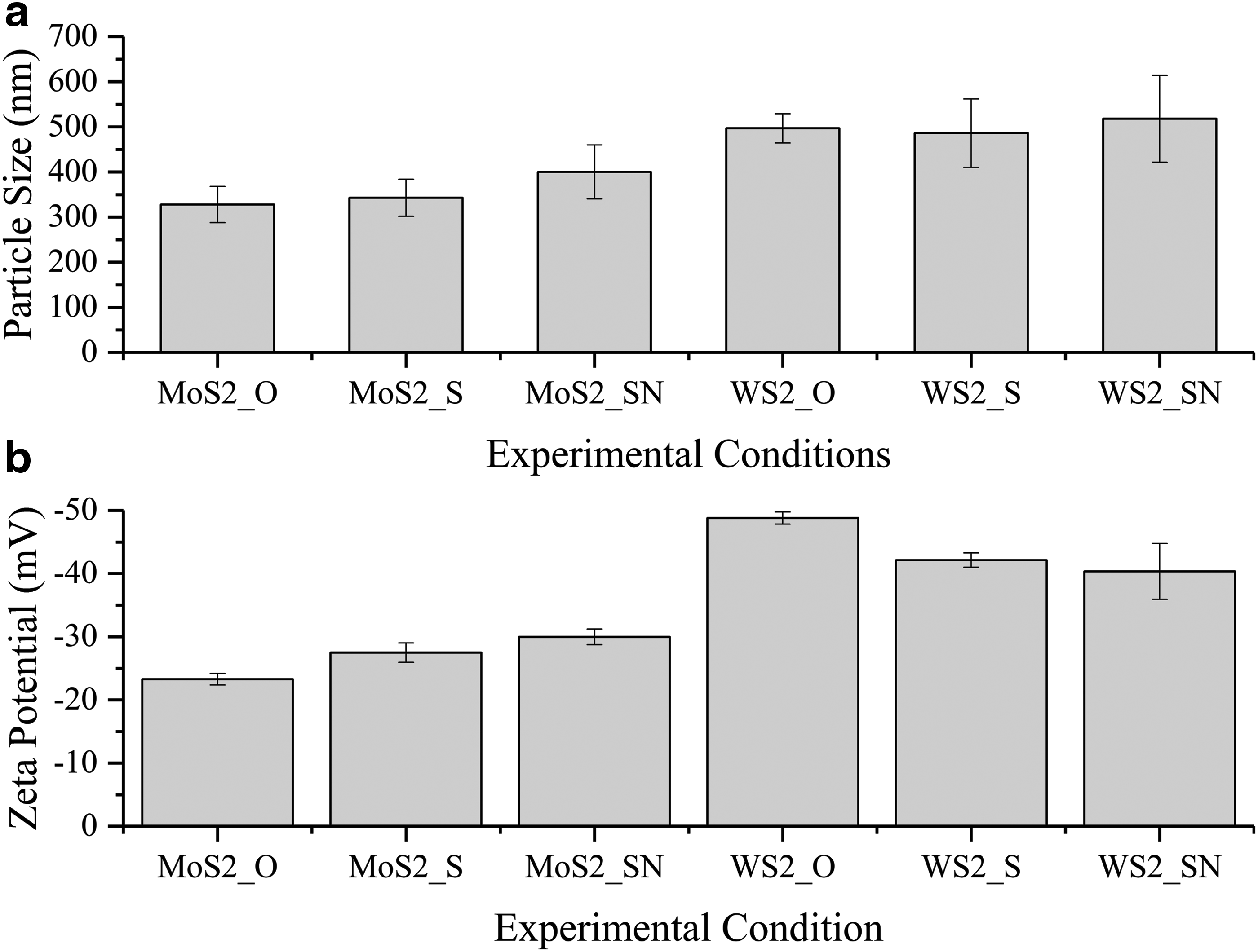
Size and zeta potential of MoS2 and WS2 used in the experiment; MoS2 and WS2 were, respectively, dispersed in Milli-Q water after 4 h of ultrasonication.
The BET surface area of MoS2 and WS2 powder used in this study was 11.20 ± 0.02 m2/g and 1.96 ± 0.02 m2/g. These results agree with the surface area data reported by other researchers. The MoS2 surface area varied from 14 m2/g (Wu et al., 2018) to 70 m2/g (Wang et al., 2018a), whereas WS2 surface areas were from 2.8 m2/g (Huang et al., 2014) to 94.6 m2/g (Choi et al., 2014).
Figure 2 shows SEM images of MoS2 and WS2. Figure 2 indicates that both MoS2 and WS2 are irregular sheets. There are no porous structures in MoS2 and WS2 nanosheets, and all available surfaces are exposed outside. Hence, the adsorption process could only happen on the surface and edge of these materials. This feature could be an advantage of MoS2 and WS2 over conventional adsorbents such as porous-structured activated carbon, which omit the interparticle diffusion steps of adsorption and reduce the pore blocking effect on the adsorption performance (Punyapalakul et al., 2013).

SEM image of MoS2 and WS2 particles.
Properties of selected PPCPs
Physicochemical properties of the three selected PPCPs (17β-estradiol, triclosan, and erythromycin) are listed in Supplementary Table S1. All three PPCPs have low solubility (<10 mg/L) in water and high Kow values. Erythromycin has the lowest solubility and Kow values followed by 17β-estradiol and triclosan. Low solubility in water and high Kow values indicate that these PPCPs tend to be adsorbed by hydrophobic materials and soil in the natural environment (Briggs, 1981). They also have high pKa values, which means, in the aqueous phase, that they exist in their neutral form (no proton dissociation, no apparent surface charge) at the experimental pH (7.4 ± 0.3).
Adsorption of PPCPs
Adsorption in Milli-Q water
17β-estradiol
Supplementary Figures S1 and S2 show that in adsorption kinetic experiments, as the concentration of MoS2 was increased from 50 to 800 mg/L, the removal efficiency of 17β-estradiol in the aqueous phase increased from 6% to 97.6%. When the concentration of WS2 increased from 50 to 800 mg/L, the removal efficiency of 17β-estradiol also increased significantly from 12% to 86.5%. The adsorption of 17β-estradiol required about 5 to 10 h to reach equilibrium, which is slower than other adsorbents used for 17β-estradiol removal. For example, the adsorption equilibrium of 17β-estradiol on glutaraldehyde-modified amino-functionalized Fe3O4 nanoparticles took 30 min (Hao et al., 2015). Supplementary Figures S1 and S2 show the fast adsorption at the beginning, then it slowed down until the equilibrium.
The pseudo-first-order adsorption rate constants of 17β-estradiol on MoS2 and WS2 (200 mg/L) were 2.3/h and 2.5/h. Isotherm fitting results of 17β-estradiol adsorption on MoS2 and WS2 in Milli-Q water are shown in Fig. 3. The isotherm data of 17β-estradiol adsorption on both MoS2 and WS2 can be fitted with both Langmuir and Freundlich isotherm models quite well (with r2 varying from 0.92 to 0.98). The adsorption capacity of MoS2 (4.53 mg/g) and WS2 (4.37 mg/g) in Milli-Q water from Langmuir fitting results is lower than the capacity of reduced graphene oxide (rGO) (203 mg/g), carbon nanotubes (CNT) (151.5 mg/g), and activated carbon (127.3–214.7 mg/g) in other reports (Yoon et al., 2005; Jiang et al., 2017; Sun et al., 2017).

Adsorption isotherm results of three selected PPCPs adsorption on MoS2 and WS2.
However, considering the lower surface areas of MoS2 and WS2 in this study with respect to graphene (from 100 to over 2,500 m2/g), CNT (420 to 650 m2/g) (Ji et al., 2010; Liu et al., 2014), and activated carbon (more than 1,500 m2/g) (Dillon et al., 1989), the adsorption efficiencies of MoS2 and WS2 per surface area for 17β-estradiol are significantly higher (up to several hundred times) than graphene, CNT, and activated carbon.
Table 2 summarizes the comparison of adsorption efficiencies of selected PPCPs with MoS2, WS2, activated carbon, rGO, and CNT. As shown in Table 2, adsorption efficiencies of MoS2 and WS2 per unit surface area for 17β-estradiol are at least 3 and 10 times higher than those of activated carbon, respectively. Regarding other nanomaterials, including rGO and CNTs, the adsorption efficiencies of MoS2 and WS2 are significantly higher (Table 2). As MoS2 and WS2 are platelet-like particles, possible adsorption can only happen on their surface or edges, which is different from the adsorption process of activated carbon possessing complex porous structures (Li et al., 2002). WS2 shows higher adsorption capacity per surface area for 17β-estradiol than MoS2. Overall, MoS2 and WS2 are promising adsorbents for 17β-estradiol.
Comparison of Adsorption Capacity Based on Unit Surface Area of MoS2 and WS2 with Other Adsorbents
CNT, carbon nanotubes; rGO, reduced graphene oxide.
Triclosan
As shown in Supplementary Figs. S3 and S4, adsorption of triclosan on MoS2 is a relatively fast process, which reached equilibrium at about 1 h. It is significantly faster than the adsorption of 17β-estradiol on MoS2. Similar to the adsorption on MoS2, the adsorption process of triclosan on WS2 is also really fast, which also reached equilibrium at about 1 h. When MoS2 and WS2 concentration was 200 mg/L, the pseudo-first-order adsorption rate constants for triclosan were 2.3 and 2.5 h−1, respectively.
The results of triclosan adsorption isotherms in Milli-Q water are shown in Fig. 3. As shown in these figures, the isotherm data of triclosan adsorption on MoS2 and WS2 can be fitted with both Langmuir and Freundlich isotherm models quite well, with r2 about 0.97 to 0.99 (Table 1). As previously mentioned, both MoS2 and WS2 are platelet-like particles; possible adsorption can only happen on their surface or edges, which is different from that of activated carbon possessing complex porous structures (Li et al., 2002).
From results in Table 1, the adsorption capacity of MoS2 (4.41 mg/g) and WS2 (9.02 mg/g) for triclosan in Milli-Q water was lower than that of activated carbon (>35 mg/g) (Behera et al., 2010) and that of reported Fe2O3 carbon composites (>170 mg/g) (Zhu et al., 2014), which was probably due to the aggregation of MoS2 and WS2. Because MoS2 and WS2 are hydrophobic materials, it is hard to reach a good dispersion in water for fine hydrophobic particles (Cho et al., 2011). The Freundlich model parameters [1.44 and 1.31 (mg/g)(L/mg)1/n] are slightly lower than another report of activated carbon [3.03 (mg/g)(L/mg)1/n] (Behera et al., 2010).
However, taking the surface area of MoS2 and WS2 into consideration, the adsorption efficiencies of MoS2 and WS2 for triclosan based on the unit surface area are much higher than those of activated carbon as the surface area of activated carbon is several hundred times higher than those of MoS2 and WS2. Table 2 shows that adsorption efficiencies of MoS2 and WS2 for triclosan are at least 20 and 40 times higher than those of activated carbon, respectively. Overall, WS2 is more efficient than MoS2 for adsorption of triclosan.
Erythromycin
Erythromycin is one of the most persistent PPCPs in the environment. Most of the reported adsorption materials for erythromycin are made of resin and through ion exchange (Ribeiro and Ribeiro, 2005). Compared with 17β-estradiol and triclosan adsorption, the erythromycin adsorption on both MoS2 and WS2 is a slow process, which took about 24 h to reach equilibrium. This agreed with another report with ion-exchange methods (more than 24 h for adsorption on clays) (Kim et al., 2004). As the concentration of MoS2 or WS2 decreased, the adsorption rates became slower and needed longer time to reach equilibrium, which are shown in Supplementary Figs. S5 and S6. Compared with the adsorption capacity of MoS2 (57.10 mg/g), WS2 shows higher erythromycin adsorption capacity (190.31 mg/g) (Table 1).
As shown in Table 1, the isotherm data of erythromycin adsorption on both MoS2 and WS2 can fit both Langmuir and Freundlich isotherm models quite well, with r2 around 0.99. From Langmuir model fitting data, the adsorption capacity of resin in other report was more than 58 mg/g (Ribeiro and Ribeiro, 2005), which is similar to that of MoS2 (57.1 mg/g) and lower than that of WS2 (190.31 mg/g). Table 2 shows that erythromycin adsorption efficiencies of MoS2 and WS2 per surface area are at least several hundred times higher than those of activated carbon, respectively. Hence, MoS2 and WS2 will be excellent adsorbents for erythromycin. Overall, WS2 is a more efficient adsorbent than MoS2 for erythromycin removal from the water phase.
Adsorption in synthetic surface water
The effects of ionic strength and NOM on 17β-estradiol adsorption were evaluated through comparing adsorption performance among Milli-Q water (marked as “0”), synthetic surface water with NOM (“SN”), and synthetic surface water without NOM (“S”) (Table 1).
17β-estradiol
In the synthetic surface water system without NOM (noted as “S” in Fig. 3), the adsorption capacity of both MoS2 and WS2 (4.49 and 4.37 mg/L) was similar to that in Milli-Q water (4.53 and 4.37 mg/L). Therefore, the ionic strength did not show much influence on 17β-estradiol adsorption by MoS2 and WS2, which implied that there was no electrostatic interaction between adsorbents and adsorbates. A similar result was also reported by other researchers that ionic strength within the typical range in natural waters did not exhibit a significant influence on the adsorption of estrogens by rGOs (Jiang et al., 2018). Further discussion about the adsorption mechanisms of 17β-estradiol on TMDCs is presented in the Adsorption Mechanisms section.
Comparing the adsorption capacity of MoS2 and WS2 in synthetic surface water with and without NOM, the system with 10 mg/L NOM (noted as “SN” in figures) showed less than 50% capacity of the artificial surface water system without NOM, which means that NOM reduced the 17β-estradiol adsorption by MoS2 and WS2 significantly. NOM can compete for adsorption sites on MoS2 or WS2 with 17β-estradiol, which reduced the available sites for 17β-estradiol adsorption (Wang et al., 2018b).
Other reports also mentioned that humic acid affected adsorption performance (Zhu et al., 2016), and it competed with PPCPs for adsorption (Wang et al., 2015; Rodriguez et al., 2016), such as increasing NOM concentration resulted in decreasing PPCPs removal (Wang et al., 2016). For example, in the solution of 3 mg/L NOM, the adsorption performance of 17β-estradiol by rGO reduced about 35.5–48% (Jiang et al., 2018). In another report, the 10 mg/L NOM reduced the adsorption capacity of GO by more than 50% (Jiang et al., 2016). The adsorption performance of 17β-estradiol by granular activated carbon decreased by more than 50% when NOM increased from 0 to 10 mg/L (Zhang and Zhou, 2005). In this study, the removal capacity dropped by more than 50% in a solution of 10 mg/L NOM, indicating that a similar suppression effect happened on MoS2 and WS2.
Triclosan
In the synthetic surface water system without NOM (noted as “S” in Fig. 3), the adsorption capacity of both MoS2 and WS2 (27.71 and 34.06 mg/L) was much higher than that in Milli-Q water (4.41 and 9.02 mg/L), which is different from adsorption results of 17β-estradiol. Therefore, the ionic strength did enhance adsorption of triclosan by MoS2 and WS2, which implied the possible electrostatic interactions between adsorbents and adsorbates.
Similar enhanced adsorption performances were also reported by other researchers (Wu et al., 2015; Dou et al., 2017). For example, at low pH (pH 3), the triclosan sorption was enhanced 1.2, ∼4, and 3.5 times, respectively, for activated carbon, kaolinite, and montmorillonite when ionic strength was increased from 1 mM to 0.5 M (Behera et al., 2010). Further discussion about the adsorption mechanism of triclosan on MoS2 and WS2 is in the Adsorption Mechanisms section.
Comparing the adsorption capacity of MoS2 and WS2 in synthetic surface water with and without NOM, the system with 10 mg/L NOM (noted as “SN” in Fig. 3) showed less than 25% capacity of the artificial surface water system, which means that NOM significantly reduced the triclosan adsorption by MoS2 and WS2. Similar to the adsorption of 17β-estradiol, the possible reason is NOM competing for adsorption sites on MoS2 or WS2 with triclosan, which reduced the available adsorption sites for triclosan (Rodriguez et al., 2016).
Similar results were reported by other researchers when the adsorption system had 10 mg/L humic acid; the removal ratio of triclosan by CNT-based materials decreased by about 50% (Wang et al., 2018b). The increasing NOM concentration would result in decreasing PPCPs removal (Wang et al., 2016). The adsorption of triclosan by activated carbon dropped by more than 66% when humic acid was added in the solution (Behera et al., 2010). PPCPs adsorption on soil was also influenced by NOM (Foolad et al., 2016; Zhu et al., 2016), due to competitive adsorption (Wang et al., 2015).
Erythromycin
In the synthetic surface water system without NOM (noted as “S” in Fig. 3e, f), the adsorption capacity of both MoS2 and WS2 (36.78 and 20.28 mg/L) was lower than that in Milli-Q water (57.1 and 190.31 mg/L), which is different from neither the 17β-estradiol adsorption nor the triclosan adsorption. Therefore, the ionic strength can reduce erythromycin adsorption on MoS2 and WS2. Other research also found that when the ionic strengths increased from 0.05 N up to 0.2 N, the values of erythromycin sorptive capacity decreased by 2.5 times (Ezhova et al., 2011). The possible mechanism is discussed in the Adsorption Mechanisms section.
Comparing the adsorption capacity of MoS2 and WS2 in synthetic surface water with and without NOM, the system with 10 mg/L NOM (noted as “SN” in Fig. 3) showed 20% capacity of the artificial surface water system, which means that NOM significantly reduced the erythromycin adsorption by MoS2 and WS2, which is similar to the adsorption performance drop of 17β-estradiol and triclosan. Similar results were reported by many researchers (Rodriguez et al., 2016; Wang et al., 2016; Zhu et al., 2016), the possible reason for which is NOM competing for adsorption sites on adsorbents with erythromycin (Wang et al., 2018b). Therefore, the adsorption performance of MOS2 and WS2 will be significantly influenced by NOM, which presents in the natural water system ubiquitously.
Overall, the adsorption efficiencies of MoS2 and WS2 per surface area for the selected PPCPs are significantly higher than those of traditional adsorbents. The pseudo-first-order adsorption rate constants of selected PPCPs on both MoS2 and WS2 were the highest for triclosan followed by 17β-estradiol and erythromycin. The pseudo-first-order adsorption rate constants of selected PPCPs on 200 mg/L MoS2 follow the order: triclosan (3.3/h) >17β-estradiol (2.3/h) > erythromycin (0.31/h). The order for adsorption on WS2 is also triclosan (3.4/h) >17β-estradiol (2.5/h) > erythromycin (0.36/h). In general, adsorption rate constants and efficiencies based on the unit surface area of PPCPs are higher on WS2 than on MoS2.
The Freundlich adsorption coefficients Kf can reflect the affinity (Pan and Chu, 2016) of each PPCPs to MoS2 and WS2. As shown in Table 1, 17β-estradiol, triclosan and erythromycin showed similar affinity to both MoS2 and WS2. Among the three PPCPs, erythromycin showed the highest affinity (Kf) to both MoS2 and WS2, followed by 17β-estradiol and triclosan. The adsorption capacity of MoS2 and WS2 for erythromycin is almost 10 times higher than those of 17β-estradiol and triclosan. One possible reason is that erythromycin has higher molecular weight (734 g/mol) than triclosan (289.5 g/mol) and 17β-estradiol (272.4 g/mol). Another reason may be the higher affinity of erythromycin on MoS2 and WS2.
As for effects of ion strength and NOM on adsorption performance, the NOM showed consistent effects on all adsorption experiments of selected PPCPs on TMDCs, reducing the adsorption capacities, due to competition between NOM and selected PPCPs. However, the ionic strength showed a different effect on selected PPCPs adsorption performance, including enhancing triclosan adsorption, reducing erythromycin adsorption performance, and no effect on 17β-estradiol adsorption. Possible mechanisms are discussed in the Adsorption Mechanisms section.
Adsorption mechanisms
Several mechanisms have been proposed to be possible explanations for different PPCPs on MoS2 and WS2, as schematically shown in Fig. 4.
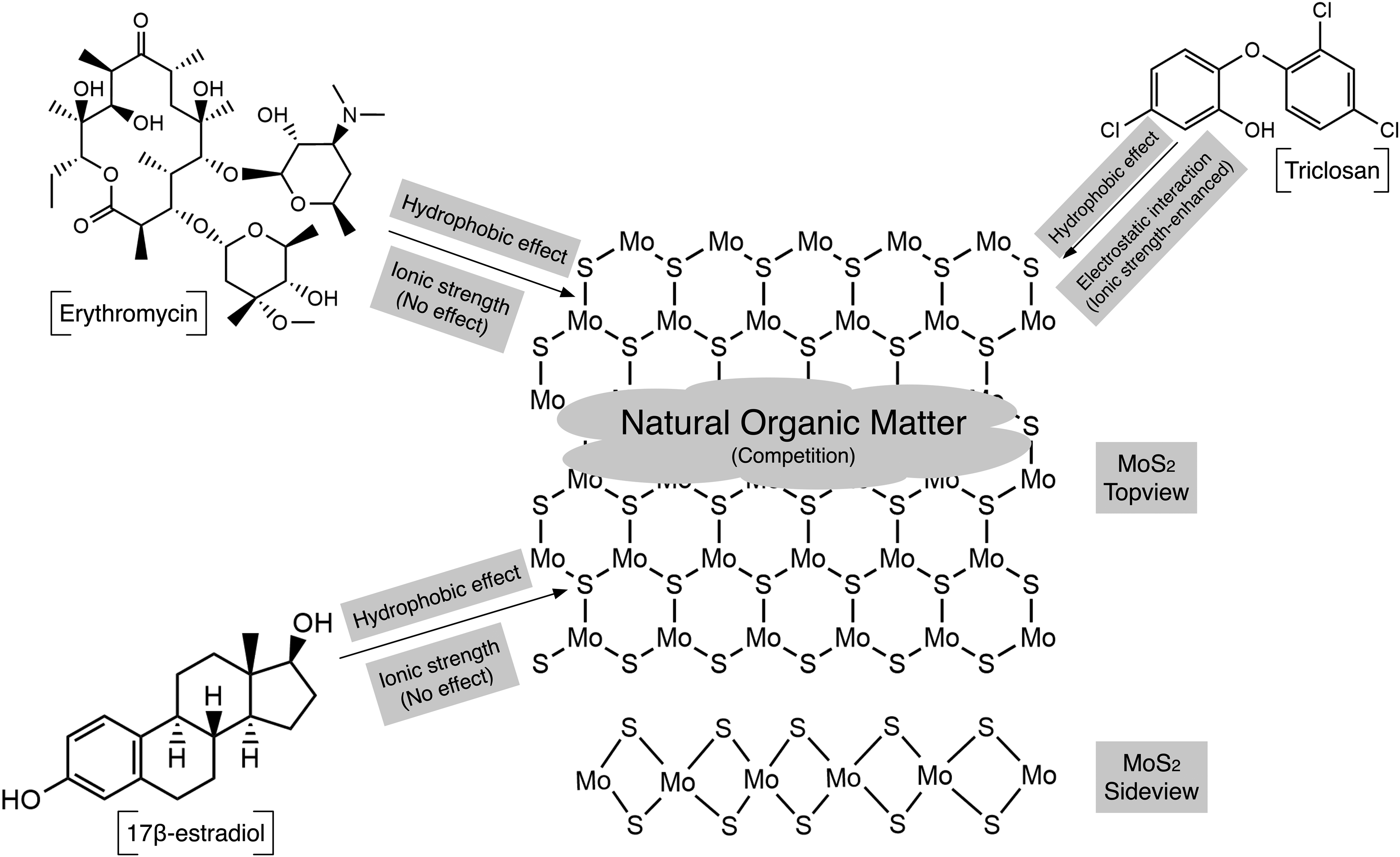
Proposed mechanisms of selected PPCPs adsorption on MoS2/WS2 nanomaterials.
Electrostatic interactions
The electrostatic interaction is the attractive or repulsive interaction between objects having electric charges (Sharp and Honig, 1990). A report mentioned that the electrostatic interaction could be one of the primary mechanisms for Rhodamine B adsorption on MoS2 (Long et al., 2016). Triclosan, 17β-estradiol, and erythromycin have a pKa value of 7.9, 10.7, and 8.88, respectively (Supplementary Table S1). For triclosan, under the experiment pH (7.4), there was about 25% of triclosan in anionic form, the adsorption of which could be affected by ionic strength. Therefore, in the artificial surface water, the adsorption of triclosan increased because of compression of electrical double layers of adsorbents by increasing ionic strength.
The other two PPCPs (17β-estradiol) do not have apparent surface charges under the experimental pH condition (pH 7.4). Therefore, electrostatic interaction should be involved in the adsorption processes of triclosan but not 17β-estradiol, and erythromycin.
π-π interactions
This interaction acts between the π electron in adsorbent and aromatic rings of PPCPs (Cho et al., 2011). The π–π interaction has been considered one of the most important mechanisms for the adsorption of some PPCPs (bisphenol A and 17α-ethinyl estradiol) on activated carbon and other carbonaceous materials such as CNT (Dąbrowski et al., 2005; Ji et al., 2009). From the structures of selected PPCPs in Supplementary Table S1, there are aromatic rings in both triclosan and 17β-estradiol, which enable the π–π interaction between adsorbents and contaminants (Björk et al., 2010). Erythromycin is a macrocyclic antibiotic possessing several characteristics such as stereogenic centers and functional groups, which allow it to have multiple interactions with adsorbents, including π–π and hydrophobic interactions (Chen et al., 2010).
Both MoS2 and WS2 have a similar structure to graphene (Matte et al., 2010); however, the structures of MoS2 and WS2 are non-aromatic (Lu et al., 2017), which means that there is no π–π interaction between MoS2 or WS2 with selected PPCPs.
Hydrophobic interactions
Hydrophobic interactions have been reported as an important mechanism for some PPCPs adsorption on CNT, graphene, and rGO (Cho et al., 2011; Zhao et al., 2014). MoS2 and WS2 are reported to be hydrophobic materials (Chow et al., 2015; Kozbial et al., 2015). Hydrophobic interaction has been considered an important mechanism for 17β-estradiol adsorption on rGO and CNT (Wei et al., 2017). The adsorption of triclosan through hydrophobic interaction is also reported in other research (Cho et al., 2011). Erythromycin can also interact with adsorbents (montmorillonites) through a hydrophobic interaction, which is mentioned in other reports (Kim et al., 2004).
As shown in Supplementary Table S1, all three PPCPs tested in this article have low solubility and high Log Kow values (triclosan 4.76, 17β-estradiol 4.01, and erythromycin 3.06). Moreover, according to the adsorption figures, the adsorption rate order is triclosan >17β-estradiol > erythromycin, which follows the Kow order, which is shown in Supplementary Fig. S7. However, there is no correlation between Kow and adsorption capacity (Supplementary Fig. S8). As reported by Zangi et al. (2007), the increasing ionic strength will reduce the hydrophobic interactions. In this study, the adsorption of erythromycin by MoS2 and WS2 in artificial surface water showed lower adsorption capacity than Milli-Q water, which was probably due to the increased ionic strength reducing the hydrophobic interaction between erythromycin and TMDCs.
Overall, the hydrophobic interaction is considered one of the most important mechanisms in the adsorption of three PPCPs.
Hydrogen bond
Hydrogen bonds are usually formed between functional groups with oxygen on the adsorbent and −OH or −COOH in the PPCPs molecules (Sun et al., 2017). One of the adsorption mechanisms of some PPCPs on graphene oxide, rGO and CNT are considered hydrogen bonds between aromatic compounds and carbon-based nanomaterials (Behera et al., 2010; Sun et al., 2017). Triclosan, 17β-estradiol, and erythromycin have −OH groups in their structures. However, there are no oxygen-containing functional groups in MoS2 and WS2 (Zhou et al., 2014; Vattikuti et al., 2016). Therefore, the adsorption of triclosan, 17β-estradiol, or erythromycin on MoS2 and WS2 could not be the hydrogen bond interaction.
Competition of adsorption sites
NOM can play an important role in the adsorption process in an environmental-relevant water system. In this study, compared with the Milli-Q water system, all adsorption processes NOM involved, the adsorption performance dropped to different extents, such as more than 70% for triclosan, more than 50% for 17β-estradiol, and about 80% for erythromycin. Many researchers have reported that humic acid affects adsorption performance (Zhu et al., 2016). Results in this study agree with other reports, which showed that NOM can compete with PPCPs for sorption sites, and reduce the removal efficiency for PPCPs, especially the humic acid (Wang et al., 2015, 2016, 2018b; Foolad et al., 2016; Rodriguez et al., 2016).
In summary, NOM showed the significant influence on PPCPs adsorption performance, which means that once released into water environments, TMDCs materials will adsorb PPCPs but with a lower adsorption ability than that in Milli-Q water due to the ubiquitous presence of NOM in aquatic environments.
Summaries
The adsorption of three selected PPCPs, 17β-estradiol, triclosan, and erythromycin, on MoS2 and WS2 in Milli-Q water and synthetic surface water with and without NOM was investigated in this work. Both MoS2 and WS2 possess superior adsorption capacities (up to several hundred times) per surface areas for these selected PPCPs than traditional adsorbents such as activated carbon and resins.
Particularly, the adsorption of erythromycin on MoS2 and WS2 is almost 10 times higher than that of 17β-estradiol and triclosan. Ionic strength can enhance triclosan adsorption whereas it can reduce erythromycin adsorption. NOM reduced the adsorption capacity of all selected PPCPs on MoS2 and WS2 by competing for adsorption sites with other adsorbates. The possible interaction between TMDCs and three selected PPCPs is a hydrophobic effect. For triclosan, the electrostatic interaction also played a role in the adsorption. Overall, WS2 shows more efficiency than MoS2 in the adsorption of the selected PPCPs. All results of this work suggested that MoS2 and WS2 possess potential as excellent adsorbents of PPCPs for environmental applications.
The aggregation of hydrophobic MoS2 and WS2 nanosheets reduced available adsorption sites for PPCPs. Hence, more effort is still needed to produce well-dispersed TMDC nanomaterials. To utilize these TMDC materials for further adsorption application, the material modification to increase the surface area of nanomaterials is necessary. Moreover, due to various categories of PPCPs, a wide range of PPCPs adsorption with TMDCs should be explored. The regeneration of spent adsorbents is still a challenge for many conventional materials. An important advantage of MoS2 and WS2 is that MoS2 and WS2 have narrow bandgaps, which enable them to utilize visible light for photocatalytic reactions (Sang et al., 2015; Liu et al., 2016). This property gives them the potential to be used as adsorbents with self-regeneration ability under light irradiation.
Footnotes
Acknowledgments
This work was supported by a New Faculty Award and start-up grant from Washington State University.
Author Disclosure Statement
No competing financial interests exist.
References
Supplementary Material
Please find the following supplemental material available below.
For Open Access articles published under a Creative Commons License, all supplemental material carries the same license as the article it is associated with.
For non-Open Access articles published, all supplemental material carries a non-exclusive license, and permission requests for re-use of supplemental material or any part of supplemental material shall be sent directly to the copyright owner as specified in the copyright notice associated with the article.
