




Abstract
Abstract
A scale-up methodology was developed and verified that utilizes bench-scale biofilter results to simulate field-scale (pilot or full scale), flow-through biofilter performance. This methodology builds on recirculating batch reactor methods combined with single-pass flow-through methods at empty bed contact times (EBCTs) equivalent to the field scale. This method allows for control of variables that are often not controllable at the field-scale level, that is, influent primary and secondary substrate concentrations, temperature, and replication. The robustness of the method was verified using dissolved organic carbon (DOC) removal in one drinking water (DW) and two wastewater (WW) effluents and the removal of 12 trace organic contaminants in one WW effluent. The average absolute difference (delta) between bench- and pilot-scale results for 14 comparisons was 2% for DOC removal. Experimental DOC results were not impacted by the range of biofilter hydraulic loading rates (HLRs) with a WW effluent and a DW effluent, confirming that at Damköhler number II values less than 0.1, the biofilters were reaction rate limited with little contribution from mass transfer. This allows for the use of lower HLRs and shorter filter media depths at the bench scale to yield equivalent EBCTs of field scale. Utilizing bioacclimated media, this bench-scale methodology could expedite biofilter implementation in DW and water reuse treatment plants.
Introduction
Application of biological filtration as a drinking water (DW) or wastewater (WW) reuse treatment process has the potential to significantly control organic and inorganic contaminants. However, removal performance may range from 100% to 0%, and predictive models are yet to be fully successful (Brown et al., 2018). The current design approach includes literature assessment, on-site pilot-scale demonstration, and design and full-scale implementation. Literature assessment can offer the experience of other studies with target contaminants, and published literature reviews yield a general sense of expected performance often by binning into removal quartiles (Brown et al., 2018) or with central tendency models (Terry and Summers, 2018). To better assess performance under site-specific conditions, pilot-scale demonstrations are utilized, however, they can be costly and logistically difficult, as they must be continuously operated. One constraint that adds significant time and expense to the pilot-scale demonstration is that the acclimation period for biofilters takes a few weeks for bulk organic matter (Terry and Summers, 2018) and months for some trace organic compounds (Zearley and Summers, 2012). Scaling procedures that utilize data gathered at the bench scale to represent data from the field scale (pilot and full scale) can overcome the downsides of pilot-plant operation and have been developed, validated, and used for many processes, for example, activated carbon adsorption and membrane filtration (Crittenden et al., 1991; Allgeier and Summers, 1995), but not for biofiltration.
If performance data from the bench scale could be “scaled up” to represent that at the field scale, that is, pilot or full scale, the biofiltration application process could be streamlined to reduce time to implementation, cost of materials and supplies, and operation time and energy. Bench-scale experiments are more efficient to execute because they are logistically easier to set up and operate. Bench-scale systems can be differentiated into on-site and off-site systems. For the purposes of this article, bench-scale systems are considered to be off-site systems, unless otherwise noted. Bench-scale experiments (1) utilize less material than pilot-scale experiments, (2) are often executed in the laboratory, which reduces the time required for sample collection, transportation, and analysis, and also eliminates additional pathways of contamination, (3) allow for control of operating parameters, for example, temperature, that is often not possible at pilot scale, (4) eliminate water quality variability present in flow-through pilot operations that can impact overall results, such as variability in influent contaminant and background organic matter concentration, pH, and alkalinity, and (5) allow for target contaminants to be spiked in at constant concentrations (Hallé et al., 2015).
Downsides of off-site bench-scale systems include the following: (1) bench-scale flow-through reactors are often not used as they require a large volume of water and associated transportation of source water from the field to the laboratory, (2) the influent to pilot-scale systems yields a continuous supply of microorganisms, primary substrates, and contaminants, while the grab sample bench-scale influent has a finite supply of these, (3) they utilize a single grab sample of the water to be evaluated, which may not represent water quality over a longer time period, for example, ∼6 months to 1 year, the length a pilot study should be run based on seasonal conditions, and (4) bench-scale batch reactors that are commonly used for proof of concept usually have limited applicability for full-scale treatment performance simulation. Our new methodology attempts to address downsides (1), (2), and (4).
Several bench-scale methods have been utilized to measure biodegradable dissolved organic carbon (BDOC) in water, as reviewed by Huck (1990) and LeChevallier (2014). BDOC is calculated as the change in dissolved organic carbon (DOC) concentration due to exposure to biomass over a specified time period. Methods use batch reactors with suspended biomass (Servais et al., 1987; Lim et al., 2008) and biomass fixed to sand (Joret and Levi, 1986), or biomass attached to media in a recirculating column (Mogren et al., 1990), single-pass column (Frías et al., 1992), and shaken batch reactor (Allgeier et al., 1996). However, these methods do not yield expected biofilter removal performance data, only the potential for complete removal. Summers (1993) compared four of the BDOC techniques on four different waters (Ohio River [OR] water, ozonated OR water, and two groundwater humic substance waters with total organic carbon (TOC) concentrations of 4.14 and 17.5 mg/L) and found that the methods of Servais et al. (1987), Joret et al. (1988), Mogren et al. (1990), and Allgeier et al. (1996) produced similar results for all four waters.
Snyder et al. (2007) evaluated the removal of trace organic contaminants in drinking water (DW) and reuse water by biotreatment at the bench and pilot scale. For the bench scale, a shaken batch reactor BDOC method with acclimated media was adapted from Allgeier et al. (1996) and, at the pilot scale, a continuous flow-through system was used. A direct comparison of results was not made and different removals were reported at each scale. Reasons for removal discrepancies could be due to adsorption, substrate availability, contact time, or differing hydraulics.
Manem and Rittmann (1990) developed a similitude-based scaling approach using a mechanistic model with external mass transfer and diffusion and reaction (Monod based) in a contiguous biofilm developed under WW treatment conditions, that is, high primary substrate concentrations. Other model assumptions included acclimated media, substrate concentration at the surface of the biofilm, the biofilm shear loss rate, and the substrate mass balance. The model was found to fit bench-scale results, however, testing at the pilot or full scale was not carried out. In addition, a model based on diffusion and reaction in a contiguous biofilm may not be appropriate for DW and tertiary WW treatment, as the influent primary substrate is much lower, typically 0.2 to 5 mgC/L (Terry and Summers, 2018) in source waters and 6.0 to 8.0 mgC/L in WW secondary effluent for reuse scenarios (Krasner et al., 2009), and thus, discontinuous or patchy biofilms develop (Rittmann, 1993).
Two major limitations of bench-scale biofiltration methods are the need for bioacclimated media and the depth of filter bed. The first limitation, the need of bioacclimated media, has been addressed in the BDOC methods that use attached biomass, as they utilize media acclimated at one site to measure the BDOC of water from a different site (Huck, 1990). Biofilters are in use at many DW treatment plants, and as such, bioacclimated media is available. Mogren et al. (1990) directly addressed the robustness of biomass acclimated at a site-specific source. They compared the BDOC results from three reactors with sand media acclimated to the OR, a Florida groundwater (FGW), and the Delaware River. FGW with an influent TOC concentration of 11.4 mg/L was fed to parallel reactors with acclimated OR media (n = 3) or FGW media (n = 3). Both media yielded 18% (±1%) BDOC. A comparison was also made with media from all three sites and a humic substance solution, TOC concentration of 5.7 mg/L, which yielded a 23% (±4%) BDOC. These results demonstrated that BDOC reactor performance was independent of the source of the bioacclimated media and that indigenous attached biomass are similar enough in functionality that they metabolize the same amount of primary substrate in a given water. If bioacclimated media is not available, then a small upflow reactor can be used to acclimate media, including a 500 mL (24 inch [60 cm] length) cylindrical separatory funnel (Gimbel and Maelzer, 1987) and a 6-inch-diameter (15 cm), 18-inch-long (46 cm) polyvinyl chloride (PVC) pipe (Mogren et al., 1990 and this study), both screened with tapped end caps to allow for flow through. These are set up at water treatment plants before chlorine is added to the water. To study TOC removal, flow was passed through this acclimation reactor for 3–8 weeks. The bioacclimated media was then transferred to the bench-scale bioreactor columns.
To avoid using the full length of media found at pilot or full scale, commonly 1–2 m, it is advantageous to use shorter filter depths at lower hydraulic loading rates (HLR) to maintain equivalent empty bed contact times (EBCTs) at the bench-scale biofilters. However, if external mass transfer is a rate-limiting step, then lower HLRs will lead to more mass transfer resistance and yield lower removal at a given EBCT. Wang and Summers (1994) addressed this both experimentally and with a model.
Their steady-state plug-flow model included external mass transfer and bioreaction at the media surface, but not biofilm diffusion and reaction, as the model was developed for low substrate utilization under DW conditions. For the fast reacting BDOC that forms after ozonation, they used Monod-type reaction kinetics and for the remaining BDOC, or for nonozonated natural organic matter (NOM), they used first-order kinetics in the plug-flow model as follows:
where Ceff and Cinf are the effluent and influent concentrations, respectively, and k′ is the observed (first-order) reaction rate. The fast reacting BDOC was shown to be removed in the first 3 min of EBCT. They found k′ values of 0.07/min−1 best fit the remaining NOM and the nonozonated NOM data sets. The model was verified using experimental data with a sand biofilter (particle diameter size of 0.44 mm). Based on the baseline conditions that fit the data, they ran a sensitivity analysis and determined that the model was not external mass transfer limited, when the external mass transfer coefficient, kf, was above 5 × 10⁻⁶ m/s.
However, since external mass transfer is system specific, that is, a function of media size and filter velocity, a more generalized approach is needed (Clark, 2009). The Damköhler number II (DaII), the ratio of the reaction rate to mass transfer rate, defined in Equation (2), offers a way to determine if mass transfer is limiting the overall performance of a system as follows:
where k° is the surface reaction rate (m/s), k′ is the observed reaction rate (s−1), and as is the media-specific surface area (m−1). A DaII value equal to 1.0 represents equal contributions of reaction and mass transfer, while less than 0.1 indicates that the reaction rate is slower, and above 10 indicates that mass transfer rate is slower, where the slower rate controls the reaction. Both the external mass transfer coefficient and the specific surface area are functions of the media diameter, and the calculation approach is shown in Supplementary Data. The relationship between the minimum HLR (HLRmin) values that ensure that mass transfer is not rate limiting and the media size is shown in Fig. 1 for a DaII value of 0.1, the value at which there is little external mass transfer contribution. For a given first-order rate constant, k′, value, the HLRmin values that ensure that mass transfer is not rate limiting can be determined. The media size range shown is representative of that for sand, granular activated carbon, and anthracite. The k′ values are representative of that for TOC reported by Terry and Summers (2018) under median for all literature data (n = 107), k′ = 0.07 min−1, median for high-temperature data (≥20°C) (n = 28), k′ = 0.13 min−1, and median for low-temperature data (≤10°C) (n = 29), k′ = 0.03 min−1, conditions. The kf values were calculated using the Gnielinski correlation, as simplified by Cornel et al. (1986), and a function of the HLR, media size, bed porosity, diffusion coefficient, and water density and viscosity (Supplementary Data). For the median k′ value of 0.07 min−1, the minimum HLRmin values that ensure mass transfer is not rate limiting, that is, DaII ≤0.1, for media sizes of 0.5, 1.0, and 1.4 mm are <0.5, 0.75, and 2.0 m/h, respectively. For a filter with 1.0 mm media, an EBCT of 10 min, a full-scale operational HLR of 10 m/h, and a bed depth of 1.7 m would be required; however, it could be simulated at the bench scale at HLR values greater than the HLRmin of 0.75 m/h, for example, HLR of 1 m/h with bed depth 0.17 m, without causing external mass transfer to be rate limiting. For biofilters operated at low temperatures, median k′ value of 0.03 min−1, the HLRmin was below 0.5 m/h for all three media sizes. For biofilters operated at higher temperatures, median k′ value of 0.13 min−1, the HLRmin values were <0.5, 3.0, and 7.5 m/h for media sizes of 0.5, 1.0, and 1.4 mm, respectively. Thus, at higher temperatures for the example above, the bench-scale filter would need to increase from 0.17 to 0.5 m deep; still shorter than the 1.7 m at the field-scale HLR.
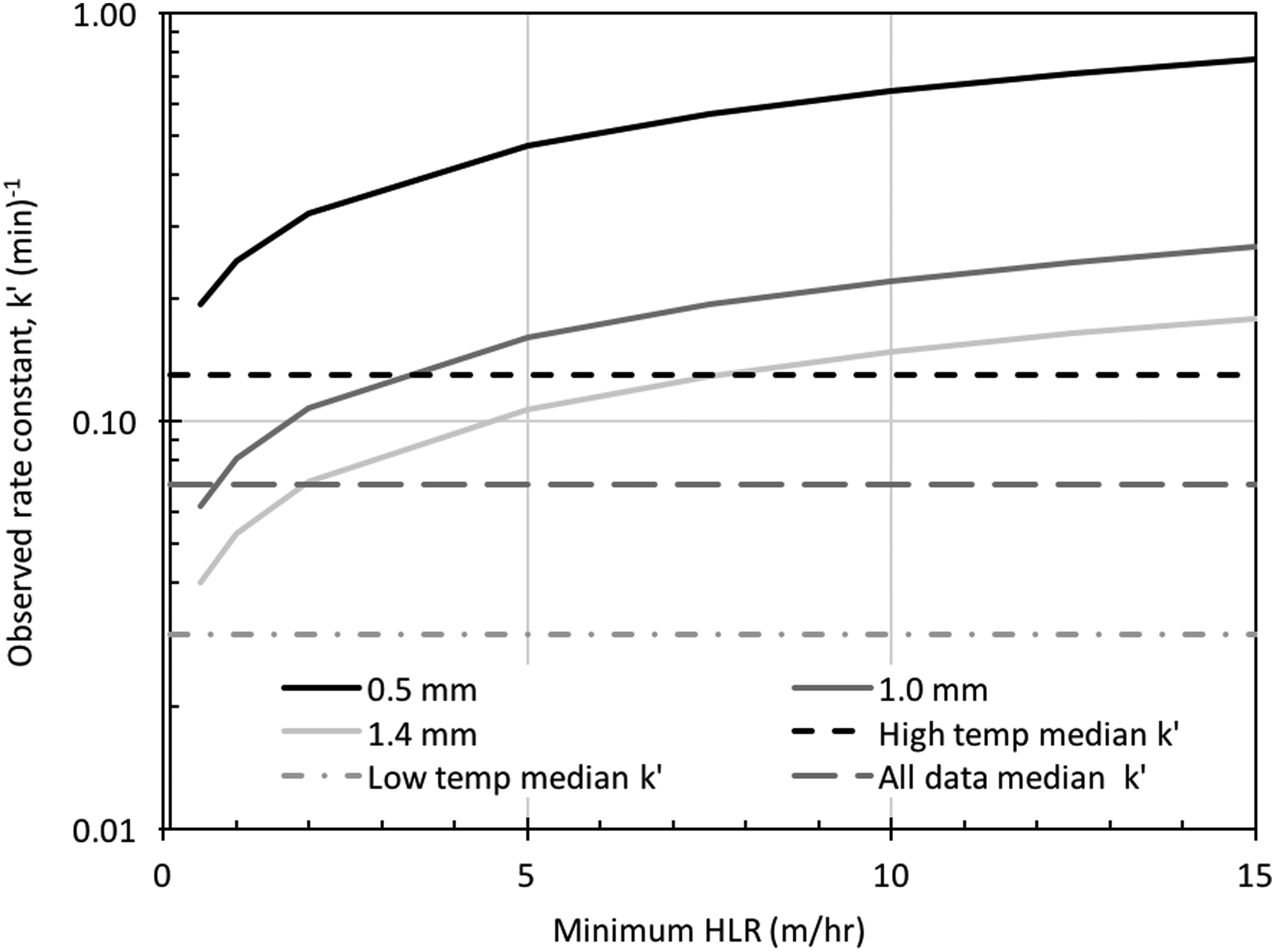
Minimum HLR needed to yield DaII = 0.1 as a function of observed first-order rate constant and media size at 20°C. HLR, hydraulic loading rate.
To assess the impact of external mass transfer experimentally, Wang and Summers (1994) used a continuous-flow biofilter with acclimated biomass attached to sand (diameter = 0.44 mm). They operated the biofilter at the HLR of 15 m/h (6.1 gpm/ft2), representative of the high end of a rapid rate filter, and sampled at depths of 1.4, 0.8, and 0.4 m. The DOC removal results are shown in Fig. 2. The HLR was reduced to 8, 5, and 1.5 m/h (3.3–0.61 gpm/ft2) and sampled at depths ranging from 1.4 to 0.05 m. The DaII values for these conditions ranged from 0.01 to 0.02. As shown in Fig. 2, at a given EBCT, the DOC removal performance was not affected by changing the filter velocity, thus demonstrating experimentally that external mass transfer did not constrain DOC removal in the range tested.
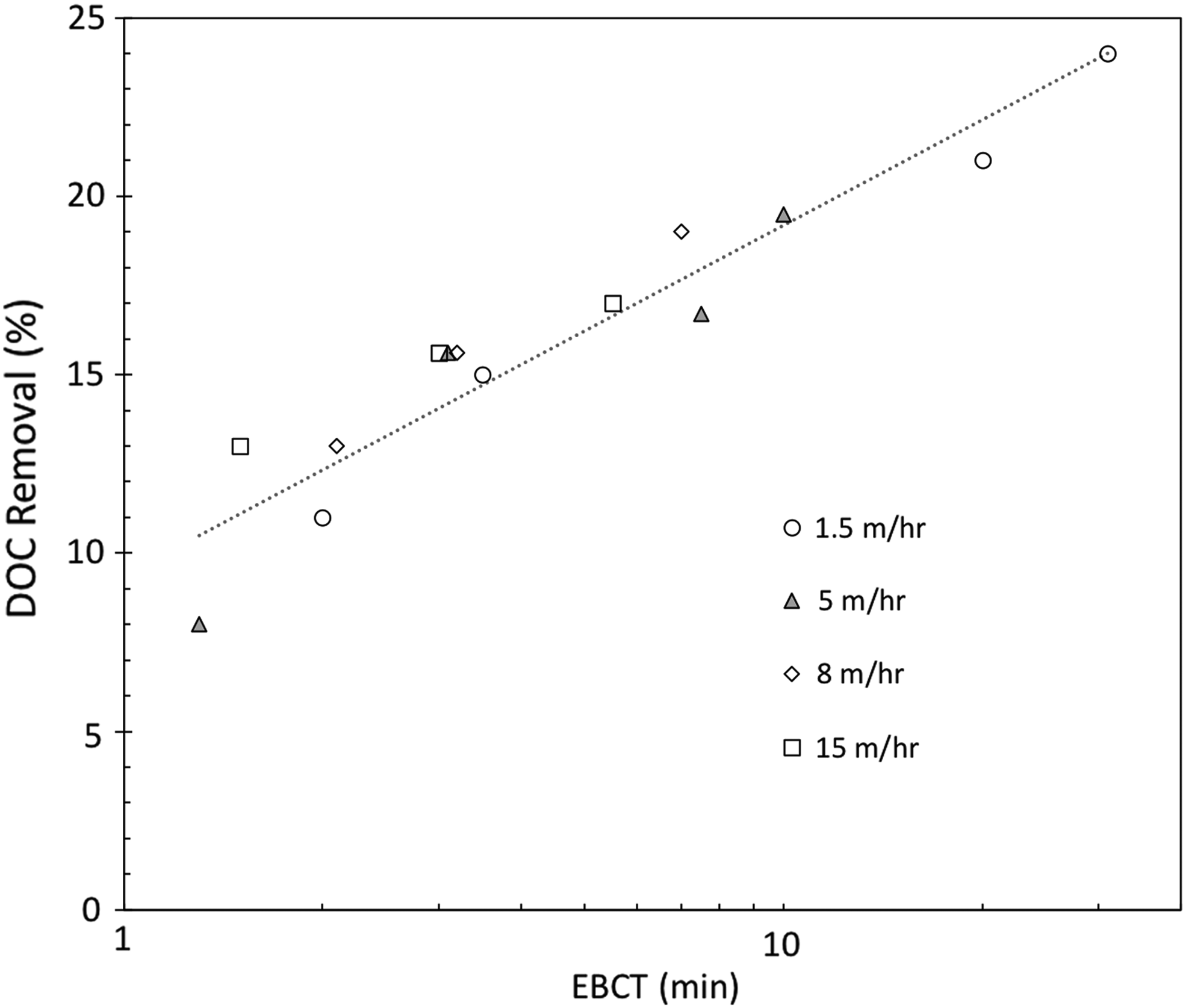
DOC removal as a function of EBCT at four filter velocities with sand media (based on data from Wang and Summers, 1994). EBCTs, empty bed contact times; DOC, dissolved organic carbon.
The objective of this study was to develop a bench-scale methodology that simulates pilot- or full-scale biofilter performance and to further demonstrate the role of mass transfer. The approach taken builds on the recirculating batch reactor method (Mogren et al., 1990) and combines it with the single-pass plug flow reactor method (Frías et al., 1992) to yield scalable results. The uniqueness of this method allows for controlling variables that often cannot be controlled at the pilot scale, for example, influent primary and secondary substrate concentrations, temperature, and replication. In addition, this methodology minimizes the volume of water required from the field. The methodology was tested for scalability of DOC removal in one DW and two WW effluents and of trace organic contaminant removal in one WW effluent.
Experimental Protocol
Experiments were performed at the University of Colorado, Boulder (CU-B), City of Boulder's Betasso Water Treatment Plant (Betasso WTP), and a water reclamation facility in Las Vegas, Nevada (LVNV-WWT). The Betasso WTP pilot-plant and the CU-B bench-scale DW experiments utilized untreated water from the Betasso WTP intake. CU-B pilot plant and bench-scale WW experiments utilized secondary treated WW effluent (before disinfection) from the City of Boulder 75th Street Wastewater Treatment Plant (Boulder WWTP). The Boulder WWTP uses primary treatment (bar screen, grit removal, and clarification), secondary treatment (with biological nitrogen removal), and ultraviolet disinfection. The LVNV-WWT pilot- and bench-scale filters were fed tertiary-treated WW before disinfection. The LVNV-WWT facility uses an advanced WW treatment process, including primary treatment (bar screen, ferric chloride coagulant, grit removal, anion polymer, and primary clarification), secondary treatment (with biological nitrogen and phosphorus removal), tertiary treatment (dual-media (anthracite/sand) filtration), and ultraviolet disinfection. General water quality parameters for all waters tested are provided in Supplementary Table S1.
Pilot-scale biofilters
The Betasso WTP pilot biofilters were packed with biologically active anthracite media from a full-scale filter, which was in operation for more than 7 years at the City of Longmont (CO) Nelson Flanders DW Treatment Plant. This acclimated anthracite media, with an effective size of 1.0 mm and an approximate uniformity coefficient of 1.3, was placed in clear PVC columns with an inner diameter (ID) of 7.6 cm and run as direct filtration with no chemical addition at a target HLR of 2.0 m/h. Sample ports were placed 50 and 100 cm below the top of the media to represent EBCTs of 15 and 30 min. The pilot-scale biofilters were operated for 6 months in which the temperature varied from 3°C to 19°C.
The pilot-scale biofilter at the LVNV-WWT facility was 15.2 cm (6 inch) ID clear PVC filled with 1.22 m of acclimated anthracite (1.4 mm effective size) over 0.3 m of sand and operated at a target HLR of 9.1 m/h to yield an EBCT of 10 min. The biofilter was operated for 18 months and data were collected from the last 4-month period in which the temperature varied from 14°C to 20°C.
The Boulder WWTP pilot biofilter was a series of four 1.5 cm ID glass columns filled with anthracite (1.0 mm effective size), which was acclimated to secondary WW effluent for 4 weeks at Boulder WWTP. The filter had sampling ports at the bottom of each column and the target HLR of 7.2 m/h yielded EBCTs of 3.3, 7.2, 11.2, and 15 min. The biofilter was operated at the CU-B laboratory for 6 weeks, fed with WW sampled twice per week in 200 L barrels, at laboratory temperature (22°C ± 1°C).
Bench-scale filters
Glass chromatography columns with Teflon caps (Ace Glass 5820-12 and 5820-24, Vineland, NJ) and stainless steel metal fittings (Swagelok Cleveland, OH) were used for all bench-scale biofilters. For the CU-B DW, biologically active anthracite media from the Betasso WTP pilot plant was packed into two 1.1 cm ID columns connected in series to a depth of 55 cm and operated at HLR of 2.2 m/h to yield EBCTs of 15 and 30 min. For WW biofilters, Boulder WWTP media was packed into three 1.5 cm ID columns connected in series. HLR varied from 2.6 to 6.8 m/h and media depth was adjusted to approximate the pilot column EBCTs. The bench-scale biofilter at the LVNV-WWT facility utilized a 5 cm ID column packed with acclimated anthracite media from the pilot plant that had been in use for 18 months for a previous experiment with the same source water. The biofilter was operated at the HLR of 3.0 m/h and sampled at the 10-min EBCT.
To prevent media loss or clogging, the bottom of each column was packed with 5 cm of support media (2-mm-diameter glass beads) supported by a wire mesh, and the columns were covered to minimize the growth of photosynthesizing microorganisms in the biofilters. Sampling ports were located immediately before and after each column to assess removal associated directly with the biofilter. The temperature of the CU-B DW bench-scale biofilters was regulated by a water chiller with capacity for cooling and heating. The feed water line passed through the chiller basin and the biofilters were wrapped with temperature-controlled tubing. The temperature at the LVNV-WWT facility was not controlled and was the same as the pilot plant: 14°C–20°C.
Recirculation/single-pass method
For both CU-Boulder and LVNV-WWT, the bench-scale biofilters were first operated in a recirculating batch mode (adapted from Gimbel and Maelzer, 1987; Joret et al., 1988; Mogren et al., 1990; and Frias et al., 1992) to determine the BDOC of the sample and then run in a single-pass mode to determine the biofilter performance at the targeted EBCTs, for example, 5, 10, or 30 min as seen in Supplementary Fig. S1.
Feed water was divided into two batches (4 L each for CU-Boulder, 50L each for LVNT-WWT). The larger volume for the LVNT-WWT was needed as the on-site bench-scale biofilter column diameter was 3.33 times larger than the others. One batch was used for recirculation to acclimate the media to the specific water matrix for a period of 5 days and the second batch was used for single pass (stored at 4°C until after the 5-day recirculation period ended). During the recirculation period, BDOC can be measured using the 5-day biofilter column test adapted from Mogren et al. (1990). BDOC is determined by subtracting the DOC remaining after 5 days of recirculating the feed water through a bioacclimated column at room temperature from the initial DOC of the feed water.
The recirculation approach reduced the amount of water needed for the experiment by 80%, compared with a 5-day single-pass operation. Following the recirculation period, the second half of the feed water (the batch stored at 4°C) was run in a single-pass mode for 4 h under the same flow and HLR conditions as during recirculation, and then sampled to determine biofilter performance.
CU-B WW biofilters were operated in a single-pass mode without recirculation to study the impact of HLR on DOC removal. For each HLR, the biofilter was acclimated in single pass for 2 days followed by sampling at 2 and 3 days. To minimize carryover effects between each HLR test run, the biomass was redistributed by emptying the media in each column, gently mixing and repacking, and then backwashing (∼10% bed expansion for ∼1 min). Feed water for the bench-scale biofilter was drawn from the same reservoir as the pilot biofilter.
DOC analysis
DOC concentrations were measured with a Sievers M 5310 C Laboratory Organic Carbon Analyzer using the ultraviolet irradiation/persulfate oxidation method (SM 5310C). The samples were collected and immediately filtered through a 0.45 μm membrane filter (Pall Life Sciences). Filters were first rinsed with 250 mL of reverse osmosis water to ensure that carbon leaching from the filters did not occur.
Trace organic analysis
For LVNV-WWT, the trace organic compounds were measured through solid-phase extraction, liquid chromatography/tandem mass spectrometry with isotope dilution, and analytical protocols based on previously published methods (Vanderford et al., 2003; Trenholm et al., 2006, 2008, 2009; Vanderford and Snyder, 2006; Mawhinney et al., 2011). Tandem mass spectrometry of the analytes and their isotopic surrogates was performed using an API 4000 triple-quadrupole mass spectrometer.
Statistical analysis
Nonparametric statistical analysis was utilized to compare treatment performance at each EBCT for the LVNV-WWT and Boulder WWTP effluents because the data sets were determined to be non-normal. The Kruskal–Wallis one-way Analysis of variance (ANOVA) was used to test for equality of means among multiple data sets. For positive results, the Wilcoxon–Mann–Whitney test was used for post hoc multiple comparison testing until all significant differences were identified. Data sets were considered significantly different for p < 0.05.
Results and Discussion
Calculated DaII values for the pilot- and bench-scale biofilters at all HLRs tested were all less than 0.1 (0.01–0.09), indicating that substrate utilization was reaction rate limited and not mass transport rate limited (Supplementary Table S2). Thus, the performance at the bench scale should represent that at the pilot scale.
The scale-up methodology for DOC removal was evaluated at the Betasso WTP facility using untreated source water. Temperature varied seasonally at the pilot scale and was a systematic change at the bench scale. For the pilot scale, results were averaged for the specific temperature bin ±1°C (i.e., for 5°C bin, results were the average removal for temperatures within the range of 5 ± 1°C from the pilot facility). The DOC removal results at the bench and pilot scale for each EBCT and temperature range are shown in Fig. 3, with error bars representing standard deviation of the data. Increased temperature yielded higher DOC removal at both scales. At all temperatures, DOC removals for the 15-min EBCT at the bench (n = 2) and pilot scale (n = 3) were similar based on the overlap of the sample standard deviations. Given the small sample size, a formal statistical analysis could not be carried out. At 30-min EBCT, the bench-scale results (n = 2) were systematically higher by a delta of 2% than those at the pilot scale (n = 3). The DOC removal difference at 14°C had a delta of 3%. At 5°C and 30-min EBCT, DOC removal averaged to 12% removal at the pilot scale and 10% at the bench scale, comparable with literature data (LeChevallier et al., 1992; Urfer et al., 1997; Emelko et al., 2006). At 22°C and 30-min EBCT, DOC removal averaged 22% removal at the bench scale, but the pilot scale did not experience temperatures higher than 18°C. Experimental results indicate that the recirculation/single-pass bench-scale methodology yields results similar to those at the pilot-scale flow-through systems, yet more validation is needed for multiple waters and contaminants.
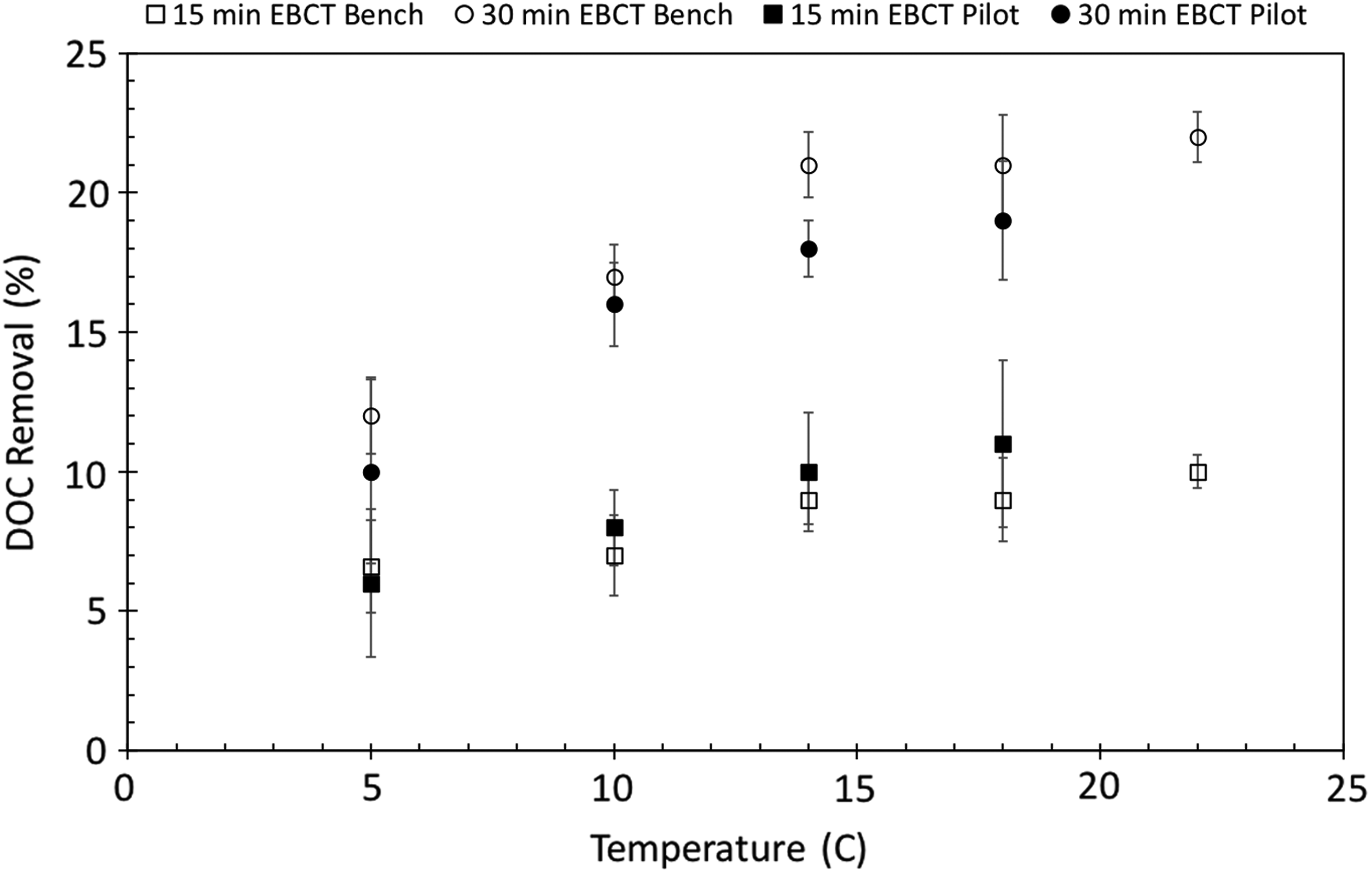
Bench scale (recirculation/single-pass method) compared with pilot scale (single pass) for DOC removal at CU-B (pilot-scale influent DOC 2.1–7.0 mg/L, bench-scale influent DOC 2.5–3.5 mg/L). CU-B, Colorado, Boulder.
To further validate the relationship between recirculation/single-pass bench-scale method and pilot-scale flow-through experiments, DOC and trace organic contaminant removal from WW effluent was evaluated at the LVNV-WWT facility with 10-min EBCT biofilters. Samples for the bench and pilot scale were collected within the same time period, February and May 2016, so temperature is not likely a factor in comparing the removal performance between system scales. The on-site bench-scale system was utilized four times during this period with a volume of 50 L to evaluate the removal performance. The pilot-scale system was also sampled four times during this 4-month period.
Initially, a group of 17 trace organic contaminants were selected for evaluation based on usage classes, chemical structures, partitioning behavior, and biodegradation (Zearley and Summers, 2012). However, only 14 of these compounds occurred in the biofilter influent at levels consistently above the detection level. The median trace organic contaminant concentrations in this WW effluent ranged from 2.0 ng/L for gemfibrozil to 42 μg/L for sucralose and the average coefficient of variance was 0.28. The average (n = 4) percent removal of 14 measured trace organic contaminants for the pilot-scale HLR = 9.1 m/h and bench-scale HLR = 3.0 m/h, biofilters are shown in Fig. 4. Error bars are one standard deviation above and below the average. Data marked with asterisks indicate a statistically significant difference (p = 0.05) between the removal achieved by the bench- and pilot-scale biofilters.
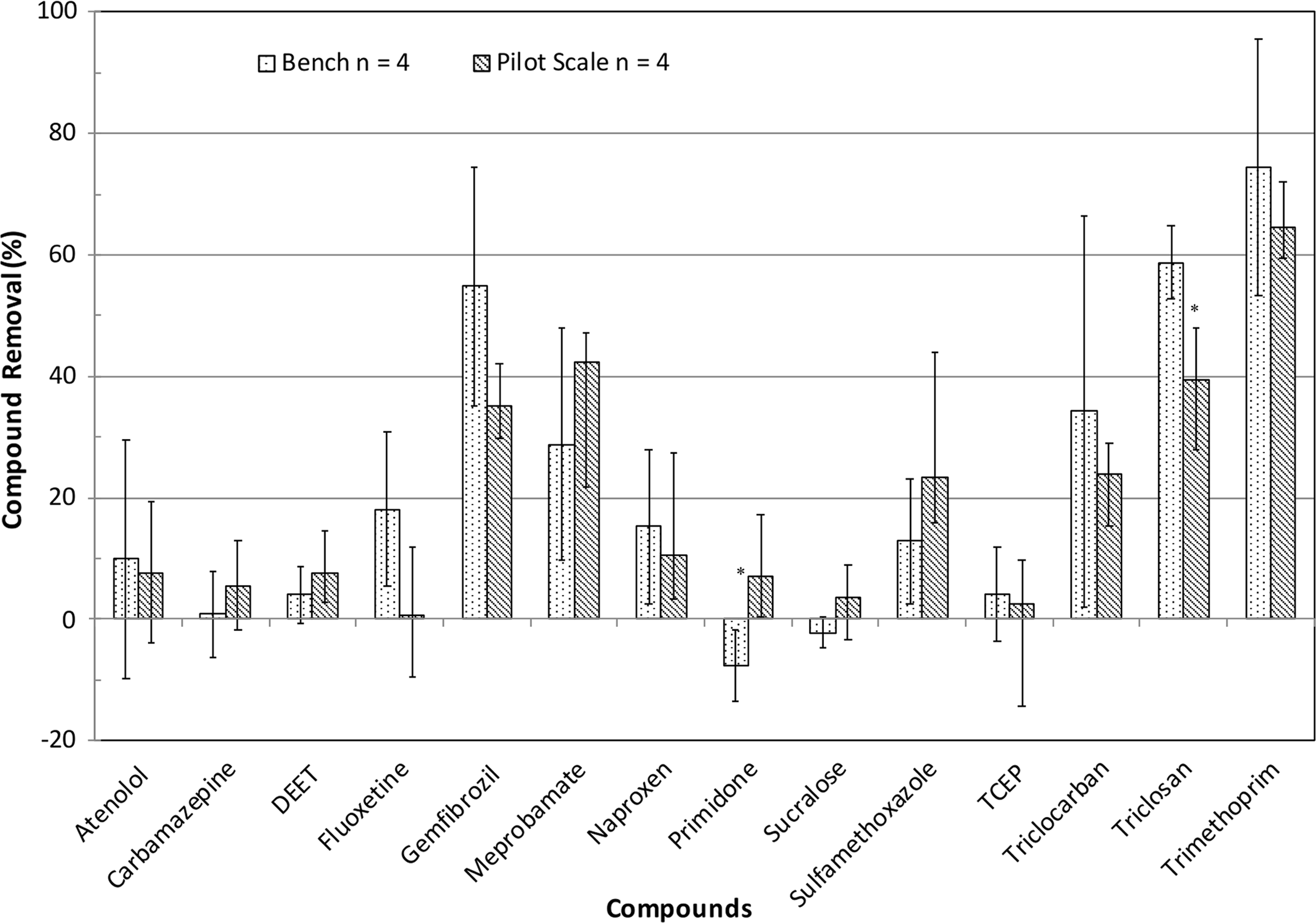
Average removals of experimental trace organic contaminants for bench- and pilot-scale filters. Data bars marked with asterisks indicate a statistically significant difference (p = 0.05) between the removal achieved by the bench- and pilot-scale filters.
For 12 of the 14 compounds shown in Fig. 4, there is no significant statistical difference (p = 0.05) between the average removal achieved at the bench and pilot scales. This indicates that the recirculation/single-pass bench-scale biofiltration performs similarly to the pilot-scale flow-through biofiltration in terms of trace organic contaminant removal. Even with a significant difference between the bench-scale (59%) and pilot-scale (39%) removals for triclosan, the other 13 compounds included in this experiment showed similar removal and the expected compound removal trends are consistent with previous results (Snyder et al., 2007; Teerlink et al., 2012; Zearley and Summers, 2012; Hallé et al., 2015). The DOC removal was also measured for two sampling events at the pilot scale, and it was 9%, while at the bench scale it was 12%, a delta of 3%, and the BDOC was 18%. The low BDOC values were a result of tertiary biofiltration application at the full-scale plant, which was upstream of the pilot- and bench-scale systems. Full-scale biofiltration yielded 19% DOC removal.
To support the theoretical understanding that the bench-scale results are controlled by reaction rate and not mass transfer rate, pilot- and bench-scale columns were operated simultaneously with the Boulder WWTP effluent. The pilot biofilter was operated at a constant HLR (7.2 m/h) representing a typical full-scale rapid media biofilter, and the bench-scale biofilter was operated at four lower HLRs (2.6, 3.7, 5.7, and 6.8 m/h) to represent a scaled down condition. The pilot-scale biofilter feed water DOC was 8.8 ± 0.9 mg/L, the BDOC was 33% (n = 4), and the temperature was 15.5°C ± 0.5°C at collection and brought to laboratory temperature, 22°C ± 1°C, before testing. The bench-scale biofilter was operated continuously during the same time period as the pilot-scale biofilter, in the recirculating batch mode between experiments and in a single-pass mode for each HLR experiment.
DOC removal at pilot and bench scales is shown in Fig. 5. For the bench-scale results at HLRs of 2.6–6.8 m/h, the DaII values were 0.014–0.022 and there was no evidence of an impact of HLR on DOC removal, indicating that mass transfer did not control the overall DOC removal. While the average pilot-scale DOC removal was systematically higher by an average delta of 2% than that at the bench scale, in only 1 of the 10 bench-scale cases were the results statistically different from the pilot column (p = 0.05). At the bench scale, similar DOC removal was also observed when the data are directly compared at a similar EBCT. Of the 12 bench-scale results, 10 were operated at a similar EBCT (±1 min) to the pilot column.
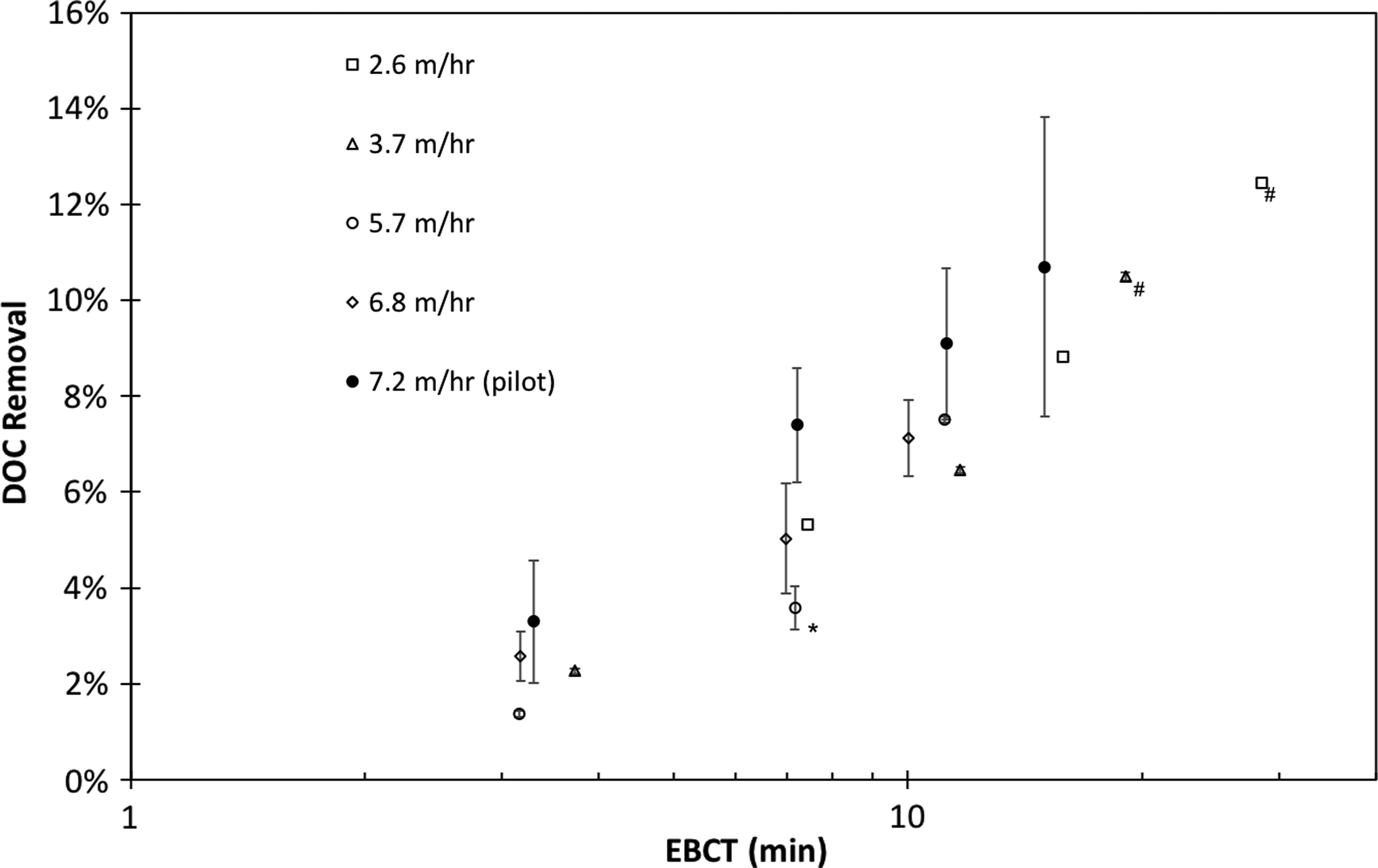
Average DOC removal for pilot- and bench-scale columns operated at different HLRs. The error bars represent the standard deviation for pilot- and bench-scale results. Data marked with an asterisk indicate a statistically significant difference (p = 0.05) and bench-scale data marked with a pound were not directly compared with pilot results.
Summary
Biofilter results at three locations with a range of EBCTs, 3–30 min, demonstrate that the recirculation/single-pass method at the bench scale produces removal results similar to those of flow-through pilot-scale biofilters and can potentially serve as an alternative to pilot-scale testing for removal of dissolved organics. The robustness of the method was verified with DOC removal in DW and DOC and trace organic contaminant removal in WW effluents. The average absolute difference (delta) between bench- and pilot-scale results for 14 comparisons was 2% for DOC removal. The experimental results at a range of biofilter HLRs with a WW effluent and in DW confirmed that at DaII values less than 0.1 the biofilters were reaction rate limited with little contribution from mass transfer. This allows for the use of lower HLRs and biofilter media depths at the bench scale in this scale-up methodology.
Footnotes
Acknowledgments
The first, third, and last authors were funded through the U.S. EPA Science to Achieve Results (STAR) Grant (#83560301) as part of the Design of Risk-reducing, Innovative-implementable Small-system Knowledge (DeRISK) Center. The first author was also funded by the U.S. EPA STAR Fellowship (Grant #11913593). The second and fourth authors were funded by the Water Research Foundation (Project #4559). Any opinions, findings, and conclusions or recommendations expressed in this material are those of the authors and do not necessarily reflect the views of any other organization. The authors also thank the following personnel at the Southern Nevada Water Authority for pilot plant and analytical support: Mandu Inyang, Mac Gifford, Marco Velarde, Brett Vanderford, Oscar Quiñones, Janie Zeigler-Holady, and Brittney Stipanov.
Author Disclosure Statement
No competing financial interests exist.
References
Supplementary Material
Please find the following supplemental material available below.
For Open Access articles published under a Creative Commons License, all supplemental material carries the same license as the article it is associated with.
For non-Open Access articles published, all supplemental material carries a non-exclusive license, and permission requests for re-use of supplemental material or any part of supplemental material shall be sent directly to the copyright owner as specified in the copyright notice associated with the article.
