




Abstract
Abstract
Activated carbon is a versatile sorbent and effective contaminant removal media due to its complex porous structure and high surface area. The main purpose of this research is to increase the uptake of perfluoroalkyl and polyfluoroalkyl substances (PFAS) through modifications of granular activated carbon (GAC) by chemical treatment. To increase the adsorption of perfluorooctanoic acid (PFOA) and perfluorohexanesulfonic acid (PFHxS) onto GAC, the surface characteristics of two types of GAC from Calgon Carbon Corporation (charcoal-based Filtrasorb-F400 and coconut-based OLC 12 × 30—CBC) were chemically modified. Two GAC were treated with acid (hydrochloric acid [HCl]), base (sodium hydroxide [NaOH]), heat activated persulfate (PS), and hydrogen peroxide catalyzed with iron (H2O2/Fe). The extent of adsorption after 2-, 5-, and 10-day reaction time and the changes in carbon surface physical and chemical characteristics of treated GAC were compared with untreated GAC. Several characterization techniques, including Brunauer–Emmett–Teller surface area, pH of point zero charge, scanning electron microscopy with elemental analysis, and Fourier transform infrared spectroscopy, were used to analyze treated and untreated GAC. The extent of adsorption of both PFHxS and PFOA increased (7–8% in F400 and 6–9% in CBC) with HCl treatment likely due to increase in positive charge density, had no significant change with NaOH treatment, and decreased with PS (22–25% in F400 and 27–35% in CBC) and H2O2/Fe (4–8% in F400 and 12–13% in CBC) treatment. All the treated GAC had lower BET surface area compared to untreated GAC which is the main physical property deemed responsible for decreased adsorption. It was found that surface oxygen functional groups increased with treatments and decreased the hydrophobicity of the GAC surface, which resulted in lower PFAS adsorption.
Introduction
P
Recent research evaluating treatment processes for removal of PFAS from water sources has indicated that most conventional techniques are ineffective in destroying PFAS, while adsorption by carbon can effectively remove various PFAS from aqueous matrices (Ochoa-Herrera and Sierra-Alvarez, 2008; Yu et al., 2009; Carter and Farrell, 2010; Senevirathna et al., 2010a, 2010b; Takagi et al., 2011; Zhang et al., 2011).
Moreover, adsorption by activated carbon appears to be currently one of the most viable options for PFAS removal in real world applications. Most of the research has investigated adsorption of perfluorooctanoic acid (PFOA) and perfluorooctanesulfonic acid (PFOS), although more recent work has also investigated PFAS precursors and other PFAS (Eschauzier et al., 2012). Both powdered activated carbon and granular activated carbon (GAC) have relatively high affinity for PFOS and PFOA; however, several researchers have demonstrated that activated carbon may be less effective for shorter chain PFAS (Ochoa-Herrera and Sierra-Alvarez, 2008; Eschauzier et al., 2012). Weak interaction between PFAS and the GACs sorbent surface is the key factor that may limit the treatment effectiveness of GAC. Therefore, techniques to improve the affinity of PFAS for GAC may be beneficial for both effective and economical treatment of PFAS (Zhi and Liu, 2016).
It is necessary to understand the various factors that influence the adsorption capacity of carbon sources before the modification (Yin et al., 2007). Adsorption affinity for the surface of an adsorbate depends on the physical characteristics of carbon such as specific surface area, pore size distribution, pore volume, and shape; chemical characteristics such as presence of surface functional groups, point of zero charge, acidity, and basicity; as well as the chemical structure of the sorbate (Karanfil and Kilduff, 1999; Yin et al., 2007; Zhi and Liu, 2015). Physical properties of carbon sources depend and vary on the raw material and the activation conditions during production (Marsh and Rodrigues-Reinoso, 2006; Yin et al., 2007).
Because of extensive surface area, properly developed microporous structure, and existence of a vast range of surface functional groups, activated carbon has unique adsorption properties and is a successful adsorbent for the removal of various organic and inorganic contaminants (Yin et al., 2007; Zhi and Liu, 2016). Activated carbon can be produced from various carbonaceous raw materials, such as coal, wood, nut shells, lignite, peat, and coconut shells (Karanfil and Kilduff, 1999; Marsh and Rodrigues-Reinoso, 2006).
The activated carbon structure consists of carbon atoms which are arranged in parallel stacks of hexagonal layers (Karanfil and Kilduff, 1999). There are many reactive sites available at the edges, dislocation, and discontinuities in the activated carbon structure (Marsh and Rodrigues-Reinoso, 2006). These active centers contain carbon atoms with unpaired electrons and unsaturated valencies that can chemically interact with different heteroatoms such as oxygen, hydrogen, nitrogen, and sulfur as single atoms or surface functional groups which are responsible for the surface reactivity (Karanfil and Kilduff, 1999; Marsh and Rodrigues-Reinoso, 2006).
Oxygen is the most important heteroatom in the carbon structure. Carboxyl, carbonyl, phenols, enols, lactones, and quinones are some of the oxygen-containing functional groups as also may be present (Karanfil and Kilduff, 1999; Marsh and Rodrigues-Reinoso, 2006; Roque-Malherbe, 2010). These oxygen-containing surface groups in activated carbon can be categorized depending on acidic, basic, and neutral characteristics. Acidic groups include carboxyl, lactone, and phenol; and basic characteristics are linked with pyrone, ether, and carbonyl groups (Marsh and Rodrigues-Reinoso, 2006; Yin et al., 2007; Roque-Malherbe, 2010). The neutral functional groups have been identified as ethylene type unsaturated sites on the carbon structure (Marsh and Rodrigues-Reinoso, 2006).
Furthermore, activated carbon surfaces contain minerals such as calcium, sulfate, and phosphate ions, which have an influence on the adsorption capacities, as well as surface properties such as zeta potential and specific surface area (Julien et al., 1998; Marsh and Rodrigues-Reinoso, 2006).
Recent studies have focused on modifying the specific properties of GAC to enhance its effectiveness and enhance affinity of GAC for certain contaminants (Karanfil and Kilduff, 1999; Babel and Kurniawan, 2004; Goel et al., 2005; Huling et al., 2005, 2007, 2009; Yin et al., 2007; Kan and Huling, 2009; Zhi and Liu, 2016). For example, detailed investigations have been carried out with acidic treatment to introduce acidic functional groups onto the surfaces of activated carbon, because it has been found to be the main factor that controls the uptake of metal ions (Karanfil and Kilduff, 1999; Yin et al., 2007; Huling et al., 2009; Kan and Huling, 2009).
According to Yin et al. (2007), carbon modification techniques are categorized into three main groups, including chemical, physical, and biological modifications. These modifications are further divided into subgroups as per the available treatment techniques. Treatment with acid, base, and impregnation of foreign material are chemical modification techniques (Karanfil and Kilduff, 1999; Yin et al., 2007). Physical modification includes thermal treatment, and bioadsorption or adsorption of microorganisms is the technique available for biological modification of activated carbon (Yin et al., 2007). Despite the availability of small fraction of active sites with functional groups compared to total surface area, a large impact on adsorption capacity can result from a small change in surface chemistry (Marsh and Rodrigues-Reinoso, 2006).
PFAS exist as anions at environmentally common pH values (5–8) due to their low pKa values (Zhi and Liu, 2016). Therefore, increasing basicity through surface modification may increase the removal efficiency of PFAS anions (Zhi and Liu, 2016). Treating GAC with oxidizing agents introduces oxygen surface complexes that make the carbon surface more hydrophilic and acidic, which increase surface charge density and decrease the pH of point zero charge (Moreno-Castilla et al., 2000). This may increase the electrostatic repulsion and decrease adsorption of PFAS to some degree because PFAS adsorption onto activated carbon occurs mainly through hydrophobic interactions (Johnson et al., 2007; Du et al., 2014).
Moreover, it was reported that modification of carbon surfaces using oxidation reactions, including hydrogen peroxide (H2O2) and ammonium persulfate (PS), introduced the specific surface functional groups to enhance removal of contaminants (Yin et al., 2007). In addition, various classes of zwitterionic and cationic PFAS were also identified in groundwater (Backe et al., 2013). Hence, chemical modification of GAC surfaces through different technologies may affect removal of different classes of PFAS. It is important to be able to relate changes in adsorption of PFAS to changes in GAC properties. Therefore, a detailed description of general GAC properties and modification methods was included in the introduction.
In this study, the surfaces of two types of GAC (F400-charcoal based and CBC-coconut based) were chemically modified with hydrochloric acid (HCl), sodium hydroxide (NaOH), H2O2 activated with iron (III) perchlorate, and sodium persulfate. PFOA and perfluorohexanesulfonic acid (PFHxS) were chosen as the representative PFAS. The amount of PFOA and PFHxS sorbed onto both treated and untreated GAC was compared after 2, 5, and 10 days of reaction time.
Characteristics of treated and untreated GAC, including Brunauer–Emmett–Teller surface area, point of zero charge, scanning electron spectroscopy, and FTIR analysis, are also presented. This study only focuses on how the modifications of GAC surface affect the adsorption of PFAS. Influences of groundwater conditions and co-contaminants on sorption of PFAS to GAC were investigated in a separate study (Siriwardena, 2017). The results of this work allow for a better understanding of how the physical and chemical characteristics of GAC surfaces change after different treatment methods.
Materials and Methods
Chemicals and materials
Two perfluoroalkyl acids, including PFOA (C8F15HO2, 98%) and PFHxS potassium salt (C6F13KO3S, ≥98%), were obtained from Sigma-Aldrich Co. It was previously reported that both the length and functionality of the head groups of PFAS have an effect on sorption (Higgins and Luthy, 2006; Wang et al., 2012). The sulfonic group is more hydrophobic than the carboxylic group even though they have the same carbon chain length (Higgins and Luthy, 2006). Therefore, PFOA and PFHxS, which have different head groups and a different number of fluorinated carbons, were chosen for this study to compare the adsorption behavior.
Deionized (DI) water was used to prepare the reaction solutions. Linear perfluoroalkylcarboxylic acids and sulfonates were purchased from Wellington Laboratories (Guelph, ON, Canada) and used for standards. A series of 13C-labeled PFAS were used for quantification (internal) standards consisting of perfluoro-1-hexane[18O2] sulfonate (MPFHxS) and perfluoro-n-[1,2,3,4–13C4] octanoic acid (MPFOA). Stock solutions of each individual standard or mixtures supplied by the manufacturer were prepared by diluting the original in methanol High Performance Liquid Chromatography (HPLC) grade.
All the original standards and stock solutions were stored in a refrigerator (∼4°C) in amber vials covered with aluminum foil. HCl (Technical grade), NaOH (≥97.0), and sodium persulfate (NaS2O8, >98%) were obtained from Sigma-Aldrich Co., and H2O2 (30.9%) from Fisher Scientific was used for the proposed experiments. DI water was used to prepare all the reaction solutions.
One coal based GAC (GAC-FILTRASORB F400) and one coconut-based GAC (CBC-OLC 12 × 30) were obtained from Calgon Carbon Corporation. Preliminary isotherm studies were carried out to select the best performing GAC source for adsorption of PFAS (Siriwardena, 2017). As per the preliminary experiment results, F400 was the best-performing coal-based carbon and that was chosen for this study. CBC was chosen as contrasting properties based on differences in source to investigate adsorption behavior of PFAS depending on raw material. The differences in the basic properties of coconut-based and coal-based carbon are pore types and functional groups. It was reported that CBC has more micropores (<2 nm), and coal-based carbon has more mesopores (2–50 nm) and macropores (>50 nm) (Schaeffer and Potwora, 2008).
In addition, it was noted that CBC has abundant functional groups on the surface (Li et al., 2011). Each carbon type was cleaned by first rinsing in DI water thrice, then washing in 80°C DI water for 2 h, and finally oven drying at 105°C for 48 h. The dried carbon was crushed by mortar and pestle and passed through a 0.42–1.0 mm sieve (Yu et al., 2009; Senevirathna et al., 2010a).
Methods
Treatment of GAC
F400 and CBC were modified using catalyzed H2O2, acid treatment, base treatment, and heat activated persulfate treatment. One hundred milliliters of 1 M HCl, 100 mL of 1 M NaOH, and 100 mL of 10% solution of H2O2 and iron (III) perchlorate (10:1 ratio) were added to glass vials containing 2.5 g of GAC (F400 and CBC) separately. The containers were covered and kept at room temperature for 24 h.
For heat activated persulfate treatment, 0.1 g of Na2SO4 was dissolved in 100 mL of DI water and added to glass vials containing 2.5 g of GAC and kept in the oven at 80°C for 24 h. After 24 h, the excess solution was decanted, and the carbon was rinsed thoroughly with DI water thrice and placed in the oven at 105°C for 48 h. Finally, treated GAC was used for adsorption experiments, and the effect of treatment on the adsorption of PFAS was evaluated after 2, 5, and 10 days. Two samples were collected at each time period and analyzed.
Adsorption of PFAS to treated and untreated carbon
Adsorption of PFOA and PFHxS in mixture (1 mg/L each) onto 10 mg of each of the two carbon types, both treated and untreated, was evaluated in 125 mL of DI water in 125 mL polypropylene reactors. The sample pH was controlled around 7.2 using 0.1 M phosphate buffer. Reactors were tumbled at 145 rpm and sampled at 2, 5, and 10 days (these time points were selected based on adsorption isotherms of PFAS) (Supplementary Materials and Methods, Supplementary Table S1). Samples were analyzed by ultra-performance liquid chromatography equipped with a quadrupole time-of-flight mass spectrometer (UPLC-QToF-MS) as described below.
The amount of PFAS adsorbed by each T (treated) and UT (untreated) GAC was calculated using the Equation (1), and the percent difference in adsorption of treated GAC relative to untreated GAC was determined using Equation (2). In addition, the mass of PFAS adsorbed per BET surface area was calculated using Equation (3).
where Q = the amount of solute adsorbed from the solution (mg/g), V = volume of the adsorbate (mL), W = the weight in grams of the adsorbent, Ccon = the concentration of the control sample after the adsorption time period, and Ce = the equilibrium concentration of the samples after the adsorption time period.
Sample preparation and analytical method
For sample preparation, a collected aliquot at each selected time interval was filtered through a 0.2 μm nylon syringe filter. (Control samples were carried out with all the conditions and went through the same procedure as samples, including filtering. The loss due to use of nylon syringe is less than 5% and in acceptable level.) Samples were diluted 50-fold in HPLC-grade water for UPLC-QToF-MS analysis. At the final step, 0.1 mL of the diluted sample, 2 ng (50 μL of 40 ng/mL) of injection standard, 450 μL of 100% methanol, and 1 mL of HPLC grade water were added to a 2 mL vial before injection.
A Waters ACQUITY UPLC with a Xevo G2 QToF mass spectrometer was equipped with a 2.1 × 100 mm ACQUITY HSS T3 1.8 μm column and 100 μL injection loop. All Teflon lines were replaced with polyetheretherketone tubing. An isolator column was placed directly after the mobile phase mixing chamber but before the syringe to delay the elution of solvent derived background. Mobile phases consisted of 0.1% formic acid in water (A) and methanol (B) at a flow rate of 0.450 mL/min. After full loop injection, the initial gradient, 75% A, was held for 1 min, 40% A by 1.5 min, 1% A by 9.5 min, 100% B by 9.6 min and held until 17.0, and returned to the initial composition of 75% A by 18.5 min. Flow was directed to waste during the column flush (13–19.5 min) and re-equilibration to 75% A for 1 min (18.50–19.50 min) before the next run.
The Xevo-QToF was set to negative polarity in sensitivity mode (>10,000 FWHM) with the extended dynamic range option selected. The capillary, sampling, and extraction cone voltages, source, and desolvation temperatures were set to 1.9 kV, 60 V, 4.0 V, 120°C, and 250°C, respectively, with a desolvation gas flow of 750 L/h. The QToF was alternated between three data acquisition functions (MSe), to simultaneously collect (1) a low energy scan consistent with a standard time-of-flight spectrum from 50 to 1,000 Da (F1), (2) a high energy scan (F2) applying a collision energy ramped from 15 to 35 eV using argon as a collision gas, and (3) lock mass utilizing fragments 236.1035 and 554.2615 m/z of leucine enkephalin.
The first two functions provide complementary spectra for a given peak, creating typical precursor ion fragments (F1) and potential product ions (F2) during a given run. Applying collision energy, the second function further fragments parent ions relative to F1 providing a simultaneous high-resolution precursor (F1) and product (F2) characterization/confirmation of the compound of interest. The QToF was calibrated daily using sodium formate clusters (100–1,000 m/z) (Crimmins et al., 2014). The limit of detection (LOD) for PFOA and PFOS was 0.14 and 0.09 ng/mL, respectively, and the limit of quantification (LOQ) was 0.46 and 0.31 ng/mL, respectively. LOD and LOQ were calculated using linear regression method (Shrivastava and Gupta, 2011).
Characterization of GAC
Characterization of GAC was carried out to understand what factors relate to measured differences in adsorption of PFAS onto treated and untreated GAC. The BET surface areas of the GACs were measured by gas adsorption isotherms by a volumetric method using a Micromeritics ASAP2020 surface area and pore analyzer.
The pH drift method was used to determine the pH at point of zero charge (pHpzc) (Kan and Huling, 2009). Fifty milliliters of 0.01 M NaCl solution was placed in 100 mL amber vials. The pH was adjusted to each value between 2 and 9 with 0.1 M HCl or 0.1 M NaOH solutions, and nitrogen was sparged through the solution to stabilize the pH by preventing the dissolution of CO2. Then, 0.15 g of GAC was added to the solution, and the vial was capped immediately. The equilibrium solution pH was measured after 48 h and plotted versus the initial pH. The pH at which the curve crossed the line pHinitial = pHfinal was taken as the point of zero charge (Kan and Huling, 2009).
Scanning electron microscopy (SEM) was used to examine the morphology of the treated and untreated GAC. The specimens were examined under the secondary electron imaging mode using a JEOL JSM-7400F electron microscope coupled with an Energy Dispersive X-Ray Detector (EDX). The lower electron image detector was used for taking images. The composition of the solids was evaluated by transmission furrier transform infrared (FTIR) spectra obtained with a BRUKER Vector 22 spectrophotometer.
Results and Discussion
Adsorption of PFAS to treated and untreated carbon
The batch experiment result for extent of adsorption of PFHxS and PFOA mixture onto the two types of GAC (F400 and CBC) with four different treatments (HCl, NaOH, PS, and H2O2/Fe) is shown in Fig. 1. Out of all treatment methods, both the F400 and CBC GAC treated with HCl showed increased adsorption of both PFHxS and PFOA.
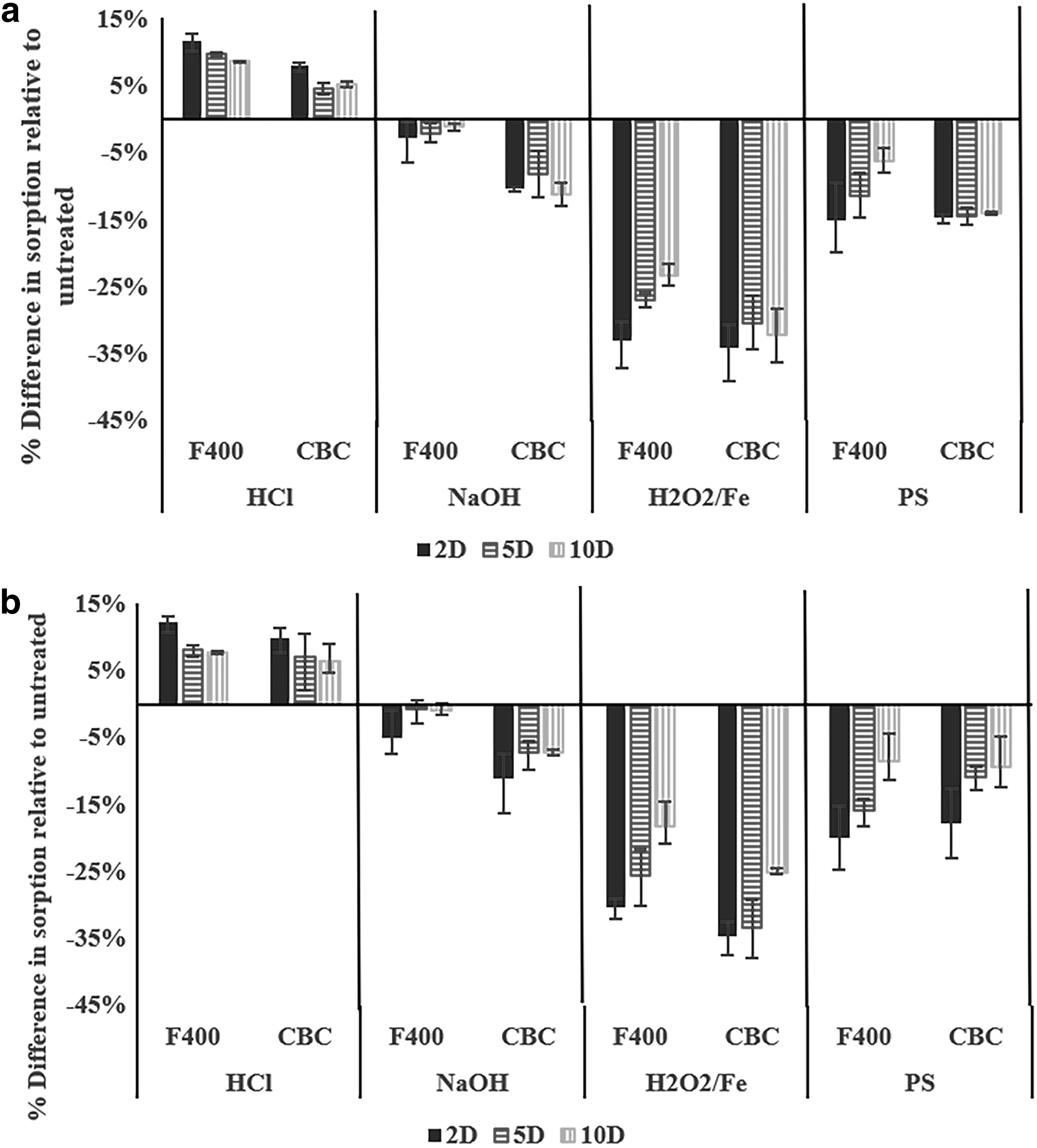
Percent difference in adsorption
The percent difference of adsorption on untreated GAC relative to the treated GAC is summarized in Table 1 after 2-, 5-, and 10-day reaction time. The extent of adsorption of PFHxS was increased by 8.6% ± 0.01% for the HCl treated F400, and 5.1% ± 0.6% for HCl treated CBC, after 10 days. The amount of sorbed PFOA increased by 7.6% ± 0.2% and 6.4% ± 2.5% for HCl treated F400 and CBC, respectively, after 10 days.
Percent Difference of Adsorption on Treated Granular Activated Carbon Relative to Untreated Granular Activated Carbon
CBC, coconut-based carbon; GAC, granular activated carbon; H2O2, hydrogen peroxide; HCl, hydrochloric acid; NaOH, sodium hydroxide; PFHxS, perfluorohexanesulfonic acid; PFOA, perfluorooctanoic acid; PS, persulfate.
For all other three treatments (NaOH, PS, H2O2/Fe), the extent of adsorption decreased. The greatest decrease in adsorption was observed with H2O2/Fe treated GAC followed by PS treatment, for all cases. The decrease was around 20% for both PFHxS and PFOA with H2O2/Fe treated F400 and around 30% and 25% with H2O2/Fe treated CBC for PFHxS and PFOA. For NaOH treated F400 compared to the untreated control, there was no difference in the extent of adsorption of both PFHxS and PFOA. Mass of PFAS per mass of treated and untreated GAC and mass of PFAS per BET surface area results are summarized in Table 2, which showed a similar trend. In addition, percent removal of PFAS for all cases is included in Supplementary Table S2.
Mass of Perfluoroalkyl and Polyfluoroalkyl Substances Adsorbed per Mass of Treated Granular Activated Carbon and Mass of PFAS Adsorbed per Brunaver-Emmett-Teller Surface Area
BET, Brunauer–Emmett–Teller; UT, untreated.
Differences in the extent of adsorption are mainly attributed to the physical properties of GAC. The main factors for adsorption of PFAS onto GAC relate to the surface area and pore size distribution (Yu et al., 2009; Deng et al., 2012). As shown in the results in Table 3, treatment of both types of GAC resulted in a decrease in the BET surface area, pore volume, and pore width. This may be a result of pore blockage in the micropores caused during treatment due to modification of the textural characteristics of the untreated GAC (Yin et al., 2007). The highest decrease of BET surface area was obtained for H2O2/Fe treated GAC followed by PS treated GAC for both F400 and CBC. This is comparable with the reduction in the extent of adsorption results (Fig. 1). The iron precipitates formed as a result of activation can accumulate on the GAC surface and decrease the active surface area (Huling et al., 2007; Hutson et al., 2012; Zhong et al., 2015). This statement is supported by the results of SEM analyses as iron was detected in elemental composition analysis of H2O2/Fe treated samples, and a greater amount of iron was detected in the pores than the surface. However, SEM analysis was carried out with few points on GAC particles due to the high cost for the analysis, and data are limited. An accumulation of sulfur and sodium, which are sodium persulfate residuals, and sulfate anions, which is a by-product of persulfate oxidation, can result in the blockage of adsorption sites and decrease the contaminant adsorption (Hutson et al., 2012).
Characteristics of Treated and Untreated Granular Activated Carbon
BJH adsorption SA of pores (m2/g).
BJH adsorption pore volume (cm3/g).
BJH adsorption average pore width (4V/A) (Å).
BJH, Barrett-Joyner-Halenda; SA, surface area.
The pKa values of PFOA and PFHxS are around 2.8 (Agency, 2016) and 0.14 (Deng et al., 2012; Du et al., 2014), both lower than the controlled pH (7.2) used in this study. Therefore, PFOA and PFHxS mainly exist as anions at the pH of these experiments. The pH of point zero charge (pHpzc) of untreated F400 and CBC was found to be 6.1 and 7.5, respectively (Table 3). Thus, the surface of F400 tends to be more negatively charged resulting in electrostatic repulsion between F400 surface and PFAS anions and can decrease the adsorption capacity to some extent (Deng et al., 2012; Du et al., 2014).
In contrast, CBC has a weakly charged surface (pH ∼ pHpzc) with likely negligible electrostatic interactions (Tang et al., 2010). After HCl treatment, the pHpzc was slightly less for F400 and it decreased to 5.6 for CBC. Hence the electrostatic repulsion should increase. With NaOH treatment, the pHpzc increased for both F400 and CBC creating more positively charged surfaces with potential for increased electrostatic interactions. However, for both HCl and NaOH, treatments show the opposite effect, which demonstrates that electrostatic interactions have less influence on adsorption than hydrophobic interactions (Zhi and Liu, 2015). This effect may be because of the low pHpzc, which resulted from the acid treatment protonating the anionic PFAS making them even more hydrophobic; hence, the increased adsorption observed in the acid treated GAC.
Although the electrostatic effects may be altered by a change in pHpzc of the carbon, it may be even more influenced by the degree of protonation/hydrophobicity of the PFAS in the lower pHpzc of the acid-treated system. In addition, acid treatment can increase the positive charge on GAC surfaces with the existing pH range and increase the ability to interact with PFAS anions (Arias Espana et al., 2015). For both types of GAC, the pHpzc decreased to around 2 with H2O2/Fe and PS treatment creating negative charge on the GAC surfaces. This drastic reduction of pHpzc may increase the electrostatic repulsion and influence adsorption to some extent because H2O2/Fe and PS treatments show the greatest decreases in the extent of adsorption compared to untreated GAC.
Scanning electron microscopy
Figures 2 and 3 show the SEM images which primarily characterized the surface of F400 and CBC GAC types before and after treatment and the EDX pattern of untreated and H2O2/Fe treated GAC. Tables 3 and 4 present the weight percentage of each element present in treated and untreated F400 and CBC GAC, respectively. A complicated pore network, including small pores and cracks, can be seen over the GAC surface. Treatment affects surface structures differently for F400 and CBC GAC types. The treatments do not significantly change the morphology of F400 surface compared to the untreated F400. But CBC surfaces demonstrate some changes due to treatment. In comparison to the untreated CBC, pore widening can be seen in the HCl and PS-treated CBC, whereas small pore structures can be seen in NaOH and H2O2/Fe treated CBC.
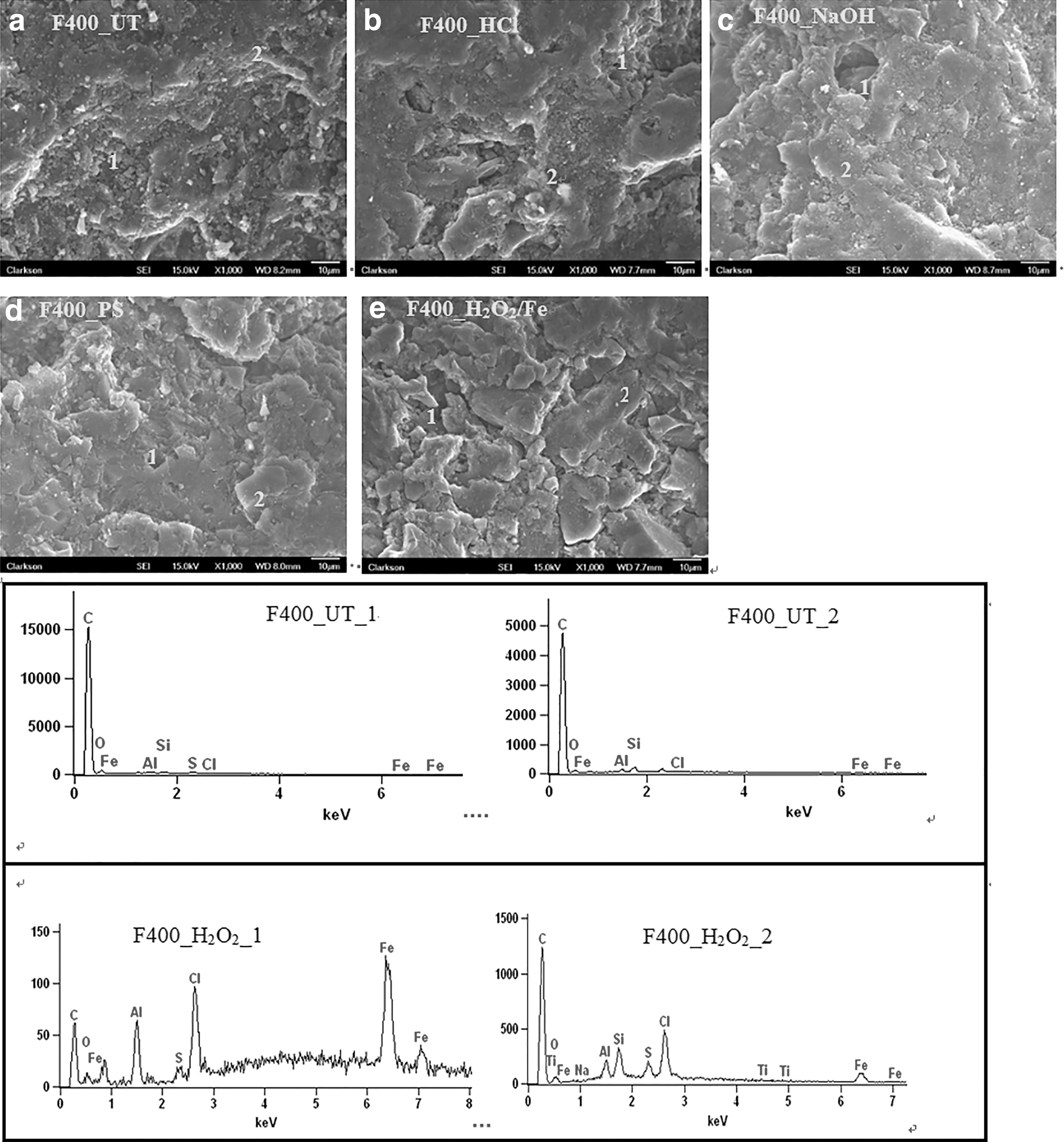
Scanning electron micrographs of F400
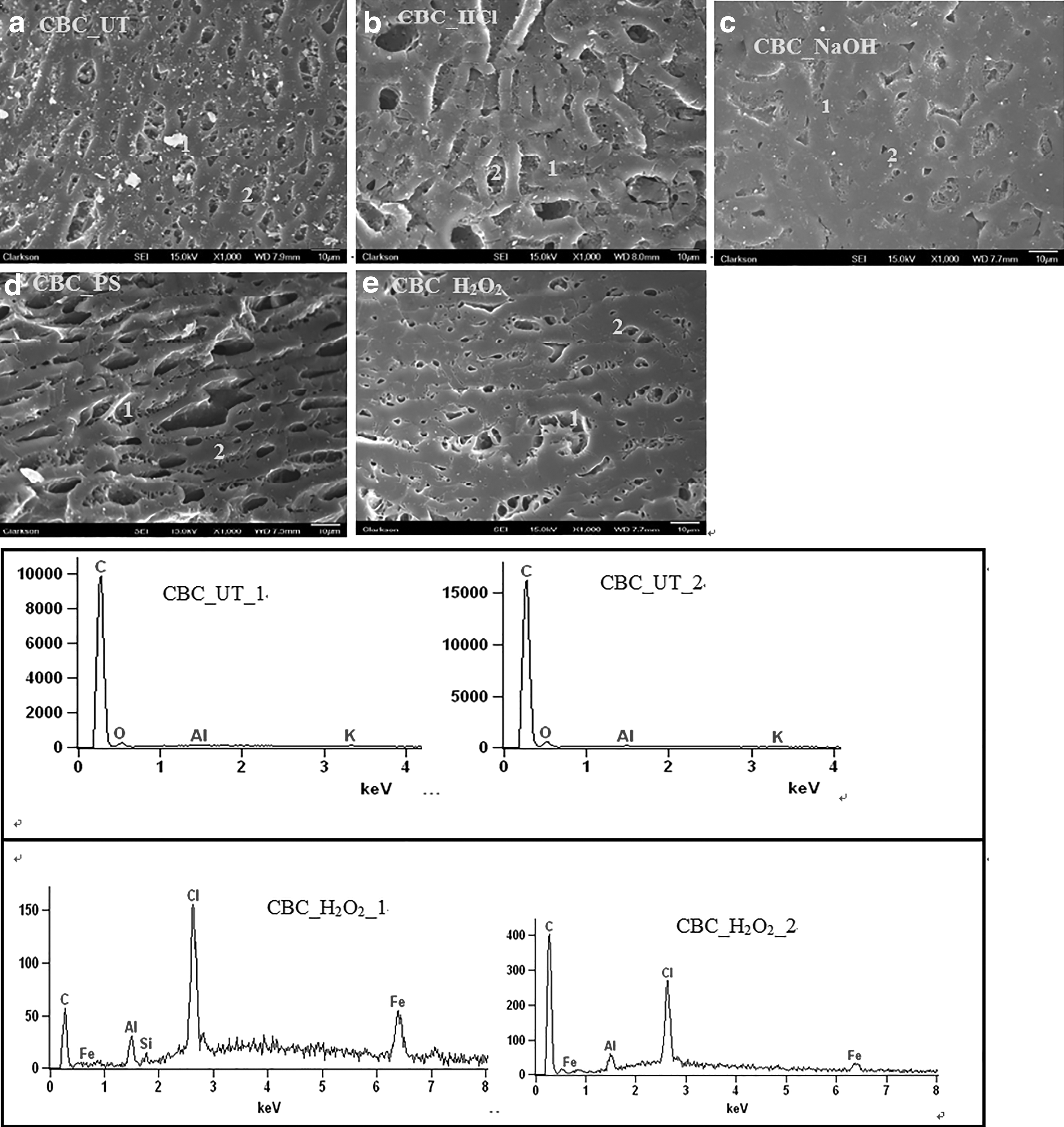
Scanning electron micrographs of CBC
Weight Percentage of Elements Present in Each Point Marked on Scanning Electron Microscopy Micrographs of F400-Hydrochloric Acid, Sodium Hydroxide, Persulfate, and Hydrogen Peroxide/Iron Treated Granular Activated Carbon and F400-Untreated Granular Activated Carbon
Elemental analysis provided the complete weight percentage of elemental composition of both treated and untreated carbon as shown in Table 4 for F400 and in Table 5 for CBC. The elemental compositions obtained for two points marked in SEM micrographs of treated and untreated F400 and CBC are included in Tables 4 and 5 accordingly. Chloride content was increased in both F400 and CBC HCl treated GAC. This is due to some chlorine that remained chemisorbed on the GAC surface and decreased micropore volume and width (Table 3) (Moreno-castilla et al., 1998).
Weight Percentage of Elements Present in Each Point Marked Scanning Electron Microscopy Micrographs of Coconut-Based Carbon-Hydrochloric Acid, Sodium Hydroxide, Persulfate, and Hydrogen Peroxide/Iron Treated and Coconut-Based Carbon-Untreated Granular Activated Carbon
Hydroxide ions were expected to react with surface functional groups on the GAC surface with NaOH treatment. Oxygen content is increased in both GAC types with NaOH treatment, and sodium was detected in F400 NaOH treated GAC. In addition, sulfur content was increased in both PS treated GAC types. Therefore, an accumulation of sulfur and sodium may result in blockage of adsorption sites and decreased the micropore volume and width (Table 3). In the H2O2/Fe treated GAC, a high amount of Fe is accumulated in the pores (Point 1of both H2O2/Fe F400 and CBC micrographs), which is responsible for the pore blockage and lower micropore volume and width.
Fourier-transform infrared spectroscopy analysis
FTIR transmission spectra for the F400 and CBC untreated and treated GAC are represented in Fig. 4. In addition, possible vibration assignments per band position are included in Table 6. The peaks or broad bands observed in the spectra are due to the presence of functional groups. According to Chiang et al. (2002), adsorption peaks in between 445–511 and 630–688 cm−1 are due to the C-C bond in alkanes and out of plane C-C bond, respectively (Chiang et al., 2002). These can be seen in all the samples. A new band appears in HCl, NaOH, PS, and H2O2/Fe-treated F400 and CBC treated GAC in between 1,000 and 1,300 cm−1 attributed to C-O bond stretching and O-H bending modes of alcohol, phenol, and carboxylic groups (Pradhan and Sandle, 1999).
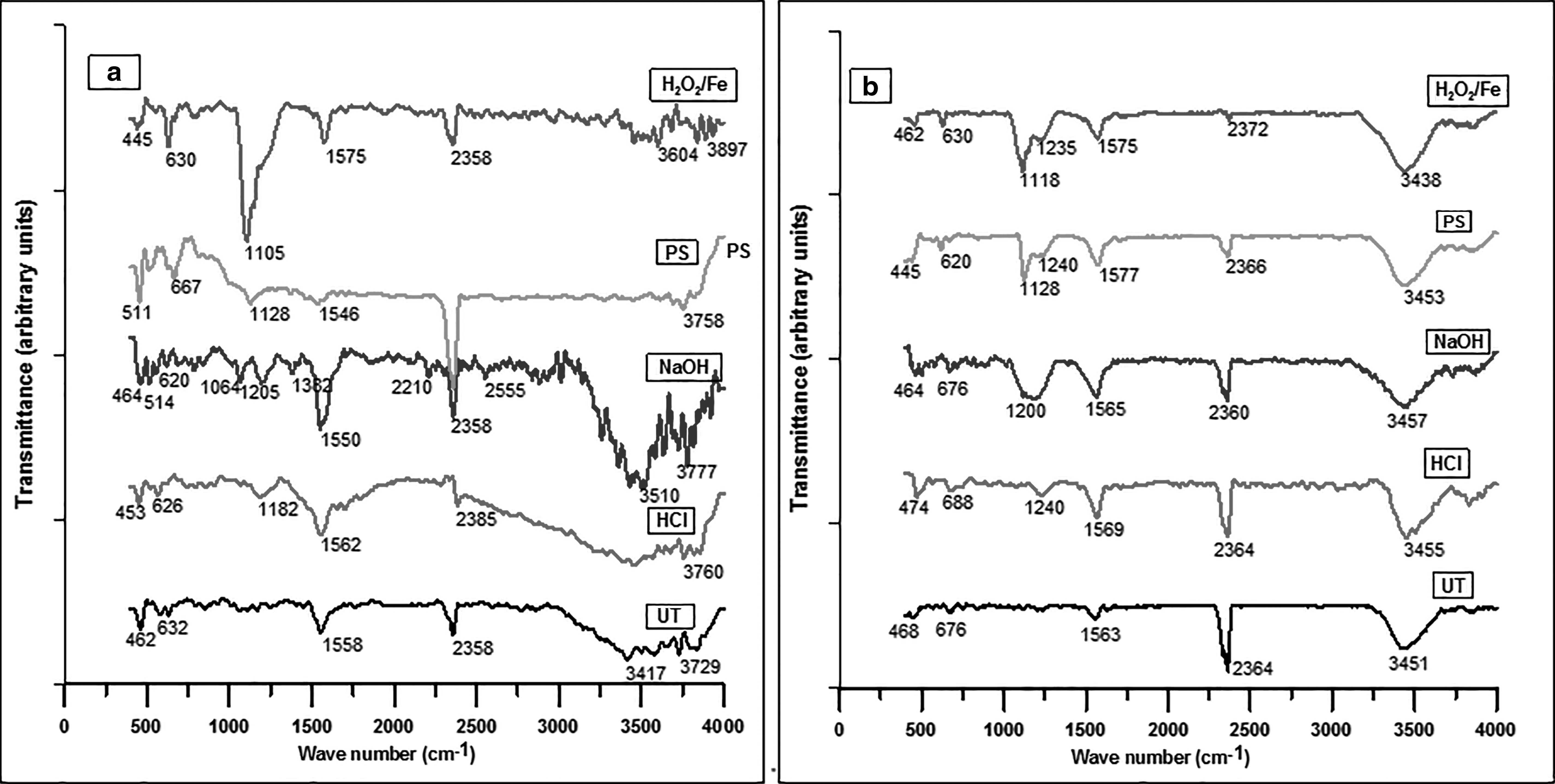
FTIR patterns of UT, HCl, NaOH, PS, and H2O2 catalyzed with Fe treated
Fourier-Transform Infrared Spectroscopy Frequencies
The adsorption bands of overlapping aromatic ring bands and C = C vibrations with the band of C = O moieties appeared between 1,500 and 1,600 cm−1 (Park and Jang, 2002). This band can be observed in all samples, with a small intensity of PS treated F400. In addition, C-O-C vibration from ether structures can be observed in the range of 1,000–1,250 cm−1 (Pradhan and Sandle, 1999; Park and Jang, 2002). The O-H stretching mode of the hydroxyl functional group arises around 3,500 cm−1, which can be seen in all the samples of CBC with similar intensity and high intensity with broadband in NaOH-treated F400 (Pradhan and Sandle, 1999).
In addition, it was reported that the bond in the region of 1,600 cm−1 can be highly conjugated carbonyl groups (C = O) related to the structure of acetylacetone (Moreno-castilla et al., 1998; Pradhan and Sandle, 1999). Therefore, treatment of GAC introduced more surface oxygen functional groups such as alcohol, phenol, and carboxylic, which were detected in FTIR spectra. Increasing oxygen content in the carbon surface decreases the electronic density of the basal planes and as a result it lowered the basicity of the carbon surface (Moreno-Castilla et al., 2000).
Zhi and Liu (2015) reported that carbon basicity, an indicator of acid neutralizing ability of anion exchange capacity, favored the adsorption of PFAS anions. Therefore, introducing surface oxygen functional groups increases the surface acidity and hence increases the polarity of the carbon surface resulting in decreased adsorption of hydrophobic PFAS. Moreover, these acidic surface functional groups decrease the hydrophobicity of GAC surface and affect the chemical interactions that may decrease the contaminant adsorption (Karanfil and Kilduff, 1999; Hutson et al., 2012).
Alteration of GAC using different treatments may adversely affect its physical characteristics. For example, acidic treatment for longer duration (2 weeks) decreased the adsorption capacity of an organic contaminant through the physical process of carbon surface breakdown and resulting decreased GAC surface area for adsorption of organic contaminants (Hutson et al., 2012).
Conclusions
The extent of sorption of PFOA and PFHxS increased with HCl treatment for both F400 (8% and 9%) and CBC (6% and 5%), respectively, due to an increase in positive charge density resulting from treatment. The extent of sorption decreased with the other three treatments, where decreases were minimal with NaOH and largest with H2O2/Fe followed by PS treatment. Treatment of both types of GAC resulted in a decrease in the BET surface area, pore volume, and pore width, which are the main physical characters related to the sorption.
This decrease was likely due to pore blockage in the micropores caused by treatment due to modification of the textural characteristics of the untreated GAC, as shown in elemental analysis. An accumulation of chloride, sodium, sulfur, and iron may result in blockage of sorption sites, decreasing the micropore volume and width with HCl, NaOH, PS, and H2O2/Fe treatments, respectively. The pH of point zero charge results revealed that for HCl treatment, both hydrophobic and electrostatic interactions have contributed to increasing adsorption of PFAS. The degree of protonation of PFAS is increased with lower solution pH causing more hydrophobic interactions, and electrostatic interactions influence up to some extent on adsorption of PFAS due to increase in the positive charge of the surface.
For both types of GAC, H2O2/Fe and PS treatment created negative charge on GAC surfaces and resulted in drastic reduction of pHpzc. This effect increased the electrostatic repulsion and influenced sorption to some extent because those two treatments show the greatest decreases in the extent of sorption relative to untreated GAC. The treatment of GAC introduced more surface oxygen functional groups like alcohol, phenol, and carboxylic, which were detected in FTIR spectra. pHpzc decreases as the oxygen content increases, which reflects an increase in surface acidity.
Moreover, surface oxygen functional groups increase the polarity of the carbon surface, which can result in decreased sorption of hydrophobic PFAS. The final result of adsorption is related to a combination of all factors of changes in physical and chemical properties of the GAC surfaces due to chemical modification.
The cost comparison was conducted based on the number of GAC change-outs needed for a 30-year project with a capacity of 10,000 pounds GAC system (4,536 kg of GAC) (CH2M HILL, 2011) and a treatment rate of 60 gallons per minute (Supplementary Results and Discussion). The cost associated with the mass of GAC required for the calculated number of change-outs and the chemical demand of HCl was calculated. The cost estimate presumed for the treatment of 1 million gallons of PFAS contaminated groundwater using HCl treated and untreated GAC is included in Supplementary Table S3. The HCl treated GAC had a higher treatment cost compared to the untreated GAC when considering the optimum conditions. However, it is important to note that despite the treated GAC being more cost intensive than the untreated GAC, it helps to address the issue of extending GAC life (waste production and cost for replacement/treatment).
Footnotes
Acknowledgments
This research was supported by the U.S. Department of Defense, through the Strategic Environmental Research and Development Program (SERDP—Program Grant ER-2423). The authors thank Adam Point for assistance and for sharing technical knowledge about ultra-performance liquid chromatography (UPLC-QToF) instrument.
Author Disclosure Statement
No competing financial interests exist.
References
Supplementary Material
Please find the following supplemental material available below.
For Open Access articles published under a Creative Commons License, all supplemental material carries the same license as the article it is associated with.
For non-Open Access articles published, all supplemental material carries a non-exclusive license, and permission requests for re-use of supplemental material or any part of supplemental material shall be sent directly to the copyright owner as specified in the copyright notice associated with the article.
