




Abstract
Abstract
A laboratory-scale oxygen-limited hybrid membrane bioreactor (OyHMBR) treating synthetic municipal wastewater was operated to investigate performance in terms of chemical oxygen demand (COD) and nitrogen removal and membrane fouling mechanism during stable state operation period. Round porous polymer carriers were added to generate a combination system, in which attached biomass and suspended sludge grow simultaneously. At a constant hydraulic retention time of 8 h and dissolved oxygen (DO) concentration below 0.5 mg/L, the removal rate of COD in the OyHMBR was about 91.7% independent of mixed liquor volatile suspended solids (MLVSS). However, NH4+–N conversion was significantly influenced by MLVSS concentration, and NH4+–N was almost completely oxidized in case that the average MLVSS concentration was above 2,000 mg/L. The transmembrane pressure increase was effectively retarded by carriers scouring compared to that absent of carriers fluidization at a constant flux of 8 L/(m2·h). The mean particle size of suspension of OyHMBR increased more sharply than that of seed sludge by article size distribution analysis. Sludge characteristics were also evaluated in terms of soluble microbial products and bound extracellular polymeric substances. It was found that over four times higher loose bound extracellular polymeric substances in cake sludge compared with bulk sludge. Results of scanning electron microscopy indicated diverse bacteria deposited on membrane. Also, Fourier transform infrared spectroscopy analysis demonstrated that the protein-like substance was the main pollutant in cake layer. This critical investigation would contribute toward a better understanding of the performance and membrane fouling behavior in OyHMBR operation.
Introduction
Anaerobic treatments have attracted increasing attention in treating low-strength wastewaters, because of lower sludge production as well as the fact that no energy for aeration is required. However, effluent quality of anaerobic bioreactor alone does not meet the requirement for wastewater effluent to surface receivers (Singh et al., 1996; Seghezzo et al., 1998; Gomec, 2010). For this reason, there has been growing interests in anaerobic membrane bioreactors (AnMBRs), which combines anaerobic treatment with membrane filtration (Martinez-Sosa et al., 2011; Bae et al., 2013). The main advantages of membrane bioreactors (MBRs) are the smaller physical occupancy than clarifiers (Munch et al., 2000; Drews et al., 2005) and better effluent quality in relationship to a specialized bacterial community resulting from the high sludge retention time (SRT) (Drews et al., 2005). However, the extensive application of MBR is restrained by membrane fouling, which results in smaller permeate flux and higher operational costs. McCarty and his team first developed an anaerobic fluidized bed membrane bioreactor (AFMBR) as a posttreatment method for an anaerobic fluidized bed bioreactor, achieving 87% removal of chemical oxygen demand (COD) and about 100% of total suspended solid. In addition, a low energy demand of 0.028 kWh/m3 for AFMBR alone, which is much lower than that required for treatment, using aerobic MBR (Kim et al., 2011). Membrane fouling is well controlled by mechanical scouring due to fluidization of granular activated carbon (GAC) particles in an AFMBR. However, one main drawback of AnMBRs is total nitrogen (TN) that has not been reported to be reduced during anaerobic treatment, as nitrification is generally accomplished by autotrophic bacteria under aerobic conditions (Ye et al., 2017).
Recently, a research demonstrated that pollutants removal would be enhanced and energy consumption could be reduced by at least 10% by limited filamentous bulking under oxygen-limited conditions (Guo et al., 2010). Oxygen-limited conditions seem to be potentially more energy-efficient than conventional aerobic systems, requiring less energy for blower operation and producing significantly less biosolids to be handled (Zitomer and Shrout, 1998). This method improves the removal efficiencies of COD, SS, phosphorus (P), TN, and other pollutants while NH4+-N removal was adversely impacted. Previous study reported that hybrid membrane bioreactors (HMBRs), in which suspended and attached biomass grow simultaneously in the same system, would not only improve the efficiency of biodegradation but also would enhance the nitrification process (Artiga et al., 2005). The use of HMBRs is an excellent alternative for treating municipal wastewaters, especially when to overcome the harm of low dissolved oxygen (DO). Some studies have pointed out that the ability of the carriers added to bioreactor included can be not only beneficial to microbial growth and pollutant degradation (Zheng et al., 2018) but also can assist in mitigating membrane fouling through particle scouring (Wei et al., 2006; Damayanti et al., 2011). Furthermore, attached biofilm could adsorb small biological flocs and colloidal matter, such as extracellular polymeric substances (EPS), which have been identified as the major foulants in MBR operation (Hu et al., 2013; Jin et al., 2013), so that the membrane fouling in HMBR can be reduced. In the present work, a HMBR that comprises of membrane filtration and an internal cycle fluidized bioreactor was operated for a long-term under oxygen-limited conditions in treating synthetic municipal wastewater. Some biofilm materials were used to fix bacteria as well as control membrane fouling in MBRs (Huang et al., 2008; Jin et al., 2013), powdered activated carbon was the most applied carrier (Ng et al., 2006; Kim et al., 2011). Nevertheless, their compatibility with the membrane should be material checked since abrasive cleaning can leave brush marks on the membrane surface, and some granular materials may be fragile during a long-term operation (Siembida et al., 2010). In an attempt at fouling control, a kind of spherical porous polymer carriers were added into the oxygen-limited HMBR (OyHMBR) in the present study. Physical parameters of the spheroidal porous polymer carrier were summarized as follows: dry particle size of 0.32 mm, wet particle size of 0.56 mm, skeletal density of 1,320.00 kg/m3, wet packing density of 1,010.00 kg/m3, pore volume of 0.301 mL/g, and wet surface area of 5,357.00 (m2/m3). Although many studies have been done on membrane fouling mechanical in MBRs (Wei et al., 2006; Yang et al., 2010; Wang et al., 2017; Zhang and Jiang, 2019), few reports are available on an OyHMBR. However, by their nature as filters, membranes are prone to fouling as a result of interactions between membrane and the mixed liquor, which severely affect their performance. Since the suspended sludge may be different from aerobic and anaerobic MBRs, in addition, the lower density and spheroidal carriers circulated in the bioreactor and colloids with membrane fibers constantly, the mechanism and effect of membrane biofouling in OyHMBR might be quite different from the other MBRs.
The purpose of this study was to investigate the performance of OyHMBR in terms of COD and nitrogen removals, together with the characteristics of membrane fouling by studying the bulk sludge characteristics and cake layer properties. The major components of the organic contents in cake layer were determined.
Materials and Methods
Experimental setup and operating conditions
A lab-scale 19 L OyHMBR was operated in this study at room temperature 26°C ± 2°C (Fig. 1), the experimental equipment was made of Plexiglas. The reactor was 795 mm height by 200 mm internal diameter; an upflow zone and downflow zone were formed by a draught tube installing in center of the reactor with internal diameter of 100 mm and height of 605 mm. Aeration ports were in the middle of upflow zone inside the tube and at distance of 30 mm from the bottom. The MBR was installed with a submerged hollow fiber microfiltration membrane module in the upflow zone above the aeration. The membrane module was made of polyvinylidene fluoride (PVDF) with a nominal pore size of 0.2 μm and an effective surface area of 0.3 m2 (Motian). Thirty to forty mesh porous polymer carriers were added into the reactor with a packing ratio of about 5%. A recirculation flow rate of 2.0 L/min resulted in carriers recirculating through the upflow zone to downflow zone in reactor.

Schematic diagram of the lab-scale OyHMBR system. OyHMBR, oxygen-limited hybrid membrane bioreactor.
The experiments were conducted using a synthetic wastewater to avoid any fluctuation in the feed concentration and provide a continuous source of biodegradable organic pollutants. The composition of the synthetic wastewater was as follows: glucose, 300 mg/L; (NH4)2SO4, 235.7 mg/L; KH2PO4, 35 mg/L; and 1 mL/L of a trace element solution. Correspondingly, influent COD, NH4+-N, and TP were 320, 50, and 10 mg/L, respectively. One liter of trace element solution contained 15.0 g/L, EDTA; 1.1 g/L, (NH4)6Mo7O2·4H2O; 0.99 g/L, MnCl2·4H2O; 4.2 g/L, CaCl2·H2O; 0.24 g/L, CoCl2·6H2O; 0.014 g/L, H3BO4; 5.0 g/L, MgSO4·7H2O; 5.0 g/L, FeSO4·7H2O; 0.25 g/L, CuSO4·5H2O; and 0.21 g/L, NiSO4·6H2O. NaHCO3 with 1 g/L added to the influent to maintain the pH of the OyHMBR suspension between 7.8 and 8.4. Synthetic wastewater was continuously fed to the reactor with a pump (Longer), and the permeate suction was done using a peristaltic pump (Longer). The DO concentration was maintained below 0.5 mg/L to form oxygen-limited conditions and provided a specific aeration demand of 160 L/(m2·h). The hydraulic retention time (HRT) was 8 h and SRT was controlled mainly based on mixed liquor suspended solids (MLSS) concentration, with a minimum SRT of 20 days. The impact of mixed liquor volatile suspended solids (MLVSS) concentrations on performance of the MBR (COD and nutrient removal) was evaluated twice. The whole process was divided into two stages in continuous operation for around 2 months. MLVSS concentration was controlled below 2,000 mg/L (Stage I) and above 2,000 mg/L (stage II) by discharging suspended sludge from the reactor. The impacts of carriers fluidization and nonfluidization on membrane fouling were also investigated by adjusting recirculation flow rate. Before the experiments, the OyHMBR was operated for over 4 months to investigate the impact of different low DO levels on performance, and the DO values ranged from 0.06 to 0.5 mg/L.
Sludge samples preparation
Bulk sludge and cake sludge were sampled from the lab-scale MBR. At the end of operation, the fouled membrane module was taken out from the bioreactor. Then cake sludge samples were collected by scraping the fouling layer by a plastic scraper, and then gently shaken to form uniform liquor for the particle size distribution (PSD) measurement. Meanwhile, bulk sludge samples were directly collected from the MBR.
Resistance analysis
According to resistance-in-series model, the membrane flux of the MBR could be expressed and estimated by Equations (1) and (2).
where J is the permeate flux, μ is the viscosity of the permeate, Rt is the total membrane resistance, Rm is the intrinsic membrane resistance, Rp is the pore plugging resistance, and Rc is the cake layer resistance.
Nitrogen assimilation
The nitrogen assimilation could be calculated as 12% of biomass growth (Px,bio), Px,bio could be estimated by Equation (3) (Li et al., 2007).
where V is the OyHMBR volume and Q is the influent flow rate.
Extraction of soluble microbial product, BPC, loose-bound extracellular polymeric substances, and tight-bound extracellular polymeric substances
The collected sludge samples of activated sludge were centrifuged at 4,000 g for 15 min and then the extracted supernatant was collected. The extracted supernatant was further filtrated through a 0.45 μm membrane filter regarded as soluble microbial product (SMP) (Su et al., 2013). The SMP was analyzed for their protein and carbohydrates contents. The loose-bound extracellular polymeric substances (L-EPS) and tight-bound extracellular polymeric substances (T-EPS) from the sludge sample were extracted according to a two-step heat extraction method (Li et al., 2007). The sludge pellet was resuspended with 0.05% NaCl solution to 50 mL and then heated at 50°C for 15 min. The sludge suspension was then centrifuged at 4,000 g for 10 min, and the organic matter in the supernatant was regarded as the L-EPS. For further T-EPS extraction, the sludge pellet was resuspended in 0.05% NaCl solution to its original volume. The sludge suspension was heated at 80°C in a water bath for 30 min and then centrifuged at 4,000 g for 15 min. The organic matter in the supernatant was regarded as the T-EPS. L-EPS and T-EPS extracts were further filtered through a 0.45 μm membrane filter. Then, the filtrates were analyzed for their protein and carbohydrates.
Analytical methods
COD of the samples were measured by COD analyzer (Lianhua). DO concentration in the reactor was measured by a DO monitor (TWT Multi 3510). NH4+-N, NO2--N, NO3--N, TN, biomass concentration (MLSS), and volatile suspended solids (VSS) were analyzed according to Standard Methods [Environmental Protection Administration of China (SEPA), 2002]. For proteins quantification, Lowry method using bovine serum albumin as the standard is used (Lowry et al., 1951) and for polysaccharides quantification, anthrone method using sucrose as the standard is chosen (Raunkjaer et al., 1994).
PSD of the mixed liquor was obtained using Mastersizer 2000. All the above analyses were conducted in triplicate, and their average values were reported. The cake layer deposited on the membrane surface was observed using a scanning electron microscopy (SEM; JSM-7500F). Functional group characteristics of cake sludge and bulk sludge were characterized by a Fourier transform infrared (FTIR) spectrometer (Nicolet 6700; DTGS).
Results and Discussion
Performance of OyHMBR
COD removal
The OyHMBR system was operated with addition of the porosity polymer carriers at a dose of 5% (carrier volume/total volume, v/v), which is the best dosage for bioreactor performance obtained by our previous result. DO concentration was maintained below 0.5 mg/L to keep oxygen-limited condition. Figure 2a exhibits the water quality parameters of the influent (synthetic sewage) and the effluent (permeate from the MBR). The effluent COD averaged 27.3 mg/L, which corresponded to a 91.7% removal rate in steady phase. It can be seen that the OyHMBR system achieved a high removal of COD, indicating that OyHMBR can be cost-efficient in treating domestic wastewater in terms of COD removal.
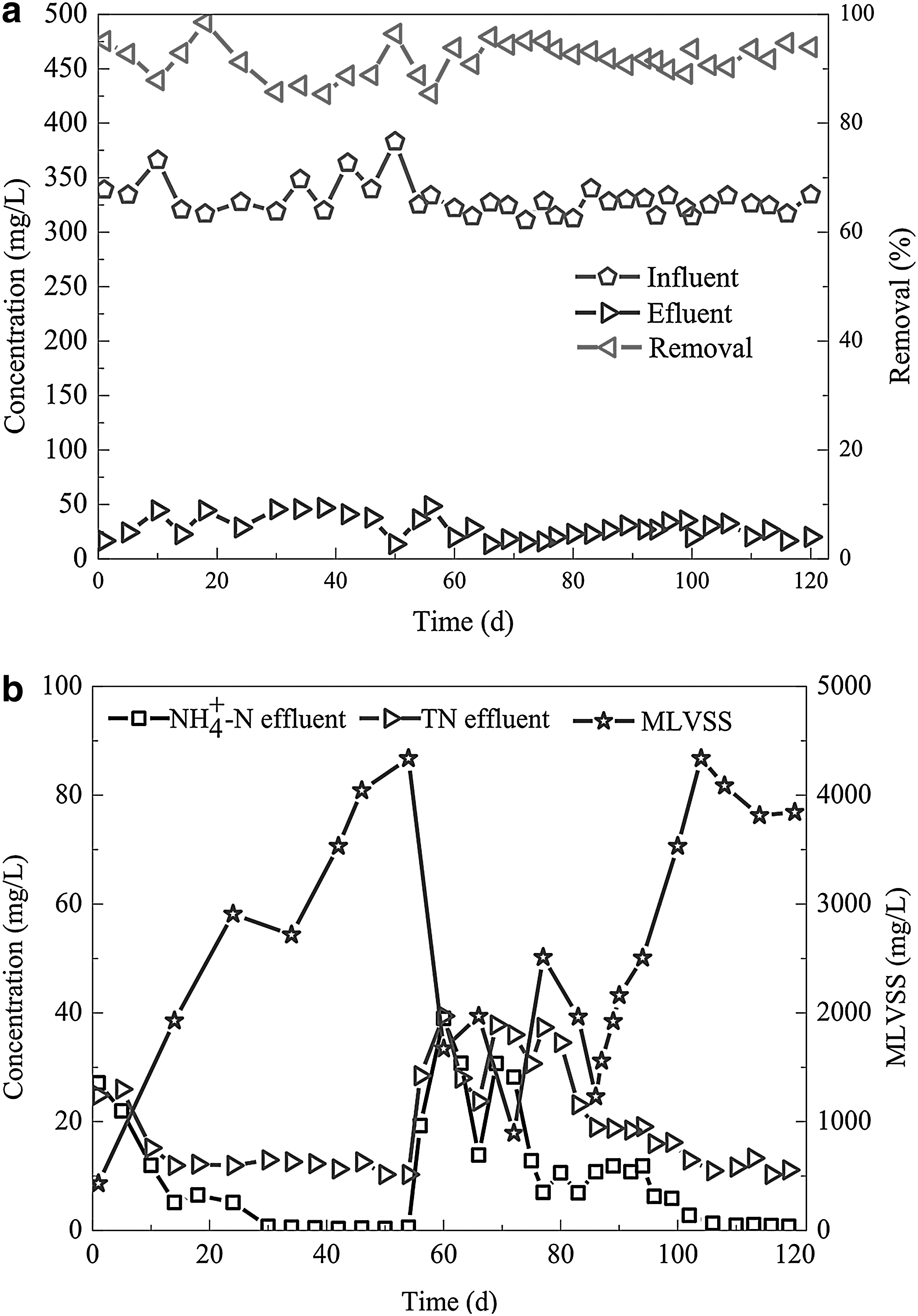
Profiles of COD and nitrogen removal.
Nitrogen removal
The influence of MLVSS concentration on ammonium oxidation was studied by controlling suspended sludge concentration of OyHMBR at stable period. In this study, influent TN concentration was equal to ammonia, since the synthetic wastewater mainly contained ammonia in influent. Influent ammonia nitrogen load was 0.15 kgN/(m3·day). As shown in Fig. 2b, the ammonia conversion and TN removal efficiency increased gradually, from 45.8% to 98.5% and from 44.4% to 74.1%, respectively, with MLVSS concentration increasing from 431 to 2,908 mg/L. Subsequently, the average concentration of MLVSS was 3,971 mg/L, and effluent NH4+-N and TN concentrations were stable, with average removal rates of 99.1% and 76.3%, respectively. The ammonia conversion decreased sharply while MLVSS concentration was less than 2,000 mg/L, even though DO concentration in reactor was close to 1 mg/L. However, the denitrifying capacity was not as strongly influenced as that of nitrification, since TN removal efficiency was similar to ammonia conversion when MLVSS was below 2,000 mg/L. This also indicates that denitrification is mainly occurred in biofilm. Many studies demonstrated that under the condition of suspended biomass, simultaneous nitrification–denitrification was affected by the DO as well as the floc size (Liu et al., 2010). The biological flocs in HMBR must be looser than that in the conventional activated sludge (Zhang et al., 1997; Henriques et al., 2005) due to the high-strength shear stress of the carrier, and this may be a disadvantage of HMBR in regard with denitrification. The function of the biofilm carriers was similar to that of larger biological flocs, and their increased size and inner space provided better condition for denitrification within the attached biomass. In addition, DO concentration decreased with suspended sludge increase, which might further stimulate denitrification.
To verify the importance of suspended sludge, we discharged suspension again on the 60th day. The MLVSS concentration was kept stable at around 1,715 mg/L for a period, then gradually increased to above 2,000 mg/L, and finally stablized at around 3,923 mg/L. Similar trend was observed (Fig. 2b). Nitrogen removal in biological wastewater treatment includes dissimilation and assimilation in microbes. When system stabilized under the condition of SRT of 20 days and MLVSS of 4,000 mg/L, the assimilation rate was about 9.12 mg/L. Assimilation rate was a little higher compared with MLVSS concentration of 2,000 mg/L. Therefore, dissimilation was the main pathway of nitrogen removal in this system. Heterotrophic growth occurred mainly in suspension; the growth of heterotrophs in suspension might favor the ammonia conversion by nitrifiers in the biofilm (Fig. 3) and thus enhance the nitrifying capacity of the hybrid system. In addition, abundance of filamentous bacteria growing both in suspension and in biofilms could enhance nitrogen removal by degrading lower residual substrate concentrations (Fig. 3) (Guo et al., 2010). Existence of suspension in the HMBR not only could increase biomass concentration and further remove remaining nitrogen but also could induce the activity of attached nitrifying bacteria by consuming COD. The average effluent ammonium concentrations were below 1 mg/L, indicating that the system has excellent performance of ammonia nitrogen removal. Liu et al. (2010) found that HMBR could enhance NH4+-N removal by comparing a conventional MBR with a HMBR. Therefore, such high ammonia removal efficiency obtained in OyHMBR must attribute to combination of suspended biomass and attached biomass. The existent suspension probably was beneficial to stimulating activity of attached microbes.
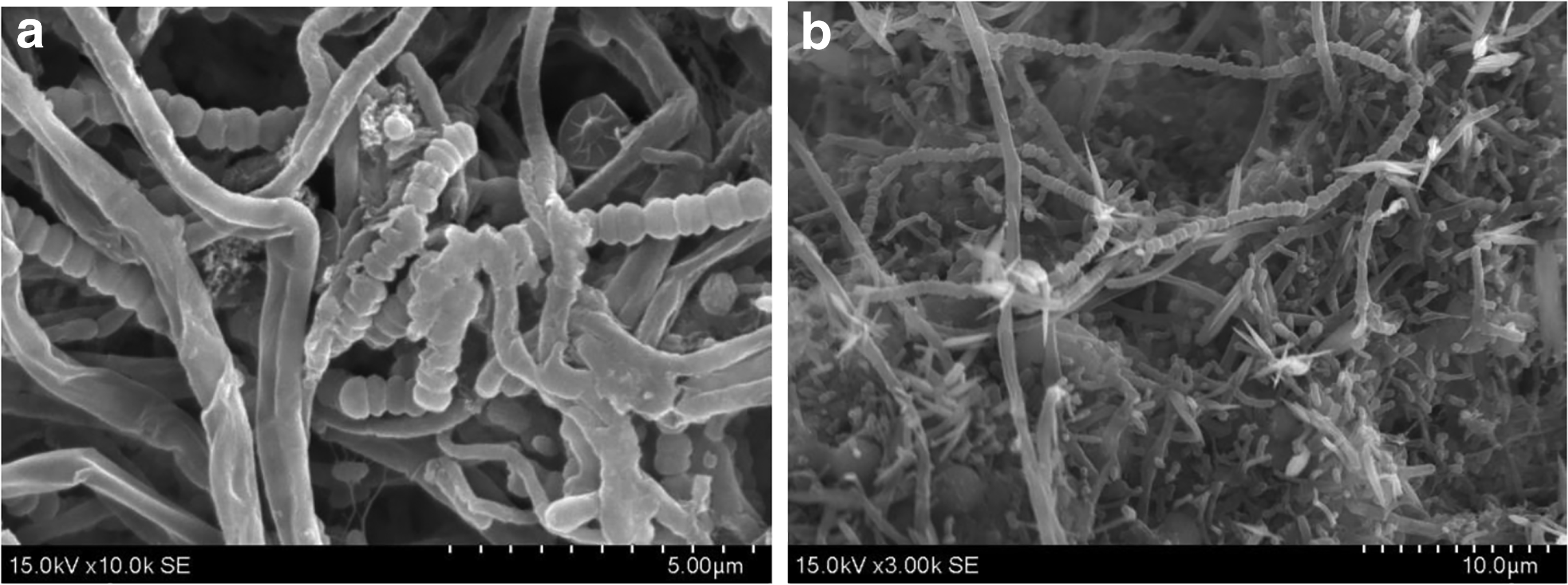
SEM imagines.
Variation of transmembrane pressure
The influence of the addition of polymeric round carriers on membrane performance was demonstrated by examining the transmembrane pressure (TMP) trend. Figure 4 shows the TMP variation during continuous operation of the MBR under a constant flux of 8 L/(m2·h) without additional membrane fouling control measures (such as membrane frequent relaxation and cleaning) except for carriers scouring the membrane surface. In the case of carriers fluidization, the initial TMP increase took about 7 days and then stabilized at a TMP of 3–5 kPa for 48 days. Finally, about 48 h were required for the TMP to increase to 20 kPa. The filtration operations were terminated when TMPs reached 20 kPa because it was difficult to maintain the flux at constant level at TMP of over 20 kPa. Therefore, we took out of the membrane module for cleaning on the 57th day.

Evolution of TMP. TMP, transmembrane pressure.
Several studies have demonstrated that TMP could be reduced by adding particles to produce physical scouring membrane surface (Wei et al., 2006; Damayanti et al., 2011; Aslam et al., 2014). After putting a clean membrane into the MBR, fluidization was induced for the first 11 days with TMP remaining at a low level. Recirculation was then stopped to let the carriers settle, following which a sudden TMP jump in about 4 days, indicating that the membrane will be blocked without the presence of carriers scouring. This trend could also be reflected in the value of membrane fouling rate (MFR): after the cease of carriers circulation, the rate of TMP increase is 4.82, 4.4 kPa/day higher than that with carriers scouring (0.42 kPa/day). The circulated carriers produced scouring effect on the membrane surface to prevent sludge particle deposition.
Powered activated carbon (PAC) was extensively researched granular materials which can improve the critical flux and increase the filtration period without significant fouling (Iorhemen et al., 2017). It has been indicated that the addition of PAC to MBRs has the potential to reduce the operation and maintenance cost for membrane cleaning and/or membrane replacement by about 25% (Yang et al., 2009). In case a material has lower specific gravity and larger surface area than PAC, it will result in less energy requirements and offer other possibilities (the prerequisite is that it is proved to be effective). The carriers used in the study meet the requirements above, thereby easily circulated in the OyHMBR through circulated flow rate, as a result of low energy consumption than PAC. However, Yang reported that it only took about 12 days for a rapid increase of TMP occurred in a biofilm bioreactor from <20 kPa to about 40 kPa with constant filtration rate of 4.2 L/(m2·h) due to the overgrowth of filamentous bacteria (Yang et al., 2009). In addition, Meng et al. (2006) reported that the amount of EPS and the sludge viscosity would increase, which then resulted in severe membrane fouling if filamentous bacteria predominate in bioreactors. From Fig. 3, plenty of filamentous bacteria existed in suspension in present study, while it exhibited better performance with slow increase in TMP. In view of the above, sludge properties were further studied to make it clear.
Particle size distribution
The PSD measurements for both the inoculum and the bulk sludge along the operation time are shown in Fig. 5. According to d (0.5), it seems that the sludge particles underwent a substantial increase from 44.55 μm on the first day to 85.96 μm after inoculation for 2 months in the MBR, and followed by a substantial increase to 134.65 μm in the steady periods. The over growth of filamentous bacteria in sludge suspension could cause an increase of floc size (Meng et al., 2006). Similar phenomenon was observed in the present study. Previous study reported that bulk sludge with a smaller particle size could cause severe membrane fouling (Meng and Yang, 2007). Previous study reported that bulk sludge with a smaller particle size could cause severe membrane fouling (Meng and Yang, 2007). Some researches claimed that in this case, the sludge suspension with higher floc size resulting from over growth of filamentous bacteria would induce more serious membrane fouling (Yang et al., 2009). However, Chen et al. (2012) stated that the flux of nonbulking MBR descended much faster than the flux of filamentous bulking MBR, mainly due to the fact that the diameter of particles in filter cake decreased rapidly. Larger size possesses higher shear-induced transport (Fshear), which could overcome the forces of hydrodynamic drag and foulant-membrane interaction effectively, thereby alleviating foulants deposition (Zhang and Jiang, 2019). The entwined filamentous bacteria served as the framework in the bioflocs and adsorbed smaller particles, thereby enlarging the floc size. Therefore, the combined effect of cake layer scouring and filamentous bacteria absorbing contributed to a better performance in terms of TMP profile. In this study, the resistance of Rc and Rp was 0.91 × 10¹² m−1 and 0.48 m−1, respectively, accounting for 51% and 27% of the total resistance (1.77 × 10¹²), respectively. This result demonstrated that the cake layer formation was the main cause of the eventual severe membrane fouling. Nevertheless, PSD is one of the factors affecting membrane fouling. Therefore, for a better understanding of the fouling mechanisms of OyHMBR, physicochemical characteristics of the activated sludge should be researched properly.

Floc size distributions of inoculum and suspension.
Evolution of organic contents in MBR
Organic contents were investigated from the beginning of the experimental period, with clean membrane. Larger sized particles accumulated on the membrane surface can be removed by shear force, however, soluble organics and colloidal particles deposited onto the membrane surface and pore wall can induce severe fouling (Bae and Tak, 2005). Considering the ready biodegradability of the feed substrate (mainly glucose) in the present study, the organic substrate in the suspended sludge is believed to mainly contain SMP. SMP was reported to have a moderate molecular weight (MW) of several hundred to several thousand Daltons (Rittmann and McCarty, 2012), reducing the flux by filling the void spaces between the cell particles in the cake layer. In this study, proteins and polysaccharide were studied as dominant components in SMP (Fig. 6). SMP has been reported to contain two groups based on the bacterial phase from which they are derived: the utilization-associated products (UAPs) generated in microbial growth and the biomass-associated products (BAPs) derived from biomass decay in the endogenous phase (Namkung and Rittmann, 1986; Jarusutthirak et al., 2002; Laspidou and Rittmann, 2002). During the period of investigation, the sludge stabilized at about 2,000 mg/L in the first 8 days, then rose sharply to around 5,500 mg/L within a few days and finally stabilized at 4,000 ± 200 mg/L from the 23rd day on (data not shown). When the sludge grew to a steady state, the total SMP concentration decreased from the initial 8.8 mg/g VSS to around 2.5–3.0 mg/g VSS. These results are taken with the sludge concentration results, and these SMP released into the bulk solution at initial could be postulated to be a sort of UAP. In addition, SMP decrease indicated that UAPs are more biodegradable than BAPs (Noguera et al., 1994), resulting in a reduction of SMP at initial. The PN/PS (proteins/polysaccharide) ratios for SMP were between 0.6 and 2.1 times, and most of the PN/PS ratios averaged 1.3 times in the first 40 days. The results indicated that the protein content was a high fraction in the reactors. Then, the total SMP concentrations increased slightly due to the accumulation of polysaccharide and leveled off. Protein concentration was reduced to about 1.6 mg/g VSS during this period. By contrast, the polysaccharide concentration leapt to about 3.8 mg/g VSS and became predominant in SMP. Previous study showed that the polysaccharides were of high MW and gelling property, which may lead to the accumulation of polysaccharides in the mixture and cake layers (Meng et al., 2011). Although there is no clear consensus in the literatures concerning the relationship between membrane fouling propensity and identified fractions of SMP in MBR, many reports indicated that the SMP may contribute 26–52% of membrane fouling depending on the experimental conditions (Rosenberger et al., 2006). In this study, the increased polysaccharide component of the SMP seems to promote fouling under oxygen-limited conditions.
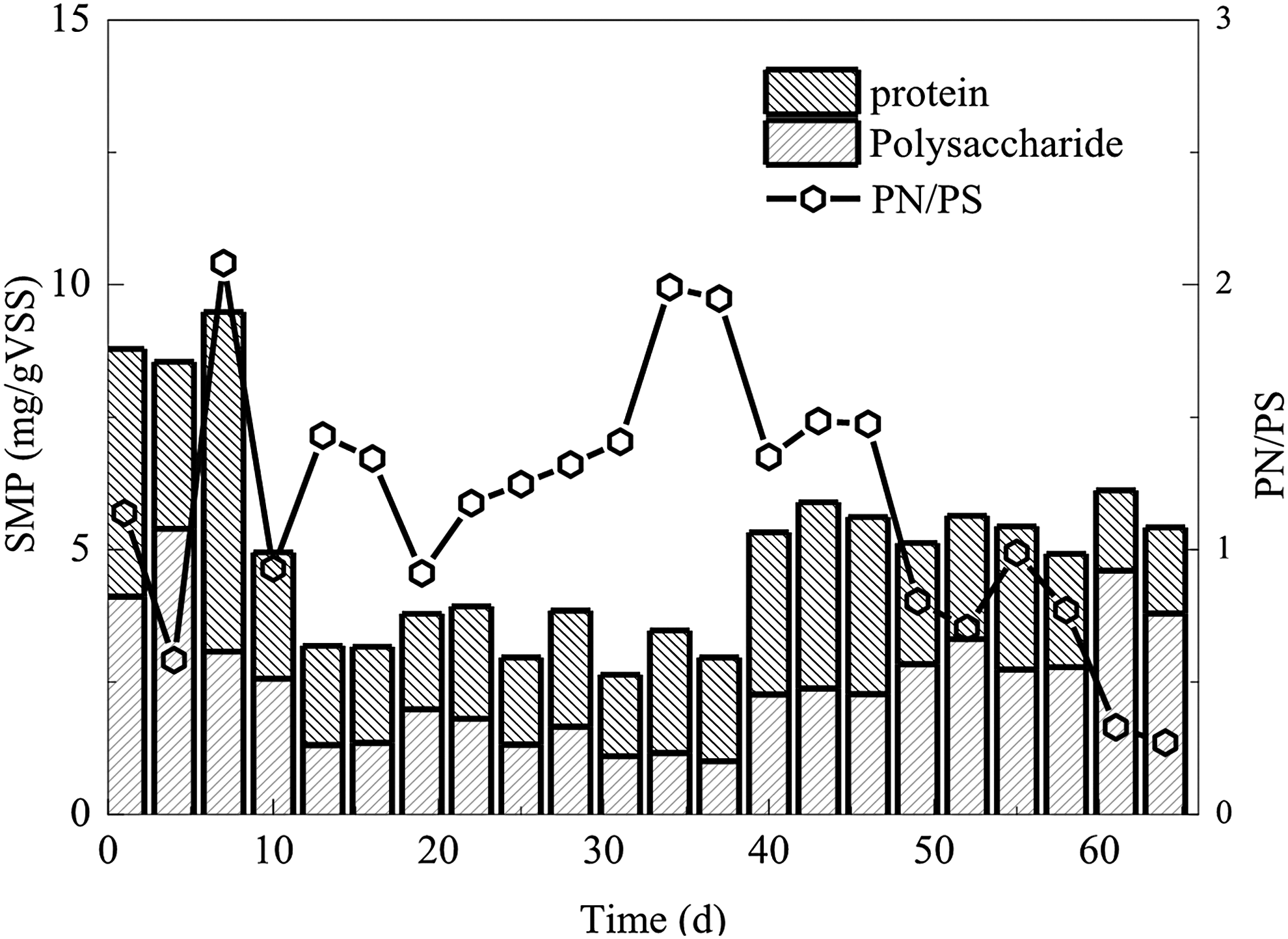
Evolution of SMP in OyHMBR. SMP, soluble microbial product.
Previous study found that suspended carriers enhanced the breaking up of bioflocs formed in the reactor, which released a higher amount of SMP content (Huang et al., 2008). In contrast, the phenomenon of breakage of bioflocs experienced in this study did not appear (as discussed in the previous section) as the biofilm carriers used were of lower density. The higher aeration rate would induce higher shear stress and more SMP was thought to be released. Therefore, lower aeration intensity might have contributed to less SMP release (Ji and Zhou, 2006; Ng et al., 2006; Meng et al., 2008). Nevertheless, because of the presence of filamentous bacteria, there was a complex membrane fouling mechanism. On one hand, filamentous bacteria with a length more than 200 μm could enlace on the hollow fiber membrane and fix the foulants on the membrane surface. On the other hand, filamentous bacteria could produce much more biopolymers, thereby increasing bound EPS in sludge flocs. The serious cake fouling is likely to be induced by the deposition of filamentous bacteria and bound EPS. Therefore, a further study needs to analyze the impact mechanisms of filamentous bacteria and bound EPS.
Bound EPS analysis
It has been reported that the overgrowth filamentous bacteria in sludge caused severe membrane fouling due to producing more bound EPS (Meng and Yang, 2007). EPS extracted from a series of the bulk and cake sludge samples were determined. The EPS have a multilayer structure consisted of L-EPS (Fig. 7a) and T-EPS (Fig. 7b). Both L-EPS and T-EPS contents were high at initial. While as time elapsed, rather than an accumulation, there was a significant decrease of EPS in the bulk liquid, especially L-EPS. Similar phenomenon was reported by other researchers who observed the accumulation of EPS in the start-up stage of MBRs and partial degradation of EPS as time elapsed (Ji and Zhou, 2006). Although EPS are virtually compounds secreted by microorganisms, as organic substances, they may also undergo transformations and/or fade through biodegradation, adsorption, or other reactions in the biological process (Laspidou and Rittmann, 2002; Drews et al., 2006). The OyHMBR biological process seems to be effective in eliminating EPS by biomass degradation or biofilm carriers absorption, so that the bound EPS contents were much lower than the bulk sludge reported in literature (Meng and Yang, 2007).

Bound EPS concentration in both suspended sludge and cake sludge.
Based on the significant effect of bound-EPS concentration on fouling potential, the total amount of EPS was evaluated. Since polysaccharide and protein are the dominant components typically found in extracted EPS in the waste-sludge supernatant, EPS was evaluated as the sum of polysaccharide and protein. Figure 7 shows the evaluated concentrations of polysaccharides and protein in different bound EPS. It was found that proteins were the major quantified compounds in the two types of bound EPS (Fig. 7). In both types of EPS, there were much higher contents of proteins than that of polysaccharide, especially in T-EPS; proteins were always the major fraction (above 80%). Similar phenomenon was observed in an A2/O MBR system with protein fraction of 80% (Hu et al., 2013). However, the other study indicated that the production of polysaccharides increased as filamentous bacteria became dominant (Meng and Yang, 2007). The different results probably attribute to different influent substrate and operation conditions. It was confirmed that proteins had a strong correlation with the hydrophobicity properties of microbial flocs, whereas polysaccharides had no remarkable influence (Lee et al., 2003). The predominance of protein in EPS could be due to the presence of large quantities of exoenzymes from bacterial excretions, such as lysis products and extracellular products in the flocs, depending on microorganism type and substrate properties (Sponza, 2002). Protein component in EPS is mainly hydrophobic in nature, while polysaccharides are hydrophilic in nature. Therefore, sludge with high PN/PS ratio in bound EPS is usually considered to have high stickiness and thus favor the development of cake formation (Lin et al., 2009).
Figure 7 still presents the comparison of EPS content between the bulk sludge and the cake layer. The results verified that differences in protein, polysaccharide, and total EPS between the cake and bulk sludge samples were all significant. Overall, the cake sludge has EPS (both L-EPS and T-EPS) content (101 mg/g MLSS), which was higher than that of bulk sludge (about 73.32 mg/g MLSS). On average, the L-EPS content in cake sludge was 29.02 ± 2.7 mg/g MLSS, over four times higher than that (6.69 mg/g MLSS) in bulk sludge. However, the T-EPS content in cake sludge was 72.75 ± 2.9 mg/g MLSS, similar with that (66.66 mg/g MLSS) in bulk sludge. T-EPS, which is located on the surface of cells and combined strongly with cell wall, has no obvious relationships to MFR (Wang et al., 2009). While L-EPS originated from T-EPS is a loose and dispersible slime layer without an obvious edge (Sheng et al., 2010). Higher L-EPS contents in cake sludge might worse dewaterability and filterability of cake sludge (Su et al., 2013). In addition, higher content of protein exhibited in cake layer implies that proteins, as potential foulants, would easily attach to the membrane. These results from this study indicate that L-EPS as well as PN/PS ratio is an important factor affecting sludge cake formation and thus membrane fouling.
Fouled layer on the membrane surface
Figure 7 exhibited the fouled membrane taken at the end of the 2-month operation cycle. The membrane fouling was mostly attributed to the pore blocking as well as to the formation of a cake layer. It can be seen that the membrane was apparently covered by cake layer (Fig. 8a) with rough surface and uneven structure. The cake layer formed in OyHMBR was porous in appearance; this might be explained by mechanical scouring. Cake layer in present study resulted from the deposition of filamentous bacteria and short-rods bacteria as well as other materials on the membrane surface. Filamentous bacteria acted as the framework in cake layer. This membrane is called dynamic membrane. It was the products of the precipitation of suspended solids that could help interrupt the deterioration of permeability of membrane (Lee et al., 2001). Low MW substances or submicron colloidal particles could be rejected/sorbed and biodegraded by dynamic membrane (Yamagiwa et al., 1994), with fewer chances of interaction with membranes and thereby favoring membrane permeation. The combined action of mechanical scouring and dynamic membrane could cause cake layer higher compressibility. This could explain the serious cake layer but gentle TMP increase in this system.

Analysis of dry biomass in cake layer: SEM
The FTIR was used to detect the biomass functional groups in the cake layer. As shown in Fig. 8b, the large and deep valley near 3,409 cm−1 would be due to the stretching vibration of either the hydroxyl group of the polysaccharides or amino groups of the proteins (Kumar et al., 2006), indicating that many of the organic foulants, as identified by the EPS analysis discussed in the former section, were retained in the cake layer. The dominance of proteins in the cake layer was also verified by the three peaks at 1,620, 1,544, and 1,243 cm−1 in the spectrum unique to the protein secondary structure called amides I, II, and amide III, respectively (Smidt and Parravicini, 2009). This result indicates that there were proteins in the membrane foulants. The broad peak of 1,025 cm−1 is a peak due to C-O bonds associated with polysaccharide or polysaccharide-like substances (Marcato et al., 2009). Other organic substances identified also included aliphatic substances (the bands near 2,927 and 2,848 cm−1) and carbonate bands (1,423 cm−1) (Marcato et al., 2009). Through the FTIR spectra, the major components of the cake layer were identified as protein. This implied that proteins, as potential foulants, would easily attach to the membrane. Under oxygen-limited conditions, the main foulant that induces membrane fouling is verified to be protein. The FTIR spectrum of the dry matters in the cake layer was coincided well with those found in EPS component measured for cake layer foulants.
In the design of the OyHMBR system, the primary objective was to enhance the biological nitrogen removal from the domestic wastewater in one single system in a cost-efficient way. With carriers scouring the membrane surface, TMP could be maintained at a much lower level than anticipated. Assuming that membrane fouling control combines mechanical scouring and other measures (backwashing and relaxation), the time for the next chemical cleaning will be prolonged. The OyHMBR might be a suitable process not only for achieving effective nitrogen and COD removal but also for controlling membrane fouling in an economical way. However, further study is still required to illuminate the mechanism of foulants reduction by adopting such a system.
Conclusion
The OyHMBR system treating synthetic domestic wastewater at a constant HRT of 8 h and DO concentration below 0.5 mg/L produced a stable COD removal rate of 92.2%. NH4+-N removal rate was varied with MLVSS concentration, and a stable removal rate was obtained (averaged 99.1%) when the average concentration of MLVSS was 3,971 mg/L. The results of PSD and the SEM analysis indicated that the growth of filamentous bacteria in suspension was beneficial to membrane permeation by absorbing small particles in suspension and forming dynamic membrane. By EPS and the FTIR analysis of the cake layer on the membrane surface, it was found that L-EPS accumulated in cake layer; in addition, protein was the main contaminant in cake layer. The porous polymer carriers circulation could not only provide particle scouring to delay the formation of cake layer but also make the cake layer porous, thereby delaying TMP jump in OyHMBR.
Footnotes
Acknowledgment
This study was supported by Grants from the science and technology project of SiChuan: “Study on the key technology of high efficiency deep treatment of combined process” (No. 2017SZ0180).
Author Disclosure Statement
No competing financial interests exist.