




Abstract
Abstract
Excessive chemical fertilizer application in croplands and untreated discharge from livestock and poultry industries have resulted in serious nonpoint pollution in China. In 2014, geographic information system was used to evaluate the potential of chemical and organic fertilizer application to affect the spatiotemporal characteristics of mineral fertilizer application, and the impacts of nutrient supply from livestock and poultry industries were analyzed in China. Environmental impact of mineral fertilizer was estimated by the nitrogen and phosphorus discharge coefficient of mineral fertilizer in different zones. Average total nitrogen and total phosphorus of chemical fertilizer application per arable land were 158.5 N kg/ha and 68.7 P kg/ha, respectively. Average organic nitrogen and phosphorus supply potential per unit of arable land from livestock and poultry in China were 211 N kg/ha and 32 P kg/ha, respectively; however, large regional variations were observed. Partially replacing chemical fertilizer with suitable organic fertilizer from the livestock and poultry industries with safety threshold for application is an effective measure to develop organic agriculture. This will also serve as a better strategy for future agricultural development where farming and animal husbandry will be well integrated to develop organic agriculture. This study provides regional nutrient guidance and environmental management to decrease agricultural nonpoint source environmental pollution.
Introduction
After the establishment of the People's Republic of China, feeding China's large and increasing population with limited and decreasing arable land as well as highly uneven distribution of water has been a great challenge (Fu, 2008). To solve this problem, high crop production in the field and large-scale livestock and poultry industries have been developed.
The grain production in China increased from 113 million tons in 1949 to 607 million tons in 2014. In 2014, the amount of breeding of pigs, cattle and sheep, and poultry had reached 735 million, 331 million, and 11.5 billion, respectively, which made China the largest meat producing country in the world for the past 22 years (Wu et al., 2016). However, chemical fertilizers were excessively used to gain this high yield. Unabsorbed nutrients (nitrogen and phosphorus) from excessive use of fertilizers led to nutrients runoff into the surface water and groundwater, culminating to algae bloom. The treatment and recycling of livestock waste products and excretions to be used as organic fertilizer are highly limited mainly due to the high cost of labor required.
According to the data of First National Pollution Census Bulletin (2010) in China, the total nitrogen (TN) and total phosphorus (TP) discharge from crop production in 2010 were 1.6 and 0.11 million tons, respectively, and those from livestock and poultry industries were 1.0 and 0.16 million tons, respectively. Both crop production and livestock/poultry industries accounted for 97.0% and 94.5% of TN and TP pollution from agricultural source, and 55.5% and 63.6%, respectively, for general pollution in China. Therefore, pollution from crop production and livestock and poultry industries has contributed greatly to the eutrophication of water bodies in China (MEPPRC, 2014).
Livestock and poultry manure form a valuable fertilizer resource and soil amendment, and their usage has been proposed to reduce the overdependence on chemical fertilizers (Odhiambo and Magandini, 2008). For the past 70 years, short-term economic profit and mutative management practices have inevitably led to decreased organic fertilizer application in China. Less than one-third of animal excrement was recycled to cropland in China, whereas 81% of animal excrement was recycled in EU and 74% in the United States (Bai et al., 2017).
Substituting chemical nitrogen fertilizers with organic fertilization should be taken into consideration since it provides adaptive strategies for optimizing manure and chemical fertilizer for crop production with minimal environmental costs. However, some previous studies also showed that use of manure could result in environmental degradation (Alloush, 2003; Lee et al., 2012), largely attributed to application of manure nutrients in amounts that exceed the recommended rates needed to meet the crop nutrient requirements (Ogg, 1999).
Extensive research has been conducted on environmental pollution from nonpoint pollution sources in China at different scales, such as national scales, regional scale, and county scales (Gan and Hu, 2016; Ouyang et al., 2017). In national and regional scales, geographic information system (GIS) has emerged as a useful tool by its capability to integrate layers of spatially oriented information in environmental modeling, particularly for nonpoint sources (Corwin et al., 1997). The advantages of using GIS in these studies include easy retrieval of data and display information gained by testing interactions between phenomena, as well as the ability to discover and display spatial relationships through the application of empirical and statistical models (Walsh, 1988).
Gan and Hu (2016) after assessing the annual pollutant productions from livestock and poultry farming in China by GIS found that Huang-Huai-Hai region and southwestern region account for 50% of the total pollution in the nation. Sun and Wu (2013) estimated pollution loads from livestock and poultry from 2000 to 2010 at the province level in China. Tilman (1999) found that the double increase in agricultural production as a result of agricultural intensification in the past decades was associated with a 6.87-fold increase in nitrogen fertilization and a 3.48-fold increase in phosphorus fertilization. As such, GIS studies in China assessed and predicted that agriculture brought about substantial environmental pollution, such as greenhouse gases (GHGs) emission, heavy metal accumulation, and surface and groundwater pollution (Qiu et al., 2011; Sun et al., 2016).
For the past 5 years, China has succeeded in producing more grain with lower environmental costs through integrated soil–crop system management (Chen et al., 2014). Therefore, we assume that it is available for the combination of farming and breeding systems in China to ensure food security with lower chemical fertilizer input and environmental pollution. In the present cultivation and livestock status, some regions have the condition of eco-agriculture cycle in China.
The objectives of this study were (1) to determine the spatiotemporal characteristics of chemical fertilizer application on the water environment in China by using the GIS to evaluate the nitrogen and phosphorus discharge, (2) to analyze the effect of chemical fertilizer application in crop production on the environment, (3) to estimate the organic fertilizer application potential in the livestock and poultry industries in China by GIS, and (4) to assess the possibility of a combination of planting and breeding to ensure food security with lower chemical fertilizer input and environmental pollution at the provincial level in China.
The results in this article can provide targeted regional nutrient guidance and ecoagricultural management to decrease agricultural nonpoint source environment pollution for local government.
Materials and Methods
Data collection
China has a land area of 9.6 million square kilometers and is made up of 34 provincial administrative units. The data for chemical fertilizer application, arable areas of crop production, and the livestock production of different provinces in China in 2014 (Hong Kong, Macau, and Taiwan were omitted due to lack of data) were collected from National Bureau of Statistics of China (2014). Runoff coefficient of fertilizer
(where i represents nitrogen or phosphorus, Q represents runoff load with common farmer's fertilizer rate (kg/ha), q represents runoff load without fertilizer application (kg/ha), and R represents fertilizer application rate (kg/ha)).
Agricultural planting fields in China were divided into the following six zones based on topography and climatic characteristics: northern highlands, northeast semihumid plains, northern semihumid plains, southern mountainous hilly areas, southern humid plains, and northwest arid and semiarid plains. The average value of fertilizer runoff coefficient under the different conditions was chosen as the fertilizer runoff coefficient in this study since the fertilizer runoff coefficients changed as a result of diversity in different soil types, crop species, and modes of production and irrigation (Fig. 1).
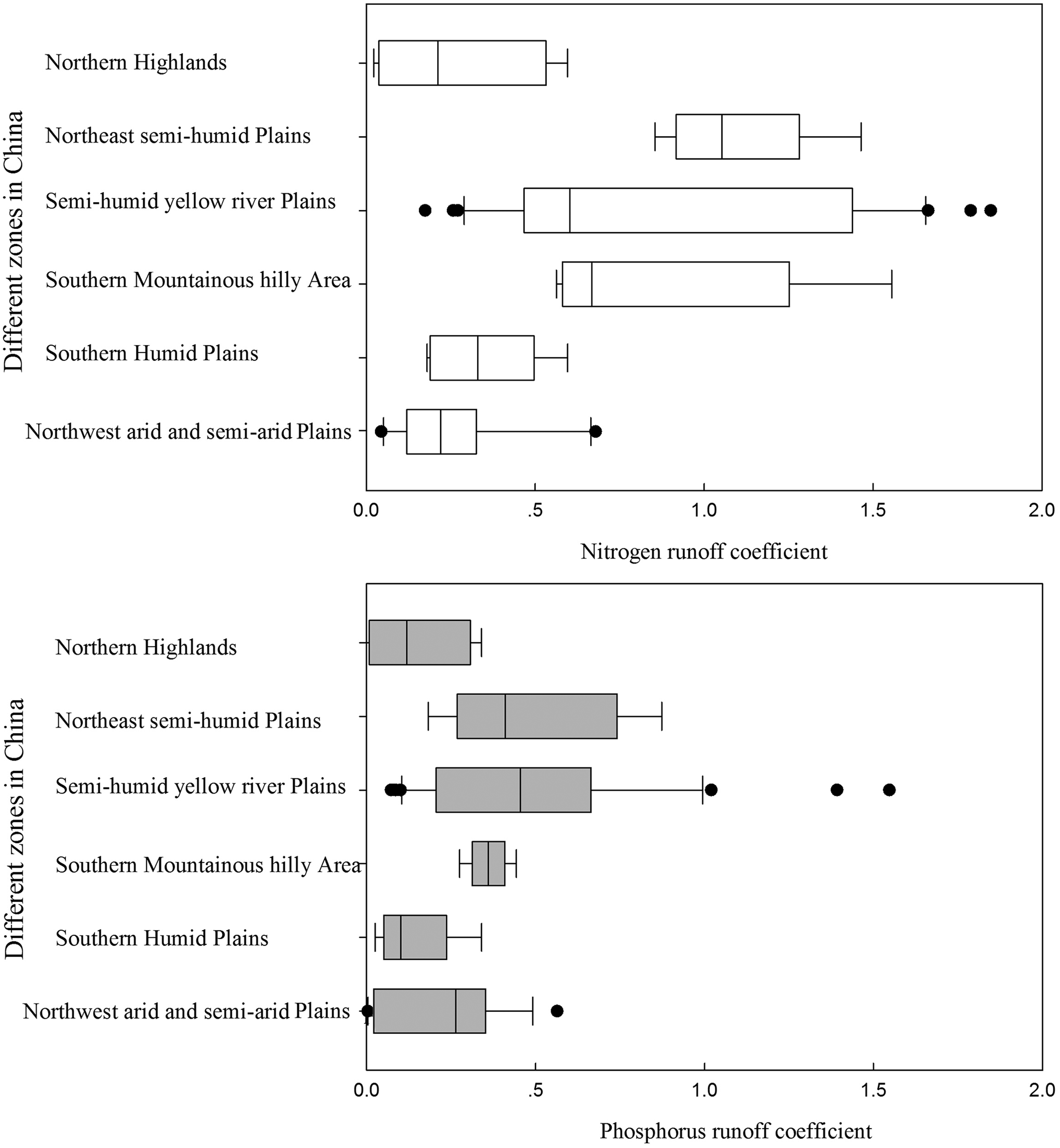
Nitrogen and phosphorus runoff coefficient of fertilizer in different zones in China. Solid lines in the figure indicate median value. The box boundaries indicate upper and lower quartiles, the whisker caps indicate 90th and 10th percentiles, and the circles indicate the 95th and 5th percentiles. Northern highlands include Inner Mongolia, Shanxi, and Shaanxi provinces; northeast semihumid plains include Jilin, Liaoning, and Heilongjiang provinces; northern semihumid plains include Beijing, Tianjin, Hebei, Henan, and Shandong provinces; southern mountainous hilly area include Jiangxi, Guangdong, Chongqing, Sichuan, and Yunnan provinces; southern humid plains include Shanghai, Zhejiang, Jiangsu, Anhui, Fujian, Hunan, Hubei, Guangdong, and Hainan provinces; northwest arid and semiarid plains include Xinjiang, Ningxia, Gansu, Xizang, and Qinghai provinces (data came from First China Pollution Source Census).
The types of livestock production included pig, cattle, sheep, and poultry (chicken, geese, and ducks). The daily production coefficient of TN and TP for feeding livestock in the feeding period was obtained from The China Pollution Source Census (2009b). The daily production coefficient
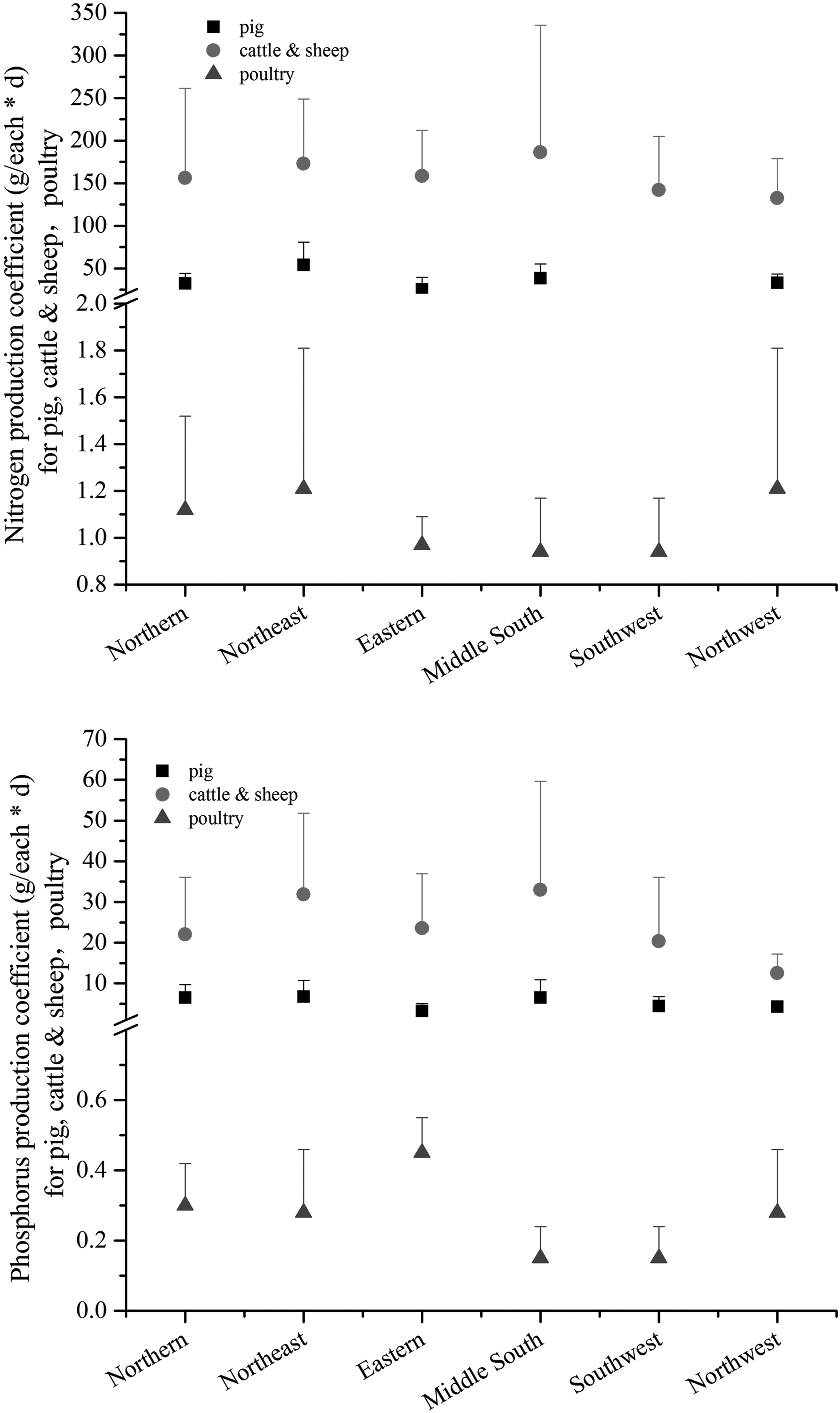
Nitrogen and phosphorus production coefficient of each pig, cow and sheep, and poultry every day in a feeding period (the whisker caps indicate standard deviation). Northern includes Beijing, Tianjin, Hebei, Shanxi, and Inner Mongolia provinces; northeast includes Liaoning, Jilin, and Heilongjiang provinces; eastern includes Shanghai, Jiangsu, Zhejiang, Anhui, Fujian, Jiangxi, and Shandong provinces; middle south includes Henan, Hubei, Hunan, Guangxi, Guangdong, and Hainan provinces; southeast includes Chongqing, Sichuan, Guizhou, Yunnan, and Xizang provinces; northwest includes Shaanxi, Gansu, Qinghai, Ningxia, and Xinjiang provinces.
Data analysis
Mechanical and statistical evaluation models were used to estimate the discharge and production of nitrogen and phosphorus in planting and livestock fields (Neumann et al., 2009). Statistical evaluation was widely adopted due to its simple operation and few data requirements (Wang et al., 2003). In this study, the TN and TP fertilizer application rates per year were calculated by pure nitrogen and phosphorus fertilizer plus 15% mix fertilizer (15-15-15). The pollution release load of TN and TP from fertilizers was calculated based on the following equation:
where
The organic nitrogen and phosphorus supply potentials per arable area in China were calculated based on the following equation:
where
In the organic and mineral fertilizer application assessment, the organic nitrogen and phosphorus residues were calculated by the differences between organic supply potential and safety application threshold; the required rates of mineral nitrogen and phosphorus were calculated by the differences between chemical fertilizer input and maximum of organic fertilizer application in different provinces in China (170 N kg/ha and 35 P kg/ha). GIS can present data easily and has been widely adopted by many researchers (Petropoulos et al., 2015).
Nitrogen and phosphorus were divided into three levels using the fertilizer application standards in developed countries and risk assessment standards in China (where an application rate of not more than 170 N kg/ha in the form of animal manure for arable land was allowed by the European Union). An application rate of 250 N kg/ha was the standard for grassland in the Netherland, which was used as the threshold of Fertilization Environment Safety (FEST) by Ministry of Environmental Protection of People's Republic of China. Phosphorus fertilizer application was limited to not more than 100 kg/ha (45 P kg/ha) in France and the Netherlands (Henkens, 2001; Oenema et al., 2004; Schroeder and Neeteson, 2008; Liu et al., 2015).
Results and Discussions
Chemical fertilizer input in China
To achieve high crop yield in limited arable lands, China's consumption of chemical fertilizers has been increasing since the 1960s (Sun et al., 2012). The results of our study showed that in 2014, annual chemical fertilizer input of TN and TP in China was 852.1 million N kg/year and 374.5 million P kg/year, respectively. Average TN and TP fertilizer application per arable land were 158.5 N kg/ha (ranging from 73.3 N kg/ha in Qinghai to 331.9 N kg/ha in Beijing) and 68.7 P kg/ha (ranging from 30.1 P kg/ha in Guizhou to 128.8 P kg/ha in Xinjiang), respectively. The results showed that the average TN and TP fertilizer applications per arable land in China were remarkably higher than the allowed limit of the average rate of nitrogen (74 N kg/ha) and phosphorus (12 P kg/ha) fertilizer application in the world (Lu and Tian, 2017). Although the set limits for nitrogen and phosphorus application in the United States are 79 N kg/ha and 27 P kg/ha, the application rates in China still exceeded this limit (World Bank, 2014). Furthermore, spatiotemporal variations in provinces in China were significantly different (Fig. 3). Nitrogen input rate in more than half of the provinces was higher than 170 N kg/ha, especially in the coastal provinces such as Liaoning, Tianjin, Hebei (near Bo Sea), Jiangsu (near Yellow Sea), Zhejiang, Fujian (near East Sea), Guangdong, and Hainan (near South Sea) with 213.1 ± 23.2 N kg/ha application. In addition, the average application in Beijing reached 332 N kg/ha, which was remarkably higher than the environmental safety threshold. Phosphorus input rate in most provinces was higher than 45 P kg/ha, which was above the pollution risk level except for Qinghai, Hunan, and Guizhou provinces. Average input was 87.8 ± 18.7 P kg/ha in the lower reaches of Yellow River and Yangtze River such as Henan, Shandong, Hubei, and Jiangsu provinces; and it was 82.7 ± 10.6 P kg/ha in the areas of South Sea such as Fujian, Guangdong, Guangxi, and Hainan provinces.
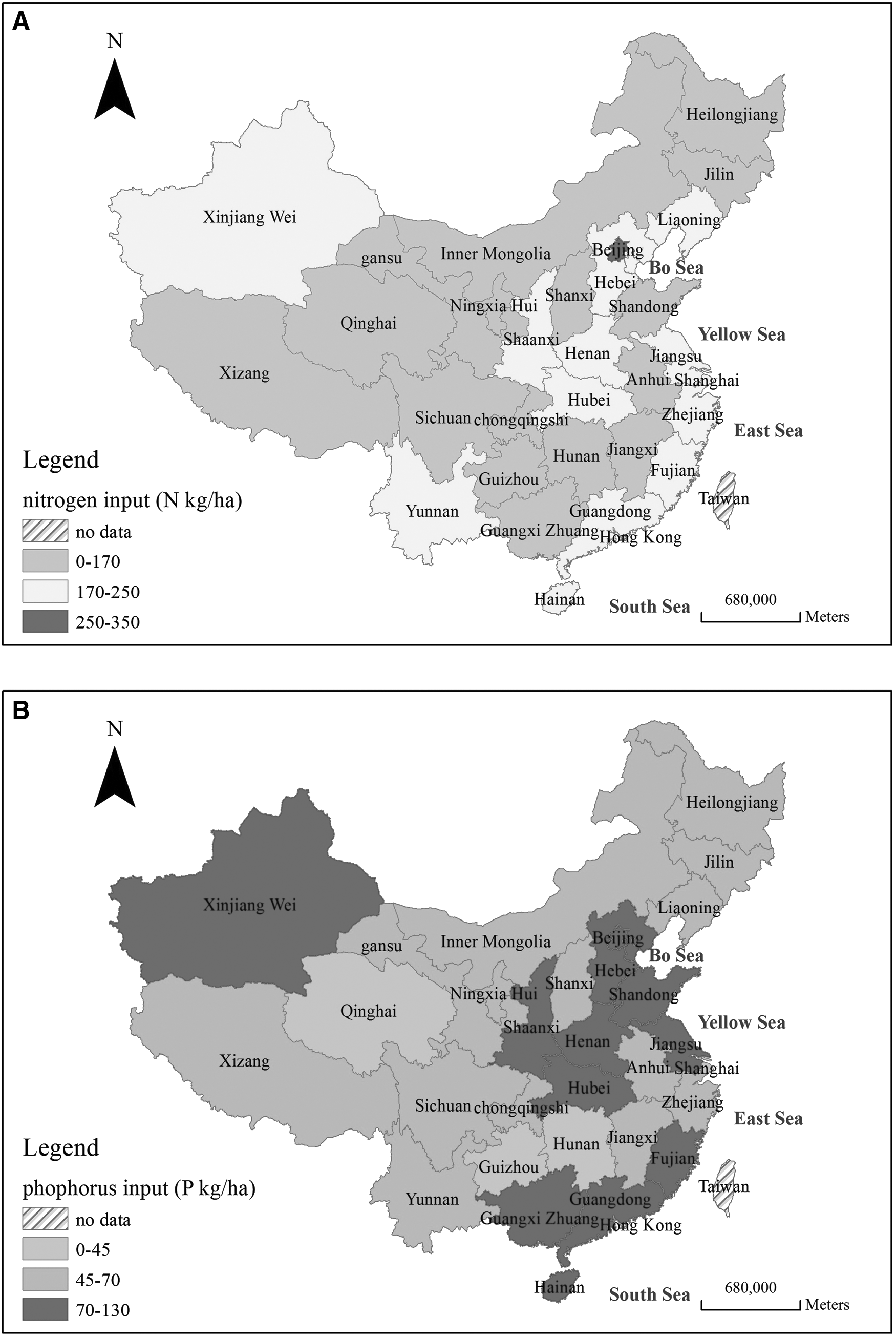
Nitrogen
The chemical fertilizer application increased by 6.7-fold with the double increment of crop yield (cereals) compared with that of 1978 in China. However, the efficiency of nitrogen fertilizer decreased from 57% in 1979 to 33% in 2010 (Liu et al., 2015). In areas around Bo Sea area, and provinces such as Liaoning, Hebei, Shandong, and Beijing, where fertilizer was often applied at rates >1000 N kg/ha for greenhouse vegetable production systems, the nitrogen use efficiency was <10% (Zhu et al., 2005). In developed countries, some measures have been set to limit fertilizer application. In Fertilizer Ordinance 2007 in Germany, the nutrient balance-allowed surplus was limited to annual 60 kg N/ha and 20 kg P/ha (Bationo et al., 2008; Kuhn, 2017), whereas in Denmark the maximum phosphorus limit is 45 kg P/ha. Therefore, the government of China needs to set up the maximum fertilizer threshold for the different crops as soon as possible. Also, best nutrient management practices should be offered to farmers through training programs by agricultural extension agencies and services.
Environmental effect of mineral fertilizer in China
Excessive fertilizer application has contributed substantially to pollution by nitrogen and phosphorus discharge through runoff, leaching, and soil erosion as well as an increase in GHGs such as methane and nitrous oxide. The fertilizer use efficiency of nitrogen and phosphorus in China was only about 33% and 24%, respectively (Zhu and Wen, 1992; Yan et al., 2016). Approximately, ∼2% of applied nitrogen fertilizer is lost into surface water by runoff, 2% is lost to groundwater through leaching, 1.1% is lost into the atmosphere through denitrification process, whereas 11% is lost through volatilization (Zhang et al., 2015; Yan, 2016). The TN loss of fertilizer by runoff, leaching, denitrification, and volatilization in China was 354, 354, 195, and 1947 million kg/year, respectively. The nitrogen release loads of different provinces are shown in Fig. 4. Average nitrogen loss varied in different provinces due to diverse topography, climate, and planting pattern. Owing to the lack of relative data, this study was able to precisely estimate only the discharge load of fertilizer through runoff. The annual TN and TP fertilizer runoff release loads in 2014 [Eq. (2)], which were assessed by fertilizer runoff discharge coefficient and fertilizer application rate (Fig. 5), were 204.1 million N kg and 43.5 million P kg, respectively. The nitrogen discharge load from 13 provinces out of 31 provinces accounted for 82.9% of the total discharge load in China. These 13 provinces were located around coastal areas and important inland lakes. Owing to the large area of arable lands in Shandong, Jiangsu, Henan, and Hubei provinces, the runoff from nitrogen discharges was 74.8 million N kg, which was more than one-third of whole country's nitrogen runoff load. The phosphorus discharge load from 15 provinces out of the 31 provinces accounted for 87.0% of the total discharge load in China. These 15 provinces were mainly located in the eastern and southern parts of China. The runoff from phosphorus discharges of Henan and Hubei provinces was 11.6 million P kg, which was also more than one-fourth of the whole country's phosphorus runoff load. For the past 20 years, substantial runoff from nitrogen and phosphorus discharges has resulted in water quality degradation and severe eutrophication in rivers and lakes. Half of the major lakes in China were eutrophic as at the year 2000, and water quality of over half of rivers and 67% of lakes was assessed to be in poor quality during 2000–2008 (Yuan, 2000; Sun et al., 2012). In addition, 47.8% of the sea areas of Bo Sea, Yellow Sea, East Sea, and South Sea were in eutrophic conditions as of 2014 (SOA, 2014). The annual frequency of red tide in offshore water was >100 during 2000–2014 (Xu et al., 2014).

Nitrogen release load of different provinces in China.

Nitrogen
Organic fertilizer supply potential
Changes in food consumption structure and increasing demand for livestock and poultry together with economic development in China have resulted in >12% increase in the annual rate of livestock and poultry production in the past 30 years (Yang et al., 2013; Geng et al., 2013). In this study, it was observed that the excrement of livestock and poultry during the feeding period contained nitrogen and phosphorus, which led to serious environmental pollution. In the past 10 years, developed countries emphasized the important function of organic fertilizer in the soil and also assessed the sensory threshold of organic fertilizer application to decrease environmental pollution. According to our evaluation [Eq. (2)] by the production coefficient method (Cheng et al., 2007; Zhang et al., 2007; Gao et al., 2012), the nitrogen and phosphorus supplies from different provinces by feeding livestock and poultry in China in 2014 were 25.9 million N tons/year and 4.2 million P tons/year, respectively. Average organic nitrogen and phosphorus supply potential per unit area of arable land in China was 211 N kg/ha and 32 P kg/ha, respectively (Fig. 6). This was significantly higher than the 2009 assessment that reported that the average organic nitrogen supply potential per unit area of arable land in China was 138 N kg/ha (Yang et al., 2013).
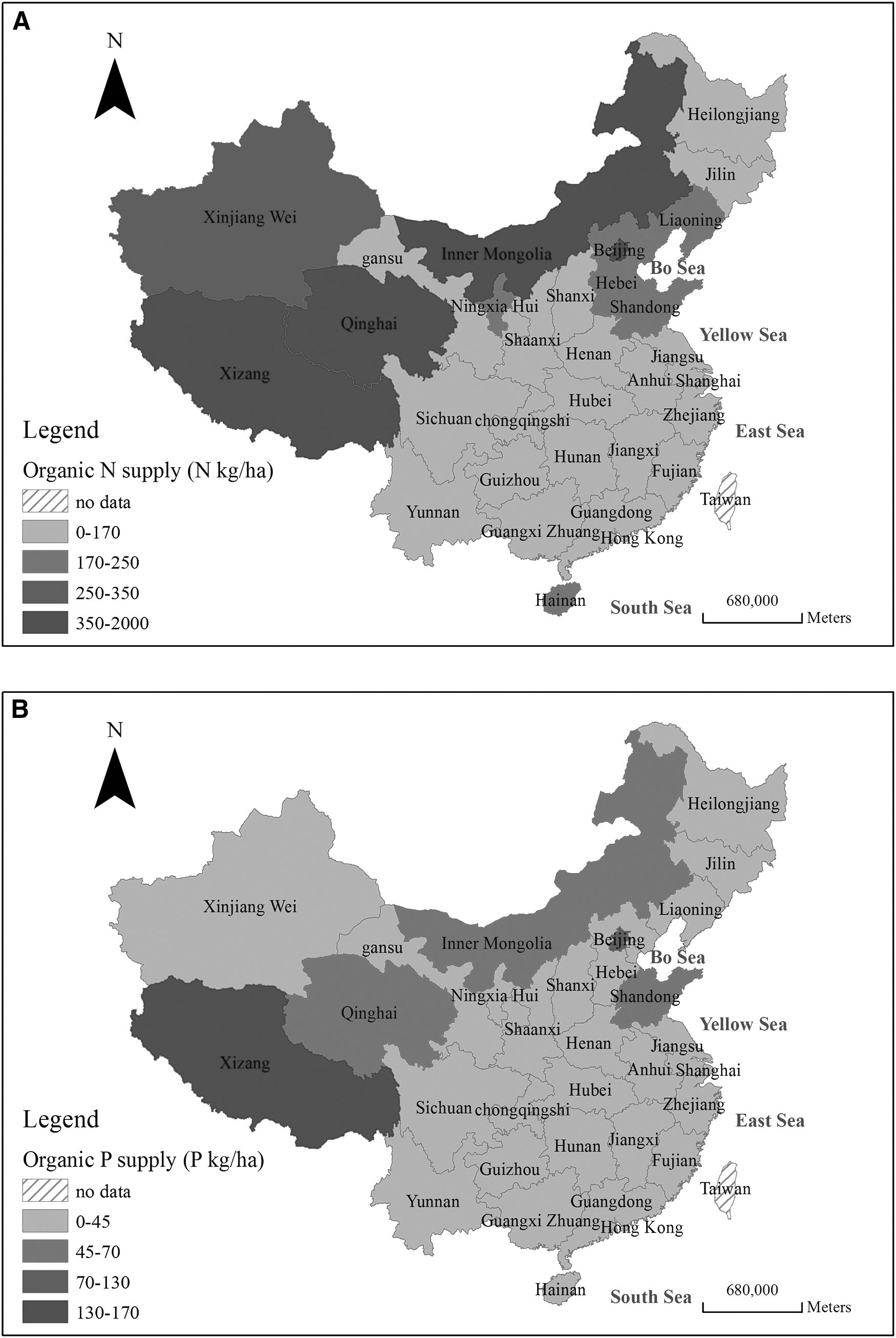
Organic nitrogen
According to the Netherland standard, organic nitrogen application in grassland is 250 N kg/ha (Schroeder and Neeteson, 2008). In the EU Nitrates Directive, the set limits for organic N and P application on the arable area were 170 kg/ha and 45 kg/ha, respectively. Comparing the results of this study with the EU standards, most of northeast, southern, and eastern China recorded a safer level of organic nitrogen application such that the organic nitrogen supply was <170 N kg/ha. In these areas, the excrement of livestock and poultry was sufficiently used, which decreases the application rate of mineral fertilizer to evade environmental pollution. In the areas near the Bo Sea such as in Liaoning, Hebei, and Shandong, which serve as the main agricultural provinces in China, organic nitrogen supply was higher than 170 N kg/ha. As such treatment of excrement of livestock and poultry for environmental protection especially in ecological buffer zones and environmentally sensitive areas should be emphasized more strictly. The government should also consider not only the utilization of organic fertilizer for environmental safety but also a reduction and restructure of the scale of livestock and poultry industries. For northwest China, the organic nitrogen supply is very huge in Xizang, Inner Mongolia, Xinjiang, and Qinghai provinces, mainly due to the large amounts of livestock and poultry production in those areas. The mentioned four provinces have a large grassland area that forms ∼65% of the whole country's grassland. The average organic nitrogen supply per grassland in Xinjiang and Qinghai provinces was <250 N kg/ha, which was within the safe environmental level. This means that the excrement of livestock and poultry can have no pollution risk on the environment if used properly and effectively. Combination of farming and animal husbandry to develop organic agriculture is a better strategy for future agricultural development. However, for Xizang and Inner Mongolia, excessive nitrogen discharge from the livestock and poultry industries would be a serious pollution risk. The same phenomenon was observed for organic phosphorus supply; most of the provinces had safe levels with the exception of Shandong province and Beijing.
Organic and chemical fertilizer application assessment
China being the largest consumer of chemical fertilizer in the world due to excessive fertilizer application has gained both national and international attention for resolution (Ju et al., 2007; Mueller et al., 2012; Liang et al., 2013; Yang et al., 2017). Policy makers in China are becoming increasingly aware of the problems associated with overuse and misuse of fertilizer, hence new policies are being developed to sustain the increasing demand for food while minimizing negative environmental impacts of excessive fertilizer consumption (Zhang et al., 2017). However, until these policies are fully implemented, the issue of overusing fertilizer will not be well resolved. At the same time, massive breeding that has exceeded the point source pollution from livestock and poultry is one of the key current issues in China (Clemencio et al., 2014; Liu et al., 2016). Excrement from livestock and poultry industries, when applied as manure fertilizer in agricultural system, can increase crop yield, and also improve soil productivity and ecological sustainability (Yang et al., 2017). Since the 1980s with the green revolution, manure application has decreased rapidly due to more labor force input and cheaper mineral fertilizer price. The best problem-solving strategy for nonpoint source pollution from planting field and livestock and poultry field is to use organic fertilizer resource from livestock and poultry to reduce the amount of chemical fertilizer application. This will minimize pollution load production to keep fertilizer application threshold within the limits that are safer for the environment. In addition, nutrient management for crops can be improved. More efficient use of phosphorus fertilizer and more effective recycling of manure phosphorus could possibly resolve global agronomic phosphorus imbalances and increase global agricultural productivity as well as improve freshwater quality (MacDonald et al., 2011). Data from the organic and chemical fertilizer application assessment per cropping area in China (Fig. 7) show that at present with the maximum safety threshold of organic nitrogen application at 170 N kg/ha, in Xinjiang, Yunnan, Hubei, Henan, and areas near Bo sea and East Sea, reasonable and suitable additional mineral fertilizer application can be accepted since nutrient supply in the area is still low. Also with the 35 P kg/ha organic fertilizer application, most provinces will need additional mineral fertilizer application, especially in Xinjiang, Hunan, Hebei, and Fujian provinces. In Xizang, Inner Mongolia, and Beijing, setting up chemical fertilizer application limitation threshold and reducing the scale of livestock and poultry industries should be measured immediately and inevitably. Moreover, for higher organic nitrogen surplus areas such as Xinjiang, Qinghai, Xizang, and Inner Mongolia, which are the main grassland areas in China, the mode of combination of planting and breeding to develop organic agriculture should be advocated. From the organic and mineral fertilizer application assessment, it was suggested that organic nitrogen and phosphorus resource should be used sufficiently to reduce the requirement of mineral fertilizer application. However, the rate of application should be controlled since recent studies have reported that long-term excessive manure application could be lost from cropland to surface water (Eneji et al., 2001; Chen et al., 2016).

Organic nitrogen
Conclusions
Average TN and TP of chemical fertilizer application per arable land in China were 158.5 N kg/ha and 68.7 P kg/ha, respectively. Nitrogen and phosphorus discharge load from cropland posed environmental risks on most provinces especially in the coastal provinces such as in Bo Sea, Yellow Sea, East Sea, and South Sea, and in the lower reaches of Yellow River and Yangtze River and other sites of several important inland lakes. This placed those provinces under serious risk of eutrophication. The total loss of nitrogen fertilizer by runoff, leaching, denitrification, and volatilization in China was 354, 354, 195, and 1947 million kg/year. The phosphorus discharge load from 15 provinces out of the 31 provinces accounted for 87.0% of the total discharge load in China and these provinces were mainly located in eastern and southern parts of China. Average organic nitrogen and phosphorus supply potentials per unit of arable land in China were 211 N kg/ha and 32 P kg/ha. Combination of farming and animal husbandry to develop organic agriculture is a better strategy for future agricultural development. However, provinces such as Xizang and Inner Mongolia that produced excessive nitrogen discharge from livestock and poultry industries pose serious pollution risks. The same phenomenon also existed for organic phosphorus supply, whereby most of the provinces were in safe levels with the exception of Shandong province and Beijing.
Footnotes
Author Disclosure Statement
No competing financial interests exist.
Funding Information
The authors thank the National Key R&D Program of China (Grant Nos. 2018YFD0800101, 2017YFD0201804, and 2016YFD0200403); Natural Science Foundation of Jilin province, China (Subject to guide project, Grant No. 20170101004JC); and the National Natural Science Foundation of China (Grant No. 31471945) for their financial support.
References
Supplementary Material
Please find the following supplemental material available below.
For Open Access articles published under a Creative Commons License, all supplemental material carries the same license as the article it is associated with.
For non-Open Access articles published, all supplemental material carries a non-exclusive license, and permission requests for re-use of supplemental material or any part of supplemental material shall be sent directly to the copyright owner as specified in the copyright notice associated with the article.
