




Abstract
Abstract
Pyrolysis temperature affects biochar properties, which in turn determine its application potential. Here, we examined the properties of crofton weed biochar (C-BC) produced at different pyrolysis temperatures of 300°C, 400°C, 500°C, and 600°C. We measured the yield, ash content, pH, iodine sorption value (ISV), and elemental composition of C-BC. We also characterized C-BC using scanning electron microscopy (SEM), X-ray diffraction (XRD), and Fourier transform infrared, as well as its ability to remove Pb2+ and Cd2+ from aqueous solution. C-BC yield decreased with increasing pyrolysis temperature, whereas ash content and pH increased. ISV first increased at 300–400°C and decreased at 500–600°C. For C-BC produced at pyrolysis temperatures 300–600°C (C-BC300 to C-BC600, respectively), H, N, and O content decreased, but C, Ca, Mg, P, and K content increased with increasing temperature. Water-soluble K+ content had the same trend as the K content, and water-soluble Ca2+, Mg2+, PO43−, NO3−, and NH4+ content decreased with increasing pyrolysis temperature. The (NO3−+NH4+), PO43−, and K+ content of C-BC was high, and the K+ content in C-BC600 was particularly high at up to 26,293.33 mg/kg. All C-BCs had a certain number of pore structures. Increasing pyrolysis temperatures decreased the amount of -OH, -COOH, aliphatic C-H, and polar C-O on the C-BC surface. As the pyrolysis temperature increased, calcium magnesium carbonate, calcium magnesium silicate, calcium magnesium phosphate, and potassium salt crystalline minerals gradually formed. The percentage of Pb2+ and Cd2+ removed increased with increasing pyrolysis temperatures. Overall, for C-BC, a low pyrolysis temperature was beneficial for producing a more porous biochar and increased content of water-soluble calcium, magnesium, nitrogen, and phosphorus, whereas high pyrolysis temperatures yield biochar that had high alkalinity, aromaticity, and stability, as well as heavy metal removal activity and water-soluble potassium content.
Introduction
Biochar is a pyrogenic black carbon produced from thermal degradation of carbon-rich biomass (<700°C) in an oxygen-limited environment, and usually has a porous structure, a surface rich in oxygenated functional groups, strong adsorption capacity, and a certain degree of surface area and stability (Inyang et al., 2016). Biochar has multiple uses, including agricultural applications, particularly for soil remediation, and pollution control in water and soil (Alwabel et al., 2013; Ahmad et al., 2014). Application of biochar has several significant socioeconomic and environmental benefits such as carbon sequestration, pollutant removal, and soil improvement.
Methods for development and utilization of biochar have been a focus of biochar research. Inexpensive and readily available waste biomasses from agriculture, livestock, and industry (e.g., crop residues, livestock manure, wood pellets, sewage sludge) are the main materials used to prepare biochar. The source materials affect the composition and properties of the resulting biochars, which can have varying yield, pH, ash content, surface morphology, and adsorption properties, which in turn determine their application potential (Chan and Xu, 2009). Therefore, studies on the properties of biochar are important for maximizing its effective use. Pyrolysis temperature is one of the most important factors that affect biochar properties (Yuan et al., 2015). Several recent studies have assessed the properties of biochar materials prepared from different feedstocks using different pyrolysis temperatures and provided data that support the development of methods to optimize production of biochars having desirable properties (Cao and Harris, 2010; Alwabel et al., 2013; Meng et al., 2013; Wang et al., 2015b; Yuan et al., 2015; Inyang et al., 2016).
Eupatorium adenophorum Spreng (crofton weed) is a perennial herb or semishrubby plant that grows between 0.8 and 2.5 m tall. Crofton weed is native to Central America, but is an invasive plant in America, New Zealand, China, and many other countries (Liu et al., 2006; Li and Feng, 2009; Wang et al., 2017). Crofton weed spread from Myanmar to China in the 1940s, and since then has quickly become widespread across southwest China, where it is damaging to native bioecosystems. At present, the economic loss to animal husbandry and grassland ecosystem function in China caused by invasive crofton weed is estimated to be 0.99 and 2.63 billion Yuan/hm2, respectively (Wan et al., 2010). Several methods have been developed to control crofton weed, including those that involve chemical control, biological control, and manual control. However, these methods have not produced notable results (Guo et al., 2009). Compared with these control methods, resource utilization of crofton weed has been explored in recent years (Guo et al., 2009; Sahoo et al., 2011; Zheng et al., 2014). As an invasive plant, crofton weed is easily obtained at low cost. Based on these properties, crofton weed would be a suitable feedstock for preparation of biochar, but there are few reports describing the properties of crofton weed biochar (C-BC).
The aim of this study was to explore the effect of pyrolysis temperature on the properties of C-BC. Here, C-BC was prepared at different temperatures (300°C, 400°C, 500°C, and 600°C) under oxygen-limited conditions, and the yield, ash content, pH, iodine sorption value (ISV), elemental composition, surface morphology, mineral phase, and surface functional group of the resulting C-BC were characterized and analyzed. The ability of C-BC to remove Pb2+ and Cd2+ from aqueous solution was also determined in a batch experiment. Results from this study can guide the preparation and utilization of C-BC to maximize its potential applications.
Materials and Methods
Preparation of C-BC
Crofton weed (except for the roots) was collected from Xichang City, Sichuan province, China (101° 46′-102° 25′E, 27° 32′-28° 10′N). The collected crofton weed was washed, air-dried at room temperature, and crushed for passage through a 10-mesh sieve. The crushed crofton weed was then used to fill several covered ceramic crucibles and pyrolyzed in a muffle furnace (SX2-4-10, Shenyang Energy Saving Electric Furnace Factory, Shenyang, China) at 300°C, 400°C, 500°C, or 600°C for 4 h, after which the crucibles were removed and cooled at room temperature. The carbonized crofton weed in each crucible was then ground to pass through a 60-mesh sieve. The carbonized crofton weed powders produced at different pyrolysis temperatures were termed C-BC300, C-BC400, C-BC500, and C-BC600, respectively, and C-BCs are collectively referred to as C-BC.
Properties of C-BC
C-BC yield was calculated using the following Equation (1):
where ma and mb represent the weight of C-BC and crofton weed, respectively. The ash content was detected by heating C-BC at 1000°C for 2 h and was calculated using Equation (2):
where Na and Nb refer to the weight of C-BC after and before heating, respectively. The pH of C-BC was measured with a pH meter (PHB-4; Shanghai Rex Instrument Factory, Shanghai, China) in a mixture of 1.00 g C-BC and 20 mL deionized water following a 1 h intermittent equilibrium. The ISV of C-BC was determined according to Chinese National Standards (GB/T12496.8-2015). In brief, a C-BC sample (0.5 g) was mixed with 50 mL 0.1 M I2-KI solution in a 250 mL conical flask, which was placed in an oscillator (240 rpm/min) for 15 min. The solution was then filtered, and 10 mL of the filtrate was titrated with 0.1 M Na2S2O3. A starch solution (5 g/L) was used as an indicator in the titration process. The consumption volume of Na2S2O3 was used to calculate the ISV of C-BC.
Elemental analysis of C-BC (carbon [C], hydrogen [H], and nitrogen [N]) was performed using an elemental analyzer (Vario EL III; Elementar Corp., Hanau, Germany). The oxygen (O) content was calculated by subtracting the C, H, N, and ash content from the total quantity (Mimmo et al., 2014). For Ca, Mg, K, and P, 0.10 g C-BC was digested with HNO3 using a microwave digestion method, and the concentrations in C-BC were detected and calculated using a ICP-OES (iCAP 6000 series; Thermo Fisher Scientific, Inc., Waltham, MA). Water-soluble Ca2+, Mg2+, K+, PO43−, NH4+-N, and NO3−-N were extracted by mixing 5.00 g C-BC with 50 mL deionized water. The mixture was shaken in an oscillator at room temperature for 1 h before centrifugation in a high-speed centrifuge and filtration of the supernatant through a 0.45 μm filter membrane. The Ca2+, Mg2+, K+, and PO43− content in the filtrate was determined by the ICP-OES. The NO3−-N content was detected according to the Chinese National Standards (HJ/T346-2007). The soluble NH4+-N content was measured using an automated wet chemistry analyzer (San++; Skalar Analytical BV, Breda, The Netherlands).
The surface morphology of C-BC was analyzed by scanning electron microscopy (SEM) with a field-emission electron microscope and an operating voltage of 15 kV (JSM-7500F; JEOL Ltd., Tokyo, Japan). Mineral phase analysis of C-BC was conducted by X-ray diffraction (XRD) (DX-1000; Dandong Yuanfang Instrument Co. Ltd., Dandong, China). The characterization of C-BC surface functional groups was recorded by Fourier transform infrared (FT-IR) spectroscopy (Spectrum II L1600300; Perkin-Elmer Crop., Norwalk, OH).
Removal of Pb2+ and Cd2+ from aqueous solution
Pb2+ and Cd2+ solutions (50 mg/L) were prepared with Pb(NO3)2 and Cd(NO3)2 4H2O. The initial pH of the solution was adjusted to 5.0 by adding 0.1 M HNO3 or NaOH solutions. A C-BC sample (0.10 g) was added to 50 mL Pb2+ (50 mg/L) or Cd2+ (50 mg/L) solution, and the mixture was shaken for 24 h at 120 rpm/min at room temperature before filtration through a 0.45 μm filter membrane. The final pH of the filtrate was measured with a pH meter, and ICP-OES was used to determine the final concentration of Pb2+ and Cd2+. In this experiment, the percentage of Pb2+ and Cd2+ removed was used to evaluate the removal activity of C-BC. The percentage of Pb2+ and Cd2+ removed was calculated using the following Equation (3):
where C0 represents the original concentration of Pb2+ or Cd2+ (i.e., 50 mg/L), and C1 refers to the remaining concentration of Pb2+ or Cd2+.
Data processing
Each experiment was repeated three times, and the average value of the three replicates was taken as the experimental result. Excel 2007, IBM SPSS Statistics 20, and Origin 8 were used for data management and processing.
Results and Discussion
General properties of C-BC
Yield of C-BC decreased with increasing pyrolysis temperature (Table 1), and this decreasing trend was consistent with other reports concerning biochars produced from herbaceous biomass (Peng et al., 2011; Ronsse et al., 2013; Wang et al., 2015b). The decrease in C-BC yield was related to further pyrolysis of raw materials upon increases in the pyrolysis temperature (Onay, 2007; Angin, 2013). An obvious decrease (p < 0.05) occurred as the pyrolysis temperature increased from 300°C to 400°C, which could be due to the decomposition of hemicellulose and cellulose (Cao and Harris, 2010). The yield of C-BC at different pyrolysis temperatures ranged from 29.10% to 44.43%, and was approximately the same as that seen for other biochars, such as rice straw (Peng et al., 2011), canola straw, corn straw, soybean straw, peanut straw (Yuan et al., 2011), and pig manure (Zhao et al., 2013).
Crofton Weed Biochar Yield, Ash Content, pH, and Iodine Sorption Value
C-BC, crofton weed biochar; ISV, iodine sorption value.
The ash content of C-BC ranged from 9.73% to 14.78% (Table 1), and increased with increasing pyrolysis temperature, which was also consistent with previous studies (Yuan et al., 2011; Wang et al., 2015b). The increase in ash content was due to increases in the amount of minerals and combustion of residual organic matter at high temperature (Cao and Harris, 2010). Upon increasing the pyrolysis temperature from 300°C to 400°C, the ash content increased by 3.80% (p < 0.05) after decomposition of hemicellulose and cellulose in this temperature range (Table 1).
The pH of C-BC ranged from 7.25 to 10.34, with only C-BC300 falling outside the alkaline range (pH = 7.25; Table 1). Generally, the pH of C-BC increased with increasing pyrolysis temperature. A previous study indicated that biochar pH is significantly and positively correlated with the ash content (Wang et al., 2015b). Indeed, the high ash content seen for C-BC prepared at high pyrolysis temperatures was associated with a higher pH, and a significant change in pH occurred between C-BC300 and C-BC400 (p < 0.05). Furthermore, organic nitrogen present in amine functional groups was transformed into pyridine-like compounds, and the amount of acidic surface functional groups decreased (De Filippis et al., 2013; Chen et al., 2014), both of which contributed to increased alkalinity of C-BC with increasing pyrolysis temperature. The surface functional group changes of C-BC are discussed in additional detail in the Fourier transform infrared section.
The ISV of C-BC (Table 1) increased from 230.40 (C-BC300) to 299.54 mg/g (C-BC400), before gradually decreasing to 223.49 mg/g (C-BC600). The ISV of C-BC400 (299.54 mg/g) was significantly higher than that of the other C-BCs (p < 0.05), whereas the ISVs of C-BC300, C-BC500, and C-BC600 were all approximately the same (p > 0.05). Mianowski et al. (2007) showed a positive correlation between ISV and surface area. Thus, our results indicate that the C-BC surface area increased first, and then decreased with increasing pyrolysis temperature. This is consistent with studies performed by Tsai et al. (2012), Angın (2013), and Lu et al. (2013), who also showed decreased surface area for biochar produced at pyrolysis temperatures >500°C.
The general consistency of C-BC properties with those of other biomass-biochars suggests that crofton weed is suitable for conversion into biochar. The C-BC prepared using pyrolysis temperatures >400°C is alkaline, and thus could be used to reduce soil acidity for agricultural planting. All of the C-BCs in this study had a certain degree of ISV, and thus addition of C-BC to soil could be a practical method to reduce nutrient loss and capture pollutants.
Biochar elemental analysis
C content of C-BC increased by 7.94% between C-BC300 and C-BC600 (Table 2), likely due to the concentration effect of pyrolysis (Kloss et al., 2012; Sun et al., 2014). Meanwhile, the H, N, and O content decreased with increasing pyrolysis temperature. Specifically, the H, N, and O content decreased from 2.79%, 1.39%, and 37.00% (C-BC300) to 0.64%, 1.12%, and 31.49% (C-BC600), respectively (Table 2). During pyrolysis, loss of increasing amounts of volatile agents, hemicellulose, and cellulose with increases in pyrolysis temperatures decreases the overall amount of H, O, and N elements (Chen et al., 2014). Here, the atomic ratios of H/C, O/C, and (O+N)/C were, respectively, decreased from 0.57, 0.35, and 0.37 (C-BC300) to 0.11, 0.19, and 0.20 (C-BC600).
Elemental Composition of Crofton Weed Biochar and Atomic Ratios
The ratios of H/C and O/C can be used as carbonization indicators (Wang et al., 2015b). Thus, the low H/C and O/C for C-BC600 indicated that highly carbonized biochar was formed at this pyrolysis temperature. The atomic ratios of H/C and (O+N)/C can serve as indices for aromaticity and polarity, respectively (Chen et al., 2005; Pujol et al., 2013). The decreasing trends for the atomic ratios H/C and (O+N)/C demonstrated that high-temperature pyrolysis is beneficial to produce C-BC that has enhanced aromaticity and decreased polarity, respectively. In previous studies, Spokas (2010) found that biochar having an O/C ratio between 0.2 and 0.6 was stable and had a 100–1,000 year half-life. Schimmelpfennig and Glaser (2012) showed that an O/C < 0.4 and an H/C ratio <0.6 as well as C content >15% are associated with stable biochar. For all C-BCs in this study, the ratios of O/C, H/C, and C content fell within these intervals, suggesting that they have good stability and thus would be suitable for use as materials or additives for soil remediation.
Content of Ca, Mg, K, and P ranged from 17,790.08–29,750.08, 3,230.92–5,211.75, 31,661.67–49,553.33, and 3,469.08–5,453.75 mg/kg, respectively (Fig. 1a). Overall, the content of Ca, Mg, K, and P had an increasing trend from C-BC300 to C-BC600 (p < 0.05), which was consistent with previous studies (Cao and Harris, 2010; Hossain et al., 2011; Yuan et al., 2011; Cantrell et al., 2012).
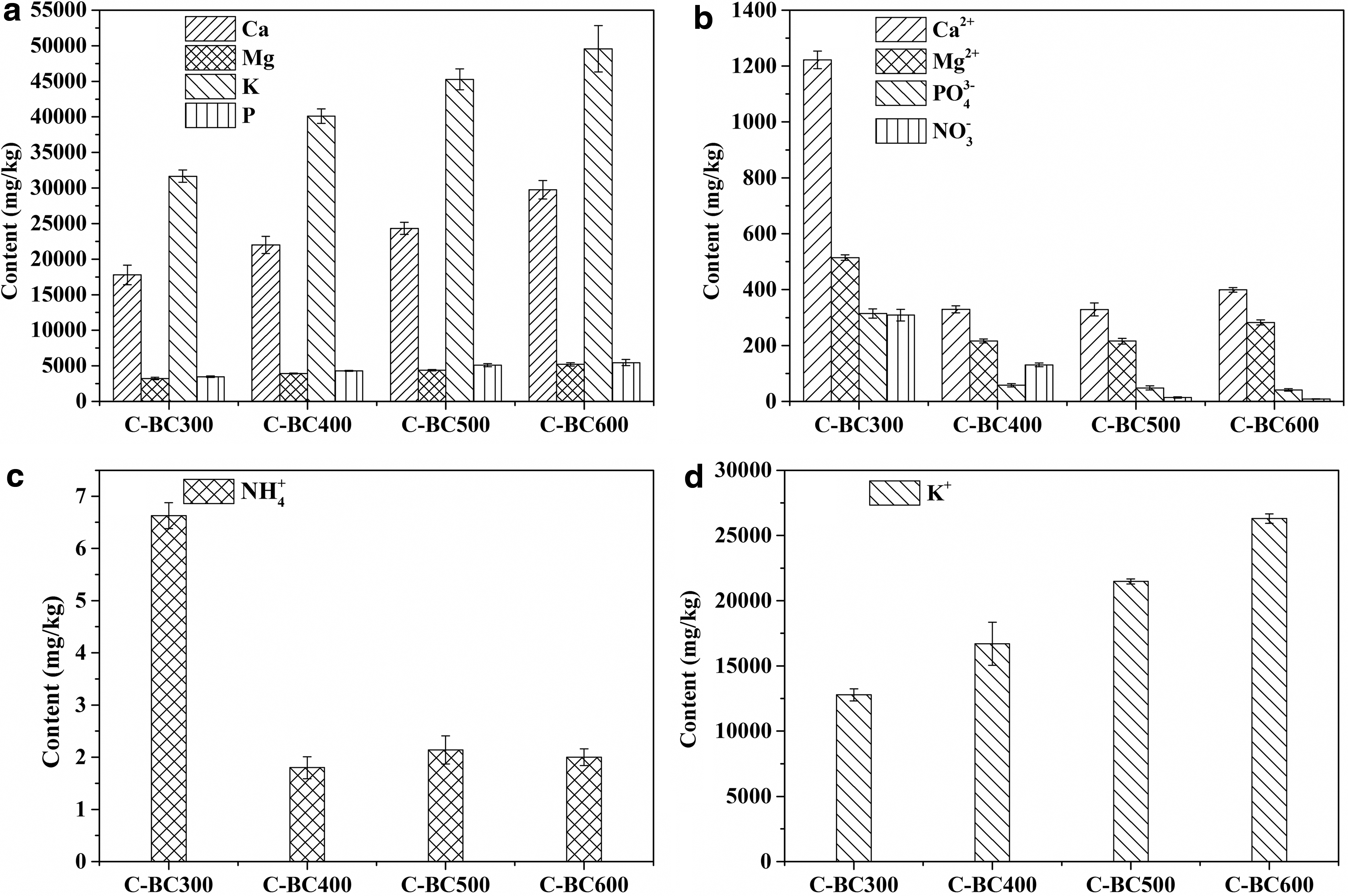
Nutrient element content of C-BC.
Ca2+, Mg2+, PO43−, NO3−, and NH4+ content showed a decreasing trend with increase in pyrolysis temperature, as seen for the differences between C-BC300 and C-BC600 (Fig. 1b, c). The maximum content for Ca2+, Mg2+, PO43−, NO3−, and NH4+ was 1,221.67, 514.80, 314.73, 308.62, and 6.63 mg/kg, respectively. Changes in the content of Ca2+, Mg2+, and PO43− had an opposite trend to those seen for Ca, Mg, and P (compare Fig. 1a with b). With increasing pyrolysis temperature, P can gradually convert to less-soluble minerals with Ca and Mg (Zheng et al., 2013) and Ca, Mg can convert to silicate minerals, which might be one reason for the decrease in the content of water-soluble Ca2+, Mg2+, and PO43−. The mineral phase of C-BC will be discussed in detail in subsequent XRD analyses. The decrease in the NO3− and NH4+ content with increasing pyrolysis temperature was related to the loss of total nitrogen and N heterocyclization during pyrolysis (Koutcheiko et al., 2007). Unlike the above five ions, the K+ content (Fig. 1d) showed an increasing trend from C-BC300 to C-BC600 (p < 0.05), and the maximum K+ content was 26,293.33 mg/kg. The concentration of K (Fig. 1a) and the formation of KCl crystallized mineral (see the X-ray diffraction section) contributed to the high K+ content in C-BC prepared at high pyrolysis temperature.
(NO3−+NH4+), PO43−, and K+ are important sources of available N, P, and K for plant uptake in agricultural production. Compared with previous studies, the water-soluble (NO3−+NH4+) content (11.01–315.25 mg/kg) was higher than that seen for biochars prepared from giant reed (8.00–39.6 mg/kg) (Zheng et al., 2013), manure (1.73–37.93 mg/kg), crop residues (2.30–5.94 mg/kg), and municipal solid waste (2.30–7.70 mg/kg) (Zornoza et al., 2016), whereas the water-soluble PO43− content (41.41–314.73 mg/kg) was higher than that in biochars produced from swine manure (2.79-139.00 mg/kg) (Meng et al., 2013) and poplar wood (37.00–59.00 mg/kg) (Kloss et al., 2012). Meanwhile, the C-BC water-soluble K+ content (12,786.67–26,293.33 mg/kg) was much higher than that for biochars prepared using wheat straw (10,200.00–18,200.00 mg/kg), spruce wood (1,200.00–1,600.00 mg/kg), and poplar wood (1,700.00–2,500.00 mg/kg) (Kloss et al., 2012). According to variations in the trends for NH4+, NO3−, K+, and PO43−, C-BC produced at high pyrolysis temperature would be beneficial for applications requiring K, whereas C-BC prepared at low pyrolysis temperature would be useful in applications requiring increased amounts of N and P.
Surface morphology
Morphologies of the four C-BCs are shown in Fig. 2. C-BC300 and C-BC400 retained the relatively complete tubular cell structure of crofton weed, whereas this structure was gradually destroyed in C-BC500 and C-BC600 with the degree of destruction increasing with increasing temperatures. All C-BCs had a certain number of pore structures (Fig. 2) formed from the large amounts of pyrolysis gas released from the C-BC surface during pyrolysis. However, excessive pyrolysis gas released through the surface of C-BC could lead to expansion and coalescence of pores (Angın, 2013), which might result in collapse of pore structures. Although the expansion and coalescence of pore structures are not visible in Fig. 2, the decreased ISVs for C-BC500 and C-BC600 (Table 1) support this possibility to some extent.

Scanning electron micrographs of C-BC prepared at different pyrolysis temperatures. The scale bar represents 10 μm.
The application of C-BC with suitable pore structures to soils can improve the physical properties of the soil by augmenting porosity, reducing bulk density, and increasing water holding capacity. Moreover, the pore structure in C-BC can provide a good habitat for microbes, and in turn increase the number and activity of beneficial microbes to improve the soil microbial environment. Based on our findings, C-BC prepared at low pyrolysis temperature (<400°C) would be suitable to produce biochar that has these properties.
X-ray diffraction
XRD can be used to analyze the mineral phase of biochar. In XRD analysis of the different C-BCs, we observed an elevated background between 16° and 22° (2θ) for C-BC300. This elevated background could be assigned to organic, cellulose material (Jiang et al., 2007; Cao and Harris, 2010; Kloss et al., 2012). However, as the pyrolysis temperature increased, this elevated background gradually disappeared, as seen in XRD for C-BC400, C-BC500, and C-BC600 (Fig. 3). These results reflected the decomposition of hemicellulose and cellulose in crofton weed (Cao and Harris, 2010), and were consistent with the significant reduction of yield seen between 300°C and 400°C (Table 1). For all C-BCs, sylvite (KCl) (2θ = 28.345o, 40.507o, 50.169o, 66.381o), dolomite (CaMg(CO3)2) (2θ = 35.323o, 41.127o), and quartz (SiO2) (2θ = 26.243o, 44.996o) were detected. The peak heights for these minerals increased with increasing pyrolysis temperature, indicating that the sylvite, dolomite, and quartz content gradually increased in the relevant C-BC.
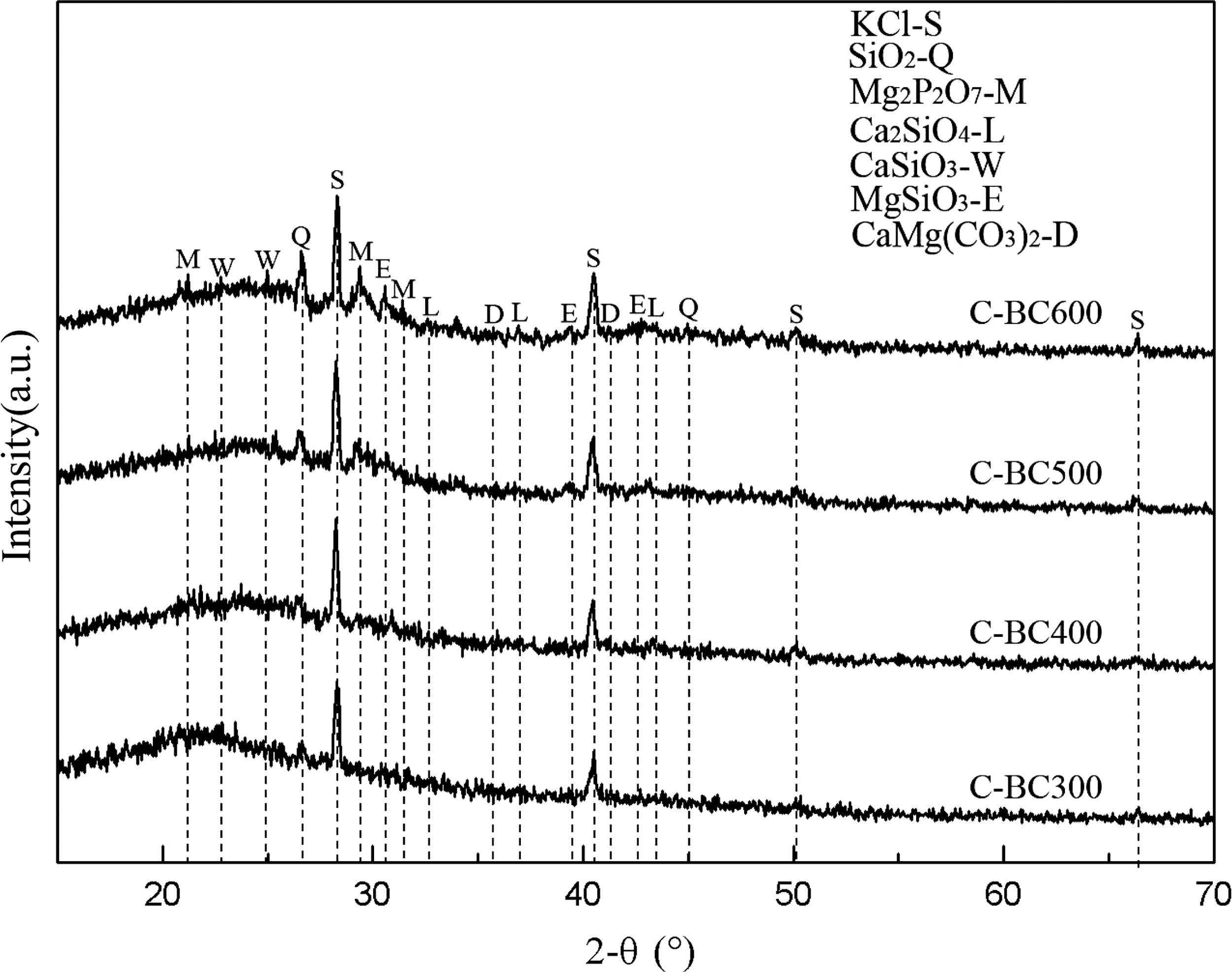
X-ray diffraction patterns of C-BC prepared at different pyrolysis temperatures. The single letters beside the compound names correspond to those above the peaks in the spectra.
Wollastonite (CaSiO3) (2θ = 23.149o, 25.303o), enstatite (MgSiO3) (2θ = 1.137o, 39.545o, 42.812o), and larnite (Ca2SiO4) (2θ = 32.642o, 36.758o, 44.622o) were only seen for C-BC600, suggesting that silicate minerals associated with Ca and Mg were formed at a high pyrolysis temperature. In addition, peaks for magnesium diphosphate (Mg2P2O7) (2θ = 20.291o, 29.554o, 30.484o) were seen for C-BC500 and C-BC600, and the peaks were more sharp for C-BC600. Thus, these crystallized phosphate minerals were gradually formed as pyrolysis temperatures increased. This finding was consistent with a previous report by Zheng et al. (2013). In summary, increasing amounts of calcium magnesium carbonate, calcium magnesium silicate, calcium magnesium phosphate, and crystallized sylvite minerals were formed in C-BC with increases in pyrolysis temperature. For C-BC, the main mineral phases were sylvite, dolomite, quartz, and magnesium diphosphate.
Fourier transform infrared
In FT-IR spectra of C-BC, several sorption peaks showed that the composition of the surface functional groups was complex (Fig. 4). The peak at 3400 cm−1 was attributed to the O—H stretching vibration (Peng et al., 2011), and the peaks at 2851 and 2919 cm−1 were due to aliphatic C—H vibration (Yang et al., 2007; Liu et al., 2015). Between C-BC300 and C-BC600, the absorption intensities of C-BC at 3400, 2919, and 2851 cm−1 decreased. These results indicated that the number of hydroxyl groups and aliphatic compounds on C-BC gradually decreased with increasing pyrolysis temperature (Yuan et al., 2011; Cantrell et al., 2012; Fang et al., 2014; Zornoza et al., 2016). This reduction imparts decreased polarity and a concomitant increase in aromaticity (Chen et al., 2008; Kloss et al., 2012; Mimmo et al., 2014). The peaks at 1687.5 and 1373 cm−1 were due to the C═O stretching vibrations from the carboxyl group (Dong et al., 2011; Zhang et al., 2015). The intensities of these two peaks gradually decreased across C-BC300 to C-BC600, which showed that the carboxyl group content gradually decreased with increasing pyrolysis temperature. The peak at 1593 cm−1 was assigned to the C—O stretching in the aromatic ring in lignin (Ahmad et al., 2012). This peak tended to smooth out as the temperature increased and was completely absent for C-BC600. Zornoza et al. (2016) also reported that the peak heights for biochars prepared from pig manure, cotton crop residues, and municipal solid waste progressively declined with increasing pyrolysis temperature. The decreasing size of the peak at 1593 cm−1 from C-BC300 to C-BC600 represented an increasing degree of carbonization of crofton weed. The peak at 1121 cm−1 is the polar C═O bending vibration (Gan et al., 2015). With increasing pyrolysis temperature, the intensity at 1121 cm−1 showed a decreasing trend, indicating that the polarity of C-BC decreased. The peak at 873 cm−1 is attributed to the aromatic C═H out of the plane bend, implying the presence of an adjacent aromatic hydrogen (Ahmad et al., 2012). The increasing peak intensity at 873 cm−1 suggested that the aromaticity of C-BC was increasing as the pyrolysis temperature increased. The peak at 1420 and 619 cm−1 corresponds to inorganic CO32− and Na2SO4, respectively (Ahmad et al., 2012; Yu et al., 2017).

FT-IR spectra of C-BC prepared at different pyrolysis temperatures. The dashed lines indicate wave numbers associated with various functional groups: 3400 cm−1: O—H stretching vibration; 2919 and 2851 cm−1: aliphatic C—H vibration; 1687.5 and 1373 cm−1: C—O stretching vibrations from the carboxyl group; 1593 cm−1: C—O stretching in the lignin aromatic ring; 1420 cm−1: inorganic CO32−; 1121 cm−1: polar C—O bending vibration; 873 cm−1: aromatic C—H out of the plane bend; 619 cm−1 Na2SO4.
Overall, the FT-IR spectra demonstrated that aromatic hydrocarbons and oxygen-containing groups are present on the surface of C-BC. From C-BC300 to C-BC600, the absorption peak intensity of -OH, -COOH, aliphatic C—H, and polar C—O gradually decreased, while that of aromatic C—H gradually increased. This result indicated that the polarity and aromaticity of C-BC decreased and increased, respectively, which was consistent with trends for the atomic ratios of H/C and (O+N)/C (Table 2). Moreover, the reduction in the carboxyl group peak height with increasing pyrolysis temperature corroborated the results for pH changes (Table 1).
Removal of Pb2+ and Cd2+with C-BC
Percentage of Pb2+ removed by C-BC treatment of a 50 mg/L aqueous solution increased from 97.19% (C-BC300) to 99.39% (C-BC600) (p < 0.05), whereas the percentage of Cd2+ removed increased from 83.42% (C-BC300) to 97.49% (C-BC600) (p < 0.05) (Table 3). These results were consistent with those reported by Chi et al. (2017), and indicated that C-BC prepared using a high pyrolysis temperature had a better ability to remove Pb2+ and Cd2+ contaminants. However, the increasing trends for the percentage of Pb2+ and Cd2+ removed were not consistent with the trends for ISV (Table 1), implying that the Pb2+ and Cd2+ removal activity was not closely related to the surface area of C-BC. Cao and Harris (2010) reported that the main mechanism for removal of Pb2+ with biochar involved an interaction between the phosphate in biochar with Pb2+ to form stable Pb phosphate minerals. Cui et al. (2016) showed that the formation of Cd-phosphate precipitate, cation exchange, and relevant functional groups together promoted biochar-mediated removal of Cd2+. Therefore, the increasing Pb2+ and Cd2+ removal activity by biochar could be related to the amounts of P, Ca, Mg, and K, and a certain amount of surface functional groups that are present on biochars produced using different pyrolysis temperatures (Figs. 1a and 4).
Percentage of Pb2+ and Cd2+ Removed from Solution by Crofton Weed Biochar and Final pH of Solution
Moreover, from C-BC300 to C-BC600, regardless of whether Pb or Cd removal was considered, the final pH tended to increase (Table 3). All of the C-BCs in this study had a final pH >7.0 for Pb2+ removal, whereas for Cd2+ removal all except C-BC300 raised the final pH >7.0. These results indicated that the pH in solution can be increased by the presence of C-BC, particularly those C-BCs that were prepared at high pyrolysis temperature. This significant pH elevation caused by C-BC is, on the one hand, conducive to deprotonation of the biochar surface, which helps capture Pb2+ and Cd2+ by C-BC (Yap et al., 2016), yet on the other hand, the elevated pH creates conditions for Pb2+ and Cd2+ precipitation (or surface precipitation) (Wang et al., 2015a). Therefore, the percentage of Pb2+ and Cd2+ removed by C-BC300 to C-BC600 was increased. In general, C-BC prepared using high pyrolysis temperatures may be more suitable for the removal of Pb2+ and Cd2+.
Application of C-BC in China
One of the important effects of biochar is withdrawal of CO2 from the atmosphere. Thus, biochar application represents a method for long-term sequestration of carbon. In this study, we found that C-BC can remain stable for long periods, suggesting that application of C-BC can contribute to reduced CO2 emissions. In China, crofton weed is present on >30 million hm2 (Wang et al., 2014). The average aboveground biomass of crofton weed (dry weight) is ∼19,000 kg/hm2 (Hu et al., 2008). Thus, according to the average yield (36.77%) of C-BC, ∼10.5 million tons C-BC can be prepared annually if only 5% of crofton weed is converted into biochar. Once C-BC is applied, its effect is equivalent to 6.6 million tons of carbon sequestration based on the average C content (62.78%) of C-BC. As such, C-BC could be used to reduce CO2 emissions by 24.2 million tons annually, which is equivalent to ∼0.23% CO2 of total emissions in China in 2015 (Netherlands Environmental Assessment Agency, 2017).
As an alternative fertilizer, adding 4,500 kg of C-BC to a hectare planting soil can yield increases of 50.40–62.55 kg/hm2 N, 15.61–24.54 kg/hm2 P, and 142.48–222.99 kg/hm2 K according to the content of N, P, and K (Table 2 and Fig. 1a). However, most N, P, and K in C-BC cannot be utilized by plants due to biochar recalcitrance (Peng et al., 2011). According to the amount of water-soluble NH4+-N, NO3−-N, PO43−, and K+ in C-BC (Fig. 1b–d), the available N, P, and K would be at least equivalent to applying 0.02–0.34 kg nitrogen fertilizer (N), 0.14–1.03 kg phosphor fertilizer (P2O5), and 69.34–142.59 kg potassium fertilizer (K2O) per hectare of soil after adding 4,500 kg C-BC to planting soil. For these equivalent chemical fertilizers, the amount of potassium fertilizer (K2O) is considerable in terms of agriculture planting.
In addition, most nutrients in soil are absorbed by crofton weed to support its rampant expansion in areas that it invades. Zhou and Xie (1999) reported that nitrogen, phosphor, and potassium in soil were decreased by 56–96%, 46–53%, and 6–33%, respectively, after crofton weed had invaded for 210 days. Therefore, soil must often be supplemented with a certain amount of nitrogen, phosphor, and potassium fertilizer for soil remediation in areas where crofton weed has invaded. Application of C-BC to invaded areas that require remediation would help reduce the amount of chemical fertilizer that must be used.
Due to the rapid urbanization and industrialization in China, heavy metal pollution, especially in soil, has become an increasingly serious problem. There are >20 million hectares of soil in China that are contaminated by heavy metals, particularly Pb and Cd (Hu et al., 2014). Thus, control of heavy metal pollution in soil is an important task for the Chinese government. In this study, C-BC exhibited the ability to remove Pb2+ and Cd2+ from aqueous solution, suggesting that application of C-BC would contribute to remediation of soils polluted by heavy metals.
As mentioned above, application of C-BC has multiple benefits, such as reduced CO2 emissions and fertilizer use, as well as heavy metal pollution remediation. Moreover, converting crofton weed to biochar would be a desirable approach to control the spread of this weed. However, to achieve practical application of crofton weed biochar, several issues must be addressed, including (1) efficient methods to collect crofton weed, (2) safe transport of croton weed that avoids spreading the weed to areas that are not yet affected, and (3) determination of ideal amounts of C-BC to different soils to achieve effective remediation.
Conclusions
In this study, the C-BC yield decreased with increasing pyrolysis temperature, whereas the ash content and pH increased. The maximum yield, ash content, and pH were 44.43% (C-BC300), 14.78% (C-BC600), and 10.34 (C-BC600), respectively. ISVs increased from 230.40 (C-BC300) to 299.54 (C-BC400) mg/g, and then decreased to 223.49 (C-BC600) mg/g. The basic properties of C-BC are approximately the same as those for other biomass-biochars.
Increases in pyrolysis temperature resulted in concomitant decreases in the H, N, and O content of C-BC, while the C content increased. Determination of H/C, O/C, and (O+N)/C demonstrated that the stability and aromaticity of C-BC gradually increased with increasing pyrolysis temperature, whereas the polarity decreased. SEM analysis showed that C-BCs produced at all pyrolysis temperatures tested had a certain number of porous structures, but the porous structure might collapse with increasing pyrolysis temperatures due to the expansion and coalescence of pore structures. FT-IR analysis demonstrated that the surface of C-BC comprised of aromatic hydrocarbons and oxygen-containing groups. With increasing pyrolysis temperature, the amount of -OH, -COOH, aliphatic C—H, and polar C—O on the surface of C-BC gradually decreased, whereas that of aromatic C-H gradually increased. C-BC having high aromaticity, stability, and a suitable pore structure can be used as a soil remediation additive, which can improve soil physical properties and create a favorable environment for microbes found in soil.
The Ca, Mg, P, and K content in C-BC positively correlated with pyrolysis temperature. With increases in pyrolysis temperature, the content of water-soluble Ca2+, Mg2+, PO43−, NO3−, and NH4+ decreased, while the water-soluble K+ content increased. XRD analysis indicated that calcium magnesium carbonate, calcium magnesium silicate, and calcium magnesium phosphate gradually formed in C-BC with increasing pyrolysis temperature and explains why changes in water-soluble Ca2+, Mg2+, and PO43− content and the total Ca, Mg, and P had opposite trends. The (NO3−+NH4+), PO43−, and K+ contents of C-BCs were relatively high. In particular, the K+ content in C-BC600 was as high as 26,293.33 mg/kg. Based on its properties, C-BC can be used as a biofertilizer to provide N, P, and K that can be used by crops. When K is required, C-BC prepared at high pyrolysis temperatures is more suitable, whereas C-BC prepared at low pyrolysis temperatures is more suitable to meet N and P needs.
The C-BCs prepared at different temperatures exhibited the ability to remove Pb2+ and Cd2+ from aqueous solution. Increasing pyrolysis temperature was associated with enhanced ability to remove these heavy metals. Thus, C-BC, particularly C-BC prepared at high temperature, may be used as a remediation material to reduce heavy metal pollution in future.
Footnotes
Acknowledgments
This work was supported by the Scientific Research Innovation Team Project of the Sichuan Provincial Department of Education (No. 16TD0006) and the Undergraduate Training Program for Innovation and Entrepreneurship of Sichuan Agricultural University (No. 201610626042).
Author Disclosure Statement
No competing financial interests exist.