




Abstract
Abstract
Conventional electrokinetics (EK) has been applied to treat phenanthrene (PHE)-contaminated soil. However, it is challenging for the conventional EK to achieve the desired outcome for the migration and degradation of PHE. Iron/activated carbon (Fe/C) particles were often used in the wastewater treatment. In the micro-electrolysis process, significant degradation of organic compounds was achieved by Fe/C galvanic cells; thus, Fe/C particles were also potential materials for permeable reaction barriers (PRBs). In this study, the surfactant-enhanced EK coupled with a Fe/C-PRB was used to treat PHE-contaminated soil. A nonionic surfactant, Tween 80, was selected as the solubility-enhancing agent. In addition, the Fe/C mixture was used as the PRB filling material. Seven sets of tests were conducted to investigate the performance of EK-PRB to remove PHE from contaminated soil. In addition, the impact of potential gradient and surfactants on the soil remediation was investigated. Furthermore, the methods including scanning electron microscopy, X-ray diffraction, and X-ray photoelectron spectroscopy were used to characterize iron in PRB and analyze the effect of EK on the micro-electrolysis in PRB. Results showed that PHE migrated toward the cathode under the driving force of electro-osmotic flow, and reacted with Fe/C-PRB. After 5 days of repair, the removal efficiency of PHE in the test group with the potential gradient of 1 V/cm and the Fe/C mass ratio of 4:1 was 3.5 times as high as that in the control group in which only EK was applied. Removal efficiency of PHE in the test group and control group were 14.4% and 4.11%, respectively. Addition of Tween 80 also improved desorption and mobility of PHE in the soil. It was noteworthy that when the potential gradient was increased from 1 to 2 V/cm, the removal efficiency of PHE was increased by 42.3% (26.9% vs. 18.9%).
Introduction
In recent years, pollution by polycyclic aromatic hydrocarbons (PAHs) has drawn much attention. PAHs are mainly caused by the burning of civil and industrial bituminous coal and the traffic emissions (Zhang, 2016). PAHs have aroused significant concern because of their volatility, potential carcinogenic characteristics, and possible diffusion from the air to nearby soils at suitable temperatures (Cetin, 2016). As the cornerstone of the environmental system, soil may transfer PAHs into the ecosystem through groundwater, posing a potential threat to human health (Subramanian et al., 2015).
Previous studies have shown that the treatment of hydrophilic organic pollutants, such as chlorophenols and ethers, has achieved great results using electrokinetics (EK) (Wang et al., 2016). However, the EK treatment has limitations. On the one hand, EK can only transfer the organic compounds in a certain area within a limited duration, and most of the contaminants accumulate in that area without being further removed (Fan et al., 2016). On the other hand, it is challenging for the conventional EK approach to treat the hydrophobic organic pollutants in soil. The EK approach limits desorption of organic matters from the surface of soil particles and the migration of them with electro-osmotic flow (EOF) (Hashemi et al., 2015). Therefore, as a typical hydrophobic PAH, phenanthrene (PHE) in soil is inevitably difficult to be degraded by the conventional EK approach. In this study, a permeable reaction barrier (PRB) was proposed, and EK was coupled with PRB to remediate the PHE-contaminated soil. Moreover, Tween 80, a nonionic surfactant, was used as the solubility-enhancing agent to promote desorption of PHE from the surface of soil particles into the pore fluid and achieve the purpose of directed migration.
PRB is mostly used to reduce the groundwater pollution, in which the heavy metals and some organic substances in water are removed mainly by adsorption. They cut off contaminants without shutting off groundwater flow by controlling the high hydraulic conductivity (higher than surrounding aquifers) in the PRB area (Xu et al., 2013). In recent years, the use of PRB to treat organic contaminated soil has gained great interest. In addition, EK can provide external support to meet the requirement of hydraulic conductivity (García et al., 2015). The basic principle for EK to support the hydraulic conductivity is that when a low-intensity current is applied to the electrodes inside the soil, the pollutants are migrated to the PRB area through EOF, electromigration, and electrophoresis (Mena et al., 2015). As a result, the adsorption and reduction reaction occur in the PRB area. The organic compounds are mainly migrated through electro-osmosis.
Fu et al. (2017) investigated the treatment process of decabromo-diphenyl ether (BDE209) through EK coupled with a PRB constituting of Fe0. They found that when Fe0-PRB was installed at 15 and 20 cm from the anode, the average removal efficiency was increased by 16% and 13%, respectively. Ruiz et al. (2014) found that, after a week of remediation, >80% of 2,4,6-trichlorophenol could be removed from soil by the enhanced EK coupled with the activated carbon adsorption of PRB. The results indicated that the combination of EK and activated carbon-PRB was effective in the remediation of contaminated soil. Lin et al. (2016) remediated the PHE-contaminated soil by EK coupled with biological stuffing treatment zone, and found that 49.9% of the PHE in the cathode region was removed after 10 days of treatment. So far, the zero-valent iron powder and activated carbon particles (iron/carbon [Fe/C]) have not been investigated and used as the PRB material for soil remediation. In general, Fe/C micro-electrolysis is commonly used in the treatment of industrial wastewater, which can significantly degrade and precipitate suspended particulates in wastewater (Han et al., 2016). Considering the low cost and practicality of Fe/C particles, they are also a great choice for the PRB material.
In EK remediation, the surfactants, such as ionic (sodium dodecyl sulfate) and nonionic (Tween 80 and Triton X-100) surfactants, and some biosurfactants, are usually added to the contaminated soil. The ionic surfactant (sodium lauryl sulfate) is a good compounding agent. However, when it is used alone, the ionic surfactant decomposes into ionic groups, which can interfere with the realization conditions. Biosurfactants are also limited because of the high cost and the reduced activity in long-term operation. Although Tween 80 and Triton X-100 are both nonionic surfactants, Tween 80 is significantly more effective in handling organic contaminants than Triton X-100 (Boulakradeche et al., 2015). Tween 80 can reduce the free energy of reaction system by replacing the bulk molecules of high energy at an interface. Tween 80 has a hydrophilic portion with a small affinity for the bulk medium and a hydrophilic group that is attracted to the bulk medium. When the concentration of Tween 80 in the pore fluid is higher than its critical micelle concentration (14 mg/L), it tends to form colloidal-sized micelles and reduce the surface tension between the solid and liquid interfaces. The process is capable of dissolving the hydrophilic compounds, such as PHE, from soil particles. In this study, the concentration of Tween 80 was chosen to be 1.5 g/L, which was much higher than the critical micelle concentration.
In this study, EK coupled with a Fe/C-PRB was proposed to remediate the PHE-contaminated soil. In addition, the nonionic surfactant Tween 80 was used to improve PHE migration. PHE widely exists in the soil near industrial areas all over the world, and it is well known for its carcinogenicity, teratogenicity, and mutagenicity (Sampath et al., 2015). In this study, micro-electrolysis was first used to degrade PHE in contaminated soil. In the experiment, the Fe/C mass ratio was optimized and the best condition was applied to the EK-PRB method. The potential gradient can directly affect the flow rate of electrodialysis, which determines the migration rate of PHE (Cameselle, 2015). Therefore, in the experiment, the potential gradients were set to 0.5, 1 and 2 V/cm, respectively. Meanwhile, the reaction time was set to 5 days. Using the designed experiment, the removal capacity of PHE in soil using the combined EK-PRB (Fe/C) and Tween 80 was compared with that using EK alone. In addition, the migration ability of PHE under different potential gradients was compared. After the reaction, the iron powders from the PRB in the two groups of tests (with and without EK) were extracted to investigate the effect of EK on the micro-electrolysis of Fe/C. Furthermore, the methods including scanning electron microscopy (SEM), X-ray diffraction (XRD), and X-ray photoelectron spectroscopy (XPS) were used to characterize the products of the reaction. The results of this study can provide a reference to address the current issue of inefficient PHE removal from soil.
Materials and Methods
Chemicals and soil
Both PHE (≥97%) and Tween 80 (≥90%) were purchased from Sigma-Aldrich (Shanghai, China). Methanol (≥99%), glacial acetic acid, and sodium acetate were purchased from Sinopharm Chemical Reagent Co., Ltd (Wuhan, China). Reduced iron powder (≥98%) was purchased from Shanghai Kefeng Industrial Co., Ltd, and the powdered activated carbon was obtained from Wuhan Hongcheng Chemical Reagent Factory (Wuhan, China).
The soil used in this study was collected from the surface of ground (with the depth of 5–10 cm) on the campus of Wuhan University of Science and Technology (Wuhan, Hubei Province, China). The soil was air-dried, grounded, sieved through a 26-mesh sieve (0.710 mm mesh), and stored at room temperature for later use. The pH, organic matter, and cation exchange capacity of the soil was 7.90, 11.0 g/kg, and 12.1 cmol(+)/kg, respectively. The moisture content of the soil was 3.98%. The clay (<2 μm), silt (2–20 μm), and sand (>20 μm) contents in the soil was 7.4%, 42.9%, and 49.7%, respectively.
EK-PRB experimental device
Bench-scale EK-PRB experiments were conducted in the reactor as given in Fig. 1. The reactor was made of polymethyl methacrylate. It comprised of a soil column (with the L × W × H of 13 × 6 × 7 cm), a pair of electrode chambers (6 × 6 × 7 cm), and a PRB compartment (3 × 6 × 7 cm). Other parts of the reactor included a DC power supply, two high-purity graphite electrodes (Φ10 mm), two electrolyte reservoirs, and a two-channel peristaltic pump. The soil column was divided into five sections as given in Fig. 1 (S1–S5, in which S1 was closest to the anode and S5 was closest to the cathode). The PRB was placed into the chamber next to the cathode and loaded with Fe/C particles.
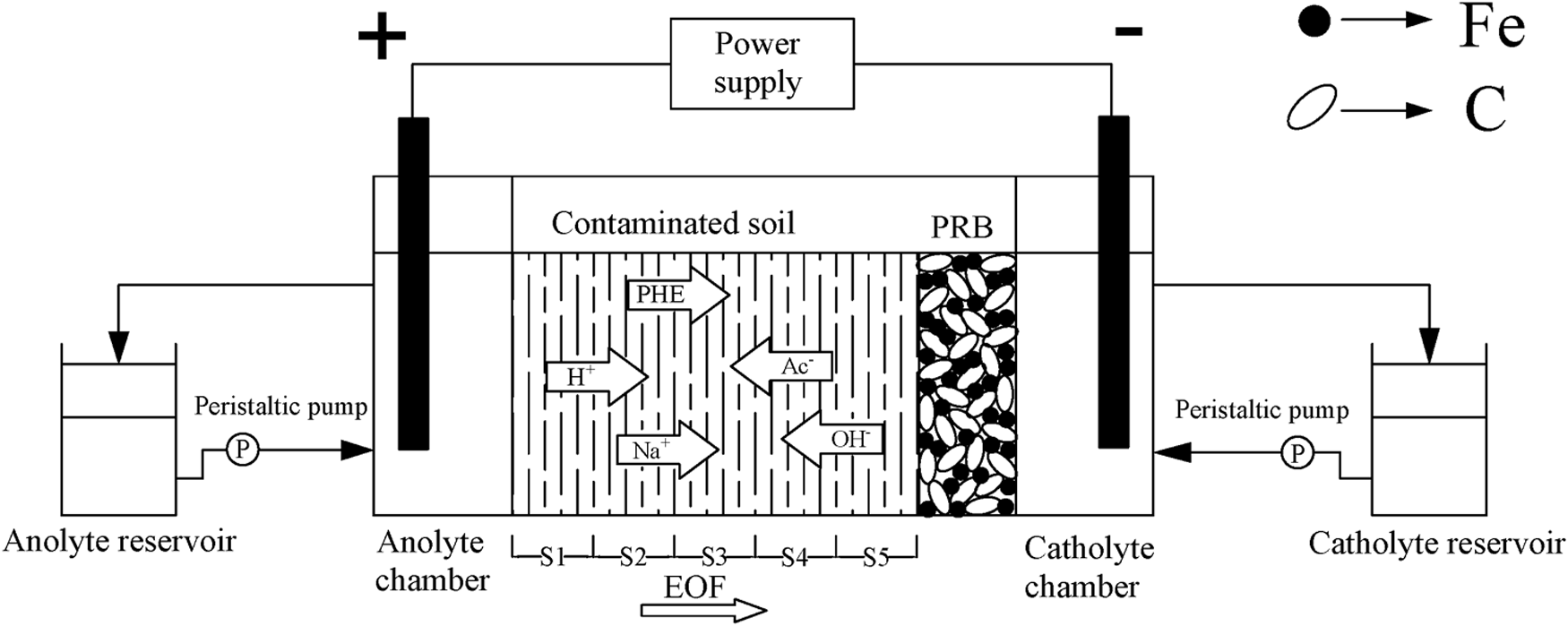
Electrokinetics-permeable reaction barrier experimental device.
Experimental design
Preparation of contaminated soil
The contaminated soil was prepared by adding 100 mL of methanolic solution containing 0.1536 g PHE to 800 g of soil. Then the soil was periodically stirred and continuously ventilated in a fume hood for 24 h. After the methanol was completely volatilized, the moisture content of the contaminated soil was adjusted to 30%. The contaminated soil was then moved into the reactor and compacted. The PHE concentration in the contaminated soil was measured to be 189 mg/kg.
Optimization of Fe/C mass ratio
Before the soil remediation experiments, using EK-PRB, the microcosm experiments were conducted to determine the optimal Fe/C mass ratio for micro-electrolysis of the PHE-contaminated soil. The removal efficiencies of the PHE under different Fe/C mass ratios (2:1, 3:1, 4:1, 5:1, and 6:1) were compared. In the experiments, five conical flasks containing 50 g of the contaminated soil, 30 g of Fe/C particles, and 200 mL of acetic acid solution were horizontally shaken at 25°C and 120 rpm for 60 min in a thermostated shaker. Once the reaction was complete, the slurry in each flask was centrifuged in a high-speed centrifuge, and then the remaining concentration of PHE was analyzed with high-performance liquid chromatography (HPLC). The Fe/C mass ratio with the highest removal efficiencies was selected for the subsequent EK-PRB experiment.
Design of EK-PRB experiment
First, glass fiber filter papers were placed between the two electrode chambers and the soil sample chamber to avoid soil particles intruding into the electrode chambers. Second, two high-purity graphite rods were fixed on both sides of the soil sample chamber and used as electrodes. The electrode chamber had a water inlet and an outlet. The electrode chamber and the electrolyte reservoir were sequentially connected by silicone tubes. The electrolyte reservoir was designed as the large graduated cylinder; thus, the EOF can be calculated from the difference between the readings of the anode and cathode cylinders. In addition, the sodium acetate solution and the acetic acid solution were selected as the anolyte and the catholyte, respectively. The sodium acetate solution in the anode could effectively inhibit the rapid acidification of the anode and the nearby soil. The acetic acid solution at the cathode could ensure the iron and carbon in the PRB region in an acidic environment for a long time. The two-channel peristaltic pump was used to control the flow rate at 20 mL/min. The reaction time was set to 5 days.
Table 1 summarizes the parameters controlled in the seven EK-PRB tests. Test 1 served as a control, in which a conventional EK treatment was used without PRB or surfactant. In Tests 2–7, the PRB was placed in the chamber connecting the soil column and the catholyte that was next to the cathode. The Fe/C mixed particles were used as PRB material. In Tests 3–7, the nonionic surfactant, Tween 80, with the concentration of 1.5 g/L, was added to the anolyte. The comparison of the results of Tests 2 and 3 demonstrated the role of the nonionic surfactant Tween 80 in improving the migration of PHE. The potential gradient was reduced and increased by the same amount in Tests 4 and 5, respectively, to evaluate the influence of potential gradient on the improvement of the migration and removal of PHE from soil. In Test 6, NaOH was added to the anolyte. By comparing the results in Tests 5 and 6, the effect of anode-controlled alkali on the migration of PHE was investigated. The potential gradient was set to 0 V/cm (EK not applied) in Test 7. The produced Fe in Tests 5 and 7 were characterized and compared to evaluate the promoting effect of EK on micro-electrolysis.
EK-PRB Experimental Control Conditions
EK, electrokinetics; Fe/C, iron/activated carbon; PRB, permeable reaction barrier.
Extraction and determination of PHE
After the EK-PRB reaction was complete, the soil column was divided into five sections as given in Fig. 1. A composite soil sample was taken from each section by randomly collecting three subsamples and completely mixing them. The pH and the residual concentrations of PHE of the composite samples were measured. The results represented the pH and contaminant concentrations of the corresponding sections. The pH of the composite samples was mainly measured using a digital soil pH tester, and the residual concentrations of PHE of the composite samples were determined by HPLC. The extraction and determination procedures of PHE were as follows: First, 1 g of composite dry soil was accurately weighed by an electronic analytical balance and stored in a centrifuge tube. Then 20 mL methanol was added as the extraction agent. Second, the mixture was shaken at 150 rpm for 90 min followed by 40-min extraction in ultrasonic bath at 40°C. The above extraction process was repeated thrice. Third, the mixture was centrifuged at a speed of 4,000 r/min for 8 min and the supernatant was filtered in a funnel containing anhydrous sodium sulfate and glass fiber to remove the water and the suspended particles. Fourth, the filtered supernatant was treated with a 0.45 μm organic filter membrane. Finally, the obtained PHE was quantified using HPLC. The detection wavelength for PHE was 254 nm, and the mobile phase was 90% methanol and 10% water. The column temperature was set to 30°C, and the flow rate was set to 1 mL/min.
Characterization of Fe
After the reaction was complete, the Fe/C particles in the PRB of Tests 5 and 7 were taken out and dried in a vacuum oven for 12 h at 50°C. Then the mixture was crushed and sieved to separate Fe powder from C particles. The Fe powders were placed into a sample bottle (Z1 indicates that EK was not applied and Z2 indicates that EK was in normal operation). The samples were characterized by SEM, XRD, and XPS.
Results and Discussion
Optimization of Fe/C mass ratio
The removal efficiencies of PHE by Fe/C micro-electrolysis under different Fe/C mass ratio are given in Fig. 2. From Fig. 2, Fe/C particles significantly degraded PHE at the pH of 5 (the pH of acetic acid solution was 5). Even at the worst Fe/C mass ratio for the removal performance (2:1), 51% of PHE was removed. At the optimal Fe/C mass ratio, that is, 4:1, the removal efficiency of PHE was as high as 75.2%.

Removal of PHE under different Fe/C mass ratio. Fe/C, iron/activated carbon; PHE, phenanthrene.
At large Fe/C ratio, the main structure of PHE was more easily attacked and destructed. However, the largest Fe/C ratio (6:1) did not lead to the best removal. Zhang et al. (2015) found that as the Fe/C ratio increased, the amount of floc increased and the floc particle size decreased. As a result, the flocculation process was restrained and the removal of PHE was reduced. Our results demonstrated that Fe/C micro-electrolysis could effectively degrade persistent organic compounds. Thus, the Fe/C mass ratio of 4:1 was selected for the subsequent EK-PRB experiments.
Electrical current in the EK-PRB reaction
Figure 3 shows the variation of electrical current with the change of the elapsed time for all the six soil remediation tests (Tests 1–6). Overall, the electrical currents in all the six tests first increased until reaching the peaks, and began to drop at the late stage of the experiment. At the beginning of the experiment, the current was small, only 10–15 mA. The ions in the electrolyte (Na+, Ac−, H+, OH−) entered the soil, and the current intensity increased because of the increased ion concentration (Lee et al., 2015). As the experiment continued, the current showed a decreasing trend, which was mainly caused by the following three reasons: First, during the experiment, the NaAc in the anode electrolyte partially neutralized the H+ generated by the anode electrolyte, which led to the decrease of the pH of the anode electrolyte and the cathode. The continuous acidification and alkalization of the anode and cathode chambers, in turn, inhibited the electrolytic reactions, and resulted in the reduction of the produced H+ and OH− by electrolysis. Second, at the late stage of the experiment, Fe/C particles in PRB were continuously corroded along with the soil remediation process, leading to the hardening phenomenon of the packing, which reduced the permeability of the packing and increased the resistance. Third, with the alkalization of the cathode, the OH− generated by the cathode electrolysis and the iron ion generated by the micro-electrolysis reacted to form an oxide film, which was attached to the surface of the graphite electrode. In addition, H2 and O2 generated by the electrolysis of the anode and cathode also attached to the surface of the graphite electrode, resulting in the increased resistance (Seo et al., 2015).

Variation of electrical current in the tests 1–3
As given in Fig. 3a, the current of Test 2 showed a rapid increase within 12–24 h. This phenomenon was mainly because the anode electrolyte was able to fully immerse in the soil after 12 h, which increased the concentration of ions in the soil solution. At the same time, a large number of ions (Fe2+, Fe3+, OH−) were produced by the Fe/C particles in PRB through micro-electrolysis reaction in the acidic environment of the cathode, which also led to the rapid increase of current. The current in Test 3 increased significantly after 60 h, and the highest current value reached 38.4 mA. Comparing the current of Tests 2 and 3, the introduction of Tween 80 not only reduced the migration resistance of free ions in the soil solution, but also released the metal ions (Ca2+, Mg2+) adsorbed in the soil. The consistent results were obtained in this study and the report by Qiao et al. (2018), that is, the introduction of the Tween 80 can promote the ion migration in the soil and increase the current, which are beneficial to the EOF.
Figure 3b shows the effect of potential gradient on the system current. The current peaks of Tests 4, 3, and 5 was 10.2, 38.4 and 85.5 mA, respectively. Therefore, the current value was not directly proportional to potential gradient. In Test 5, the peak current was reached after 66 h, which indicated that the higher potential gradient would increase the degree of electrolysis and the corrosion rate of Fe/C material (Kumar et al., 2016). Compared with Test 5, Test 6 had a delayed peak of system current, which indicated that anode-controlled alkali could continuously consume H+ produced by anodic electrolysis, thus promoting the anodic water electrolysis process.
Cumulative EOF in the EK-PRB reaction
The promoting effect of EK on the migration of PHE is mainly through electro-osmotic flow, which can be represented by the change of cumulative EOF (Hassan et al., 2015). Figure 4 provides the cumulative EOF as a function of time (h). The results demonstrated that the cumulative EOF generally exhibited the same trend as the electrical currents. When the current reached the peak and began to slowly decrease, the growth rate of EOF also decreased accordingly. During operation, the decrease of anode electrolyte storage and the increase of cathode electrolyte storage indicated that the direction of EOF was from anode to cathode (López-Vizcaíno et al., 2012).

Variation of cumulative EOF in the tests 1–3
As given in Fig. 4a, Tests 2 and 3 exhibited higher EOF compared with Test 1 without a PRB. This phenomenon indicated that the micro-electrolysis could partially increase the Zeta potential of the soil near the PRB and improve the flow rate of the pore water. Cappai et al. (2012) also demonstrated that the addition of PRB could significantly increase the EOF rate, thus promoting the migration of contaminants. Furthermore, the addition of Tween 80 in Test 3 allowed the final cumulative EOF to reach 500 mL, which indicated that Tween 80 reduced the resistance of soil particles to pore water, thereby increasing the cumulative EOF. The results were in agreement with the results obtained by Chang et al. (2015), who suggested that a surfactant was beneficial to the process of electro-osmosis.
Figure 4b shows the effect of potential gradient on the cumulative EOF. Comparing Tests 3–5, it was apparent that the potential gradient had a significant influence on the cumulative EOF. Mena Ramírez et al. (2015) used EK technology to treat the soil contaminated with hydrophobic organics, and demonstrated that the EOF rate was proportional to the potential gradient, zeta potential, and dielectric constant of the system. The improvement in the pH of the anode electrolyte in Test 6 enabled the final accumulated EOF to be improved to 970 mL, which indicated that the late occurrence of the peak current was beneficial to improve the accumulated EOF. In conclusion, the addition of Tween 80, the increase of the potential gradient, and the anode-controlled alkali can all enhance the EOF effect.
pH profiles in soil column
The pH values of soil across the columns are plotted in Fig. 5. As previously described, each soil column was divided into five sections (S1–S5), where S1 was closest to the anode and S5 was closest to the cathode. The initial pH of the contaminated soil was tested to be 7.90. In general, soil pH showed an increasing pattern from anode to cathode, which was mainly attributed to the following two factors: First, the continuous deepening of anode acidification and cathode alkalization caused the H+ and OH− that were produced by electrolysis at both poles continuously enter the soil solution. Because H+ has a small radius, its migration speed is much faster than that of OH−, resulting in the acidification of soil near the anode (Vieira Dos Santos et al., 2017). Second, in the PRB tests, the micro-electrolysis reaction of Fe/C particles would consume the free H+ near the cathode, which led to a higher soil pH. The pH of the soil adjacent to the cathode was close to the initial soil, which was mainly affected by the catholyte. (The catholyte reservoir level raised continuously, causing its pH to be close to neutral.)
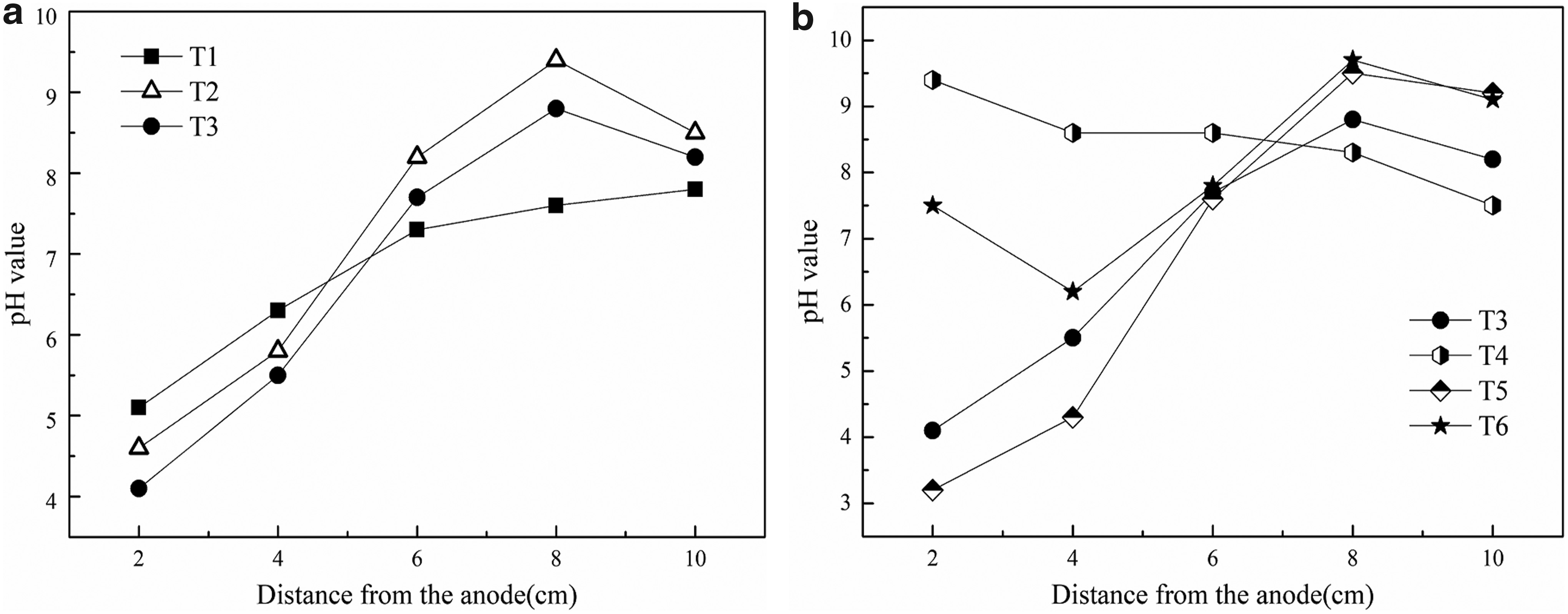
Soil pH profiles upon the completion of the reaction in the tests 1–3
As given in Fig. 5a, the pH values near the cathode were higher than the initial soil pH (7.90) in all the tests except for Test 1. In Test 1, the pH values near the cathode and in S4 were 9.4 and 8.8, respectively. The results indicated that the free H+ was significantly consumed by Fe/C particles, and the acidification of soil near the anode was more serious in Tests 2–7 than that in Test 1. The overall pH of Test 3 was lower than that of Test 2 because of the higher current in Test 3. In addition, the introduction of Tween 80 could modify the organic clay to some extent and generate a separation effect to promote the migration of free H+ in the soil (Bezza and Nkhalambayausi-Chirwa, 2015).
Figure 5b shows the effect of potential gradient on soil pH values. Comparing Tests 3–5, it was apparent that the potential gradient had a significant influence on the cumulative EOF. The trend of soil pH of Test 4 was completely opposite to that of the other tests. This was because the potential gradient in Test 4 was too small; thus, only a low concentration of H+ was produced by the anodic electrolysis, which was insufficient to compensate the influence of the anolyte. In Test 5, the pH was 3.2 close to the anode and gradually increased to 7.6 toward the S3. Among the tests with PRBs (Tests 3, 4, 5, and 6), the lowest pH near the anode was observed in Test 5, because the higher potential gradient speeded up the rate of water electrolysis in the electrode chamber and produced more H+ into the soil. The results were also in agreement with those obtained by Cameselle (2015), who suggested that the potential gradient could directly affect the degree of electrolysis and change the pH of the soil. The soil near the anode of Test 6 was the least acidified, which indicated that the anode-controlled alkali could slow down the acidification of the soil to some extent (Rao et al., 2016).
Performance and mechanisms of EK-PRB
Figure 6 provides the concentration distribution of the remaining PHE in different sections (S1–S5) across the soil column after the reactions was complete. In general, in all the six tests, the remaining PHE showed an increasing pattern from the anode to the cathode. This was because of the migration of hydrophobic organic matter, PHE, which was driven by the EOF moving toward the cathode during the EK remediation. At the same time, the acidification of the soil could promote both desorption of organic pollutants from soil particles and the migration of the pollutants with EOF. Therefore, the sectional removal efficiencies were negatively correlated with the distance to the anode (Sun et al., 2017). As a control experiment without a PRB and surfactant, Test 1 demonstrated a very limited capability of removing PHE by EK alone. In Table 2, the total residual mass in the soil column and in the catholyte reached up to 98.9% in Test 1, indicating that EK alone could only move PHE from the contaminated soil into the catholyte without providing significant degradation. This result was consistent with the conclusions in previous reports, which was that the EK alone not only had difficulties to migrate the pollutants but also provided almost zero degradation. The overall removal efficiency in all the tests with PRBs was higher than that in Test 1 (only 4.11%), indicating that the addition of PRB (Fe/C) could significantly promote the migration and removal of PHE in contaminated soil. The lower residue of PHE at the S5 site was mainly caused by two reasons. First, the diffusion of the ferrous ions produced by micro-electrolysis in the PRB into the nearby soil solution was reduced, which promoted desorption and removal of PHE. Second, in the later stages of the experiment, the decrease of current weakened the EOF, thus resulting in a limited rate of migration of PHE (Mumford et al., 2015).
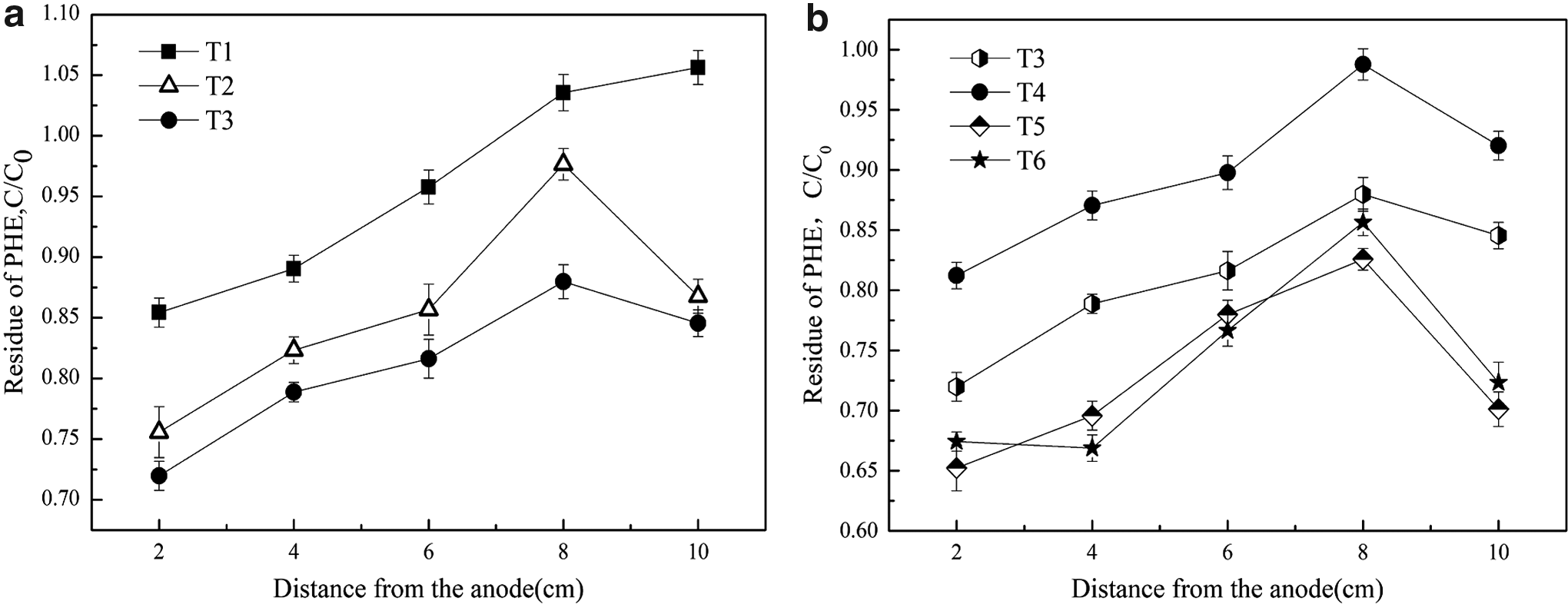
Concentration distribution of PHE across soil column in tests 1–3
Removal Efficiencies of PHE in the Six Tests
This table was calculated based on mass balances.
Removal by PRB = initial mass − residual in soil − mass in catholyte (the electrolytic removal of EK could be ignored).
Removal from soil = initial mass − residual in soil.
PHE, phenanthrene.
As given in Fig. 6a, the mass balance in Test 2 showed that 14.4% of PHE was degraded by the Fe/C-PRB, accounting for 77.1% of the mass moved out of the soil column. The total removal rate of PHE in Test 2 was nearly 3.5 times as high as that in Test with EK alone (4.11%), which indicated that the introduction of PRB (Fe/C) could address the problem that conventional EK could only migrate and but not degrade PHE. In addition, the micro-electrolysis reaction in Test 2 could specifically remove PHE in the soil near the PRB. Compared with Test 2, the addition of Tween 80 in Test 3 not only promoted the migration of PHE in the soil, but also improved the removal rate of PHE by 39.6% (15.5% vs. 11.1%) in PRB. The improvement was because of the synergistic effect of Tween 80 on the migration of PHE in soil under the action of EK. The results were also in agreement with the results obtained by Hahladakis et al. (2016), who suggested that the introduction of nonionic surfactants in the EK method could improve the solubility of PAHs and thus enhance the removal efficiency of PAHs.
Figure 6b shows the distribution of PHE residue under different potential gradients across the soil column. When the applied potential gradient was increased from 1 to 2 V/cm, the residual concentration of PHE in the soil near the anode (S1 region) was reduced by 6.76%, and the vicinity of the cathode (S5 region) was decreased by 14.4%. This indicated that the increase of the potential gradient had a greater influence on the PRB region near the cathode than soil near the anode (Cameselle, 2015). On the contrary, when the applied potential gradient decreased from 1 to 0.5 V/cm, the total removal rate of PHE was decreased by 46.1% (from 18.9% to 10.2%). The total removal rates in Tests 6 and 5 were not significantly different (26.2% vs. 26.9%), indicating that anode-controlled alkali had no effect on the migration direction of PHE. Thus, anode-controlled alkali could be used to treat the soil acidification (Zhu et al., 2009).
EK-PRB had good performance in removing the PHE-contaminated soil. The main remediation mechanisms of EK-PRB include the movement of contaminants with EOF and the retaining and degradation of contaminants by PRB. In the EK process, the migration of pollutants can be improved by electro-osmosis, electromigration, and electrophoresis, among which electro-osmosis is the main mechanism for the removal of organic pollutants. The removed percentages of PHE from the soil by PRB were relatively stable. Therefore, the enhancement of desorption and mobility of contaminants from the soil can generate a greater contaminant flux, which is critical to improve the removal of hydrophobic organic contaminants by EK-PRB. This enhancement was achieved by adding a nonionic surfactant, Tween 80. When the concentration of Tween 80 in the pore fluid is higher than its critical micelle concentration, it tends to form colloidal-sized micelles and reduce the surface tension between the solid and liquid interfaces (Mena et al., 2016). The addition of Tween 80 also helps to dissolve some of the hydrophobic organic matter in the soil particles. As given in Fig. 7, micro-electrolysis is the main mechanism for the removal and degradation of the organic contaminants by Fe/C-PRB. Fe/C micro-electrolysis is an integrated process of oxidation, reduction, flocculation, and adsorption (Ren et al., 2018). In a Fe/C micro-electrolysis system, a large number of microscopic galvanic cells are formed. In addition, Fe acts as the anode and loses two electrons to form Fe2+. Meanwhile, under aerobic conditions, the cathode of C could accelerate the reduction reaction by accepting electrons and transferring the electrons to the organic compounds or oxygen. Both the Fe2+ produced by the anode and the [H] produced by the cathode have high chemical activity, thus the carbon chain of the PHE can be broken and degraded by reduction (Yang et al., 2017). Moreover, Fe2+ loses an electron to form Fe3+ by oxidation under full aerobic aeration. Then, the Fe2+ and Fe3+ ions are hydrolyzed to form ferrous and ferric hydroxides (such as Fe(OH)2+ and Fe(OH)2+), which are flocculants favorable for adsorption and removal of organic pollutants.
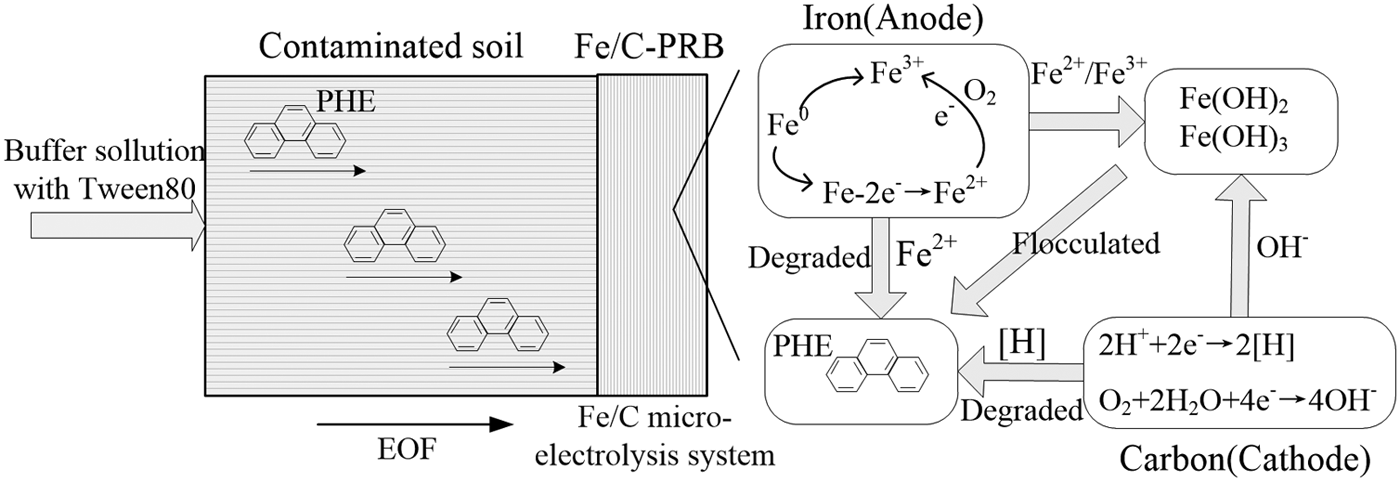
Mechanism of Fe/C micro-electrolysis for degradation of PHE.
Morphological characterization of Fe
SEM characterization of Fe
Figure 8 shows the SEM images of the as-prepared samples obtained with different reaction conditions (Z1 represents the reaction without EK and Z2 represents the normal operation of EK). There were many particles on the surface of Fe in Z1. The main reason was that the PRB reaction chamber was located in the acidic environment of the cathode and continuously washed by acetic acid solution, resulting in the partial oxidation of Fe surface. The surface of Z2 was like a honeycomb, which was significantly different from that of Z1. The corrosion degree of Fe in Z2 was obviously greater than that of Z1. At the same time, a protective film was formed by a large amount of white floccus on the surface (produced from the reaction between the OH− produced by the electrolysis of H2O in the cathode electrode chamber and Fe2+/Fe3+), which prevented the inner layer from being oxidized. The results in Fig. 8 illustrated that EK had a greater effect on Fe in PRB when the PRB was located near the cathode. EK accelerated the oxidation of Fe, which improved the degradation efficiency of PHE by the Fe/C micro-electrolysis in the PRB reaction chamber.

Environmental scanning electron micrograph of Fe [Figure
XRD characterization of Fe
Figure 9 shows the XRD patterns of the prepared samples. The X-ray source was the Cu Ka radiation with a step width of 0.013° and a scanning speed of 6°/min from 10° to 50°. The peaks at 44.6 of Z1 and Z2 could be attributed to the diffraction peak of zero valent state iron (Wu et al., 2014). Both Z1 and Z2 had diffraction peaks of FeOOH at 27.2°–27.6°. This was because the hydrolysis of Fe2+ and Fe3+ ions formed ferrous and ferric hydroxides, which were converted into FeOOH by oxidation. At the same time, Z1 had a weak peak of Fe3O4–Fe2O3 at 35.46°, which was because FeOOH could be converted into Fe3O4 and Fe2O3. In general, the conversion ratio of FeOOH to Fe3O4 and Fe2O3 was very slow. According to previous studies, Fe2+ could accelerate the conversion process. Z2 exhibited a more intensive peak of Fe3O4–Fe2O3 than Z1, indicating that EK could contribute to the formation of Fe2+ and promote the conversion of FeOOH to Fe3O4 and Fe2O3.
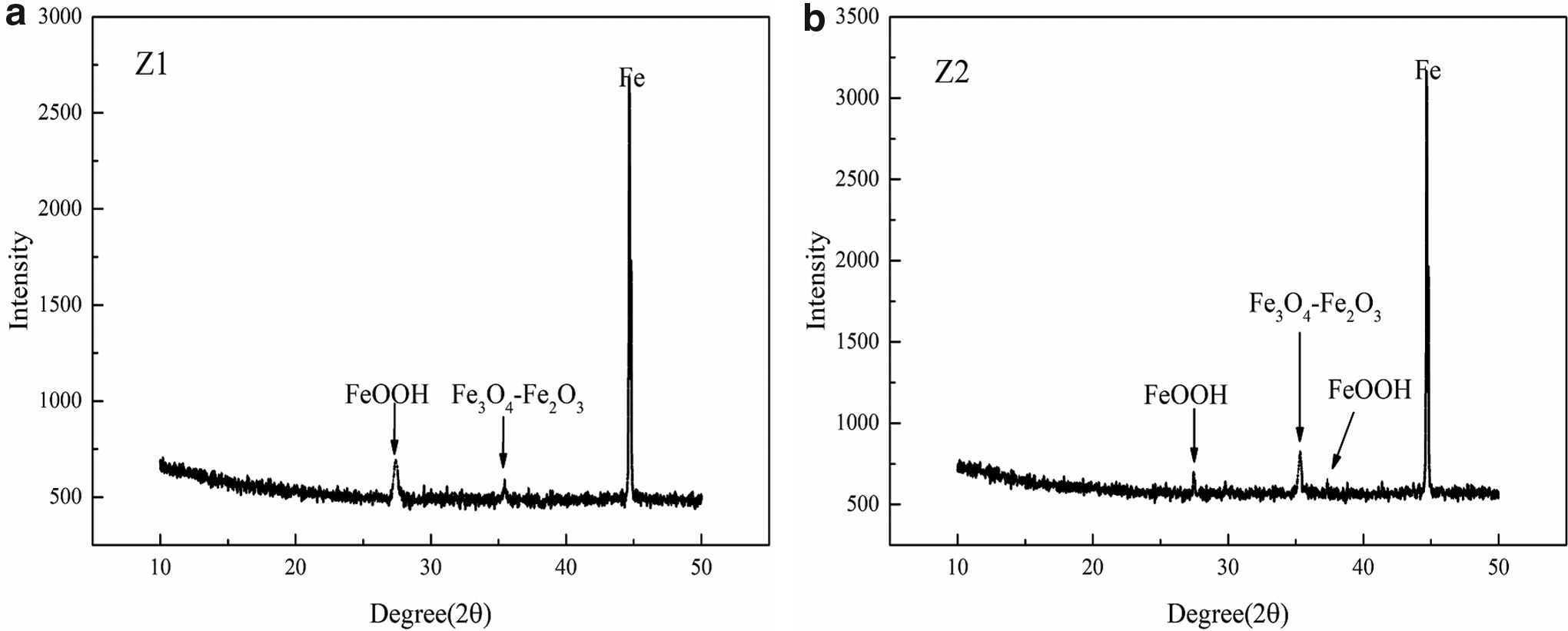
X-ray diffraction pattern of Fe [Figure
XPS characterization of Fe
The chemical compositions of the prepared samples were further investigated by XPS. Figure 10 gives the XPS patterns of Fe (a and b represent the full peak measurement spectra, c and d represent the Fe2p core energy level spectra). It was obvious that the full-peak spectra of Z1 and Z2 were slightly different. The binding energies of the peaks of the 3/2p and 1/2p orbitals of Fe3+ in the XPS standard peak were 711.2 and 724.3, respectively, indicating that the iron in Z1 and Z2 were mainly in the form of Fe3+ (Wang et al., 2017). The peaks of the 3/2p and 1/2p orbitals of elemental iron in Z1 were 707.2 and 720.1, respectively (Fig. 10c). It should be noted that part of the elemental iron in Z1 was not oxidized, which may be because of the limited reaction rate of Fe/C micro-electrolysis when EK was not applied. In this case, it was difficult for the iron to be further oxidized. On the contrary, the iron was mostly in the state of Fe3+ in Z2, and the elemental iron was also completely oxidized. At the same time, there were weak peaks at positions 718.8 and 732.7, which were suggested to be a mixture of Fe3O4 and Fe2O3 (Fig. 10d). The results also demonstrated that EK accelerated the oxidation of Fe when the PRB was in the acidic environment of the cathode.
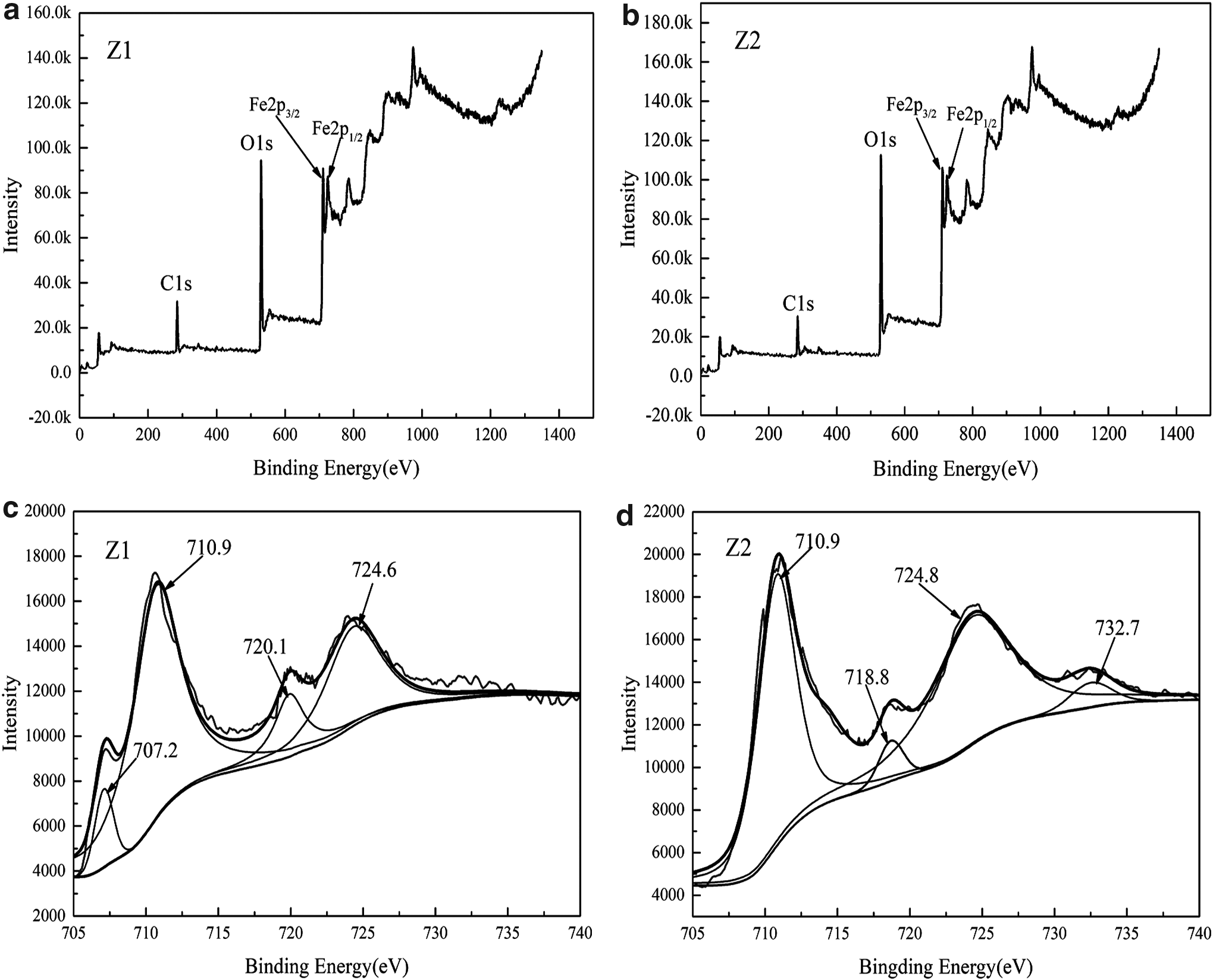
X-ray photoelectron spectroscopy [
Conclusions
In this study, the performance of EK-PRB technique on remediation of a soil contaminated by the typical persistent organic pollutants PHE was investigated. In addition, the Fe in specific PRBs was analyzed by means of SEM, XRD, and XPS spectral characterization. The major conclusions were drawn as follows:
The addition of PRB did not hinder the migration of PHE. The micro-electrolysis using a mixture of Fe/C particles was effective in the treatment of the PHE-contaminated soil. The total removal rate of PHE using the micro-electrolysis with Fe/C particles was 3.5 times as high as that using EK alone (14.4% vs. 4.11%). The potential gradient was another important factor affecting the EK treatment effect. Under the higher potential gradient, the removal efficiency of contaminants was better. When the potential gradient was increased from 1 to 2 V/cm, the total removal rate of PHE increased by 42.3% (from 18.9% to 26.9%). At the same time, the anode-controlled alkali had no negative effect on the removal of PHE, thus can be used to inhibit the acidification of the anode soil. The results of SEM, XRD, and XPS spectroscopy indicated the following: When EK was applied, a large amount of white floc was observed on the Fe surface, and the process of converting FeOOH into Fe3O4 and Fe2O3 was promoted. When EK was not applied, the Fe/C micro-electrolysis reaction was limited and the elemental iron was not completely oxidized. These phenomena indicated that EK could accelerate the micro-electrolysis reaction rate when the PRB was located at the acidic environment of the cathode.
Footnotes
Acknowledgments
The study was supported by the National Natural Science Foundation of China (Grant No. 41571306), the Project of Excellent Fund in Hubei (the Project of Excellent Fund in Hubei); Major Project of Science and Technology Research Program of the Hubei Provincial Department of Education (Grant No. D20181101). Hubei Key Laboratory for Efficient Utilization and Agglomeration of Metallurgic Mineral Resources, China (Grant No. 2017zy003).
Author Disclosure Statement
All the authors have no conflict of interest.