




Abstract
Abstract
Saltwater is detrimental to biological wastewater treatment processes. Anaerobic reduction is a promising technology for treating complex organic wastewater but is limited by relatively long reaction times and high demand for electron donors. In microbial fuel cells (MFCs), the salinity contained in saltwater promotes the redox reaction between the electrodes to accelerate the removal of chemical oxygen demand (COD) and generate electricity. In this study, a system combining an anaerobic fluidized bed (AFB) with an MFC was constructed to treat high-salinity wastewater. As a result, the anode attained good removal efficiency of 98.6% for COD and 52.1% for
Introduction
Many industrial wastewaters, including wastewaters from seafood processing (Jayashree et al., 2016), cotton dyeing (Oon et al., 2018), and the shale gas industry (Chang et al., 2019), contain high concentrations of organics and high salinity. The treatment of high-salinity organic wastewater is mostly carried out by physicochemical systems (Wang et al., 2017), which are more costly than biological treatment methods. However, highly saline wastewaters are generally unfavorable for common biological treatment methods. On the one hand, high salt concentrations may lead to the separation of the cytoplasmic wall and the death of microorganisms in sewage, which decrease the particle size and density of granular sludge (Abou-Elela et al., 2010). On the other hand, high salt will reduce the number of filamentous bacteria, which play an important role in the mechanical integrity and structure formation of sludge flocs, thus hindering the flocculation and sedimentation of sludge (Jang et al., 2013). Therefore, bioreactors capable of withstanding high salinity should be selected for treating high-salinity wastewater.
Anaerobic reduction is considered a promising technology for treating complex organic wastewater. As high-efficiency reactors, anaerobic fluidized bed (AFB) reactors have the advantages of a large biomass quantity and good mixing effect (Zhang et al., 2007). The relatively high biomass concentrations of anaerobic biological particles in AFBs can withstand a wide range of organic matter concentrations and high salinity (Kobayashi et al., 2018). However, conventional anaerobic treatment systems are often limited by their relatively long reaction time and high demand for electron donors.
Recently, anaerobic bioreactors have been coupled with (bio)electrochemical systems to improve the complementarity of these two technologies for uses such as nutrient recovery, biogas upgrading, and effluent polishing (De Vrieze et al., 2018). Moreover, electrical stimulation can change functional proteins (PNs) that improve microbial resistance to salinity. Chen et al. (2019) designed an upflow electricity-stimulated anaerobic system to enhance anaerobic debromination. They proposed that phenol could be completely utilized as fuel by the bioanode. Jiang et al. (2018) suggested that the microaerobic environment in bioanodes might promote pyridine biomineralization in anaerobic reactors. Therefore, an adaptive electrochemical system combined with an AFB can promote salinity adaptability and processing efficiency.
Microbial fuel cells (MFCs) are a novel (bio)electrochemical technology that combines wastewater treatment with bioelectricity generation (Logan et al., 2006). In the anode chamber, microorganisms oxidize organic matter to generate electrons and protons. Electrons flow along an external circuit to form a current (Logan, 2009), whereas protons pass through a proton exchange membrane (PEM) and react with oxygen to form water in the cathode, achieving organic matter removal and electricity generation. MFCs have been proven to be able to handle a variety of high-concentration organic wastewaters, such as pig wastewater (Ma et al., 2016), paper recycling wastewater (Huang and Logan, 2008), and furfural wastewater (Luo et al., 2010). When an MFC is applied to treat saline wastewater, high concentrations of anions and cations can increase the conductivity of the wastewater, thereby reducing the internal resistance of the MFCs and increasing power generation (Rengasamy et al., 2016).
To date, most research on the MFC treatment of saline wastewater has focused on the efficiency of electricity production. Lefebvre et al. (2012) improved the maximum output power from 27 to 35 W/m3 by increasing the NaCl concentration from 0 to 20 g/L. Miyahara et al. (2015) obtained a fourfold increase in power output from 2.6 to 11.4 W/m3 when the Cl− concentration increased from 0 to 5.8 g/L, which reflects that a moderate range of salinity benefits MFC performance. However, if the suitable salinity range is exceeded, the metabolism and growth of microorganisms will be restricted, thus affecting MFC performance (Yong et al., 2013). Md Khudzari et al. (2016) suggested that high-salinity MFCs produce less power because high levels of salinity (10 g/L NaCl) inhibit electricigenic microorganisms. Therefore, examining the effect of increased salinity on microbial community structure is critical and should be considered.
Consequently, we combined an AFB reactor with the anode (anaerobic zone) of an MFC to improve the salinity resistance and the removal of pollutants. The large biomass in the AFB in turn ensured the stability and efficiency of the system. Relatively high chemical oxygen demand (COD) removal efficiency and electricity generation in AFB-MFC systems have been demonstrated by several researchers (Huang et al., 2011, 2015; Kong et al., 2011). Nevertheless, the application of such systems to the treatment of saline wastewater has not been reported, nor has the effect of salt on the anodic community structure of AFB-MFCs. Therefore, to confirm the effectiveness of treating wastewater with a high concentration of organics and high salinity, a lab-scale continuous-flow biological system, an AFB-MFC, was constructed in this study. The characteristics of the anode reactor were investigated through a series of chemical, electrochemical, and biological analyses.
Materials and Methods
MFC configuration and media
A two-chamber anaerobic–aerobic continuous flow MFC system made of plexiglass was used for this experiment (Fig. 1), with an AFB (10.66 L effective volume) as the anode chamber and aerobic-activated sludge (9.96 L aeration zone +3.81 L sedimentation zone) in the cathode chamber. The anode and cathode were separated by a PEM (Nafion 117; Dupont). Both the anode and cathode electrodes were made of carbon paper (HCP030, effective area of 200 cm2). A porous plexiglass plate (180 × 450 mm) was used to connect the anode and cathode after cutting holes (7 × 15 holes) in the sidewalls of both the anode and cathode chambers. The PEM was tightly sandwiched between the plexiglass plate and the cathode sidewall.
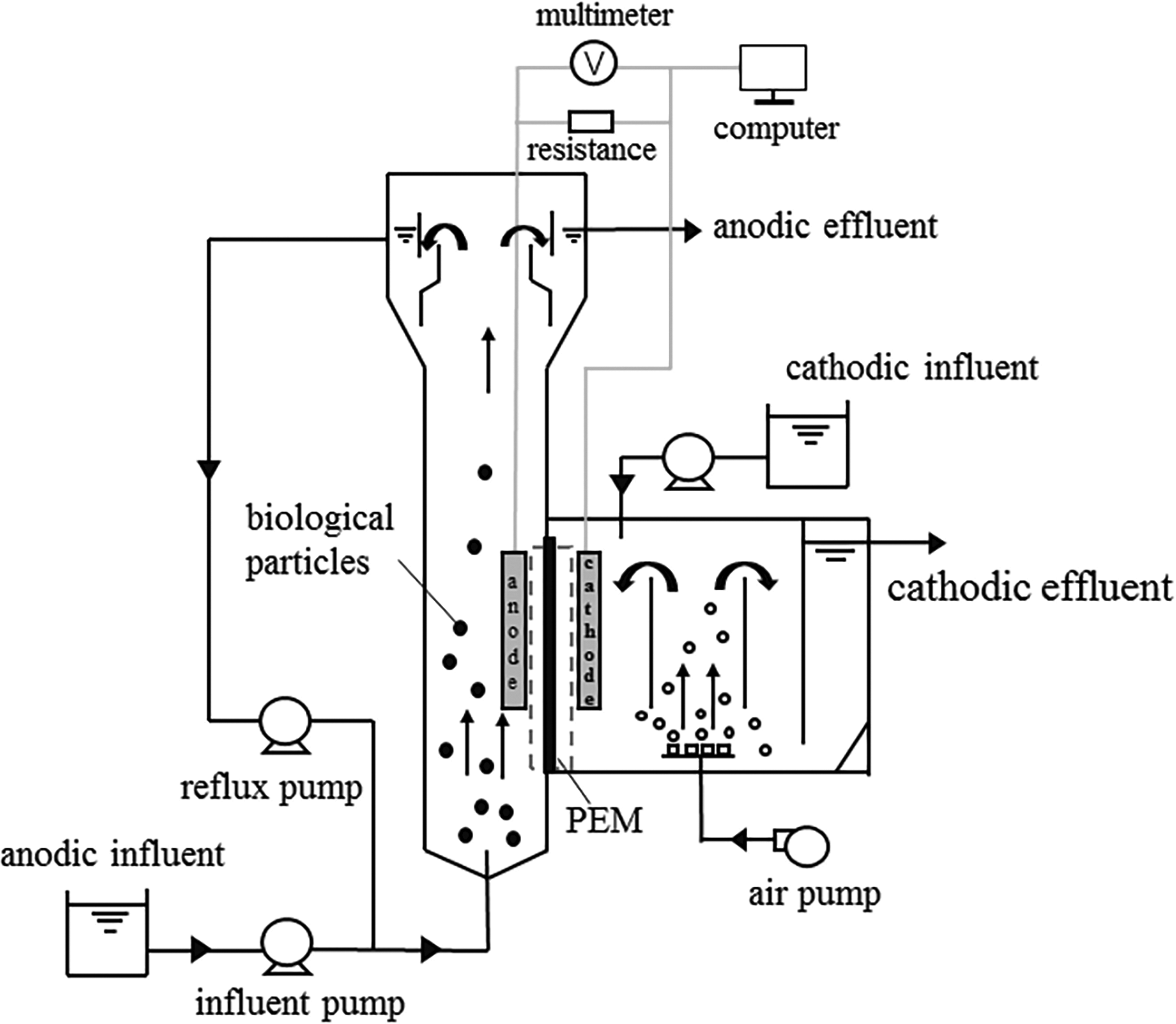
Schematic representation of reactor.
In the anode AFB bioreactor, porous polymer carriers (Huang et al., 2011) were used as the nuclei of the anaerobic biological particles and accounted for ∼1/6 (v/v) of the anode chamber. Reflux (4.6 L/h) from the upper part of the AFB bioreactor through a reflux pump was applied to improve the fluidization performance of the granular sludge in the AFB. The influent was mixed with the circulating water and then uniformly fed to the bottom of the AFB bioreactor. The external resistance was fixed at 1 kΩ, and the output voltage was recorded by a computer connected to a UT70B multimeter.
Experimental wastewater and reactor operating parameters
Synthetic wastewater was used in this experiment, and the anode and cathode were fed separately. Glucose was used as the carbon source, (NH4)2SO4 was used as the nitrogen source, and KH2PO4 was used as the phosphorus source. Small amounts of trace elements were added to maintain microbial growth needs. The nutrient solution consisted of the following (mg/L): EDTA, 30.00; ZnSO4·7H2O, 0.42; CuCl2·2H2O, 0.17; NiSO4·6H2O, 0.21; H3BO3, 0.014; CoSO4·7H2O, 0.28; MnSO4·H2O, 0.85; (NH4)2MoO4, 0.20; and FeSO4·7H2O, 5.00.
The inoculum used in this study consisted of anaerobic biological particles and activated sludge flocs present in the reactor after treating ammonium-/organic-rich wastewater (Liu et al., 2017). The Cl− concentration was adjusted by adding NaCl. The experimental period was divided into six phases according to different anodic influent Cl− concentrations (0, 2000, 4000, 6500, 9000, and 12,000 mg/L). Each phase was maintained for at least 20 days to reach stable performance. The operating parameters are given in Table 1. The hydraulic retention time of the AFB was 24 h, and the temperature was controlled at 35°C ± 1°C. All experiments were performed in closed-circuit mode to measure the effect of increased chloride ion concentration on pollution removal and electricity production.
Operating Parameters of Microbial Fuel Cell System
COD, chemical oxygen demand; HRT, hydraulic retention time.
Analysis and calculations
The performance of the AFB-MFC system was evaluated in terms of treatment efficiency and bioelectricity production. COD,
Samples were taken at 2-day intervals to measure the COD,
Microbial community analysis
After salinity acclimation, a sample of anode bioparticles was collected at a Cl− concentration of 12,000 mg/L. Genomic DNA was extracted using the E.Z.N.ATM Mag-Bind Soil DNA Kit (Omega Bio-tek, Inc., Norcross, GA). The integrity of the DNA was tested by agarose gel. For archaeal samples, the Qubit3.0 DNA Assay Kit was used to accurately quantify the genomic DNA to determine the amount of DNA that should be added to the polymerase chain reaction (PCR). There were three rounds of PCR amplification. The first round used 340F and 1000R primer amplification, whereas the second round used 349F and 806R. For the third round, Illumina bridge PCR-compatible primers were introduced.
For bacterial samples, the V1–V3 region of the 16S rRNA gene of the extracted DNA was amplified using universal bacterial primers 341F and 805R, whereas Illumina bridge PCR-compatible primers were introduced in the second round of amplification. The specific amplification steps were as follows: initial denaturation at 94°C for 3 min, 25 cycles of denaturation at 94°C for 30 s, annealing at 65–45°C for 30 s, extension at 72°C for 30 s, and another extension at 72°C for 5 min. After PCR amplification, the amplicons were extracted from the agarose gels using an AxyPrep DNA Gel Extraction Kit (Axygen Biosciences, Union City, CA) and quantified using QuantiFluor™-ST (Promega, Inc.). After the pretreatment of chimera and target regions, the RDP classifier database and classified sequences were used to analyze the data based on the operational taxonomic unit clustering results.
Results and Discussion
Effects of Cl− on the treatment performance in the anode
COD removal
The COD concentrations and removal efficiencies of the anode were measured under six operation conditions (Fig. 2A). The influent COD concentration was 6500 mg/L. Initially, the average effluent COD concentration of the anode was 146.8 mg/L, corresponding to a removal efficiency of 97.7%, without the addition of NaCl. Then, the COD removal efficiency showed an initial improvement with an increase in salinity to a moderate level (2000–6500 mg/L), followed by a slight decrease at 9000 mg/L.
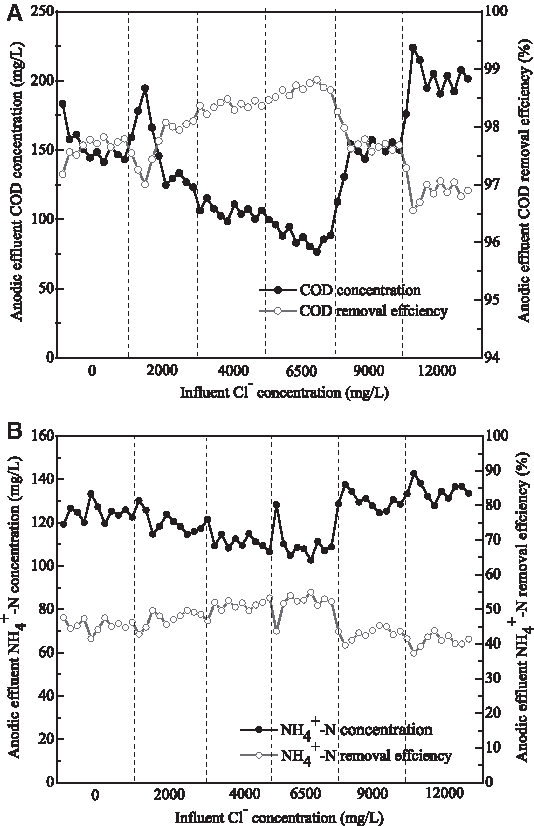
Various anodic concentrations and removal rate in COD
The effluent COD concentration decreased from 127.6 mg/L (Cl− concentration of 2000 mg/L) to 88.1 mg/L (Cl− concentration of 6500 mg/L). The maximum COD removal efficiency (98.6%) was observed at a Cl− concentration of 6500 mg/L. The high removal efficiency indicated that a moderate concentration of Cl− had little effect on the COD removal performance of the anode; thus, the anode AFB maintained a good operating state. When the salinity was slowly increased, the microorganisms could balance the osmotic pressure through their own osmotic pressure regulation mechanism, thus enhancing the salt tolerance performance while maintaining viability in a high-salt environment.
Zhao et al. (2016) reported that the proper salinity of a culture could provide essential nutrients for the growth of microorganisms, which increased the metabolic rate and enzyme activity of the microorganisms, thereby improving the removal of organic matter. Meanwhile, the high conductivity provided by the salinity promoted the redox reaction between the electrodes to accelerate the removal of COD (Guo et al., 2018). Moreover, the anaerobic biological particles with favorable mass transfer in the AFB facilitated sufficient contact between the microorganisms and wastewater. Therefore, at a certain salt concentration, the COD removal efficiency increased with Cl− concentration.
At relatively high Cl− concentrations (9000–12,000 mg/L), the COD removal efficiency dropped slightly from 98.6% to 97.0%. As the Cl− concentration further increased to 15,000 mg/L at day 125, the impact became obvious. The sludge flocculation ability became poor, and sludge flowed out with the effluent. Hence, the increase in Cl− concentration was stopped, and the sludge sedimentation performance and COD removal recovered when the Cl− concentration was reduced to 12,000 mg/L. The rapid recovery of COD removal efficiency might be related to the anaerobic biological particles in the AFB, which had a well-buffered adaptability to changes in the external Cl− concentration under the condition of high salinity (Cl− concentration of 12,000 mg/L). In addition, the relatively high COD removal efficiency showed that the AFB-MFC designed in this study can provide good organic matter removal efficiency.
\documentclass{aastex}\usepackage{amsbsy}\usepackage{amsfonts}\usepackage{amssymb}\usepackage{bm}\usepackage{mathrsfs}\usepackage{pifont}\usepackage{stmaryrd}\usepackage{textcomp}\usepackage{portland, xspace}\usepackage{amsmath, amsxtra}\usepackage{upgreek}\pagestyle{empty}\DeclareMathSizes{10}{9}{7}{6}\begin{document}
$${ \rm{NH}}_4^ +$$
\end{document}
-N removal
The influent
The previous study demonstrated that the anode of the AFB-MFC system is a complex biological system consisting of organic degradation, denitrification, and bioelectrochemical denitrification that can achieve a relatively high ammonia removal efficiency (Liu et al., 2017). Moreover, in the initial stage, when the microorganisms had attained a certain adaptability to salinity, the salt anions favored
Effect of Cl− on the sludge characteristics
MLSS and MLVSS
The stability of anaerobic granules was assessed by measuring the concentration of MLSS and MLVSS (Corsino et al., 2017). At the beginning, MLSS and MLVSS increased from 32.6 to 42.2 g/L and from 28.0 to 33.3 g/L, respectively (Fig. 3A). The elevation of MLSS and MLVSS indicated that with more biomass and better flocculation performance, Cl− had a certain promoting effect on the anaerobic microbial community.
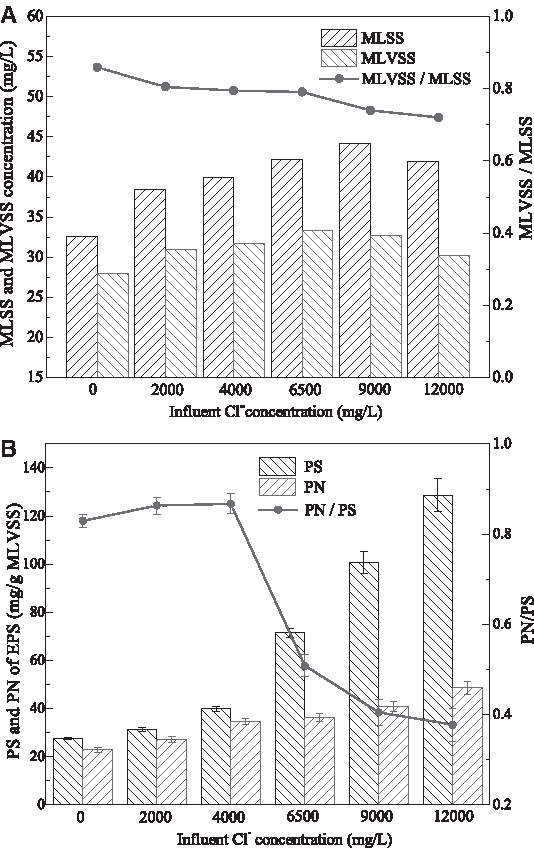
MLSS and MLVSS concentrations and ratio in the anode
Moreover, MLSS and MLVSS showed a downward trend when the Cl− concentration reached 12,000 mg/L. It has been reported that MLVSS decreased dramatically at a Cl− concentration of 12,797 mg/L (Osaka et al., 2008). These results could be attributed to the suppression and higher buoyancy caused by high salinity. First, at high concentrations of Cl−, the activity of some species of the anaerobic microbial community (such as exoelectrogenic microorganisms and methanogens) was inhibited. Second, the higher buoyancy reduced the settling velocity of the granules, which affected the sedimentation performance of the anaerobic microbial community (Md Khudzari et al., 2016).
In contrast, MLVSS/MLSS showed a decreasing trend throughout the experiment, dropping from 85.9% to 78.9%. This decrease might be because of the gradual inclusion of salts within the structure of the anaerobic biological particles (Campo et al., 2018). As an indirect reflection of microbial activity, the decrease in MLVSS/MLSS reflected that the anaerobic microbial activity was slightly affected at a moderate Cl− concentration. Nonetheless, the biomass in the anode reactor was still maintained at a high level, which endowed the AFB with a certain adaptability and buffer capacity for salinity wastewater.
Extracellular polymeric substances
EPS play a key role in particle formation and stabilization. Studies have shown that high salt concentrations have a significant effect on the structure of microbial EPS (Corsino et al., 2017). To further investigate the influences of salinity on community structure, the EPS from the anodic anaerobic granules were extracted, and the main components of PS and PNs in the EPS were analyzed.
The EPS structure was significantly affected by salinity. From Fig. 3B, Cl− addition in the influent resulted in an increase in the PS and PN contents, varying from 27.5 to 128.7 mg/g MLVSS and 22.9 to 48.6 mg/g MLVSS, respectively. Strikingly, PS and PNs both initially increased and then gradually decreased to a relatively stable value under different conditions (data not shown), which is possibly attributed to the acclimatization. Biomass in a toxic environment generates substantial amounts of EPS (Jang et al., 2013). Moreover, the increase in PS (3.63 times) was greater than that of PNs (1.12 times). This fact was perhaps because of the high salt levels that motivated the bacteria to produce more extracellular PS to hinder cell lysis and death (Wang et al., 2015).
This release of EPS content would in turn influence sludge structure. Jang et al. (2013) reported that compression of the double electric layer formed with higher EPS contents in sludge would result in greater sludge stability. In general, the granulation of particles is strictly related to the PN/PS ratio, where a higher PN/PS increases the hydrophobicity of the particles (Corsino et al., 2017). Hence, the slowly increasing PN/PS ratio in the initial stage indicated the beneficial effect of low concentrations on sludge flocculation. In contrast, the ratio of PS/PN showed an opposite trend, dropping to 0.38 as Cl− increased to 6500 mg/L. The sharp decrease in PN/PS indicated that salinity might reduce the hydrophobicity of anaerobic particles, leading to a reduction in anaerobic particle formation (She et al., 2018).
Effect of Cl− on electricity generation in AFB-MFC system
Conductivity and TDS in the anode chamber
The changes in the conductivity and TDS of the anodic influent and effluent under different conditions are given in Fig. 4. With increased Cl− concentration, both conductivity and TDS increased significantly, following similar trends, and produced a good linear correlation. As the Cl− concentration varied from 0 to 12,000 mg/L, the conductivity and TDS of the influent increased from 1.1 to 49.8 ms/cm and 0.74 to 29.0 g/L, respectively. In contrast, the conductivity and TDS of the effluent increased from 7.9 to 49.0 ms/cm and 3.90–28.6 g/L, respectively.

Various conductivity and TDS of influent, effluent of anode under different Cl− concentrations. TDS, total dissolved solids.
The large variations in conductivity and TDS matched the conclusion that conductivity increased proportionally with increasing salt and benefited the MFC system (Lefebvre et al., 2012). In addition, when the Cl− concentration further increased to 12,000 mg/L, the effluent TDS was higher than the influent TDS. The elevation could be because the excessive concentration of Cl− caused dehydration and rupture of the microbial cells, secreting a large amount of dissolved substances, which in turn sharply increased the effluent TDS.
Electricity generation
Under different influent Cl− concentrations, both voltage and power density initially decreased, followed by an increase, suggesting that the microorganisms in the anode underwent a process of adaptation to different salt concentrations. From Fig. 5, when the influent Cl− concentration increased from 0 to 12,000 mg/L, the output voltage varied from 653.6 to 841.3 mV, with the power density varying from 21.3 to 35.4 mW/m2 (anode). The increasing trend in output power density in the reactor was sharp at first and then slowed down. However, there was no downward trend in the whole process.
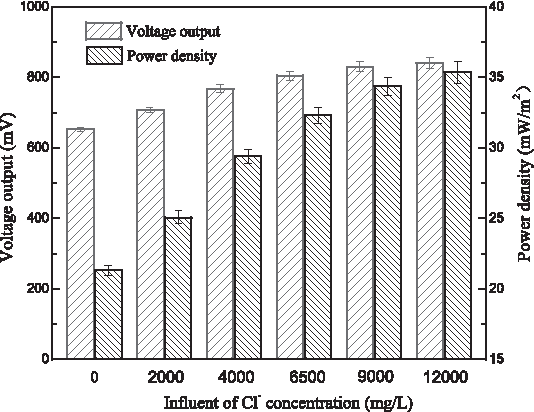
Various voltage and power density output under different Cl− concentrations.
The improvement in performance was directly correlated with the increase in ionic strength, which benefited the conductivity of the solution and reduced the internal resistance of the reactor, thus increasing the electricity output (Rousseau et al., 2013). Studies have shown that the activity of exoelectrogenic organisms was affected at a Cl− concentration of 6075 mg/L, whereas acidogenic organisms could withstand a Cl− concentration of 12,150 mg/L (Lefebvre et al., 2007). Thus, the anode AFB maintained good handling properties and power generation capability above a Cl− concentration of 12,000 mg/L. In addition, the deceleration of electricity output might be because of the competitive processes and bacterial growth. Methanogens competed with anodophiles for the substrate, thus reducing the power generation and coulombic efficiency of the MFC.
Specifically, the output voltage change trend was consistent with the trend in effluent conductivity/TDS but did not have a linear correlation. This situation might be related to the increasing conductivity, which reduced the internal resistance but enhanced the diffusion resistance (Neethu and Ghangrekar, 2017). In the initial stages, the electrogenic bacteria on the anode surface were in the enrichment stage; at this time, the relatively low activation reaction rate led to a larger activation internal resistance. Then, the gradual enrichment of bacteria decreased the internal resistance of activation and diffusion. Finally, PEM fouling was gradually aggravated, increasing the diffusion and activation internal resistance (Becker et al., 2016). As a result, the increase in voltage was initially fast and then slower.
Microbial community analysis of the anode
Initially, there were anaerobic biological particles in the anode AFB reactor. The biological particles had high sphericity and dark color with a particle size of 2–4 mm. Upon domestication to salinity, most of the biological particles were disintegrated. The remaining biological particles in the anode reactor became smoother and more rounded, with a layer of white film, whose size became more uniform. These changes were possibly because of the salinity domestication shock, which caused the changes in sludge characteristics mentioned in the “Effect of Cl− on electricity generation in the AFB-MFC system” section.
Elevated salt levels led to an increase in water density and thus washed away some of the lighter flocs, selecting for larger flocs (Moussa et al., 2006). The genome microbial sequencing analysis results of bacteria at the genus level are given in Table 2 and Fig. 6A. Halanaerobiaceae (46.5%) was most frequently detected, followed by Candidatus Saccharibacteria (8.50%), Endomicrobium proavitum (6.23%), Actinomycetaceae (5.14%), Aranicola (4.4%), and Mesotoga (3.86%).
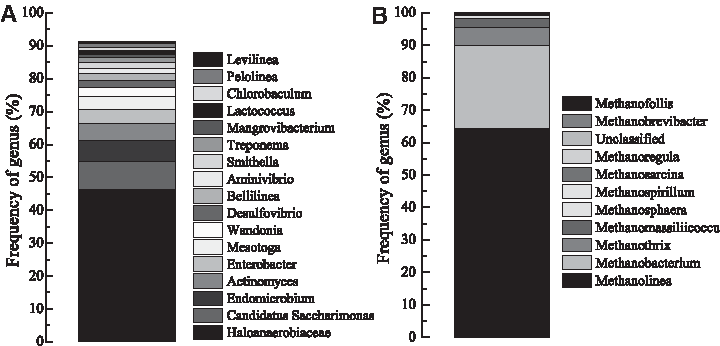
Categories and abundance of microorganisms in anode chamber
Summary of Bacteria Phylotypes Retrieved from Anode Chamber
Halanaerobiaceae, strictly anaerobic and moderately halophilic bacteria, require an NaCl concentration between 0.5 and 3.4 M for optimal growth (Oren, 2014). The halophilic mechanism of Halanaerobiaceae is because of the accumulation of large amounts of small polar molecules, such as glycerol, monosaccharides, and amino acids, which can be rapidly synthesized and degraded in cells. These polar molecules form osmotic adjustment substances in the cells, helping the cells obtain water from a high-salt environment. Furthermore, some species can grow by anaerobic respiration using different electron acceptors (nitrate and Fe3+) and chemolithoautotrophic growth mechanisms based on hydrogen and elemental sulfur (Oren, 2014).
Candidatus Saccharibacteria bacterium is capable of degrading complex polysaccharose (Li et al., 2017) and was also found in the anodic community analysis in previous experiments with ammonium-/organic-rich wastewater (Liu et al., 2017). E. proavitum Strain Rsa215 is a strictly anaerobic ultramicrobacterium that grows exclusively on glucose, which is fermented to lactate, acetate, hydrogen, and CO2, and is capable of nitrogen fixation (Zheng et al., 2016). Aranicola proteolyticus sp. is a high-producing protease strain selected from marine environments and organisms. Some species of Aranicola have been found to optimally grow in NaCl concentrations from 0% to 6%.
Actinomyces naeslundii sp. ferments glucose into lactate, acetate, hydrogen, and carbon dioxide and was found to be involved in another anodic MFC fed with palm oil mill effluent (Kang et al., 2016). A new type of moderate temperature anaerobic rod-shaped bacterium, Mesotoga infera sp., can use fructose, galactose, glucose, lactose, and lactic acid as its energy sources and can fully adapt to the environment provided by the anode AFB reactor in this experiment (Cl− concentration between 0 and 15 g/L) (Ben Hania et al., 2013).
In addition, the bacterial community contained a small amount of Smithella propionica sp. (1.64%), an anaerobic, propionate oxidizing bacterium that uses propionate to form acetic acid and carbon dioxide instead of methane. S. propionica sp. can also grow in coculture with methanogens such as Methanospirillum hungatei sp. However, the most common electrogenic bacteria in MFCs, Geobacter sp. was not found in this study (Zhao et al., 2017). This absence may be because of the difference in the samples, which were not taken from the anode biofilm but from the anaerobic biological particles in the anode chamber.
Conversely, the archaea communities analyzed by genome microbial sequencing showed much less diversity than the bacterial communities. Almost all the archaea were methanogens, including acetoclastic methanogens and hydrogenotrophic methanogens (Table 3 and Fig. 6B). Accounting for 64.3% of the clones, Methanolinea tarda sp. is essentially a freshwater organism that can tolerate 15 g/L NaCl (Imachi et al., 2008). Moreover, M. tarda sp., Methanobacterium formicicum sp. (25.5%), and Methanomassiliicoccus luminyensis sp. (2.75%) are hydrogenotrophic methanogens that utilize formic acid as the substrate and immobilize molecular nitrogen. In contrast, Methanosaeta concilii sp. (5.75%) is a kind of acetoclastic methanogen that utilizes acetate as the sole source of carbon and energy.
Summary of Archaea Phylotypes Retrieved from Anode Chamber
The overall results demonstrated that the AFB anode reactors included a variety of coexisting microorganisms. Compared with pure inoculum, the AFB anodes possessed stronger impact resistance, higher substrate degradation efficiency, and higher energy output efficiency.
Conclusions
The effect of salinity on the pollutant removal performance and microbial communities of an anodic AFB-MFC system were investigated. The high biomass (MLVSS over 27.0 g/L) in this system enabled good COD (98.6%) and
Footnotes
Acknowledgments
This research was supported by the Science and Technology Support Program of Sichuan Province [2015SZ0009].
Author Disclosure Statement
No competing financial interests exist.