




Abstract
Abstract
Concentrations of iron, lead, arsenic, manganese, zinc, and cadmium in the water and sediment of the Yellow Spring, an artesian spring in a Southwest Ohio nature preserve, were measured. Dissolved oxygen, specific conductance, pH, and sulfate were measured to determine if pyrite is the source of elevated iron in the water and sediment. Manganese exceeded the US EPA limit of 50 μg/L in the water and arsenic was just under the US EPA limit of 10 μg/L. Exposure to the Yellow Spring as a drinking water source could cause a slight risk for arsenic and manganese exposure. Use of the Yellow Spring as a drinking water source should be avoided. In the sediment, arsenic (57.91 ± 10.95 mg/kg dry weight) and cadmium (0.615 ± 0.068 mg/kg dry weight) were strongly associated with iron indicating that they originate from arsenopyrite minerals. Lead (8.211 ± 0.950 mg/kg dry weight) and zinc (35.89 ± 2.20 mg/kg dry weight) were elevated in the Yellow Spring sediment implicating galvanized metal pipe as a point source. A one-inch cross-section of the original 1920's clogged pipe subjected to nondestructive X-ray fluorescence gave a reading of 0.793% lead, also consistent with zinc-galvanized coatings. Evidence suggests that galvanized iron pipe left behind from plumbing projects is leaching Pb, Zn, and perhaps Cd into the spring water adding a significant amount of these heavy metals to the sediment over time. Exposure to the Yellow Spring sediment should be minimized or avoided since it contains significant arsenic, lead, and cadmium.
Introduction
The Yellow Spring, located in Antioch College's Glen Helen Nature Preserve (Yellow Springs, OH) is an artesian spring characterized by orange iron-laden travertine deposits that form on and around a man-made façade that was constructed in the mid 1940s. The private preserve encompasses over 1,000 acres of land, mostly forested, with 20 miles of hiking trails. About 100,000 visitors, including many children, flock to Glen Helen and the Yellow Spring each year. Many visitors drink from the “healing” spring, splash in the basin below, and apply orange sediment from the basin to their bodies.
One of the earliest accounts of cures appeared in the journal of Josiah Espy, who visited the spring late in the summer of 1805 with his brother Hugh, in the hopes of alleviating Hugh's rheumatism: “These are the most celebrated mineral waters in Ohio, and are beginning to be much frequented” (Clarke, 1871). In the mid 1800s, people came each week by train to the Neff House hotel that was built near the spring to partake of the iron-rich water and sediment. In 1823, the Columbus Gazette wrote: “These springs have lately become celebrated in many parts of Ohio for their medicinal qualities, and have, we believe, become a resort, during the summer months, for very many whose state of health requires tonics. They are also recommended to persons who are afflicted with bilious affections [liver dysfunction], chronic constipation, scrofula [inflamed lymph nodes due to tuberculosis], dyspepsia, rheumatism, and many other diseases.” The Columbus Gazette goes on to express near wonder at the composition of the water that gives the spring its name: “Their waters are palatable, cold, clear and sparkling, containing considerable fixed air, and is found to be replete with crystalline particles, which, on being exposed to the action of the air, rust and sink, and become bright yellow.” Popularity of the spring and its picturesque surroundings caused the hotel to thrive into the 1860s but waned considerably after the Civil War until its closure in the early 1880s.
Since 1852, the campus of Antioch College has stood due west of the former hotel property about a half-mile from the Yellow Spring. Noted flood control engineer, Arthur E. Morgan (Antioch College President from 1919–1933), brought much-needed modernization to a college largely unchanged since its founding in 1850. Its most pressing requirement was a reliable source of fresh water, a problem made more acute after extensive testing of local wells conducted by the Ohio State Department of Health (DOH) in 1919 and 1920 (Sweeney, 1920) showed considerable contamination by microbial pathogens. According to a December 26, 1919 letter by DOH Chief Engineer, WH Dittoe, tests initiated by Antioch Instructor in Chemistry Mabel Lindsey “did not indicate any general contamination of the ground water supply in [the] vicinity” of the college campus (Dittoe, 1919; Morgan, 1920). Steel pipe was installed in the Yellow Spring in the 1920s to carry “pathogen-free” water to Antioch College for drinking and bathing. Unfortunately, the pipe clogged with travertine deposits within a few years and the spring was abandoned by Antioch College as a water source. Evidence of that system exists to this day in the remains of pipe still visible in the ground near the spring. In the mid 1940s, a stone façade and pool were constructed over the Yellow Spring to make it more attractive for visitors.
In hard water areas like Greene County, OH, plumbers often used galvanized iron pipes in plumbing installations (Troesken, 2006). Galvanized iron or steel pipes made in the United States before 2014 were bathed in molten zinc (Zn) to protect them from weathering. Zinc-galvanized coatings may contain 0.5–1.4% lead (Pb) by weight with traces of cadmium (Cd) as a contaminant (Clark et al., 2015). Leaching of Zn, Pb, and Cd from galvanized pipes can result in significant contamination of drinking water (Pieper et al., 2017) in addition to atmospheric deposition (Neupane and Roberts, 2009; Clark et al., 2015; Pieper et al., 2017). Correlation of Zn concentration to Pb and Cd concentrations were used to identify galvanized pipe as a source of Pb in drinking water (Clark et al., 2015). Any remaining galvanized pipe underground in contact with the Yellow Spring may contain Zn, Pb, and Cd that could leach into the spring water and be deposited in the sediment over time. To this date, no documentation has been found that shows what type of pipe was installed, including whether lead or brass fittings were used.
The geology of the area is characterized by Pleistocene glacial deposits overlying layers of limestone, dolomite, shale, and clay with a layer of Osgood Shale as an impermeable layer confining the aquifer at the bottom (Evers, 1991; Geise, 2016). Water emanating from the Yellow Spring originates from the watershed to the northeast and comes through bedrock fractures in Silurian Cedarville Dolomite (Evers, 1991). Iron is naturally added to the water as it passes through pyrite (iron sulfide). The discharge rate of the spring held steady at around 400 L/min from 1854 to 1943 until the late 1940s construction of the limestone façade over the spring and an airport in the watershed caused the flow to decrease to about 250 L/min (Evers, 1991).
Mineral springs are often high in dissolved metals that precipitate upon exposure to the atmosphere. Just as the source waters of the Yellow Spring dissolves pyrite under reducing conditions found in groundwater, it has the potential to dissolve other minerals as well. Arsenic (As) is often associated with pyrite in underground deposits as arsenopyrite, especially in Southwest Ohio (Thomas, 2007; Ayotte et al., 2017). The geochemical transport from subsurface to surface of arsenic and heavy metals, such as cadmium that are strongly associated with pyrite minerals is a common occurrence in natural springs (Ramos et al., 2014; Muñoz, et al., 2015; Herath et al., 2016). While the concentrations of heavy metals in cold springs is usually below drinking water limits, arsenic is often found at levels slightly above or near those limits (Sklyarov et al., 2015; Çeliker et al., 2019). The water solubility of transition metal carbonates is extremely low, at neutral to basic pH, with a Ksp of about 10−12 (Pita and Hyne, 1975; Grauer, 1999), so heavy metals will precipitate as carbonates and oxyhydroxides in a limestone aquifer near the spring outlet and can accumulate over time. Over a period of years, toxic metals in precipitated sediments can accumulate to hazardous levels (Gutiérrez et al., 2004; Xu at al., 2016).
The toxic effects of heavy metals have received much study. Lead has numerous effects on human health, especially at high levels of exposure. Tetraethyl lead added to gasoline from the 1920s through the 1970s left behind widespread atmospheric lead contamination (Mielke, 2018). However, most Pb from gasoline and Pb-containing paint is deposited near roadways that were in use during that time period (Turer et al., 2001). Atmospheric Pb and Zn deposition can also result from automobile wear and emissions from coal-fired power plants (Lough et al., 2005; Neupane and Roberts, 2009). The most severe risks from Pb exposure are for pregnant women and children, even at relatively low levels in the bloodstream (about 10 μg/dL) (Rabin, 2008). At this level or above, women are more likely to miscarry or give birth early, and children have significantly lower IQs than peers with lower lead levels in their blood [Agency for Toxic Substances and Disease Registry (ATSDR), 2007]. Arsenic exposure can occur through ingestion, inhalation, or absorption through the skin. Chronic exposure to arsenic can cause peripheral neuropathy and raises the risk of liver, kidney, bladder, and skin cancer (Dopp et al., 2004; Valko et al., 2016). Chronic cadmium exposure affects primarily the kidneys (renal tubular dysfunction) and bone (osteomalacia) (Nordberg, 2009; Valko et al., 2016). Iron, manganese, and zinc, on the other hand, are important nutrients that regulate key cellular functions but can cause neurodegeneration at high levels (Farina et al., 2013; Valko et al., 2016). While elevated Fe, Mn, and Zn in drinking water causes mostly organoleptic effects, Mn has recently been identified as having greater neurological effects in the young and elderly, so US EPA has recommended that it be limited to <0.050 mg/L (United States Environmental Protection Agency, 2004).
The degree of contact that the Yellow Spring visitors have with water or sediment could present an exposure hazard if potentially harmful elements are present in significant amounts. This study examined the concentrations of iron, lead, arsenic, manganese, zinc, and cadmium in the Yellow Spring water and sediment, as compared with water and sediments taken nearby in the nature preserve. Since arsenic and cadmium associate with pyrite minerals, their correlation with iron should indicate if they are of mineral or anthropogenic origin. If the Yellow Spring sediment contained higher lead, zinc, and cadmium than the surrounding areas, it would implicate galvanized metal pipe as a point source. Since the Yellow Spring is an important historical site and tourist destination, damage to the façade had to be avoided during this investigation. A one-inch cross-section of the original 1920's clogged pipe, preserved in the archives at Antioch College, was subjected to nondestructive X-ray fluorescence (XRF) for analysis of Pb content.
Materials and Methods
Reagents and standards
ASTM Type 1 water was used for digestions and to prepare all reagents and solutions. Trace Metal™ Grade concentrated nitric acid (CAS No. 7697-37-2), Trace Metal™ Grade concentrated hydrochloric acid (CAS No. 7647-01-0), and hydrogen peroxide 30% (CAS No. 7722-84-1; EMD Millipore Corporation) were purchased from Fisher Scientific and used for digestion/leaching of sediments. Multielement mixed standards were prepared from the following single element 1,000 mg/L Fisher ASSURANCE ICP standards; Pb (CAS No. 7439-92-1), Fe (CAS No. 7439-89-6), As (CAS No. 7440-38-2), Cd (CAS No. 7440-430-9), Mn (CAS No. 7439-96-5), and Zn (CAS No. 7440-66-6).
Site descriptions and sampling
Since the Yellow Spring in Glen Helen Nature Preserve is on private property, permission was obtained before obtaining samples. A map showing sample site locations can be found in Fig. 1. Table 1 lists sample sites with descriptions and GPS locations. Three separate samples were gathered from one site about 15 m south of the Yellow Spring, where a tree had fallen over. The sediment near the tree roots was the characteristic orange rust color matching the Yellow Spring sediment. The first sample (CH1) was dug out from inside the cliff hang, where it had little exposure to the air. The second sample from the same area (CH2) was collected from the ground next to the cliff hang and was exposed. The third sample taken from the same area (VG) was an exposed vuggy chunk that was found on the ledge of the cliff hang. Vuggs are crystal-lined cavities formed by groundwater in carbonate bedrock so this rock-like chunk contained numerous holes. The fourth sample was from an area known as the Grotto (GR), a small waterfall and basin a few meters downstream from the Yellow Spring, where sediment was collected from the edge of the basin that forms a small pool that ultimately drains into Yellow Springs Creek. The fifth site was the Yellow Spring (YS) sediment. A characteristically orange-colored sediment sample was collected from the basin into which spring water is deposited at a site that is less disturbed by visitors. A sixth site (CE) was located just a few meters north of the Yellow Spring and was not discernably orange.
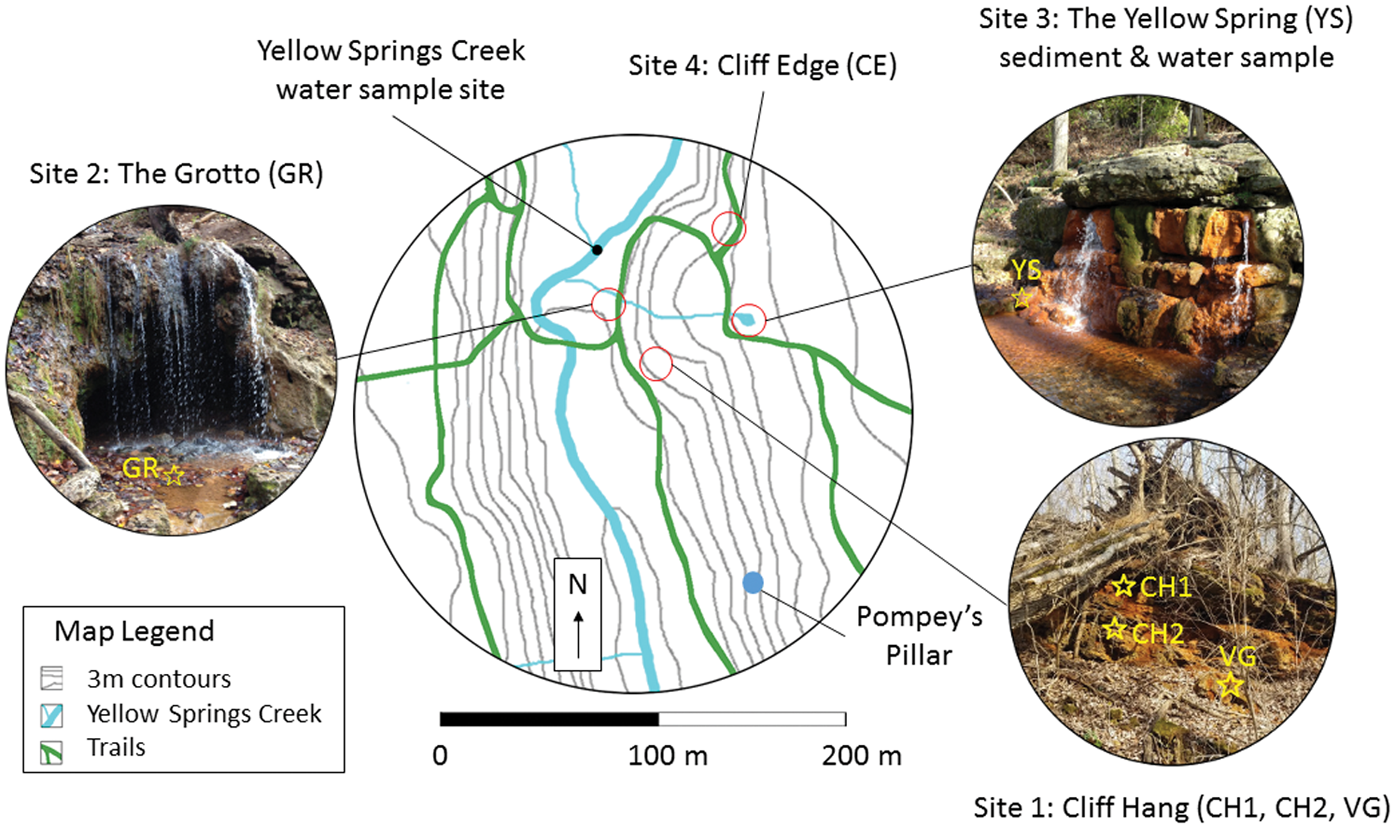
Map showing location of the Yellow Spring and other sample sites within Glen Helen Nature Preserve. Base map courtesy Antioch College. Notes and photos were added by the authors.
Sediment Sample Sites with Description, Location, Properties, and Metal Concentrations
Standard deviation, n = 4. N/A means there is no TEC value for Fe or Mn.
Ohio TEC for sediments.
TEC, Threshold Effect Concentration.
Samples were collected while wearing plastic gloves and using precleaned plastic scoops and 250-mL wide-mouth polyethylene bottles (rinsed with 4% HNO3 solution and Type I reagent water). The vuggy-chunk sample was placed in a clean plastic bag since it did not fit through the mouth of a sample bottle. For determination of iron, cadmium, arsenic, manganese, zinc, and lead, water samples were collected from the Yellow Spring outlet in precleaned polypropylene bottles. All samples were transported back to the laboratory.
A YSI Professional Plus (Pro Plus) Multiparameter portable probe that included pH, conductivity, and dissolved oxygen (YSI/Xylem) system was used to determine basic water quality parameters in the Yellow Spring and in Yellow Springs Creek, just upstream from where the two converge. Water samples were taken for metals analysis in acid-rinsed 125-mL polypropylene bottles. To support the theory that the iron in the Yellow Spring was coming from pyrite deposits, sulfate was determined using anion chromatography. Water samples were taken from the outlet of the Yellow Spring and several sites in Yellow Springs Creek upstream from where the discharge of the spring enters the creek. Samples for sulfate analysis were filtered through 0.2-μm PTFE filters into clean 10-mL polypropylene test tubes, stored in a cooler, and frozen before analysis.
Sediment sample preparation
The samples were spread out in a hood on paper toweling to air dry. Wet samples (YS, GR) were decanted before drying. Larger pieces and the vuggy chunk samples were broken up with a plastic-covered hammer. Samples were sieved using a precleaned 2.00-mm stainless steel sieve and stored in precleaned 250-mL polyethylene bottles.
Sediment properties
Four aliquots of each sample were weighed (∼1 g to the nearest 0.0001 g) using a Mettler AE 240 balance into prelabeled aluminum weighing dishes. All weighing dishes were placed in the oven for 2 days at 105°C. After cooling in a desiccator, samples were reweighed to determine moisture loss. The pH and specific conductance of each sample were measured using the YSI Professional Plus (Pro Plus) Multiparameter portable. A slurry of 10 g of each sediment with 10 mL of Type I reagent water was prepared in a plastic bag. The probe was inserted into the slurry for each measurement of pH and specific conductance.
Sediment digestion
Four separate aliquots (∼0.5 g to the nearest 0.0001 g) of each air-dried sample were weighed on a Mettler AE 240 balance. Following EPA Method 3050B (United States Environmental Protection Agency, 1996), each sample was transferred to a 250-mL Erlenmeyer flask, where 10 mL of a solution of 1:1 HNO3:H2O was added. The samples were swirled to mix, covered with a ribbed watch glass, and placed on a 95°C ± 5°C hot plate. Each sample was refluxed for 10–15 min. Then, the sample was removed from the hot plate and cooled before adding 5 mL of concentrated HNO3. The samples were refluxed for another 30 min. When, and if, brown fumes were generated, the sample was removed from hot plate and another 5 mL of concentrated HNO3 was added until no brown fumes were given off. Each solution was evaporated down to ∼5 mL. Upon cooling, 10 mL 30% H2O2 was added to each solution and heating on the hot plate was resumed at 95°C ± 5°C until there was no observed effervescence and the solution was reduced to ∼5 mL volume. After cooling again, 10 mL of concentrated HCl was added to each sample flask and the samples were refluxed for 15 min. Upon cooling, each digested/leached sample was filtered through Whatman No. 42 (11.0-cm) paper into a 50-mL volumetric flask. The solutions were diluted to the mark with 4% HNO3 acid.
Sulfate analysis of water
Following EPA Method 300.1 (United States Environmental Protection Agency, 2007), a Dionex-1600 ion chromatograph fitted with a Dionex IonPac AS22 anion exchange column (4 × 250-mm) was employed with sodium carbonate/sodium bicarbonate eluent (Na2CO3/NaHCO3, 4.5 mM/1.4 mM), a column temperature of 30°C, cell temperature of 35°C, and suppressor current of 31 mA. Sulfate retention time was 10.9 min at a flow rate of 1.2 mL/min. Linearity was 0.9998 for calibration from 0.1 to 75 parts-per-million (ppm).
Metals analysis of sediment and water
Water samples were filtered and acidified to pH <2 with concentrated nitric acid before analysis by Inductively Coupled Plasma—Optical Emission Spectrometer (ICP-OES). Each digested sediment sample was filtered through a 0.45-μm PTFE syringe filter before analysis. Metal analysis was performed using a Varian 710 ICP-OES with autosampler. The following wavelengths were selected for analysis: As (188 nm), Cd (214 nm), Pb (220 nm), Mn (257 nm for sediment, 293 nm for water), Zn (213 nm for sediments, 206 nm for water), and Fe (238 nm). A multielement standard was prepared by combining 5.00 mL of each analytical standard in a 100-mL volumetric flask and diluting to the mark with 4% concentrated HNO3 to create a high standard of 50.0 ppm. Serial dilutions were performed to create standards that ranged from 0.0020 to 5.00 ppm. A multielement quality control standard was included to ensure accuracy. All calibration lines were R2 = 0.9994 linearity or greater.
XRF of pipe section
An Olympus VANTA C Series Handheld XRF analyzer was used to measure surface Pb in the original 1920's pipe cross-section. It contains a 4-W X-ray tube with a rhodium and tungsten anode (8–40 kV) and a silicon drift detector with an 8 mm2 measurement window. It has a built-in barometer to correct for altitude and air density and a full VGA CMOS aiming camera. The outside edge of the pipe (galvanized coating) was scanned along with sections of the travertine deposits inside.
Results and Discussion
Water chemistry
The results from water chemistry tests can be found in Table 2. The pH of the Yellow Spring water was significantly lower than the Yellow Springs Creek water (7.25 and 7.94, respectively), perhaps due to the influence of dissolved pyrite. The dissolved oxygen concentration was 4.25 mg/L in the Yellow Spring and 8.81 mg/L in the creek upstream, evidence that the spring water is emerging from a reducing environment. Specific conductance for the Yellow Spring was 632 and 716 μS/cm for the creek, minimal for the two water sources. The sulfate concentration in the Yellow Spring water was 61.23 ppm, considerably higher than measurements taken along Yellow Springs Creek above and below, where the Yellow Spring water enters (30–35 ppm). The source of this sulfate is likely dissolved pyrite in the spring water that oxidizes producing sulfuric acid and precipitation of iron.
Water Sample Physical and Chemical Characteristics
N/A means there is no regulated value.
United States Environmental Protection Agency (2009).
Iron was determined to be 0.780 mg/L in the spring water and 0.050 mg/L in the stream water. The spring iron concentration is greater than the EPA drinking water limit of 0.3 mg/L although it is considered only a nuisance. The elevated iron concentration in the Yellow Spring is also an indication of a reducing environment containing pyrite from which the spring evolves. Arsenic was below the limit of detection (13 μg/L), but was extrapolated to 9.7 μg/L in the Yellow Spring and came very close to the EPA drinking water limit of 10 μg/L (United States Environmental Protection Agency, 2009). Pb was below the limit of detection in both water sources. However, Cd in the spring was 3 μg/L, just under the EPA drinking water limit of 5 μg/L. Mn in the spring was 62 μg/L, over the recommended EPA limit of 50 and 18 μg/L upstream in Yellow Springs Creek (United States Environmental Protection Agency, 2004). Zinc results in the Yellow Spring and Yellow Springs Creek were below the limit of detection of 20 μg/L and well below the EPA drinking water limit of 500 ppm.
Sediment properties
Sediment property measurements can be found in Table 1. The pH ranged from 7.35 to 7.79, all within normal levels (7.2–8.2) for sediments in areas with limestone and dolomite bedrock. The lowest specific conductance measurements were of sediment samples taken from under water, as would be expected since soluble salts have dissolved and have been removed by flowing water. The percent moisture for all of the samples was relatively low, indicating that they are high in inorganic minerals and lacking in organic matter.
Metal analyses of sediments
Table 1 shows the results of metal analysis of sediments. Iron was extremely high, as expected, and ranged from 3,913 to 21,084 mg/kg dry weight. The highest iron measurement was found in the unexposed sediment sample, CH1 (21,084 mg/kg dry weight) followed by the Yellow Spring sediment (17,238 mg/kg dry weight). The lowest Fe concentration was found in the site farthest away from the spring, CE, which was more than five times less concentrated in Fe.
Arsenic concentration ranged from 18.71 to 100.3 mg/kg dry weight with the highest value found in the unexposed sediment (CH1) that was also highest in Fe. Arsenic in all of the sediments was above the Threshold Effect Concentration (TEC) of 9.79 mg/kg dry weight for Ohio (Ohio Environmental Protection Agency, 2010) indicating that exposure could have deleterious effects on aquatic life and correspondingly animals and humans. Elevated concentration of arsenic in groundwater, especially in Southwest Ohio, has been shown to be associated with high iron concentration (Dixit and Herring, 2003) so this finding was not unexpected.
Cadmium concentrations ranged from 0.188–0.616 mg/kg dry weight with the highest values in the Yellow Spring sediment and in CH1. All of these levels were significant but still below the TEC of 0.99 mg/kg. Arsenic and cadmium concentrations are both strongly correlated with iron (Pearson's r = 0.956 and 0.900, p = 0.003 and 0.015, respectively), indicating weathering of naturally occurring minerals such as arsenopyrite as a source (Fig. 2). The CH1 sample contained the highest ratio of Cd and As to Fe. CH1 was the unexposed sample that was dug out of the side of the cliff. It probably experienced the least amount of weathering while CE was the sample that was farthest from the Yellow Spring with frequent exposure to the atmosphere and had the lowest levels of heavy metals, except for Zn.
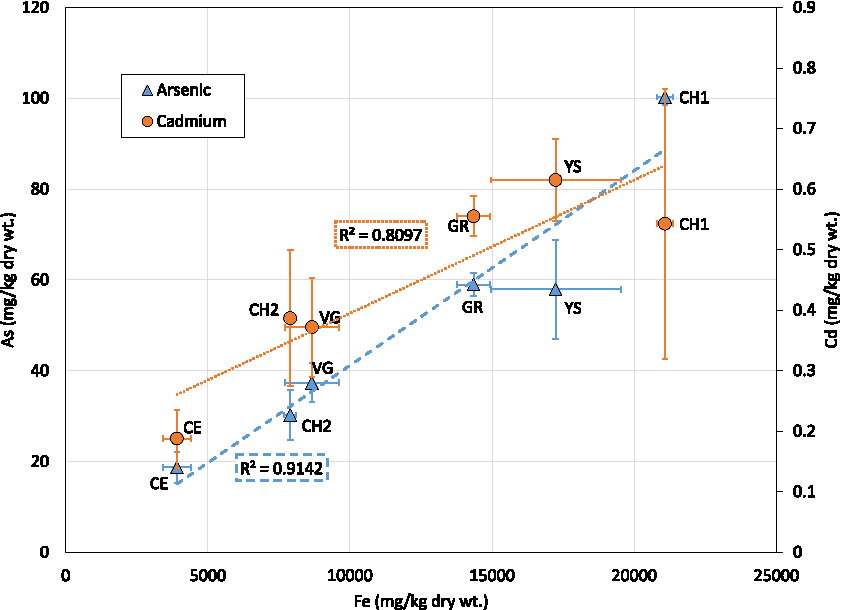
Correlation of arsenic (As) and cadmium (Cd) to iron (Fe). Error bars represent standard deviation for four samples.
Manganese varied wildly ranging from 102.4 to 1,036.6 mg/kg dry weight. Manganese concentrations did not correlate with any of the other metals.
The Yellow Spring sediment, Pb (8.211 mg/kg dry weight), was more than twice the next highest concentration found in the Grotto sediment (4.080 mg/kg dry weight). The Pb result for the Yellow Spring sediment is the highest value indicating an anthropogenic source of Pb in this sample. The data for Pb versus Fe concentration were plotted along a linear trendline with and without including the Pb value for the Yellow Spring sediment (Fig. 3). The slope of the trendline without the YS data point was effectively zero, showing that Pb was not associated with Fe. Lead is not strongly associated with iron (Fe) minerals in reducing environments and lower pH (Brown et al., 1999; Schaider et al., 2014). Natural minerals, such as galena, can contribute trace amounts of lead to sediments. However, there is very little galena in Ohio sediments (Carlson, 1991). Pb from only atmospheric deposition should have produced similar results in all samples. This indicates a point source of contamination of Pb for the Yellow Spring sediment.
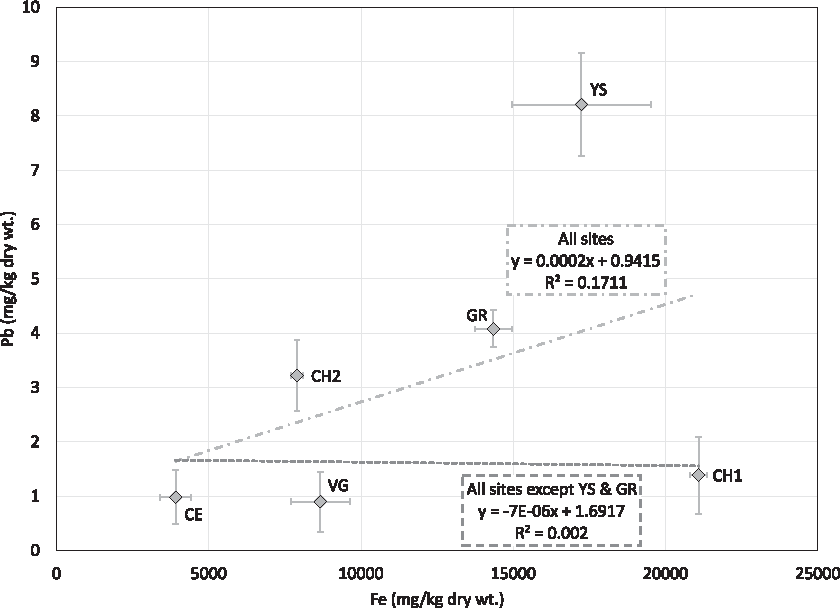
Correlation of lead (Pb) to iron (Fe). The Yellow Spring Sediment is more than twice as high in Pb content than the next highest sample. Error bars represent standard deviation of four samples.
Zinc results ranged from 10.45 to 35.89 mg/kg dry weight. The highest Zn value was found in the Yellow Spring sediment and the lowest value was found in the unexposed sediment, CH1. These levels are all well below the TEC concentration of 121 mg/kg dry weight. A plot of Zn versus Fe (Fig. 4) shows the same type of relationship as seen in Fig. 3, with no correlation between zinc and iron for all six samples. There is a strong negative correlation if the Yellow Spring and Grotto sediments are removed from the dataset (Pearson's r = 0.947, p = 0.004).
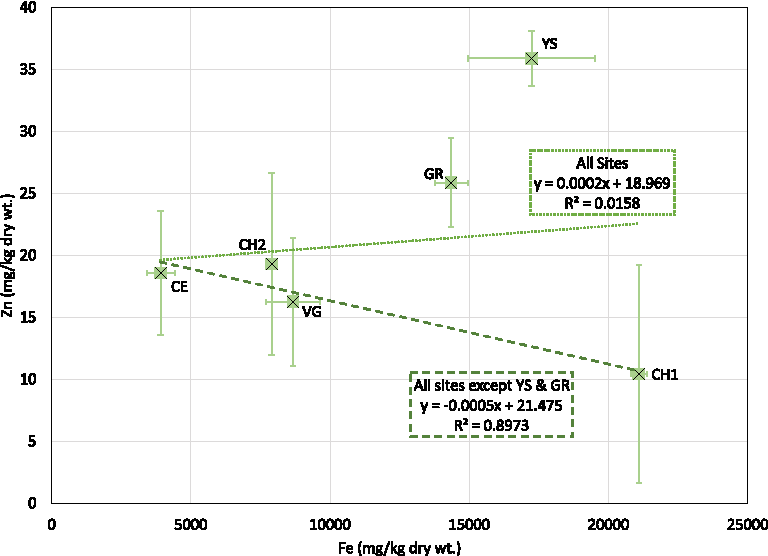
Correlation of zinc (Zn) to iron (Fe). The Yellow Spring Sediment is the highest in zinc. Error bars represent standard deviation of four samples.
It is clear that Pb and Zn are elevated in the Yellow Spring sediment when compared with the other sites (Fig. 5). Correlation between the two metals (Pearson's r = 0.925, p = 0.00826) supports the theory that the source could be galvanized pipe. However, the ratios reported by Pieper et al. (2017) for Pb, Zn, and Cd in water coming from contaminated pipe cannot be applied to the sediments here since sedimentation is affected by flow rate, temperature, precipitate solubility, and deposition times. For instance, the ratio of Pb:Zn (μg/L:mg/L) reported by Pieper in water was 989–1,824 and the value obtained in this study for the Yellow Spring was 229. The pH of the system and availability of carbonates for precipitation would have a large effect on this ratio over time.
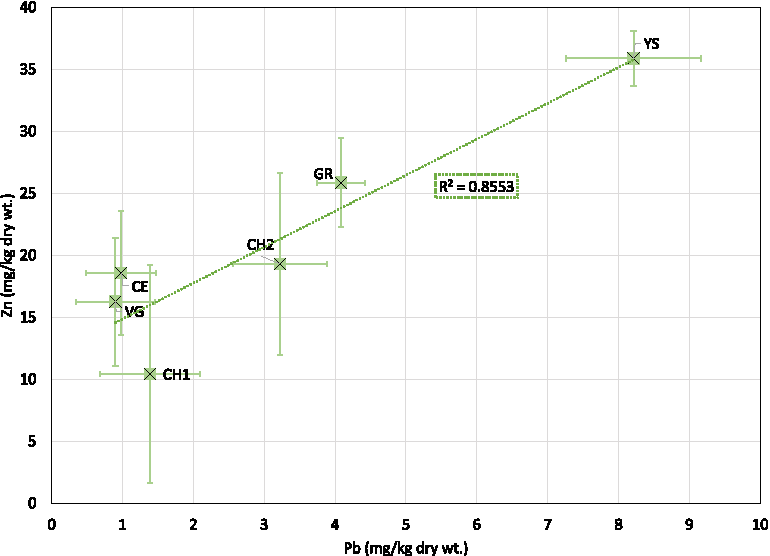
Correlation of lead (Pb) to zinc (Zn). The two highest sites in lead and zinc are the Yellow Spring and the Grotto downstream. Error bars represent standard deviation of four samples.
Greene County, Ohio sediments/soils have an average lead concentration of 17.4 ± 0.1 mg/kg dry weight [United States Geological Survey (USGS), 2012], little of which comes from local mineral sources and is likely enhanced from the burning of leaded gasoline. The background Pb concentration around the Yellow Spring appears to be about 2 mg/kg dry weight. Anthropogenic activities add Pb to the environment as a solid, for example in chromate road paint (LeGalley et al., 2013), in water, dissolved in its pure form or as part of a soluble molecule or adsorbed to suspended particles such as clay, or into the atmosphere, generally by burning of coal, smelting nonferrous metals, or leaded gasoline. Atmospheric Pb returns to the ground through wet or dry deposition and can be carried long distances. Leaded gasoline sold in the United States, beginning in 1923 and ending in 1989, with the advent of the catalytic converter (Nriagu, 1990) was mostly deposited near roadways that were in use during this period. The Yellow Spring is at least a 100 m away from any roadway.
The bedrock in the area is a series of Ordovician and Silurian limestones (CaCO3), shales (various clay minerals), and dolostone [CaMg(CO3)2] beds overlain by Wisconsinan glacial sediments (Shumacher et al., 2012). There are no reported deposits of galena (PbS), the major mineral ore from which lead is refined, or its weathering products, anglesite (PbSO4) and cerussite (PbCO3), in Greene County (Carlson, 1991). However, there are probably tiny fragments in the glacial sediments. These have been detected in glacial deposits in Indiana (Erd and Greenberg, 1960). Lead is probably also present in trace amounts as an impurity in small pyrite and marcasite (FeS2) deposits in vuggs. Lead was below the TEC in the Yellow Spring sediment. However, since there is no safe level of exposure to these heavy metals, contact with the Yellow Spring sediment would pose a risk.
XRF of pipe section
The original 1920's clogged pipe cross-section is shown in Fig. 6. The bottom of the photo correlates to the position of the pipe when it was in service. The thicker layer of travertine deposits at the bottom of the pipe indicates that settling of precipitates occurred over time. Measurement of the outer edge of metal pipe itself gave a reading of 0.793% Pb. This is consistent with concentrations of Pb found in galvanized coatings. No records have been found that relate to the purchase of the pipe, so it was not possible to verify the source. Sediment deposits inside the pipe section are visible as light- and dark-colored bands. Readings from various locations within the travertine deposit inside the pipe section gave values ranging from 20 to 377 ppm Pb. X-ray fluorescence measurements that included more of the darker areas in the travertine deposit were higher in Pb, indicating that Pb was depositing in layers. Lead could have been released into the water in bursts or perhaps it happened to settle in layers as a result of density at times of low flow. Using XRF, Clark et al. (2015) found lead concentrations ranging from undetectable to 1.8% in the zinc coatings of galvanized steel service lines and premise potable water pipes in Florida, Chicago, and Indiana. The pipes ranged in age from 60 to <10 years, but there was no correlation between the age of the pipe and the lead content of the coating. Lead was still being released from the coating on the oldest pipes, reaching aqueous concentrations of up to 172 μg/L.

Photo of pipe section with XRF data included for lead (Pb) concentration. XRF, X-ray fluorescence.
To further probe for the existence of pipe inside the spring façade, a Bounty Hunter® Land Star metal detector was employed to probe for evidence of iron still contained within the structure. The iron setting was selected on the detector controls. The metal detector was run along the face of the façade, around the perimeter, and atop the stone edifice. Metal detector measurements indicated that the inside of the Yellow Spring façade contained a significant amount of iron pipe. Iron pipe is visible in the area of the façade in Fig. 7, where an arrow is pointing to a visible pipe at the time the façade was constructed. The detector also indicated a large amount of iron inside the façade when scanned from the top of the structure. A Depstech® Wireless Endoscope Inspection Camera (SA071007, WF010) with a 10-m cable and LED lights was used to search the internal structure. The top of the 1940's structure is a slab of limestone that functions as a lid but has not been moved since installation. A small opening at the bottom of this slab permitted the insertion of the inspection camera to a depth of ∼1 m. Photographs and video were taken using the Depstech app, which transmitted video through WiFi signal to an Apple iPhone 7. A screenshot of video from the endoscope inspection camera showed remnants of pipe inside the constructed façade of the Yellow Spring. Figure 8 shows what appears to be a disconnected pipe near the center left of the photo. A hexagonally shaped pipe fitting can be seen at the top right.

Photo of construction of the Yellow Springs Façade circa 1940. A pipe or pole can be seen extending from the stones near the top right in the photo (blue arrow). Photo courtesy of Glen Helen Nature Preserve.

Screen shot of video from inside the Yellow Spring façade using an endoscope inspection camera. The half-covered hexagonal metal object at the top center appears to be an old pipe fitting. The object at the center left appears to be an old pipe remnant.
“Healing” potential of the Yellow Spring
The high iron, sulfate, and arsenic concentrations in the water and sediment could explain some of the reported healing properties of the Yellow Spring water and sediment. Iron and arsenic have had medicinal uses since the late 18th and early 19th centuries. Iron sulfate has been used as medicine back to the days of Hippocrates who reportedly used iron salts as styptics (Beulter, 2002). Ferrous sulfate has been used for centuries for the treatment of anemia, tuberculosis, weakness, diarrhea, vomiting, cystitis, fevers, and skin infections. Parasitic infections, peptic ulcers, gastrointestinal cancers, hepatitis, and liver conditions cause chronic iron deficiency (Stein et al., 2016) leading to many of the symptoms such as bilious affections that drew people to the Yellow Spring for relief before the advent of modern medicine. Arsenic has been used as medicine since 2000 BCE (Hughes et al., 2011). Hippocrates treated ulcers and abscesses with arsenic pastes. Since the late 18th century, arsenic has been used to treat skin conditions such as eczema and psoriasis. Malaria, asthma, and chorea (a neurological disorder characterized by involuntary jerking movements) were treated with Fowler's solution containing 1% potassium arsenite. Salvarsan, a revolutionary drug in 1910, was introduced as an effective treatment for syphilis. Low doses of arsenic-containing drugs, such as Stovarsol and Treparsol, were used to treat tuberculosis, syphilis, and internal parasites in the early 20th century (Tompkins, 1934). Arsenic compounds are still being investigated as chemotherapeutic agents (Burnett et al., 2015).
Conclusions
The high iron and arsenic content likely contributed to the medicinal quality of the Yellow Spring water and sediment a century ago. However, arsenic, cadmium, lead, and manganese could cause an exposure risk for those who drink from the spring regularly. Use of the Yellow Spring as a drinking water source should be avoided. The ratio of arsenic to iron indicates that they emanate from natural mineral sources such as arsenopyrites. Cadmium is also correlated with iron but to a lesser degree. The evidence suggests that galvanized lead pipe left behind from the 1920's water project or as part of the 1940's façade structure could be leaching Pb, Zn, and perhaps Cd into the spring water adding a significant amount of these heavy metals to the sediment over time. Exposure to the Yellow Spring sediment should be minimized or avoided since it contains a high concentration of arsenic and low levels of lead and cadmium.
Footnotes
Acknowledgments
The authors wish to thank Nick Boutis and Ben Silliman from the Glen Helen Nature Preserve, Edward Walker of Olympus America, and John A. Case metal detectorist. Kellie Bohrer, Thomas Chenault, Brandon Myers, and Megan Shade provided sulfate, manganese, and zinc water measurements. Support was provided by the Wright State University Department of Chemistry.
Author Disclosure Statement
No competing financial interests exist.
Funding Information
No funding was received for this article.