




Abstract
In this study, the electrochemical oxidation treatment of landfill leachate on a boron-doped diamond (BDD) electrode was examined. A factorial design method was applied to evaluate the experimental variables: treatment time, initial pH, current intensity, and chloride concentration. The processes of chemical oxygen demand (COD), ammonia nitrogen (NH4+-N), total nitrogen removal, and nitrate (NO3−-N) formation were all assessed. Results demonstrated that the interaction between pH value and chloride concentration had a significant effect on COD removal. NH4+-N was mainly affected by the interaction between pH value and chloride concentration. In addition, the products of NH4+-N oxidation were investigated under varying operating conditions. Results showed that nitrogen (N2) was the main transformation product of NH4+-N and was strongly affected by the current density. Specifically, when the current density increased from 50 to 100 mA/cm2, the proportion of N2 increased from 52.2% to 82.06% after 4 h of electrolysis. The alkaline condition was not conducive to the accumulation of NO3−-N, while the addition of chloride ion contributed to an increase in both NO3−-N and nitrite (NO2−-N) production. After 4 h, the percentage of the formed NO3−-N increased from 14.49% to 20.72%, for chloride concentrations of 2,498 and 7,000 mg/L, respectively. At the same time, the NO2−-N percentage increased from 0.19% to 1.74%. Furthermore, fluorescence and gas chromatography-mass spectrometry analysis showed that the toxic and biorefractory substance levels decreased following electrochemical oxidation treatment. This work is able to provide valuable information and sound evidence for the application of electrochemical oxidation technology in landfill leachate, and thus it has a practical significance in environmental pollution control.
Introduction
With the improvement of living standards and changes in life style, the amount of municipal solid waste (MSW) is increasing rapidly with time. Thus, effectively dealing with MSW is extremely important (Iskander et al., 2018). At present, sanitary landfilling is the most widely used method for treating MSW around the globe (Mukherjee et al., 2015). Although this method can achieve the purpose of waste reduction, a large amount of landfill leachate is produced, and if not properly treated, soil and water environments will be damaged, further threatening the survival of plants, animals, and humans (Clarke et al., 2015; Baderna et al., 2019). In practical engineering applications, the pervasive combination of biochemical and membrane treatment methods is widely used to handle landfill leachate. However, membrane cleaning and the treatment of concentrates produced by membrane filtration can prove to be problematic (Fernandes et al., 2015). As a consequence, identifying an effective and substitutable means to treat landfill leachate still remains a focal task in the field of wastewater treatment.
In recent years, advanced oxidation processes (AOPs) have been the focus of much attention, as they are able to decompose refractory pollutants into small molecules intermediates, or completely into carbon dioxide and water (Wiszniowski et al., 2006; Sirés et al., 2014). Studies on AOPs [including ozonation (Cortez et al., 2010), photocatalytic oxidation (Poblete et al., 2011), Fenton process (Jurczyk and Koc-Jurczyk, 2017), electrochemical oxidation (Bashir et al., 2009), or combinations of the above (Wang et al., 2017; Zhao et al., 2017)] have been extensively covered. Among such processes, ozonation demonstrates the selective oxidation to organic pollutants and a low mineralization effect, while Fenton technique requires a large amount of reagent and produces a lot of chemical sludge. In addition, the problem of photocatalyst recovery has yet to be solved in an efficient manner. Comparatively speaking, electrochemical oxidation has emerged as a promising technology presenting many advantages, such as versatility, high efficiency, mild operational conditions, the requirement of little or no reagent, and easy automation (Cabeza et al., 2007; Zhao et al., 2010; Garcia-Segura et al., 2018). Anode material is a principal concern affecting the function of electrochemical oxidation technology, and studies have proved that boron-doped diamond (BDD) is superior to other materials in terms of its potential window, service life, and mineralization efficiency (Panizza and Martinez-Huitle, 2013; Fernandes et al., 2014; Ukundimana et al., 2018).
In addition to the anode material, operating parameters such as pH, applied chloride ion concentration and current density may also have a significant impact on the electrochemical process (Chiang et al., 1995; Fernandes et al., 2016). In most studies, the one-factor-at-a-time approach has been widely used to evaluate the effects of electrochemical conditions. However, this approach fails to recognize the interaction of variables, which must be considered for comprehensive analysis. In contrast, factorial experimental design methods can simultaneously assess the positive/negative effects of factors and their interactions on system efficiency (Chatzisymeon et al., 2009; Anglada et al., 2011).
Moreover, degradation products must be evaluated in terms of their effectiveness in the electrochemical oxidation process. For example, the oxidation product of ammonia nitrogen (NH4+-N) should be taken into account as NH4+-N is an important water quality parameter, and it is present in high levels in landfill leachate. Eutrophication caused by nitrogen (N2) and other nutrients has recently been widely observed, causing harm to aquatic organisms and the ecological environment (Zhang et al., 2018). Therefore, it is necessary to study the migration and transformation of NH4+-N in the process of electrochemical oxidation, so as to clarify whether the final product of NH4+-N is detrimental. However, limited studies focus on the analysis of such products, and for those who do, simulated wastewater is generally taken as the target, which is not effective when considering actual wastewater. In addition, the types and molecular structures of organic pollutants change during the electrochemical oxidation process, which can act as an important basis for testing the degradation capacity of this type of technology.
In this work, the landfill leachate treatment using electrochemical oxidation with BDD as an anode was performed. The influence of experimental variables (including initial pH value, current density, chloride ion concentration, and reaction time) on degradation efficiency was assessed using a factorial experimental design method. The chemical oxygen demand (COD), NH4+-N, total nitrogen (TN) removal rate, and nitrate (NO3−-N) concentration were chosen as the response parameters. Moreover, the oxidation products and degradation paths of NH4+-N in the electrochemical oxidation process under different operating conditions were analyzed. Excitation–emission matrix (EEM) fluorescence spectroscopy and gas chromatography–mass spectrometry (GC-MS) analysis were tested before and after treatment for further insights into the degradation of the refractory organics.
Materials and Methods
Sanitary landfill leachate
The leachate used in this study was collected from a MSW landfill site, located in Qingdao (China). The water quality characteristics are presented in Table 1. The average value of each water quality parameter was calculated based on three measurements. During the experiment, the concentration of Cl− in the leachate was adjusted by adding NaCl, the initial pH value of leachate was adjusted with 2 mol/L H2SO4 and NaOH, and the conductivity of the leachate was adjusted with NaSO4.
Leachate Characterization
BOD, Biochemical oxygen demand; COD, chemical oxygen demand; TN, total nitrogen; NH4+-N, ammonia nitrogen; NO3−-N, nitrate; NO2—N, nitrite.
Electrochemical oxidation experiments
The electrochemical experimental apparatus (Supplementary Fig. S1) was made up of a DC power supply (KXN-305D; Zhaoxin, China), an electrochemical oxidation reactor, a peristaltic pump (YZ1515x; Longer, China), a water storage tank, and a magnetic stirrer. The electrochemical oxidation reactor was made of acrylic sheets, with an effective volume of 180 mL and a circulating mode. The flow rate was controlled by the peristaltic pump at the rate of 40 rpm. Using BDD as the anode material and stainless steel as the cathode, a three-electrode system with a single anode and double cathode was constructed. During the electrolysis process, the effective usable area of the electrode was 5 cm × 5 cm, and the spacing of the electrode plate was 15 mm. To maintain the uniformity of the leachate, a 1-L glass reservoir was placed on a magnetic stirrer, and the leachate was continuously stirred through the rotor at the bottom.
Analytical methods
Water quality index
COD was determined by the potassium dichromate oxidation method. The determination of NH4+-N and nitrite (NO2−-N) were performed by salicylic acid spectrophotometry and the N-(1-Naphthyl) ethylenediamine dihydrochloride method, respectively. NO3−-N and TN were measured by means of UV-Vis spectrophotometry. The concentration of the chloride ions was determined using the silver nitrate titrimetric method according to the relevant standards. The pH value was determined using a laboratory pH meter (Knick International, Berlin, Germany).
Fluorescence spectra analysis
EEM fluorescence spectra were measured using a Varian Eclipse fluorescence spectrophotometer (F7000; Hitachi, Japan) in scan mode. EEM spectra were gathered with scanning emission wavelengths (Em) from 220 to 550 nm at 5 nm increments, and excitation wavelengths (Ex) from 200 to 400 nm at 5 nm increments. The spectra were recorded at a scan rate of 12,000 nm/min, using excitation and emission slit bandwidths of 5 nm. The voltage of the photomultiplier tube was set to 500 V for low level light detection.
GC-MS analysis
The composition of the sample was detected using GC-MS (ThermoFisher; TRACE GCMS-ISQ Lt) with a TG-WAXMT GC Metal column (30 m × 0.25 mm × 0.25 μm). The GC oven temperature was set at 50°C and then programmed to 250°C for at a rate of 20°C/min and subsequently kept constant for 20 min. The carrier gas flow rate was 0.8 mL/min and the split ratio was 40:1. MS was run in electron impact mode with the ion source temperature at 200°C and the connecting line temperature at 250°C. Organic compounds were analyzed by spectral comparison using the NIST08 library (National Institute of Standards and Technology, Gaithersburg, MD). A compound was deemed identified and reported if the match percentage was higher than 60%.
Factorial design methodology
A factorial design method was applied to analyze the main effect of various operational factors and their interaction on the treatment effect of landfill leachate. The Minitab 17 software was used to achieve these goals. In this work, four independent factors were chosen, namely, electrolysis time, current density (J), initial pH value, and Cl− concentration, labeled as A, B, C, and D, respectively. As shown in Table 2, two values, a high level (denoted as “1”) and a low level (denoted as “−1”), were assigned to each variable. Therefore, the electrochemical oxidation experiment was carried out with a 24-factor design. There were 19 groups of experiments, 3 of which were designed as the center points to evaluate the standard error.
Factors and Levels Applied in the Factorial Design
Results and Discussion
Factorial design of experiments
For factorial design of experiments, the percent removal of COD, NH4+-N, TN, and the formation of NO3−-N were taken as response values, and recorded as Y1, Y2, Y3, and Y4, respectively. The experimental results of the factor design are shown in Table 3. As can be seen, the COD removal rate was between 48% and 70%. Regarding the elimination of TN, a similar level to that of COD was generally achieved. However, the removal of NH4+-N in landfill leachate varied with factor levels was quite different, with a minimum removal rate of 66.08% and the maximum of 97.83%. In addition, the NO3−-N concentration ranged from 356.60 to 537.59 mg/L under the operating conditions.
Results of the Factor Design Experiment
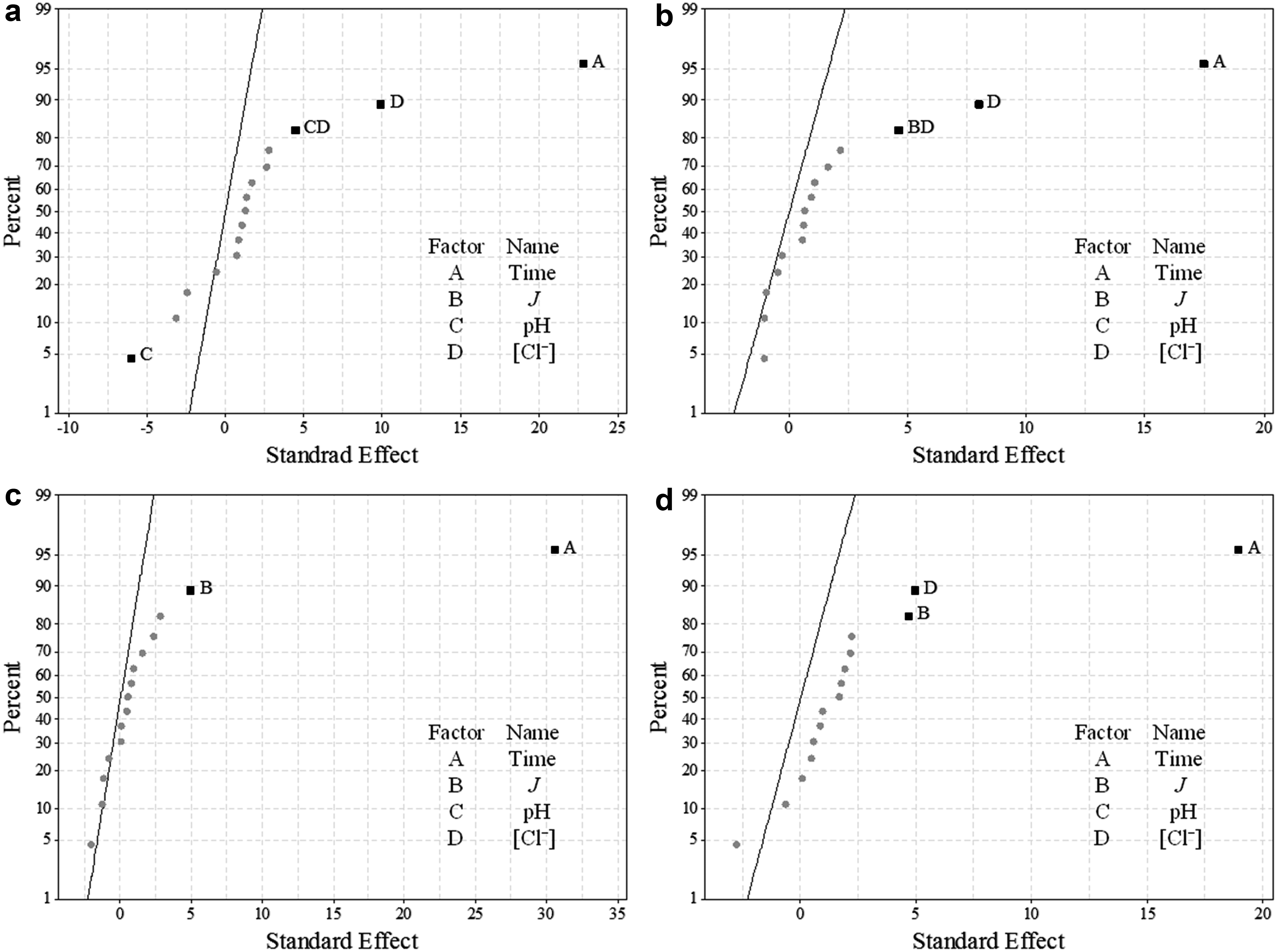
In this study, three runs at the center point of the factorial design were used to calculate the standard error to assess the significance of the effects. If an effect is about or below the standard error, it may be considered insignificant. However, the contribution of a variable whose effect is above the standard error is not necessarily very large. To establish if the effects are important, the normal probability plot was constructed. The normal probability plot of the effects for each response value was determined according to the results of factor design experiment. Figure 1 presents the normal probability plot of the response factors. In a normal probability plot, any effects (rendered as circulars) with a small contribution will fall near a straight line. However, the points (rendered as squares) far from the normal probability line can be considered that the influence of the corresponding variables on the response are significant. Moreover, the factors on the right of the line have a positive effect, while the factors lie on the left side has negative effect on the response value.
Normal probability plot of the effects for the removal of
As can be seen from the Fig. 1a, four points lie away from the normal probability line, namely, the main effect of treatment time, Cl− concentration, initial pH value, and the interaction between pH value and Cl− concentration. Among these, electrolysis time exhibited the most positive effect on the degradation of COD, indicating that prolonging the electrolysis time can effectively improve the removal rate of COD in leachate. Also, Cl− concentration was an important factor affecting COD treatment. A high concentration of chlorine will promote the production of more active substances, such as chlorine/hypochlorite, and can hence achieve an improved COD removal. In addition, studies have shown that an increase in the concentration of Cl− can effectively inhibit the reaction of oxygen evolution in the reaction process, thereby improving the oxidation efficiency of organic compounds (Bonfatti et al., 2000). Nevertheless, in our experiment, the amount of oxidized COD decreased for high pH levels as the pH effect value (<0) falls to the left of the line. The reason can be explained as follows. On the one hand, as most people believed, the activity of hydroxyl radicals is lower in high pH conditions (Zhao et al., 2016). On the other hand, the removal of COD mainly depends on the role of the hydroxyl radical (•OH) generated by the electrolysis process. The carbonate and bicarbonate ion are known scavengers for hydroxyl radicals. The concentration of them is reduced under acidic conditions, thereby reducing the consumption of •OH and increasing the oxidation rate of organic matter (Cañizares et al., 2005; Anglada et al., 2011).
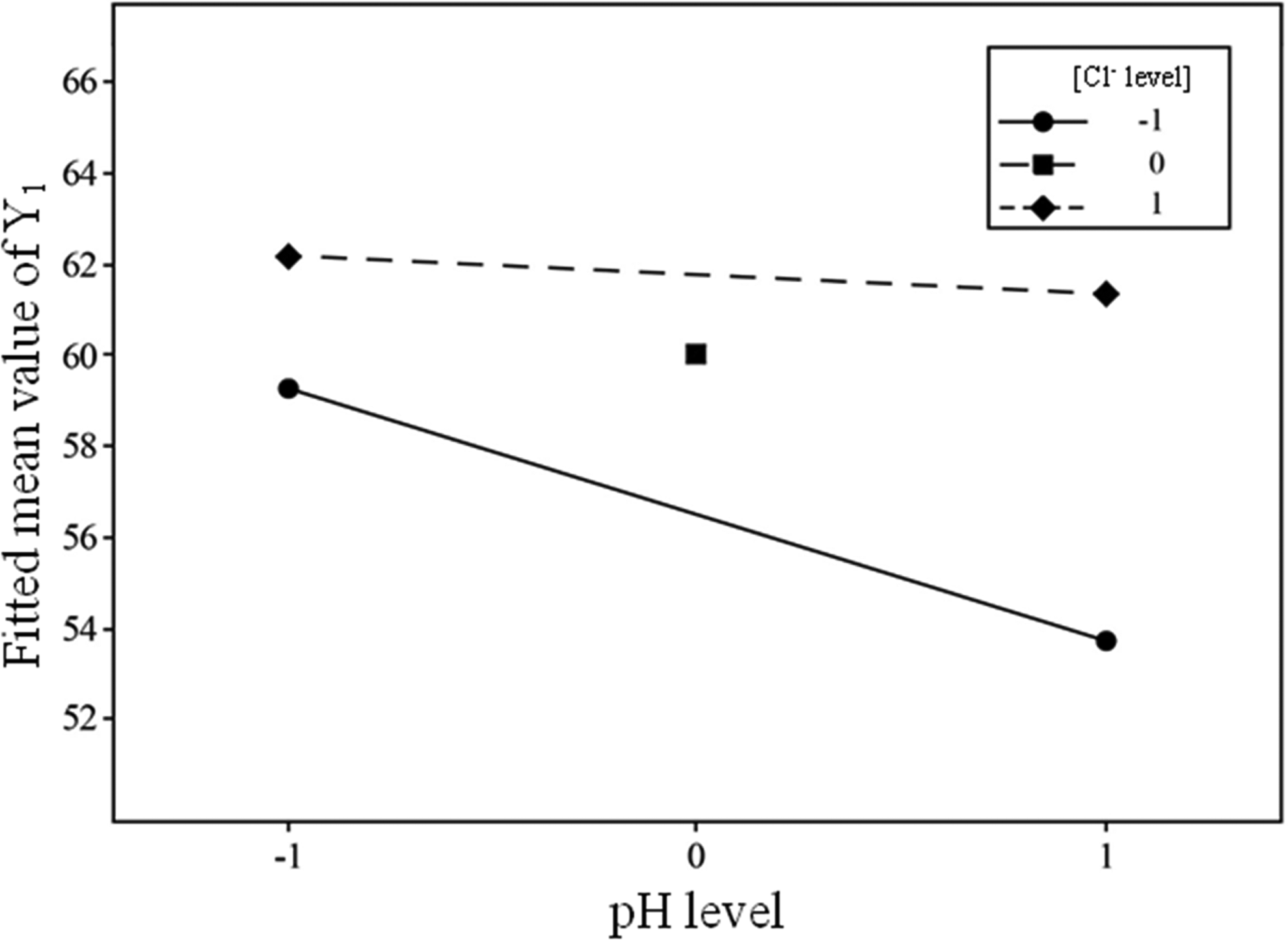
To further investigate the interaction between initial pH and chloride ion concentration, a two-factor interaction chart (Fig. 2) was plotted. In general, the change of the initial pH value is negatively correlated with the fitted mean value. When the pH value changed from a low level to high level, the fitted mean change of the COD removal rate differs for varying Cl− concentrations. According to the degree of the opening and closing of the horizontal axis (representing Cl− levels), we can conclude that when the initial pH value of leachate is higher, the influence of the Cl− concentration on the COD removal rate was more significant. The reason is that under neutral and weak acidic conditions, the concentration of Cl− has a greater influence on the production of active chlorine groups (ClO− and HClO) in the leachate.
Interaction plot for COD removal.
In terms of the removal of NH4+-N (Fig. 1b), it is observed that the electrolysis time is still the most critical factor. In addition, COD removal and chloride concentrations also have a positive effect. As mentioned above, the increase of Cl− concentration in leachate brings about the increase of HClO and ClO− production during electrolysis. This accelerates the oxidation rate of NH4+-N because NH4+-N is mainly removed by the indirect oxidation of the active chlorine/hypochlorite produced in the electrolysis process.
To further analyze the interactions between current density and Cl− concentration, we refer to the two-factor interaction plot in Fig. 3. The change of current density is negatively associated with the fitted mean for low Cl− concentrations, while the fitted mean value increases with the increase of current density for high Cl− concentrations. These results are consistent with the findings of Li et al. (2016). Comparing the different trends of the two Cl− concentration lines, it can be seen that under the condition of high current density, the effect of Cl− concentration on the degradation effect of NH4+-N in the leachate is more significant. It can thus be interpreted that in the electrolysis process, the production rate of the active chlorine groups is affected by the current density, and the production amount is affected by the Cl− concentration. Hence, at a high current density, improving Cl− concentration leads to an acceleration in the production rate of reactive chlorine and an increase in the steady-state concentration of reactive chlorine (Zhang et al., 2018).

Interaction plot for NH4+-N removal.
For the factorial design experiment, the extent of TN removal was observed to be between 50.88% and 73.45%. Figure 1c displays the normal probability plot for the elimination of TN. Electrolysis time has a positive effect on TN elimination, and although current density also shows the same trend, the generated value is relatively smaller compared to the main effect value of the remaining factors. A higher current density resulted in a more rapid removal of TN. This because increasing the current density allows for the faster generation of active chlorine and thus a higher steady-state concentration, further enhancing the indirect oxidation.
Furthermore, treatment time, chloride concentration, and current intensity strongly affected NO3−-N formation (Fig. 1d). It can be seen that prolonging the electrolysis time and increasing the current density and chloride concentration were all beneficial to the accumulation of NO3−-N. Figure 1c and d shows that under the experimental conditions, variable interactions are not obvious.
Effect of operating factors on NH4+-N oxidation products
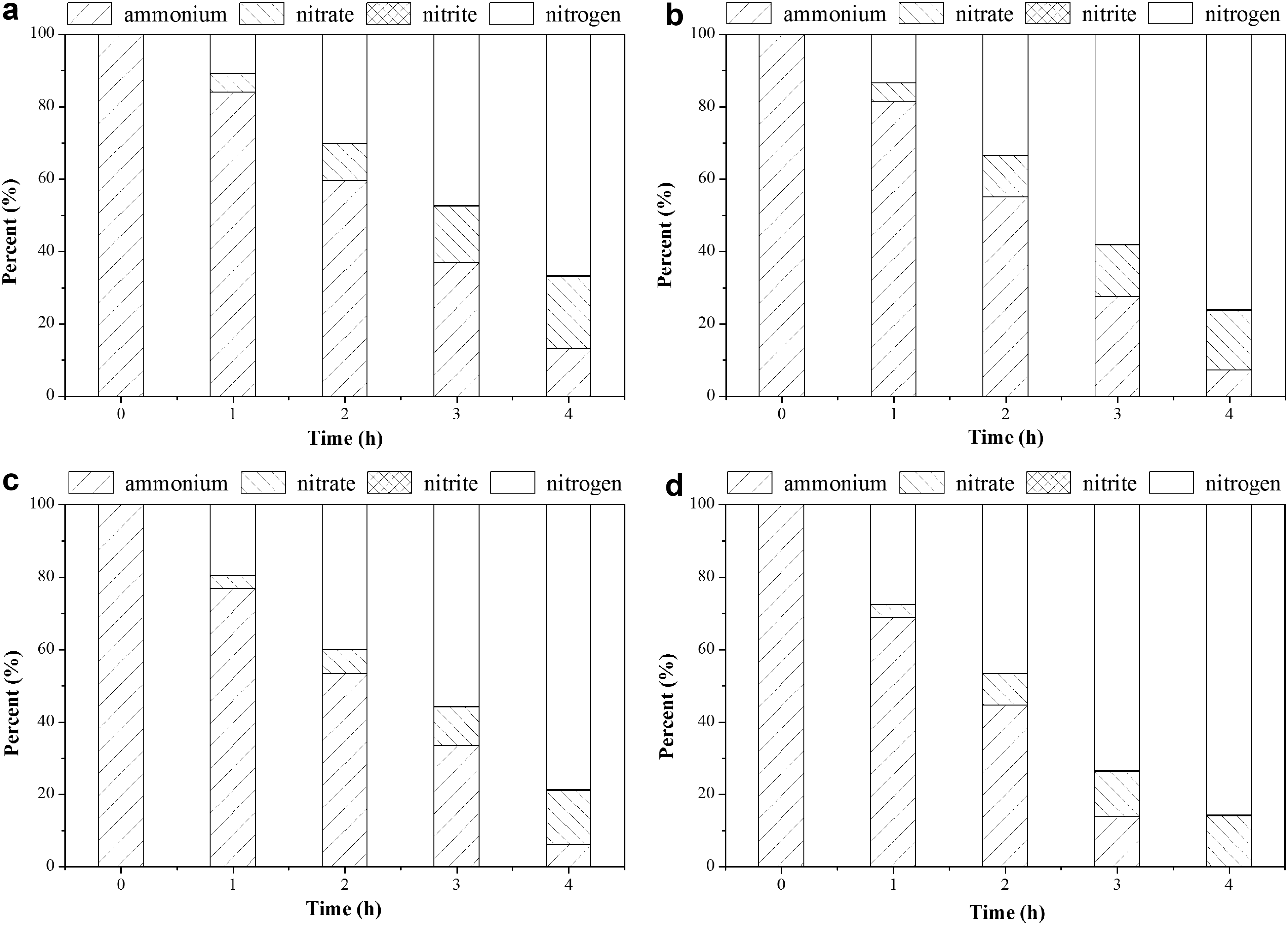
The effect of different initial pH (5, 6, 7, and 8) on the products of NH4+-N oxidation was evaluated at the current density of 90 mA/cm2, without the addition of NaCl. Figure 4 exhibits the change in the N2 species in leachate during the electrochemical treatment. The dominant ammonium oxidation product under all pH conditions was N2 gas, obtained after 4 h of electrochemical treatment. Following an increase in the initial pH value, the proportion of NH4+-N to N2 also increased simultaneously. Moreover, following 4 h of electrolysis, the ratio of NH4+-N to N2 reached 70.35% and 84.80% at the initial pH values of 5 and 8, respectively. During the oxidation reaction, a small proportion of NH4+-N was converted into NO3−-N, and the percentage of NH4+-N with NO3−-N as its oxidation product exhibited a downward trend as the pH increased. This indicates that alkaline conditions (pH = 8) were not conducive to NO3−-N accumulation. The proportion of NH4+-N converted to NO2−-N was <1% for several cases, as it was transformed into NO3−-N at a relatively slower rate. In summary, alkaline conditions were more conducive to the conversion of NH4+-N into harmless N2.
The percentage change of the NH4+-N oxidation product under different initial pH values [
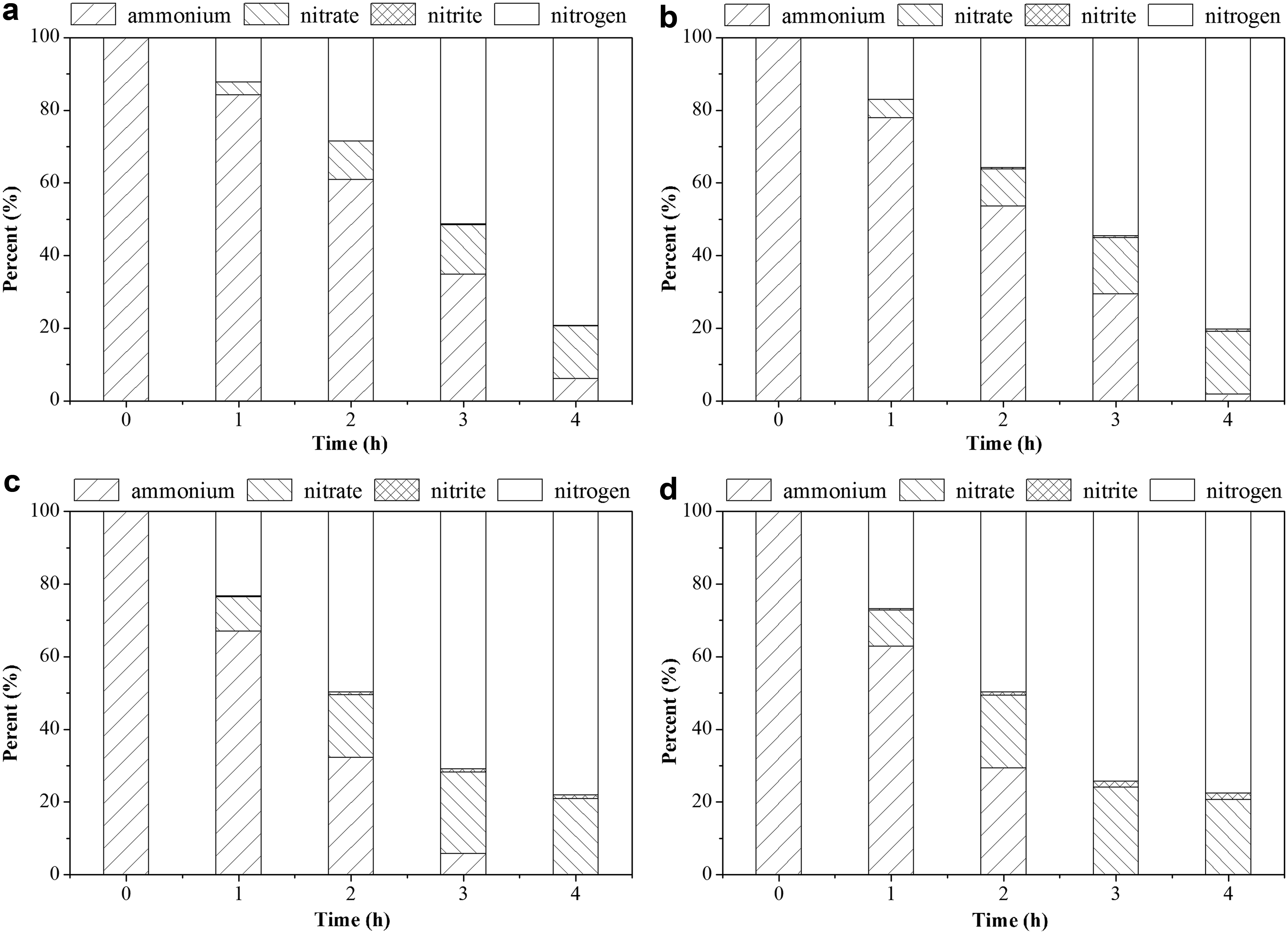
Cl− concentration plays a vital role in treating NH4+-N. Here, we evaluate its impact on the products of NH4+-N oxidation. Experiments were conducted using the raw pH value and a current density of 90 mA/cm2, with results summarized in Fig. 5. After 4 h, the percentage of the formed NO3−-N increased from 14.49% to 20.72% for chloride concentrations of 2,498 and 7,000 mg/L, respectively. This was coupled with a NO2−-N percentage increase from 0.19% to 1.74%. As shown in Fig. 5a and b, when the Cl− concentrations were set to 5,500 and 7,000 mg/L, the proportion of NH4+-N converted to NO3−-N increased in the first 3 h and subsequently declined. The decline in NO3−-N content generally occurred when NH4+-N was completely removed. As the reaction progressed, the pH value of the leachate was reduced to an acidic condition. The NO3−-N subsequently gained oxidizability under the acidic condition, further reacting with other easily oxidized organic compounds, and thus decreasing the quantity of NO3−-N (Pérez et al., 2012).
The percentage change of the NH4+-N oxidation product under different Cl− concentration [
The influence of current density on the NH4+-N conversion product maintaining the leachate properties as constant was investigated. The results are shown in Fig. 6. The influence of current density on the NH4+-N conversion is relatively significant. After 4 h of electrolysis, increasing the current density from 50 to 100 mA/cm2, resulting in the final proportion of N2 increased from 52.2% to 82.06%. Moreover, after 2 h of electrolysis, the oxidation rate of NH4+-N was slower, at a current density of 50 mA/cm2, and the removal rate of NH4+-N reached just 33.93%. Under the same treatment time, however, the NH4+-N removal rate reached 65.72% at a current density of 100 mA/cm2. Cabeza et al. (2007) also found that the ammonia removal rate increased with the current density. This can be attributed to the following reasons: (i) increasing of current density augments the formation of hydroxyl radicals and active chlorine groups on the surface of the anode; and (ii) the greater the current density, the faster the electrode surface charge transfer speed. This accelerates the diffusion velocity of the ammonia molecules on the anode surface, thereby achieving a more complete reaction of NH4+-N for the active group (Chiang et al., 1995; Pérez et al., 2012). Under the four current densities, the amount of NO3−-N produced in leachate gradually increased with the reaction time, while no significant change in the proportion of NH4+-N converted to NO2−-N was observed.
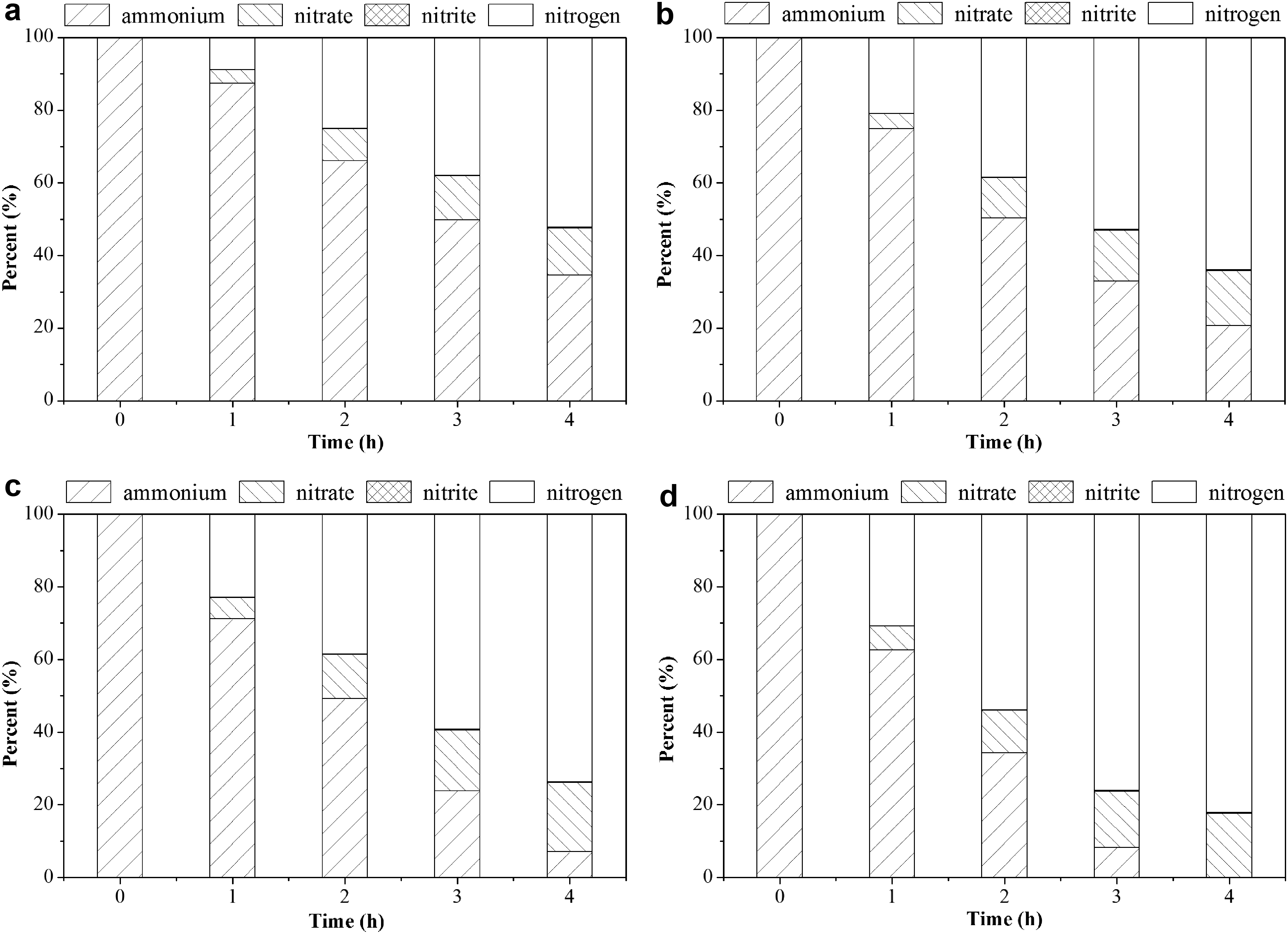
The percentage change of NH4+-N oxidation product under different current density [
Change in organics
EEM analysis
According to the fluorescence region integral (FRI) method in the literature, the fluorescence spectra can be divided into the tyrosine region (I), the tryptophan region (II), the fulvic acid region (III), the soluble microbial by-products region (IV), and the humic acid region (V) (Chen et al., 2003). Figure 7 depicts the EEM of landfill leachate during the electrolysis process under the following conditions: a current density of 100 mA/cm2, a Cl− concentration of 5,500 mg/L, and an initial pH (7.78). Fluorescence peaks of the raw landfill leachate can clearly be observed in four regions, indicating that the raw landfill leachate contained a large amount of organic fluorescent substances. The fluorescence peaks in regions I and II are associated with low-excitation tyrosine and tryptophan, respectively. The fluorescence peak in region III is mainly attributed to fulvic acids in landfill leachate. Moreover, the fluorescence peak in region IV is linked to the benzene ring protein, and high levels of tyrosine and tryptophan produced by microbial metabolisms (Chen et al., 2010). As the electrolysis proceeded, the fluorescence intensity of the five regions was significantly reduced. The total fluorescence value of each region during electrolysis is listed in Supplementary Table S1. Electrochemical oxidation resulted in a fast removal rate of organic fluorescent substances within the leachate, with the total fluorescence intensity of each region reduced by ∼90% after 1 h of electrolysis. Therefore, it can be concluded that the electrochemical oxidation technique is effective degrading organic compounds with fluorescent characteristics within the leachate.
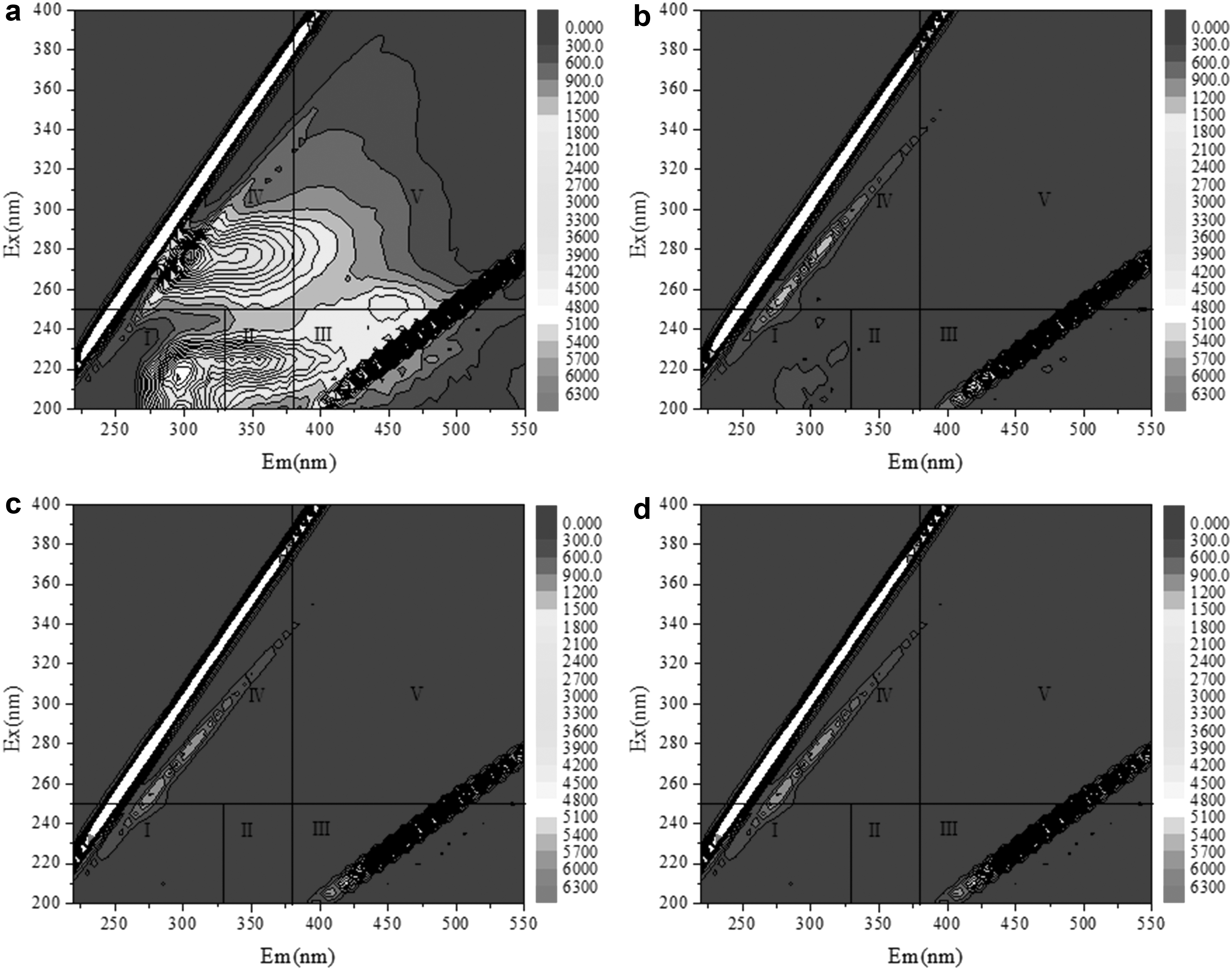
EEM of landfill leachate before and after electrochemical oxidation (a: t = 0h; b: t = 1h; c: t = 2h; d: t = 4h).
The proportion of various organic fluorescent substances was calculated using the FRI method (Chen et al., 2003), the results are shown in Table 4. After 1 h of electrolysis, the percentage of humic-like substances composed of humic acid and fulvic acid decreased from 12.85% to 8.74%. This indicates that the humic substances in the leachate were preferentially degraded, with the oxidation destroying its stable conjugated system. Moreover, the percentage of protein-like substances decreased at a later stage of the reaction, while the proportion of humic-like substances increased slightly. The reason may be that the degradation rate of humic-like substances is lower than that of protein-like substances during this reaction period.
Organic Fluorescent Substance Ratios During Electrolysis
HA, humic acid; SMP, soluble microbial by-products.
GC-MS analysis
To determine the changes of organic components in leachate during the electrochemical process, GC-MS analysis was performed on the raw landfill leachate and the water sample after 4 h of treatment (Table 5). A total of 55 organic compounds were identified in the raw landfill leachate. In particular, the content of carboxylic acids, phenols, nitriles, and amides was higher among the organic compounds. In addition, no polycyclic aromatic hydrocarbons were detected in the raw landfill leachate. This may be attributed to the following reasons: (i) the content of this substance may be too low to reach the detection limit; and (ii) the boiling points of organic materials such as anthracene and fluorene are all above 290°C, which is higher than the maximum temperature of the chromatographic column.
Gas Chromatography-Mass Spectrometry Analysis Results of Raw Landfill Leachate
After 4 h of electrochemical oxidation, a total of 38 compounds were identified in the leachate, as shown in Table 6. Compared with the raw landfill leachate, there were fewer organic contaminants in the leachate following electrochemical oxidation. In addition, the content of carboxylic acid organics (such as formic acid and acetic acid) with a simple structure significantly increased, while the relative content of phenolic compounds and saturated fatty acids (such as palmitic acid and stearic acid) fell to <0.5%. Furthermore, nitrile and amide organic compounds were not detected, indicating that the electrochemical oxidation method was able to degrade these contaminants. Organic chlorine compounds, such as 1-chloro-2-methyl-2-propanol, 1-chloro-2-propanol, and 3-chloro-butyric acid, were observed in the water samples. This implies that the active chlorine groups (HClO and ClO−) can oxidize macromolecular organics in the leachate into carbon dioxide and chlorinated organic compounds with a lower molecular weight (Lei et al., 2007).
Results of Leachate Gas Chromatography-Mass Spectrometry Analysis After Four Hours of Electrolysis
Conclusions
This study performed the electrochemical oxidation of landfill leachate using a factorial design method, with the electrolysis time, current density, initial pH value, and chloride concentration as the experimental variables. Results showed that the interaction between pH value and Cl− concentration had a significant effect on the degradation of COD in leachate. When the pH value was high, the Cl− concentration had a greater influence on the removal of COD. In addition, the removal of NH4+-N was affected by the interaction between current density and Cl− concentration. Under a high current density, the influence of Cl− concentrations on the degradation of NH4+-N in the leachate was more significant. Moreover, there were no observed significant interaction factors for the removal of TN and the formation of NO3−.
For the transformation of NH4+-N in the electrochemical oxidation process, results demonstrated that most of the NH4+-N in the leachate was converted into harmless N2. The alkaline condition was not beneficial to the accumulation of NO3−-N. However, the proportion of N2 in the oxidation products increased with pH levels. In addition, increases in Cl− concentration resulted in the percentage of NO3−-N and NO2−-N to initially increase and subsequently decrease. Moreover, the current density had an important effect on the formation of N2. The higher the current density the faster the conversion of NH4+-N to N2. Furthermore, the electrochemical oxidation process can effectively degrade the organic fluorescent substances in leachate and can oxidize the macromolecular organic compounds, including phenols, nitriles, and amides, to smaller molecules. In summary, our results demonstrate the potential of the electrochemical oxidation technique as a promising treatment for landfill leachate.
Footnotes

References
Supplementary Material
Please find the following supplemental material available below.
For Open Access articles published under a Creative Commons License, all supplemental material carries the same license as the article it is associated with.
For non-Open Access articles published, all supplemental material carries a non-exclusive license, and permission requests for re-use of supplemental material or any part of supplemental material shall be sent directly to the copyright owner as specified in the copyright notice associated with the article.
