




Abstract
As(V) adsorption mechanisms on an iron-modified montmorillonite (Fe-Mt) were studied by analysis from kinetic and equilibrium perspectives, and applicability of Fe-Mt for As(V) removal from groundwater was evaluated. Iron-modified montmorillonite was characterized by Small Angle X-Ray Scattering (SAXS), Wide Angle X-Ray Scattering (WAXS) and scanning electron microscopy technique and an excellent performance for As(V) removal, even at neutral and basic pH values and high conductivity conditions, was determined. Moreover, As(V) adsorption was higher with the increasing of ionic strength of the solution. Both Langmuir and Freundlich models provided a suitable fit to the experimental data, and the maxima adsorption capacity was 6.3 g/kg. Kinetic studies indicated that about 99% of As(V) was removed in the first 30 min of time from a starting concentration of 3 mg/L following a pseudo-second order kinetic. Formation of inner-sphere complexes of As(V) at the surface of Fe-Mt was stated by evaluation of As(V) adsorption in the presence of Cl−, NO3−, and PO43− ions and of the zeta potential versus pH curves.
Introduction
Arsenic removal from drinking water is a very important issue in many regions of Latin America, the United States, India, Bangladesh, China, Japan, and other countries. Nowadays, it is estimated that 226 million people worldwide are exposed to unsafe As concentrations in drinking water (Murcott, 2012). Its occurrence in environmental matrices is associated with natural weathering, volcanic emissions, geochemical reactions, and biological activity. Particularly, in Latin America, most of the environmental problems regarding the presence of As are due to its mobilization under natural conditions (Smedley et al., 2005; Litter et al., 2019). Moreover, mining activities, steel industry, combustion of fossil fuels, and use of arsenical pesticides create additional impacts (Apul et al., 2005; Ancelet et al., 2012; Bundschuh et al., 2012; Iriel et al., 2015a). In ground and surface waters, dissolved As is present in inorganic forms either as oxyanions or as neutral species depending on the pH and oxidative conditions (Smedley and Kinniburgh, 2002; Smedley et al., 2005).
More than 100 years ago, it was stated that long-term exposure to drinking water with As, even in lower concentrations, is responsible for several medical disorders that include dermal disorders (Kazi et al., 2009), cancer, and diabetes (Sinha et al., 2007). Several technologies that were able to remove As from aqueous matrices were proposed in the past decades, with the operational volume and the physicochemical properties of raw water together with economic aspects being the most important factors to decide about their applicability (Litter et al., 2012). Conventional large-scale As removal plants mainly use coagulation-flocculation-filtration with polyaluminum chloride or ferric oxide and reverse osmosis-based methods (Litter et al., 2012). Nevertheless, their implementation in small communities is wasteful to provide safe water due to the low population density (Bundschuh et al., 2012).
Emerging and innovative technologies that are suitable to isolated rural and periurban areas such as phytoremediation, the use of zerovalent iron, iron/copper bimetallic nanoparticles, iron-based sorbents, photochemical and geological processes, electrochemical technologies, and the use of low-cost materials as adsorbents have ultimately received more attention (Kumar et al., 2008; Litter et al., 2012; Iriel et al., 2015a, 2015b; Babaee et al., 2018; Alvarez-Cruz and Garrido-Hoyos, 2019; Sherlala et al., 2019; Wang et al., 2019; Xu et al., 2019).
Interestingly, constructed wetlands combine several mechanisms implied in As removal such as adsorption, precipitation of metal sulfide, and plant uptake (Chowdhury et al., 2008). In a critical review, the role of microbial activity, organic matter, and redox potential in the fate and transport of As in constructed wetlands was detailed (Chowdhury, 2017). Prototype wetlands planted with Cyperus haspans and Juncus effusus showed an efficiency close to 90% to remove As from the rejection of the reverse osmosis process (Corroto et al., 2019).
The efficiency of As removal strongly depends on conditions of the proceedings that can be easily adjusted in a treatment plant. Otherwise, in a level home, minimal handling is required. This constitutes the major problem considering that there is a wide range of possibilities in natural waters regarding pH, conductivity, and major ions. Consequently, removal methods that exhibit good results in a lab may be not good enough at field conditions (Bundschuh et al., 2010). The use of geological materials is an economical and sustainable alternative due to the abundance and low cost (Mohan and Pittman, 2007).
Montmorillonite (Mt) has large specific surface area, layered structure, chemical and mechanical stability, and high cation exchange capacity (CEC). It is found in large deposits around the world and has received attention in both academic and industrial research due to its promising and peculiar features such as adsorbent material, low cost, or for reinforcing polymer nanocomposites, among others (Bhattacharyya and Gupta, 2008; Zhu et al., 2016; Bee et al., 2018). Particularly, pillared and modified clay minerals are interesting materials because of their possibility of being tuneable in terms of their properties (Timofeeva et al., 2009). These materials exhibit multi-charged sites, large surface area, high interlayer space, and thermal stability (Gil et al., 2011).
Pillared materials obtained by solutions containing iron or titanium had demonstrated excellent performance in the adsorption of oxoanions of As(III) and As(V) from aqueous solutions (Lenoble et al., 2002; Li et al., 2012). Regarding modified clay minerals, obtaining it is cheaper than the pillared ones since they do not need to be heated during their synthesis.
Several studies were performed on iron-modified clays materials to evaluate their performance for As removal. Grygar et al. (2007) focused on the study of synthesis procedures to obtain information about iron species formed in these materials. These authors also evaluated their performance regarding As adsorption, concluding that the sorption capacity increases with the Fe/OH ratio during the synthesis. Luengo et al. (2011) studied the adsorption/desorption kinetics of arsenate on Fe-modified montmorillonite at several pH values, stirring rates, and As initial concentrations. Moreover, Ren et al. (2014) reported the adsorption parameters of As adsorbed onto Fe-modified montmorillonite.
Besides these previous papers, there are still questions to be addressed to understand better the applicability of these materials to remove As from natural waters. In a recent work, Bhowmick et al. (2014) presented the kinetic parameters and mechanisms for the As adsorption onto a montomorillonite-supported nanoscale zero-valent iron where the ion's competence and pH were considered. Although most of the cited articles in this work evaluate the adsorption at several pH, the maxima adsorption capacities are determined at the most favorable pH condition. Moreover, studies considering conductivity of the media are scarce. In this context, we are interested in evaluating the As(V) adsorption onto iron-modified clay minerals from a kinetic and equilibrium perspective at natural groundwater conditions and that are the principal mechanisms involved.
Materials and Methods
Reagents
All the reagents used were of analytical grade and used without further purification. A stock As(V) solution of 1,000 mg/L was prepared by dissolving 4.4570 g of the salt Na3AsO4.7H2O (Biopack) in a volume of 1 L by using milliQ water (Millipore GmbH). Working solutions were prepared by dilution to obtain As(V) concentrations ranging from 0.1 to 12 mg/L, which is the range documented for As concentration in groundwater in Latin America (Bundschuh et al., 2012; Litter et al., 2019). The salt Fe(NO3)3.9H2O (Aldrich) was used for the synthesis of the modified clay material. To adjust pH of the solutions, HNO3 (Suprapur®; Merck) and KOH solutions (Cicarelli) were utilized. The effects of the counter-ion and the ionic strength were evaluated with KNO3 (Merck), NaCl (Cicarelli), and Na3PO4.12H2O (Sigma-Aldrich).
Clay materials
Montmorillonite API number 26, Clay Spur, Wyoming, was provided by Ward's Natural Science Establishment, Inc. Mt was manually milled in an agate mortar and sieved to a particle size lesser than 125 μm. The main properties of raw material, reported in a previous work (Marco-Brown et al., 2014), are: CEC 138 meq 100 g−1 determined by the formaldehyde method (Reeve and Sumner, 1971), purity >98% determined by X-ray diffraction (XRD) (Rietveld, 1969), and isoelectric point at pH = 3.2 (diffusion potential method) (Tschapek et al., 1989). The structural chemical formula that includes the isomorphic substitutions ([(Si3.94Al0.06)(Al1.56Fe0.18Mg0.26)O10(OH)2]M+0.32) was determined from the chemical analysis following the method of Siguín et al. (1994).
Modified clay material (iron modified montmorillonite [Fe-Mt]) was prepared according to Marco-Brown et al. (2012). Briefly, a solution of Fe(III) 1 M was prepared by dissolution of the salt at room temperature with vigorous stirring and the slow addition of a solution of KOH (2 M), until reaching a molar ratio of OH−/Fe = 2. The solution was kept at room temperature for 4 h for aging. Mt was added to the Fe(III) solution to obtain an Fe/Mt ratio of 60 mmol Fe g−1 Mt. The mixture was allowed to react, stirring at room temperature for 12 h. The solid was separated by centrifugation and washed with deionized water until a conductivity value lower than 10 μS was reached.
Surface characterization of clay materials
Nitrogen adsorption
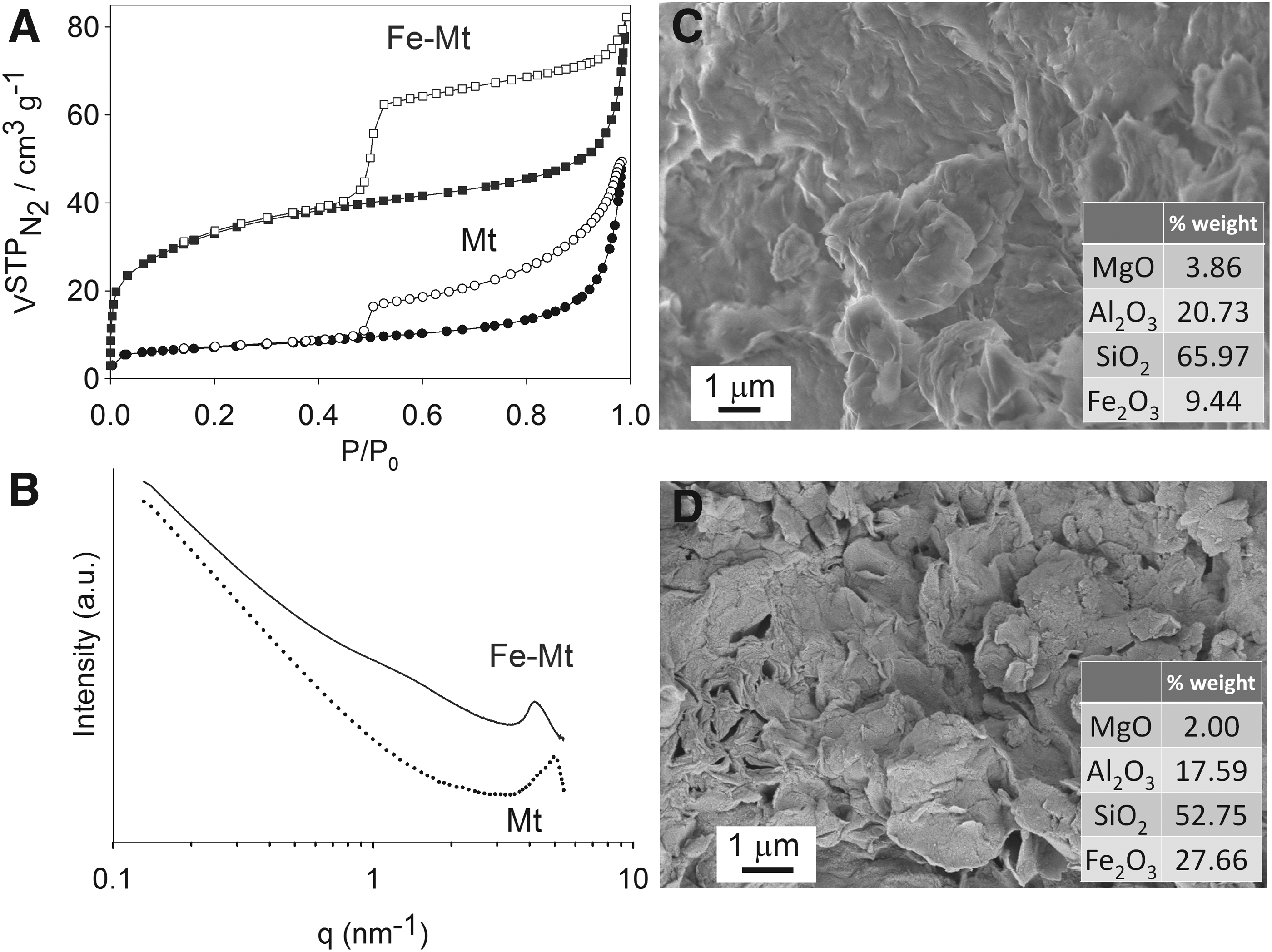
Mt and Fe-Mt samples were characterized by Small Angle X-Ray Scattering (SAXS) and Wide Angle X-Ray Scattering (WAXS) to determine changes in the interlayer spacing. Data were obtained at the D01A SAXS line workstation of the Brazilian Synchrotron Light Source (LNLS), Campinas, Brazil, by using a wavelength of 0.155 nm and a sample to detector distance of 491.334 mm. The recorded scattering vector (q) ranged from 0.25 to 5.9 nm. Measurements were made at room temperature and registered in a 2D-CCD detector (MAR-USA 165 mm).
The morphology and surface chemical analysis of Mt and Fe-Mt were determined by scanning electron microscopy (SEM) using an FEG-SEM Zeiss Supra 55vp coupled with an energy-dispersive X-ray analyzer (EDX) that provides a qualitative and semiquantitative composition of the sample surface.
The zeta potential was achieved through the measurement of electrophoretic mobility values that were converted by using the Smoluchowski equation. Fe-Mt samples with or without As(V) adsorbed were dispersed in solutions of 1, 10, and 25 mM KNO3. The pH was adjusted by adding drops of KOH or HNO3 from 2 to 11. Measurements were performed by using a dosage of 200 mg/L with Zeta Plus light-scattering zeta potential analyzer (Brookhaven Instruments Co.).
Adsorption batch experiments
Batch experiments were conducted to determine the kinetic and equilibrium parameters of the As(V) adsorption onto clay material particles. To evaluate the extension of the As adsorption regarding the solution properties, experiments were conducted at pH 4, 6, and 8; whereas the influence of the ionic strength was determined by using solutions adjusted at 1, 10, and 25 mM KNO3 (that corresponds to conductivities of 160, 1,300, and 3,300 μS, Hanna, HI 255). Experiments were also performed in the presence of NaCl and Na3PO4 electrolytes. For that, 0.25 mg of adsorbent (Mt or Fe-Mt) was dispersed in 1 × 10⁻² mM As(V) solutions with a molar ratio of 1:100 arsenic:electrolyte.
Kinetic studies were performed to evaluate the effect of the contact time on the As(V) adsorption. Thus, 300 mL of As(V) solution of 1 mg/L with 0.15 g of adsorbent (Fe-Mt) at constant pH = 8 and ionic strength of 1 mM KNO3 was mechanically stirred (300 rpm) for 24 h. During this time, several aliquots were taken and the supernatant was separated by centrifugation and filtration (cellulose nitrate membrane, 0.45 μm). Samples were acidified to 0.5% with HNO3 and stored at 4°C until the As measurement.
Equilibrium experiments were performed with As(V) working solutions with concentrations ranging from 0.1 to 12 mg/L and a dose of 0.5 g/L of adsorbent (Fe-Mt), at constant pH = 8. Dispersions were maintained on agitation at room temperature for 6 h and then As concentration was evaluated in the supernatant.
Arsenic measurements
As(V) concentration in sampled solutions was measured by Inductively coupled plasma-optical emission spectrometry (ICP-OES, Optima DV 2000; Perkin Elmer) according to the methodology reported by Iriel et al. (2015a). From these measurements, the clay mineral adsorption coverage Γ
e
for As(V) was calculated as:
where both C0 and Ce are As(V) concentration at initial and equilibrium time in the solution (mg/L), respectively; m is the clay mineral mass (g); and V is the volume of the solution (L). In adsorption kinetic experiments, Γ
t
is calculated in a similar way to Γ
e
but Ce is replaced by Ct (As(V) concentration at a given time t). As(V) removal (%) was estimated as:
Kinetic and equilibrium adsorption models
Kinetic analysis
Kinetic parameters from adsorption process have been obtained by fitting experimental data to pseudo-first order (PFO), pseudo-second order (PSO), and intra-particle diffusion model (IDM) equations (Areco et al., 2013; Haerifar and Azizian, 2013; Marco-Brown et al., 2014) and to the mixed surface reaction and diffusion-controlled adsorption kinetic model (MSR/DCK), recently proposed (Haerifar and Azizian, 2013). For further information about kinetic models used in this work, see Supplementary Data.
Equilibrium studies
Adsorption isotherms are extremely helpful for optimizing the use of adsorbent materials, because they describe the nature of the interaction between the sorbate and the adsorbent. The analysis of the experimental data is useful for the practical design and operation of adsorption systems. There are several expressions used for description of adsorption isotherms, with Langmuir and Freundlich models being the most widely applied for the interpretation of adsorption processes in a wide variety of adsorbents. For further information regarding isotherm models used in this work, see Supplementary Data.
Statistical analysis
Analysis was performed by Sigmaplot 11.0 software to determine adsorption isotherm and kinetic parameters of the cited models. Infostat® statistical software (Di Rienzo et al., 2011) was used to perform the analysis of variance and the Pearson correlations. Previously, a normal distribution for the whole data set was confirmed by using the Shapiro-Wilks modified test and variance homogeneity was proved with the Levene test.
Results and Discussion
Characterization of clay materials
All materials presented a type II nitrogen adsorption
Influence of pH and of coexisting ions
The dependence of the solution pH on the solute adsorption is mainly related to the surface functional groups of the sorbent and the charge of the species into the solution. Figure 2A showed the adsorption capacities for Mt and Fe-Mt in contact with an As(V) solution of 3 mg/L equilibrated at pH 4, 6, and 8. Results indicated that Fe-Mt had a maxima value of 5.3 g As kg−1 at pH 4, which corresponds to 90% of the initial concentration. However, a significant diminution at pH 6 was observed where the adsorption (%) was nearly 80%; whereas at pH 8, a minimal adsorption of 2.9 g As kg−1 that corresponds to the 50% was observed. From H3AsO4 acidity, constant values (pKa1: 2.28; pKa2: 6.97 and pKa3: 11.6) (Wang et al., 2017) can be estimated, proving that the predominant species are H2AsO4− at pH = 4, H2AsO4− and HAsO42− at pH = 6, and HAsO42− at pH = 8. Taking into account this feature where the As(V) removal (%) diminishes as the pH increases, it can stated that Fe-Mt exhibited an anionic adsorption profile.

Adsorption of As(V) from a 3 mg/L starting solution by Mt and Fe-Mt (clay mineral dosage of 5 mg/L)
Similar results have been reported for the adsorption of picloram (anionic herbicide) on raw clays and Fe oxides modified motmorillonite (Marco-Brown et al., 2012, 2014, 2015, 2019) and nitrate adsorption on biochars (Chintala et al., 2013). Antelo et al. (2005) reported the adsorption of arsenate on goethite varies with the ionic strength (0.1–0.01 M KNO3) and pH (4–10). They also observed that the As adsorption decreases as the pH increases. Analogous results have been reported for the adsorption of As(III) and As(V) onto variable charge soils (Xu et al., 2010). Regarding our results, it was observed that even when Fe-Mt had a better performance in acidic media, in both neutral and basic conditions, Fe-Mt possess an excellent efficiency for As(V) removal. For instance, nearly 80% and 50% of arsenate was removed at pH 6 and 8, respectively. This is a very important result that indicates that modified Fe-Mt is able to be used in natural waters without the previous acidification procedure, and, consequently, it could be implemented at a household level.
The effect of ionic strength on the As(V) adsorption process was evaluated to determine the capability of these materials to remove As(V) anions in natural waters with different salt content. Moreover, the presence of electrolytes in the media allows discerning between the specific and nonspecific nature of the binding evaluating the changes in As(V) adsorption (Partey et al., 2009). In particular, changing the background electrolyte concentration influences adsorption in at least two ways: (1) by affecting the interfacial potentials and (2) by the competition between the electrolyte anions and the anionic adsorbing species for the available sites for adsorption (Hayes et al., 1988).
Figure 2B shows a significant enhancement of As(V) adsorption as the KNO3 concentration increases, as has been indicated for anion adsorption on hydrous oxide materials (Hayes et al., 1988; Liu et al., 2008). A marked reduction of anion adsorption with increasing ionic strength suggests an outer-sphere complex formation. Otherwise, when anion adsorption is relatively unaffected by changes in ionic strength, the adsorption process could be associated with an inner-sphere complex formation. Results presented in Fig. 2B are not only indicative of an inner-sphere adsorption mechanism for arsenate onto Fe-Mt but also indicate that the use of Fe-Mt as As(V) adsorbent is appropriate in natural waters with high conductivity. The competition of As(V) adsorption (at pH 8) with other ions such as chloride (Cl−) and phosphate (PO43−) was determined in Fe-Mt samples in this study, and the results indicated that As(V) removal by Fe-Mt increased in the following order: PO43− (0.96%) < Cl− (30.64%) < NO3−(47.15%), showing a greater decrease in arsenic adsorption in the presence of phosphate. Adsorption from strong anions such as Cl−, NO3−, Br−, and ClO4− to functional groups on the surface of mineral acids occurs through outer-sphere complexation processes that are driven mainly by electrostatic forces (Essington, 2004; Marco-Brown et al., 2017b). The adsorption of phosphate on metal oxides has been reported to occur by inner-sphere complexation processes, interacting with a metal center via formation of monodentate or bidentate complexes or with two adjacent metal centers by forming a bridge complex (Higuchi and Connors, 1965; He et al., 1997; Marco-Brown et al., 2017b). Therefore, these results could indicate that As(V) adsorption onto the surface of Fe-Mt occurs by forming an inner-sphere complex. To confirm the inner-sphere complex formation, the zeta potential of Fe-Mt particle dispersions with and without adsorbed As(V) was determined at different pH values. Results are shown in Fig. 3.

Zeta potential of Fe-Mt particles as a function of pH.
Zeta potential for Fe-Mt dispersions in KNO3 solutions showed negative values in the entire range of studied pH (Fig. 3A). The distribution observed for Fe-Mt was a combination between the zeta potential observed for Mt (Marco-Brown et al., 2012) and for iron(III) (hydr)oxides (Tombácz et al., 2001). The iron incorporation in the clay mineral structure changed the surface properties by adding iron metallic centers. In addition, Fe(III) has a different acid
The iron atoms located at the Fe-Mt surface are coordinated to oxygen atoms, where they can be in several forms such as protonated (≡FeOH2+), neutral (≡FeOH), or deprotonated (≡FeO−) depending on the solution pH. At pH values lower than 4, the reaction may occur at Fe-Mt surface as is indicated in Equation (3), where the interaction of the main As(V) species at pH 4 (H2AsO4−) with surface sites occurs by forming a monodentate inner-sphere complex (≡FeOAsO3H2) and the leaving group is the hydroxyl anion. Similar reactions can be described for ≡FeOH2+ and ≡FeO− surface sites and with water and/or hydroxyl anion being the leaving groups. The monodentate complex is formed without changes in the surface charge or with an increase in the negative charge depending on the surface charge balance. Then, the surface charges of Fe-Mt with As(V) and without As(V) adsorbed had a similar result, as is observed in Fig. 3B–D. This effect was observed at the three KNO3 concentrations: 1, 10, and 25 mM.
At a pH around 6, the reactions that may occur at the Fe-Mt surface are indicated in Equations (3) and (4). The interaction of main As(V) species at pH 6 (H2AsO4− and HAsO42−) with surface sites occurs by forming a new monodentate inner-sphere complex (≡FeOAsO3H−), and the leaving groups are hydroxyls in both cases. Nevertheless, the surface charge of Fe-Mt with As(V) adsorbed is much more negative than Fe-Mt without As(V) adsorbed (Fig. 3B–D). The main reaction on the Fe-Mt surface is represented in Equation (4).
The monodentate surface complex ≡FeOAsO3H2 may suffer acid
As the pH increases, the charge difference between Fe-Mt with and without As(V) adsorbed samples is becoming smaller and the slope of the zeta potential versus pH for Fe-Mt with the As(V) adsorbed sample becomes flat. At a pH around 8, the reactions that may occur at the Fe-Mt surface are indicated in Equations (4) and (6). The interaction of the main As(V) species at pH 8 (HAsO42−) with surface sites may occur by forming a monodentate [Eq. (4)] and/or bidentate [Eq. (6)] inner-sphere complexes, and the leaving groups are hydroxyls in both cases. Nevertheless, the surface charge of Fe-Mt with As(V) adsorbed is similar compared with Fe-Mt without As(V) adsorbed (Fig. 3B–D), demonstrating that the main reaction occurred at the Fe-Mt surface at pH 8, as indicated in Equation (6).
In Fig. 3C (insets), the main As(V) surface complexes species at different pH domains were schematized. These results provide indirect and conclusive evidence about the formation of surface complexes between the surface of the Fe-Mt particles and As(V), confirming an inner-sphere complex formation.
Adsorption kinetics
Due to the low quantity of As(V) adsorbed onto Mt (lower than 5%), kinetics and adsorption parameters were determined by using only Fe-Mt as adsorbent. Kinetic experiments were performed while evaluating the As(V) concentration from the solution as a function of time. Surface coverage of As(V) on Fe-Mt was calculated by using Equation (1) and plotted according to PFO, PSO, IDM, and MSR/DCK models (Supplementary Data), as is shown in Fig. 4. The first fitting indicated that the Lagergren model did not fit the experimental data due to R2 being lower than 0.01 (Fig. 4A). Regarding the PSO model, an excellent agreement was observed over the entire range of time (Fig. 4B). In addition, the plot of qt versus t1/2 for As(V) adsorption on Fe-Mt is shown in Fig. 4C. The diffusion kinetic plots exhibited the three-stage linearity, which indicates that two or more steps occur in the adsorption processes (Peng et al., 2016; Marco-Brown et al., 2017a, 2018). The first portion (corresponding to initial times) had been related to high adsorption rate on the external surface of the adsorbent, which has enough available adsorption sites. Afterward, the adsorption rate diminishes due to the difficulty in As(V) reaching the adsorption sites in the inner pores of Fe-Mt, where the intra-particle diffusion is the rate-controlling step. The kid and C constant values were obtained from the slope and intercept from the linear regression of the second portion (intermediate times) of the curve, respectively (Doěan et al., 2009). In addition, the curve did not pass through the origin, which indicates that diffusion through the pores is not the limiting factor (Guo et al., 2014). The C value [Eq. (S3), Supplementary Data] reflects the boundary layer effect. The larger the intercept of the plot, the greater the contribution of the surface sorption in the rate-limiting step. Finally, the third portion is the final equilibrium stage, where the intra-particle diffusion starts to slow down due to the low As(V) concentration in solution (Sun and Yang, 2003). Hence, the three-stage linearity of intra-particle diffusion plots confirmed the presence of both surface adsorption and intra-particle diffusion (Guo et al., 2014) as was proposed by PSO modeling. Thus, the adsorption process has a complicated nature involving both surface adsorption and intra-particle diffusion (Doěan et al., 2009). In conclusion, the adsorption of As(V) on Fe-Mt involved a two-step mechanism, a rapid one occurring on the external surface followed by a slower process that occurs on the pores by interlayer diffusion as was previously reported (Luengo et al., 2011).
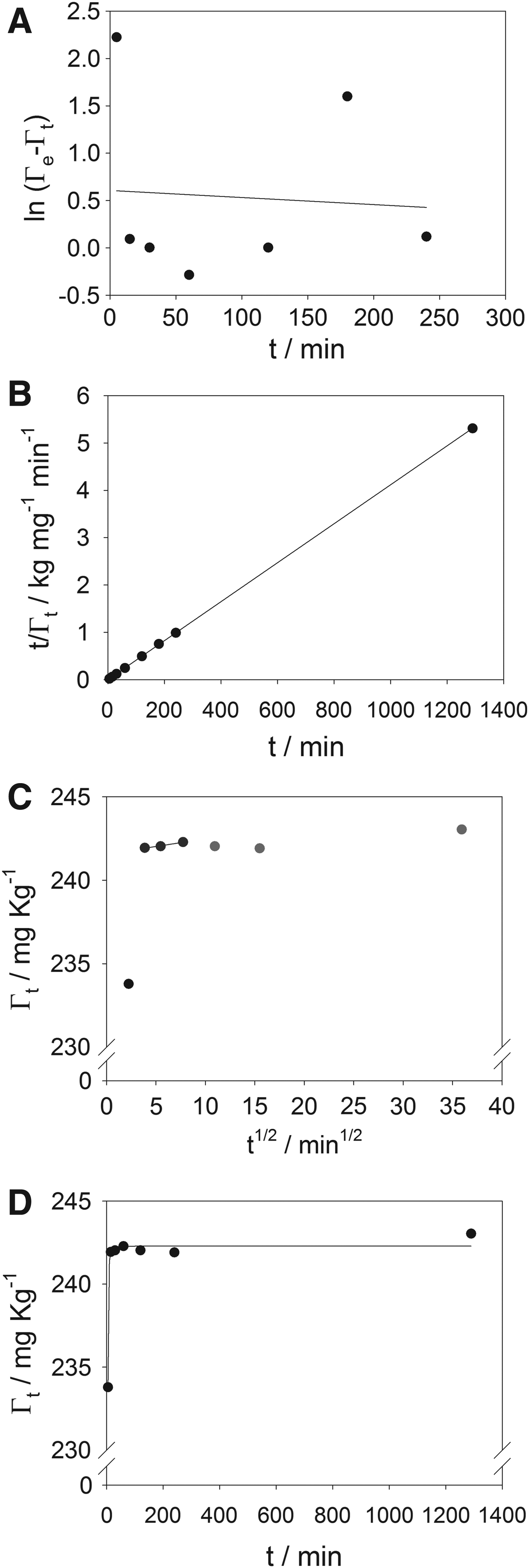
Fitting of experimental data of As(V) adsorption onto Fe-Mt at As(V) initial concentration 3 mg/L, solid dosage 0.5 g/L, pH 8, and ionic strength 1 mM KNO3.
Haerifar and Azizian (2013) have proposed a new model that can be used when diffusion and surface reaction control the overall rate of the process at the solid/solution interface. In these cases, the mixed surface reaction and diffusion-controlled kinetic model can be applied, where the surface coverage as a function of time is modeled according to Equation (S4) (Supplementary Data) (Fig. 4D). The obtained value of τ is >0, which means the presence of diffusion in conjunction with surface reaction. A μeq value near to 1 indicated that As(V) was completely removed from the solution by Fe-Mt. Further, the good correlation of the MSR/DCK model with the experimental data is indicated by the high value of R2 and the Γ e value of 242.28 mg/kg. Also, the τ value confirms the previous results obtained by IDM adjustment, indicating that As(V) adsorption on Fe-Mt occurs through both surface adsorption and intra-particle diffusion processes. Kinetic parameters derived from the evaluated models are presented in Table 1.
Parameters Obtained for Kinetic Models for As(V) Adsorption onto Fe-Mt
Fe-Mt, iron-modified montmorillonite; IDM, intra-particle diffusion model; MSR/DCK, mixed surface reaction and diffusion-controlled kinetic model; PFO, pseudo-first order; PSO, pseudo-second order.
Adsorption isotherm models
Equilibrium studies were performed to determine the adsorption mechanism of As(V) on Fe-Mt and the adsorption maxima capacity of the synthesized material. For that, batch Fe-Mt dispersions with As(V) concentrations ranging from 0.1 to 12 mg/L were equilibrated at pH 8 and the ionic strength was set at 1 mM KNO3. The ratio between the quantity of As(V) adsorbed onto the Fe-Mt particles and the remaining into the solution was fitted to the Freundlich and Langmuir models (Supplementary Data).
From Fig. 5, it is observed that either the Langmuir or Freundlich equations [Eqs. (S5) and (S6), Supplementary Data] are applicable to adsorption experimental data. In the first model, the affinity between sorbent and sorbate is represented by the constant KL. In general, for good sorbents high Γmax and high KL are desirable. The KL for As(V) sorption on Fe-Mt expressed as L/mg was 0.966 (Table 2). The same behavior was observed for the adsorption of As(V) onto zero-valent ions on Mt, where a KL value of 0.005 L/mg was reported (Bhowmick et al., 2014). Moreover, the Γmax for As(V) obtained from the Langmuir model (6.28 g/kg) is near to the experimental one. In addition, both are within the range reported earlier for As(V) adsorption on iron clay material: 4 g/kg (Lenoble et al., 2002) and 7.6 g/kg (Luengo et al., 2011) at more acidic pH values.
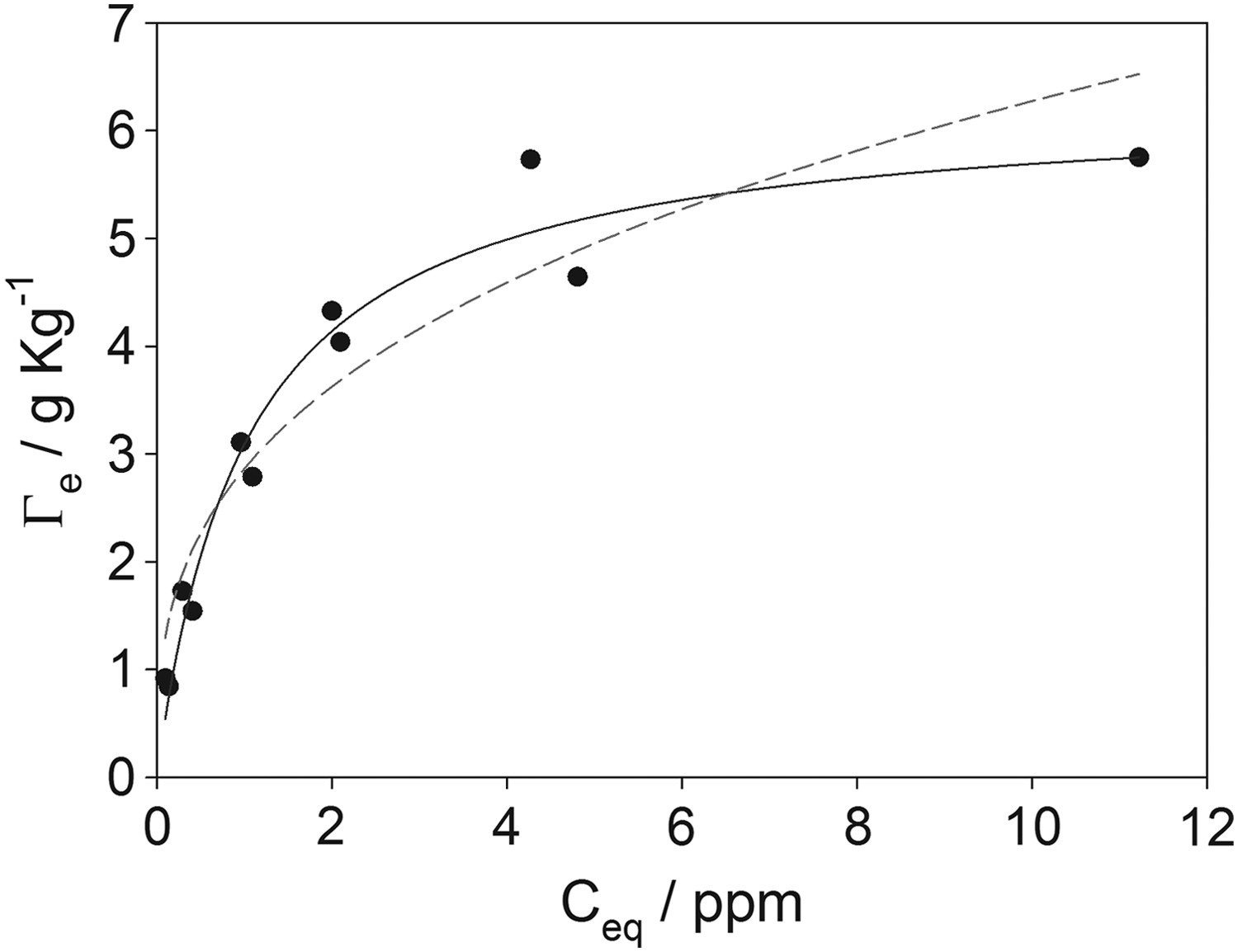
As(V) adsorption isotherms on iron-modified clay material at Fe-Mt dosage 0.5 g/L, pH 8, and ionic strength 1 mM KNO3. Solid and dashed lines were obtained by using Langmuir and Freundlich models, respectively.
Langmuir and Freundlich Parameters for As(V) Adsorption on Fe-Mt at Solid Dosage 0.5 g/L, pH 8, and Ionic Strength 1 mM KNO3
The Fe-Mt performance to remove As(V) was compared with that of other clay minerals in Table 3.
Comparison of Adsorption Capacities Reported in the Literature for As(V) on Modified Clays
From Table 3, it should be noticed that the synthetic routes of mineral materials affect the performance with regard to As removal. This is a very important issue to be considered due to the cost of the modified material being associated with the synthesis procedures. In addition, it is observed that the final Fe content needs to be optimized. Regarding their implementation at a domiciliary level, it is necessary to provide data according to the natural conditions of pH and conductivity to assure their applicability to achieve safe As concentration for drinking water.
The study of low-cost adsorbents for As(V) removal has a promising future in the development of technologies aimed at mitigating the problem of As in drinking water in periurban or isolated rural areas lacking centralized water supplies. Adsorption-based methods of treatment could be applied along or in combination with oxidation
Conclusions
Montmorillonite was modified in this work with the intercalation of iron oligomers, and it is proposed as an adsorbent material for As(V) removal from groundwater in small-scale processes. Fe-Mt was synthesized through a low-cost method, and its As(V) adsorption capacity was evaluated by varying parameters such as pH or ionic strength.
The iron modification process of montmorillonite led to a basal space expansion as well as a BET surface value and microporosity increment of the material with respect to raw montmorillonite. Moreover, a modification of active surface sites occurred with the deposition of iron oxides. Structure and surface site modification led to Fe-Mt possessing an extraordinary removal power of As(V) from contaminated water with respect to raw montmorillonite and other adsorbents.
The arsenic adsorption capacity of Fe-Mt had a strong dependence on the physicochemical properties of solutions. Particularly, adsorption capacity was higher at low pH values; nevertheless, good performance was observed at neutral pH values. Regarding ionic strength, adsorption capacity increases with KNO3 concentration. This result suggested that Fe-Mt could be appropriate for use in As(V) removal processes without previous treatment.
Equilibrium adsorption data were successfully fitted to the Langmuir and Freundlich models. A maximum adsorption capacity of 6.3 g/kg and a KL value of 0.966 L/mg were determined by fitting experimental data to the Langmuir model. The time of contact necessary to reach the equilibrium condition was around 20 min. Also, it was determined that the adsorption process followed a PSO law. In addition, the suitable fitting to the IDM and MSR/DCK models indicated that not only a surface reaction controls the rate of the process but a diffusion reaction is also important.
Finally, it was stated that As(V) reacts with iron surface sites on Fe-Mt through the formation of inner-sphere complexes.
Footnotes
Author Disclosure Statement
A.I., J.L.M-B., M.A.T, and A.F.C. are members of Consejo Nacional de Investigaciones Científicas y Técnicas (CONICET). All other authors have no competing financial interests.
Funding Information
The authors gratefully acknowledge the Consejo Nacional de Investigaciones Científicas y Técnicas (CONICET) and the Agencia Nacional de Promoción Científica y Tecnológica (ANPCYT) for the financial support (PICT 2015-1260 and PICT 2015-2010).

References
Supplementary Material
Please find the following supplemental material available below.
For Open Access articles published under a Creative Commons License, all supplemental material carries the same license as the article it is associated with.
For non-Open Access articles published, all supplemental material carries a non-exclusive license, and permission requests for re-use of supplemental material or any part of supplemental material shall be sent directly to the copyright owner as specified in the copyright notice associated with the article.
