




Abstract
TiO2 nanotubes (TiNTs)/graphite-like carbon nitride (g-C3N4) nanorod (NR) photocatalyst was synthesized by the droplet evaporation method followed by annealing. The aim of this research is to implement the environmental application of nanomaterial in terms of metal-free photocatalyst to treat organic pollutants. The as-prepared samples were characterized by X-ray powder diffraction, energy-dispersive spectroscopy, X-ray photoelectron spectroscopy, scanning electron microscopy, and UV–vis diffuse reflectance spectrometry. The results reveal that g-C3N4 NRs were decorated on TiNTs. Moreover, the photocatalytic performance of TiNTs/g-C3N4 NR composite under simulated solar light was measured for phenol as a test pollutant. The results of phenol degradation showed that the photocatalytic activity of TiNTs/g-C3N4 NR composite was higher than that of as-synthesized TiNTs under simulated light. Furthermore, the photocatalytic efficiency of the TiNTs/g-C3N4 NR composite was improved due to decrease in the charge transfer resistance and efficient transfer of photogenerated electron/hole pairs. The rate of photocatalytic reaction was determined from the pseudo first-order kinetics. Photocatalytic mechanism was proposed to explain the electron/hole separation and transport over the TiNTs/g-C3N4 NRs as well as phenol degradation under simulated light irradiation.
Introduction
Water resource contamination by polluted wastewaters and groundwater is a major environmental concern. Phenols and phenolic compounds are common pollutants present in aquatic systems spawned from industrial activities, such as pharmaceuticals, pesticides, dyes, herbicides, plastics, petrochemicals, and explosives (Pigatto et al., 2013). The presence of phenol in drinking and irrigation water raises considerable health concerns for humans, animals, and plants.
The phenol has been classified by the United States Environmental Protection Agency (USEPA) as a priority pollutant (Vasudevan, 2014). Several techniques have been applied for phenol removal from the aquatic systems. Unfortunately, phenol is a resistant pollutant and is difficult to degrade with traditional techniques. Therefore, there is a need to develop effective degradation method for resistant pollutants to mineralize completely.
Titanium dioxide (TiO2) is a promising photocatalyst because of nontoxicity, good stability, low cost, and strong oxidation ability (Sato et al., 2005; Ullah et al., 2015). A large number of TiO2 morphologies have been explored and one of the most investigated morphology is aligned TiO2 nanotubes (TiNTs). These TiNTs are prepared by the electrochemical anodization ofTiO2. The widespread research interest in TiNTs is due to the unique combination of their geometry and large surface area (Chen et al., 2013; Zhou et al., 2014). Predominantly, TiNT's photoconversion efficiencies were reported to be very high due to a fast charge transfer rate and orthogonal carrier separation (Baker and Kamat, 2009; Zheng et al., 2016). However, the intrinsic limitation of TiO2 wide band gap (3.2 eV anatase and 3.0 eV for rutile) makes it active only in UV light response and causes high recombination rate of photoinduced electron/hole pairs that limits the photocatalytic performance (Li et al., 2015a; Sun et al., 2016, 2017). Therefore, numerous approaches have been applied to overcome this problem, such as surface modification, metal and nonmetal doping (Cavalcante et al., 2015; Chen et al., 2016; Madhusudanan et al., 2017; Park et al., 2017; Jiang et al., 2018; Yu et al., 2018a), and coupling with narrow band gap semiconductors (Luo et al., 2013; Mao et al., 2013; Wei et al., 2014; Liu et al., 2017; Low et al., 2017).
Metal-free graphite-like carbon nitride (denoted as g-C3N4) has received great attention because of the appropriate band gap (2.7 eV), low cost, and comparably high stability (Thomas et al., 2008; Zhang et al., 2012, 2018). g-C3N4 is used in various applications, such as hydrogen production, hydrogen storage, solar energy conversion, and wastewater purification (Ye et al., 2015; Yan et al., 2016; Faisal et al., 2018; Tan et al., 2018). Nevertheless, a practical problem with pure g-C3N4 is low quantum efficiency due to rapid photogenerated carrier's recombination, which hinder its photocatalytic performance. An equally significant aspect to limit the practical applications might be low surface area (Yu et al., 2018b). Therefore, to resolve this problem, many attempts like nonmetal doping (Lu et al., 2017), formation of heterojunction between g-C3N4 and other materials (Zhang et al., 2014b; Yang et al., 2016), and preparation of nanoporous C3N4 (Liao et al., 2012) have been carried out to improve the photocatalytic performance of g-C3N4. Moreover, textural engineering of g-C3N4 also has been employed to improve the photocatalytic activities of g-C3N4-based photocatalysts (Zhang et al., 2014a).
Various kinds of g-C3N4 nanostructures have already been studied, including g-C3N4 nanorods (NRs) (Bai et al., 2013), and g-C3N4 nanosheets (Zhang et al., 2015). Transformation of bulk g-C3N4 into NRs has been proved to be an efficient strategy to obtain larger surface area that can provide more exposed interfacial contact and improve photocatalytic activity (Li et al., 2011; Xu et al., 2014). Furthermore, coupling of g-C3N4 with TiO2 nanostructure is an acceptable strategy to improve the photocatalytic activity of TiO2 semiconductor for enhanced charge separation (Qiu et al., 2017). Thus, composing TiNTs with g-C3N4 NRs may be an appropriate method to achieve effective charge separation and enhanced photocatalytic performance. The enhanced charge carrier's separation between g-C3N4 and TiO2 provides leading role in the photodegradation of toxic organic chemicals (Zhifeng et al., 2016). The assembly of TiO2 and g-C3N4 is considered to be an efficient synthesis route to offer large surface area, promote the photonic efficiency, and high photodegradation rate of dye (Wenli et al., 2017). Several researchers have investigated the synthesis of TiO2/g-C3N4 nanostructures. Recently, Xu et al., (2016) synthesized g-C3N4 layer on aligned TiNT arrays by Chemical Vapor Deposition (CVD) approach to enhance the visible light response of TiNTs for antimicrobial applications. Likewise, Sun et al., (2017) fabricated g-C3N4 Quantum Dots (QDs)/TiO2 nanotube arrays heterojunction by facile dipping method on TiNT arrays for improved efficiency of pollutant degradation under visible light. However, there was no significant work carried out to investigate the TiNTs modified with g-C3N4 NRs for improved photocatalytic activity under simulated solar light.
In the current work, we have prepared g-C3N4 NRs fabricated onto the TiNTs by the droplet evaporation method followed by annealing. The photocatalytic efficiency of TiNTs/g-C3N4 NRs was explored by studying the phenol degradation under simulated solar light, as synthesized nanocomposite may exhibit enhanced photocatalytic activity compared with g-C3N4 NRs and TiNTs. Large specific surface area and faster charge carrier transfer kinetics may significantly restrict recombination of photoinduced electron/hole pairs and exhibit enhanced photocatalytic activity for degradation of phenol. The mechanism of the phenol degradation was determined by scavenger study and presented in detail.
Experimental
Synthesis of TiNTs
All analytical grade reagents were used without further purification. Twice-distilled water was used throughout the experiments. Commercially accessible pure titanium (Ti) plates (99.9% purity; Aldrich, Milwaukee, WI) of 10 mm3 × 10 mm3 × 1 mm3 size were used as substrates. The Ti substrates were cleaned by the double distilled water. To eliminate any residual pollutants from Ti surface, the samples were rinsed ultrasonically in acetone and ethanol, respectively, for certain period of time and then dried. The dried Ti substrates were anodized in a two-electrode electrochemical cell connected to a DC power supply (GW Instek; GPR-30H10D) for 2 h at controlled voltage of 40 V in fluorine-containing ethylene electrolyte at room temperature. The Ti plate and Pt plate were used as working electrode and counter electrode, respectively. Both were immersed in ethylene glycol solution containing 0.5 wt.% NH4F and 10 wt.% volume of H2O. The prepared TiNTs were rinsed with a large amount of deionized water to remove precipitation at the top of the TiNTs and dried in an N2 stream. The rinsed samples were then annealed in air at 500°C for 3 h with a heating/cooling rate of 2°C/min to induce crystallinity.
Preparation of g-C3N4 and g-C3N4 NRs
g-C3N4 was synthesized by thermal treatment of urea. Typically, 10 g of urea was placed in a crucible with a cover under ambient pressure in air. Urea was first dried at 80°C and then was heated to 550°C for 3 h in muffle furnace to complete the reaction. The obtained yellow-colored product was washed with nitric acid (0.1 mol/L) and distilled water to remove any residual alkaline species (e.g., ammonia) adsorbed on the sample surface and then was dried at 80°C for 24 h. This g-C3N4 was used without any further treatment. A certain amount of as-prepared g-C3N4 was dispersed in 50 mL of de-ionized (DI) water under continuous stirring overnight. The aqueous solution was then transferred to 100 mL Teflon-lined autoclave that was sealed and kept at 160°C for 24 h further cooled naturally at room temperature to obtain g-C3N4 NRs.
Synthesis of TiNTs/g-C3N4 NR composites
TiNTs/g-C3N4 NR composites were obtained by the droplet evaporation method (Xie et al., 2013) followed by annealing. As obtained, g-C3N4 NRs were centrifugated (5,000 rpm for 15 min) and the pellet was removed to obtain the clear solution. The obtained solution was then poured onto the TiNTs as a droplet and placed in the oven at 60°C for 15 min. This process was repeatedly performed five times. After that, samples were placed in a muffle furnace and annealed at 200°C for 2 h under N2 stream.
Characterization
The morphologies and structures of the as-prepared samples were examined by the field emission scanning electron microscopy (SEM; Hitachi SU-8010, Japan). X-ray powder diffraction (XRD) was characterized at 40 kV and 200 mA (XRD, M21X; MAC Science Ltd., Japan) Cu K 1 (λ = 0.15418 nm) radiation to investigate phase structure. X-ray photoelectron spectra (XPS) experiments were carried out on a XPS, K-Alpha 1063 (Thermo Fisher Scientific, England) with Al Kα radiation. UV–vis diffuse reflectance spectra (DRS) were performed on a carry 300 spectrophotometer.
Evaluation of the photocatalytic activity
Phenol degradation under simulated solar light irradiation was performed in a quartz glass reactor to examine the photocatalytic activity of the as-prepared samples. The light source was 500 W Xenon arc lamp with 100 mW/cm photon flux (CHF-XQ-500 W; Beijing Changtuo Co., Ltd.). The degraded pollutants were 100 mL phenol with the initial concentration of 5 mg/L in a beaker placed in the dark to establish desorption/adsorption equilibrium. Then photocatalyst samples were vertically placed in a quartz beaker containing phenol. The distance between the light source and the suspension was about 13 cm. The temperature of the aqueous phase during irradiation was kept at 22 ± 1°C using a water bath. During photocatalysis reaction, samples were collected at 10-min intervals and concentration of phenol in solution was detected by UV–vis spectrophotometer (Carry 300) at λmax = 270 nm. Active species trapping experiment was carried out using tert-butanol (TBA), triethanolamine (TEOA), and 1,4-benzoquinone (BQ) to quench the hydroxyl radicals (•OH), holes (h+), and superoxide radicals (•O2−), respectively, under the same reaction condition of photocatalytic activity test with TiNTs/g-C3N4 NRs. Moreover, the concentration of scavengers in addition were 10 mM, and the main active species was identified.
Results and Discussion
Crystal structures
The XRD patterns of TiNTs, g-C3N4 NRs, and TiNTs/g-C3N4 NRs are shown in Fig. 1. It is obvious that diffraction peak at 2θ = 25.4° corresponds to (101) plane of anatase TiO2 (JCPDS 21-1272). The XRD patterns of TiNTs, g-C3N4 NRs, and TiNTs/g-C3N4 NRs are exhibited in Fig. 1. Only the diffraction peak corresponding to (101) plane of anatase TiO2 was found in the pristine TiNTs and no diffraction peaks of rutile TiO2 were observed in TiNTs. This suggests that the amorphous TiO2 completely converted to anatase TiO2 after being calcinated at 500°C. The XRD pattern of g-C3N4 NRs exhibited two distinct diffraction peaks of (001) and (002) planes at 10.4° and 27.4°, which corresponded to the interlayer structural packing and the characteristic interplanar staking peaks of aromatic systems (Chen et al., 2014), respectively. The diffraction peak at 27.4° confirmed the presence of g-C3N4. For TiNTs/g-C3N4 NR composite, all the diffraction peaks could be well indexed to g-C3N4 and anatase TiO2.
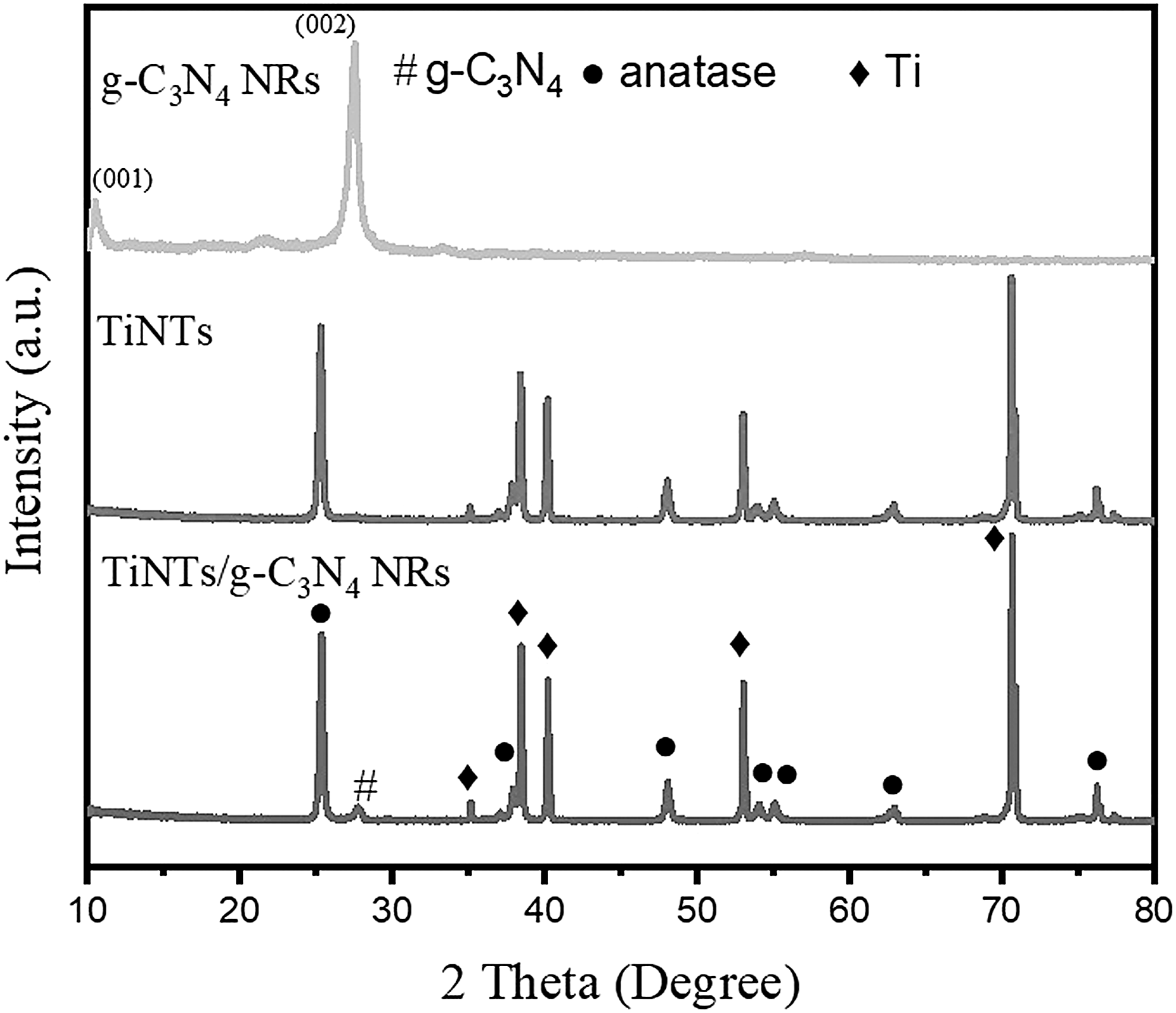
X-ray powder diffraction patterns of g-C3N4 NR, TiNT, and TiNTs/g-C3N4 NR composites. g-C3N4, graphite-like carbon nitride; NR, nanorod; TiNT, TiO2 nanotube.
Morphology characterizations
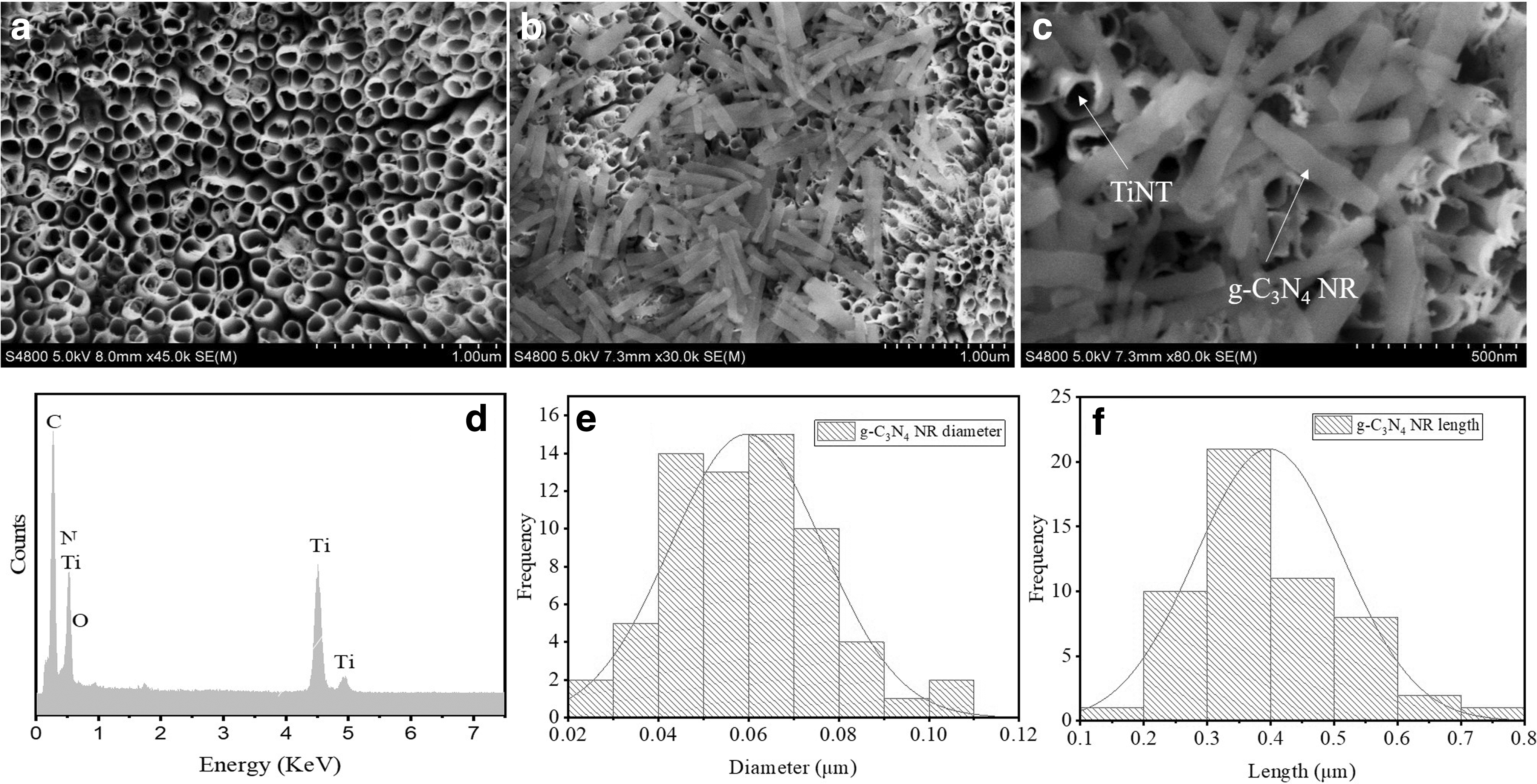
Morphology of as-prepared samples and size distribution of g-C3N4 NRs were investigated and illustrated in Fig. 2. The unmodified TiNTs grown on Ti substrate were 100–120 nm in pore size, and 10 nm in wall thickness, well ordered, and uniform (Fig. 2a). The SEM images in Fig. 2b and c clearly shows that after the droplet evaporation followed by annealing process, surface of the TiNTs was covered with g-C3N4 NRs. This unique structure may suppress charge recombination and provide a pathway for increased charge separation. Notably, not all the TiNT's surface covered g-C3N4 NRs and would not block all the pores of TiNTs that facilitate electron transfer between TiNTs and g-C3N4 NRs. Furthermore energy-dispersive X-ray spectrum (energy-dispersive spectroscopy [EDS]) analysis was performed to investigate the composition. The results of EDS (Fig. 2d) confirmed that the photocatalyst is composed of C, N, O, and Ti elements. The diameter and length of g-C3N4 NRs were calculated and demonstrated in Fig. 2e, f. The g-C3N4 NRs with 58 nm in diameter and 320 nm in length formed into the surface of TiNTs. The SEM and EDS results confirm that the g-C3N4 NRs successfully deposited onto the surface of TiNTs.
XPS spectra of TiNTs/g-C3N4 NRs
XPS technique was employed to identify the chemical state and elemental composition of TiNTs/g-C3N4 NR composites. It can be inferred from Fig. 3a that the XPS survey spectrum of TiNTs/g-C3N4 NRs contain four elements of Ti, O, C, and N. Figure 2b illustrates the C 1s high-resolution spectrum. Three peaks located at 284.7, 286.3, and 288.7 eV correspond to sp2 C = C, sp2 hybridization carbon atoms bonded to three nitrogen atoms in g-C3N4 NRs and sp2 carbon atoms in the aromatic ring (Rathi et al., 2018), respectively. The N 1s spectra shown in Fig. 3c, mainly composed of three peaks centered at 398.3, 399.7, and 400.7 eV, are assigned as sp2 hybridized nitrogen (C = N–C), sp3 tertiary nitrogen (H–N–(C)3), and amino functional groups with a hydrogen atom (C–NHx) (Li et al., 2015b), respectively. The high-resolution spectrum of O 1s in Fig. 3d shows two peaks centered at 529.6 and 531.4 eV. Peak at 529.3 was assigned to O atoms in Ti–O–Ti, whereas the peak at around 531.4 eV attributed to O–H bond of water molecules (or due to Ti–O–H bond) (Xiao et al., 2018). The high-resolution Ti 2p XPS spectrum of TiNTs/g-C3N4 NRs is displayed in Fig. 3e, which was composed of two deconvoluted peaks centered 458.3 and 464.03 eV, corresponding to Ti 2p3/2 and Ti 2p1/2 (An et al., 2016), respectively. A comprehensive analysis of XPS results proved that g-C3N4 NRs successfully deposited onto the TiNTs have good accordance with SEM and XRD results.

UV–vis DRS
The absorbance properties of the as-prepared samples (TiNTs and TiNTs/g-C3N4 NRs) were measured using UV–vis diffuse reflectance spectroscopy. Figure 4a demonstrates the UV–vis DRS of the TiNTs and TiNTs/g-C3N4 NRs. TiNTs absorb light with wavelength below 390 nm, owing to the intrinsic band gap absorption of TiO2 (3.2 eV). However, a broad absorption tail appeared in the range of 400–600 nm, due to the creation of surface defect sites during thermal annealing process and light scattering by the pores of TiNTs (Zhu et al., 2009). Moreover, it can also be inferred that after g-C3N4 NRs modification on TiNTs, the absorption tail in the visible region was slightly reduced in the TiNTs/g-C3N4 NR composites. This is because of the deposition of the g-C3N4 NRs onto the TiNTs, which reduced the defect sites on the TiNT surfaces. Furthermore, the clear shift of the absorption edge by incorporation of g-C3N4 NRs onto TiNTs was not observed. This might be because of the deposited mass of g-C3N4 NRs onto TiNTs compared with the TiNT matrix, which is not sufficient to induce the clear band gap change. Likewise, light scattering by TiNTs might also be one of the possible reasons. The band gap energies of semiconductors can be estimated by Kubelka–Munk transformation αhν = A (hν − Eg) (Li et al., 2016), where α, h, ν, Eg, and A are absorption coefficient, Planck's constant, the light frequency, direct band gap, and a constant, respectively. By plotting (αhv)2 versus the photon energy hν, the bandgap energy can be determined. In Fig. 4b, it can be observed that the calculated band gap of TiNTs and TiNTs/g-C3N4 NRs were 3.1 and 2.93 eV, respectively.

Optical property of photocatalysts.
Electrochemical studies
The transient photocurrent response of the TiNTs and TiNTs/g-C3N4 NRs were also tested under simulated solar light irradiation with a light on/off circle of 60 s at a bias potential of 0.5 V versus Ag/AgCl electrode. As shown in Fig. 5, fast and steady photocurrent response was observed for each switch on and off for all of the electrodes. The photocurrent response of as-prepared samples was completely reversible. The photocurrent density of the TiNTs/g-C3N4 NR composites is almost six times higher than that of TiNTs. The improved photocurrent density can be attributed to the superior electron transportation efficiency and charge separation through the interaction between the TiNTs and g-C3N4 NRs.
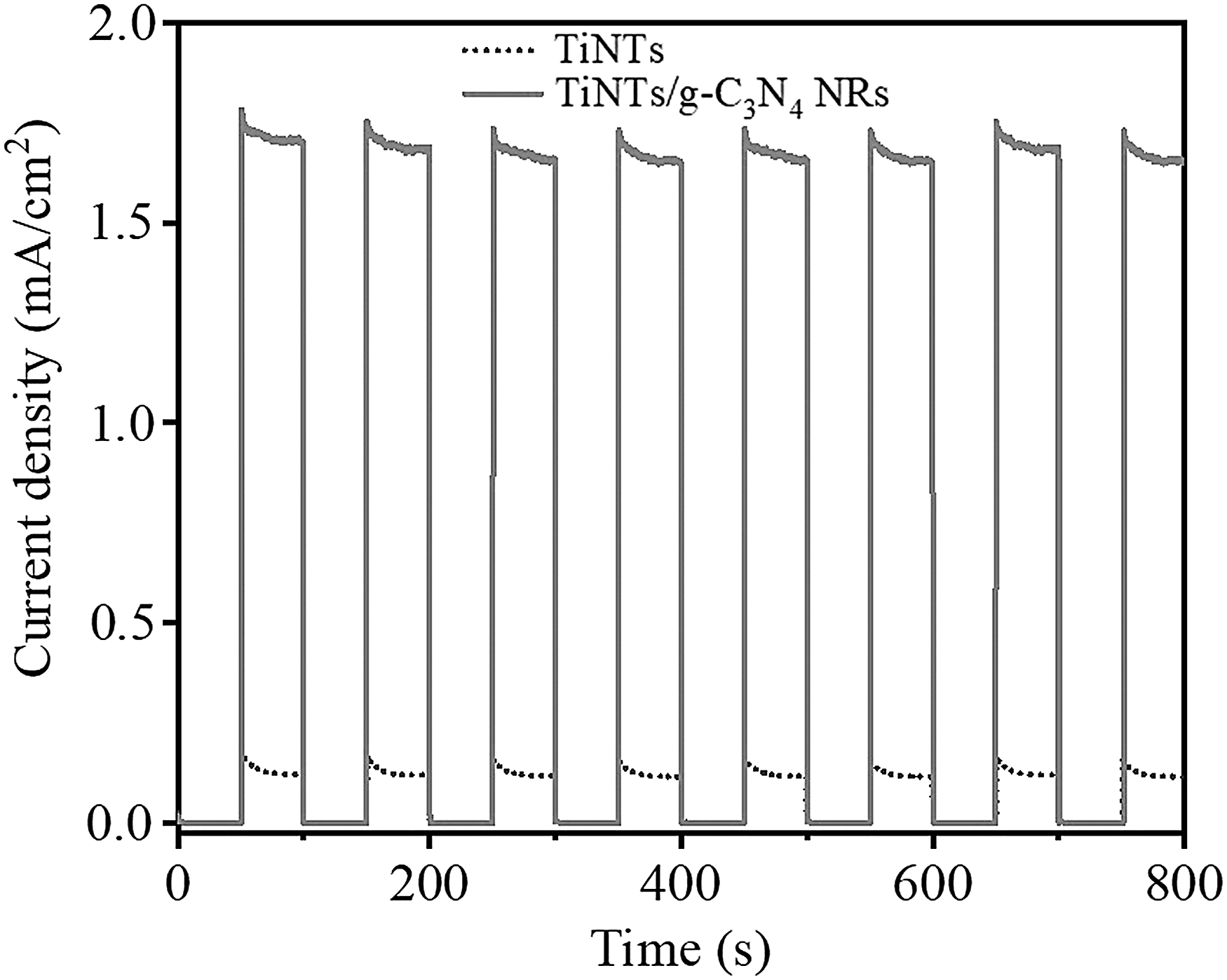
Transient photocurrents of TiNTs and TiNTs/g-C3N4 NRs.
Photocatalytic performance and analysis
To compare the photocatalytic abilities of as-prepared samples (g-C3N4 NRs, TiNTs, and TiNTs/g-C3N4 NRs), photocatalytic decomposition of phenol under simulated solar light was employed. It can be clearly seen from Fig. 6a that the control experiment without photocatalyst for phenol did not exhibit any activity. TiNT and TiNTs/g-C3N4 NR composites were tested for phenol degradation under the same experimental conditions as a control experiment (without catalyst). g-C3N4 NRs show 56% removal efficiency at 60 min, whereas TiNTs show 67% at 60 min. Both g-C3N4 NRs and TiNTs could not completely mineralize phenol due to prolonged time. As compared with both TiNTs/g-C3N4 NR composite, maximum efficiency reached nearly 100% in 60 min and phenol was completely mineralized. Furthermore, the pseudo-first-order kinetic equation was applied and can be described as ln(C0/Ct) = kt, where C0 is the initial concentration of phenol, Ct is the rest concentration of phenol at the irradiation time t, and k is the kinetic constant (Pan et al., 2012). The plots of ln(C0/Ct) against t are nearly linear, and the corresponding kinetic constants of g-C3N4 NRs, TiNTs, and TiNTs/g-C3N4 NRs are shown in Fig. 6b. According to the value of the slopes, it was 0.017 min−1, 0.022 min−1, and 0.075 min−1 for g-C3N4 NRs, TiNTs, and TiNTs/g-C3N4 NRs, respectively. The results suggest that TiNTs/g-C3N4 NR composites exhibited higher photocatalytic performance than g-C3N4 NRs, TiNTs, and TiNTs showed higher photocatalytic performance than g-C3N4 NRs. The increase in the phenol photodegradation efficiency of TiNTs/g-C3N4 NR composites could be attributed to the formation of interface between TiNTs and g-C3N4 NRs that may enhance the photocatalytic activity of the catalyst by delaying the charge recombination time. The increased surface area of the composites as relative to TiNTs could help to promote photocatalytic activity due to the availability of more active sites for adsorption of phenol molecules.

Good stability is critical for a photocatalyst to outspread its applications in practical exploitation. Therefore, the photocatalytic recycling experiments of TiNTs/g-C3N4 NRs were carried out to evaluate its reusability. It was found that TiNTs/g-C3N4 NRs exhibited effective phenol removal ability, excellent stability, and reusability of the TiNTs/g-C3N4 NR composites after five consecutive test runs as shown in Fig. 7.
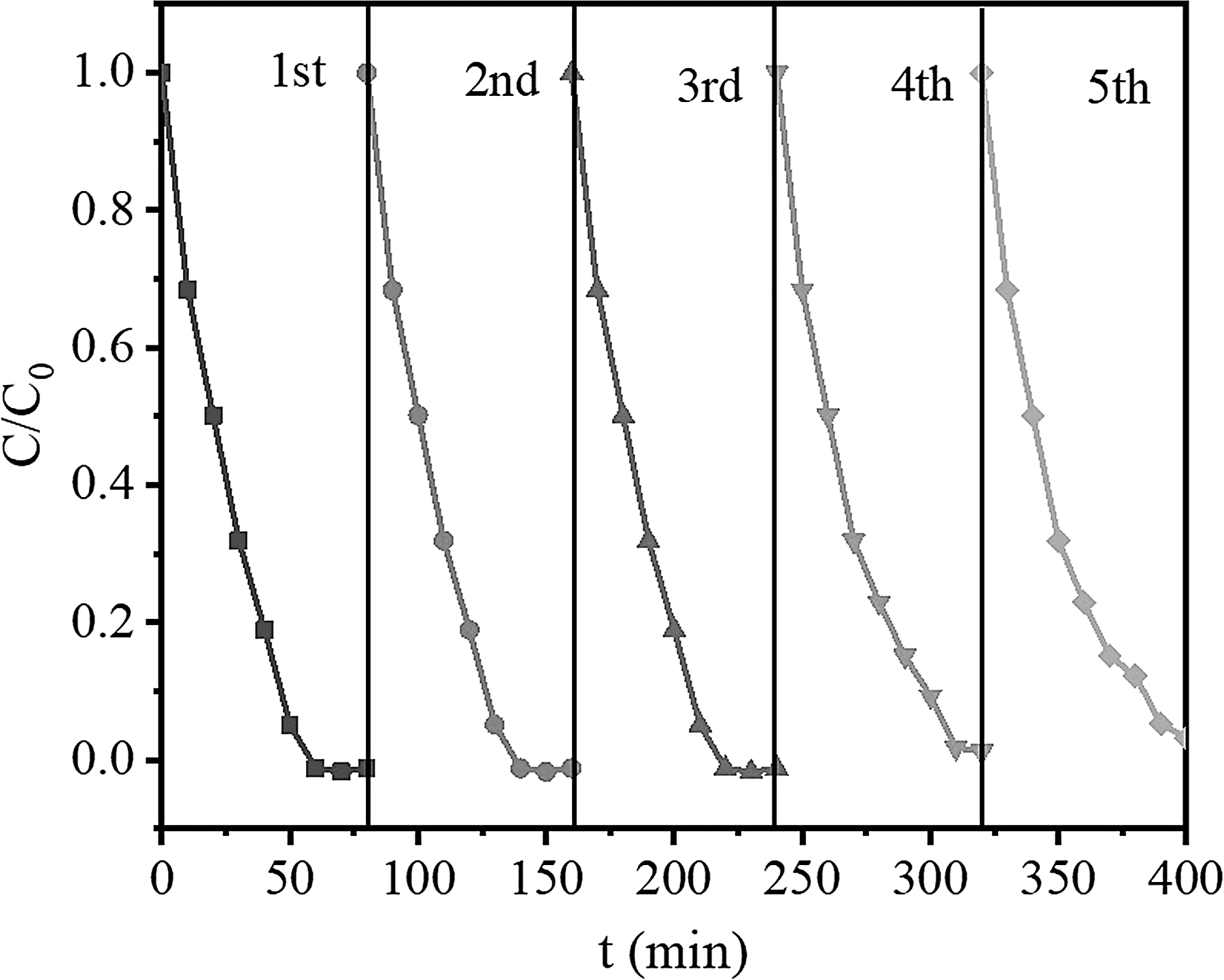
Photocatalytic stability and recyclability of TiNTs/g-C3N4 NRs.
Photocatalytic mechanism
To understand the possible photocatalytic mechanism of TiNTs/g-C3N4 NR composites for phenol degradation, a trapping experiment was carried out by adding different radical scavengers. The scavengers TBA, BQ, and TEOA were used to quench the •OH, •O2−, and h+, respectively. From Fig. 8, it can be seen that the photocatalytic performance of phenol by TiNTs/g-C3N4 NR composites decline slightly after the addition of BQ and TEOA, respectively. However, without the addition of radical scavengers, the TiNTs/g-C3N4 NR composite degradation activity of phenol does not affect after 60 min of irradiation. Furthermore, when TBA was added to the target solution much more reduction was seen as compared with BQ and TEOA. The results suggest that •O2− and h+ are the main active species in the photocatalytic oxidation process of phenol, whereas •OH contributes relatively less for the photocatalytic performance of TiNTs/g-C3N4 NR composites. For a better understanding, we also calculated k (first-order rate constant) value for the phenol degradation (Pan et al., 2012); the k values without scavenger (0.11 min−1), TBA (0.0082 min−1), TEOA (0.0075 min−1), and BQ (0.006 min−1), respectively. Further, the active species were measured by high performance liquid chromatography (HPLC) and results are presented in Fig. S1.

Effects of different scavengers on the degradation efficiency of phenol over TiNTs/g-C3N4 NRs.
According to the above experimental discussion, possible photocatalytic mechanism of the composites and the corresponding schematic diagram are proposed in Fig. 9. Effective utilization of photogenerated electrons (e−) and hole (h+) pairs determine the photodegradation efficiency of the photocatalyst toward photocatalytic decomposition of phenol. Moreover, photoexcited electron/hole pairs in g-C3N4 NRs have a fast recombination rate leading to a poor photodegradation efficiency of phenol. On the other hand, TiNTs exhibit weaker photocatalytic activity because it cannot generate electron/hole pairs due to the broader band gap (3.1 eV). The enhanced photocatalytic performance of the TiNTs/g-C3N4 NRs as compared with g-C3N4 NRs and TiNTs nanocomposites can be attributed to the significantly increased surface area of the composite, and also to the restriction of the recombination of photogenerated electron/hole pairs. g-C3N4 NRs deposited on the surface of the TiNTs, resulted in the formation of heterostructure between TiNTs and g-C3N4 NRs. As illustrated in Fig. 9, the conduction band (CB) and valance band (VB) of TiNTs are located below the CB and VB of g-C3N4 NRs, respectively. When the catalyst was exposed to simulated light irradiation, the electrons generated in the CB of g-C3N4 NRs could easily transfer to the CB of TiNTs through an intimate interface. The CB edge of g-C3N4 NRs was lower than that of TiNTs. On another hand, holes could transfer from VB of TiNTs to VB of g-C3N4 NRs. Furthermore, the accumulated electrons on the CB of TiNTs could be captured by O2 to form •O2−, because the CB potential of TiNTs is more negative than the reduction potential of O2/•O2− and •O2− effectively oxidizes organic pollutant. Meanwhile, the holes accumulated on the VB g-C3N4 NRs could directly oxidize phenol rather than react with H2O or OH− to generate •OH because the VB of g-C3N4 NRs is more negative than both of •OH/OH− and •OH/H2O (Hao et al., 2017).
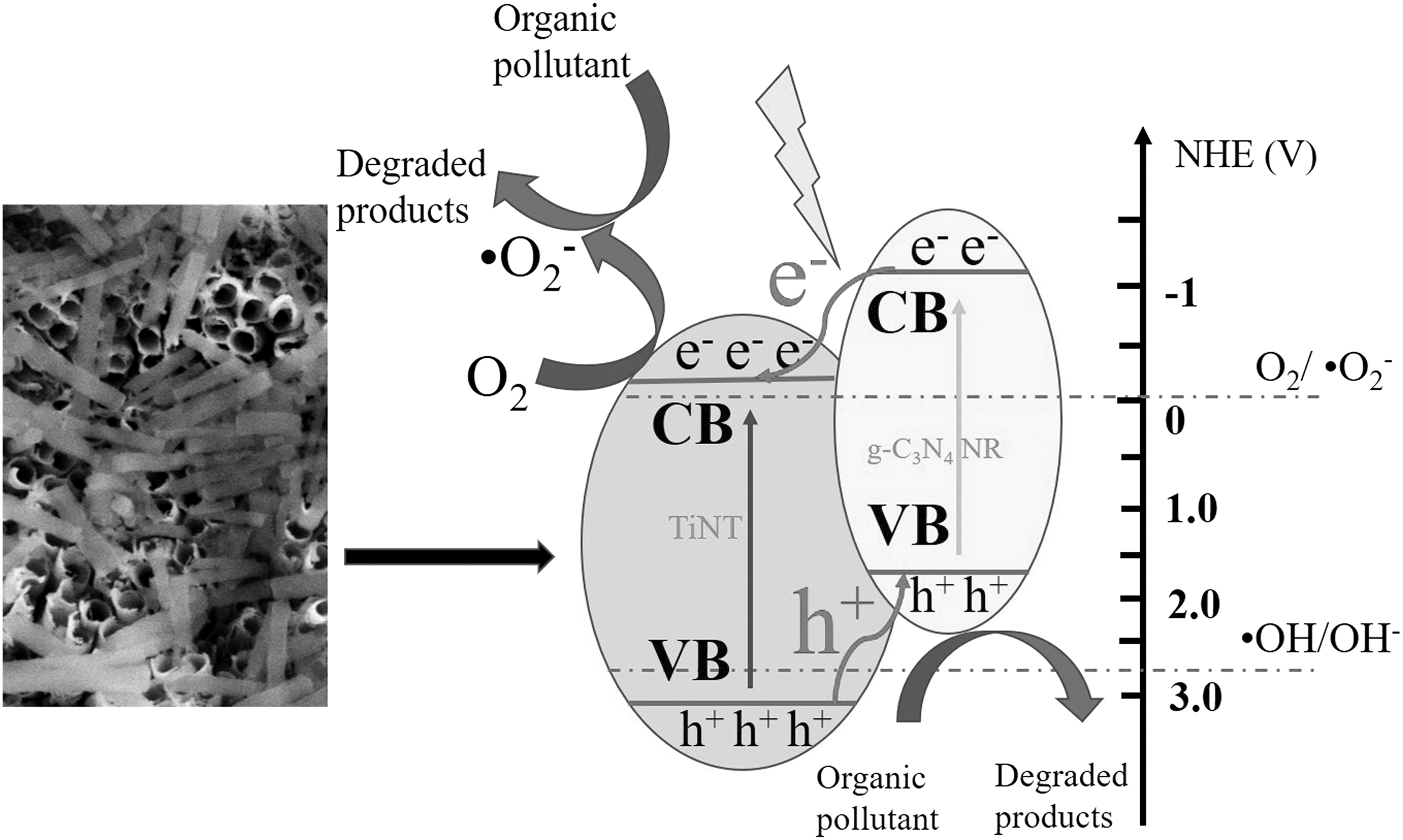
Photocatalytic reaction mechanism of TiNTs/g-C3N4 NRs for phenol degradation.
From the abovementioned analysis of the photocatalytic mechanism, the results of the trapping experiment were demonstrated considering the fact that h+ and •O2− are the most important active species during the photocatalytic degradation of phenol. Meanwhile, •OH is not the main active specie and plays a minor role in photocatalytic reaction. The rapid charge transfer and efficient charge separation explains the higher photocatalytic activity of the TiNTs/g-C3N4 NR photocatalyst.
Conclusions
In this work, droplet evaporation method was followed by annealing to fabricate TiNTs/g-C3N4 NR nanocomposites. The nanocomposites displayed excellent photocatalytic performance for phenol degradation under simulated solar light. Moreover, the TiNTs/g-C3N4 NR nanocomposites exhibited enhanced photocatalytic activity of phenol degradation as compared with unmodified samples and almost 100% phenol was eliminated in 60 min irradiation. Likewise, the photocurrent density of the nanocomposites was six times higher than unmodified TiNTs 0 V versus Ag/AgCl. The photocatalytic degradation mechanism reveals that the interface between g-C3N4 NRs and TiNTs benefits the effective separation of photogenerated carriers. Trapping experiment results for phenol degradation over the TiNTs/g-C3N4 NR photocatalyst displayed that superoxide radicals and holes play a major role in degradation activity. Furthermore, TiNTs/g-C3N4 NRs showed excellent stability and reusability toward the degradation of phenol. This photocatalyst is expected to be utilized for the organic pollutant elimination from wastewater.
Footnotes
Acknowledgment
The ideas and views expressed in this work do not represent the funding agency. The authors thank the anonymous reviewers who have helped to improve this article.
Author Disclosure Statement
No competing financial interests exist.
Funding Information
The authors acknowledge, Hunan University China and China Scholarship Council for supporting this work. This work was supported by China Postdoctoral Science Foundation (2019M652759), and the Natural Science Foundation of Hunan Province, China (Nos 2018jj3040, 2018jj3096).

References
Supplementary Material
Please find the following supplemental material available below.
For Open Access articles published under a Creative Commons License, all supplemental material carries the same license as the article it is associated with.
For non-Open Access articles published, all supplemental material carries a non-exclusive license, and permission requests for re-use of supplemental material or any part of supplemental material shall be sent directly to the copyright owner as specified in the copyright notice associated with the article.
