




Abstract
Easily separated novel magnetic composite, derived from a kind of green macroalgae—Enteromorpha prolifera, was employed for effective adsorption of radioactive cobalt (60Co) and nickel (63Ni). The characteristics and adsorption mechanisms of the magnetic E. prolifera composite (MEPE) were investigated by VSM, XRD, FT-IR, SEM, TEM, BET, and XPS. The results indicated that the saturated magnetization exceeded 4.90 emu/g. The surface area and average pore diameter of MEPE were 10.995 m2/g and 5.49 nm, respectively. The biosorbent had a good affinity to both Co(II) and Ni(II) with the maximum adsorption capacity of 135 and 137 mg/g, respectively. Coexisting nonradioactive ions, like Na+, K+, Mg2+, and Ca2+, affected the sequestration of Co and Ni to a limited degree. Compared with the single-component system, the uptake of Co(II)/Ni(II) for the binary-component adsorption decreased due to competitive adsorption. The potential mechanism of Co(II)/Ni(II) removal by MEPE was mainly electrostatic attraction and surface complex formation. Hydroxyl groups and amine groups in MEPE could be involved in the reaction and adsorption process, and the novel biosorbent MEPE could achieve rapid separation from radioactive wastewaters and effective uptake of Co(II) and Ni(II) simultaneously.
Introduction
Nuclear energy, regarded as a clean energy option, has attracted considerable attention currently. Globally, an increased number of nuclear power stations and nuclear laboratories generated large quantities of radioactive liquid waste. The treatment and disposal of radioactive waste is a major and urgent concern for sustainable development of nuclear industry (Zhang et al., 2018).
60Co is a typical radioisotope, which is a major contributor for the building up of radiation field in Pressurized Heavy Water Reactors (Zhu et al., 2014a). Due to its long half-life (t1/2 = 5.27 years), high energy (2.5MeV) of γ-ray emission, and wide application in the field of the nuclear medicine, 60Co is of vital concern (Malekpour et al., 2011; Zhu et al., 2014a; Zhang et al., 2017; Zhuang et al., 2018). Unlike heavy metals, radionuclide can produce rays, which can penetrate into the human body to form internal irradiation in the human cells, and may cause death (Zhu et al., 2014a; Mahmoud et al., 2018). High levels of cobalt may have adverse health impacts, such as diarrhea, paralysis, lung irritation, bone defects, and low blood pressure to humans (Zhang et al., 2017).
Radioactive element of 63Ni is an important product of the neutron activation in engineering materials from nuclear power plants, which is long lived (half-life of 63Ni is 100.1 year). The excessive nickel in drinking water may bring about allergic, sensitization, dermatitis, diarrhea, and anemia to humans. Chronic exposure to high concentrations of nickel may lead to cancers of lungs, nose, and bone; hepatitis; encephalopathy; and dysfunction of central nervous system (Pivarčiová et al., 2015).
Accordingly, effective decontamination of 60Co and 63Ni from wastewater has received much attention recently. Various technologies have been developed to remove radionuclides from wastewaters, including precipitation, membrane filtration, solvent extraction, adsorption/ion exchange, and so on. Among all the treatment processes as mentioned, biosorption is an alternative method with the advantages of being a convenient operation, simple process, is cheap, and is an easily available adsorbent, as well as highly efficient. At present, different kinds of biosorbents have been developed for effective removal of heavy metals and radionuclides (Chen and Wang, 2008; Abdel-Halim and Al-Deyab, 2012; Zhu et al., 2014a; Saleh et al., 2017). However, it is difficult to separate and recover the conventional biosorbents from the treated solution except by high-speed centrifugation or filter.
Therefore, in some studies, iron magnetic nanoparticles have been researched in the remediation applications owing to their high surface areas, easy separation, and recovery from medium by simply applying an external magnetic field (Song et al., 2015). However, pure magnetite nanoparticles are susceptible to agglomeration, and their practical application is controversial on account of their toxicity. Thus, the hybrid systems embedded with magnetic nanoparticles, such as magnetic cellulose-based beads (Luo et al., 2016), magnetic amine/Fe3O4 functionalized biopolymer resin (Song et al., 2016a), magnetic carbon composites (Zhu et al., 2014b), magnetic agricultural by-product-based adsorbents (Song et al., 2016b; Shang et al., 2017a), have shown tremendous potential for adsorption process owing to their rapid adsorbent separation and effective recovery by a simple magnetic process.
Enteromorpha prolifera, a kind of green macroalgae, has caused so-called “green tides” in recent years due to their large-scale blooms from the intertidal to the upper subtidal zones, which generated a serious threat to the coastal environment (Zhao et al., 2014; Zhong et al., 2018; Chen et al., 2019). The chemical constituents of E. prolifera have been studied by Zhang et al. (2010). Among them, “cholesterol” and “132-hydroxy-(132-R)-phaeophytin a” are the main monomeric compounds in E. prolifera (Supplementary Fig. S1). In our previous studies, raw E. prolifera was utilized as an adsorbent to remove cationic dye (Methylene Blue) from aqueous solution with the aim of “treating waste with waste” (Zhong et al., 2018). However, there is no study on the E. prolifera-based magnetic materials. Furthermore, there are few studies on the removal of radionuclides from wastewaters using magnetic biosorbents.
Therefore, in this work, E. prolifera was used as the raw material to prepare a new-type magnetic adsorbent, which was applied to remove radionuclides 60Co and 63Ni. First, Fe3O4 nanoparticles were embedded into Virgin E. prolifera matrix through coprecipitation technology, producing Magnetic E. prolifera composite (MEPE). In addition, the physicochemical characteristics of MEPE were observed with Vibrating Sample Magnetometer (VSM), X-ray diffraction (XRD) technique, Fourier Transform Infrared Spectroscopy (FTIR), Scanning Electron Microscope (SEM)/Transmission Electron Microscopy (TEM), Brunauer–Emmett–Teller principle (BET), and X-ray photoelectron spectrometer (XPS). The adsorption behaviors in static (batch) mode (including mono-component and binary adsorption), as well as in fixed-bed column system were investigated. The correlations between the properties and the adsorption capacity of MEPE were also studied, to understand the sorption mechanism of MEPE. Our results demonstrated that MEPE exhibited tremendous potential for effective uptake of 60Co and 63Ni and rapid separation from aqueous media simultaneously.
Materials and Methods
Materials and chemicals
E. prolifera was collected from Zhoushan, Zhejiang Province, China. It was smashed and sieved to a size range of 800 μm–1 mm.
The primary reagents used in this study, including cobalt chloride (CoCl2·6H2O), nickel nitrate [Ni(NO3)2·6H2O], ferrous sulfate (FeSO4·7H2O), ferric chloride (FeCl3·6H2O), and ammonium hydroxide (NH3·H2O, 25%), were of analytical grade (unless otherwise stated) and purchased from Tianjin Yongda Chemical Reagent Co. (Tianjin, China). Standard solutions with concentration of 1 g/L for Co (GBW08613) and Ni (GBW08618) were both provided by the National Institute of Metrology (China).
Nonradioactive CoCl2 and Ni(NO3)2 were used as the surrogate for radioactive isotopes 60Co and 63Ni for safety considerations, in that the isotopes of the same element have essentially identical chemical properties.
Synthesis and characterization of MEPE
MEPE was prepared by in situ coprecipitation method. Three grams of virgin E. prolifera was dispersed in 300 mL Fe2+/Fe3+ (0.067/0.133 M) mixed solution in a 500-mL three-neck flask. Then 25 mL NH3·H2O (25%) was added into the flask under stirring. The mixture was stirred at 70°C for 240 min to keep it as sufficient suspension. Afterward, the nano-Fe3O4 was embedded in the raw Enteromorpha. The magnetic Fe3O4-embedded Enteromorpha was collected by magnetic separation, rinsed, and dried in an oven for 4 h (103°C). The products named MEPE was obtained.
VSM (JDAW-2000D, Changchun, China) was employed to assess the magnetic property of the sample at room temperature. Crystal structure of MEPE was examined by XRD technique (D/MAX 2500, Rigaku, Japan). The patterns with Cu-Kα radiation at 40 kV and 200 mA were recorded over the 2θ range of 5–90° at a scan rate of 4°/min and a step size of 0.02° in 2θ. The functional groups in MEPE were evaluated by the FTIR (TENSOR37, Bruker, Germany) with spectrum scanned from 400 to 4,000 cm−1. The morphology of MEPE was observed by scanning electron microscopy (SEM; SIGMA300, Carl Zeiss, Germany) and transmission electron microscopy (TEM; Tecnai G2 20, FEI, America). The specific surface area and pore size distribution of MEPE were identified by nitrogen adsorption/desorption at −196°C with an automated gas sorption analyzer (KUBO-X1000, BJbuilder, China). The XPS of clean MEPE/MEPE samples after adsorption were analyzed using the spectrometer (XPS, ESCALAB 250XI; Thermo Fisher Scientific) with X-ray source of Al Ka irradiation (hv = 1,486.6 eV).
Adsorption/desorption experiments
Batch adsorption tests were performed by the traditional bottle-point method. The effects of adsorbents' dosage and initial solution pH on Co(II) or Ni(II) removal were examined in 50 mL Co(II) or Ni(II) solution. The adsorbent dosages both ranged from 0.2 g/L to 4.0 g/L. The initial pH of solution was 2.0–9.0 for Co(II) and 2.0–8.5 for Co(II), respectively. To study the kinetics of MEPE, Co(II) or Ni(II) solution was mixed with a certain amount of adsorbent at 20°C for 0–240 min, and the concentrations of Co(II) or Ni(II) at time (t) were analyzed at various intervals. The adsorption isotherms were investigated at 20°C. In addition, the effect of coexisting radiologically inactive ions on Co(II) and Ni(II) adsorption performance was evaluated, and the test solutions of Co(II) or Ni(II) were spiked with 0.001–1.0 M NaCl, KCl, MgCl2, or CaCl2 solutions.
Fixed-bed column adsorption tests were conducted in an organic glass column with inner diameter of Φ9 mm and length of 200 mm. The column was packed with 1.0 g MEPE and the bed depth was 2.5 cm. Around 10 mg/L of Co(II) or Ni(II) solution was fed through the top of the fixed bed at a constant flow rate and the empty bed contact time was controlled at 0.795 min. The effluent solution was collected from the bottom of the column at a given time interval to examine the concentration of Co(II) or Ni(II).
For binary adsorption tests, 0.05 g of MEPE was mixed with the Co(II) and Ni(II) mixture solutions (50 mL) at desired concentrations. Experiments consisted of two parts: (I) Effect on the removal of Co(II) when Ni(II) was present in the mixture solution. In this section, the initial concentration of Co(II) remained constant at 25 mg/L, whereas the concentration of Ni(II) varied from 0 to 50 mg/L. (II) Effect on the uptake of Ni(II) with Co(II) present in the mixture solution. The initial Ni(II) concentration was fixed at 25 mg/L, whereas the initial Co(II) concentration changed from 0 to 50 mg/L in this part.
The spent MEPE was desorbed by using different eluents in first run desorption tests. When the desorption equilibrium was reached, the concentration of the released Co(II) or Ni(II) ions in solution was determined. Afterward, the most appropriate regenerant was chosen for subsequent readsorption/desorption recycling tests.
Co(II) and Ni(II) liquid samples were detected by a UV-visible spectrophotometer (UV759; Shangha) at λ = 425 and 530 nm An et al., 2019; Wang et al., 2017, respectively. All the experiments were conducted in triplicate and the reproducibility of the test data was well proved.
The amount of Co and Ni loaded on the adsorbent (qt, mg/g), the removal efficiency (η, %), and the distribution coefficient (Kd, mL/g), were described by the following equations:
Where C0 (mg/L) and Ct (mg/L) are the initial concentrations and the residual concentration after adsorption, respectively. V (mL) is the solution volume, and m (g) stands for the weight of the adsorbent.
Results and Discussion
Physicochemical characteristics of MEPE
VSM and XRD of MEPE
The magnetic hysteresis loop is a characterization for the response ability of magnetic materials (Song et al., 2016b). As shown in Fig. 1a, the magnetization saturation of MEPE exceeded 4.90 emu/g, indicating that MEPE has magnetic properties. Moreover, the adsorbent could be separated effectively from aqueous solution and collected within less than 10 s by applying an external magnet.

The crystal structure of virgin E. prolifera, MEPE, and pure Fe3O4 nanoparticles are illustrated in Fig. 1b. The peaks in virgin E. prolifera corresponded to mineral salts (such as sodium chloride, magnesium chloride) acquired from seawater. After modification and magnetization, The XRD patterns of MEPE exhibited that the sharp peaks disappeared, due to the removal of salts (Gao et al., 2014). For XRD pattern of pure Fe3O4, six characteristic peaks occurred at 30.1°, 35.5°, 43.1°, 53.5°, 57.1°, and 62.7°, corresponding to the (2 2 0), (3 1 1), (4 0 0), (4 2 2), (5 1 1), and (4 4 0) crystal planes (Zhu et al., 2011; Anirudhan et al., 2014; Song et al., 2015, 2016a). Compared with virgin E. prolifera, new peaks of 35.5° were assigned to (3 1 1) crystal plane of loaded Fe3O4 on MEPE. It indicated that the Fe3O4 phase was introduced into the E. prolifera.
FT-IR and XPS of MEPE
FT-IR spectra of virgin E. prolifera, MEPE, and pure Fe3O4 nanoparticles are shown in Supplementary Fig. S2. For the spectrum of raw E. prolifera, there was a broad and strong band located at 3,398 cm−1, which was assigned to the overlapping of O-H and N-H stretching vibrations originating from cellulose, carbohydrates, and protein (Gao et al., 2014; Song et al., 2015, 2016b; Zhong et al., 2018).Other three characteristic peaks of virgin E. prolifera, which represented the stretching vibrations of C = O, deformation vibration of methyl (−CH3), stretching vibration of C-O, were around 1,655, 1,385, 1,035 cm−1 (Jmel et al., 2016; Zhao et al., 2016; Yu et al., 2017). In the spectrum of pure Fe3O4 nanoparticles, the strong characteristic peak at 605 cm−1 corresponded to Fe-O vibrations (Shang et al., 2017a). After coprecipitation reaction, the new peak at 605 cm−1 for MEPE, which was attributed to Fe-O vibrations, clearly demonstrated that Fe3O4 magnetic nanoparticles had been introduced successfully.
Figure 1c shows an XPS analysis of MEPE. As depicted in Fig. 1c, the elemental composition of MEPE was determined and peaks were successfully attributed to the corresponding iron, oxygen, carbon, and nitrogen. Figure 1d illustrated that Fe 2p3/2 and Fe 2p1/2 peaks were located at 711.9 and 726.18 eV, indicating the presence of Fe3O4 in MEPE (Üzüm et al., 2009; Xing et al., 2016; Duan et al., 2019). This further confirmed the magnetic property of MEPE.
SEM and TEM of MEPE
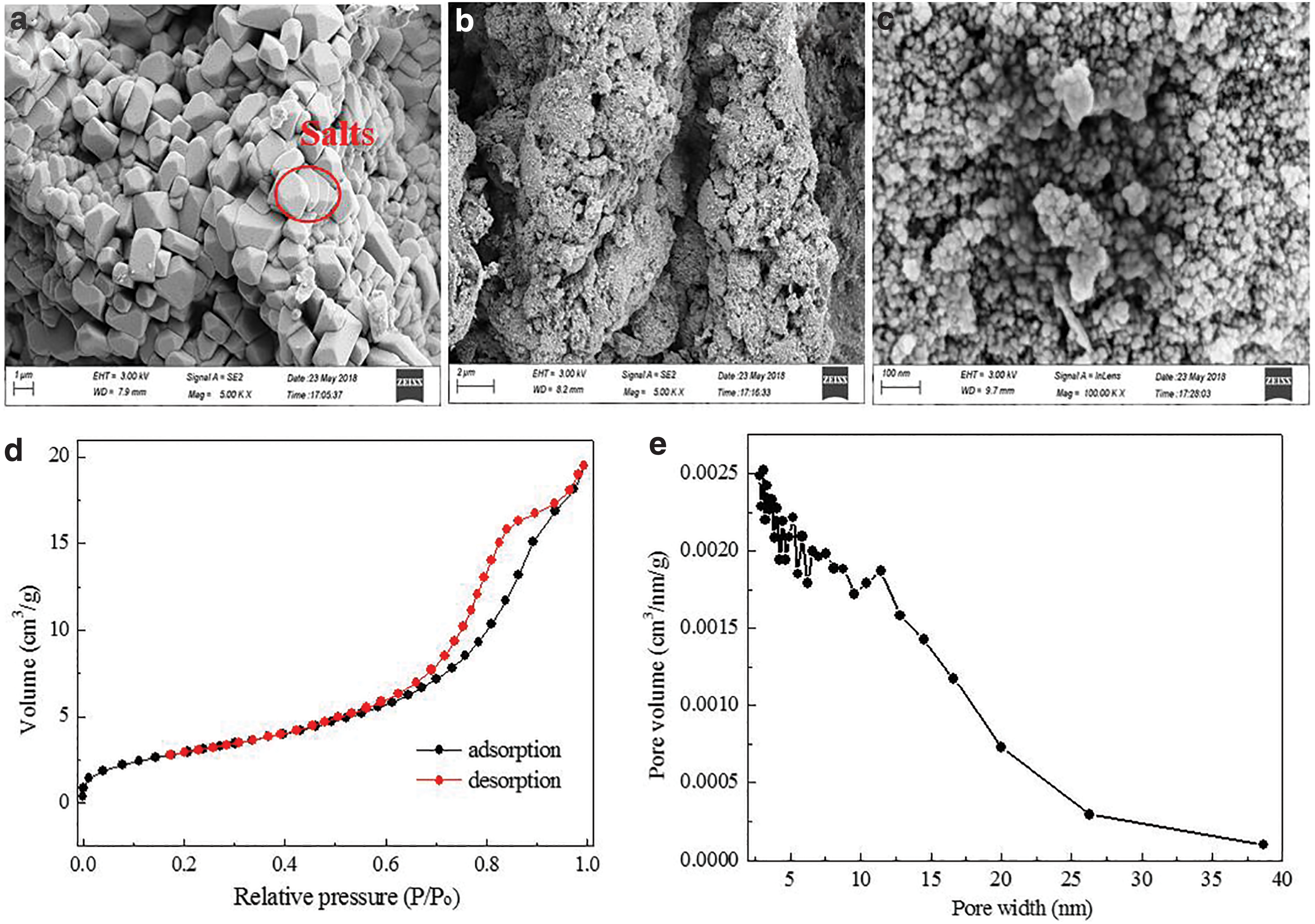
SEM and TEM analysis was conducted to acquire detailed morphological and structural information of samples. Figure 2a–c displays the SEM images of virgin E. prolifera and MEPE. It can be observed that the surface morphology of MEPE was quite different from that of raw E. prolifera. Large stacks of fine salt particles can be seen on the surface of the original E. prolifera (Gao et al., 2014), and after magnetization, biomass components, such as salt, soluble alginate, pigments, and water, were removed (Lee et al., 2004). Enhanced irregularity and roughness of MEPE appeared and surface pore channels in MEPE internal framework became larger after modification, which would provide larger active sites for adsorption (Song et al., 2015, 2017). Besides, a large quantity of nanosize particles appeared and covered the surface of MEPE as shown in Fig. 2b and c. Meanwhile, Supplementary Fig. S3 shows the TEM images of MEPE. It further confirms that Fe3O4 nanoparticles (with the diameter of 10 nm or so) have been embedded into MEPE, which is in good agreement with previous studies (Song et al., 2016a). Thus, these images verified the successful modification and magnetization of MEPE.
Surface area and pore character of MEPE
Surface area and pore character of native E. prolifera and MEPE are depicted in Table 1. Compared with raw E. prolifera, the surface area of MEPE increased by 30 times (from 0.368 m2/g to 10.995 m2/g) after medication, whereas the average pore size of MEPE reduced by a factor of approximately eight (from 40.04 nm to 5.49 nm). The nitrogen adsorption–desorption isotherms and pore size distribution of MEPE are illustrated in Fig. 2d and e. The isotherm type of MEPE presented type IV curves according to IUPAC classification, which indicated that MEPE was a mesoporous material. The steep N2 adsorption at p/p0<0.05 implied the existence of a micropore structure, even in a minority (micropore volume of 0.0044 cm3/g). Accordingly, MEPE had better porous structure than raw E. prolifera, contributing to the improvement of adsorption capacity.
Brunauer–Emmett–Teller Parameters of Magnetic Enteromorpha prolifera Composite
BET, Brunauer–Emmett–Teller; MEPE, magnetic Enteromorpha prolifera composite.
Adsorption tests in a single-component system
Dosage effect on Co(II) and Ni(II) adsorption
Effect of MEPE dosage on Co(II) and Ni(II) uptake is shown in Supplementary Fig. S4. It was observed that the removal efficiency and qe (the amount of the ion adsorbed per unit weight of the adsorbent) of the two ions onto MEPE were both higher than that of raw E. prolifera. With the dosage of 4 g/L, the removal efficiencies of Co(II) by MEPE and raw E. prolifera were 96.2% and 32.4%, respectively; as for Ni(II), the removal efficiency of 97.1% by MEPE was also much higher than 49.3% by raw E. prolifera. The enhancement of adsorption performance was ascribed to the increase of surface areas and active sites after magnetization reaction. Moreover, it can be seen from the Supplementary Fig. S4 that with MEPE dosage increasing, the removal percentages of Co(II) and Ni(II) increased obviously, whereas qe drastically decreased. When the adsorbent dosage exceeded a certain value [2 g/L for Co(II) and 1 g/L for Ni(II)], the trend of increase or decrease became slow. Therefore, comprehensively considering both the removal efficiency (>50%) and adsorption capacity of the two ions, the adsorbent dosages were set as 1.0 g/L for Co(II) and 0.6 g/L for Ni(II) in the subsequent tests, unless otherwise stated.
Effect of pH on Co(II) and Ni(II) adsorption
The initial pH of the solution is one of the most important parameters in the adsorption process, because it affects ion speciation, the surface charge, and the ionization degree of the adsorbent. The removal of Co(II) and Ni(II) onto MEPE as a function of pH is illustrated in Fig. 3a and b. The pH variations after adsorption were also tested. The speciation of Co under different pH values has been investigated in previous studies (He et al., 2011; Zhang et al., 2016a). For Co(II) solution, Co2+ is the dominant species at pH ≤8.5 and Co(OH)2 precipitates form at pH >8.5, therefore, the experiments were performed below the pH value of Co(OH)2 precipitation, that is, pH ≤8.5.
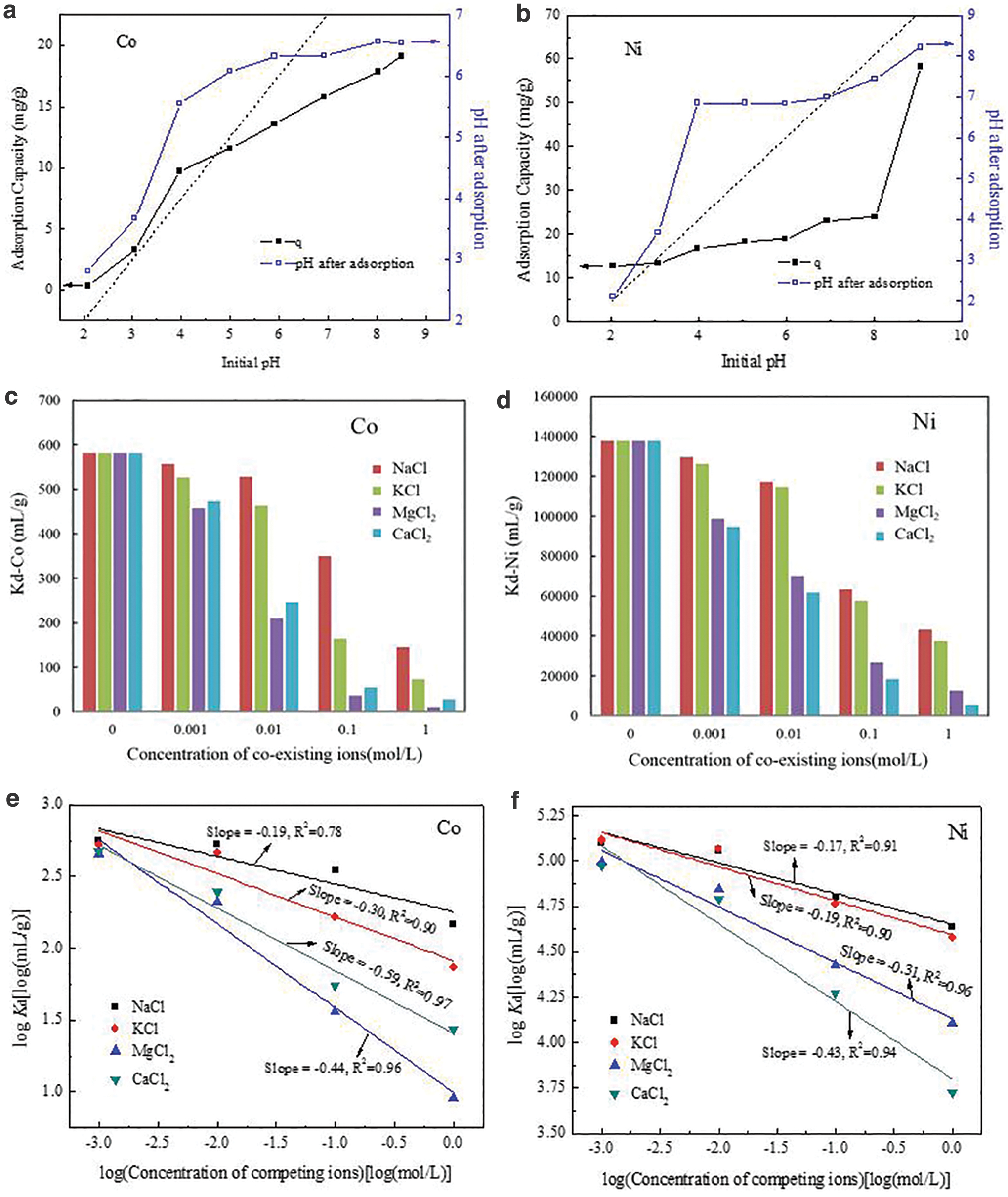
Figure 3a shows that the Co(II) adsorption enhanced as the solution initial pH increased. In acidic conditions, Co(II) faced strong competition due to the presence of high concentrations of H+, which occupied and protonated the active binding sites of the MEPE surface. The positive charge density on the surface of MEPE increased and caused the enhancement of the electrostatic repulsion for positively charged Co2+, which reduced the removal and extraction processes of Co(II) (Mahmoud et al., 2018). At higher pH value, the protonation degree of MEPE surface weakened. -OH and -NH- groups onto MEPE surface had strong binding affinity with the target Co(II) ions, and hence the Co(II) sorption enhanced (Zhu et al., 2014a; Mahmoud et al., 2018; Saleh et al., 2018). Zeta potential of MEPE as a function of pH is shown in Supplementary Fig. S5. Zeta potentials were all below zero and decreased from −6.7 mV to −43.3 mV with the rise in pH from 2.0 to 9.0, which further confirmed that electrostatic attraction between MEPE and Co(II) contributed to the adsorption process.
After the adsorption by MEPE, the solution was buffered to its equilibrium pH (pHf) value. When the initial pH (pHi) was below 7, pHf was higher than pHi; when the pHi ≥ 7, pHf was lower than pHi. This indicated that MEPE had excellent pH buffering nature, which contributed to the applicability to actual radioactive wastewater. At pHi > 7, The adsorption of Co(II) onto MEPE decreased the pHf from 8.0 to 6.5, from 8.5 to 6.5, suggesting that inner-sphere complexation was probably also involved in the adsorption mechanisms in alkaline solution [Eqs. (4), (5)] (He et al., 2011):

For Ni(II) solution, Ni2+ is the dominant species at pH ≤8 and Ni(OH)2 precipitates form at pH >8 (Wang et al., 2014). The same trends are also evident in the case of Ni(II) removal by MEPE in Fig. 3b. Similar conclusions have been reported for the adsorption of Co(II) and Ni(II) on clinoptilolite (Malekpour et al., 2011).
Effect of coexisting nonradioactive ion on nuclide ion adsorption
Large quantities of nonradioactive ions, including Na+, K+, Mg2+, and Ca2+, exist widely in radioactive wastewaters. The effects of the four coexisting nonradioactive ions on the removal of Co(II) and Ni(II) are demonstrated in Fig. 3c and d. As shown, the existence of nonradioactive ions reduced the Co(II) and Ni(II) uptake by MEPE. The higher the concentration of nonradioactive ions, the lower the Kd values. Taking Na+ for example, the Kd value of Co(II) adsorption in the absence of Na+ was 582.27 mL/g, whereas, Kd decreased to 556.53, 527.97, 349.18, and 146.25 mL/g under the conditions that Na+ concentrations were 0.001, 0.01, 0.1, and 1.0 M, respectively.
Figure 3e and f illustrates the linear dependency between values of the distribution coefficient Kd and the concentrations of interfering cations in log–log coordinates. As for the binary ion exchange process, when the sorption process of the ions is purely ion exchange, theoretically the slope of the linear regression equation is equal to - (zA/zB) (where zA and zB are the charges of the target ions to be adsorbed and competing ions, respectively) (Möller et al., 2001, 2002). As depicted in Fig. 3e and f, the deviation from theoretical values for the slopes of the curves (the slope being between −0.17 and −0.59) indicates that other sorption mechanisms are quite likely to take place (Möller et al., 2002).
In addition, as shown in Fig. 3c–f, the divalent ions (Mg2+ and Ca2+) have stronger inhibitive effects on the uptake of Co(II) and Ni(II) than the monovalent ions (Na+ and K+), indicating that electrostatic attraction may be involved in the sorption process. The charge densities (z/r, the ratio of charge to hydrated ion radius) of Mg2+ (z/r = 2/4.28) and Ca2+ (z/r = 2/4.12) are much higher than those of Na+ (z/r = 1/3.58) and K+ (z/r = 1/3.31) (Zhang et al., 2016b). Moreover, the impacts of Mg2+ and Ca2+ on Co(II) uptake are different from those of Ni(II). Mg2+ has a more negative effect on Co(II) removal than Ca2+, whereas there is a greater effect on Ni(II) removal from Ca2+ than Mg2+. The stronger inhibition of Mg2+ on Co(II) removal is probably due to the fact the hydrated ion radius of Mg2+ is similar to that of Co(II) (the hydrated ion radii for Mg2+and Co2+ are 4.28 Å and 4.23Å, respectively)(Zhang et al., 2016a). The similar sizes of Ca2+ and Ni2+ in hydrated ion radii (4.12 Å for Ca2+ and 4.04 Å for Ni2+), make Ca2+ an effective competitor with Ni(II) for sorption sites.
Adsorption kinetics in a single-component system
Kinetic behaviors of Co(II)/Ni(II) capture in a single-component system by MEPE were examined, and the results are shown in Supplementary Fig. S6. A steep slope within 5 min for Co(II) and 20 min for Ni(II) reflects a rapid adsorption rate [with uptake of 98% of Co(II) and 71.4% of Ni(II)], followed by a gradual adsorption state, and then the adsorption equilibrium was achieved within 30 min for Co(II) and 120 min for Ni(II), respectively.
Adsorption rates of Co(II) and Ni(II) by MEPE depend on (i) mass transport rate of Co(II) and Ni(II) ions, and (ii) external/intraparticle mass-transfer resistances (Shang et al., 2017b). Hence, two widely used kinetic models, that is, pseudo-second order model and Weber–Morris intraparticle diffusion models, were applied to fit the kinetic data in the single adsorption process. The equations are given in Supplementary Appendix S1 and the results are presented in Supplementary Fig. S6 and Supplementary Table S1.
The correlation coefficients R2 of 0.998–1 indicated the superiority of pseudo second-order model, and the calculated values qe2 based on it agreed well with the experimental qe,exp. It suggested that the rate-controlling step of the sorption for Co(II) and Ni(II) onto MEPE was a chemical sorption that involved valence forces through sharing of electrons between sorbent and sorbate (Song et al., 2015).
Multilinearity curves based on the Weber–Morris model are shown in Supplementary Fig. S6b and d, indicating that two or more steps occurred during the capture of Co(II) and Ni(II). The ki1 and ki2 in Supplementary Table S1 represent diffusion rates of stage 1 and stage 2 in the adsorption process. Data revealed that the uptake of the two ions by MEPE could approximate to Weber–Morris intraparticle diffusion model with R2 of 0.909–0.994. In the initial portion, Co(II) and Ni(II) ions moved from the bulk solution to the exterior surface of MEPE (film diffusion), thus the adsorption rate was rapid in the beginning. The stage 2 represented the gentle adsorption process. Co(II) and Ni(II) ions transported and entered the inner pore region and were adsorbed by the interior part of MEPE(intraparticle diffusion). ki2 < ki1 was attributed to the fact that the diffusion resistance increased when the two ions diffused inside the pore of the MEPE particle. The third part was the final equilibrium stage, where the adsorption and desorption rates remained equivalent (Qiu et al., 2015; Xu et al., 2015; Shang et al., 2017b). Therefore, both intraparticle diffusion (pore diffusion) and boundary layer (film) diffusion were involved in the uptake process of Co(II) and Ni(II) (Shang et al., 2017b).
Adsorption isotherms of Co(II) and Ni(II)
The adsorption isotherms of MEPE toward Co(II) and Ni(II) are described in Fig. 4a and b, which are fitted by Langmuir and Freundlich models (The equations are listed in Supplementary Appendix S2). The theoretical parameters along with the regression coefficient (R2) are listed in Supplementary Table S1. It was observed that the adsorption amount increased with concentration of Co (II)/Ni(II). For both Co(II) and Ni(II), the Freundlich isotherm yields the better fit with higher R2 (>0.985) compared with Langmuir model, indicating the heterogeneous coverage of Co (II)/Ni(II) on the surface of the adsorbent MEPE.
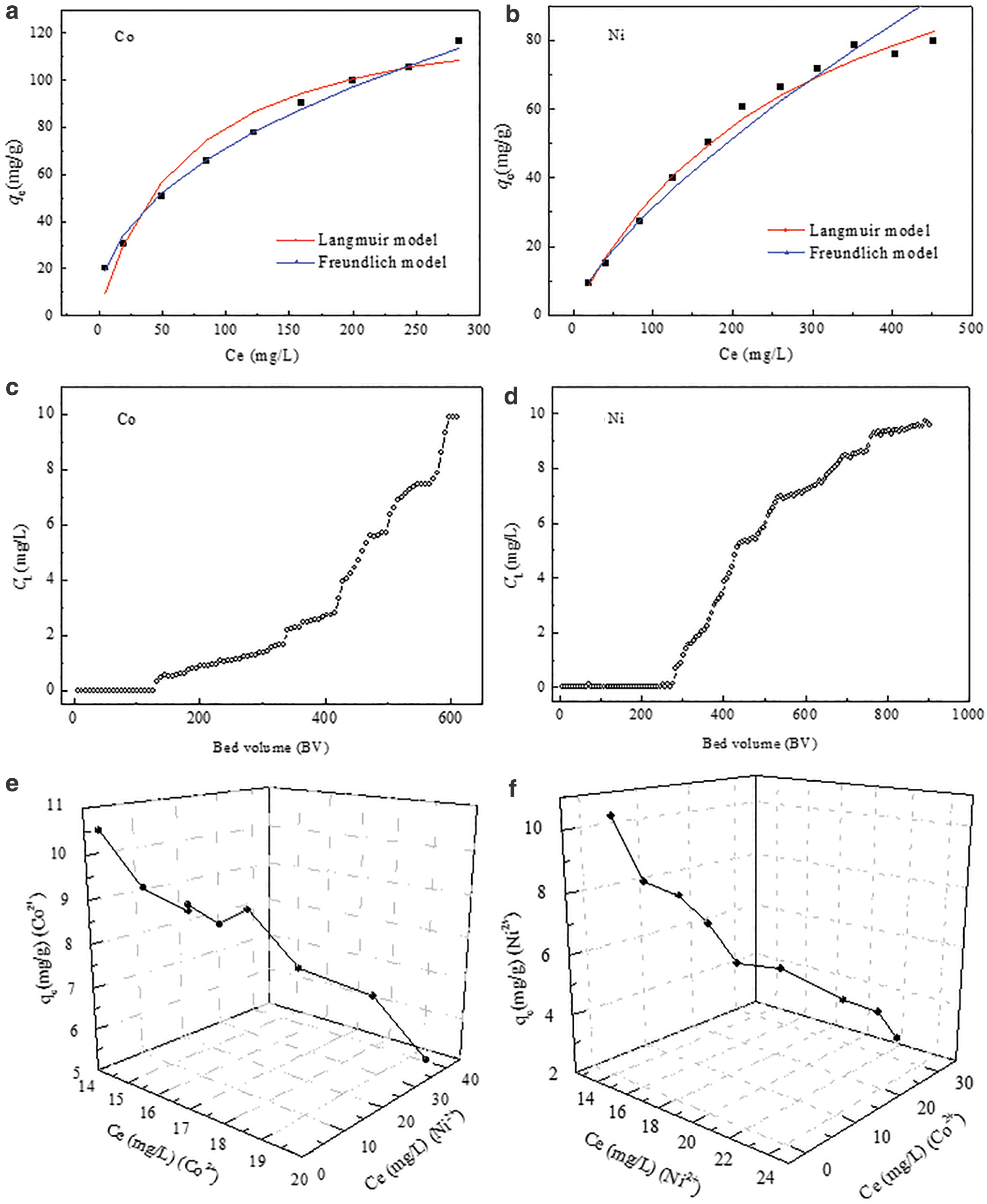
The ultimate adsorption capacity qmax (at 20°C) of Co(II) and Ni(II) by MEPE calculated in terms of Langmuir equation is about 135 and 137 mg/g, respectively. Ni(II) has higher adsorption capacity onto MEPE than Co(II) in solution. As illustrated in Supplementary Table S2, the qmax of MEPE surpassed those of previously reported sorbents and commercially available cation exchange resins used for Co (II)/Ni(II) removal. Therefore, the MEPE adsorbent is a promising and competitive alternative for Co(II) and Ni(II) removal from radioactive wastewater.
Fixed-bed column adsorption of Co(II) and Ni(II)
To further test the applicability of MEPE for Co (II)/Ni(II) removal, the fixed-bed mode was employed at room temperature. The breakthrough point was determined in 1.0 mg/L (Ct/C0 = 0.1) and the point of column exhaustion was set as 9.5 mg/L (Ct/C0 = 0.95). The breakthrough curves are depicted in Fig. 4c and d. As observed, the MEPE column generated ∼226 bed volume (BV) and ∼295 BV effluents for Co(II) and Ni(II) respectively before the breakthrough point occurred. At the point of column exhaustion, the effective treatment volumes of MEPE for Co(II) and Ni(II) were ∼591BV and ∼855 BV respectively. The adsorption capacity of MEPE in column was calculated to be 6.84 mg/g and 7.47 mg/g for Co(II) and Ni(II), respectively. So Ni(II) has a better affinity than Co(II) onto MEPE in the column experiments, which is well consistent with the case of the batch adsorption for the two ions. Similar phenomena have been reported for the fixed-bed column adsorption of Co2+and Ni2+ onto a new carboxylated sugarcane bagasse (Xavier et al., 2018). Therefore, results indicated that MEPE was effective for the removal of Co(II)/Ni(II) from solution.
Adsorption tests in a binary-component system
To investigate simultaneous sorption and competition effects in binary metal systems, the three-dimensional sorption plots were generated, describing the uptake of Co(II)/Ni(II) as a function of the equilibrium concentrations of both metals.
As illustrated in Fig. 4e and f, some reduction of the Co(II) or Ni(II) adsorption could be observed with increasing Ni(II) or Co(II) concentration. The adsorption capacity Qe of Co(II) decreased from 10.57 to 5.26 mg/g (reduction by 50.2%) with Ni(II) concentration changing from 0 to 50 mg/L; while the values of Qe for Ni(II) reduced from 10.50 to 2.55 mg/g (reduction by 75.69%) in the presence of Co(II) with the concentration from 0 to 50 mg/L. As a result, the uptake of Ni(II) was more susceptible to the interference of Co (II).
Desorption studies
The desorption experiment is one of the essential factors to determine the adsorption mechanism and to evaluate the reusability of a new adsorbent. The first run desorption test was conducted in the previous study, using acetic acid (HCA), HCl, NaOH, NaCl, and CaCl2, separately, as the regenerant solution to investigate their effects on the desorption efficiency of the spent MEPE. As illustrated in Supplementary Fig. S7a and b, NaOH was almost noneffective at releasing bonded Co(II) and Ni(II) from MEPE. The desorption efficiencies of NaCl and CaCl2 were much higher than that of NaOH, but still lower than the acid eluents. HCl was found to be the most suitable desorption eluent for the regeneration of Co (II)/Ni(II)-loaded MEPE. This result was consistent with the previous pH study that MEPE had worse capture for Co(II) and Ni(II) ions at lower pH. Supplementary Figure S7c and d shows the cyclic regeneration using HCl as eluent. It was clear that MEPE could be recycled up to four to five times without significant loss of adsorption capacities, During the 4th cycle for Co(II) and the 5th cycle for Ni(II), ∼80% and ∼73% capacities of MEPE were still retained for Co(II) and Ni(II) ions, respectively, suggesting that MEPE was an excellent reusable adsorbent for the capture of Co(II) and Ni(II).
However, the radionuclide-loaded adsorbent belongs to hazardous materials. The radionuclides transfer to a solid phase from the liquid phase by adsorption process. According to the laws “Regulation on the Safety Management of Radioactive Waste” (Document Number: Order No. 612 of the State Council; effective date: 03-01-2012, China), radioactive wastes can be canned, sealed, and buried in rock stratum or stored in storage tanks above the ground. Another method is to drop metal canisters containing nuclear wastes into the seabed below 4,000 m in selected areas. It is also possible to convert long-lived radioactive waste into stable, short-lived isotopes (under test) using reactor methods. Nuclear waste is best stored in a stable solidified form to reduce the migration and diffusion of radionuclides.
Uptake mechanism
The XPS analysis was performed to determine the adsorption mechanisms of Co (II)/Ni(II) onto MEPE. Figure 5a presents the XPS spectra of Co 2p after adsorption. The binding energies (BE) at ∼783.3 eV corresponded to Co 2p3/2 peaks, which were asymmetric to the high BE side. This value was close to those as reported earlier for Co2+ in CoCl2·6H2O (782.9 eV) (Luo et al., 2018), and Co(OH)2 (782.1 eV) (Tan et al., 1991). A significant satellite structure appeared at the high BE. This confirmed that Co(II) was adsorbed onto MEPE. Figure 5b shows the XPS spectra of Ni 2p after adsorption. The binding energies (BE) at ∼855.9 eV and ∼861.6 eV corresponded to Ni 2p3/2 and weak Ni 2p3/2 satellite peaks, which was ascribed to Ni(OH)2 (An et al., 2019). This confirmed that Ni(II) was adsorbed onto MEPE.
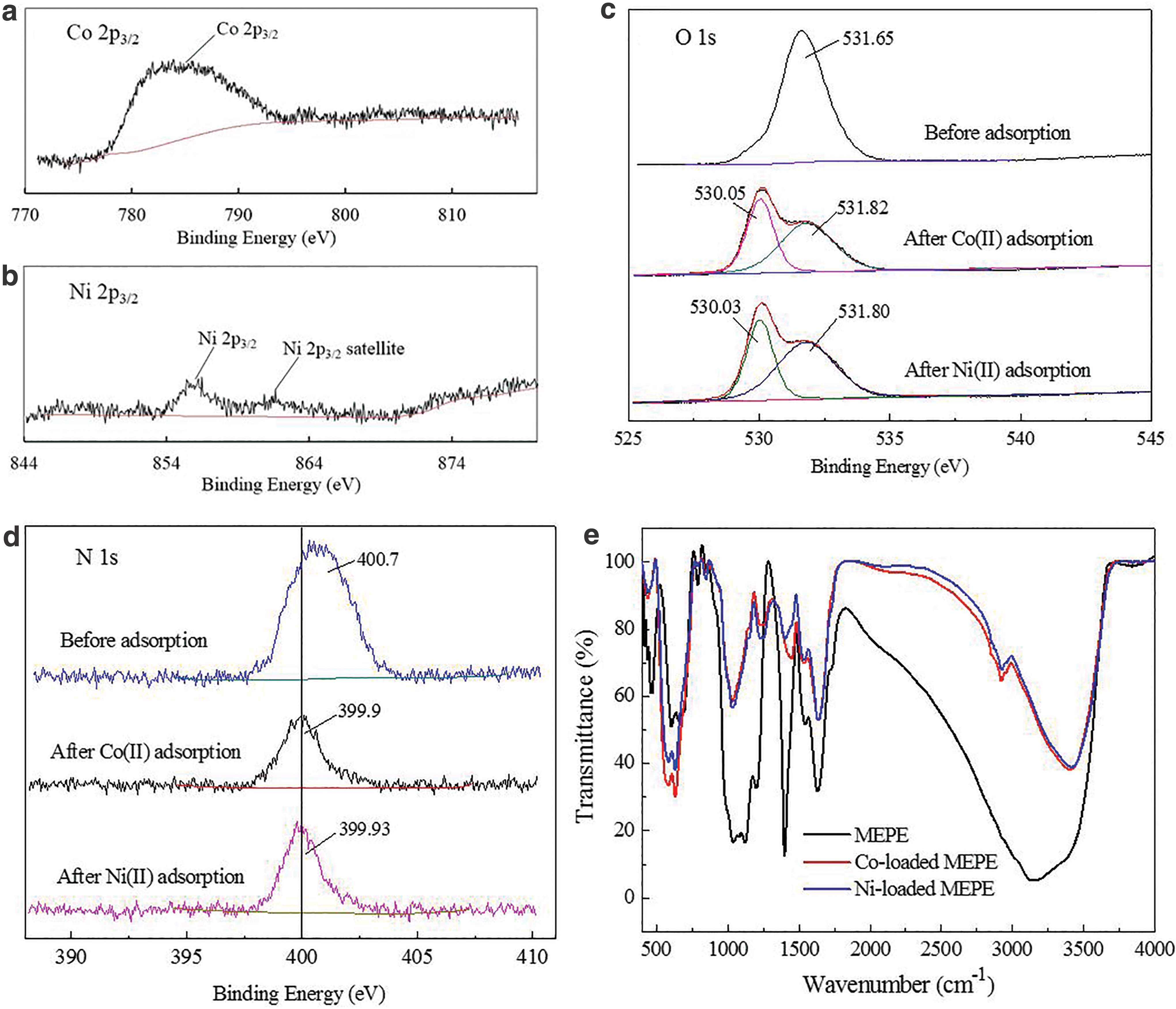
Figure 5c illustrates that O 1s XPS spectrums of MEPE during the biosorption process. The broad band at 531.65 eV was ascribed to surface hydroxyl groups. After the adsorption of Co(II), BE shifted to 531.82 eV and the relative intensity significantly decreased from 59.21% to 37.11%. New peak appeared at 530.05 eV, which was attributed to the value as reported for Co-O from cobalt hydroxide and the oxygen-containing complex of cobalt (II) in this study. Similarly, BE of O 1s moved to 531.80 eV and the relative intensity was lowered to 40.16% after the adsorption of Ni(II). New peak appeared at 530.03 eV, which was attributed to nickel hydroxide. The overall findings demonstrated that the adsorption could occur through the interaction between surface hydroxyl groups and Co(II)/Ni(II).
Figure 5d illustrates that N 1s XPS spectrums of MEPE before and after adsorption. The broad band at 400.7 eV was ascribed to surface–NH in amino groups. (Wang et al., 2016). After Co(II)/Ni(II) loading, BE shifted to 399.9 and 399.93 eV, respectively. Besides, the relative intensity of N 1s peaks decreased from 3.76% to 2.12% for Co(II)) and 2.33% (for Ni(II), separately. Similar findings have been reported in previous studies (Wang et al., 2016; Luo et al., 2018). All these demonstrated that -NH was also correlated with the adsorption of Co(II)/Ni(II). The cobalt/nickel ions were bound onto the nitrogen atoms during the adsorption process, and the shared bonds between Co(II)/Ni(II) and the N atom consisted of a lone pair of electrons, which contributed from the N atoms (Luo et al., 2018).
Simultaneously, FT-IR spectra before and after the adsorption of Co(II)/Ni(II) are shown in Fig. 5e. The IR spectrums of MEPE changed significantly after the adsorption. The peak representing the overlapping of O-H and N-H stretching vibrations at 3,152 cm−1 was weakened significantly and blue shifted to 3,404 cm−1/3,416 cm−1 after the adsorption of Co(II)/Ni(II), which suggested that surface hydroxyl groups and N-H participated in the adsorption process (Luo et al., 2018; An et al., 2019). The peak attributed to the stretching vibrations of C = O at 1,632 cm−1 was attenuated and blue shifted to 1,639 cm−1/1,637 cm−1 after Co(II)/Ni(II) loading. The peak stemming from the stretching vibrations of C-N at 1,402 cm−1 weakened markedly and blue shifted to 1,452 cm−1/1,404 cm−1 after the adsorption of Co(II)/Ni(II). The peaks ascribed to the overlapping of C-N and C-O stretching vibrations in the region of 1,039–1,124 cm−1 red shifted to 1,034 cm−1 and the peak intensity reduced tremendously after the uptake of Co(II)/Ni(II) (Lingamdinne et al., 2016; Luo et al., 2018). These results suggested that amine groups also contributed to the adsorption process.
Furthermore, it was observed that the two spectrums after adsorption were almost overlapped, indicating that the adsorption mechanisms of Co(II) and Ni(II) onto MEPE were very similar. All these were in accord with the results of XPS. Based on the above results, hydroxyl groups and amine groups could be involved in the reaction and adsorption process. The above mechanism of the uptake for Co(II)/Ni(II) is shown schematically in Fig. 6.

Mechanism of adsorption of Co(II)/Ni(II) on the surface of MEPE [Co(II) as an example].
Consequently, physical, chemical, and electrostatic adsorption simultaneously occurred according to characterization analysis and the adsorption tests in single/binary component systems, and chemical reaction played a dominant role in the adsorption process.
Conclusions
In this work, MEPE was prepared, characterized, and applied for the removal of cobalt (60Co) and nickel (63Ni) from the radioactive wastewaters. After being modified by Fe3O4 nanoparticles, MEPE exhibited properties of excellent separation from treated solution and an enlarging adsorption capacity for Co(II) and Ni(II) uptake. The saturated magnetization of MEPE exceeded 4.90 emu/g and the maximum adsorption capacity for Co(II) and Ni(II) was 135 and 137 mg/g, respectively. Coexisting nonradioactive ions, like Na+, K+, Mg2+, and Ca2+, affected the sequestration of Co and Ni to a limited degree. Compared with the single-component system, the uptake of Co(II)/Ni(II) for the binary-component adsorption decreased due to competitive adsorption. The MEPE retained a relatively high adsorption capacity after several cycles of adsorption–desorption without significant loss of capacity. Based on the analysis of uptake mechanism, the removal of Co(II)/Ni(II) by MEPE was mainly due to electrostatic attraction and surface complex formation. Hydroxyl groups and amine groups in MEPE could be involved in the reaction and adsorption process.
Footnotes
Author Disclosure Statement
No competing financial interests exist.
Funding Information
This work was supported by the University of Science and Technology Research Program of Hebei Province (Z2018017), Tangshan Science and Technology Research and Development Program (18130234a), the National Natural Science Foundation of China (51602344), and the Natural Science Foundation of Jiangsu Province (BK20160241).

References
Supplementary Material
Please find the following supplemental material available below.
For Open Access articles published under a Creative Commons License, all supplemental material carries the same license as the article it is associated with.
For non-Open Access articles published, all supplemental material carries a non-exclusive license, and permission requests for re-use of supplemental material or any part of supplemental material shall be sent directly to the copyright owner as specified in the copyright notice associated with the article.
