




Abstract
Batch kinetic tests and continuous-flow column experiments were conducted to study fluoride adsorption on porous hydroxyapatite ceramics. Batch tests showed that fluoride uptake occurred faster for smaller adsorbent particles, which is expected for ceramics with internal sorption sites. Columns with different flow rates had different breakthrough curves. Fluoride loading on the adsorbent (q) at point of exhaustion (Ceff = 0.85 C0) increased with decrease in flow rate, while the mass loading at breakthrough (Ceff = 0.15 C0) stayed nearly constant. Flow interruption at different points led to a temporary decrease in the effluent fluoride concentration demonstrating that the columns experienced nonequilibrium conditions, and intraparticle diffusion played a significant role in fluoride uptake. The Rapid Small-Scale Column Test (RSSCT) concept was tested as a scale-up approach. Small-scale columns were designed using the constant diffusivity (CD) and proportional diffusivity RSSCT approaches, with CD found to be the more suitable approach to predict the breakthrough of a large-scale column. This serves to further validate the use of porous hydroxyapatite ceramics for fluoride uptake and provides insights into the design of full-scale systems.
Introduction
Fluoride is a geogenic groundwater contaminant, naturally found in groundwater with high pH and low calcium concentrations. It is found in minerals such as fluorite, fluorspar, and apatite, in areas with high volcanic activity and igneous and sedimentary rock formations (Fawell et al., 2006). Amini et al. (2008) estimated that nearly 200 million people are exposed to drinking water with elevated levels of fluoride. Nearly 50% of ingested fluoride is retained by the body, depending on stomach pH and presence of calcium in the diet, and drinking water is a major contributor to overall fluoride intake (Fawell et al., 2006). Overtime, this exposure manifests itself as dental fluorosis at concentrations between 1.5 and 4 mg/L and as skeletal fluorosis at higher concentrations (Fewtrell et al., 2006). The World Health Organization recommends 1.5 mg/L of fluoride in drinking water below which the risk of fluorosis is minimal (WHO, 2011).
Among the most widely studied adsorbents for fluoride removal are activated alumina (AA) (Hao and Huang, 1986; Ku and Chiou, 2002; Ghorai and Pant, 2005; Levya-Ramos et al., 2008) and bone char (BC) (Kloos and Haimanot, 1999; Brunson and Sabatini, 2009; Mlilo et al., 2009). AA has a reported maximum fluoride adsorption capacity of 16 mg/g at a pH of 6.0 (Ku and Chiou, 2002). However, it can dissolve in alkaline conditions required for regeneration (Padungthon et al., 2014), which limits its regenerability. BC also suffers from similar sensitivity to pH and its maximum fluoride adsorption capacity is between 4 and 6 mg/g at a pH of 7 (Mlilo et al., 2009; Leyva-Ramos et al., 2010). Moreover, materials derived from animal bone can be considered culturally inappropriate in parts of the world such as India. These adsorbents, when used in powdered form, can also disperse in water causing an increase in head loss in a continuous-flow column (Chen et al., 2010).
A granular hydroxyapatite adsorbent was developed to simultaneously address the challenges of pH instability, cultural unsuitability, and dispersion in aqueous medium. Hydroxyapatite powder, synthesized in the laboratory, was mixed with insoluble rice starch and soluble starch and fired at 1200°C to form porous ceramics (Nijhawan et al., 2017). Nijhawan et al. (2018) found that porous hydroxyapatite ceramic beads can remove up to 18 mg F−/g at a pH of 7 with little to no interference from most anions common in ground water (with high chloride an exception). The ceramic media could be regenerated for up to four adsorption cycles with a 30% loss in adsorption capacity using 1 M sodium hydroxide (Nijhawan et al., 2018).
While equilibrium adsorption tests give useful information about the maximum adsorption capacity of adsorbents, continuous-flow column tests are needed to predict adsorbent performance in a community-scale or point-of-use (POU) flow-through (column) system. Kinetic tests can give insight into intraparticle mass transfer effects and the effect of nonequilibrium conditions on fluoride adsorption in the column. Moreover, the adsorption capacity of a material is more efficiently utilized in a column experiencing constant loading. To our knowledge, there are no reported studies on the kinetics of fluoride removal by porous hydroxyapatite ceramics; therefore, the first objective of this research was to evaluate the performance of these materials in continuous flow columns and evaluate mass transfer limitations of fluoride removal.
When properly designed, small laboratory-scale columns can be used to predict the performance of a full-scale column. A simple way to do this is the Rapid Small-Scale Column Test (RSSCT) approach. The RSSCT approach uses dimensionless mass transport parameters to design small-scale columns that can be tested in a short time with significantly less consumption of water and adsorbents (Crittenden et al., 1986). The small columns (SCs) use a smaller adsorbent particle size compared to the larger column. As the size of the adsorbent particle is decreased, the superficial velocity (determined by the flow rate and cross-sectional area of the column, also referred to as approach velocity) can be increased to maintain similar kinetic and mass transfer limitations.
This approach is applicable if the equilibrium adsorption capacity and mechanism of uptake are independent of the size of the adsorbent (Crittenden et al., 1986) and the porous medium is chemically homogenous. Compared to mathematical modeling, with its inherent complexities, the RSSCT approach has proven to predict the performance of pilot or full-scale columns more accurately so long as mass transfer parameters are scaled correctly. Doing so should result in identical breakthrough curves for the large and small RSSCT columns (Crittenden et al., 1986, 1987a).
The RSSCT approach, initially developed and validated for granular activated carbon (GAC) (Crittenden et al., 1986, 1987a), has been extensively studied for arsenic removal by granular ferric oxides (Badruzzaman et al., 2004; Westerhoff et al., 2005). It has been applied in a preliminary way to fluoride removal by BC and amended wood chars (Brunson and Sabatini, 2014). To the best of our knowledge, there are no published studies applying the RSSCT approach to porous ceramics for fluoride removal. It is hypothesized that the RSSCT approach will be valid for these materials because of the fundamental similarities between porous hydroxyapatite ceramics and GAC—they are both chemically homogeneous (as opposed to metal amended chars or resins) and have accessible internal pores that contribute most of the available surface sites while also introducing kinetic limitations due to intraparticle diffusion.
Theoretical basis for the RSSCT approach
The general scaling equations are based on the relationship between the effective diffusivity, D, and particle diameter of the adsorbent, d, and are given in Equations (1) and (2), where X can be any integer. Effective diffusivity of an ion in porous media depends on its diffusion coefficient in the liquid filling the pores, porosity of the media, and the constrictivity and tortuosity of the pores (Grathwohl, 2012). A relationship between the empty bed contact time (EBCT) and adsorbent diameter is given in Equation (2) (SC and LC stand for small column and large column, respectively).
If the effective (pore and surface) diffusivities are independent of adsorbent particle size (X = 0), then the small-scale columns can be designed using the constant diffusivity (CD) approach (Crittenden et al., 1986), and Equation (2) is reduced to
This approach assumes that the Reynolds numbers of small and LC stay constant, which gives us the following relationship between superficial velocities, v, and adsorbent diameters, d.
Crittenden et al. (1987a) found that the CD approach did not result in similar breakthrough curves for their large and SCs. Instead, the proportional diffusivity (PD) approach was applicable, which assumes that the effective diffusivity increases with increase in adsorbent particle size. For this approach, X = 1 and Equation (2) becomes
The superficial velocity can be calculated using the EBCTSC [determined from Eq. (5)] and the dimensions of the SC.
Once the dimensions of the SC are determined, the superficial velocity of the SC, vSC, can be calculated using the bed volume of the column (BVSC), cross-sectional area of the column ASC, flow rate QSC, and EBCTSC using Equations (6) and (7):
RSSCT columns scaled down using the PD approach typically have a longer EBCT and, consequently, longer time to breakthrough compared to the CD RSSCT columns (Westerhoff et al., 2005).
Experimental Protocol
Preparation of ceramics
Hydroxyapatite powder was synthesized in the laboratory according to the procedure described in Nijhawan et al. (2018). Briefly, calcium nitrate tetrahydrate and ammonium phosphate salts were mixed at a pH of 10.6, and the precipitated crystals were matured at 40°C for 60 h (Verwilghen et al., 2007). After drying, the precipitate was crushed and sieved through numbers 120 (pore size 125 μm) and 325 mesh (pore size 44 μm) to obtain a uniform particle size. The powdered hydroxyapatite was then mixed with rice starch and soluble potato starch in a volumetric ratio of 50%, 25%, and 25% each. During batch adsorption experiments, this volumetric ratio was found to have the highest fluoride adsorption capacity of 18 mg/g (Nijhawan et al., 2018).
The mixture of powdered hydroxyapatite and the two types of starches was packed into a BD 5 mL syringe with a Luer-Lok tip (Becton, Dickinson and Company, NJ) and pushed out to form thin strings. These were then allowed to dry and cut into cylindrical pellets. Pellets of approximate diameter 2 mm and length 3–4 mm were used for the SCs (diameter 2.5 cm), and pellets of 4 mm in diameter and 6–8 mm in length were used for the larger column (diameter 5 cm). Usually, a column diameter to pellet diameter ratio of at least 10–1 is recommended to avoid channeling (Rase, 1977); however, a ratio of 7–1 has also been found satisfactory (Arbuckle and Ho, 1990).
Finally, these pellets were fired in a kiln at 1200°C for 6 h to obtain the porous ceramic. The density and specific surface area of the ceramics have been previously reported as 1.3 g/cm3 and 4 m2/g, respectively (Nijhawan et al., 2017). The actual porosity of the packed bed was determined gravimetrically by measuring the weight of water needed to saturate the bed. The porosity of the porous ceramic along with the interpellet porosity contributes to the overall porosity of the packed bed.
Batch kinetic test
A batch kinetic test was done to (1) assess the kinetics of fluoride uptake and (2) to evaluate the effect of pellet size on rate of fluoride adsorption and equilibrium fluoride concentration, which would guide the application of the RSSCT approach. A 10 mg/L fluoride solution was prepared by diluting a 1000 mg/L NaF solution in 50 mM HEPES [4-(2-hydroxyethyl)-1-piperazineethanesulfonic acid] buffer solution. This fluoride solution was used for all experiments discussed in this study. Ceramic pellets were added to this solution in a solid to liquid ratio of 5 g/L in 100-mL Nalgene high density polyethylene bottles and kept on a reciprocating shaker at 30 rpm. Samples were collected for fluoride measurement every 30 min for the first 5 h and then every hour until hour 48. Fluoride loading onto the ceramic was measured by doing a mass balance and expressed as q (mg/g). This refers to the mass of fluoride (mg) adsorbed per gram of the ceramic (g).
Column adsorption tests
Small-scale column tests were done in a glass column with inner diameter of 2.5 cm and bed depth of 10 cm (bed volume of 49 mL). Two flow rates were tested—1 and 2 mg/L—corresponding to EBCTs of 49 and 24.5 min, respectively. A 10 mg/L fluoride solution was pumped from the influent storage to the inlet of the column using a peristaltic pump (Cole-Palmer Masterflex, Vernon Hills, IL) to maintain a constant flow rate. A pressure gauge was connected between the pump and inlet of the column to record the inlet pressure (Fig. 1, P1). The column was setup as an upflow column to prevent flow by gravity. Glass wool was placed near the inlet and outlet of the column to support the adsorbent bed. Glass beads were placed at both ends of the bed to allow dispersion of the water. The 10 mg/L fluoride solution was prepared according to the method described in the previous section.
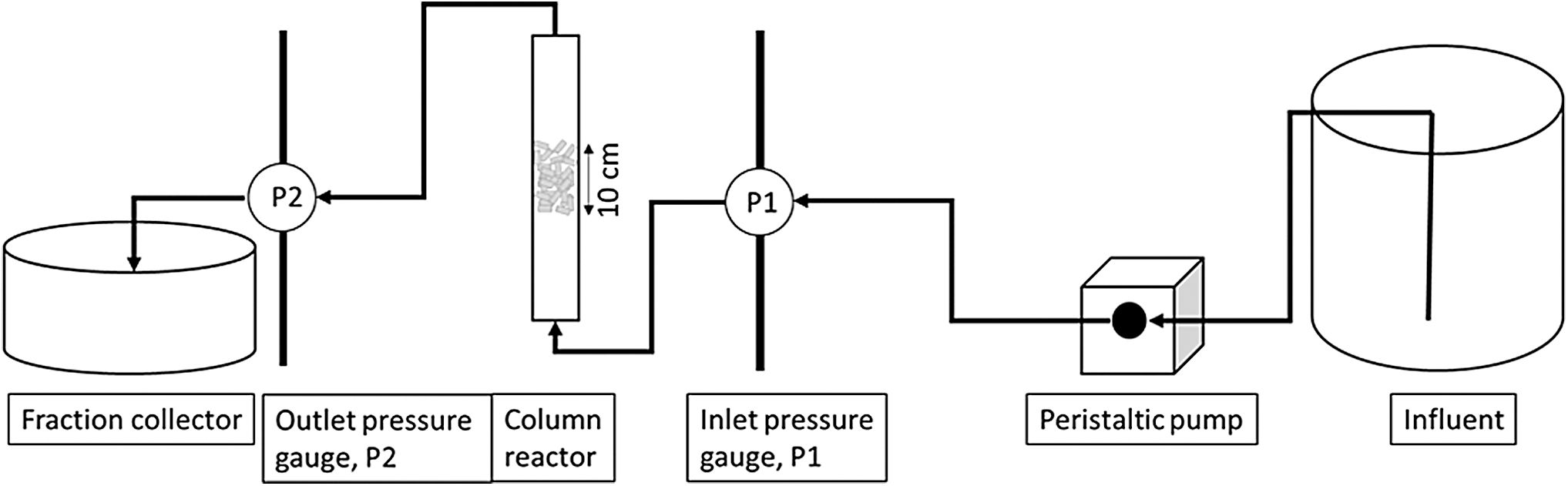
Laboratory-scale continuous-flow column setup (influent fluoride concentration, C0 = 10 mg/L).
An outlet pressure gauge (Fig. 1, P2) was placed between the column outlet and the automatic fraction collector (Pharmacia LKB-Frac-100, New York City, NY), to measure the pressure drop across the column. P1 and P2 were placed at the same height to avoid a difference in potential energy at the two points. Silicone tubing was used to connect each part of the column setup.
The large-scale column study was done in a glass column with an inner diameter of 5 cm and bed depth of 12 cm with a flow rate of 4.8 mL/min and an EBCT of 49 min.
For the RSSCT design, EBCTSC and vSC were calculated from Equations (3) and (4), whereas EBCTLC and vLC were determined from Equations (5) and (7).
Fluoride analysis
Fluoride concentrations for the batch kinetic study and the column studies were measured using an ion selective electrode (Thermo-Scientific Orion, Waltham, MA) that was calibrated using 0.025, 0.5, 1, 10, and 100 mg F−/L standards. The method detection limit of the electrode was 0.02 mg/L. Total ionic strength adjustment buffer was used to dilute samples, standards, and blanks in a 1:1 ratio to maintain a constant ionic strength and to decomplex dissolved fluoride complexes (Adriano and Doner, 1982).
Breakthrough analysis
Fluoride loading in the column was measured by doing a mass balance. The WHO Guideline for safe intake of drinking water containing fluoride, 1.5 mg/L, was chosen as the point of “breakthrough,” while 85% of influent concentration (C0 = 10 mg/L), 8.5 mg/L, was chosen as point of exhaustion. These values were expressed as qb and qe, respectively, and refer to the mass of fluoride (mg) loaded per gram of the adsorbent in the column bed.
Results and Discussion
Batch kinetic study
The applicability of the RSSCT approach was tested through batch kinetic studies, which showed similar equilibrium fluoride concentrations for the small and large pellets (Fig. 2). The smaller pellets showed a higher rate of fluoride removal initially, but the two curves converged around t = 24 h (see inset) and eventually reached an equilibrium concentration of 0.03 ± 0.003 mg/L at t = 26 h, with a fluoride loading of 1.9 mg/g. The initial rate of fluoride removal was higher for both pellets because of the large concentration gradient between the fluoride-free pellet surface and bulk solution and between the pellet surface and the intraparticle pore water. Further fluoride removal took place after fluoride ions diffused into the interior of the pellets through surface and/or pore diffusion. This process was faster for the smaller pellet size as the intraparticle diffusion distance was shorter.

Results of kinetic study to determine the rate of fluoride removal in small (2 mm diameter) and large (4 mm diameter) pellets.
Since the equilibrium concentration was independent of adsorbent size, the RSSCT approach is deemed appropriate for use with the porous hydroxyapatite ceramics studied in this research.
Continuous-flow column tests
Two small continuous-flow columns with flow rates of 1 and 2 mL/min were run until exhaustion (i.e., when the effluent concentration Ce reached 85% of [or 0.85 times] C0). The breakthrough curves, plotting the fluoride concentration in the effluent against bed volumes of each column, had the characteristic S-shape (Fig. 3) commonly reported for adsorbent beds with favorable adsorption isotherms (Tor et al., 2009; Brunson and Sabatini, 2014; Du et al., 2016).

Breakthrough curves of small columns with flow rates of 1 and 2 mL/min (empty bed contact time = 49 and 24.5 min, respectively).
The shape of the breakthrough curve is determined by the length of the mass transfer zone (MTZ) that develops in the column. The MTZ is the length of bed needed for uptake of a contaminant (Crittenden et al., 1987b); the bed is assumed to be saturated upstream of the MTZ and unused downstream of it, while the mass transfer of fluoride onto the porous adsorbent takes place in the MTZ. Once the MTZ reaches the downstream end of the column, the fluoride front appears, and the effluent concentration starts to increase. This was observed after ∼250–300 bed volumes for the columns (Fig. 3). Before this, the effluent concentration was at or near the detection limit of the ion-selective electrode (0.02 mg/L).
The shape of the breakthrough curves was influenced by the flow rate. The later appearance of fluoride and steeper slope of the 1 mL/min breakthrough curve (Fig. 3) indicate a shorter MTZ because the longer residence time (determined by the flow rate) allowed more time for the fluoride ions to diffuse into the pores and occupy available adsorption sites. At a higher flow rate (2 mL/min), however, the curve rose earlier and had a more gradual slope and a long ‘tail’ (which would likely have been more obvious had this column been run until Ceff = C0). Likewise, at 2 mL/min, the diffusion-limited adsorption caused an earlier breakthrough as expected for a longer MTZ. This is consistent with the trends reported by Ghorai and Pant (2005), Marsh and Rodríguez-Reinoso (2006), and Mohan et al. (2017) who observed shorter time to breakthrough with increase in flow rate.
A mass balance was conducted on each column to determine the amount of fluoride adsorbed per gram of ceramic (q) at breakthrough (Ceff = 1.5 mg/L) and exhaustion (Ceff = 8.5 mg/L), as shown in Table 1. The WHO Guideline value for fluoride in drinking water (1.5 mg/L) was chosen as the breakthrough effluent concentration. The values of q at breakthrough (qb) were similar for the two columns, but the values of q at exhaustion (qe) decreased from 11.7 to 10.8 mg/g with increase in flow rate. This is visually confirmed from Fig. 3, which illustrates less adsorption (area above the curves) for the 2 mL/min column. The values obtained for qb and qe are specific to this system and cannot be used for comparison under different flow rates and initial fluoride concentrations.
Operational and Design Parameters of Small Continuous-Flow Columns
The values of q1.5, q8.5, and q10 were calculated from batch isotherm data (Nijhawan et al., 2018) using Langmuir isotherm parameters (Qmax = 18.2 ± 1.6 mg/g, K = 0.3 ± 0.1). Uncertainties represent standard error of nonlinear regression.
EBCT, empty bed contact time.
While the qe values for both columns lie within the estimated range of q8.5 obtained from a batch isotherm, the qb was higher than the batch q1.5 (Nijhawan et al., 2018) (Table 1). This can be attributed to the fact when Ceff = 1.5 mg/L; the early portion of the column bed is in equilibrium with concentrations greater than 1.5 mg/L. In fact, a section of the bed near the influent might be approaching saturation and thus be in equilibrium with the inlet fluoride concentration. Therefore, the qb value can be thought of as a composite of solid phase fluoride concentrations (q) at local equilibria, averaged over the entire length of the column, and thus expected to be greater than q1.5 obtained from batch studies.
CD versus PD RSSCT approaches
The RSSCT approach was tested by designing a larger column and two SCs—with the smaller columns designed using the CD and PD approaches—to determine which would predict the breakthrough of the larger column more accurately. In the CD approach, the column EBCT is proportional to the square of the adsorbent particle diameter [(Eq. 3)], while the PD approach uses a linear relationship between column EBCTs and particle diameters [Eq. (5)]. The superficial velocity, vLC, and EBCT, EBCTLC, of the LC were 0.24 cm/min and 49 min, respectively. The CD column was designed using Equations (3) and (4), while the PD column was designed using Equations (5)–(7). The design parameters for each column are presented in Table 2. The bed densities and porosities were similar for all three columns indicating homogeneity in packing density and pore volume with increase in pellet size.
Operational and Design Parameters of Continuous-Flow Columns
CD, constant diffusivity; PD, proportional diffusivity.
The CD approach predicted the breakthrough of the LC better than the PD column, which suggests that the effective intraparticle diffusivity was independent of adsorbent size (an assumption of the CD approach). However, the three curves begin to converge after ∼500 bed volumes. This is consistent with the findings of Sperlich et al. (2005) for arsenic removal by granular ferric hydroxide. While the CD RSSCT column was a better predictor of the LC initially, the CD and PD RSSCT breakthrough curves eventually converged, and both accurately predicted exhaustion of the larger column.
The flow was paused for different durations at multiple points during the LC run to demonstrate the effect of nonequilibrium conditions. As seen in Fig. 4 inset, interrupting the flow for 48 h after 290 bed volumes decreased the effluent fluoride concentration from 2.2 to 0.30 mg/L, an 86% decrease. In comparison, an 18-h flow interruption after 625 bed volumes only decreased the effluent concentration by 26%, from 7.5 to 5.3 mg/L. Since this interruption was done further along in the column run, this could be explained by the fact that the system was closer to saturation adsorption and less fewer sites remained available for adsorption.
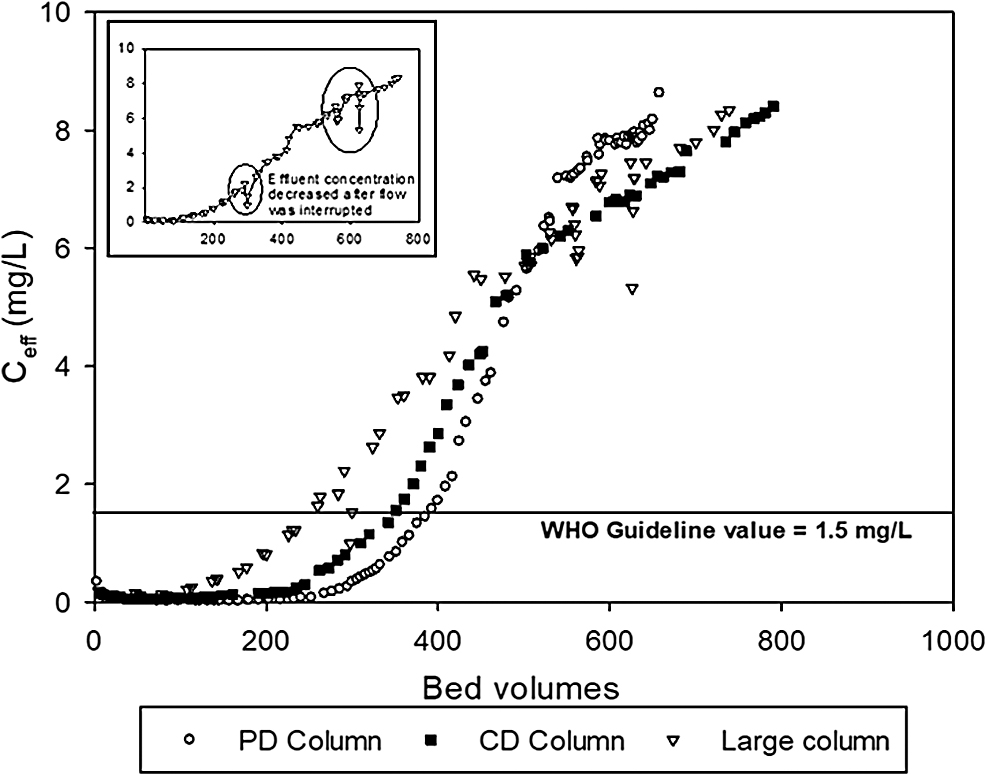
Breakthrough curves for a large column and two small (Rapid Small-Scale Column Test) columns designed using the proportional (PD) and constant (CD) diffusivity approaches.
The flow interruption allowed fluoride ions in the intraparticle region more time to diffuse into the pores of the ceramic pellet, increasing the concentration gradient between the bulk solution and adsorbent surface. A similar phenomenon was observed by Padungthon et al. (2014) who used zirconium-amended anion exchange resins to remove fluoride. The temporary decrease in effluent fluoride concentration indicates that these columns were being operated under nonequilibrium conditions and that intraparticle diffusion plays a significant role in fluoride adsorption.
Comparison with other adsorbents and preliminary cost analysis
The performance of the porous hydroxyapatite ceramic in the 1 mL/min column was 3–4 times better than AA and BC, on a bed volume basis, and comparable to other adsorbents like chemically activated bone (Table 3). The hydroxyapatite ceramic had a similar q1.5 value and similar bed volumes to breakthrough compared to chemically activated cow bone (Yami et al., 2016), as well as a greater q1.5 value and bed volumes to breakthrough than commonly used AA and BC.
Comparison of Column Performance Indicators and Langmuir Parameters for Fluoride Adsorbents
As a further step in comparing the porous hydroxyapatite ceramics to the commonly used AA, a preliminary cost analysis was conducted for producing the ceramic media. Based on cost of equipment, bulk costs of chemicals, and typical energy consumption values (Supplementary Data, and Supplementary Tables S1–S3), the cost of the porous hydroxyapatite ceramics was estimated to be $1.63 per kg. This cost compares favorably with the cost of commercially available AA ($1.50 per kg, Sorg, 2014). This, combined with the fact that bed volumes to breakthrough were almost seven times greater for the porous hydroxyapatite ceramics (Table 3), suggests that hydroxyapatite ceramic pellets are cost effective adsorbents for fluoride and supports the further evaluation of this adsorbent.
Nijhawan et al. (2018) reported that chloride and bicarbonate ions competed with fluoride for adsorption sites on hydroxyapatite ceramics in batch mode. Therefore, future studies will use actual groundwater to study the effect of these ions on the adsorbent performance in a column and include a detailed economic analysis, including capital costs for land and recurring costs of labor and equipment maintenance (not included in the present study).
Conclusions
The kinetics of fluoride adsorption on porous hydroxyapatite ceramics were studied through batch and column adsorption tests. In the batch kinetic test, cylindrical pellets of diameter 2 mm and length 3–4 mm and diameter 4 mm and length 6–8 mm were kept in contact with 10 mg/L fluoride solution for 48 h. The smaller pellets initially removed fluoride at a faster rate, because of shorter intraparticle diffusion distances, but the two systems reached the same equilibrium concentration of 0.03 mg/L after 26 h of reaction time, thus demonstrating the common equilibrium capacity while also confirming the validity of the RSSCT approach for these adsorbents.
The influence of flow rate on fluoride adsorption under continuous-flow column conditions was studied by running two SCs at flow rates of 1 and 2 mL/min. The effluent concentration in both the columns was at or below the detection limit of the fluoride selective electrode (0.02 mg/L) for ∼250 bed volumes, before it started to increase. Eventually, the effluent fluoride concentration reached 1.5 mg/L after 465 and 390 bed volumes for the 1 and 2 mL/min columns, respectively. Since the adsorbent pellet size and bed depth were kept the same, the breakthrough curve was only influenced by the flow rates of each column. The 2 mL/min column had a faster breakthrough but exhibited a more gradual slope and a long ‘tail’ because, at higher effluent concentrations, say Ceff = 7 mg/L, it had more adsorption capacity left compared to the 1 mL/min column. The porous hydroxyapatite ceramics performed better than widely used AA and BC, measured based on bed volumes to breakthrough (Ce = 0.15 C0).
The RSSCT approach was validated for the adsorption of fluoride to porous hydroxyapatite ceramic pellets. The breakthrough curves of two SCs designed using the CD and PD approaches were compared to that of a LC. The CD approach was a better predictor of the fluoride removal performance suggesting that the effective intraparticle diffusivity is independent of the adsorbent size. In contrast, the small PD RSSCT column displayed longer time to breakthrough compared to the larger column. This is comparable to results reported by other researchers who found that the PD RSSCT column often results in longer time to breakthrough.
Interrupting the column flow at different points in the column run led to a temporary decrease in the effluent fluoride concentration. The effluent fluoride concentration decreased from 2.2 to 0.30 mg/L when the flow was interrupted for 48 h after 290 bed volumes. This suggests that the column was running under nonequilibrium conditions and that intraparticle diffusion contributed significantly to fluoride removal. During flow interruption, the fluoride ions diffused further into the pores of the ceramic pellet creating a concentration gradient between the ceramic surface and bulk fluoride solution. This resulted in adsorption on the now available surface sites, when the flow was resumed.
The cost of the hydroxyapatite ceramic media was found to be ∼$1.63 per kg, which compares favorably with the cost of commercially available AA. The fact that this adsorbent performed six to seven times better than AA makes this cost even more competitive.
These results have implications for the use of this adsorbent in a POU or community-scale treatment system. Continuous-flow column tests with different contact times (and, therefore, superficial velocities) resulted in a marked difference in qb values ranging from 4.2 to 9.8 mg/g. It is likely that even higher qb values will be obtained if columns are operated with interrupted flow, thereby maximizing fluoride loading onto the adsorbent before breakthrough. Therefore, future research should focus on testing adsorption in columns with interrupted loading to determine the optimum hydraulic residence time, to maximize the fluoride removal capacity and cost-effectiveness of this material.
Footnotes
Acknowledgments
The authors acknowledge the support of the School of Civil Engineering and Environmental Science.
Author Disclosure Statement
No competing financial interests exist.
Funding Information
This research was funded by the University of Oklahoma WaTER Center and the Sun Oil Company Endowed Chair.

References
Supplementary Material
Please find the following supplemental material available below.
For Open Access articles published under a Creative Commons License, all supplemental material carries the same license as the article it is associated with.
For non-Open Access articles published, all supplemental material carries a non-exclusive license, and permission requests for re-use of supplemental material or any part of supplemental material shall be sent directly to the copyright owner as specified in the copyright notice associated with the article.
