




Abstract
The present study shows sorption capacity of the metallurgical dust, for the anionic dye—Reactive Blue 19, from aqueous solutions and real textile wastewater. The sorption processes were carried out in batch method at six doses of: 2, 5, 10, 20, 50, and 100 g/L. The highest maximum sorption capacity of the dust in relation to the dye from aqueous solution has been estimated for sorbent dose of 2 g/L, it was 319.2 mg/g, and the removal efficiency (RE) was at the level of 62.7%. The experimental data have been analyzed by the Langmuir, Freundlich, and Dubinin–Radushkevich isotherm models, using nonlinear regression. To determine the best fit isotherm 3 error functions were used. Reactive Blue 19 from aqueous solutions was probably bound by the electrostatic attraction between the anionic dye and positively charged surface of the dust. Comparing sorption of the Reactive Blue 19 dye from aqueous solution and textile wastewater, it was observed that for all doses of the metallurgical dust the dye was removed in higher amounts from wastewater, probably due to the presence of the auxiliary substances used in dyeing processes. The RE of the dye was very high both from aqueous solution and textile wastewater, in the range of 84.90–99.92% and 96.48–99.99%, respectively. The results showed that dust from a steel plant, containing iron oxides, can be used as low-cost and effective sorbent to remove reactive dye from aqueous solution and textile wastewater.
Introduction
The constantly growing needs of society and the development of consumerist models have generated a commercial overflow of staple products. The textile industry deserves special attention because it produces a huge volume of highly pollutant waste products with high organic load, sharp color, and toxicity to humans and to the environment (Hasanbeigi and Price, 2015; Alay et al., 2016; Amaral et al., 2016).
Dyes have become one of the main sources of severe water pollution as a result of the rapid development of the textile industries (Genc and Oguz, 2010; Wanyonyi et al., 2013). Many dyes have toxic, mutagenic, and carcinogenic effects and this poses a serious hazard to living organisms (Crini, 2006; Mondal, 2008; Beyene, 2014; Mirzaei et al., 2016). The widest group of dyes is reactive dyes, which, due to their high solubility in water and low biodegradability, are the most problematic chemicals in wastewater of the textile industry (Dizge et al., 2008; Jiang et al., 2014). Therefore, appropriate measures are necessary to remove dyes from wastewater before they are discharged into the sewerage system and the environment.
The main reason for choosing the reactive dye for the sorption studies was the fact that this group of dyes is commonly used for dyeing processes, and what is more, this dye was the main color component of real textile wastewater, which the authors managed to obtain from dye works. According to literature data (Kyzas and Lazaridis, 2009; Jiang et al., 2014) reactive dyes represent an increasing market share, because they are used to dye cotton fibers, which make up about half of the world's fiber consumption; furthermore, a large fraction, typically around 30% of the applied reactive dyes, is wasted due to the dye hydrolysis in alkaline dye bath, and also conventional wastewater treatment plants have a low removal efficiency (RE) for reactive and other anionic soluble dyes, which leads to colored waterways.
There are many methods available for removing dyes from textile wastewaters, such as membrane filtration, ion exchange, electrochemical techniques, coagulation and flocculation, reverse osmosis, chemical oxidation, ozonation, and biological treatment, including activated sludge and bacterial action (Robinson et al., 2001; Arslan-Alaton, 2004; Thamaraiselvan and Noel, 2014; Gadekar and Ahammed, 2015). However, these methods are relatively ineffective because most of reactive dyes are highly water soluble, have complex structures, and are stable to light, chemical, and biological degradation, and what is more, these methods are very expensive (Aksakal and Ucun, 2010; Beyene, 2014; Malakootian et al., 2015).
Among those methods sorption, due to its simplicity in design, cost effectiveness, efficiency, ease of operation, tolerance to toxic materials, biodegradability, and capability for treating dyes at high concentrations, is more promising than the other methods. The best known and most widely used sorbent is activated carbon, which has high sorption capacity. However, the main obstacle to using activated carbon as the sorbent for water and wastewater treatment is its price.
Therefore, a number of nonconventional sorbents, like natural and waste materials, for example, from industry and agriculture, have been tried for the treatment of water and wastewaters (Crini, 2006; Pengthamkeerati et al., 2008; Kyzioł-Komosińska et al., 2011; Ciobanu et al., 2016; Kyzioł-Komosińska et al., 2018; Saleh et al., 2018; Côrtes et al., 2019). Among the abovementioned sorbents iron-containing materials, such as steel plant wastes (Jain et al., 2001; Jain et al., 2003; Bhatnagar and Jain, 2005) and iron filings (Azhdarpoor et al., 2014; Dehghani et al., 2018), have proved to be effective waste material for removing textile dyes.
Research on the removal of textile dyes by sorption methods has been carried out for many years, but most of it concerns sorption from dye solutions based on distilled or tap water, not from real wastewater samples. Study on sorption of dyes from real textile wastewater is much more difficult, as industrial wastewater contaminated with the dyes also contains a significant amount of auxiliary substances, which are present in wastewater in concentrations similar to which they were used in; furthermore, wastewater can modify properties of sorbent.
However, to determine the suitability of the material as an effective sorbent, the first step is to investigate the removal of dyes from model solutions, because the use of distilled water eliminates all additional matrix effects. What is more the authors wanted to have an influence on change of individual parameters and determine their impact on the sorption properties of the tested metallurgical dust. Residue such as dusts and sludge that originate from steel plants in course of steel production is only partially recyclable; most of them are deposited in landfills (Amaral et al., 2016). They adversely affect the environment, and in addition, by occupying large areas, they reduce the esthetic values of the environment.
Therefore, it seems reasonable to look for new ways to use them. Due to their chemical composition and physicochemical properties, they show the ability to remove heavy metal ions and organic pollutants (including synthetic dyes) from water and wastewater by sorption methods (Genc and Oguz, 2010; Amaral et al., 2016; Pająk et al., 2018). Through these studies it was possible to verify the hypothesis that the dust from a steel plant used for research is an effective sorbent for removing pollutants from water and wastewater.
The aim of this study was to determine the possibility of using metallurgical dust from a steel plant as an effective sorbent for removing anionic reactive dye (Reactive Blue 19) both from aqueous solutions and from real textile wastewater. During the sorption research, the influence of parameters, that is, the initial concentration and the sorbent dose on the course and effectiveness of the process were determined. Three 2-parameter sorption isotherms, that is, Freundlich, Langmuir, and Dubinin–Radushkevich, were used to interpret the obtained results. Parameters were estimated by nonlinear regression, which allowed to calculate the maximum adsorption capacity of the dust and determined the mechanism of dye binding.
Materials and Methods
Research material
The metallurgical dust from sinter belt de-dusting, obtained from the steel plant located in the Silesian region, Poland, was used for laboratory studies as a sorbent. The raw form of the metallurgical dust, only ground to fine material of size ranging 0.1–180 μm, was used. Chemical analysis showed the following composition: Fe = 57.29%, FeO = 7.19% and, moreover, contained: SiO2 = 6.07%, CaO = 7.42%, MgO = 1.36%, Al2O3 = 1.21%, Mn = 0.37%, Na2O = 1.48%, K2O = 0.02%, Zn = 0.02%, S = 0.16%. The Mössbauer spectra and X-ray diffraction patterns point to the presence of the following phases containing iron: hematite and traces of magnetite fine grain fraction (Szumiata et al., 2017).
The pH value of the dust in water solution, measured at the suspension ratio of 1:10, was 10.11. Presence of calcium oxide contributes to high pH in water suspension and high buffer capacity indicating potential to counteract pH changes, for example, in reaction with acidic solutions (Pająk et al., 2018). The point of zero charge (pHPZC), defined as the pH at which the charge of the colloidal particles = 0 was determined with the method described by Lazarević et al. (2007), was 7.95.
Reactive Blue 19 (RB19, Remazol Brilliant Blue R, CAS number: 2580-78-1) dye was selected as a model of anionic dye for the adsorption experiments. It was produced by Boruta Zachem-Color, Ltd., Poland. Reactive Blue 19 is an anthraquinonic anionic dye that contains one vinyl sulfonyl group (–SO2–CH2–CH2–OSO3Na) on the monobenzene ring and one sulfonic group (–SO3Na) on the anthraquinone ring. This dye has a molecular weight of 626.5 g/mol, maximum absorption of λmax = 584 nm, and a pH value in water at 1 g/L = 4.29. The chemical formula of Reactive Blue 19 (C22H160O11N2S3Na2) is shown in Fig. 1.
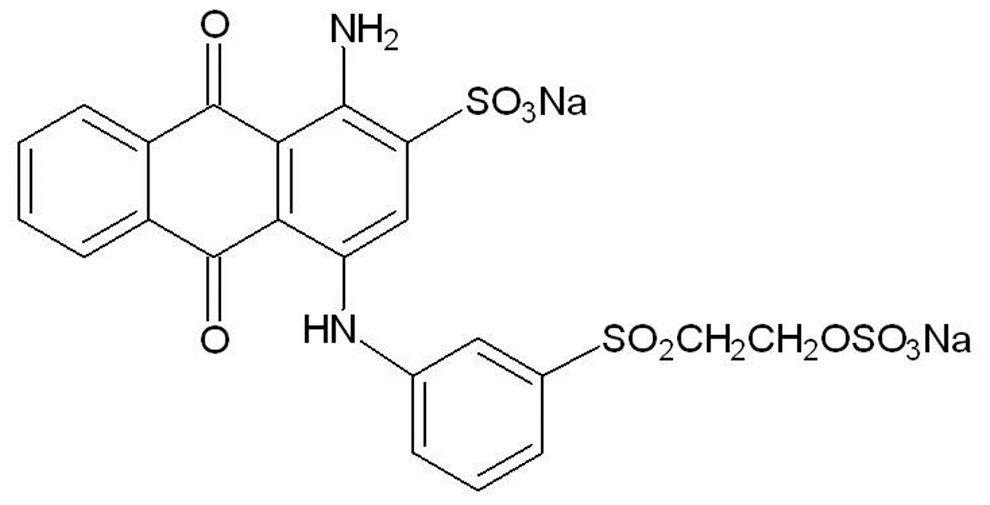
Chemical structure of Reactive Blue 19 dye.
The textile wastewater containing Reactive Blue 19 was obtained from a Dye Works located in the Lodz Province, Poland, and its composition is shown in Table 1. The composition of wastewater indicated that NaCl and Na2CO3 were a main auxiliary substance, which influenced on high value of pH of wastewater.
Composition of the Textile Wastewater
COD, chemical oxygen demand; RB19, Reactive Blue 19.
Sorption process
Preliminary study was performed to determine the metallurgical dust with the highest dye sorption capacity. Batch experiment was carried out to measure the sorption capacities of the metallurgical dust in relation to the Reactive Blue 19 dye from aqueous solutions and textile wastewater at room temperature. The time of shaking sorbent with the solution of the sorbate was 24 h. The initial dye concentrations in aqueous solution were within a wide range of 1–1,000 mg/L. The initial dye concentration in the real wastewater was 62.5 mg/L, and the model aqueous solution of the Reactive Blue 19 of the same concentration was prepared. The sorption process of the Reactive Blue 19 onto the metallurgical dust from the aqueous solutions and from the real textile wastewater was carried out with six doses of: 2, 5, 10, 20, 50, and 100 g/L.
The initial (C0) and equilibrium (Ceq) concentrations of the dye in aqueous solutions and wastewater were determined using UV-vis spectrometry (Spectrometer Varian Cary 50 Scan UV-VIS) at wave length λ = 584 nm. The pH values in all solutions were measured by potentiometric method using a pH-meter glass electrode (Elmetron ERH-111).
The equilibrium amount of the sorbed dye per unit mass [Eq. (1)] and the RE of the dye sorbed on the sorbent [Eq. (2)] were calculated using the following equations:
where C0 and Ceq are the initial and equilibrium dye concentrations in the solution (mg/L), respectively, V is the volume of the solution (L), and m is the mass of the sorbent (g).
All the sorption samples were tested in duplicate, and the mean values were applied.
Determination of parameters in the sorption isotherms
The data obtained from the equilibrium studies were analyzed using three models of two-parameter isotherms, that is, the isotherm of Freundlich, which describes equilibrium on heterogeneous surfaces and assumes that the concentration of the sorbate on the sorbent surface increases with the sorbate concentration (Freundlich, 1906; Dizge et al., 2008), the Langmuir isotherm, which assumes that monolayer sorption occurs at a fixed number of well-defined sites that are energetically equivalent, with no lateral interaction and steric hindrance between the sorbed molecules, even on adjacent sites (Langmuir, 1916; Dizge et al., 2008), and the Dubinin–Radushkevich isotherm, which is an empirical model describing the sorption with a Gaussian energy distribution on heterogeneous surfaces (Dubinin, 1960).
Parameters in isothermal equations were estimated by nonlinear regression. There was obtained better adjustment of isotherms to observed values using nonlinear than linear regression (Pająk et al., 2019). The three tested models' equations are summarized in Table 2.
Nonlinear Forms of Freundlich, Langmuir, and Dubinin–Radushkevich Isotherm Models
The constant β of the Dubinin–Radushkevich isotherm was used to determine the free energy (E) of the sorption by the equation:
Value of E between 8 and 16 kJ/mol indicates on chemical sorption, if the value is lower than 8 kJ/mol indicates on physical sorption (Özcan et al., 2006; Genc and Oguz, 2010).
The nonlinear regression, based on the classical least-squares method, was used to determine the values of parameters in the sorption isotherms (Statistica ver. 9.0—Gauss–Newton algorithm). To evaluate the fit of the isotherm to the experimental data besides the determination coefficient (R2) three nonlinear error functions, the sum of the errors square (SSE), residual root mean square error (RMSE), and chi-square test (χ2), were examined (Foo and Hameed, 2010), and in each case a set of isotherm parameters were determined by minimizing the respective error function across the concentration range studied (Table 3).
List of Different Error Functions
RMSE, residual root mean square error; SSE, sum of the errors square.
Lower values of error functions (SSE, RMSE, and χ2) indicate the similarity of the values calculated based on models to those obtained experimentally and a good fit of the isotherm to the experimental data (Foo and Hameed, 2010).
Results and Discussion
Sorption of the Reactive Blue 19 dye from aqueous solutions
The sorption capacity of the metallurgical dust was investigated as a function of the equilibrium concentration of the dye. The experimental isotherms of the sorption and the RE of the Reactive Blue 19 dye from aqueous solutions using metallurgical dust as sorbent are presented in Fig. 2.
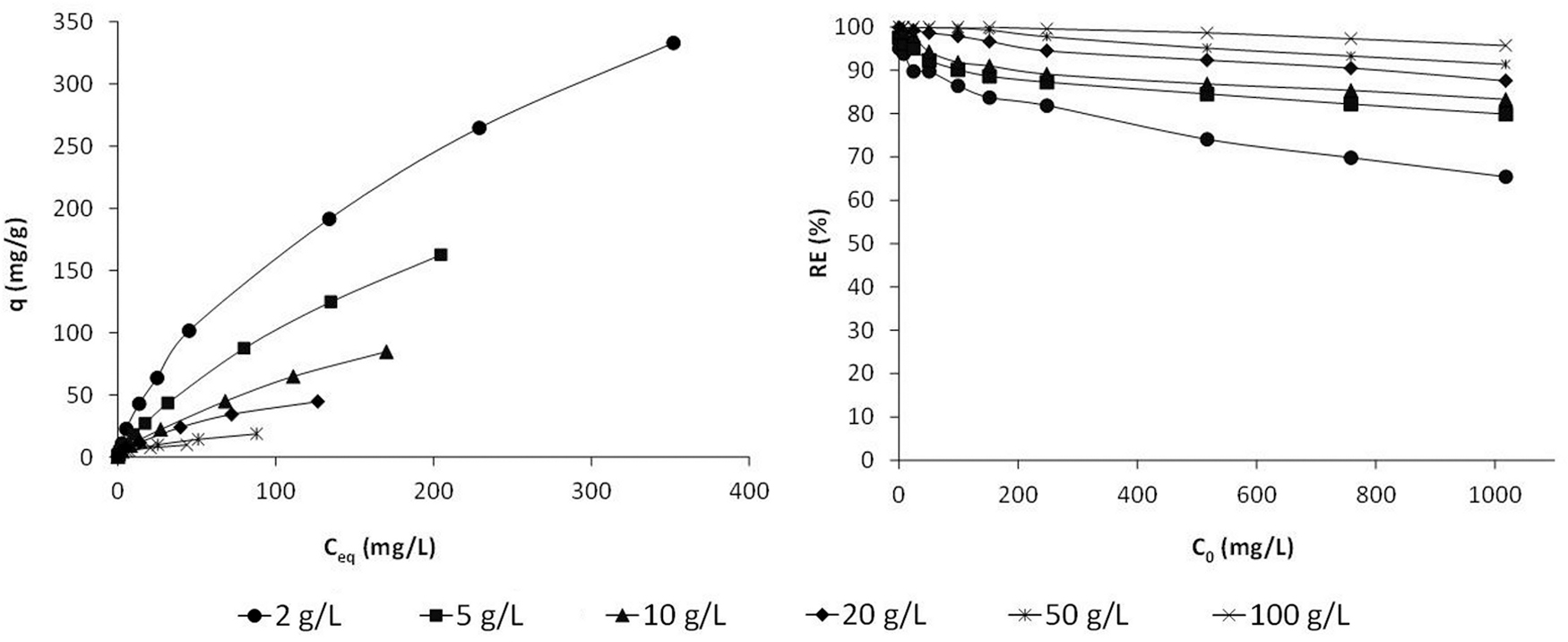
Experimental sorption isotherms and removal efficiency of the Reactive Blue 19 dye from aqueous solutions onto metallurgical dust.
The results show that the decrease of the sorbent dose caused an increase in the sorption capacity of the metallurgical dust in relation to Reactive Blue 19, while reducing the degree of the RE of the dye from the solution. The sorption capacity of the metallurgical dust depended on the initial concentration of the dye in the solution and the dose of sorbent. At the highest applied sorbent dose of 100 g/L and at the maximum initial concentration of 1,000 mg/L the Reactive Blue 19 dye was bound in the amount of 9.74 mg/g, and the RE was at the level of 95.7%. With the decrease in the sorbent dose to 50, 20, 10, and 5 g/L the maximum sorption capacity increased to 18.6, 44.6, 84.8, and 203.1 mg/g, respectively, while the RE decreased to 91.4%, 87.5%, 83.3%, and 79.8%, respectively.
Xue et al. (2009) conducted research on the sorption capacity of oxygen furnace slag from steel-making factory in relation to anionic dyes, including Reactive Blue 19. At the same sorption conditions, that is, sorbent dose of 5 g/L and initial concentration of 500 mg/L, the sorption capacity of oxygen furnace slag was 40 mg/g, while the sorption capacity of metallurgical dust obtained in this study was more than twofold higher, that is, 87 mg/g.
The highest maximum sorption capacity of the metallurgical dust in relation to Reactive Blue 19 was observed for sorbent dose of 2 g/L, it was 319.2 mg/g, and the RE was at the level of 62.7%. These findings are consistent with those of Azhdarpoor et al. (2014) concerning sorption study of reactive dye on iron filings from aqueous solutions. The researchers concluded that increasing dose of iron filing has a significant positive impact on dye adsorption. They observed that at initial dye concentration of 100 mg/L, by increasing the dose of waste iron 10 times, the RE increased from 76.89% to 97.28%. In our studies, the similar relation was observed, that is, a 10-fold increase in dose (from 2- to 20 g/L) also resulted in an increase in the RE for initial concentrations of 100 mg/L, from 86.40% to 97.9%.
Dalvand et al. (2016) studied the sorption properties of modified iron oxide (
For all sorbent doses it was observed that in the low range of the initial concentrations of the dye in aqueous solution (1–25 mg/L), the RE was very high, over 90%. Fiftyfold reduction of the metallurgical dust dose resulted in a 32.8-fold increase in its sorption capacity in relation to the dye at its maximum initial concentration. Increase of the metallurgical dust dose promoted decrease in the amount of dye uptake per gram of sorbent. Malakootian et al. (2015) explain that this decrease in unit of sorption with an increase in sorbent dose is related to the remaining unsaturated sorbent sites during the absorbing process or the overcrowding of the particles. As the sorbent mass increases, the available surface increases, so the amount of sorbent dye per unit of sorbent surface decreases. At the same time, the RE of pollutants from solutions increases.
It was observed that the pH values in the equilibrium solutions did not depend on the sorbent doses and initial dye concentrations, and they were in the range 7.24–7.70 for all sorbent doses (Fig. 3). The pH values in the equilibrium solution were lower than the value of the point of zero charge of the metallurgical dust, which suggested that the surface of the sorbent during sorption process was positively charged. In this case, the electrostatic attraction probably exists between the anionic dye and cationic sorbent. To similar conclusions came Azhdarpoor et al. (2014), investigating the sorption of the reactive dye using iron filings, as well as Malakootian et al. (2015), investigating the sorption of the reactive dyes (i.e., Reactive Blue 19 and Reactive Red 198) using alumina/carbon nanotube hybrid.

Dependence of the pH value in equilibrium solutions.
Materials rich in iron compounds are characterized by high value of the point of zero charge (pHPZC). The materials are positively charged due to the protonation of the surface when the solution pH is lower than their pHPZC values and negatively charged due to the deprotonation of the surface when the solution pH is higher than the pHPZC. Therefore, materials rich in iron compounds at pHPZC below 8.0 have positively charged surface and can bond anionic contaminants or anionic dyes.
The effect of sorbent dose on the RE of the Reactive Blue 19 dye and the sorption capacity (q) of the metallurgical dust were examined at the initial concentration of 50, 500, and 1,000 mg/L of the dye (Fig. 4).

Sorption capacity (q) and removal efficiency (RE) of Reactive Blue 19 as a function of adsorbent dose.
At the maximum initial concentration of the dye, with the increase of the sorbent dose, that is, from 2 to 100 g/L, there was almost 33-fold decrease of the sorption capacity—from 319.2 to 9.74 mg/g, respectively, while the RE increased from 62.7% to 95.7%. At the lower initial concentrations of the dye of 50 and 500 mg/L, with the increase of the sorbent dose, there were about 45- and 37-fold, respectively, decrease of the sorption capacity from 22.7 to 0.51 mg/g and 191.5 to 5.1 mg/g, respectively, whereas the RE increased from 89.72% to 99.96% at the initial concentration of 50 mg/L and from 74.08% to 98.63% at the initial concentration of 500 mg/L.
The increases in the adsorption with the dose can be attributed to increased surface area and the availability of more adsorption; similar relations were observed by Namasivayam et al. (1998), who carried out sorption studies of anionic dyes by sorption onto banana pith, as well as Fungaro et al. (2011) who carried out adsorption studies of anionic dyes from aqueous solutions on zeolites from fly ash-iron oxide magnetic nanocomposite. In contrast, the increase in the adsorbent masses promoted a remarkable decrease in the amount of dye uptake per gram of adsorbent. According to Shukla et al. (2002) the drop in adsorption capacity was basically due to sites remaining unsaturated during the adsorption and particle aggregation.
The selection of optimal conditions of sorption process should be made taking into account not only the sorption capacity but also the RE. Therefore, it was observed that the most optimal conditions for the sorption of the Reactive Blue 19 dye on the metallurgical dust, depending on the initial concentration, occur at the lower sorbent doses ranging between 2 and 5 g/L.
Sorption isotherms
The parameters calculated from the Freundlich, Langmuir, and Dubinin–Radushkevich isotherms and the values of three error functions (SSE, RMSE, and χ2) for the adsorption of Reactive Blue 19 dye from aqueous solutions onto metallurgical dust are shown in Table 4. Moreover, on the basis of the estimated parameters, the theoretical isotherms were plotted and are illustrated in Fig. 5.
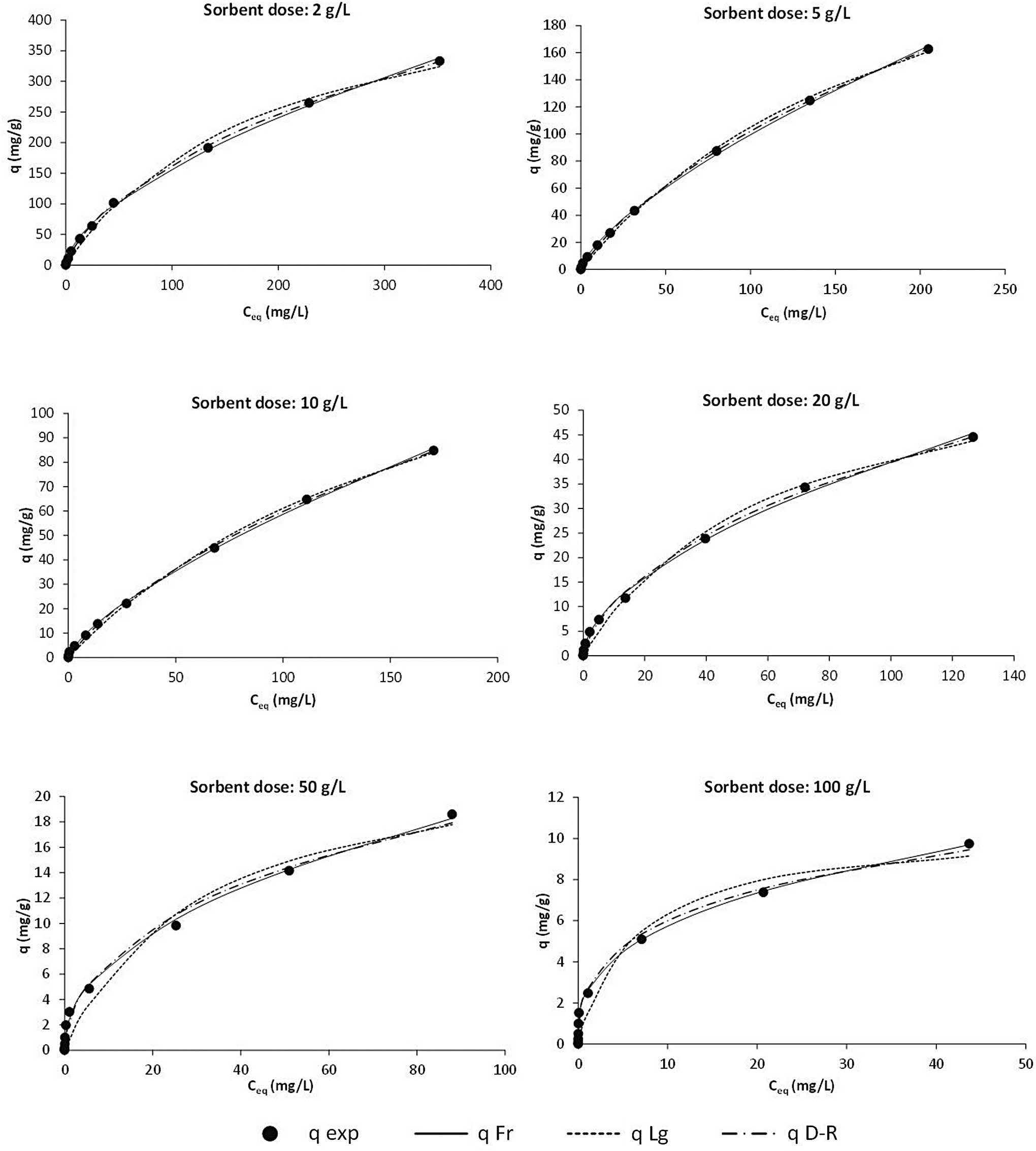
Theoretical isotherms with experimental points of Reactive Blue 19 dye adsorption.
Isotherm Parameters and Error Function Data
The lowest values of the error functions (SSE, RMSE and χ2) are in bold.
This allowed to conclude that all three used isotherm models can be used to describe the sorption process of this reactive dye on the metallurgical dust. However, based on the lowest values of the error functions (SSE, RMSE, and χ2), which are bolded in Table 4, it was observed that the Freundlich isotherm best described the sorption process of the Reactive Blue 19 dye by metallurgical dust for doses of 10, 20, 50, and 100 g/L, while the Dubinin–Radushkevich isotherm best described the sorption for doses of 2 and 5 g/L. In addition, it can be concluded that with the increase in dose, there was a change in the best fit of the isotherm to the experimental data, that is, from the Dubinin–Radushkevich model to the Freundlich model.
The values of the 1/nF parameter estimated from the Freundlich isotherm for all used sorbent doses were lower than 1, indicating a favorable nature of sorption process. Similar relations were observed by Banaei et al. (2017) who carried out sorption studies of reactive dyes (i.e., Reactive Yellow 84 and Reactive Blue 19) from aqueous solutions using silica gel modified with 2,2′-(hexane-1,6-diylbis(oxy)) dibenzaldehyde, as well as Dalvand et al. (2016) during sorption studies of Reactive Blue 19 using
The high values of the KF parameter for the dust-dye system indicated a high intensity of the sorption process of this dye. In addition, the values of the KF parameter were the highest at the two lowest doses applied, that is, 2 and 5 g/L, therefore, under the conditions for which the sorption capacity was the highest and the most optimal conditions of the sorption process were observed.
The Langmuir isotherm provides useful information, such as the maximum sorption capacity (qmax), as well as the isotherm constant (KL), which is related to the affinity of the binding sites and the binding energy. The values of the qmax parameter for all used sorbent doses were greater than the experimental values, which indicate that monolayer wasn't completely covered. The calculated value of the KL parameter was 0.005086–0.1545 L/mg. This indicates a high affinity of the dye to the surface of the metallurgical dust and a low energy of dye binding by dust depending on the sorbent dose.
The values of the parameter E, which were estimated from nonlinear form of the Dubinin–Radushkevich equation, were above 8 kJ/mol for all sorbent–dye systems. This indicates that the process was a chemical sorption. Kyzioł-Komosińska et al. (2018) came to similar conclusions while investigating the sorption of anionic dyes (i.e., Reactive Blue 19) using peat, as well as Akar et al. (2009) using a mixed biosorbent of macro-fungus Agaricus bisporus and Thuja orientalis cones to remove reactive dye.
Sorption of the Reactive Blue 19 dye from textile wastewater
The experimental isotherms of the sorption and the RE of Reactive Blue 19 dye from the real textile wastewater using metallurgical dust as sorbent are presented in Fig. 6.
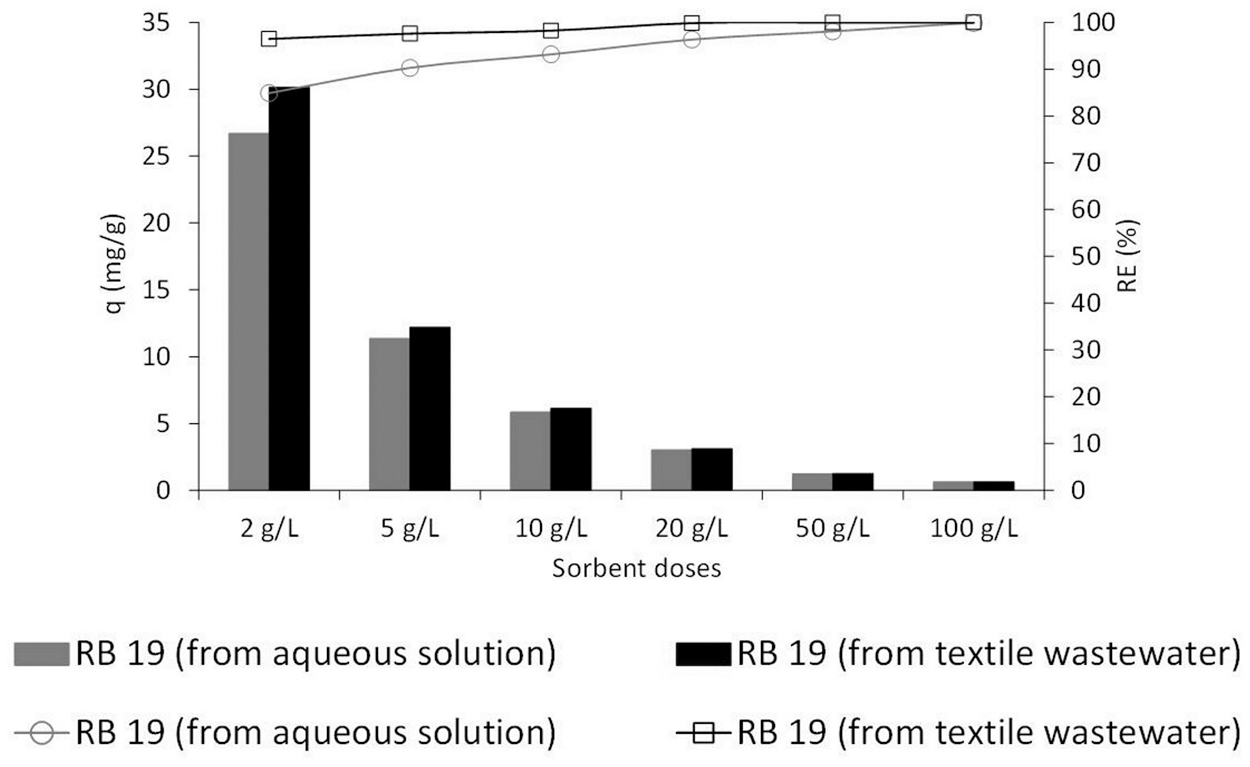
Adsorption capacity and removal efficiency of Reactive Blue 19 dye (C0 = 62.5 mg/L) from aqueous solution and textile wastewater.
According to obtained results the RE of the Reactive Blue 19 dye from both aqueous solution and real textile wastewater increases with increase in adsorbent dose, but adsorption capacity decreases with increase in adsorbent dose, which is related to the remaining unsaturated sorbent sites during the absorbing process or the overcrowding of the particles (Malakootian et al., 2015). The highest maximum sorption capacity of the metallurgical dust in relation to Reactive Blue 19 both from aqueous solution and textile wastewater was observed for sorbent dose of 2 g/L; it was 26.7 and 30.15 mg/g, respectively. Moreover, it was observed that the RE of the dye by the dust was very high both from aqueous solution and textile wastewater, in the range of 84.90–99.92% and 96.48–99.99%, respectively.
The differences in the possibility of removing Reactive Blue 19 from aqueous solutions and textile wastewater by metallurgical dust are most likely due to the pH value of aqueous solutions of the dye (pH 4.29) and wastewater (pH 10.43), as well as the presence of auxiliary substances in wastewater. The adsorption of RB19 from aqueous solutions occurred at pH 7.52–7.72 and from textile wastewater at 9.9–10.11. The adsorption of Reactive Blue 19 dye from wastewater occurred at pH > pHPZC, when the electrostatic interactions between anionic dye and negative charged surface are repulsive, which should decrease the sorption capacity. However, the obtained results indicate that the sorption capacity of metallurgical dust in that case has increased.
This can be explained by the presence of the auxiliary substances in the textile wastewater. The auxiliaries used in the dying processes with reactive dyes were NaCl, which accelerates the diffusion and adsorption of dye molecules on fibers and improved the fixation degree of dyes, and Na2CO3, which was added to get better penetration.
According to Ip et al. (2009) when the electrostatic interaction between the dye molecules and the adsorbent surface is repulsive, the addition of salts will increase the adsorption capacity, as ions in the salts can neutralize the charge on the surface and charged dye molecules. What is more, as noted by Dolphen et al. (2007) the salts can affect the adsorption capacity of fibers by changing the ionic nature, hydrophobicity, and solubility of the dye. As a result, the increase in surface concentrations results in the penetration of dye into adsorbents.
Conclusion
The present study showed that metallurgical dust from a steel plant can be used as low-cost, effective, and easily available alternative to commercial expensive activated carbon for the removal of the acid dye not only from water solution but also from textile wastewater. The sorption was found to be dependent on the sorbent dose and the initial concentration of the dye. The maximum sorption capacity of 319.2 mg/g for Reactive Blue 19 was achieved at 2 g/L adsorbent dose from the aqueous solutions. The dye was removed in larger quantities from textile wastewater than from aqueous solutions, preferably also at a dose of 2 g/L; it was 30.15 and 26.7 mg/g, respectively. The sorption capacity decreased with an increasing sorbent dose due to the remaining unsaturated adsorbent sites during the adsorption process or the overcrowding of the particles.
All three used isotherm models, Langmuir, Freundlich, and Dubinin–Radushkevich, can be used to describe the sorption process of this reactive dye on the metallurgical dust. However, based on the lowest values of the error functions (SSE, RMSE, and χ2), the Freundlich isotherm well described the sorption process of the dye from aqueous solutions at higher doses, that is, 10, 20, 50, and 100 g/L, while the Dubinin–Radushkevich at smaller doses, that is, 2 and 5 g/L. Calculated sorption parameters indicate that a favorable nature of sorption, a high intensity of the process, and a high affinity of the dye to the surface of the sorbent, moreover, indicate that monolayer wasn't completely covered and the process was a chemical sorption.
Footnotes
Author Disclosure Statement
No competing financial interests exist.
Funding Information
This work was supported by Polish Ministry of Science and Higher Education Project No. N523 3509 33 and by National Science Centre Project No. 2012/05/N/ST8/03149.