




Abstract
In this study, microscale zinc–copper (mZn/Cu) bimetallic particles were prepared through precipitating Cu on the surface of Zn and applied in the degradation of p-nitrophenol (PNP). To optimize reaction conditions, three control parameters, including reciprocating speed, mZn/Cu dosage, and PNP concentration, were investigated by the central composite rotatable design coupling with response surface methodology. To further evaluate the catalytic activity of mZn/Cu, the removal of PNP and total organic carbon (TOC) were compared in different systems. It is found that the removal of TOC by mZn/Cu, mFe/Cu, mZn, mFe, mCu, and mZn + mCu was 77%, 41%, 5%, 7%, 19%, and 9%, respectively. The maximum mineralizing of PNP was realized in the system of mZn/Cu/PNP, suggesting that PNP mainly underwent oxidative degradation. Furthermore, these results also indicate that PNP was basically reduced in the presence of mZn, mFe, and mZn + mCu. The mechanism investigations via florescence spectroscopy and free radical scavengers reveal that
Introduction
In the past decades, industrial wastewater has been one of the major concerns in environmental protection due to its high toxicity and low biodegradability. p-Nitrophenol (PNP) and its derivatives, the typical aromatic pollutants, are widely used in industrial areas for various purposes (Yu et al., 2010; Lai et al., 2013; Zhang et al., 2015a; Pang and Lei, 2016; Meijide et al., 2017; Subbulekshmi and Subramanian, 2017). Consequently, a lot of industrial wastewaters containing PNP and its derivatives are discharged into the environment, which brings a severe threat not only to the aquatic organisms but also to human beings.
In this scenario, many options such as biodegradation and adsorption have been applied to remove PNP from the contaminated environments (Shen et al., 2014; Jović et al., 2017). However, on account of their own shortcomings (low efficiency or high cost), it is imperative to search for economic, efficient, and environmental friendly methods for removing the wastewater containing PNP and its derivatives.
Advanced oxidation processes are considered to be one of potential approaches to remove PNP and its derivatives in aqueous solution. PNP could be effectively degraded by O3 activated with Mn–Co–Fe (Ma et al., 2014). In this system,
Recently, it has been reported that some zerovalent metals can induce Fenton or Fenton-like reaction to destruct organic pollutants via activating dissolved oxygen in acidic solution. At low pH, H2O2 can form through a series of reactions in the presence of zerovalent iron (ZVI) under aerobic condition, and then
To further improve the activities of metal particles and the degradation efficiencies of organic contaminants, the microscale bimetallic particles prepared through precipitating a second transition metal on the surface of Fe have been widely investigated (Ayoub and Ghauch, 2014; Marcelo et al., 2016; Dai et al., 2017; Zhang et al., 2017; Wen et al., 2018). Lai and his colleagues (Lai et al., 2014; Ji et al., 2017) used microscale iron–copper (mFe/Cu) bimetallic particles to degrade PNP at a relatively high concentration. In the mFe/Cu bimetallic system, the degradation of PNP results from the synergistic reaction of direct reduction on the catalytic activity sites and indirect reduction by atomic hydrogen produced from the interaction of Fe with H+ (Lai et al., 2014). In this case, organic contaminants mainly undergo a reductive degradation and the removal of total organic compounds (total organic carbon [TOC]) is usually not high owing to the insufficient
Zerovalent zinc (ZVZ) has a higher reductive activity than ZVI under acidic condition (Zhang et al., 2015b). Hence, ZVZ is expected to more easily offer electrons in the bimetallic system, which is in favor of the conversion of the dissolved oxygen to O2
To further investigate the activity of mZn/Cu bimetallic particles, the experiment about the degradation of PNP by mZn/Cu bimetallic particles was carried out. The main interaction effects of three variables concluding the reciprocating speed, the mZn/Cu dosage, and the PNP concentration on the removal of PNP were examined via a statistical approach. The central composite rotatable design (CCRD) was utilized to optimize the conditions for the degradation of PNP by mZn/Cu. Furthermore, the degradation efficiency of PNP and the removal of TOC in the different systems, including mZn, mFe, mCu, mFe/Cu, mZn + mCu, and mZn/Cu, were compared to assess the excellent performance of mZn/Cu bimetallic particles in the oxidative degradation of PNP. The experiments of radical scavengers and florescence spectroscopy were carried out to investigate the mechanism of PNP degradation by mZn/Cu bimetallic particles. Based on the intermediates obtained from liquid chromatography-mass spectrometry (LC-MS) spectra, finally, two possible degradation pathways were established.
Materials and Methods
Materials and reagents
The mZn, mCu, and mFe powders with the diameters about 50 μM and copper sulfate pentahydrate were purchased from Xilong Chemical Regent Co., Ltd. PNP was obtained from Aladdin chemical Regent Co., Ltd. Terephthalic acid, tert-butyl alcohol (TBA), and benzoquinone (BQ) were bought from Sinopharm Chemical Regent Co., Ltd. Methanol (high-performance liquid chromatography [HPLC] grade) was obtained from Tedia Company. Other chemicals used in this experiment were of analytical grade. All solutions used in this study were prepared by dissolving the necessary reagents in pure water (Milli-Q; 18.2 MΩ) generated from purification system (Millipore).
Preparation of mZn/Cu bimetallic particles
The ZVZ and ZVI were treated with diluted NaOH and H2SO4, respectively, to remove all oil and oxides. Then, the treated zinc and iron powders were rinsed three times with deionized water and dried at 70°C under N2 protection (Zhang et al., 2015b). The bimetallic mZn/Cu particles in this study were chemically synthesized via displacement reaction according to Equation (1) (Yu et al., 2017; Yamaguchi et al., 2018). A specific amount of fresh ZVZ and CuSO4 solution was mixed by a magnetic stirrer at a speed of 300 rpm for 20 min at 25°C. The optimal theoretical Cu mass loading of mZn/Cu bimetallic particles was 60.54 wt% (OTMLCu = 60.54 wt%), which was determined on the basis of the performance of aniline degradation in our previous study (Li et al., 2018). Furthermore, according to a report of Lai et al. (2014), the mFe/Cu bimetallic particles with OTMLCu = 47.09 wt% were obtained through the same process as described above.
Experimental procedures
PNP degradation was conducted in a glass flask (250 mL) at an initial pH 2.5 (the degradation efficiency was unsatisfactory at pH >2.5, see Supplementary Fig. S1). First, 100 mL of PNP (required concentration) solution was introduced into the glass flask. The initial pH was adjusted to the desired values with diluted H2SO4 solutions. The reaction was initiated as the bimetallic mZn/Cu particles were added to the solution. The samples were taken out at regular time intervals and filtered into a clear and dried glass tube through a 0.45 μm filter membrane. The concentration of PNP was detected by HPLC. In the section, each experiment was conducted in triplicate and the mean values were represented with error bars.
To optimize experimental conditions for the degradation of PNP by the mZn/Cu bimetallic particles, the CCRD experiment, one of the response surface methodologies (RSMs), was used. Three independent parameters, including the reciprocating speed (X1; r/min), the mZn/Cu dosage (X2; g/L), and the PNP concentration (X3; mg/L), each in five levels with 17 runs, were adopted to investigate the influence of the each variable on the design (Table 1). The quadratic equation used to model the response was as follows:
Independent Variables of the Experiments
mZn/Cu, microscale zinc–copper; PNP, p-nitrophenol.
where Y is the observed response, b0 is a constant coefficient, bi, bii, and bij are the coefficients for the linear, quadratic, and interaction effects, respectively (Fu et al., 2007; Bezerra et al., 2008; Schenone et al., 2015; Eslami et al., 2016). The results were analyzed by the least-squares method, and response surfaces were generated with a SPSS 17.0 program. In the section of the experiment, the sample was withdrawn at 60 min for the analysis of PNP.
To assess the catalytic activity of the mZn/Cu bimetallic particles, the removal of PNP and TOC by mZn, mFe, mCu, mZn + mCu (simply mixing microscale Zn and Cu at a molar ratio of Zn∶Cu = 1∶1), mFe/Cu at the OTMLCu = 47.09 wt%, and mZn/Cu at the OTMLCu = 60.54 wt% were further investigated at the same optimal parameters obtained by RSM.
Analytical methods
The morphological studies were conducted using field emission scanning electron microscopy (FESEM; (Hitachi, Japan). The concentration of PNP was measured by HPLC (Agilent). A reversed-phase C18 HPLC column (5 μm, 4.6 mm × 250 mm; Agilent) was used and the column temperature was maintained at 35°C. The mobile phase consisted of methanol–water (0.1% H3PO4) (55:45, V/V) with a flow-rate of 1.0 mL/min and manual injection volume was 20 μL. The concentration of PNP was calculated by peak area according to external standard method. The TOC in PNP solution before and after the reaction was determined with Shimadzu TOC-L analyzer (Shimadzu, Japan).
The total concentration of copper ions (TCu) was measured by atomic absorption spectrometry (AA-7020; Shimadzu). The concentration of Cu+ generated during the reaction process was determined by a photometric method with neocuproine (Yamini and Tamaddon, 1999). The H2O2 produced during the reaction was measured by a photometric method (Bader et al., 1988). The analysis of fluorescence spectrum was performed on a Hitachi F-4500 fluorescence spectrophotometer (Hitachi) to detect hydroxyl radicals produced from the activation process (Ishibashi et al., 2000). The intermediates of PNP degradation were analyzed via Agilent 1200 series LC equipped with Agilent 6410 Triple Quad mass spectrometer (Agilent).
Results and Discussion
Characterization of mZn/Cu bimetallic particles
The characterization of the fresh ZVZ and mZn/Cu bimetallic particles was investigated and the images are displayed in Fig. 1. As shown in Fig. 1a, the pristine ZVZ particles displayed a sphere structure with diameters of 20–60 nm. The FESEM image in Fig. 1b showed that a large amount of Cu particles deposited on the surface of Zn particles. Also, the elemental mapping images were performed by energy dispersive spectroscopy (EDS) and are displayed in Supplementary Fig. S2, which further confirmed that Cu particles were distributed on the surface of the Zn particles, and mZn/Cu was not a random mixture of the two metal particles. Moreover, the morphology of the mZn/Cu bimetallic particles after the reaction is also illustrated in Supplementary Fig. S3. It is noted that some tiny pieces appeared on the surface of the bimetallic particles. Besides, for the analyses of EDS and X-ray diffraction (XRD) of the materials, please see our previous study (Li et al., 2018).

Field emission scanning electron microscopy image of
Process optimization by RSM
Batch experiments designed by the CCRD-RSM model were conducted to investigate the impacts of independent variables on the response factor. The CCRD matrix and the data resulting from the experiments on the removal of PNP (YCCRD, in %) at reaction time of 60 min are listed in Table 2. The data for entries 1–17 were modeled using multiple regression analysis, given in Equation (3) for the removal of PNP.
Coded Levels for the Central Composite Rotatable Design Used for Response Surface Methodology Analysis of the Removal of p-Nitrophenol
signifies the corresponding relationship between Xi* and Xi which is shown in Table 1.
The YCCRD were the removal rate of PNP obtained at 60 min (in %).
CCRD, central composite rotatable design.
To confirm the validation of the model above, square regression coefficient (R2), Fisher distribution (F-test), and residual test were performed (Almeida et al., 2011). The calculated R2 value (0.951 for YCCRD, >0.90), as well as the F-value obtained (15.232 for YCCRD, >3.293), identified the reliability of PNP model (Neto et al., 2006). Moreover, Fig. 2a shows the statistical relationships between predicted values and observed values, indicting the reasonability of the model. In Fig. 2b, the diagram of the residual values is randomly distributed around zero deviation (Li et al., 2014), confirming the reliability of the model.

The results concerning the main and the interaction effects for the removal of PNP are presented in Fig. 3a and b, respectively. The former indicated the effects of each parameter, while the other ones keep constant. In the latter one, the crossing lines meant that there was a strong interaction between the two parameters, and parallel lines indicate the contrary (Li et al., 2014). As can be seen from the Fig. 3a, the reciprocating speed is the most important factor impacting the degradation of PNP. When the reciprocating speed rose from 130 to 230 r/min (for entries 9 and 10 in Table 2), the removal efficiency significantly increased from 65.6% to 86.3%.

Main
This phenomenon can be explained from two aspects: (i) the mass transport rate of the reactants and the intermediates between the solution phase and the mZn/Cu surface could be enhanced by elevating the reciprocating speed. Consequently, the performance of the catalyst in PNP degradation is promoted; (ii) the dissolved oxygen plays an important role in PNP oxidation degradation process (discussed later). The high reciprocating speed could facilitate oxygen to dissolve in the reaction solution. Therefore, the reciprocating speed exerts a strong effect on the PNP degradation (Hung et al., 2000; Lai et al., 2014).
Besides, the dosage of catalyst also greatly affects the degradation of organic pollutants in heterogeneous catalytic system. The removal rate of PNP increased with an increase of the mZn/Cu dosage, which is attributed to the fact that the higher mZn/Cu dosage can provide with the larger surface area and the more active sites of the catalyst (Xie et al., 2015; Gonçalves et al., 2016). Nevertheless, the increase of PNP concentration led to the decrease of removal efficiency, a similar trend reported in the previous literature (Shu et al., 2010; Qiu et al., 2011). This phenomenon could be explained by the fact that the higher concentration of PNP would lead to more strongly competitive with the intermediates of PNP degradation for active sites on the surfaces of the mZn/Cu bimetallic particles. Thus, the removal efficiency decreased with the PNP initial concentration increase.
In Fig. 3b, the crossing between the pair of the curves indicates that the interaction effects between the mZn/Cu dosage and the PNP concentration is significant. This phenomenon could be explained by the fact that the higher mZn/Cu dosage can offer more active sites for the molecule of PNP. The nonintersect is observed between the reciprocating speed and the mZn/Cu dosage and between the reciprocating speed and the PNP concentration, implying that weak interaction effects exist between these parameters. This is because reciprocating speed could not affect the mZn/Cu dosage and PNP concentration, respectively.
The surfaces presented in Fig. 4 show the graphical displays of the regression equations and the contour plots. It is seen from Fig. 4 that the higher reciprocating speed, the higher mZn/Cu dosage and the lower initial concentration are in favor of the degradation of PNP. On the basis of the analyses above, the optimum operating conditions for PNP degradation were determined as follows: the reciprocating speed = 230 r/min, the mZn/Cu dosage = 2.34 g/L, and the PNP concentration = 6.6 mg/L.

Response surface generated from the central composite rotatable design method for the removal of PNP within 60 min to show the effect of
Degradation of PNP in different systems
To assess the catalytic activity of mZn/Cu, the degradation of PNP and the removal of TOC in the presence of mZn, mFe, mCu, mZn/Cu, mFe/Cu, and mZn + mCu were investigated under the optimum operating conditions and at the initial pH 2.5. The results shown in Fig. 5a indicated that the removal rate of PNP by mZn, mFe, and mZn + mCu was tremendously fast and more than 95% of PNP was degraded within 5 min. Nevertheless, the removal of TOC illustrated in Fig. 5b demonstrated that the mineralization of PNP in the presence of mZn, mFe, and mZn+mCu was very weak and <9% of TOC removal was achieved.
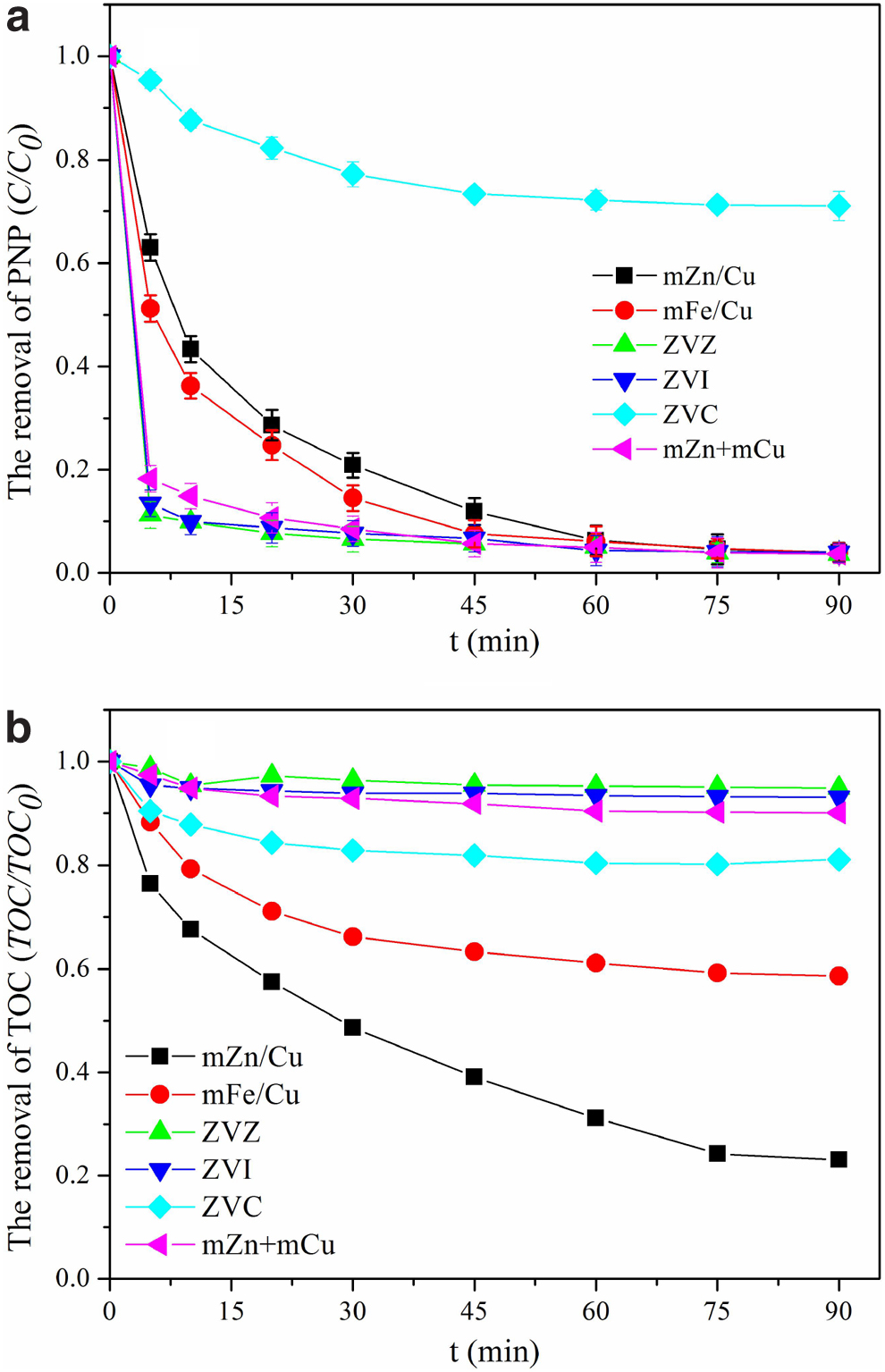
The degradation of PNP
In the systems of mZn/PNP, mFe/PNP, and mZn + mCu/PNP, the rapid removal of PNP resulted from the synergistic reaction of direct reduction on the catalytic activity sites and indirect reduction by H (H2) produced from the interaction of active metals with H+. On the contrary, in these systems, the amount of
Although copper could realize the degradation of azo dyes (Dong et al., 2014), in this study, only ∼25% PNP and 19% TOC were removed, respectively. This suggests that copper alone is not efficient enough for the catalytic degradation of PNP under aerobic condition as compared with Zn and Fe. Hence, it can be concluded that mZn/Cu bimetallic particles are a feasible and promising approach to decompose PNP in aqueous solution.
Possible reaction mechanism and degradation pathways of PNP by mZn/Cu
In the previous study, it has been reported that the production of H2O2 is the precursor of
In the mZn/Cu bimetallic system, the presence of galvanic couple between Zn and Cu markedly improves the transport of electrons. As a result, the dissolved O2 accepts an electron more easily from the catalytic sites (Cu) of the mZn/Cu bimetallic particles than from the surface of ZVC alone. This is well verified by the results illustrated in Fig. 5. In addition, the reaction potential between Zn and Cu is higher (1.10 V) than that between Fe and Cu (0.78 V). It is expected that the activity for the PNP degradation is an order of mZn/Cu > mFe/Cu, which is in accordance with the removal of TOC shown in Fig. 5.
The decomposition of H2O2 in the presence of Cu+ will produce

The variation of copper ions as a function of reaction time in mZn/Cu system: initial pH 2.5; mZn/Cu dosage (OTMLCu = 60.54 wt%) = 2.34 g/L; PNP concentration = 6.6 mg/L.
According to Equations (6) and (7),

The effect of radical scavengers on the degradation of PNP. The initial pH = 2.5; mZn/Cu dosage (OTMLCu = 60.54 wt%) = 2.34 g/L; PNP concentration = 6.6 mg/L; TBA and BQ = 20 mg/L, respectively; temperature = 25°C. TBA, tert-butyl alcohol; BQ, benzoquinone.
2-Hydroxyterephthalic acid with a highly fluorescent intensity will be generated from the reaction between terephthalic acid and

Fluorescence spectra at different reaction time in the system of terephthalic acid/mZn/Cu bimetallic system. The initial pH = 2.5; mZn/Cu dosage (OTMLCu = 60.54 wt%) = 2.34 g/L; [terephthalic acid] = 0.2 g/L; temperature = 25°C.

Proposed possible catalytic mechanism of PNP degradation in mZn/Cu bimetallic system.
To identify the possible pathways of PNP degradation by the mZn/Cu bimetallic particles, the intermediates of PNP degradation were analyzed using LC-MS, and the data of LC-MS were listed in Supplementary Fig. S5. The intermediates detected in this study included p-nitrosophenol, p-aminiphenol, hydroquinone, 4-nitro-1,2-benzenediol, and 4-nitro-1,3-benzenediol.
According to the observed intermediates, three possible degradation pathways were proposed (Fig. 10). (i) PNP was first reduced to p-nitrosophenol, and then p-aminiphenol was generated from the further reduction of p-nitrosophenol. Next, p-aminiphenol was oxidized to hydroquinone and 1,4-benzoquinone by the produced hydroxyl radicals. These products have lower toxicity and higher biodegradability than their parent compounds (viz. PNP) (Zhou and Lei, 2006; Sun and Lemley, 2011; Zhang et al., 2015c; Xiong et al., 2018) (ii) PNP was directly converted into hydroquinone and then it was further transferred to 1,4-benzoquinone. (iii) 4-Nitro-1,2-benzenediol and 4-nitro-1,3-benzenediol are produced because PNP was attacked by hydroxyl radicals. Since ∼77% of TOC was removed in the system of PNP/mZn/Cu, it is speculated that 1,4-benzoquinone, 4-nitro-1,2-benzenediol, and 4-nitro-1,3-benzenediol were further decomposed into small molecular acids via the cleavage of C–C bond. Finally, some of the by-products were mineralized to CO2 and water.
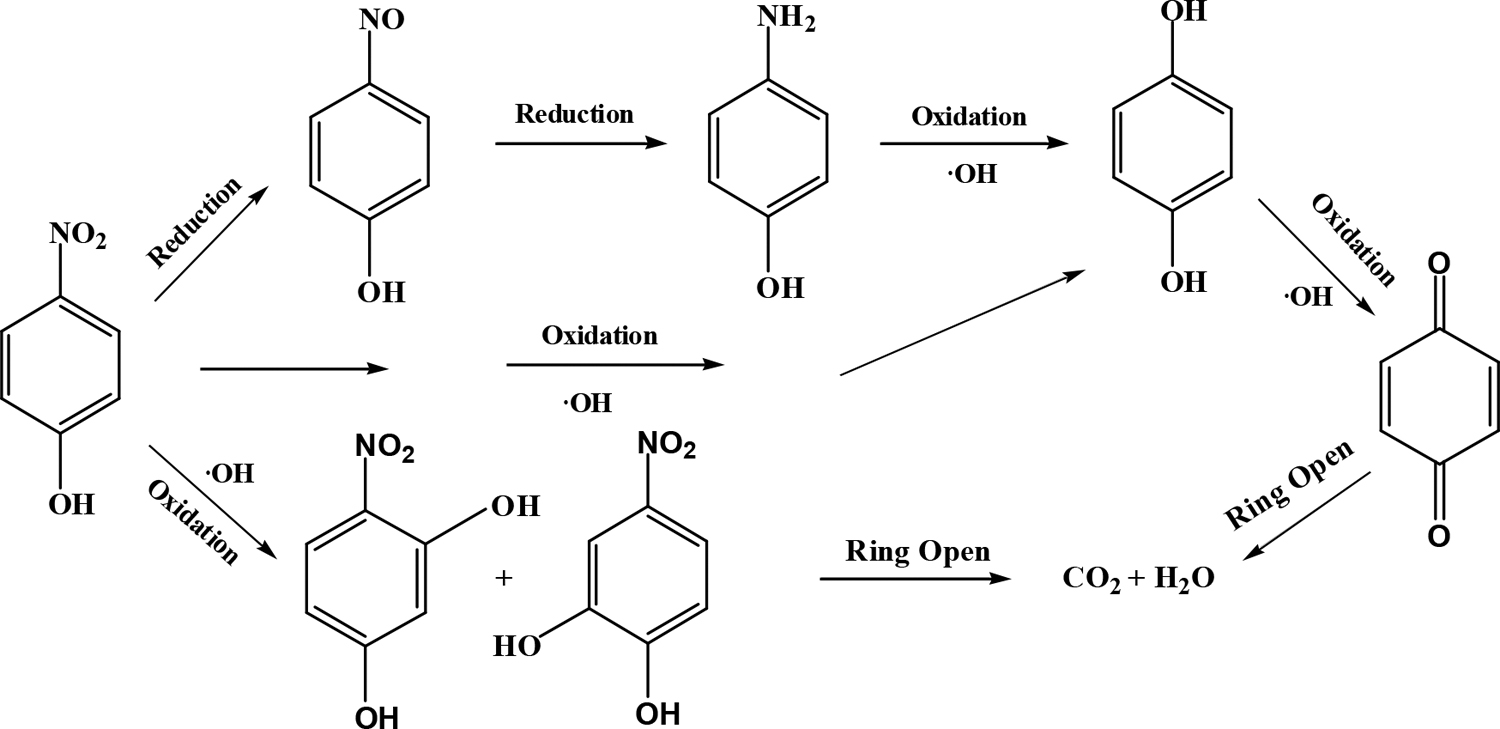
Possible pathways of PNP degradation by mZn/Cu bimetallic particles.
Conclusions
The mZn/Cu bimetallic particles were successfully synthesized via precipitating Cu on the surface of Zn and for the first time applied in the removal of PNP. A CCRD coupled with RSM was adopted to optimize the process. The optimal reaction conditions were obtained as follows: the reciprocating speed = 230 r/min, the mZn/Cu dosage = 2.34 g/L, and the PNP concentration = 6.6 mg/L. Approximately 77% of TOC in the 6.6 mg/L PNP solution was removed by mZn/Cu, demonstrating the good performance of mZn/Cu in the mineralization of PNP under acid condition. This is ascribed to the formation of infinite galvanic cells between ZVZ and ZVC, which improved the dissolved oxygen to accept electrons from the catalytic sites (Cu) of mZn/Cu bimetallic particles. Consequently, more H2O2 and
Footnotes

References
Supplementary Material
Please find the following supplemental material available below.
For Open Access articles published under a Creative Commons License, all supplemental material carries the same license as the article it is associated with.
For non-Open Access articles published, all supplemental material carries a non-exclusive license, and permission requests for re-use of supplemental material or any part of supplemental material shall be sent directly to the copyright owner as specified in the copyright notice associated with the article.
