




Abstract
Three kinds of submerged plants (Hydrilla verticillata, Vallisneria natans, and Potamogeton wrightii Morong) were used to construct plant ponds for the removal of nitrogen, phosphorus, and organic matter in low-pollution water. The bacterial community structure in these plant rhizospheres was analyzed. Results showed that the maximum removal rates of total nitrogen (TN) and total phosphorus (TP) were observed in the H. verticillata plant ponds at 92.83% and 82.66%, respectively. Under the conditions of three different hydraulic retention times (HRT; 4, 6, and 8 days), the maximum removal rates of TN and TP in each of the three kinds of plant ponds increased with an increase in HRT. The absorption contribution rates of the three plants were 16.22% (V. natans), 20.38% (H. verticillata), and 16.97% (P. wrightii Morong) for TN; for TP, 19.16% (V. natans), 18.88% (H. verticillata), and 21.06% (P. wrightii Morong). The relative abundances of Proteobacteria in the plant rhizosphere of P. wrightii Morong, V. natans, and H. verticillata were 59.70%, 88.57%, and 68.57%, respectively. Proteobacteria played an important role in nitrogen removal for the three submerged plants. The relative abundances of heterotrophic denitrifying bacteria Rhodobacter for each of the rhizospheres were found to be 7.74% (P. wrightii Morong), 3.19% (V. natans), and 13.87% (H. verticillata), where denitrification was apparent. The results of this study provide theoretical guidance and technical support for the pollution control and ecological restoration of natural lakes and rivers.
Introduction
In recent years, the amount of domestic sewage and industrial wastewater discharged into the environment has gradually increased with the development of social economies, and the problems of water pollution have grown in severity (Yin and Wang, 2014). Although wastewater treatment plants can remove most of the contaminants in wastewater, the amount of the discharged effluent is still quite large, and the concentrations of nitrogen and phosphorus in sewage treatment plant tailwater are still high, resulting in severe eutrophication of neighboring water bodies (Caen et al., 2019).
Low-pollution water refers to water quality that is polluted to the extent that its water quality index is better than the standard pollutant discharge of urban sewage treatment plants, but is still a viable source of pollution when compared with rivers and lakes (Liu et al., 2019). The stream discharge for low-pollution water usually fluctuates greatly. Water quality is unstable, pollutant concentration is low, and nitrogen removal is difficult (Duan et al., 2016). Therefore, it is an urgent matter to effectively control low-pollution water. The management of low-pollution water is a new challenge in the eutrophication of rivers and lakes.
Aquatic plants have been widely used in the study of sewage purification due to their economic, efficient, and environmentally friendly characteristics (Song et al., 2018). The purification mechanism of organic matter, nitrogen, and phosphorus for aquatic plant ponds includes plant absorption of the pollutants, microbial degradation, and the synergistic effect of plant root substrates (Lu et al., 2018). Aquatic plant ponds beautify the environment, improve the removal rates of contaminants (especially nitrogen and phosphorus), inhibit the growth of algae, and prevent secondary pollution of the receiving body of water (Zimmo et al., 2003).
Aquatic plants ponds can be divided into three categories based on their plant content: emergent plants, floating plants, and submerged plants. The stems of emergent plants stick out of the water surface; the roots are developed and have strong oxygen transport capacity (Zhang et al., 2015a). The growth cycle of emergent plants is longer than that of algae and floating plants, and the storage of nitrogen and phosphorus is more stable than that of algae (Fan et al., 2018). Floating plants float above the water, and their roots are submerged underwater. Submerged plants are completely immersed in water, with their roots rooted at the bottom of the pond (Choudhury et al., 2019; Schwammberger et al., 2019). Submerged plant ponds have good oxygen-carrying capacity, which can improve the dissolved oxygen (DO) content in the water (Fan et al., 2019).
In particular, good resistance to impact load and low temperature was observed for submerged plant ponds. The removal effect of nitrogen and phosphorus is remarkable, and submerged plants have the ability to absorb heavy metals, which has attracted some attention and is being widely used for wastewater purification (Xu et al., 2019).
Previous research indicates that introduction of submerged plants into eutrophic water bodies can facilitate a long-term improvement in water quality. In shallow eutrophic water bodies, submerged plants can assimilate a large amount of nitrogen and phosphorus from sediments via their roots during the growing season (Xie et al., 2013). In addition, the roots of submerged plants can create a variety of microenvironments for microorganisms to breed and reproduce (Choi et al., 2014). The stems and leaves of submerged plants can directly absorb water and nutrients from the water (Xu et al., 2013).
In the present work, three submerged plants (Vallisneria natans, Hydrilla verticillata, and Potamogeton wrightii Morong) widely distributed in rivers, lakes, and ponds with different roots, stems, and leaves structures are selected to purify the low-pollution water. Most of previous literature investigate the remediation efficiency of polluted water by using submerged plant ponds under static conditions (Badejo et al., 2017; Xu et al., 2019). In fact, it is under dynamic conditions when submerged plants are used for polluted water remediation. Further, it is important to identify the plants' absorption contribution rate and evaluate the potential of the different submerged plants in removing contaminants on the condition that plant biomass can be adequately harvested. Finally, the effect of microbial community structure in rhizosphere of submerged plants on the transformation mechanism of pollutants is not clearly clarified.
It has been reported that aquatic plants can provide a surface for bacterial colonization, as well as a carbon source for the colonizing microorganisms and the microbes can utilize the nutrients in the water (Lu et al., 2018). Microorganisms play an important role in nitrogen cycling and removal, and nitrification/denitrification can effectively remove nitrogen (Morse et al., 2018). It is widely accepted that microbes are key regulators of nitrogen cycling, but plants influence the microbial communities and their subsequent abilities to cycle nitrogen (Knops et al., 2002). Microbes also play an important role in phosphorus removal as mineralizers of organic phosphorus via biological mineralization and biochemical mineralization (Truu et al., 2009).
Therefore, the objectives of the present work here were to (1) determine the effects of three submerged plants (V. natans, H. verticillata, and P. wrightii Morong) on the remediation of low-pollution water under dynamic conditions; (2) identify the plants' absorption contribution rate of the three submerged plants in contaminant removal and evaluate the potential of the submerged plants in removing contaminants on the condition that plant biomass can be adequately harvested; and (3) analyze the microbial community structure in the rhizosphere of the three submerged plants and the mechanism of contaminant removal by submerged plants.
Materials and Methods
Three commonly used submerged plants were used in the experiment: V. natans, H. verticillata, and P. wrightii Morong. After the plants were precultured in tap water for 3 days, plants that had good growth, complete preservation of stems and leaves, and relatively uniform characteristics were selected for the experiment. Before the experiment, each of the plants were cleaned and weighed. Then, each plant was fixed with a planting ring. Plants with similar growth rates were selected. Each planting ring contained about 10 g plants.
The schematic diagram of the experiment apparatus is shown in Supplementary Fig. S1. The experimental device used 100 L opaque high-strength plastic boxes. Ninety liters of simulated low pollution was added to each plastic box. Three plants (90 g) were placed in each plastic box. The fixation method of the aquatic plants was as follows (Supplementary Fig. S2): First, excess roots or leaves of the aquatic plants were pruned; then, the roots or stems were wrapped with cotton; and finally, the wrapped aquatic plants were inserted into the planting ring. Simulated low-pollution water was prepared from tap water, the carbon source was provided by CH3COONa, nitrogen was provided by NH4Cl, and phosphorus was provided by KH2PO4. The water quality of simulated low-pollution water is shown in Table 1.
Water Quality of the Simulated Low-Pollution Water
CODCr, chemical oxygen demand; TN, total nitrogen; TP, total phosphorus.
The experimental site was selected from an outdoor open space, and rain protection measures were made. Precultured V. natans, H. verticillata, and P. wrightii Morong were placed in the experiment boxes according to different experimental schemes. Experiments were carried out from September to October in 2018. Water temperature was 22.1–26.9°C; pH was 6.20–7.10. Continuous influent and effluent operations were adopted for this experiment. Hydraulic residence times (HRT) were set at 4, 6, and 8 days, respectively. When switching HRT conditions, the water in the original tank was completely replaced.
Chemical oxygen demand (CODCr) content was determined by fast digestion spectrophotometry (HJ 828-2017, China). NH4+-N content was determined by Nessler's reagent spectrophotometry (HJ 535-2009, China). Total nitrogen (TN) content was determined by ultraviolet (UV) spectrophotometry with an alkaline potassium persulfate digestion (HJ 636-2012, China). Total phosphorus (TP) content was determined by ammonium molybdate spectrophotometry (GB 11893-89, China). NO3−-N content was determined by UV spectrophotometry (HJ/T 346-2007, China). NO2−-N content was determined by spectrophotometry (GB 7493-87, China). The plant TN and TP contents were determined by H2SO4-H2O2 colorimetry.
On the 19th day of the experiment, parts of the rhizosphere of V. natans and P. wrightii Morong were taken, the roots and branches of H. verticillata were taken, and the bacterial community was determined. The DNA of the sample was extracted by using an OMEGAkit (E.Z.N.ATM Mag-Bind Soil DNA Kit; Omega). The MiSeq platform was used to sequence high-variation regions of the 16S ribosomal RNA (rRNA) genes (Xu et al., 2016).
For biodiversity and species classification analysis: the sequences were divided into different operational taxonomic units (OTUs) according to the similarity between sequences. The OTUs at the 97% similarity level were clustered for analysis. To obtain the species classification information corresponding to each OTU, the Ribosomal Database Project (RDP) Classifier algorithm was applied to analyze each sequence at each classification level.
Results and Discussion
Removal of water pollutants by H. verticillata
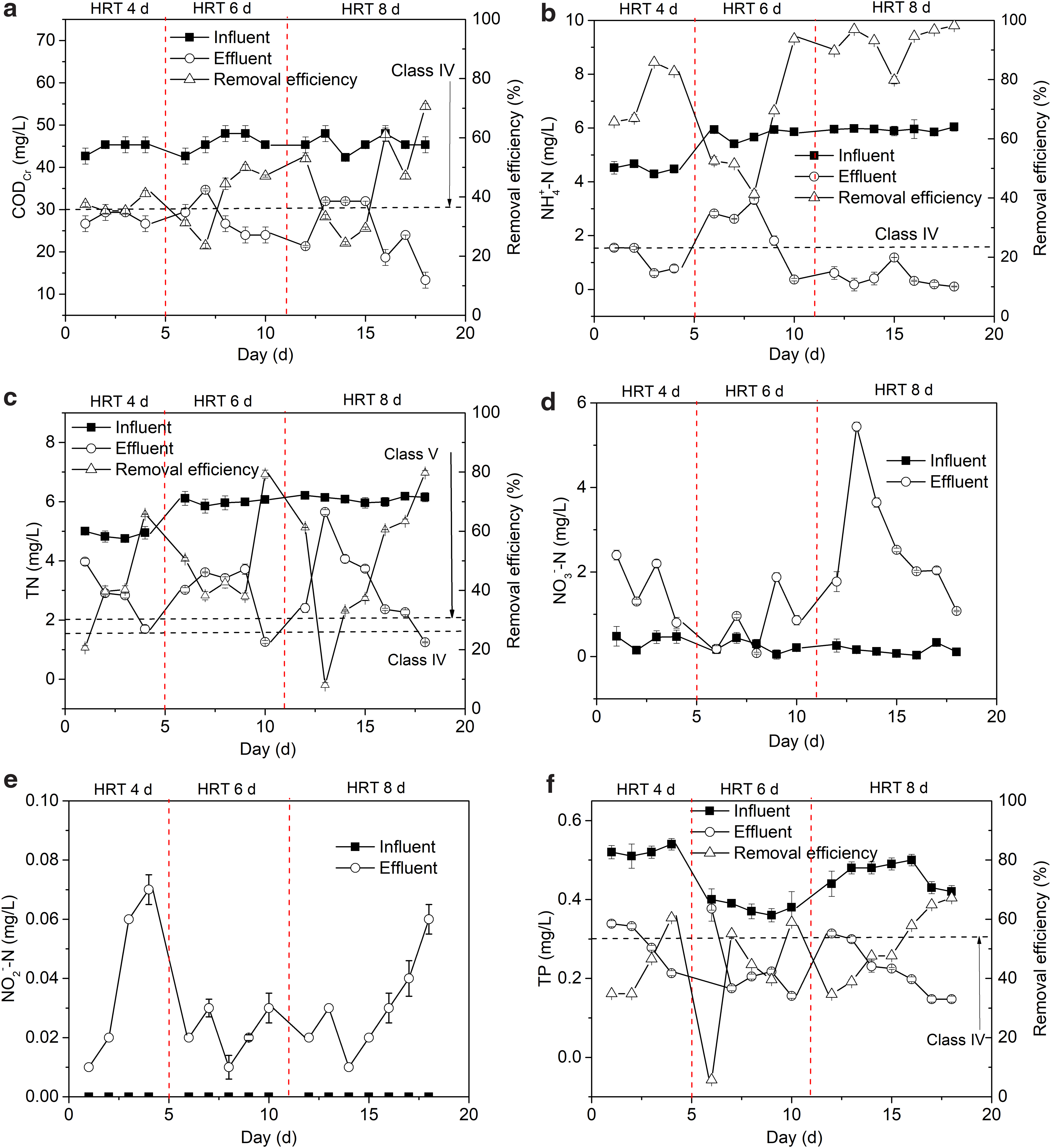
Figure 1a shows the removal of CODCr by H. verticillata in water. Under three HRT conditions, the effluent concentration was below 30 mg/L (except on days 1, 2, 6, and 16), and the effluent quality met Class IV qualifications of the Environmental Quality Standard for Surface Water (EQSSW; GB 3838-2002, China). Bacteria and DO in aquatic plant systems have been shown to play an important role in the degradation of organic matter in water (Körner et al., 1998). Aquatic plant ponds have a higher removal rate of CODCr under aeration and normal bacterial growth conditions (Chen et al., 2013).

Water quality [
For each of the three plants, the concentration of DO rises rapidly in the first 4 days, from 0.80–1.00 to 4.80–5.55 mg/L in the present work. In aquatic environments, photosynthesis occurs in photoautotroph organisms, that is, higher plants, algae, and some bacteria (Desmet et al., 2011). Significant photosynthesis by the submerged plants is observed in the river (Wang et al., 2017). In a study conducted in a lowland river, the DO concentrations are in situ monitored throughout the year, which are about 4 mg/L in winter and more than 6 mg/L most of the summer (Desmet et al., 2011). Aquatic plant growth may have considerable impact on DO dynamics in a lowland river; once the amount of oxygen transferred from the aerial tissues to the root zone of the aquatic plant exceeds the plant's needs, DO diffusion occurs in the surrounding water medium (Lu et al., 2018).
Starting from day 6, the DO concentration tended to be stable, with DO concentration starting from 5.35 mg/L (H. verticillata), 5.85 mg/L (V. natans), and 5.65 mg/L (P. wrightii Morong) and slowly rising to 5.85 mg/L (H. verticillata), 6.10 mg/L (V. natans), and 5.65 mg/L (P. wrightii Morong) at 19 days, respectively. The presence of rhizosphere bacteria and the increase in DO in water can improve the removal of CODCr.
The removal rate of NH4+-N by H. verticillata reached more than 65% for all three HRT conditions (except on day 6), with the highest removal rate at 98.19% for HRT at 8 days (Fig. 1b). The concentrations of the effluent NH4+-N met Class IV qualifications of the EQSSW (GB 3838-2002, China; except on days 6 and 7). With the increase of residence time, TN concentration in water gradually decreased, and the highest removal rate was 92.83% under HRT at 6 days (Fig. 1c). The concentrations of the effluent TN met Class V of the EQSSW (GB 3838-2002, China; except on days 1, 2, 3, 6, 12, 15, and 16).
At the beginning of the experiment, the concentrations of NO3−-N and NO2−-N in the effluent increased continuously (Fig. 1d, e). The effluent concentration of NO3−-N ranged from 0.01 to 4.27 mg/L. The concentration of the water's NH4+-N decreased rapidly, and nitrification transformed a large amount of NH4+-N into NO3−-N, which led to the rapid rise of NO3−-N in the water during the initial stage of the experiment. Aquatic plants were able to provide favorable conditions for the growth of microorganisms and improve the concentration of DO in water, which was conducive to aerobic microbial activity and improved the removal of water pollutants (Stottmeister et al., 2003; Liu et al., 2018).
With the extension of HRT, the removal of TP concentration was improved, and there was no significant difference in the removal rate of TP (p > 0.05) on HRT at 6 and 8 days, with highest removal rates measured at 75.02% and 82.89%, respectively (Fig. 1f). On days 4, 8, 9, 10, 16, 17, and 18, the concentrations of the effluent TP met Class III qualifications in the EQSSW (GB 3838-2002, China). Studies have shown that aquatic plants had a positive effect on the removal of dissolved phosphorus (Moore et al., 2016). For the removal of phosphorus in water by four aquatic plants (Oenanthe javanica [Blume] DC, Acorus calamus L., Canna indica L, and Potamogeton crispus L.), plant absorption accounted for 25.2–33.4% of phosphorus removal, water substrate (quartz sand) accounted for 7.3–25% of phosphorus absorption, and microbial degradation accounted for 41.5–67.5% of phosphorus removal (Li et al., 2015).
A strong correlation between phosphatase activity and PO43−-P removal rate with an R2 value of 0.78 is reported, and phosphatase can act as an important indicator of the aquatic plant treatment system's capability for reducing soluble phosphorus (Li et al., 2015). The activity and content of phosphatase also indicates the ability of submerged plants to reduce phosphorus in water (Wang et al., 2012). Phosphatase is a kind of phosphate-solubilizing enzyme that has been identified in many bacteria such as Pseudomonas, Rhizobium, Azospirillum, Burkholderia, Bacillus, Aspergillus, and Penicillium (Illmer and Schinner, 1995). In the present work, a positive correlation between Pseudomonas relative abundances and TP removal rate with a Pearson correlation coefficient of 0.96 is observed.
Removal of water pollutants by V. natans
Under the condition of HRT at 8 days, the highest removal efficiency of CODCr was 70.59%, whereas under HRT at 4 days, the removal rate was significantly different from that of HRT at 6 days (p < 0.05), where the highest removal rate was 41.17% and 50.00%, respectively (Fig. 2a). The concentrations of the effluent CODCr met Class IV in the EQSSW (GB 3838-2002, China; except on days 7, 13, 14, and 15). Rhizosphere bacteria in aquatic plants also participated in the degradation of CODCr (Ando et al., 2015).
Water quality [
The removal rate of NH4+-N reached 98.21% at HRT 8 days, and NH4+-N at HRT 8 days met Class IV qualifications of the EQSSW (GB 3838-2002, China) (Fig. 2b). The TN removal rate of effluents can reach above 75% on HRT at 6 and 8 days, and effluents on days 10 and 18 met Class IV qualifications in the EQSSW (GB 3838-2002, China) (Fig. 2c). No significant accumulation of NO3−-N and NO2−-N was observed (Fig. 2d, e).
The highest TP removal rate was 67.21% under HRT at 8 days (Fig. 2f). The water quality of the TP effluent on HRT at 6 and 8 days (except the effluent on days 6 and 12) met Class IV qualifications in the EQSSW (GB 3838-2002, China). Data show that different plant species under different pollution loads and phosphorous uptake by plants accounted for 3–60% of the phosphorus removal rate (Gottschall et al., 2007). In winter (<5°C) and summer (>35°C), phosphorus uptake may be reduced; whereas in the growth stage of aquatic plants, phosphorus removal is beneficial (Zhang et al., 2014; Roy, 2017).
Removal of water pollutants by P. wrightii Morong
Under the condition of HRT at 6 and 8 days, the removal effect of CODCr was improved, with the highest removal rate of 66.67% (Fig. 3a). However, under the condition of HRT at 4 days, the removal effect was worsened, with the highest removal rate of 47.05%. The water quality of the past 2 days (days 3, 4, 9, 10, 17, and 18) under three HRT operating conditions met Class IV expectations in the EQSSW (GB 3838-2002, China).

Water quality [
For the removal of NH4+-N, with the extension of HRT, the NH4+-N concentration in the effluent was stable at HRT 8 days, and the removal rate was above 95% for 5 consecutive days (days 14, 15, 16, 17, and 18), with the highest removal rate at 99.83% (Fig. 3b). Under HRT at 6 days, the highest removal rate of TN was 85.76%; the concentrations of the effluent TN met Class V qualifications in the EQSSW (GB 3838-2002, China) on days 8, 9, 10, 14, 15, 16, 17, and 18 (Fig. 3c). Aquatic plant root bacterial nitrification and denitrification has been proven to be able to remove nitrogen from water (Breen, 1990; Hu et al., 2008). Also, no significant accumulation of NO3−-N and NO2−-N was observed (Fig. 3d, e).
Under HRT at 8 days, the highest removal rate of TP was 77.70% (Fig. 3f). The concentration of the effluent TP was lower than 0.3 mg/L except for day(s) 1, 6, and 14; the effluent quality met Class IV qualifications in the EQSSW (GB 3838-2002, China). The high removal rate in the initial stage of the experiment may be due to the uptake of phosphorus in plants and microbial activity (Hijosa-Valsero et al., 2012). Studies have shown that adequate nutrients can cause a sharp increase in the biomass of aquatic plants at initial stages, but over time, plant growth slows down. The amount of phosphorus absorption is directly proportional to the density of aquatic plants; as plant growth slows down, the TP removal rate also decreases (Dzakpasu et al., 2015).
Comparison of pollutant removal effect by three submerged plants
CODCr reflected the content of organic matter that could be oxidized in water. As shown in Figs. 1a, 2a, and 3a, the influent CODCr concentration was between 42.33 and 48.00 mg/L, whereas the effluent CODCr concentration was between 13.33 and 37.33 mg/L. Under HRT at 4 days, the removal rate of CODCr in the three plants was lower. However, under HRT at 6 and 8 days, the highest removal rate significantly increased. Under the condition of HRT at 4 and 8 days, V. natans had the best removal effect on CODCr, with the highest removal rates of 41.17% (HRT at 4 days) and 70.59% (HRT at 8 days). However, under HRT at 6 days, H. verticillata had the best removal effect for CODCr.
As shown in Figs. 1b, 2b, and 3b, with the extension of HRT, the removal effect of all three submerged plants on NH4+-N was better than other contaminants. Under HRT at 8 days, NH4+-N removal rate of all three plants exceeded 60%, and these were the highest overall removal rates: P. wrightii Morong (99.83%), V. natans (98.21%), and H. verticillata (98.19%). When HRT at 4 days was extended to 6 days, DO in the water increased from 0.80–6.00 to 5.25–5.85 mg/L, which enhanced the activity of nitrifying bacteria and nitrification (Fig. 4a). During HRT at 4 days, the NH4+-N removal rate of all three submerged plants reached over 40%. The absorption effect of plants and the nitrification effect of nitrifying bacteria have important effects on NH4+-N removal (Mayo and Hanai, 2017).
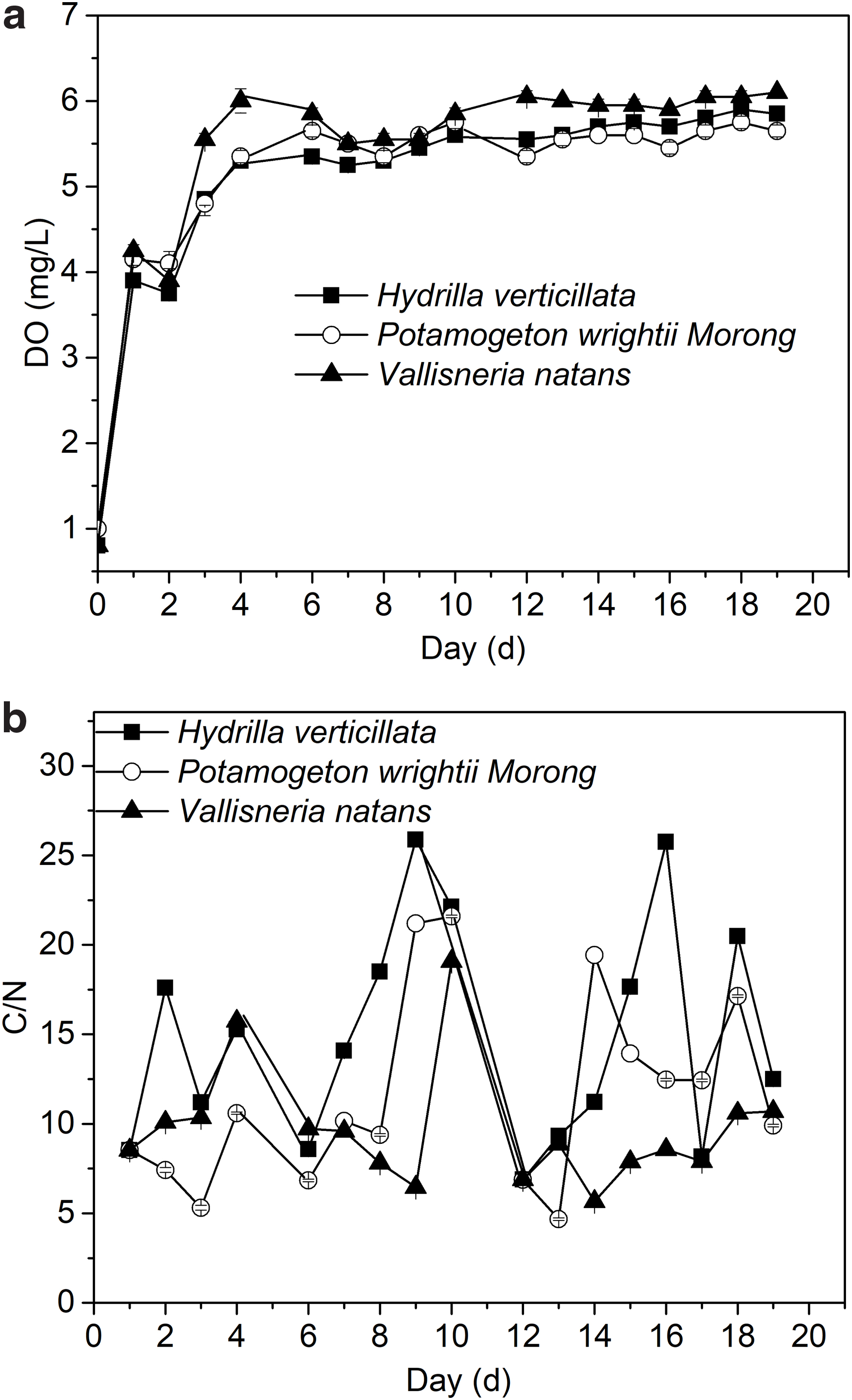
Changes of DO and C/N in effluent of three plants. DO, dissolved oxygen.
As shown in Figs. 1c, 2c, and 3c, for the removal of TN, the effluent concentration of the three plants ranged from 0.43 to 5.65 mg/L, and the effluent concentration fluctuated dramatically. The highest removal rate of TN by H. verticillata decreased from 92.83% (HRT 6 days) to 77.63% (HRT 8 days), and the highest removal rate of TN by P. wrightii Morong decreased from 85.76% (HRT 6 days) to 79.14% (HRT 8 days). Due to sufficient oxygen in the water (Fig. 4a) and sufficient carbon source in the reaction (Fig. 4b), with the increase of residence time, nitrification and denitrification was carried out well. Therefore, at HRT at 6 days, the TN removal rate of plants was significantly higher than that of HRT at 4 days.
The highest removal rate of TN by V. natans increased from 65.76% (HRT 4 days) to 79.28% (HRT 6 days), the highest removal rate of TN by H. verticillata increased from 64.74% (HRT 4 days) to 92.83% (HRT 6 days), and the highest removal rate of TN by P. wrightii Morong increased from 54.25% (HRT 4 days) to 85.76% (HRT 6 days). Under HRT at 4 and 8 days, V. natans had the best removal effect on TN. Under HRT at 6 days, H. verticillata had the best removal effect on TN.
At the beginning of the experiment (days 1–4), the concentration of NH4+-N decreased rapidly due to nitrification, and the concentration of NO3−-N produced by nitrification also increased rapidly. Since NO3−-N was not added in the experiment, TN in the water was mainly composed of NH4+-N. Therefore, in the removal of TN, NH4+-N was mainly removed, and most nitrogen in the water was in the form of NO3−-N. Studies have shown that there are two main ways for aquatic plants to remove nitrogen from water: The first is the absorption of nitrogen by aquatic plants; the second is that aquatic plants can transport oxygen to their roots through photosynthesis, producing aerobic, anaerobic, and anoxic environments, which can provide an ideal environment for anaerobic and aerobic bacteria, and is conducive to simultaneous nitrification and denitrification (Chang et al., 2013; Liu et al., 2017).
Fresh weight, length, nitrogen, and phosphorus of the three submerged plants at initial state and the end stage of the experiment are shown in Table 2. Nitrogen and phosphorus removal rates and contribution rates of the three submerged plants' adsorption were calculated (Table 3).
Fresh Weight, Length, Nitrogen, and Phosphorus of the Three Submerged Plants
Nitrogen and Phosphorus Removal Rates, and Contribution Rates of the Three Submerged Plants
According to the literature (Li et al., 2015; Lu et al., 2018), aquatic plants' adsorption contribution rates to TN and TP were calculated by measuring the contents of TN and TP in aquatic plants before and after finishing the experiments. Before the experiment, an aquatic plant was weighed and then dried at 70°C to constant weight; the aquatic plant TN and TP contents were determined by H2SO4-H2O2 colorimetry after grinding; and the fresh weight of all aquatic plants was also determined. After finishing the experiments, all the plants were washed with water and dried with absorbent paper; then, the fresh weight of all the plants was weighed. A plant was selected to weigh the fresh weight and then dried at 70°C to constant weight; then, the plant TN and TP contents were determined by H2SO4-H2O2 colorimetry after grinding.
As shown in Table 2, the fresh weight of all the aquatic plants was 90.00 g before the experiment, which improved to 107.06, 104.11, and 109.54 g for V. natans, H. verticillata, and P. wrightii Morong after finishing the experiments, respectively. According to the determined plant TN and TP contents before and after finishing the experiments (Table 2), the total amount of TN and TP absorbed by plants in the whole experimental period was calculated. The total amount of influent TN to the experimental system could be calculated according to the daily influent TN concentration. Aquatic plants' adsorption contribution rates to TN and TP were equal to the total amount of plants that absorbed TN and TP divided by the total amount of TN and TP entering the experimental system (Table 3).
The absorption contribution rates of the three plants were 16.22% (V. natans), 20.38% (H. verticillata), and 16.97% (P. wrightii Morong) for TN; for TP, they were 19.16% (V. natans), 18.88% (H. verticillata), and 21.06% (P. wrightii Morong).
In this experiment, the TN removal rate of water treated by the three plants was 45.67% (V. natans), 58.95% (H. verticillata), and 50.62% (P. wrightii Morong). The TN contribution rates of other functions were 29.45% (V. natans), 38.57% (H. verticillata), and 33.65% (P. wrightii Morong). The first peak value of NO3−-N in the effluent of V. natans and P. wrightii Morong was earlier than that of H. verticillata. The results showed that nitrification of V. natans and P. wrightii Morong was stronger than that of H. verticillata. The reason for this may be that V. natans and P. wrightii Morong has more abundant roots than H. verticillata (Lu et al., 2018).
Under HRT at 4, 6, and 8 days, the highest removal rates of TP were 67.21% (V. natans) and 77.70% (P. wrightii Morong). The highest removal rate of TP by H. verticillata was 82.89%. The removal of TP by aquatic plants includes absorption, precipitation, and microbial action (Gao et al., 2009). In this experiment, the TP contribution rate of plant absorption was 19.16% (V. natans), 18.88% (H. verticillata), and 21.06% (P. wrightii Morong) (Table 3). The TP contribution rates of other functions were 23.89% (V. natans), 22.33% (H. verticillata), and 27.34% (P. wrightii Morong). It was observed that plant adsorption, plant rhizosphere microorganisms, and phosphorus precipitation were important reasons for TP removal in water (Liu et al., 2019). Phosphorus absorption of plants was also the main mechanism of phosphorus removal in water.
Removal of aqueous nitrogen and phosphorus in the aquatic plant treatment system was achieved through three main ways: direct absorption by plants, absorption by substrates, and other processes (including microorganism degradation and physical processes) (Cao and Zhang, 2014). In the present work, the TN removal efficiency by plant absorption was 16.22–20.38%, whereas the TP removal efficiency by plant absorption was 18.88–21.06%. Absorption by substrates and other processes (including microorganism degradation and physical processes) accounted for 29.45–38.57% of TN removal and 22.33–27.34% of TP removal (Table 3).
According to the literature, the direct absorption of four aquatic plants (O. javanica, Iris pseudacorus L., Canna lily, and P. crispus) accounted for 28.2–34.5% of nitrogen removal and 25.2–33.4% of phosphorus removal, whereas substrate absorption accounted for 7.2–25.5% of nitrogen removal and 7.3–25.1% of phosphorus removal. Besides absorption by plants and substrates, other processes accounted for 42.5–61.5% of nitrogen removal and 41.5–67.5% of phosphorus removal (Li et al., 2015). In another report, the absorption rates of nitrogen by three aquatic plants (water hyacinth, water lettuce, and Myriophyllum spicatum) were 45.05%, 52.12%, and 72.15%; whereas for phosphorus, the plants' absorption rates were 58%, 64%, and 83% (Lu et al., 2018). The nitrogen and phosphorus could be removed from the polluted water body by harvesting the aquatic plants (Bednarek et al., 2014; Lu et al., 2018).
Analysis of bacterial community structure
High-throughput sequencing effectively analyzed the bacterial community structure in the plant rhizosphere (Lu et al., 2015). Figure 5 shows the relative abundance of rhizosphere microorganisms of three plants at the phylum level. Proteobacteria, Planctomycetes, and Bacteroidetes were all found in the rhizosphere of all three kinds of plants. Most Proteobacteria participate in the cyclic activities of river and lake ecosystems (Hempel et al., 2008; Zhang et al., 2015b). Proteobacteria accounted for 59.7% (P. wrightii Morong), 88.57% (V. natans), and 68.57% (H. verticillata) of the three kinds of rhizosphere bacteria. Proteobacteria contain a variety of metabolic bacteria, which have roles in the removal of organic matter, nitrogen, and phosphorus. Planctomycetes contain bacteria associated with Anammox (Vymazal, 2005). Bacteroidetes contain bacteria related to organic degradation (Cao et al., 2016).
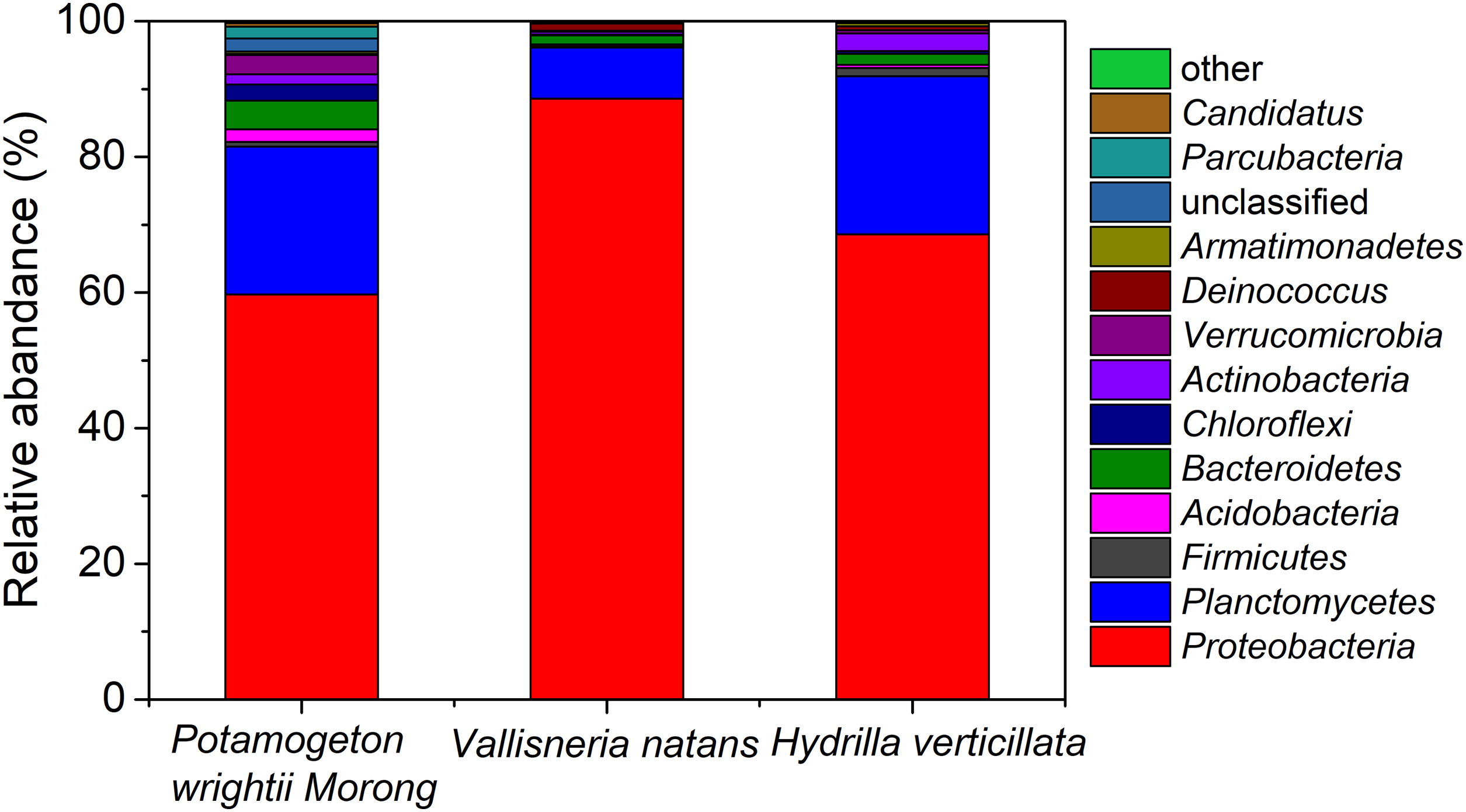
Relative abundance of bacterial communities at the phylum level.
The correlation analysis between contaminants' removal and proportion of dominant microflora at phylum level was made (Supplementary Table S1). A strong positive correlation was found to exist between three kinds of dominant microflora (Actinobacteria, Firmicutes, and Planctomycetes) and TN removal; meanwhile, Actinobacteria and Firmicutes had a positive correlation with NH4+-N removal. Further, there was also a strong positive correlation between Bacteroidetes, Acidobacteria, and Chloroflexi and TP removal. It was reported that Actinobacteria had nitrogen-fixing function (Gtari et al., 2007); Firmicutes, Proteobacteria, Chloroflexi, and Acidobacteria were the dominant phyla in the Anammox-denitrification process (Wei et al., 2017). Planctomycetes were reported as the important contributors to nutrient turnover and nitrogen cycling, and Bacteroidetes were related with the phosphorus removal (Yousuf et al., 2012; Xiao et al., 2016).
To further explore the changes of microbial community characteristics, the microbial community structure at the genus level was analyzed. Figure 6 shows the genus level abundance of rhizosphere bacteria in three plants, with 21 species that comprise more than 1% of the sample in all three samples.

Relative abundance of bacterial communities at the genus level.
Acinetobacter had the highest relative abundance in V. natans (65.01%); Rhodobacter had the highest relative abundance in H. verticillata (13.87%). The relative abundance of Pirellula in the three samples was 6.77% (P. wrightii Morong), 3.60% (V. natans), and 10.90% (H. verticillata). The relative abundance of Hyphomicrobium in the three samples was 0.96% (P. wrightii Morong), 0.52% (V. natans), and 2.20% (H. verticillata). Hyphomicrobium is also a heterotrophic denitrifying bacterium, and it can use nitrate and carbon (Timmermans and Van Haute, 1983). The relative abundances of Rhizobium in V. natans and H. verticillata were 3.24% and 2.95%, respectively; they have the function of symbiotic nitrogen fixation.
The correlation analysis between contaminant removal and proportion of dominant microflora at genus level was also conducted (Supplementary Table S2). Results showed that there was an obvious positive correlation between eight kinds of dominant microflora (Rhodobacter, Hyphomicrobium, Pirellula, Novosphingobium, Roseomonas, Ilumatobacter, Gemmobacter, and Phreatobacter) and TN removal at genus level; there was also a positive correlation between Rhodobacter, Hyphomicrobium, Roseomonas, Ilumatobacter, Gemmobacter, and Phreatobacter and NH4+-N removal. However, only three kinds of dominant microflora (Pseudomonas, Hydrogenophaga, and Gemmata) showed a strongly positive correlation with TP removal.
It was reported that Rhodobacter and Hyphomicrobium played the main role in nitrogen denitrification (Timmermans and Van Haute, 1983). Pirellula were Anammox bacteria (Xu et al., 2018); Novosphingobium and Gemmobacter were involved in the denitrification process (Feng et al., 2012; Song et al., 2020). Pseudomonas might be the dominant genus responsible for TP removal (Du et al., 2017). Hydrogenophaga was known as the denitrification bacteria for nitrogen and phosphorus removal (Gan et al., 2011).
Under HRT at 4 and 6 days, H. verticillata of the three plants had the best removal of NH4+-N. However, under HRT at 8 days, P. wrightii Morong had the best removal of NH4+-N (Supplementary Table S3). As shown in Supplementary Table S3, under HRT at 4 and 6 days, the maximum removal efficiencies of NH4+-N for H. verticillata were 91.70% and 95.46%, and the minimum effluent concentrations of NH4+-N were 0.37 and 0.26 mg/L, which were better than those of the other two plants. Under HRT at 8 days, the highest removal efficiency of NH4+-N for P. wrightii Morong was 99.83% and the lowest effluent concentration of NH4+-N was 0.01 mg/L; whereas the highest removal efficiencies of NH4+-N for H. verticillata and V. natans were 98.19% and 98.21%, respectively, and the lowest effluent concentration of NH4+-N was 0.11 mg/L.
At the genus level, Nitrospira was detected to account for 0.64% in P. wrightii Morong, 0.01% in V. natans, and it was not detected in H. verticillata. The low concentration of NH4+-N in the experiment might be the reason that the proportion of Nitrospira was 0.01–0.64% (Pang et al., 2016). Under HRT at 8 days, NH4+-N removal rate of P. wrightii Morong was as high as 99.83%, and NH4+-N concentration of effluent was as low as 0.01 mg/L, which might be related to Nitrospira bacteria attached to the roots of P. wrightii Morong. Nitrification converted nitrogen-containing materials to nitrate, and denitrification converted nitrate to nitrogen (Iannacone et al., 2019).
There was no accumulation of nitrite nitrogen in the three plant ponds. Rhodobacter was detected in the rhizosphere of all the three plants, with the abundance of 7.74% (P. wrightii Morong), 3.19% (V. natans), and 13.87% (H. verticillata). Rhodobacter belonged to heterotrophic denitrifying bacteria, which indicated that denitrification exists in the three plant ponds. Plants can release oxygen during the day through photosynthesis. Plants and most microorganisms in water use oxygen through respiration. Therefore, an aerobic
Conclusions
V. natans, H. verticillata, and P. wrightii Morong had positive removal effects on the aqueous contaminants for low-pollution water, and the highest removal rates of CODcr, NH4+-N, TN, and TP were 70.59%, 99.83%, 92.83%, and 82.66%, respectively. Under three HRT conditions, the average removal rate of pollutants increased with the increase of HRT. The average removal rate was the lowest at HRT of 4 days and was significantly different from HRT at 6 and 8 days (p < 0.05). The contribution rates of the adsorption of all three plants to TN and TP were 16.22–20.38% and 18.88–21.06%, respectively.
The results of bacterial community structure showed that Proteobacteria was dominant among the three plant rhizospheres at the phylum level. Overall, 21 bacterial species were detected at a relative abundance that exceeded 1% at the genus level, containing a large number of bacteria related to nitrification and denitrification.
Footnotes
Author Disclosure Statement
No competing financial interests exist.
Funding Information
This work was supported by the National Water Pollution Control and Treatment Science and Technology Major Project (2017ZX07603-004), the National Natural Science Foundation of China (51208163, 21876040), and the Fundamental Research Funds for the Central Universities (PA2019GDQT0010).

References
Supplementary Material
Please find the following supplemental material available below.
For Open Access articles published under a Creative Commons License, all supplemental material carries the same license as the article it is associated with.
For non-Open Access articles published, all supplemental material carries a non-exclusive license, and permission requests for re-use of supplemental material or any part of supplemental material shall be sent directly to the copyright owner as specified in the copyright notice associated with the article.
