




Abstract
Acid rain (AR) has become an important environmental problem in southern China. In addition, the pollution of polycyclic aromatic hydrocarbons (PAHs) in soils is increasingly drawing people's attention. In this work, we conducted a series of the simulated acid rain (SAR) soaking tests to study the distribution of organo-mineral aggregates and the release of PAHs in those aggregates. The results showed that the contents of silt and clay in organo-mineral aggregates increased after being soaked by SAR; while the contents of coarse sand and fine sand decreased, the extent of impact increased with increase of SAR pH. The AR facilitated the release of PAHs in organo-mineral aggregates differentially; based on the size of the compounds, the PAHs with less aromatic rings (≤4) in clay and silt released significantly, but the impact of SAR on the release of PAHs with more aromatic rings (≥5) was slight. The amount of PAHs released from organo-mineral aggregates increased with the increase of SAR pH. The contents of clay and hematite in the soil decreased significantly after being soaked by SAR, which results in the decomposition of organo-mineral aggregates, the desorption of organic matter with lower molecular mass from organo-mineral aggregates, and the release of PAHs bond to the aggregates.
Introduction
The trace amounts of polycyclic aromatic hydrocarbons (PAHs) are widely distributed in the natural environment (Liang et al., 2018). Due to the mutagenicity and carcinogenicity of these compounds, PAHs have attracted much public attention (Verma et al., 2015; Ranjbar Jafarabadi et al., 2017). Soil acts as an important environmental medium, where PAHs become closely adhered to the soil matrix. Mineral compounds and organic particles like PAHs are both physically and chemically integrated through relatively strong bonding force, rather than existing separately (Wagai et al., 2015). These complexes of mineral and organic matter are termed organo-mineral aggregates. Organic matters in nature mainly exist (50–90%) in the form of organo-mineral aggregates in soils (Feng et al., 2014).
The bonding force between organic matter and minerals is an important pathway to integrate soil with organic matter (Baldock and Skjemstad, 2000; Klimkowicz-Pawlas et al., 2017; Chen et al., 2018). The interaction between organic matter and minerals originates from the bonding effect of organic matter, rather than simple adsorption of organic matter on mineral (Kaiser and Guggenberger, 2000; Zhang et al., 2014; Chen et al., 2019). Therefore, organic matter is dispersed among minerals; however, it does not necessarily cover the mineral surface with a single layer. The aggregates are formed with polyvalent metals, minerals, and organic matter (Fan et al., 2017).
The impact of organo-mineral aggregates on organic contaminant is different from that on native organic compounds or minerals. The amount of hydrophobic organic contaminant adsorbed by organo-mineral aggregates with different sizes mainly depends on the heterogeneity of organic matter structure and mineral constituent. Hydrophobic organic contaminants, including PAHs and their metabolites, combine with organic matter with higher molecular mass in soil through covalent bonds.
The bioavailability of organic contaminant in the organo-mineral aggregates with different sizes varies because the mineralization of PAHs can only be accomplished by transforming organic matter composition in soil. PAHs with higher aromatic rings (≥5) accumulated normally in the particles with smaller sizes (de Jesus Mendes et al., 2011). Likewise, it was reported by Aichner et al. that the amounts of PAHs are different among organo-mineral aggregates with a range of particle sizes (Aichner et al., 2007). Due to the high affinity of silt for organic matter, silt becomes the preferential absorbent for PAHs. Feng studied the distribution of PAHs in several agricultural soil classifications and found that the average contents of phenanthrene in different particle sizes decreased in the following order: coarse sand > fine sand > clay > fine silt > coarse silt. In addition, the distribution of benzopyrene decreased in the following order: coarse sand > fine sand > coarse silt > fine silt > clay. In the different particle-size separates, the contents of Bαp had significantly positive correlations with the particle sizes (Feng et al., 2017).
Acid rain (AR), which is caused by excessive emissions of sulfur dioxide (SO2) and nitrogen oxide (NO2), has become an urgent problem of increasing environmental, ecological, and agricultural concerns worldwide (Marx et al., 2017; Zong-Jie et al., 2017). With the rapid industrial development of China in the last 30 years, this region has become the third largest AR producer in the world, after Europe and North America (Zhang et al., 2017). In terrestrial ecosystems, soil is one of the main receptors of AR. AR results in acidification of soil, which affects several chemical and biological properties, as well as the reactions that control the bioavailability and toxicity of certain contaminants in soil (Bakhshipour et al., 2016; Wei et al., 2017; Xiao et al., 2017). Acid precipitation affects the speciation distribution and physicochemical behaviors of metal in soil through disturbing the balance of precipitation-dissolution, adsorption-desorption, complexation-disassociation, and oxidation-reduction. Prolonged acid precipitation negatively affects soil acidification, soil degradation, soil microstructure, and transformation of contaminant (Chen et al., 2015; Zhao et al., 2017). Soil acidification facilitates the migration of inorganic nutrition elements and mobilization, starting with the transformation of trace metals (Li et al., 2015; Tanner et al., 2016).
Researches on effects of AR on trace metals have already been conducted extensively. However, relatively few studies reported the effects of AR on organic contaminants in soil relatively. Similar studies have focused on the effect of AR on the distribution of dissolved organic carbon in soil (Liu et al., 2009; Tian et al., 2015; Wu et al., 2016). It is not yet clear how AR influences the release of PAHs in environmental media such as red soil. In this work, we studied the effect of simulated acid rain (SAR) on the constituents, distribution, and release of PAHs in organo-mineral aggregates of red soil to recognize the mobility of hydrophobic organic contaminants in the soil and, therefore, provide some supportive information for the risk assessment of groundwater in Central South China.
Materials and Methods
Sample preparation
The soil samples for testing were collected from the surface (0–20 cm depth) of a gasworks (27°52.965′N and 113°05.265′E) in Hunan province. The soil sample belonged to red soil that is the main soil type in tropic and subtropical zone in 14 provinces of south China. This area covers 569,000 km2 (about 6.5% of total country land) and is one of the main suppliers of grain crops, meat, and other economic plants in China (NSCO, 1998). Red soil is acidic and contains lower organic matter than other soils (Liu et al., 2018). The average annual temperature in this area is 18°C and the average annual rainfall is 1,250 mm. After air dry, soil sample was crushed mildly with a metal hammer and plant residues were removed. Then the soil was passed through a 2 mm sieve. Some physical-chemical characteristics of the red soil are summarized in Table 1.
Physical and Chemical Characteristics of the Red Soils for Test
Simulated acid rain
A major source of AR in central south China is the extensive use of coal, which has accounted for 69% of the energy production in 2004 (Larssen et al., 2006). The main kind of ARs in central south China is sulfuric AR with higher sulfate (SO42−) and calcium ion concentrations. However, pH and nitric ion (NO3−) concentration are lower than those in North America and Europe. To mimic the characteristics of the AR in central south China, according to the studies by Wu (Hao et al., 2001) for the AR in Hunan province, in this study, a dilute solution containing CaSO4, (NH4)2SO4, MgSO4, NaNO3, NH4Cl, NaCl, and KF with mole ratio of 33:22:5:15:15:6:8 was first made, and the mole ratio of [SO42−] to [NO3−] was 4:1. Four types of AR were prepared by adjusting the solution pH with a solution containing H2SO4 and HNO3 with a mole ratio of [SO42−] to [NO3−] at 4:1 from 6.64 to 2.5, 3.5, 4.5, and 5.6, respectively. The compositions of SAR used in this study are listed in Table 2.
Ion Concentrations of Simulated Acid Rain (μmol/L)
SAR, simulated acid rain.
Soaking the soil sample with SAR
Around 50.00 g of soil sample was put into a 500 mL centrifugal bottle. Then, 50 mL of saturated NaCl solution was added. After being ground into a paste with a glass stick with a rubber head, the mixture was diluted to 150 mL by deionized water. The suspended plant residues on the liquid surface of the NaCl solution were removed after agitation and centrifugation, this step was repeated until there was no plant debris on the liquid surface. The treated soil samples were mixed with SAR with specific pH and shaken at room temperature for 72 h; then the soil samples were collected and washed with deionized water by centrifugation. Naturally occurring organo-mineral aggregates were isolated by the method of Edwards and Bremner (1967). From the remaining suspension, clay (<2 μm), silt (2–20 μm), fine sand (20–200 μm), and coarse sand (>200 μm) fractions were separated by repeated sedimentation and siphoning off the suspension at the appropriate depths. The particle-size fractionation was repeated until a pellucid supernatant liquid was obtained. The fractions were freeze-dried, ground, and stored.
Analytical methods
Sixteen PAHs (Nap, Acy, Ace, Fle, Phe, Ant, Fla, Pyr, Baa, Chr, Bbf, Bkf, Bap, Daa, Bgp, and Inp) in U.S. EPA priority list were extracted by accelerated solvent extractor (ASE; Dionex ASE-200) and analyzed with high performance liquid chromatography (HPLC; Shimadzu LC20-A). The extraction conditions of ASE were acetone/hexane = 1:1 (V/V), heating temperature 140°C, static extraction time 5 min, extraction pressure 1,500 Psi, and static extraction cycle twice. The extraction liquid was purified by column chromatography and then concentrated to 1 mL by nitrogen blowing. HPLC column was LC-PAH of Supelco Company and its specification was 25 cm × 4.6 mm and temperature was controlled at 30°C. The mobile phases were acetonitrile and ultrapure water; volume ratio of acetonitrile to ultrapure water was 6:4 at first, flow rate was 1 mL/min, and elution time was 5 min. Then the ultrapure water reduced linear gradient at the gradient steep T = 0.024 and reduced to zero within 25 min. Wavelength optimization was conducted on the basis of the U.S. EPA PAH method 8310 and the ultraviolet detector wavelength was set at 254 nm. Sixteen PAHs were characterized according to the retention time and quantified based on peak area of external standard method, and their spiked recoveries of extraction method were between 79% and 129%.
Mineralogical analyses and characterization of organo-mineral aggregates were performed by X-ray diffractometry (XRD; Bruke D-8 Advance).
Results and Discussion
Effect of SAR types on distribution of organo-mineral aggregates
The effect of SAR types on content distribution of organo-mineral aggregates with different sizes in red soil was studied (Table 3). As can be seen, the soaking of SAR has great effect on distribution of organo-mineral aggregates. The contents of clay and silt in organo-mineral aggregates increased significantly after soaking, while the contents of coarse sand and fine sand decreased. Moreover, the contents of clay and silt in organo-mineral aggregates decreased with the decrease of acidity of SAR, while the contents of coarse sand and fine sand increased. For example, in the treatment of SAR1, the contents of clay and silt increased by 84.62% and 8.57%, while and the contents of coarse sand and fine sand decreased by 11.34% and 17.45% after soaking. In the treatment of SAR4, the contents of clay and silt increased by 2.56% and 4.64%, while and the contents of coarse sand and fine sand decreased by 3.64% and 10.10% after soaking. This result may be caused by the decrease of water-stable big aggregates. It was difficult to form new water-stable big aggregates after the preexisting ones were broken apart because of the effect of AR on soil aggregation. The soil pH is one of the key factors affecting the stability of the colloid because of the hydroxyl groups on the clay surface. If the soil pH is lower than pHzpc, the H+ ion will occupy the absorbent points on the clay surface and result in the increase of repellent force between clay particles, which decreases the stability of the colloids. Moreover, the AR will result in faster leaching of organic matter in soils, which acts as adhesive for soil aggregates. It was reported that the contents of clay and silt in the forest soil from the region with AR were significantly higher than those in the soils from the region without AR (Johnson et al., 1982; Krug and Frink, 1983). The surface of soil aggregates in the soil from the region without AR was covered or bonded with plentiful humus, oxides and hydroxides of metals, and other minerals. However, the similar structure was not found in the surface of soil aggregates from the region with AR. All of these findings showed that the aggregation capability decreased and the clay deposition increased under the stress caused by long-term AR leaching and strong weathering (Rampazzo and Blum, 1992). The continuity of soil pores and the stability and connectivity of soil structure were worse in the soil from the region with AR than those in the soils from the region without AR.
The Effect of Simulated Acid Rain Types on Distribution of Organo-Mineral Aggregates
The sample loss rate is <2% in the extraction process of organo-mineral aggregates, within the allowable error range.
Effect of SAR type on the total contents of PAHs in organo-mineral aggregates
The effect of SAR type on total contents of PAHs in organo-mineral aggregates with different sizes is determined (Fig. 1). As can be seen, the soaking of SAR has great effect on total contents of PAHs in organo-mineral aggregates with different sizes. The total contents of PAHs in organo-mineral aggregates with different sizes decreased after soaking with SAR. The percentage of decreasing content of
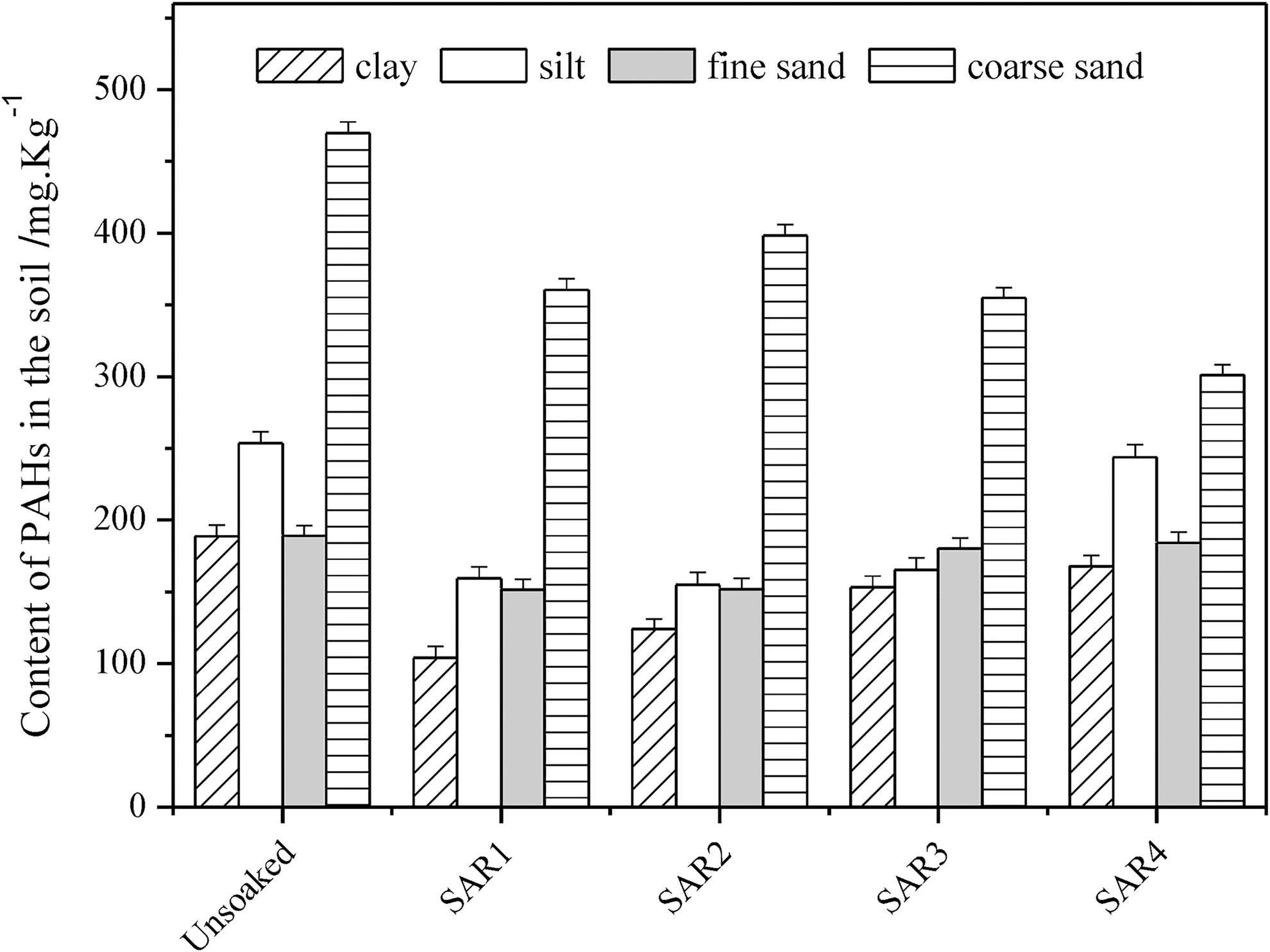
The effect of SAR type on total contents of PAHs in the organo-mineral aggregates with different sizes. PAHs, polycyclic aromatic hydrocarbons; SAR, simulated acid rain.
Percentage of Decreasing Content of Σ Polycyclic Aromatic Hydrocarbons in Organo-Mineral Aggregates with Different Sizes Soaked by Simulated Acid Rain
The total contents of PAHs in clay, silt, and fine sand decreased significantly in SAR1 treatment, while the total contents of PAHs in clay, silt, and fine sand decreased slightly in SAR4 treatment, which indicates that the acidity of SAR has significant effect on total contents of PAHs in organo-mineral aggregates in red soil and the impact increased with the decrease of pH of SAR. In the SAR1 treatment, the contents of PAHs decreased in the order of clay > silt > fine sand and the trend was not observed in other treatments. The total contents of PAHs in coarse sands decreased after soaking by all type SAR. However, the extent of decrease varied insignificantly between different treatments, which indicates that the AR had a slight impact on the coal particles.
Effect of SAR type on the contents of PAHs with different rings
The effect of SAR type on the contents of PAHs with different rings in organo-mineral aggregates was determined (Fig. 2). As can be seen, the contents of PAHs with different rings in the organo-mineral aggregates decreased after soaking with SAR, but the extent of decrease varied with the particle sizes of organo-mineral aggregates and the pH of the SAR.
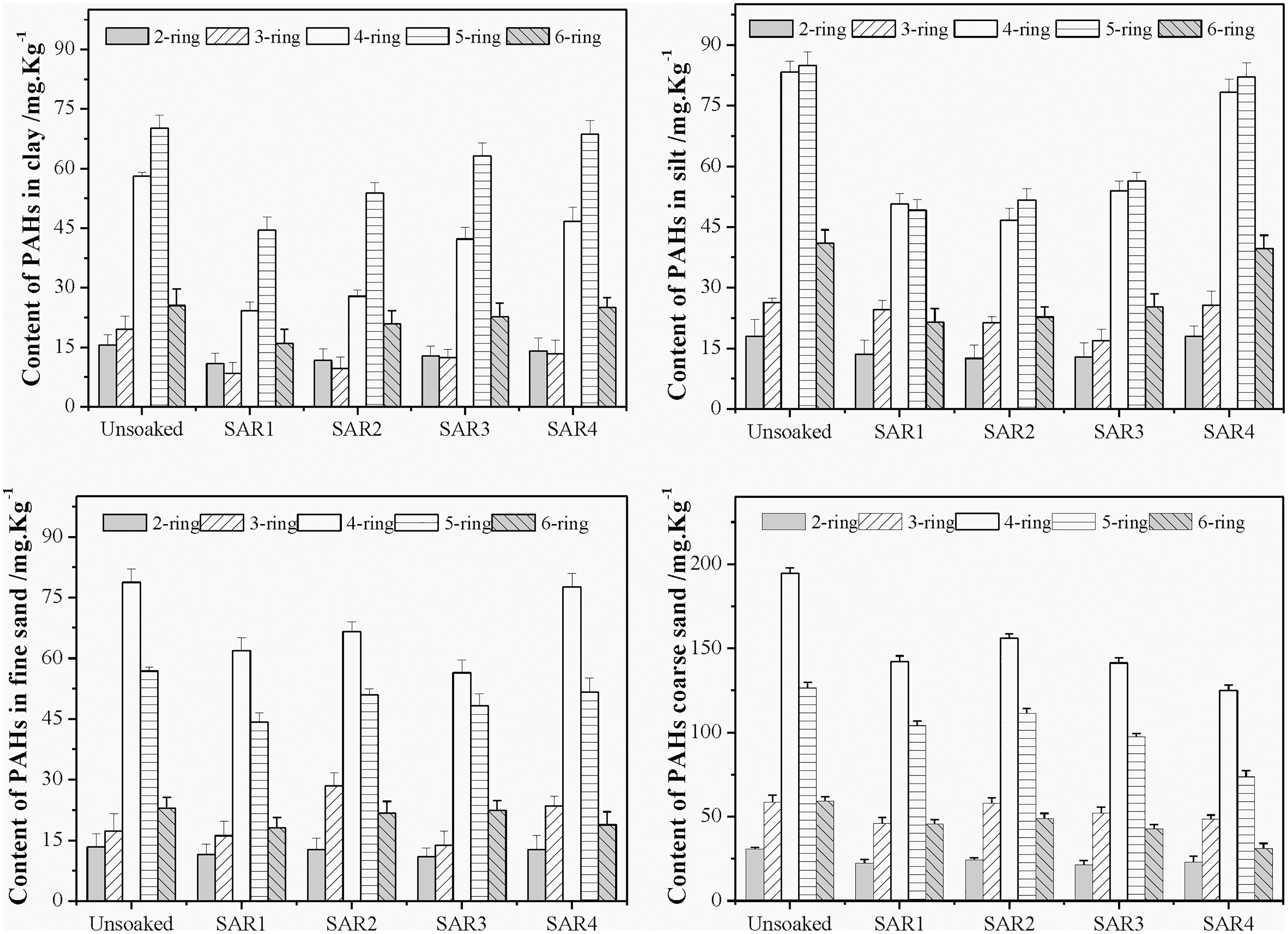
The effect of SAR type on the contents of PAHs with different rings in organo-mineral aggregates. Percentage of PAH decreases in silt.
Except coarse sand, the contents of PAHs with different rings in clay, silt, and fine sand decreased significantly in the treatments of SAR with lower pH (Fig. 3), which indicates that the leaching of PAHs increased with the increase of SAR acidity. Furthermore, the contents of PAHs in organo-mineral aggregates varied with the particle sizes of organo-mineral aggregates.

Percentage of decreasing content of PAHs with different rings in organo-mineral aggregates soaked by SAR.
In clay and silt, the contents of PAHs with aromatic rings of 3 and 4 decreased significantly and the PAHs with aromatic rings of 5 and 6 decreased slightly after soaking with SAR. The difference of contents of PAHs with aromatic rings of 2 caused by different acidity of SAR was slight. Naphthalene is the only PAH with aromatic rings of 2 in the priority list of U.S. EPA and it can volatilize easily in room temperature with a low saturated vapor pressure. Naphthalene gets lost partly in the process of extraction, condensation, and purification. It can be concluded that the SAR facilitated the release of PAHs with lower aromatic rings (≤4) in clay and silt, but affected the release of PAHs with higher aromatic rings (≥5) insignificantly. The reason for that is the difference of PAH properties and the substances bonded to them in soils. Normally, the PAHs with lower aromatic rings bond to humic acid and fulvic acid; the PAHs with higher aromatic rings bonded with humin in soils. The PAHs with lower aromatic rings were released with the dissolution of humic acid and fulvic acid caused by SAR. The release of PAHs with higher aromatic rings was affected insignificantly by SAR because of the low solubility of humin either in acidic or alkaline conditions.
The contents of PAHs in the coarse sand decreased after soaking with SAR, but the acidity of SAR affected the decrease insignificantly. The PAHs in the coarse sand were extracted by the procedure of accelerated solvent extraction and some coal particles were decomposed to PAHs by high temperature in the process of extraction. The amount of PAHs transformed from coal particle was much greater compared with PAHs absorbed by coarse sand. Also, the coal particles in the coarse sand were affected by the acidity slightly. As a result, the SAR had a slight impact on the release of PAHs in the coarse sand.
Effect of SAR on the mineral composition
The effect of SAR soaking on mineral composition of clay and silt in red soil was characterized by XRD analysis (Fig. 4 and Table 5).

XRD analysis of clay and silt in red soil soaked by SAR1. XRD, X-ray diffractometry.
Mineral Composition of Clay and Silt in Red Soil Soaked by Simulated Acid Rain 1
As can be seen, quartz is the main mineral because the content of quartz in clay and silt is 38% and 71%, respectively. As one kind of primary mineral with stable SiO2 crystal lattice, the quartz has no absorptive property and cannot provide adsorption points for contaminants. The change of quartz contents in clay and silt caused by SAR slightly affected the contents of PAHs. XRD analysis shows that SAR soaking has little effects on the mineral composition of clay and silt (Fig. 4), but the proportion of the mineral changed after being soaked by SAR. The contents of kaolinite, chlorite, illite, and hematite in clay and silt decreased by 5.8%, 0.5%, 2.6%, and 0.3%, respectively. The hematites in clay play an important role in the adsorption of organic contaminants. The clay that consisted of aluminum silicate minerals is a weak adsorbent for organic matter. Under the stress of SAR, the organo-mineral aggregates were broken with the speciation transformation of aluminum in soils. The organic matter with small molecular mass was desorbed from the organo-mineral aggregates and the PAHs bonded with them released.
Conclusions
The distribution of organo-mineral aggregates in red soil was affected by SAR soaking. The contents of clay and silt in organo-mineral aggregates of red soil increased after SAR soaking, while the contents of coarse sand and fine sand decreased. The extent of variation increased with the increase of SAR acidity. The SAR facilitated the release of PAHs in organo-mineral aggregates with different sizes and the impact varied with acidity of SAR and the particle sizes. The amount of PAHs released from the organo-mineral aggregates increased with the increase of SAR acidity. The SAR facilitated the release of PAHs with lower aromatic rings (≤4) in clay and silt, but the impact of SAR on the release of PAHs with higher aromatic rings (≥5) was slight.
Footnotes
Acknowledgments
We are grateful to Dr. Fangni Zhao for assistance in obtaining soil samples, and Prof. Fasheng Li and Dr. Hui Li for their valuable comments and suggestions.
Author Disclosure Statement
The authors declare that the research is in compliance with ethical standards, and they have no conflict of interests. This article does not contain any study with human participants or animals performed by any of the authors.
Funding Information
The study was financially supported by the National Natural Science Foundation of China (Grant No. 41701358) and the Henan Province Education Department Science and Technology Breakthrough Project (Grant No. 14B610011).