




Abstract
Ammonia nitrogen (NH3-N) and chemical oxygen demand (COD) are two major pollutants in the first-effect distillate obtained from shale gas produced water after multiple-effect evaporation (MEE) treatment. Accordingly, an integrated adsorption–photocatalysis system with 4A zeolite was applied for the simultaneous removal of NH3-N and COD from the shale gas first-effect distillate. Effects of temperature, light source, reaction time, light intensity, and solution pH of the integrated system were discussed and optimized for pollutants removal. After 60-min illumination (PL-XQ500W xenon lamp, AM1.5, 25 A), NH3-N and COD removal rates were up to 88.9% and 59.0%, respectively. GC-MS analysis showed that long-chain organics in the shale gas distillate were oxidized and decomposed into short-chain organics mainly because of the effect of photocatalysis. The removal of NH3-N was the synergistic effect of zeolite adsorption and photocatalysis based on nitrogen component analysis in water samples.
Introduction
In recent decades, the rapid development of shale gas industry has led to a huge increase in unconventional energy production. However, shale gas produced water, a mixture of fracturing fluid and formation water, contains high concentration of salt and complex organic compounds and could produce serious problems to environment if discharged inappropriately (Cho et al., 2018; Jang and Chung, 2019). As one kind of desalination processes, single-/multiple-effect evaporation (SEE/MEE) systems are widely applied for shale gas wastewater treatment (Onishi et al., 2017). The main pollutants in these distillates after SEE/MEE operation are ammonia nitrogen (NH3-N) and chemical oxygen demand (COD). Therefore, the simultaneous removal of NH3-N and COD from wastewater is necessary to the subsequent harmless treatment and recycling utilization of shale gas distillates. Aiming at the coexistence pollutants in wastewater, a combination of multiple treatment technologies can effectively and simultaneously remove complex pollutants (Chang et al., 2019; Moser et al., 2019).
Adsorption is applied to separate pollutants from aqueous system and is considered one of the most promising methods for water treatment. Zeolite is widely used in adsorption process because of its low cost, high efficiency, and simple operation (Zhou and Boyd, 2014; Lu et al., 2019). It is a kind of porous nonmetallic oxide adsorbent and a diverse group of alkaline and hydrated crystalline aluminum silicate mineral. The adsorption performance of zeolite is strongly related to its pore structures and chemical properties. The crystal structure of zeolite is generally considered to be a three-dimensional four-connected framework formed by TO4 (T = Si, Al, P, etc.) tetrahedral, that is, connected by sharing vertex oxygen atoms (Li and Yu, 2014). Those interconnected channels are favorable for the high cation exchange capacity, which make zeolite a good NH3-N adsorbent. Plenty of researches have confirmed the affinity of zeolites for NH3-N (Huang et al., 2010; Yusof et al., 2010). One NaCl-modified zeolite had obtained a high NH3-N removal of 81% for pretreated leachate treatment (Couto et al., 2017).
Adsorption of organic compounds on zeolite is significantly affected by organic properties including polarity, hydrophobicity, and alkalinity. Tsai et al. (2009) investigated the adsorption of methylene blue (MB) (cationic dye) and bisphenol-A from aqueous solutions onto a synthesized zeolite using hydrothermal method, and found that this novel zeolite exhibited much higher adsorption capacity on MB than bisphenol-A because of the difference in molecular hydrophilicity.
Photocatalysis is an advanced oxidation process. In recent years, photocatalytic degradation of various compounds in water and wastewater treatment has been deeply studied, especially in treatment of high organic concentration wastewaters (He et al., 2016; Nguyen et al., 2018; Wang et al., 2018). Threrujirapapong et al. (2017) investigated the efficiency of the photocatalysis process on an industrial wastewater containing high nonbiodegradable organic carbon, and the results showed that the highest COD removal efficiency (85%) was reached at 1 g/L titanium dioxide (TiO2) loading in a laboratory scale reactor. Theoretically, when a photocatalyst excited under strong light, electrons (e−) migrate from the valence band to the conduction band, leaving a positive hole on the valence band. Hydroxyl radicals (•OH) and superoxide radicals (
TiO2 is widely studied in the photocatalysis system because of its environmentally benign, chemical stable, strong oxidation and low cost advantages (Byrne et al., 2018). According to the determination and analysis of internal structures, zeolites with abundant holes displayed similar tetrahedral pore structures to TiO2. It is highly possible that the internal electrons in zeolite might be also excited by the irradiation under strong light and generate charged electron holes and superoxide/hydroxyl radicals. Current researches have found that zeolites can exhibit excellent adsorption capacities and are also with high nonsemiconductor photocatalytic performance (Kato et al., 2002; Matsuoka and Anpo, 2003). The founding of Nassar and Abdelrahman (2017) showed that the prepared zeolite could be simultaneously used as adsorbents and photocatalysts for the removal of MB dye from aqueous solutions. However, simultaneous removal of NH3-N and COD using zeolite as the adsorbent and photocatalyst was seldom reported. Thus, it is valuable to adopt zeolite in an adsorption–photocatalysis integrated system and explore its pollutants degradation ability.
According to our previous study (Wang et al., 2019a), 4A zeolites were used to effectively remove COD and NH3-N from shale gas distillates through an integration system of adsorption and photocatalysis, and the treated wastewater could well meet the circulation cooling water (CCW) quality. The results proved that it was a feasible way to use zeolites for the simultaneous removal of COD and NH3-N. The main objective of our research was to further discuss the impact of operational factors for removal of NH3-N and COD from the shale gas distillate and also to discuss the degradation mechanism of NH3-N and COD in this zeolite adsorption-photocatalytic system.
Materials and Methods
Materials and reagents
Typical wastewater used in this study was collected from a certain shale gas well located in Weiyuan, Sichuan Province, China. The raw wastewater was pretreated by alkali precipitation (Wang et al., 2019b), filtration, and MEE to get the target distillate (Wang et al., 2019a) for further research. Multiple-effect evaporation was carried out subsequently through three SEE units equipped with an externally heated evaporator to obtain different stage distillates. Table 1 provides the components of shale gas produced water and the first-effect distillate.
The Characteristics of Water Samples
COD, chemical oxygen demand.
As given in Table 1, the distillate was alkaline with very little chloride ion, whereas it had an excess concentration of NH3-N and COD that violated the CCW requirements (Q/SH 0104-2007, China).
A certain 4A zeolite (Na2O·Al2O3·xSiO2·yH2O) was selected according to our previous research as the adsorbent and photocatalyst because of its good performance toward NH3-N and organic compounds. All chemicals used in this study were analytical grade and provided by Kelong Chemical Reagent Co. Ltd.
Experiments
The aim of this study was to discuss the operation and mechanism of this integrated system (adsorption and photocatalysis) on the simultaneous removal of NH3-N and COD from the first-effect distillate. Zeolite was used as the adsorbent and photocatalyst. A xenon lamp (luminous spectrum: 300–2500 nm, 25 A, Beijing Precise Technology Co. Ltd, China) was used as the light source. Zeolite (10 g/L) and wastewater (50 mL) were thoroughly mixed in a quartz beaker (100 mL) and put under the xenon lamp. The suspension was stirred at a rate of 150 rpm. The temperature of the suspension was kept constant by a cooling water system. After a period of reaction, the supernatant was filtered out (0.45 μm) and determined for COD and nitrogen fractions. Meanwhile, the residual gas was collected and its nitrogen components were determined.
All experiments and analysis were carried out twice under identical conditions, and all data were calculated as the average values.
Analytical methods
COD concentration was obtained according to the rapid-digestion method using a 5B-1 and 5B-3(C) COD rapid measurement instrument (Lian-hua Tech Co. Ltd, China). Ammonia nitrogen concentration (NH3-N) was determined by spectrophotometry (Lian-hua Tech Co. Ltd, China). The measurement of COD and NH3-N were in accordance with standard methods HJ/T 399-2007 and HJ 535-2009 (China), respectively. Chloride ion, total nitrogen (TN), nitrite nitrogen (
Results and Discussion
Integration of adsorption and photocatalysis
Adsorption, illumination, photocatalysis after adsorption equilibrium, and integration of adsorption–photocatalysis were carried out for comparison. Fifty milliliter distillate was stirred (150 rpm) and illuminated under the xenon lamp (25 A) for 60-min photolysis, whereas 50 mL distillate with 10 g/L zeolite was stirred (150 rpm) for 4-h adsorption. After 4-h equilibrium adsorption, the mixture was illuminated under the xenon lamp (25 A) for 60-min photocatalysis. The integration of adsorption–photocatalysis experiment was carried out using 50 mL distillate mixed with 10 g/L zeolite and stirred (150 rpm) under the xenon lamp (25 A) for 60-min reaction.
As given in Fig. 1, there was little elimination of COD under 4-h adsorption or 1-h illumination. However, photocatalysis after 4-h adsorption equilibrium improved COD removal to 63.4% degradation, whereas in the 1-h adsorption–photocatalysis system, the removal rate of COD could obviously increase from none to 59.0%. Thus it indicated that the removal mechanism of COD in this system was mainly because of zeolite photocatalytic degradation. The NH3-N removal rates were 24.5%, 56.7%, 96.7%, and 88.9% for illumination, adsorption, photocatalysis after adsorption, and adsorption–photocatalysis treatment, respectively. It showed that zeolites' adsorption played an important role in NH3-N removal, whereas photocatalysis had a good synergistic effect on NH3-N degradation and encouraged the treatment process. It should be noted that the adsorption–photocatalysis method was more efficient owing to its time-saving and easy operation. Detailed discussion on these four systems was elaborated in our previous research (Wang et al., 2019a).
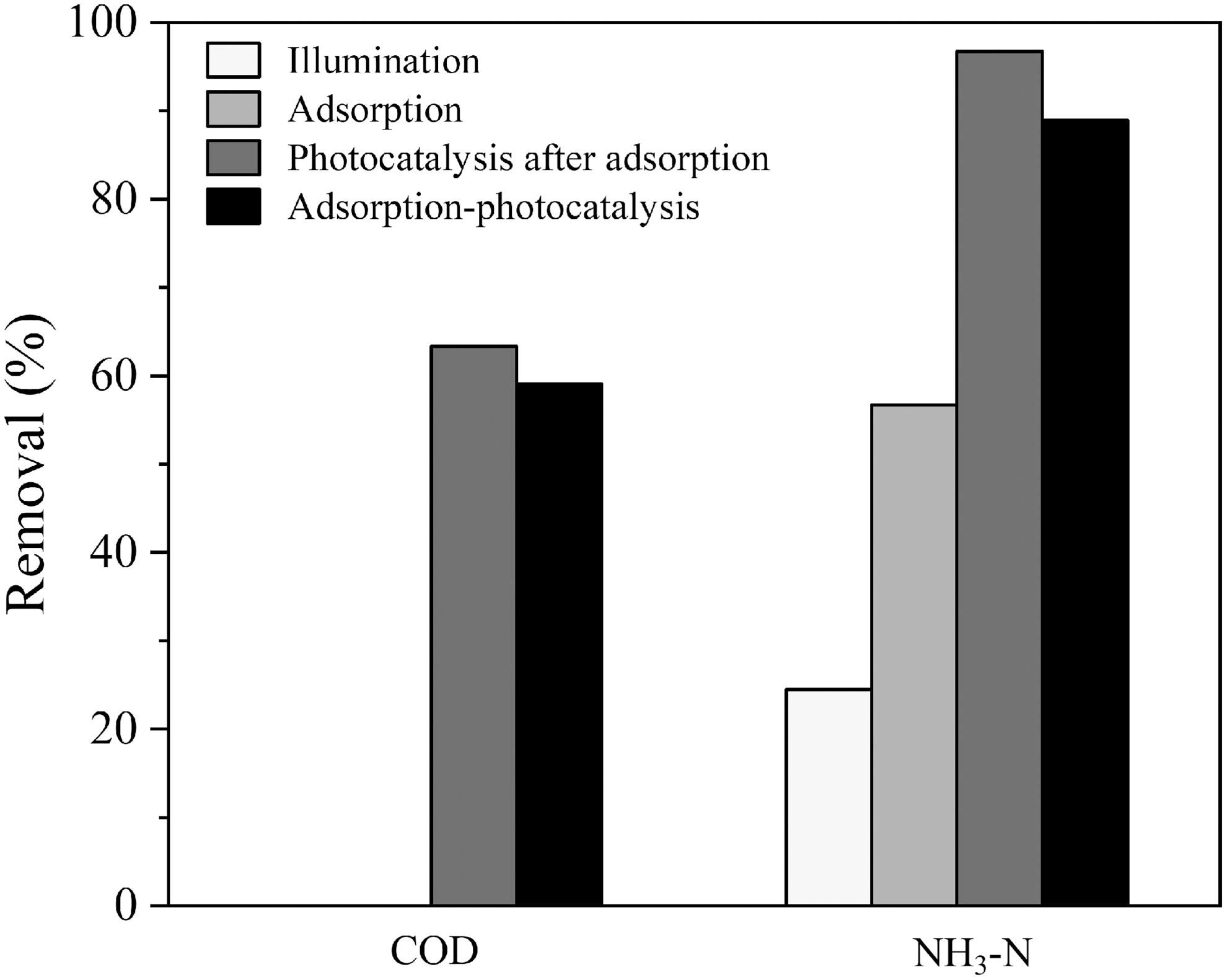
COD and NH3-N removal in the shale gas distillate by illumination, adsorption, and photocatalysis after adsorption, and adsorption–photocatalysis. COD, chemical oxygen demand; NH3-N, ammonia nitrogen.
Adsorption-photocatalysis studies
Reaction temperature
PL-XQ500W xenon lamp was used as the excited light source and brought excess energy to the reaction system. Directly exposing under the light would lead to a temperature increment of water samples in the system. To study the influence of temperature change in the integrated system, two reaction systems were studied and discussed. One group used a water cooling system (Fig. 2) to keep the whole reactor under a steady temperature (25°C), and the other was without cooling apparatus as a control group. All experiments were carried out under xenon lamp irradiation and with a light intensity of 25 A.

The impact of temperature on NH3-N and COD removal in the shale gas distillate by adsorption–photocatalysis integrated treatment.
After 30, 45, and 60 min, the temperature differences of the two groups were 5.5°C, 7.5°C, and 7.5°C, respectively. In Fig. 2, the removal rates for both contaminants increased with reaction time. For 30 or 45 min, the degradation rates of the two systems were almost the same. After 60 min, NH3-N and COD removal without special cooling was only 4.6% and 2.0% higher than the ones with condensation. Meng et al. (2018) applied g-C3N4 for the photocatalytic degradation on Congo Red, and found the fluctuation of removal rate was <10% within temperature range of 20°C. Above all, the efficiencies for both NH3-N and COD were insignificantly affected by temperature changing in a small range (5.5–7.5°C).
Light source
The wavelength and energy are much different among ultraviolet light, visible light, and sunlight, and thus have important roles on the photocatalytic reaction. Three kinds of filter (AM1.5, UV cut-400 nm, UV) to get different wavelength conditions were installed on the xenon lamp to simulate sunlight (0–2500 nm), visible light (400–760 nm), and ultraviolet light (250–400 nm) individually. All experiments were carried out with a light intensity at 25 A.
As given in Fig. 3, there was no obvious difference in degradation of NH3-N under three different light sources. After 60 min, NH3-N removal rate under sunlight was high up to 80.3%, and 4.2% and 2.8% higher than that under visible light and ultraviolet light, respectively. For COD, the removal rates under visible and ultraviolet light were nearly identical, and only ∼5% lower than the one under sunlight illumination. Either visible light or ultraviolet light had certain impact on degradation of NH3-N and COD in the adsorption–photocatalysis integrated system. Sunlight, combining both energy of visible light and ultraviolet light, had a better performance on COD and NH3-N removal. Hong et al. (2019) found that the photocatalysis rate constant of glutaraldehyde removal with Ag/AgCl/BiOCl under natural light was 0.0336 min−1, suggesting the potential of sunlight photocatalysis. It is favorable to apply nature light source and complete a better degradation efficiency on simultaneous removal of COD and NH3-N from shale gas distillate.
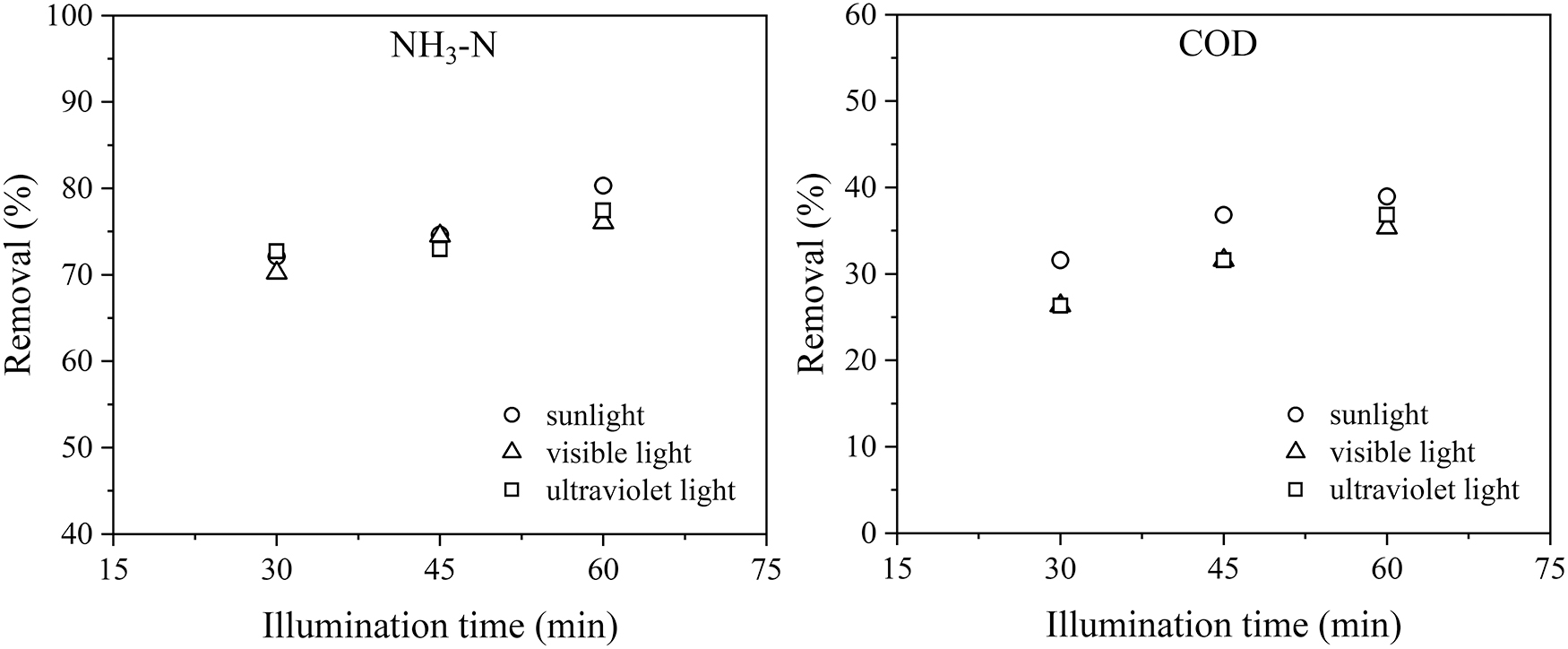
The impact of light source on NH3-N and COD removal in the shale gas distillate by adsorption–photocatalysis integrated treatment.
Reaction time
A series of experiments were studied from 0 to 60 min to determine the impact of illumination time on the degradation of NH3-N and COD. All experiments were carried out under xenon lamp (AM1.5) with the light intensity 25 A. As given in Fig. 4, NH3-N and COD removal exhibited a similar trend. The degradation was fast in the first 30 min, then became unchanged after 45 min. Within the first 10 min, NH3-N removal rate reached 61.8% quickly. The degradation of COD mainly occurred in the first half hour and was up to 51.0%. The removal rates of NH3-N and COD were finally stabilized at 88.9% and 59.0% after 1 h.
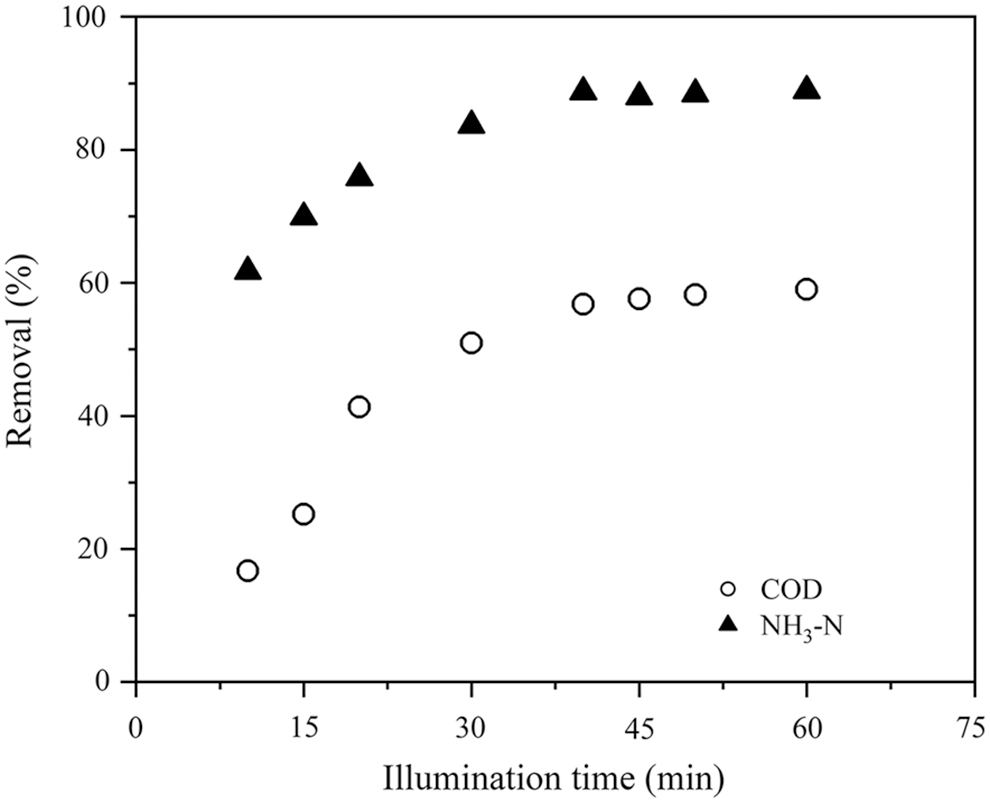
The impact of reaction time on NH3-N and COD removal in the shale gas distillate by adsorption–photocatalysis integrated treatment.
Intensity
The rate of photocatalysis activation and electron-hole formation are highly related to the light intensity. Working current of the xenon lamp (AM1.5) was adjusted within 15–25 A (500–2000 W). In Fig. 5, NH3-N removal rate slightly increased with the increasing light intensity. After 60 min, NH3-N removal rates under light intensity of 15, 20, and 25 A were 74.4%, 76.6%, and 80.3%, respectively. However, COD removal rates were substantially changed with the increasing light intensity. After 60 min, COD removal rate under 25 A was 17.9% higher than the one under 15 A. Generally, larger light intensity is helpful for higher degradation efficiency by generating more incident photons and more active substances. Bendjabeur et al. (2018) found that the degradation rate of gentian violet increased from 23% to 51% with light intensity increasing from 2 to 6 mW/cm2.

The impact of light intensity on NH3-N and COD removal in the shale gas distillate by adsorption–photocatalysis integrated treatment.
The increasing light intensity did not significantly improve the degradation of NH3-N. It could be deduced that NH3-N removal in this system was mainly controlled by zeolite adsorption rather than photocatalytic effect. Meanwhile, COD removal under the photocatalytic process was much sensitive with light intensity changes.
pH
pH is an important factor in the integration system of adsorption–photocatalysis. It relates to the surface charge properties of the adsorbent/photocatalyst and the existence form of contaminants. Under acidic or alkaline condition, zeolite surface could be protonated or deprotonated; thus it was positively charged in acidic conditions and negatively charged in alkaline conditions. In our study, the original pH of the target distillate was basic (between 9 and 11). The solution's pH was adjusted from 2 to 12 by NaOH and HCl solution. Experiments were operated under xenon lamp (AM1.5) with the light intensity 25 A for 1 h (Fig. 6).
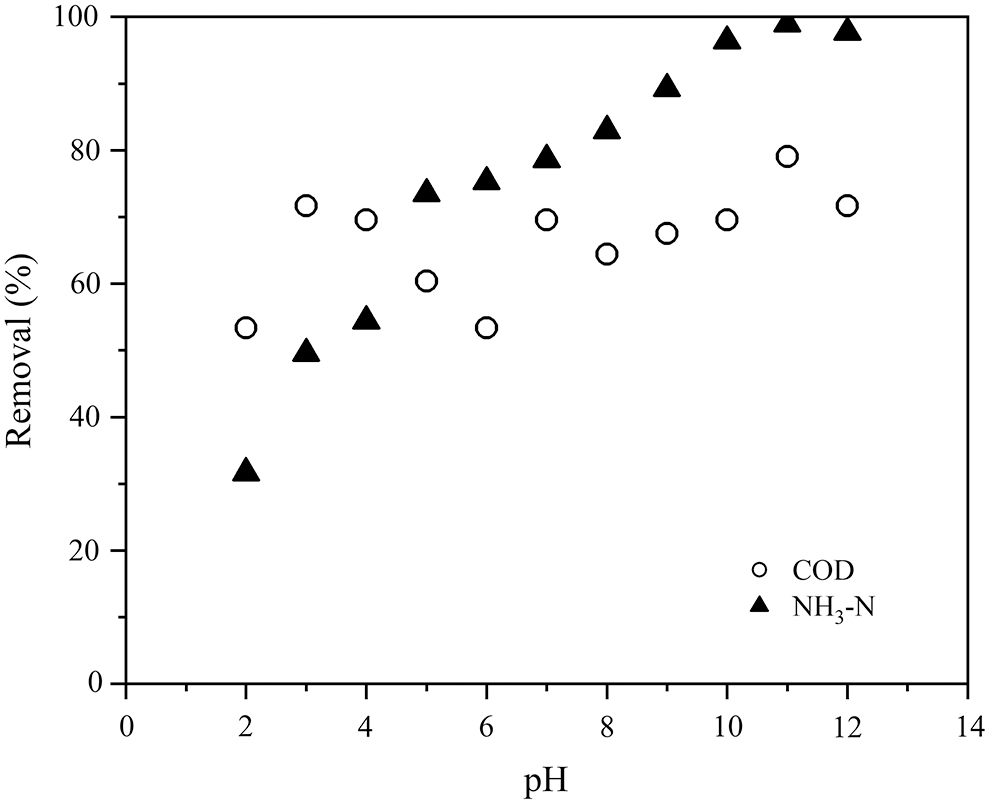
The impact of solution pH on NH3-N and COD removal in the shale gas distillate by adsorption–photocatalysis integrated treatment.
For NH3-N, the removal rate increased from 31.6% to 98.9% with pH changing from 2 to 11 and then slightly decreased at pH 12. Similar trends were also found in other NH3-N photolysis studies (Wang et al., 2017; Liu et al., 2019; Tu et al., 2019). As pH increased, H+ ion concentration was gradually decreased, which abated the competition with
Removal mechanism of COD
To study the removal mechanism of COD in the integrated system, GC-MS analysis was performed on the distillate and water sample after 1 h of adsorption–photocatalysis treatment. In Table 2, the organic contents in the distillate were mainly C8H8O and C14H18N2Si, which accounted for 77.24% and 8.85%, respectively. After degradation, the main components were 44.48% C5H8O and 26.78% CH2Cl2, respectively. Long-chain organic matters, that is, C14H18N2Si, C13H18O2, C11H16O, and C8H16O were not detected after treatment, which indicated that those organic matters were completely degraded. Meanwhile, nonexistent matters in the distillate including CH2Cl2, C5H8O, C8H9NO2, and C13H22O were presented in the treated water.
GC-MS Analysis of Distillate and Water Sample After Adsorption-Photocatalysis
N.D., not detected.
When exposed to strong light, the generation of
Removal mechanism of NH3-N
The removal mechanism of NH3-N was studied by nitrogen component analysis in water samples. TN, NH3-N,
As given in Table 3, the nitrogenous components for the target distillate were mainly NH3-N and organic nitrogen and their proportions were 83.5% and 16.5%, respectively (sample I). After 4-h adsorption to get equilibrium, the remaining nitrogen in the water was still NH3-N and organic nitrogen in sample II. Compared with sample I, 52.7% nitrogen components were adsorbed by zeolite. Moreover, organic nitrogen content was almost unchanged in sample II. Then, 1-h additional photocatalytic operation was conducted in sample III. The TN removal was further increased to 64.1% compared with sample II (52.7%). Concentrations of
The Nitrogen Component of Distillate and Treated Water
NH3-N, ammonia nitrogen;
The produced water was collected from a working shale gas well, and the organic components in samples were relatively complicated and difficult to eliminate. NH3-N in the solutions was the target nitrogenous part to be treated in our adsorption–photocatalysis system. Referring to the nitrogen concentrations in samples II and III, photocatalysis efficiently improved NH3-N removal rate (up to 18%) in sample III with the subsequent illumination compared with the one in sample II with simple adsorption. It proved that zeolite could additionally exert a photocatalytic oxidation under illumination and promote the conversion/degradation of NH3-N.
Overall, NH3-N in the target distillate was mainly adsorbed by high cation exchange capacity of zeolite (Wang and Peng, 2010; Markou et al., 2014). A part of NH3-N in the integrated system was converted into nitrogen by active radicals like hydroxyl radicals (•OH) or superoxide radical (
Conclusions
Aiming at the coexistence of NH3-N and COD in the shale gas first-effect distillate, the integrated adsorption–photocatalysis system with 4A zeolites was adopted and could efficiently remove these pollutants simultaneously. Effects of system temperature, light source, reaction time, light intensity, and solution pH of the integrated system were studied and optimized for pollutants removal. After 60 min, the removal rates of NH3-N and COD with 10 g/L zeolite under a xenon light (AM1.5, 25 A) were 88.9% and 59.0%, respectively. Compared with visible light or ultraviolet light, sunlight was more favorable for simultaneous removal of COD and NH3-N from shale gas distillate. Compared with NH3-N, COD removal was substantially enhanced by increasing light intensity, and the removal rate under 25 A was 17.9% higher than that under 15 A. Alkaline conditions were beneficial to degrade both COD and NH3-N in the system. In the integrated system, COD removal from the distillate was mainly dependent on photocatalysis, and long-chain organics in solution was reduced from 90.2% to 20.7% after treatment. For NH3-N, zeolite adsorption was much crucial on NH3-N removal, whereas photocatalysis excited by zeolite had a good synergistic effect (18%) to improve the elimination.
Footnotes
Author Disclosure Statement
No competing financial interests exist.
Funding Information
This study was supported by the National Science and Technology Major Project in the 13th Five-Year Plan “High-efficiency development of ultra-deep bioherm gas reservoirs with bottom water” (No. 2016ZX05017-005).