




Abstract
The decentralized sewage discharge changes greatly in quantity, quality, and spatial distribution, and is becoming increasingly intractable. Therefore, a chemical catalytic biofilm reactor (CCBR) was established with an iron-based microbial coupling carrier and applied to treat domestic sewage. The dynamic features of the CCBR were examined along with the effects of the hydraulic retention time (HRT), dissolved oxygen (DO), and recycle ratio on pollutant removal. An optimal DO content of 4.0 mg/L, HRT of 7.5 h (4.5 h for anaerobic biological reactor and 3.0 h for aerobic biological reactor), and recycle ratio of 4:1 were obtained at total nitrogen, chemical oxygen demand (COD), and total phosphorus (TP) removal efficiency levels of ∼91.7–94.1%, ∼95.4–97.0%, and ∼88.9–93.3%, respectively. Simultaneous heterotrophic and autotrophic denitrification occurred in the CCBR as revealed by analysis of the microbial communities. Thus, the CCBR shows great potential for application in decentralized domestic sewage treatment systems.
Introduction
The collection, treatment, and discharge of domestic sewage can be performed in centralized or decentralized systems (Di Capua et al., 2015). With the rapid development of the economy, large centralized sewage treatment plants have been established in China; Under the premise of using appropriate treatment technology, the centralized sewage treatment plant shows high performance (is efficient) in treating the effluent in relatively close vicinity to its source of generation. However, for residential areas such as scattered buildings, rural areas, and microcolonies without a centralized sewage treatment system, the decentralized sewage discharge changes greatly in quantity, quality, and spatial distribution, and is becoming increasingly intractable (Jorsaraei et al., 2014). In addition, wastewater treatment plants are among the major energy consumers at municipal level worldwide (Capodaglio, 2017; Capodaglio and Olsson, 2020). In recent years, due to the increasing pollution of the environment and sustainable economic development becoming very necessary, the discharge standards of pollutants from sewage treatment plants have been restricted to protect the water environment and alleviate water body pollution (Libralato et al., 2012; Jin et al., 2014; Capodaglio et al., 2016).
Biological treatment methods can effectively treat the soluble organic substances widely present in domestic sewage. Therefore, biological methods are often used for the treatment of domestic sewage. The selection of an on-site treatment systems was based on many factors such as low cost, an appropriate efficiency, minimum energy, and maintenance costs (Dawes and Goonetilleke, 2003; Brix and Arias, 2005; Leverenz et al., 2010). The treatment options for decentralized domestic sewage mainly include intermittent sand filters (ISF), constructed wetlands (CW), and land treatment systems (LTS) (Healy et al., 2007; Massoud et al., 2009; Tanner et al., 2012). However, with the population growth and urbanization development, the cost and availability of land are becoming limiting factors considering the treatment options of ISF, CW, and LTS require large facility areas (Parkinson and Tayler, 2003; Aiyuk et al., 2004; Sevda et al., 2013).
The sequential anaerobic–aerobic treatment of domestic sewage takes the advantages of the two systems in the most cost-effective settings (Kassab et al., 2010). Fluidization is a process that granular bed is suspended by the wastewater flow. Fluidization has many advantages, including large specific surface area, excellent mixing effect, increased mass transfer, uniform particles, and temperature distributions (Nelson et al., 2017). Anaerobic–aerobic processes using fluidization technology is widely used in domestic sewage treatment plants (Islam et al., 2009; Li et al., 2013).
Currently, various engineered systems have been studied for nitrification and denitrification. It can be concluded that the biofilm reactor is an attached growth system, which has proven to be a reliable technology with smaller footprints and lower capital and operating costs than activated sludge systems. The quality of biofilm formation is an important criterion for the biological treatment unit to treat decentralized domestic sewage. Biofilm carriers are the core of a biofilm reactor for supporting microbial adhesion. The biological carriers used in a biofilm reactor have an extremely high specific surface area, which targets high biomass concentrations, thus, the treatment of high pollutant loadings can be achieved (Di Capua et al., 2015). The suspended biofilm carriers used for biofilm treatment processes are typically made of hard plastics such as polyethylene (PE), polypropylene, and high-density polyethylene depending on the density requirements because of their high durability and stability; and their density is not only close but also lower than the density of water (McQuarrie and Boltz, 2011). However, these biofilm carriers have some inherent disadvantages, such as their electronegative characteristics. Cytomembranes contain many carboxyl and phosphate groups, which impart a negative surface charge to the membranes at neutral pH, which could result in easy separation of biofilms, a long startup time in the systems, and affect the development and structure of the biofilm on the carriers (Busscher et al., 1995). Therefore, it is very important to choose a biofilm carrier that is suitable for microbial growth.
In a previous study, iron-based microbial coupling carriers (IBMCs) were produced by zero valent iron (ZVI) and catalysts (Hu et al., 2019). An IBMC hosts chemical activities of nitrate reduction and phosphorus removal (Deng et al., 2017). Additionally, IBMCs have high specific surface area to provide a suitable growth environment for microorganisms. The microelectrolysis process produces H2 and Fe2+, which provides electrons for microbial denitrification (Deng et al., 2016a, 2016b; Xing et al., 2018). Equations (1)–(3) show the reactions of iron corrosion-based denitrification (Huang et al., 2003; Zhu and Getting, 2012). The formation of catalytic galvanic cells can improve the in situ content of H2 or [H], and the production [Eq. (1)] rate of Fe2+ by accelerating the electron transfer between iron and carbon, which significantly benefits for autotrophic denitrification. Thus, an IBMC is an efficient and suitable biological treatment carrier.
The dual-stage A/O is a classic sewage biological treatment device, which can maturely control various parameters of the reactor. In this study, the chemical reduction properties of an IBMC and functional biofilms associated with the IBMC were combined to establish a chemical catalytic biofilm reactor (CCBR). CCBR consists of an anaerobic biological reactor (ABR) and oscillatory baffled reactor (OBR). In CCBR system, IBMC was used as biofilm carrier in ABR and OBR, and chemical microelectrolysis reaction occurred inside IBMC. The nitrate from domestic sewage could be removed by chemical reduction of the IBMC, and phosphorus could be removed by chemical precipitation of the IBMC. Simultaneously, the active ·O generated by microelectrolysis can oxidize part of organic matter (Hu et al., 2019). As a highly efficient biological carrier, an IBMC was placed in a CCBR system to provide a suitable environment for the development of nitrification and denitrification. In OBR, nitrifying bacteria convert ammonia into nitrate under the action of oxygen with ammonia as nutrient. In ABR, IBMC chemically generated Fe2+ and H2, are provided as electron donors for the growth of denitrifying bacteria and nitrate was removed by reduction to nitrogen gas.
To study the feasibility and applicability of a CCBR for the treatment of domestic sewage from an expressway management station, a field test was performed. The influencing factors of system operation and performance of the system under relatively constant conditions were studied. Furthermore, the biofilms in the ABR and OBR were sampled for the analysis of the microbial communities in the reactor. Additionally, the IBMC mechanisms of systematic pollutant removal were studied. This work aimed to provide an applicable technology and a corresponding theoretical basis for the treatment of domestic sewage. This research could also provide an approach for other decentralized sewage treatment systems.
Materials and Methods
Preparation of the IBMC
The IBMC (Fig. 1a) (Li, 2013) consisted of the following raw materials: ZVI (20 and 200 mesh), and catalyst (200 mesh). An IBMC is an efficient bio carrier with a high specific surface area. The average specific surface area of the IBMC was 35.2 m2/g, which was higher compared with coke and quartz sand (Hou et al., 2015). The IBMC comprised a reengineered iron–carbon complex, and a mass of galvanic cells were formed. Through the galvanic cell reaction, Fe(0) was converted to Fe2+, and [H] was produced. Fe2+ and [H] were used as electron donors in the denitrification process (Nguyen et al., 2015).
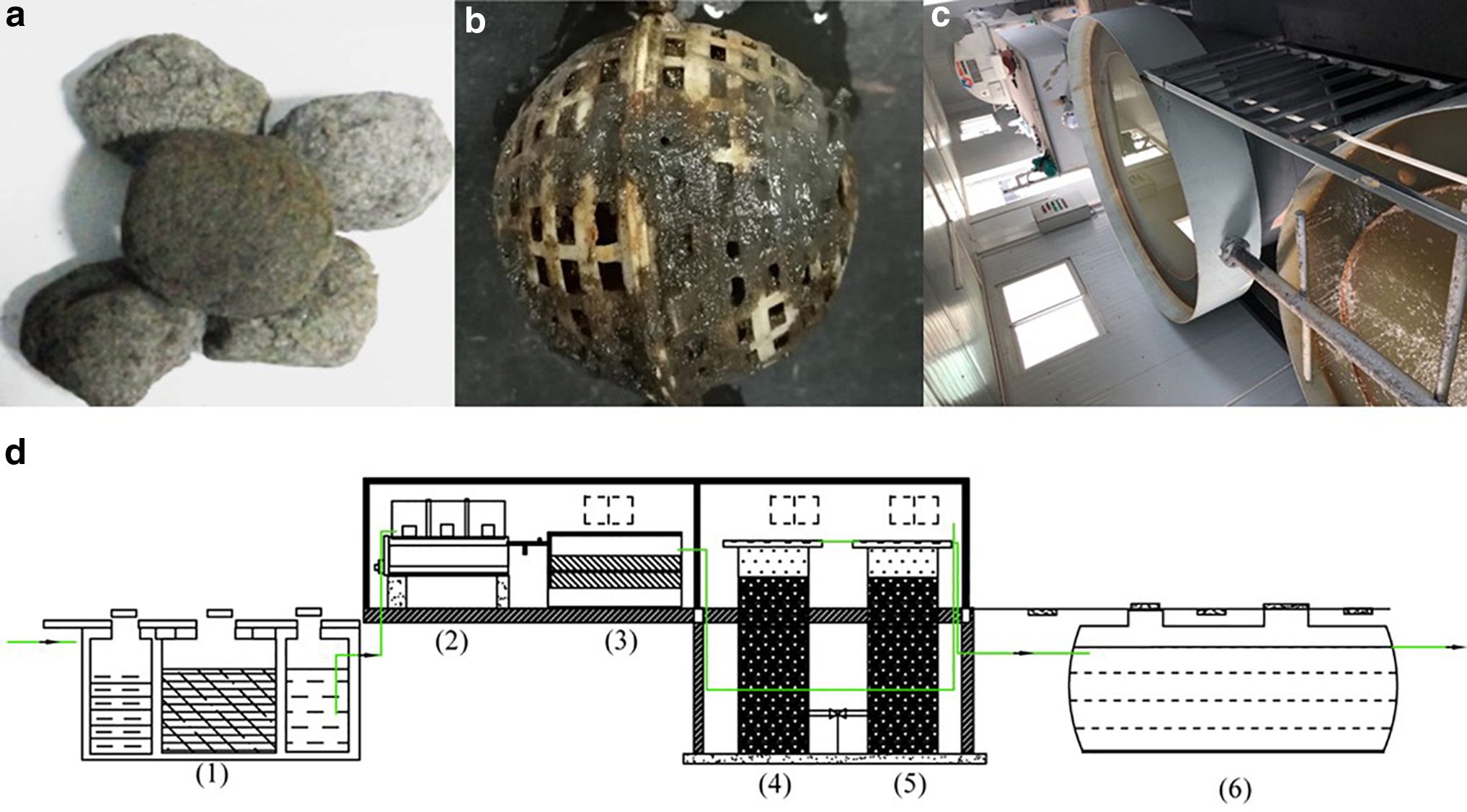
IBMC and field test [
Experimental setup
The field test was conducted in Juyongguan expressway station, which is located in Changping District, Beijing. The Juyongguan expressway station employs ∼100 people and produces 15–20 t domestic sewage each day. The field test was conducted with a grille well, hydrolysis acidification tank, rotating biological contactor, sedimentation tank, ABR and OBR. The rotating biological contactor is a commercial pretreatment process. Pipes connected each component of the field test, and reflow devices were used between the ABR and OBR (Fig. 1d). The ABR and OBR were filled with an IBMC contained in a PE spherical cage (Fig. 1b), which is denoted by the intersection line in Fig. 1d. The electrochemical reaction occurred in the IBMC, and the reaction products were released into the sewage, which provided the electron donors needed for denitrification in the ABR and the growth conditions for the nitrifying bacteria in the OBR.
The sewage flowed into the reactor from the bottom of the ABR, and the effluent of the ABR flowed into the top of the OBR and flowed out from the bottom of the OBR. Compressed air was passed through an air pump for aerobiosis in the OBR. The best operating conditions, such as the hydraulic retention time (HRT), dissolved oxygen (DO) content, and recycle ratio after on-site commissioning, were selected. Different HRTs were obtained by adjusting the pump flow, the DO content was controlled by an air compressor, and the recycle ratio was adjusted by a reflow device. Since the reactor was operated from winter to summer (from December 2017 to May 2018), the operation stability of the reactor under low-temperature conditions was also studied.
Sewage quality and operational strategies
The domestic sewage was discharged from the living area of the highway management station. The water quality is listed in Table 1. The field test was operated in six stages, namely, the start-up phase, individual experiments on the effect of the HRT, recycle ratio, DO, temperature, and operation under relatively constant conditions. In the start-up phase, activated sludge from the Yanjiao sewage treatment plant in Hebei Province was added to the ABR and OBR. After the start-up period, the experiments on the effect of different HRTs maintained at 5.0, 7.5, or 10.0 h (the HRTs of the ABR and OBR were 2.0, 3.0, or 4.0 h and 3.0, 4.5, or 5.0 h, respectively) and recycle ratios (2:1, 3:1, 4:1, or 5:1) on the pollutant removal in the CCBR were conducted. Under each HRT condition, a stabilization period of ∼5 days was needed for each HRT test. The effect of the DO content (the DO content of the OBR was controlled at 3.0, 4.0, or 5.0 mg/L) and the effect of a low temperature (lower than 12°C) were investigated in this study.
Characteristics of the Domestic Sewage from Expressway Management Station
COD, chemical oxygen demand; TN, total nitrogen; TP, total phosphorus.
Analytical methods
Samples of grille influent, ABR influent, ABR effluent, and OBR effluent were collected regularly, and the levels of the chemical oxygen demand (COD)Cr, NH4+-N, NO3−-N, NO2−-N, total nitrogen (TN), Fe2+, and Fe3+ were measured according to the Water and Wastewater Monitoring and Analysis Methods (Protection CsMoE, 2002). The pH, temperature, and DO content were determined by a probe method with a multiparameter water quality analyzer (WTW Multi3410; WTW Co., Ltd, Germany), UV–Vis spectrophotometer (TU 1810; Purkinje Co., Ltd., China), and chemical oxygen demand (COD) analyzer (COD Max II; Hach Co. Ltd.).
Microbiological analysis
To explore the microbial characteristics in the CCBR system, two samples of the biofilms attached to the IBMCs obtained from the ABR and OBR were obtained on the 60th day. The FastDNA SPIN Kit for soil (Qbiogene, Inc., CA) was used for extracting DNA from 0.5 g of sludge for each sample. The samples were mixed together for microbiological molecular analysis. The primers 806R and 338F were utilized for gene amplification in the polymerase chain reaction. Amplicon combination and purification were processed in triplicate; the amplicons were sequenced on an Illumina® HiSeq (Maj. Bio. Tech. Co., Shanghai).
Results and Discussion
Effect of the HRT
The relationship between the pollutants and HRT in the CCBR was investigated under the following conditions: a DO content of ∼3.9–4.1 mg/L and a recycle ratio of 4:1. The HRT was maintained at 5.0, 7.5, or 10.0 h by adjusting the influent flow to 0.6, 0.9, or 1.2 L/h. Samples were collected and analyzed regularly.
As shown in Fig. 2a, the removal rates of NH4+-N, NO3−-N, TN, and COD were found to increase with increasing HRT. The HRTs were controlled by adjusting the feed pump flow rate to examine the effects in the CCBR on the nitrogen and organic removal. When the HRT increased from 5.0 to 7.5 h, the removal efficiencies of NH4+-N, TN, and COD in the effluent increased from 65.9%, 47.8%, and 86.7% to 95.3%, 92.1%, and 96.4%, respectively. When the HRT increased from 7.5 to 10.0 h, the removal efficiencies of NH4+-N, TN, and COD did not continue to increase. The possible reason is that the biodegradable organic matters in domestic wastewater has been exhausted. Therefore, the approximate extension of denitrification in CCBR does not require excessively high HRT, so as to avoid energy waste. Nevertheless, with an excessively long HRT, the COD and phosphorus are exhausted, which might decrease the activity and even cause death of the microbes (Fu et al., 2010; Hocaoglu et al., 2011). In addition, the COD was not primarily consumed during the denitrification but by other pathways, such as oxidation in air and nondenitrification activities (Carrera et al., 2004).

Different influencing factors on pollutant removal [
An optimal HRT of 7.5 h (4.5 h for the ABR and 3.0 h for the OBR) for the CCBR was obtained, and the corresponding TN and NH4+-N loads were 81.8 and 37.2 g/[m3·d], respectively. This result indicated that the physical properties of the IBMC, such as the diameter, bulk density, specific surface area, and porosity, are beneficial for microbial attachment and growth. Furthermore, the electrons needed for denitrification are provided by galvanic reaction between iron and carbon.
Effect of the DO content
In the OBR, NH4+-N was oxidized into NO2−-N and NO3−-N by the nitrifying bacteria under aerobic conditions (Sinthusith et al., 2015), as shown in Equation (4). The generated NO3−-N diffused into the inner portion of the biofilms and was reduced by denitrifying bacteria using carbon resources or the [Fe2+] and [H] produced by the galvanic cell reaction in the IBMC under anaerobic conditions (Tang et al., 2013). Thus, a moderate DO content in the OBR and a low concentration of DO in the ABR are needed.
To investigate the effect of the DO content on pollutants in the CCBR system, the experimental conditions were as follows: the HRT was controlled at 7.5 h (4.5 h for the ABR and 3.0 h for the OBR); a recycle ratio of 4:1 was employed; and the DO content was controlled by adjusting the air pump to 3.0, 4.0, or 5.0 mg/L, in the top portion of the OBR.
As shown in Fig. 2b, the concentration of NH4+-N gradually decreased with increasing of DO content, and the NH4+-N removal rate reached at 89.5% and 91.7% when the DO content was 4.0 and 5.0 mg/L, respectively, in the top portion of the OBR. The concentration of NO3−-N gradually increased with increasing DO content, and the NO3−-N removal rate reached 94.3% and 95.9% when the DO content was 4.0 and 3.0 mg/L, respectively, in the top portion of OBR. To achieve the removal of TN in a reactor, it is necessary to achieve simultaneous and efficient removal of NH4+-N and NO3−-N. When the DO content was 4.0 mg/L, the TN was efficiently removed in the reactor, and the removal rate was 90.6%. Simultaneously, when the DO content was 4.0 mg/L, the COD was also removed at a removal rate of 91.1%. Thus, when the DO content was at 4.0 mg/L, the reactor could achieve simultaneous and efficient removal of pollutant. Compared with other reactors, the reactor had a high DO utilization rate and required less DO than other processes (Deng et al., 2016b).
Effect of the recycle ratio
The recycle ratio is one of the most important factors affecting the nitrogen removal efficiency of an anaerobic–aerobic process. The relationship is as follows (Eddy, 2004):
where η is the nitrogen removal efficiency, %; r is the water recycle ratio, and R is the sludge recycle ratio.
Since there is no sludge recycle ratio in this process, Equation (5) can be simplified as Equation (6):
Thus, the recycle ratio determines the upper limit of the nitrogen removal efficiency of conventional A/O processes. To investigate the effect of the recycle ratio on nitrogen removal, the HRT was maintained at 7.5 h (4.5 h for the ABR and 3.0 for the OBR), and the DO content was controlled at 4.0 mg/L in the top portion of the OBR. The recycle ratio (reflux rate:influent rate) was controlled at 2:1, 3:1, 4:1, or 5:1 by adjusting the flow rate of the reflux pump. The reactor was continuously operated under normal temperature conditions.
When the recycle ratio increased from 2:1 to 4:1, the removal rates of NH4+-N, NO3−-N, TN, and COD increased from 78.8%, 33.1%, 54.8%, and 89.1% to 89.5%, 94.5%, 90.6%, and 91.2%, respectively. When the recycle ratio increased from 4:1 to 5:1, the removal rates of NH4+-N, NO3−-N, TN, and COD decreased slightly. As Fig. 2c shows, the change in the recycle ratio mainly affected the removal of NO3−-N. When the recycle ratio gradually increased from 2:1 to 4:1, the NO3−-N content in the effluent decreased significantly, while the NH4+-N content in the effluent remained almost unchanged. Therefore, it can be concluded that the TN removal rate of the system was mainly improved by increasing the recycle ratio, and in the absence of an effluent, the NH4+-N removal rate was also mainly improved by increasing the recycle ratio. As the recycle ratio increased, the NO3−-N content of the effluent in the system gradually decreased, thereby indicating an increase in the TN removal rate. The optimum recycle ratio of this system was 4:1. At this recycle ratio value, the TN content in the effluent was 2.68 ± 0.12 mg/L, and the TN removal rate was 90.6% ± 0.8%. The actual TN removal rate was significantly higher than the theoretical removal rate [80.0% from Eq. (6)], presumably because the microelectrolysis reaction of the IBMC in the reactor removed a portion of the NO3−-N.
Treatment stability of system under low-temperature conditions
The temperature is very important to biological sewage treatment processes. Most microorganisms in this process are temperature dependent, with optimum temperatures of 20–35°C. Therefore, a decrease in the wastewater temperature will inevitably affect microbial metabolism and contaminant removal. A low temperature can change the physiological properties of cells, microbial growth rate, microbial activity, microbial community structure, and sludge settle ability, leading to a deteriorated sewage treatment performance (Zhou et al., 2018). In northern China, the sewage temperature can decrease to ∼8–15°C, and even below 5°C during the winter/spring, which is common for sewage treatment systems located in a temperate climate.
To study the effect of low-temperature conditions on the pollutant removal efficiency of the CCBR system, the HRT was controlled at 7.5 h (4.5 h for the ABR and 3.0 h for the OBR), the DO content was maintained at 4.0 mg/L in the top portion of the OBR and the recycle ratio (reflux rate:influent rate) was controlled at 4:1. The influent temperature of this stage was ∼8.5–10.2°C.
As Fig. 3 shows, the quality of the effluent was not greatly affected by the low temperature, and the TN, NH4+-N, NO3−-N and COD contents of the OBR effluent were 4.75 ± 0.56, 1.86 ± 0.29, 2.16 ± 0.42, and 18.35 ± 1.35 mg/L, respectively. The removal rates of TN, NH4+-N, NO3−-N, and COD were all slightly lower than those under homoeothermic conditions, but could still match the Beijing integrated discharge standard of water pollutants (DB11/307–2013) (Bureau BMEP, 2013). These results indicate that the nitrifying and denitrifying bacteria did not suffer a loss of biological activity. Presumably, although nitrifying and denitrifying bacteria are susceptible to low temperatures and can lose activity, the exothermic microelectrolysis reaction of the IBMC was able to maintain a warmer temperature in the microenvironment of the reactor and provide a suitable survival temperature for the microorganisms. Thus, the water quality of the CCBR effluent could still be guaranteed under low-temperature conditions in the winter. The CCBR is a novel process technology for decentralized domestic sewage treatment at low temperatures.
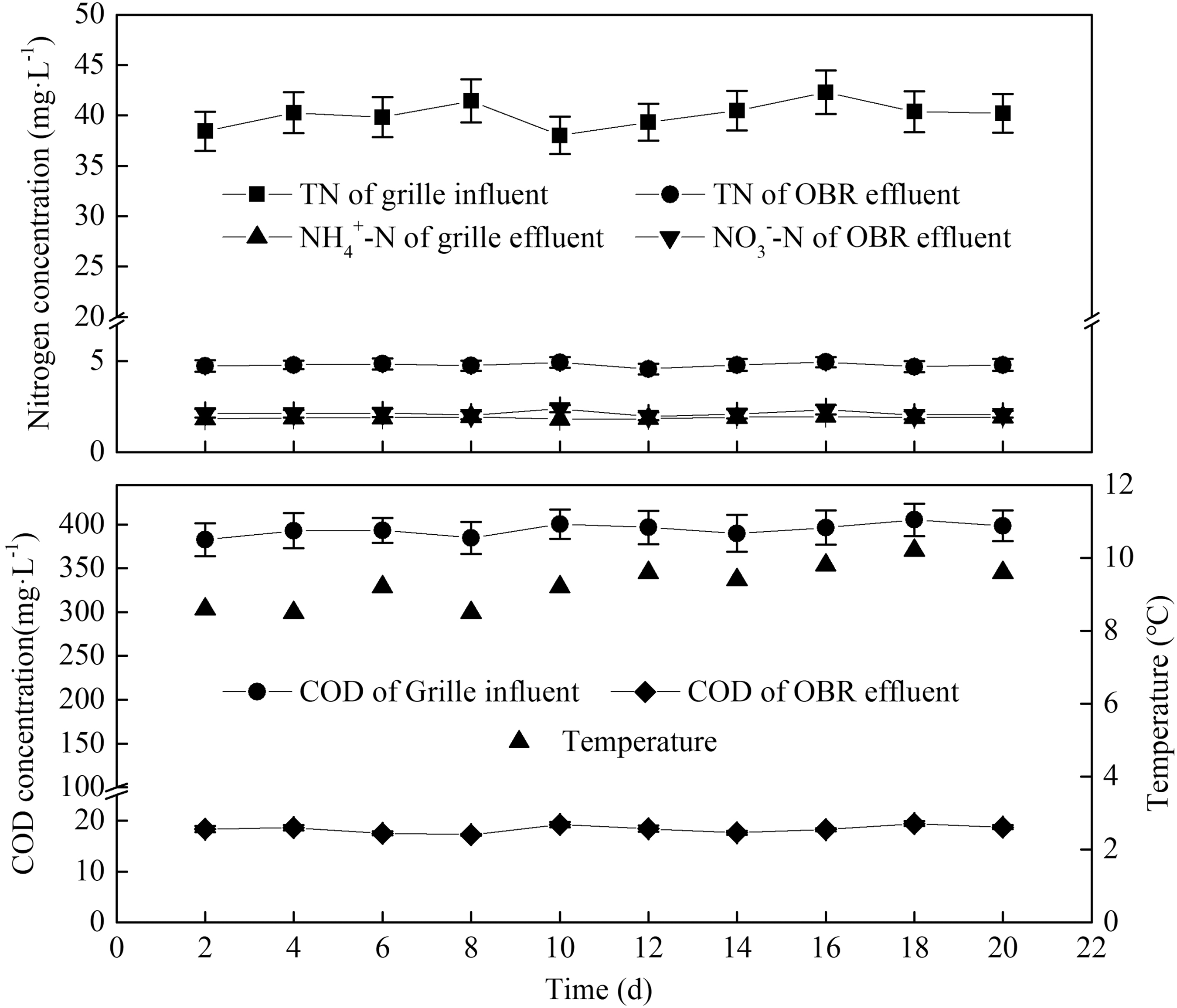
Effect of low temperature on pollutant removal. OBR, oscillatory baffled reactor; COD, chemical oxygen demand.
Performance and treatment stability of the system under relatively constant conditions
Through the study of the factors affecting the process, the optimal operating conditions for the CCBR process were determined as follows: an HRT of 7.5 h (4.5 h for the ABR and 3.0 h for the OBR), a DO content of 4.0 mg/L, and a recycle ratio of 4:1. The reactor was operated for 60 days under the optimal operating conditions. The TN concentration of the grille influent was ∼36.82–46.35 mg/L, the TN content of the OBR effluent was ∼2.72–3.06 mg/L, and the TN removal efficiency of the system was ∼91.7–94.1%. The TN content of the effluent during the operation period reached the first-class A standard of the Beijing integrated discharge standard of water pollutants. The influent TN load during the operation had no significant effect on the effluent concentration. The system had a high effluent stability and strong resistance to the TN load. The COD concentration of the grille influent was ∼342.6–422.6 mg/L, the COD content of the OBR effluent was ∼12.4–15.6 mg/L, and the COD removal rate was ∼95.4–97.0%. The TP concentration in the grille influent fluctuated greatly at ∼1.63–2.10 mg/L. The TP concentration in the OBR effluent was ∼0.14–0.18 mg/L, and the removal rate was ∼88.9–93.3%. The CCBR system is mainly based on phosphorus removal through chemical means. The IBMC can generate Fe2+ due to the galvanic reaction and then form Fe3+ under the action of DO. Fe3+ can combine with phosphate to form iron phosphate precipitate under the action of water (Deng et al., 2017).
The results show better performance than other denitrification processes of multistage A2O or A/O process (Lu and Shim, 2015) and anaerobic membrane bioreactor (Hülsen et al., 2016), used in municipal sewage treatment. For instance, (Abualhail et al., 2017) found that the multitank A2O process could achieve COD, NH4+-N, and TN removal rates of 76.1%, 87.7%, and 76.4%, respectively. In addition, anaerobic ceramic membrane bioreactors have been used to treat domestic sewage and achieved 86–88% COD removal efficiency (Yue et al., 2015) (Fig. 4).
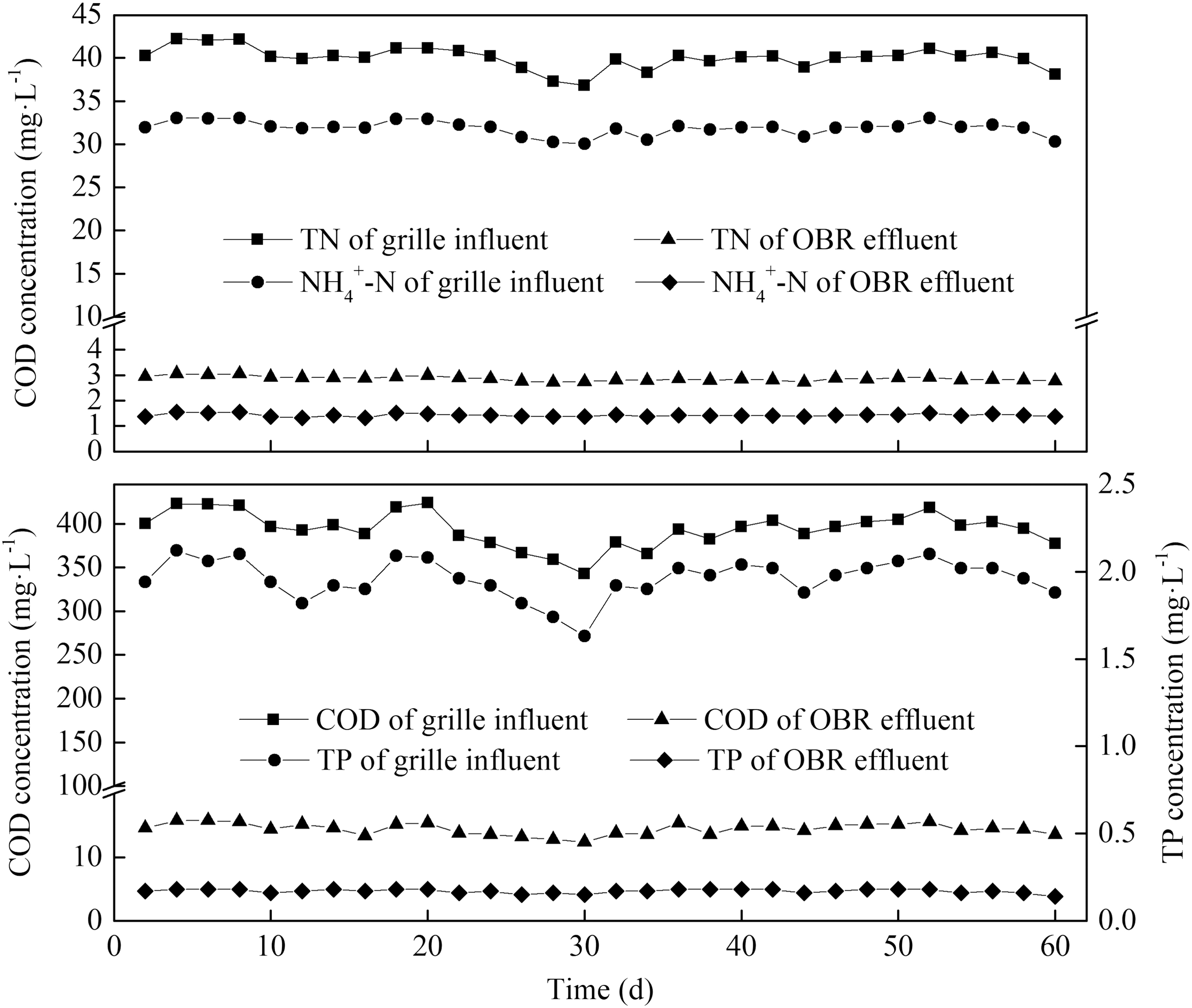
Performance of CCBR system under relatively constant conditions.
Microbial communities and the contribution of nitrification and denitrification
To further study the dominant genus in the CCBR system, the relative abundances of genera and heat maps of bacterial genera in the samples are shown in Fig. 5; the differences in the bacterial genera among the two samples are also presented. The dominant genera in the attached sludge of the OBR were Novosphingobium, Flavobacterium, and Saprospiraceae, which shared 11.2%, 10.1%, and 9.5% of sequences, respectively. In the attached sludge of the ABR, the dominant genera, such as Thiobacillus and Denitratisoma, shared 24.0% and 7.0% sequences, respectively; they were both found to have the function of autotrophic denitrification (Gu, 1993; Kristina et al., 1996).
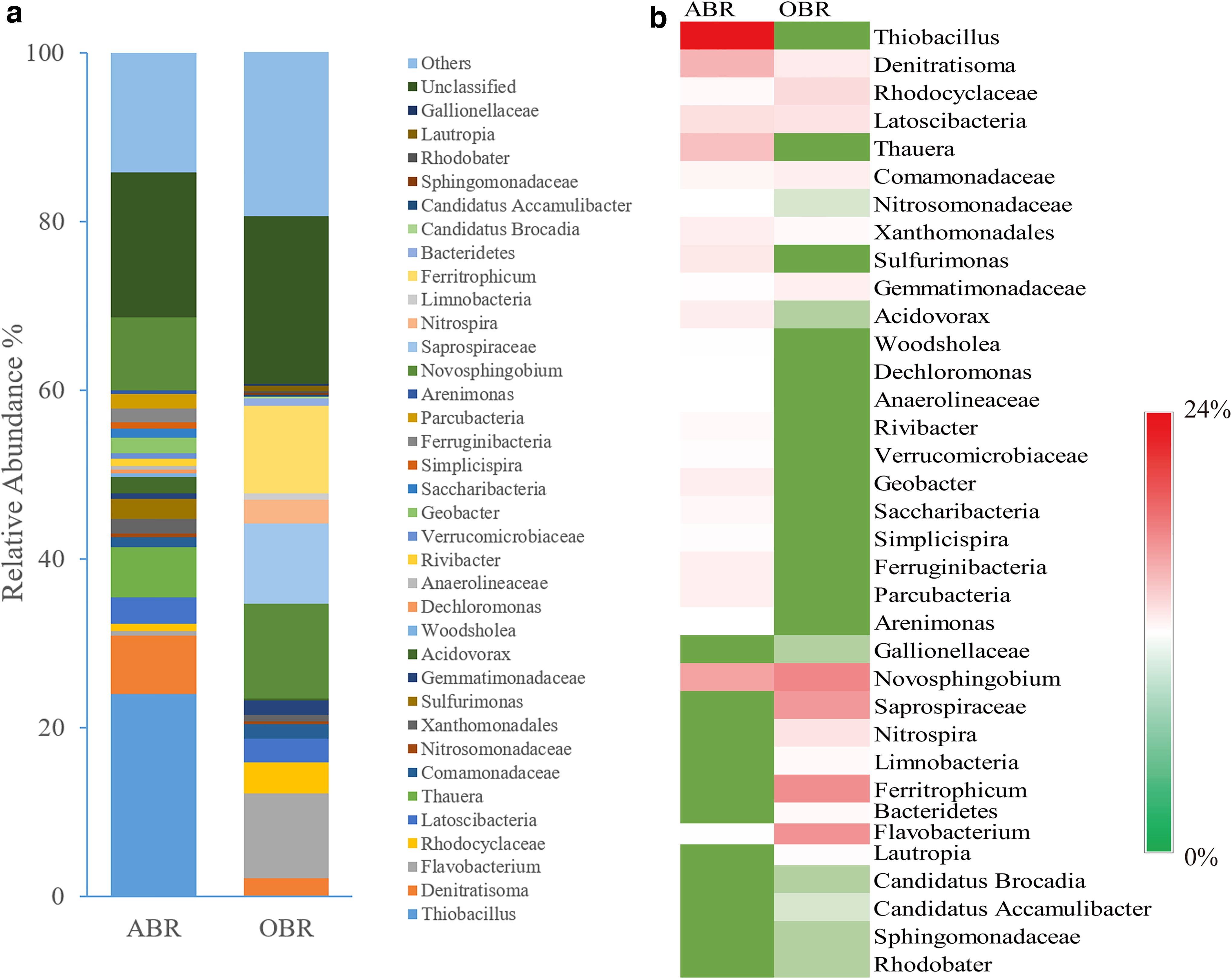
Distribution of the microbes in the bacterial genera based on 16S rRNA sequencing.
In the heat maps, the 35 most dominant genera accounted for 68.7% and 60.8% of all OTUs in the ABR and OBR, respectively. The microbial communities in the ABR were significantly different from those in the OBR. In the OBR, the autotrophic denitrification genera attached to the IBMC, such as Thiobacillus and Denitratisoma, were hardly detected. Thus, the IBMC in the CCBR favored the cultivation of the denitrificans through attached growth and the interactions between microorganisms and the carrier.
Although the microbial community analysis verified the predominance of autotrophic denitrifying-related bacteria, the heterotrophic denitrification could also participate in the CCBR process. The methanol-based denitrification by McCarty et al., (1969) suggests that the required methanol/TN ratio for denitrification obeys the following equation:
where Cm is the required methanol concentration for denitrification, mg/L; NO3−-N is the initial nitrate concentration, mg/L; NO2−-N is the initial nitrite concentration, mg/L; and DO is the dissolved oxygen content in the reactor, mg/L. Since denitrification is generally an anaerobic reaction, only the situation in the ABR is considered. The concentrations of COD, NO3−-N, and NO2−-N in the ABR influent were 148.5, 13.98, and 1.02 mg/L, respectively, and the concentrations of COD, NO3−-N, and NO2−-N in the ABR influent were 113.2 mg/L, 0.78 mg/L, and minimal to zero, respectively. The value of Cm was obtained by subtracting the COD content of the effluent from that of the influent in the ABR and was ∼35.3 mg/L, which amounted to a methanol concentration of 23.53 mg/L. The NO2−-N consumption was ∼1.02 mg/L in the ABR, and the DO content was ∼1.20 mg/L in the ABR. The NO3−-N consumption in the ABR was ∼13.13 mg/L, whereas the NO3−-N removal rate by methanol-based heterotrophic denitrification was calculated as 8.47 mg/L. Thus, heterotrophic denitrification contributed to 64.5% of the total denitrification in the CCBR system. Hence, a contribution rate of approximately >35% by IBMC-based autotrophic denitrification existed in the CCBR reactor. In addition, the removal of NO3−-N was carried out simultaneously by heterotrophic and autotrophic denitrification.
Kinetic mode along the nitrogen conversion pathway in the CCBR
The CCBR consisted of a two-part reactor made of the ABR and OBR. The two parts were connected to each other to achieve biological nitrification and denitrification. Therefore, the CCBR system can be considered as a fully hybrid system. When the reaction system is stable, the nitrification and denitrification reactions proceed simultaneously, and the biofilm degradation process conforms to the Monod kinetic equation (Pochana et al., 1999).
According to the Monod kinetic equation, the specific growth rate of the nitrifying bacteria is expressed as follows:
where
Considering the effect of the DO content on the specific growth rate of nitrifying bacteria, and using the Monod equation, the specific growth rate model of nitrifying bacteria is:
where
Combining Equation (8) with Equation (9) results in:
In the nitrification reaction, the growth of nitrifying bacteria is the result of NH4+-N degradation of the substrate. The relationship between the rate of degradation of NH4+-N and the growth rate of nitrifying bacteria is as follows:
where
Equations (10) and (11) can be combined to obtain the NH4+-N specific degradation rate model as follows:
Combine the Equations (11) and (12) to obtain the NH4+-N reaction rate model as follows:
Similarly, in the denitrification process, the proliferation rate of the denitrifying bacteria and the substrate NO3−-N concentration are expressed by the Monod equation:
The substrate that affects the assimilation and catabolism of denitrifying bacteria is the concentration of NO3−-N, which is the electron donor required for denitrification. According to Equation (14) and using the Monod equation to analyze the effect of two substrate concentrations on the specific growth rate of denitrifying bacteria, the specific growth rate model of denitrifying bacteria in the system is:
The relationship between the rate of degradation of NO3−-N and the growth rate of denitrifying bacteria is as follows:
The material balance equation for NO3−-N in the CCBR nitrification and denitrification system is established as follows:
The test was continuously operated under steady conditions and analyzed in the black box mode. Therefore, both
According to Equation (16), the NO3−-N reaction rate model during denitrification can be expressed as follows:
Substituting Equations (19) and (21) into Equation (16), the equation describing the CCBR denitrification system dynamics model is as follows:
where P, Q, and
The effective volume of the CCBR system is V, the inlet and outlet flow rates are q, and the NH4+-N reaction rate is r(NH4+-N). The material balance equation for NH4+-N in the system is as follows:
Where V = qT, r(NH4+-N) = dC(NH4+-N)/dt
Substituting Equation (17) into Equation (24) results in:
Integrating Equation (26) for C (from 0 to T) leads to:
where T is the HRT and t is the aeration time. The CCBR is a continuous aeration system, and t = T.
Similarly, a material balance equation for NO3−-N is established as follows:
Where ΔC is the amount of degradation of NH4+-N per unit time, that is:
According to Equation (19), the reaction rate model of NO3−-N in the reactor is:
Substituting Equation (30) into Equation (28):
that is:
Using the operational data of the reactor under different denitrification loads, the parameters P, x, and y were solved according to Equations (27), (33), and (34).
The y was plotted with x as the abscissa and linear regression was performed, as shown in Fig. 6.
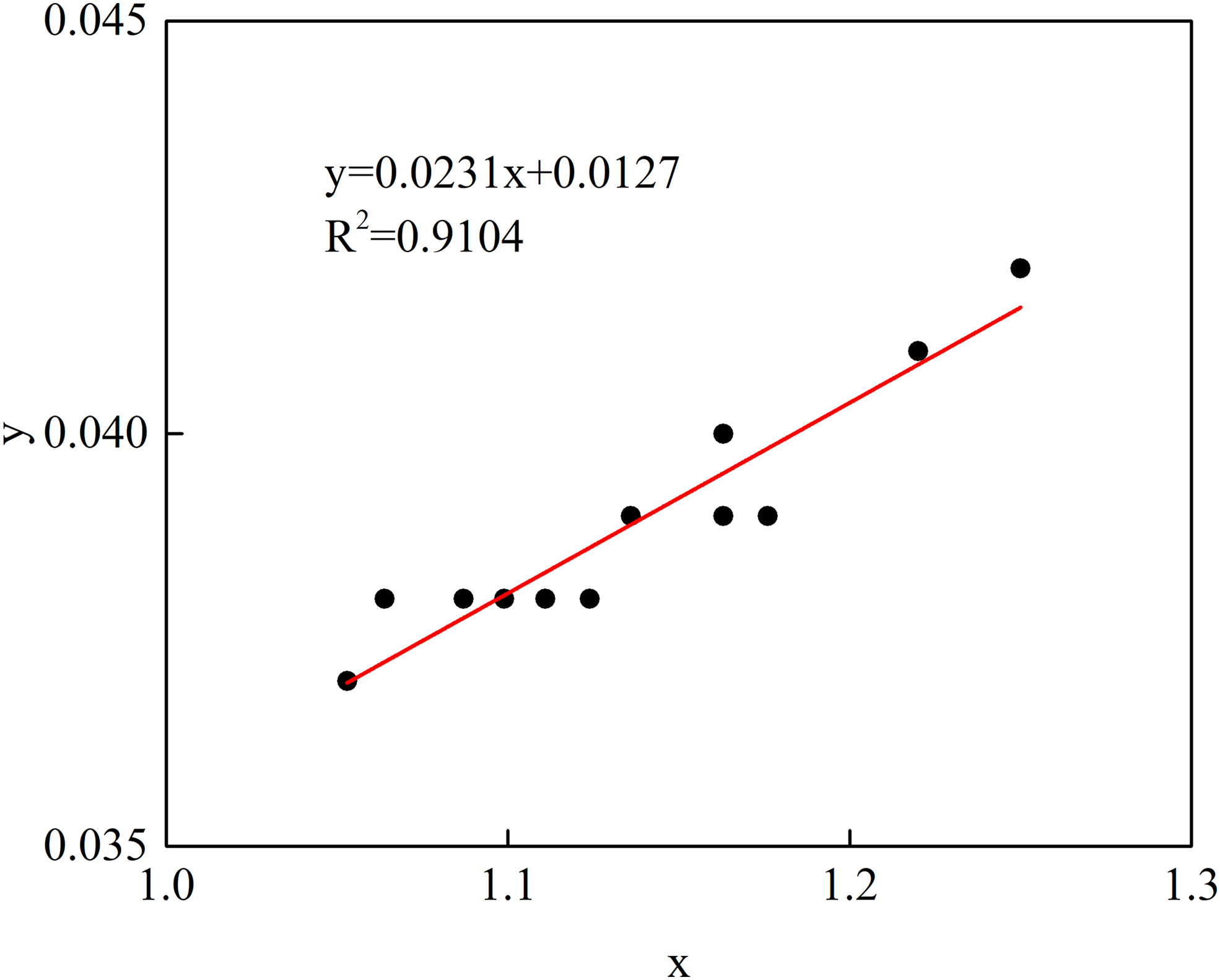
Calculation of the kinetic constants Q and K.
The linear fitting equation is y = 0.0231x + 0.0127 and the kinetic constants Q and KNO3−-N are 10.50 and 1.819, respectively. The reactor kinetic equation can be obtained by substituting the solved kinetic constants P, Q, and KNO3--N into Equation (22):
The TN degradation rate equation of nitrification and denitrification in CCBR system is as follows:
The saturation constant is also called the semireaction rate constant. The NO3−-N saturation constant of the denitrification process is the concentration of NO3−-N when the system reaches half of the maximum denitrification rate (i.e., 1/2 μmax). It is generally considered that denitrifying enzyme activity is inhibited when the NO3−-N concentration is lower than 1/2 μmax (Gu, 1993). In the heterotrophic denitrification in traditional activated sludge anaerobic tanks, the nitrogen saturation constant of the denitrifying nitrate is generally ∼0.2–0.6 mg/L (Gu, 1993). In this study, the nitrate saturation constant is 1.819 mg/L, which is higher compared with the traditional denitrification process, indicating that the CCBR can achieve removal of the TN in decentralized domestic sewage.
Conclusions
An optimal DO content of 4.0 mg/L, HRT of 7.5 h (4.5 h for the ABR and 3.0 h for the OBR), and recycle ratio of 4:1 were obtained with resulting TN, COD, and TP removal efficiencies of ∼91.7–94.1%, ∼95.4–97.0%, and ∼88.9–93.3%, respectively.
The IBMC in the CCBR favored the cultivation of denitrificans. Simultaneously heterotrophic and autotrophic denitrification occurred in the CCBR system.
The TN degradation rate equation of nitrification and denitrification in the CCBR system indicates that the CCBR can achieve the TN removal from domestic sewage.
Footnotes
Author Disclosure Statement
No competing financial interests exist.
Funding Information
This work was financially supported by the Beijing Outstanding Young Scientist Program (No. BJJWZYJH 01201910004016) and the National Natural Science Foundation of China (No. 51778040).