




Abstract
Biochar is considered as a potential material for the bioremediation of the polluted soil. Biochar of three particle sizes (<3, 3–6, and 6–9 mm) of Acacia arabica wood was used for the phytostabilization and targeted hazard assessment to the consumers. Tomato (Lycopersicum esculentum L.) was harvested and grown on the heavy metal (HM) spiked soil to study the phytostabilization efficiency, bioaccumulation of the HMs in different parts of the plant, and the hazard assessment. The results revealed that the extractable cadmium (Cd), lead (Pb), and nickel (Ni) were significantly (p < 0.05) reduced with the application of biochar particles having size <3 mm by 47%, 47.4%, and 36%, respectively. Bioaccumulation in the crop roots, leaves, and fruits was lowered by 3, 3, and 2 μg/kg for Cd, 0.1, 0.08, and 0.3 mg/kg for Pb, and 0.08, 0.03, and 0.05 mg/kg for Ni, respectively, with <3 mm biochar particles compared to 6–9 mm particles. Metal translocation factor (TF) from <3 mm biochar particle size treated soil to the edible parts were significantly (p < 0.05) reduced (by 13%, 38%, and 30%), the TF trend was in the order of Cd (781%) > Ni (121%) > Pb (82%). Target hazard quotient (THQ) for Cd and Ni was <1 both for adults and children, while for Pb, THQ >1 indicated Pb toxicity risk for the exposed population. Lower bioconcentration factor (<1) indicated low uptake of HMs to the vegetables. Contamination factor (CF) showed only Cd contamination (CF >1), while Pb and Ni had CF <1. Daily intake of metals was also below the provisional tolerable daily intake. It was concluded from the results that for maximum phytostabilization and reduced bioaccumulation of HMs (Cd, Pb, and Ni), biochar amendment at the smallest particle size (<3 mm) may be applied.
Introduction
Heavy metals (HMs) are substances that with their contents higher than the permissible limits in plant tissues harm the leaves, roots, and fruits. The toxic HMs hinder the enzymatic activities, reduce crops quality, and decrease the overall production (Li et al., 2012). The crops containing HMs higher than the allowable limits are carcinogenic (Radwan and Salama, 2006) as well as result in other critical health disorders such as renal, neuronal, and cardiovascular health issues (Steenland and Boffetta, 2000; Schmitt et al., 2006) in humans. HMs such as nickel (Ni), cadmium (Cd), and lead (Pb) are not essentially required for the plant growth, yet, if present in soil or irrigation water, they are absorbed and accumulated easily by the plants. The concentration of these toxic HMs may attain the poisonous levels (Mussarat and Bhatti, 2005).
Soils near by the mining sites, irrigated with polluted water or treated with sewage sludge are often enriched with these HMs (Lee et al., 2001). The crops grown on such soils, when used for production of food for human consumption, become a major human health concern (Lee et al., 2005; Liu et al., 2005).
Tomato (Lycopersicum esculentum L.) is a favorite home vegetable cultivated all over the world and is the second widely used vegetable after potato (Lugasi et al., 2003). The plant attains a height of 2–3 feet (Tyagi, 2014) and fruits are excellent source of vitamins A, C, K, and E. Besides tomato fruits, leaves and stems are used to make medicines (Manthri et al., 2011). Due to its large consumption, tomato has a good market and is a source of income. However, fields near to industrial units, city wastes disposal sites, exposed to road dust, or those irrigated with municipal wastewater are mostly polluted with HMs. Cultivation of vegetables including tomato crops on such polluted soil results in the high uptake and accumulation of HMs in edible parts. The accumulated HMs pose a serious threat to the consumer's health. Therefore, remediation technologies based on physical, chemical, and biological processes have been developed to immobilize such HMs in polluted soil and reduce their uptake and accumulation by crops. Such remediation technologies include soil amendments such as composts, lime, and phosphate and the use of biochar (Kumpiene et al., 2008; Bolan et al., 2014; Rao et al., 2017). Because of its structural porosity with elevated specific surface area, biochar has not only been proved a useful amendment for soil fertility restoration (Lehmann and Joseph, 2015) but also as an effective immobilizer for contaminants both from organic and in organic origin in soil and water (Ahmad et al., 2014; Caporale et al., 2014; Tan et al., 2015) and reduce their entrance into the food chain or toxicity to living organisms.
Biochar is prepared by pyrolysis of organic material under controlled oxygen environment (Lehmann and Joseph, 2015). The product is also called char and is used as a soil conditioner. Biochar is resistant to the microbial degradation and bears half-life of C > 1000 year (Glaser et al., 2002). Their stay in soil for longer period provides long-term benefits to the soil fertility (Steiner et al., 2007). Biochar application is up to date and multidimensional approach because it utilizes the agricultural wastes as a source material and enhances soil quality (water and nutrient holding capacities, permeability, nutrient retention and availability, soil organic carbon, microbial biomass C and N) (Paz-Ferreiro et al., 2014), nutrient recovery efficiency, and plant growth. High C/N valve because of the biochar application to N deficient soil sometime may decrease N availability to plant, which may lead to temporarily decreased crop productivity (Lehmann et al., 2006). Biochar increases soil N mineralization (Nelissen et al., 2012; Song et al., 2014), and they reported that nitrification is increased, while increased denitrification in soil was observed by Cayuela et al. (2013) with the biochar addition. Nitrogen, phosphorous, and potassium plus high biochar fraction application have shown enhanced crop productivity (Glaser and Woods, 2004).
Although a significant portion of previous research showed biochar as a successful bioremediation agent for the HMs under polluted soil conditions (Ahmad et al., 2014; Caporale et al., 2014; Tan et al., 2015; Tian et al., 2016; Turan et al., 2018a, 2018b; Turan 2019a, 2019b), yet, more research is needed to identify suitable particle size fraction of biochar that is most useful in bioremediation and reducing the uptake and accumulation of HMs by the crops. This study hypothesized that potential of biochar as a bioremediant for HMs increases with decreasing its particle size fraction. The study focused on the optimization of the most suitable particle size fractions of biochar under polluted soil conditions that successfully and maximally reduces HMs uptake. Tomato was used as a test crop.
Materials and Methods
The experiments were conducted in pots at the Agricultural Research Institute (34° 78′ 54″ N and 72° 34′ 71″ E), Mingora, Swat (Pakistan) during October–December, 2017. Soil from agricultural field with physiochemical characteristics as shown in Table 1 was collected, sieved with 2 mm mesh, and filled in pots carrying 6 kg soil each. Wood (Acacia arabica) biochar with physiochemical characteristics previously published in our article (Zeeshan et al., 2020) and also summarized in the Table 2 was chopped and sieved in three particle sizes viz <3, 3–6, and 6–9 mm. The biochar was mixed well with designated pots soil at the rate of 10 g/kg soil (20 t/ha) in an open container to assure the uniformity of the biochar and soil mixture then transferred to the pots. The HMs Ni, Cd, and Pb contents in the biochar were 0.01, 0.01, and 1.21 mg/kg, respectively. According to the European Biochar Certificate, the threshold values for Ni, Cd, and Pb are 55.12, 1.65, and 165.34 mg/kg. Designated pot soil was spiked with HMs Cd, Pb, and Ni to achieve artificially polluted soil conditions according to limits for soil (Cd: 0.2–2, Pb: 10–15, and Ni: 8.1 mg/kg) using cadmium sulphate (CdSO4), lead nitrate (Pb(NO3)2, and nickel nitrate (Ni(NO3)2) solutions (WWF Pakistan, 2007). Pots were irrigated and kept in open environment for 20 days to allow the contents to attain equilibration with the soil. Tomato (Lycopersicum esculentum L.) (CV 007) seedlings were transplanted in pots. A basal recommended nitrogen (N), phosphorus pentaoxide (P2O5), and potassium oxide (K2O) dose (100:100:50 kg/ha) for tomato crop was mixed with soil in each pot using diammonium phosphate, urea and sulfate of potash as P, N, and K sources, respectively. Pots were arranged in completely randomized design, replicated three times and were rearranged after each 15 days to minimize environmental variations. The methodology and initial treatment are summarized in Table 3.
Physiochemical and Heavy Metals Characteristics of the Soil Used in the Experiment
Cd, cadmium; EC, electrical conductivity; K, potassium; N, nitrogen; Ni, nickel; P, phosphorus; Pb, lead.
Physiochemical Properties of the Biochar Used in the Experiment
Summery of Soil Treatment and Methodology
HMs, heavy metals.
Soil and plant sample analysis
Plant roots, leaves, and fruits were sampled at the first fruit ripening for assessing HMs uptake and accumulation. Samples were washed with distilled water to remove dust particles and any other external material and then air dried for 3 days. The contents were transferred to oven and dried at 105°C for 48 h. The samples of dried roots, leaves, and fruits were then chopped and powdered with steel grinder. Samples were digested according to the procedure outlined by Pittman et al. (2005) and the final volume was made to 100 mL. Postharvest soil samples were collected from each pot where HMs were determined by ammonium bicarbonate-diethylenetriaminepentaacetic acid (AB-DTPA) extraction procedure (Soltanpour, 1985). Analysis for Ni, Cd, and Pb in solution was performed by using atomic absorption spectrophotometer.
Health risk assessment of HMs in tomato
To assess the health risks associated with the ingestion of HMs (Cd, Pb, and Ni) from tomato, the daily intake of metal (DIM), target hazard quotient (THQ), bioaccumulation factor (BAF), and contamination factor (CF) were calculated as follows;
where, the average daily vegetable intake for adults and children were considered to be 0.345 and 0.232 kg/(person·d), respectively, while the average body weights for adults and child were considered to be 55.9 and 32.7 kg, respectively (Wang et al., 2005).
where,
EF = Exposure frequency (365 days/year)
ED = Exposure duration (70 years) (Bennett et al., 1999)
FIR = Rates of food intake [kg/(person·d)] for adult and child are 345 and 232 g/(person·d), respectively (Teng et al., 2005)
C = Concentrations of metals in crop seed/vegetable
RFD = Oral reference dose [mg/(kg·d)], which are 1 × 10⁻³, 3.5 × 10⁻³, and 0.02 mg/(kg·d) for Cd, Pb, and Ni, respectively (Li et al., 2014)
WAB = Average body weight (average adult and children weight were considered as 55.9 and 32.7 kg, respectively)
TA = Average exposure time [365 days/year × number of exposure years (average life expectancy 70 years)]
The significance value for THQ is 1 and calculated according to method of Qing et al. (2015).
BAF =
where Cmetals is the concentration of pollutants in sediment, Cb is the geochemical background value (world surface rock average given by Martin and Meybeck, 1979), which are 0.34 ± 0.10, 49, and 20 mg/kg, respectively, for Cd, Ni, and Pb. With the help of CF values, the intensity of contamination can be inferred (Hakanson, 1980) as follows: low contamination, CF <1; moderate contamination 1 < CF <3; considerable contamination, 3 < CF <6; and very high contamination, CF >6.
HMs have the ability to translocate from the soil to the edible parts of food crop and can be determined by the accumulation factor (AF) (Li et al., 2012) for selected HMs with the following equation:
AF = heavy metal concentration in the food crops edible parts/HM concentration in the soil.
Analysis of variance for the collected data was performed using Statistix 8.1 software and significantly different treatment means were separated using least significant difference test at the 5% level of significance (Steel and Torrie, 1980).
Results and Discussions
Biochar particle sizes (BPSs) revealed highly significant (p < 0.01) effect on tomato roots, leaves, and fruits with respect to the HMs (Cd, Pb, and Ni) contents in the HMs-spiked soil. The smallest size biochar particle (<3 mm)-treated plant roots, leaves, and fruits showed the lowest Cd, Pb, and Ni concentrations. Particle sizes of <3, 3–6, and 6–9 mm induced Cd concentration reduction in the tomato roots by 13%, 10%, and 2%, respectively, compared with the pot with no biochar. Similarly in the leaves, the Cd contents were found 23%, 10%, and 5% and in the fruits 13%, 9%, and 5%, lowered, for the biochar of particle sizes of <3, 3–6, and 6–9 mm, respectively (Table 4). The Pb accumulation showed a reduction of 11%, 9%, and 6% in roots, 15%, 13%, and 10% in leaves, and 30%, 19%, and 6% in fruits with the above mentioned particle sizes of biochar treatments, respectively (Table 4). The Ni concentration showed reduction in the roots by 27%, 19%, and 1.4%, in the leaves by 22%, 18%, and 8%, and in the fruits by 38%, 25%, and 14% due to the treatment with the BPSs (<3, 3–6, and 6–9 mm) compared to the biochar control, respectively (Table 4).
Cadmium, Lead, and Nickel Partitioning and Uptake by Tomato Crop Under Biochar Different Particle Sizes and Heavy Metals (Cd, Pb, and Ni) Treatment
Permissible limits (Cd = 0.02 and Ni = 10 mg/kg, World Health Organization, 1996) and (Pb = 2 mg/kg, Asaolu, 1995) for vegetables edible parts. LSD(p<0.05) for root Cd = 1.96, leaves Cd = 1.35, fruits Cd = 9.13, root Pb = 0.062, leaf Pb = 0.023, fruits Pb = 0.055, root Ni = 0.03, leaves Ni = 0.0182, and fruits Ni = 0.0204.
Parameters from statistical analysis.
Interaction (BPS × HM) LSD(p<0.05) leaves Pb = 0.05.
BPSs, biochar particle sizes; Ns, nonsignificant; LSD, least significant difference.
Because of its structural porosity and high specific surface area and cation exchange capacity (CEC), biochar has not only been proved an effective immobilizer for contaminants both from organic and inorganic origin in soil and water. Application of biochar with the lowest particle diameter is supposed to have a higher surface area and CEC than particles with the larger diameter. The biochar produced in a result of pyrolysis has been reported with high carbonate contents and additional functional groups (−COO¯ and O¯) on its surface (Yuan et al., 2011). These functional groups and carbonate contents are supposed to increase the pH of the soil. The biochar adopts surface oxygenation in the soil resulting in the formation of oxygen containing functional groups (e.g., carboxyl, hydroxyl, phenol, and carbonyl groups) on internal surface area of the biochar (Cheng et al., 2006). This further induces a negative charge and a high CEC to its surfaces. This negative charge attracts cations as well as H+ from the soil and results in elevated soil pH. The soil pH increases due to the alkaline pH of biochar that induced a liming effect (Bian et al., 2014; Jones et al., 2016). The biochar releases cations in soil, which decrease soil acidity (Chintala et al., 2014). The data (Table 4) show significantly reduced accumulation of HMs in the different parts of the plants under lower particle size treatment. This indicates the more effectiveness of the smaller particles of biochar for the HMs retention in soil and their reduced uptake by the crops roots. Besides, the biochar application also increases the soil pH (Biederman and Harpole, 2013; Knox et al., 2015). The particles with the lower diameter cast higher alkaline effect than with the larger diameter particles (Amjad et al., 2019), and due to such changes in soil environment, the HMs might have gone immobilized and unavailable for plant uptake. Rees et al. (2014) reported that Chinese sages treated with biochar showed the lowest Cd bioconcentration factor (BCF) for root and leaves content because of the enhanced absorbing capacity of biochar for metals, the other possible reason may be the alteration of physiochemistry of the soil and decreasing HMs bioavailability thereof. Biochar's higher specific surface area and adsorption capacity renders HMs and make them insoluble through chelation or precipitation.
The plants grown in the soil with Cd treatment showed significantly (p < 0.01) higher Cd concentration in the roots, leaves, and fruits (6.5, 7.4, and 8 times) than the Pb-, Ni-treated, and the control pots (Table 4). Pots treated with Pb and Ni were similar to the control with respect to Cd content in the roots, but had a significantly higher Cd content in the leaves (22% and 11%) and the fruits (37% and 37%) than the control, respectively (Table 4). The Pb-treated pots had highly significant (p < 0.01) Pb content in roots, leaves, and fruits (by 146%, 143%, and 82%) than those treated with Cd, Ni, and the control pots. However, the Cd- and Ni-treated pots were also significantly (p < 0.01) higher (by 10% and 8% in the roots, 11% and 8% in the leaves, and 11% and 6% in the fruits Pb accumulation than the control (Table 4). The Ni concentration in the roots, leaves, and fruits was significantly (p < 0.01) higher in the Ni-treated pot over the Ni concentration in Cd- and Pb-treated pots, respectively, and the control. The Ni concentration in the root was higher by 79%, 14%, and 12%, in the leaves by 26%, 14%, and 11%, and in the fruits by 112, 5%, and 2% higher over HMs control (Table 4).
Interaction effect between the biochar particle sizes and HMs treatments on Pb concentration in the leaves was highly significant (Table 4; Fig. 1) and nonsignificant on bioaccumulation of other HMs in either part of the crop. The Pb-treated pots' crop in the biochar control conditions showed the maximum and significantly higher Pb-concentration in the leaves than the biochar-treated pots. These results are with the agreement with the previous reports (Biederman and Harpole, 2013) revealing higher bioaccumulation of Pb in tomato under contaminations higher than World Health Organization (WHO)/Food and Agriculture Organization (FAO) permissible limits. According to Tian et al. (2016), bioaccumulation coefficient of the HMs highly decreased due to the biochar application, and its transfer (from ground to the plant tissues and edible parts) factor reduced many folds.
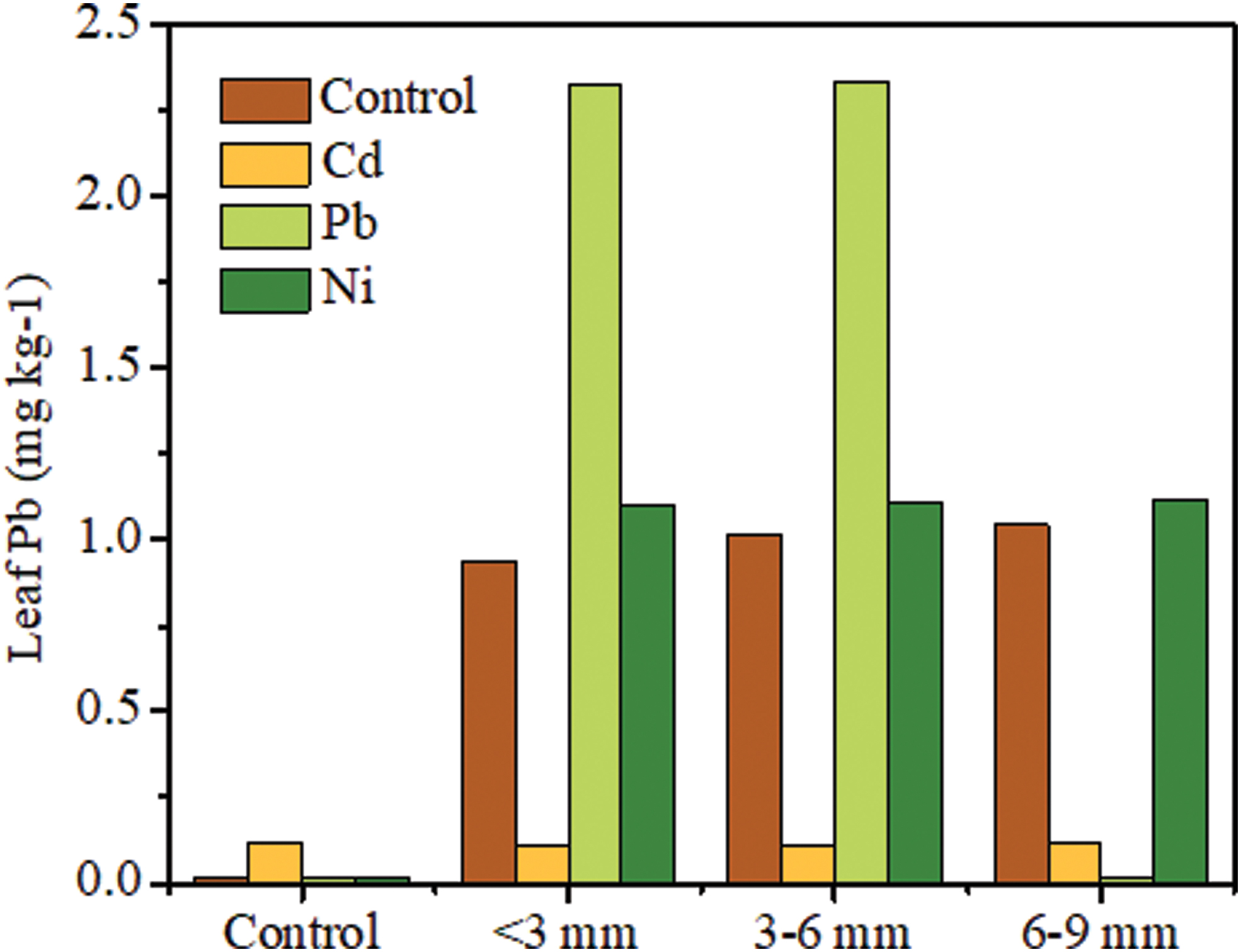
Interaction between biochar particle sizes and HMs on the leaf Pb content (mg/kg). Cd, cadmium; HMs, heavy metals; Ni, nickel; Pb, lead.
Metals treatment significantly (p < 0.05) increased soil extractable contents of HMs (Table 5). Extractable Cd content in Cd-spiked soil was higher by 167%, 167%, and 243% over the Pb-, Ni-spiked soils and the control. Extractable amount of Pb in the Pb-spiked soil was higher by 119%, 142%, and 200% over the Cd- and the Ni-spiked soils and the control, respectively. Extractable amount of the Ni in the Ni-spiked soil was higher by 121%, 120%, and 156% over the Cd- and the Pb-spiked treatments and the control (Table 5). Biochar with different particle sizes significantly (p < 0.05) reduced the AB-DTPA extractable of these HMs. Extractable Cd contents were 47%, 16%, and 8% lower, Pb was 47%, 28%, and 27% lower, and the Ni was 36%, 23%, and 17% lower in <3, 3–6, and 6–9 mm particle size treatments, respectively, over the biochar control (Table 5). This showed an increased retention and a reduced release of HMs with reducing particle size of the biochar. The oxygenation of the biochar surface occurs when applied to the soil, where the O2 containing functional groups such as carboxyl, OH−, phenol, and carbonyl groups are modified on the massive internal surface area of biochar (Lee et al., 2010; Uchimiya et al., 2010), which induces a negative charge and high CEC (Cheng et al., 2006). This behavior is indicative of enhanced reactivity of biochar with reducing its particle size. Reduced particle size maximum exposed surface area and enhanced the absorbance and immobilization of the metals soil as indicated by the magnitude of metals retention in the soil.
Extractable Cadmium, Lead, and Nickel Contents of the Postharvest Soil Sample and Their Translocation Factor from the Soil to the Edible Parts (Tomato Fruits)
Critical limits of (Cd = 0.2–2, Pb = 10–15 mg/kg in soil WWF Pakistan, 2007), and (Ni = 8.1 mg/kg by Maclean et al., 1987). LSD(p<0.05) for soil Cd = 0.0109, Pb = 0.178 and Ni = 0.118. BPS × HM LSD(p<0.05) for soil Cd = 0.024, Pb = 0.356 and Ni = 0.237.
Parameters from statistical analysis.
Statistically significant.
AB-DTPA, ammonium bicarbonate-diethylenetriaminepentaacetic acid.
A highly significant (p < 0.01) interaction effect of the BPS and the HMs existed on soil extractable Cd, Pb, and Ni contents (Fig. 2). Possibly, biochar addition might have no effect on metals mobility in soil but decreased soil pore water, Pb concentration was reduced by 70% (Lebrun et al., 2017). Younis et al. (2015) concluded that cotton sticks biochar have ability to absorb metals in the soil and reduced Ni ions transfer to the parts of the plant.
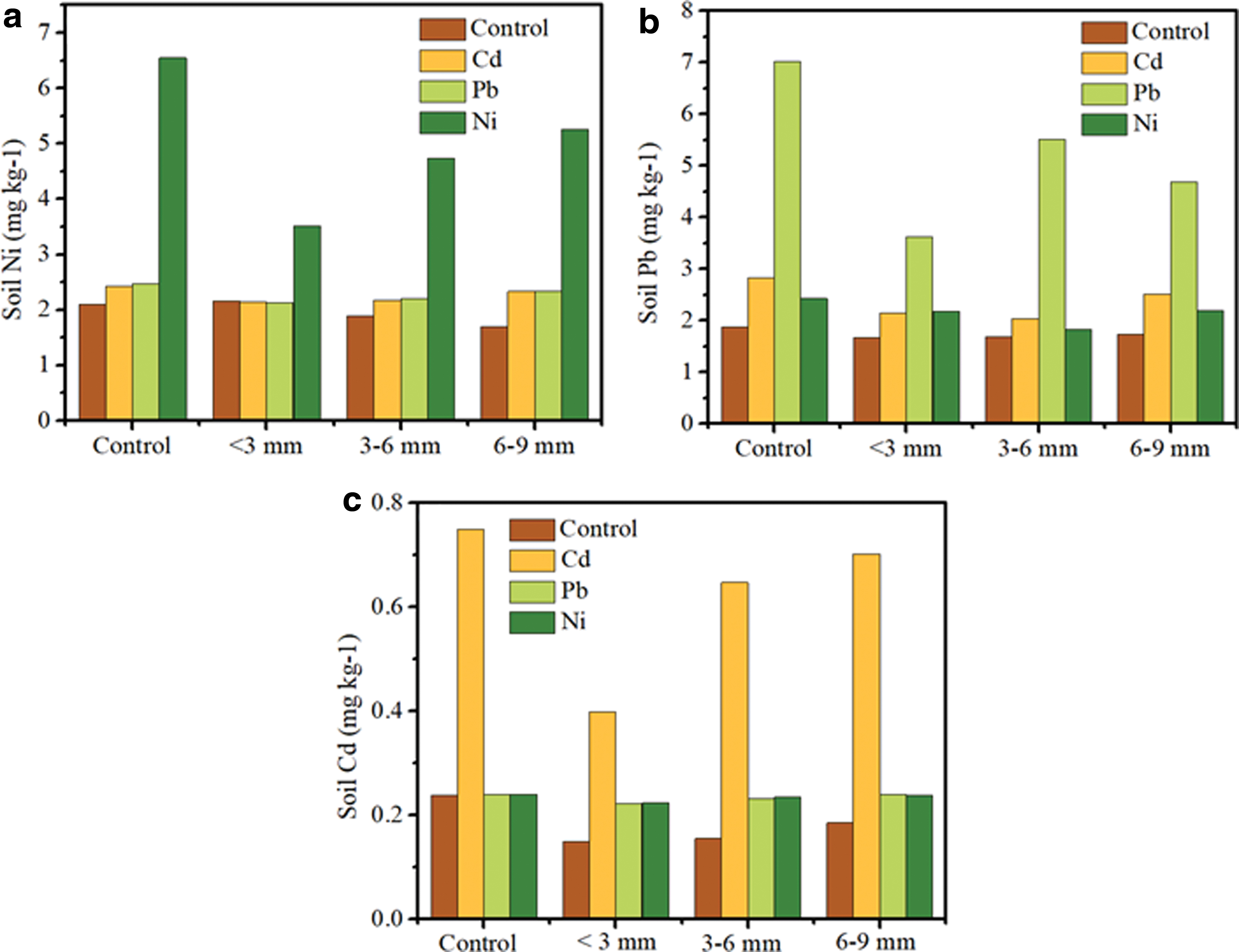
Interaction between biochar particle sizes and HMs treatments on AB-DTPA extractable HMs contents (mg/kg).
Data on translocation factor (TF) from the soil to the edible parts of the plants (Table 5) showed that the biochar with the different particle sizes (<3, 3–6, and 6–9 mm) significantly (p < 0.05) reduced the absorption of the Cd (by 13%, 10%, and 5%), Pb (by 30%, 19%, and 6%), and the Ni (by 38%, 26%, and 14%) from the soil. This indicated significant reduction in the translocation of metals from soil to the edible parts with application of biochar with smaller size particles. Among the HMs, the TF was observed as Cd>Ni>Pb, that showed Cd maximally translocate than Ni and Pb by 781%, 121%, and 82%, respectively, over the HMs control treatment.
The metals mobility from the soil to the plants is a function of the soil's physical and chemical properties and of vegetable species. This property of the soil mobility is usually changed by innumerable environmental and human factors (Zurera et al., 1987). The highest TF of Cd might be due to higher mobility of the Cd with a natural occurrence in the soil and the low Cd (II) retention in soil than other toxic cations (Alam et al., 2003; Lokeshwari and Chandrappa, 2006). Similarly a significant results of the metal TF from the soil to the vegetables were observed for the Cd, Pb, and the Ni, where the highest TF for Cd was observed in spinach, tomato, and cauliflower, respectively (Naser et al., 2009).
Biochar different particle sizes showed a significant effect for THQ in adults and child population for the HMs (Cd, Pb, and Ni) pollution. THQ values for both adults and children with regard to the Cd and the Ni were <1, which further decreased significantly with the application of the biochar. Furthermore, the BPS (<3, 3–6, and 6–9 mm) showed a significant (p < 0.05) reduction in the THQ values for the Cd (by 13%, 9%, and 4.5% for the adult and 13%, 9%, and 4.6% for the child) and the Ni (by 38.2%, 25.4%, and 14% for the adult and 38%, 25.3%, and 14% for the child). THQ value <1 showed that the exposed population may not be at toxicity risk and that is further reduced with the use of the biochar at lower particle size fraction. For the Pb, the THQ values were more than 1 at every treatment of the biochar particle, which showed that the Pb exposed population may be at risk of toxicity. However, with biochar different particle sizes (<3, 3–6, and 6–9 mm) application, a reduction of 30%, 19%, and 6% for the adult and 30%, 19%, and 6% for the child were observed in THQ values for the Pb.
The combined interaction effect of HMs and BPS was nonsignificant.
BPS effect on the DIM for the adults and child population was highly significant (p < 0.01). The DIM values (Table 6) were compared with Joint FAO/WHO Expert Committee on Food Additives (JECFA) stipulated a provisional tolerable daily intake (PTDI) of 3.57 μg/kg body weight for Pb (JECFA, 1993), 0.83 μg/kg body weight for Cd (JECFA, 2011), and 5 μg/kg body weight for Ni (World Health Organization, 1996). These corresponds to 200 and 117 μg/day for Pb, 46.4 and 27 μg/day for Cd, and 280 and 164 μg/day for Ni, respectively, for 55.9 kg adult and 32.7 kg child body weight. These results showed that DIM for Cd, Pb, and Ni for the adults and the children were below the PTDI values for Cd, Pb, and Ni. With application of BPSs (<3, 3–6, and 6–9 mm) the DIM for Cd, Pb, and Ni further reduced where maximum reduction of 13%, 30%, and 38% pertained to <3 mm size particle, respectively, over the HMs control for the Cd, Pb, and Ni intake of the adults and children. Reduction in DIM for the Cd, Pb, and Ni with 3–6 mm particle size treatment was 9%, 18%, and 25% both for the adult and the child, while with the 6–9 mm, it was 5% and 4% Cd for the adult and the child, respectively, 5% for the Pb and 14% for the Ni for both the adults and children (Table 6).
Target Hazards Quotient and Daily Intake of Metals [μg/(kg·person·d)] for Adults and Child
Means followed by similar letter are not significantly different at the p = 0.05.
Parameters from statistical analysis.
DIM, daily intake of metals; THQ, target hazards quotient.
The BCF above 1.0 indicated higher uptake of HMs in the vegetables than in the soil. Any area which recorded BCF below 1.0 indicates high HM concentration in the soil in relationship to the levels in the vegetables (Hellen and Othman, 2014) and therefore low uptake of HMs to vegetables. Several reports have dealt with BCF determinations for vegetables (Lui et al., 2006; Yadav et al., 2013). These results (Table 7) showed that the BCF for Cd, Pb, and Ni for the tomato fruits were below one (1.0). But due to the application of the biochar (particle sizes <3, 3–6, 6–9 mm), the BCF values for the HMs (Cd, Pb, and Ni) further reduced significantly (p < 0.05) and the lowest BCF values for the Cd (0.037), Pb (0.31), and Ni (0.093) were observed with the lowest particle size treatment (Table 7).
Bioaccumulation Factor and Contamination Factor for Heavy Metals Under Different Biochar Particle Size Treatments
CF <1 = low contamination, 1 ≤ CF ≥3 = contamination, 3 ≤ CF ≥6 = considerable contamination, CF >6 = very high contamination. Means followed by similar letter are not significantly different at the p = 0.05.
Parameters from statistical analysis.
BAF, bioaccumulation factor; CF, contamination factor.
CF showed highly significant (p < 0.01) effect of BPSs in the HMs (Cd, Pb, and Ni)-polluted soil (Table 7). The smallest size biochar particle (<3 mm)-treated pots showed lowest CF of Cd, Pb, and Ni followed by the 3–6 mm and the 6–9 mm particle sizes over the biochar control. Among the HMs, Cd at the biochar 6–9 mm particle and the control are in category II (contamination), while Pb and Ni lie at category I (low contamination). The <3, 3–6, and 6–9 mm particle sizes reduced the CF of Cd by 47%, 16%, and 8%, Pb by 48%, 28%, and 27%, and Ni by 36%, 23%, and 17%, respectively.
Conclusions
Biochar reduced the soil extractable content of HMs and their bioaccumulation by the crop, the extent of which showed further reduction when biochar was applied in the reduced particle size range. This reduced the contamination of tomato with the HMs, their daily intake and subsequent target hazard significantly. Results from the experiment concluded that biochar application with the reduced particle size to HM-contaminated soil has significant edge over the larger particle size for reducing HM accumulation by the crop and its subsequent hazard for the consumers.
Footnotes
Acknowledgments
The testing facilities provided by Pakistan Tobacco Board, Khan Ghari, Mardan, Pakistan and University of Agriculture, Peshawar, Pakistan are gratefully acknowledged.
Author Disclosure Statement
No competing financial interests exist.
Funding Information
This work was supported by Wuhan Technology and Business University, Wuhan China (D2018005).