




Abstract
Different metal cation (Co2+, Fe2+, La3+, and Zn2+)-doped layered double hydroxides (LDHs), yielded CoMgAl-LDH, FeMgAl-LDH, MgAlLa-LDH, and ZnMgAl-LDH, respectively. The four LDHs synthesized from same molar ratio of MII:MIII had different adsorption capacities toward Cr(VI) and fluoride (F−). Single and competitive adsorption kinetic and isotherms of Cr (VI) and F− were studied. For each LDH, the adsorption capacity of Cr(VI) was higher compared with F− in single adsorption, which confirmed that the LDHs were more selective for Cr(VI) adsorption. In single adsorption, CoMgAl-LDH achieved the best sorption capacity for F− and Cr(VI) removal, reaching 38.01 and 59.27 mg/g, respectively. The maximum adsorption capacity of CoMgAl-LDH to Cr(VI) and F− was 39.33 and 13.46 mg/g in competitive adsorption. Various experimental parameters, such as pH, contact time, concentration of coexisting anions, and anion (F− and Cr(VI)) addition order were investigated in competitive adsorption system. Cr(VI) and F− competed for active sites during adsorption and the affinity of Cr(VI) to LDHs was stronger compared with F−. Co-doped method is a valid method to improve adsorption performance of the LDHs.
Introduction
Drinking water safety is becoming a global problem. Groundwater is the major and preferred source of drinking water in rural as well as urban areas, particularly in developing countries (Jagtap et al., 2012). The World Health Organization has set a guiding value of 1.5 mg/L for F− and 0.05 mg/L for Cr(VI) in drinking water (Zhang et al., 2012; Mobarak et al., 2018). However, some countries in the world such as western USA, part of Mexico, Argentina, India, many parts of the African continent, Pakistan, Afghanistan, China, the Middle Eastern region, and parts of Australia are already under severe F− contamination in groundwater (>1.5 mg/L) (Jagtap et al., 2012). Plenty of waters contaminated with chromium are discharged into surface water environment and further enter the groundwater environment, posing a potential threat to human health, especially cancer risk (Cho et al., 2011).
Furthermore, compared to the less hazardous trivalent chromate Cr(III), hexavalent chromate Cr(VI) is highly toxic to biological systems due to its carcinogenicity and teratogenicity. Because groundwater is deeply buried and has weak self-purification capacity, the treatment of groundwater pollution is far more complex than surface water treatment. Adsorption, coagulation, nanofiltration, and biological process have been widely applied in the treatment of aqueous solution polluted by Cr(VI) and F− (Mobarak et al., 2019). Among these methods, adsorption has been extensively applied for the removal of anionic contaminants. Known as a natural clay with high anion exchange ability and affinity for a range of anions, layered double hydroxides (LDHs) are considered to be efficient adsorbents for anionic contaminant removal from aqueous solution. Therefore, LDHs would be suitable adsorbents for the treatment of F−- and Cr(VI)-contaminated water.
Accepted formula of LDHs is [M1–xIIMxIII (OH)2](An−)x/n·mH2O, where MII and MIII are divalent and trivalent cations, respectively, while An− denotes interlayer anion. Compared to other synthetic adsorbents, the synthesis process of LDHs is relatively facile and less costly. One of the most fascinating aspects of LDHs is their flexible plasticity. As the main component, MII and MIII can be substituted by different metal ions, so it is possible to replace the types of MII and MIII according to actual needs to prepare LDHs with different characteristics. Wang et al. (2017b) found MgAlZr-LDH fabricated by doping Zr to the MgAl-LDH exhibited excellent F− removal performance in the groundwater. Auwalu et al. (2019) reported that after doping metal Co into MgAl-LDH, the surface area steadily increased with increasing Co content in CoMgAl-LDH and then reached to maximum at intermediate composition of Co. Cai et al. (2018) found that after adding metal La to LiAl-LDH, the defluorination capacity of LiAlLa-LDH is much higher than the former. There have been enough proofs indicating that as the component of the LDH structure, metal cations play an important role in the adsorption performance.
The conditions for synthesizing these metal-doped LDHs are different, which make it difficult to compare the effect of different metals on the adsorption performance of MgAl-LDH. Consequently, it seemed interesting to check under the same condition, the influence of different doping metal cations on adsorption performance and structural properties of the MgAl-LDH. Moreover, adsorbents with high adsorption capacity to remove individual contaminant may not be suitable for simultaneous removal of F− and Cr(VI). Similarly, limited knowledge is available about comparative adsorption of F− and Cr(VI) on the LDHs during the simultaneous removal process.
Thus, in this work, CoMgAl-LDH, FeMgAl-LDH, MgAlLa-LDH, and ZnMgAl-LDH were obtained by doping the modified metal cations (Co2+, Fe2+, La3+, and Zn2+) into MgAl-LDH. The removal ability of the above four materials toward F− and Cr(VI) was first investigated in solutions containing F− or Cr(VI) solely, aiming to select the type of LDHs with the highest adsorption capacity for F− and Cr(VI), so as to facilitate subsequent adsorption studies in solution containing F− and Cr(VI). In addition, the interplay between F− and Cr(VI) in the co-removal system was investigated. The purpose of this study was to compare the effect of different metal-doped LDHs on the adsorption performance of F− and Cr (VI), and whether the coexisted F− and Cr(VI) mutually affect their removal performance. Also, the adsorption efficiency and mechanism for F− and Cr (VI) removal were studied.
Materials and Methods
Chemicals
Sodium fluoride (NaF), potassium bichromate (K2Cr2O7 and all chemicals used for LDHs synthesis were of analytical grade and purchased from Sigma-Aldrich. Stock solutions of 1,000 mg/L F− and Cr(VI) were prepared with deionized water. Then, experimental solutions were obtained by diluting the stock solutions. The pH value was adjusted by addition of 0.1 M NaOH and/or 0.1 M HCl to designed value.
Synthesis of LDHs
Metal-doped LDHs were synthesized by co-precipitation method, which was similar to previous reports (Goh et al., 2008). Divalent metallic cations M2+ (Mg2+, Co2+, Fe2+, and Zn2+) and trivalent metallic cations M3+ (Al3+ and La3+) were mixed in 100 mL deionized water (M2+/M3+ = 3 and Al3+/La3+ = 1). To take CoMgAl-LDH, for instance, first, 0.02 mol CoCl2·6H2O, 0.04 mol MgCl2·6H2O, and 0.02 mol AlCl3·6H2O were dissolved in 100 mL of deionized water to obtain a metal ion-mixed solution. Then, 0.1 mol of NaCl and 0.2 mol of NaOH were dissolved in 100 mL of deionized water to obtain an alkali solution. Next, the prepared metal ion-mixed solution and the alkali solution were simultaneously dropped into a high-speed stirred reactor containing 100 mL of deionized water, while the reactor was charged with nitrogen as a protective gas. After that, the mixture was aged in the mother liquor at 80°C for 24 h. Then, the products were centrifuged and washed thoroughly with deionized water until pH of the wash solution was neutral. Finally, the washed samples were then dried at 65°C for 24 h in air flow. The synthesis of other metal-doped LDHs was similar to that of CoMgAl-LDH, except that Co was replaced with other metals.
Cr(VI) and F
−
adsorption experiments
The batch adsorption experiments were carried out in a serial of 100 mL plug-contained conical flasks and placed in a constant-temperature shaking incubator at 25°C ± 0.3°C with 300 rpm. The pH values were adjusted by using 0.1 M HCl or NaOH. The dosage of adsorbents was 0.5 g/L. After reaction, the supernatants were collected and filtered with a 0.22 μm filter before measuring the concentrations of residual F− and Cr(VI). The concentration of F− was measured by a fluoride ion-selective electrode (PF-1 Leici, China) (Wang et al., 2017a). The Cr(VI) concentration remaining in the filtrates was analyzed by reaction with 1,5-diphenylcarbazide followed by absorbance measurement at 540 nm using a UV-visible spectrophotometer (Yan et al., 2015).
In the evaluation of the effects of pH on single adsorption of Cr(VI) and F−, the initial concentrations of Cr(VI) and F− were set at 20 and 10 mg/L, respectively. The pH range was from 2.0 to 10.0.
In the isothermal experiment, different initial concentrations of Cr(VI) (10–80 mg/L) and F− (5–80 mg/L) were tested for adsorption equilibrium studies in both single and competitive systems. Isothermal adsorption reactions of all systems were carried out under the experimental conditions of initial pH 5 and reaction time of 60 min.
In the kinetic experiments, the initial concentrations of Cr(VI) and F− were 20 and 10 mg/L, respectively, and the pH of the system was adjusted to 5.0. The adsorption conditions of the competitive system were consistent with that of the single system. Kinetic experiment was carried out by mixing 25 mg of LDHs with 50 mL of single F−, single Cr(VI), or F− and Cr(VI) co-adsorption solution at a predetermined concentration in a 100 mL polypropylene flask, and 0.5 mL solution was sampled by using a micropipette at different time intervals.
All experiments were repeated three times and the removal efficiency was assessed by the average value. The adsorption amount (qt, mg/g) at any time was calculated by the following equation (Goswamee et al., 1998):
where m (mg) is the weight of LDHs, V (mL) is the volume of solutions, and C0 and Ct (mg/L) represent the initial and moment t (min) concentrations of F− or Cr(VI) ions. For the modeling of the equilibrium data, two different kinetics models and two different isotherm equations were used to evaluate the kinetics, isotherms, and mechanism of the adsorption process. The equations of above models would be represented later.
Characterization and analysis
Crystalline structure of the LDHs was determined by X-ray powder diffraction (XRD) employing a scanning rate 4°/min over an angular range 2θ between 10° and 80° with Cu Kα as source of radiation (PAN analytical B.V. Holland). The specific surface areas were achieved by N2 adsorption based on Brunauer–Emmett–Teller (BET) method at −196°C with an ASAP 2020 apparatus. The surface area and total pore volume were calculated according to the BET model and the pore size distribution was determined by the nonlocal density functional theory method with a slit pore model. Analysis of Fourier transform infrared (FTIR) spectroscopy spectra enabled evaluation of surface functionality of the LDHs, and their variations after adsorption of Cr(VI) and F. The spectra were obtained in the attenuated total reflection mode ranging from 0 to 4,000 cm−1 with a 2 cm−1 resolution (Nicolet 6700, USA). Scanning electronic micrograph (SEM) images were obtained on an EVO MA15 instrument (Carl Zeiss, Germany). Energy dispersive X-ray spectroscopy (EDX) analyses were taken on a Hitachi S4800 field-emission scanning electron microscope.
Results and Discussion
Characterization of LDHs
X-ray powder diffraction
The crystal structures of the LDHs were characterized by XRD. Figure 1 shows the XRD patterns for the LDHs prepared by the same batch. The CoMgAl-LDH, ZnMgAl-LDH, and FeMgAl-LDH showed a series of characteristic diffraction, and peaks (003) (006) (009) (015) (110) and (113) indicated the typical hydrotalcite structure. However, for LaMgAl-LDH, the characteristic peaks of (009) and (015) disappeared and the intensity of characteristic peaks of (003) (006) (110) (113) receded, and some new peaks appeared after La doping. The results showed that doping La into MgAl-LDH caused a significant decrease in crystallinity, so a complete hydrotalcite structure was not formed. The insertion of La, which has larger atomic radius than Al, resulted in the distortion of its layered phase and favored the formation of carbonate and oxyhydroxide lanthanum species (Cai et al., 2018). Similar results were reported for La-doped LDHs (Pavel et al., 2017).
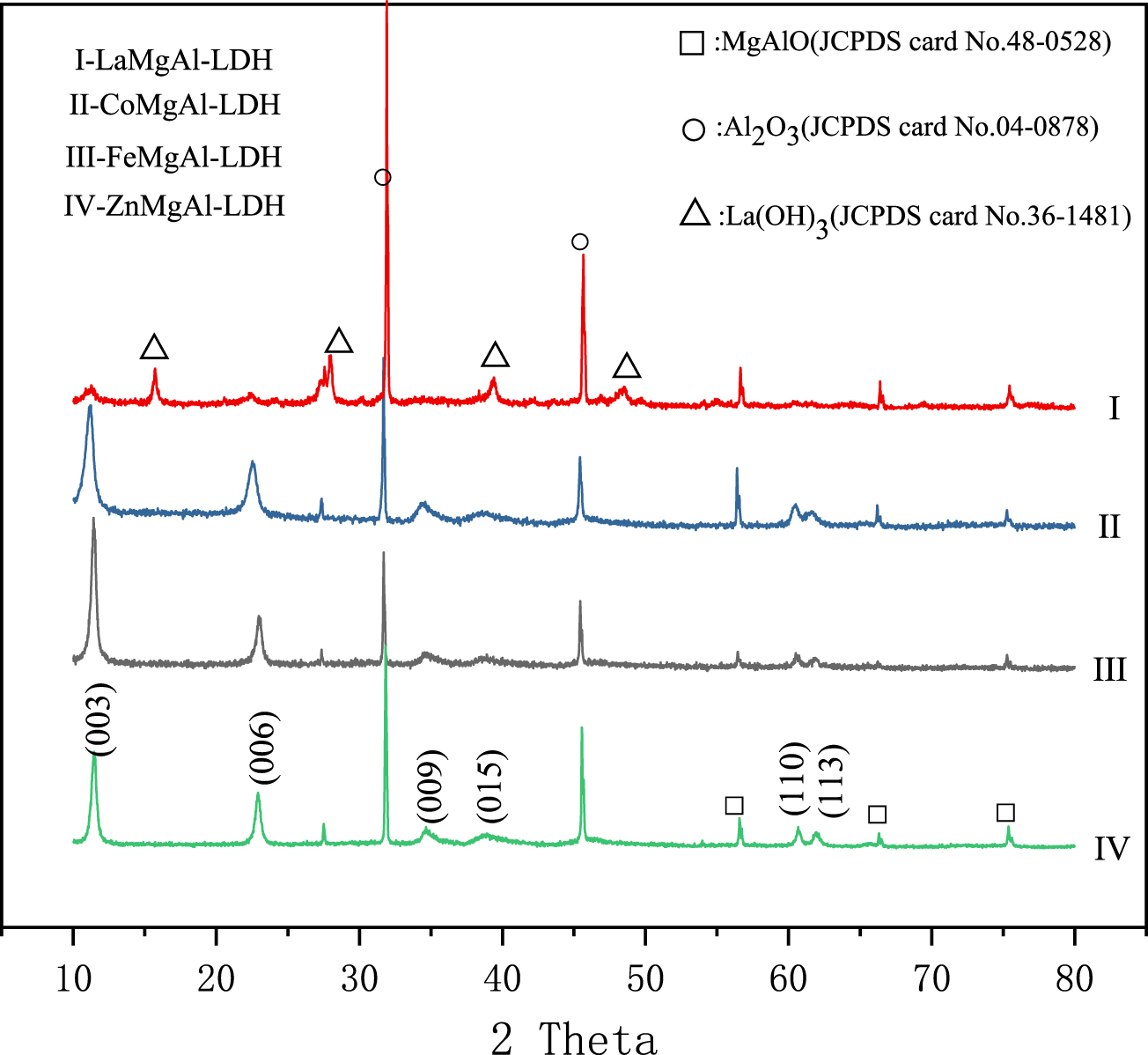
XRD patterns of LDH samples. LDH, layered double hydroxide; XRD, X-ray powder diffraction.
Brunauer–Emmett–Teller
The N2 adsorption and desorption isotherms and the pore size distributions of the LDHs are shown in Fig. 2. The N2 adsorption and desorption isotherms followed the type IV adsorption isotherms according to the International Union of Pure and Applied Chemistry (IUPAC) classification with an H3-type hysteresis loop for the desorption isotherm, which was the characteristic type of mesoporous materials (Xiao et al., 2015). In addition, there was a significant hysteresis loop in LaMgAl-LDH, indicating that there was a saturated adsorption platform on the adsorption isotherm, reflecting a uniform pore size distribution (Zhang et al., 2008; Gaikwad and Balomajumder, 2018).

N2 adsorption–desorption isotherms and corresponding pore size distribution curves of the LDHs samples.
At high p/p0 values, there was no plateau on the adsorption isotherm, indicating N2 physical adsorption between the aggregates of platelet particles due to the lamellar morphology of LDHs (Said et al., 2018). The surface area and pore size distribution were determined by the BJH method, which showed that the pore distribution of CoMgAl-LDH, ZnMgAl-LDH, and FeMgAl-LDH was more abundant than LaMgAl-LDH in the 3–10 nm range. The surface area of CoMgAl-LDH (49.89 m2/g) was larger compared with other LDHs (Table 1). However, the corresponding value of LaMgAl-LDH obviously decreased. It might be caused by the presence of several excess phases that exhibited high crystallinity. Generally, the larger the specific surface area, the more adsorption sites would be provided, resulting in better adsorption performance (Cai et al., 2012).
The Surface and Pore Structure of Different Layered Double Hydroxides
LDH, layered double hydroxide.
Fourier transform infrared
Fourier transform infrared (FTIR) spectroscopy is another useful tool for characterization of LDHs, including the vibrations in the octahedral lattices, the hydroxyl groups, and the interlayer anions. These methods can be used to determine the presence of interlayer charge balance anions, the type of bonds formed by anions, and their orientation (Goh et al., 2008).
The surface functional groups of the LDH were studied by FTIR. Figure 3 shows all samples have characteristic absorption peaks of LDHs and no obvious difference among the LDHs samples, except the intensity. The bands at ∼3,456 and 855 cm−1 were ascribed to O–H stretching due to the presence of hydroxyl as well as both adsorbed and interlayer water (Zhao et al., 2015). The band at 2,925 cm−1 was likely attributed to the symmetric and asymmetric stretching vibrations of C–H bonds (Lippincott and Schroeder, 1955). The band appeared at 1,632 cm−1, which could be attributed to the H2O bending vibration of interlayer water (Liu et al., 2016). The band observed at about 1,380 cm−1 was assigned to the asymmetric stretching of the carbonate and the extra bands at 1,485 and 1,427 cm−1 were ascribed to carbonate vibration, which indicated there was still few CO2 participate in the reaction during the synthesis process. Other peaks under 800 cm−1 were attributed to the stretching and bending vibrations of Metal–O and Metal–OH (Zhang et al., 2014). The peak strength of CO32− absorption vibration at 1,370 cm−1 of CoMgAl was significantly stronger compared with the other three materials, indicating that the sample contains more CO32−, which further revealed the reason for its strong adsorption capacity of anion [Cr(VI) and F−].
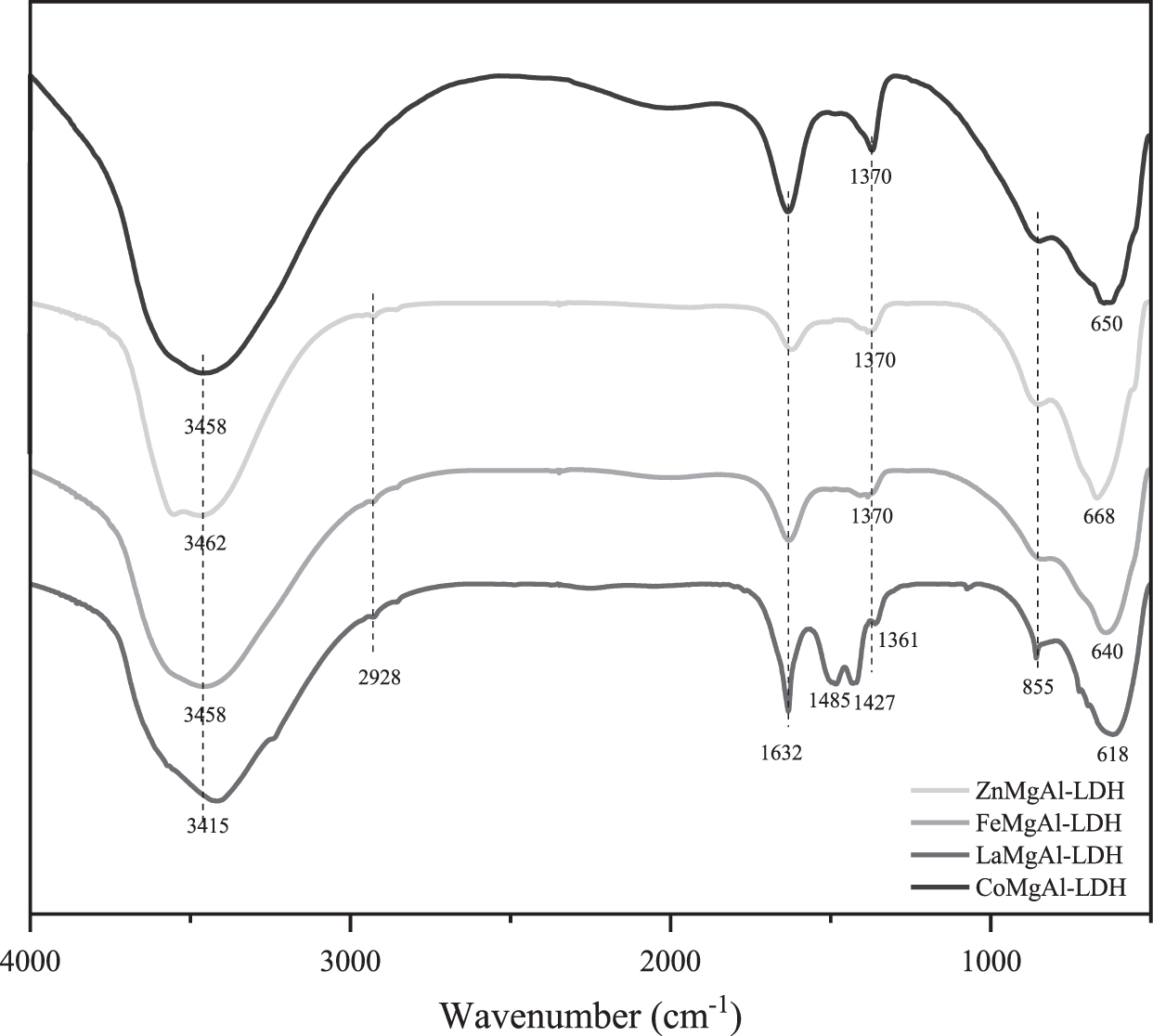
FTIR spectra of LDHs. FTIR, Fourier transform infrared.
Scanning electronic micrograph
Figure 4 shows SEM images of different LDHs. CoMgAl-LDH and ZnMgAl-LDH were composed of uniformly dispersed sheets, indicating that the layered structure was maintained well and formed lot of pore canal, which was beneficial to the adsorption. In Fig. 4c, FeMgAl-LDH also had a layered structure, and some hexagonal lamellar structure was distributed among them. However, it was more compact than the structure of CoMgAl-LDH and ZnMgAl-LDH, and there were a small number of stacks. In Fig. 4d, surface of the LaMgAl-LDH was flat and there were a large number of stacked structures. This might be employed to explain the subsequent experimental fact that LaMgAl-LDH had the weakest adsorption capacity for Cr (VI) and F−.

SEM images of samples
Single adsorption
Effect of initial pH
In these experiments, the added amount of LDHs was 0.50 g/L. The influence of initial pH on adsorption capacity is shown in Fig. 5. The adsorption capacity of Cr(VI) and F− on LDHs was done at 25°C and different initial pH values in the range 2.0–10.0 were studied. For all LDHs, when the pH changed, the adsorption capacity first increased, then entered a gentle phase, and finally fell. It is similar to other studies (Das et al., 2003; Lv et al., 2006, 2007). The adsorption of Cr(VI) by MgAlLa-LDH was significantly lower than that by CoMgAl-LDH, FeMgAl-LDH, and ZnMgAl-LDH. Moreover, the adsorption effect of CoMgAl-LDH and ZnMgAl-LDH on F− was better compared with FeMgAl-LDH, and the adsorption amount of MgAlLa-LDH was the lowest. The change of pH exerted less influence over the removal of F− than Cr(VI).
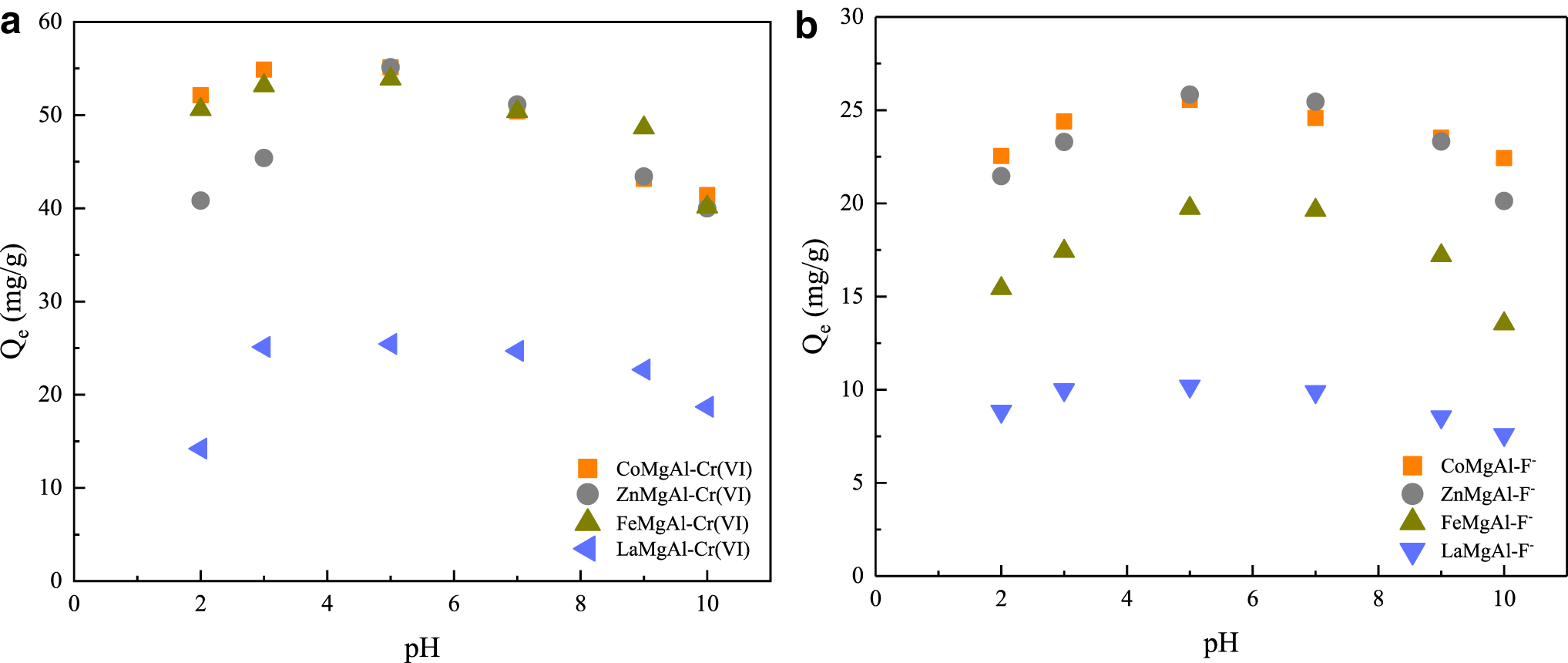
Effect of initial pH on Cr(VI) and F− adsorption onto LDHs.
The result showed that the adsorption of Cr(VI) and F− could be carried out at a wide pH value range with a considerable removal capacity. More F− and Cr(VI) were adsorbed at lower pH than at higher pH and the maximum adsorption capacity of Cr(VI) and F− occurred at pH 5.0. The result was due, in part, to the fact that the large number of H+ ions present at low pH (<6.0), which could neutralize the negatively charged adsorbent surface, reducing the effect of electrostatic interaction, thus promoting the diffusion of chromate ions (Rao et al., 2002).
Furthermore, HCrO4− (the dominant species of chromate) might occur a reduction reaction and be converted to Cr (III) (Mobarak et al., 2019). At lower pH value, F− could be combined with H+ in the solution to form hydrogen fluoride (Vázquez-Guerrero et al., 2016), and the carbonate in the interlayer was decomposed into carbon dioxide, facilitating its replacement by fluoride (Das et al., 2003). However, when the pH was reduced to 5.0, the adsorption capacity of fluoride decreased due to the possibility that the layered material might be partially dissolved (Das et al., 2003; Cai et al., 2012).
On the other hand, a higher pH could cause the surface of the LDHs to carry more negative charge, creating a repulsive interaction between the adsorbent surface and the anion in the solution (Lv et al., 2006). The results showed that adsorption behavior of adsorbent on Cr(VI) and F− significantly related to the pH of the solution. All the subsequent Cr(VI) and F− adsorption experiments in single-compound and binary systems were arranged at pH of 5.0.
Kinetics studies in single adsorption
Contact time is an important parameter to determine the adsorption efficiency. To examine the potential rate-limiting factor and the reaction process, the classical pseudo-first-order and the pseudo-second-order models were applied to evaluate the experimental data (Ho and McKay, 1999; Ho, 2004):
where qe (mg/g) is the equilibrium capacity and qt (mg/g) is the amount of adsorbed F or Cr(VI) at time t, and k1 (min−1) and k2 (g/mg × min) are the rate constant of the pseudo-first-order and pseudo-first-order model, respectively.
The fitting curves of the kinetic model are shown in Fig. 6, and the corresponding parameters are listed in Table 2. For the CoMgAl-LDH, FeMgAl-LDH, ZnMgAl-LDH, and MgAlLa-LDH, the entire adsorption process increased rapidly in 10 min, and then slightly reached equilibrium capacity at ∼40 min. The correlation coefficient (R2) of pseudo-second-order model was higher compared with pseudo-first-order model in all cases. The theoretical adsorption capacity (qe) of Cr(VI) and F− was basically consistent with the experimental data. The result indicated that the adsorption process may be dominated by chemisorption, which involved valence forces by sharing or exchange of electrons between LDHs and Cr(VI) or F− ions (Ma et al., 2014). The adsorption capacity of Cr(VI) and F− was in the following sequence: CoMgAl-LDH>ZnMgAl-LDH > FeMgAl-LDH > MgAlLa-LDH.
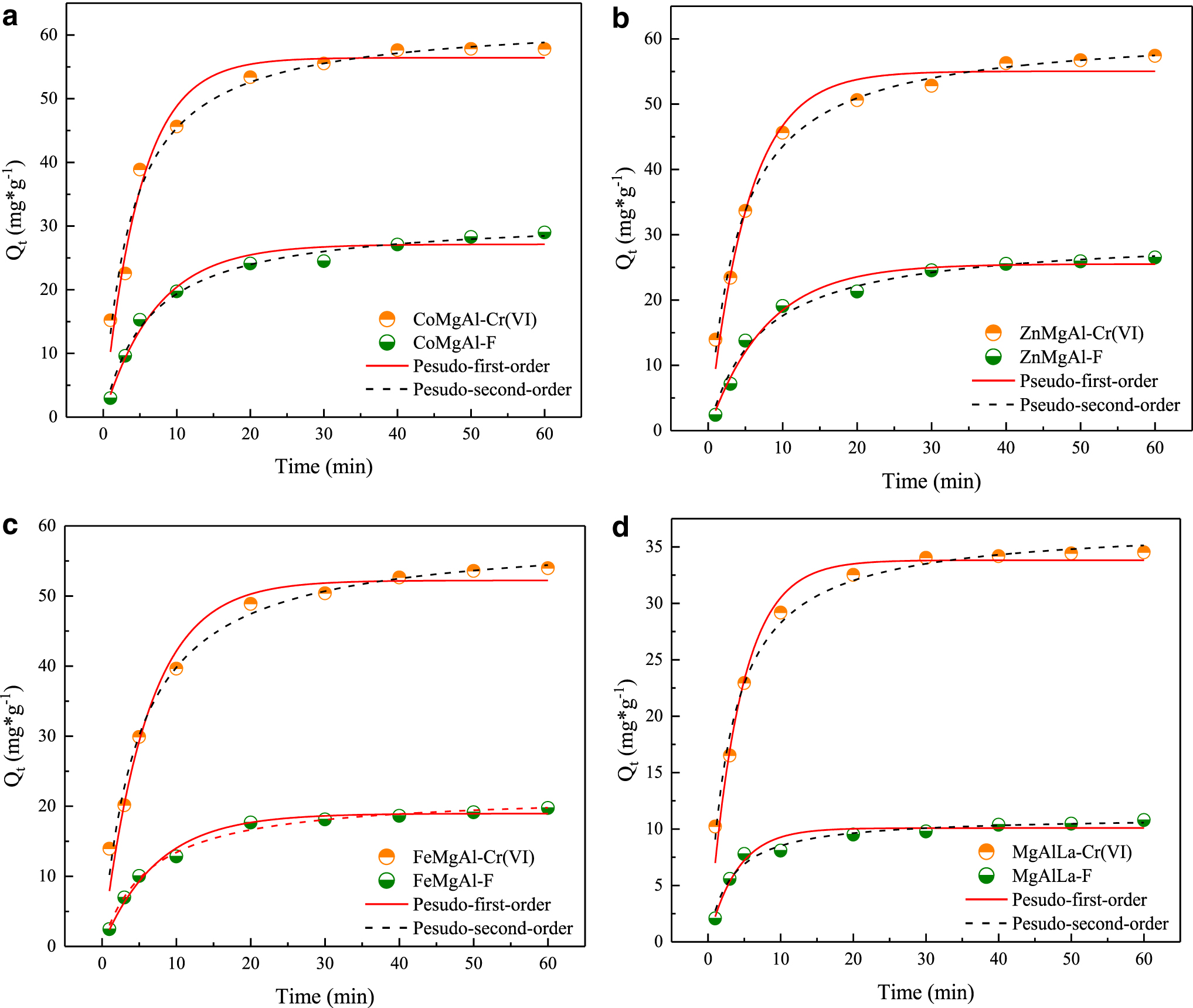
Variation in adsorption loading of Cr(VI) and F− with contact time for LDH samples (T = 25°C, adsorbent dose = 0.5 g/L, 20 mg/L of Cr(VI), 10 mg/L of F−, pH 5).
Kinetics Parameters for F− and Cr(VI) Adsorption on Different Layered Double Hydroxides
Isotherm studies in single adsorption
Adsorption isotherms not only help in determining the effectiveness of the LDHs in removing F− and Cr(VI) from aqueous solution but also provide a general idea of the maximum adsorption capacity (qmax) (Cho et al., 2011). Langmuir and Freundlich isotherm models were employed to simulate the experimental data of the adsorption for single system and the equation can be expressed as follows (Tran et al., 2017):
where Ce (mg/L) is the equilibrium concentration of F− or Cr(VI) in solution, qe (mg/g) is the equilibrium adsorption capacity, Qmax (mg/g) is the maximum saturated monolayer adsorption capacity, b (L/mg) is a constant related to the affinity between an adsorbent and adsorbate, Kf (mg/g)/(mg/L) n is the Freundlich constants related to adsorption capacity, and n (dimensionless) is the Freundlich intensity parameter indicating the magnitude of the adsorption driving force or the surface heterogeneity.
Figure 7 shows the isotherms of Langmuir and Freundlich and the corresponding parameters are given in Table 3. The high values of regression coefficients (R2) indicated that both Langmuir and Freundlich equation provided an accurate description of the experimental data. In all cases, the Langmuir model was better description for experimental data of the adsorption of F− and Cr(VI) than Freundlich, which suggested that the F− and Cr(VI) might be adsorbed on the surface of adsorbent in the form of monolayer.
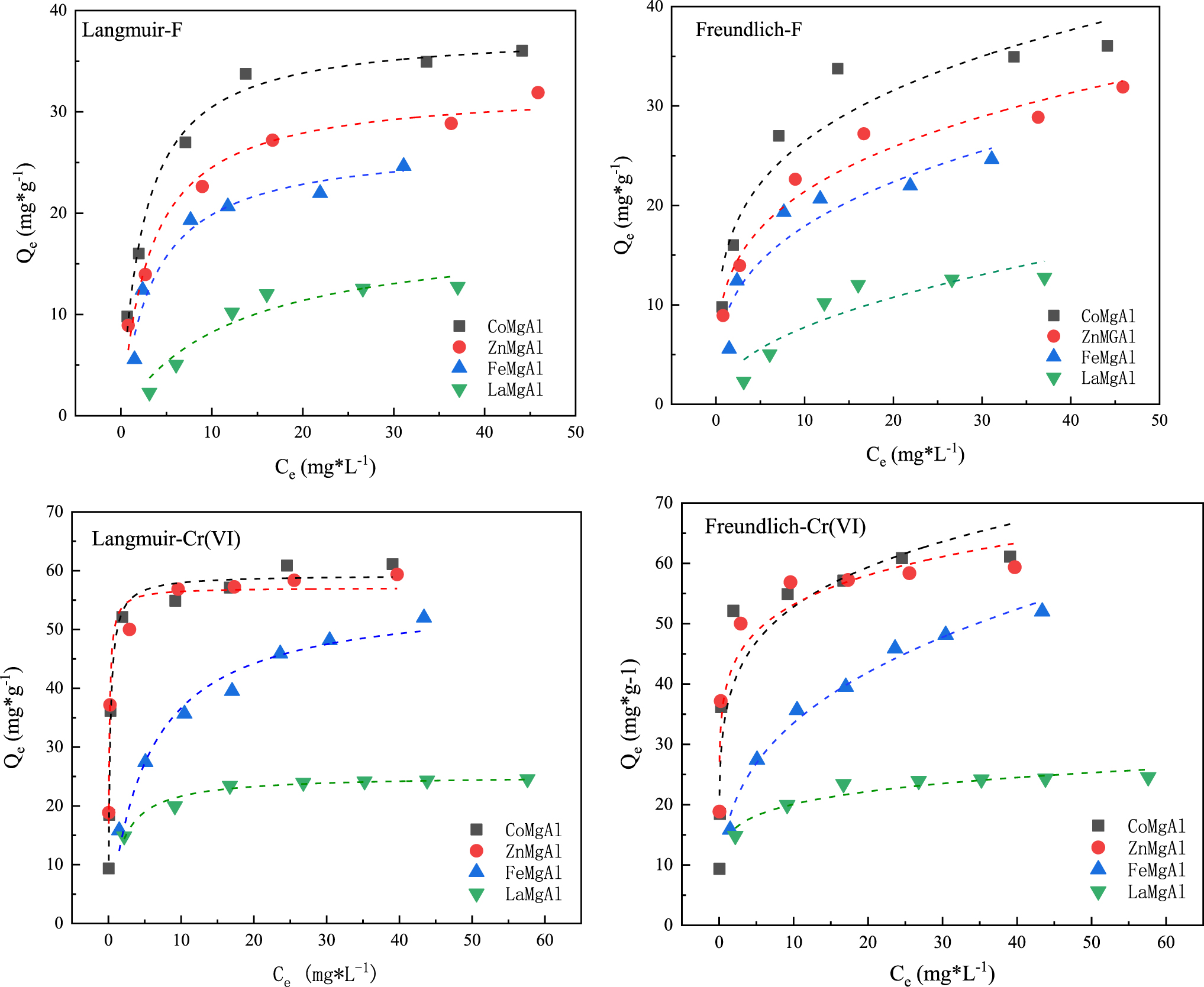
Langmuir and Freundlich nonlinear plots of adsorption isotherms for F− and Cr(VI) on the LDHs (T = 25°C, pH 5, contact time = 60 min, and dosage = 0.5 g/L).
Langmuir and Freundlich Parameters for F− and Cr(VI) Adsorption in Single-Compound System
In addition, the n values for the studied ions (Table 3) were between 0.1 and 1 (i.e., less than unity), indicating a favorable Cr(VI) and F adsorption at low concentrations, characterized by a certain degree of heterogeneity (Mobarak et al., 2019). In single-compound systems, for each investigated LDHs, the qmax values of F− were higher than the corresponding of Cr(VI), which confirmed that the LDH active sites were more selective for F−. The result could be ascribed to some physicochemical properties of the two ions such as ionic radius and electronegativity, together with the functional groups present on the adsorbent surface. To some extent, the bigger ionic radius and higher electronegative value of Cr(VI) ions (equal to 4.0) led to a faster and more favorable adsorption on LDH active sites (Mobarak et al., 2019).
According to Table 3, CoMgAl-LDH had excellent monolayer adsorption capacities (qmax) of Cr(VI) and F− with values of 59.27 and 38.01 mg/g, respectively. Therefore, CoMgAl-LDH was selected as the optimal adsorbent in subsequent experiments.
Competitive adsorption
Kinetics studies in competitive adsorption
The study on the single adsorption system showed that the adsorption capacity of Cr(VI) and F− on CoMgAl-LDH was obviously better compared with other LDHs. Therefore, in the study of competitive adsorption, CoMgAl-LDH was chosen as the adsorbent. Figure 8 displays the adsorption kinetics of Cr(VI) and F− on CoMgAl-LDH. The entire adsorption process in competitive system was still fast, and the adsorption capacity of CoMgAl-LDH to Cr(VI) and F− reached basic saturation at 30 and 40 min, respectively. The corresponding fitting data are shown in Table 4. The correlation coefficients (R2) for the pseudo-second-order model were higher than those of the pseudo-first order. The equilibrium adsorption amount (qe,cal) calculated according to the pseudo-second-order model was evidently closer to the experimental value (qe,exp). In competitive adsorption system, the adsorption processes of Cr(VI) and F− on CoMgAl-LDH still well fitted the pseudo-second-order kinetic model.
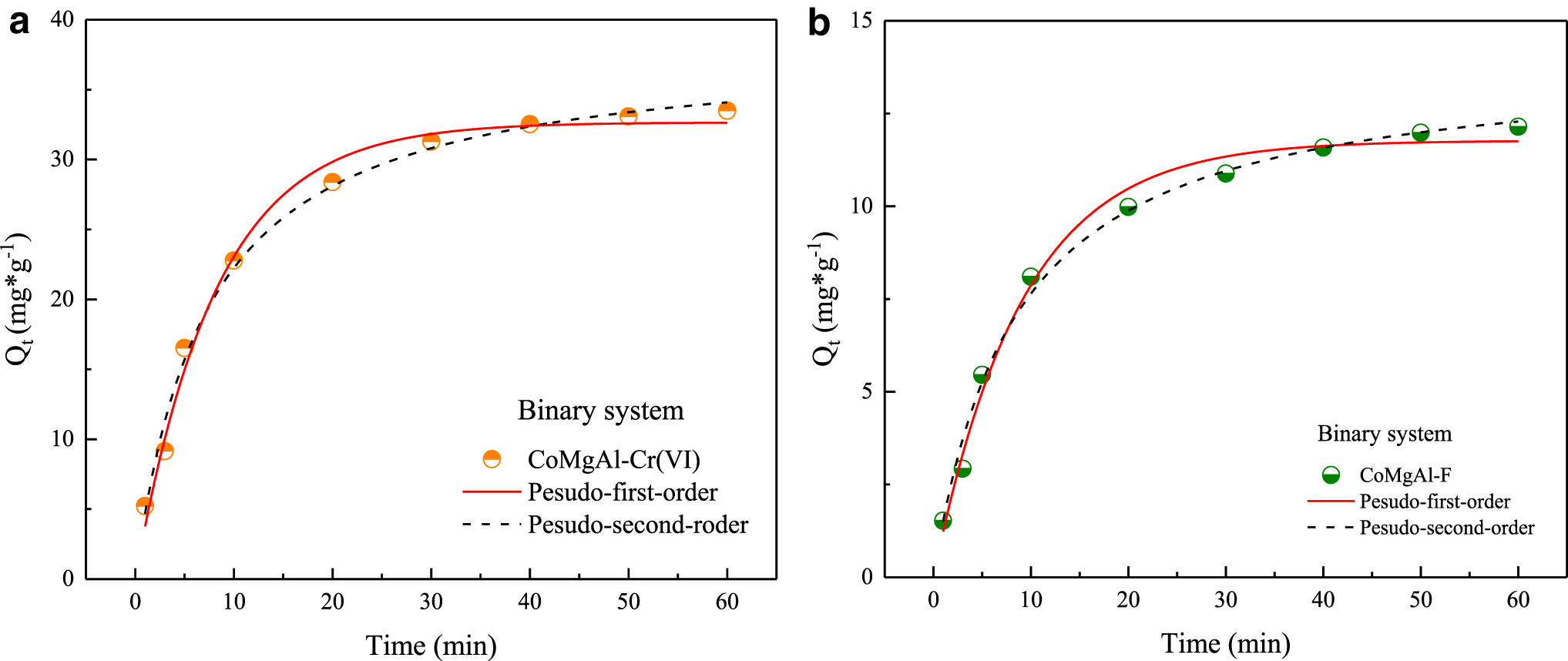
Adsorption kinetics of
The Model Parameters of Adsorption Kinetics and Adsorption Isotherms in Competitive Adsorption System
Isotherm studies in competitive adsorption
Figure 9 shows the adsorption isotherm curves of Cr(VI) and F− on CoMgAl-LDH, and the corresponding parameters are listed in Table 4. The adsorption processes for adsorbing Cr(VI) and F− in competitive system followed the Langmuir model with higher R2 values compare with the Freundlich model, indicating that the simultaneous adsorption processes were apt to monolayer adsorption. The maximum adsorption capacity of CoMgAl-LDH to Cr(VI) and F− was 39.33 and 13.46 mg/g, respectively. The result demonstrated that CoMgAl-LDH is promising adsorbent for the simultaneous removal of Cr (VI) and F− from the aqueous solution.
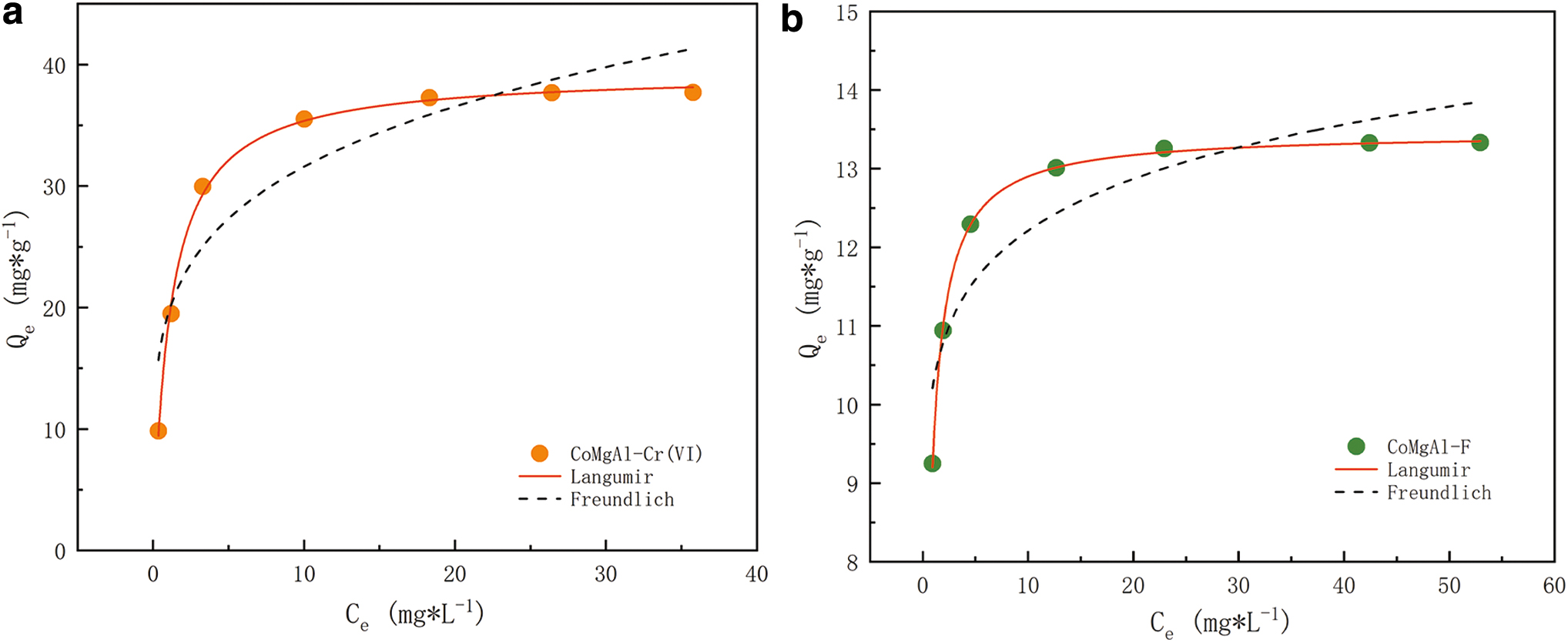
Adsorption isotherms of
Effect of coexisting ion concentration
To understand the interaction and mechanism, with one of the anion [Cr (VI) or F−] concentrations unchanged, the other anion was added with different concentration as a coexisting competing ion. Figure 10 shows the equilibrium absorption capacity of Cr(VI) or F− with increasing coexisting ions in the solution, indicating that Cr(VI) and F− would compete for adsorption sites and obstacle the adsorption of each other. This competitive behavior eventually caused the decline of adsorption performance. When the concentration of the coexisting ion of Cr(VI) in the solution was enlarged, the interference with the adsorption of F− was obvious. It was noteworthy that for the adsorption of F−, the low concentration of Cr(VI) (≤10 mg/L) had a slight effect on the adsorption capacity of F−, and the curve was mild. However, the adsorption capacity of Cr(VI) was more susceptible to F−, even if the concentration of F− in the solution was very low (≤10 mg/L). The result was attributed to Cr(VI) being sufficient to occupy most of the adsorption sites on the surface of the CoMgAl-LDH at a concentration of 20 mg/L. Even when a low concentration of F− ions was added, the competitive adsorption was triggered and led to the decrease of Cr(VI) adsorption.
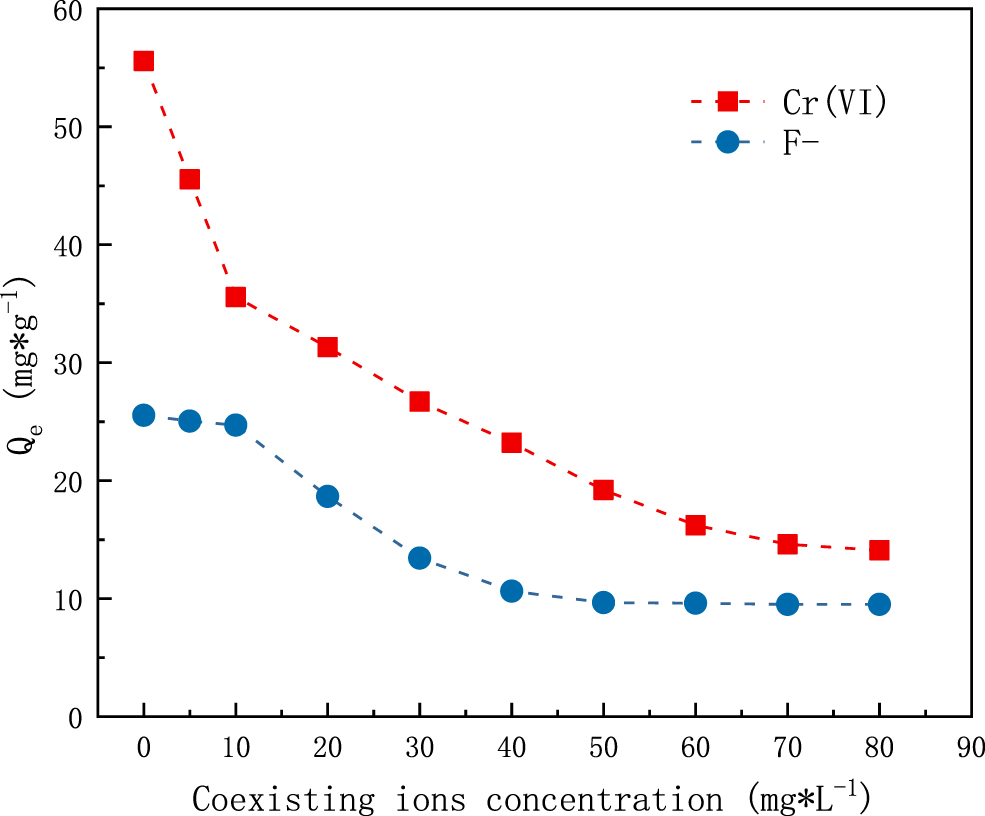
Interference of different concentrations of coexisting ions on Cr(VI) and F− adsorption on the CoMgAl-LDH (10 mg/L of F−, 20 mg/L of Cr(VI), T = 25°C, dosage = 0.5 g/L, pH 5).
In contrast, the initial concentration of F− (10 mg/L) was too low to rapidly occupy all the adsorption sites on the LDH surface. However, when Cr(VI) (0–10 mg/L) was added to the solution, the total anion concentration gradually increased and the adsorption sites of the CoMgAl-LDH surface were gradually occupied. In addition, by continuously increasing the concentration of Cr(VI) (>10 mg/L), the competition between F− and Cr(VI) for the adsorption sites affected adsorption capacity of F− sharply. More importantly, the curve eventually flattened out, indicating that Cr(VI) and F− reached adsorption equilibrium on CoMgAl-LDH. Although the concentration of competitive anions kept increasing, the anions that originally occupied the adsorption site were not replaced, which indicated that there were some special adsorption sites on the surface of CoMgAl-LDH, which belong to Cr (VI) and F−, respectively.
Effect of F
−
and Cr(VI) addition order
The chemical composition of the CoMgAl-LDH before and after adsorption of fluoride and Cr(VI) can be seen in corresponding EDX spectrum presented in Fig. 11. Figure 11a shows the presence of Mg, O, Al, Co, and Cl, indicating the CoMgAl-LDH was successfully prepared. Meanwhile, in Fig. 11b, F and Cr appear in the EDX spectrum after the adsorption of fluoride and Cr(VI), which verifies the adsorption of fluoride and Cr(VI) by the CoMgAl-LDH.
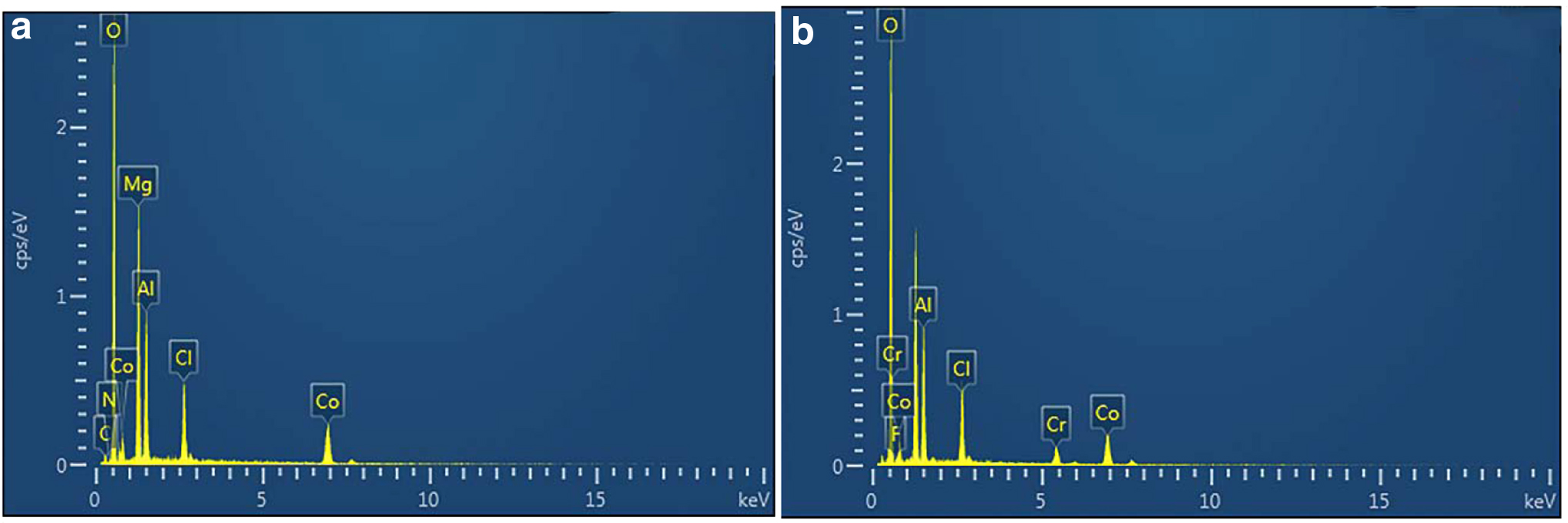
Corresponding EDX spectrum of
To obtain further insight into the mechanism of the effect of F− or Cr(VI) on the adsorption of the other one, the effect of different contact order of F− and Cr(VI) on adsorption capacity of the CoMgAl-LDH was studied. Figure 12a represents Cr(VI) adsorption at a given F− concentration (10 mg/L) with different order of addition. Addition of F− has an obvious effect on the amounts of Cr(VI) adsorbed on CoMgAl-LDH. When F− was added first (system [F−-Cr(VI)]), more suppression was observed than the system in which Cr(VI) was added first. However, when Cr(VI) was first added (system [Cr(VI)-F−]) or Cr(VI) and F− were added at the same time (system [Cr(VI)+F−]), the adsorption amount of Cr(VI) was similar.
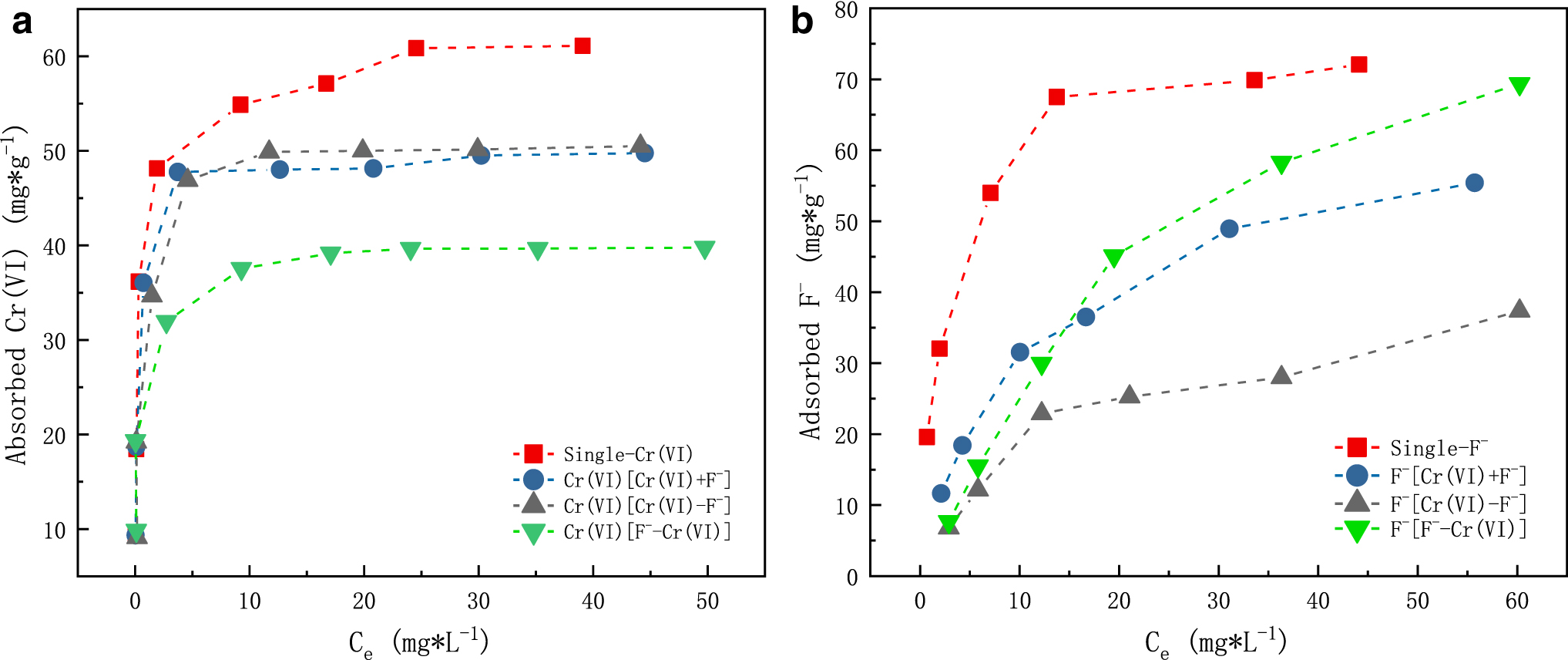
Effect of the order of addition on
The amount of adsorbed Cr(VI) was in the following order: single-Cr(VI) > Cr(VI)[Cr(VI)-F−] ≈ Cr(VI)[Cr(VI)+F−] > Cr(VI) [F−-Cr(VI)]. Similar to Cr(VI) adsorption, adsorption of F− in the presence of Cr(VI) (20 mg/L) was also suppressed.
Figure 12b shows that more F− was adsorbed when the F− was added before Cr(VI). Cr(VI) and F− were anions competing for similar activate sites on the CoMgAl-LDH. Whether it was Cr (VI) or F−, once they came into contact with the CoMgAl-LDH, they would occupy the activate point first. When the activation site was limited, ion exchange would be dominant between F− and Cr(VI) according to a different contact order. In the competitive system, when Cr(VI) was first adsorbed on the CoMgAl-LDH, Cr(VI) was more difficult to be replaced by F−, which also indicated that F− could not compete effectively with Cr(VI). The possible reason was attributed to the CoMgAl-LDH having stronger affinity for multivalent anion Cr(VI) than monovalent anion F−.
Adsorption mechanism
The XRD and FTIR spectra of CoMgAl-LDH before and after adsorption of F− and Cr(VI) are presented in Figs. 13 and 14, and the XRD data are given in Table 5. It could be seen from Fig. 13 that the crystal structure of LDHs changed significantly before and after the adsorption of F− and Cr(VI). The XRD results indicated that there were some sites on the surface of CoMgAl-LDH that supported adsorption. Interpretations of the spectra were based on the information acquired from literatures (Das et al., 2003; Lv et al., 2006; Vijaya and Krishnaiah, 2009; Meng et al., 2018).
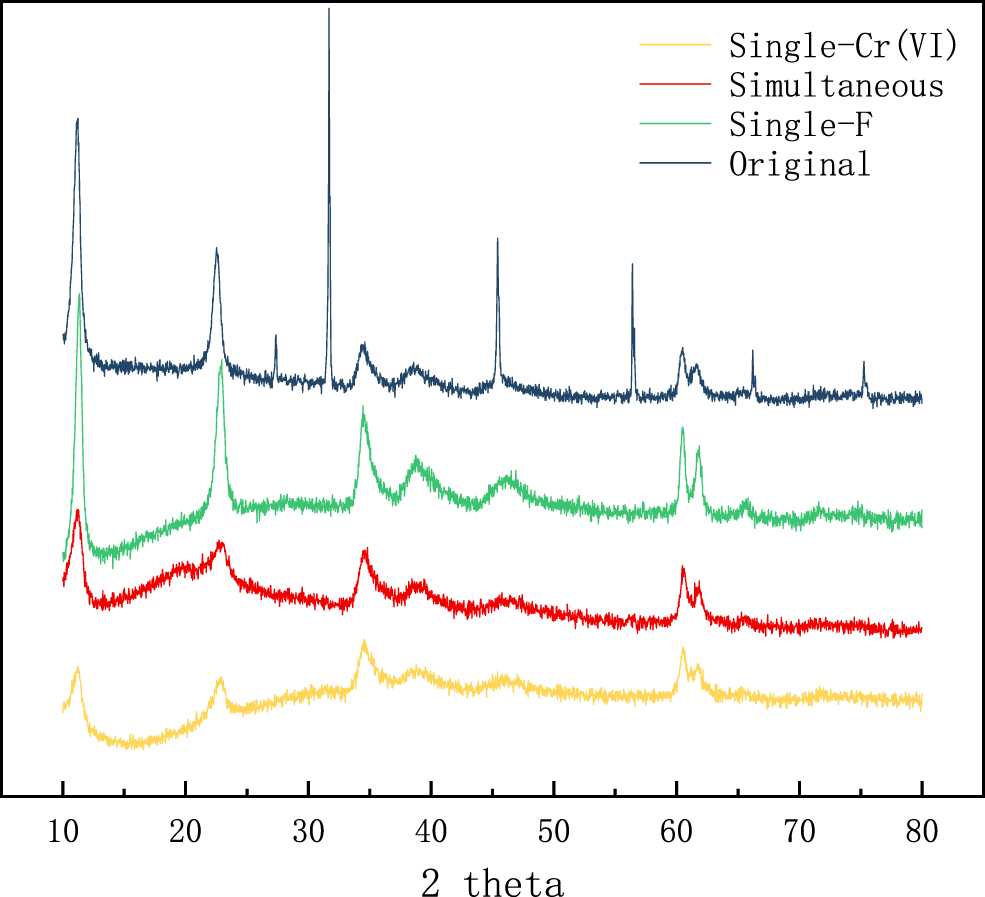
XRD of CoMgAl-LDH before and after adsorption of F− and Cr(VI).
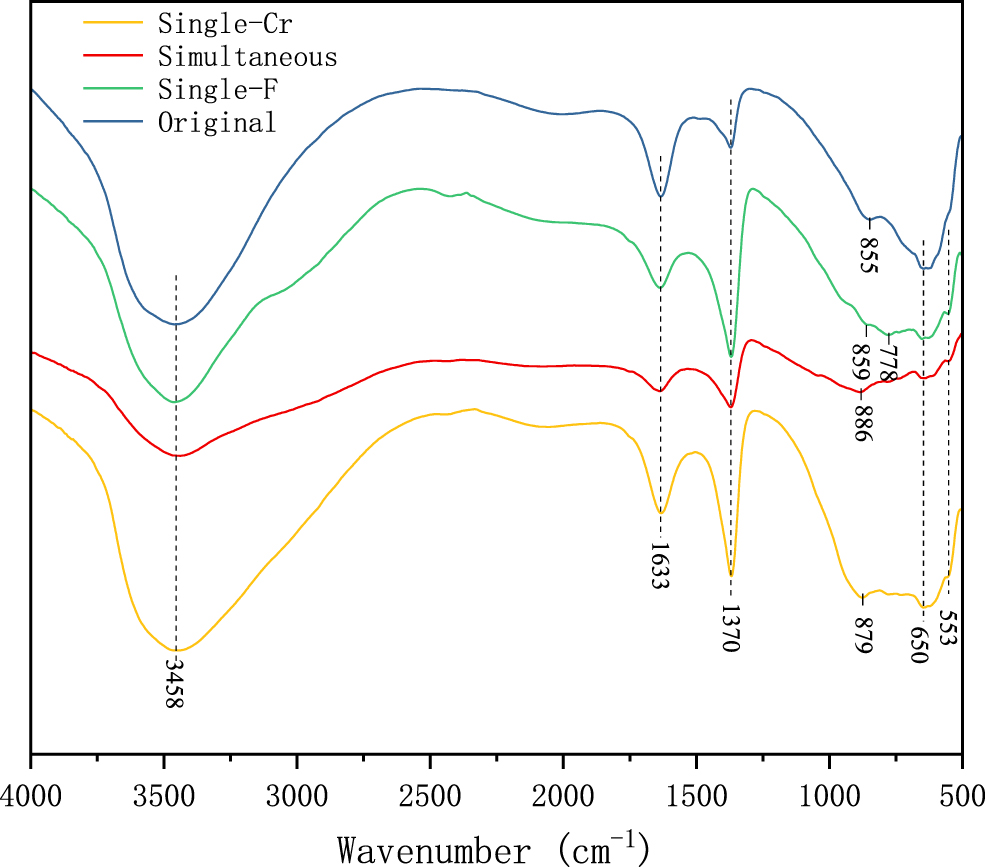
FTIR of CoMgAl-LDH before and after adsorption of Cr(VI) and F.
X-Ray Powder Diffraction Data for the CoMgAl-Layered Double Hydroxide Before and After Adsorption of F− and Cr(VI)
c: three times the distance between two layers, c = 3d003.
a: distance between two cations in the layers, a = 2d110.
According to Fig. 14, the absorption peaks at 553 and 650 cm−1 were caused by the vibration of the metal-oxygen bond (Mg-O and Al-O), while significant new absorption peaks appeared at 879 and 886 cm−1, which were caused by the stretching vibration of the Cr–O bond after the absorption of Cr(VI). After adsorption of Cr(VI) and F−, the band observed at 1,370 cm−1 became sharp (Single-F and Single-Cr), which could be due to the reconstruction of the LDHs. However, the change of the band at 1,370 cm−1 (simultaneous) was not obvious, possibly because the competitive adsorption of Cr(VI) and F− hindered the material reconstruction. Display of strong bands in the region 3,458 cm−1 (Single-F, Single-Cr, and Simultaneous) was observed, which could be due to hydrogen bonding.
FTIR results indicated that the main hydroxyl groups were involved in Cr(VI) and F− sorption. This observation was consistent with the pH study data. The above results suggested that the adsorption of F− and Cr(VI) on the CoMgAl-LDH was a complex process involving both physical and chemical sorption. Cr(VI) and F− had stronger electrostatic interactions than Cl−, and Cr(VI) and F− could be spontaneously inserted into the intermediate layer of the CoMgAl-LDH by anion exchange, while the Cl− in the interlayer was exchanged out. Removal process of the F− was shown as follows: M–OH + F− → M–F + OH– (around natural pH), where M stands for Co, Mg, and Al (Zhang et al., 2012). Through the previous analysis, ion exchange and surface adsorption were the mutual ways to remove Cr(VI) and fluoride using the LDHs.
Comparison with other adsorbents
Table 6 shows the maximum adsorption capacity of Cr(VI) and F− on recently reported adsorbents. The amount of Cr(VI) and F− onto the CoMgAl-LDH was larger than most other adsorbents. Therefore, this result indicated that the CoMgAl-LDH provided a new research idea for exploring the significant adsorption tend of Cr(VI) and F− in aqueous solution, especially in simultaneous adsorption of Cr(VI) and F−.
Comparison of Cr(VI) and F− Adsorption with Other Studies
ESM, eggshell membrane.
Conclusion
Different kinds of metals were doped into the MgAl-LDH to improve the adsorption performance of Cr(VI) and F−. Among them, CoMgAl-LDH had a surface area of 49.89 m2/g, which is superior to the other three LDH materials. In the single system, CoMgAl-LDH showed excellent adsorption capacity of 58.27 mg/g for Cr(VI) and 38.01 mg/g for F−. The adsorption behavior of Cr(VI) and F− was consistent with the Langmuir adsorption isotherm both in a single system and competitive system. The single adsorption and competitive adsorption of Cr(VI) and F− well fitted the pseudo-second-order kinetic model.
For all the LDHs, with increasing pH from 2 to 10, Cr(VI) and F− removal capacity increased first and then decreased, reaching the maximum at pH 5.0. The coexistence of Cr(VI) and F− would impact the removal behavior for the single one, and the equilibrium adsorption capacity of Cr(VI) and F− decreased. When Cr(VI) and F− were added simultaneously, a high concentration of Cr(VI) occupied the adsorption sites on LDHs, thus inhibiting the removal of F−. However, the removal of F− was almost unaffected by the low concentration of Cr(VI) (≤10 mg/L). Cr(VI) and F− competed for activate sites during adsorption and the affinity of Cr(VI) to LDHs was stronger compared with F−. Whether F− or Cr(VI) was added first, once in contact with LDH, the activation point would be occupied first. Cr(VI) and fluoride removal were achieved by surface adsorption and interlayer ion exchange mainly. This work provided new insight into the use of LDHs in the common removal of anionic pollutants in groundwater.
Footnotes
Author Disclosure Statement
No competing financial interests exist.
Funding Information
This research was supported by the International Scientific and Technological Innovation and Cooperation Project of Sichuan (No. 2019YFH0170).