




Abstract
The vision of the U.S. government when they passed the Clean Water Act (CWA) in 1972 was to restore and maintain the chemical, physical, and biological integrity of the nation's waters to support fishing and recreation. The U.S. Environmental Protection Agency and Army Corps of Engineers have recently made major and controversial changes to the CWA in a 2020 regulation referred to as the Navigable Waters Protection Rule. This article reviews the bipartisan history of the CWA and the historic trajectory of how “waters of the United States” are defined to provide legal jurisdiction. It then discusses the science that supported changes to the CWA made in 2015 and lack of science that supported recent changes. The 2015 Clean Water Rule was intended to be a science-based clarification of what “waters of the United States” mean to CWA regulation. That rule was based on synthesis and review of >1,200 peer-reviewed articles that served as the basis for a 408-page scientific Connectivity Report. For the recently released regulation, U.S. Environmental Protection Agency's (EPA's) Science Advisory Board wrote that EPA did not incorporate the best-available science into the rule making process and provided no “comparable body of peer-reviewed evidence” to support the proposed changes to the CWA. Furthermore, the EPA ignored science by even stating that “science cannot dictate where to draw the line between Federal and State waters.” EPA's mission is to protect human and environmental health, the Corps has a vision of “engineering solutions for our Nation's toughest challenges.” Ultimately, the EPA and the Corps have ignored their responsibilities, mission, and vision by ignoring well-established science in their mandates to protect our nation's water for current and future generations.
Introduction
The U.S. Environmental Protection Agency (EPA) and Army Corps of Engineers (Corps) have recently made major and controversial changes to the Clean Water Act (CWA). These changes are estimated to remove CWA protections for over half of wetlands and 20% of streams (Sullivan et al., 2019).
The stated objective of the U.S. Congress when they passed the CWA in 1972 was “to restore and maintain the chemical, physical, and biological integrity of the Nation's waters.” Congress further listed as a national goal that wherever attainable, we should achieve water quality “which provides for protection and propagation of fish, shellfish, and wildlife and provides for recreation in and on the water.…” Yet assessment of the 1.2 million miles of rivers and streams located in the United States tells a story about the United States not achieving Congress's vision regarding the quality of surface waters (EPA, 2016). For example, 46% of U.S. rivers and streams are reported to be in poor biological condition and thus cannot support healthy aquatic communities, >40% have nutrient levels that are too high, 22% exceed bacteria indicators that may result in an increased likelihood of gastrointestinal illness, and >13,000 miles are found to contain unsafe levels of mercury in fish tissue (EPA, 2016).
If the United States has not achieved stated objectives and goals regarding our nation's water quality that are clearly articulated in the CWA, and if the CWA is the principal U.S. law governing pollution of surface waters, then what was the scientific basis that the White House, the EPA, and the Corps used in developing their recently released regulations? This article examines this question, starting with a review of the bipartisan history of the CWA and how regulatory agencies define waters of the United States. We conclude with details about the disregard for science and peer review in developing recent changes to the CWA.
History of Bipartisan Efforts to Pass the CWA
“A nation that fails to plan intelligently for the development and protection of its precious waters will be condemned to wither because of its shortsightedness” Vice President Lyndon B. Johnson (quote from presidential report to Congress on Assessment of the U.S. Water Resources under the Water Resources Planning Act of 1965) (Journal of the Senate of the United States of America, 1970)
October 18, 1972, is an important date for the American people. On that day, the CWA ‡ became law. At that time in U.S. history, miles and miles of rivers and streams were reported to not be safe for fishing and swimming.
Although the passage of the CWA was a bipartisan effort, it was not an easy process. It was discussed and debated throughout 1971 and 1972, and if you viewed the U.S. House and Senate versions of the bill being discussed at that time, you would see they looked very different. House and Senate members met 40 times in conference to come up with a bill that both chambers of Congress could agree on. A final agreement was made on September 14, 1972. The House then passed the legislation by a vote of 366-11 and the Senate followed with a vote of 74-0. The bill was sent to President Richard Nixon for his signature on October 5.
EPA Administrator William Ruckelshaus, a Nixon appointee, was a supporter of the CWA. However, Nixon was not, and he used his presidential powers to veto the bill on October 17, 1972, stating he wanted to address water pollution in “a way that does not ignore other very real threats to the quality of life, such as spiraling prices and increasingly onerous taxes.” Ruckelshaus had urged Nixon to sign the CWA stating, “It seems reasonable to me to spend less than one percent of the Federal budget and 0.2 percent of the Gross National Product over the next several years to assure for future generations the very survival of the Gross National Product” (Association of State and Interstate Water Pollution Control Administrators, 2004). Nixon's veto was quickly overridden by bipartisan efforts when on October 18th the Senate voted to override by a vote of 52-12 and the House voted to override by a vote of 247-23 (Foster and Matlock, 2001; Hines, 2013; Simon, 2019).
Study after study, public opinion poll after public opinion poll have revealed that the economy of this nation can absorb the costs of cleaning up pollution without inflation or without a loss in economic productivity, Senator Howard Baker, Republican of Tennessee.
The Meaning of “Waters of the United States”
There are many excellent references that discuss what “waters of the United States” means under the CWA. The reason this is so important is because it provides legal justification for what waters EPA and the Corps have jurisdiction over. Some of this section is summarized from the Congressional Research Service (March 5, 2019) article titled Evolution of the Meaning of the “Waters of the United States” in the Clean Water Act (CRS, 2019).
As stated previously, the intent of the CWA is to “restore and maintain the chemical, physical, and biological integrity of the Nation's waters.” This intent required a definition of “the Nation's waters” subject to regulation under the CWA, now more commonly known as “waters of the United States” (sometimes referred to as WOUS).
The federal government had long exercised authority over the nation's waters, starting with the Rivers and Harbors Appropriations Act of 1899 that established federal authority over “navigable water[s] of the United States.” This generally was considered to mean waters that were “navigable-in-fact,” or waters that were “used, or are susceptible of being used,. .. as highways for commerce, over which trade and travel are or may be conducted in the customary modes of trade and travel on water.” With the passage of the CWA, federal authority was extended beyond “navigable-in-fact” waters to “waters of the United States, including the territorial seas.”
During debate for the passage of the CWA, many in Congress encouraged defining “waters of the United States” in the broadest of terms, including Rep. John Dingell (D-Michigan) who opined that the definition “clearly encompasses all water bodies, including streams and their tributaries, for water quality purposes.” However, though Congressional intent was clearly to expand the definition of “waters of the United States,” the CWA itself does not contain text in great detail on the actual meaning of the terms, and federal agencies have since been charged with implementing regulations and guidance to explain this term. This has led to much discussion and debate on what comprises the geographic extent of “waters of the United States” subject to regulation under the CWA.
EPA and the Corps, each used different definitions for “waters of the United States” throughout the 1970s [see CRS (2019) for discussion]. In 1982, the Corps adopted a definition of EPA's that had been developed in 1980. The two agencies have worked under aligned definitions since the 1980s, working with one definition in particular from the late 1980s through the middle 2010s (Table 1).
Definition of “Waters of the United States” Used from the Late 1980s to the Middle 2010s
There has always been some degree of ambiguity, which has led to numerous legal challenges. In United States v. Riverside Bayview Homes, Inc., 474 U.S. 121 (1985), the Supreme Court of the United States (SCOTUS) concluded that because “water moves in hydrological cycles” rather than along “artificial lines” it was reasonable for the Corps to conclude that “adjacent wetlands are inseparably bound up with the “waters” of the United States.…” (CRS, 2019). However, in Solid Waste Agency of Northern Cook Country v. U.S. Army Corps of Engineers, 531 U.S. 159 (2001), the SCOTUS was asked to rule whether an abandoned sand and gravel pit that held water and migratory birds was a “water of the United States” subject to regulation under the CWA. In that action, the Corps had asserted authority because of the presence of migratory birds. The SCOTUS ultimately ruled the Corps had exceeded their statutory authority, stating the ponds that had formed in the abandoned gravel pit was “not adjacent to open water” and thus lacked what is termed a “significant nexus” to traditional navigable waters that would be necessary for protection under the CWA.
At this time, the agencies concluded they could “continue to exercise jurisdiction over isolated waters as long as the use, degradation, or destruction of those waters could affect other Waters of the United States.” [reference titled Joint Memorandum (Guzy and Anderson, 2001), cited in CRS, 2019] The SCOTUS' next ruling on the CWA was in Rapanos v. United States, 547 U.S. 715 (2006). This dispute had to do with whether the CWA allowed for federal jurisdiction over wetlands far from navigable waters, though adjacent to tributaries connected to those navigable waters. The SCOTUS failed to reach a plurality, with a 4-1-4 ruling remanding the case back to the lower court. Justice Antonin Scalia, writing for three justices, noted that the dictionary clearly defines waters, and the definition could in no way be interpreted to mean wetlands. He concluded that a wetland could only be a “waters of the United States” if it were “a relatively permanent body of water connected to traditional interstate navigable waters,” with a “continuous surface connection” thereby “making it difficult to determine where the ‘water’ ends and the ‘wetland’ begins.” Justice Paul Stevens, also writing for three justices, wrote that this was a relatively straightforward case in which the courts should defer to the agencies original interpretation (i.e., Chevron deference, from Chevron USA v Natural Resources Defense Council, Inc., 467 U.S. 837 [1984]), with the agencies having determined that wetlands adjacent to non-navigable streams play important roles in the chemical, physical, and biological integrity of downstream navigable-in-fact waters. Justice Anthony Kennedy sided with the Scalia faction, but authored his own opinion. In it, he proposed that “wetlands possess the requisite nexus…if the wetlands, either alone or in combination with similarly situated lands in the region, significantly affect the chemical, physical, and biological integrity of other covered waters more readily understood as ‘navigable’.”
This split ruling set up competing standards as to whether or not a wetland is a “waters of the United States”: the Scalia Standard, requiring relatively permanent surface-water flows from the wetland to a downstream, navigable-in-fact water, and the Kennedy Standard, requiring the existence of a significant nexus between the wetland the chemical, physical, and/or biological integrity of a downstream, navigable-in-fact water (Leibowitz et al., 2008).
By the late 1980s, the basic definition of “waters of the United States” was settled (refer to Table 1). Throughout the late 1980s to the middle 2010s, the key court decisions resulted in new regulatory guidance, but not a new regulatory definition of “waters of the United States.” In 2008, the EPA and Corps developed guidance based on some of the undetermined decisions made in Rapanos. In 2011, the EPA and Corps solicited comments on their 2008 guidance, developing new guidance. This new guidance angered some members of Congress and accordingly, it was abandoned by the two agencies. This ultimately led to creation of the 2015 Clean Water Rule (Fig. 1).
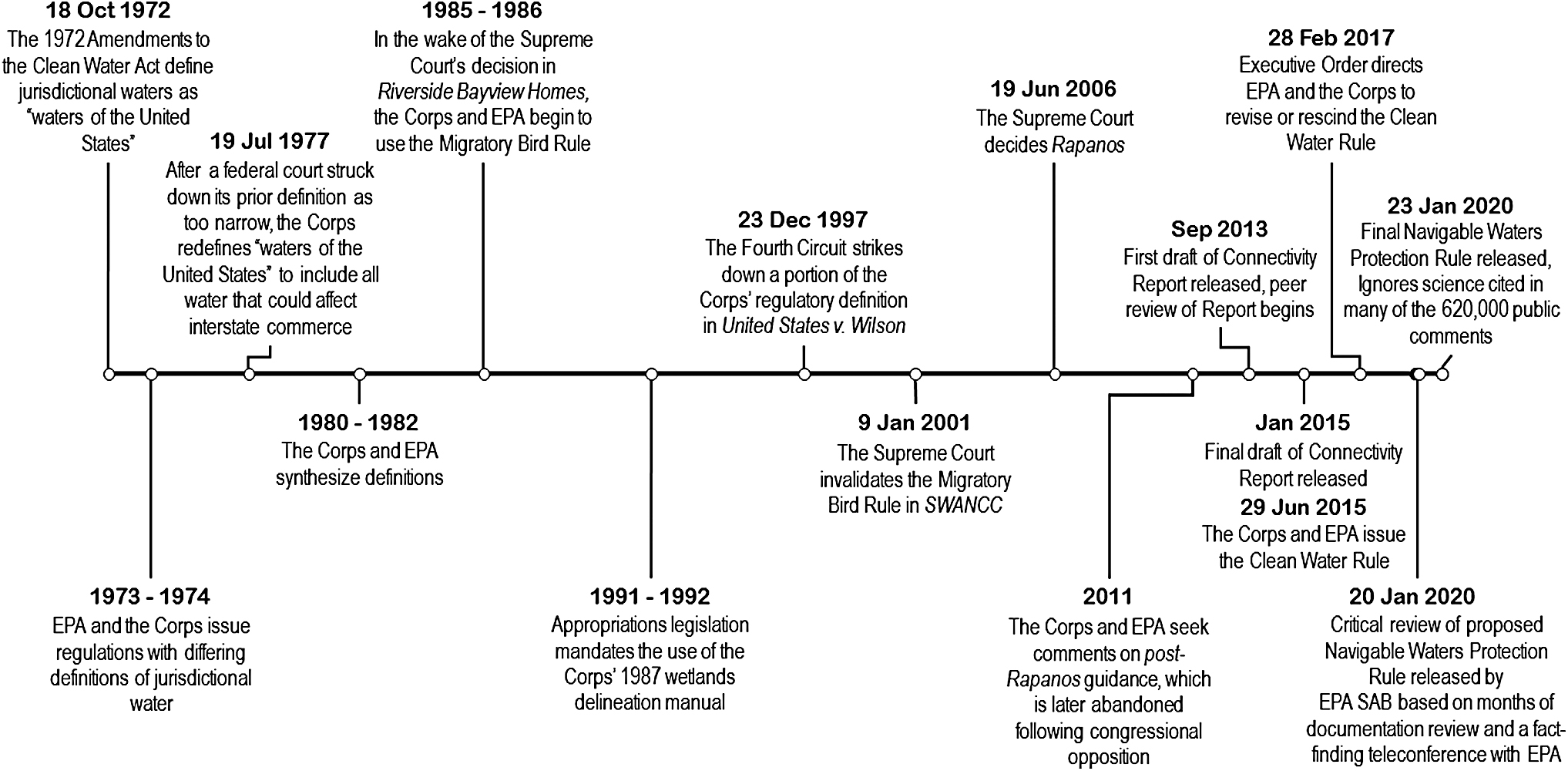
Major events in the evolution of the waters of the United States (redrawn and updated from CRS, 2019). EPA, U.S. Environmental Protection Agency; SAB, Science Advisory Board.
The 2015 Clean Water Rule: The Role of Science
The 2015 Clean Water Rule was intended to be a
That draft Connectivity Report was released in 2013 and EPA's Office of Research and Development requested that the EPA Science Advisory Board (SAB) review and comment on it. The SAB was established in 1978 through Congressional direction. It provides a mechanism for the EPA to “review the quality and relevance of the scientific and technical information being used by the EPA or proposed as the basis for the promulgation of EPA regulations” (https://www.epa.gov/aboutepa/about-science-advisory-board-sab-and-sab-staff-office). This is because a key priority for EPA is to base actions on sound scientific data, analyses, and interpretations.
That draft Connectivity Report was initially reviewed by an expert panel of 11 peer reviewers, including greats such as Don Rosenberry of the U.S. Geological Survey and the late Becky Sharitz of the Savannah River Ecology Laboratory. The 17 original agency scientists then prepared a second draft of the Connectivity Report based on the input provided by this expert panel convened by the SAB. That draft was then reviewed by 11 different external peer reviewers who included established scientists such as Mark Wipfli of the U.S. Geological Survey and Arnold van der Valk of Iowa State University.
The 17 agency scientists then prepared a third draft of the Connectivity Report. That draft was then reviewed by 27 members who made up the EPA SAB Panel for the Review of the EPA Water Body Connectivity Report. Members of that subject-expert committee include greats such as Judson Harvey of the U.S. Geological Survey and Jennifer Tank of the University of Notre Dame. Finally the comments provided through this final panel review were reviewed by 52 scientists who served on the EPA Chartered SAB.
The 17 agency scientists then prepared the final draft Connectivity Report, published in January 2015 (EPA, 2015). This final report, therefore, represents a summary and synthesis of >1,200 peer-reviewed journal articles as determined by 17 agency scientists and 49 unique peer reviewers from agencies, academia, industry, and nongovernmental organizations, all of whom were focused on answering one key set of questions: for purposes of the CWA, what rivers, streams, and wetlands should be jurisdictional, and why? What scientific information should the agencies be aware of to inform their determination? The review of the underlying science by these scientists was also reviewed by the 52 members of EPA's Chartered SAB. The scientific community clearly and collectively answered these questions—in writing, in public, and with citations. In any case, this final draft of the Connectivity Report (EPA, 2015) was then used as the scientific basis underlying the Clean Water Rule.
The 2020 Navigable Waters Protection Rule: The Lack of Science
On February 28, 2017, the White House released Presidential Executive Order on Restoring the Rule of Law, Federalism, and Economic Growth by Reviewing the “Waters of the United States” Rule (https://www.whitehouse.gov/presidential-actions/presidential-executive-order-restoring-rule-law-federalism-economic-growth-reviewing-waters-united-states-rule/). That executive order required the EPA and Corps to review the Clean Water Rule and interpret the term “navigable water” in a manner consistent with the previously described opinion of Justice Scalia in Rapanos v. United States, 547 U.S. 715 (2006). It should be recalled that Justice Scalia's was not a majority opinion, it was signed by a total of just four justices. On February 14, 2019, the EPA and Corps released a proposed revised definition of “waters of the United States” (Federal Register/Vol. 84, No. 31/Thursday, February 14, 2019/Proposed Rules). Over 620,000 public comments were received while developing the final rule.
The EPA did engage the current SAB, staffed under the current administration, and the SAB held a public meeting on January 17, 2020, and issued a draft response to the proposed rule, the most recent draft dated January 20, 2020 (https://yosemite.epa.gov/sab/sabproduct.nsf/547F1883CD4EF72C852584F8003C2030/$File/WOTUS+SAB+Draft+Commentary_1_20_20.pdf).
Conclusion
We started this article by asking the question, if the United States has not achieved stated objectives and goals regarding our nation's water quality that are clearly articulated in the CWA, and if the CWA is the principal U.S. law governing pollution of surface waters, then what was the scientific basis for the 2020 Navigable Waters Protection Rule? Our conclusion (and others) is that a large reservoir of peer-reviewed scientific information was ignored by the EPA and the Corps. There is ample evidence that even small and geographically remote wetlands and streams can play important roles in maintaining the chemical (e.g., Alexander et al., 2000; Marton et al., 2015), physical (e.g., Evenson et al., 2015; Thorslund et al., 2018), and biological (e.g., Meyer et al., 2007; Colvin et al., 2019) integrity of the nation's waters. Nevertheless, the administration of these two federal agencies ignored this science, including their own science (EPA, 2015), and the advice of their own SAB.
So what happens now? Thousands and thousands of miles of our nation's rivers and streams are still assessed to be in poor quality. Furthermore, an exploratory analysis by Saint Mary's University of Minnesota predicts widespread losses of wetland functions through the loss of federal protections for thousands of miles of ephemeral streams and >16 million acres of wetlands in the conterminous United States (SMUM, 2019). Losses will likely be particularly acute for already vulnerable waters (Creed et al., 2017), possibly including playa lakes, prairie potholes, Carolina and Delmarva Bays, pocosins, and vernal pools (Lane and D'Amico, 2016).
Footnotes
Author Disclosure Statement
Readers can learn more about the extensive review process of the Connectivity Report by accessing documentation on the EPA SAB's website ( ).
).
J.R.M. was appointed by the EPA Administrator and served for two consecutive terms on the U.S. EPA Chartered Advisory Board (2010–2016). During that time period he was involved in review of scientific reports generated by the EPA and panel scientists regarding the Connectivity Report.
M.R. was twice a peer reviewer of the Connectivity Report, first as a member of the 11-member panel of external peer reviewers convened to review the second draft of the Connectivity Report and later as a member of the 27-member U.S. EPA SAB panel of external peer reviewers convened to review the third draft of the Connectivity Report.
Funding Information
No funding was provided by any entity to the authors for writing this article.