




Abstract
The long-term effects of the antibiotic oxytetracycline (OTC) on the process of anaerobic ammonium oxidation (anammox) were studied in an upflow low-matrix anammox biofilter. When OTC was increased to 40 mg/L, the nitrogen removal rate (NRR) reduced from 0.536 to 0.395 kg/(m3·day), and then decreased further with OTC concentration. Although extracellular polymeric substances (EPS) increased from 36.3 to 177.6 mg/g of suspended solids, this was insufficient to resist the toxicity of OTC to anaerobic ammonia-oxidizing bacteria (AAOB). The total nitrogen removal efficiency decreased from the initial 85.2% to 17.3%, and the relative abundance of AAOB decreased from 16.40% to 9.35%. When the OTC concentration exceeded 40 mg/L, some microorganisms died, which led to a decrease in EPS, but an increase in soluble microbial products. The relative abundance of AAOB decreased from 16.40% to 4.6% when the OTC concentration reached 90 mg/L, and remained at 4.8% when OTC was no longer added. The anammox process could not be recovered during the four generation cycles after OTC addition ceased. The IC50 of OTC toward the NRR of the anammox process was calculated to be approximately 10.47 mg/L.
Introduction
The application of various antibiotics for both humans and animals is becoming increasingly prevalent (Meng et al., 2019). Antibiotics are a special category of pharmaceuticals that might result in potential threats to the aquatic environment (Wang et al., 2020). China is one of the largest producers of antibiotics in the world and produces an estimated 210,000 t/a (Zhang et al., 2020a). Norfloxacin, ciprofloxacin, ofloxacin, sulfamethoxazole, erythromycin, oxytetracycline (OTC), and trimethoprim are the top seven antibiotics that are used widely in medications (Vo et al., 2019), and have been extensively detected in wastewater (Zhou et al., 2018; Sun et al., 2019). The concentrations of these antibiotics range from ng/L to mg/L (Hou et al., 2016; Kafaei et al., 2018). Several studies have shown that antibiotics might have momentous effects on microbes in sewage treatment systems. It has been reported that the long-term use of norfloxacin decreased 30.0% of the specific anaerobic ammonium oxidation (anammox) activity and 39.6% dehydrogenase activity. Moreover, erythromycin has been found to have a slight impact on the anammox process, whereby antibiotic resistance genes in the anammox system were induced to resist the shock of erythromycin (Zhang et al., 2019c).
Anammox is an economical and sustainable technology for the biological removal of nitrogen, and was first discovered in a denitrifying fluidized bed reactor in 1995. Under anaerobic conditions, anaerobic ammonia-oxidizing bacteria (AAOB) oxidize ammonium (NH4+) using nitrate (NO2−) as an electron acceptor to produce N2 (Ma et al., 2019; Tan et al., 2020). However, functional microorganisms grow slowly and are sensitive to changes in the external environment (e.g., antibiotics, nanoparticles, and heavy metals), thus limiting the application of the anammox process (Zhang et al., 2018a, 2018b, 2018d; Yu et al., 2019; Zhou et al., 2019; Chen et al., 2020).
Among the many antibiotics, OTC is widely used in aquaculture and husbandry due to its low cost and high performance (Alatalo et al., 2019). Previous studies investigated the influence of OTC on the nitrogen removal performance and bacterial community structure in activated sludge systems. In our previous work, we found that 1 mg/L of OTC increased the ammonia removal efficiency to 76.6% in comparison to 62.9% in the control reactor (Zhang et al., 2020b), and that the addition of OTC retarded the growth rate of AAOB (Zhang et al., 2019a). The key functional genes in the anammox system (e.g., nirS, hzsA, and hdh) were also found to exhibit conspicuous variations in response to the addition of OTC (Zhang et al., 2019b). Moreover, a transient shock of 155 mg/L of OTC was observed to inhibit anammox activity (Zhang et al., 2014).
To the best of our knowledge, no studies to date have evaluated the effects of OTC on the low-matrix anammox process. Accordingly, the research hypothesis in this work is that OTC may have a significant impact on anammox when treating sewage with a low nitrogen concentration. The aim of this study is to adequately understand the effects of OTC on the anammox process. First, the performance of the anammox reactor under the stress of OTC as well as the community dynamics were investigated. Second, the evolution of extracellular polymeric substances (EPS) in response to the perturbation of OTC was investigated. Finally, the relationships between the reactor's performance and EPS and microbial components were analyzed. The outcomes of this study will provide further reference and meaningful insight into the combined impact of antibiotics on biological wastewater treatment.
Materials and Methods
Experimental setup
An upflow anaerobic biofilter with an effective volume of 2 L (200 mm height and 125 mm diameter) was adopted in this study (Fig. 1). Volcanic rock with a particle size of 6–8 mm was chosen as packing material. The influent was pumped into the reactor from the bottom using a peristaltic pump, and the effluent was emitted naturally from the upper part of the reactor. The reactor showed a stable performance for nitrogen removal before this experiment. The total nitrogen (TN) removal efficiency (TRE) and nitrogen removal rate (NRR) remained at ∼85.2% and ∼0.536 kg/(m3·day), respectively. The synthetic wastewater consisted of 235.7 mg/L of (NH4)2SO4, 246.4 mg/L of NaNO2, 2012.9 mg/L of NaHCO3, 68 mg/L of KH2PO4, 150 mg/L of MgSO4·7H2O, 68 mg/L of CaCl2, 20 mg/L of EDTA, 0.430 mg/L of ZnSO4·7H2O, 0.240 mg/L of CoCl2·6H2O, 0.990 mg/L of MnCl2·4H2O, 0.250 mg/L of CuSO4·5H2O, 0.220 mg/L of NaMoO4·2H2O, and 0.210 mg/L of NiCl2·6H2O.

Schematic diagram of the experimental reactor.
The experiment was conducted for 220 days and was divided into 10 phases. The operational conditions and the OTC concentration during different phases are provided in Table 1. The sludge samples were obtained at the end of each phase.
The Operational Conditions in Different Phases
OTC, oxytetracycline.
Analytical methods
The concentrations of NH4+-N, NO2−-N, and NO3−-N were determined using an ultraviolet spectrophotometer according to the standard method (American Public Health Association, 2005). A portable multiparameter instrument was used to measure the temperature and pH in the reactor. The contents of suspended solids (SS) and volatile suspended solids (VSS) were determined by weighing them after drying and burning.
The TRE and NRR were calculated using Eqs. (1) and (2), respectively:
EPS extraction and determination
The sludge samples were centrifuged for 15 min at 8000 rpm to extract EPS. The supernatants were collected to measure soluble microbial products (SMP). Phosphate-buffered saline (pH of 7) was added to the precipitate for sonication (3 min at 40 kHz). After shaking uniformly, the mixture was heated in a water bath at 80°C for 3 min, and then centrifuged for 15 min at 8000 rpm. The obtained supernatant was collected for EPS determination and the remaining sludge was used to measure the SS and VSS contents. The contents of polysaccharides (PS) and proteins (PN) in the SMP and EPS were measured using the anthrone-sulfuric acid method at 625 nm and the Flint-phenol method at 500 nm, respectively (Zhang et al., 2017).
High-throughput sequencing
A Qubit 2.0 DNA detection kit (Sangon, China) was used to determine the DNA of samples. The high-throughput pyrosequencing (Sangon Company) was performed to measure the qualified DNA using the V3–V4 universal PCR primers 341F/805R (341F: CCTACGGGNGGCWGCAG; 805R: GACTACHVGGGTATCTAATCC) (Zhang et al., 2019d). The high-throughput pyrosequencing was carried out using the MiSeq sequencing platform (Illumina, Inc., San Diego, CA). Sequences were usually divided into different operational taxonomic units (OTUs) based on a 97% similarity threshold. The Shannon diversity index was analyzed using Mothur software (www.mothur.org/). The sequences were compared with the microorganisms in the Silva database. The rarefaction analysis along with the OTU-based analysis of the alpha diversity indices (including coverage), Shannon index, abundance-based coverage estimator (ACE), and Chao1 were performed with Mothur v.1.30.1.
Mathematical models
The modified Boltzmann model (Yang and Jin, 2013) and the modified Stover–Kincannon model (Ni et al., 2010; Yang and Jin, 2013) can be used to describe the characteristics of the anammox process. Therefore, the characteristics of NRR during the entire process were described by these two mathematical models. The modified noncompetitive inhibition model [Eq. (3)] was applied to represent the inhibitory characteristics of OTC inhibition on anammox (Yang et al., 2013).
where I (%) is the inhibition response, [OTC] is the concentration of OTC (mg/L), a is the value of 50% inhibitory concentration (IC50) (mg/L), and b is a fitting parameter.
Results and Discussion
Nitrogen removal performances during each phase
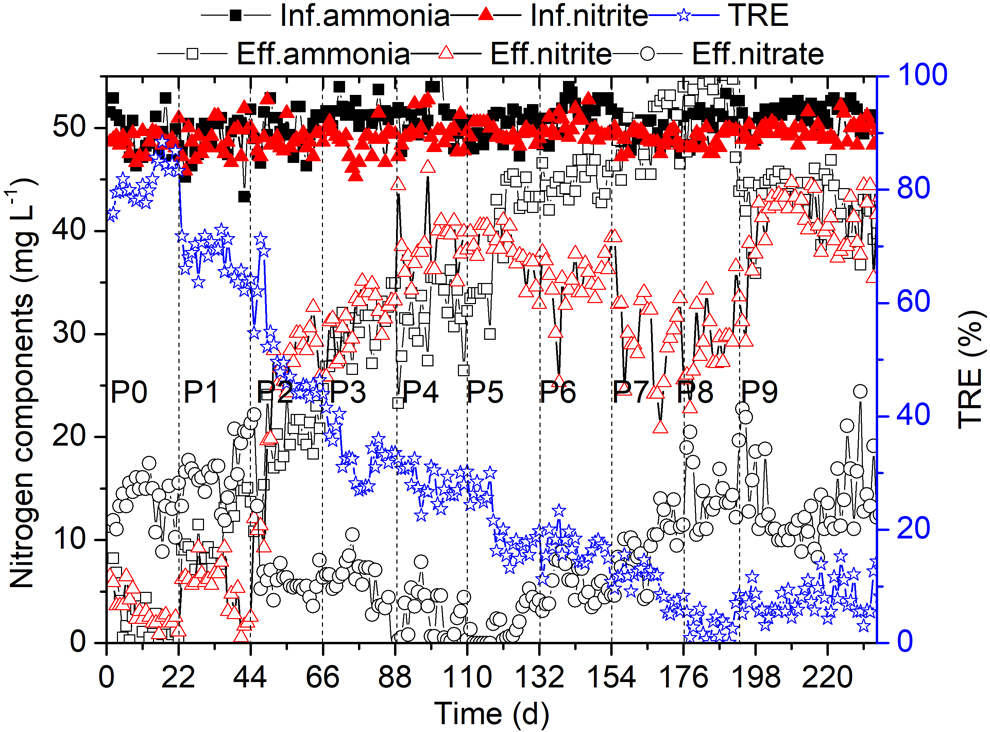
The nitrogen removal performance during each phase is shown in Fig. 2, whereby OTC was increased stepwise in each phase. In phase zero (P0), the reactor was operated without any addition of OTC; hence, this was used as the control. The TRE increased to ∼85.2% by the end of P0, which indicates that the anammox process was very stable in the upflow low-matrix anammox biofilter. In P1, 1 mg/L of OTC was directly added into the influent. The TRE subsequently decreased slightly after several days to ∼69.4%, whereas the NH4+-N and NO2−-N concentrations in the effluent increased to 9.3 and 6.0 mg/L, respectively. It can be speculated that the 1 mg/L addition of OTC had an inhibitory effect on AAOB, such that NH4+-N and NO2−-N in the effluent could not be consumed in that period of time. By comparison, the NO3−-N concentration in the effluent increased to 16.4 mg/L, which led to a further decrease in the TRE to 65.3%. These results indicated that 1 mg/L of OTC had an inhibitory effect on anammox, but that the AAOB activity did not entirely disappear.
Reactor performance in each phase with different OTC addition. OTC, oxytetracycline.
The OTC concentration was further increased to 10 mg/L in P2, and the NH4+-N and NO2−-N concentrations in the effluent reached 22.8 and 26.9 mg/L, respectively. Meanwhile, the NO3−-N concentration in the effluent decreased to 6.6 mg/L. This infers that the activity of microorganisms was significantly inhibited, especially that of AAOB, which led to a reduction in the NRR to 0.271 kg/(m3·day). In P3, the OTC concentration was increased to 20 mg/L, and the TRE decreased further to 31.4%. This unsatisfactory result indicated that 20 mg/L of OTC had a more serious inhibition effect on AAOB. Similarly, in P4, the OTC concentration was increased to 30 mg/L and the activity of AAOB was further inhibited, such that the NH4+-N and NO2−-N concentrations in the effluent increased to 34.1 and 38.5 mg/L, respectively.
The OTC concentration was increased to 40 mg/L in P5 and the NO3−-N concentration in the effluent decreased to 0 mg/L at the beginning of this phase. The chemical oxygen demand (COD) in the effluent was also 0 mg/L; hence, OTC was consumed as the COD by microorganisms. This may have been due to the increased number of denitrifying bacteria, as evidenced by the microbial component results (Microbial Components in Each Phase section). After operating for several days, the TRE decreased significantly and finally reached 17.2%, whereas the NH4+-N concentration in the effluent increased from 34.1 to 43.8 mg/L and the NO2−-N concentration remained at 36.1 mg/L. These results suggest that the activity of AAOB was inhibited such that they could not consume NH4+-N or NO2−-N.
In P6, the NH4+-N concentration in the effluent increased to 46.3 mg/L, while the NO2−-N concentration decreased to 36.8 mg/L and the TRE decreased to 13.7%. This indicates that 50 mg/L of OTC completely inhibited the activity of AAOB. As the concentration of OTC increased to 70 and 90 mg/L in P7 and P8, respectively, the NH4+-N concentration in the effluent increased to 51.7 and 54.8 mg/L, which exceeded that of the influent. One possibility for these NH4+-N concentrations in the effluent is that the dead cells broke down and released NH4+-N. Meanwhile, the NO3−-N concentration in the effluent increased to 12.3 and 14.7 mg/L, respectively. This may have been due to the fact nitrite-oxidizing bacteria (NOB) could utilize the NO2−-N that was not consumed by AAOB, thus increasing the activity of NOB.
Finally, in P9, no further OTC was added to the influent. Figure 2 shows that the TRE increased slightly to 15.7% after 44 days. The reactor exhibited a weak ability to recover. The NH4+-N concentration in the effluent decreased to ∼40.3 mg/L and the NO2−-N concentration increased to 40.2 mg/L at the end of P9, thus suggesting that the biological activity of AAOB could not return to the initial levels without special treatment during the four generation cycles after OTC addition ceased.
It could be seen that OTC significantly inhibited the anammox process. An obvious inhibition on AAOB was observed for an addition of OTC in the range of 1 to 40 mg/L. Although the TRE declined over the course of all of the phases, the anammox process was still the main reaction. When the OTC concentration was >40 mg/L, the anammox process was severely suppressed and the TRE decrease was below 20.0%. In P6, the activity of NOB was enhanced by dissolved oxygen in the influent, thus resulting in the oxidation of NO2−-N to NO3−-N, which caused the increase in NO3−-N concentration. The system lost its ability to remove nitrogen and the TRE decreased to 2.80% at an OTC addition of 90 mg/L. Hence, anammox system had no self-recovery capability during the four generation cycles when OTC addition ceased.
EPS variation in each phase
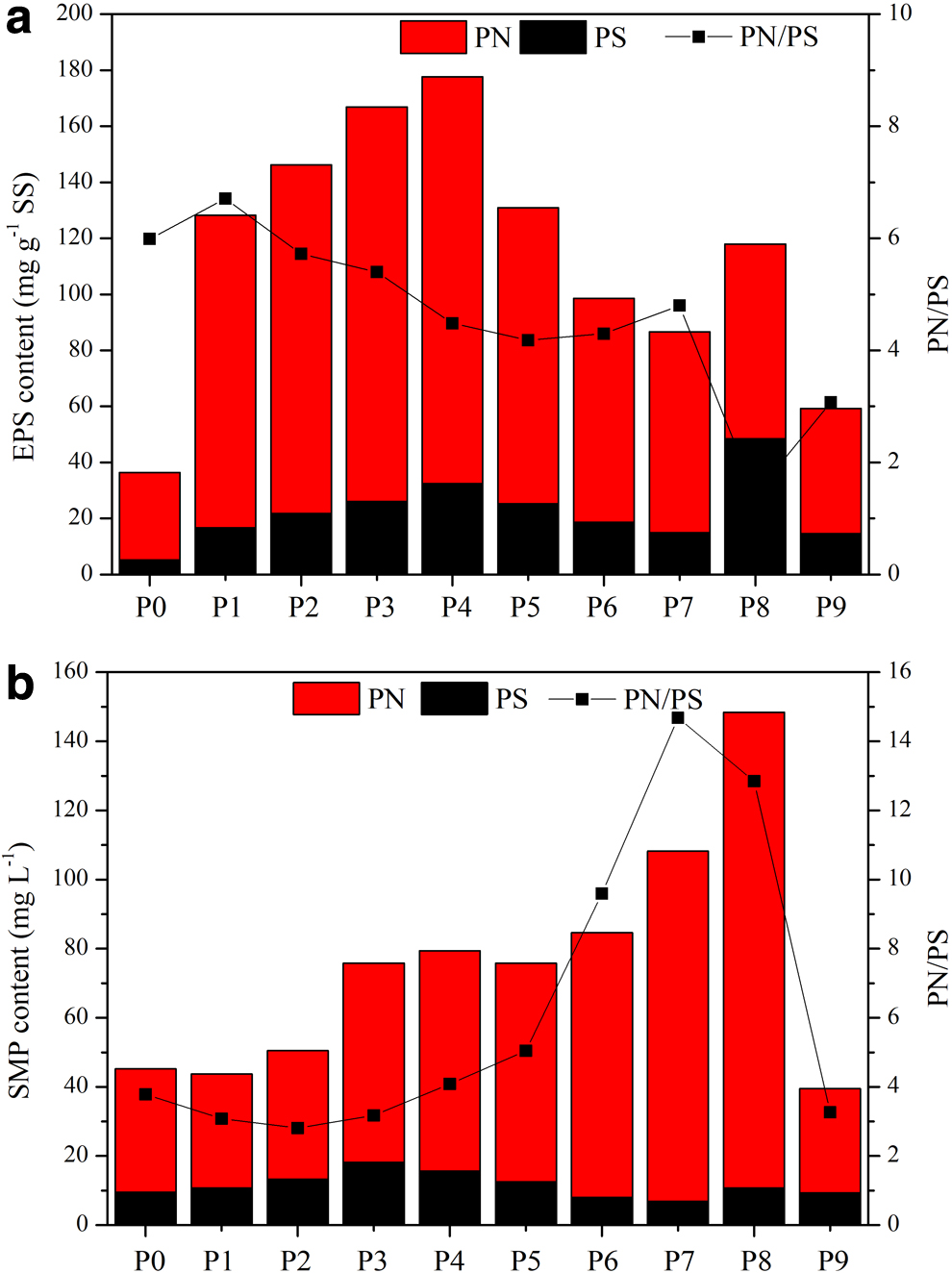
Extracellular polymeric substances are the first barrier helping microbial cells to resist toxic substances that directly contact and interact with other substances in aqueous environments (Lin et al., 2020). Both EPS and SMP include PN and PS. Figure 3 shows that EPS markedly increased from 36.3 to 128.2 mg/g of SS in P1. PN significantly increased with the addition of 1 mg/L OTC, whereas the growth of PS was relatively slow. In response to the addition of OTC, the anammox biofilm produced plenty of PN and PS, which were used by microorganisms to protect themselves from the toxicity of OTC. The main EPS component was PN, which showed a more significant increase than PS, and may have contributed more to resisting the toxicity of OTC (Zhang et al., 2018c). With an increasing OTC concentration, EPS gradually increased to 177.6 mg/g of SS at 40 mg/L of OTC. As a result, microorganisms had to secrete more EPS in response to the toxicity of OTC. However, these EPS were insufficient to prevent anammox bacteria; therefore, the TRE decreased to 30% in P4. When the OTC concentration exceeded 40 mg/L, microorganisms died and EPS decreased. This indicates that AAOB were seriously inhibited in P4, thus leading to a reduction of their activity and a decrease in the TRE to <20%. However, when the OTC concentration was increased to 90 mg/L, EPS increased to 117.8 mg/g of SS and PS increased to 48.4 mg/g of SS, which may have been due to the induction of OTC and the increase in the relative abundance of nitrifying bacteria. Therefore, the TRE decreased to 28% in P8, and the NO2−-N and NO3−-N concentrations in the effluent increased to 35 and 23 mg/L, respectively.
Variations in the amount and composition of
The SMP that are released during matrix degradation and cell lysis were defined in this study as soluble cellular components. The concentration of SMP was 45.2 mg/L before the addition of OTC, and decreased slightly to 43.7 mg/L after the addition of 1 mg/L OTC, which may have been due to the inhibition of microorganisms by OTC. On the contrary, EPS increased. With the subsequent increase in the OTC concentration, the SMP concentration exhibited an increasing trend. With the OTC concentration of <40 mg/L, SMP could have been released due to the stimulation of microorganisms by OTC, such that the activity of AAOB was inhibited. When the OTC concentration exceeded 40 mg/L, EPS were reduced due to the death of microorganisms, which then decomposed into SMP, thus resulting in the increase of SMP to 39.4 mg/L in P9.
The results showed that with increasing addition of OTC, SMP and EPS both increased. However, when the OTC concentration exceeded 40 mg/L, EPS declined, while SMP increased due to the death of some microorganisms. This suggested that although EPS was beneficial to microorganisms in the anammox system, EPS were insufficient to resist the toxicity of OTC. Finally, the death of some microorganisms led to a variation in the microbial community, which subsequently affected the reactor's performance.
Stoichiometric ratios in each phase
The variation of the stoichiometric ratios in each phase is shown in Table 2. The quantitative relationship between the reactants and products in a biochemical reaction can be calculated by the stoichiometric ratio, which is typically a constant value (Ni et al., 2011). The theoretical stoichiometric ratio values of the conversion of NO3−-N to a depletion of NH4+-N (Rp) and the conversion of NO3−-N to a depletion in the TN (Rs) were 0.26 and 0.11, respectively (van de Graaf et al., 1996). In this study, the Rp and Rs values were 0.27 and 0.13, respectively, in P0. With the addition of 1 mg/L of OTC, the Rp and Rs values increased to 0.34 and 0.16, respectively. Nitrification, which leads the conversion of partial nitrite to nitrate, maybe one of the reasons for these deviations of the Rp and Rs values.
The Variation of Stoichiometric Ratios of RP and Rs
However, in P5, Rp and Rs decreased to 0.03 and 0.01, respectively. The TRE decreased to 17.2% due to the inhibition of AAOB, which led to an increase in the NH4+-N and NO2−-N concentrations in the effluent. Meanwhile, the NO3−-N concentration in the effluent decreased; thus, the Rp and Rs values both decreased. The OTC concentration increased to 50 mg/L in P6, and the Rp and Rs values increased to 0.10 and 0.05, respectively. In line with the nitrogen removal performance, the TRE decreased below 20%. The relative abundance of AAOB was so low that the NO2−-N concentration in the influent could not be completely consumed, which led to an increase in the relative abundance of the NOB from 0.03% to 0.86%. Besides, the related genus was indeed detected in this study (Microbial Components in Each Phase section). Hence, the NO3−-N concentration in the effluent increased to 5.2 mg/L, which resulted in an increase in the Rp and Rs values. When OTC was no longer added, the Rp and Rs values tended to recover to their initial levels; however, this did not correspond to a recovery of the anammox activity. The actions of other microorganisms led to the restoration of the Rp and Rs values. Another reason may be that denitrifying bacteria were induced in this process, thus leading to the consumption of the produced nitrate.
The long-term response of the NRR to the different concentrations of OTC is shown in Fig. 4. Equation (4) was obtained by fitting the relationship between the OTC concentration and NRR. The toxicity of OTC to the bacteria was negatively related to the ORC concentration, and the NRR decreased markedly with the increased concentration of OTC (Fig. 4a).
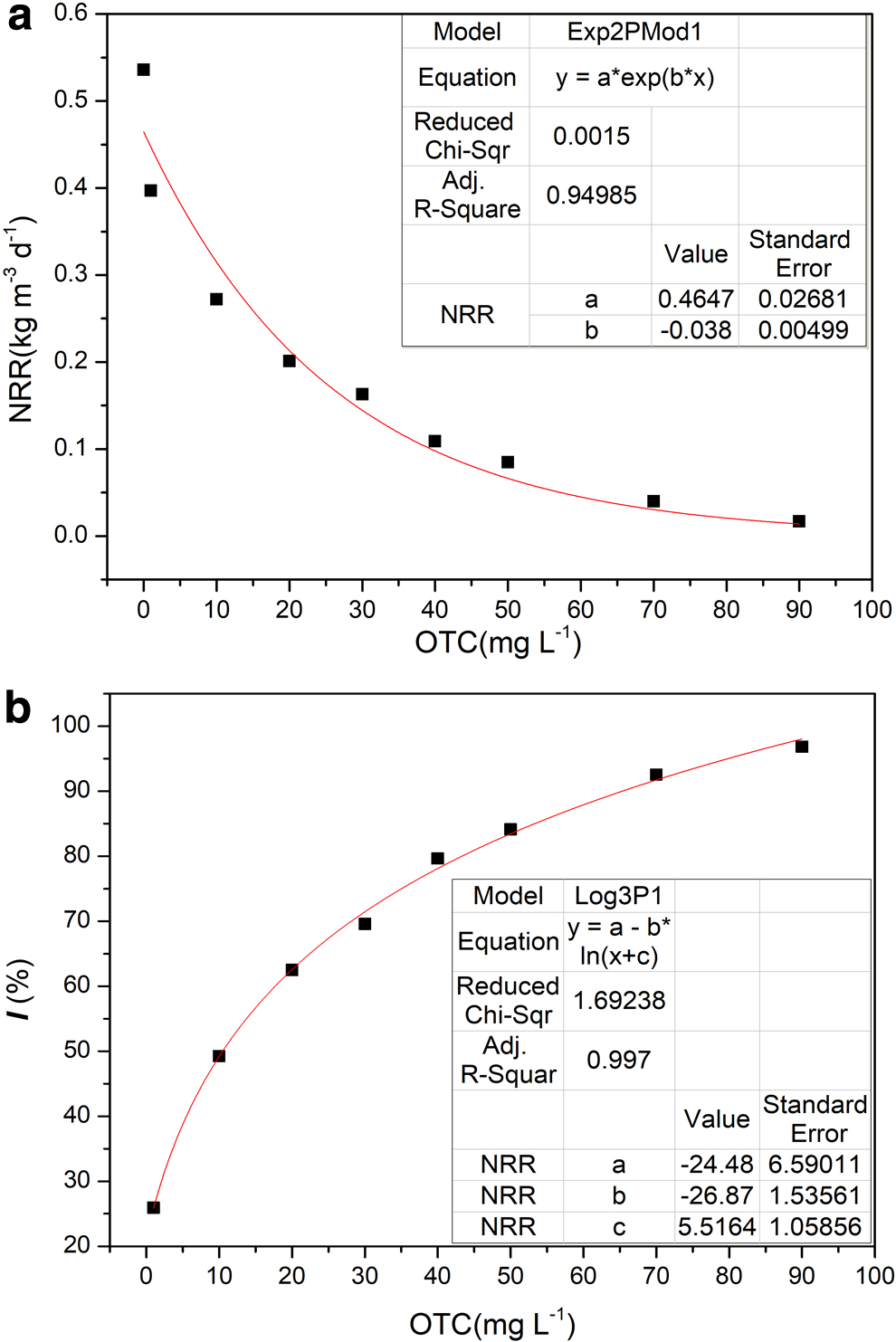
The simulation results of these test data using the modified noncompetitive inhibition model [Eq. (5)] showed that the values of a, b, and c were −24.484, 26.873, and 5.516 (R2 = 0.997). Thus, an IC50 of 10.47 mg/L was obtained. The modified noncompetitive inhibition model with a higher R2 value had a better prediction precision than the first-order model. This implies that the inhibition effect of OTC on anammox was noncompetitive. Hence, the IC50 of OTC toward the NRR was ∼10.47 mg/L.
Microbial components in each phase
Sludge samples were obtained from the experimental reactor at the end of each phase for high-throughput pyrosequencing analysis. The alpha diversity statistic reflects the diversity of microorganisms in the sludge. The alpha diversity values for P0 to P9 are shown in Table 3, whereby 55666, 86566, 70511, 72604, 65644, 57247, 65915, 84987, 87093, and 90942 sequences were detected in the sludge samples at each phase, respectively.
Sequencing Results of the Sludge Sample in Different Phases
ACE, abundance-based coverage estimator; OTU, operational taxonomic unit.
A rareness analysis of the OTUs, which provides a measure of species richness in the sample, also revealed whether the sequencing quantity was sufficient to reflect the majority of the microbial species in the samples (Mysara et al., 2017; Kerrigan et al., 2019). The Shannon index, on the other hand, measures the heterogeneity of the community; the higher the Shannon index, the higher the diversity of the microbial community.
The microbial diversity when subjected to OTC was higher compared with the blank sample. The richness of the bacterial community increased with the addition of OTC, as reflected by the increase in the ACE index. This could have been due to the response of microorganisms to the impact of OTC in the sludge system, which increased the stability of system to resist toxic substances by increasing the richness of the bacterial community; hence, the richness increased with the addition of OTC. However, as microorganisms cannot cope with the shock of OTC by increasing their diversity, the microbial activity declined when OTC was added. All of the indexes were restored to their initial values when OTC addition ceased. The death of the microorganisms in the reactor caused a considerable reduction in the microbial activity, and the activity of anammox could not be recovered once OTC was no longer added.
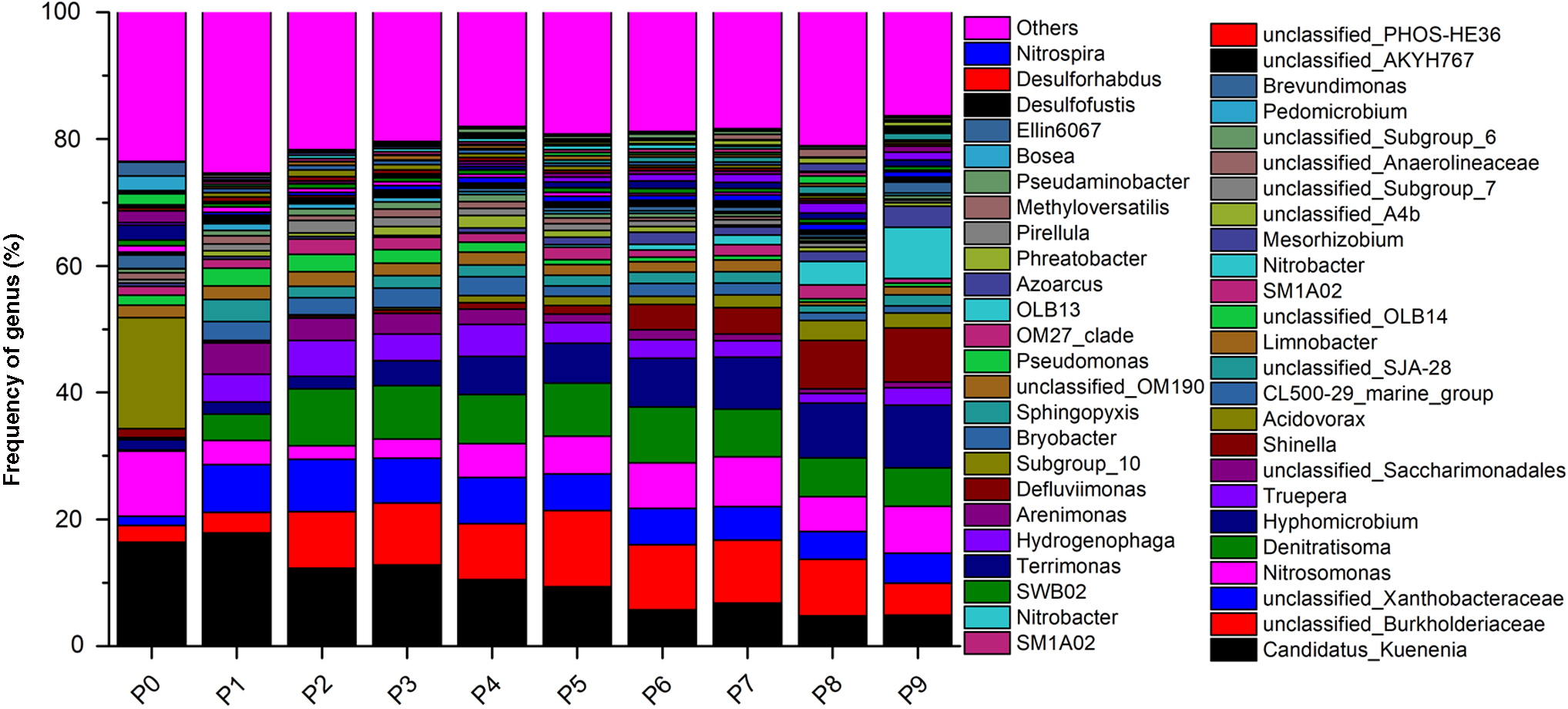
The taxonomic results at the genus level were determined using the Silva database, as shown in Fig. 5. Table 4 summarizes the relative abundance of bacteria related to nitrogen removal, including ammonia-oxidizing bacteria (AOB), AAOB, NOB, and denitrifying bacteria.
The taxonomic results in genus level of each phase.
Relative Abundances of the Nitrogen Removal-Related Microorganisms in Different Phases
Candidatus Kuenenia was the dominant AAOB during the entire experiment. When 1 mg/L of OTC was added to the reactor, the relative abundance of Candidatus Kuenenia increased slightly from 16.40% to 17.82%. The relative abundance of other microorganisms may have reduced due to the toxicity of OTC to the system, which then increased the relative abundance of AAOB. With the increase of OTC concentration from 10 to 90 mg/L, the relative abundance of Candidatus Kuenenia gradually decreased. The AAOB could not tolerate the toxicity of OTC, thus decreasing their relative abundance. As the activity of AAOB was inhibited, the TRE and NRR decreased in this process. Another possible reason is the enhancement of NOB and other bacteria. This indicates that the inhibitory effect of a high OTC concentration on AAOB became stronger. The decreased nitrogen removal was related to the weakening of the AAOB. When OTC was no longer added, the relative abundance of Candidatus Kuenenia did not increase, thus indicating that AAOB could not recover after being stimulated by OTC.
Nitrosomonas was the main AOB during the entire experiment. When Nitrosomonas came into contact with 1 mg/L of OTC, its relative abundance decreased significantly from 10.30% to 3.82%. As the OTC concentration increased, the relative abundance of AOB increased, which suggested that AOB were sensitive to OTC. The increased abundance of AOB may have corresponded to the inhibited activity/decreased relative abundance of AAOB.
For NOB, only Nitrobacter was detected with a comparatively high relative abundance, although this was only 0.03% in P0 and did not increase at an OTC concentration of <40 mg/L. This may have been due to the high relative abundance of AAOB, which resulted in insufficient NH4+-N, NO2−-N, and dissolved oxygen to allow them to multiply. However, when the OTC concentration increased to >40 mg/L, the relative abundance of Nitrobacter increased to above 0.11%, and the AAOB were gradually suppressed by OTC. The NO2−-N in the influent could not be consumed during the process and there may have been dissolved oxygen in the water; thus, NOB multiplied under sufficient nutritional conditions, which also increased the Rp and Rs values.
For denitrifying bacteria, the anammox process was the main reaction in the reactor and the relative abundance of Denitratisoma was only 0.14% in P0. When 40 mg/L of OTC was added to the influent, the relative abundance of denitrifying bacteria increased to 8.33%. Hence, the NO3−-N concentration reduced to 0 mg/L in P5. Denitratisoma was detected at each phase, which indicates that denitrifying bacteria existed during the entire experiment.
Mechanism of the effect of OTC on the anammox process
OTC is one of the broad-spectrum antibiotics of the tetracycline family. Studies have shown that the main mechanism of the effect of OTC on microorganisms involves the interference of OTC with bacterial PN synthesis. Molecules of OTC can bind to the 30S ribosomal subunit, thus preventing the attachment of the transferred tRNA and the subsequent elongation of the amino acid chain (Awad et al., 2015).
According to the experimental results, OTC had a significant inhibitory effect on the anammox process. The activity of AAOB was inhibited and their relative abundance decreased from 16.40% to 9.35% when an OTC concentration of ≤40 mg/L was added to the reactor, thus leading to a decrease in the TRE. During this process, microorganisms secreted more EPS and SMP in response to the shock of OTC addition. Studies have shown that a sludge surface with a large amount of EPS could adsorb toxic substances from the external solution, which alleviated bacterial inhibition (You et al., 2017). However, in this experiment, EPS did not effectively help AAOB to resist the toxicity of OTC.
When the OTC concentration exceeded 40 mg/L, the nitrogen removal performance deteriorated further and the TRE reduced to <20%. Moreover, EPS reduced due to the death of microorganisms, which then decomposed into SMP, thereby increasing the SMP. Meanwhile, the relative abundance of AAOB decreased such that the NO2−-N in the influent could not be consumed. However, NOB could use the NO2−-N, which resulted in a gradual increase in the NO3−-N concentration in the effluent and gradual increase in the relative abundance of NOB. Denitrifying bacteria could have been induced when organic matter was present. When OTC was added to the reactor, denitrifying bacteria were also induced due to the dead cells and SMP. When OTC addition ceased, the relative abundance of AAOB could not be recovered, while NOB and denitrifying bacteria could not be inhibited. Therefore, the inhibitory effect of OTC on the anammox process and the deterioration of its stability were irreversible. With this in mind, further studies should investigate effective recovery strategies.
Conclusions
To understand the impact of OTC on low-matrix anaerobic anammox processes. Once the system was exposed to OTC, the activity of anammox was inhibited and decreased the NRR to 0.395 kg/(m3·day). Although a large amount of EPS and SMP was secreted, these were insufficient to resist the toxicity of OTC, thus leading to the gradual reduction of the TRE to below 30%. The IC50 of OTC toward the NRR was calculated to be approximately10.47 mg/L. When the concentration of OTC exceeded 40 mg/L, some microorganisms died, thereby further decreasing the TRE to below 20%. Subsequently, EPS declined, while SMP increased, and the suppression of OTC on anammox became chronic and irreversible. Anammox could not be recovered during the four generation cycles after OTC addition ceased. This conclusion provides theoretical significance for the effects of OTC on the low-matrix anammox process.
Footnotes
Author Disclosure Statement
No competing financial interests exist.
Funding Information
This work was supported by the National Natural Science Foundation of China (NSFC; grant No. 41701569), the Scientific and Technological Innovative Talents in Colleges and Universities of Henan Province (20HASTIT014), and the project of Young-backbone Teachers in Colleges and Universities of Henan Province (2019GGJS129).