




Abstract
The integrity of cemented wellbores is fundamental to the containment of subsurface greenhouse gases and hydrocarbons, while minimizing migration of deep subsurface brines. These brines contain salts and hazardous chemicals that could contaminate potable water resources. This study integrated flow measurements, X-ray diffraction, microscopy, and solution chemistry to investigate the physicochemical effects of reacting saline brine waters at circumneutral pH with fractured wellbore cement under varying stress conditions. Chemical reactions of saline brines with cement fracture surfaces can alter the permeability and porosity of the fracture and consequently impact the potential for leakage through the wellbore. Flow measurements on fractured wellbore cement specimens were made with nitrogen, de-ionized water, and finally brine for a range of hydrostatic confining stresses under controlled laboratory conditions. Hydraulic apertures obtained from nitrogen flow measurements decreased in response to the initial increase in confining stress applied to the fracture owing to crushing of asperities. During flow of saline brine, the hydraulic aperture progressively decreased fourfold compared with its unreacted condition. Precipitation of calcite along the flow path likely decreased the hydraulic aperture, limiting the fluid transport through the damaged wellbore system. Our results indicate that saline brine supersaturated with respect to CaCO3(s) promotes precipitation at the wellbore surface showing an initial rapid drop in the fracture aperture followed by a more gradual reduction in the aperture with increasing pore volume. This result suggests injection of brine may reduce leakages of hydrocarbon fluids into the environment.
Introduction
Cement fractures of wellbores used for oil and gas industry operations pose a risk to the environment and health because of their potential to leak hydrocarbons or brines into freshwater aquifers (Zhang and Bachu, 2011; Phillips et al., 2016) and the atmosphere (Phillips et al., 2016; Garcia-Rios and Gouze, 2018). Leakage also provides a pathway to release greenhouse gases into the environment including carbon dioxide (CO2) and methane (Kang et al., 2014; Townsend-Small et al., 2016; Schout et al., 2019).
Fractures can be difficult and expensive to repair and affect the functionality of the wellbore (Heathman and East Jr, 1992; Carey et al., 2010). Information is still limited regarding the environmental conditions that affect wellbore cement fractures (i.e., stress, fluid flow, and chemical constituents in both solid and fluids). A better understanding of physicochemical changes in fractured wellbore cement will provide useful information to predict the impact of these fractures.
Fractures in wellbore cements are typically mechanically induced and caused by poor cementing, shrinkage, expansion/contraction, and thermal gradients. Pressure and temperature of fluid inside casing imposing stresses (Wiprut and Zoback, 2000), deformation of adjacent formations (Wiprut and Zoback, 2000; Sobolik and Ehgartner, 2006), or expansion/compaction of underlying reservoirs can change the stress conditions on wellbore cements. Injection of CO2 following a cyclic pattern can also enlarge the aperture of the fracture (De Andrade et al., 2014).
Interfacial chemical reactions between water and cement can affect the permeability, tortuosity, and porosity of cement. The dissolution/precipitation of portlandite, swelling of calcium silica hydrate solids (C–S–H), hydration of nonreacted cement, and adsorption of water (Loosveldt et al., 2002) can decrease cement permeability. Dissolution/precipitation can clog pores and decrease porosity limiting the penetration of fluid through the pores (Brunet et al., 2013). Leaching of calcium from portlandite can increase hydraulic diffusivity (Marchand et al., 2001). Duguid and Scherer (2010) found that calcium-saturated brine did not degrade nor decrease the mechanical properties of cement suggesting that water saturated with calcium prevents the dissolution of portlandite and decalcification of calcium silica hydrate solids (C–S–H). Studies evaluating ammonium nitrate as a surrogate for de-ionized water found that nitrate accelerated the leaching of Ca, increased cement porosity, and decreased its compressive strength (Carde and Francois, 1999; Agostini et al., 2007; Yurtdas et al., 2011a).
A better understanding of coupled physicochemical mechanisms related to the alteration of flow-through cement fractures is necessary to quantify risks associated with wellbores (Carroll et al., 2016). Most studies have focused on the physicochemical effects of acidic brines on fractured cement. Acidic brines, such as those associated with CO2 sequestration applications, induce reaction zones in cement that alter its mechanical properties (Kutchko et al., 2007; Huerta et al., 2012; Walsh et al., 2014). Acidic brines can cause plastic deformation of asperities, deterioration of mechanical properties of cement (e.g., elastic moduli and hardness) (Huerta et al., 2011; Spokas et al., 2018), and increase the dissolution rates of portlandite (Baur et al., 2004; Marty et al., 2009), which increase the porosity of cement (Kutchko et al., 2007; Huerta et al., 2011; Mason et al., 2013).
Acidity erodes carbonate fracture surfaces and the effect of the acid on the surface depends on the reaction kinetics and flow (Deng and Peters, 2019). Dissolution of the calcium- and carbonate-bearing solids can produce an amorphous-silicate region adjacent to the brine that might increase or decrease fracture permeability (Carey and Lichtner, 2009; Walsh et al., 2014). For instance, mineral precipitation along the fracture at high pH or acidic brine can induce self-sealing (Huerta et al., 2011, 2012; Plattenberger et al., 2020). The amount of precipitation can increase depending on the speed of the flow that goes through the fracture (Nguyen et al., 2020). Research has shown that precipitation by carbonation of calcium and magnesium silicates can seal fractures (Tao et al., 2016; Plattenberger et al., 2020).
Although the body of work concerning reactions at acidic pH constitutes an important foundation, the expected reactions are different for systems involving saline brines at circumneutral pH. The physicochemical alterations potentially occurring in cement fractures from saline brines, such as those that may be associated with hydrofracture flowback waters remain poorly understood (Haluszczak et al., 2013; Vengosh et al., 2014; Ju et al., 2018). This study aims to investigate the physical changes and chemical reactivity that fractured wellbore cement undergoes under confining stress and when reacted with de-ionized water or brine. We used flow measurements, X-ray diffraction, microscopy, and solution chemistry to investigate the physicochemical effects of fractured wellbore cement reacted with nitrogen gas and saline brine waters at circumneutral pH under varying stress conditions. The novel aspect of the experimental approach is that it enables the integrated identification of changes in stress and hydraulic properties caused by mineral dissolution and precipitation in fractured cement. We hypothesize that the reaction of cement with brine will result in dissolution of portlandite and concurrent calcite precipitation causing a decrease in the fracture aperture. The results from this study are relevant to resource extraction applications in which gas and brine fluids interact with cement and can influence wellbore integrity.
Experimental Methods
Sample preparation
A cylindrical wellbore cement sample with a through-going fracture along its axis was prepared for this study. This sample was subjected to a sequence of flow tests using nitrogen gas, de-ionized water, and brine; this sample will be referred to as the flow test sample. The nitrogen test was considered a nonreactive fluid, and thus served to establish a baseline for flow measurements for the other fluids. The experiments with de-ionized water were conducted as a chemical control to evaluate the baseline concentration of readily releasable calcium from cement into solution. A fracture creating two halves that were nearly equal in size was developed through tensile-splitting in a Brazilian test configuration. A 0.6 mm thick perforated carbon steel sheet was placed on opposing and opposite ends of the cement core halves to offset the fracture surface, so that the fracture did not perfectly mate when subjected to confinement (Fig. 1).
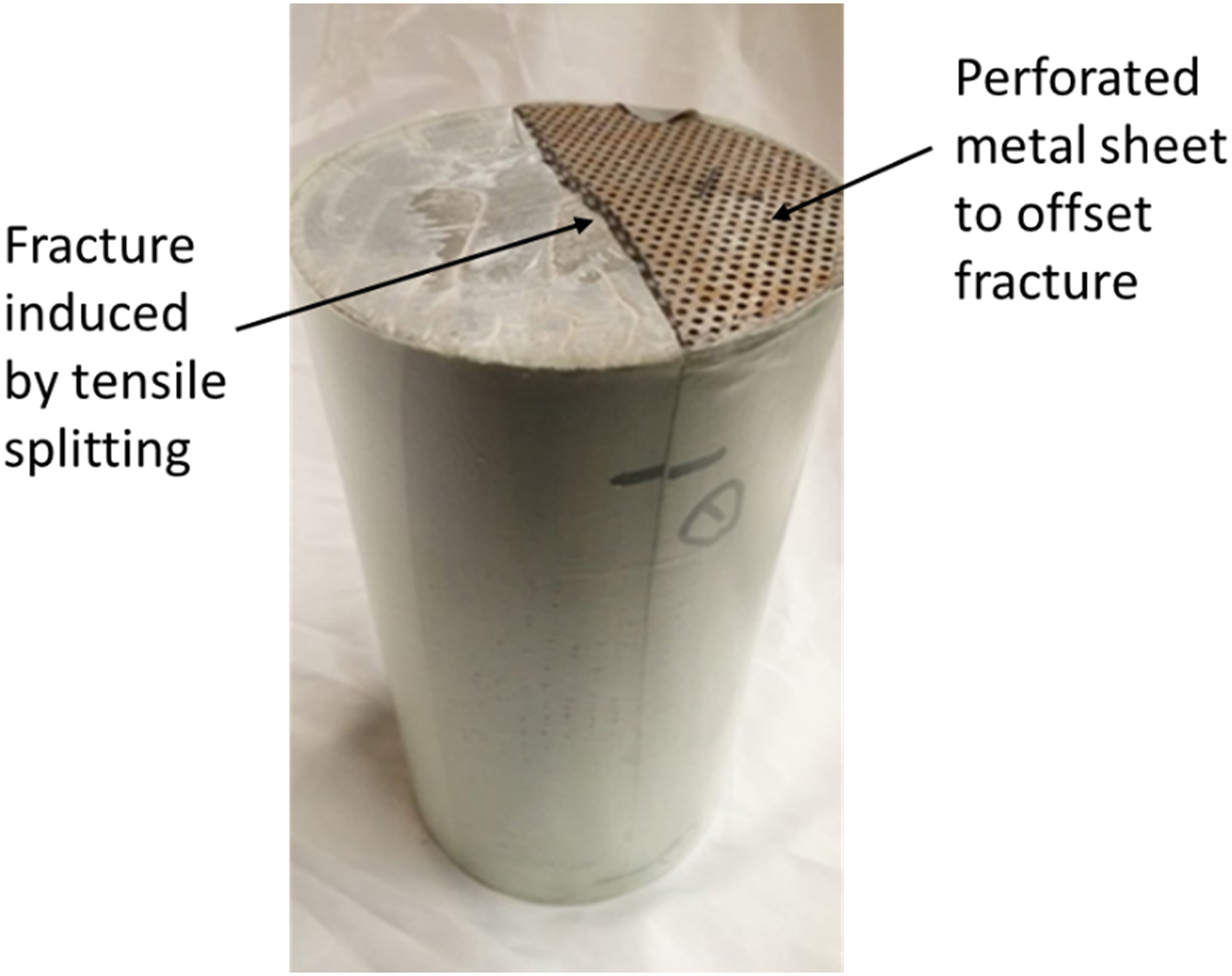
Fractured cement core (102 mm diameter, 180 mm length) with perforated steel sheet attached to offset the fracture. A similar steel sheet is placed on the bottom of the sample on the opposing side of the fracture.
The carbon steel sheet allowed for reaction with fluid that was injected through the fracture. This sequential flow test was conducted under a range of confining pressures and the effluent was collected for subsequent chemical composition analysis. After the flow test, the hardness and chemical composition of the fracture surface were measured on this cement sample. Another cement sample was prepared in a similar manner for a long-term flow test only with de-ionized water under the same conditions used for the flow test sample.
All cylindrical samples were cast using a ratio of 1,000 g Type I cement, 330 g water, 100 g silica fume, and a 7 g plasticizer, and were cured in a humid environment at 50°C for a minimum of 21 days in accordance with ASTM-International (2014). The cured cylindrical samples had a diameter of 102 mm and a length of 180 mm.
Flow measurements
The flow tests were conducted in a pressure vessel that permitted a hydrostatic confining pressure to be applied to the samples (Fig. 2). Gas flow tests used ultrapure N2. The upstream gas pressure was controlled with a regulator and measured with a digital pressure gauge. The downstream outlet pressure was atmospheric. Volumetric gas flow was measured using rotameters of different ranges (with ±2% accuracy of total flow range) connected to the downstream side of the specimen.

Experimental set-up for flow test.
Liquid flow tests were conducted using a piston pump that supplied water and brine to the upstream side of the sample at flow rates ranging from 0.01 to 10 mL/min. The upstream pressure was measured with a digital pressure gauge. The downstream side was directed to a collection reservoir at atmospheric pressure. The de-ionized water (18 MΩ) used in flow tests was obtained from an ultrapure water dispenser with an initial pH of 5.6. The brine used in flow tests contained (per 1 L of water): 36.75 g of calcium chloride (CaCl2), 117.29 g of sodium chloride (NaCl), and 0.09 g of sodium bicarbonate (NaHCO3) with an initial pH of 8.3. Our brine was prepared based on the concentration range for Ca, Na, Cl, and
The flow rate through the sample was always more than an order of magnitude greater than that attributable to unreacted cement; consequently, all the flow was assumed to occur through the fracture. The flow data were interpreted as hydraulic aperture (b) of the cement fracture (Witherspoon et al., 1980):
where μ is fluid viscosity, Q is the volumetric flow rate through the fracture, w is the width of fracture, and
Test conditions
The sequence of flow tests including the test fluids and confining stress conditions are given in Table 1. The confining stress was removed and re-applied between flow tests with different fluids. During the flow tests under constant confining stress with de-ionized water and brine (test sequences 3 and 5, respectively), effluent was collected for subsequent chemical analyses. These tests were run for more than 10,000 pore volumes, where a pore volume was taken as the volume of the fracture calculated from the average hydraulic aperture and the sample dimensions.
Flow Test Sequence and Conditions
A second cement sample was only subjected to a long-term flow test with de-ionized water under the same conditions used for the flow test sample described above. This sample was independently analyzed to evaluate the effect of de-ionized water only on the physicochemical response of cement.
Hardness measurements of reacted and unreacted fracture surfaces
The hardness values of cement along fracture surfaces were evaluated using micro-hardness values with a Vickers 402 MVD imposing a 300 g force. Fractured surfaces from three different cement cores were evaluated: the flow test sample after conclusion of the flow test sequence given in Table 1, a sample that was only exposed to de-ionized water and the control (unreacted) sample. The measured hardness values of these three samples allows the evaluation of mechanical property alterations after fractures were exposed to brine (the flow sample) and de-ionized water compared with unreacted cement.
Chemical analyses of aqueous and solid samples
Aqueous samples were analyzed using a Perkin-Elmer Optima 5300 DV Inductively Coupled Plasma-Optical Emission Spectrometer (ICP-OES) and a Perkin-Elmer Nexion 300D inductively coupled plasma–mass spectrometer (ICP-MS) system were used to analyze calcium concentrations in aqueous samples. Samples of unreacted and reacted cement with de-ionized water and brine were collected to identify morphology, elemental composition, and mineralogy. Fragments of unreacted and reacted cement samples were prepared for solid analyses by chipping the samples from the fracture faces, making sure that the surface in contact with de-ionized water and brine was preserved as carefully as possible.
Analyses with scanning electron microscopy (SEM; FEI Quanta 3d FEG) integrated with energy dispersive X-ray spectroscopy (EDX; Oxford Instruments INCA) were conducted to identify morphology and chemical composition of areas on the surface (top 1 μm) of the analyzed solids. Diffraction analyses were conducted using a Rigaku Smart Lab X-ray diffractometer (XRD) to identify the crystallinity, mineral structure, and normalized approximate percentage of mineral phases present in bulk solid samples, using Cu K-alpha radiation. The XRD data were analyzed using the Jade® software. The estimated standard deviations (esd) indicating the precision for the quantitative analyses to estimate the weight % of the mineral content, as determined by the Jade software, are given in parentheses in Table 2.
X-Ray Diffractometer Analysis Data for Unreacted Cement, De-Ionized Reacted Cement, and Brine Reacted Cements
Quantity in parenthesis is esd.
esd, estimated standard deviation.
Chemical speciation modeling was performed using MINEQL +4.6 with ionic strength correction based on specific interaction theory (Schecher and McAvoy, 2007; VanBriesen et al., 2010) and FLOTRAN with ionic strength correction using the Pitzer model (Lichtner and Felmy, 2003). These simulations were useful to determine chemical speciation and saturation indices (SIs) for solids that could precipitate under the experimental conditions investigated.
Results and Discussion
Hydraulic response
Hydraulic apertures changed as a function of the fluid (gas or liquid) contacting the wellbore and the confining stress. The hydraulic aperture decreased from 59 to 38.8 μm with confining stress ranging from 5.5 to 16.5 MPa during the first N2 gas cycle and returned to 39 μm when the confining stress was unloaded to 5.5 MPa (Fig. 3a). During the second cycle of gas flow measurements, the hydraulic aperture varied from 40 to 31 μm with confining stress ranging from 4.1 to 16.5 MPa. The hydraulic aperture returned almost to its initial size (38.5 μm) when the pressure was unloaded. The results of the second cycle showed, therefore, a smaller change in aperture from increase in stress compared with the initial loading and a more elastic response during unloading. The nonrecoverable change in the hydraulic aperture after the initial loading cycle has been widely observed in rock fractures (Bandis et al., 1983; Zhang and Nemcik, 2013; Chen et al., 2015; Zhou et al., 2015) and can be attributed to plastic deformation of asperities of the fracture. Other factors can influence the hydraulic aperture response including flow rate (Elkhoury et al., 2013; Garcia-Rios et al., 2015) or fracture geometry (Deng et al., 2018). For instance, increasing the flow rate may shift the effect on the fracture from compact dissolution to fracture channelization to uniform dissolution (Deng et al., 2018).
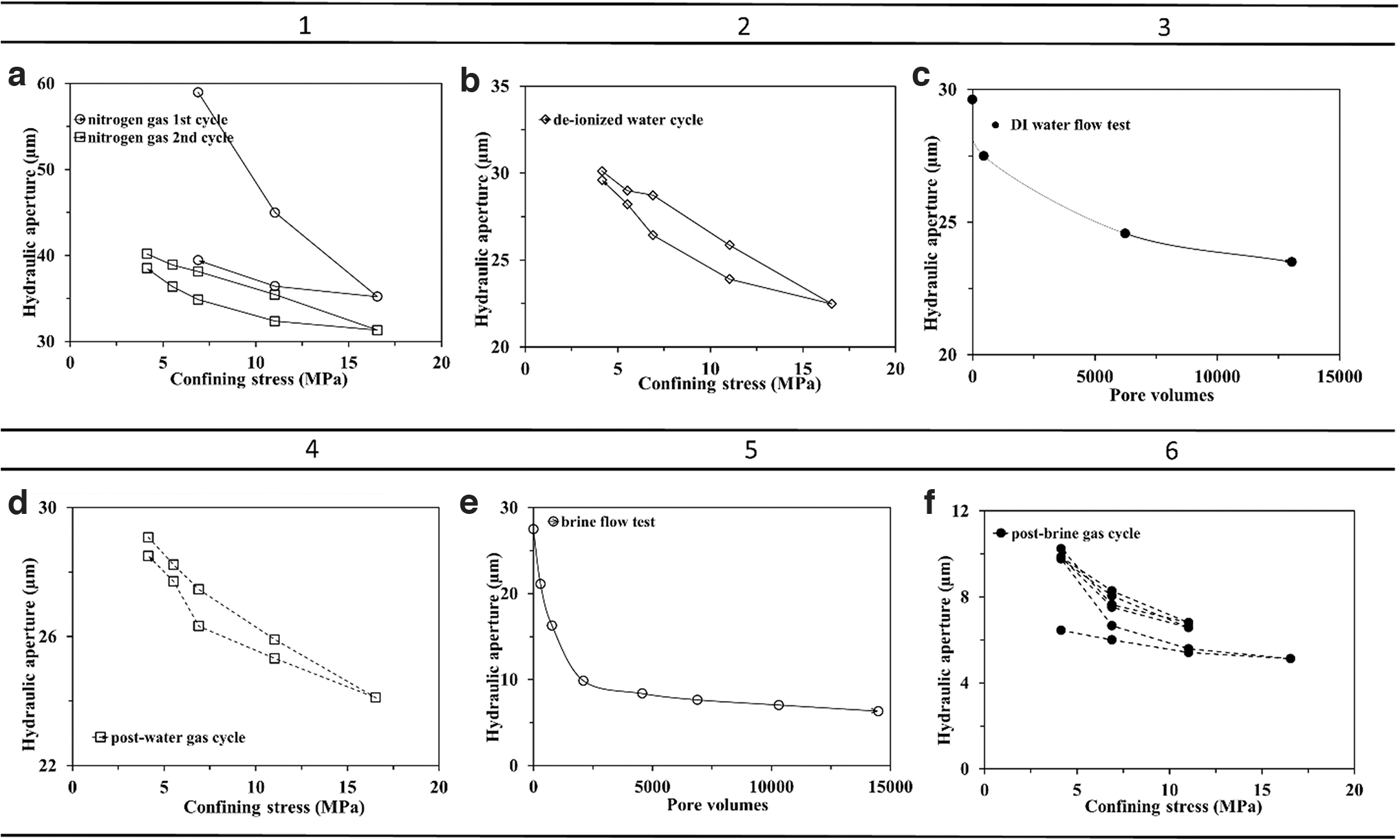
Hydraulic apertures of cement fracture measured during flow tests under range of confining stresses and fluids.
A set of flow tests were then made with de-ionized water to compare with the nitrogen gas flow results (Fig. 3b). Measurements of the hydraulic aperture were made with loading path ranging from 5.5 to 16.5 MPa and unloading path returning to 5.5 MPa. The hydraulic aperture decreased from 30 to 22 μm during loading and returned to 30 μm upon unloading. Next, a flow test with de-ionized water was conducted at a constant confining stress of 11 MPa (Fig. 3c). The hydraulic aperture decreased from 29 to 23 μm after 13,000 pore volumes.
Flow tests with nitrogen gas were conducted under the same loading–unloading sequence (5.5 to 16.5 to 5.5 MPa) (Fig. 3d). The hydraulic apertures changed from 29 to 24 μm during loading and returned to 28 μm after unloading. These hydraulic aperture values are similar to those determined from the flow test only with de-ionized water and confirmed that the reduction in hydraulic aperture observed using de-ionized water was permanent and not an artifact of the test fluid.
The subsequent flow measurements were conducted using brine as the test fluid. The confining stress was constant at 11 MPa. The effect of saline brine on the hydraulic aperture was more evident compared with the de-ionized water flow test. The hydraulic aperture changed from 27.5 to 6 μm after 14,500 pore volumes of brine were injected (Fig. 3e). Huerta et al. (2011) found similar results in hydraulic apertures in response to brine flow. The postbrine nitrogen gas test confirmed the hydraulic aperture decreased owing to reactivity with brine (Fig. 3f).
Surface hardness comparison for unreacted, de-ionized-reacted, and brine-reacted fractured cement
Hardness was measured on the flow test sample exposed sequentially to nitrogen, de-ionized water, and brine. In addition, hardness measurements were made on the sample that was only exposed to de-ionized water and on the unreacted sample (control). Overall, the reacted samples showed lower Vickers hardness values compared with the unreacted sample (Fig. 4). The mean hardness value of the unreacted sample was 241 MPa compared with ∼60 MPa measured in the samples exposed to brine and de-ionized water. All hardness values from reacted samples were less than the minimum value from the unreacted sample. Hardness values of unreacted samples were consistent with values reported by others for cement paste (Igarashi et al., 1996). Hardness values have been linearly correlated to strength and inversely correlated to porosity (Beaudoin and Feldman, 1975), suggesting that the fracture surfaces that were exposed to brine and de-ionized water had a lower strength and greater porosity than the unreacted cement.

Hardness values from fractured cement surfaces of unreacted (control) sample, brine-reacted (flow test) sample, and de-ionized water-reacted sample.
There was no discernable difference between the hardness values of samples reacted with de-ionized water and the flow test sample (reacted sequentially with nitrogen, de-ionized water, and brine). However, the differences in chemical composition indicated by our solid analyses data for experiments reacted with de-ionized water and brine suggest that dissolution and surface precipitation reaction mechanisms that decreased the hardness under these experimental conditions are different. The salts contained in the synthetic brine, particularly NaHCO3, may have reacted with the wellbore surface. Bicarbonate is well known for solubilizing, complexing, and precipitating a wide range of metals and salts (Benjamin, 2014).
The solid phases identified by XRD analyses such as portlandite [Ca(OH)2], haturite (Ca3SiO6), calcite [CaCO3], monticellite [CaMgSiO4], have different quantities in the unreacted cement, de-ionized reacted cement, and brine reacted cement (shown hereunder in the XRD analyses; Table 2). Lower hardness values and the corresponding decrease in strength and increase in porosity have been attributed to leaching of Ca from cement (Schwotzer et al., 2010; Hou et al., 2014). De-ionized water, on the contrary, is free of salts (undersaturated) and causes the dissolution of a readily releasable fraction of calcium in the wellbore cement into the liquid phase.
Flow of de-ionized water and brine through fractured cement caused a decrease in hardness and hydraulic aperture. To better understand the interaction between mechanical and chemical processes, further aqueous chemical analyses were performed on water samples collected from experiments reacting fractured cement with de-ionized water and brine.
Chemical Reactivity Experiments on Fractured Cement
Calcium release in liquid flow experiments
During the flow tests given in Fig. 3c and e, we measured the concentration of Ca in the effluent. Figure 5 shows the effluent Ca concentrations and flow tests as a function of pore volume with de-ionized water. The concentration of Ca stabilized at ∼9,000 mg/L (224.55 mM) after the injection of 1,900 pore volumes (Fig. 5a), whereas it reached ∼150 mg/L (3.74 mM) after ∼500 pore volumes of de-ionized water passed through and decreased to ∼75 mg/L (1.87 mM) (Fig. 5b). The hydraulic aperture decreased from 27.5 to 6.3 μm (4.3 × ) in the sample exposed to brine compared with 29.6–23.5 (1.26 × ) in the sample exposed to de-ionized water.

Calcium (Ca) concentration of the effluent from the flow test after reaction of cement with brine
Chemical speciation calculations using MINEQL and FLOTRAN indicated that the experimental solution used in this study is supersaturated with respect to CaCO3 solids calcite and aragonite (Table 3). These simulations also indicated that the solution was undersaturated with respect to Ca(OH)2 solids portlandite and lime. Note that the SIs obtained using parameters of the specific interaction model with MINEQL and Pitzer model with FLOTRAN were similar and consistent. Slight differences in equilibrium constants used in the calculations partially account for the differences in SIs.
Solid Saturation Indices Obtained from Chemical Equilibrium Simulations Using MINEQL and FLOTRAN Based on the Brine Composition Used for This Study
Note that the information provided corresponds to the following reactions:
Ca2+ − 2H+ + 2H2O = Ca(OH)2(s).
K is the chemical equilibrium constant used for the simulations with MINEQL and FLOTRAN.
SIs, saturation indices.
Our results indicate that the supersaturation of CaCO3(s) in the brine caused closure of the fractures in the cement and the reduction in hydraulic aperture. The major source of Ca comes from the brine given that the soluble Ca concentration is ∼9,000 mg/L (224.55 mM) during the flow test, compared with only ∼150 mg/L (3.74 mM) of Ca released in the flow test when reacted with de-ionized water. The de-ionized water reaction (pH 5.66) with cement serves as a baseline of readily releasable Ca caused by portlandite dissolution. Such results suggest that supersaturated brines with respect to CaCO3(s) may decrease fluid leakage into the environment by sealing cement fractures.
In field conditions, actual brines are complex solutions, that is, contain high concentrations of total dissolved solids and are rich in salts and organic matter (Lauer et al., 2016). Brines rich in salts and CO2 could promote CaCO3 precipitation replacing portlandite and reducing fluid leakage as the fracture aperture decreases. However, intense alterations of the wellbore surface may enable leakage of fluids into the environment and decrease sealing reactions (Garcia-Rios and Gouze, 2018). Additional solid analyses were conducted to characterize morphology, element composition, and mineralogy of unreacted and reacted solids from these experiments.
Characterization of Unreacted and Reacted Solids
SEM/EDX: Morphology and elemental content
Figure 6 shows the analyses of SEM images and EDX spectra (signal corresponding to the top 1 μm depth from the surface) for different regions in unreacted cement samples and in those reacted from the flow tests (reacted sequentially with nitrogen, de-ionized water, and brine) and the sample reacted only with de-ionized water. Differences in morphology and elemental composition were observed for the flow test sample compared with unreacted and reacted only with de-ionized water likely owing to chemical precipitation over the course of the experiments. Data from SEM and EDX analyses for unreacted cement samples indicate that Ca was predominant (Fig. 6a, b). Small crystals were observed in the SEM images for areas with hardness values >250 MPa in samples reacted with de-ionized water; Ca and Si were predominant elements as indicated in the EDX spectra (Fig. 6c, d).
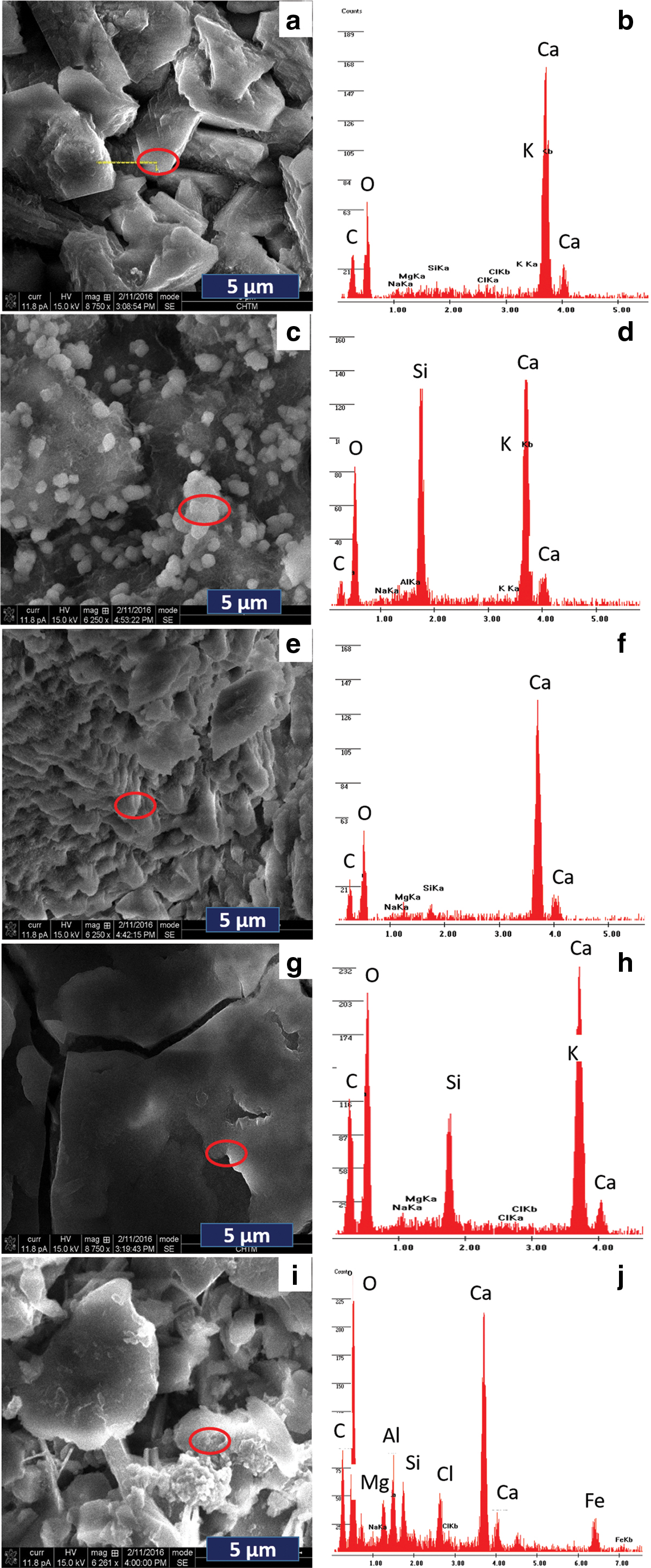
SEM Image and EDX Spectra.
In contrast, the morphology of areas with hardness values lower than 100 MPa resembles that of unreacted cement, but with layers of smaller sized crystals containing Ca and limited Si (Fig. 6e, f). Fractured cement from the flow test sample (reacted sequentially with nitrogen, de-ionized water, and brine) with hardness values >250 MPa showed precipitates with Ca as the predominant element and lower concentrations of Mg and Si (Fig. 6g, h). Fractured cement from the flow test sample with hardness values <100 MPa also showed Ca as the predominant element and lower concentrations of Mg, Al, Si, Fe, and Na (Fig. 6i, j). Additional XRD analyses were conducted to identify the bulk mineralogical composition of these solids.
X-ray diffraction: Mineralogical analyses
The XRD data for unreacted fractured cement and reacted with de-ionized water and brine are summarized in Table 2. The main minerals identified in the bulk of unreacted and reacted samples with de-ionized water and brine are portlandite [Ca(OH)2], haturite (Ca3SiO6), calcite [CaCO3], monticellite [CaMgSiO4], CaAl4Si2O11, periclase [MgO], and brownmillerite [Ca2FeAlO5]. A component for amorphous phases was also included in the quantitative analyses and detected in all samples.
Unreacted and reacted fractured cement samples with de-ionized water (pH 5.6) showed a similar mineralogy. However, certain differences were observed with a higher content of calcite in samples reacted with de-ionized water (14.3%) with hardness <100 MPa, compared with that observed in unreacted samples (10.9%) and in those reacted with de-ionized water with hardness >250 MPa (10.7%). In addition, a 4.6% weight portlandite was observed in samples reacted with de-ionized water at hardness <100 MPa compared with 9.7–10.4% weight portlandite in unreacted and reacted samples with de-ionized water at hardness >250 MPa. This slight decrease in portlandite content in the reacted sample at lower hardness is owing to mineral dissolution, which is related to the increase of Ca in solution (as high as 140 mg/L) (Fig. 5b).
The fractured cement sample from the flow test (reacted sequentially with nitrogen, de-ionized water, and brine) showed the most noticeable changes in mineralogical content. Fractured cement samples from the flow test contained from 2.2 to 2.5 times more calcite than unreacted samples and 1.71–2.6 times more calcite than samples reacted only with de-ionized water (Table 2). Higher contents of calcite detected by XRD and precipitates with high Ca signals observed in SEM/EDX suggests that chemical precipitation occurred in the surface of the fractured cement sample from the flow test. Calcite precipitation likely caused the fourfold decrease in hydraulic aperture in the fractured cement sample from the flow test.
The supersaturation of the brine solution with respect to CaCO3(s) and undersaturation with respect to portlandite appears to have led to the reduction of the hydraulic aperture and fracture permeability. The dissolution and precipitation of portlandite, swelling of calcium silica hydrate (C–S–H), hydration of nonreacted cement, and adsorption of water can decrease cement permeability (Loosveldt et al., 2002; Yurtdas et al., 2011b; Tao et al., 2016). Walsh et al. (2014) determined that properties such as strength, hardness, and elastic moduli changed in agreement to alterations in cement composition. Dissolution and precipitation can clog pores and decrease porosity limiting the penetration of fluid through the pores (Brunet et al., 2013; Iyer et al., 2017; Nguyen et al., 2020; Plattenberger et al., 2020). Leaching of calcium from portlandite can increase porosity and hydraulic diffusivity (Marchand et al., 2001; Phung et al., 2016). Duguid and Scherer (2010) found that calcium-saturated brine did not degrade or decrease the mechanical properties of cement suggesting that water saturated with calcium prevents the dissolution of portlandite and decalcification of calcium silica hydrate (C–S–H). Precipitates that consist of amorphous solid phases not detectable by XRD may also be affecting the physical properties of the fractured cement surface. Future research is necessary to better understand the effect of precipitation and dissolution reactions on the physical properties of fractured cement.
Conclusions
Our findings indicate that hydraulic aperture decreased the most in fractured cement samples from the flow test (reacted sequentially with nitrogen, de-ionized water, and brine) because of the precipitation of CaCO3 (e.g., calcite and aragonite) solids. An effluent concentration of ∼9,000 mg/L (224.55 mM) of Ca was measured during the flow test when reacted with brine, compared with only ∼150 mg/L (3.74 mM) of Ca released in the flow test when reacted with de-ionized water. This result indicates that the readily released Ca from the reaction of cement with de-ionized water is at least two orders of magnitude lower than the Ca concentration present in the supersaturated brine with respect to CaCO3(s) and that released from dissolution of portlandite, which is not possible to distinguish in this experiment.
Although brine and de-ionized water similarly affected the cement hardness (average values ∼60 MPa), spectroscopy (SEM/EDX) and XRD solid analyses confirmed the increase in calcite precipitation after reaction of cement with brine. Our data suggest that brine can promote CaCO3(s) precipitation that causes sealing in cement fractures. Sealing can potentially decrease leakages and the undesired impact of hydrocarbon contaminants on aquifers and atmosphere. Future research should investigate the effect of hardness on hydraulic aperture and chemical composition under conditions that are relevant for resource extraction applications such as hydraulic fracturing. This knowledge will help understand the effect of complex chemical reactions in waters with elevated ionic strength that could affect flow transport from fractured cement into the environment. This has relevant implications for oil and gas extraction.
Footnotes
Disclaimer
Any opinion, findings, and conclusions or recommendations expressed in this material are those of the authors(s) and do not necessarily reflect the views of the National Science Foundation.
Author Disclosure Statement
No competing financial interests exist.
Funding Information
This work was supported by the National Science Foundation through the University of New Mexico Center for Water and the Environment (CREST Grant Nos. 1345169 and 1914490).