




Abstract
This study evaluated the use of Fe(II)-modified layered double hydroxides-graphene oxide [LDHs-GO@Fe(II)] for Cu(II) adsorption. The Fe(II)-modified LDH-GO composites [LDH-GO@Fe(II)x] was synthesized by contacting the powdered LDH-GO with Fe(II)-containing solution. The effect of Fe(II) modification on the surface morphology and adsorption behavior, as well as the Cu(II) adsorption mechanism were investigated. With the modification, noncrystalline iron oxides clusters generated on the surface of the LDH/GO, with a slight decrease of the structure of LDH-GO. Cu(II) removal capacity was enhanced after Fe(II) modification. The kinetics data correlated well with the pseudo-first-order rate law. The adsorption equilibrium data were analyzed by both Freundlich and Langmuir isotherm models and the data well with the Langmuir isotherm model. The maximum Cu(II) adsorption capacity of the unmodified LDH-GO, LDH-GO@Fe(II)10, and LDH-GO@Fe(II)50 were 148.47, 166.16, and 174.87 mg/g, respectively. The X-ray powder diffraction and the X-ray photoelectron spectroscopy analysis manifested the formation of Cu2Cl(OH)3 and isomorphic substitution of Mg(II) for Cu(II) removal by the unmodified LDH-GO. The enhanced removal of Cu(II) by Fe(II)-modified LDH-GO was induced by the enlarged specific surface area and the reaction with Fe ions to form CuFe2O4.
Introduction
Heavy metals are a serious threat to environment because of their toxicity and abuse. Copper (Cu) is an essential micronutrient for plants, animals, and human beings, and is required for growth and development at low levels (Habiba et al., 2015). When beyond certain limits, it is toxic and can cause serious environmental and public health concerns (Tong et al., 2011). Therefore, it is necessary to eliminate toxic heavy metals, such as Cu(II), from wastewaters before discharging into the ecosystem.
Owing to the advantage of convenient to operate, relatively low-cost, and equally effective, adsorption is regarded to be an attractive method to remove heavy metals from aqueous solutions (Uddin, 2017). However, most conventional adsorbents suffer from low adsorption efficiency or low adsorption capacity (Xu et al., 2008; Dahlan et al., 2013). The synthesis and modification of novel materials and their application in adsorption of different environmental pollutants still need to be improved.
Since the past decade, the combination of graphene and layered double hydroxides (LDHs) into composite has brought an explosive interest in many research fields (Dong et al., 2012; Miao et al., 2015). By combining two different materials can make the best use of their features to form a novel composite with hierarchical structure and even form multifunctional composites with unexpected properties (Cao et al., 2016).
Recently, some researchers use LDH-graphene composite as a candidate sorbent for the application in heavy metal ions removal (Fang and Chen, 2014; Zhang et al., 2015). Wen et al. (2013) reported an easy and efficient way to synthesize layered double hydroxides and graphene oxide (LDHs/GO) nanocomposite, and the synthesized LDHs/GO showed a high removal capacity for As(V). Yu et al. (2017) reported the maximum removal capacity of GO-Ni-Al LDH (GO@LDH) nanocomposites was 160 mg/g for U(VI).
It is a permanent goal to enhance adsorption capacity of materials for practical application. Iron (Fe) oxide minerals are commonly found in soil, which has been noted that iron oxides have a high potential for heavy metal ions removal (Swedlund et al., 2009; Ozmen et al., 2010; Cho et al., 2018). Introducing Fe can greatly modify the surface properties of adsorbents by the presence of Fe species in the interlayer or by Fe (hydr)oxide surface coating and induce severe changes in both surface and pore structures, thus alter the adsorption and desorption properties (Luengo et al., 2011; Sun et al., 2012; Gitari et al., 2013).
Previous studies usually used Fe(III) salts to modified adsorbents, which verified that the adsorption behavior of the adsorbents can be improved efficiently by suitable modification methods with Fe species (Bia et al., 2012; Gutierrez-Segura et al., 2012). Luengo et al. (2011) detected an increased arsenate adsorption on a Fe(III)-modified montmorillonite. Unob et al. (2007) also prepared iron oxide-modified waste silica to enhance the removal of heavy metal ions from wastewater. There are rare reports on the modification with Fe(II) salts. Our previous study showed an enhanced removal of Cd(II) by Fe(II) salts modified LDH-GO (Liao et al., 2019a). However, the simultaneous presence of various valence states of Fe species in the modified adsorbent, and the influence on the removal of heavy metals have not yet been unambiguously established.
Herein, Fe(II) salt was used to modify LDH-GO@Fe(II) and the role of Fe(II) in the modification was discussed. The efficiency of LDH-GO@Fe(II) for the uptake of Cu(II) was systematically investigated. Several kinetic models were applied to evaluate the interaction of Cu(II) with LDH-GO@Fe(II) based on the obtained experimental data. The Langmuir and Freundlich models were used to evaluate the experimental data of the adsorption isotherms. The scanning electron microscopy and energy-dispersive X-ray spectroscopy (SEM/EDS), X-ray powder diffraction (XRD) patterns, and X-ray photoelectron spectroscopy (XPS) were tested to probe Cu(II) adsorption mechanism by the LDH-GO@Fe(II). It is expected that the outcomes from this study will help to understand the effect of Fe(II) modification on the surface morphologies and adsorption behaviors on LDH-GO, as well as the Cu(II) adsorption mechanism by the LDH-GO@Fe(II).
Experimental
Materials
The graphite powder was obtained from Sinopharm Chemical Reagent Co. Ltd. Other chemicals were analytical grade and were purchased from Sigma Aldrich (Shanghai) Co. Ltd. without further purification. A stock solution containing 1000 mg/L Cu(II) was prepared using CuCl2·2H2O. A series of Cu(II) solutions with various concentrations were prepared by successive dilution. All test solutions contained 0.01 M NaCl as the background electrolyte.
Fabrication of the adsorbents
GO was prepared by Hummers methods (Hummers and Offeman, 1958). Mg and Al ions were chosen as precursors in the synthesized LDH. The LDH-GO composites were prepared through co-precipitation methods as described in our previous study (Liao et al., 2019b). The detailed processes are presented in the Supporting Information. The Fe(II)-modified LDH-GO composites were synthesized by mixing a certain amount of LDH-GO to Fe(II)-containing (5, 10, 20, and 50 mg/L) solutions. The mixed solutions were reacted for 1 h, and the obtained composites were noted as LDH-GO@Fe(II)x (x = 5, 10, 20, and 50).
Batch adsorption experiments
Cu(II) was selected as representative pollutant to investigate the adsorption properties of LDH-GO@Fe(II). Cu (II) adsorption kinetics experiments were evaluated with 200 mL of 100 mg/L Cu(II) solution and 0.2 g adsorbent in a 250 mL glass conical flask at 298 K with continuous stirring at 500 rpm over a water bath magnetic stirrer. The initial pH of Cu(II) solution was 5. At predetermined time intervals, samples were withdrawn from the flask and immediately filtered by 0.45-μm membrane filters before further analysis. The adsorption isotherms of Cu(II) were carried out by adding 0.2 g adsorbent into 200 mL solution with different copper initial concentrations (from 5 to 300 mg/L). All the experiments were performed with three replicates.
Kinetic studies
The pseudo-first-order, pseudo-second-order, and intraparticle diffusion kinetic models were applied to analyze the data obtained from the Cu(II) adsorption process on the prepared composites. The linear form of the pseudo-first-order (1), the pseudo-second-order (2), and intraparticle diffusion (3) equations are expressed as follows (Abdi et al., 2017; Yao et al., 2017):
where qe and qt (mg/g) are the capacities of Cu(II) adsorbed at equilibrium time and at time t (h), respectively. And k1 (1/h), k2 (g/[mg·h]), and kp (mg/[g·min0.5]) are the rate constants of the pseudo-first-order model, pseudo-second-order model, and intraparticle diffusion, respectively. I is the intercept.
Adsorption isotherm
The Langmuir and Freundlich adsorption isothermal models were applied to probe the interaction mechanism and the maximum adsorption capacity. The Langmuir model is based on monolayer adsorption onto a surface of finite identical adsorption sites. The linear form of the isotherm can be depicted by the following equation (Zhou et al., 2018):
The Freundlich model explains multilayer adsorption on the heterogeneous solid surfaces, which can be described as (Zhou et al., 2018)
where Ce (mg/L) is the equilibrium concentration of Cu(II) in aqueous solutions, and qe (mg/g) is the adsorbed amount of Cu(II) on solid phase, and qm (mg/g) is the maximum adsorbed amount of Cu(II) on per unit weight of solid. Kl (L/mg) is Langmuir constant, which is related to the bonding and affinity of Cu(II) on adsorbents. Kf (mg1–n·Ln/g) is Freundlich constant, which is related to sorption capacity.
Characterization
The concentrations of Mg(II), Al(III), Fe(II), Pb(II), Zn(II), Mn(II), Cd(II), and Cu(II) were measured by inductively coupled plasma-atomic emission spectroscopy (ICP-OES, Varian 720). The SEM and EDS (JSM-7500F, Japan) were used to measure the surface morphology and the compositions of the samples. The Brunauer–Emmett–Teller (BET) nitrogen-specific surface areas of the materials were estimated by N2 adsorption–desorption at 77 K on a surface area and porosity analyzer (ASAP2020). The XRD patterns were measured using a powder diffractometer (PANalytical B.V., Holland). The XPS tests were obtained with an AXIS Ultra DLD (Shimadu, Japan) using monochromatic Al Kα X-ray source.
Results and Discussion
Hierarchical composites composed of various blocks into a well-designed structure have superb removal capacities for pollutants. The hierarchical structure and negatively charged interlayer of LDH-GO can attract heavy metal ions into the inner structure. Our previous study showed that Fe(II) can transfer into inner space of LDH-GO and stretch parallel flakes more loosely, which lead to a porous structure and enlarged specific surface area (Liao et al., 2019a). It is believed to be beneficial to enhance adsorption capacity.
Characterization of LDH-GO@ Fe(II) adsorbent
The SEM micrograph of the pure LDH and GO are shown in Supplementary Fig. S1. The pure LDH was composed of aggregates of inhomogeneous flakes (Liao et al., 2018). GO consisted of randomly aggregated thin highly wrinkled sheets (Lujanienė et al., 2015). The results of EDS spectra and SEM micrograph of the LDH-GO before and after modification by Fe(II) are presented in Fig. 1.

The SEM of
The LDH-GO showed a similar morphology with the pure LDH (Fig. 1b.), but the flakes were more loosely packed. The surface of LDH-GO@Fe(II)10 presented the structure with a large area of continuous porous-flocculent, but they did not form separate flakes (Fig. 1b) (Liao et al., 2019a). As for LDH-GO@Fe(II)50, the morphology had an obvious alteration. Almost every flake was upright and formed a porous structure (Fig. 1c). The EDS spectra gave information about the elements of Mg, Al, C, and O dominated on the surface of LDH-GO adsorbent (Fig. 1d). Obviously, the Fe peak was clearly detected after Fe(II) modification, indicating that Fe was successfully grafted onto the LDH-GO@Fe(II) during the modification process.
The XRD patterns of the unmodified LDH-GO and the Fe(II)-modified LDH-GO [LDH-GO@Fe(II)10 and LDH-GO@Fe(II)50] are presented in Supplementary Fig. S2. It seems that the LDH-GO@Fe(II) maintained the main characteristic peaks of LDH-GO, which were present in the spectrum but with lower intensity. The XRD patterns elucidated no presence of additional Fe-formation crystalline phases, indicating no crystalline Fe species have been formed. The intensities of the diffraction peaks decreased and the width of the diffraction peaks slightly increased for the sample after Fe(II) modification. The values of d003 of unmodified LDH-GO, LDH-GO@Fe(II)10, and LDH-GO@Fe(II)50 were 7.70, 7.79, and 7.85 nm, respectively. The XRD reflections for the LDH-GO@Fe(II)x were shifted to higher d values than the respective d values for LDH-GO, indicating framework expansion.
The BET surface areas as well as the corresponding pore volumes and pore size of the prepared samples are summarized in Table 1. The modification altered the specific surface area and pore size, whereas had no significant influence on pore-specific volume. The Fe(II)-modified LDH-GO [LDH-GO@Fe(II)10 and LDH-GO@Fe(II)50] had a larger specific surface area than that of the unmodified LDH-GO, but a smaller average pore size. Jie and Gui-Rui (2002) reported that the coatings of amorphous Fe oxides induced significant effect on specific surface area of solid materials. The Fe formations coating possibly blocked certain pores of the LDH-GO, which changed the average pore ranges to small diameter pores (Unob et al., 2007).
Textural Properties of the Samples
BET, Brunauer–Emmett–Teller; LDH-GO, layered double hydroxides-graphene oxide.
Adsorption performance
The effect of initial Fe(II) concentration (0–50 mg/L) on modification process was evaluated by comparing adsorption capacities for Cu(II) (Fig. 2). The results revealed that the LDH-GO@Fe(II) had a higher removal capacities for Cu(II) than the unmodified LDH-GO. The adsorption capacities for Cu(II) increased, with the elevated concentration of Fe(II) in the range of 5–50 mg/L (Fig. 2). The adsorption capacity for Cu(II) on LDH-GO@Fe(II)50 increased 15.6%, compared with unmodified LDH-GO. The LDH-GO@Fe(II)50 exhibited the highest removal capacity, which could be ascribed to its high specific surface area.
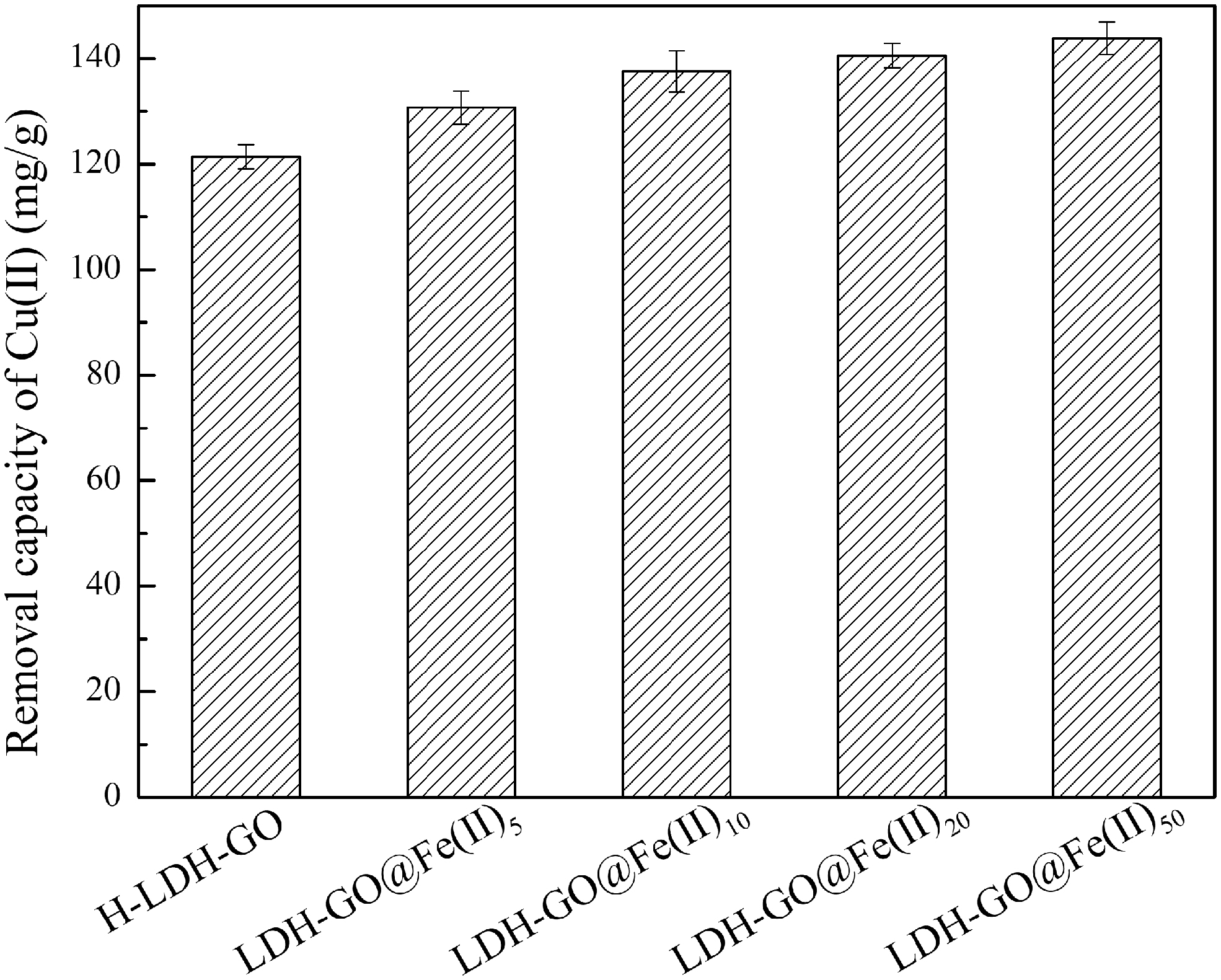
The removal performance of Cu(II) on LDH-GO@Fe(II)x. (V = 200 mL, C0 = 150 mg/L, t = 24 h, T = 298 K, adsorbent = 0.2 g).
Our previous study showed that the increase of initial Fe(II) concentration would block the Cd(II) adsorption by Fe-modified LDH-GO, which suggested different interaction mechanism between Fe in the structure with Cu(II) and Cd(II) (Liao et al., 2019a). Unob et al. (2007) used X-ray fluorescence spectroscopy (XRF) to analyze iron oxide content in iron oxide-modified waste silica, and the result showed that removal efficiency of Cu(II) was likely related to the iron oxide content. The properties of the modified LDH-GO were different from the unmodified LDH-GO. The increase in specific surface area and iron formation coating were attributed to the enhancement of adsorption capacities. In contrast, Fe in the LDH-GO was chemical active, and Cu(II) in the solution may react with Fe to deposit as Cu–Fe oxides. This was another reason for the enhancement of adsorption capacities.
Adsorption kinetics
The adsorption kinetics of Cu(II) are shown in Fig. 3, and the removal capacities increased significantly within the first 6 h, followed by a slow increase until equilibrium reached. An equilibrium time of 24 h was employed for all other experiments to make sure the complete removal of Cu(II). The initial rapid adsorption might own to an increased number of available sites at the initial stages. As time proceeded, the decrease in adsorption velocity at the later stages might be because the accumulation of Cu(II) adsorbed on the surface sites led the concentration gradients diminished (Zhao et al., 2011).

Effect of contact time on the adsorption of Cu(II). (V = 200 mL, C0 = 150 mg/L, T = 298 K, adsorbent = 0.2 g).
The kinetic model parameters were obtained from fitting results, which are presented in Table 2. The correlation coefficient value R2 for pseudo-first-order model was higher than that of pseudo-second-order model, which suggested that the interpretation of adsorption kinetic by pseudo-first-order was more suitable than pseudo-second-order kinetics model. Moreover, the comparison between the experimental adsorption capacity (qexp) value and the calculated adsorption capacity (qcal) value showed that qcal value was very close to qexp value for the pseudo-first-order kinetics.
Kinetics Parameters for Cu(II) Adsorption on Unmodified LDH-GO, LDH-GO@Fe(II)10, and LDH-GO@Fe(II)50. (V = 200 mL, C0 = 150 mg/L, T = 298 K, Adsorbent = 0.2 g)
The fitting results of intraparticle diffusion kinetic model showed multilinearity correlation which revealed the presence of two governing steps happened. The rate constants of the two steps are represented by kp1 (the intraparticle diffusion) and kp2 values (the equilibrium). Badawi et al. (2017) also reported the adsorption process of biosorbent on Al(III) and Pb(II) governed by two steps.
Adsorption isotherm
The initial Cu(II) concentration played an important role on the adsorption capacity. As is shown in Fig. 4, the amount of adsorbed Cu(II) at equilibrium increased considerably by increasing the initial Cu(II) concentration. The increase of Cu(II) concentration accelerated the diffusion from the solution to the adsorbent surface due to the increase in driving force of concentration gradient, thus led to the cumulative adsorption of Cu(II) onto the adsorbent surface (Badawi et al., 2017).
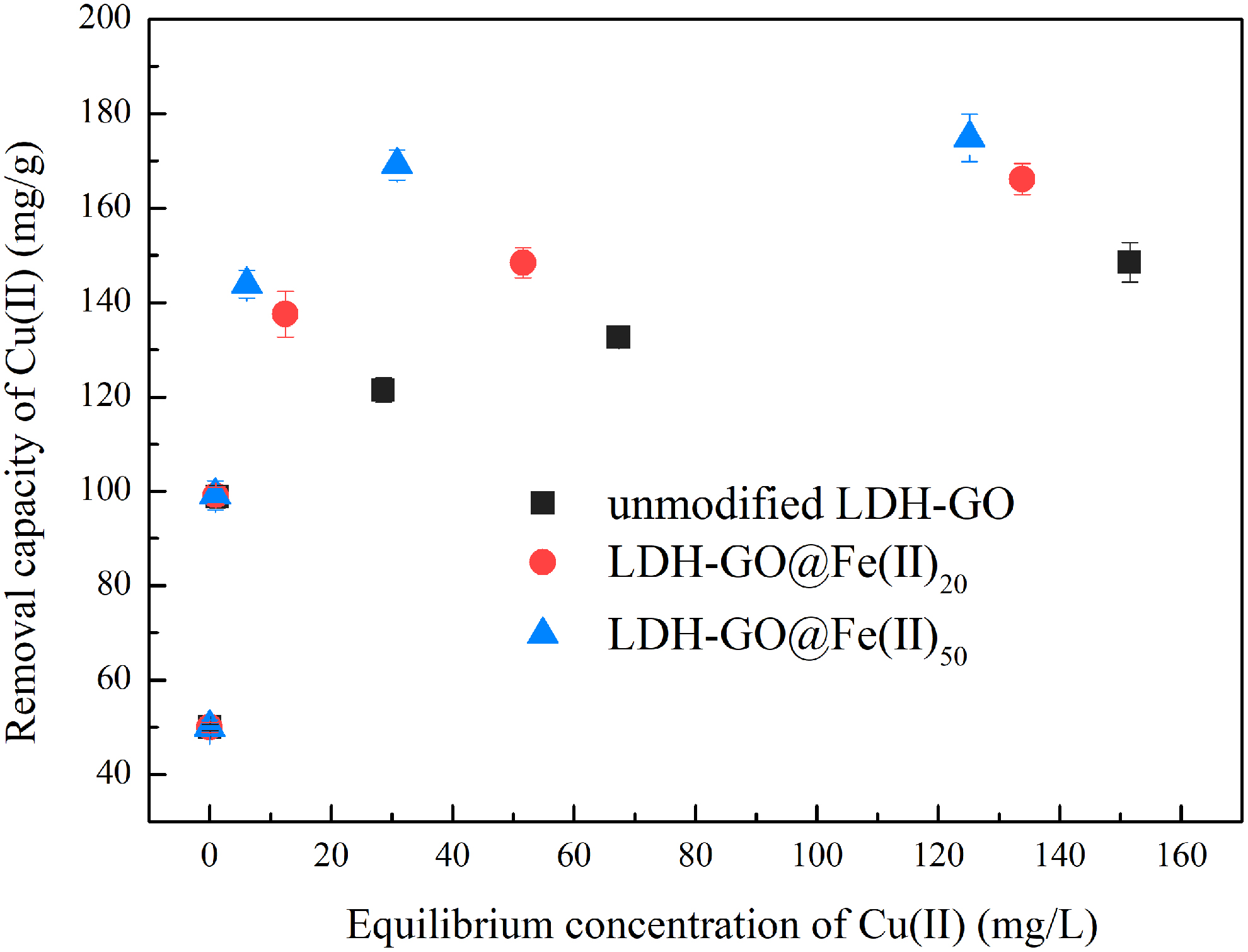
Adsorption isotherm of Cu(II). (V = 200 mL, t = 24 h, T = 298 K, adsorbent = 0.2 g).
The adsorption isotherms of Cu(II) are shown in Fig. 4 and Table 3. It was shown that both Langmuir and Freundlich models could well describe the sorption isothermal behaviors with high correlation coefficients. The maximum adsorption capacity (qm) for Cu(II) on unmodified LDH-GO, LDH-GO@Fe(II)20, and LDH-GO@Fe(II)50 were determined as 149.25, 166.67, and 175.44 mg/g, respectively. The adsorption capacities of pure GO and LDH were 55.87 and 99.01 mg/L, respectively. This verified hybridization GO with LDH can improve the removal capacity. In our previous study, the maximum adsorption capacity for Cd(II) on LDH-GO@Fe(II)50 was determined as 24.01 mg/g, which was much lower than that for Cu(II). The result was indicative of selective adsorption for Cu(II) on the synthesized adsorbent.
Isotherm Parameters for the Adsorption of Cu(II) onto Unmodified LDH-GO, LDH-GO@Fe(II)10, and LDH-GO@Fe(II)50. (V = 200 mL, t = 24 h, T = 298 K, Adsorbent = 0.2 g)
Comparing with qm value of Cu(II) adsorption on other adsorbents, such as olive stone waste (2.03 mg/g) (Fiol et al., 2006), Peanut straw char (88.9 mg/g) (Tong et al., 2011) and layered double hydroxide-humate hybrid (49.62 mg/g) (González et al., 2014). It can be seen that the obtained adsorbents exhibited superior adsorption capacity than other materials, which showed its attractive potential for applications in real practice. Compared with LDH-GO@Fe(II)x, biochar usually owns limited surface functional groups and relative low surface area with limited porosity. The high adsorption capacity of prepared adsorbents may be related to their porous structure, high specific surface area, and more active adsorption sites (Abdi et al., 2017).
Selectivity adsorption
To show the selectivity, the competitive ability of Pb(II), Zn(II), Mn(II), and Cd(II) to Cu(II) was studied. One gram per liter of LDH-GO@Fe(II)50 adsorbent was suspended in a solution containing a mixture of Pb(II), Zn(II), Mn(II), Cd(II), and Cu(II), where the species had the same initial concentration of 150 mg/L. The removal efficiencies of LDH-GO@Fe(II)50 to Pb(II), Zn(II), Mn(II), Cd(II), and Cu(II) were 27.33%, 30.00%, 0.02%, 34.55%, and 87.60%, respectively. The result was indicative of selective adsorption for Cu(II) on the LDH-GO@Fe(II)50.
Cu(II) removal mechanism
The SEM results of unmodified LDH-GO and LDH-GO@Fe(II)50 after Cu(II) adsorption are shown in Fig. 5. Compared with original samples, some small particles were clustered on the surface of the unmodified LDH-GO, which suggested the Cu2Cl(OH)3 particles deposited on the surface of the unmodified LDH-GO (Yue et al., 2017). Similar morphology of lumpy structure was also observed for LDH-GO@Fe(II)50/Cu, which was probably due to the copper ferrite precipitations formed on the surface during the adsorption reaction.

The SEM of
The content of various elements on the surface of unmodified LDH-GO and LDH-GO@Fe(II)50 after Cu(II) adsorption was measured by EDS (Fig. 5). The results showed the load of Cu(II) on the surface of unmodified LDH-GO and LDH-GO@Fe(II)50 were 2.18% (atomic%) and 7.86% (atomic%), respectively. The content of Mg on the surface of the samples after Cu(II) adsorption decreased comparing with the original samples, which can be ascribed to the result of isomorphic substitution of Mg by Cu. In addition, the atomic ratio of Fe/Cu on the surface for LDH-GO@Fe(II)50/Cu was <2, which suggested that the formation of CuFe2O4 was not the only mechanism for Cu(II) adsorption.
Isomorphic substitution in layered clays usually change the d-spacings and relative intensities of peaks, which reflect lattice parameters of layer framework due to the difference in ion size and scattering power between different cations (Park et al., 2007). The XRD patterns of the unmodified LDH-GO and LDH-GO@Fe(II)50 samples after adsorption 150 mg/L Cu(II) are shown in Fig. 6. The (003) and (006) peaks shifted to lower 2θ values and the intensities of the XRD peaks decreased after the adsorption of Cu(II) for both samples, which indicated that the Cu(II) adsorption affected the layered crystal structure.

The XRD patterns of the samples after Cu(II) adsorption. XRD, X-ray powder diffraction.
Similar phenomenon has been reported, and the XRD pattern of MgAl-LDH was affected by adsorbing transition metals through isomorphic substitution of Mg(II) in the anionic clay structure (Komarneni et al., 1998). In addition, the concentrations of Mg(II), Al(III), and Fe(II) in the solution after adsorption of 150 mg/L Cu(II) have been measured by ICP. The concentration of Mg(II) in the solution for unmodified LDH-GO and LDH-GO@Fe(II)50 was 28.12 and 31.86 mg/L, respectively. The concentrations of Al(III) and Fe(II) released in the solution were <0.1 mg/L for both adsorbents. The detected Mg(II) in the solution was an evidence of isomorphic substitution of Mg(II).
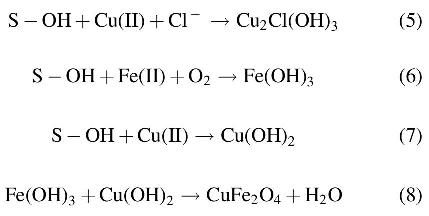
Notably, new peaks were also observed after Cu(II) adsorption. For LDH-GO/Cu, the new peaks were indexed Cu2Cl(OH)3 (JCPDS:50-1559). The LDH-GO surfaces were covered with hydroxyl groups and surrounded by excess hydroxide ions (Park et al., 2007). The Cu(II) would react with the surface OH and lead to the formation of Cu hydroxide-chloride precipitation (Yue et al., 2017). Therefore, the preferred reactions between LDH-GO and Cu(II) were suggested to be surface adsorption and precipitation. The corresponding reactions in the system can be expressed as Equation (5). Park et al. (2007) reported Cu(II) reacted with OH− on the surface of Mg/Al LDH and led to significant precipitation of Cu7Cl4(OH)10·H2O along with steady decomposition of Mg/Al LDH. Yue et al. (2017) also observed the formation of Cu2Cl(OH)3 precipitation during the removal of Cu(II) by Mg-Al-Cl-LDH.
As for the adsorption products of LDH-GO@Fe(II)50, a new phase was detected and the character peaks of the original LDH-GO@Fe(II)50 sample were impaired to a worse extent. The 2θ values at 18.19°, 29.91°, 34.59°, 35.21°, 57.06°, and 64.12° could be indexed to the (101), (112), (103), (211), (321), and (224) planes of CuFe2O4 (JCPDS No.34-0425) (Brezesinski, 2012; Vijayanand et al., 2013; Gohain et al., 2015), which suggested that Cu(II) in the solution reacted with Fe in the LDH-GO@Fe(II)50 and formed copper ferrite (CuFe2O4).
XPS was further used to study the surface chemical compositions. As shown in Fig. 7, the presence of Cu was observed after Cu(II) adsorption, which signified the adsorption of Cu on the surface of the adsorbents. The first two peaks with binding energies (BE) of about 934.5 ± 0.5 eV and 942.9 ± 0.5 eV were assigned to Cu 2p3/2 and its shakeup satellites, whereas the higher BE peaks around 954.3 ± 0.5 eV and 962.3 ± 0.5 eV corresponded to Cu 2p1/2 and its shakeup satellites, respectively (Park et al., 2007; Wang et al., 2014). The presence of divalent copper in samples was confirmed by the intense Cu 2p3/2 shakeup satellite on the higher binding energy side of the spectrum (Jia et al., 2009). The XPS results were consistent with the earlier XRD results, which indicated that the formation of hydroxides [Cu2Cl(OH)3] for Cu(II) as the main reactions in the removal of Cu(II) by LDH-GO.
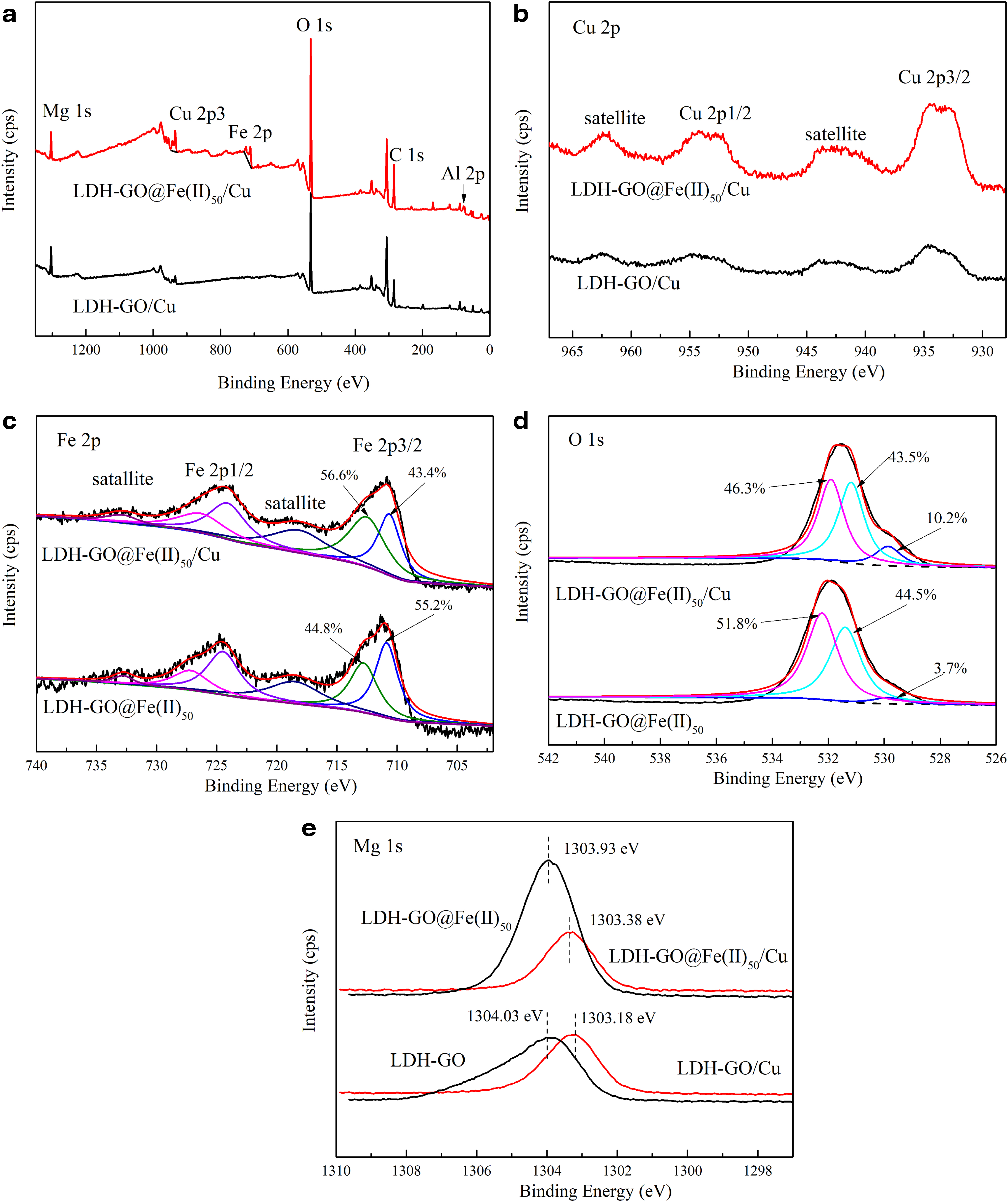
The XPS spectra
The peaks due to Fe were observed for LDH-GO@Fe(II)50/Cu, which revealed the presence of Fe species in LDH-GO@Fe(II)50 composites (Fig. 7c). The peaks observed at ∼725 and ∼711 eV can be assigned to Fe 2p1/2 and Fe 2p3/2, respectively. The Fe 2p spectra displayed a main peak at around 711.4 eV and a satellite at around 719.1 eV, suggesting the presence of Fe(III) (Dhanda and Kidwai, 2016). The presence of the peaks around 712.5 and 710.7 eV indicated that Fe(III) existed in two coordination environments where tetrahedral site at higher binding energy and octahedral site at lower binding energy, respectively (Gu et al., 2015; Nakhate and Yadav, 2017). This suggested that the adsorbed Cu(II) reacted with Fe(III) to form copper ferrite (CuFe2O4).
The detail spectra of the O 1s of LDH-GO@Fe(II)50 before and after Cu(II) adsorption is illustrated in Fig. 7d. High-resolution deconvoluted O 1s spectrum displayed three peaks. The peak located at around 530 eV was corresponded to the oxide type oxygen (M-O), and the O 1s component at ∼531 eV was accounted for hydroxide (OH) type oxygen (Yin et al., 2014; Wu et al., 2016). The binding energy side around 532 eV of O 1s peak might be assigned to C-O bonds and adsorbed water oxygen (Li et al., 2014; Kwan et al., 2015).
The amount of the oxide type oxygen (M-O) increased from 3.7% to 10.2% after Cu(II) adsorption due to the formation of O-Fe or/and O-Cu bands (Yue et al., 2017). This again corroborated the formation of CuFe2O4 during the Cu(II) adsorption. In addition, the BE value of Mg 1s also shifted to lower binding energies (Fig. 7e), implying the change of Mg bonding environment (Yue et al., 2017). This was due to the isomorphic substitution of Mg(II) by Cu(II) into the structure.
Based on the aforementioned analysis, the mechanisms of Cu(II) removal by LDH-GO@Fe(II)50 were proposed. In general, Cu(II) was sequestrated through a synergistic process, including adsorption, isomorphic substitution, and chemical deposition. The character activity of ferrous is very active, which can be easily oxidized by dissolved oxygen during the modification process (Hiemstra and van Riemsdijk, 2007).
The modification of LDH-GO with Fe(II) was mainly through the following reaction: (1) The Fe(II) isomorphic substituted of Mg(II); (2) Fe(II) reacted with the trace amount of dissolved oxygen through a slow oxidation; (3) Fe(III) subsequently hydrolyzed on the surface to form Fe(OH)3 compounds [Eq. (6)]. Owing to Fe(II) isomorphic substituted with octahedral metal atoms (Mg(II)), the Fe species not only coated on the surface but also modified the structure. The formation mechanism of CuFe2O4 was proposed as follows [Eqs. (7)–(8)]. The Cu(II) was adsorbed on the LDH-GO@Fe(II)50 surface and reacted with the surface OH and transformed into corresponding Cu(OH)2 [Eq. (7)]. The newly formed Cu(OH)2 reacted with and Fe(OH)3, thus giving rise to CuFe2O4 [Eq. (8)] (Gu et al., 2015).
Conclusion
This study evaluated the use of Fe(II)-modified LDH-GO@Fe(II) for Cu(II) adsorption. With Fe(II) modification, amorphous Fe oxides generated on the surface, which lead a porous structure and increased specific surface area. The adsorption results showed that Fe(II)-modified LDH-GO had much higher adsorption capacities for Cu(II) than the original LDH-GO, which indicated that the graft modification of Fe onto LDH-GO to promote Cu(II) adsorption was successful.
The adsorption isotherm studies indicated that the adsorption of Cu(II) follows both Langmuir and Freundlich isotherms. The maximum adsorption capacity (qm) for Cu(II) on LDH-GO@Fe(II)50 was 175.44 mg/g. Cu(II) adsorption followed a pseudo-first-order rate law consisting of two steps: the fast step in the first 6 h, and followed by a slow step until equilibrium reached. The fitting results of intraparticle diffusion kinetic model revealed two governing steps happened during the adsorption process. The desorption and regeneration studies showed that the prepared adsorbents can be simply regenerated and reused even after five cycles, demonstrating high and stable recyclability.
The mechanism for Cu(II) removal on unmodified LDH-GO and LDH-GO@Fe(II) was elucidated by the XRD and XPS analysis. It revealed that Cu(II) adsorption on unmodified LDH-GO was by the formation of Cu2Cl(OH)3 and isomorphic substitution of Mg(II). The enhanced removal of Cu(II) by Fe-modified LDH-GO was induced by the enlarged specific surface area and reaction with Fe to form CuFe2O4. This study showed a potential to usage Fe(II)-modified LDH-GO for metal removal from aqueous solutions.
Footnotes

References
Supplementary Material
Please find the following supplemental material available below.
For Open Access articles published under a Creative Commons License, all supplemental material carries the same license as the article it is associated with.
For non-Open Access articles published, all supplemental material carries a non-exclusive license, and permission requests for re-use of supplemental material or any part of supplemental material shall be sent directly to the copyright owner as specified in the copyright notice associated with the article.
