




Abstract
Silver nanoparticles (AgNPs) are the most widely used engineered nanomaterials in consumer products, primarily due to their antimicrobial properties. This widespread usage has resulted in concerns regarding potential adverse environmental impacts and increased probability of human exposure. As the number of AgNP consumer products grows, the likelihood of interactions with other household materials increases. AgNP products have the potential to interact with household cleaning products in laundry, dishwashers, or during general use of all-purpose surface cleaners. This study has investigated the interaction between surfactant-based surface cleaning products and AgNPs of different sizes and with different capping agents. One AgNP consumer product, two laboratory-synthesized AgNPs, and ionic silver were selected for interaction with one cationic, one anionic, and one nonionic surfactant product to simulate AgNP transformations during consumer product usage before disposal and subsequent environmental release. Changes in size, morphology, and chemical composition were detected during a 60 min exposure to surfactant-based surface cleaning products using ultraviolet-visible (UV/Vis) spectroscopy, transmission electron microscopy-energy dispersive X-ray spectroscopy (TEM-EDX), and dynamic light scattering (DLS). Generally, once AgNP suspensions were exposed to surfactant-based surface cleaning products, all the particles showed an initial aggregation, likely due to disruption of their capping agents. Over the 60 min exposure, cleaning agent-1 (cationic) showed more significant particle aggregates than cleaning agent-2 (anionic) and cleaning agent-3 (nonionic). In addition, UV/Vis, TEM-EDX, and DLS confirmed formation of incidental AgNPs from interaction of ionic silver with all surfactant types.
Introduction
The utilization of silver nanoparticles (AgNPs) in consumer products is quickly expanding on the global market (Hedberg et al., 2012; Vance et al., 2015). Due to their antimicrobial properties, AgNPs are commonly used in consumer products such as textiles, plastics, medical devices, and dietary supplements (Blaser et al., 2008; Fabrega et al., 2011; Rogers et al., 2018). AgNP consumer products existing in many areas of the household leads to interactions with multiple common household cleaners, including laundry detergent, dishwasher soap, and all-purpose surface cleaners. Many of the surfactants in these surface cleaning products have similar properties to common AgNP capping agents and may exhibit the ability to disrupt the stability of AgNPs. As the toxicity of AgNPs is related to their size and shape (Fabrega et al., 2009), disruption due to interaction with surfactants could result in either release of toxic AgNPs to the environment or a decrease in the intended antimicrobial effect of the AgNP consumer product. In addition, any release of ionic or colloidal silver from these products would inevitably end up in municipal wastewater through a household drain. These transformed AgNPs could have unknown effects in the wastewater treatment process. There is a need for research into the fate and transformation of nanomaterials in consumer products during their intended use and after their disposal.
AgNPs are primarily synthesized with capping agents to prevent particle agglomeration and to produce monodisperse suspensions (El Badawy et al., 2010). Since the stability of AgNPs may be affected by interaction with surfactant-based surface cleaning products, it is important to investigate the physicochemical parameters of AgNPs during these interactions. Various surfactants have been shown to affect AgNP stability, leading to changes in antimicrobial activity (Kvitek et al., 2008). The exposure of laundry detergents to AgNPs has also been shown to cause aggregation of AgNPs (Skoglund et al., 2013; Nawaz and Sengupta, 2017). Studies involving real cleaning product formulations, particularly all-purpose cleaners, which are used in all areas of the household, and AgNP consumer products are uncommon.
Release of both ionic and colloidal silver has been detected from simulated usage of a variety of AgNP-containing products, including socks (Benn and Westerhoff, 2008), food containers (Mackevica and Foss Hansen, 2016), children's toys (Quadros et al., 2013), textiles (Geranio et al., 2009; Pasricha et al., 2012), commercial toothbrushes (Mackevica et al., 2017), and medical dressings (LaRiviere et al., 2011; Courtemanche et al., 2015). These products all have the opportunity to interact with surfactant-based cleaners during intended use or maintenance. Increased ionic silver release or transformation of the AgNPs in these products could diminish their antimicrobial effect, posing a threat to the user.
In addition to the surfactants, which serve as the active ingredients in many all-purpose surface cleaners, there are other components of these products that could interact with ionic and colloidal silver. Many surfactant-based surface cleaning products contain plant extracts that have been shown to act as reducing agents in AgNP synthesis, including lavender (Kumar et al., 2016), lemon (Vankar and Shukla, 2012), and citrus extracts (Prathna et al., 2011b). Ionic silver emitted from nanocomposites can interact with surface cleaning products during usage and possibly form incidental AgNPs. The incidental AgNPs, formed unintentionally during other interactions, will have unpredictable physicochemical properties, toxicity, and stability after disposal.
For this work, three all-purpose surface cleaning products were selected based on the identity of their primary surfactant ingredient. Cleaning agent 1 (CA1) contains a cationic surfactant, cleaning agent 2 (CA2) contains an anionic surfactant, and cleaning agent 3 (CA3) contains a nonionic surfactant. The ionic properties of the surfactant was used to select the surface cleaning products due to the common use of capping agents with varied ionic properties in AgNP synthesis. The AgNPs included laboratory-synthesized citrate-coated AgNPs (AgNPs-cit), laboratory-synthesized polyvinylpyrrolidone-coated AgNPs (AgNPs-PVP), and a colloidal AgNP consumer product intended for aerosolized application (CP10). CP10 is part of a larger sample set studied in two previous publications and therefore its sample ID was maintained from those studies for the sake of consistency and comparison (Rogers et al., 2018; Radwan et al., 2019). CP10 was selected from a group of 22 consumer product AgNP suspension because of high concentration of silver, high polydispersity, and usage method that would increase likelihood of contact with household cleaning products.
The primary objective of this work is to investigate the transformation of AgNPs during interaction with surfactant-based surface cleaners. This project was carried out in three phases, with each subsequent phase being planned and executed due to unexpected results from the previous phase. In phase one, the three cleaning agents and three AgNP suspensions were used to make a total of nine combinations and analyzed with regard to the physicochemical properties of the AgNPs. In phase two, an ionic silver solution was incorporated as a new material for interaction with the surface cleaning products to simulate the release of ionic silver from AgNP nanocomposite products. In phase three, we investigated the long-term stability of incidental AgNPs formed from the interaction of ionic silver with the surface cleaning products.
Materials and Methods
Materials
Basic information about the three commercially available surface cleaning products used in this work are shown in Supplementary Table S1. Elemental analysis of the surface cleaning products is shown in Supplementary Table S2 and their advertised ingredients are shown in Supplementary Table S3. One AgNP colloidal consumer product designed for aerosolized use, here referred to as CP10, was selected from a group of 22 consumer products (Rogers et al., 2018) because of high concentration of silver, high polydispersity, and recommended usage that would increase likelihood of contact with cleaning agents. Citrate-capped AgNPs and polyvinylpyrrolidone-capped AgNPs were synthesized and purified as described by El Badawy et al. (2010).
Characterization of AgNP suspensions
Hydrodynamic diameter (HDD) was measured using a Malvern Zetasizer Nano ZS (Malvern, United Kingdom). Localized surface plasmon resonance (LSPR) was measured using a Shimadzu UV-2700. For HDD and LSPR analysis, 200 μL of cleaning product was added to 1 mL of an AgNP suspension in a cuvette and measurements were taken at regular time intervals. Measurement intervals of 5, 15, 30, and 60 min were used for all LSPR measurements, while some mixtures received additional measurements past 60 min because they were still undergoing transformation. Measurement intervals of 5, 30, and 60 min were used for HDD measurements. A solution of 200 mg/L Ag+ was also used in interactions with surface cleaning products and additional time intervals at 90, 150, and 240 min were measured to investigate the stability of incidental AgNPs. Elemental analysis was performed using an iCAP 6500 Duo inductively coupled plasma-optical emission spectrometer (ICP-OES; Thermo Scientific, Waltham, MA) after acid digestion, following EPA SW846 methods 3015A. Transmission electron microscopy-energy dispersive X-ray spectroscopy (TEM-EDX) analysis was used to verify particle size, shape, and aggregation using a JEOL-1200 EX TEM (JEOL, Inc.) acquiring images at 300 kV. EDX spectroscopy (Oxford instrument, United Kingdom) was used to confirm the identity of silver particles and aggregates during TEM micrograph acquisition. TEM samples were prepared by depositing a drop of AgNP + cleaning product mixture on a carbon-coated copper grid after 60 min of reaction time. TEM grids were air-dried at room temperature overnight in a dust-free box.
Dissolution batch test
Due to significant short-term stability, incidental AgNPs formed from interaction of ionic silver with the surface cleaning products were selected for a longer dissolution test. In a 100 mL Pyrex bottle, 5 mL of cleaning product was added to 25 mL of 200 mg/L Ag+ with continuous stirring (500 rpm). HDD measurements were acquired at 5, 30, 60, 180, 300, 1,260, and 1,440 min.
Results and Discussion
Ultraviolet-visible analysis
The LSPR of AgNPs is primarily reliant on particle size and shape (Jensen et al., 2000). Measuring a shift in the plasmon resonance maximum is an established method for determining changes in AgNP structure, including dissolution and aggregation (Malinsky et al., 2001; Liu and Hurt, 2010; Prathna et al., 2011a; Mwilu et al., 2013). LSPR of AgNP suspensions in deionized water has been reported in literature with a range from 360 to 460 nm (Li et al., 2010).
The absorbance spectra of AgNP suspensions used in this study all showed plasmon resonance peaks around 400 nm. When the surface cleaning products were measured, there was no detected peak for CA1, but there was a detected peak at 300 and 320 nm for CA2 and CA3, respectively (Supplementary Fig. S1). These peaks are outside the typical range of AgNPs, persisted through reaction with AgNPs, and are likely due to dyes or other organic components in the cleaning agents.
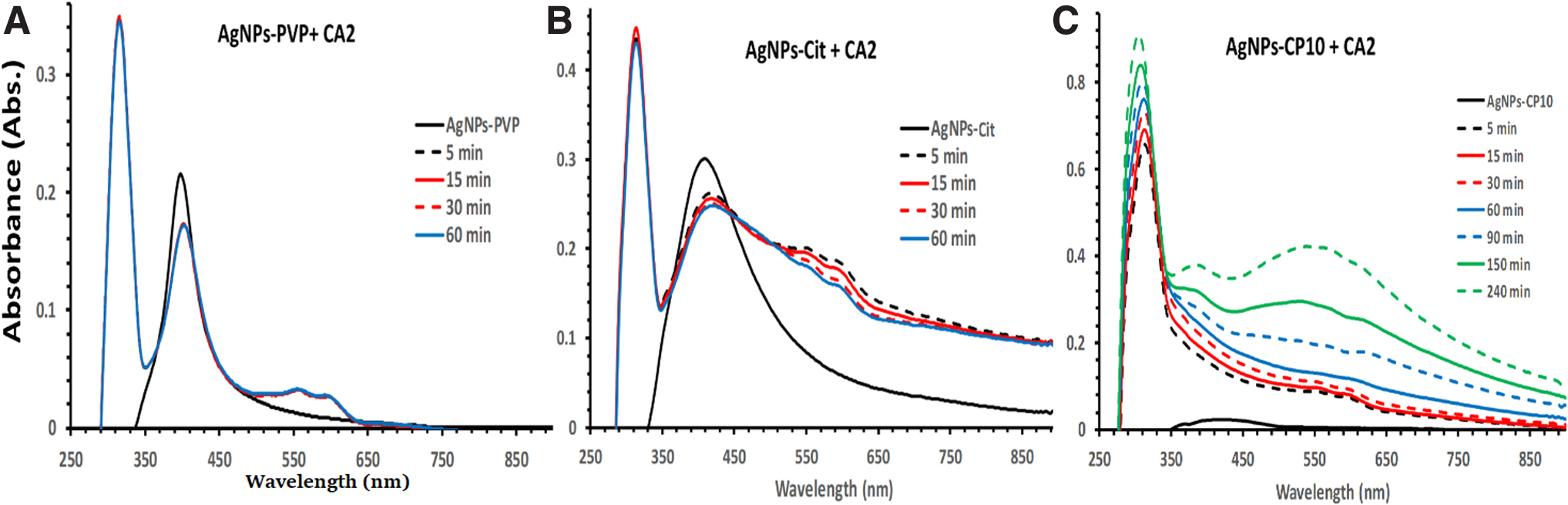
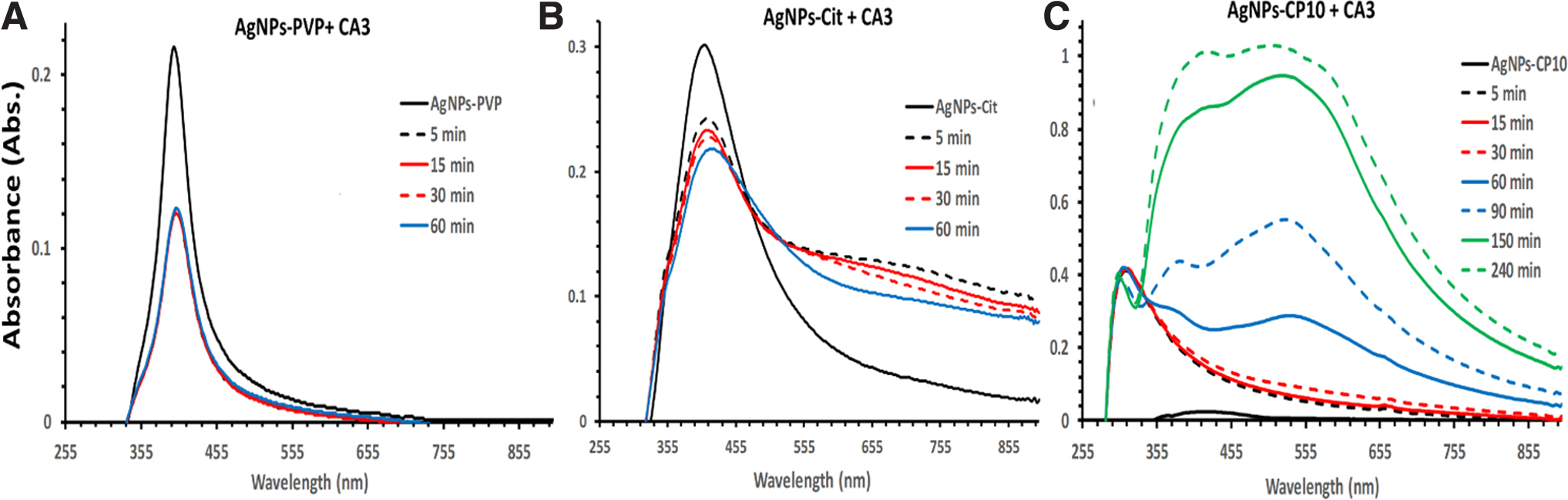
Upon exposure of AgNPs-PVP to CA1, CA2, and CA3, the plasmon resonance peak exhibited a decrease in intensity that was slow in CA1 (Fig. 1A) and immediate in CA2 and CA3 (Figs. 2A and 3A, respectively). The only other observed change for AgNPs-PVP was in reaction with CA2, where two overlapping peaks appeared near 600 nm. These new peaks are indicative of aggregates but are significantly lower in intensity than the initial peak. The mechanism of stabilization for PVP is through steric hindrance, so it is expected that it exhibits minimal transformation when reacting with the charged surfactants. In fact, the largest decrease in initial plasmon peak intensity occurs when AgNPs-PVP reacts with the neutral surfactant in CA3.

Absorbance spectra of
Absorbance spectra of
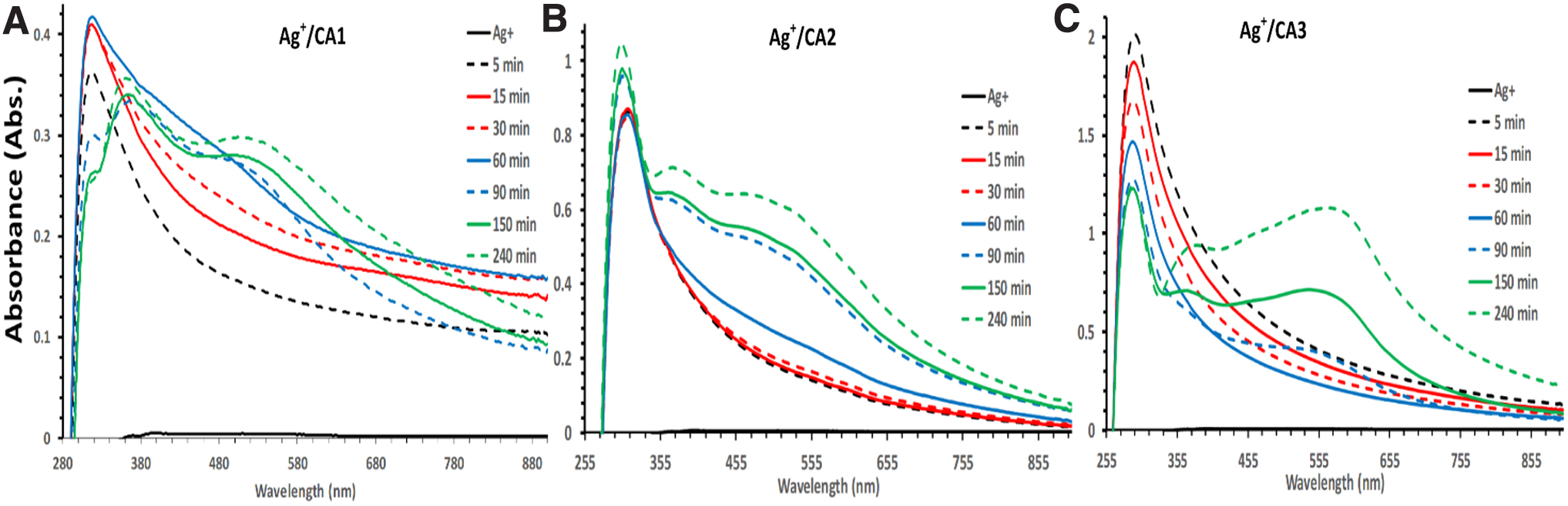
Absorbance spectra of
AgNPs-cit exhibited significant transformation during reaction with all three surface cleaning products. A rapid decrease in initial plasmon intensity was seen in all three mixtures (Figs. 1B, 2B, and 3B) and was greatest in reaction with CA1. The citrate anion relies on electrostatic interactions to stabilize AgNPs and is therefore more susceptible than AgNPs-PVP to interference from charged surfactants. Aggregation was also detected in AgNPs-cit during interaction with all three cleaning agents, with broad red-shifted peaks appearing near 600–700 nm. While still significant, the mixture of AgNPs-cit with the nonionic surfactant in CA3 exhibited the lowest decrease in initial plasmon peak and least apparent aggregate peak, which agrees with our conclusion that AgNPs-cit is most susceptible to charged surfactants such as those in CA1 and CA2. The largest decrease in initial plasmon peak was seen during interaction of AgNPs-cit with CA1. As an anion, citrate experiences the most interference from the cationic surfactant in CA1.
CP10 is a commercially available product that was used directly from the bottle. No information is given by the manufacturer with regard to size, shape, or capping agent. In a previous study, CP10 showed similar dissolution trends to PVP-capped AgNPs (Radwan et al., 2019), but this is not conclusive identification. In fact, CP10 behaves very differently from AgNPs-PVP in reaction with CA1, CA2, and CA3. During interaction with CA1, CP10 behaved similarly to AgNPs-cit, with a slow decrease in initial plasmon peak and appearance of a very broad red-shifted peak indicating aggregates. In reaction with CA2 and CA3, CP10 exhibited significant growth of new plasmon peaks that greatly surpass the initial peak. If the correlation between capping agent and transformation is consistent, then CP10 is likely stabilized by an electrostatic capping agent. But one property that sets CP10 apart from AgNPs-PVP and AgNPs-cit is high ionic content. Possibly by design or due to dissolution after manufacture, CP10 contains 90% of its silver in ionic form while both laboratory-synthesized AgNPs contain less than 1% ionic silver. The significant growth of plasmon peaks seen in the reaction of CP10 with CA2 and CA3 can be interpreted as new AgNPs formed from the ionic silver in CP10. While the specific mechanism for incidental AgNP formation is unclear, the surface cleaning products contain both surfactants that can act as capping agents and plant extracts that are known reducing agents (Prathna et al., 2011b; Vankar and Shukla, 2012; Kumar et al., 2016). After recording this result, a solution of ionic silver was incorporated as an additional reactant for interaction with the cleaning agents.
A solution of 200 ppm ionic silver was used to simulate Ag+ released from AgNP suspensions and solid nanocomposites during consumer use. Because it contains no AgNPs, there was no initial plasmon resonance peak for the ionic silver solution. As seen in Figure 4, incidental formation of AgNPs was detected after 5 min of reaction with all three surface cleaning products. During reaction with CA1 and CA2, the incidental AgNPs were extremely stable, exhibiting minimal change over the 60 min experiment. For these samples, additional measurements were acquired past 60 min to investigate their stability. After 90 min, broad peaks at higher wavelengths suggested the presence of aggregates. During interaction of ionic silver with CA3, the incidental AgNPs were less stable. The first plasmon peak decreased significantly over the first 60 min and aggregates appeared by the 90 min measurement. While all three surface cleaning products contain the capping agents and reducing agents needed for AgNP synthesis, the incidental AgNPs exhibited differences in stability. Identification of an unknown capping agent can be very difficult due to low concentrations and interference from other matrix components; therefore, we can only speculate that the primary surfactant ingredients are acting as capping agents and infer their stability from their cationic, anionic, or nonionic identity.
Absorbance spectra of
Dynamic light scattering analysis
For some of the reaction mixtures, the measured HDD was less reliable than other methods of size determination due to their polydispersity. Despite this limitation, the HDD measurements are still useful as a comparison of trends in AgNP size change during reaction with the surface cleaning products. The initial HDD in AgNPs-PVP, AgNPs-cit, and CP10 were 15 ± 0.54, 12.6 ± 0.63, and 13.8 ± 0.37 nm, respectively. Similar diameter values were measured from both dynamic light scattering (DLS) analysis and TEM micrographs (Table 1).
Initial Particle Size of All Samples Measured by Dynamic Light Scattering and Transmission Electron Microscopy
AgNPs, silver nanoparticles; HDD, hydrodynamic diameter; Int., Intensity; PVP, polyvinylpyrrolidone; TEM, transmission electron microscopy.
Upon addition of CA1, the primary HDD size fraction for all AgNP suspensions showed a large initial increase after 5 min that was followed by a slower increase over the following 60 min (Table 2). While aggregates were seen in all mixtures of CA1, AgNPs-PVP aggregates only reached 334.3 nm while AgNPs-cit aggregates reached 5,241 nm. This difference in aggregation between PVP-capped and citrate-capped AgNPs follows the same trend seen in the ultraviolet-visible (UV/Vis) results. The HDD measurements of CP10 reaction mixtures deviate from the UV/Vis results. All three CP10 mixtures show significant aggregates after only 5 min of reaction, while aggregation was only detected by UV/Vis after 60–90 min. This deviation is likely due to CP10 being the most polydisperse of the AgNP suspensions, which adversely affects the quality of HDD measurements.
Hydrodynamic Diameter Measurements by Dynamic Light Scattering for Silver Nanoparticles Exposed to Surface Cleaning Products
All HDD measurements in nanometers.
CA1, cleaning agent 1; CA2, cleaning agent 2; CA3, cleaning agent 3; Int., Intensity.
Due to the increased stability exhibited by incidental AgNPs formed from ionic silver interacting with the surface cleaning products, a larger-scale dissolution test was performed for these samples. The other AgNPs were not included in this experiment because the previous 60 min measurements were sufficient to assess their stability and identify their transformations. This batch dissolution test was used to compare stability of newly formed incidental AgNPs to determine whether they pose a likelihood of persisting through disposal to wastewater systems. As seen in Table 3, Ag+ exposure to CA1 and CA2 led to an increase in particle size until 300 min, at which time a decrease in average particle size was observed. This decrease is likely related to the stability of the incidental particles. However; in case of CA3, there was an increase in particle size over the entire duration of the experiment and significant aggregates formed after 300 min. While these samples are likely affected by high polydispersity, the lack of significant aggregates in the CA1 and CA2 mixtures after 24 h indicates that these AgNPs are very stable and have the capability to persist after use and disposal.
Hydrodynamic Diameter Measurements by Dynamic Light Scattering After Exposure of Ag+/CA1, Ag+/CA2, and Ag+/CA3 During Dissolution Batch Test
All HDD measurements in nanometers.
Int., Intensity.
TEM and EDX analysis
Representative TEM images of all the particles before exposure to surface cleaning products showed mostly individual spherical particles and a few clusters (Fig. 5A, E, I). Upon exposure to surface cleaning products for 60 min, TEM images showed AgNPs to be morphologically different from the AgNPs not exposed to surface cleaning products. The AgNPs-PVP, AgNPs-cit, and AgNPs-CP10 particles that were exposed to surface cleaning products for 60 min formed aggregates with small distinct boundaries defining individual particles (Fig. 5B, C, D, F, G, H, J, K, L). These results agree with DLS measurements (Table 2) and UV-Vis spectra (Figs. 1–3). For the Ag+ exposed to surface cleaning products, TEM images showed formation of nanoparticles (Fig. 6) and their identity as AgNPs was confirmed by EDX spectroscopy (Supplementary Fig. S2), which also agreed with DLS measurements (Table 3) and UV-Vis spectra (Fig. 4).

Representative TEM micrographs for AgNPs after exposure of AgNPs-PVP, AgNPs-cit, and CP10 to surface cleaning products

Representative TEM micrographs for AgNPs after exposure of Ag+ (as AgNO3) to surface cleaning products
Conclusions
The interaction between three surface cleaning products with differently charged surfactants and AgNPs was studied to expand our understanding of AgNP consumer product transformation during use and after disposal, which is essential for environmental fate assessments. Laboratory-synthesized AgNPs were used along with an AgNP consumer product to investigate the fundamental mechanisms of interaction between surface cleaning products and AgNP-enabled products. This study shows that AgNPs readily interact with surface cleaning products depending on the ionic properties of the cleaning product and surface chemistry of the AgNPs. In particular, the capping agent identity is a primary factor determining whether an AgNP will interact with a certain surfactant in a cleaning product and to what extent a transformation will take place. Among the studied materials, PVP-capped AgNPs were the most stable in the presence of different surfactants, while citrate-capped AgNPs showed significant aggregation and the CP10 consumer product exhibited formation of incidental AgNPs. Aggregation of AgNPs reduces their antimicrobial activity and could lead to diminished performance of AgNP consumer products, including food packaging, children's toys, and medical dressings.
When an ionic silver solution was included in the reactions, the formation of incidental AgNPs was confirmed through UV/Vis, DLS, and TEM analysis. While AgNPs are able to be synthesized from a wide variety of capping and reducing agents, the ability for AgNPs with unknown properties to form during consumer use of surface cleaning products on AgNP consumer products has not been previously demonstrated. The toxicity of these incidental AgNPs is unknown and they exhibit greater stability in solution than the AgNPs selected for this study, increasing their likelihood of persisting through the wastewater treatment process and being transported to urban watersheds.
The exposure of AgNPs to surface cleaning products has been shown to alter their morphology, speciation, and even form new incidental AgNPs in the presence of Ag+. The implication of these changes could mean altered antimicrobial activity, increased risk of user exposure, and altered transportation in the environment. Therefore, this study suggests that more information is needed to assess all properties that determine AgNP interactions with surfactant-based surface cleaning products and characterize incidental AgNPs formed from these interactions. Future work will include an expanded set of AgNPs and cleaning products, X-ray spectroscopy to determine changes in silver speciation, and sampling through realistic usage scenarios to simulate surface to surface transfer.
Footnotes
Acknowledgments
This article was subjected to EPA internal reviews and quality assurance approval. Mention of trade names or products does not constitute endorsement or recommendation for use. The views expressed in this article are those of the authors and do not necessarily represent the views or policies of the U.S. Environmental Protection Agency.
Author Disclosure Statement
No competing financial interests exist.
Funding Information
This research was funded and conducted by the National Risk Management Research Laboratory of U.S. Environmental Protection Agency (EPA), Cincinnati, Ohio under the CSS program. This research was supported, in part, by a PhD research grant from the Egyptian Ministry of Higher Education and Scientific Research (Grant No. 1582014) by providing stipend to Mr. Radwan and by appointments in the Research Participation Program at the Office of Research and Development (ORD), EPA administered by the Oak Ridge Institute for Science and Education (92431601).

References
Supplementary Material
Please find the following supplemental material available below.
For Open Access articles published under a Creative Commons License, all supplemental material carries the same license as the article it is associated with.
For non-Open Access articles published, all supplemental material carries a non-exclusive license, and permission requests for re-use of supplemental material or any part of supplemental material shall be sent directly to the copyright owner as specified in the copyright notice associated with the article.
