




Abstract
Manipulation of water chemistry plays an important role in water and wastewater treatment. Much effort has been directed at accomplishing such changes in ways that require less energy and material consumption to reduce treatment costs and improve process sustainability. Magnetic fields have been shown to affect the properties of water and its constituents. In this study, theoretical assessments of changes in electrical conductivity and proton concentration, as a function of flow velocity through a magnetic field, were developed and experimentally verified. Experiments were done using a flow-through system consisting of permanent neodymium magnets arranged in a helical pattern in a pipe to generate a constant multidirectional magnetic field (1.350 T). In accordance with increasing flow velocity (8–6 cm/s), the proton concentration decreased from 10−7 to
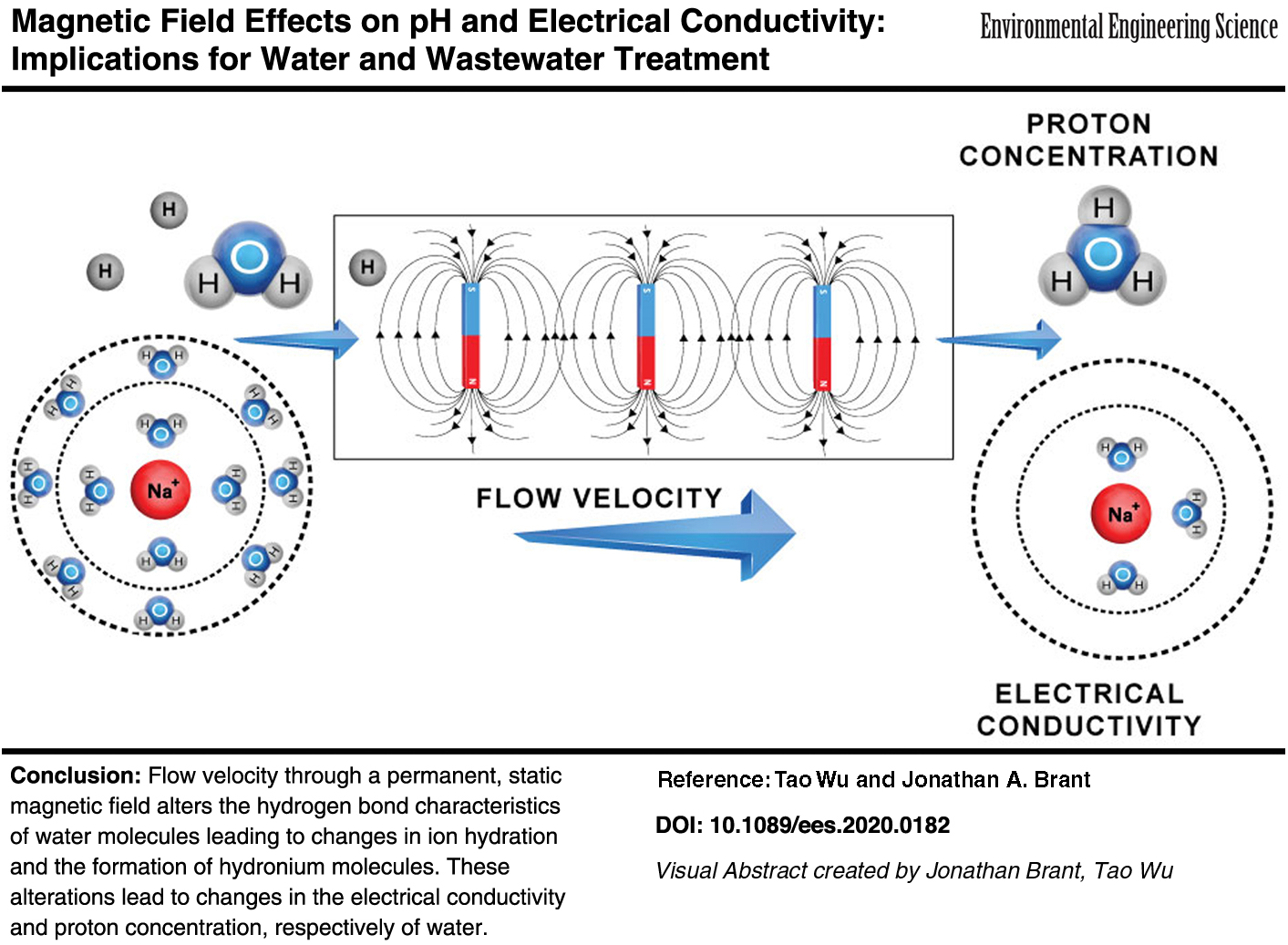
Graphical abstract
Introduction
The world faces a growing water crisis due to exponential population growth, climate change, finite freshwater supplies, and other factors (Ashoori et al., 2017). Additional concerns have been raised regarding the safety of potable water supplies with regard to the presence of unwanted compounds, like disinfection byproducts (Ding et al., 2019), and emerging contaminants of concern (Wee and Aris, 2017). Entry routes for these materials into water systems are diverse and may be intentional or unintentional. Conventional water and wastewater treatment systems use chemical additives to alter water chemistry and/or affect the behavior of water constituents. While effective, the usage of chemicals is associated with a variety of drawbacks like cost, the generation of unwanted byproducts, and health and safety concerns for operators. Development of processes that can supplement, or replace, the need for chemical addition is therefore of interest to the water management stakeholders. Devices that rely on magnetic fields for altering the properties of materials, like water, are emerging, and exciting technologies that may alter how water is treated in the future. Of relevance to this work, is that magnetic devices are not reliant on physical barriers or chemical additives to affect changes in system characteristics.
Magnetic fields have been shown to affect the characteristics of water, like pH and electrical conductivity, and its constituents (Quickenden et al., 1971; Yamashita et al., 2003; Cai et al., 2009; Szcześ et al., 2011b; Ebrahimi and Saghravani, 2017; Wang et al., 2018; Liu et al., 2019). These observations are generally ascribed to changes in the strength and/or number of hydrogen bonds between water molecules and water molecules and ions. Important characteristics of the magnetic field in these applications include strength, or flux density, of the magnetic field, B, magnetic field gradient, ΔB, and residence time within the magnetic field, th. Upon exposure to a magnetic field, the total conformation energy of a molecular system is altered (Levitt et al., 1997; Spreiter and Walter, 1999; Wu et al., 2006). These alterations consist of the energy differences introduced by individual bonding, bending, van der Waals, and Coulomb potentials. With changes in energy, the distance between an oxygen atom of a molecule and a hydrogen atom of another molecule will be altered accordingly. If the distance is shortened, hydrogen bonds will be formed/strengthened, and if the distance is prolonged, the hydrogen bonds are eliminated/weakened. And as reported by Chang and Weng (2006, 2008), when exposed to magnetic fields, the distance was decreased and more hydrogen bonds were formed. Numerous researchers have observed how magnetic fields can alter the properties of water.
Cai et al. (2009) observed that the application of B = 10 to 1,000 mT for 15 min, to water stream increased its viscosity from 1.07 to 1.18 mPa/s, resulting from an increase in the Lorentz force, which comprised electrical and magnetic forces. Yamashita et al. (2003) studied the effects of two different types of magnetic fields on pH and oxidation reduction potential (ORP). They found that the pH fluctuated by ∼0.05 to 0.1 pH units and the ORP fluctuated by roughly ∼60 mV following several hours of exposure. In a similar study, Chibowski et al. (2005) observed an increase in pH (∼0.25 pH units) as a function of exposure time (0–10 min) at B = 0.27 T. Changes in hydrogen bonding were referenced as the source of the observed pH effects. Szcześ et al. (2011b) found that circulating water through a magnetic field (B = 0.27 T) for 5 min resulted in a decrease (∼0.125 μS/cm) in its electrical conductivity. This relationship was a function of th, although the authors did not postulate on the underlying mechanisms. Contrasting observations were made by Holysz et al. (2007), who studied the changes in electrical conductivity when exposed to a static (no flow) magnetic field (B = 0.015 T). Electrical conductivity increased indicating that the presence of a ΔB may play a role in determining how the conductivity changes. The authors hypothesized that changes in electrical conductivity were due to weakening of the hydration shells around proton, hydroxide, potassium, and chloride ions. Since electrical conductivity is inversely proportional to the diameter of the hydrated cation or anion, and when the hydration shell is weakened/distorted by the magnetic field, the conductivity of a solution is increased (Chibowski et al., 2005). There is supporting evidence from other works to support the idea that magnetic fields can affect hydrogen bonding between water molecules and ions.
Pang and Feng (2003) developed a theoretical construct for describing the relationship between magnetic fields and water structuring at the quantum and molecular scales. These changes in water structuring were used to describe experimental observations in terms of ion mobility in water and the solution electrical conductivity. Cai et al. (2009) reported that hydrogen bonding between water molecules was enhanced when exposed to a magnetic field (B = 0.5 T). This was attributed to the effect of the Lorentz force on protons and promoting their bonding to water to form hydronium (H3O+). Wang et al. (2013) also found that at a fixed temperature (300 K), a magnetic field (B = 0.27 T) increased the number of hydrogen bonds in a solution. Supporting observations were made by Pang and Deng (2008), who observed that the Raman absorption at 6,000 cm−1 shifted from 0 to 90,000 (unitless). An increased Raman absorption indicated that the structure arrangements of water molecules were changed, and an increase occurred in hydrogen bonds between water molecules and between water molecules and hydronium. This finding was supported by Chang et al. (2006) who using molecular dynamics simulations, determined that that the number of hydrogen bonds increased in the presence of a magnetic field (B = 1 T).
There exist important knowledge gaps in our understanding of how magnetic fields affect water properties. In this work, we studied the role that velocity through a magnetic field plays in determining changes in proton concentration (pH) and electrical conductivity. Both water properties are important in water/wastewater treatment applications. The former is particularly important as it is commonly manipulated to affect the solubility of metal salts (coagulation) and minerals (hardness removal), and stabilizing water postacidification. Flow velocity is important as it directly affects the magnitude of the Lorentz Force. Models were developed, and experimentally verified, for describing how flow velocity through a magnetic field determined the magnitude of change in water proton concentration (pH) and electrical conductivity. We found that when a constant external magnetic field is applied, electrical conductivity increased proportional to flow velocity, while proton concentration (pH) decreased inversely proportional to the velocity.
Theoretical
Assessment of changes in electrical conductivity
Elucidating the roles of, and relationships between, flow velocity through a magnetic field and electrical conductivity of water was theoretically evaluated in terms of an electromagnetic force [Eq. (1)].
where F was the sum of the total electromagnetic forces acting on those substances moving through the magnetic field; n was the number of ionic substances;
Because
where
Using Equation (5), the electrical conductivity of a solution may be plotted as a function of flow velocity (Supplementary Fig. S1). Here,
Assessment of changes in proton concentration
Energy introduced into the water by the magnetic field, E(B), was calculated according to Equation (6) (Kusminskiy, 2019).
where B was the strength of the magnetic field ( = 1.350 T); S0 was the uniform angular momentum, or spin, through the system at constant temperature;
Equation (7) was expanded and expressed as a Taylor series approximation [Eq. (8)]. Equation (8) shows how molecular mechanics may be combined with Newtonian mechanics when water molecules were considered collectively,
The energy of water molecules was dependent on the structure of the molecule and would be changed when temperature changed or other external energy was applied, and thus when external energy was considered another aspect,
where L represents the linear momentum; m is the mass of all substances; R is radius of rotation, and v is the velocity. In this study, the radius of rotation is considered the inner diameter of the tube through which the water flows. Since Equations (7) and (8) support that potentiality, molecular mechanics could be correlated to Newtonian mechanics, the total angular momentum S in Equation (6) is substituted with Rmv in Equation (9) to form Equation (10).
The energy E(B), introduced by the magnetic field, increases linearly with flow velocity.
The change in proton concentration resulting from flow through the magnetic field was calculated using Equation (11). With the conceived α and Equation (10), an equation could be built as Equation (11)
where
Materials and Methods
Chemicals and reagents
All solutions were made using ultrapure water from a Milli-Q® Direct 16 water system (Millipore Sigma, Burlington, MA). The ultrapure water had a resistivity of 18 MΩ/cm and an unbuffered pH of 6.07 ± 0.05. Magnetic field experiments were done using tap water from the city of Laramie, WY. Representative water quality values for the tap water, measured over the course of the experiments, are given in Supplementary Table S2. The values reported in Supplementary Table S2 were collected for influent water samples used during the proton concentration and electrical conductivity experiments. The tap water in Laramie is characterized as relatively hard water with low total dissolved solid (TDS), characteristic of systems fed by a blend of ground and surface water. Citric acid (purity = 99.6%) and sodium chloride (purity ≥99.0%) were acquired from Fisher Scientific (Hampton, NH).
Analytical chemistry
Water samples were analyzed for major and minor ions using a Dionex Reagent-Free Ion Chromatograph (ICS-2100; Thermo Fisher Scientific; Waltham, MA). Samples were collected and stored in glass containers with screw top lids that had been acid washed before use. The organic content of water samples was determined in terms of the total organic carbon (TOC) concentration using a Sievers InnovOx ES Laboratory TOC Analyzer (Suez, Paris, France). TOC samples were collected in triplicate in precleaned glass vials. Turbidity was measured using a Micro 100 Laboratory Turbidimeter (HF Scientific, Inc., Fort Myers, FL).
Fourier transform infrared spectroscopy (FTIR) spectra were acquired by a Nicolet™ iS50 FTIR Spectrometer with an ATR module (Thermo Fisher Scientific). The infrared (IR) used for this study was mid-IR with a range of 4,000 to 500 cm−1. For each measurement, 32 scans were performed. Before measurements for water samples, the spectrum of air was collected and used to correct that measured for the aqueous sample. To avoid potential effects introduced by changes of sample temperature, the FTIR spectra of the samples were acquired right after the water samples were collected (Tavg = 13°C).
Nuclear magnetic resonance (NMR) transverse relaxation (T2 relaxation) was conducted using a Bruker mq20 NMR spectrometer. The sample was filled in the instrument with a height of 1 cm as an optimum position for the probe chamber. The T2 relaxation was measured by a standard Carr-Purcell-Meiboom-Grill pulse sequence. Here, 200 echoes, as well as an echo time of 14.21 μs were set to avoid the spin-locking effect. The number of scans used for this study was 32. The relaxation time was then obtained by the instruments with its provided software CONTIN. Also, T2 relaxation analyses were performed right after the water samples were collected.
All analyses incorporated blanks and control samples in the sample matrix to ensure the accuracy of the measurements. All reported values represent the mean of a minimum of five measurements.
The magnetic field within the tubes that constituted the magnetic field test unit was modeled using Amperes 10.1 (Integrated Software, Manitoba, Canada). Amperes is a 3D modeling software that uses finite element methods to simulate the magnetic field strength as a function of system geometry and magnet characteristics. Simulations were done to characterize the magnetic field within the tubes as well as to ensure that the tubes were saturated with the magnetic field. For this study, the geometry, spatial arrangement, and properties of the N45 Grade NdFeB magnets were inputted into the software to visualize the resulting magnetic field in a single tube. When simulating the magnetic field, the simulation was set as finite with a direct matrix solver. For the simulations, the stainless-steel containers for the magnets were not included because they would not be magnetized, or affect the generated magnetic field, under the conditions used (B << 1,000 T). Other settings used during the simulations are summarized in Supplementary Table S3.
Flow-through magnetic field experiments
Magnetic field experiments were done using a pilot-scale test unit comprising three flow-through tubes linked in series and containing permanent neodymium magnets (B = 1.350 T, N45 Grade NdFeB). The magnets had a nickel chrome coating. The strength of magnetic field was measured using a Senis 3MTS 3-Axis USB Teslameter (GMW Associates, San Carlos, CA). The test unit was designated as the MFED system and was supplied by Strategic Environmental Solutions (Pensacola, FL). The magnets were sealed in machined stainless-steel tubular containers that were arranged in a helical pattern through a pipe. This spacing prevented the strength of the magnetic field from weakening to a nonsaturation point before reaching another magnet (Supplementary Fig. S2). The helical arrangement of the magnets created a multidirectional magnetic field configuration. A multidirectional magnetic field prevented charged moieties from moving in only one direction, as well as preventing the creation of unidirectional attractive/repulsive forces from the magnetic field within their effective distance. When two magnets are arranged with reverse poles directions, a charged moiety moving between the two fields would experience a unidirectional force, or no force at all (Supplementary Fig. S3a). Conversely, when a magnetic field generated by one magnet aligns with the poles of a second magnet, the two magnetic fields would have the same field direction and repel one another. Thus, there would be a zone within the effective area between the magnets that would lack a magnetic field (Supplementary Fig. S3b). Furthermore, charged moieties moving through this zone would not be impacted by magnetic field.
The process flow diagram for the MFED system is given in Fig. 1. This flow schematic is representative of how the actual system could be integrated into a full-scale water/wastewater treatment process. Essentially, no modifications to existing processes are required as the magnetic device is self-contained in the pipes. Only a change in the hydraulic flow path would be required, that is, the process would be piped into existing piping structures. The feed pump, pressure sensors (GC35; Ashcroft, Stratford, CT), and water quality probes (pH, electrical conductivity, dissolved oxygen, and free chlorine) were all connected to a computer for control and data acquisition through a LabView 2019 designed program. Sensors were acquired from HACH® (Loveland, CO) and were the following HACH models: pH (DPD1P1), conductivity (3700 Digital Inductive Conductivity Sensor), dissolved oxygen (LDO® Model 2), and free chlorine (CL 17). All probes were calibrated before each test. Sampling pumps acquired water samples for subsequent analysis on the influent and effluent flows for the MFED system. The hydraulic residence time of the MFED system was characterized using a sodium chloride tracer that was injected in the inlet to the MFED system. Influent and effluent samples for the tracer tests were collected from sample ports located on the immediate inlet and outlet from the MFED tubes. The electrical conductivities of these samples were measured using a bench-top conductivity meter. Tracer tests were done at four different flow rates: 37.9, 75.7, 113.6, and 151.4 L/min. The tracer solution was dosed into the feed flow until the effluent conductivity varied by ≤5 μS/cm. The hydraulic residence time was determined as the t10 time from C-plots for the conductivity data (Supplementary Fig. S4). From these tests, the system had mean residence times at the tested flow rates of 3.90, 1.97, 1.35, and 1.00 min.

Process flow diagram for the MFED system (C: electrical conductivity; DO: dissolved oxygen; Cl: free chlorine; and P: pressure). Temperature was measured by the conductivity and pH probes and the average value was reported.
All tests were done at a feed pH of 7, which was achieved using 0.1 M citric acid and 0.1 M sodium hydroxide dosing solutions. Free chlorine was quenched from the tap water using a 0.06 M sodium metabisulfite solution. Conductivity tests were done with an initial electric conductivity of 1,000 μS/cm, which was accomplished using 0.02 M sodium chloride dosing solution. The chemical dosing pumps were interfaced with online pH/free chlorine sensors for automatic adjustment. The temperature of the feed flow varied between 15.6°C and 16.8°C. Upon start-up, the system was flushed with tap water for a minimum of 30 min at a flow rate of 37.9 L/min to remove any air from the flow lines and to achieve the desired solution chemistry through the dosing systems. All probes remained in a wetted condition between tests. After the 30-min warm-up period, the test was initiated at the desired flow set-point. Water quality data were collected automatically every 10 s, apart from the free chlorine concentration, which was collected every 2.5 min.
Statistical analyses
Significance was assessed using a paired t-test analysis. Null hypothesis was postulated that the true mean difference is zero,
Results and Discussion
Changes in proton concentration and flow velocity
Irrespective of velocity, the solution pH increased significantly (p = 0.0187, decreasing proton concentration, Fig. 2) upon passing through the MFED magnetic field (

Normalized proton concentration and changes in pH in the effluent from the MFED system as a function of flow velocity, and theoretical changes in proton concentration as a function of flow velocity (
Before testing the presented theoretical construct for describing the changes in proton concentrations in the MFED system, hypotheses from the literature were evaluated. Previous works have determined that solution pH, or proton concentration, may be altered in the presence of a magnetic field, and attributed this to changes in the bonding among water molecules and the bonding between water molecule and hydronium molecule (Yamashita et al., 2003). According to this hypothesis, within the magnetic field, water molecules would form more hydrogen bonds with hydronium molecules to balance the external energy provided by moving through the magnetic field.
Other possible mechanisms may be playing a role in affecting the observed changes in proton concentration. Specifically, the magnetic field may be altering the hydration characteristics of the ions present in the solution. This mechanism is captured within Coey's hypothesis, which describes how the magnetic field alters a process called prenucleation, which is the condition before nucleation of an inorganic crystal cluster (Coey, 2012). In this scenario, the prenucleation of a calcium carbonate crystal, defined by a diameter of 2 nm, is affected. As explained by the Coey's hypothesis, free protons would favor transferring to bicarbonate anions to form carbonic acid when moving through magnetic field. Therefore, the calcium carbonate crystal growth kinetics are reduced. After removal of the protons, a layer of cations could then be formed around the prenucleus. More specifically, during the growth of the prenucleus, a cation was added to the bicarbonate. The cation would then displace a proton leading to the formation of calcium carbonate. Cation displacement of the proton was hindered by the magnetic field gradient within the MFED system. As a cation passed through the magnetic field, the rate at which a cation displaced a proton decreased. The supporting mechanism for this proton displacement occurred as a result of the Lorenz Force [Equation (2)]. Coey's ecoefficiency, C [Eq. (12)], was used to quantify the potential, or likelihood, of cation displacement.
where L is the pathway length through the gradient magnetic field;
Coey's coefficient could qualitatively explain why the pH would change because of the presence of ions, including calcium and magnesium, in water. However, Coey's hypothesis did not quantitatively work well in this study. According to Coey's hypothesis, when calcium, magnesium, cadmium, or zinc is present, it would lead to the displacement of carbonic acid to water and carbon dioxide. However, if it were considered that all calcium and magnesium would be displaced, the proton concentration would be less than zero because the concentration of free protons would be out of mass balance (Table 1). Because the pH was initially set to pH = 7, which cannot provide enough protons to be displaced. Thus, not all calcium and magnesium would be displaced. However, the Coey's hypothesis did not explain why potentially not all ions would have the displacements. Besides, Coey's hypothesis could not explain changes of proton concentration as a function of velocity.
Theoretical Proton Requirement for Displacing Calcium or Magnesium When C > 1 and pH = 7
The previously postulated hypotheses could not explain the findings in this study. In contrast, our results shown in Fig. 2 agreed with the relationship detailed in Equation (11). When the flow velocity through the magnetic field increased, so too did the amount of energy entering the water. This means that the term
With this introduced energy, E(B), the structural arrangement of water molecules in solution was altered as hydrogen bonds were affected. Several scenarios are possible for free protons. Free protons may bond with water molecules to form new molecules, such as protonated water (hydronium) (Aida and Akase, 2019). Furthermore, the length of the bonding decreased/shortened when the total introduced external energy increased (Hus and Urbic, 2012). Since free protons may bond with water molecules, and the number of bonds increased in accordance with the increase in external energy, the proton concentration may decrease as velocity through the field increased (Supplementary Fig. S6). With higher bonding energy, the bond length would reduce and the hydrogen bonding structure would be altered from anticooperative to cooperative linearly. In this study, hydrogen bonding potential describes the proclivity of a water molecule, or hydronium (H3O+) ion, to bond with a second water molecule. Transition from an anticooperative to a cooperative condition indicates that the number of water molecules that bond with other water and/or hydronium molecules increases (Hus and Urbic, 2012; Iwata et al., 2016; Aida and Akase, 2019).
According to Equation (11), as the flow velocity approaches 100 cm/s, the free proton concentration will begin to approach a value of zero, or pH = 14 (Fig. 2). Beyond a velocity of >100 cm/s, there may be other effects on the water properties; however, these effects are not yet captured in Equation (11). The values reported in Fig. 2 are specific to the water tested in this study. Values would differ for other systems according to the initial free proton concentration, magnetic field strength, starting energy, and water composition. Nevertheless, the same linear relationship between velocity and change in proton concentration will persist; however, the provided mechanism for changes of proton concentration in this study still could not be fully verified since the changes of energy were not yet accessible due to limited capability of current computation. For instance, the structural energy of total water molecules,
Impact of magnetic field on electrical conductivity
As with the solution pH (proton concentration), a linear relationship (R2 = 0.9833) between changes in solution electrical conductivity and flow velocity through the MFED magnetic field was observed (Fig. 3). Also, like changes in pH, such changes in conductivity are consistent over time (Supplementary Fig. S5). In contrast to what was seen for the changes in proton concentration, the electrical conductivity from the influent to the effluent significantly increased with increasing flow velocity (Supplementary Table S4). The difference of electrical conductivity increased with flow velocity from −250 to −100 μS/cm in accordance with the increase of velocity. As with the pH measurements, the observed changes in electrical conductivity were above those variances measured when the water was not passed through the magnetic field. Changes in electrical conductivity were further verified through grab sample analysis, indicating that the observed changes were not due to probe-specific effects.
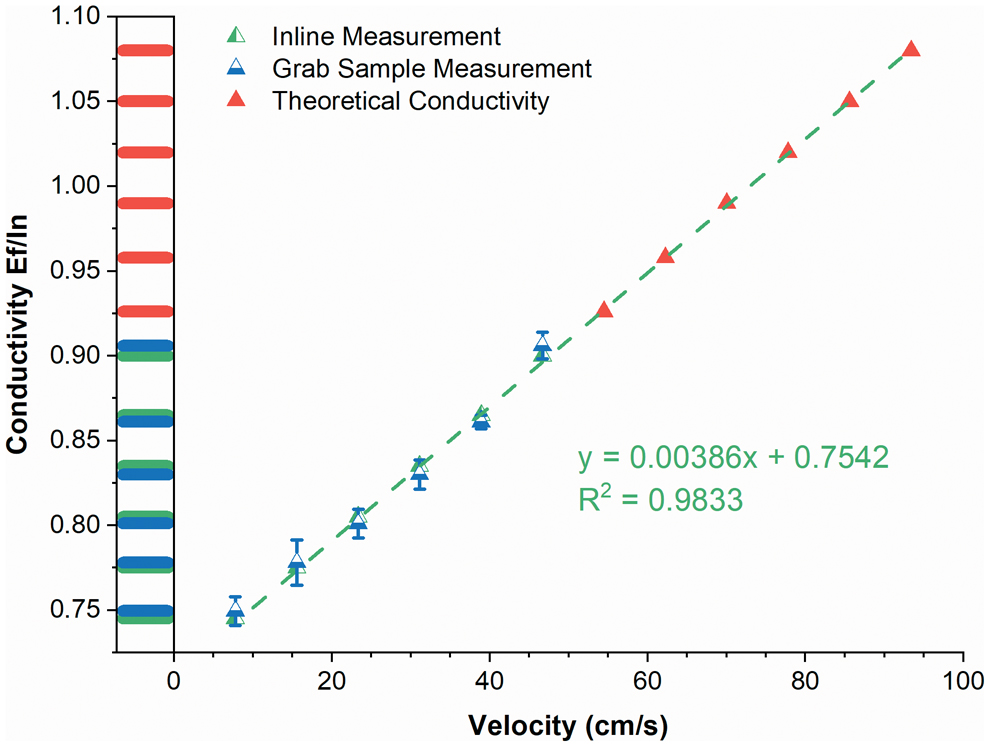
Normalized changes in solution electrical conductivity upon passing through the magnetic field as a function of fluid flow velocity (
Previous works have shown that the structure of the hydration shell surrounding ions is influenced/altered by the presence of a magnetic field (Holysz et al., 2007; Hus and Urbic, 2012). Differences in how this structure is altered have also been seen to be a function of whether the ion is characterized as a water structure ordering or disordering ion (Tang et al., 2011; Chibowski and Szczes, 2018). The more specific changes and explanations are summarized in introduction. Holysz et al. (2007) observed that the change(s) in conductivity persisted up to at least 30 min even after the magnetic field was removed. This phenomenon was termed as a “memory effect” by the water and was supported by a subsequent study by Holysz et al. (2007). Holysz et al. (2002, 2007) also suggested that exposure to a magnetic field weakened the hydration shell structure of ions in solution as weakening of the hydration shells around proton, hydroxide, potassium, and chloride ions. Because the electrical conductivity of a solution is inversely proportional to the diameter of the hydrated cation and anion, and when the hydration shell is weakened or distorted by the magnetic field, the conductivity of a solution is increased (Holysz et al., 2002, 2007). As was observed in the Szcześ et al.‘s (2011a) study, these researchers consistently saw an increase in solution conductivity upon exposure to a static magnetic field (B = 0.27 T). The magnitude of the observed increase was a function of the type (water structure ordering/disordering), and concentration, of salts present in solution. The change in conductivity, assuming constant conditions, was ascribed to a change in the thickness of the water layers, or hydration shell, around a given ion in solution. This reduces the hydrated radius of the ion and results in an increase in conductivity as originally hypothesized by Higashitani et al. (1995).
While changes in conductivity have been previously observed in the presence of magnetic fields of different strengths, correlations to flow velocity are missing from the literature. A mechanistic description of such relationships is also missing or is incomplete. As shown in Fig. 3, the electrical conductivity increased in a linear manner with fluid velocity. This phenomenon may be described by considering the reordering of water molecules (Pang, 2006). As the energy introduced by the magnetic field and applied to a water molecule and free protons, the ordering of water molecules were changed with effects of magnetic field on hydrogen bonds. Water molecules were reordered from free molecules to form water molecule chain shapes within the external magnetic field. as Also, the chain would contain more molecules if a stronger magnetic field was applied to the water. And the mechanism is described in introduction. The shown chains of water molecules, although did not affect hydration shell of ions to cause the changes on conductivity, such chains between water molecules would increase the ion concentration in the overall “water system.” Because as the chains of water molecules formed, they could be considered bigger molecular clusters (or bigger water molecules), and other ions such as metallic ions like calcium or nonmetallic ions like chloride would not exist in interior regions of these clusters due to steric hindrances. Therefore, as chains of water molecules were formed, the number of free water molecules in a given unit volume was reduced, and thus the ion concentration increased, leading to an increase in conductivity.
It has been reported that the relationship between velocity and alterations in hydrogen bonding is nonlinear, because of instinct nonlinear system properties (Ceriotti et al., 2013). Overall, some mechanisms on effects of magnetic field on electrical conductivity have been proposed and used to explain changes in conductivity. In this study, before the conductivity ratio increased with flow velocity, the effluent conductivity was lowered relative to the influent value at v = 10 cm/s. This decrease was explained using the mechanism provided by Szcześ et al. (2011b). However, that theory was not enough to demonstrate the later increased conductivity as the velocity increase.
Equation (5) illustrates the roles of, and relationships between, flow velocity through a magnetic field and electrical conductivity. Since the velocity in this study was much lower than the threshold velocity, according to impact of velocity on conductivity at lower range, the conductivity introduced by moving through the magnetic field should increase in a linear manner with flow velocity (Fig. 1). The results (Fig. 3) presented a linear relationship (R2 = 0.9833) between changes in solution electrical conductivity and flow velocity. Thus, the theory was supported by the experimental data. Therefore, the relationship,
Furthermore, to determine if the structuring of water molecules in solution had been altered by the MFED, FTIR absorption and NMR transverse relaxation were measured. It was found that with MFED magnetic field treatment at a flow velocity of 46.7 cm/s, the absorbance of effluent water samples was 0.05 absorbance units higher compared with the influent sample at λ = 3,300 cm−1; the absorbance of effluent samples was 0.025 higher compared with the influent sample at λ = 1,600 cm−1 (Fig. 4). Peaks at λ = 3,300 cm−1 and λ = 1,600 cm−1 are the two peaks water would present absorbance (Mojet et al., 2010). When the water molecules have different structures, including forming/deforming more hydrogen bonds or molecule chains, the FTIR spectrum absorbance would change accordingly. In this case, the FTIR absorbance is increased because the hydrogen bonds increase or water molecule chains are formed (Pang, 2006; Pang and Deng, 2008). Therefore, the MFED magnetic field treatment succeeded in altering water molecules.
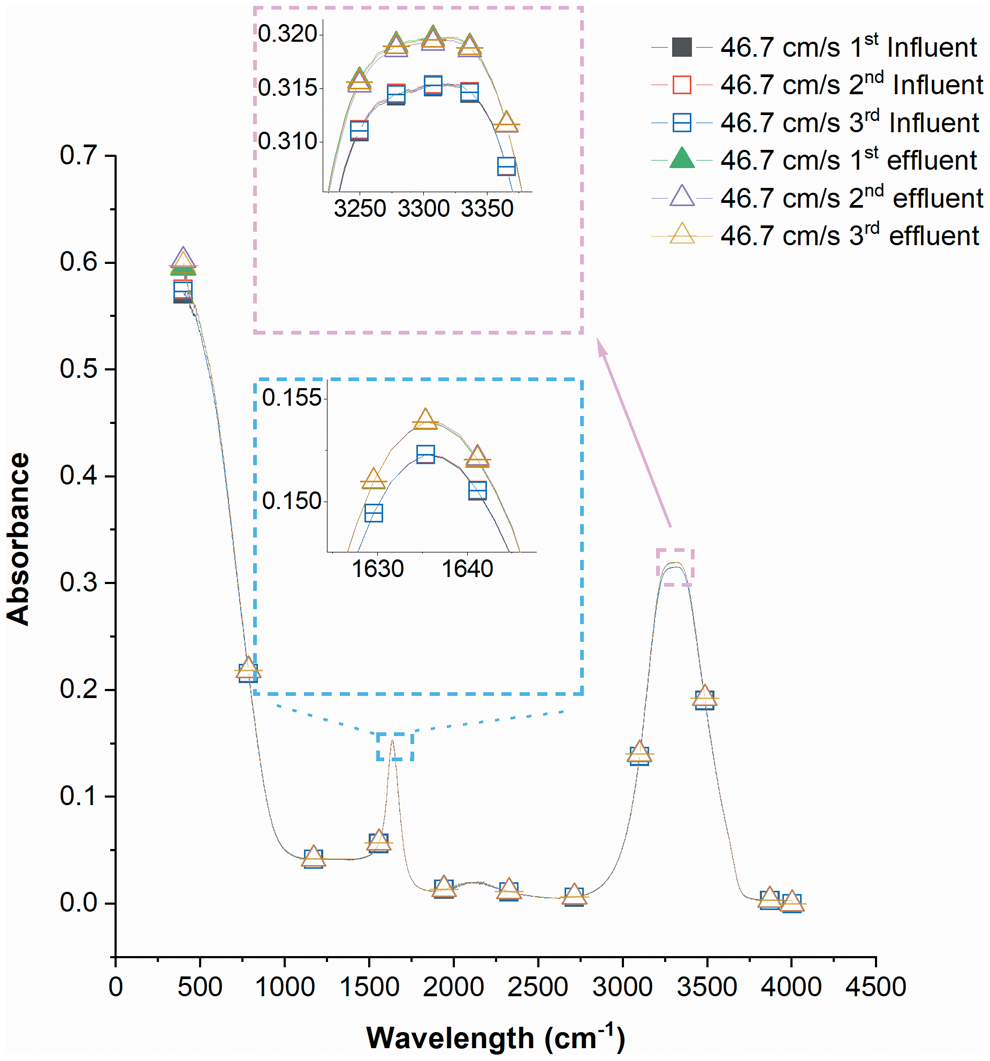
FTIR spectra of water prior, and posterior, to flowing through the magnetic field at a flow velocity of 46.7 cm/s. FTIR, Fourier transform infrared spectroscopy.
NMR transverse relationship (T2 relaxation) was conducted to determine if there were more free water molecules, or more bonded water molecules through hydrogen bonds, after the MFED treatment. A shorter T2 relaxation time means that the water molecules bonded with one another and/or other substances present in the solution relative to the untreated solution. A shorter T2 relaxation time could also mean there are stronger hydrogen bonds between water molecules and other substances in the solution. A longer T2 relaxation time means the water molecules are less bonded, or less tightly bonded, with other water molecules or substances (Thulborn et al., 1982; Hills et al., 1990; Jarymowycz and Stone, 2006; Cai et al., 2009). At a flow velocity of 46.7 cm/s through the MFED, the effluent water samples had a T2 relaxation time of 2246.21 ± 26.06 ms, while the influent, or untreated, water had a longer T2 relaxation time of 2279.81 ± 0 ms. This indicates that the MFED system increased the number and/or strength of the hydrogen bonding structure of the water molecules in solution in agreement with the theoretical assessments previously discussed. With magnetic field treatment, the proportion of free water molecules declined, and/or the hydrogen bonds were strengthened. And the NMR finding in this study also agreed with the ones reported by Cai et al. (2009). Hence, the hypotheses in this study were supported by both the FTIR and NMR results.
Conclusions
Proton concentration and electrical conductivity were altered as a function of flow velocity through the magnetic field generated by the MFED system. Changes (decrease) in proton concentration were inversely proportional to increases in flow velocity. This decrease was due to increased hydrogen bonding between water molecules and free protons and hydronium ions. Increases in electrical conductivity were a linear function of flow velocity over the value range studied here. This was due to weakening of the hydration shells around constituent ions and increases in internal electrical field. All experimentally observed changes in proton concentration and electrical conductivity were statistically significant and reproducible. Modification of water chemistry is therefore possible in flow-through conditions, and the magnitudes of these changes may be controlled through manipulation of flow velocity. These findings demonstrate that a fundamental property, hydrogen bonds, inherent to water systems may be manipulated using magnetic fields. This opens the door for affecting the properties and behaviors of diverse substances relevant to water/wastewater treatment, such as particle stability (coagulation) and mineral solubility. As such this work represents an important first step in reducing our reliance on chemical additives in water/wastewater treatment applications.
Footnotes

References
Supplementary Material
Please find the following supplemental material available below.
For Open Access articles published under a Creative Commons License, all supplemental material carries the same license as the article it is associated with.
For non-Open Access articles published, all supplemental material carries a non-exclusive license, and permission requests for re-use of supplemental material or any part of supplemental material shall be sent directly to the copyright owner as specified in the copyright notice associated with the article.
