




Abstract
A common azo dye, Reactive Red 195 (RR195), is widely used in the printing and dyeing industry. Due to the complicated composition of RR195, how to degrade it has aroused great interest from researchers. The extensive use of RR195 caused environmental pollution and irreversible recovery. More important, few reports have been made to investigate the degradation of RR195, especially intrinsic mechanism. Herein, we present a facile strategy for the synthesis of reduced graphene oxide-supported biphasic titanium dioxide (B-TiO2/rGO). Benefiting from high conductivity and specific surface area provided by rGO, the recombination efficiency of photoinduced electron-hole pairs stemming from TiO2 is significantly suppressed, and broadening the photoreaction range of TiO2, leading to more stable photocatalytic performance for RR195. The degradation efficiency of RR195 by using B-TiO2/rGO could reach 99% at neutral solution. This work provides a new insight to rational design high-effiency photocatalysts that hopefully applied to pratical industrial manufacture.
Introduction
With the development of nanotechnology, photocatalysis has attracted considerable attention as an extremely promising and effective method among various water purification methods. Titanium dioxide (TiO2) has become the most popular high-efficiency catalyst due to the advantages of its wide band gap, high oxidation-reduction potential, cost-efficiency, nontoxicity, and chemical stability (Wold and Aaron, 1993; Hoffmann et al., 1995; Yu et al., 2005; Andronic et al., 2011; Molea et al., 2014; Samsudin and Hamid, 2017). In particular, TiO2 has exhibited photocatalytic activity for dyeing wastewater (Liu et al., 2006; Pekakis et al., 2006; Manzoor and Pandith, 2019). However, the photocatalytic degradation of TiO2 for wastewater is restricted owing to its high energy band gap, rapid recombination of photoinduced electron-hole pairs, and slow mass transfer. These issues not only suppress photocatalytic activity of TiO2 but also hinder its practical application to some extent (Somekawa et al., 2008).
Currently, a feasible pathway for enhancing photocatalytic performance of TiO2 is to introduce an efficient support to achieve the synergistic effect. Various supports, including nanoscale porous zeolite, mesoporous silica, and carbonaceous materials, were used to construct composite materials (Cheng et al., 2016; Natarajan et al., 2017; Mahdiani et al., 2018; MiarAlipour et al., 2018). Integrating TiO2 into the functional support can minimize recombination of electron-hole pairs and facilitate mass transfer, resulting in the improvement of photocatalytic efficiency of TiO2-based hybrids (Shokri et al., 2016; Low and Lai, 2018), which exhibited good photocatalytic performance for methyl orange, rhodamine B, and others (Wang and Zhou, 2011; Alamelu et al., 2018; Nguyen et al., 2019). However, TiO2 need to be supported by a binder to be better to be supported on a carrier endowed with rapid adsorption capacity characteristics. In addition, Reactive Red 195 (RR195) is hard to degrade due to the stability of azo group, leading to very few reports of this dye degradation than other dyes. The previous research results indicate the valid degradation pH of RR195 is ranging from 3 to 6 (Belessi et al., 2009; Chládková et al., 2015; Salamat et al., 2017). Hence, an environmental support with good adsorption ability is needed urgently for the enhancement of TiO2 for RR195, which can be acted as satisfying ingredients in an effective and feasible way.
Graphene with an ideal 2D geometric structure has been emerged as one of the most promising functional materials since it was discovered in 2004 (Novoselov et al., 2004). Compared with other supports, its unique merits, such as high electronic conductivity, zero-gap semiconductor, and ultrahigh specific surface area enable graphene to be a good support that can effectively increase carrier mobility without any adhesive agent (Dikin et al., 2007; Bonaccorso et al., 2010). TiO2 can be integrated into graphene nanosheets through the interaction, simultaneously photoelectrons resulted from TiO2 are transfered to the graphene. The photoinduced electrons and holes are confined, respectively, in heterogeneous media to suppress the recombination of electron-hole pairs, and to broaden the photoreaction range of TiO2, leading to more stable photocatalytic performance (Wang and Zhou, 2011).
Motivated by need, in this work, biphasic TiO2/reduced graphene oxide composites (B-TiO2/rGO) were prepared by a facile hydrothermal method (Fig. 1). Anchoring B-TiO2 nanoparticles on rGO surface forms the heterostructures, in which the reduction of graphene oxide (GO) and the immobilization of B-TiO2 on the surface of the rGO occur simultaneously. The photocatalytic activity of the as-prepared B-TiO2/rGO hybrids was evaluated by degradation rate of RR195. Compared with independent B-TiO2, B-TiO2/rGO exhibits enhanced adsorption and degradation of dye at pH 7 under ultraviolet (UV) light irradiation. More importantly, it also displays a favorable reusability and the stability in aqueous solution.
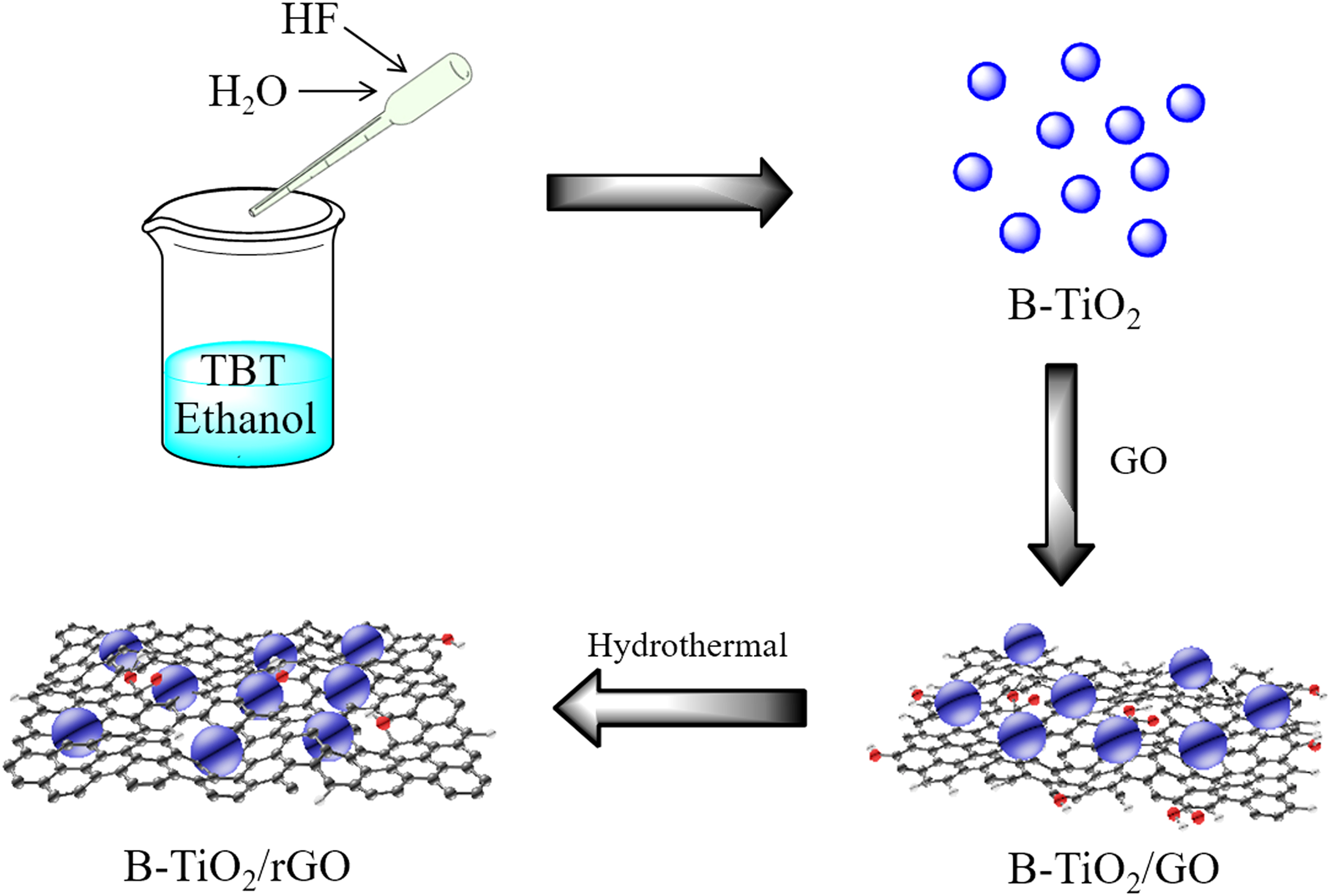
Schematic illustration for the synthesis of B-TiO2/rGO. B-TiO2/rGO, reduced graphene oxide-supported biphasic titanium dioxide.
Experimental
Chemicals
Natural graphite powder (325 mesh) was purchased from Qingdao Huatai Lubricant Sealing S&T Co., Ltd. Tetrabutyl titanate (TBT) was purchased from Chinasun Specialty Products Co., Ltd. Hydrofluoric acid (HF) and sodium hydroxide (NaOH) were purchased from Xilong Scientific Co., Ltd. RR195 was obtained from Zhejiang Lonsen Chemical Dyestuff Co., Ltd. All chemicals were used as received without any purification.
Synthesis of GO
GO was prepared with a modified hummers' method. Typically, graphite powder (0.7 g), NaNO3 (0.4 g), and H2SO4 (25 mL) were added to the flask, then KMnO4 (2.8 g) was slowly added to the above solution under stirring in ice bath. Afterward, the mixture was heated to 35°C with stirring for 3 h, and the temperature of reaction system was heated up to 95°C, followed by pouring deionized water (80 mL) to the solution and stirring for 1 h. Subsquently, H2O2 (20 mL) was added to remove the excess KMnO4, and the reaction mixture was washed with 5% HCl and deionized water until the pH value stabilized around 6–7. Finally, the resultant GO dispersion was dried at 60°C for further use.
Synthesis of B-TiO2
In a typical procedure, TBT was mixed with ethanol absolute with agitation for 5 min, then a mixture containing ethanol absolute and HF was added slowly to the TBT solution with magnetic stirring until the formation of milky white solution. After continuous stirring for 1–1.5 h, the resultant solution was transferred to a 100 mL Teflon-lined stainless-steel autoclave, followed by the treatment from room temperature to 150°C and kept for 12 h. Afterward, the obtained product was washed with ethanol absolute and deionized water before dried at 80°C. Finally, the products were calcined at 450°C, 550°C, 650°C, and 750°C for 4 h in the muffle furnace, respectively, and then the samples were grounded into powder.
Preparation of B-TiO2/rGO composites
Ten milligrams GO was added into a mixed solution containing ethanol absolute and deionized water with ultrasonication for 1 h until a brownish solution was formed. One hundred milligrams TiO2 samples were added to GO aqueous solution, followed by ultrasonicating for 3 h, and subsequently transferred to a 100 mL Teflon-lined stainless-steel autoclave at 120°C for 3 h. Finally, the mixture was washed three times with deionized water and then dried at 75°C to yield B-TiO2/rGO composites.
Characterization
The structures of TiO2 samples were performed with X-ray diffraction (XRD; D8 ADVANCE, Germany) with Cu-Kα radiation in the scanning 2θ range from 20° to 80° and with Raman spectrometer (Ram; Horiba, Japan). The structures and morphologies of rGO and B-TiO2/rGO composites were characterized by scanning electron microscopy (SEM; JSM-6510, Japan) and field emission scanning electron microscope (transmission electron microscopy, TEM; FEI TECNAI G2 F20, American) coupled with energy-dispersive spectrometry (EDS). The diffuse reflectance spectroscopy (DRS) was carried out with spectrpmeter (TU-1901, China). Fourier transform infrared spectroscopy (FTIR) spectra were recorded on a FTIR analyzer (FTIR; IS10) using KBr pellet method in the range of 400–4000 cm−1. Chemical bond energy was analyzed via X-ray photoelectron spectroscopy (XPS; ESCALAB 250Xi). The Brunauer-Emmett-Teller (BET) surface area measurements were characterized with nitrogen (N2) adsorption-desorption isotherms at 77 K (BET; ASAP 2020 PLUS HD88).
Photocatalytic activity evaluation
The photocatalytic performance was evaluated by degradation of RR195. The RR195 (20 mg/L) aqueous solution was prepared with tap water (at pH 7) and its initial absorbance was first tested. Ten milligrams catalysts were dispersed in 100 mL RR195 solution, which were stirred in a dark environment for 30 min to reach adsorption equilibrium. Then photocatalytic reactions were tested under 250 W mercury lamp (365 nm) for 2 h. The sampling time was considered to be once every 15 min and the residual dye concentrations were analyzed at 543 nm by a V-1200 visible spectrophotometer (Shanghai, China). The efficiency of RR195 degradation (D) was calculated by the following equation:
D = (C0 - Ct) / C0 × 100%
where C0 and Ct are the absorbance of RR195 before and after photocatalysis at time, respectively.
Results and Discussion
Figure 2 illustrates the XRD patterns of TiO2 samples calcined in the range from 450°C to 750°C. The peaks of TiO2 samples obtained from the calcination at 450°C and 550°C clearly correspond to anatase phase (black and blue curves). With increasing of the calcination temperature (up to 650°C), the diffraction peaks centered at 27.45° are observed, indicating that the rutile phase was formed but with weak intensity. However, at 750°C, the intensity of the diffraction peaks of anatase phase (25.42°, 54.07°, and 55.35°) gradually weakens or even disappears, while the diffraction peaks of rutile phase at 27.45°, 36.33°, and 41.24° are more pronounced. The crystal structure of TiO2-750 is predominantly rutile with a little anatase. This phenomenon indicates a part of anatase TiO2 is gradually converted into rutile TiO2 with the increase of the calcination temperature. However, Sclafani et al. (1990) found that TiO2 nanoparticles form agglomerates as the temperature is higher than 700°C, which leads to low specific surface area, and further influences its photocatalytic activity (Sclafani et al., 1990; Bokhimi et al., 2001).

XRD patterns of TiO2-T (T refers to calcination temperature, 450°C, 550°C, 650°C, and 750°C) samples at different calcined temperature with a heating rate of 5°C min−1 under air flow. XRD, X-ray diffraction.
In addition, structure characterization and optical properties of TiO2 samples obtained from different calcination temperature are shown in Fig. 3. The characteristic peaks of Raman spectra at 143, 397, 516, and 639 cm−1 are assigned to the anatase TiO2 (Fig. 3a). As seen from the range of 400 to 700 cm−1 in magnified Raman spectra (insert in Fig. 3a), another two weak peaks of TiO2 calcined at 650°C and 750°C appear at 435 and 602 cm−1. This is in accordance with rutile phase, moreover, the intensity of these peaks significantly increases in TiO2-750. All these results also prove the coexistence of anatase and rutile TiO2 in TiO2-650 and TiO2-750, and the content of rutile TiO2-T samples increases as rising calcination temperature.
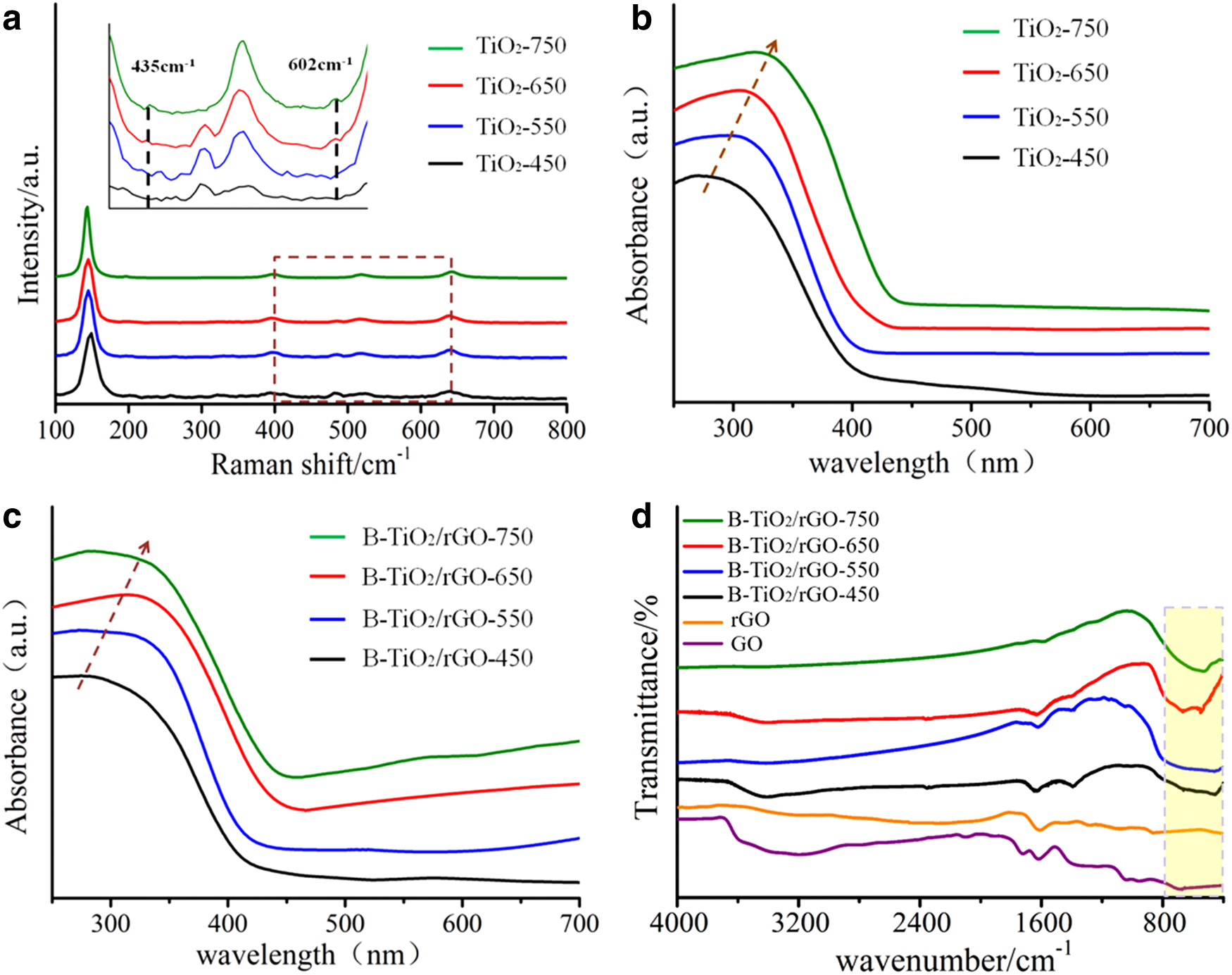
DRS of TiO2-T samples clearly indicate UV light are absorbed over the range of 230–410 nm (Fig. 3b). With increasing calcination temperature, a shift to higher wavelength is detected for TiO2-T samples, and intensity of their light absorption enhances gradually. The results also confirm that the crystal structure of one-phase TiO2 is converted to B-TiO2 composed of anatase and rutile as the calcination temperature above 650°C. Since the presence of appropriate amount of rutile phase, the asymmetry and defects between the anatase phase increase. The B-TiO2 has a stronger absorption of visible light than the one-phase TiO2, and this phenomenon is called as the mixed-phase effect, namely B-TiO2 (Zhang et al., 2006).
According to the above mentioned analysis, B-TiO2 samples calcined at both 650°C and 750°C have a stronger absorption capacity in higher wavelength region. By introducing reduced graphene oxide to form composite (B-TiO2/rGO), the optical performance of TiO2 could be tuned. Figure 3c shows the DRS of B-TiO2/rGO composites. The spectra of B-TiO2/rGO samples display a more noticeable red shift to the visible-light range than TiO2 due to the incorporation of rGO, which reduce the band gap of TiO2 and form the interaction with TiO2. Among all samples, the B-TiO2/rGO-650 shows the most obvious red shift phenomenon, that may be with the reason that GO and TiO2 have the best attachment in B-TiO2/rGO-650 compared with other samples.
FTIR spectra of GO, rGO, and B-TiO2/rGO are shown in Fig. 3d. For GO, the broad absorption bands near 3396 and 1620 cm−1 are assigned to the stretching and bending vibrations of −OH group originated from the adsorbed moisture, respectively (Liu et al., 2010). The band at 1620 cm−1 is attributed to stretching vibration of C = C. Moreover, the band at 1718 cm−1 represents carboxyl stretching vibration of C = O, and the band at 1392 cm−1 correspondes to bending vibration of O-H. Furthermore, the bands centered at 1229 and 1028 cm−1 are ascribed to the C-O-C stretching vibration and C-O stretching vibration, respectively (Liu et al., 2015). All of the bands above show the presence of oxygen containing functional groups on the surface of GO, which have the possibility for the combination with TiO2.
After hydrothermal treatment of GO, the intensity of absorption peaks related to these above oxygen functional groups decreases significantly, confirming that GO has been reduced into rGO during hydrothermal reaction. However, the spectrum of B-TiO2/rGO displays a low absorption peak intensity of the oxygen functional groups compared to pure GO, which is similar to the rGO. New absorption bands of B-TiO2/rGO can be observed over the range of 400–800 cm−1, which are originated from the vibration overlap of Ti-O-Ti and Ti-O-C (Zhang et al., 2009). It reveals the presence of chemical interaction between TiO2 and rGO. Besides, the peak strength of the B-TiO2/rGO-650 is highest among all B-TiO2/rGO-T samples, indicating that GO can possess the strong chemical combination energy at this calcination temperature.
The morphologies of rGO and B-TiO2/rGO are investigated by SEM and TEM. As shown in Fig. 4a, rGO has a continuous film structure with some wrinkles. After the composites of TiO2 with GO, TiO2 nanoparticles are anchored on graphene sheets (Fig. 4b, c). Figure 4d shows the EDS spectrum and the corresponding elemental compositions of B-TiO2/rGO. C, Ti, and O elements are observed clearly in the composite material, revealing the successful intergration of TiO2.

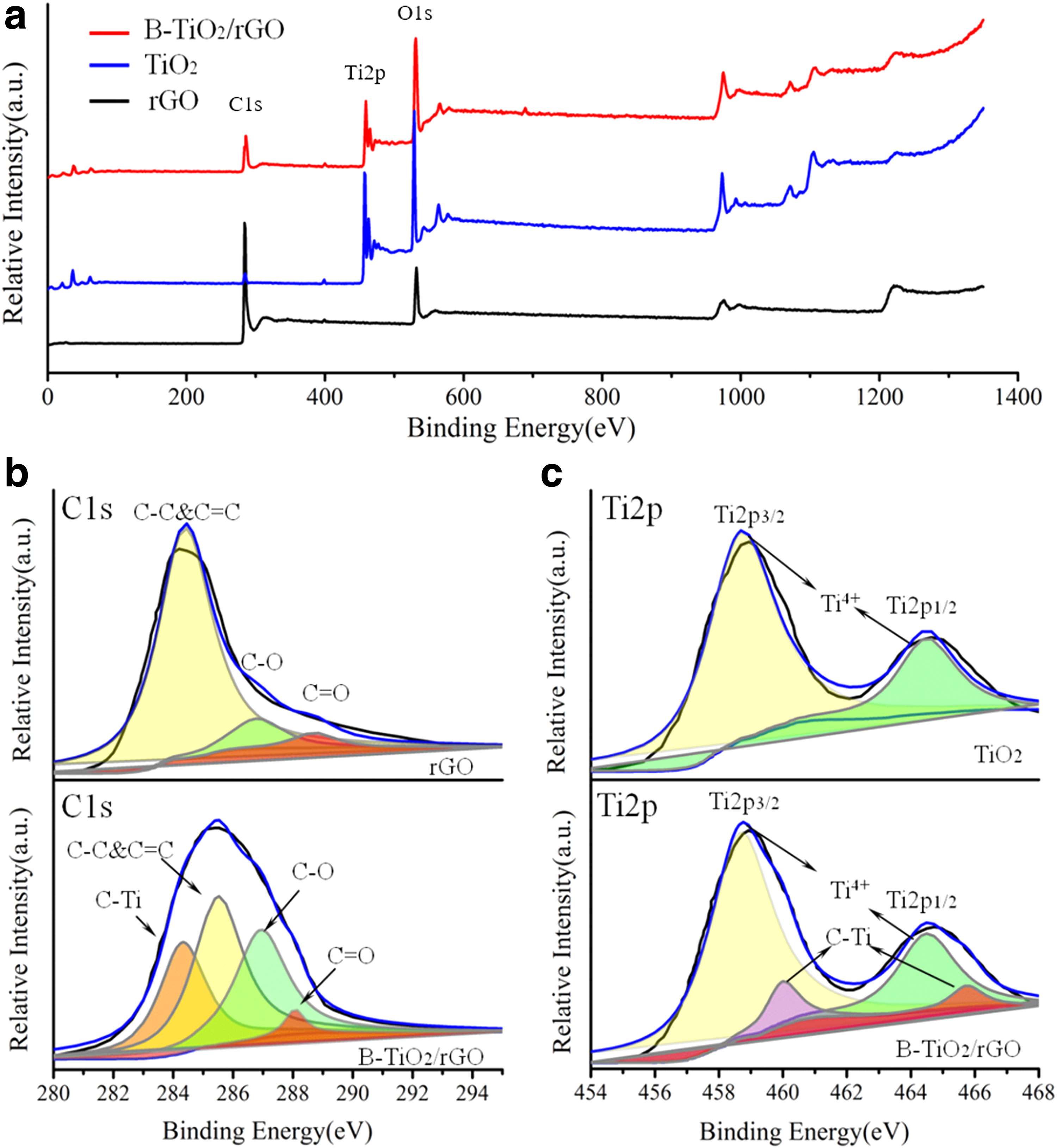
The survey XPS of rGO, TiO2, and B-TiO2/rGO are shown in Fig. 5a. The appearance of C 1s, Ti 2p, and O 1s indicates the existence of C, Ti, and O elements in B-TiO2/rGO. The C1s spectrum of rGO exhibits three peaks at 284.7, 287.1, and 288.9 eV, which correspond to C-C, C-O, and C = O, respectively (Fig. 5c) (Zhang et al., 2013). In addition, a new shoulder peak located at 284.3 eV, is found in B-TiO2/rGO, which is assigned to the formation of Ti-C bonds (Dolat et al., 2015). The results demonstrate that chemical bonds between carbon and titanium atoms form in the B-TiO2/rGO. The high-resolution Ti 2p peaks of B-TiO2 located at 458.7 and 464.5 eV are attributed to Ti 2p3/2 and Ti 2p1/2, respectively. In contrast to pure TiO2, the appearance of another two weak peaks centered at 460.2 and 466.1 eV are originated from the formation of C-Ti bond (Pan et al., 2015). Furthermore, compared with the peak of Ti 2p3/2 in B-TiO2/rGO at 459.0 eV, the red shift of Ti 2p3/2 in TiO2 to 458.7 eV proves that TiO2 are successfully bonded to rGO (Shokri et al., 2016).
The specific surface area and pore structure of the TiO2-650 and B-TiO2/rGO-650 were carried out by the N2 adsorption desorption measurements at 77 K. The BET equation and Barrett-Joyner-Halenda (BJH) methods were used to characterize the specific surface areas and pore diameters of samples, respectively. As shown in Fig. 6, both of TiO2-650 and B-TiO2/rGO-650 exhibit similar type-IV isotherm, revealing the presence of abundant mesoporous. The isotherm of TiO2-650 has H3 hysteresis loop characteristic, while that of B-TiO2/rGO-650 has H4 hysteresis loop characteristic, which is attributed to the fact that rGO holds layered pores. According to the BET analysis, the specific surface areas of TiO2-650 and B-TiO2/rGO-650 are calculated to be 28.8 and 47.2 m2/g, respectively (Supplementary Table S1). The higher specific surface area of B-TiO2/rGO-650 may be due to the curving of rGO, which will contribute to enhancing the absorption ability of photocatalyst for RR195.
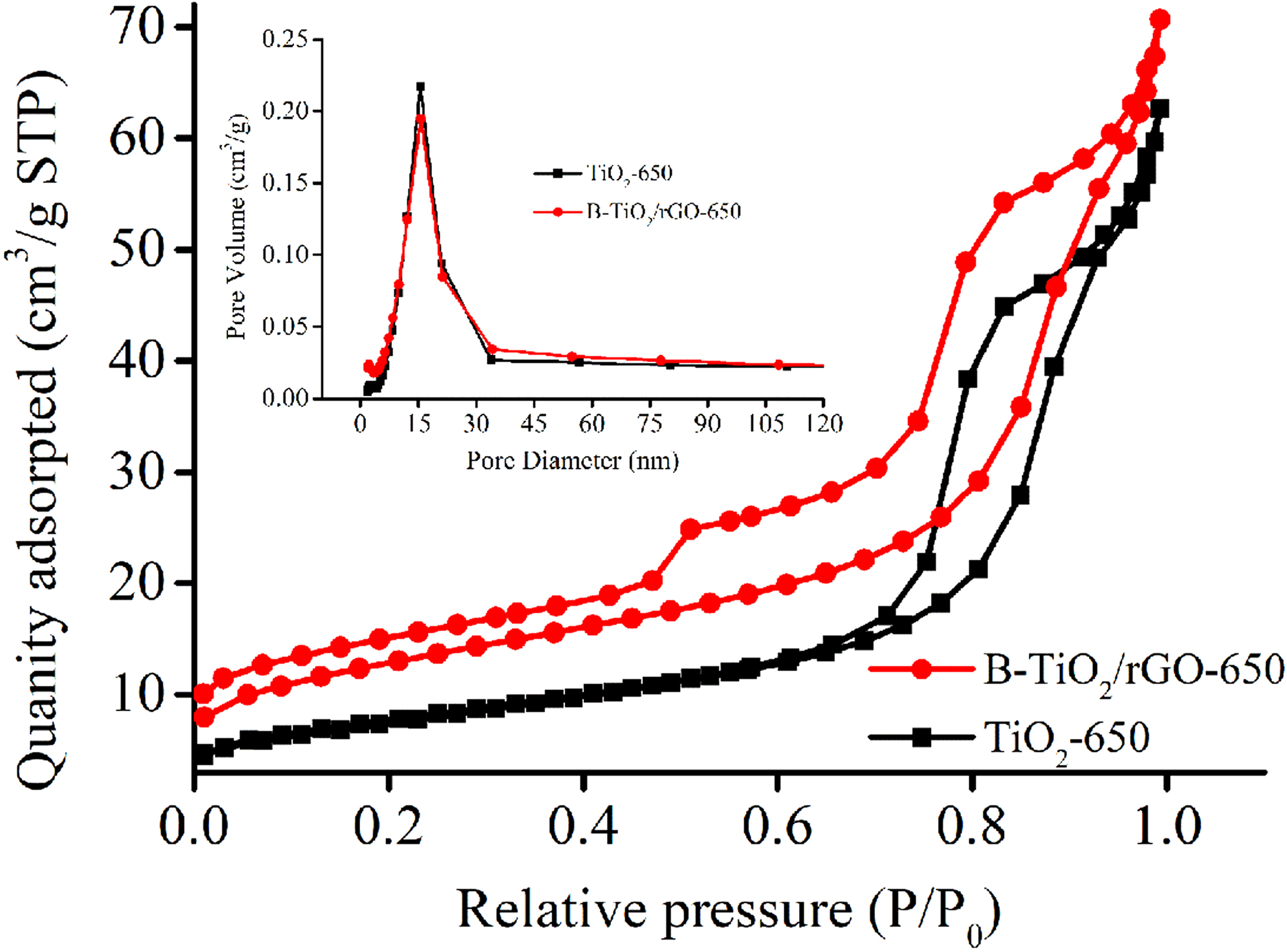
N2 adsorption-desorption isotherms and the corresponding pore-size distributions of TiO2-650 and B-TiO2/rGO-650.
RR195 is a bright red organic dye with good water-solubility, level dyeing property, and dispersibility, which is commonly used for dyeing and printing in most plants. As shown in Fig. 7a, RR195 has two naphthalene nucleus in connection with azo-bond, one naphthalene nucleus in the structure of RR195 connects adjacent azo and hydroxyl group, which can easily form a stable intramolecular hydrogen bond. With the reason that the wastewater, including RR195, is difficult to decolorize with ordinary wastewater treatment methods.
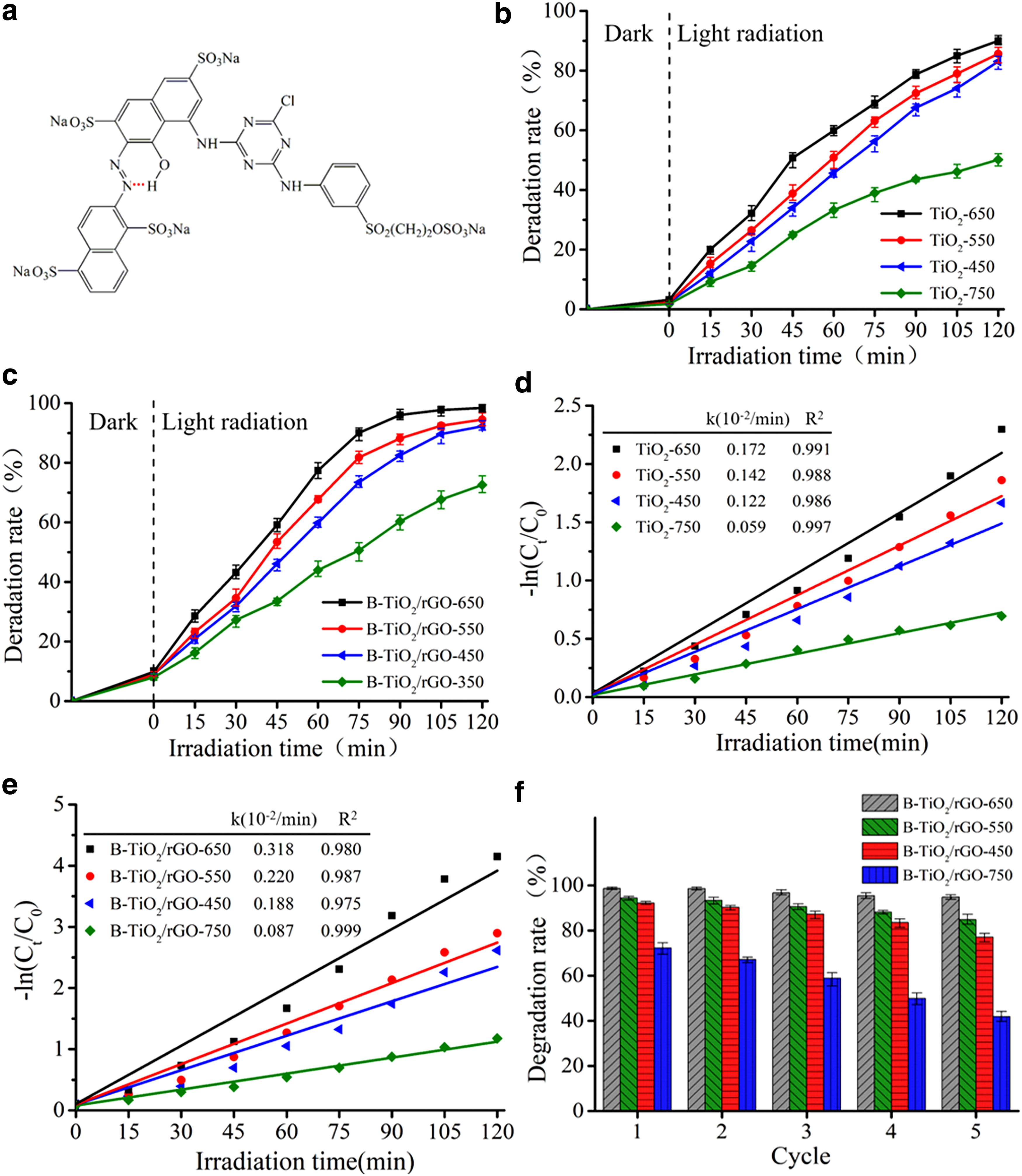
In this study, RR195 was used to explore the photocatalytic performance of TiO2 and B-TiO2/rGO under UV light irradiation. Before UV light irradiation, RR195 solution with catalysts was maintained in the dark for 30 min under stirring to reach the adsorption equilibrium, and its degradation rate was calculated for analyzing photocatalytic ability of TiO2 and B-TiO2/rGO (Supplementary Figs. S1 and S2). The results are shown in Fig. 7b and c. The photodegradation efficiency of RR195 by using TiO2 decreases as follows: TiO2-650 > TiO2-550 > TiO2-450 > TiO2-750. It is seen that degradation rate of RR195 by TiO2-650 is up to 89.94%, which is higher than that of TiO2-550 and TiO2-450, but 50.15% for TiO2-750. This may be because large proportion of rutile phase in TiO2-750 has a weaker absorption capacity for UV light than dominated anatase samples (Foger et al., 1991; Campostrini et al., 1994). The afore-mentioned results draw the conclusion that optimized TiO2-650 composed of mixed phase with a high proportion of anatase is a promising candidate for the enhancement of high photocatalytic activity.
After integrating B-TiO2 to rGO, the degradation rate of B-TiO2/rGO for RR195 is obviously higher than pure TiO2. The photodegradation efficiency are as follows: B-TiO2/rGO-650 > B-TiO2/rGO-550 > B-TiO2/rGO-450 > B-TiO2/rGO-750. Among them, B-TiO2/rGO-650 exhibits best degradation effect up to 98.42%. This may be caused by on the one hand, rGO has a large specific surface area, which facilitates the adsorption of RR195 on the surface of rGO (Zhang et al., 2007; Liu et al., 2012). On the other hand, it was found that rGO can play a role as electron acceptors in decreasing the rate of recombination of electron-hole pairs, thereby improving photocatalytic efficiency of composites (Williams et al., 2008; Dang et al., 2013). The photocatalytic efficiency of B-TiO2/rGO-650 is highest, because the chemical bonding energy between rGO and TiO2 is strongest at this calcination temperature, which can also be proved by FTIR spectra. Furthermore, the synergistic effect of rGO on the photocatalytic action of TiO2 could improve its photocatalytic activity.
Figure 7d and e shows the pseudo-first-order kinetic behavior of RR195 photodegradation catalyzed by TiO2 and B-TiO2/rGO. The reaction rate constant (k) is determined by the intercept of the plot of −ln(Ct/C0) against time t. The k of TiO2-650 toward RR195 is 0.0172 min−1, which is higher than that of TiO2-550, TiO2-450, and TiO2-750. The calculated k value of B-TiO2/rGO is evidently higher than pure TiO2. Among B-TiO2/rGO composites, k of B-TiO2/rGO-650 is the highest, which is up to 0.0318 min−1, indicating that B-TiO2/rGO-650 has great photodegradation activity toward RR195.
The stability and reproducibility of the photocatalyst are very important for practical applications and were performed to measure photocatalyst stability of B-TiO2/rGO. To this aim, the B-TiO2/rGO samples were separated at the end of each cycle by centrifugation, after washing and drying them, which were reused for the RR195 removal under the same conditions. As displayed in Fig. 7f and Supplementary Fig. S3, the photodegradation rate of RR195 by B-TiO2/rGO-650 remains 94.80% after five cycles. But B-TiO2/rGO at other calcination temperatures have different degrees of decrease. These results clearly demonstrate that B-TiO2/rGO-650 is stable with repeated use under a neutral condition, which can also be attributed to the strong chemical interaction between TiO2 and rGO.
Figure 8a shows the corresponding changes in the UV-vis absorption spectra of RR195 in the presence of B-TiO2/rGO-650 during the photocatalytic degradation process. When the B-TiO2/rGO-650 is dispersed in RR195 aqueous solution in dark for 30 min, the peaks of RR195 start to weaken, which can be owing to the adsorption capacity of B-TiO2/rGO-650. During the photodegradation process for 150 min, the intensity of UV absorbance of RR195 decreases continuously, illustrating that RR195 is successfully degraded by B-TiO2/rGO-650.
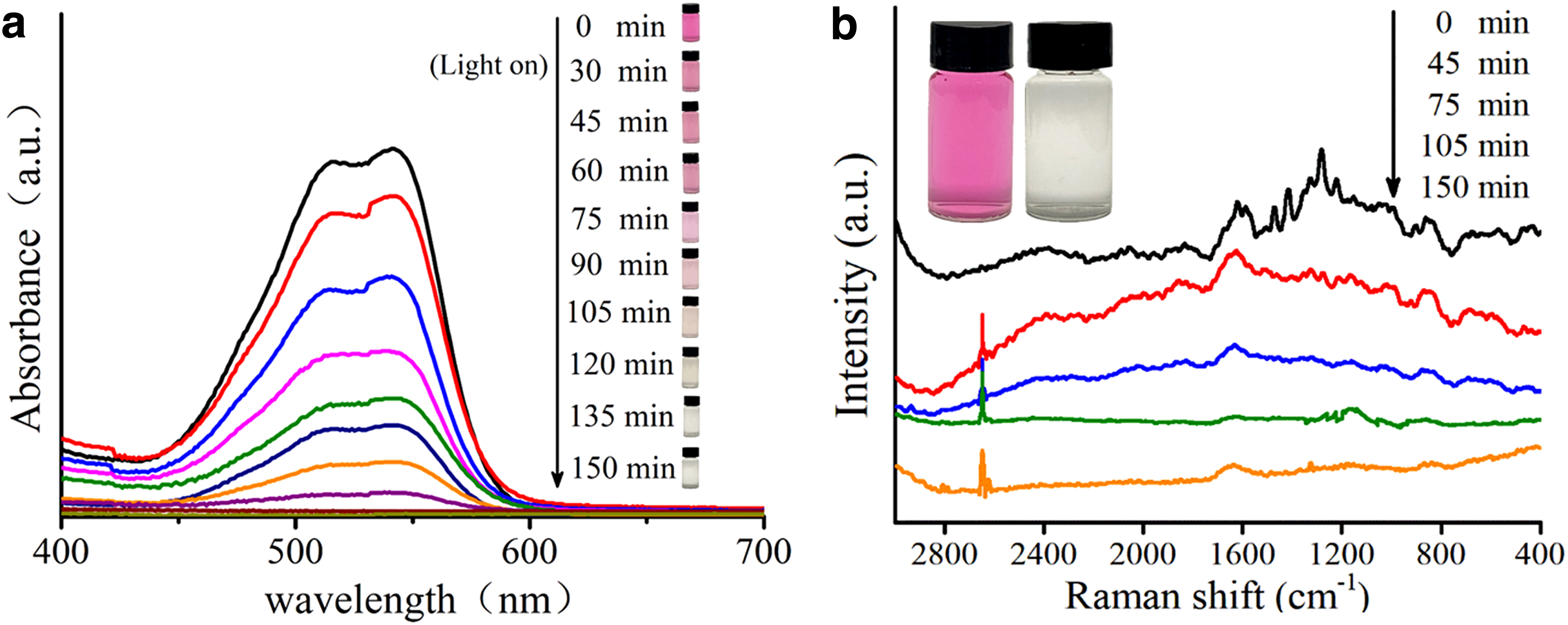
The time-dependent Raman spectra of RR195 in the presence of B-TiO2/rGO-650 are displayed in Fig. 8b. In the first 45 min, the intensity of some peaks decreases. Hereafter, the intensity of the main absorption peaks for RR195 decreases rapidly with the increase of irradiation time and even disappears after degradation for 150 min, which also proves that RR195 can be removed by B-TiO2/rGO-650.
Figure 9 elucidates the possible photocatalytic mechanism for B-TiO2/rGO. Under the irradiation of UV light, as the energy of the light wave greater than the band gap energy of TiO2, the electrons (e-) on the valence band (VB) of TiO2 are excited to the conduction band, leaving equal amounts of positively charged holes (h+) in the VB (Etacheri et al., 2015). rGO can act as a electron guest because of its electrical and optical properties. Therefore, the photogenerated electrons can transfer to rGO through the intimate interfacial contact between TiO2 and rGO. Then, during the transfer process, the lifetimes of the excited electrons (e-) and holes (h+) are prolonged and the recombination rate of electron-hole pairs is inhibited (Shokri et al., 2016; Wang and Zhou, 2011). The strong oxidizing holes on the VB can react with oxygen to form superoxide anion radicals (·O2−), the separated holes on the VB of TiO2 can also be directly trapped by oxygen to form reactive oxygen species, which can react with either water (H2O) or hydroxyl ions (OH−) adsorbed on the catalyst surface to generate hydroxyl radicals (·OH). Both ·O2− and ·OH have strong oxidizing abilities and are capable of degrading RR195 into gases such as CO2, NH3, N2, and low molecular mass organic acids such as oxalic acid and acetic acid (Song et al., 2010).
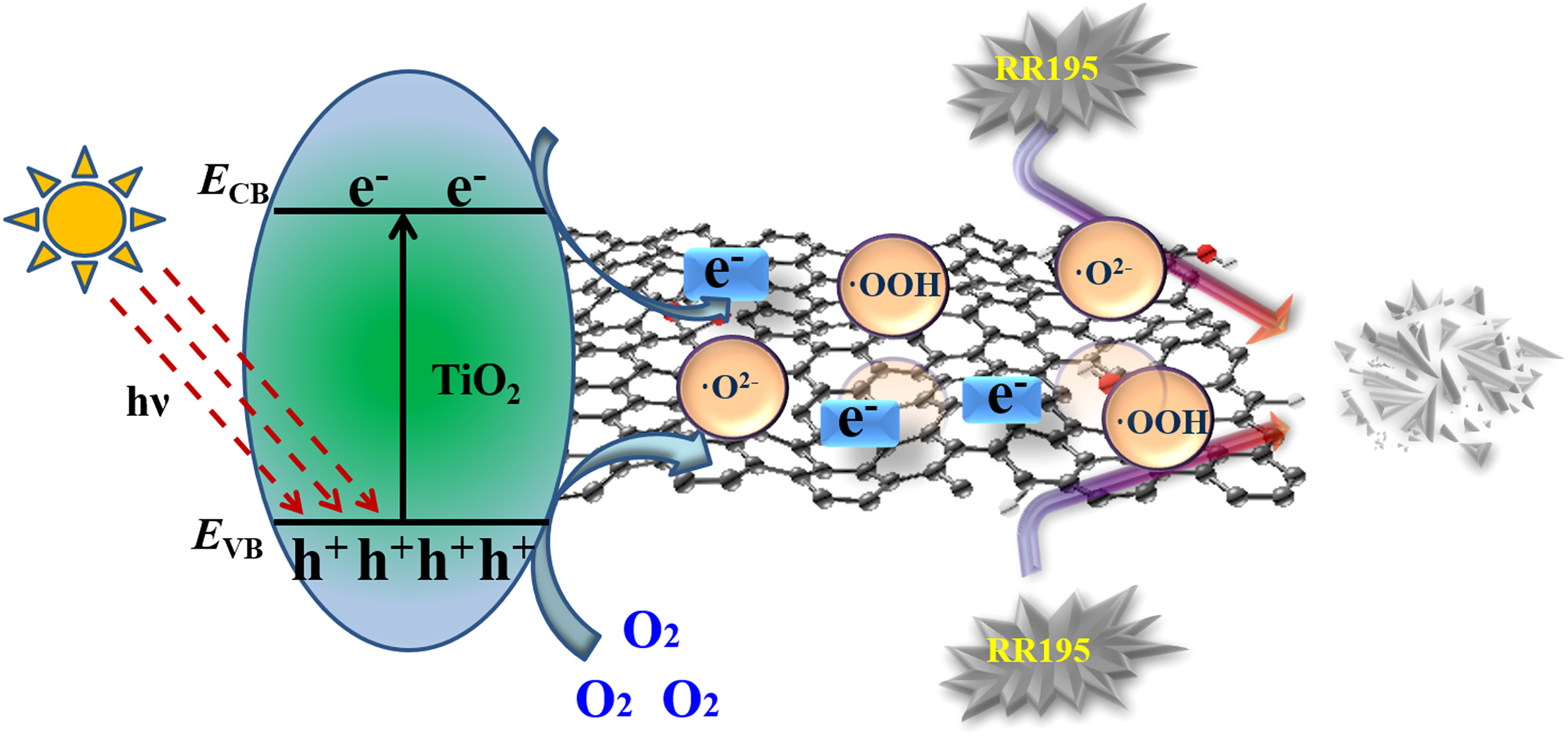
Schematic illustration of high photocatalytic activity for B-TiO2/rGO composites.
Conclusion
In conclusion, B-TiO2 and B-TiO2/rGO composites were successfully prepared via hydrothermal method and characterized by various methods. We demonstrated that the chemical interaction of Ti-O-C between TiO2 and rGO is formed. The absorption edge of B-TiO2/rGO has a red shift compared with TiO2 because the photoelectron of TiO2 easily transfer to the surface of graphene. The electrons and holes are, respectively, confined in different phases, which supress the recombination of electron-hole pairs and enhance the light utilization capacities. Further, compared with TiO2-650, B-TiO2/rGO-650 exhibits outstanding photocatalytic performance due to the synergistic effect. During recycled photoactivity tests, the degradation efficiency of B-TiO2/rGO-650 for RR195 remains 94.80% even after five cycles under a neutral condition. Therefore, the photocatalysts prepared by this method will have a promising prospect in efficiently removing the organic pollutants.
Footnotes
Author Disclosure Statement
No competing financial interests exist.
Funding Information
The authors thank the National Nature Science Foundation of China (61571245); Research Fund of Nantong University (03083030) for financial support and the Nantong University Analysis & Testing Center for structure and morphology characterization.

References
Supplementary Material
Please find the following supplemental material available below.
For Open Access articles published under a Creative Commons License, all supplemental material carries the same license as the article it is associated with.
For non-Open Access articles published, all supplemental material carries a non-exclusive license, and permission requests for re-use of supplemental material or any part of supplemental material shall be sent directly to the copyright owner as specified in the copyright notice associated with the article.
