




Abstract
Antibiotics are often used excessively in the livestock industry, and the effluent from livestock wastewater treatment is one of the main sources of antibiotic resistance genes (ARGs) in the environment. Biological treatments and traditional disinfection cannot effectively remove ARGs from this wastewater. This study evaluated the feasibility of removing ARGs from actual swine wastewater treatment effluent using single and sequential electrocoagulation (EC) and electro-Fenton (EF) processes. An EC process with 60 min of electrolysis removed the selected intracellular ARGs with a removal efficiency of 2.21–2.83 logs and the extracellular ARGs with a removal efficiency of 1.82–2.56 logs. In comparison, the EF process was less efficient for the removal of intracellular ARGs (1.03–2.19 logs), but more efficient for the removal of extracellular ARGs (3.19–4.02 logs). Compared to the individual EC and EF processes alone, the sequential EC/EF processes were more effective for the removal of both intracellular and extracellular ARGs, with 2.49–3.25 logs and 3.23–4.38 logs of removal efficiency, respectively. Our results show that the sequential EC/EF treatment might be a promising technology for removing both intracellular and extracellular ARGs from swine wastewater.
Introduction
Antibiotic resistance genes (ARGs) have been identified as emerging pollutants in the environment that reduce the efficacy of antibiotics for infectious diseases, especially in less-developed countries (Goff and Rybak, 2015). This antibiotic resistance can also be disseminated by the sharing of ARGs among microorganisms using a mechanism called horizontal gene transfer (Berendonk et al., 2015). Intracellular ARGs readily adapt to new hosts, and extracellular ARGs, which are released from dead bacterial cells and are often two to three orders of magnitude less abundant than intracellular ARGs, can play an important role in the propagation of ARGs (Dong et al., 2019). The livestock industry is one of the most important economic activities in China, where antibiotics are often excessively used to promote animal growth, as well as to prevent and cure diseases (Zhang et al., 2015a). Animal farms are considered to be important reservoirs of ARGs, and livestock wastewater effluents might be significant sources of the ARGs released into the environment (Auguet et al., 2017). Although disinfection is usually performed after the biological treatment of livestock wastewater, the levels of ARGs in the effluents are still very high, and the discharge and land application of the treated wastewater represent a great threat to the surrounding environment (Jia et al., 2017).
Conventional disinfection processes such as chlorination, ultraviolet (UV) irradiation, and ozone oxidation have been evaluated for the removal of ARGs from wastewater but were determined to be inefficient (Sharma et al., 2016). Usually, a dose of chlorine greater than 30 mg/L, a dose of UV irradiation greater than 10 mJ/cm2, or a dose greater than 3 mg/L ozone is required for the effective inactivation of ARGs (Oh et al., 2016; Zheng et al., 2017). However, high doses of disinfectant could simultaneously greatly increase the possibility of ARG transfer (Guo et al., 2015). Advanced oxidation processes such as Fenton oxidation, TiO2 photocatalysis, and UV/H2O2 not only showed high removal efficiencies of 2.3–5.8 logs of ARG reduction but also presented a low risk of ARG transfer (Zhang et al., 2016; Guo et al., 2017). Nevertheless, the high energy consumption of these processes and the addition of chemical reagents are still problems to be solved.
In the last few years, electrochemical disinfection has received particular attention. As a prospective technology for water and wastewater disinfection, electrochemical disinfection is more eco-friendly and cost-effective than conventional disinfection methods (Ghernaout, 2013). Electrocoagulation (EC) and electro-Fenton (EF) processes are the most promising processes for electrochemical disinfection. During the EC process, coagulants are generated in situ by the electrochemical oxidation of an iron or aluminum anode in an undivided cell, which forms flocs and precipitates with bacteria or contaminants (Ghernaout, 2013). The EC process has been studied for the disinfection of swimming pool water, the removal of organic pollutants, and the disinfection of municipal wastewater and actual swine wastewater (Baran et al., 2018; Rahmani et al., 2019). During the EF process, hydrogen peroxide is continuously electrogenerated in situ, and hydroxyl radical •OH is produced with the addition of a small amount of iron as a catalyst. As a strong oxidant, •OH can mineralize most organic compounds and destroy cell structures (Bruguera-Casamada et al., 2017). Compared with the Fenton process, the EF process consumes less energy, produces less waste, and handles H2O2 more easily (Valero et al., 2017). However, the addition of the iron catalyst is still required. Sequential EC/EF processes without the addition of any chemical reagents have been evaluated for the inactivation of microbiota from urban wastewater (Anfruns-Estrada et al., 2017). Nevertheless, the ability of sequential EC/EF processes to remove ARGs from wastewater, especially from actual livestock farming effluents, has not been explored.
The current study aims to assess the ability of sequential EC/EF processes to remove both intracellular and extracellular ARGs from the effluent of a swine wastewater treatment plant. The frequently detected ARGs in swine wastewater (sul1, sul2, tetM, and tetW) and 16S rRNA, which would reveal the abundance of background bacteria, were selected as the target genes. The results provide a potential alternative technology for the effective removal of ARGs from livestock farming wastewater.
Materials and Methods
Wastewater sampling
Wastewater samples were collected from the effluent of a swine wastewater treatment plant on a swine farm in May 2019. The treatment plant uses the anaerobic-anoxic-oxic (A2O) process for the removal of organic matter and nitrogen pollutants. The wastewater had the following characteristics: chemical oxygen demand of 195 mg/L, ammonium nitrogen of 18 mg/L, suspended solids of 152 mg/L, Escherichia coli concentration of 109 CFU/mL, pH 7.2, and conductivity of 11.24 mS/cm. The water samples were stored at 4°C immediately after collection.
Electrochemical experiments
All the electrochemical experiments were carried out in an undivided cylindrical glass cell containing 200 mL of wastewater kept at 25°C. The reaction solution was stirred with a magnetic bar. A constant current of 20.0 mA/cm2 was provided by a direct current power supply. For the EC process, the anode and cathode were 10 cm2 Fe plates and stainless steel (SS) electrodes separated by 1 cm. The Fe surface was mechanically abraded using SiC paper and cleaned with 0.1 mol/L H2SO4 solution before use. After a specified period of electrolysis, the suspension was left for 2 h for sedimentation. A sample of 100 mL was taken from the supernatant for DNA extraction. During the EF treatment, the Pt electrode (5 cm2) was used as the anode, and the SS electrode (10 cm2) was used as the cathode. The pH of the solution was adjusted to 3.5 with H2SO4. A small amount of ferrous ions (1.0 mmol/L) was introduced into the cell. Compressed air was bubbled into the cell continuously at a flow rate of 0.6 L/min. After a certain period of electrolysis, 100 mL of the reaction solution was collected for DNA extraction. The sequential EC/EF treatment was composed of an initial EC process with a Fe/SS cell and a subsequent EF process with a Pt/SS cell. The EC process was conducted with electrolysis for 30 min. Then, the supernatant was transferred to another cell with Pt-SS, and the pH was adjusted to 3.5. The EF treatment was performed for another 30 min, and then a sample of 100 mL was obtained for DNA extraction. All the electrochemical experiments were performed in triplicate, and three sets of electrochemical devices were in use at the same time. To reduce the effect of water quality on the results, all the electrochemical experiments were carried out within 3 days using the same batches of wastewater.
DNA extraction and real-time quantitative polymerase chain reaction
Each sample was divided into two parts for intracellular DNA extraction and total DNA extraction (containing both intracellular and extracellular DNA), respectively. The abundance of extracellular ARGs was determined by the difference between the abundance of total ARGs and that of intracellular ARGs. For intracellular DNA extraction, the samples were filtered through 0.22 μm membranes (Millipore) for cell interception. For total DNA extraction, sodium acetate (NaAc, 3 mol/L) and absolute ethanol were added to each water sample (VNaAc/VEthanol/VWater = 1:22:10), which was stored at −20°C overnight before centrifugation at 10,000 g for 10 min (Zhang et al., 2018). The precipitates were collected and air-dried before DNA extraction. The membranes were then stored at −20°C before DNA extraction. Then, a PowerSoil DNA Isolation Kit (MoBio Laboratories) was used to extract the intracellular DNA from the filtered membranes and the total DNA from the precipitates. The concentration and purity of the extracted DNA were determined by a NanoDrop 1000 spectrophotometer (Thermo Scientific). ARGs (sul1, sul2, tetM, and tetW) and 16S rRNA were quantified using SYBR Green I qPCR on a real-time PCR system. The primers, annealing temperature, and amplification size are provided in Table 1. All the standard curves of the real-time quantitative polymerase chain reaction (qPCR) were prepared from 10-fold serial dilutions of the plasmid-carrying target genes ranging from 108 to 102 gene copies per microliter (Guo et al., 2017). The qPCR amplification and quantification processes were carried out on a StepOnePlus real-time PCR system (Applied Biosystems). Each reaction was run in triplicate. The R2 values for the calibration curve were in the range of 0.991–0.997.
Primers Used in This Study
Statistical analysis
In this study, removal of ARGs was calculated as the log removal (log C/C0), where C0 is the initial abundance of ARGs in the wastewater and C is the final abundance of ARGs in wastewater after treatment. Pearson correlation analysis was conducted with Statistical Package for the Social Sciences 16.0 for Windows. The difference between pairs of samples was analyzed with a t-test and was considered significant at p < 0.05 for each test.
Results and Discussion
Concentrations of selected ARGs in untreated wastewater
The abundance of intracellular ARGs, extracellular ARGs, and 16S rRNA in the untreated wastewater is shown in Table 2. The concentrations of sulfamethoxazole resistance genes (sul1 and sul2) were higher compared with tetracycline resistance genes (tetM and tetW). The extracellular ARGs were two to three orders of magnitude less abundant than intracellular ARGs, which is close to the findings by Dong et al. (2019) and Sui et al. (2018).
The Abundance of Selected Antibiotic Resistance Genes and 16S rRNA in the Untreated Wastewater (Copies/mL)
ARG, antibiotic resistance gene.
EC process
The electrolysis step of the EC process was conducted for 15, 30, 60, and 90 min at neutral pH and a current density of 20.0 mA/cm2. As shown in Fig. 1, the removal efficiencies for ARGs and 16S rRNA increased substantially with the electrolysis time. At longer electrolysis periods (more than 60 min), the removal efficiencies increased slightly with time. When the electrolysis time was increased to 90 min, the reduction efficiency reached 2.92 logs for sul1, 2.84 logs for sul2, 3.23 logs for tetM, 2.35 logs for tetW, and 2.72 logs for 16S rRNA, respectively. The removal efficiency of EC for intracellular ARGs and extracellular ARGs with 60 min of electrolysis is shown in Table 3 and was in the range of 2.21–2.83 logs and 1.82–2.56 logs, respectively.
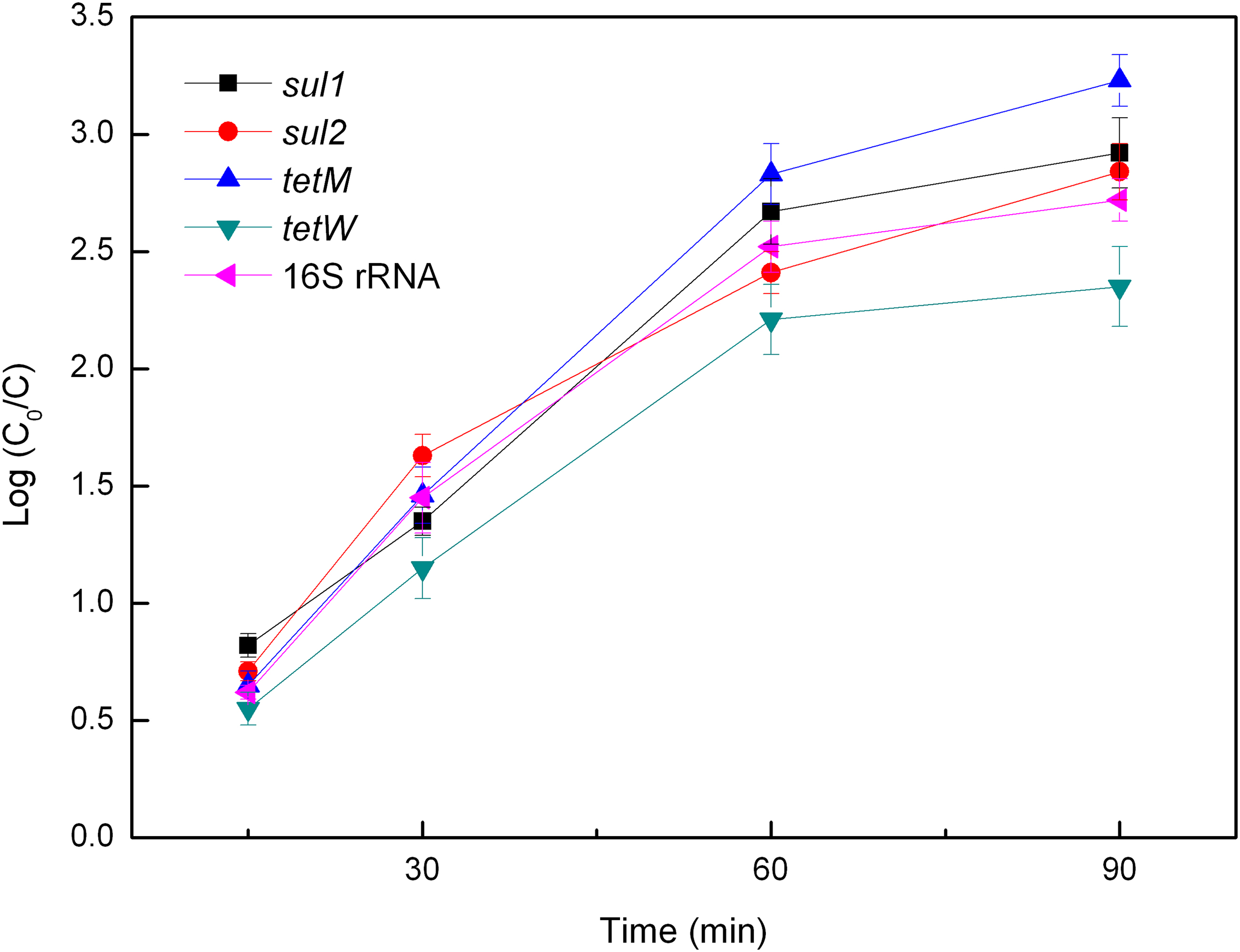
Removal efficiencies of selected ARGs and 16S rRNA from swine wastewater by the electrocoagulation process. ARG, antibiotic resistance gene.
Removal of Intracellular and Extracellular Antibiotic Resistance Genes by Different Treatments (log Copies/mL)
EC process (60 min).
EF process (60 min).
EC process (30 min)/EF process (30 min).
EC, electrocoagulation; EF, electro-Fenton.
Fe2+ is released at the anode, and OH− is formed at the cathode in the EC process when iron is used as the anode at neutral pH. Fe2+ is further transformed into Fe(OH)2 or Fe(OH)3 when oxygen is present. These hydroxides neutralize charges and foster charge aggregation or act as sweep flocs with large surface areas that adsorb bacterial cells and dissolved pollutants (Ghernaout, 2013). Thus, the primary mechanism for the removal of ARGs and 16S rRNA genes in wastewater by EC might be the adsorption and enmeshment of precipitated flocs. In addition, the formation of permanent pores in the cell membrane or the loss of important cell components caused by the electric field may also lead to the activation of bacteria (Drees et al., 2003). To explore the potential mechanism of the removal of ARGs by EC, a correlation analysis was carried out between the removal efficiency for ARGs and that for 16S rRNA with different electrolysis times. The abundance of 16S rRNA genes is often used to reflect the abundance of background bacteria in water samples (Ju et al., 2014). As shown in Table 4, the removal efficiencies for selected ARGs (sul1, sul2, tetM, and tetW) were all significantly correlated with that for 16S rRNA, suggesting that the removal of ARGs during the EC process was mainly attributed to the removal of bacterial cells.
Correlation Analysis Between the Removal Efficiencies of Antibiotic Resistance Genes and 16S rRNA
Correlation is significant at the 0.05 level (two tailed).
Correlation is significant at the 0.01 level (two tailed).
As shown in Fig. 1, both the selected ARGs and bacteria (16S rRNA) seemed to be removed effectively by the EC process. Although UV irradiation and chlorination have been widely used to inactivate bacteria in wastewater, their ability to remove ARGs is often limited, for example, only 0.80–1.21 logs by UV irradiation and 1.65–2.28 logs by chlorination (Zhang et al., 2016). As water quality may have important effects on the inactivation of bacteria and the removal of ARGs, a comparative study of EC and conventional disinfection processes using the same wastewater samples is necessary in the future.
EF process
In the EF process, the reduction of ARGs and 16S rRNA genes increased slowly during the initial 15 min and then increased dramatically, which was quite different from the trend in the EC process, as shown in Fig. 2. This lag phase might be due to the protection of the cell wall and the defense of antioxidative enzymes against oxidative stress (Sun et al., 2016). After 90 min of electrolysis, the removal efficiency reached 1.92 logs for sul1, 1.74 logs for sul2, 2.63 logs for tetM, 2.35 logs for tetW, and 1.82 logs for 16S rRNA, which was lower than that in the EC process. In addition, the reduction in sulfamethoxazole resistance genes (sul1 and sul2) was lower than that in tetracycline resistance genes (tetM and tetW), indicating that sulfamethoxazole-resistant bacteria had greater tolerance to oxidative stress than tetracycline-resistant bacteria. Similar findings were observed during chlorination and UV disinfection (Zhang et al., 2015b; Zheng et al., 2017). The removal efficiency of EF for intracellular ARGs and extracellular ARGs with 60 min of electrolysis is shown in Table 3 and was in the range of 1.03–2.19 logs and 3.19–4.02 logs, respectively.

Removal efficiencies of selected ARGs and 16S rRNA from swine wastewater by the electro-Fenton process.
During the EF process, hydrogen peroxide is generated in situ through oxygen reduction on the cathode. Then, hydrogen peroxide reacts with a small amount of catalytic Fe2+ to produce the hydroxyl radical •OH, which is well known as Fenton's reaction (Bruguera-Casamada et al., 2017). The strong oxidizing agent •OH can react with the organic components of bacterial cells, destroy the cell structure, and then penetrate into the cells, oxidizing intracellular DNA molecules. Meanwhile, •OH can directly oxidize free extracellular DNA molecules. In addition, the electric field applied may result in the formation of permanent pores in the cell membrane, allowing •OH to freely enter the cell and enhancing the removal of ARGs (Drees et al., 2003). A correlation analysis between the removal efficiency for ARGs and that for 16S rRNA with different electrolysis times was also performed. As shown in Table 4, the removal efficiency for ARGs except tetM was not correlated with that for 16S rRNA, indicating that the decrease in the abundance of bacteria was not the reason for the removal of ARGs by the EF process, unlike in the EC process. The hydroxyl radical •OH is likely primarily responsible for the removal of ARGs during the EF process at pH 3.5 in the present study. The initial pH has been reported to be the main factor that determines the efficiency of the Fenton process (Trapido et al., 2009). Fenton oxidation is often conducted within a pH range of 3.0–3.5; the yield of •OH radicals is reduced due to the formation of Fe2+ complexes at a lower pH (<2.5) or due to the precipitation of ferric oxyhydroxides at a higher pH (>4.0) (Gogate and Pandit, 2004). The efficiency of Fenton oxidation is typically lower in neutral solutions than in acidic solutions.
Table 3 shows that EC was more effective for the inactivation of intracellular ARGs and bacterial cells, while EF had a greater ability to remove extracellular ARGs. This result might be due to the differences in the removal mechanisms of the two processes. Thus, sequential EC/EF processes were evaluated for their removal of both intracellular and extracellular ARGs.
Sequential EC/EF processes
The reduction in ARGs and 16S rRNA genes during the sequential EC/EF processes was similar to that during the individual EC process in the first 30 min but promoted by the EF process in the subsequent 30 min (Fig. 3). After 60 min of treatment, the removal efficiency for selected ARGs reached 2.94 logs for sul1, 2.49 logs for sul2, 3.25 logs for tetM, 2.64 logs for tetW, and 2.86 logs for 16S rRNA. The removal efficiencies for intracellular ARGs and extracellular ARGs are shown in Table 3, which were both higher than those by the individual EC or EF process alone. Pretreatment with the EC process seems to enhance the effect of the EF process. This may be because most of the bacterial cells were first removed by the adsorption and enmeshment of precipitated flocs during the EC process, and the resultant low bacterial density was beneficial for the action of •OH radicals for the removal of ARGs in the subsequent EF process. In addition, the bacterial cell walls and membranes may have been weakened by their interaction with the hydroxide flocs in the EC process, which would promote the oxidant attack on ARGs in the subsequent EF process (Anfruns-Estrada et al., 2017). Compared to EC or EF alone, sequential EC/EF processes were more effective in the removal of both intracellular and extracellular ARGs.

Removal efficiencies of selected ARGs and 16S rRNA from swine wastewater by the sequential electrocoagulation/electro-Fenton processes.
Conclusions
Both EC and EF processes removed selected ARGs and 16S rRNA from actual swine wastewater treatment plant effluent more effectively than conventional disinfection processes. As different mechanisms were involved in the two processes, EC was found to be superior for inactivating intracellular ARGs and bacteria, while EF was more efficient at removing extracellular ARGs. Sequential EC/EF processes were more efficient for the removal of both intracellular and extracellular ARGs than individual EC or EF processes; the removal efficiencies of the sequential process were 2.49–3.25 logs for intracellular ARGs and 3.23–4.38 logs for extracellular ARGs, respectively. The results suggest that the sequential EC/EF treatment is a promising method for the removal of both intracellular and extracellular ARGs from swine wastewater treatment effluent.
Footnotes
Author Disclosure Statement
No competing financial interests exist.
Funding Information
This work was supported by the Key Laboratory of Water Pollution Control and Environmental Safety of Zhejiang Province, China (No. 2018ZJSHKF04) and the Jiangsu Provincial Key Laboratory of Environmental Science and Engineering (No. Zd1904).