




Abstract
Hydrothermal liquefaction (HTL) is a promising route to convert food waste (FW) to value-added biocrude. Real FW collected from a university campus dining hall and three principal FW components, namely carbohydrate (starch), lipid (oil), and protein (tryptone), were chosen to study the HTL performance (320°C, 20 min). Significant interactions between carbohydrate and protein were observed, which promoted the biocrude yield and decreased solid residue yield dramatically. A biocrude yield prediction method was proposed based on this interaction, which was more precise than linear calculation. The optimal content of protein in carbohydrate and protein blends for the biocrude yield was between 37.5% and 50.0%. The interactions promoted the migrations of C and N in feedstock to biocrude, while the migration of C to solid residue decreased. The amino acids derived from protein would react with the reducing sugars derived from carbohydrate to produce N-heterocyclic compounds. The interactions between carbohydrate and protein also resulted in a more dispersed biocrude with a larger polydispersity (1.828).
Introduction
In recent years, the rapid economic development and population growth significantly increase the food consumption. Approximately one-third of food produced globally for human consumption is either lost or wasted and about 1.3 billion tons of food waste (FW) is generated every year, arousing several negative impacts on environment, such as greenhouse gases, leachate, and odor (FAO, 2014). To avoid these problems, recycling of FW has become obligatory. Waste to energy concept for incineration of FW is not suitable due to the high moisture content in FW and dioxin problem (Saqib et al., 2019). Therefore, other treatment methods are preferred for proper handling of FW.
One of the recent technologies that has been adopted to convert FW into value-added products is the hydrothermal liquefaction (HTL). HTL has the advantages of high feedstock flexibility, short reaction time, and producing renewable energy, which is especially suitable for the treatment of FW (high water and organic matter contents, and low heating value). HTL converts the FW into biocrude, solid residue, aqueous, and gas products under high temperature and pressure (280–380°C, 10–25 MPa). The HTL process often involves homogeneous and/or heterogeneous catalysts to improve both the quality and yield of the target product biocrude, which can be used as liquid fuels or chemical raw materials (Villadsen et al., 2012). The byproduct solid residue can be applied as fertilizers or activated carbon.
The HTL process is both affected by the biochemical composition of feedstock and operating conditions (temperature, reaction time, and solid-liquid ratio). The biocrude yields of typical components in FW rank are as follows: lipids > proteins > carbohydrates (Biller and Ross, 2011). The high content of lipid in feedstock is beneficial for the production of biocrude during HTL. Zhang et al. (2016b) investigated the effects of temperature and solid-liquid ratio on the product distribution during HTL of FW. Results showed that the highest biocrude yield was achieved (16.7%) at 320°C with a solid-liquid ratio of 1:15. Further increasing temperature or decreasing solid-liquid ratio promoted the yield of gas products. Aierzhati et al. (2019) studied the effects of reaction temperature (280–380°C) and time (10–60 min) on the yield and properties of biocrude. The lipid-rich feedstock (salad dressing and cream cheese) presented the greatest biocrude yields of 78.1% and 74.9%, respectively, both at 320°C for 40 min. The biocrude yield showed a trend of first increasing with reaction time and, then, slightly decreasing after passing the optimal reaction time (40 min).
There are interactions between the components in FW during HTL process reported, which significantly influence the yields and distribution of products (Teri et al., 2014; Lu et al., 2018; Sheng et al., 2018). The interactions between carbohydrates and protein promoted the biocrude yield by the Maillard reaction. The carbohydrate and lipid interactions had effects on the acid yield, hydrocarbon yield, and ketone yield, but lignin and lipid behaved independently in the HTL processes (Yang et al., 2018). The HTL operation conditions also influenced the interaction. Relatively mild HTL conditions (270–300°C, 5–11 min) enhanced biocrude formation, while more severe HTL conditions (310–320°C, 12–20 min) were preferred to reduce solid residue formation (Yang et al., 2019). However, the detailed properties of biocrude from mixtures and the specific mechanism of interaction are still unclear in the prior work. The models predicting the biocrude yield during HTL process are usually based on the chemical composition (carbohydrate, protein, and lipid) of FW. A linear model based on the mass-fraction averages of experimental results from individual components was established and revised by Biller and Ross (2011) and Leow et al. (2015). The biocrude yield (%) = protein content (%) × protein yield (%) + carbohydrate content (%) × carbohydrate yield (%) + lipid content (%) × lipid yield (%). However, this model did not consider the interactions between these components. Thus, more comprehensive researches concerning the interactions of FW components and a model considering these interactions to predict the biocrude yield during HTL of FW are critically needed.
In this study, detailed HTL processes (320°C, 20 min) of FW and individual components were investigated (Zhu et al., 2015; Zhang et al., 2016b; Fan et al., 2018). Three model compounds [carbohydrate (Zea mays starch), lipid (Brassica napus oil), and protein (tryptone)] and real FW from a university dining hall were chosen to investigate the HTL characteristics of these materials and the interactions between these model compounds. A model based on the interactions of carbohydrate and protein was proposed. The properties of biocrude were analyzed through elemental analysis, thermogravimetric analysis (TGA), gel permeation chromatography (GPC), and gas chromatograph coupled with mass spectrometer (GC-MS). The results of this study offer some experimental and theoretical references for the understanding of HTL mechanism, especially the interactions between carbohydrate and protein. The findings of this research support the application of HTL for FW handling and contribute to the FW management system.
Materials and Methods
Materials
Z. mays starch, B. napus oil, and tryptone were chosen as carbohydrate (CH), lipid (L), and protein (P) model compounds, respectively. Z. mays starch and tryptone were purchased from Sigma Chemical Reagent Co., Ltd. B. napus oil was purchased from a local market in Hangzhou, China. The FW was collected from a university campus dining hall. Big bones, plastics, and metals were removed from the FW, which was then dewatered by mechanical extrusion and drained the water at room temperature for 6 h, followed by drying at 105°C for 24 h in an oven. The dried FW was sieved to a particle size of 0.83–1.70 mm. The samples were stored at 4°C until preparation for experiments. The contents of CH, L, and P in FW were determined by sulfuric acid-anthrone method, in situ transesterification, and Lowry method, respectively (Zhang et al., 2016a). The C content (75.46%) and higher heating value (HHV, 39.88 MJ/kg) of L were significantly higher compared with CH and P (Table 1). The N of FW was mainly from P. The N contributions of CH and L were negligible. The dry ash free weight percentages of CH, L, and P in FW were 50.46 wt.%, 29.83 wt.%, and 19.71 wt.%, respectively. The compositions of blends (CH+P, CH+L, P+L, and simulated FW) were obtained according to the dry ash free composition of real FW.
Properties of Feedstock
Calculated by linear interpolation of three model compounds' values.
Hydrothermal experiments
The HTL experiments were carried out using a 500 mL hydrothermal reactor (Hastelloy C276 autoclave purchased from Parr Instruments, Fig. 1). Before each experiment, the reactor, tube, and valves were washed by dichloromethane, followed by drying at 105°C for 12 h in an oven to remove the dichloromethane. Thirty grams feedstock (individual materials or blends) and 240 mL deionized water were then fed into the reactor. After the reactor was sealed, 300 mL/min N2 was made to flow through the reactor for 5 min to remove the remaining air. Then, the valves of gas inlet, gas outlet, and tube were closed sequentially. The reactor temperature increased to 320°C with a heating rate of 15°C/min and remained at 320°C for 20 min without water circulation. The reaction pressure was ∼11.0 MPa. After each experiment, the reactor was cooled to room temperature by cooling water and the products were collected for later analyses.
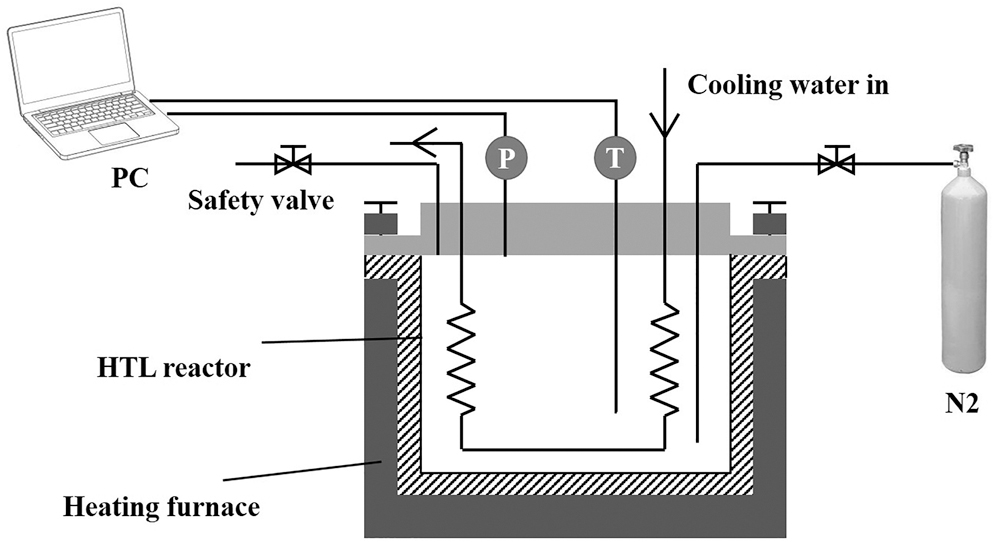
Schematic drawing of 500 mL hydrothermal liquefaction reactor.
Analytical methods
After each experiment, the remaining products in reactor were washed using dichloromethane to separate aqueous fraction, biocrude, and solid residue (Qi et al., 2020; Xiu et al., 2020). The water-soluble portion was defined as the aqueous fraction. The dichloromethane-soluble products were defined as biocrude. The dichloromethane-insoluble fraction was defined as the solid residue. After separation, the biocrude and solid residue were dried in an oven at 45°C for 12 h to remove the dichloromethane, followed by weighting to calculate the yields.
The C, H, N, and S contents of the biocrude and solid residue were determined using an elemental analyzer (Thermo NA 2100), with the O content being calculated by difference. The total organic carbon (TOC) of aqueous fraction was calculated by subtraction inorganic carbon (IC) from total carbon (TC), which was obtained by Shimadzu COT-meter (COT-5050). The total nitrogen (TN) of aqueous fraction was measured on a Shimadzu TNM-1 analyzer. The recovery of X (C or N element) in products meant the migration of X in feedstock to different HTL products and was calculated by Equations (1)–(3). The units of content and mass in Equations (1)–(3) are % and g, respectively. The units of concentration and volume in Equation (3) are g/L and L, respectively. The C/N recovery was used as indicator of the biocrude quality (Gai et al., 2014).
The TGA of the biocrude (∼30 mg) was conducted with a TG instrument (TGA/SDTA851; Swartzerland) under N2 atmosphere (99.9999%, 60 mL/min). The temperature increased from room temperature to 800°C at a heating rate of 15°C/min. The number-average molecular weight (Mn) and weight-average molecular weight (Mw) distribution of biocrude were analyzed at 40°C using a gel permeation chromatography instrument (GPC, Waters 1525/2414) with μStyragel HR1 columns (7.8 mm Ø × 300 mm, exclusion limit of 5000).
Biocrude composition was analyzed through a gas chromatograph coupled with mass spectrometer (GC-MS, trace ISQ; Thermo Fisher), which was equipped with a TR-5MS capillary column (30 m length, 0.25 mm inner diameter, and 0.25 μm film thickness). The injector and the transfer line were set at 260°C and 280°C, respectively. The oven temperature of GC-MS was kept at 50°C for 5 min, and then ramped to 270°C at 10°C/min and held for 10 min. The carrier gas was He with a flow rate of 1 mL/min.
Results and Discussion
Yields of HTL products
The biocrude and solid residue yields of individual component varied significantly (Fig. 2). The biocrude yields of single component ranked as follows: R > CH > P, and the solid residue yields ranked as follows: CH > P > L. L produced the most biocrude (98.6%), while CH and P had smaller biocrude yields of 11.3% and 7.9%, respectively. The solid residue yield of CH was 27.7%, while P and L barely produced solid residue. It should be noted that the biocrude yield (11.3%) of CH was significantly lower than solid residue yield. Thus, the CH-rich feedstock maybe more suitable for hydrothermal carbonization than HTL (Aierzhati et al., 2019).

Yields of biocrude and solid residue after HTL of various feedstock (320°C, 20 min).
The HTL experiments of blends (CH+P, CH+L, P+L, and simulated FW) were conducted to investigate the interactions between model components. The solid dots in Fig. 2 were obtained by linear calculation (mass-fraction average calculation) from individual compounds' values. The linear calculation results of CH + L and P + L were very close to the experimental results, which indicated that the effects of interactions between CH and L and interactions between P and L on product yields were insignificant. However, the linear calculation results of CH + P were 10.3% (biocrude yield) and 20.0% (solid residue yield), which were significantly different from the experimental results (21.4% for biocrude and 11.0% for solid residue). The same rule was observed for simulated FW. The results showed that the interactions between CH and P existed increased biocrude yield and decreased solid residue yield, which may be explained by Maillard reactions (Zhang et al., 2016a). The biocrude yield of simulated FW (44.4%) was close to the dry ash free result of FW (45.3%), while the solid residue yield (5.1%) was significantly smaller compared with FW (11.2%). The results were explained by the absence of inorganics in the simulated FW, which may also act as catalysts promoting the formation of solid residue.
The linear calculation results cannot predict the yields of products precisely (CH + P and simulated FW) due to the interactions between CH and P. Thus, a model based on this interaction was proposed to avoid the influence of CH-P interactions on biocrude yield by simply treating CH + P as one component [Eqs. (4) and (5)]. The unit of content and yield in Eqs. (4) and (5) is %.
The parity plot with the experimental and predictional biocrude yield results from HTL experiments in this study and literature was drawn (Fig. 3). If the prediction was perfect, the data points would fall on the diagonal line (Lu et al., 2018; Aierzhati et al., 2019). For most cases, with the same experimental biocrude yield, the red dots from interaction prediction were closer to the diagonal line than the black dots from linear prediction. The sum of squared errors was 661 for the interaction model, which was significantly smaller than the linear model (1559) (Lu et al., 2018). Therefore, the proposed model predicted the biocrude yield more precisely than linear calculation, which further proved the existence of CH-P interactions. However, the proposed model was only a preliminary attempt to prove the existence of interactions between CH and P. The effects of operating conditions (e.g., temperature and retention time) on the accuracy of this model are not investigated due to the limitation on the scope of this research (Lu et al., 2018; Jiang et al., 2019).

Comparison of biocrude yield obtained by the proposed interaction model with linear calculation [The data were collected from this study and the literature (Teri et al., 2014; Déniel et al., 2016; Raikova et al., 2016; Reddy et al., 2016; Zhang et al., 2016a). Details are in the Supplementary Table S1].
Effect of interactions on the product yields and C/N recovery
The ratio between CH and P is an important factor that affects the performance of the Maillard reaction. HTL tests for the blends of CH and P with different P contents (12.5%, 25.0%, 37.5%, 50.0%, 62.5%, 75.0%, and 87.5%) were conducted to investigate the effect of the Maillard reaction on biocrude and solid residue yields (Fig. 4). The solid lines and dash lines were experimental and linear calculation results, respectively. The deviation between solid line and dash line reflected the significance of interaction between CH and P. The biocrude yield increased from 13.4% to 24.0% when the P content increased from 12.5% to 37.5%, and then decreased to 10.7% when the content further increased to 87.5%. The solid residue yield decreased significantly with the ratio increasing. The optimal content of P for the biocrude yield maybe between 37.5% and 50.0%. The largest deviations of yields between the experimental results and linear calculation were also presented in the optimal content range. The results indicated that the interactions were more significant when the P content was 37.5–50.0% in CH + P blends.
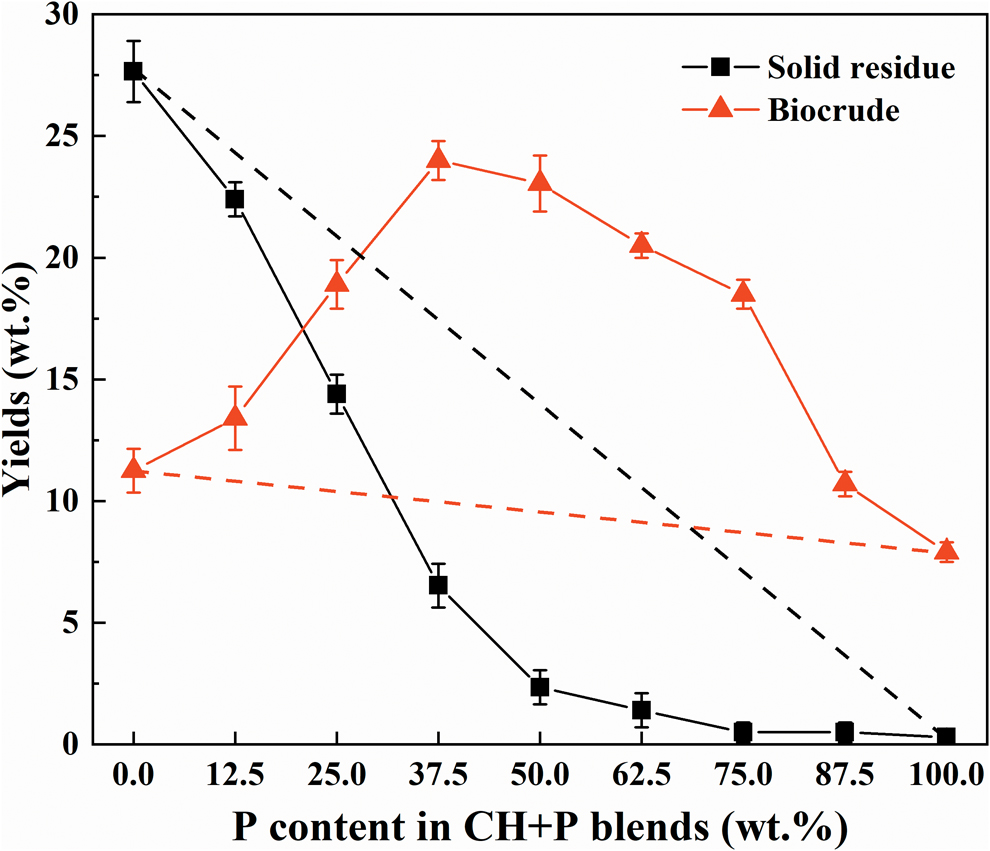
Yields of biocrude and solid residue after HTL of CH + P blends with different P contents.
C and N recoveries in solid residue, biocrude, and aqueous fraction after HTL of CH, P, and their blends with different P contents (25%, 50% and 75%) were obtained and compared. Most carbon in CH was distributed in solid residue (51.6%) that was the predominant product of CH during HTL (Fig. 5a). Most carbon in P was transferred to aqueous fraction (48.5%) due to the water-soluble nitrogenous compounds and short-chain acids derived from P degradation. As the P content in blends increased, the C recovery of biocrude first increased to 38.0% and then decreased to 28.0%. The maximum C recovery of biocrude was reached when P content was 50%. The C recovery of solid residue significantly decreased from 26.4% to 0.1%, while the C recovery of aqueous fraction increased from 34.0% to 63.5% with the P content increasing. The dramatic drop of C recovery of solid residue was due to the decrease of solid residue yield caused by the Maillard reactions between CH and P (Zhang et al., 2016a). Usually, carbonization occurs during hydrothermal conversion by furan-based intermediates and further polymerizing to “hydrochar,” hence fixing more carbon in the solid residue. When mixing P with CH, the Maillard reactions inhibited the carbonization of sugars due to elimination of the key intermediate hydroxymethyfurfuran (HMF). Instead of polymerization, HMF reacts with the amino acids, reducing the formation of “hydrochar” (Fan et al., 2018). As a result, the interactions promoted the distribution of carbon in biocrude and aqueous fraction. It is preferred that the carbon in feedstock was migrated to the biocrude during HTL process due to the application of biocrude as liquid fuel.

The N in products was mainly generated from the P in FW (Table 1). The N content was negligible in the products of CH HTL (Fig. 5b). For the HTL of P, the N was predominantly distributed in aqueous fraction (90.2%) due to the high water solubility of the N-containing compounds (e.g., ammonia). When P was mixed with CH, part of N was transferred to biocrude and solid residue. This result may be explained by the Maillard reaction between P and CH that promoted the formation of N heterocyclic compounds (Teri et al., 2014). The N heterocyclic compounds subsequently spread into the oil and solid phases. As the CH content in mixture increased, the N recoveries in biocrude and solid residue increased significantly, while the N recovery in aqueous fraction decreased. It is worth noting that a high N content in biocrude shows negative effect on the quality of oil, which increases the asphaltene content and viscosity and creates environmental problems (e.g., NOx) during combustion. The interactions between CH and P have the benefit of promoting the biocrude yield and C recovery in biocrude, while also generating a problem that the N content in biocrude increases significantly (Supplementary Table S2).
Effect of interactions on the composition of biocrude
The compounds were analyzed by GC-MS (Supplementary Fig. S1–S3) to investigate the effect of interactions between CH and P on the biocrude composition. The alkane long-chain organic acids (e.g., C16H32O2) were the predominant components in CH biocrude, followed by aldehydes, alcohols, and phenols (Supplementary Fig. S1>). When hydrothermal temperature was higher than 250°C, CH was quickly hydrolyzed to form oligosaccharides and glucoses (Bobleter, 1994; Minowa et al., 1998; Sasaki et al., 2000, 2004; Sakaki et al., 2002; Rogalinski et al., 2008). The secondary hydrothermal reactions of glucoses led to the formation of weak polar substances, such as phenols, aldehydes, ketones, organic acids, gaseous alkanes, and CO2 (Kruse and Gawlik, 2003). The soluble polymers from the secondary reactions of glucoses further undertake aromatization and form macromolecular oil products. When the concentration of aromatics in aqueous phase reaches saturation value, crystal nucleus will be formed explosively, which subsequently grows to be char particles (Sevilla and Fuertes, 2009; Sevilla et al., 2011).
The composition of P biocrude was much more complicated, including a lot of N-containing compounds, especially indoles and pyrroles, even some long-chain esters (e.g., C35H68O5) (Supplementary Fig. S2). A large amount of nitroxy heterocycles existed in the hydrothermal products of P, which were mainly formed through Maillard reactions or the condensation of amino acids, including pyrroles, pyridine, thiazole, imidazole, and their derivatives (Fan et al., 2018). Under hydrothermal condition, P was hydrolyzed to amino acids, followed by the reactions between these amino acids, forming pyrroles (Gai et al., 2015). In addition, some amino acids may transfer to nitrogen heterocyclic compounds through repolymerization reactions, subsequently producing indoles.
Some new compounds were formed in the biocrude derived from the mixture of CH and P compared with individual CH biocrude or P biocrude (Supplementary Fig. S3). The first step of HTL for various feedstock (CH, P, and L) was similar, which was hydrolysis, forming and releasing oligomers and monomers as intermediate products. More types of indoles and pyrroles appeared in CH-P mixture biocrude due to the polymerization, recombination, condensation, and dehydration reactions between these unstable intermediate products (e.g., monosaccharides, amino acids and fatty acids, and glycerols) (Gai et al., 2015; Yang et al., 2019). N-heterocyclic compounds could be produced by Maillard reactions. The amino acids derived from P would react with the reducing sugars derived from CH to produce N-heterocyclic compounds. The alkaline products derived from P would react with the acidic products derived from glucose to produce esters (Sheng et al., 2018). The existence of substances produced from the combination of monosaccharide and amino acids proved the interactions between CH and P during HTL.
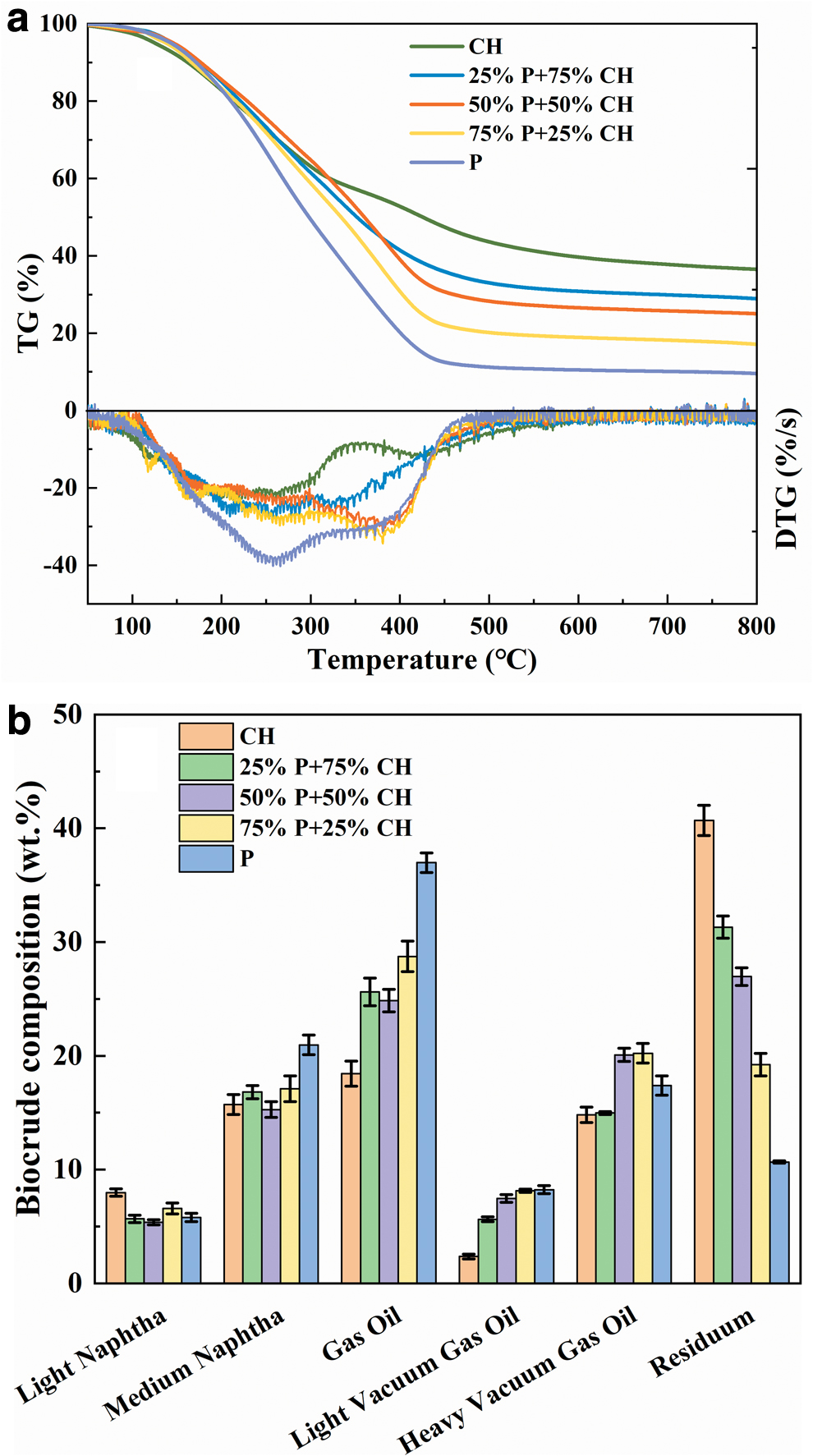
The TG-DTG curves of biocrude under N2 atmosphere were obtained to assess the biocrude evaporation characteristics (Fig. 6a). The boiling point (b.p.) distribution of biocrude oil components can be roughly obtained from the TG curves based on the petroleum product classification method proposed by Speight (2001) (Zhu et al., 2015), namely light naphtha (b.p. <149°C), medium naphtha (149–232°C), gas oil (232– 43°C), light vacuum gas oil (343–371°C), heavy vacuum gas oil (371–566°C), and residuum (b.p. >566°C). Significant weight loss occurred between 150–450°C. There were two peaks in the DTG curves of CH biocrude (210°C and 425°C) and P biocrude (260°C and 368°C). Therefore, the medium naphtha (20.96%), gas oil (36.97%), light vacuum gas oil (8.23%), and heavy vacuum gas oil (17.39%) contents in P biocrude were higher than that in CH biocrude (15.72%, 18.43%, 2.36%, and 14.81%, respectively), while the light naphtha (5.79%) and residuum (10.66%) contents in P biocrude were lower than that in CH biocrude (7.98% and 40.70%) (Fig. 6b). The accumulated aromatics from the condensation of hydrolysis products of CH easily lead to the nucleation reactions, which form spherical char particles and biocrude with high asphaltene content (Sun and Li, 2004; Sevilla and Fuertes, 2009), which explained the relatively higher residuum content in CH biocrude. When CH was mixed with P, the DTG curves of biocrude derived from mixtures showed the trend to a relatively higher temperature range. The weight loss between 350°C and 550°C was enhanced, indicating that more light and heavy vacuum gas oils were produced due to the interactions between CH and P. As the P content in blends increased, the percentages of light and heavy vacuum gas oil increased, while the percentage of residuum decreased dramatically. The reduced residuum percentage was consistent with the reduced solid residue yield in Fig. 4, together emphasizing the interactions between CH and P.
The molecular weight (MW) distribution of biocrude was further studied by GPC (Fig. 7). Different molecules were separated by passing through a chromatographic column. Usually, the retention time was longer and the MW of molecule was smaller. The MW of the tested biocrude was mainly distributed between 100 and 1,000. The curve of blend biocrude was similar to the curve of P biocrude when MW was smaller than 100. As MW increased to larger than 1,000, the curve of blend biocrude was similar to that of CH biocrude. The results may indicate that the small molecules and large molecules in blend biocrude predominantly derived from P and CH, respectively. The content of compounds with larger MW than 300 in CH biocrude was significant higher compared with P biocrude, while the content of P biocrude with smaller MW than 300 was higher. Thus, the number-average molecular weight (Mn) and weight-average molecular weight (Mw) of CH biocrude were 257.1 and 445.3 Da (Table 2
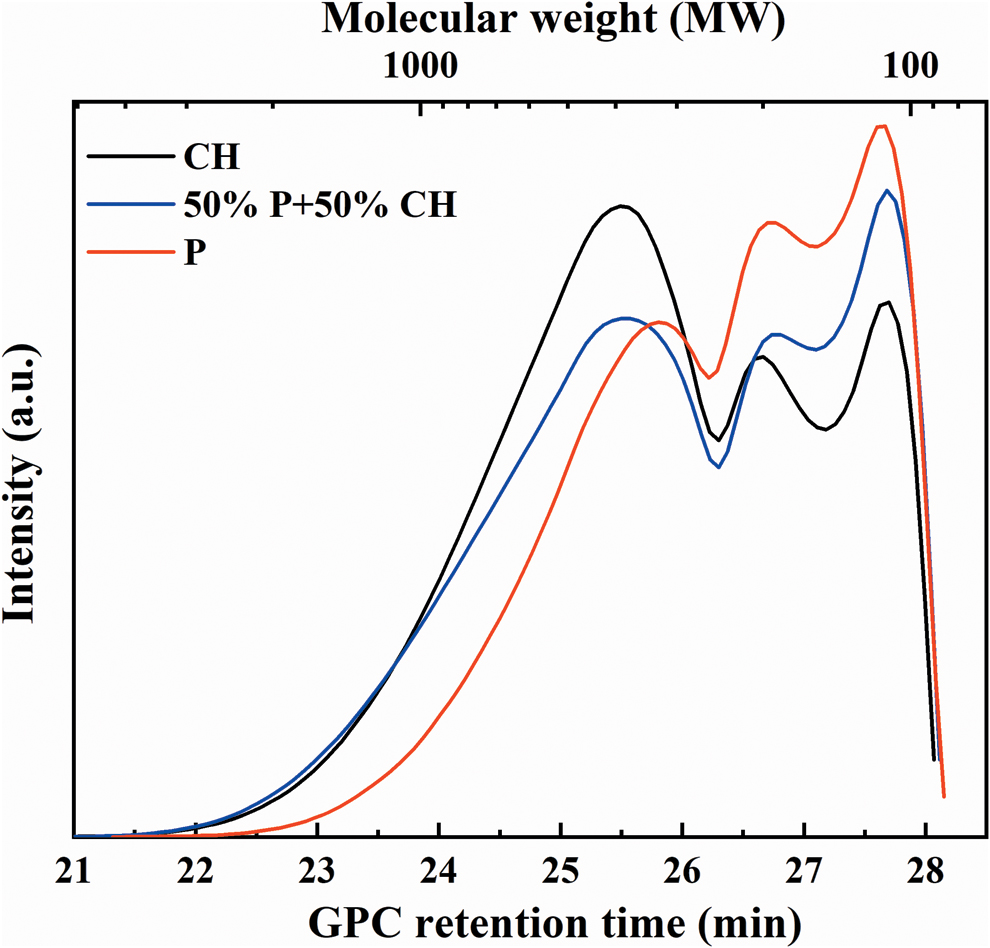
Molecular weight distribution of biocrude.
Molecular Weight of Biocrude
Conclusions
HTL experiments (320°C, 20 min) of FW and major FW components (CH, P, and L) were investigated using a 500 mL batch hydrothermal reactor. The significant interactions between CH and P were observed. A model based on this interaction was then proposed and the prediction biocrude yields were closer to the experimental results than the linear model based on mass-fraction averages of experimental results from individual components. The interactions promoted the biocrude yield and C/N recovery in biocrude, while decreased the solid residue yield and C recovery in solid residue. More types of indoles and pyrroles, and substances produced from the combination of monosaccharide and amino acids appeared in CH-P blend biocrude. The blend biocrude was highly dispersed with a larger polydispersity (1.828) when compared with CH biocrude (1.732) and P biocrude (1.546). The positive effect of CH-P interactions on biocrude is the promotion of yield and heating value. The interactions also raise a negative effect by increasing the N content in biocrude, which will cause a more severe NOx problem when the biocrude is combusted as liquid fuels.
Footnotes
Acknowledgments
The authors sincerely thank the financial support of the National Natural Science Foundation of China (NSFC-51778264 and NSFC-51676170), and the Central Public-interest Scientific Institution Basal Research Fund (PM-zx703-202002-015).
Author Disclosure Statement
No competing financial interests exist.
Funding Information
This work was supported by the National Natural Science Foundation of China (NSFC-51778264 and NSFC-51676170) and the Central Public-interest Scientific Institution Basal Research Fund (PM-zx703-202002-015).

References
Supplementary Material
Please find the following supplemental material available below.
For Open Access articles published under a Creative Commons License, all supplemental material carries the same license as the article it is associated with.
For non-Open Access articles published, all supplemental material carries a non-exclusive license, and permission requests for re-use of supplemental material or any part of supplemental material shall be sent directly to the copyright owner as specified in the copyright notice associated with the article.
