




Abstract
To realize the high-efficiency plasmonic hot-electron injection in photocatalytic pollutant elimination, Ag/g-C3N4 heterostructure photocatalyst was synthesized through a novel in situ photochemical solid-phase reduction approach. Transmission electron microscope images of the obtained samples showed that Ag atom was uniformly dispersed on the surface of g-C3N4 sheet, thus can fully utilize the local surface plasmon resonance of metallic Ag and then improve the photocatalytic performance of Ag/g-C3N4. It is reported that Ag/g-C3N4 heterojunction presented significantly enhanced sunlight absorption and inhibited the recombination of photoinduced carriers, and further reinforced the photocatalytic performance of g-C3N4 substrate. The 3 wt%-Ag/g-C3N4 exhibited the best catalytic activity toward rhodamine B (RhB) and phenol degradation under visible light irradiation, with apparent rate constants of 0.016 and 0.018 min−1, which was 8 and 10 times that of pure g-C3N4, respectively. This work supplied an advanced approach for constructing efficient solar light-driven photocatalysts, which would be making a certain contribution to the control of water pollution.
Introduction
Recently, water pollution phenomenon in human living environment has become one of the key problems. In addition to a variety of effective methods, including adsorption, flocculation, and biological methods, photocatalysis has also attracted extensive attention of scientists. To succeed in efficient degradation of organic contaminants, it is necessary and key to develop photocatalytic materials. g-C3N4 material has been of wide concern in the field of photocatalysis and energy conversion in recent years (Wang et al., 2009; Cao et al., 2015). g-C3N4 has unique and superior physical and chemical properties, such as large specific surface areas, high separation rate of electron–hole pairs, visible light response and stability. Nevertheless, photocatalytic performance of bulk g-C3N4 was poor due to the low solar absorption efficiency and carrier mobility (Ong et al., 2016). Therefore, for the purpose of improving the photocatalytic activity of bulk g-C3N4, a lot of modification methods have been carried out, including metal/nonmetal element doping, expanding specific surface area, noble metal loading, morphology control, and the development of heterojunction, etc. (Niu et al., 2012; Dong et al., 2016; Tong et al., 2017; Sudhaik et al., 2018; Hasija et al., 2019; Guo et al., 2020a, 2020b; Raizada et al., 2020a, 2020b).
In the heterogeneous photocatalysis, the stable and metal-free carbon materials can not only rapidly transport the photogenerated carriers but also provide large surface areas (Raizada et al., 2017; Singh et al., 2020). The superior photocatalytic performance of hybrid photocatalyst has attracted more and more attention in the field of photocatalysis (Guo et al., 2019; Raizada et al., 2019; Sonu et al., 2019; Kumar et al., 2020). In contrast to bare g-C3N4, the Ag/g-C3N4 composites can accelerate the surface electron migration rate and significantly improve the catalytic performance (Qian et al., 2018; Cai et al., 2019; Xu et al., 2019). However, the preparation of efficient, stable, and noble metal highly dispersed Ag/g-C3N4 composite photocatalysts is still facing challenges.
To develop efficient broad-spectrum photocatalysts, noble metal Ag was atomically dispersed on the surface of mesoporous support for photodegradation with the surface plasmon resonance (SPR) effect (Wang et al., 2018). A novel composite of monatomic Ag-modified mesoporous g-C3N4 was developed through deposition–condensation method (Wang et al., 2017). The Ag/g-C3N4 composites exhibited supreme activity for the degradation of bisphenol A in contrast to g-C3N4. With the plasma effect of noble metals, the deposition of noble metals on the g-C3N4 surface can effectively enlarge the visible light absorption range, which is widely used to enhance the photocatalytic performance. The effective combination of g-C3N4 and surface Ag nanoparticles (NPs) can repress the aggregation of Ag NPs and then improve the visible light activity of the matrix (Chang and Chen, 2009; Wunder et al., 2010; Gangula et al., 2011; Huang et al., 2016). He et al. (2017) investigated the mpg-C3N4/Ag composites to enhance the photocatalytic and photoelectrocatalytic activity of g-C3N4 by light-assisted reduction route, which greatly increased the visible light oxygen/reduction ability. A straightforward synthesis method of novel Ag/g-C3N4 nanosheets was proposed, in which Ag NPs with diameter of 5–20 nm were uniformly loaded on the g-C3N4 nanosheets to form a heterostructure. Compared with pure g-C3N4 nanosheets, Ag/g-C3N4 composites have stronger absorption in the visible light region and lower photoinduced carrier recombination probability. The results showed that the synergistic effect of metallic Ag and g-C3N4 was the critical factor for improving the catalytic performance (Fu et al., 2015; Li et al., 2015; Qin et al., 2016). Bai et al. fabricated the core–shell Ag/g-C3N4 nanomaterials by refluxing Ag NPs and g-C3N4 nanosheets in methanol. The Ag/g-C3N4 hybrid exhibited gratifying visible light photocatalytic performance owing to the efficient photoinduced electron–hole pair separation (Bai et al., 2014).
It has been reported that noble metal atoms, such as Ag, Au, Pd, and Pt were used as cocatalysts to expand the absorption range of visible light and increase the carrier's separation efficiency, which are beneficial for the photocatalytic performance on the contaminant of g-C3N4 (Baffou and Quidant, 2014; Ding et al., 2015; Xue et al., 2015; Qin and Zeng, 2017). The enhanced photoactivity of g-C3N4 catalysts modified by noble metal is mainly due to the smaller size and higher dispersion of silver NPs, as well as the stronger visible light absorption induced by SPR of Ag NPs. Due to the difference of work function and Fermi level, Schottky barrier and built-in electric field can form and therefore promote the separation of photoinduced carriers in heterojunction (Tong et al., 2018). Pt is the best cocatalyst among many noble metals, but its cost is relatively high, whereas Ag has a low cost and relatively low toxicity. Therefore, the preparation of high-activity g-C3N4 photocatalyst by Ag modification is worthy of further study (Bao et al., 2008). Due to the abundant electronic structure on the surface, g-C3N4 with heterocycles provide a platform for stabilizing noble metal atoms (Chen et al., 2018). Single atom of many noble metals can be stabilized on g-C3N4 by direct synthesis and postsynthesis approaches (Vilé et al., 2015; Chen et al., 2016; Li et al., 2016; Huang et al., 2017; Liu et al., 2017; Vorobyeva et al., 2017; Zheng et al., 2017; Yin et al., 2018).
As a result of the high surface activity and surface energy of Ag NPs, agglomeration of the NPs occurs easily, which affects its physicochemical properties. The challenges associated with this are not only the difficulty in realizing a homogeneous distribution of the Ag atom in the materials, but also the increased number of concomitant recombination centers for the photogenerated charge carriers in the materials. Herein, we have developed Ag/g-C3N4 heterostructure composites with single-atom dispersed Ag by a novel in situ photochemical solid-phase reduction method. g-C3N4 with Ag atom anchored on the surface was verified by the results of microstructure characterization. Meanwhile, the photocatalytic performance has also been investigated by the degradation of organic pollutant in water.
Materials and Methods
Materials
Main reagents
Melamine, silver nitrate, chloroauric acid, ethanol, rhodamine B (RhB), and phenol are all analytically pure, and the experimental water is deionized water.
Synthesis of g-C3N4 nanosheets
Bulk g-C3N4 was synthesized by thermal condensation of melamine, based on the literature (Yan et al., 2009). Typically, 5 g of melamine was heated to 550°C in the alumina crucible and kept at constant temperature for 4 h, cooling naturally to room temperature, then the light-yellow g-C3N4 powder was prepared.
A certain amount of bulk g-C3N4 was dispersed in ethanol and was then peeled ultrasonically for 3 h. The resultant g-C3N4 nanosheets were obtained by centrifuging at 8,000 rpm for 5 min, washed with ethanol several times, and dried at 60°C for 4 h.
Synthesis of Ag/g-C3N4 photocatalyst
For the construction of Ag/g-C3N4 composites, a facile solid-phase photodeposition approach was applied (Scheme 1).

Illustration of the formation process of Ag/g-C3N4 by photochemical solid-phase reduction process.
Specifically, 0.25 g of the as-prepared g-C3N4 was added into 30 mL deionized water and was ultrasonicated for 1 h to get a well-dispersed suspension. Then a certain amount of AgNO3 was added into the above suspension and magnetically stirred for 2 h. After drying for 4 h at 80°C, the pale yellow powder was obtained. Subsequently, the powder was irradiated under 250 W high-pressure mercury lamp for 1 h in a culture dish. The resulting sample was denoted as x%-Ag/g-C3N4, where x% (1%, 3%, 5%, 7%) is the mass percentage of Ag to g-C3N4. When the AgNO3 was omitted, the synthesized sample was named g-C3N4.
Characterization
Morphology analysis of all samples were carried on QUANTA FEG250 field emission scanning electron microscopy (FESEM) and high-resolution transmission electron microscope (HR-TEM; FEI), operated at 200 kV. X-ray photoelectron spectroscopy (XPS) (Thermo Fisher) was performed on an electron spectrometer (Al Kα, hυ = 1,486.6 eV), with the signal of C 1s peak at 284.8 eV as reference. X-ray diffraction (XRD) spectra were tested on X-ray diffractometer (CuKɑ radiation; Bruker). The specific surface areas were acquired by N2 adsorption–desorption isotherms using the Brunauer–Emmett–Teller (BET) analysis (Microtrac BEL). Diffuse reflectance spectroscopy was measured using a UV-2000 (Hitachi). Photoluminescence (PL) spectra analysis was carried out on the F-4600 (Hitachi) fluorescence spectrometer.
Photocatalytic activity and active species trapping experiments
The photocatalytic performances of the samples were tested in XPA photochemistry reactor with 500 W Xe lamp as the light source and a filter (>420 nm) was used to obtain visible light. Twenty-five milligrams of catalyst was accurately weighed and placed into a quartz tube reactor with 50 mL RhB solution (c = 1 × 10⁻⁵ mol/L) and was then dispersed ultrasonically for 10 min. Before irradiation, the suspensions were kept on stirring for 30 min in darkness to achieve the adsorption–desorption equilibrium. The photocatalytic reaction proceeded with a sampling interval of 20 min. Solid–liquid separation was carried out immediately after withdrawing 3 mL of the degradation solution from the quartz tube by centrifuging at 8,000 rpm for 10 min. Then the absorbance of the supernatant was measured at λmax = 554 nm. No catalyst was added in blank test and other conditions remained unchanged.
Under the same reaction conditions, the photocatalytic activities of as-prepared samples were also evaluated by phenol decomposition and hydrogen peroxide (H2O2) as accelerant. The initial concentration of phenol is 3 × 10⁻⁵ mol/L and judged by the water quality determination standard (HJ-503-2009, China).
To detect the roles of active species played during the photocatalytic reaction process, capture experiment was performed; hydroxyl radical (•OH), holes (h+), and superoxide radical (•O2−) can be captured by 1.0 mM tertbutanol (t-BuOH), edetate disodium (EDTA-2Na), and p-benzoquinone (BQ) scavengers, respectively. The decomposition of RhB has also been investigated under the visible light (λ > 420 nm) irradiation.
Results and Discussion
Morphology and structure analysis
Figure 1 and Supplementary Fig. S1 show the FESEM and HR-TEM images of pure g-C3N4 and Ag/g-C3N4. In Fig. 1a, the morphology of g-C3N4 is composed of irregular overlapped layer-like structures. Figure 1b confirms that the uniform Ag NPs existed and tightly adhered on the lamellar g-C3N4 due to the in situ photochemical solid-phase reduction ability. No apparent aggregation of the Ag NPs could be observed in Fig. 1c, suggesting that Ag NPs were deposited on g-C3N4 nanosheets in a well-dispersed form. The formation of interfaces between Ag NPs and g-C3N4 nanosheets indicating a heterostructure has been successfully constructed. Ag NPs with diameters of 20–30 nm loaded on the surface of g-C3N4 nanosheets can offer a large-exposure active surface. HR-TEM image in Fig. 1d exhibited fringes with spacing of 0.234 nm corresponding to the (111) plane of metallic Ag (Yang et al., 2017). Combined with infrared spectrum analysis of Supplementary Fig. S3, it can be concluded that Ag/g-C3N4 composites were successfully synthesized, and was expected to facilitate the migration of electrons from g-C3N4 to Ag NPs.
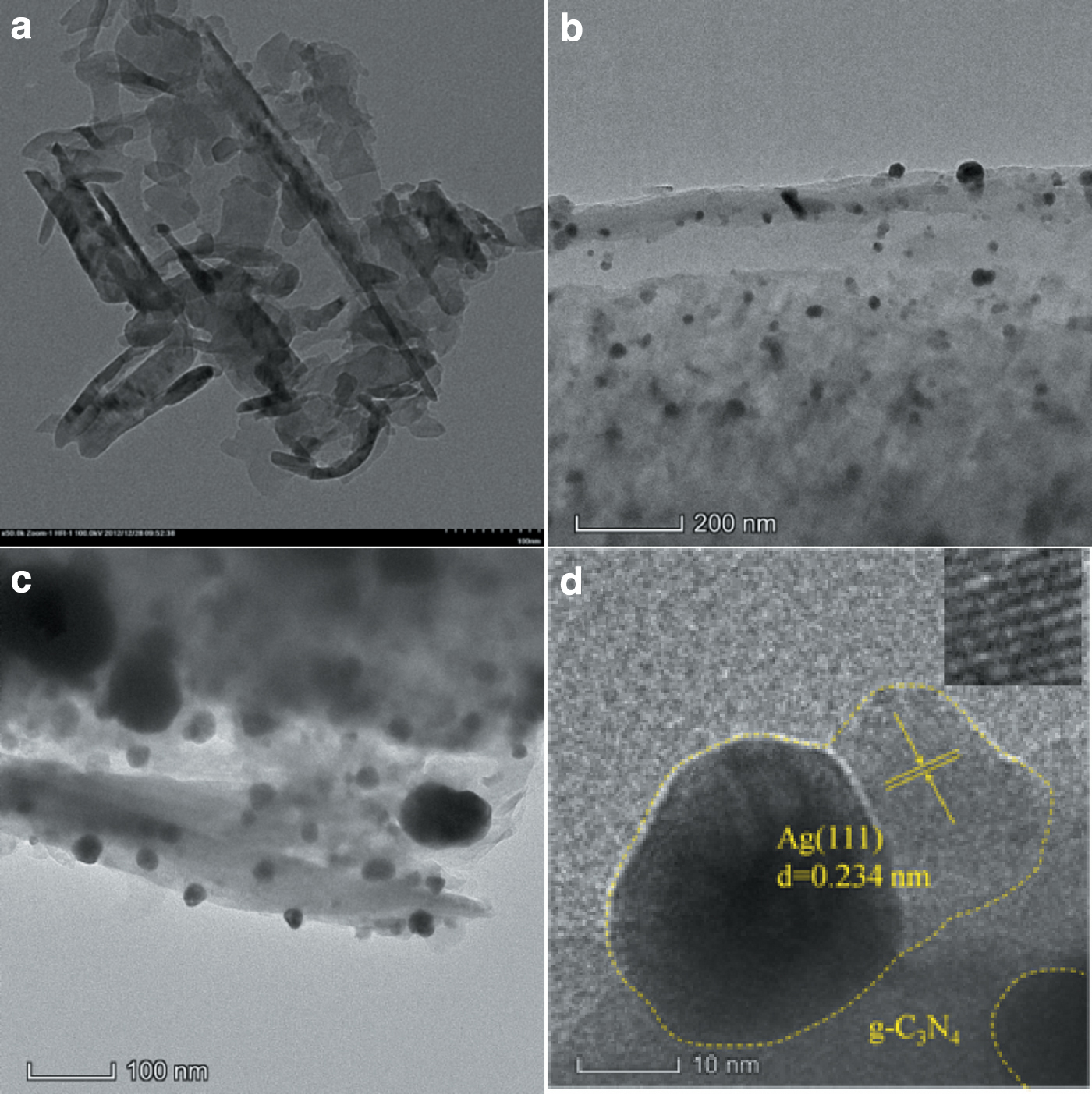
TEM images of g-C3N4
XRD patterns of Ag/g-C3N4 composites and pure g-C3N4 are shown in Fig. 2a. Two distinct diffraction peaks at 13.1° and 27.5° in the XRD pattern of g-C3N4, can be ascribed to (100) and (002) planes of g-C3N4, which corresponded to interplanar structural packing and interlayer stacking of aromatic systems, respectively (Yan et al., 2010; Fu et al., 2013). Compared with pure g-C3N4, no obvious diffraction peaks can be found in Ag/g-C3N4 composite, which demonstrated that the introducing of Ag NPs probably did not change the crystal phases of bare g-C3N4 sample. This may be due to the low content and high dispersion of Ag NPs.
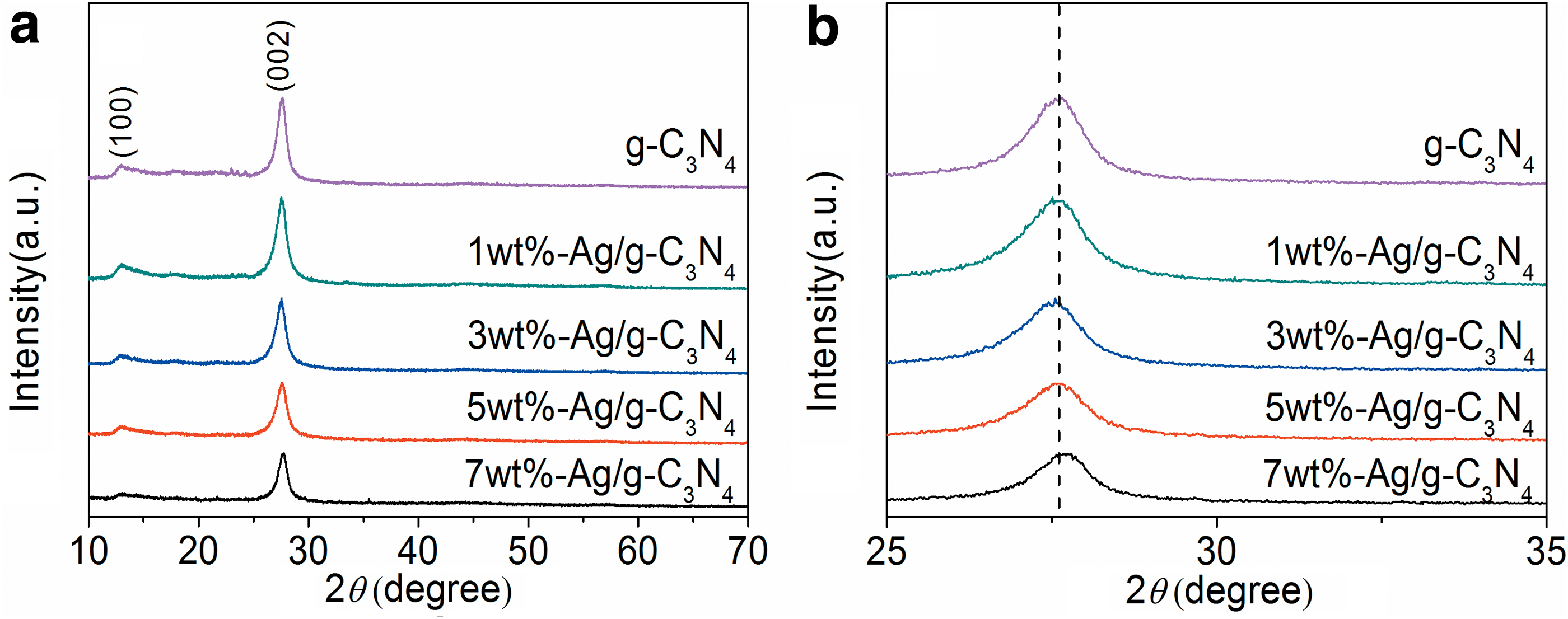
XRD patterns
In Fig. 2b, the one typical diffraction peak located at 27.5° is attributed to the (002) crystal facets of g-C3N4, corresponding to the interplanar stacking reflection of the conjugated aromatic segments (Wu et al., 2017). A close-up view of the (002) diffraction peak of g-C3N4 clearly shows the shift of the diffraction peak angle toward a higher 2θ value. Also, these peak intensities gradually become weak with increasing Ag content. From the XRD results, one can infer that Ag NPs have been successfully produced on the g-C3N4 nanosheets after the ultraviolet light irradiation.
Specific surface area and optical properties
N2 adsorption–desorption isotherms of 3%-Ag/g-C3N4 and pure g-C3N4 were collected (Fig. 3). The isotherms of both g-C3N4 and Ag/g-C3N4 can be assigned to classical IV type, indicating the presence of pore structures within the aggregated g-C3N4 nanosheets. The BET-specific surface area of g-C3N4 and 3%-Ag/g-C3N4 were 8.95 and 21.16 m2/g, respectively. Additionally, the total pore volume of 3%-Ag/g-C3N4 was 0.15 cm3/g, which was larger compared with g-C3N4 (0.06 cm3/g). It is generally believed that the larger surface area can provide more reaction active sites, which is beneficial to the adsorption of more pollutant molecules (Di et al., 2016; Liu et al., 2016). Therefore, 3%-Ag/g-C3N4 is expected to exhibit higher catalytic activity than g-C3N4.
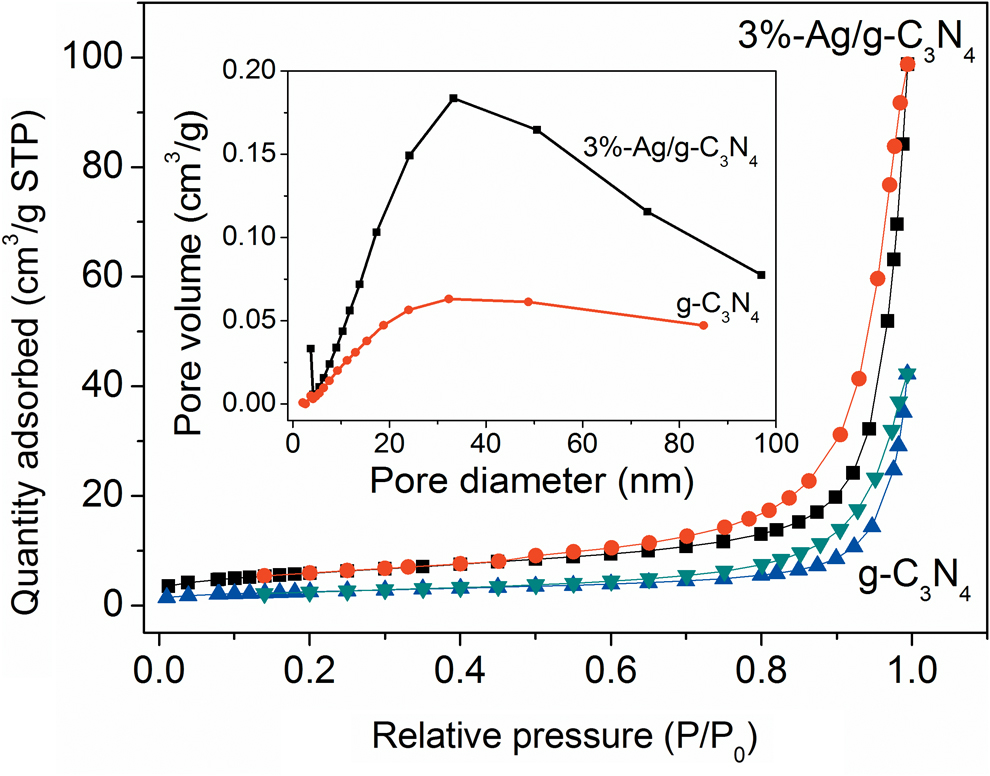
Nitrogen gas (N2) adsorption–desorption isotherms of pure g-C3N4, 3%-Ag/g-C3N4 and pore size distribution (inset).
The optical absorption property of the as-prepared samples were also investigated. As can be seen in Fig. 4, g-C3N4 can absorb visible light with the absorption edges at about 460 nm. After loading with Ag, Ag/g-C3N4 clearly showed an enhanced visible light absorption from the visible region to near-infrared regions implying Ag atoms SPR and high uniform dispersion contributed to the wave bands. The peak intensity becomes stronger as the Ag contents increased. In addition, the absorption spectrum of Ag/g-C3N4 is shifted to mildly red. The enhanced visible light absorption may be attributed to the structure of g-C3N4, the photophysics property of the Ag NPs with local SPR, and their synergistic effects that can effectively expand the visible light response range of g-C3N4 and produce more e−–h+ pairs and, which is essential and favorable for photocatalytic activity (Cheng et al., 2017; Guo et al., 2017; Zhang et al., 2017).
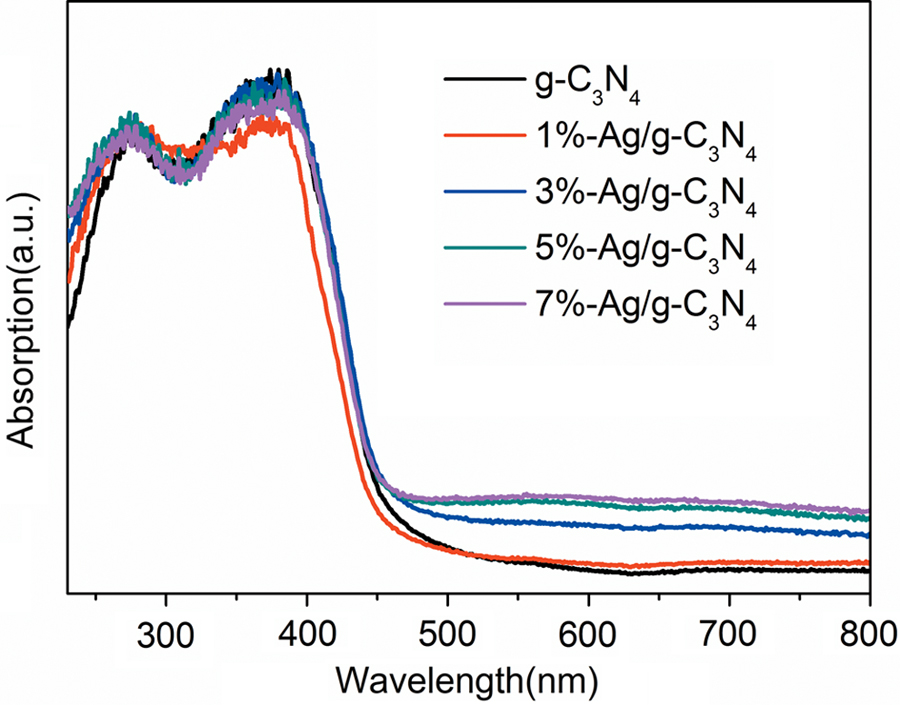
UV-visible spectra of g-C3N4 and Ag/g-C3N4 composites. UV, ultraviolet.
Chemical state analysis
The surface chemical compositions of g-C3N4 and Ag/g-C3N4 were analyzed by XPS measurements (Fig. 5a). Contrasting the pure g-C3N4 (containing C1s and N1s peaks), a new Ag3d peak is present in the Ag/g-C3N4 sample. The corresponding high-resolution XPS spectra of Ag3d, C1s and N1s are shown in Fig. 5b–f. In Fig. 5b and c, the C1s spectrum can be fitted to two peak components corresponding at binding energies of 284.2 and 287.8 eV, which were identified as the characteristic peaks of C-C and C-N species of sp2-hybridized carbon bonded to an N atom, and the XPS, the NI peaks of g-C3N4 at 398.2, 399.8, and 401.3 eV correspond to C = N-C, N-C3, and N-H bonding, respectively (Bian et al., 2018). Figure 5d presents the XPS of Ag/g-C3N4 in the Ag3d-binding energy regions. The doublet peaks of Ag 3d5/2 and Ag 3d3/2 located at about 367.68 and 373.68 eV, with 6.0 eV splitting between the two peaks, correspond to the metallic Ag0 species (Chen et al., 2017).

XPS survey spectra
Compared with the pure g-C3N4, the binding energy of C1s (Fig. 5e) and N1 (Fig. 5f) in Ag/g-C3N4 composite moved slightly to the low-energy region. These changes of binding energy indicated that there were strong interactions between g-C3N4 and Ag. The XPS results validate the coexistence of Ag, g-C3N4 in Ag/g-C3N4 composite. It can be concluded that there are strong interfacial interactions in the heterojunction of Ag/g-C3N4, which may facilitate the rapid migration of photogenerated carriers and enhance the photocatalytic activity of Ag/g-C3N4.
Photocatalytic performance evaluation
The photocatalytic activities of Ag/g-C3N4 composites were examined under visible light (λ > 420 nm) irradiation. Moreover, the kinetic behavior of photocatalytic degradation reaction was further investigated; all of the plots can be simplified with a pseudo-first-order model:
where C and C0 are the concentrations of RhB/phenol at irradiation time t and the initial equilibrium concentration of RhB/phenol at t = 0, respectively, and k being the apparent rate constant for photocatalytic reaction.
Figure 6a is the photocatalytic degradation performance curve of RhB. As can be seen from Fig. 6, the concentration (C0) of RhB without photocatalyst in the blank experiment has hardly changed before and after the experiment, indicating that its photodecomposition is very weak. In comparison with pure g-C3N4 sample, with the increase of Ag loading, the activity of Ag/g-C3N4 samples increased at first and then decreased gradually. The activity of 3 wt%-Ag/g-C3N4 samples was the highest, the degradation rate was about 86% in 2 h, and the first-order rate constant was about eight times that of single-phase g-C3N4. From the distribution of reaction rate constant of Fig. 6b, the photocatalytic activity of Ag/g-C3N4 showed volcanic distribution. With the increased Ag content (>3 wt%), and the activity decreases, indicating that excessive Ag loading may mask active sites. The synergistic effect between Ag and g-C3N4 was weakened, which led to the reduction of photocatalytic efficiency.
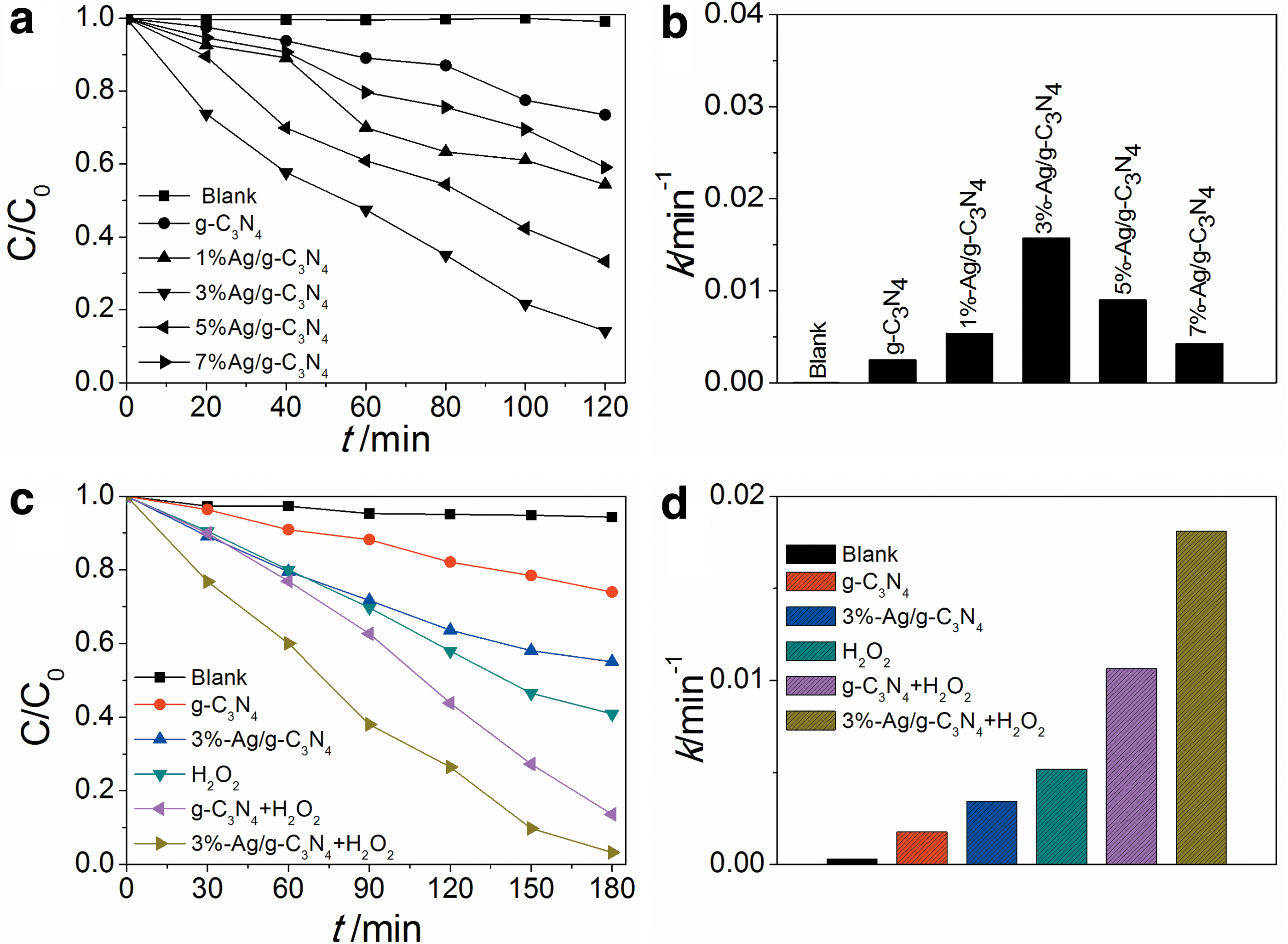
Photodegradation efficiency and first-order reaction rate constant for RhB
Figure 6c and d shows the performance curve and rate constant distribution of photocatalytic degradation of phenol by 3 wt%-Ag/g-C3N4 sample. The synergistic effect of adding H2O2 in the reaction system was investigated experimentally. The photocatalytic activity of 3 wt%-Ag/g-C3N4 has significantly improved compared with g-C3N4. The degradation rate of phenol was about 96% after 3 h, and the first-order reaction rate constant was about 10 times that of bare g-C3N4. The results show that the degradation rate of phenol could be significantly enhanced by adding H2O2 as accelerator in the Ag/g-C3N4 photodegradation system. It may be attributed to the fact that the presence of H2O2 can promote the generation of •OH, and thus enhance the photocatalytic activity of the samples.
Figure 7 shows the activity comparison of samples prepared by solid-phase (S) and liquid-phase (L) methods, respectively. The catalytic performance of 3%-Ag/g-C3N4 (S) prepared by solid-phase photochemical reduction method is obviously better than 3%-Ag/g-C3N4 (L) prepared by conventional liquid-phase photo reduction method, and its degradation rate is about two times (Fig. 7a). As can be seen in Fig. 7b, the calculation result shows the reaction rate constant as about three times. It indicates that Ag/g-C3N4 (S) composite has better photocatalytic activity, which can enhance photocatalytic efficiency, more effectively exert the efficiency of noble metal atoms in catalysts, and greatly reduce the cost of catalysts.
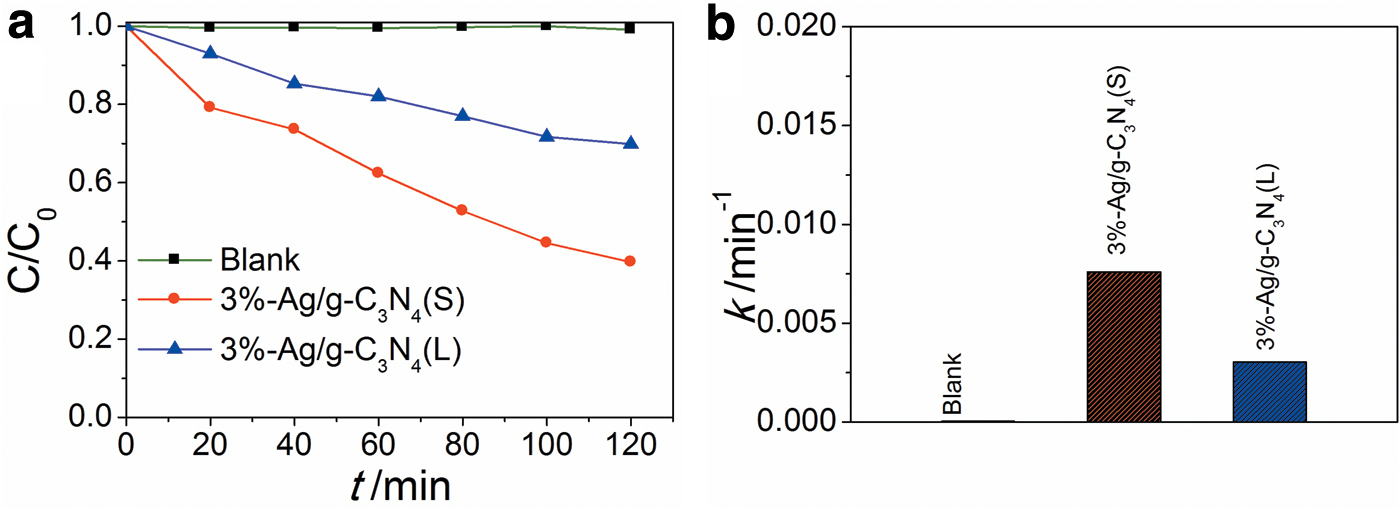
Comparing of photocatalytic performance of as-prepared 3%-Ag/g-C3N4 samples through solid-phase method (S) and liquid-phase method (L), the degradation curves
The obtained results exhibited that the Ag/g-C3N4 composites have larger specific surface area and enhanced light absorption ability than pure g-C3N4, which were beneficial for the improvement of photocatalytic performance. Compared with the bare g-C3N4, 3%-Ag/g-C3N4 exhibited higher photocatalytic activity. In addition, the photochemical solid-phase reduction method has universality (Supplementary Fig. S2 and Supplementary Data), and it will become a highly efficient and promising approach to enabling photocatalysts to possess the dual advantage of semiconductor and noble metal. In addition, as observed from Supplementary Figs. S4 and S5, indicating the Ag/g-C3N4 with good photostability and reusability.
Possible photocatalytic mechanism
Radical trapping results of Ag/g-C3N4 exhibit a similar trend in Fig. 8. For 3%-Ag/g-C3N4, the photocatalytic efficiency of RhB significantly decreased when BQ was added, demonstrating that •O2− is the main active species. Similarly, the addition of EDTA-2Na significantly decreased the activity, suggesting that the h+ also played a crucial role in the photocatalytic reaction process. However, the photocatalytic performance of Ag/g-C3N4 has hardly changed after the addition of TBA demonstrating that •OH was not the reactive species during the degradation of RhB. Surprisingly, TBA enhanced the photocatalytic performance of Ag/g-C3N4, which may be caused by the generation of •O2− reactive species, when TBA consumed h+ on the VB of g-C3N4. The results indicate that •O2− and h+ play the significant roles as major reactive species in the photodegradation process (see Supplementary Fig. S6). Consequently, with the presence of Ag NPs in the Ag/g-C3N4 composites, the recombination of the electron–hole (e−–h+) pairs was suppressed, leading to higher photocatalytic performance of Ag/g-C3N4.
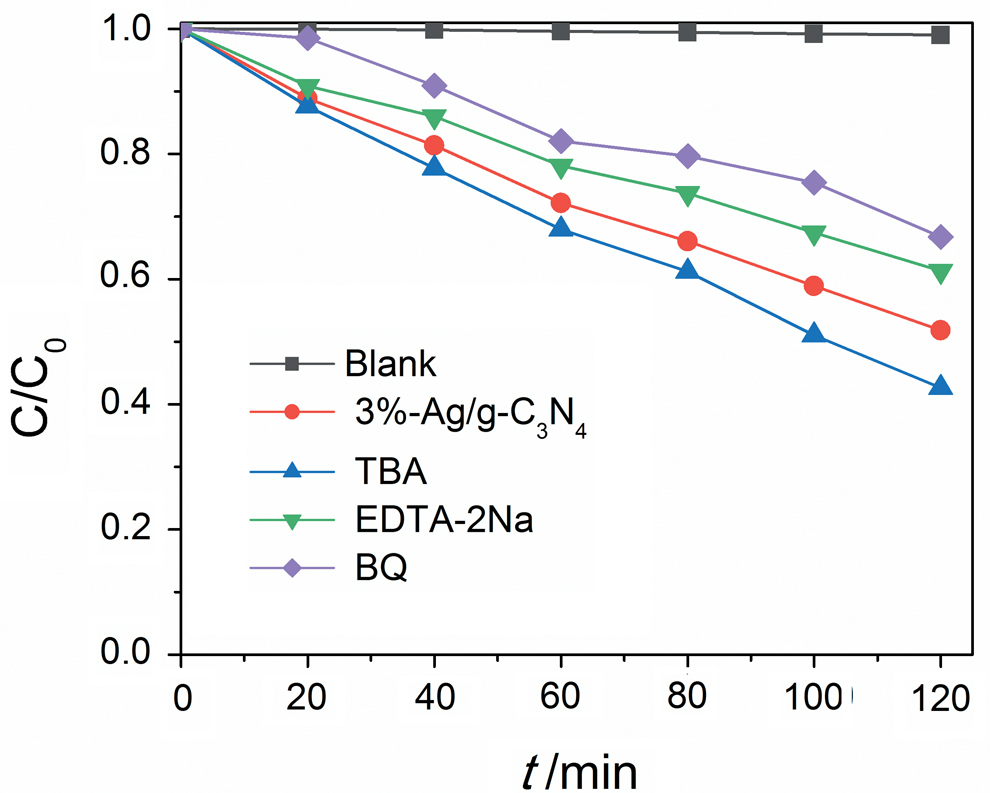
Scavenger test on RhB degradation performance of 3%-Ag/g-C3N4.
PL spectra were commonly used to estimate the separation and recombination of photogenerated carriers. In Fig. 9, the PL spectra of g-C3N4 and Ag/g-C3N4 were measured with an excitation of 380 nm. It was found that the strong emission at 452 nm could be observed in the spectra, with the order of intensity as follows: g-C3N4 > 1%-Ag/g-C3N4 > 7%-Ag/g-C3N4 > 5%-Ag/g-C3N4 > 3%-Ag/g-C3N4. The peak intensity of Ag/g-C3N4 is lower compared with pure g-C3N4, suggesting a lower recombination rate of photoexcited e−–h+ pairs. This is ascribed to the migration of electrons from g-C3N4 to Ag NPs, resulting in the enhanced carrier separation efficiency of Ag/g-C3N4. Furthermore, the introduction of Ag NPs on g-C3N4 leads to more efficient separation of e−–h+ pairs, and higher photocatalytic activity (Qiao et al., 2019). Moreover, the peak intensity of 3%-Ag/g-C3N4 was the lowest among all the catalysts, which is consistent with the highest photocatalytic activity of all the prepared samples.
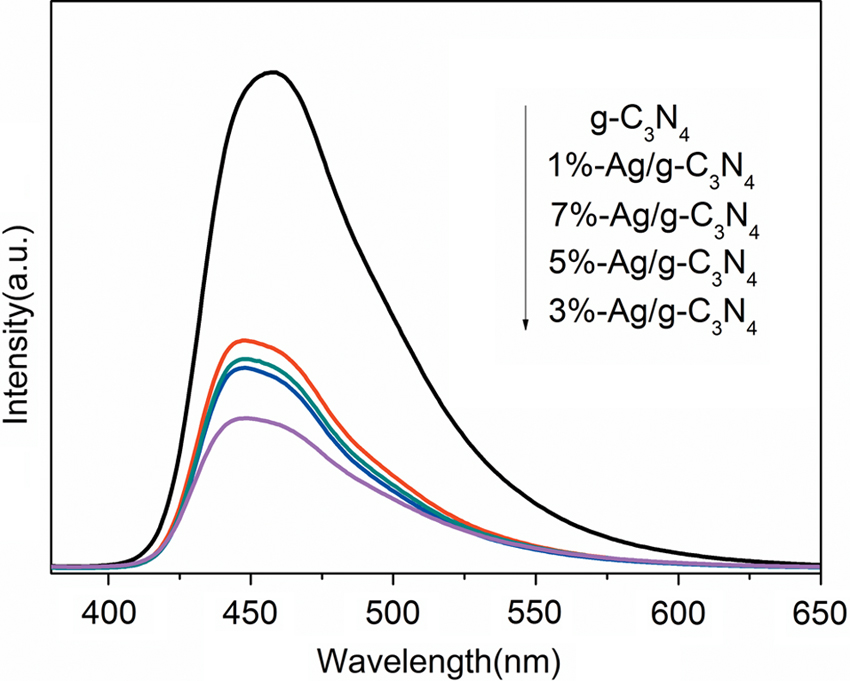
PL spectra of g-C3N4 and Ag/g-C3N4 samples. PL, photoluminescence.
The possible mechanism of Ag/g-C3N4 photocatalytic process is elucidated in Scheme 2. The appearance of the Ag/g-C3N4 composites with Ag NP-modified g-C3N4 layer resembles pitaya. From the analyses results, it can be indicated that the photocatalytic performance of Ag/g-C3N4 was greatly enhanced, modified with metallic Ag NPs. Meanwhile, the Schottky barrier at the Ag/g-C3N4 interface enables the efficient charge separation, thus preserving the more reactive holes on the VB of g-C3N4 and electrons on the surface of Ag NPs for the oxidation of organic pollutant, which are the two key factors for the enhanced photoactivity of Ag/g-C3N4 composites. As electron transmission mediators of noble metal Ag provide outstanding photogenerated carrier transfer and separation efficiency, it results in the enhanced photocatalytic activity. Thus, in photocatalysts, plasma-mediated Z-scheme charge transfer synergistically boosts photocatalytic process.

Proposed photocatalytic oxidation organic pollutant mechanism for the Ag/g-C3N4 composite.
The photocatalytic activity of Ag/g-C3N4 composite is significantly better compared with bare g-C3N4, which is attributed to the fact that noble metal Ag can be used as an electron trap to prolong the recombination life of e− and h+. Different Fermi levels of noble metal Ag and g-C3N4 can form Schottky barrier on the contact surface, which can produce more e−-h+ pairs, effectively reduce the recombination of e− and h+, and enhance the photocatalytic activity.
Conclusions
In summary, Ag/g-C3N4 heterojunction composites were synthesized through a facile photochemical solid-phase reduction method. Compared with pristine g-C3N4, enhanced photocatalytic performance on RhB and phenol decomposition under visible light was achieved. Around 86% RhB and 96% phenol were eliminated under visible light irradiation for 120 and 180 min, respectively. The apparent first-order kinetic rate constant over 3%-Ag/g-C3N4 sample for RhB and phenol catalytic reaction degradation are about 8 and 10 times higher compared with pure g-C3N4, respectively. This enhancement of the visible light activity of Ag/g-C3N4 is mainly attributed to the higher surface area and the facilitated carrier separation efficiency owing to the heterostructure formation between Ag and g-C3N4. h+ and •O2− are responsible for the photodegradation in the Ag/g-C3N4 reaction system. In the article, this synthesis method not only realizes the uniform loading of single-atom Ag on the surface of g-C3N4, but also significantly improves the utilization efficiency of noble metals and the reaction center is formed on the atomic scale. It can be concluded that the geometric and electronic properties of Ag/g-C3N4 composite catalysts greatly depend on both the isolated Ag atoms and g-C3N4, and instinctively affect its photocatalytic reaction. During the synthesis process, enhancing the interface interaction and intimate contact between Ag atoms and g-C3N4 is necessary. This study provides the feasibility of constructing high-efficiency photocatalysts for practical applications through a versatility synthesis approach.
Footnotes
Author Disclosure Statement
The authors declare that no competing financial interests exist.
Funding Information
This research is supported by the Science and Technology Project of Henan (192102310496), the Project of Science and Technology Innovation of Xinxiang University (15ZP05), China.

References
Supplementary Material
Please find the following supplemental material available below.
For Open Access articles published under a Creative Commons License, all supplemental material carries the same license as the article it is associated with.
For non-Open Access articles published, all supplemental material carries a non-exclusive license, and permission requests for re-use of supplemental material or any part of supplemental material shall be sent directly to the copyright owner as specified in the copyright notice associated with the article.
