




Abstract
Fenton reaction is extensively used in wastewater treatment to produce •OH, which can be used to remove organic pollutants excellently. However, the greatest issue of the process is the low efficiency of Fe2+/Fe3+ conversion cycle and hydrogen peroxide (H2O2) decomposition rate (<30%). In this study, molybdenum disulfide (MoS2) was used as a co-catalyst in Fenton system to accelerate the oxidation of acid orange 7 (AO7) dye. The enhanced removal efficiency was attributed to that the unsaturated S atoms on the surface of MoS2 could capture the protons in solutions and turn into H2S, exposing the active sites with reducibility and accelerating the conversion of Fe2+/Fe3+. A high degradation rate of 98% was obtained in 30 min under the optimal conditions of AO7 concentration 100 mg/L, MoS2 6 g/L, FeSO4·7H2O 50 mg/L, H2O2 concentration 1.5 mmol/L, and pH 3.5. Furthermore, the degradation pathway and mechanism of AO7 were thoroughly discussed. The toxicity of the intermediates during the degradation progress slightly increased initially, which then decreased to nontoxicity. MoS2 can keep stable, which can maintain high AO7 removal efficiency even after being reused for seven times. Moreover, the obtained results provide a theoretical basis and guidance for the application of inorganic co-catalyst in practical wastewater remediation applications.
Introduction
Dye wastewater is a kind of complex industrial wastewater containing various organic compounds (Qi et al., 2009; Katheresan et al., 2018). The untreated organic wastewater significantly affects water quality, public health, and welfare (Brillas and Martínez-Huitle, 2015). Because of the complex composition, high chemical oxygen demand, and toxicity value, it is difficult to remove and degrade (Gazi et al., 2010). As a result, it is necessary to put forward a useful removal method for wastewater before it is discharged into the environment. At present, wastewater treatment methods can be clarified into membrane separation, adsorption (Asfaram et al., 2015), magnetic separation, biological method, and chemical method like chlorination (Du et al., 2016), ozonation (Soltermann et al., 2017), and flocculation (Fan et al., 2017; Zhuang et al., 2017). Recently, advanced oxidation processes (AOPs) have received considerable attentions in the treatment of dye wastewater (Pera-Titus et al., 2004). Fenton reactions, based on the generation of hydroxyl radicals (•OH), through the reaction of hydrogen peroxide (H2O2), are frequently used to oxidize complex organic constituents (Mu et al., 2017). Nevertheless, this method is restricted by the low production of •OH and low efficiency of H2O2 decomposition (Qin et al., 2015). To solve the current problem, researchers began to search for a co-catalyst to decompose H2O2 in the Fenton reaction. Co-catalysts such as salen (Gazi et al., 2010), cysteine (Qian et al., 2014), and protocatechuic acid (Qin et al., 2015) were selected to enhance the generation of •OH. However, these organic co-catalysts usually cause secondary pollution during the treatment progress. Although many inorganic catalysts were used in photocatalysis (Lang et al., 2015; Xiang et al., 2016), inorganic catalysts were seldom used in wastewater treatment (Sheng et al., 2019). Therefore, it is urgent to develop higher chemical stability inorganic co-catalysts (Xing et al., 2018; Sheng et al., 2020). According to Xing et al. (2018), metal sulfides (including WS2, molybdenum disulfide [MoS2], CoS2, Cr2S3, ZnS, and PbS) might be used to be the favorable co-catalysts for substantially increasing the H2O2 degradation efficiency and markedly reducing the Fe2+ and H2O2 doses needed within AOPs. In addition, Dong et al. (2018) investigated how WS2 affected Fenton reaction during Cr(VI) synchronous reduction and phenol remediation. Moreover, as suggested by Wang et al. (2019), the MoS2 quantum dots exhibited favorable performance to co-catalyze Fenton reactions because those surface Mo4+ active sites facilitated the reaction between Fe(III) and Fe(II) while increasing the H2O2 degradation rate. But few studies are conducted for the systemic investigation on the dye degradation under the co-catalysis of MoS2.
In this study, MoS2 was introduced as a co-catalyst to increase the Fe3+/Fe2+ conversion in photo-Fenton progress for the removal of acid orange 7 (AO7). In addition, the reaction mechanism, performance optimization, and toxicity evaluation were systematically studied. Exposed Mo4+ active sites with reductive properties could speed up the Fe3+/Fe2+ recycle and improve H2O2 decomposition. The removal efficiencies of AO7 were investigated under different experimental conditions including pH, MoS2 dosage, H2O2 concentration, FeSO4·7H2O concentration and initial AO7 concentration. Then, the degradation pathway of AO7 was proposed by the gas chromatography–mass spectrometry (GC-MS) analysis. In the meanwhile, the toxicity evaluation was also discussed. MoS2 co-catalytic Fenton progress has a positive application prospect in environmental remediation. Moreover, the obtained results provide a theoretical basis and guidance for the practical use of inorganic co-catalyst in environmental applications.
Materials and Methods
Chemicals and materials
MoS2 and AO7 (C16H11N2NaO4S) were purchased from Aladdin Industrial Corp. (Shanghai, China). H2O2 (30 wt%) and FeSO4·7H2O were obtained from Sinopharm (Shanghai, China). All the chemicals were of analytical grade and used without further purification. In addition, all the solutions were prepared using deionized water.
Fenton experiments
A certain amount of MoS2 (diameter <2 μm) and FeSO4·7H2O were added into 100 mL AO7 aqueous solution in a 150 mL quartz tube. About 0.1 mol/L HCl solution was used to adjust pH as needed. A certain amount of H2O2 solution was added into the above solution. The photo-assisted Fenton oxidation of AO7 was carried out under visible-light irradiation by a tungsten lamp (500 W, ∼550 nm). At the same time, all experiments were performed at constant temperature (25°C).
Analytical methods
The pH of the solution was monitored by a portable pH meter (Mettler-Toledo, Shanghai, China). The absorbance of AO7 during the degradation process was tested using a ultraviolet-visible (UV-Vis) spectrophotometer (UV-1700; Shimadzu, Japan). About 1.0 mL supernatant was mixed with 1.0 mL 1,10-phenanthroline monohydrate (1 mg/mL). Then, the absorbance was studied by UV-vis spectroscopy with the aim to make the evaluation of the concentration of Fe2+ ions. To measure the concentration of Fe3+ ions, potassium thiocyanate was used to replace 1,10-phenanthroline monohydrate. The intermediates formed during the AO7 degradation process were identified based on GC-MS (GC7890/MS5975; Agilent Technologies). Samples at different time intervals were extracted in dichloromethane (DCM) (ratio: dye solution:DCM of 1:10). Subsequently, 1.0 μL sample was injected at 40°C for 2 min. The column temperature was increased to 100°C at 10°C/min rate, and the temperature was then increased to 200°C at 5°C/min rate and maintained for 5 min. Afterward, the temperature was increased to 280°C at 20°C/min rate for 10 min. The microstructure of the MoS2 was tested by scanning electron microscope (SEM; Merlin Compact, Zeiss, Germany).
Toxicity test
Vibrio fischeri was selected as a model bacteria to evaluate the toxicity by using bioluminescence inhibition assay. Before the toxicity test, an ampoule of the V. fischeri lyophilized powder was reactivated in 1 mL of 2 wt% NaCl solution for 10 min at 4°C and subsequently inoculated rapidly. AO7 and the degradation intermediates were arranged in the standard opaque plates. Each sample contained 20 μL of toxicants and 180 μL of the prepared bacteria solution. Regarding the control experiment, each sample was mixed with 20 μL 2% NaCl solution and 180 μL prepared bacteria solution. After exposing to the contaminant for 15 min, the luminescence intensity was detected with a microplate reader (GloMax-Multi; Promega). The percentage of inhibition of V. fischeri compared with the control group was used to evaluate the toxicity effect:

where L denotes the inhibition ratio; LSample and LBlank refer to the average luminescence intensity of V. fischeri to the test samples and control group, respectively.
Result and Discussion
MoS2 co-catalytic Fenton degradation of AO7
Effect of MoS2 dosage
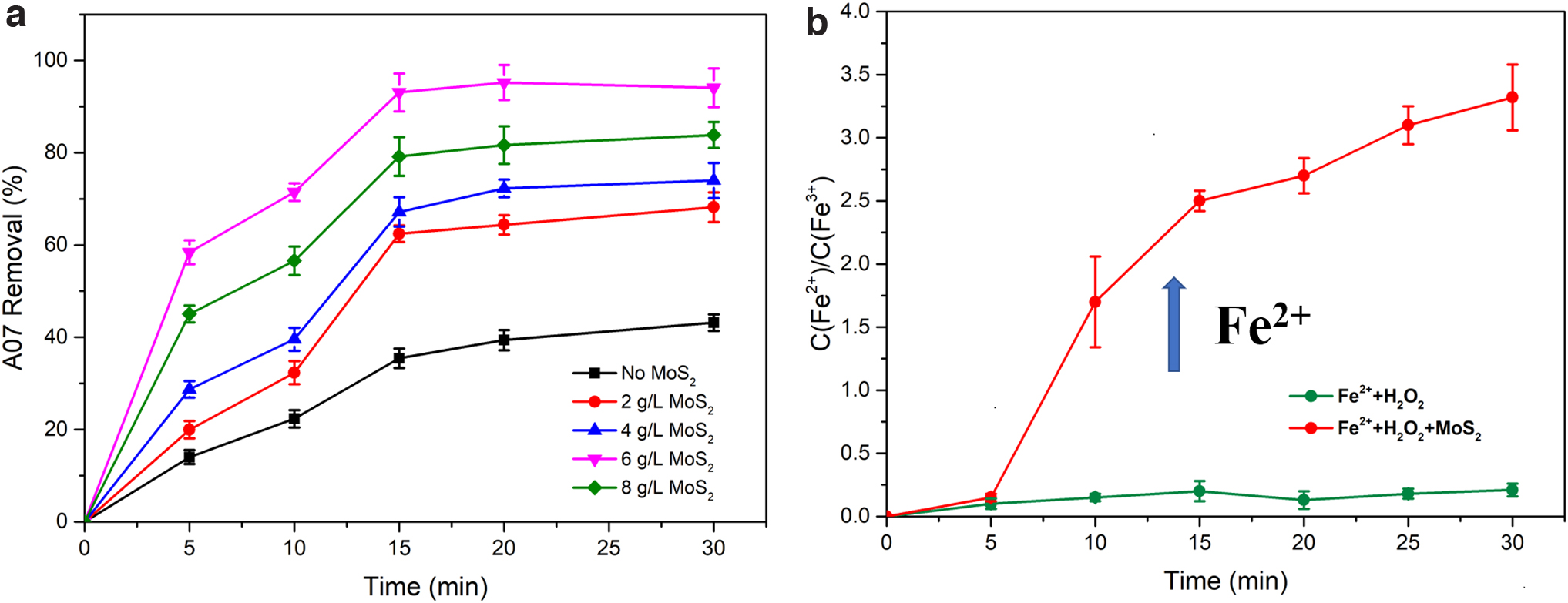
To investigate the effect of MoS2 dosage, a series of experiments were conducted at different concentrations of 2, 4, 6, and 8 g/L with the initial AO7 of 100 mg/L, Fe(SO4)·7H2O of 50 mg/L, H2O2 of 1.5 mmol/L, pH = 3.5. Figure 1a shows the effect of MoS2 dosage on the removal of AO7. The catalytic efficiency without MoS2 is much lower than that of the addition of MoS2. Obviously, the AO7 removal efficiency increased from 68.19% to 98.05% with the MoS2 concentration increasing from 2 to 6 g/L in 30 min. However, no significant increment of AO7 removal efficiency was observed at MoS2 concentration of 8 mg/L, which is mainly owing to that too much MoS2 would weaken the light absorption (Dong et al., 2018). As given in Fig. 1b, under the condition [AO7 of 100 mg/L, Fe(SO4)·7H2O of 50 mg/L, H2O2 of 1.5 mmol/L, pH = 3.5, MoS2 of 6 g/L], the Fe2+/Fe3+ ratio increased to 3.32 in the presence of MoS2, indicating that MoS2 could enhance the conversion efficiency from Fe3+ to Fe2+.
Effect of FeSO4·7H2O dosage
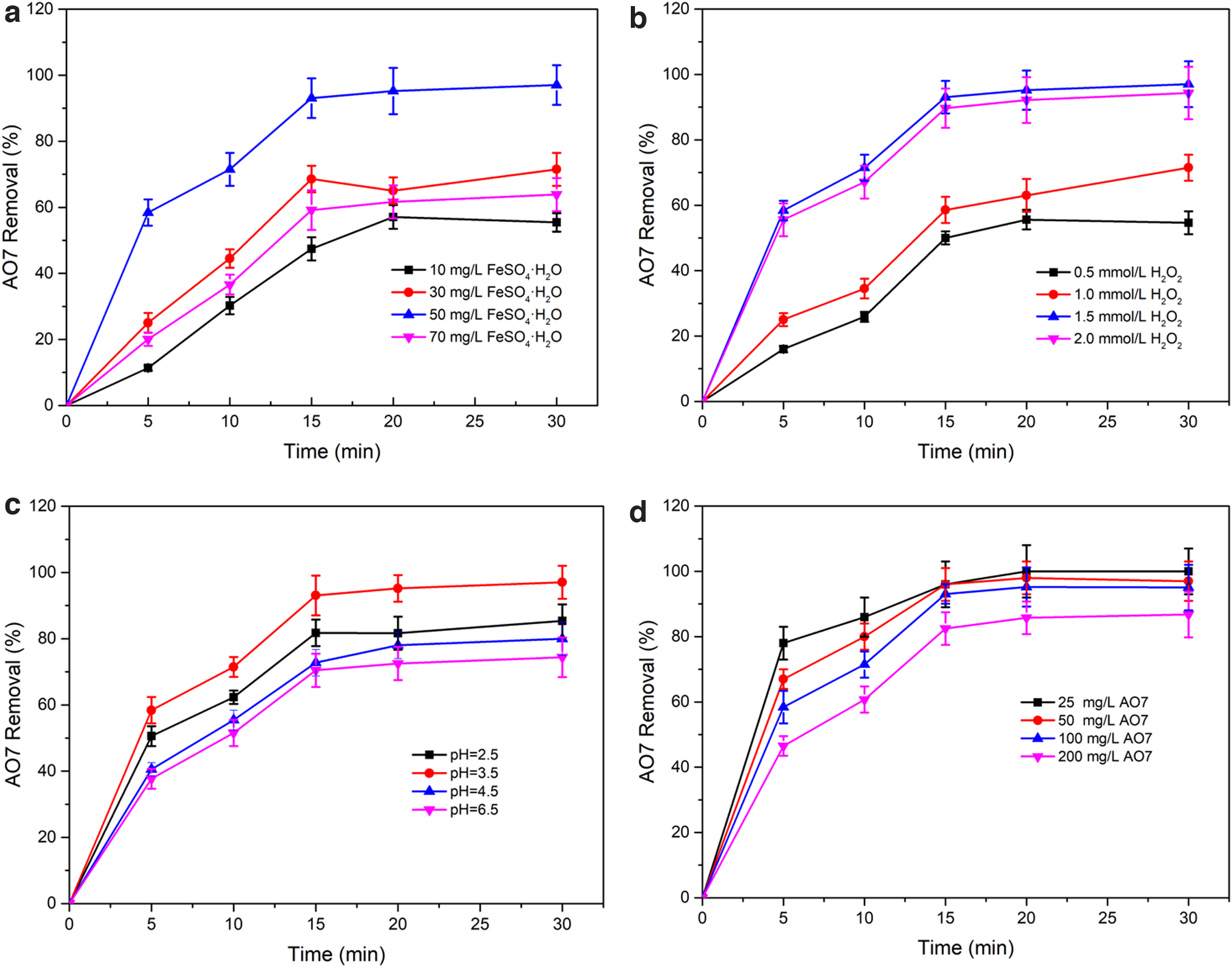
Iron ion is essential to the homolysis of H2O2. To investigate the effect of FeSO4·7H2O on AO7 removal, different FeSO4·7H2O concentrations of 10, 30, 50, and 70 mg/L were investigated and the results are given in Fig. 2a. For the same initial AO7 concentration (100 mg/L), a low FeSO4 concentration (10–50 mg/L) has a great influence on the reaction. It was observed from the curve that the AO7 removals increased with the increase of FeSO4 concentration. However, the AO7 removal efficiency decreased when the FeSO4 concentration was >50 mg/L. This was because •OH was scavenged by the Fe2+ and H2O2, which was harmful to the enhanced degradation of AO7 (Tang and Huang, 1996). Therefore, FeSO4 concentration of 50 mg/L was used in the following experiments.
The removal efficiency of AO7 by adding MoS2 cocatalyst at different conditions:
Effect of H2O2 dosage
As the hydroxyl radicals were formed in the reaction solution, the effect of H2O2 concentration was explored. To investigate the effect of H2O2 decomposition for the removal of AO7, the pH of the prepared solution was adjusted as 3.5, the initial concentration of AO7 was 100 mg/L, the concentration of MoS2 was 6 g/L, the concentration of FeSO4·7H2O was 50 mg/L, and the concentration of H2O2 was 0.5, 1.0, 1.5, and 2.0 mmol/L, respectively. As given in Fig. 2b, the removal of AO7 was almost proportional to the H2O2 concentration. The degradation rate of AO7 reached the highest value when the concentration of H2O2 was 1.5 mmol/L. The AO7 removal efficiency increased from 54.64% to 98.05% with the H2O2 concentration increasing from 0.5 to 1.5 mmol/L in 30 min. However, the AO7 removal efficiency showed no significant increment at 2.0 mmol/L of H2O2 concentration. This was mainly because of the fact that
Effect of pH
pH is a crucial factor determining reaction effect in this MoS2-photo-Fenton system. The effect of pH in operating time of 30 min was measured at 50 mg/L Fe(SO4)·7H2O and 6 g/L MoS2, 1.5 mmol/L H2O2, and initial pH range of 2.5–6.5. The results are given in Fig. 2c. Clearly, low pH could promote the degradation of AO7. It could also be found that the removal efficiencies of AO7 increased at initial pH 2.5–4.5. The present results were in consistence with previous studies (Rivas et al., 2001; Szpyrkowicz et al., 2001). In addition, the Zeta potentials of the MoS2 aqueous solution under different pH values (pH = 2.5, 3.5, 4.5, 6.5) could be measured and are given in Supplementary Fig. S1. Consequently, the isoelectric point of MoS2 is ∼2.98. Therefore, it can be concluded that the MoS2 surface is negatively charged under a pH value of 3.5. Under the action of exposed Mo4+, the Fe3+ adsorbed may be reduced in a continuous manner for the formation of Fe2+. Thereafter, the resultant Fe2+ ions were further distributed in the water solution to decompose H2O2.
It also indicated that the higher the pH, the worse the dispersion of MoS2. That is why low pH can lead to better AO7 removal. In addition, the excessively high or low pH values reduce FeOH2+ content. As a matter of fact, at pH >4.0, the solubilized iron deposits in the form of ferric hydroxide, thereby resulting in catalyst poisoning.
The variation of pH during the reaction at different initial pHs was measured and presented in Supplementary Fig. S2. During the reaction, the unsaturated S atoms could capture the protons to form H2S, causing the low and steady pH value of the MoS2 aqueous solution. This explanation was also according to the pH variation. The pH decreased slightly at first, then increased and kept stable. The proper pH values could promote the concentration of reactive species of Fe(OH)2+ (Clarizia et al., 2017). When the initial pH was >4.5, lower AO7 removal efficiency was observed. Indeed, at higher pH values of >4.5, dissolved iron would precipitate to form ferric hydroxide, leading to catalyst poisoning. When the solution was alkaline, Fe2+ in the solution was extremely easy to convert into precipitation.
Effect of initial AO7 concentration
As given in Fig. 2d, after 30 min, the AO7 removals reached 100, 97.54, 95.15, and 86.25% for the initial concentrations of 25, 50, 100, and 200 mg/L, respectively. The results indicated that the AO7 decreased with the increasing initial AO7 concentration. It could be explained that under the same condition, the number of reactive species produced in the photo-Fenton progress was maintained constant. The AO7 solution at high concentration could not be degraded effectively because there were no sufficient reactive oxidative species (Yao et al., 2019). As a result, combining all the factors mentioned previously, 100 mg/L of the AO7 solution was the appropriate initial concentration.
Effect of operation method with/without visible-light
According to the experiments mentioned previously, it could be concluded that the optimal MoS2-photo-Fenton reaction conditions were as follows: AO7 concentration of 100 mg/L, MoS2 of 6 g/L, Fe(SO4) · 7H2O of 50 mg/L, H2O2 of 1.5 mmol/L, and pH of 3.5. To compare different operation methods for AO7 degradation, a series of experiments were conducted to investigate the MoS2 co-catalysis effect in the Fenton reaction. The MoS2 adsorption in dark/under visible light indicated the dye adsorption by MoS2 alone. As given in Fig. 3, the AO7 removal by MoS2 adsorption was very low. Therefore, for pure MoS2, its efficiency is low under light irradiation and in dark, which can offset its photocatalytic and adsorption performances (Xing et al., 2018). The poor activity of MoS2 + H2O2 indicated that MoS2 could not directly decompose H2O2. In addition, the activity of MoS2 under visible light irradiation was much better in comparison with that in dark environment. It could be explained by the fact that light could improve the decomposition of H2O2 as well as the conversion of Fe3+ to Fe2+ (Sang et al., 2013). Through introducing visible light, the efficiency of traditional Fenton reaction experienced little increase. The removal of AO7 was >70% for 10 min under visible light irradiation by the addition of MoS2. Even through an obvious enhancement could be acquired in the lack of visible light irradiation, carrying out the reaction under visible light irradiation could make further improvement of the dye degradation. The above results indicated that the MoS2 could enhance the oxidation of Fenton under visible light.
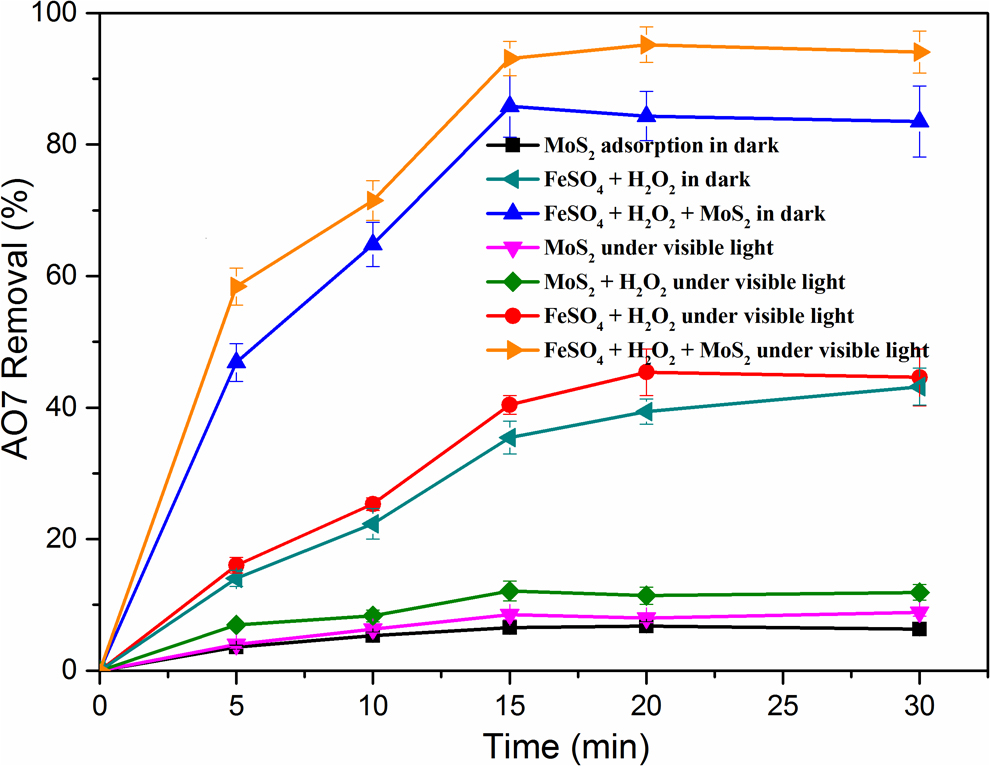
Degradation of AO7 under visible light and in dark. [AO7 of 100 mg/L, MoS2 of 6 g/L, Fe(SO4)·7H2O of 50 mg/L, H2O2 of 1.5 mmol/L, pH = 3.5].
Mechanism investigation
Degradation pathways of AO7
To further understand the degradation pathways of AO7 in this MoS2 co-catalytic Fenton reaction, GC-MS analysis was used to identify the intermediates and detect the degradation pathway. Table 1 provides the main intermediates and their structures. According to the intermediates, we could propose a possible degradation pathway of AO7, as given in Fig. 4. First of all, the azo bond (−N = N−) of AO7 undergoes cleavage under the attack of hydroxyl radicals, which leads to the decolorization of the solution. The GC-MS results demonstrated that AO7 was decomposed to 4-aminobenzenesulfonic acid (A1) and 1-amino-2-naphthol (A3). Then, A1 was degraded into p-dihydroxybenzene (A2) with the releasing NO3−/ and
and  ions (Garcia-Segura et al., 2013). Meanwhile, A3 was hydroxylated and converted to naphthalene-1, 3-diol (A4) and naphthalene-1, 2, 4-triol (A5) (Guinea et al., 2009). Subsequently, the smaller aromatics A2 and A5 were oxidized by hydroxyl radicals. The benzene rings were opened and many linear carboxylic acids were produced. Consequently, the AO7 was efficiently removed by the co-catalytic Fenton reaction.

The degradation pathway of AO7 during the MoS2 co-catalytic Fenton reaction.
The Intermediates During the Molybdenum Disulfide Co-Catalytic Fenton Reaction
In this study, MoS2 was introduced as a co-catalyst to this photo-assisted Fenton system. The presence of MoS2 effectively enhanced the efficiency of Fenton progress. Admittedly, conventional Fenton progress involved Fe2+/H2O2 processes through the following equations:


Equation (4) reveals that a large quantity of H2O2 is required owing to the presence of Fe3+.
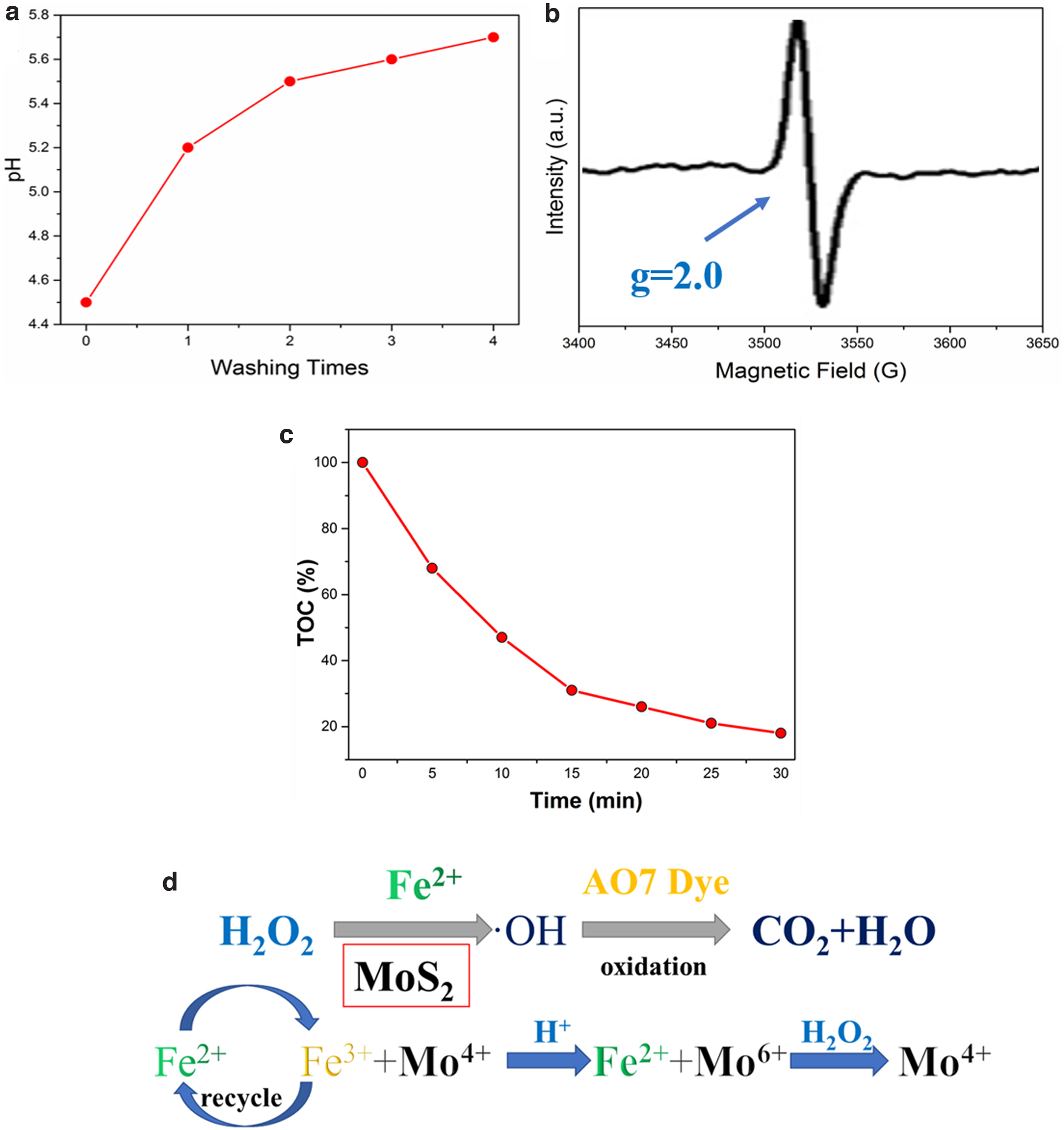
When the co-catalysts MoS2 was added in this system as given in Fig. 5a, the initial pH of the 6 g/L MoS2 aqueous dispersal is ∼4.5, which is acidic, indicating either donating protons or/and getting hydroxyl groups happened in water. Because MoS2 is incapable of donating protons to H2O, it is highly likely that MoS2 is being able to capture hydroxyl groups from water. The possible route is the leaving of S on Mo with the aid of proton to form H2S. Moreover, when washed, the MoS2, the sample became less and less acidic, which might be owing to the removal of H2S during washing (Fig. 5a). To investigate the generation of sulfur vacancies of MoS2, the electron paramagnetic resonance (EPR) spectra of the MoS2 was tested. As given in Fig. 5b, MoS2 after water washing presents a significant EPR signal at g = 2.0, which can be explicated as the sulfur vacancies can be generated. In general, it is believed that the unsaturated S atoms can capture protons during H2 evolution (Voiry et al., 2016).
To sum up, the reaction was added with the conversion of Fe3+ to Fe2+, as given in the following Equation (5) (Xing et al., 2018).


First, the protons was captured by unsaturated S atoms on the surface of MoS2, forming H2S with the oxidization of Mo4+ to Mo6+. Furthermore, the Mo6+ was reduced to Mo4+ with the decomposition of H2O2 in Equation (6), ensuring the catalytic of MoS2. The reason can be speculated in two aspects. One is that the MoS2 can guarantee the recycling of Fe3+/Fe2+. In addition, it can effectively promote the H2O2 to produce hydroxyl radicals.
The total organic carbon (TOC) of AO7 was also measured in the removal process. As given in Fig. 5c, the TOC of orange acid after 30 min was 18.7%. Figure 5d proposed the mechanism of MoS2 as the co-catalyst in Fenton reaction. MoS2 shows excellent co-catalytic activity for Fenton reactions owing to the Fe3+/Fe2+ cycle reactions and high H2O2 decomposition efficiency.
Toxicity evaluation and UV-vis absorption spectra during the degradation process
In conventional wastewater treatment, the toxicity of the intermediates was rarely tested during the degradation. To test the toxicity of accumulation of AO7 and its intermediates, the V. fisheri bioluminescence bacterial assay was used to determine the luminescence intensity and the results are given in Fig. 6a. The inhibition ratio of the initial toxicity of the AO7 solution (100 mg/L) was tested as 31.32%. During the first 5 min, the inhibition ratio rose slightly from 31.32% to 37.34%, indicating that there might be some new intermediates that were more toxic than AO7 in the solution. Then, the inhibition ratio rapidly reduced to 2.47% in 15 min of treatment. Subsequently, the inhibition ratio of the test solution was decreased to negative values. This was owing to the fact that luminescence of V. fisheri was not inhibited. These toxicity test results indicated that AO7 was effectively degraded by MoS2 co-catalytic Fenton reaction. Furthermore, the UV-Vis absorption spectra during the Fenton degradation are given in Fig. 6b. The characteristic peaks of AO7 intensity decreased dramatically in 20 min and maintained unchanged. This can be attributed to the production of •OH, which comes from the decomposition of H2O2 by the efficient Fe3+/Fe2+ conversion cycle.

The inhibition to Vibrio fischeri
Stability of MoS2 co-catalytic Fenton reaction
The recyclable property of MoS2 used in the reaction was studied and the results are given in Fig. 7a. The recycled MoS2 catalyst maintains nearly the same removal performance even after being reused seven times and the AO7 removal efficiency can keep up to 98%. Because the surface property determined the catalytic activity of the catalyst, X-ray photoelectron spectroscopy was used to characterize the surface information of MoS2 co-catalyst before and after dye degradation. By comparing the Mo3d and S2s peaks in Fig. 7b, it was found that the surface of Mo and S on MoS2 had no obvious change before and after the dye degradation. In other words, it is one of the reasons that the MoS2 can be reused many times. In addition, the SEM images of MoS2 before and after co-catalytic Fenton reaction (Fig. 7c) confirms the stability of MoS2 during the reaction. The mass and microstructure of MoS2 almost do not change after the cycle test, indicating that the MoS2 can be used as a stable co-catalyst in the Fenton reaction for wastewater treatment. In addition, the content of Mo element in the supernatant of the treated solution was measured by inductively coupled plasma optical emission spectrometer. The actual content of Mo was 0.008 mg/L in the treated AO7 solution after filtering. During this process, a certain amount of dissolved Mo ions could be produced and caused a wastage of MoS2. However, in this study, the mass loss of MoS2 was very small and could be ignored.

Conclusion
To conclude, MoS2 was introduced as co-catalyst in the Fenton system for the enhanced removal of AO7. The co-effect speeded up the reduction cycle of Fe3+ to Fe2+ owing to the oxidation of Mo4+. The removal efficiency of AO7 in the MoS2 co-catalytic Fenton reaction reached 98.05% in 30 min under the optimal conditions as follows: AO7 of 100 mg/L, MoS2 of 6 g/L, Fe(SO4)·7H2O of 50 mg/L, H2O2 of 1.5 mmol/L, and pH = 3.5. The main intermediates of AO7 degradation were detected in Fenton's progress by performing the GC-MS analysis. Furthermore, the toxicity of intermediates during the degradation progress slightly increased at first and then decreased to nontoxicity. The cycle test shows that MoS2 can be used as a stable co-catalyst in the Fenton reaction. Moreover, this study suggested that inorganic co-catalyst could be widely applied in Fenton progress for the treatment of wastewater polluted by organic dyes.
Footnotes
Author Disclosure Statement
No competing financial interests exist.
Funding Information
This study was supported by the Program National Natural Science Foundation of China (No. 41807469), the Scientific Research Fund of Yunnan Provincial Education Department (2018JS026), Yunnan Applied Basic Research Project (No. 2019FD038), and Yunnan Provincial Scientific Innovation Team of Soil Environment and Ecological Safety (2019HC008).

References
Supplementary Material
Please find the following supplemental material available below.
For Open Access articles published under a Creative Commons License, all supplemental material carries the same license as the article it is associated with.
For non-Open Access articles published, all supplemental material carries a non-exclusive license, and permission requests for re-use of supplemental material or any part of supplemental material shall be sent directly to the copyright owner as specified in the copyright notice associated with the article.
