




Abstract
One of the major groups of pollutants is formed by dyes existent in industrial wastewater and with increasing worldwide concerns on environmental issues, dye removal has gained significant attention. The Ag/AgCl (silver and silver chloride) counts as a suitable photocatalyst because of its surface plasmon resonances band. In this study, Ag/AgCl nanoparticles were loaded on various supports including TiO2 (titanium dioxide), La2O3 (lanthanum oxide), and ZnO (zinc oxide) using deposition–precipitation and photoreduction method. The photocatalytic activity of composites was evaluated by removing dye solutions under irradiation of visible light. The results displayed that the photocatalytic activity of Ag/AgCl/TiO2 and Ag/AgCl/ZnO is higher than Ag/AgCl/La2O3, owing to TiO2 and ZnO partial photocatalytic activity under the radiation of visible light. The Ag/AgCl/TiO2 also displayed remarkable photocatalytic activity compared with AgCl/TiO2 and Ag/TiO2 due to the coexistence of both active species Ag0 and AgCl in the composite. The nanocomposites' physicochemical properties were analyzed by X-ray diffraction, Fourier-transform infrared spectroscopy, Brunauer–Emmett–Teller, scanning electron microscope, and UV-vis diffusive reflectance spectra mode. This study provides a promising photocatalyst for dye treatment in wastewater using visible light.
Introduction
Organic dyes in industrial wastewater induce great environmental concerns as dyes bring pollution because of improper discharge and other reasons (Zhao et al., 2015). Therefore, dye pollutants replace one of the most severe environmental problems that threaten human health. Nowadays, various techniques are implemented to withdraw dye pollutants from wastewater, for example, biodegradation, adsorption, and photocatalytic oxidation degradation (Jie et al., 2014). A considerable number of studies have revealed that photocatalytic oxidation is a hopeful method for having numerous potential applications in treating most organic pollutants (Li et al., 2017). TiO2 is widely in use for photocatalytic removal of pollutants because of its outstanding characteristics, such as nontoxicity, low cost, and thermal stability (Stucchi et al., 2015). Yet, TiO2 does not have an extensive practical application because of low visible-light absorption and consequently, low photocatalytic performance in visible light.
For TiO2 photocatalyst, various modification methods have been explored and one of the most important technologies to improve the photocatalytic activity of TiO2 under irradiation of visible light is noble metal modified TiO2. It is well known that noble metal nanoparticles (NPs), for example, Pt, Au, and Ag have strong UV-vis absorption because of surface plasmon resonance (SPR) nanostructures (Zhou et al., 2012). Silver-based NPs have gained much attention because of their ability to remove dye contaminants, but silver NPs alone do not have an appropriate band gap to make them a practical photocatalyst. Instead, Ag/Ag halides (e.g., Ag/AgBr or Ag/AgCl) are appropriate photocatalysts owing to the SPR band (Das et al., 2017; Sharma et al., 2017). Researches have shown that Ag/AgX (X = Cl, Br) NPs' loading onto suitable supports efficiently prevent the NP aggregation, minimize the photoinduced electron and hole pairs recombination, and therefore, the photocatalytic performance increases (Wang et al., 2017; Liang et al., 2018; Yang et al., 2018).
Zhoua et al. have studied the effect of Ag/AgCl loading on the photocatalytic performance of TiO2 in removing 4-chlorophenol pollution. The composite proved to have an effective photocatalytic performance to remove 4-chlorophenol from water (Zhou et al., 2011). Wang et al. (2017) prepared Ag/AgCl@chiral TiO2 nanofibers, which showed very high photocatalytic efficiency for the decomposition of 17-b-ethinylestradiol under irradiation of visible light. Tiana et al. (2014) reported the synthesis of Ag/AgCl/TiO2 plasmonic photocatalyst through a simple multistage method, and nanocomposite indicated a very high photocatalytic activity to remove the orange 7, 2, and 4-dichlorophenol acid, and even to inactivate Escherichia coli. Tao et al. (2018) synthesized Ag/AgCl/ZnO composites under irradiation of visible light in a continuous microfluidic system and the results showed that the performance of Ag/AgCl/ZnO composites is better than both AgCl/ZnO and Ag/ZnO in the decomposition of methyl orange (MO). Xie et al. (2020) prepared graphite carbon nitride/La2O3 (denoted as CN/La) using hydrothermal method and the results showed that CN/La-6% displayed the most photodegradation activity.
Finally, Ag/AgCl composite is highly effective in reaction photocatalytic application, and many studies have focused on Ag/AgCl photocatalytic application. However, to the best of the authors' knowledge, no articles related to the support characteristic effect on photocatalytic performance of supported Ag/AgCl composite have been published. Therefore, this work compares the photocatalytic performance of Ag/AgCl NPs loaded on various supports such as La2O3, TiO2, and ZnO in removing various dyes. The TiO2 and ZnO are active photocatalysts and lanthanide perovskites also have photocatalytic activity (Nakhostin Panahi et al., 2019, 2020). Consequently, they were selected as support for the Ag/AgCl loading. This study explores the effect of support characteristics on the photocatalytic performance of supported Ag/AgCl composite.
Materials and Methods
Materials
Silver nitrate (AgNO3), hydrochloric acid (HCl), zinc oxide, and titan dioxide (TiO2) used for the preparation of nanocomposites were of analytical grade (Merck), were purchased from Mehr Azmon Co. (Iran), and used without any additional purification. Double-distilled water was used as a solvent for washing samples and preparing all necessary solutions.
Synthesis of nanocomposites
The Ag/AgCl/TiO2 nanocomposites with different loadings of Ag/AgCl (30%wt and 70%wt) were synthesized by deposition–precipitation and photoreduction method. In brief, TiO2 (1 g) was added to 50 mL of distilled water and ultrasonicated to disperse evenly. Then, AgNO3 (0.33 g) and HCl (0.13 mL) were added to the suspension, and white precipitation of AgCl was formed. After that, the resulting suspension was subjected to ultrasonic waves and then located under irradiation of ultraviolet light (30 min) so that a few of Ag+ to Ag0 was reduced. Finally, the resultant product (Ag/AgCl/TiO2 nanocomposite) was collected by centrifugation and dried at 60°C. Ag/AgCl/ZnO and Ag/AgCl/La2O3 nanocomposites were synthesized by a similar method. Ag/AgCl and AgCl/TiO2 and Ag/TiO2 with 70%wt were also synthesized by the same method and without TiO2, without ultraviolet light irradiation, and without adding HCl, respectively (Zhang et al., 2011; Guo et al., 2012).
Characterization of nanocomposites
Information on the crystalline phases of the synthesized nanocomposites was characterized by X-ray diffraction (D500 Ziemence) using Cu Kα radiation. Morphological analysis was performed with a scanning electron microscope (SEM; VEGA, TESCAN-XMU). The textural property was obtained using a Micromeritics Asap 2000 Analyser. The Fourier-transform infrared spectroscopy was carried out with a spectrophotometer (Nicolet isIQ; United Kingdom) in the range of 4,000–400 cm−1 with four wavenumber resolutions. To study the light absorption, the UV-visible light diffusive reflectance spectra (DRS) of the nanocomposites were measured using a UV-vis spectrophotometer (S4100-00-0701001U; Scinco, Korea).
Photocatalytic activity test
The photocatalytic activity of the synthesized nanocomposites was determined by studying the removal of dyes under irradiation of visible light. The widely used dyes in the industry, including MO, methylene blue (MB), basic red (BR), direct red (DR), and Congo red (CR), were chosen as the model. Properties of dyes are presented in Table 1. The details of the experiment are as follows: The nanocomposite was distributed into 100 mL of dye solution and a light-emitting diode lamp (60 W) was used as an irradiation source (light spectrum of the lamp is given in Supplementary Figure S1) and distance was 10 cm between the surface of the liquid and the light source. The temperature was also controlled by a cooling fan (26°C) throughout the removal experiments. The removal tests were conducted in ultrapure water with neutral pH. To achieve the adsorption–desorption equilibrium of dye on the photocatalyst, the suspension was stirred in the dark for 30 min before irradiation. Every 1 h, 5 mL of suspension was taken out of the reaction beaker and then centrifuged with a g-force equal to 2,332 to separate the photocatalyst particles. The dye solution's absorbance was measured by a UV-vis spectrophotometer (DR 2800; Shimadzu) and the dye concentration was determined according to Beer–Lambert law. Finally, the percentage (%) of dye removal was calculated by the following Equation (1):
Properties of Dyes
where C0 and Ct are defined as the initial dye concentration and the dye concentration after irradiation, respectively (Luo et al., 2014).
Results and Discussions
Characterization
X-ray diffraction analysis
Figure 1 displays X-ray diffraction (XRD) patterns taken from Ag/AgCl, Ag/AgCl/TiO2 (70%wt), and Ag/AgCl/ZnO (70%wt) powders. At the XRD pattern of Ag/AgCl/TiO2, the diffraction peaks at 2θ = 25.3°, 37.8°, 48.1°, 55.1°, 62.7°, 68.7°, 70.3°, and 75.1° are assigned to anatase TiO2 (JCPDS No. 21-1272), which are perfectly indexed to (101), (004), (200), (211), (204), (116), (220), and (215) crystalline planes, respectively. At the XRD pattern of Ag/AgCl/ZnO, the characteristic diffraction peaks at 2θ = 31.772°, 34.420°, 36.256°, 47.603°, 56.627°, and 62.901° are also assigned to ZnO (JCPDS No. 3614-51). The diffraction peaks located at 2θ = 27.8°, 32.2°, 46.2°, 54.9°, 57.6°, 67.4°, 74.5°, and 76.6° of XRD patterns of Ag/AgCl, Ag/AgCl/ZnO, and Ag/AgCl/TiO2 are assigned to cubic AgCl (JCPDS No. 31-1238), which are indexed to (111), (200), (220), (311), (222), (400), and (331) crystalline planes, respectively. Finally, a peak at 38.2° that exists at all XRD patterns is assigned to metallic AgNP (JCPDS No. 65-2871). All the diffraction peaks in the XRD patterns were marked as the TiO2, ZnO, AgCl, and Ag. Besides, the gray color of nanocomposites proved that metallic silver exists on the surface of Ag/AgCl, Ag/AgCl/ZnO, and Ag/AgCl/TiO2 (Guo et al., 2012; Yin et al., 2016; Liang et al., 2018; Yu et al., 2018).
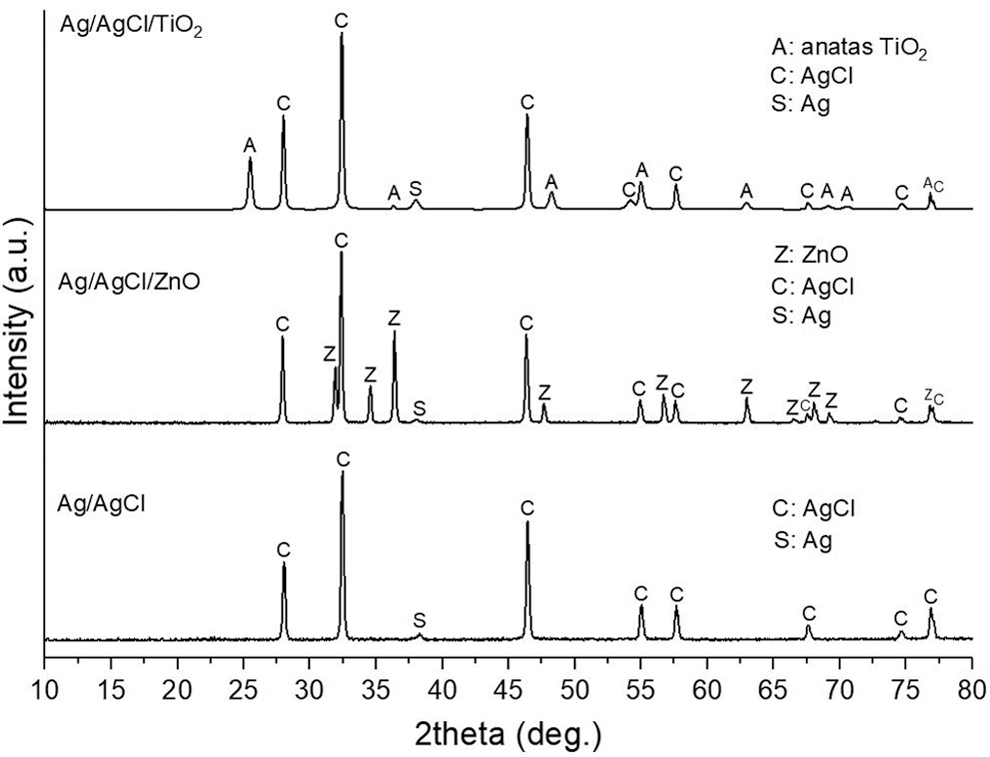
XRD pattern of Ag/AgCl/TiO2 (70%wt), Ag/AgCl/ZnO (70%wt) and Ag/AgCl.
FTIR analysis
The FTIR spectra belonging to the TiO2, Ag/AgCl/TiO2 (70%wt), ZnO, and Ag/AgCl/ZnO (70%wt) samples are given in Supplementary Figure S2. The vibrations at 500–700 cm−1 for TiO2 and Ag/AgCl/TiO2 correspond to stretching vibrations of Ti–O bond, and at the FTIR spectra of ZnO and Ag/AgCl/ZnO, the vibrations within 400–600 cm−1 are indexed to the characterized vibrations of the Zn–O bond. The vibration ∼3,400 cm−1 can be assigned to the hydroxyl groups of TiO2 or ZnO. At all samples, the vibration at ∼1,630 cm−1 is due to the bending vibration of OH bond of chemisorbed and/or physisorbed water molecules (Liu et al., 2017; Seirafi et al., 2018). For Ag/AgCl/TiO2 and Ag/AgCl/ZnO, a new peak appeared at ∼1,385 cm−1 attributed to the interaction between AgNP and TiO2 or ZnO that caused by Ag/AgCl deposited on the TiO2 or ZnO surface (García-Serrano et al., 2009).
Brunauer–Emmett–Teller surface area and SEM and EDAX analysis
The particle size and morphology of Ag/AgCl/TiO2 (70%wt) and Ag/AgCl/ZnO (70%wt) were examined by SEM, and the results are given in Fig. 2. The SEM images of Ag/AgCl/TiO2 imply that this composite is uniform and spherical. According to SEM images of Ag/AgCl/ZnO, the Ag/AgCl particles were distributed as nanosize on the ZnO surface.
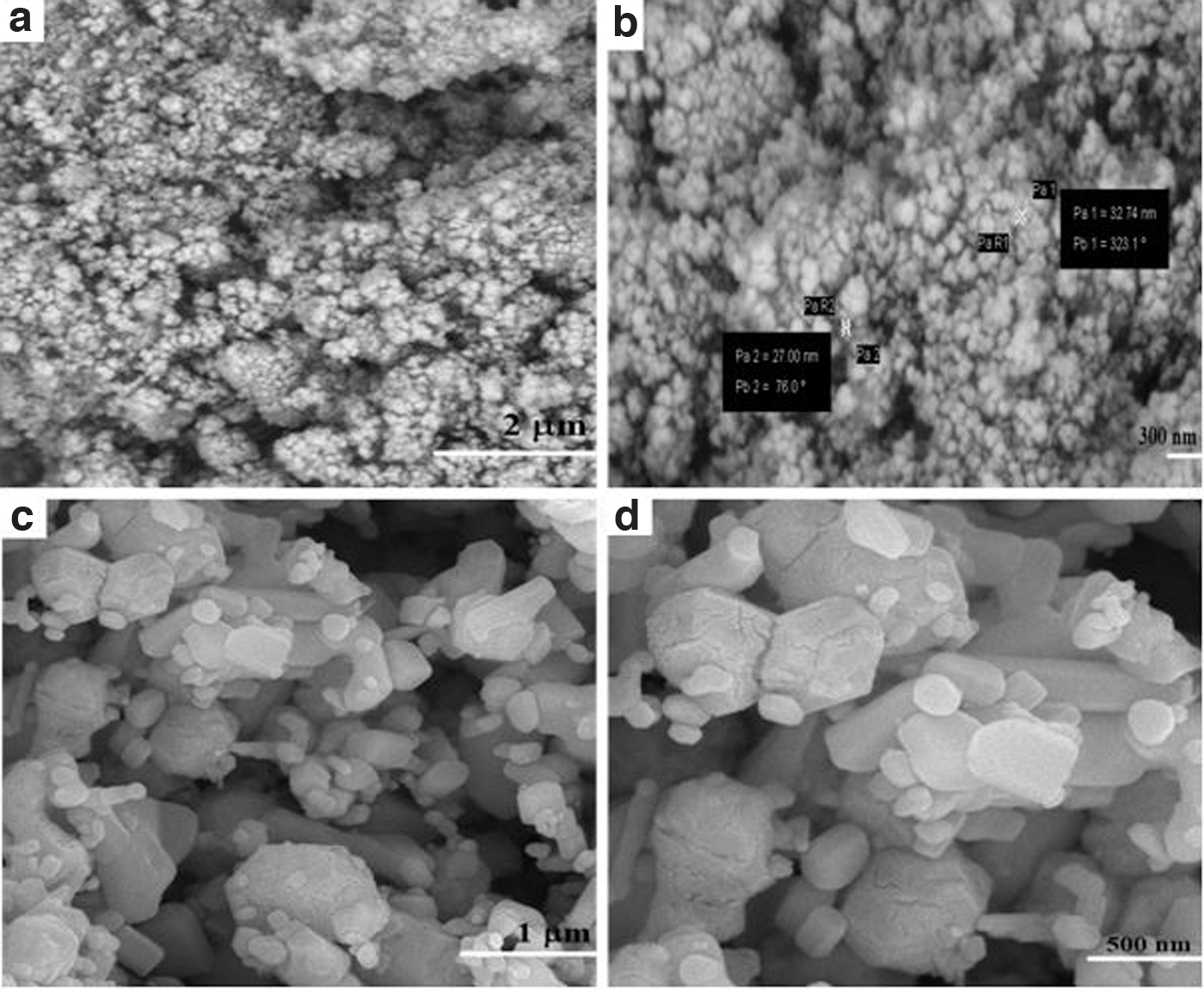
SEM images of
The Brunauer–Emmett–Teller (BET) surface area was explored by nitrogen adsorption–desorption experiments. The BET-specific surface area of TiO2 and Ag/AgCl/TiO2 (70%wt) were 33.7 and 35.1 cm2/g, respectively. The BET-specific surface area of ZnO and Ag/AgCl/ZnO (70%wt) also were 21.2 and 23.4 cm2/g, respectively. Therefore, it is concluded that the BET surface area of the nanocomposites is similar to those of the TiO2 and ZnO pristine.
Additional information obtained from SEM–EDAX (energy dispersive X-ray) profiles regarding the presence of elements in Ag/AgCl/TiO2 and Ag/AgCl/ZnO are given in Supplementary Figure S3. The Ag peak that appeared in the EDAX profiles of Ag/AgCl/TiO2 and Ag/AgCl/ZnO, indicates that it is present in the nanocomposites. Finally, the spectrums confirmed the existence of the corresponding chemical elements (Ag, Cl, Ti, and O for Ag/AgCl/TiO2 and Ag, Cl, Zn, and O for Ag/AgCl/ZnO), and also no other elements were detected.
UV-vis diffuse reflectance spectra
Figures 3 and 4 provide the UV-vis diffuse-reflectance spectra of the TiO2, Ag/AgCl, Ag/AgCl/TiO2 (70%wt), and Ag/AgCl/ZnO (70%wt), respectively. It is clear from Fig. 3 that the visible light absorption of Ag/AgCl/TiO2 was increased compared with TiO2 and the Ag/AgCl and Ag/AgCl/ZnO also showed absorption at visible light region regarding SPR of AgNP. It is proof of the fact that Ag/AgCl, Ag/AgCl/TiO2, and Ag/AgCl/ZnO have optical activity in the visible region (Guo et al., 2012; Liang et al., 2018).

UV-vis diffuse reflectance spectra of Ag/AgCl, TiO2 and Ag/AgCl/TiO2 (70%wt).

UV-vis diffuse reflectance spectra of Ag/AgCl/ZnO (70%wt).
The band-gap energy (Ebg) could be estimated by the following Equation (2):

where α, h, υ, A, and Ebg are absorption coefficient, Planck constant, light frequency, constant, and band-gap energy, respectively. The n is 2 or 1/2 for indirect and direct transitions, respectively, and n = 2 was used to determine the band-gap energy of nanocomposites (Yin et al., 2016). The value of the band-gap energy can be obtained from the (αhυ)2-hυ plot by extrapolating the linear portion of (αhυ)2 to 0. According to Figs. 3b and 4b, the band-gap energy of TiO2, Ag/AgCl, Ag/AgCl/TiO2, and Ag/AgCl/ZnO were estimated to be 3.42, 2.9, 3.0, and 3.08 eV, respectively.
This means that Ag/AgCl loading can make the band gap narrow. Consequently, more efficient use of visible light can be achieved, and Ag/AgCl/TiO2 show more removal efficiency of pollution compared with TiO2 under visible light radiation.
Photocatalytic property
Ag/AgCl/TiO2 nanocomposite
The Ag/AgCl/TiO2 (30%wt) photocatalytic activity was evaluated by removing different dyes under irradiation of visible light. According to results given in Fig. 5a, Ag/AgCl/TiO2 (30%wt) has a high photocatalytic activity for removal of MB, MO, CR, and BR dyes under irradiation of visible light.
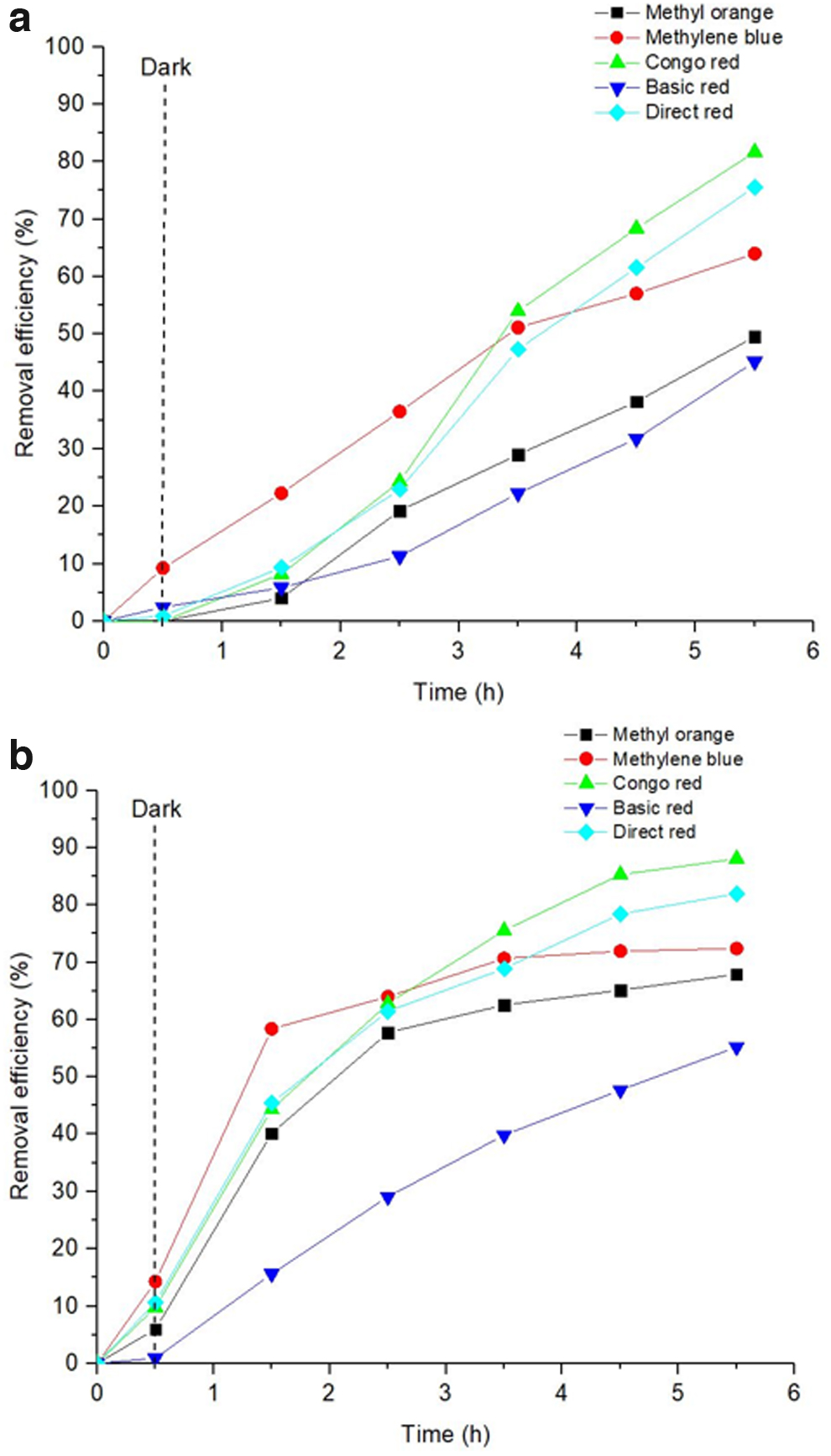
Removal of
For further improvement of photocatalytic activity, Ag/AgCl was loaded with more amount (70%wt) on TiO2, and Ag/AgCl/TiO2 (70%wt) was tested to remove high concentrations of organic dyes. The removal results are given in Fig. 5b. According to this Figure, the Ag/AgCl/TiO2 (70%wt) can remove high concentrations of dyes under irradiation of visible light. To differentiate between the absorption and the photocatalysis of dyes, experiments were also carried out in the absence of irradiation of visible light and under identical conditions. The results of dye removal through adsorption over the Ag/AgCl/TiO2 (70%wt) nanocomposite (dark test) are given in Supplementary Figure S4, and it was found to be slight.
Owing to the more use of the CR in the industry, this dye was chosen as a model for further study on the photocatalytic properties of Ag/AgCl/TiO2 nanocomposite.
Ag/TiO2, AgCl/TiO2, AgNP, Ag/AgCl and TiO2 components
The Ag/TiO2 (70%wt), AgCl/TiO2 (70%wt), and Ag/AgCl/TiO2 (70%wt) nanocomposites' photocatalytic activity in removing CR under irradiation of visible light is given in Fig. 6a. It could be found that discoloration percentage by Ag/TiO2 and AgCl/TiO2 is less compared with Ag/AgCl/TiO2, and this implies the necessity of the coexistent active species Ag0 and AgCl for high photocatalytic performance.
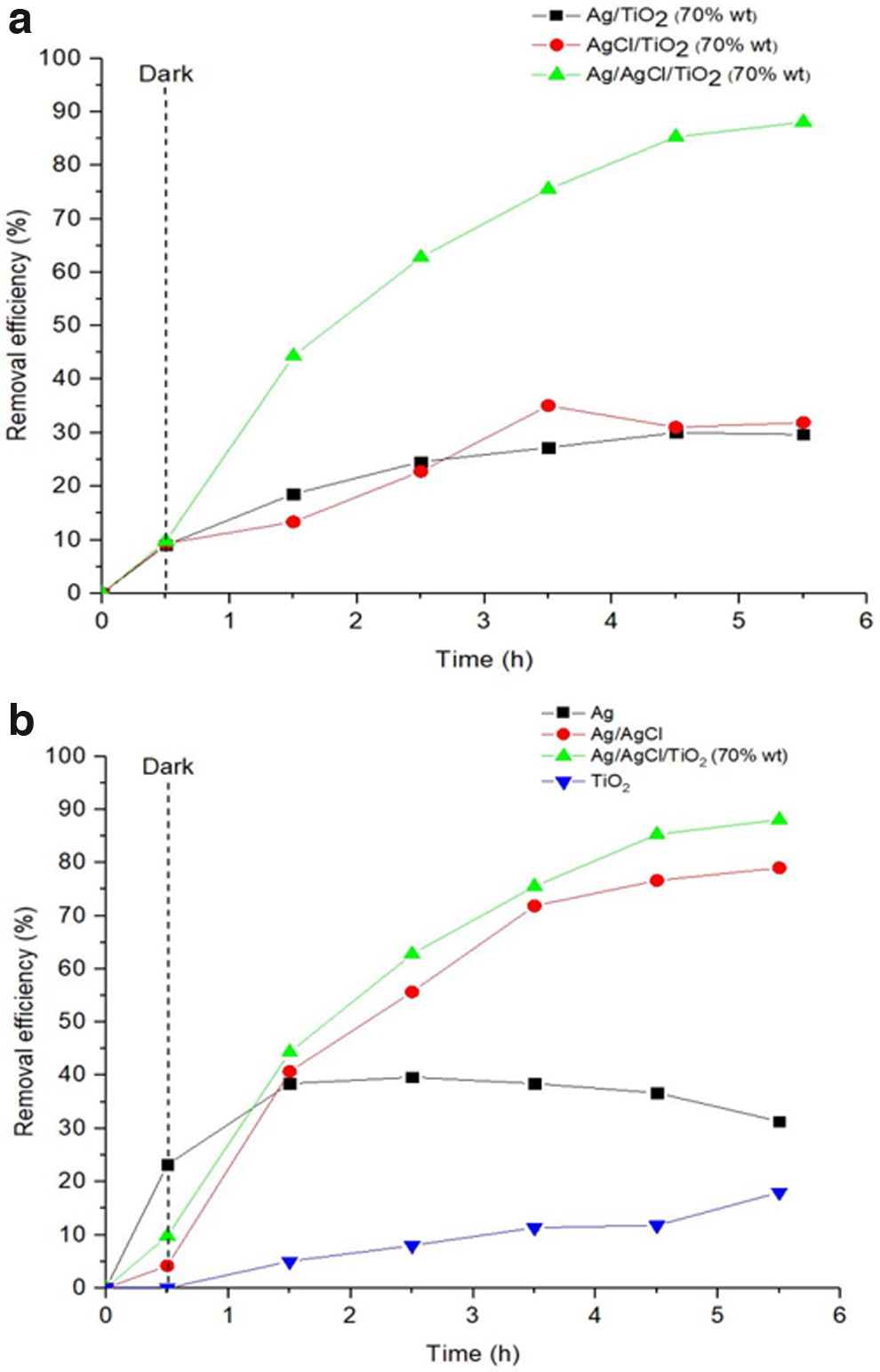
Removal of Congo red (70 ppm) by
The comparison between the photocatalytic activity of TiO2, Ag/AgCl, and AgNP with Ag/AgCl/TiO2 nanocomposite was also performed, and results of the removal efficiency are given in Fig. 6b. It is obvious that the photocatalytic activity of AgNP and TiO2 is very low in visible light, and the photocatalytic activity of Ag/AgCl is also less than Ag/AgCl/TiO2. The TiO2 substrate has a large surface area and can uniformly disperse Ag/AgCl NPs upon the surface. Therefore, the loading of Ag/AgCl onto TiO2 efficiently prevents particle aggregation, and consequently, photocatalytic activity increases (Wang et al., 2017; Liang et al., 2018).
According to dark tests (given in Supplementary Figure S5), the adsorption of CR over Ag/TiO2, AgCl/TiO2, AgNP, Ag/AgCl, and TiO2 was slight.
Photocatalytic mechanism
To explore the photocatalytic mechanism of Ag/AgCl/TiO2 and to verify the specific reactive species, several sacrificial agents were used for scavenging the active species during the photocatalytic reaction. Hence, isopropyl alcohol was used for quenching •OH, benzoquinone (BQ) for quenching •
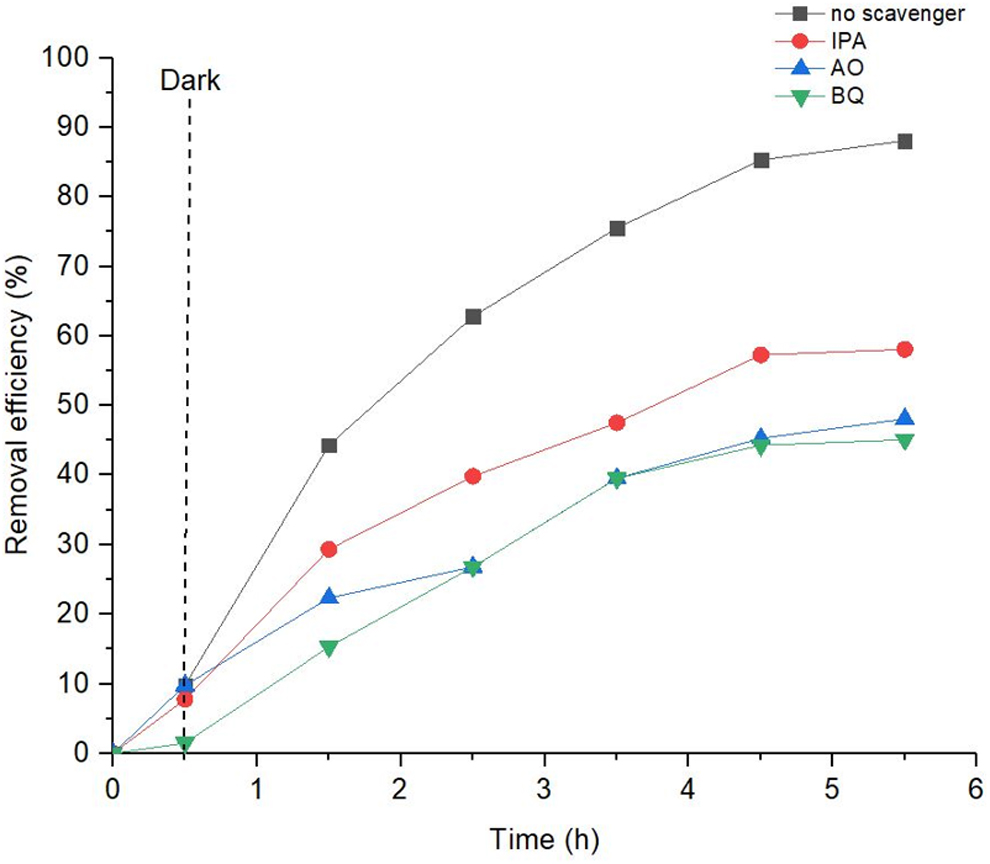
Effects of various scavengers on the photocatalytic activity of Ag/AgCl/TiO2 (70% wt) toward Congo red under visible light irradiation (photocatalyst dose = 70 mg/100 mL).
Therefore, based on the above observations, a feasible mechanism was proposed for the decomposition of CR over the Ag/AgCl/TiO2 nanocomposite under irradiation of visible light. A schematic of the electron-hole separation and also transfer path of charges in the Ag/AgCl/TiO2 is given in Supplementary Figure S6 (a). Regarding SPR, electron-hole pairs are photoinduced in AgNP under irradiation of visible light. The photogenerated electrons at the AgNP are easily transferred to the conduction band of TiO2. Then, they are trapped by oxygen molecules (O2) that were adsorbed on the catalyst's surface, and finally, superoxide radicals (•
Ag/AgCl/ZnO and Ag/AgCl/La2O3
In the next step, Ag/AgCl NPs upon ZnO and La2O3 were also loaded (Ag/AgCl/ZnO [70%wt] and Ag/AgCl/La2O3 [70%wt]). The removal efficiency of CR by Ag/AgCl/ZnO (70%wt) and Ag/AgCl/La2O3 (70%wt) under irradiation of visible light is given in Fig. 8a. The Congo red removal by Ag/AgCl/TiO2 (removal 88.5%) and Ag/AgCl/ZnO (removal 88%) nanocomposites is higher than Ag/AgCl/La2O3 (removal 45%), and this indicates that the type of support in composite affects photocatalytic performance. Therefore, the photocatalytic activity of TiO2, ZnO, and La2O3 supports in the removal of CR was also investigated, and results are given in Fig. 8b. It was found that TiO2 and ZnO have partial photocatalytic activity (removal 19% and 25%, respectively) under the radiation of visible light (Oda et al., 2015; Ullah et al., 2018) and La2O3 has no photocatalytic activity for removal of CR. Therefore, because TiO2 and ZnO are partially visible light active photocatalysts, there can be a synergistic effect between TiO2 or ZnO and Ag/AgCl. The loading of Ag/AgCl onto TiO2 or ZnO presents an adding second semiconductor function way for improving the photocatalytic activity, and consequently, the CR removal increases.
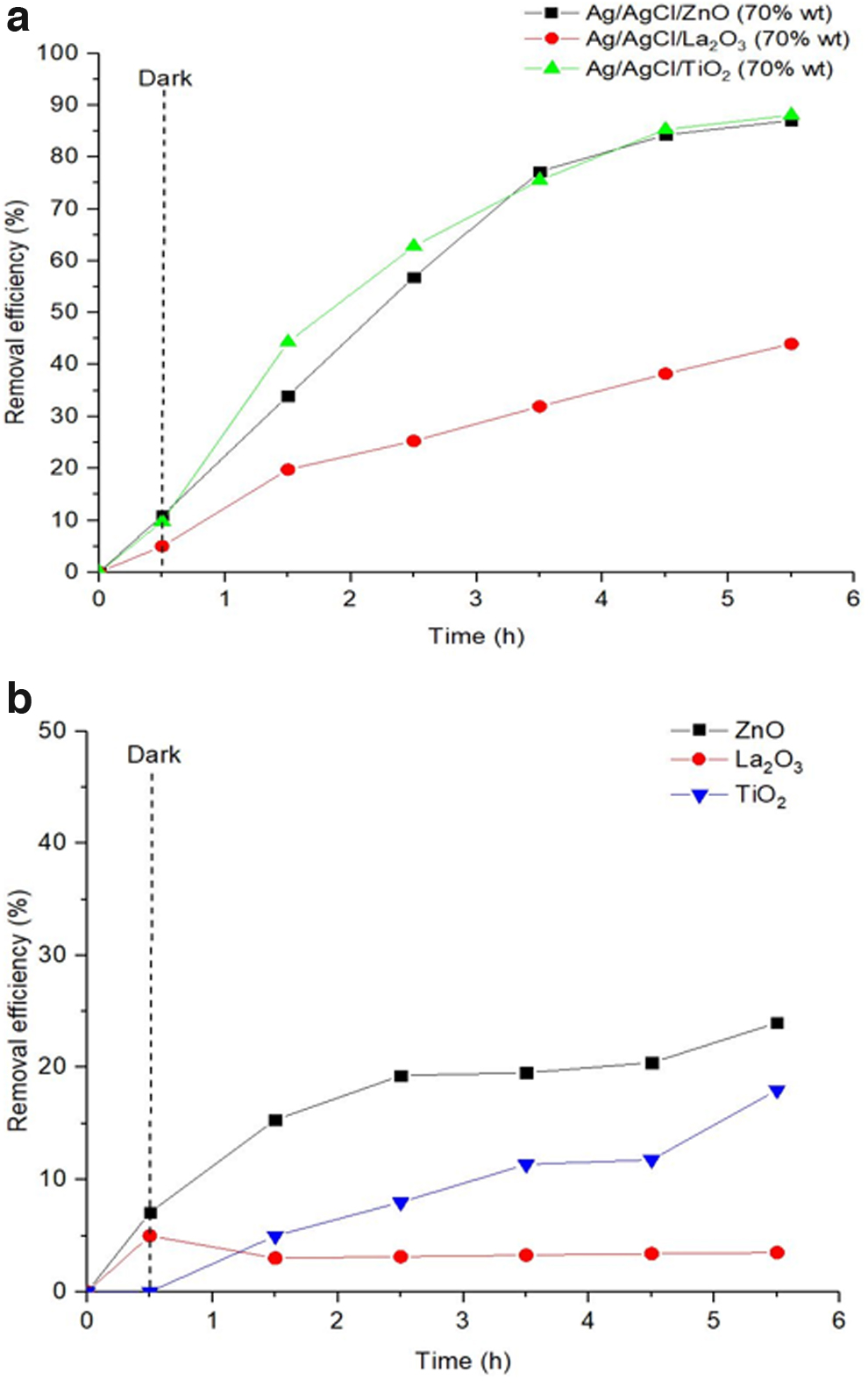
Removal of Congo red (70 ppm) by
The CR removal through adsorption, using the Ag/AgCl/ZnO (70%wt) and Ag/AgCl/La2O3 (70%wt) nanocomposites (dark test), were also carried out, and results are given in Supplementary Figure S7 that was slight.
Ag/AgCl/TiO2 recycling
The photocatalyst recovery for reuse is one of the most significant characteristics in practical application for wastewater treatment (Yang et al., 2017). For this purpose, the cycle removal experiments of CR were performed under identical conditions to investigate the photostability of Ag/AgCl/TiO2 (70%wt). The TiO2 was more available and cheaper than ZnO, and therefore, we selected Ag/AgCl/TiO2 for cycle removal experiments. After each removal cycle, the Ag/AgCl/TiO2 was filtered and washed with water, and then dried at 70°C (Feng et al., 2018). The results of CR removal using the regenerated Ag/AgCl/TiO2 after four cycles are given in the Supplementary Figure S8. It was found that the CR removal efficiency slightly decreases (∼10%) after the fourth cycle of the experiment. It is because of the covered active surface sites with intermediates. Consequently, the Ag/AgCl/TiO2 photocatalyst's high performance during regeneration examinations makes it an excellent photocatalyst for wastewater treatment.
In the next step, the Ag/AgCl/TiO2 (70%wt) performance for decolorization of real textile industry's wastewater was evaluated. This wastewater mainly contains nonbiodegradable dyes, which are highly resistant to conventional oxidizing agents. The wastewater had a maximum absorption at 520 nm wavelength. Therefore, this wavelength was chosen to measure decolorization. The results of decolorization are given in Supplementary Figure S9 that was less than pure water. The real dye-contaminated wastewater has a very complex matrix compared with a dye in ultrapure water; therefore, the applicability of this approach to treating real dye-contaminated wastewater is low.
Ayodhya et al. (2016) studied the CR dye degradation under the irradiation of solar, visible, and UV lights using copper sulfide NPs, and 75.47% and 60.35% of dye were degraded at UV and solar lights, respectively. Pathania et al. (2016) synthesized chitosan-g-poly(acrylamide)/ZnS nanocomposite materials through microwave radiations, and their photocatalytic activity was tested for the CR degradation under irradiation of simulated solar. According to the results, 75% of CR was degraded. Therefore, the comparison between the photocatalytic performance of Ag/AgCl/TiO2 and Ag/AgCl/ZnO nanocomposites with other photocatalysts (given in Table 2) proves that these nanocomposites are more effective in the CR dye degradation.
The Summary of Studies on Photocatalytic Removal of Congo Red
Conclusions
The Ag/AgCl/TiO2 nanocomposite was successfully synthesized using deposition–precipitation and the photoreduction method. The photocatalytic activity of Ag/AgCl/TiO2 was superior compared with Ag/TiO2 and AgCl/TiO2, and as a consequence, for the high photocatalytic efficiency, the coexistence of both active species Ag0 and AgCl in the composite is necessary. The Ag/AgCl/TiO2 (70%wt) can remove high concentrations of dye pollutants under irradiation of visible light. According to DRS results, loading of Ag/AgCl increases absorption at visible light region owing to SPR of AgNP, and loading of Ag/AgCl also makes the band gap narrow. In the following, Ag/AgCl NPs were loaded on ZnO, and La2O3 and photocatalytic results showed that the type of support in composite affects photocatalytic performance. The removal of CR by Ag/AgCl/TiO2 and Ag/AgCl/ZnO was more than Ag/AgCl/La2O3. In the final, Ag/AgCl/TiO2 nanocomposite for decolorization of real textile industry wastewater was also utilized and according to results, the removal efficiency was less than pure water.
Footnotes

References
Supplementary Material
Please find the following supplemental material available below.
For Open Access articles published under a Creative Commons License, all supplemental material carries the same license as the article it is associated with.
For non-Open Access articles published, all supplemental material carries a non-exclusive license, and permission requests for re-use of supplemental material or any part of supplemental material shall be sent directly to the copyright owner as specified in the copyright notice associated with the article.
