




Abstract
The ground movement induced by underground mining operation affects or even damages the roots of land plants with resultant vegetation deterioration. The adaptability of land plant to mining disturbance is species dependent. In this study, several typical xeromorphic plants growing in Shendong Coalfield, an arid and semiarid area of northwestern China, were compared in terms of root distribution and lengths. Distinct element method-based models were established to investigate the evolution of stress and deformation of topsoil during underground coal excavation, indicating that incongruous dislocations associated with tensile or shear deformation of soil blocks contribute to the negative effects on the roots of land plant. Furthermore, in the same scenario of deep-seated coal seam extraction, numerical modeling with more sophisticated topsoil blocks and plant roots visually indicated that most parts of the vertical root cracked, while pivotal parts of horizontal roots remained almost intact. Field data of vegetation communities in unexploited and exploited areas at two coal mines of Shendong Coalfield in terms of the coverage, density, and frequency, which showed a good agreement with modeling results, reveal that plants with more developed horizontal roots have stronger adaptability to mining disturbance, and should be cultivated more to become the dominant species in coal mining areas.
Introduction
Coal, one of the largest energy sources, most often occurs in underground stratified sedimentary deposits. Underground coal mining, by default, can slightly or even drastically force the surrounding strata to move toward the voids left by the extracted coal and reshape the surface eco-environment (Bell et al., 2000; Kumar et al., 2017; Milanović et al., 2017; Lucca et al., 2018; Maigret et al., 2019). Take Shendong Coalfield as an example, large-scale mining has triggered local eco-environment deterioration, which can be demonstrated by such issues as vegetation depletion and grassland degradation (Fu et al., 2003; Lei et al., 2016; He et al., 2017; Ma et al., 2018).
In fact, different land plant may possess various adaptive capacities to mining disturbance in consideration of an actual situation that not all land plant withered up with deep-seated coal seam extracted (Ye et al., 2015). It is of great significance to understand the impacts of underground coal mining on land plant so that some species with stronger adaptability can be screened out and substituted for those with lower performance. If this practice could be achieved, the resistibility of surface eco-environment against forthcoming mining disturbance would be strengthened as a consequence.
Generally, the growth of land plant is at the mercy of the soil quality such as moisture content and nutrient substance, whose reduction may give rise to vegetation depletion over a large area. In fact, as key factors to plant growth, relevant knowledge revolving around the changes in soil quality affected by underground coal mining has been studied by many academics. Bian et al. (2009) found that soil moisture did not have significant changes before and after underground coal mining in Shendong Coalfield, which was based on a field sampling investigation by remote sensing and ground-penetrating radar. Indoor experiments conducted by Yang et al. (2016) proved that coal mining in Daliuta coal mine could slightly decrease the average values of soil water moisture and organic matter, and yet, this phenomenon did not always occur to every specimen.
Arid and semiarid coalfield are especially regarded as specific research background to study mining-induced changes in soil moisture and nutrient substance. By means of measuring the field moisture capacity and standard hydraulic conductivity, it was found that both indexes in exploited area had similar values and variation characteristics to those in unexploited area (Lv et al., 2005; Wei et al., 2008; Zawadzki et al., 2016; Wu et al., 2018). In other words, differences in soil nutrients between exploited area and unexploited area were slight in terms of the content of total nitrogen, phosphorus, and potassium (Zang et al., 2010). According to the above previous studies, the impacts of underground coal mining on the nutrient substance of surface soil and its impacts on the regular growth of land plant in this area can be well excluded.
Here comes an inference that there should be other downside inducements causing vegetation depletion with deep-seated coal seam exploited. In this context, do cracks induced by stress redistribution in topsoil damage the roots so as to affect the regular growth of land plant? Starting from such a perspective, this article selects Shendong Coalfield as a case, by virtue of research methodologies like numerical modeling and field investigation, to further study the impacts of underground coal mining on the roots of land plant.
Materials and Methods
Study area
This study is conducted after obtaining approval from the Institutional Review Board (IRB) at China University of Mining and Technology. Shendong Coalfield is situated in arid and semiarid areas of northwestern China. Local land surface is mostly covered by moving sand dunes and semifixed dunes. Comprised by several large-scale modernized coal mines shown in Fig. 1, the total annual output of coal resources in this field has outnumbered two hundred million tons, whereas, on account of the water scarcity and sparse vegetation, Shendong Coalfield is encountering a contradiction between rich coal resources and fragile eco-environment (Zhang et al., 2011).
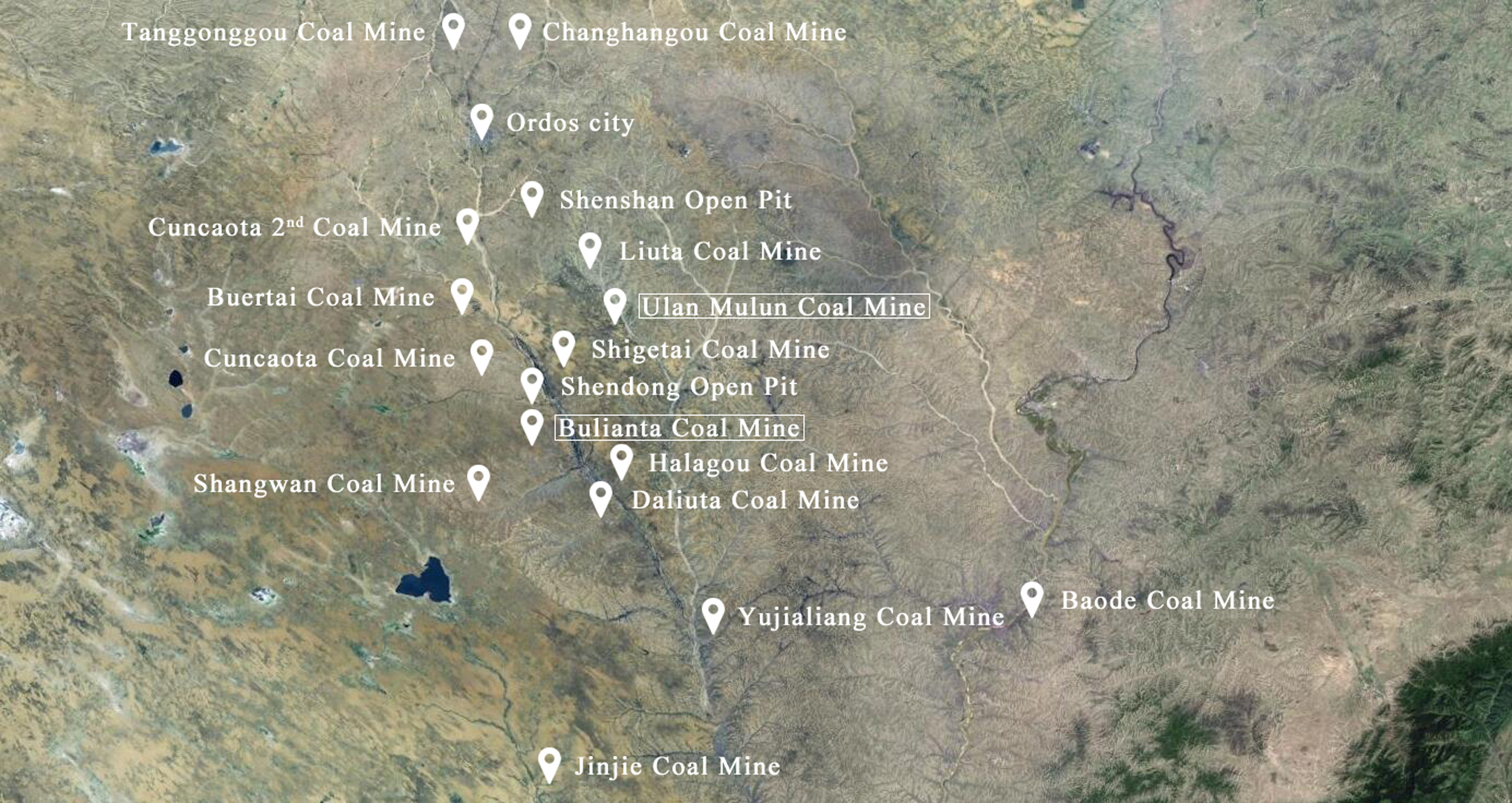
Satellite imagery and subordinate mines of Shendong Coalfield.
In Shendong Coalfield, the coal-bearing strata are mainly controlled by Yan'an Formation (J2y) of the Lower Jurassic Series. The coal seam, with about 120 m in depth and about 5.5 m in thickness, is nearly horizontally seated underground. Figure 2 shows the typical geologic column in Shendong Coalfield (Fan, 2011). It can be seen that the topsoil is mainly made of unconsolidated aeolian sand, whose average thickness is around 46 m. The strata, from the top of the coal seam up to the bottom of topsoil, can be classified into bed rocks, whose average thickness is no more than 75 m. Therefore, thick unconsolidated formation and thin bed rocks are the noteworthy characteristics of Shendong Coalfield.

Typical geologic column of Shendong Coalfield.
Take Bulianta Coal Mine affiliated to Shendong Coalfield as an example; the soil composition of N, P, and K at different depths was measured and is shown in Table 1. It can be seen from Table 1 that, within the depth of 1.3 m, the content of N and P in soil goes up with depth, but that of K is evenly distributed in general. As the study area of this work is the same one, the survey results of soil composition in Bulianta Coal Mine can represent the soil characteristics of Shendong Coalfield.
Soil composition of Bulianta Coal Mine
Field count on plant roots
There exist diverse xeromorphic vegetations on the land surface of Shendong Coalfield. Six kinds of natural plants shared by unexploited and exploited areas in Shendong Coalfield were counted and classified into two categories in terms of the main growing orientation of their roots (Zhang et al., 2007).
Salix psammophile
S. psammophile, with general height ranging from 2 to 4 m, is a common shrub growing in moving and semimoving sandy lands in Shendong Coalfield. Inspection and measurement were launched revolving around two medium-sized samples and the root distribution is shown in Fig. 3. The comparison of the growth situation according to the ruler in Fig. 3 indicates that the roots of S. psammophile have similar length and depth in horizontal and vertical directions. Specifically, the average and maximum lengths of the horizontal roots reach 6.11 and 13, and 6.61 and 8.7 m in depth, respectively.
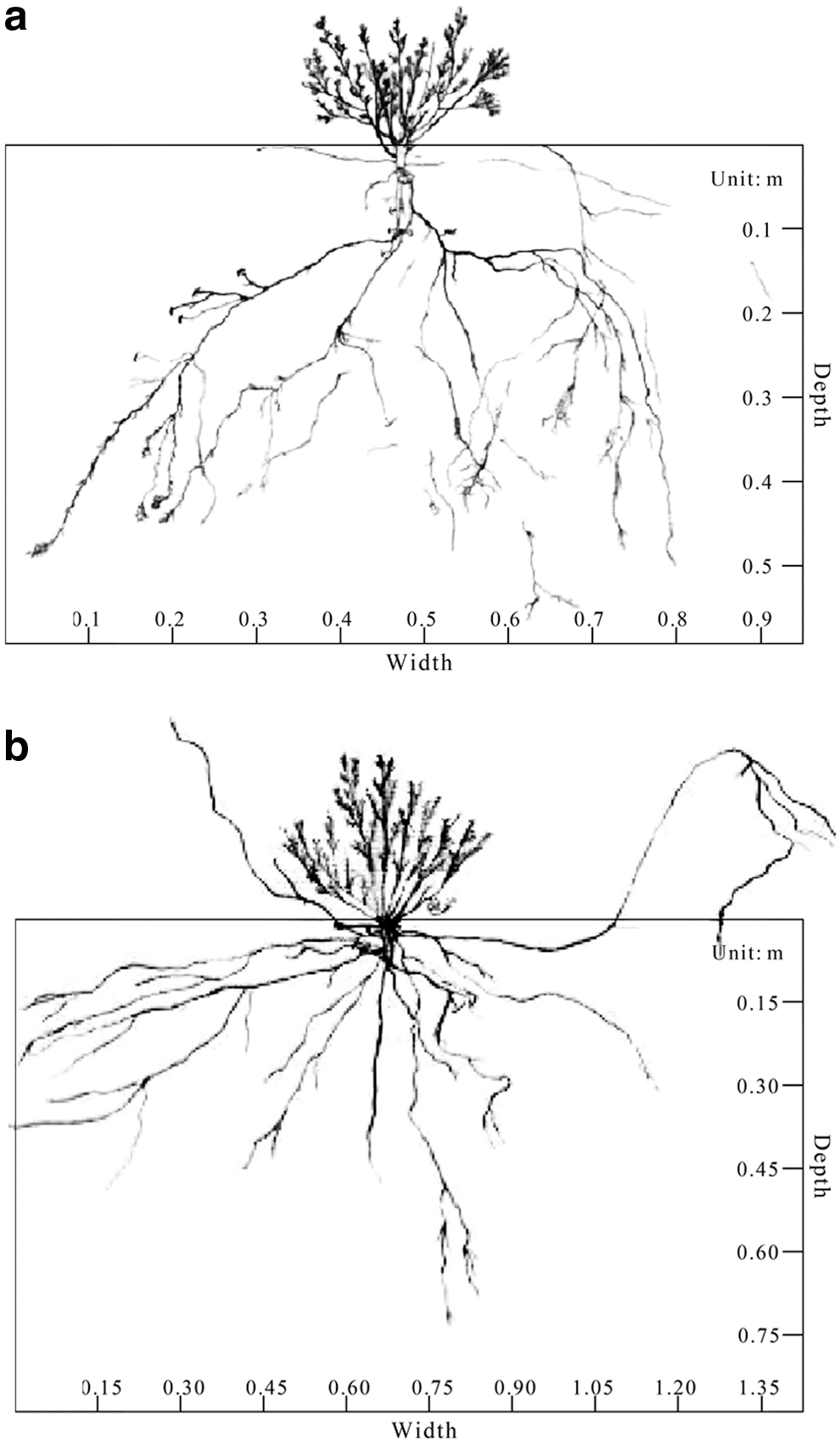
Root distribution of Salix psammophile:
Artemisia ordosica krasch
A. ordosica krasch is a kind of xeromorphic sandy semishrub growing in arid grassland and dessert grassland. This kind of land plant, with cluster height ranging from 0.05 to 0.10 m, is one of the key constructive species in arid and dessert grasslands. Two bigger-sized samples of A. ordosica krasch were selected to investigate the distribution of their roots. It can be seen from Fig. 4 that the average cluster height and crown width of both samples are 0.77 and 1.44 m, respectively. Horizontally, the length of the roots averages 2.33 m and peaks at 4.78 m, compared with 1.0 and 1.37 m vertically. Therefore, the horizontal roots of A. ordosica krasch are more flourishing.

Root distribution of Artemisia ordosica krasch:
Hedysarummaxim
Hedysarummaxim is another kind of xeromorphic sandy semishrub growing in moving and semifixed dunes and loess hills. This species is distributed more extensively in coalfield. The cluster height of Hedysarummaxim ranges from 1 to 2 m. Compared with A. ordosica krasch, Hedysarummaxim has more flourishing roots in the vertical direction, which can be demonstrated in Fig. 5. The cluster height and crown width of two samples are 0.89 and 1.74 m on average. The average length of vertical roots is around 5.75 m, yet, with horizontal roots around 2.19 m.
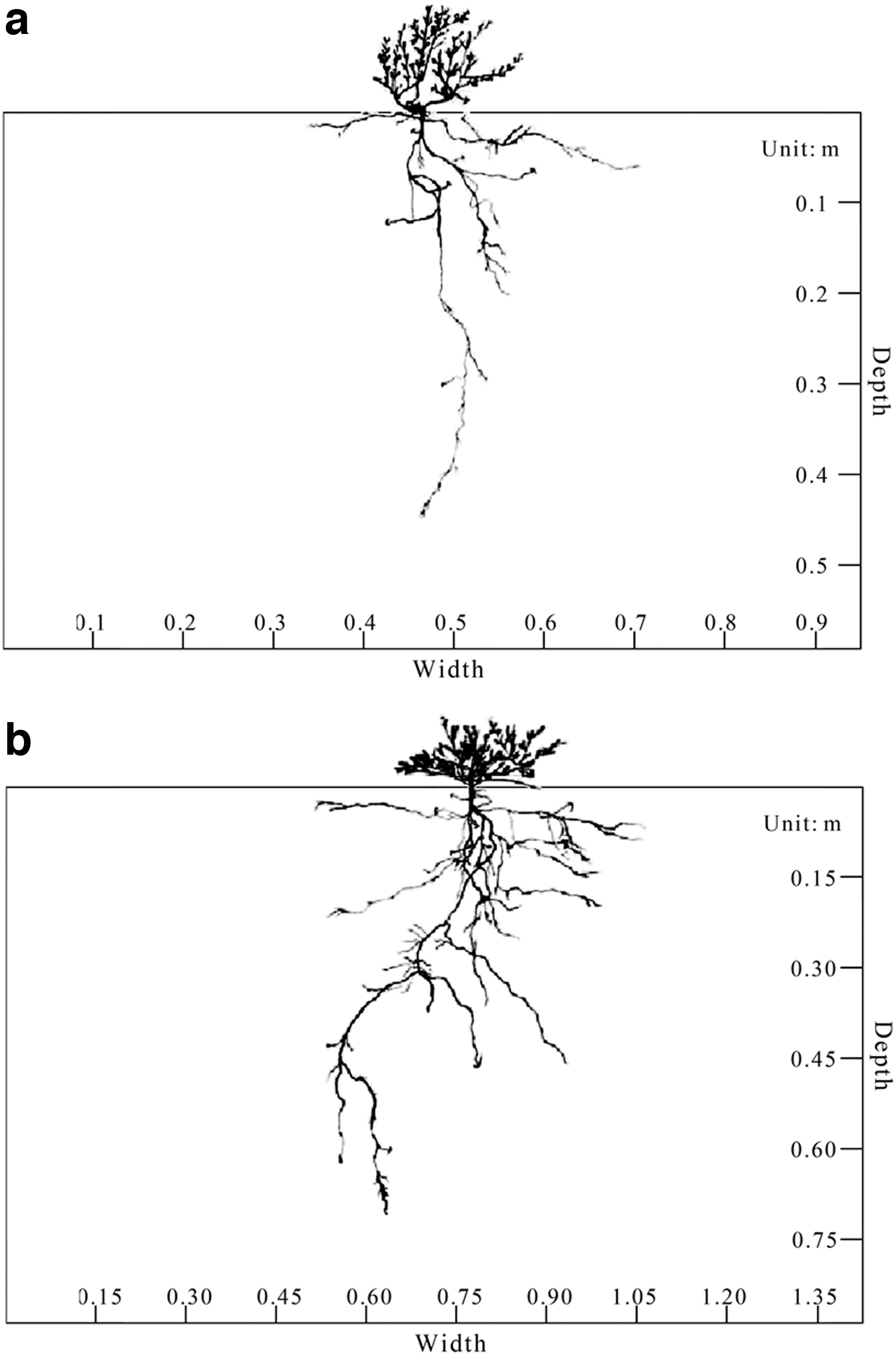
Root distribution of Hedysarummaxim:
Corispermumspp
Corispermumspp is an annual herb, which is widely distributed in the sandy soil of grassland and dessert grassland. From 0.01 m, the cluster height can reach 0.05 m. Two medium-sized samples in study area, with cluster height and crown width averaging 0.02 and 0.04 m, were selected to make comparison between the distribution of horizontal roots and that of vertical roots in Fig. 6. Figure 6 shows that, with 0.08 m on average and 0.17 m at a maximum, the horizontal roots of Corispermumspp are more flourishing than its vertical roots, whose average length and the maximum are just 0.07 and 0.09 m, respectively.

Root distribution of Corispermumspp:
Agriophyllum pungens
As another kind of annual sand herb with cluster height ranging from 0.02 to 0.05 m, A. pungens is a pioneer plant in the sandy soil of Shendong Coalfield. In Fig. 7, the horizontal roots of two selected samples with medium size average 0.07 m and peak at 0.15 m, compared with 0.70 and 0.90 m in vertical direction. For A. pungens, this indicates that the horizontal roots are more flourishing.
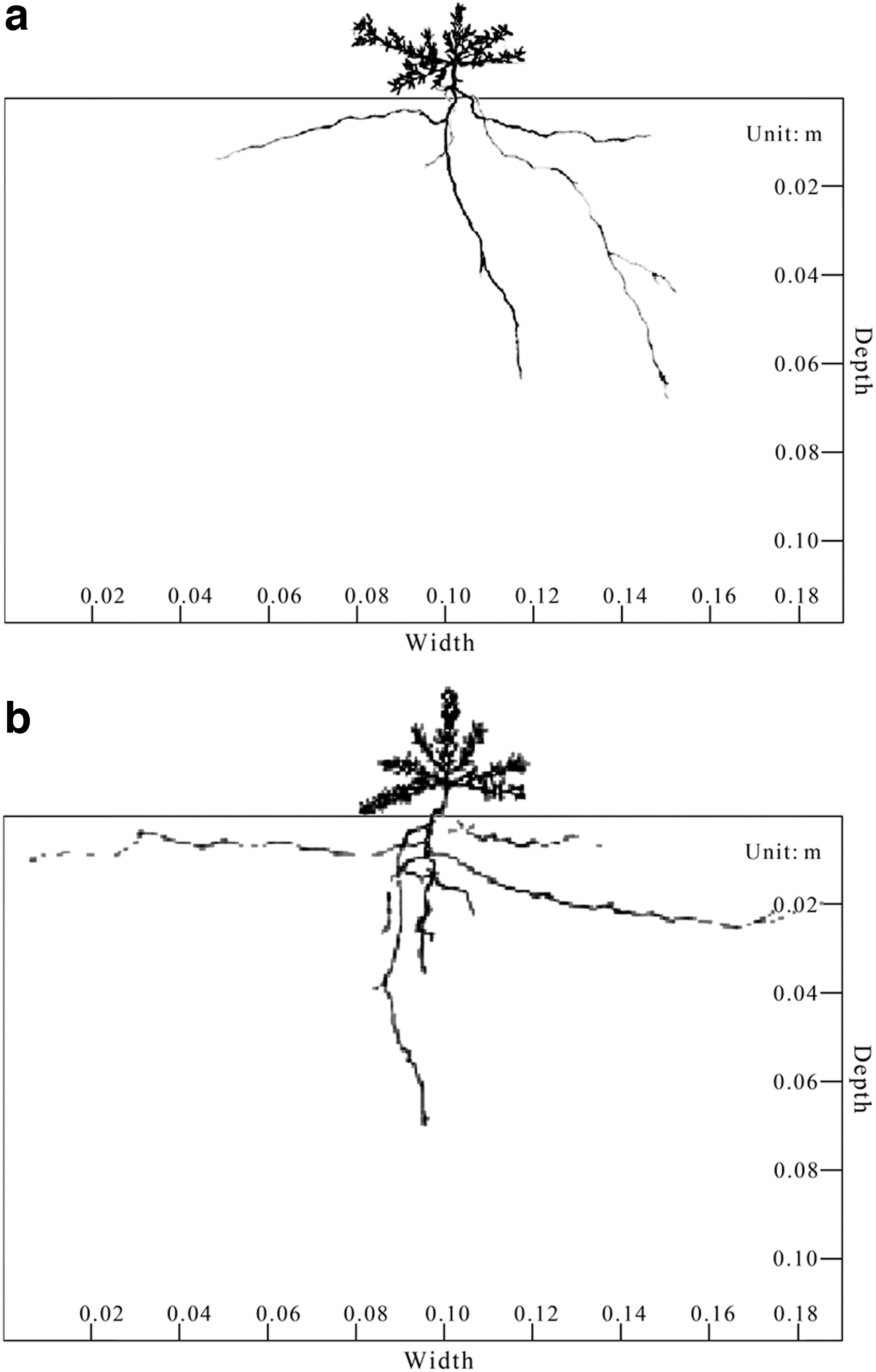
Root distribution of Agriophyllum pungens:
Poplar
Poplar, as a kind of arbor, is widely planted in northern and northwestern China. It has effective functions of water and soil conservation as well as wind prevention and sand fixation. A poplar with cluster height and crown width averaging 4.82 and 1.41 m was selected. The left and right sticks are 7.74 and 9.70 m, respectively, with the main root more than 12 m long vertically.
The comparison between different plants is made in Fig. 8. Both horizontal and vertical roots of Poplar and S. psammophile have more vigorous growth than those of the other four plants. For each individual, roots also have different growth situation determined in horizontal and vertical directions, which can be indexed by ratio of maximum lengths of horizontal root to that of vertical root (H-V ratio). It can be seen that A. ordosica krasch with more vigorous horizontal roots has a higher H-V ratio of ∼2.33. H-V ratios of S. psammophile, Corispermumspp, and A. pungens are basically flat at 1.0, which indicates that these plant roots have a relatively balanced growth situation in horizontal and vertical directions. Owing to much longer vertical roots, the H-V ratio of Poplar is slightly lower than 1.0, and reaches the lowest value at 0.38 by Hedysarummaxim.
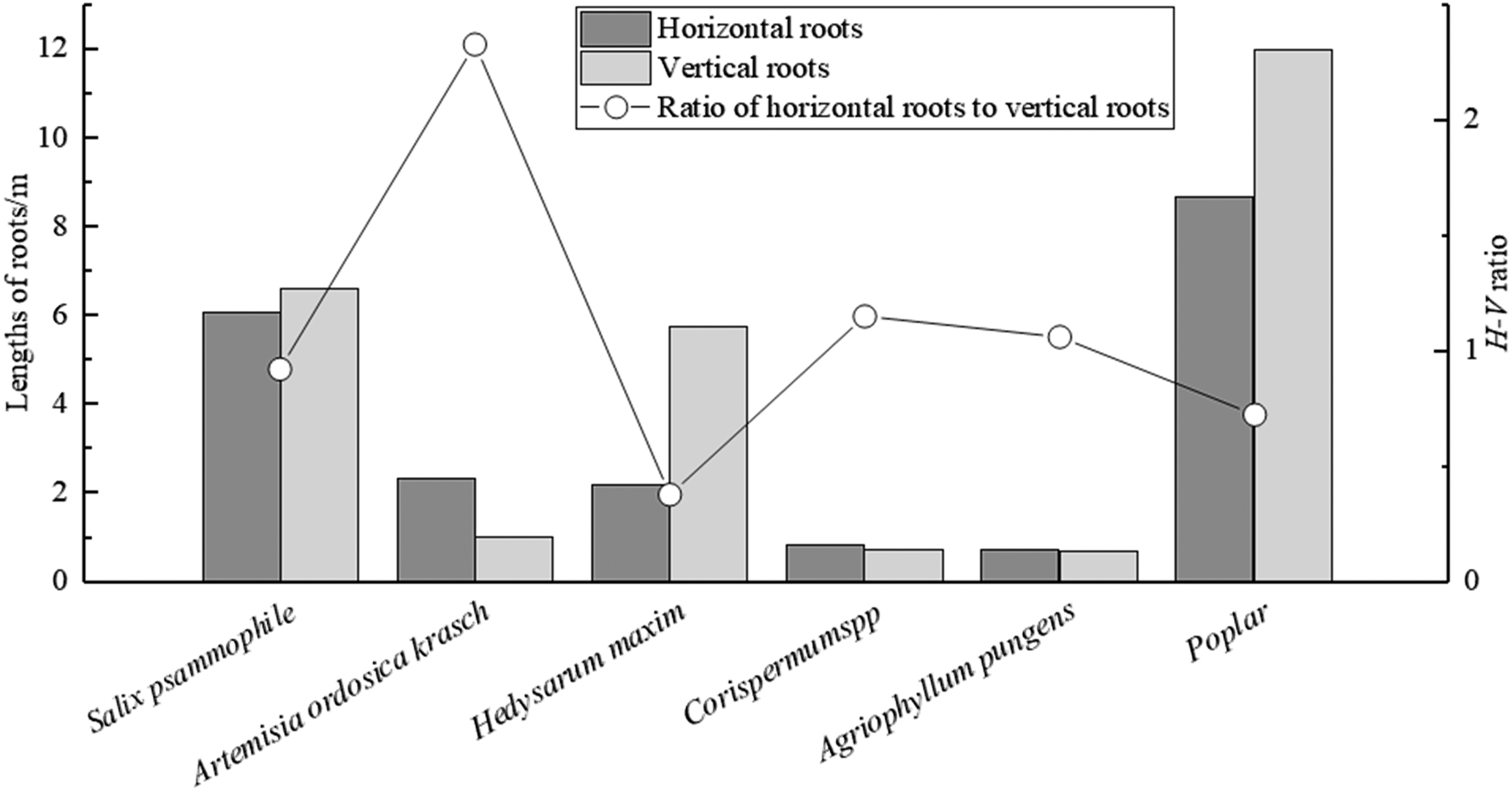
H-V ratios of different plants. H-V ratio, horizontal root to that of vertical root.
Numerical model configuration
Numerical modeling was employed to analyze the impacts of underground mining on roots at different scales. Macroscale modeling was conducted to understand how the underground mining operation affects the subsurface. Medium-scale modeling was used to evaluate the impacts of underground mining on the form of plant roots.
Based on the stratigraphic sections and mechanical parameters of each layer, a distinct element method based (DEM-based) numerical model was established in universal distinct element code (UDEC) to investigate the response of mining-induced fractures and the distribution of superficial geo-stresses during phased excavation (Fuenkajorn and Archeeploha, 2011). Figure 9 shows the UDEC model for this geometry and detailed lithological characters and prerequisite parameters. The strike length and vertical height of this model were 420 and 131.5 m, respectively. Sixty-meter-long coal seam was reserved as initial boundary on both left and right sides. According to practical mining operation, back-stepping excavation with the length of 20 m was executed 15 times and the total distance of excavated coal seam was 300 m.
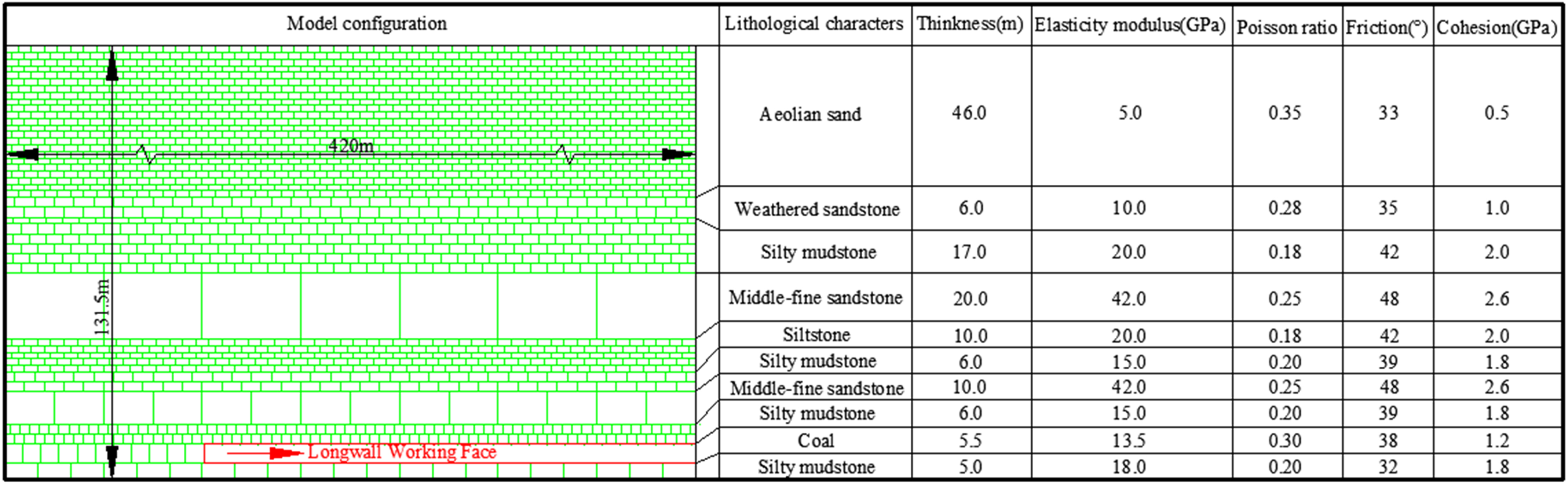
UDEC model of coal seam extraction.
Measure lines were also embedded to collect dynamic stress of the area where roots lived during the process of back-stepping excavation. The field observation indicated that the length of a single root was 1–12 m vertically or 1–18 m horizontally. As a result, two horizontal measure lines, including the upper at a depth of 5.5 m and the lower at a depth of 9.5 m, were settled with a set of measure points at 1 m interval. Two measure lines and point samplings are shown in Fig. 10.
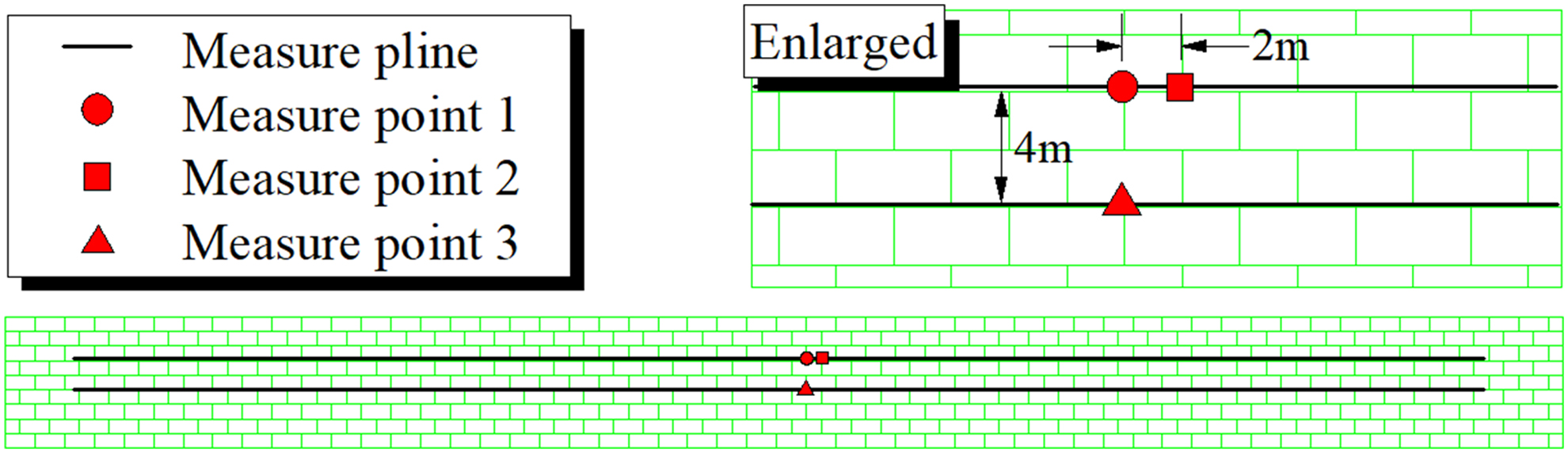
Measure lines embedded in the numerical model.
Based on the measure point 1 located at the middle of the upper measure line, the other measure point 2 at 2 m distance from point 1 along the direction of working face was selected so as to compare vertical stress and vertical displacement between two areas represented by point 1 and point 2 during the process of back-stepping excavation. Similarly, to check whether there would be differences in stress and displacement in the horizontal direction, measure point 3 situated right below point 1 at 4 m distance was also assigned.
To evaluate the impacts of underground coal mining on the form of plant roots, two kinds of blocks with smaller size were defined to reconstruct rock masses at the middle-upper range of the model, which is shown as Fig. 11. Cable module internally installed in UDEC could be employed to simulate the roots of land plant (Ji and Yang, 2013). DEM-based roots as well as its surrounding blocks were extracted from the entire model and are shown with amplification as Fig. 11.
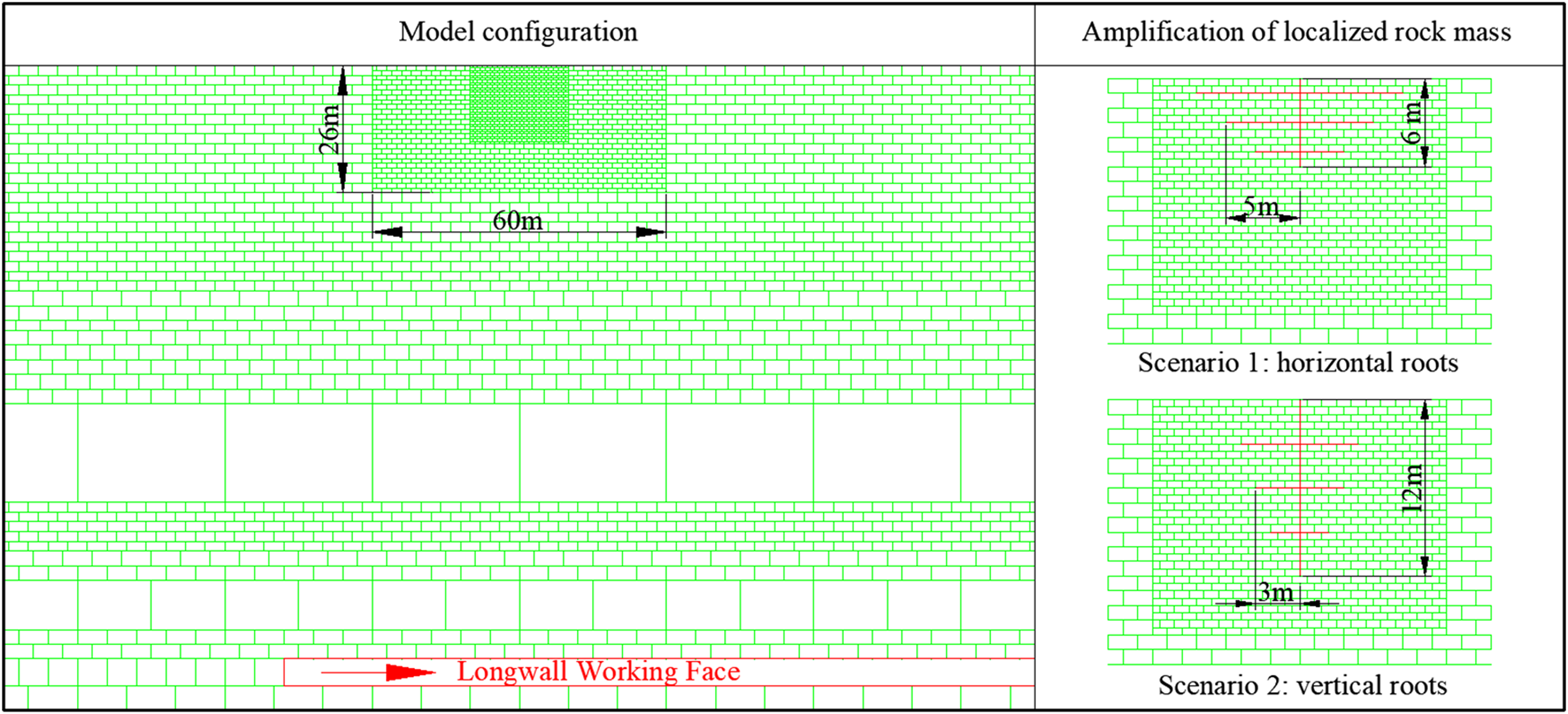
Plant roots simulated in the model.
According to the classification of six kinds of typical land plants growing in Shendong Coalfield, to start with, cable-based plant roots mainly in the horizontal direction were established in UDEC, which is shown as the Scenario 1 in Fig. 11.
Specifically, the vertical root was 6 m long, and the main horizontal roots were 7, 5, and 3 m, respectively, from shallow to deep, distributing symmetrically around the vertical root. Similarly, another cable-based root was established to imitate the one mainly in the vertical direction, shown as Scenario 2 in Fig. 11, where the main vertical root was 12 m long, and the minor horizontal roots were 5 m, 3 m, and 1 m from shallow to deep, regarding the vertical root as the axis of symmetry. In addition, other physical and mechanical parameters of roots were also defined. The mass density, extensional failure strain, compressive yield force, tensile yield force, and Young's modulus were 1,074 kg/m3 (Yu et al., 2011), 0.05, 10, 1, and 20 MPa (Liu et al., 2006), respectively. Then, the underground coal seam was excavated using the same pattern as that in macroscale analysis.
Due to the fact that the superficial soil blocks is the bridge connecting plant roots and the impacts of mining operations, mining-induced soil movement may pose certain acting forces on the roots, further triggering different kinds of failure. In this study, the relative movement of soil blocks and root is simplified as Fig. 12.
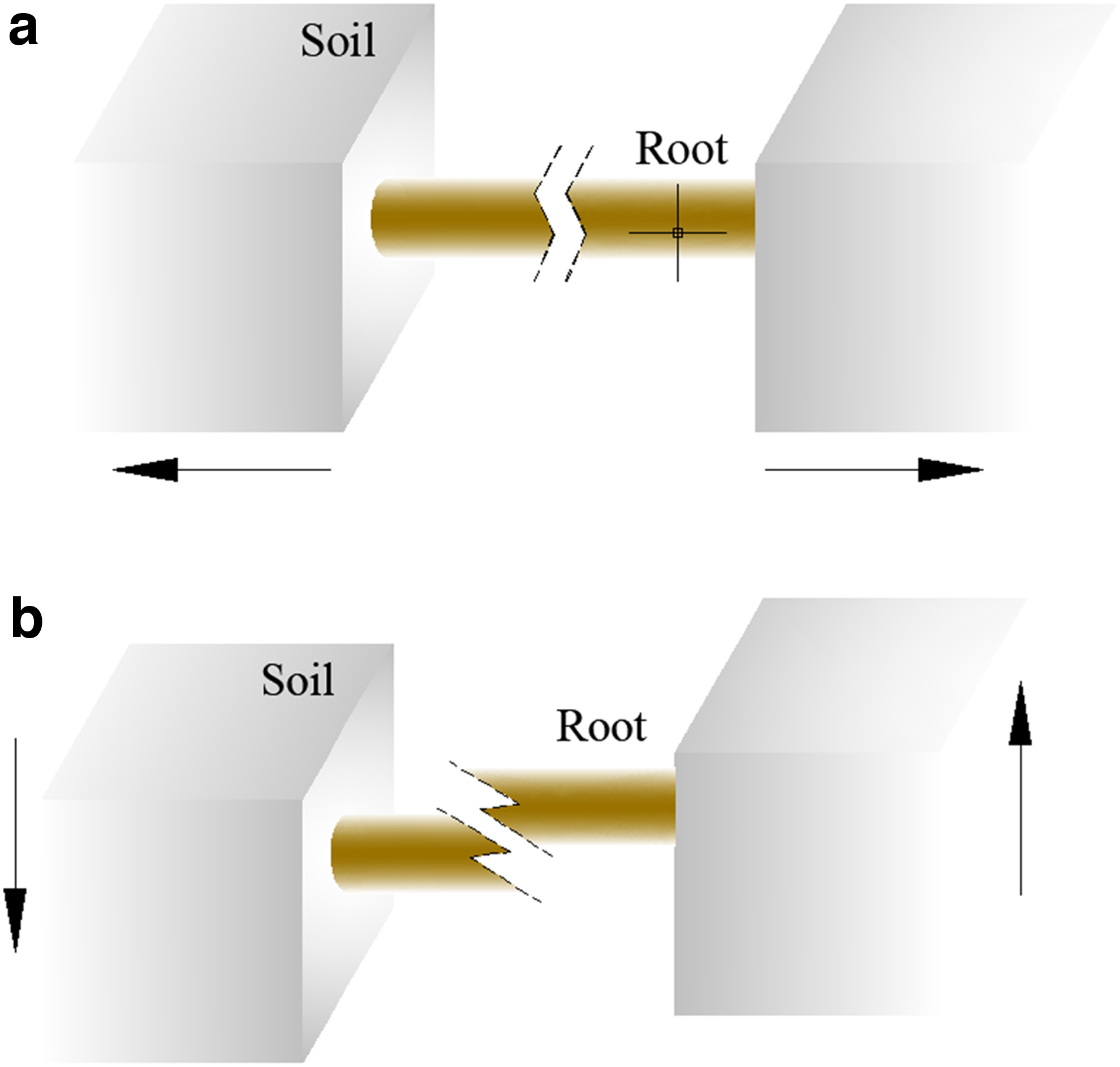
Root failure caused by relative movement of adjacent soil blocks:
When both adjacent soil blocks have relative movement along the axial direction of the root, it may fail in tension. By contrast, when both adjacent soil blocks have relative movement along the normal direction of the root, it may fail in shear. These two kinds of failure mechanism indeed exist, no matter what failure pattern occurs. As a consequence, the axial force cannot be transmitted further due to the root failure and shows dramatic changes. Based on this characteristic, the question, whether the land plant roots are impacted and destroyed by mining disturbance, can be investigated by analyzing the variations of roots' appearance and axial force before and after mining operations.
Results
Macroscale modeling
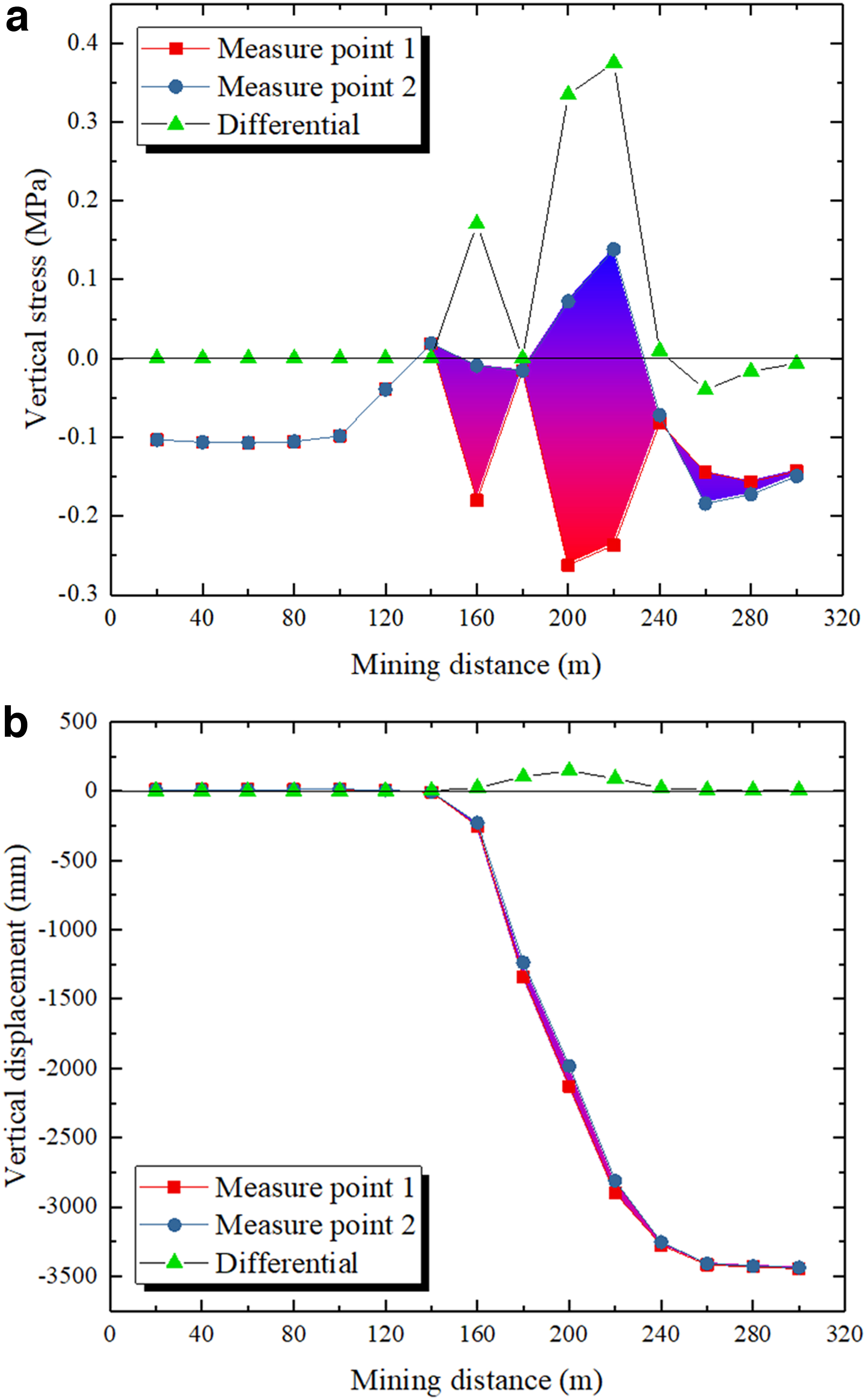
Vertical stress and displacement of measure point 1 and 2 were monitored and plotted onto coordinate systems shown in Fig. 13. Due to the fact that both measure points have the same buried depth where the rock mass had not been affected by mining-induced stress redistribution, the incipient vertical stress of both points almost maintained at the value of original rock stress with mining distance increasing to 100 m. Then vertical stress experienced a synchronous variation from minus to positive, indicating that mining disturbance had already triggered the redistribution of in situ stress field.
Variation of vertical stress and displacement with coal seam extracting:
The differential, the value of stress of measure point 2 minus that of measure point 1, shows that there was remarkable stress disparity between both points when mining distance reached 130 m. It almost peaked when longwall working face surpassed the measure point location and then gradually returned to the level of original status. Affected by rock stress redistribution, there accordingly was a different movement of rock mass in measure point 1 and 2, which was incongruous dislocation on vertical direction, whose maximum could reach 148 mm. As a result, horizontal roots would deform or even crack under the influence of vertical incongruous dislocation brought by mining disturbance. Data of horizontal stress and displacement of measure point 1 and 3 under mining disturbance were also monitored and plotted, shown in Fig. 14.
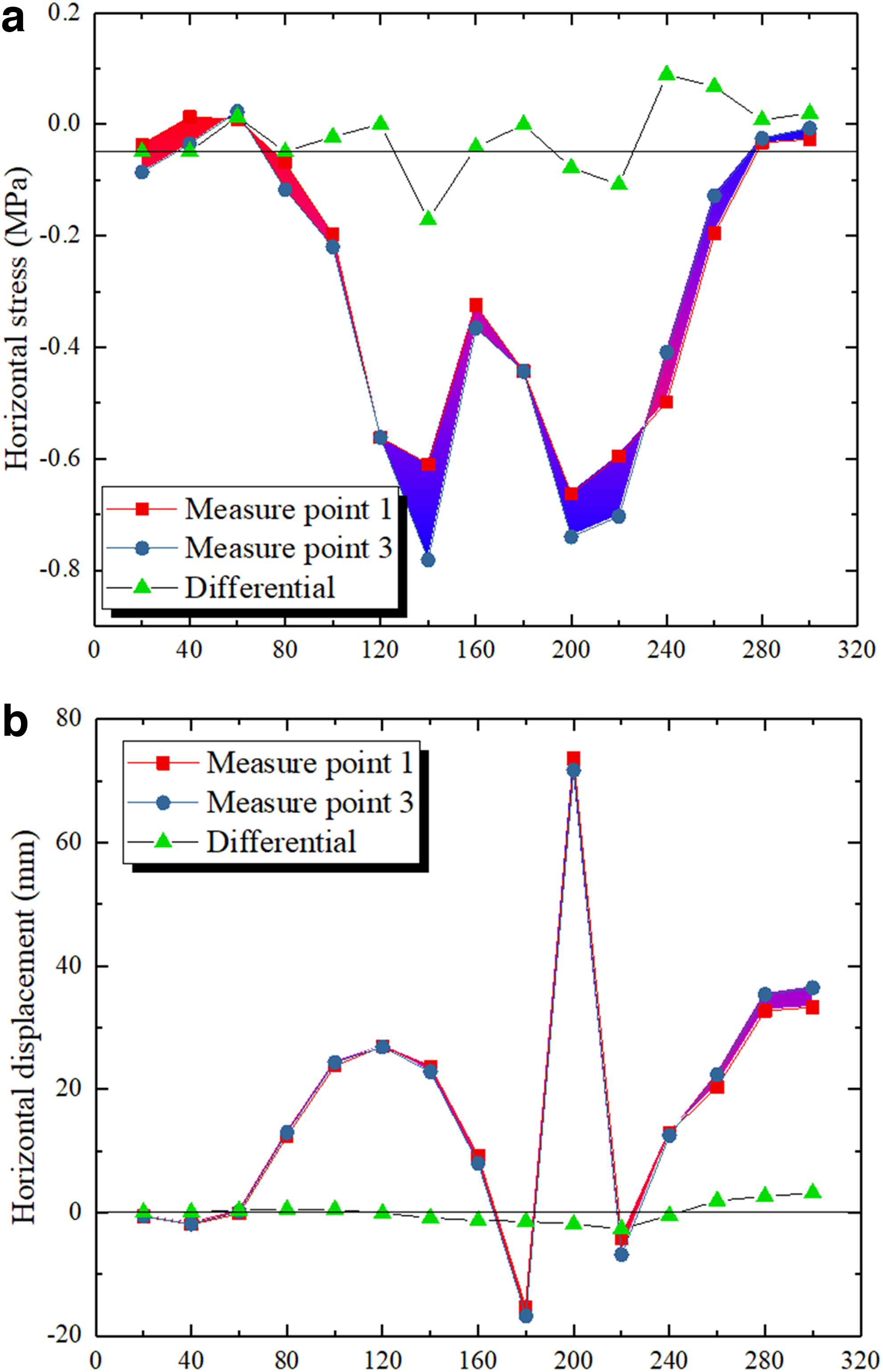
Variation of horizontal stress and displacement with coal extracting:
Initially, horizontal stresses of point 1 and 3 were different according to depth disparity, which dynamically developed with mining distance extending indicated by Fig. 14a. Driven by stress variation, there was also horizontally incongruous movement concerning rock mass located at both points during the whole process of underground coal mining. The curve of differential indicates that there was incongruous dislocation back and forth in the horizontal direction, whose value reached 5.8 mm when back-stepping excavation in numerical model was completed. This reciprocating dislocation of adjacent layers might bring bending deformation to vertical roots, or even cracks, so as to undermine the natural growth of living plant.
Based on the above analysis, it can be concluded that the shallow rock mass with identical depth would have vertically incongruous dislocation and horizontally incongruous dislocation in terms of adjacent rock layers with different depth under the influence of in situ stress redistribution derived from back-stepping excavation. Two kinds of incongruous dislocation might impose negative effects on the roots of land plant in both horizontal and vertical directions, whereas it is difficult to estimate whether the roots affected by such effects would bend or crack, which should be further investigated by employing DEM-based method on medium scale.
Medium-scale analysis
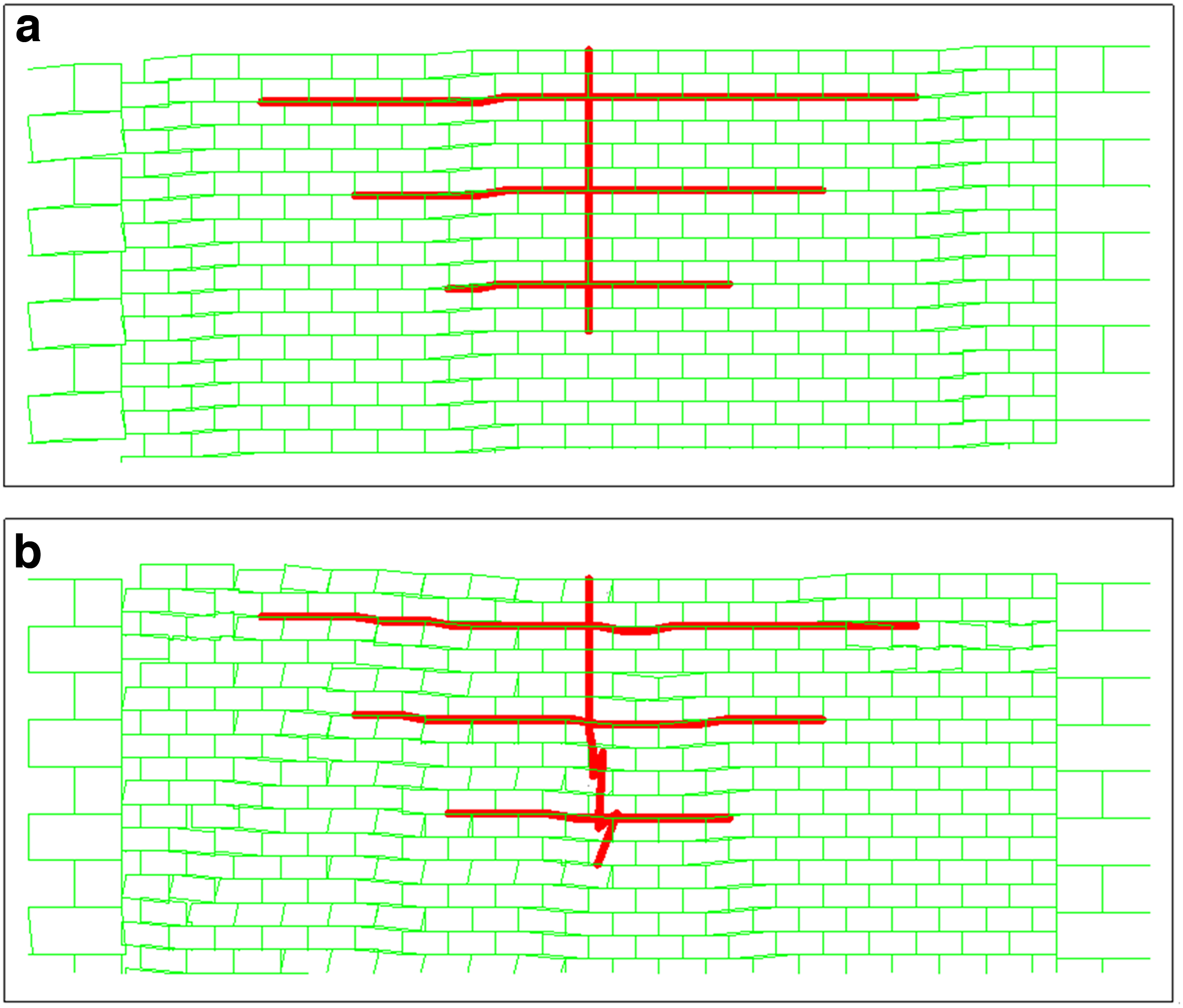
Appearances of roots and the maximum values of roots' axial forces were dynamically recorded with the longwall working face advancing. The morphologic variations of horizontal and vertical roots are shown in Figs. 15 and 16, respectively, when the working face reached 160 and 240 m. In Figs. 15a and 16a, it can be found that the horizontal root had a slight deformation, while the vertical root remains almost unchanged when the longwall working face reached 160 m. With the distance further increasing by 80 m and beyond the position of the roots, both the horizontal and vertical roots had deformed significantly. For the plant whose roots were mainly horizontal, shown in Fig. 15b, the horizontal roots remained continuous, but with a small degree of bend in some parts.
Appearance of plant roots mainly in the horizontal direction with coal seam exploited:
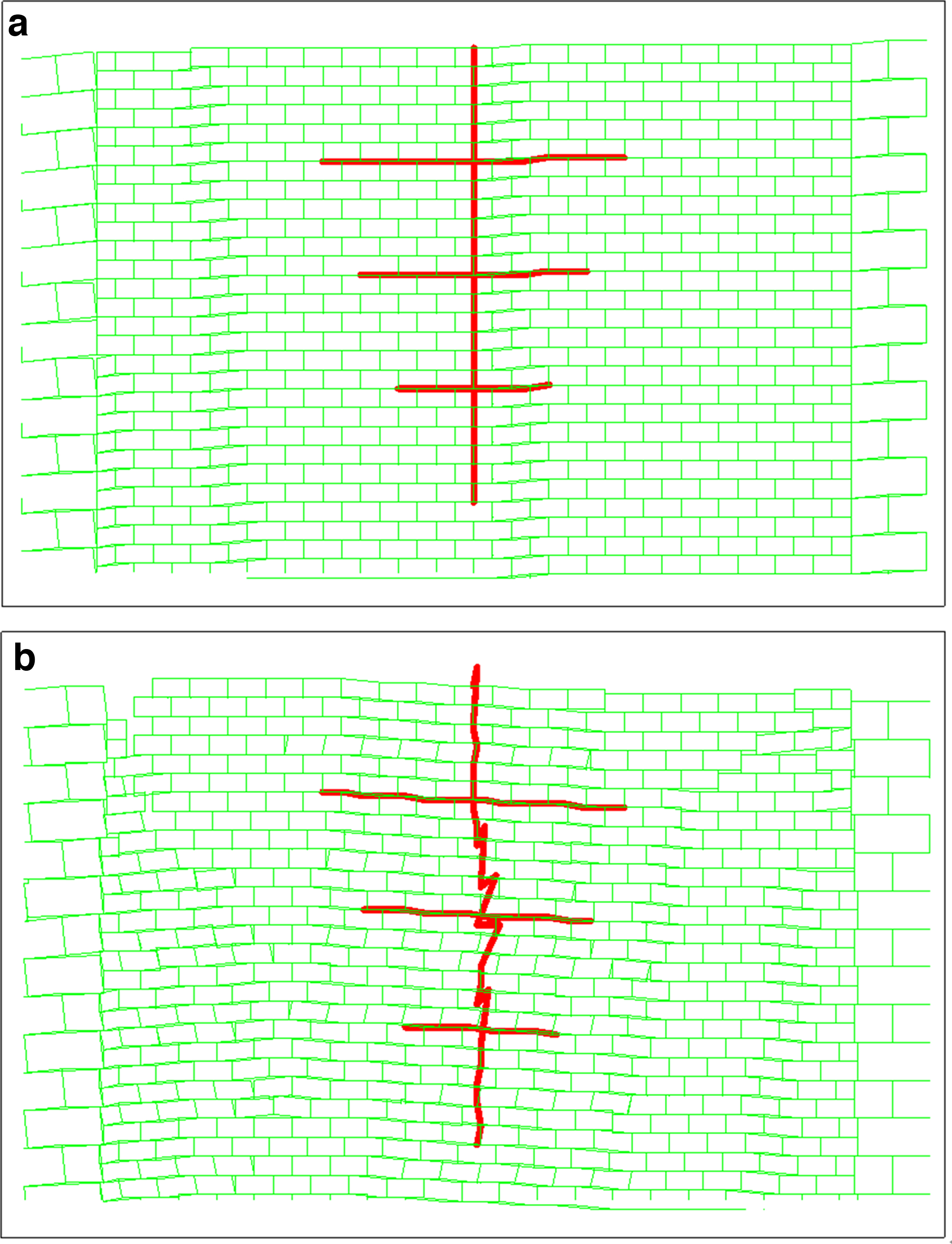
Appearance of plant roots mainly in the vertical direction with coal seam exploited:
In comparison, the vertical root showed more significant deformation with the part above the middle remaining unchanged and the part below the middle deviating with respect to horizontal roots and cracking. Similarly, in Fig. 16b, for the plant whose roots were mainly vertical, its horizontal roots deformed in some parts, but the vertical root cracked drastically both at the top end and in the middle, compared with smaller deformations in some parts of both ends. The results show that the vertical root can be more significantly affected by mining-induced soil movement than the horizontal ones. Those plants whose roots are mainly in the vertical direction are likely to be depleted.
According to the above analysis regarding the criterion that the axial force of cracked root approximately equals 0, the data of axial force of the longest horizontal root in Fig. 15 and the vertical root in Fig. 16 were exported from DEM-based model, and then plotted into three-dimensional bar charts. Figure 17 shows the axial forces of different parts of roots at different mining distances. For the single horizontal root, the intersection of the horizontal and vertical root serves as the null point of coordinate axis. Seven-meter long horizontal root distributes at each side of the vertical root. For the single vertical root, the intersection of the vertical root and the earth surface serves as the null point. The total depth of the vertical root is 12 m.
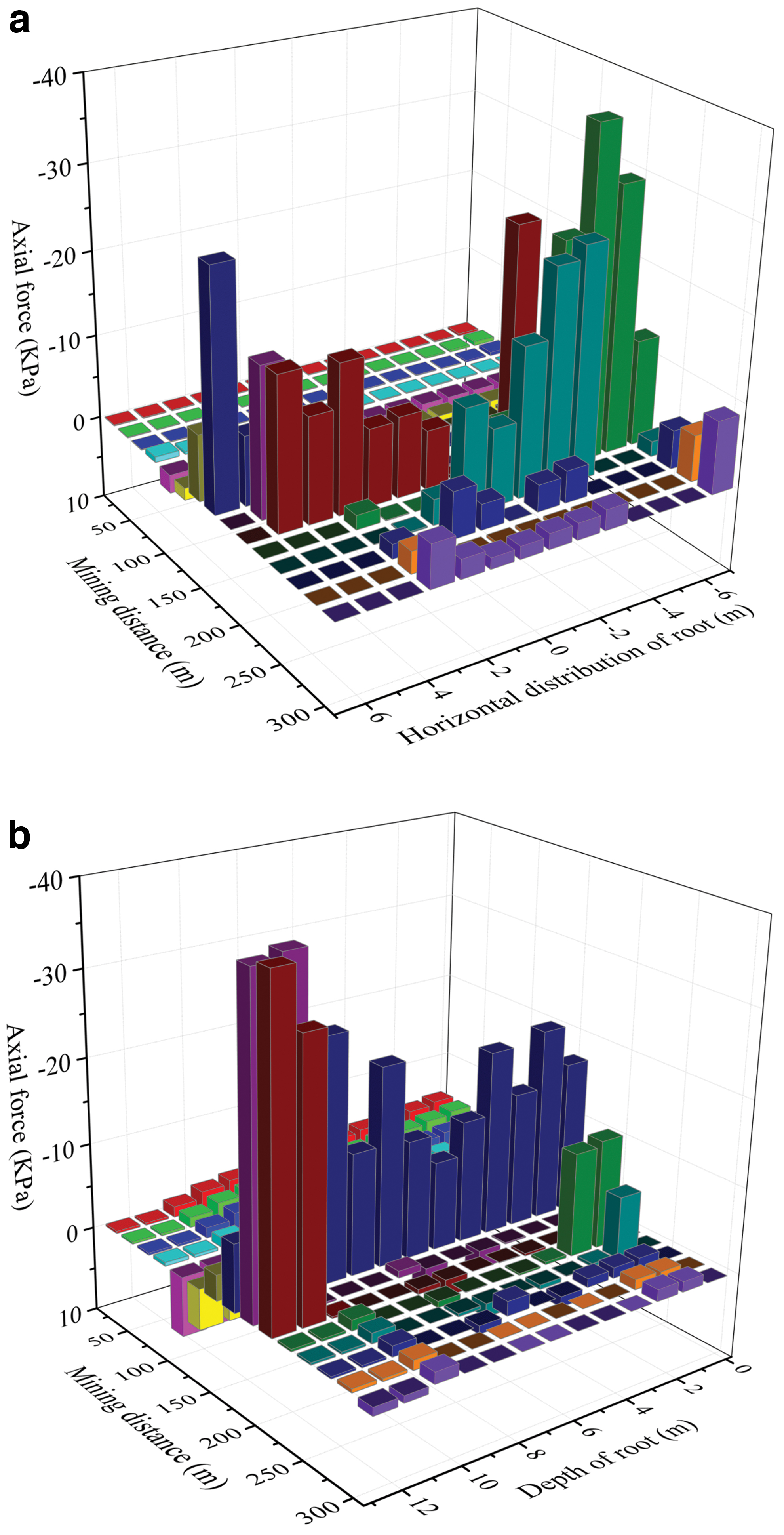
Axial forces of different parts of root with mining distance increasing:
In Fig. 17, where “-” stands for tensile axial force, it can be seen that the axial force of the horizontal root approximately equaled 0 at the earlier stage, while the axial force of the vertical root gradually increased from deep to shallow under the influence of crustal stress. When the longwall working face reached 140 m, there was obvious tensile stress in both roots. Specifically, tensile stress of the horizontal root's both ends was larger and that in the middle was smaller. Each part of the vertical root suffered from large tensile stress. With the working face further advancing, tensile stress of the middle part of the horizontal root still existed with that of the both ends varying to 0; tensile stress of the vertical root gradually decreased to smaller values in the shallow part, but sharply decreased to 0 approximately in the part on the earth's surface as well as below 2 m deep.
According to the criterion that the tensile stress of cracked root should equal 0, it can be deduced that the middle part of the horizontal root still remained intact and could deliver nutrient substance so that its corresponding land plant continued living, whereas most parts of the vertical root cracked and the residual would not transfer water and nutrient substance so that those plants whose roots were mainly in the vertical direction may gradually wither away with mining area expanding, especially in this case of desert area.
Discussion
Field investigation was undertaken to verify whether the results of numerical simulation and its theoretical analysis were reasonable. Unexploited and exploited areas of Bulianta Coal Mine and Ulan Mulun Coal Mine situated in Shendong Coalfield were selected as cases. Quadrat sampling method was employed to identify some indicators, including the coverage, density, and frequency (Haas et al., 2010). There were five square quadrats with edge length of 10 m. Each of them randomly included three smaller square quadrats with edge length of 1 m. The above three indicators can be used to demonstrate the variation of vegetation communities from qualitative and quantitative perspectives (Zhou et al., 2009).
Except for Cynachum komarovii, five out of the above six typical plants were found in Bulianta Coal Mine. To analyze the growth situation of land plants before and after mining operation, and further reveal the adaptability of different plant roots to mining disturbance, the coverage, density, and frequency of various land plants growing in unexploited and exploited area are compared as shown in Fig. 18 (Zhang et al., 2007).
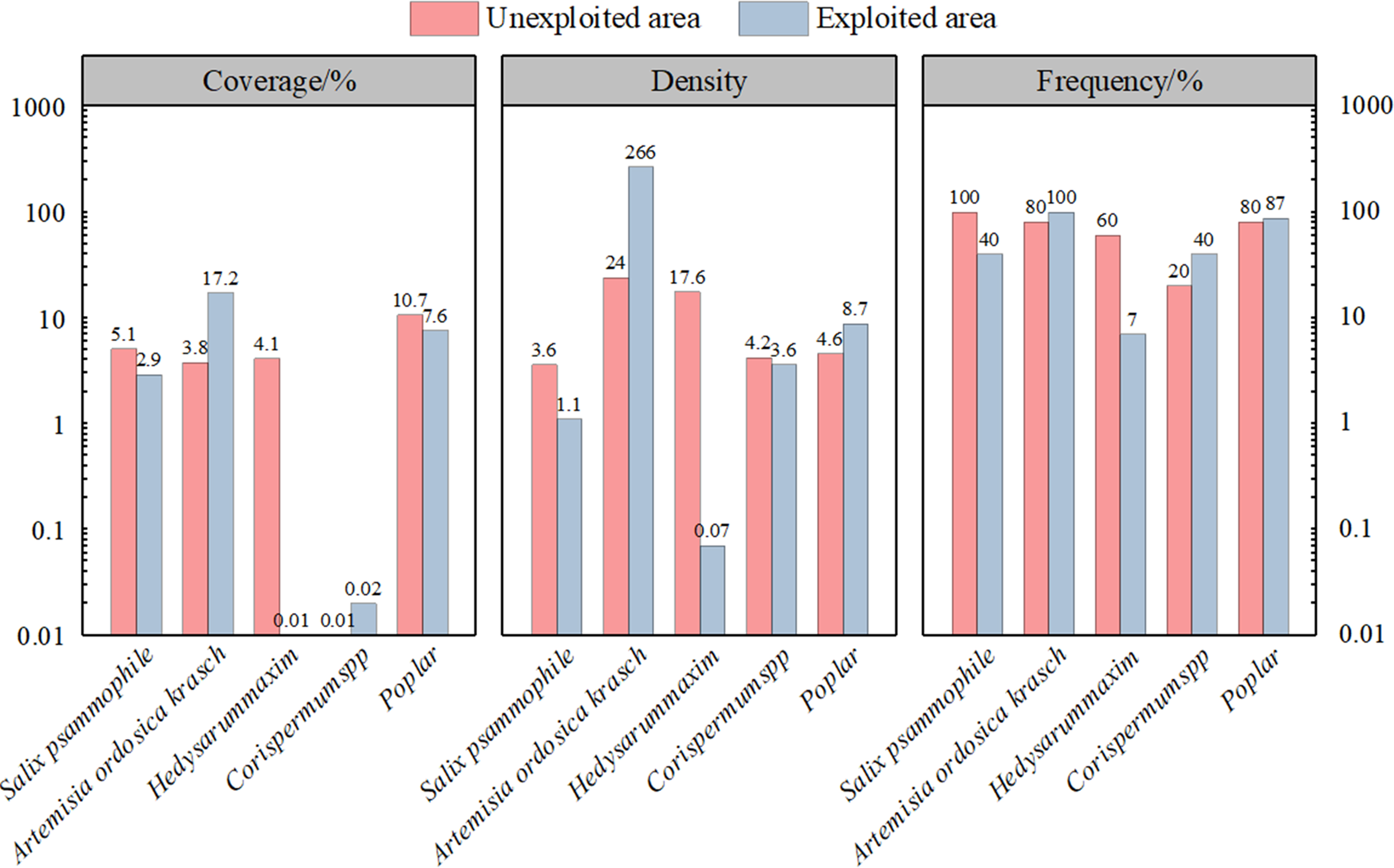
Indicators of five plants growing in unexploited and exploited areas in Bulianta coal mine.
The species whose H-V ratio is >1, such as A. ordosica krasch with more developed horizontal roots, had a higher coverage after mining operation, say 17.2%, while the species whose H-V ratio is much <1, such as Hedysarummaxim with more developed vertical roots, are in peril of extinction after mining, which is concluded through the evidence of remarkably lower coverage, nearly 0. The species whose H-V ratio approximates 1, such as S. psammophile and Poplar, had relatively slight change in coverage, density, and frequency.
Similar situation can be demonstrated by the indicators of land plants growing in Ulan Mulun Coal Mine, shown in Fig. 19 (Zhang et al., 2007). It can be seen that A. ordosica krasch, Corispermumspp, and A. pungens, which had more developed horizontal roots, became dominant species in exploited area, but compared with unexploited area, the growth situation of Hedysarummaxim with more developed vertical roots became worse in exploited area.
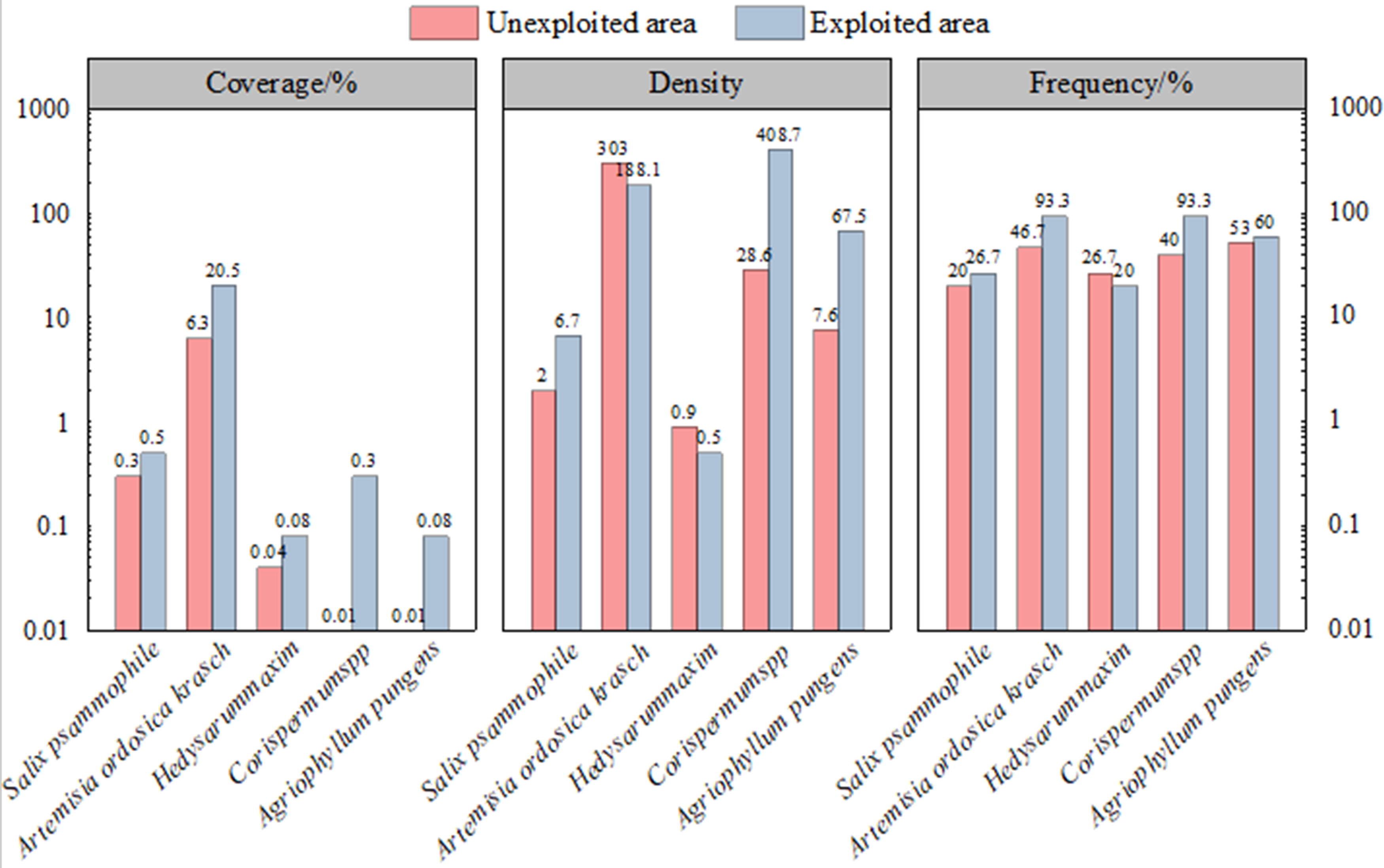
Indicators of five plants growing in unexploited and exploited areas in Ulan Mulun coal mine.
The above investigation results indicate that land plants show different growth situations in Shendong coal mine. Under the influence of underground coal mining, plants with more developed horizontal roots can evolve into the dominant species in community, while plants with more developed vertical roots gradually wither away. Those plants whose roots are equally developed in both directions can still survive to some extent. These results have an agreement with the deduction obtained in the above theoretical analysis, that is, the impact of underground coal mining on horizontal roots is smaller than that on vertical ones.
Therefore, plants with more developed horizontal roots can be planted extensively and made to become the dominant species in local phytocoenosium; plants with equally developed horizontal and vertical roots can serve as pioneer plants. As a consequence, land plants will not wither away massively under the impacts of underground coal mining. The stability of eco-environment can be enhanced and kept out of underground mining disturbance.
By means of numerical modeling and field investigation, the question how underground coal mining affects the growth of land plant roots is studied from the perspective of physical failure, such as tensile and shear failure. In addition to that, the impacts of mining operation on other biomass physiology were not given detailed investigation, but in the future, this point will be introduced into our studies and paid for further analyses and discussions.
Conclusion
Based on the land plant intensively growing in Shendong Coalfield, a series of research methods, including numerical modeling and theoretical analysis, were employed to investigate the impacts of underground coal mining on plant roots. Correspondingly, quadrat sampling and mathematical statistics methods were undertaken in unexploited area and exploited area. The height, cluster size, and root length of 6 kinds of representative plants growing in the ground surface of Shendong Coalfield were counted and further classified on basis of the ratio of the maximum length of H-V ratio. In the study area, A. ordosica krasch with vigorous horizontal roots had the greatest H-V ratio, and Hedysarummaxim with longer vertical roots has the lowest H-V ratio.
To understand the mechanism of roots in response to underground mining, macroscale DEM-based numerical models, in which the horizontal stress and displacement as well as the vertical stress and displacement are recorded, show that adjacent superficial soil blocks have significant relative movement with unexploited area, which may pose tensile or shear effect on plant roots. The incongruous dislocations contribute the negative effects on the roots of land plant in both horizontal and vertical directions.
Furthermore, cable-based roots are embedded in medium-scale DEM-based models to evaluate the impacts of underground mining on horizontal root and vertical root. The changes of roots configuration and axial force indicate that the vertical root is always more significantly affected by mining-induced soil movement than the horizontal ones, which means that the plant with greater H-V ratio is more adapted to underground mining disturbance.
Field data of land plants were collected in Bulianta and Ulan Mulun coal mines of Shendong Coalfield to verify the adaptability of various plants to underground mining. By comparing community compositions and quantitative characteristics of land plants existing in unexploited area and exploited area, it can be seen that the results of field measurements have a good agreement with modeling-based studies and also suggested that plants with more developed horizontal roots become the dominant species after mining disturbance, while plants with more vertical horizontal roots gradually wither away. Therefore, plants with more developed horizontal roots possess stronger adaptability and resistibility to mining disturbance.
Authors' Contributions
G.F. designed the overall concept of the study. S.Z. processed and analyzed the data and composed the article. M.C. corrected spelling, grammar, and verb tense errors to improve readability. D.Z. adjusted the structure of the article and modified the content. S.R. completed the drawing of some figures.
Footnotes
Acknowledgments
The authors would like to express their sincere gratitude to Shendong Coal Group for providing field data, as well as the helpful comments provided by the anonymous reviewers.
Author Disclosure Statement
The authors declare that they have no conflicts of interest.
Funding Information
This work was supported by the Fundamental Research Funds for the Central Universities (grant No. 2017XKQY073).