




Abstract
Consequences of climate inaction are already felt by many vulnerable populations, and adapting to these impacts is an increasingly important necessity for affected communities. This study assessed adaptation priority differences in the Philippines to determine if traditional climate change decision makers accurately represent the marginalized communities they serve. Specifically, this study gathered baseline data of climate change knowledge, compared resiliency priorities and proposed strategies between local government workers and village residents, and analyzed factors that contribute to identify differences. The study's target group (residents of small villages) has historically been marginalized in municipal environmental decision making. Data collected through focus group discussions and interviews demonstrated there was a statistical difference between local government officials who were more likely to propose abstract, systemic adaptation strategies to build social capacity (69% of government officials' proposed strategies), while village residents focused on physical infrastructure (59% of village residents' proposed strategies). A second study outcome was the identification of contributing factors in how Filipinos might propose climate change adaptation strategies: for example, education levels, social or economic class, accessibility to resources, sources of information, and past experience with hazards. The significance of this research is the evidence of climate change adaptation prioritization differences between the country's traditional decision-making group, the municipal government unit, and marginalized members of local villages. The differences show that local municipal government units in the Philippines may not be the most effective base group for bottom-up adaptation and support the need for effective collaboration and community engagement in future climate change planning.
Introduction
Addressing carbon emissions and climate change has been described as the greatest challenge of the 21st century and listed as an environmental engineering Grand Challenge to achieve sustainability in the world's developing regions (Ravindranath and Sathaye, 2002; Mihelcic et al., 2017; United Nations, 2019; Madzivhandila and Niyimbanira, 2020). Although over two-thirds of carbon emissions are attributed to 10 nations (Ge and Friedrich, 2020), it is recognized that the consequences of climate change inaction are disproportionately felt by small, less-developed, low- and lower middle-income countries and historically marginalized populations (Elliot, 2000; United Nations Development Programme, 2007; Mearns and Norton, 2010). While the cause of climate change is widely agreed upon, political and economic drivers have made the acceptance and widespread incorporation of mitigation efforts difficult (Elliot, 2000). Furthermore, even if global temperature rise is kept to 1.5°C, climate-induced processes are already in motion, which make some degree of consequence inevitable. Poor and marginalized communities especially are at significant risk and carry the greatest need for adaptation strategies; however, these communities historically have the least capacity and opportunity for inclusion in adaptation planning (Demetriades and Esplen, 2008; Tanner and Mitchell, 2008).
“Bottom-up” climate change planning is important to ensure participation of those most at risk, notably poor, and historically marginalized (Demetriades and Esplen, 2008). As opposed to “top down,” a bottom-up approach takes into account existing adaptation strategies (Burton et al., 2005) and encourages local community members to self-identify areas of vulnerability and subsequent resiliency strategies (Figueiredo and Perkins, 2013). Blanket action plans that are associated with top-down approaches are frequently unable to address the unique environmental and socioeconomic needs for individual communities and also ignore long-standing local adaptation practices (Mearns and Norton, 2010; Butler et al., 2015; Sanogo et al., 2017).
While there are many successful examples of local participation in climate change adaptation (Jabeen et al., 2010; Gero et al., 2011; Figueiredo and Perkins, 2013; Plate et al., 2020), some studies warn of instances where local participation is limited to tasks such as helping to provide historical data, while the actual adaptation planning is carried out by others (Somda et al., 2014; Sanogo et al., 2017). To expect success in the adaptation strategies, local community members must be involved in all stages of the planning and implementation process (Sanogo et al., 2017; Sautier et al., 2017). As the group most directly affected by impacts of climate change, marginalized communities should be provided appropriate information and allowed to consider their own environmental and socioeconomic situation and deliberate to make an informed decision (Mearns and Norton, 2010). Research has shown that when local community members are provided greater roles and participation in a project, overall involvement, ownership, engagement, and enthusiasm increase (Sanogo et al., 2017). Community buy-in with planning and identification of local needs also enhances the sustainability of shared interventions (Whiteford and Vindrola-Padros, 2015). Indeed, the bottom-up approach is generally preferred to international or national plans because it considers the local knowledge, sociocultural dynamics, and local connection to the environment (Narayan et al., 2020).
In the Philippines, Republic Act No. 7160 (1991) was passed to provide for a more responsive local government structure, promoting local autonomy and granting more power to the local government level. Although community engagement demands time and resources, it is a critical component to ensure sustainable actions are being made toward climate change resiliency. In dealing with climate change, the Philippine national government focuses on local government units (LGUs) (municipal governments) as the “bottom” level of planning and implementation groups (ACCBio, 2009; Philippines Climate Change Commission, 2020). In a municipality setting, marginalized groups of local residents have historically been excluded from decision-making processes. Similar to the study presented by Gaillard and Cadag (2009), the focus population of this study is marginalized: economically as poor, rural workers; geographically by living in hazard-prone areas and sometimes distant from resources; and, politically by exclusion from political decision making. Jacoby (2001) states that conceptualizing rural communities as uniquely ignorant makes it easier to exclude them from resources, furthering marginalization. Moreover, Hernandez et al. (2018) showed that local residents often have very different opinions and climate strategies from those articulated by government officials. Based on research findings from Hernandez et al. (2018), levels of education can influence the direction of climate change adaptation approaches. Those findings led the authors of this article to question how climate change adaptation approaches would change when formed by local government officials versus local residents in the Philippines and if LGUs are truly the appropriate base unit for bottom-up participatory climate change adaptation.
Through these questions, this study's overall objective was to compare climate change adaptation priorities and resiliency strategies between local government officials and local residents, thereby determining whether the LGU is an accurate representation of the traditionally marginalized constituents they serve. The target group in this study (i.e., the local village residents) has historically been marginalized in municipal-wide environmental decision making with restricted access to participation in planning. Specific objectives of the study include gaining an understanding of local baseline climate change knowledge, identifying and comparing climate change priorities and resiliency strategies between the two groups, and determining factors that contribute to differences.
In our study, it was hypothesized that college-educated government officials in the Philippines are more likely to propose more systemic, social capacity building solutions, while rural residents with generally lower education levels are more likely to focus on physical solutions (such as engineering infrastructure). In addition to levels of education, this study also sought to identify and better understand other factors that may lead to variances in climate change adaptation proposals.
Approach and Methods
Study site
The municipality of Calubian is located on the northwest tip of the island of Leyte, located in the eastern side of the Philippines's Visayas island group. Calubian has a population of 31,228 with an average annual growth rate of 1.06% (Philippines Statistics Authority, 2015a; Municipal Government of Calubian, 2016). It is a north-south coastal municipality with 30 out of its 52 barangays (i.e., small villages) located along the water.
The majority of storms affecting the Philippines originate from the east heading westward, making the island of Leyte an important area to study resiliency. Calubian was selected as a representative location to research climate change adaptation strategies in low- and lower middle-income municipalities because of its economic status and because of the local economy's basis in agriculture and fisheries (Municipal Government of Calubian, 2016). Out of the country's 17 regions, Region VIII, the location of Calubian, ranks as 14th in Gross Domestic Product (GDP) per capita, $1,521 (USD) compared to the national average of $2,655 (Philippines Statistics Authority, 2018). The Municipality of Calubian specifically has a poverty incidence of 40.5, higher than the national average of 29.9 (Philippines Statistics Authority, 2015b). Its coastal location also makes Calubian highly susceptible to climate impacts.
Data collection
Data collection occurred between December 2018 and June 2019 by the first author who served 2 years as a United States Peace Corps Volunteer as part of her graduate studies (Mihelcic et al., 2006; Mihelcic, 2010). As a Peace Corps volunteer, the author lived and worked in the municipality of Calubian, while building relationships with community members and learning the local dialects. Before beginning the research, the study received approval from the University of South Florida Institutional Review Board.
This is an exploratory study using standard rapid ethnographic small sample-size methods. Rapid ethnographic assessments are effective in cases of limited time or resources (Taplin et al., 2002), and have been used in developing countries in place of surveys or other quantitative data collection processes for obtaining targeted social and behavioral information (Trotter et al., 2001). In this study, data collection was split into two method types: focus group discussions and structured interviews. Study population was achieved using snowball or convenience sampling techniques (Schensul et al., 1999).
Focus group discussions
Focus group discussions were conducted in 6 of the 30 coastal barangays (villages) with 64 participants. Time and travel constraints limited the number of barangays surveyed to only 20% of the municipality's coastal barangays, with no upland barangays included. The six barangays (and associated participant count) were Nipa (8), FE Marcos (7), Abanilla (8), Villalon (12), Limite (9), and Dalumpines (10). The population of these six barangays makes up nearly 15% of the total municipal population. They are shown in Fig. 1 along with the town proper where the government officials work. Invitations to participate were distributed to the barangay captain, the top official of the barangay, who was responsible for selecting at least seven other residents. Focus groups included men (64%) and women (36%) and came from diverse livelihoods and economic statuses. Participants included members of the barangay council, local health works, fishermen, as well as assorted residents. Diversification of participants was emphasized to account for residents not typically able to interact and petition local government officials, such as those who have neither the time nor means of transportation for a trip to the municipal hall.
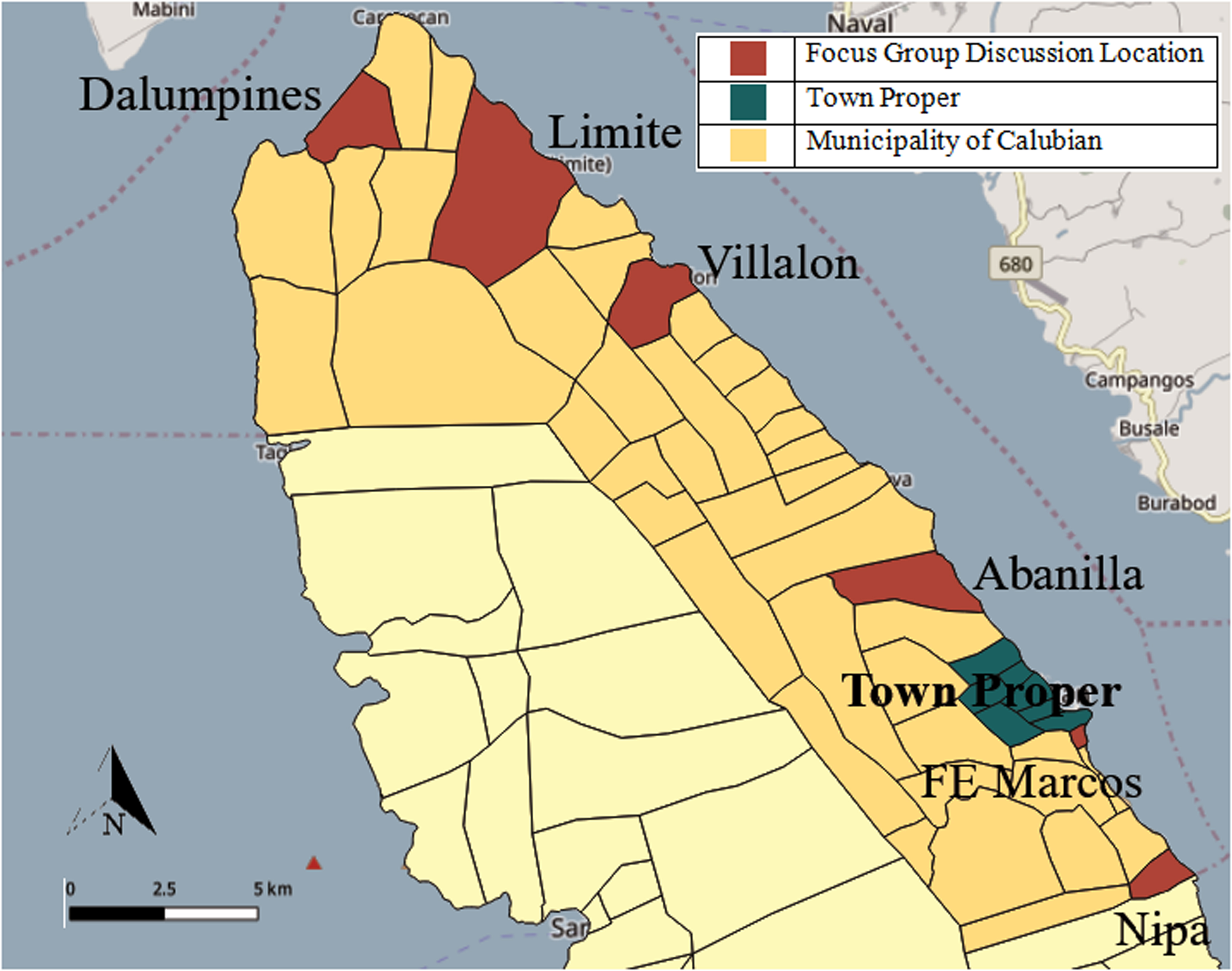
Location of town proper and focus group discussion barangays in Calubian, Leyte.
To determine variance of responses between villages, the selected barangays were grouped by their distance away from the town center, where the three barangays in the first grouping were all located <5 km from the town proper, while the three barangays in the second grouping were located more than 10 km from the town proper. Distance to the town proper was measured in Google Earth as the distances from the respective barangay meeting hall to the municipal government building. Because the town proper is the main hub of the municipality, as well as the seat of the municipal hall, the barangays' distance to it is related to their accessibility to resources. As a consequence of distance, the barangays experience differences in infrastructure, access to local government officials, and typical means of livelihood. Barangays closer to the town proper enjoy the benefits of a piped water supply, more diverse livelihood opportunities, more transportation services, and convenient access to government officials for more regular interaction. Barangays located farther away often receive fewer resources because of the lack of easily serviceable roads. Access to local government officials is hindered by rough, unpaved roads. In these barangays, water is supplied through individual wells or surface water sources, or shipped from the neighboring island during droughts, and livelihoods are based in subsistence and are focused in fisheries and agriculture.
Focus group discussions were facilitated in the local dialect of Cebuano and were led by the first author with logistical and translation assistance from staff of the Municipal Agriculture Office. Focus group discussions have often been used in past research to assist in participatory climate change adaptation planning such as issue and strategy prioritization (Uddin and Anjuman, 2013), agricultural adaptation (Dumenu and Obeng, 2016), and water-related risks (Nilsson et al., 2012). All six focus group discussions followed the same script and format, found in Table 1, which started with three exploratory questions to gauge participants' baseline understanding and knowledge of climate change. Following these questions, a 15-min presentation was given to discuss the causes of climate change, its impact globally, and its expected local impact, similar to the methodological approach of citizens' focus group discussions in Hernandez et al. (2018). Using the information from the presentation, along with their own local knowledge, participants were then guided through additional questions to develop strategies to protect their communities from impacts of climate change, Questions 4–14 in Table 1.
Focus Group Discussion Script for Barangay Residents
Interviews with local government officials
Seven interviews were conducted with the following individuals with decision-making power in regard to one climate change adaptation: elected mayor and nonelected municipal disaster risk reduction management official, department of social welfare and development official, municipal environment and natural resources official, municipal planner, municipal agriculturist, and fisheries technician. Single interviews were employed instead of one focus group discussion to meet the scheduling constraints of government participants. Interviews with the local government officials were conducted in a mixture of English and Cebuano as per the preference of the participant.
The interview script for the government officials was similar to that of the focus group discussions, with the exception that no presentation of climate change was given, and questions of planning were more tailored toward the officials' respective departments rather than the municipality as a whole. The decision to not present information on climate change to government officials was based on the participatory climate change adaptation study by Hernandez et al. (2018) where those with assumed prior knowledge of the topic were directed straight to relevant questions. This decision is supported by past research such as climate change issue and adaptation identification with postgraduate students (Uddin and Anjuman, 2013) and medical regulation opinion differences between experts and nonexperts (Abraham and Sheppard, 1997).
Data analysis
Due to overall sample size, study analysis was limited to word and theme count analysis and Fisher's exact test for association (McDonald, 2014). Results are suggestive, not conclusive and lay the groundwork for further in-depth explorations. Word and theme counts were used to analyze open-ended questions in both the focus group discussions and interviews. Analyzing frequency of similar responses presented trends and differences between the two groups. Questions 4 and 12 of the residents' focus group discussion script questions (Table 1) requested responses on a Likert scale where a rating of 1 translated to “Very Unlikely,” 2 as “Unlikely,” 3 as “Unsure,” 4 as “Likely,” and 5 as “Very Likely.” Toward the main objective of determining differences in adaptation strategy proposals between the two groups, a Fisher's exact test was used with an alpha value of 0.05 to determine if response variations were statistically significant.
Results and Discussion
Through the focus group discussions and interviews, participants shared their knowledge and reactions about climate change and also their reasoning for why certain adaptation strategies should be pursued. The themes that emerged in proposed adaptation strategies between the two groups focused on infrastructure development, social capacity building, and environmental conservation.
Baseline understanding of climate change
The baseline knowledge and understanding of climate change found through this study are only of the participants in the selected study location. Although comparisons may be drawn between other similar locations, it is not intended as a generalization of global rural populations or of coastal populations in the Philippines. The baseline knowledge and understanding of the participants were assessed before any information was provided on the topic. Table 2 presents a summary of the responses from the question, “What is the first word that comes to mind when you hear climate change?” The two highest ranked response categories for this question were responses that gave an example of an impact associated with climate change, or responses of “Change”/“Changing weather.” The response of an example impact as the first word that comes to mind reflects the aspects of climate change that have the most direct relationship with the lives of community members. Climate change impacts permeate through many areas of Filipinos lives, including water scarcity, damage from stronger storms, and creating more challenges for livelihoods. Increases in natural hazards associated with climate change as well as decreases in fish catch are changes that community members have experienced (Municipal Government of Calubian, 2019, unpublished data). A fisherman participant from Dalumpines shared, “The fish used to be easy to catch but now it is difficult. Even though we go deep we're not sure if we'll catch anything.” These results show that at this time, local residents' base knowledge and main ideas of climate change focus around impacts that directly affect them.
Responses of Community Residents and Local Government Officials to “What Is The First Word That Comes To Mind When Your Hear Climate Change?”
The second highest response category was that of “change” or “changing weather.” These responses are noticed to repeat one of the words of the term “climate change” or a slight rephrasing. Some participants shared that they had never heard of climate change before or, “It's a new word, we're just now hearing about it.” This shows that more effort is needed toward climate change information dissemination in rural provinces of the Philippines. Although government officials have more access to climate change-related seminars and trainings, it is likewise believed that their top response of “change” or “changing weather” also indicates an unclear understanding of the concept. Indeed, when the local government officials were pressed to give their full understanding of climate change, some could only offer short lists of the impacts they have noticed. When asked for an interview about climate change, some government officials responded with a reluctant, “Why me? You should talk to the head of Disaster Risk Reduction, that's his area.”
Expected impacts of climate change
After the presentation on the causes of climate change and its global and local impacts, the barangay participants were asked to rate how likely they thought climate change would affect them. The likelihood rating of all the barangay participants is shown in Fig. 2. With 60 total respondents, 73% said it is “Likely” or “Very Likely” that climate change will affect them, their homes, and/or livelihoods.

Perceived likelihood of climate change impact by community members (n = 60). The three barangays categorized as “far away from the town proper” (Villalon, Limite, and Dalumpines) are shown as shades of blue. The three barangays nearer to the town proper (Nipa, FE Marcos, and Abanilla), are shown in shades of red.
The barangays of Dalumpines and Villalon, both far from the town proper, had 100% of respondents saying that they feel climate change is “Very Likely” to affect them. Other barangays such as Limite, FE Marcos, and Nipa show more stratified responses with less unified opinions on the expected impact. Although climate change impacts are already being experienced, nearly 30% of the total respondents said that climate change is “Unlikely” to affect them or they are “Unsure.” In explanation of their choice for a rating of 3, participants from FE Marcos shared that because of the 2013 Typhoon Yolanda, they felt they already had the experience to withstand against the effects of climate change.
When asked how specifically they expect climate change to affect them, residents responded that they are concerned about property damage from typhoons and landslides, as well as more overarching impacts such as crops dying from new weather patterns or more difficulties in fishing because of altered fish migration patterns. Three examples of existing hardships shared by residents were: “(i) We experienced droughts, harder fishing and in health because of too much heat” (ii) “Before the typhoons were gentler, but now there is more water and there is soil erosion.” (iii) “Before, the harvests were big now they're just small.”
Identifying and comparing climate change adaptation recommendations
Proposed adaptation strategies were categorized as (i) Infrastructure/Supplies, (ii) Social, or (iii) Environmental. Figure 3 shows the responses for how both the barangay residents and local government officials suggest improving the municipality's resiliency to climate change. For the residents, Fig. 3 shows responses aggregated from Questions 8, 13, and 14 from Table 1: “What is the best way to increase resiliency?,” “How could the government better assist you?,” and “If you could petition for one protective strategy, what would that be?” In cases where participants were not familiar with a definition, such as in the case of “resiliency,” local Filipino facilitators helped to provide additional explanation. The recommended strategies from the local government officials were in response to the question, “What do you think are the best strategies for increasing our [the Municipality of Calubian's] resiliency against climate change?” Of the 20 total recommended strategies, the groups proposed 8 similar strategies.

Comparison of proposed adaptation strategy frequency between barangay residents and local officials. Adaptation strategies proposed by both groups are highlighted in yellow and bolded.
The percentage of barangays and local officials who actually mentioned each strategy in their respective focus group discussion or interview is also shown in Fig. 3. The bars in this figure represent a percentage of times each respective strategy was mentioned by the specific group, showing the relative interest per strategy between the two groups. For residents, this equates to the number of barangays that mentioned the strategy divided by six (the number of barangays). Similarly, the percentage for the strategies proposed by the local government officials was found as the number of officials who mentioned a strategy divided by seven (the number of interviewed government officials). Using the recommendation for building evacuation centers as an example, five out of the six barangays mentioned it as an adaptation strategy that they would like to see pursue, whereas only one out of the seven interviewed government officials suggested it as a strategy.
Proposed adaptation strategy— infrastructure/supplies
For Infrastructure/Supplies, the barangay residents recommended eight strategies compared to three strategies proposed by the LGU officials. The two groups only had two similar matches for this category: (i) Evacuation Centers and (ii) Equipment for Disaster Response. Residents from five out of the six barangays mentioned evacuation centers as a proposed adaptation strategy, likely based on the experience of recent typhoons. The department head of Municipal Disaster Risk Reduction was the only government official to mention this adaptation strategy. The strategy with the second highest number of barangays in agreement on was Supplies. Proposed supplies included items of food, clothes, medicine, and tools to be used in the event of a hazard that hinders supply lines. Four of the six barangays proposed assistance with supplies to better increase their resiliency, while no government official suggested supplies.
Another notable adaptation strategy proposed is a seawall. Three out of the six barangays recommended this engineering infrastructure to protect against storm surge and sea level rise. The barangays that proposed sea walls already have coastal infrastructure in some areas that has started to crumble. A seawall infrastructure project was not mentioned by any government official as an adaptation strategy. Based on discussions with government employees about budget constraints, reluctance to propose seawalls is most likely due to their greater expense when resources could be spent on projects of more immediate need.
Proposed adaptation strategy—social
In the category of Social adaptation strategies, community members and government employees separately proposed four similar recommendations. These proposals include better communication/more information, strong political willpower and law enforcement, proper waste disposal, and trainings on disaster risk reduction and livelihoods. All seven local government employees mentioned seminars and trainings, although between officials and residents there seems to be a mismatch on the topics of most importance. Both groups agreed that trainings on disaster risk reduction and livelihoods would be helpful, but the highest number of local government officials supported seminars on climate change. In this case, the proposed trainings need not be at odds because the topic of climate change can and should be integrated into specific training programs such as livelihoods and disaster risk reduction.
Another area that the residents felt could be improved was the communication between the barangays and the local government unit. In this strategy, government officials specifically mentioned “information dissemination,” while residents focused more on the general relationship between the barangays and the local government unit. Residents asked that there was a more open line of communication between barangays and government officials so that they could feel free to bring their concerns and feel confident that they would be addressed.
Barangay residents also suggested behavior changes for fellow community members in terms of unity, cooperation, sincerity in actions, and discipline in following municipal ordinances. Many barangays discussed stricter law enforcement for ordinances such as illegal tree cutting and improper waste disposal. One community member stated, “The best way to reduce climate change is to change the so called “kinaiyahan sa tawo” (human nature).”
Proposed adaptation strategy—environmental
Both residents and local government employees, specifically proposed by the Municipal Agriculturist, feel that planting trees (both upland and mangrove) will improve resilience. Planting mangroves is a priority of the national Department of the Environment and Natural Resources to protect the country's coastlines from storm surge and increase marine biodiversity. The local Municipal Agriculture Office, in collaboration with the Regional Department of the Environment and Natural Resources, has already spearheaded efforts to increase mangrove areas along Calubian's coastline. Although mangrove planting is well acknowledged as a cost-effective adaptation strategy (e.g., CRC-URI and International Resources Group, 2009; Spalding et al., 2014; Blum and Herr, 2017), only half of the barangays suggested it (and/or upland tree planting) as a resiliency strategy.
The three barangays that proposed mangrove/tree planting as an adaptation strategy (Abanilla, Villalon, and Limite), the same three to propose seawalls, were all found to have “Fair” mangrove health statuses in a 2019 assessments, compared to the “Good” of Nipa and FE Marcos (Municipal Government of Calubian, 2019; Nabong, 2020). Mangroves are useful natural buffers for sea level rise and storm surge; barangays with healthy mangrove systems should experience less need for sea walls (Das and Vincent, 2009; Barbier, 2016). Barangays Nipa and FE Marcos also likely did not suggest planting mangroves as an adaptation strategy because they are already receiving mangrove seedlings from the Regional Department of the Environment and Natural Resources.
As of 2012, fisheries made up an estimated 1.8% of the Philippines' GDP employing more than 1 million (FAO, 2014). Based on the country's cultural and economic ties to fishing, environmental adaptation strategies related to fisheries were expected to be a topic among participants. However, no such strategy was proposed. Mangroves are used as spawning and nursery grounds for marine animals, but the intent behind the suggestion by the two groups to restore mangroves was focused toward usefulness in wave breaking. Examples of environmental adaptation strategies that would help protect fishers would be the implementation of marine protected sanctuaries or fishing management (Cabral et al., 2019; Hilborn et al., 2020). To address their concerns for fishing livelihoods, barangay residents' adaptation proposals focused more on receiving new equipment and supplies. Many residents mentioned the need to fish farther away from shore as a result of climate change and suggested the need for new boat engines. Requests for new nets and fishing gear were also made. The proposed strategies of the residents for more equipment and supplies show the recognition of their immediate challenges to meet their daily needs.
Strategy differences between barangays and local officials
The adaptation strategies mentioned by the barangay residents fell into the Infrastructure/Supplies category (59% of responses), while strategies mentioned by local government officials fell in the Social category (69% of responses). In contrast, 33% of strategies mentioned by the residents fell into the Social category and 19% of strategies mentioned by local government officials fell in the Infrastructure/Supplies. Applying Fisher's exact test, the differences of responses for proposed adaptation types between the two groups were found to be statistically significant (p = 0.0156).
The focus of government officials was social strategies, notably trainings, seminars, and increased communications, while barangay residents consistently suggested more infrastructure retrofitting (seawalls) and supplies provision (through evacuation centers, increased governmental supply, and equipment assistance) to increase resiliency. This finding is supported in other coastal studies where individuals with lower educational levels proposed more concrete and practical solutions to climate change (Hernandez et al., 2018). In the overall population of the Philippines for those 25 years of age and older, <20% attend and complete a college degree (Philippines Statistics Authority, 2013). Although education levels were not recorded for the participants of this study, residents in more rural municipalities like Calubian are less likely to attend college, and instead stay home to work in agriculture, fishing, or a local business (Zamora and Dorado, 2015). Individuals with higher education levels, such as local government employees, were found to focus on addressing more underlying, systemic causes.
In addition to levels of education, other factors were identified as possible explanations for the differences between the two groups of this study. Disparities in social and economic classes between local officials and community members may also have contributed to their variations in recommendations. Results of this study show that community priorities focus on solutions to the most immediate problems. Among the government employees, the extra constraint of the knowledge of a limited budget may have led to the difference in emphasis between large infrastructure projects and training proposals. When asked about barriers to implementing climate change adaptation strategies, all seven government employees recognized lack of financial resources. Between the two groups, source of information was also a major difference. Local residents stated they exclusively obtain information from social media and news outlets, whereas government officials reported receiving climate change information through government-sponsored trainings. The focus on the national government on more systemic strategies likely plays a role in shaping the strategy ideas of the local officials. In the future, inclusion in seminar and training events will help to increase the science capital of marginalized groups. Past experience with storms was also found to affect how a participant now views climate change adaptations. As mentioned previously, some participants expressed unconcern with preparing against climate change because it is felt that their experience surviving Typhoon Yolanda has prepared them for future storms. The last potential decision-making factor identified in this study is related to the prevalent “Bahala na” mindset. Bahala na is a common expression in the Philippines that translates to a fatalistic “Come what may” or “Leave it up to God” view (Gripaldo, 2005). Community organizers facilitating local climate change adaptation should be mindful of how this attitude may potentially lead to inaction.
Summaries
This study provides a comparison of climate change adaptation proposals between traditional decision makers in the Philippines and marginalized groups such as residents of rural barangays (i.e., small villages). Although barangay residents' proposed adaptation strategies, primarily focusing on infrastructure and supplies, which do not necessarily align with the conventional ideals of sustainable climate change adaptation strategies, it is nevertheless important that all parties are able to give their opinion. As such, it is recommended that local residents, not just barangay captains, are invited to participate in identifying areas of concern at the municipal level as well as engaged in project planning, design, implantation, and future monitoring. Government officials should strive to provide relevant scientific information to local residents who may combine it with their own experiential knowledge to make informed decisions. Increasing access to information will help to empower marginalized groups in their decision making and lead to more sustainable problem solving. Inclusion in the decision-making processes is an important step to reduce the marginalization of these traditionally unrepresented groups. Given more presence in climate change decision making, historically marginalized groups can reclaim some control in adapting to climate change where decision making has been primarily regulated by higher powers that be.
Footnotes
Acknowledgments
This material is based upon Ms. Nabong's Master's thesis work supported by the National Science Foundation under Grant No. 1930451. Peace Corps also provided training and financial support to Ms. Nabong during her 2-year service in the Philippines.
Author Disclosure Statement
No competing financial interests exist.
Funding Information
This work was supported by the National Science Foundation under Grant No. 1930451.

References
Supplementary Material
Please find the following supplemental material available below.
For Open Access articles published under a Creative Commons License, all supplemental material carries the same license as the article it is associated with.
For non-Open Access articles published, all supplemental material carries a non-exclusive license, and permission requests for re-use of supplemental material or any part of supplemental material shall be sent directly to the copyright owner as specified in the copyright notice associated with the article.
