




Abstract
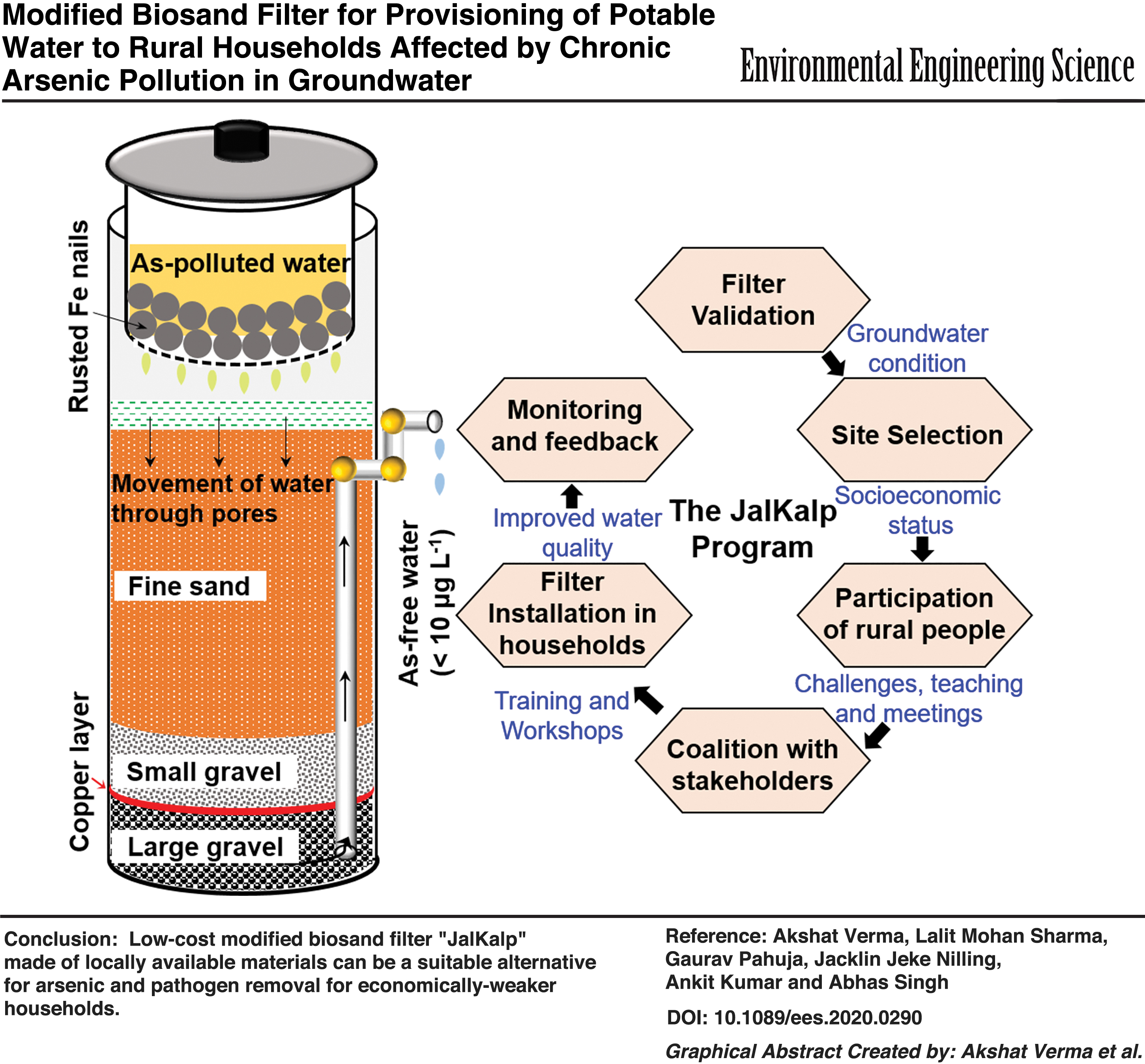
Chronic arsenic (As) pollution in aquifers is one of the major challenges faced by economically and socially marginalized sections of the world, which often depend heavily on groundwater for their sustenance. To safeguard these sections against As poisoning, an easy-to-use and sustainable water-treatment solution is warranted. This study was undertaken to systematically evaluate the performance and feasibility of a low-cost modified biosand filter (JalKalp) in providing potable water to affected rural households in India. JalKalp removes As by sorption on rusted-iron nails and pathogens by an additional copper layer. Initially, As-removal efficiencies of this filter were evaluated under laboratory conditions using (1) unpolluted groundwater spiked with variable concentrations (50–500 μg/L) of total dissolved arsenic (AsT), either as As(V), or As(III), or both; and (2) real As-polluted groundwater (∼150 μg/L). Results indicated that the JalKalp filter removed AsT with an efficiency of 95–99% and passed all water quality tests, except hardness and alkalinity. An ∼3-year long “JalKalp” program was then initiated to provide clean drinking water in selected villages of Bihar, India with the support of local agents, nongovernmental and governmental organizations. Filters were installed in select households (n = 22), and the community was involved in the program through training and workshops. The performance of these filters was evaluated through the testing of water and sludge generated, and the conduct of socioeconomic and health surveys. The filter was equally effective under field conditions and removed AsT (<10 μg/L), total iron (<1 mg/L), and fecal coliforms at all locations, at a cost of ∼INR 0.28 (US$ ∼0.004)/L of treated water. JalKalp requires replacement of iron nails after an estimated ∼1.7 years of treatment of ∼6,000 L of water containing 100 μg/L of AsT. Toxicity characteristic leaching procedure on As-containing sludge after filtration indicated that the sludge was not hazardous and could be disposed safely in landfills along with regular municipal waste. Findings from this study could be replicated elsewhere in providing immediate solutions to As-affected water pollution by enabling independent construction and sustainable use of this potentially long-lasting filter.
Introduction
Presence of arsenic (As) in groundwater is one of the leading water quality problems in the world (Smedley et al., 2001). Arsenic is a metalloid element, which mobilizes due to site-specific geochemistry (Nickson et al., 2000; Corkhill and Vaughan, 2009). In aqueous environments, it mainly exists as As(III) and As(V) depending on the prevailing redox conditions (Bissen and Frimmel, 2003). In humans, As(III) is considered ∼60 times more toxic than As(V) (Ferguson and Gavis, 1972). Sustained consumption of As-polluted water at concentrations >10 μg/L (WHO, 2017) is known to cause several chronic health problems in humans (Ratnaike, 2003), such as hypertension, neurological disorders, reproductive effects, and even cancers of skin, lungs, or kidneys (IARC, 2012). However, the severity of these problems depends on several factors, such as previous health issues and socioeconomic status of an individual, and demographic conditions of a society (ATSDR, 2007).
Economically weaker and socially disadvantaged groups of people, mainly belonging to poorer and rural regions of the world, are the most unguarded against widespread pollution of water resources (ESCAP, 2019). Specifically, lower to lower middle income countries face a major challenge in providing safe drinking water to all. For example, in India ∼69% of the population resides in the rural regions (Chandramouli, 2011), and ∼21% of the diseases in the country are related to water pollution (WHO, 2017). Furthermore, groundwater consumption in India is the highest in the world, accounting for ∼60% of irrigational and ∼85% of drinking water needs (World Bank, 2012). India can be considered the most vulnerable to As poisoning, as it has the highest incidence of As pollution in groundwater (Ravenscroft, 2007). It was estimated that As has impacted the lives of ∼100 million people in India, with West Bengal being the most affected state, followed by Bihar and Uttar Pradesh (Bindal and Singh, 2019). These statistics highlight the urgent need for an easy-to-use and sustainable treatment solution that provides As-free water to people with low annual income, especially in rural households.
One such solution is based on biosand-filtration technology, which is a sustainable and proven drinking water purification technique (Duke et al., 2006). It is an improvised slow-sand filtration technique, which works under gravity, and does not require any form of external energy or inline pressure (Duke et al., 2006; Manz and Eng, 2007). This filter can remove suspended particles, iron (Fe), and microbial contaminants (Ahammed and Davra, 2011). Moreover, with simple amendments, this filter could remove As. For example, the arsenic-biosand filter (ABF) removes As by sorption on ferric oxides (Ngai and Walewijk, 2003; Ngai et al., 2007). In this mechanism, Fe2+, which is generated from zerovalent iron (ZVI) [Eq. (1)], is oxidized to ferric oxide [Eq. (2)] by O2(aq), which acts as the terminal electron acceptor [Eq. (3)]. The insoluble ferric oxides produced from these redox reactions act as effective sorbents for arsenic:

Initially, the ABF was made of concrete, which had certain limitations—prone to breakage, poor quality, low rate of production, and difficulty in transportation to remote areas and on undulating tracks because of its heavy weight (∼75 kg) (Manz and Eng, 2007). To overcome these limitations, the Kanchan™ arsenic filter (KAF) was designed using locally available materials: plastic for outer body and outlet tubing, metal or plastic for the diffuser basin, construction materials such as sand, gravel, cement, and other miscellaneous materials available locally and made easily (Ngai et al., 2006). In the field, KAF could remove As between 85% and 95%, whereas Fe-removal efficiency was 90–99%. Further, concentrations of fecal indicator bacteria were reduced by 84–88% and of Escherichia coli by 48% (CAWST, n.d.). However, it was recommended that KAF-filtered water should be treated with additional processes such as solar water disinfection or household chlorination such as Piyush™ for effective pathogen removal (Ngai et al., 2006). The usage of these additional processes would incur extra cost, more technical inputs, and possible secondary contamination due to use of chemicals (McGuigan et al., 2012; Kumar et al., 2019), which would be challenging to implement in the rural areas. Furthermore, the use of KAF was limited to source waters with total dissolved arsenic (AsT) <0.5 mg/L and PO43− <2 mg/L (Ngai et al., 2006). In addition, if the operating flow exceeded 15-20 L/h As removal efficiency was affected due to reduction in contact time (Ngai et al., 2006).
Although KAF was tested and robustly used to treat As-polluted water in different areas of Nepal (Ngai et al., 2006), it has not been evaluated for Indian groundwaters. Arsenic concentrations in Indian aquifers can be as high as ∼3.8 mg/L in West Bengal and ∼1.8 mg/L in Bihar (Jha et al., 2010). Furthermore, the presence of high concentrations of labile organic carbon in aquifers along Indo-Gangetic plains (Nickson et al., 2000; Tareq et al., 2013) indicates the possibility of heavy loads of microorganisms (Oremland and Stolz, 2005), of which many could be pathogens. Further, the previous version of ABF was not systematically investigated for different concentrations of dissolved As(III) or As(V), which could be relevant to treatment of Indian groundwaters. Development of one such filter “JalKalp” was attempted for conditions relevant to Indian groundwater (Sharma and Sood, 2016; Sharma, 2018). Like KAF, JalKalp was constructed using local resources and utilized ZVI for As removal. However, unlike KAF, JalKalp included an additional copper layer (6 cm2) to enhance the germicidal properties of the filter, which could improve coliform-removal efficiency. Further, the body of the filter was changed to stainless steel to provide more strength, rigidity, and durability to the JalKalp (Sharma, 2018), and to avoid any potential microplastic contamination from the use of cheaper grade plastic.
The objectives of this study were to systematically evaluate the low-cost JalKalp filter under conditions relevant to As-polluted Indian groundwaters and to demonstrate it as a sustainable decentralized water-treatment solution for rural households affected by arsenic pollution. These objectives were achieved by (1) systematic validation of JalKalp filter with experiments under laboratory conditions and associated mathematical modeling, and (2) initiation of a “JalKalp” program in rural households of Bihar, India, to evaluate the performance of the filter under field conditions. Findings from this study could potentially enable rural households to construct their own filters, and treat As-polluted water at low cost and use these filters independently.
Materials and Methods
Chemicals used
Stock solutions of 1,000 mg/L of As(V) and As(III) were prepared by dissolving sodium arsenate (Na2HAsO4·7H2O) and sodium arsenite (NaAsO2) in ultrapure water (Milli-Q; resistivity >18.2 MΩ-cm). Stock solution of 1,000 mg/L of bromide (Br) was prepared using sodium bromide (NaBr). All solutions were stored at 4°C before use. Other chemicals used in this study, along with their manufacturers and purities, are detailed in Supplementary Table S1.
Analytical methodology
Aqueous phase
For filter validation in the laboratory, bromide was measured using an ion-selective electrode and a compatible benchtop meter (Eutech, ION 2700). Elemental concentrations, including total dissolved arsenic (AsT), were measured using inductively coupled plasma mass spectroscopy (ICP-MS; iCAP QC; Thermo Scientific). Germanium was used as an internal standard for As measurement. For measurement of dissolved As(V) and As(III), ion chromatography was coupled with ICP-MS (IC-ICP-MS; Thermo Scientific iCAP Q with Thermo Scientific Dionex ICS-5000 IC System). Other details of these techniques are provided in Section S1 in Supplementary Data. For measuring major cations and anions, ion chromatography (IC; Metrohm883 basic) was used. Filter validation also involved treatment of As-polluted groundwater collected from contaminated sites in Kanpur. Onsite measurements of pH, temperature (°C), conductivity (μS/cm), and redox potential (EH; V) were performed with a portable multiparameter meter (Orion star A329; Thermo Fischer Scientific) with suitable electrodes. To test whether the treated water from the JalKalp filter was potable, other water quality parameters, including total coliforms, were evaluated following the methods described in detail in Section S2 in Supplementary Data.
For the implementation of the JalKalp program in Bihar, AsT was measured using an As monitoring field kit (Chem-in Corporation, Pune, India), which reduces arsenates to arsenites, and ultimately converts all As(III) to arsine gas. Upon reaction with a reagent present in the detector tube, the arsine gas produces pink-colored vapors, which were utilized to quantitatively estimate AsT. Further, pathogenic bacteria in water samples were detected using Aquacheck vials (FTK11; TARAlife Sustainability Solutions) during routine testing in the field. When water sample was added to one of these vials, the solution color turned black indicating the presence of pathogenic bacteria. Furthermore, total dissolved iron (FeT) was estimated using a field kit (Jal TARA Mini Kit-III; Development Alternatives), whereas total dissolved solids (TDS) was measured using a digital hand-held meter with temperature sensor (TDS-3; HM digital). The method detection limits of various techniques used either in the laboratory or in the field are listed in Supplementary Table S2.
Solid phase
The surface areas of fresh and 15 days rusted-iron nails (uncrushed) from the filter used in bench-scale studies were determined using Brunauer-Emmett-Teller (BET; Autosorb I; Quatachrome Corporation) analyzer, where N2(g) was used for physisorption. To identify the crystalline phases in iron nails after reaction, X-ray diffraction (XRD; PANanalytical X'pert3 Powder) was performed from 5° to 70° with a step size of 0.01° and a dwell time of 0.36 s. For XRD, the head and the tail of an iron nail were cut using a cutter. The morphology and elemental composition of uncrushed iron nails were investigated using tungsten scanning electron microscope and associated energy-dispersive X-ray spectroscopy (W-SEM-EDX; JSM-6010LA; Jeol). Filter parameters such as porosity, sand-size range, and grain were determined using established methods, which are detailed in Section S3 in Supplementary Data and Supplementary Table S3.
Validation of JalKalp filter under laboratory settings
The JalKalp filter was installed in Environmental Geochemistry Laboratory at Indian Institute of Technology Kanpur (IITK), India. A description of the JalKalp, including its components and installation and working processes, is detailed in Section S4 in Supplementary Data and Supplementary Fig. S1.
Tracer study
To determine the hydraulic retention time (HRT) and hydrodynamic dispersion coefficient in filter media, a tracer study was performed on the JalKalp. Bromide was used as a tracer, as it does not sorb on iron hydroxide (Smith and Davis, 1974). Bromide-containing water was passed under three different heads (h = 0, 3, and 6 cm from the top of the filter). The head was maintained using a constant-head assembly (Fig. 1). Water samples from the filter outlet were collected for Br measurement.
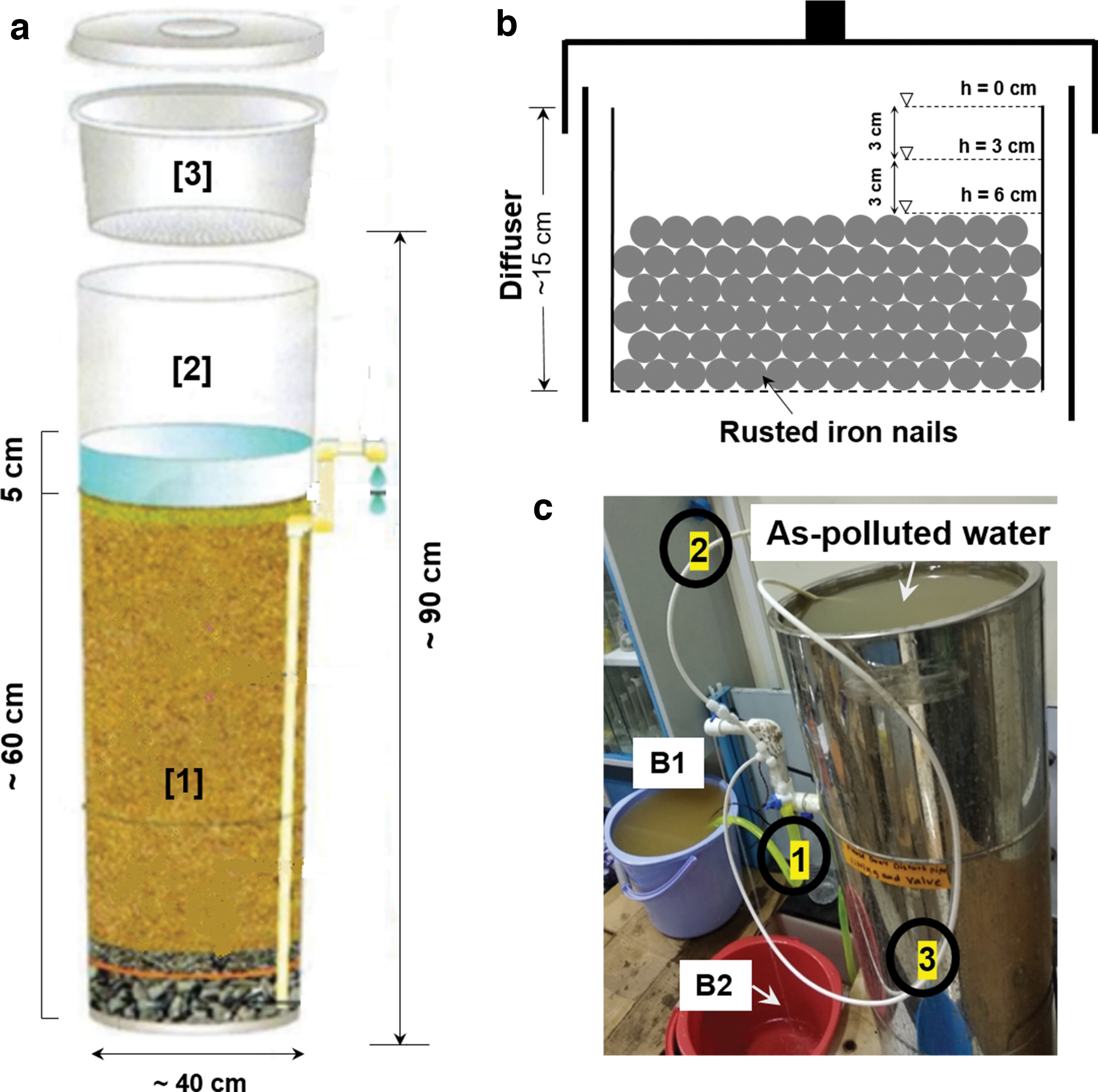
Schematics of JalKalp filter used for arsenic removal.
Evaluation of arsenic-removal efficiency
Arsenic-removal efficiency of JalKalp filter was investigated by feeding both As-spiked unpolluted and As-polluted groundwaters. IITK tapwater was considered as the As-unpolluted source of groundwater. For As-polluted groundwater, samples were collected from a previously identified site near Kanpur, Uttar Pradesh, India situated in the middle Gangetic plains. Two such locations were identified and designated as BK2 and BK14. Three sets of water samples were collected from each location. Two sets were filtered using 0.2 μm Nylon syringe filters (Cole-Parmer). One of these sets was immediately acidified to 1% HNO3 (v/v) for AsT measurement with ICP-MS. The other set was analyzed for dissolved As(V) and As(III) with IC-ICP-MS, and for cations and anions with IC.
The JalKalp was first validated with arsenic spiked in unpolluted groundwater in the form of only As(V), or only As(III), or As(V) and As(III) (1:1 molar ratio), such that the AsT (50-500 μg/L) remained the same. To optimize As removal with variable flow rate, these experiments were performed under three different heads (h)—0, 3, and 6 cm. Flow rate was estimated by collecting a known volume of filtered water in a specified duration using measuring cylinder and stopwatch. Furthermore, the JalKalp filter was validated with 40 L of real As-polluted groundwater collected from locations BK2 and BK14. This water was passed through the filter under constant head of 0 cm, based on the optimized head condition identified in head variation experiments.
Samples from the filter outlet were collected after every 10 min for 3 h before and after 0.22 μm Nylon syringe postfiltration. An identical protocol, to the one described for samples BK2 and BK14, was followed for measurement of elemental concentrations, including AsT, As(V), and As(III), and cations and anions.
Batch experiments
To determine sorption capacity (qmax) of iron nails, batch experiments were performed with fresh and rusted-iron nails. This qmax was used to calculate total capacity of JalKalp filter to treat As-polluted water and to estimate life of iron nails. Rusting was achieved by suspending fresh iron nails in an open beaker containing As-free groundwater (IITK) for 15 days [2 h/day]. Increasing concentrations of As(V) and As(III) solutions (0.05–10 mg/L; 1:1 molar ratio) were spiked in the As-free groundwater, which initially contained 5 g of fresh or rusted-iron nails. Batch experiments were performed in triplicates. An aliquot from every system was taken after 1 day for subsequent arsenic measurement in ICP-MS. Entire reacted iron nails were also collected for solid phase analyses using BET, XRD, and W-SEM-EDX techniques.
Modeling of tracer experiments
To determine the hydrodynamic dispersion coefficient, a mathematical model was fitted for bromide derived from basic mass balance equation [Eq. (4)]:

where D (cm2/s) is the hydrodynamic dispersion coefficient, u (cm/s) is the velocity along the length of the sand column (l = 46 cm), and C (mg/L) is the concentration at a particular time and space. Different steps involved in mathematical modeling are detailed in Section S3 in Supplementary Data. Reactive transport modeling of As-containing systems was not attempted as removal of arsenic was very fast, due to which breakthrough never occurred for the duration of the experiment.
Assessment of filter in rural areas: the JalKalp program
The JalKalp program was started in April 2017 for provisioning of clean drinking water to rural households in Bihar affected by chronic arsenic pollution in groundwaters.
Selection of study sites
Per the JalKalp program, volunteering households were identified in various districts of Bihar, which is the third most As-affected state (Jha et al., 2010) and the third most populated state (ORGI, 2011) of India. Groundwater pollution due to As in Bihar was first reported in district Bhojpur in the year 2002 (Chakraborti et al., 2003), and since then >16 districts have been affected by As poisoning (Kumar et al., 2016). Recently, As-polluted groundwaters were identified in villages of districts Vaishali (Singh et al., 2014) and Buxur (Kumar et al., 2016). Overall, a total of 2,410 filters have been installed in 54 As-affected villages in Bihar. In this study, however, only 22 JalKalp filters in 5 villages of district Vaishali (14 filters) and Buxur (8 filters) were included because these locations witnessed relatively high concentrations of As, Fe, and microbes in groundwaters than other locations. Details of participating households, including geographical coordinates and sampling depth, are provided in Fig. 2 and Supplementary Table S4.
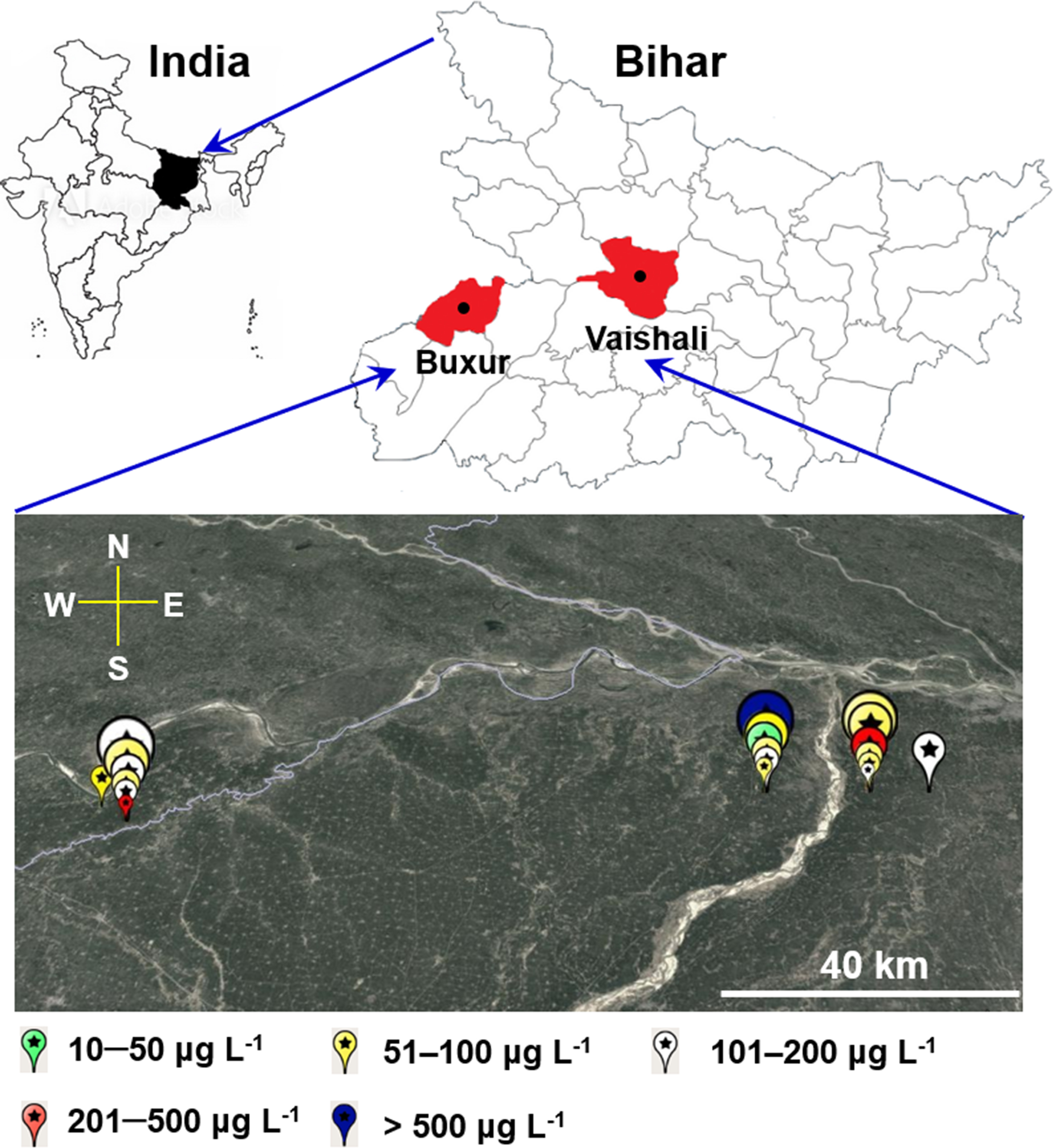
Study locations in Bihar, India, where JalKalp filters were installed during 2018–2020. The map was generated with Google Earth (https://www.google.com/earth/versions/#download-pro) containing measured GPS coordinates of locations (listed in Supplementary Table S1). The legend denotes the range of total dissolved arsenic concentrations exceeding the DWL at the respective locations (n = 22). DWL, drinking water limit.
Surveys and community engagement
Routine yearly surveys in the As-affected villages participating in the JalKalp program were conducted. For every survey, a structured-coded interview session was carried out with a member of each household to gather information on their socioeconomic status, sources and quality of drinking water, health-related issues before and after using the JalKalp filter, and specific feedback on the filter. A total of 18,942 males and 12,511 females, including 7,268 students in 34 schools, have participated in this program so far. Details of the methodology of survey, including questions asked, statistics related to participation, and feedback on the efficacy of JalKalp program, are discussed in Section S5 in Supplementary Data.
After the initial survey and groundwater testing, awareness sessions in the form of “community meetings” were convened in every As-affected village, where 30–60 people participated (Fig. 3a). The main agenda of this meeting was to build initial trust and friendly relations with the villagers. People were informed with visual aids and role-play activities about the impact of drinking unsafe water. A demonstration of testing of water samples by innovative methods, such as testing the presence of dissolved Fe in groundwater using guava leaves (Fig. 3b; Siriangkhawut et al., 2019), was also given. Furthermore, the JalKalp filter was introduced to the villagers as a low-cost decentralized water-treatment solution. Although the total cost of filter was ∼INR 3,800 (∼US$ 51), each household had to pay INR 2,500 (∼US$ 33), and the rest was supported through a grant provided by the Department of Science and Technology, Government of India (DST-GoI). The total cost of a filter was ∼0.1–0.2% of a household's five-yearly income in this region (Section S5.2.3 in Supplementary Data). To initiate the engagement of community members, the filter was provided to one household for a 15 days trial before purchase.
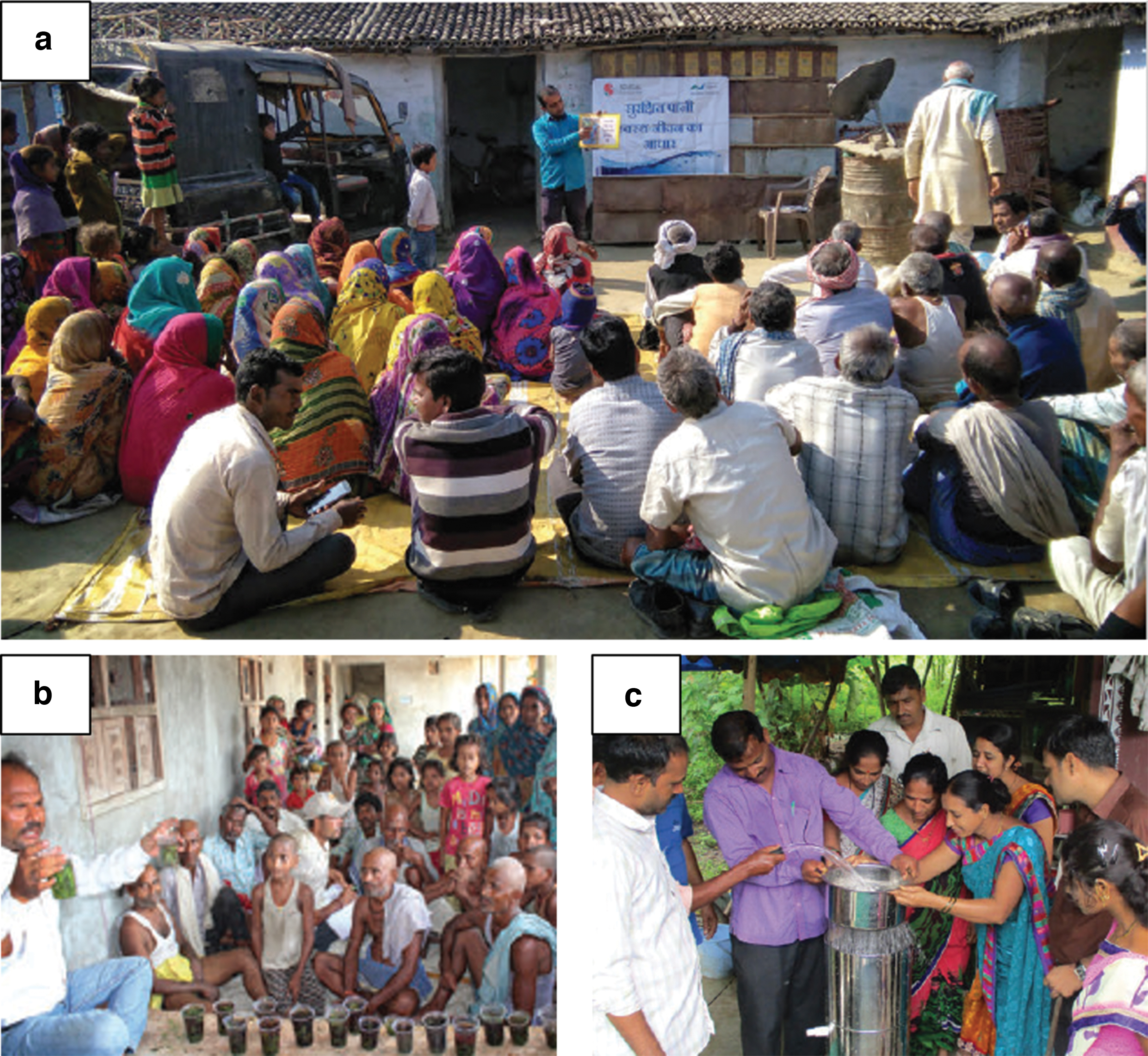
Implementation of the JalKalp program in study sites of Bihar, India, through community participation:
Role of various stakeholders
To make the JalKalp program effective and ensure its proper functioning, this study was conducted with a coalition of different stakeholders, who belonged to different backgrounds and disciplines. They were households, local agents, Sehgal foundation, IITK, and DST-GoI. Rural households were expected to participate in training and workshops, prepare filter media, share the filter costs, and provide feedback on filtered water. The next key stakeholders were local agents, mainly community workers and fabricators. A team of properly trained people or “community workers” (80 members) were assigned to teach how to operate the filter to the households, and troubleshoot any problems related to its use. These “community workers” were usually the educated youth of the villages, who either had volunteered themselves or were requested to undergo proper training on the filter provided by the Sehgal foundation, with the vision that they would be able to construct the filters in the future for their fellow residents. Besides an unknown number of fabricators were responsible for constructing filter bodies, based on the specifications provided by the Sehgal foundation. The Sehgal foundation supported local agents, and was further responsible for monitoring and improving the project. IITK provided scientific and technical support to the program by performing several bench-scale experiments to validate the filter, and by providing advanced testing facilities of sludge and water samples. DST-GoI subsidized each JalKalp filter by providing a sum of INR 1,300 (US$ ∼17) to each household.
Filter installation in rural households: trainings and workshops
After the 15 days trial period, villagers who opted to have the JalKalp filter installed at their households were divided into small groups and were trained to independently operate the filter (Fig. 3c). In total, ∼1,464 training and workshop sessions were conducted in the participating villages. Since the aim of the training was to make villagers self-reliant, members of each household were asked to arrange and prepare their own filter media. After the filter media were arranged, households called their respective community workers. During the installation process, villagers were further trained on operating, maintaining, and troubleshooting the filter.
Monitoring and feedback
After 15 days of installation, a community worker revisited the household to monitor the water quality by checking concentrations of AsT, FeT, and pathogens in filtered water. Besides, the villagers' feedback on their experience of using the JalKalp filter was documented (details in Section S5.1.I in Supplementary Data). Such process was conducted on a regular basis till 90 days after installation but visits after 15 days were focused mainly on filter maintenance. Small community meetings continued over the next few months, which allowed other villagers to observe the filter during operations.
Toxicity characteristic leaching procedure on sludge generated by filter
To evaluate the leaching potential of hazardous elements present in As-containing sludge generated after filtration, toxicity characteristic leaching procedure (TCLP) was performed (USEPA, 1992). Filter sludge was carefully sampled from the filter unit after the user experienced a decrease in flow rate over time. Per the TCLP protocol, a preliminary test was performed to determine the nature of extraction fluid. For the leaching test, ∼45 g of filter sludge was taken in a borosilicate glass bottle of 1 L capacity to attain the recommended solid-liquid ratio (w/w) of 1:20. The suspension was continuously mixed on an end-on-end shaker at 30 rpm for 16 ± 2 h. Solid and liquid phases were separated by filtration through 0.8 μm glass microfiber filters, which were prerinsed in 1 N HNO3. An aliquot of the liquid sample was acidified using 1% (v/v) HNO3, and elemental concentrations were measured using ICP-MS. More details of TCLP, including those of the samples (Lot 1, Lot 2, and Lot 3), are provided in Section S6 in Supplementary Data.
Results and Discussion
Evaluation of JalKalp filter under laboratory conditions
Determination of filter parameters
Specific surface areas of fresh and 15 days rusted-iron nails were 2.75 and 3.44 m2/g, respectively. Sieve analysis suggested that the predominant size range of sand lay between 0.15 and 0.425 mm (Supplementary Table S3), consistent with the size range used in KAF (Ngai and Walewijk, 2003). Also, the estimated value of the coefficient of uniformity of JalKalp sand (Cu = 2.22; Supplementary Fig. S2) was comparable with that of KAF (Cu = 2.42), which suggest the presence of poorly graded sand. The porosity of JalKalp sand was estimated as 0.497 and 0.458 using the Kozeny-Carman equation and beaker method (Section S3 in Supplementary Data), respectively, which was more than the porosity of KAF sand media (0.36) (Ngai and Walewijk, 2003).
Estimated permeability of JalKalp sand media was 0.052 cm/s, using the Allen Hazen equation (Section S3 in Supplementary Data), was more than the permeability of KAF sand (0.0361 cm/s). These observations from porosity and permeability suggest that flow rate would be higher in JalKalp as compared with KAF. Estimates from Br tracer data indicate that the HRT for the three heads corresponding to 0, 3, and 6 cm were 69.01, 70.55, and 128.56 min, respectively (Fig. 4). Using these experimentally determined parameters as inputs, the advective-dispersive transport modeling of Br tracer data estimated hydrodynamic dispersion coefficient (D) as 0.5, 4.7, 2.0 cm2/s for h = 0, 3, and 6 cm, respectively (Fig. 4). However, since the model fits were poor for the first two heads, D corresponding to h = 6 cm appeared to be a realistic estimate and was retained.

Tracer study for the determination of retention time under varying hydraulic heads. Open symbol represents measured value, whereas the solid line represents modeled concentrations corresponding to a particular head predicted by the solution to the advective-dispersive equation. Dotted vertical lines represent mean HRT in minutes. Mean HRT was calculated using where Ci and ti represent concentration of bromide and time duration, respectively, at the ith interval. A particular color represents data for a unique head as mentioned in the figure legend. HRT, hydraulic retention time.
Physiochemical parameters of sampled groundwater
AsT in polluted groundwaters sampled from locations BK-2 and BK-14 were 142 and 132 μg/L, respectively. The measured EH suggested that the locations were oxidizing with respect to As speciation—114.9 mV for BK2, 49.7 mV for BK14. The arsenic speciation analysis suggested that location BK2 was As(III) dominated [As(III) = 87, As(V) = 20 μg/L], whereas BK14 was As(V) dominated [As(III) = 1, As(V) = 143 μg/L]. The sum of As(V) and As(III) concentrations was within 10% of AsT for BK14, but was significantly lower in BK2. This mass imbalance in BK2 could be due to sorptive uptake of As by Fe oxides that likely formed due to oxidation of dissolved Fe(II) to Fe(III) in samples kept unacidified for IC-ICP-MS analysis. However, AsT analysis on ICP-MS precluded Fe-oxide formation as samples were immediately acidified on site. Results of other relevant geochemical parameters are listed in Table 1.
Selected Water Quality Parameters for Arsenic-Polluted Groundwater Before and After Filtration with JalKalp Filter
Water quality parameters listed under “General parameters” and F− were measured as detailed in Section S5 in Supplementary Data. SO42−, Cl−, and PO43− were measured using IC. Total dissolved arsenic (AsT) and total dissolved iron (FeT) were measured using ICP-MS.
Other water quality parameters are not listed as either they were below detection limits, or there are no guidelines.
Permissible and maximum limits were based on Indian standard (IS:10500, 2012).
Coordinates of location BK-2 were 26°33′47′′N and 80°15′17′′E, and those of location BK-4 were 26°33′53 ′′N and 80°15′19′′E.
Results correspond to water obtained after passing the filtered water two times sequentially.
BOD, biochemical oxygen demand; COD, chemical oxygen demand; IC, ion chromatography; ICP-MS, inductively coupled plasma mass spectroscopy; n.d., not detected; NTU, nephelometric turbidity units; TDS, total dissolved solids.
As-removal efficiency in different systems
AsT concentrations in treated water were <10 μg/L, when As-free groundwater spiked with variable As concentrations, and real As-polluted groundwater (Fig. 5 and Supplementary Tables S5 and S6) was passed as influents to the JalKalp. In the case of As-free water spiked with As in different forms [As(V), or As(III), or both As(V) and As(III)] and concentrations (50-500 μg/L), the filter was able to remove AsT within 20 min of filtration for all heads (h = 0, 3, and 6 cm). Figure 5a shows the arsenic removal for the experiment conducted at maximum head (h = 0 cm), which initially contained AsT concentrations of 50-500 μg/L, added in the form of both As(V) and As(III) in 1:1 ratios. For this system, As-removal efficiencies were observed in the range of 95–99%. Similar results were obtained for all other dissolved As inputs at different heads (Supplementary Table S5). The highest flow rate of 27 L/h was observed in experiments performed at h = 0 cm.

Arsenic removal using JalKalp filter under different conditions—
Similar to results with synthetic solutions, the JalKalp filter was able to treat real As-polluted groundwaters—BK2 and BK14—by bringing the AsT to below the drinking water limit (<10 μg/L) (Fig. 5b). For both water samples, As-removal efficiency was found to be >99%, whereas reported As efficiency of KAF was 85–90% (Ngai et al., 2007). Although PO43− is known to interfere with AsO43− removal due to structural similarity, the JalKalp filter efficiently removed arsenic in sample BK14, which initially had a high concentration of PO43− (∼2.7 mg/L) (Table 1). Further, the filter was able to remove iron from groundwaters BK2 and BK14 containing FeT concentrations of 9 and 1.1 mg/L, respectively, to below the drinking water limit (<1 mg/L). Removal of FeT by the JalKalp filter could possibly be due to the formation of insoluble ferric oxide colloids that were trapped in the sand layer (Ngai et al., 2006). IC-ICP-MS analysis of solute data did not indicate any As-redox transformations in any of the systems.
Tests on water quality parameters
JalKalp filter was able to pass most of the water quality tests performed, except alkalinity and hardness (Table 1). While fecal coliforms were not observed in the sampled As-polluted groundwaters, BK-2 and BK14, concentrations of total coliforms recorded were high in these locations (400–595 CFU/mL). Previous study showed that JalKalp removed total coliform (initial concentration = 350 and 240 CFU/mL) and fecal coliforms (initial concentration = 9 and 7 CFU/mL) from water samples with an efficiency of 100% (Sharma and Sood, 2016). However, in this study, the removal percentages of total coliforms were 91.3 and 98.1 for BK2 and BK14, respectively. This difference could be due to the higher initial microbial concentrations present in these locations. As the drinking water standard for total coliform ( = 0 CFU/mL) was not achieved after the first pass through the JalKalp, the filtered water was passed for the second time, after which the total coliforms were not observed ( = 0 CFU/mL) in both the treated water samples. As the influent water did not contain fecal coliforms and the total coliform removal required two passes, it is advisable to pass the filtered water from the JalKalp for the second time to achieve total coliform drinking water limit.
Batch experiments
Maximum sorption capacity (qmax) of fresh and 15 days rusted-iron nails were determined as 57.86 and 113.21 μg/g, respectively. The Langmuir isotherm (Langmuir, 1916) was used to model the sorption density (q) (Fig. 6), and qmax was obtained by linearizing the isotherm, or by plotting Ce/q against Ce, where Ce is the equilibrium dissolved As concentration (Section S7 in Supplementary Data). Higher qmax in rusted-iron nails could be due to the possible formation of iron oxides during the rusting process, which would have created more surface area (3.44 m2/g) as compared with fresh nails (2.75 m2/g). However, after reaction with As, surface area of iron nails increased to 2.86 m2/g in systems containing fresh nails and was reduced to 1.05 m2/g in rusted-iron nail system. Decrease in surface area of rusted-iron nails after reaction with As has also been reported previously (Eljamal et al., 2011). The slight increase in surface area for the fresh-nail system could be due to rusting of iron nails for 1 day, consistent with the past studies (Triszcz et al., 2009). However, the significant decrease in surface area of the rusted-iron nail system could be due to As uptake (∼100%; for initial AsT of 500 μg/L) by the prevalent iron oxides, which would have decreased the net available sites. W-SEM-EDX analysis (Fig. 7a, b and Table 2) suggests the possible formation of iron oxides in As-reacted rusted-iron nail system, as higher atomic percentage of O to Fe was observed in this system compared with the fresh-nail system (Table 2). Furthermore, XRD analysis confirmed the presence of maghemite in rusted nails. However, in fresh nails head, goethite was identified but was not observed in the tail (Fig. 7c, d).

Sorption isotherms depicting arsenic uptake in systems containing

Solid phase analyses of As-reacted fresh
Elemental Composition of Area Mapping (Tungsten Scanning Electron Microscope and Associated Energy-Dispersive X-Ray Spectroscopy) on Arsenic-Reacted Iron Nails
The numbers in bold were to highlight atomic ratio
Iron nails were not crushed to fine powders before the spectroscopic analysis.
As, arsenic.
Evaluation of JalKalp program in rural communities
Socioeconomic status, groundwater condition, and health issues before JalKalp program
There were several factors that influenced the acceptance of JalKalp filter, including several socioeconomic ones (Section S6 in Supplementary Data and Supplementary Fig. S3). Population in the targeted villages of districts Vaishali and Buxur of Bihar (India) mostly comprises small land holders who are mainly dependent on agriculture for their living. Further, some of them rear cows and buffaloes. However, there is a significant population that is landless, and depends on daily wages from agricultural and petty jobs. Moreover, selected villages do not have access to continuous supply of electricity. Due to these conditions, ∼80% of households cannot afford expensive and electrified water-treatment units.
People in these villages depend mainly on groundwater to meet their drinking water needs (Supplementary Fig. S4). However, the groundwater was found to be severely polluted with As, Fe, and microbial contamination. At all locations where JalKalp filters were installed (n = 22), groundwaters contained elevated AsT concentrations (>10 μg/L) (Table 3). Median AsT concentration in these locations was 100 μg/L, and the maximum concentration reported was 1,750 μg/L at location JF 15 (Buxur, Bihar). In 15 of 22 locations, FeT concentrations exceeded 3 mg/L (Table 3), whereas 100% of these locations (n = 22) exceeded the drinking water limit of 1 mg/L (IS:10500, 2012). Moreover, all of these groundwaters tested positive for the presence of fecal coliforms. However, TDS concentrations were below the permissible limit (500 mg/L) (Table 3) in ∼91% of these locations (n = 20).
Elemental Concentration and Other Relevant Details Related to the Performance of Installed JalKalp Filter at Rural Households in Locations of Vaishali and Buxur in Bihar, India
All these groundwaters before filtration tested positive for fecal coliform, and tested negative after filtration using H2S absence/presence test. Dissolved total As, dissolved total Fe, and TDS were measured using specialized field kits.
Swirl-and-dump maintenance process is explained in Section S8 in Supplementary Data.
Several health problems were reported by the villagers to our team, which could be due to drinking polluted groundwater. Mostly, people complained of gastrointestinal issues, such as indigestion and excessive diarrhea, in children. Further, the survey team observed skin lesions in some villagers (Fig. 8a) residing in regions with high As concentrations in groundwater. Some villagers also reported itching problems after bathing with this groundwater. Aside from health issues, villagers repeatedly observed paling of the original color of rice (Fig. 8b) and lentils when polluted water was used for cooking, possibly due to the presence of high dissolved Fe in groundwater.

Condition of villagers during the JalKalp program of study sites.
Removal capacity of JalKalp filter in rural households
Groundwater was free from elevated AsT (<10 μg/L) in every location after filtration (Table 3). Apart from As-removal efficiency of ∼100%, FeT in filtered water was <0.3 mg/L in all locations. Moreover, in every household effluent water was tested negative for pathogens using the absence-presence test. However, TDS concentrations in the filtered water remained high as in the influent water (Table 3). The amount of groundwater filtered from the JalKalp filter in every household ranged from 15 to 50 L/day, depending on the number of persons using the filter. The frequency of the swirl-and-dump maintenance process (described in Section S8 in Supplementary Data) usually ranged from 15 to 30 days, with an average of 26 ± 5 days (Table 3). Since the major contaminants of the aquifers, AsT, dissolved FeT, and pathogens were removed using the JalKalp, the filtered water could be considered safe for drinking purposes.
TCLP extract analysis
Table 4 shows the elemental concentrations of sludge collected from the filters. Results indicate that concentrations of all elements were below TCLP guidelines (USEPA, 2010; MoEFCC, 2016), which suggested that the collected sludge could be considered as nonhazardous. Although there is no TCLP standard of iron or its oxides, the concentration of dissolved Fe was excessively high in the TCLP extract. As the elevated levels do not exceed any disposal guidelines, it can be considered as a municipal waste and can be discarded in regular landfills. Yet, the villagers were advised not to discard this sludge uncontrollably, but to collect it in a particular place covered with shed until a suitable method of recycling this material was found.
Elemental Concentrations of Various Metals in Toxicity Characteristic Leaching Procedure Extract of JalKalp Filter Sludge Obtained from Study Locations
Elemental concentrations were measured on ICP-MS.
Lot 1 contains mixed sludge from JalKalp filters installed in all 14 households in Vaishali, Bihar (Table 3 and Supplementary Table S4).
Lot 2 contains sludge from JalKalp filters installed in all eight households in Buxur, Bihar (Table 3 and Supplementary Table S4).
Lot 3 contains sludge from the JalKalp filter installed in all 22 households in Vaishali and Buxur, Bihar (Table 3 and Supplementary Table S4).
bdl, below detection limit.
Estimated life of JalKalp filter and cost comparison with traditional method
Based on qmax of rusted-iron nail (113.21 μg/g), total mass of iron nails used in the filter (∼5 kg), and considering an average concentration of AsT in groundwater (∼100 μg/L), a JalKalp filter can treat ∼6,000 L (rounded to nearest thousand) of As-polluted water. Based on these values, and considering average daily drinking water demand of a household as ∼10 L, the estimated duration of iron nails to treat As in polluted water was ∼1.7 years. However, the exhausted iron nails can be replaced with the new nails, and the filter can be used repeatedly. The estimated life of a JalKalp filter is ∼25 years, based on the life span of polyvinyl chloride pipe, which has the shortest life span among other constituents used in making the filter.
The treatment cost of conventional reverse osmosis (RO) filter, with an estimated life of 5 years, is INR ∼2.1 (US$ ∼0.03)/L of water. This estimate considered costs related to the capital, total water consumption, treatment losses, and maintenance and electricity charges of a typical RO filter (Kent, 2020). Contrary to RO filters, there are minimal maintenance, operation, and electricity charges associated with the JalKalp filter. The treatment cost of a JalKalp filter is only INR ∼0.28 (US$ ∼0.004)/L of water, considering total cost during installation as INR 3,800 and estimated cost of iron nails for 5 years as INR ∼1,000. Furthermore, the treatment cost of this filter is considerably less than the reported cost of a KAF [INR ∼0.75 (US$ ∼0.01)/L of water] (Akvopedia, 2015), which was developed to treat As-polluted water in rural households of Nepal. Besides, water filtered from KAF required an additional process (not included in cost estimation) to treat pathogens (Ngai et al., 2006), which is not needed in JalKalp filter.
Positive outcomes of the JalKalp program: health, employment, and education
One of the most positive outcomes of the JalKalp program was the improvement in health of rural people. After the filter installation, most villagers who consumed unpolluted (filtered) water reported better digestion and reduced diarrheal cases (Supplementary Fig. S5). Some villagers experienced reduced incidence of skin problems after consuming filtered water. However, it may be too early to comment that these skin problems were being resolved because of drinking As-free water. Aside from improvements in personal health, villagers reported that the color (Fig. 8b) and taste of food cooked with filtered water were better. Furthermore, households reported an increase in overall quantity of drinking, as filtered water seemed colorless (Fig. 8c; SMSfoundation, 2017) and no longer tasted heavy.
Apart from providing clean and hygienic water, the JalKalp program created job opportunities for distinct groups of people ranging from local agents to entrepreneurs (Fig. 8d). Six experienced community workers were paid INR 18,000 (US$ ∼240) per month. Other community workers were to be paid after they had gained experience in the program. An unknown number of fabricators earned money for making filter bodies directly from outside agencies. Also, the JalKalp filter is currently attracting attention of local entrepreneurs who may convert this initiative to a viable business model by selling the filters on a larger scale. It has also created opportunities in development of such low-cost, easy-to-operate filters, which can remove AsT, FeT, and pathogens from polluted water.
JalKalp program has also resulted in educational benefits. Through community meetings, ∼30,000 villagers learned about their present water quality state and the methods to monitor it. Further, they understood the importance of safe drinking water and potential solutions. Training and workshop sessions (∼1,464) on the operations and troubleshooting of the filter have enhanced the capacities and confidence of rural people to solve their problems on their own.
Monitoring, feedback, and response
After 15 days visit for monitoring of JalKalp filter, concentrations of AsT, FeT, and pathogens in filtered water were found to be within drinking water limits. Even though the presence of pathogens was not identified, users were suggested to pass the filtered water again to eliminate the presence of any excess total coliforms. Furthermore, community workers ensured that filters were leakage free, and checked the general cleanliness and upkeep of the filter. Also, it was ensured that the users can competently perform swirl-and-dump maintenance on their own (Section S8 in Supplementary Data). The positive feedback obtained from the villagers, such as health improvement and employment generation, has created a sense of satisfaction and enthusiasm among us. Further, monitoring and seeking regular feedback has even led to further improvements to the filter, such as for the filter outlet tube, which was reported as fragile at the initial stages.
Strategies to overcome major challenges: future implementation of programs like “JalKalp” in Indian context
Although the JalKalp program achieved its objectives, there were many challenges that our team had to face during implementation. The most challenging task was to enter a village and build initial trust within the villagers. This challenge was addressed by performing extensive role-play activities (Fig. 3). Since our targeted locations were rural areas where people have economic instabilities, our next biggest hurdle was the affordability of JalKalp filters. Even though the subsidized cost of a JalKalp filter was INR 2,500 (US$ ∼33), there were many families who could not afford it. To overcome this limitation, we proposed the villagers to purchase the filter on a shared basis (two to three families), so that the maximum rural people could benefit from improved water quality. Some families believed that their water was holy as past generations had consumed this water. On the contrary, some believed that drinking poor quality water was not a big issue as it will not cause any health problems to them. We tried to dispel these notions by teaching the importance of drinking clean water to the younger formally educated members of the village and motivated them to convince their elders. Furthermore, among these educated members, those who underwent systematic training (80 completed; 100 ongoing) on JalKalp filter are expected to construct such filters on their own in the future. Their stepping up is not only important as it might reduce the capital cost of the filter but will also become crucial once the grant provided by the government ends.
Considering these challenges and possible solutions, the JalKalp program can be extended to other rural areas of severely As-affected states of India, such as West Bengal and Uttar Pradesh. Furthermore, in Indian scenario programs like JalKalp could be expanded to include other groundwater pollutants. For example, 19 Indian states are affected by fluoride pollution in groundwater (Jha et al., 2010); the JalKalp program could motivate future researchers to develop such low-cost filters, which could be implemented in these affected regions.
Summary
This study validated the use of a low-cost modified biosand filter with stainless-steel body, “JalKalp,” which utilized ZVI for As removal and a copper sheet for removal of pathogens under Indian groundwater conditions. The JalKalp filter efficiently removed total dissolved arsenic up to 500 μg/L under laboratory conditions, and up to 1,750 μg/L in the field, to below permissible limit (10 μg/L). Furthermore, the sludge generated from the filter after treatment process was nonhazardous, which can be disposed in regular landfills. For effective arsenic removal, JalKalp requires regeneration of iron nails after every ∼1.7 years for influent water containing 100 μg/L of AsT. The treatment cost of 1 L of 100 μg/L of average As-polluted water is ∼INR 0.28 (US$ ∼0.004), which an economically disadvantaged family could afford. The JalKalp program initiated in Bihar, India, demonstrated how rural communities, systematically under resourced, could be safeguarded against unsafe water with an engineered technology, and with participation of several stakeholders: local residents, local agents, governmental and nongovernmental organizations, and an educational institution. The program initiated to install JalKalp filter in rural areas has so far provided clean and safe drinking water, which has seemingly reduced health problems resulting from drinking polluted water, and has spread social awareness, generated employment to villagers, and opened the door to entrepreneurial, educational, and research opportunities. Considering its simple operation, easy maintenance, and its effectiveness in providing potable water, the low-cost JalKalp filter can be considered as a sustainable treatment solution at the household level.
Footnotes
Acknowledgments
We are grateful to the Ministry of Human Research and Development, Government of India, for providing Prime Minister's Research Fellowship (PMRF) to A.V. for his doctoral studies, and assistantship to G.P., J.J.N., and A.K. for their master's studies. We sincerely thank all the staff of Sehgal foundation and volunteers of villages—Khoksha, Kaila Chak, Lakhanpur, Mungroll, and Tilak Rai Ka Hata—for their sustained help throughout the field study.
Author Disclosure Statement
The authors declare no competing financial interests exist, and this work has been carried out in compliance with ethical standards.
Funding Information
We are thankful to the Department of Science and Technology, Government of India (DST-GoI), for the grant DST/TM/WTI/2K15/109(G) given to Dr. Abhas Singh under the Water Technology Initiative. We acknowledge DST-GoI for the grant DST/TM/WTI/2K16/39 given to S.M. Sehgal Foundation.

References
Supplementary Material
Please find the following supplemental material available below.
For Open Access articles published under a Creative Commons License, all supplemental material carries the same license as the article it is associated with.
For non-Open Access articles published, all supplemental material carries a non-exclusive license, and permission requests for re-use of supplemental material or any part of supplemental material shall be sent directly to the copyright owner as specified in the copyright notice associated with the article.
