




Abstract
Herein, a novel Na2SO3 process enhanced with an oxidation inhibitor was proposed for the synergic removal of SO2 and NO2 from nonferrous smelting flue gas. The co-absorption and reduction characteristics and mechanism of SO2 and NO2 were investigated. Results showed that when 80.59, 161.17, and 241.76 mM Na2S2O3 was added into 2% of Na2SO3 solution, NO2 absorption capacity increased to 264%, 300%, and 330%, and that of SO2 increased to 162%, 198%, and 232%, respectively. The inhibition action of Na2S2O3 was achieved by reacting
Introduction
At present, haze pollution is persistent in the northern area of China. Detrimental effects of particulate matter (PM2.5) (Huang, 2015; Zhao et al., 2019) produced through haze pollution is a serious concern, and recently, it has attracted considerable research attention. Nitrate and sulfate salts are the main secondary inorganic chemical components causing the increase of PM2.5 (Hao and Liu, 2016; Peng et al., 2016). The gaseous SO2 and NOX emitted during this nucleation are oxidized to form sulfates and nitrates. Therefore, integrated control of various primary pollutants such as SO2 and NOX is pertinent to solving the problems of haze pollution (Li et al., 2014; Guo et al., 2016).
The nonferrous metal smelting flue gas contains different concentrations of SO2, NOx, and various heavy metals owing to the use of sulfide ore and coal as a raw material in the nonferrous metal smelting industry (Liu et al., 2019; Ma et al., 2021). At present, the selective catalytic reaction (SCR), selective noncatalytic reaction (SNCR), and ozone oxidation are widely used to remove NOX from the flue gas (Jo et al., 2016; Vinciguerra et al., 2017). However, the high concentrations of SO2 and multiple heavy metals in nonferrous metal smelting flue gas can poison the SCR catalyst. The work temperature and NH3 reductant of the SNCR are not in an acceptable range for the particular parameter in smelting furnaces. Moreover, O3 oxidation process is frequently used to convert NO to NO2 for denitration from nonferrous metal smelting flue gas. However, the NO2 still needs to be removed. At present, the NaOH desulfurization process is used to absorb NO2 in most nonferrous metal smelters, but the removal efficiency of this desulfurization technique is not ideal (Zheng et al., 2014; Hao et al., 2017). Consequently, this study focuses on the removal of NO2 after NO oxidation.
Desulfurization technologies of the nonferrous smelting flue gas primarily involve sodium hydroxide, the organic amine process, the ionic liquid process, and the cyclic sodium sulfite process (Wu et al., 2004b; Bal et al., 2019). However, therein, NaOH is limited because the desulfurization by-product Na2SO4 is easily crystallized to block the pipe, difficult to recycle into Na2SO3 (Meikap et al., 2002; Ma et al., 2018). Although the ionic liquid can recycle gaseous SO2, sodium and heavy metal ions easily accumulate during adsorption, thereby wasting ionic liquid and incurring a high cost. The organic amine method is restricted by its low regeneration efficiency and high operating cost. The cyclic sodium sulfite process is deemed a resource recovery process with good application prospects; therein, Na2SO3 absorbs SO2 to form NaHSO3, followed by desorbing using heat to re-release recoverable SO2. Equations of the corresponding reactions are as given in Equations (1) and (2) (Wu et al., 2004a; Safe et al., 2008).
SO2 and NO2 can be simultaneously absorbed during the sodium sulfite absorption process (Guo et al., 2014). However, NO2 is absorbed to form nitrite (
In this study, the characteristics of synergistic desulfurization and denitration were studied by investigating the co-absorption of SO2 and NO2 under different flue gas components and absorption conditions. The morphological changes of NOx in the absorption system were also studied to clarify the mechanism of flue gas synergistic desulfurization and denitration. Through this research, the synergistic desulfurization and denitration effect of the Na2SO3-enhanced process can be further promoted and the control theory and technology of multipollutants from the nonferrous smelting flue gas can be developed.
Experimental Apparatus and Methods
Experimental apparatus
Supplementary Figure S1 shows a schematic of the experimental apparatus (as shown in Supplementary Data) comprising four parts: the simulated flue gas distribution system, the absorption reaction system, the online monitoring system, and the exhaust gas treatment system. The simulated flue gas flow rate was 1.0 L/min and it is supplied by several cylinders. The flue gas contained 2000–5000 mg/m3 SO2, 200–600 mg/m3 NO2, 4–8% O2, and the balance gas was N2. All gases were controlled using mass flow meters (Sevenstar D07, China). The SO2 absorption experiment was performed in a three-port bubbling reactor with 50 mL of 2–4% Na2SO3 solution. The initial temperatures of flue gas and absorption solution were 353 K and 293 K, respectively. The flue gas from the outlet was continuously absorbed by 5% NaOH and 5% KMnO4 solution such that the tail gas was purified to discharge.
The concentrations of SO2 and NOX in the inlet and outlet of the reactor were monitored online using a flue gas analyzer (Testo–350; Germany). The nitrite and nitrate concentration was determined using an ultraviolet (UV)-visible spectrophotometer (TU-1810; China).
Absorption capacities of SO2 and NO2
The absorption capacities of SO2 and NO2 in the Na2SO3 solution were obtained by integrating the absorption curve; the results are as given in Equations (3) and (4).
where
Removal efficiencies of SO2 and NO2
The removal efficiencies of SO2 and NO2 were calculated using Equations (5) and (6).
where
Calculation of N mass balance
The mass of
The mass of NO and NO2 were calculated using the following Equations (7) and (8).
where MNO and
The mass of sulfur nitrogen compound (
Results and Discussion
Absorption effect of NO2 under different conditions
NO2 absorption is affected by various factors, such as the parameters in absorption solution and flue gas. As given in Fig. 1, the curves a and b indicate that the absorption capacity of NO2 is significantly stronger in the Na2SO3 solution than in pure water. This is because the absorption of NO2 by water involves simple dissolution with small dissolution equilibrium, whereas Na2SO3 reacts with NO2 to promote absorption of NO2, as given in Equations (11) and (12) (Jia et al., 2013; Sun et al., 2015; Wu et al., 2018). Therefore, the synergetic desulfurization and denitration from the smelting flue gas by Na2SO3 are matched. Curves b and c show that when the oxygen concentration increases from 4% to 8% in the flue gas, the absorption capacity of NO2 decreases from 0.33 to 0.22 g/L in the Na2SO3 solution. This observation may be attributed to the side reaction that converts
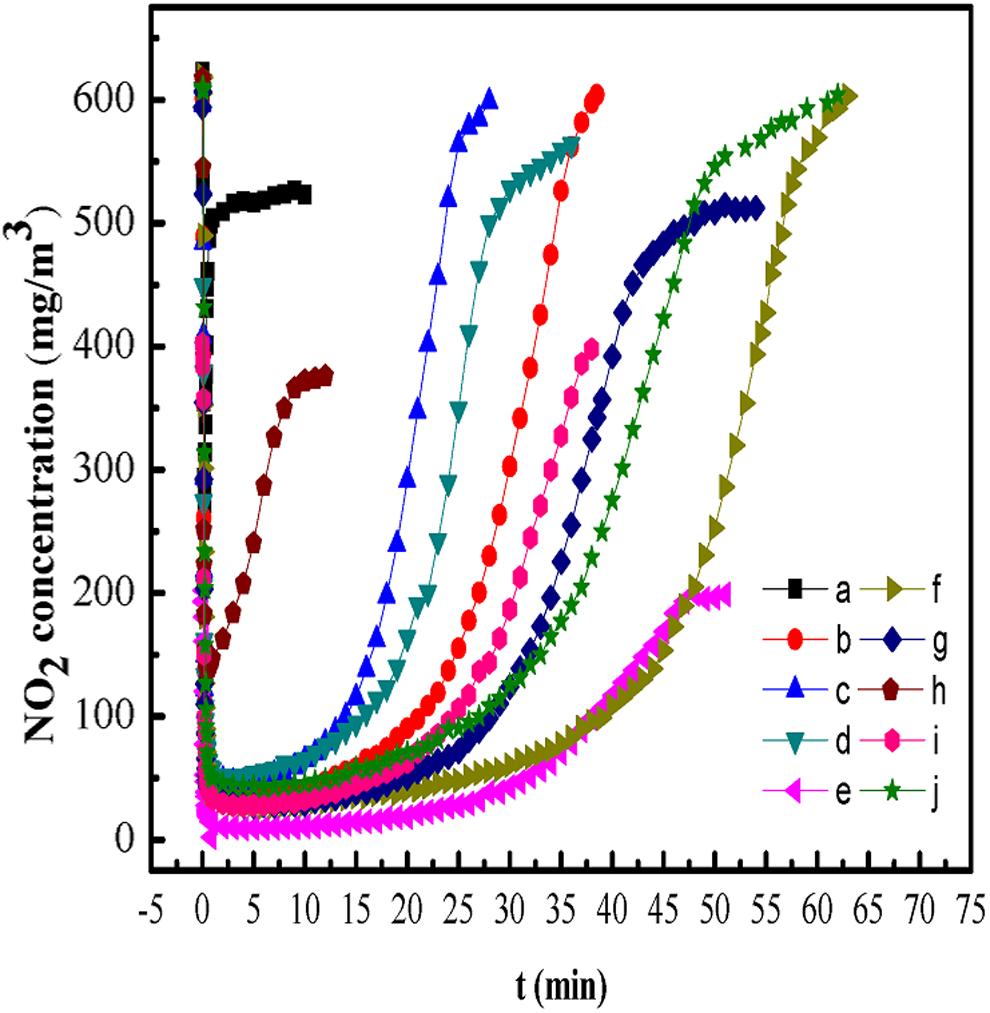
Effects of main parameters of sodium sulfite solution on NO2 absorption a: 6% O2, water, 600 mg/m3 NO2; b: 6% O2, 2% Na2SO3, 600 mg/m3 NO2, pH = 10; c: 8% O2, 2% Na2SO3, 600 mg/m3 NO2, pH = 10; d: 6% O2, 2% Na2SO3, 600 mg/m3 NO2, pH = 8; e: 6% O2, 4% Na2SO3, 600 mg/m3 NO2, pH = 10; f: 6% O2, 2% Na2SO3, 200 mg/m3 NO2, pH = 10; g: 4% O2, 2% Na2SO3, 600 mg/m3 NO2, pH = 10; h: 6% O2, 2% Na2SO3, 600 mg/m3 NO2, pH = 6; i: 6% O2, 2% Na2SO3, 400 mg/m3 NO2, pH = 10; j: 6% O2, 3% Na2SO3, 600 mg/m3 NO2, pH = 10.
Curves b and d show that the absorption capacity of NO2 decreases in the absorption solution with lower pH. Comparing curves b, e, and f reveals that reducing the initial NO2 concentration or increasing the Na2SO3 concentration can improve the absorption efficiency of NO2, whereas the NO2 absorption capacity per-unit absorption solution remains unchanged.
Effects of Na2S2O3 as an inhibitor on NO2 absorption
To ensure the preferable performances of denitration by Na2SO3, appropriate inhibitors must be added into the absorption solution to inhibit the oxidation of Na2SO3. The effects of ethanol, ethylene glycol, and Na2S2O3 as inhibitors on NO2 absorption were investigated herein, and the obtained results are given in Fig. 2. When the initial NO2 concentration was 600 mg/m3 and that of O2 was 6% in the simulated flue gas at a flow rate of 1.0 L/min, results show that the absorption effect of NO2 when 161.17 mM ethanol or ethylene glycol was added is similar to that obtained when no inhibitor was added into 2% Na2SO3 absorption solution. However, the Na2SO3 solution with additional 161.17 mM Na2S2O3 exhibited excellent performance in terms of NO2 absorption, and the absorption capacity increased from 0.29 to 2.97 g/L. Therefore, Na2S2O3 was added into the Na2SO3 absorption solution as a compatible inhibitor to improve the NO2 absorption performance.
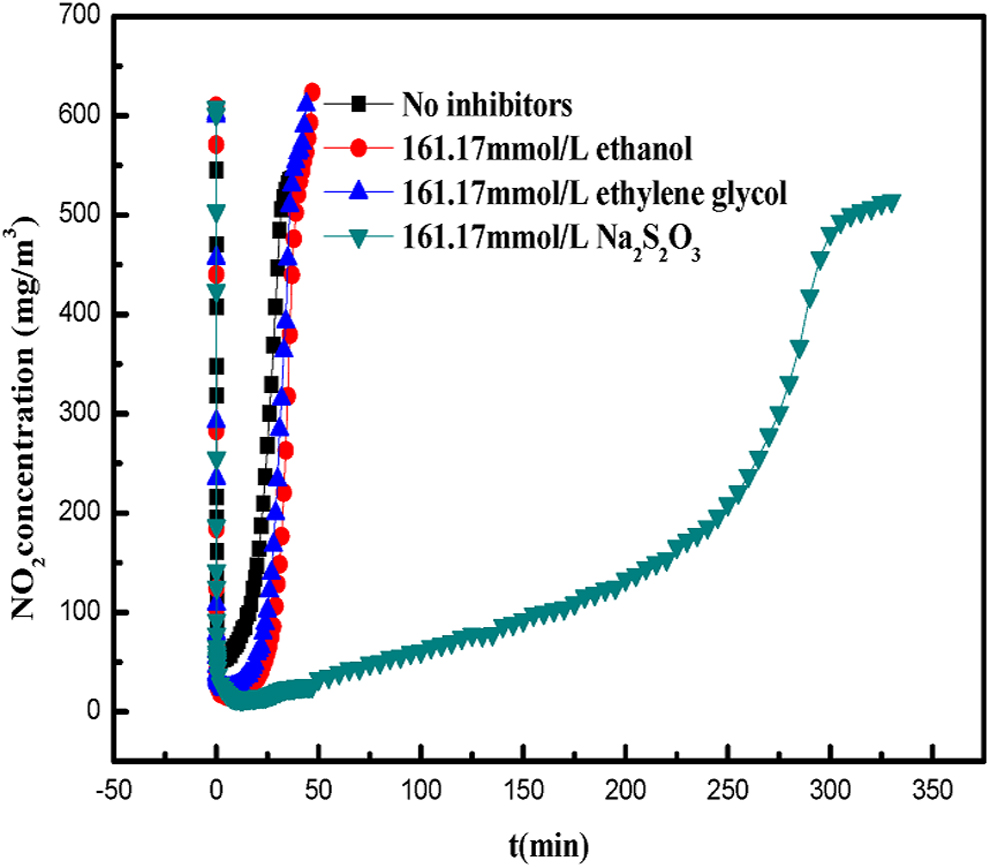
Effects of different inhibitors on NO2 absorption.
The effect of various Na2S2O3 concentrations on the NO2 absorption performance is given in Fig. 3, wherein the NO2 absorption time was 38 min and the absorption capacity was 0.29 g/L in unmixed 2% Na2SO3 solution. When 80.59, 161.17, and 241.76 mM Na2S2O3 was added to 2% Na2SO3 solution, the NO2 absorption time was extended to 252, 330, and 400 min, and the NO2 absorption capacity was increased to 2.09, 2.97, and 3.78 g/L, respectively. In addition, the NO2 absorption capacity was poor in the single 2% Na2S2O3 solution, revealing that NO2 absorption by the addition of Na2S2O3 is not particularly responsible for the significant increase in the absorption capacity of NO2 in the Na2SO3 solution.

Effects of various Na2S2O3 concentration on NO2 absorption.
Therefore, the enhancement of the NO2 absorption performance by Na2S2O3 may occur through the two mechanisms described hereunder. First, the chain reactions of the oxidizing
Effects of SO2 concentration on SO2 and NO2 co-absorption
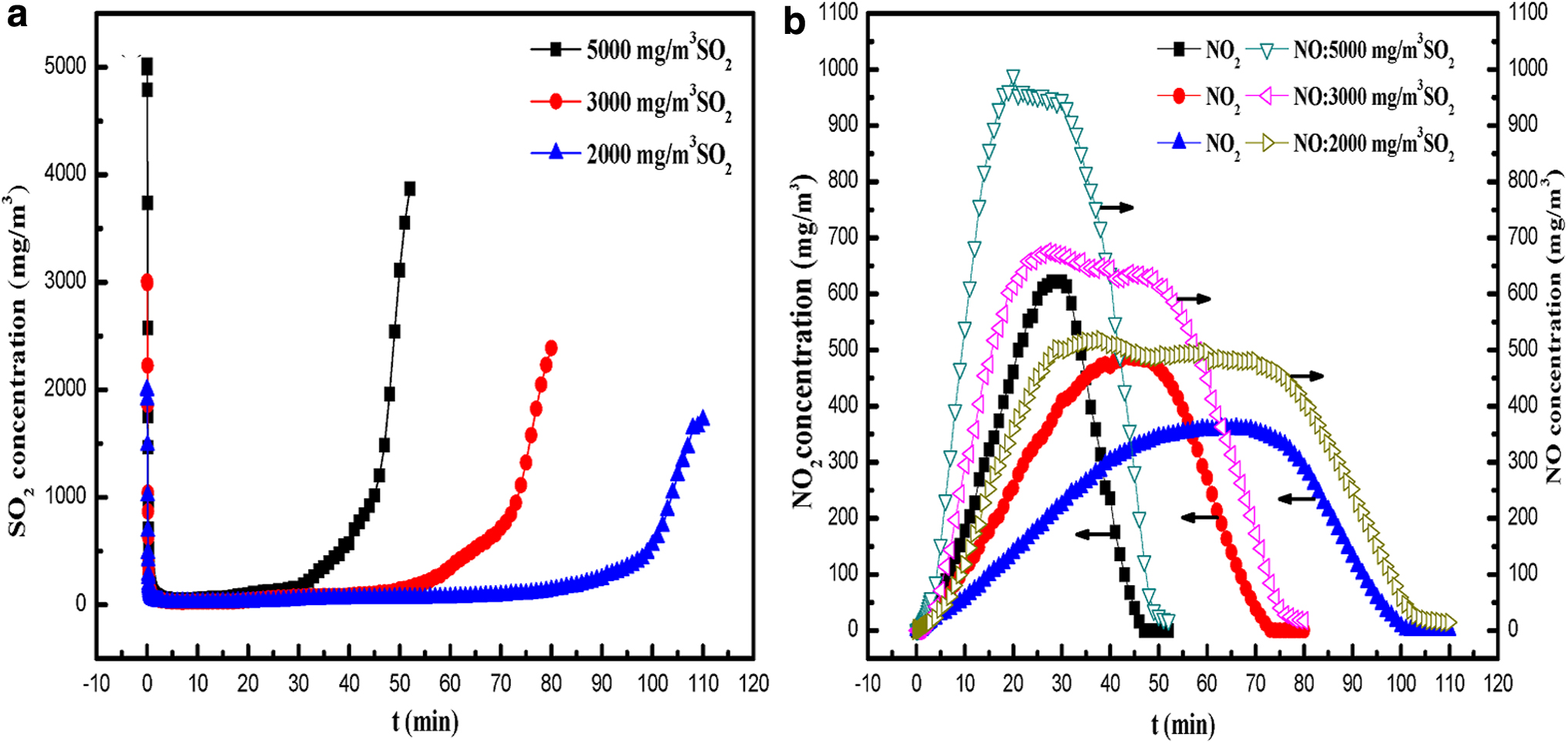
In practice, nonferrous metal smelting flue gas contains a relatively high concentration of SO2, and the Na2SO3 absorption process is used for SO2 removal from the flue gas; thus, considering the effect of SO2 and NO2 co-absorption in the Na2SO3 absorption solution is necessary. The 2000, 3000, and 5000 mg/m3 SO2 was, respectively, introduced into flue gas containing the 600 mg/m3 NO2 to investigate the effect of SO2 concentration on SO2 and NO2 co-absorption in 2% Na2SO3 solution. As given in Fig. 4, Na2SO3 had a good co-absorption effect on SO2 and NO2. The lifetime of SO2 absorption decreased from 46 to 34 min, but the SO2 absorption capacity increased from 1.51 to 2.76 g/L with increasing the initial SO2 concentration from 2000 to 5000 mg/m3. This is mainly because of the improvement in the partial pressure of SO2 and the driving force of mass transfer.
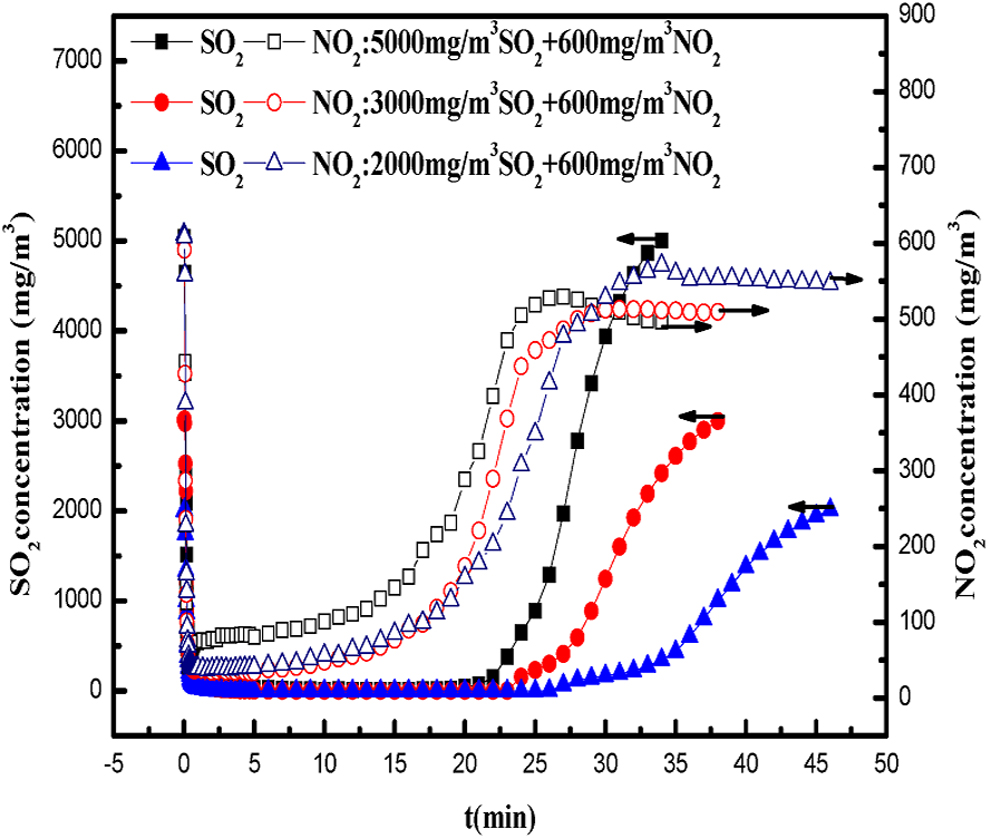
Effects of SO2 concentration on SO2 and NO2 co-absorption.
The maximum absorption efficiency of NO2 was reduced from 93% to 87% following the increase of the initial SO2 concentration in flue gas, which is because more
Effects of NO2 and Na2SO3 concentration on SO2 and NO2 co-absorption
When SO2 concentration was maintained at 5000 mg/m3 and that of Na2SO3 was 2%, the effects of different NO2 concentrations on SO2 and NO2 co-absorption were investigated and the results are given in Fig. 5. When the NO2 concentration increased from 200 to 600 mg/m3, the lifetime and capacity of SO2 absorption remained almost constant as 33 min and 2.80 g/L, respectively, indicating that NO2 concentration had a weak effect on SO2 absorption. However, the absorption capacity of NO2 significantly increased from 0.09 to 0.22 g/L, and NO2 removal efficiency decreased from 95% to 87%. That may be owing to the increase in the partial pressure of NO2 at the gas–liquid interface with increasing NO2 concentration, which is favorable for NO2 absorption. Meanwhile, preceding the reaction between NO2 and

Effects of NO2 concentration on SO2 and NO2 co-absorption.
The effect of Na2SO3 concentration on the co-absorption of NO2 and SO2 was also measured under the operating conditions of 600 mg/m3 NO2 and 5000 mg/m3 SO2 in flue gas and 2–4% Na2SO3 in solution; the corresponding results are given in Supplementary Fig. S2. NO2 absorption capacity increased from 0.22 to 0.44 g/L, and SO2 absorption capacity increased from 2.76 to 4.49 g/L with the increase in Na2SO3 concentration from 2% to 4%. The lifetime and of SO2 and NO2 co-absorption significantly extended with increasing Na2SO3 concentration, which was consistent with the trend observed when SO2 or NO2 were exclusively absorbed by the Na2SO3 solution.
Effect of Na2S2O3 concentration on SO2 and NO2 co-absorption
As observed in the previous experiments conducted herein, Na2SO3 was easily oxidized in the presence of oxygen, thereby negatively influencing SO2 or NO2 absorption. However, adding an inhibitor (Na2S2O3) into the Na2SO3 solution could effectively solve this problem; therefore, the effects of various concentrations of Na2S2O3 on SO2 and NO2 co-absorption were investigated. The experimental conditions were 600 mg/m3 NO2 and 5000 mg/m3 SO2 in flue gas with 2% Na2SO3 in solution. Based on Figs. 5 and 6, comparative examination of the absorption curve in the absence of Na2S2O3 revealed that the lifetime of NO2 absorption was extended by 45, 53, and 65 min, and that of SO2 absorption was extended by 48, 63, and 78 min. However, when Na2S2O3 was added in the concentrations of 80.59, 161.17, and 241.76 mM to the 2% Na2SO3 solution, NO2 absorption capacity increased to 264%, 300%, and 330%, and that of SO2 increased to 162%, 198%, and 232%, respectively.
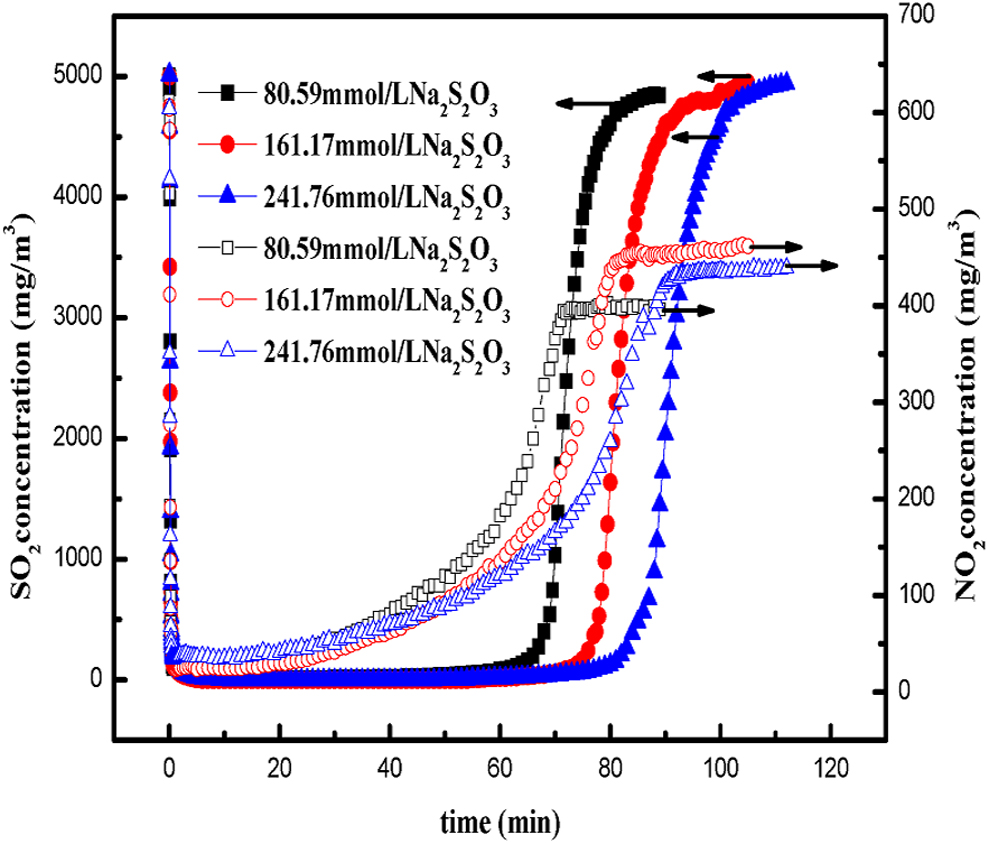
Effects of Na2S2O3 concentration on SO2 and NO2 co-absorption.
Based on Fig. 6, the SO2 and NO2 co-absorption capacity slightly increased when Na2S2O3 was added in various concentrations; therefore, the inefficiency of Na2S2O3 to particularly absorb NO2 and SO2 is evident. The main function of Na2S2O3 is to inhibit the oxidation of
Absorption and reduction of NOx in the co-absorption solution

Variations of
The variations of

Variations of
Mechanism of
reduction in the co-absorption solution
In this section, to clarify the mechanism of
Effects of SO2 concentration on reduction of
Calculation of N Mass Balance Under Various Absorption Conditions
Conclusions
In this study, a novel process of co-absorption and reduction of SO2 and NO2 by Na2SO3 solution with an oxidation inhibitor was investigated. Results showed that when 80.59, 161.17, and 241.76 mM Na2S2O3 was added into 2% of Na2SO3 solution, NO2 absorption capacity increased to 264%, 300%, and 330%, and that of SO2 increased to 162%, 198%, and 232%, respectively. However, O2 in the flue gas decreased the absorption capacity of SO2 and NO2 owing to the oxidation of Na2SO3. We observed by comparison that the addition of Na2S2O3 as an oxidation inhibitor into Na2SO3 solution could significantly improve the lifetime and absorption capacity of SO2 and NO2 co-absorption. In the inhibition mechanism of Na2S2O3,
Experiments on SO2 and NO2 co-absorption indicated that ∼42.5% of NO2(N) was reduced to N2, 21.5% of NO2(N) combined with
Footnotes
Author Disclosure Statement
No competing financial interests exist.
Funding Information
This study was supported by the Scientific and Technological Innovative Talents in Colleges and Universities of Henan Province (21HASTIT012), the Scientific and Technological Project of Henan Province-China (No. 202102310283), the Project of Young-backbone Teacher in Colleges and Universities of Henan Province (No. 2020GGJS125) and the Key Scientific Research Project of Colleges in Henan Province-China (No.20A610011).

References
Supplementary Material
Please find the following supplemental material available below.
For Open Access articles published under a Creative Commons License, all supplemental material carries the same license as the article it is associated with.
For non-Open Access articles published, all supplemental material carries a non-exclusive license, and permission requests for re-use of supplemental material or any part of supplemental material shall be sent directly to the copyright owner as specified in the copyright notice associated with the article.
