




Abstract
Soil in situ remediation, such as washing, always produces much sludge that has the characteristics of a high fine particle proportion, high moisture content, and high metal content. Problems such as high transportation costs, large land area, and the influence on landfill capacity often occur in the process of reclamation or landfill disposal. To solve the above problems, the vacuum preloading method was used to treat the sludge. The effect of this method on reducing the water content and volume of the sludge was investigated. Initial vacuum preloading (IVP) and step vacuum preloading (SVP) laboratory experiments were carried out on the sludge from the washing waste at a heavy metal soil remediation site in Shanghai. The drainage rate and settlement rate of the sludge during the experiment were recorded, and the moisture content and unconfined compressive strength (UCS) of the sludge samples after the experiment were tested and analyzed. Finally, the mechanism of uneven water content and shear strength of sludge treated by IVP and SVP were analyzed based on the grain size distribution. The results showed that the moisture content of the sludge near the prefabricated vertical drains (PVDs) decreased to 48.55%, and its volume decreased to 41.6% of the initial volume. The UCS of the sludge near the PVDs under SVP was 20.32% higher than that under IVP. The sludge treated by the vacuum preloading method can be disposed of in a landfill or other resource utilization.
Introduction
With the development of China's industry and the modernization of agriculture, the problem of heavy metal pollution in soils has become increasingly serious over the entire country (Peijun et al., 2006; Xu et al., 2014). After 2000, China has carried out a large number of studies on in situ washing and remediation technology of heavy metal contaminated soil and made great achievements (Cao et al., 2019; Xie and Cheng 2019). However, in the process of washing, many soil particles are carried out of the soil together with the washing liquid, and these soil particles accumulate in the process of treatment and washing to form another sludge. This sludge has the characteristics of fine particles, high moisture content, and high metal content. Improper disposal of this sludge will result in high transportation costs, large stacking area, and limits on landfill storage capacity (Yu et al., 2007; Zhang et al., 2020a). Hence, the treatment of this sludge has become imperative. This sludge is mainly treated by incineration or landfill disposal, especially in developing countries (Yang et al., 2015). During the combustion process, a large number of organic substances are converted into inorganic substances, resulting in high energy consumption and waste gas pollution of the atmosphere, which is not in line with the development requirements of a circular economy (Fullana et al., 2004). When this sludge is used for land filling or placed in a mixed landfill, its moisture content should be less than 60% (O'Kelly, 2005). Consequently, how to effectively reduce the moisture content of this sludge to below 60% is an urgent problem to be solved at many sludge landfills (Chen et al., 2020).
At present, the common dewatering methods for this sludge include mechanical dewatering and thermal dewatering. The mechanical dewatering of sludge is mainly divided into two steps. The first step is to use physical and chemical methods to change the dewatering characteristics of the sludge. The second step is to use mechanical and centrifugal methods to reduce the moisture content of sludge (Manea et al., 2007; Wang et al., 2012). Sludge treatment by belt filter press was used in a sewage treatment plant, and the moisture content of the filter cake after treatment was more than 70% (Wang et al., 2014). Mechanical dewatering is more suitable for the process operation of a specific sewage plant, although it has high treatment cost, complicated operation, and high requirements for mechanical equipment and other conditions. In contrast, there are few reports on the dewatering and weight reduction treatment of the sludge discharged from the in situ washing plant. Therefore, it is necessary to find an effective treatment method that has a low cost.
The vacuum preloading method proposed by Kjellman (1952) has been successfully applied to soft soil foundation treatment for more than 60 years. In recent years, with the development of pressurization technology, film-free technology, and new plastic drainage plate technology, vacuum preloading technology has been widely used in the treatment of silt and dredged soil dewatering (Saowapakpiboon et al., 2011; Voottipruex et al., 2014; Wang et al., 2016; Cai et al., 2018; Sun et al., 2018). With further research, many researchers applied vacuum preloading technology to municipal sludge dewatering treatment and made some related studies. Zhan et al. (2015) show that the moisture content of the municipal sludge significantly decreased after vacuum preloading, and the UCS increased to 2–4 kPa. Lin et al. (2014) proposed a two-stage in situ treatment method, using vacuum preloading on the conditioned sludge combined with subsequent cement solidification treatment, and their results show that 68 days of vacuum preloading on a 3.2 m thick sludge pit resulted in a magnitude of 70.9% in the average degree of consolidation and a reduction of 47.5% in the total volume of sludge. Wu et al. (2018c) studied municipal sludge consolidation characteristics using the Fenton reagent combined with the vacuum preloading method. The sludge moisture content decreased from 82.14% to 66.67%, and the sludge volume reduction was ∼40%.
The above studies have proved the feasibility of the vacuum preloading method to reduce the volume and water content of municipal sludge. Comparing the sludge discharged from the in situ soil remediation plant with municipal sludge reveals higher metal pollutant and fine soil particle contents and lower organic matter content, but the treatments of these two kinds of sludges can be shared in many cases. At the same time, the requirements are consistent with sludge dewatering. Compared with mechanical dewatering and other ectopic treatments, in situ treatment is more convenient and can save much transportation costs (Shi et al., 2011; Luo et al., 2018; Zhuang et al., 2018; Wu et al., 2020).
To explore the effect of vacuum preloading treatment of the sludge discharged by in situ washing, chemical leachate sludge from a heavy metal contaminated soil remediation plant in Shanghai was studied with the vacuum preloading method test. At the same time, in the process of sludge treatment by vacuum preloading, different loading methods have a great influence on the drainage consolidation effect. Different vacuum loading methods were proposed according to the influence of different vacuum pressures on the speed of the vacuum consolidation of the silt, dredged soil, and sludge. Wang et al. (2018) show that the dewatering effect of a two-stage vacuum preloading method is better compared with traditional vacuum loading. Yupeng et al. (2011) conducted an experimental study on air-boosted vacuum preloading of soft station foundation and indicated that increasing air pressure can improve the transfer efficiency of vacuum pressure in the soil. Cai et al. (2018) show that in comparison to the ordinary prefabricated vertical drains (PVDs), booster PVDs could provide inflow channels for the compressed air when the booster pump was in operation. Liu et al. (2017) proposed an improved multiple-vacuum preloading method and indicated that the multiple-vacuum preloading method has a better treatment effect in decreasing the moisture content and increasing the bearing capacity.
Based on the above studies, to explore the effect of vacuum pressure on sludge treatment performance, the initial vacuum preloading (IVP) experiment and the step vacuum preloading (SVP) experiment were carried out separately. Among them, the IVP experiment vacuum load was maintained at 80 KPa. In the SVP experiment, the vacuum preloading was applied in stages of 20, 40, 60, and 80 kPa. The loading time of each pressure level was 6 h. The water discharge rate and sedimentation rate were recorded during the experiment. Furthermore, the moisture content and unconfined compressive strength (UCS) of the sludge samples were tested and analyzed to explore the mechanical properties of the samples. Finally, the reason and mechanism of the uneven distribution of moisture content and shear strength of sludge treated by the IVP and SVP methods were analyzed by the distribution law of sludge particles. The above experiments can provide the basis and guidance for the treatment of the sludge discharged by soil remediation sites in the future.
Experimental Program
Studied materials
Basic characteristics of the sludge
The experimental sludge was prepared from the in situ washing waste solution of a heavy metal contaminated soil in Shanghai, having a relative density of 1.23, a pH value of 10.56, and a moisture content of 77%. The particle size grading test was carried out on sludge samples by a Mastersizer 2000 laser particle size analyzer. The cumulative curve of sludge sample grain analysis is shown in Fig. 1.
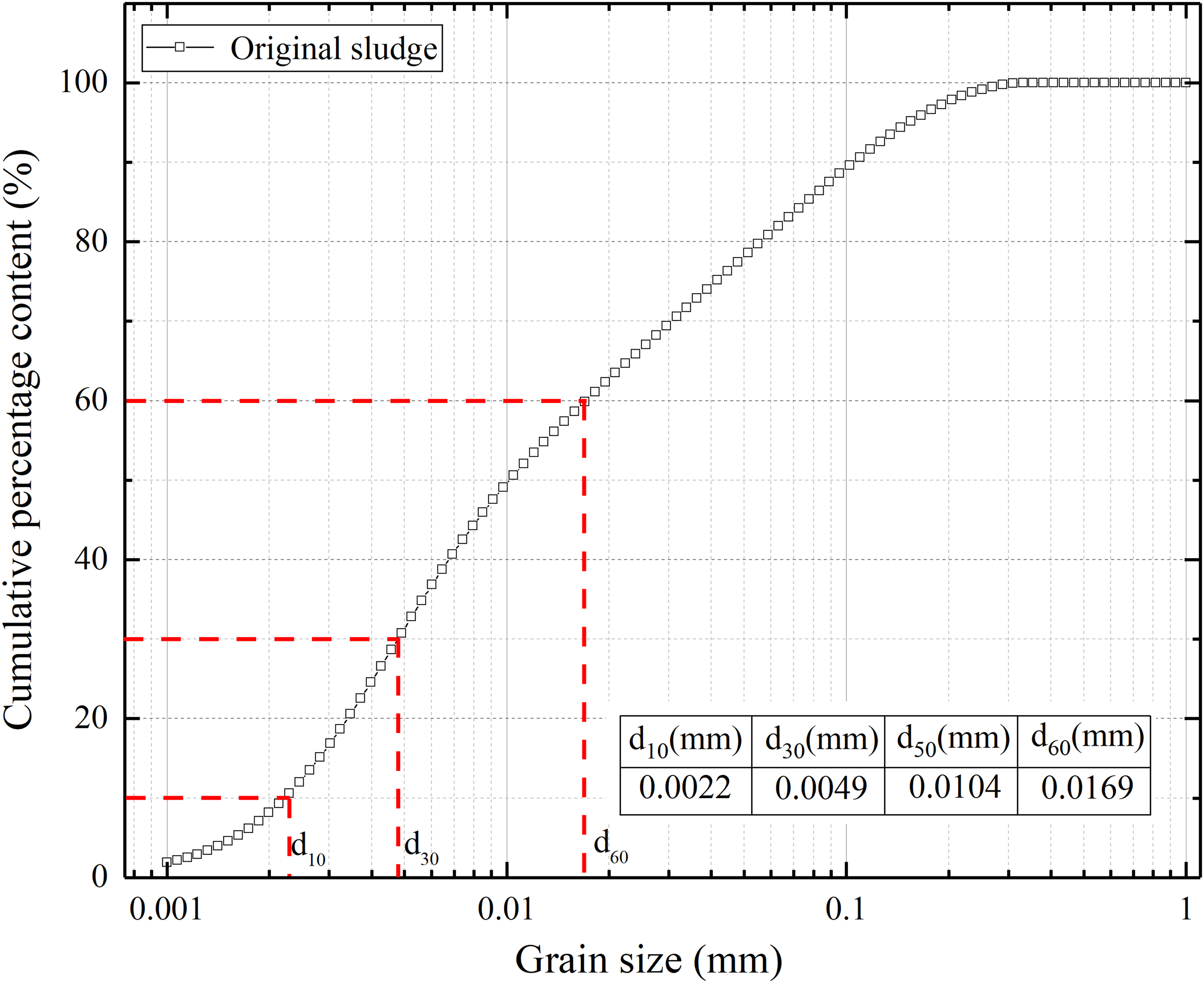
Grain size analysis curve of the original sludge.
Figure 1 shows that the grain fraction curve is relatively flat, indicating that the grain groups are evenly distributed. Among them, the sand group with a particle size greater than 0.075 mm accounts for ∼16%, the silty group with sizes between 0.005 and 0.075 mm accounts for ∼53%, and the clay group with particle sizes of less than 0.005 mm content accounts for ∼31%. It is calculated that Cu = 7.86 > 5, Cc = 0.6 < 1 and that the particle size distribution is not uniform.
Chemical properties of the sludge
The chemical composition of the sludge refers to the types and contents of chemical elements and compounds included in three-phase substances, among which the soluble salts mainly refers to all chlorides, soluble sulfates, carbonates, and so on. The content and composition of the soluble salts in the sludge have a great influence on the electric double layer on the surface of the sludge particles and, thus, affect the physical and mechanical properties of the sludge. Therefore, the contents of the soluble salts and metal ions in sludge were measured. Specific test methods and test results are shown in Table 1.
Types and Contents of Ions in the Original Sludge
Experimental procedure
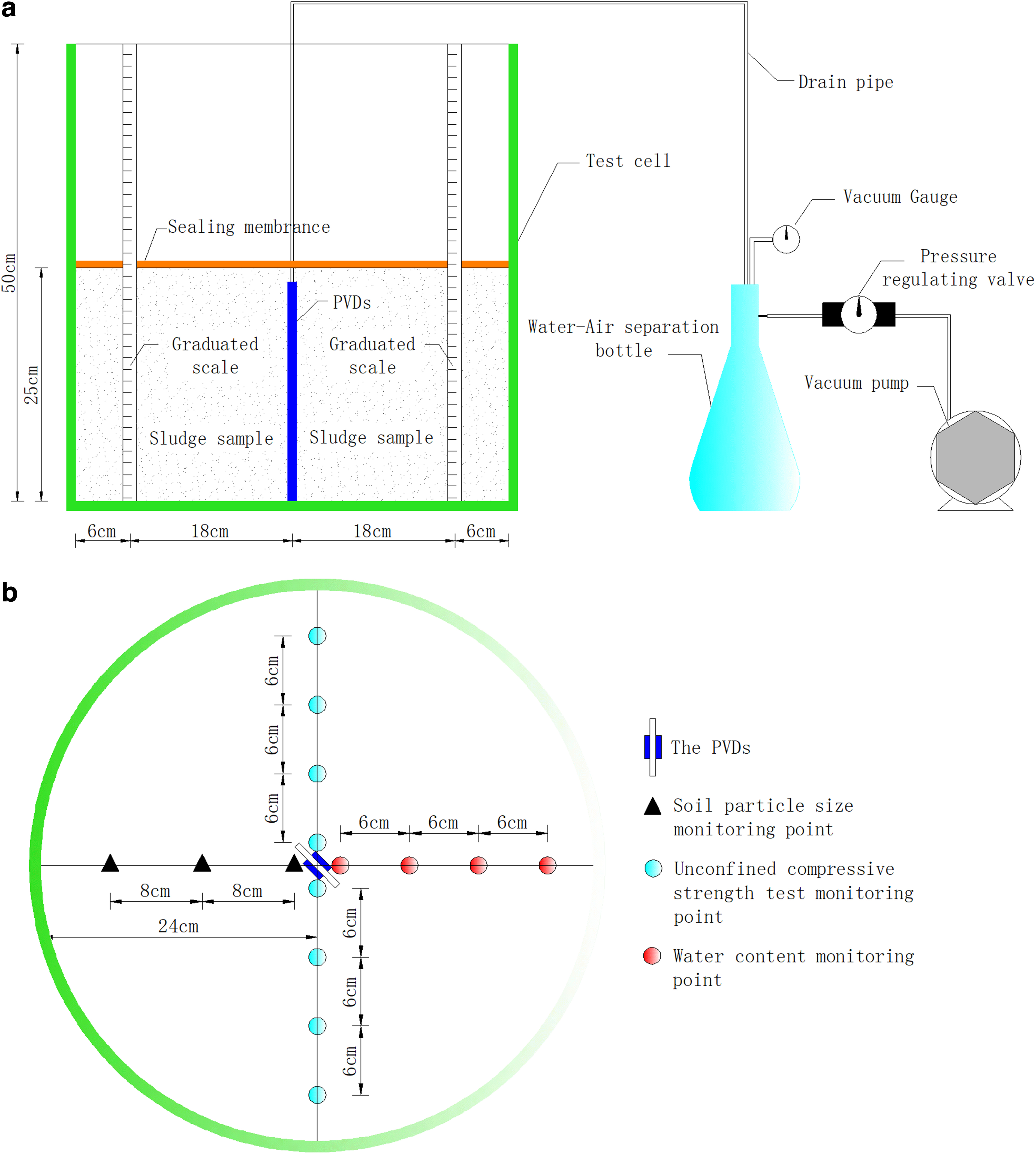
The instruments for these experiments are large fabricated model cylinders (plexiglass bucket) each with a diameter of 48 cm and a height of 50 cm, and a PVD with a diameter of 10 cm is set inside. Other test devices include a sealing member, drainpipe, pressure regulating valve, vacuum gauge, vacuum pump, water-air separation bottle (marked with calibration), electronic scale, standard screen, oven, and Mastersizer 2000 laser particle size meter. The SVP and IVP experimental devices are the same, and the vacuum pressure is controlled by pressure regulating valves. The schematic diagram of the model experimental device and sampling point figure are shown in Fig. 2.
To study the effect of different vacuum preloading methods on the treatment effect of sludge, two groups of vacuum preloading model experiments were conducted, as described in this article, hereinafter referred to as the IVP experiment and the SVP experiment.
The IVP experiment is used to simulate the conventional vacuum preloading experiment. The experimental steps are as follows. (1) First, 45.23 L of sludge was put into the experimental cell and fully stirred. The stirring speed was controlled at ∼120 r/min, and the time was 15 min. (2) After stirring, the sludge was poured into the model cylinder. After 24 h of standing in the experimental cell, the supernatant liquid volume was removed and measured (∼3.15 L). (3) The drainpipe was connected to the water-air separation bottle, the vacuum gauge, and the other vacuum experimental devices. Then, the plexiglass seal cover was installed, the valve was closed, and the vacuum pressure was checked to ensure that all equipments had no leakage after opening the outlet valve. (4) The amounts of the drainage volume, settlement, and vacuum pressure were recorded while maintaining the vacuum pressure of the model cylinder at ∼80 kPa during the experiment over the experimental time of 188 h. After completing the experiment, the cell was opened to test the grain size distribution, UCS, and water content of the samples at different locations. The soil particle size test, water content test, and UCS monitoring test points are shown in Fig. 2b.
In the SVP experiment, only the vacuum loading method was different from the IVP experiment. The vacuum loading varied: step by step, as 20, 40, 60, and 80 kPa was applied to the vacuum loading experiment. The loading time of each pressure step was 6 h, and the final loading of 80 kPa lasted 24 h. The total vacuum loading time was 188 h.
Experimental Results and Discussion
The volume of drainage
The water-air separation bottle was connected to the vacuum pipe to collect the drainage during each experiment in real time. Sludge sedimentation was monitored in real time by a scale set on the surface of the test cell. The changes in total drainage volume and drainage rate with time are shown in Fig. 3a and b.
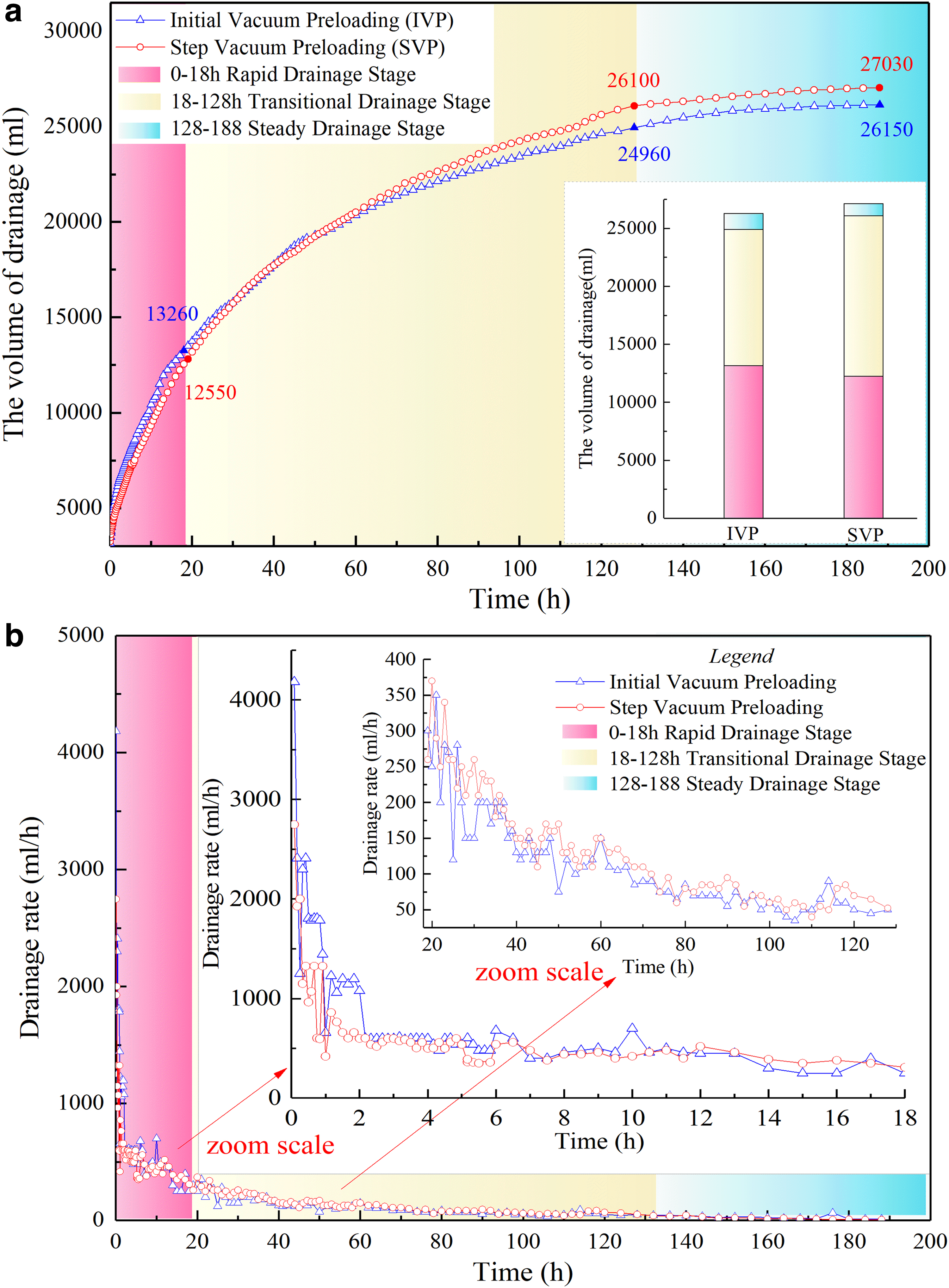
Comparison curves of
The drainage rates of mud, dredged soil, and sludge showed obvious segmentation with time during vacuum preloading experiments (Wang et al., 2016; Wu et al., 2016, 2018a). Therefore, the drainage process is divided into three stages according to the drainage rate: the drainage rate greater than 300 mL/h is the rapid drainage stage (0–18 h); the transitional drainage stage is when the drainage rate is greater than 50 mL/h and less than 300 mL/h (19–128 h); and the steady drainage stage (129–188 h) is when the drainage rate is less than 50 mL/h. Figure 3b shows that the drainage rate of IVP is higher compared with SVP in the rapid drainage stage. In the transitional drainage stage, the rate of water discharge from the SVP experiment gradually exceeds that of the IVP. In the steady drainage stage, the drainage rate of the SVP experiment was reduced to less than 10 mL/h earlier. Therefore, the sludge treated by the SVP could be reduced to the expected volume earlier (60% reduction in volume). This phenomenon indicates that the advantage of the SVP method for sludge dewatering is reflected in the transitional drainage stage. In this stage, the volume of water discharged by the SVP method experiment is 13,550 mL, 1,850 mL more than the volume of water discharged by the IVP method experiment. The total drainage volume of the first and second stages (0–128 h) exceeded 95% of the total drainage volume. In the third stage (129–188 h), the drainage volume accounts for less than 5% of the total drainage volume. This shows that the evaluation of the dewatering performance of sludge is mainly reflected in the first and second stages. After 188 h of the vacuum preloading experiments, the total drainage volume of the sludge in the two loading methods exceeded 26,000 mL, which was over 57.5% of the original volume of the sludge. The results showed that the dewatering effect of the sludge treated by vacuum preloading is remarkable.
Settlement of sludge
The curves of sludge sedimentation changing with time in the process of vacuum preloading experiments are shown in Fig. 4. The initial sludge surface height was 25 cm in both experiments. After 24 h of static settling, the IVP experiment and the SVP experiment model cylinders both removed 3,150 mL of supernatant, and the surface height of sludge dropped by 2 cm. According to the settling rate, the sedimentation process is divided into three stages: the settling rate greater than 0.2 cm/h is the rapid settling stage (0–18 h); the transitional settling stage is when the settling rate is greater than 0.03 cm/h and less than 0.2 cm/h (19–128 h); and a settling rate less than 0.03 cm/h is the stable settling stage (129–188 h).

The curves of settlement height and time.
In the first stage, the sedimentation rate of IVP is higher compared with SVP. In the transitional settlement stage, the settlement rate of the SVP gradually exceeds that of the IVP. In the final sedimentation stage, the rates of the two are basically equal. This law is consistent with the law of drainage. This phenomenon indicates that the advantages of SVP for sediment reduction are reflected in the second stage, in which the settlement amount of the SVP experiment is 0.7 cm more compared with the IVP experiment. The total settlement of the first and second stages (0–128 h) exceeds 95% of the total settlement. In the third stage (129–188 h), the settlement amount accounts for less than 5% of the total settlement amount. This phenomenon shows that the evaluation of sludge volume reduction is mainly reflected in the rapid settlement stage and the transitional settlement stage. After 188 h of the vacuum preloading experiment, the total settlement of sludge exceeded 14.5 cm under both loading methods. Finally, the volume of sludge after IVP treatment accounted for 41.6% of the original volume, and the volume of sludge after SVP treatment only accounted for 39.6% of the original volume. The above results show that the volume reduction effect of the sludge treated by the vacuum preloading method is significant. Furthermore, a 60% reduction in the volume can be achieved earlier with the SVP method.
From the images of the deformation of the PVDs, it can be seen that the bending angle of PVDs in the SVP experiment is smaller compared with the PVDs in the IVP experiment. In the first stage of the IVP experiment, the high vacuum pressure causes the gas and water in the macropore channels of the sludge to be quickly sucked away and causes the sludge to settle rapidly. This rapid settlement of sludge leads to the rapid deformation of the drainage plate and the large angle bending. The results of several laboratory tests and field investigations also indicated that the large deformation of a PVD significantly influenced its discharge capacity (Chu et al., 2006; Tran-Nguyen et al., 2010; Sun et al., 2011; Cai et al., 2017; Lu et al., 2020). To some extent, this phenomenon hinders the transfer of vacuum pressure and affects the drainage consolidation in the next stage. Comparatively, in the first stage of the SVP experiment, the vacuum pressure is relatively low, the gas and water in the large pore channels of the sludge discharge slowly, resulting in the slow settling rate of the sludge, and the bending angle of the PVDs is relatively small under this condition. The transfer of vacuum pressure has less resistance, which leads to better drainage consolidation efficiency of sludge in the next stage. In the second stage, the bending angle of the PVDs under SVP is less than that under IVP, which makes the consolidation rate of drainage under SVP better than that under IVP.
Water content and UCS
After the vacuum preloading method experiment, sludge samples were collected from the test cell at different horizontal distances from the PVDs (x = 2, 8, 14, 20 cm) for moisture content and UCS tests. The distribution diagrams of the moisture content and UCS of the sludge are shown in Figs. 5a and b.

The radial variation curves of
Figure 5a shows that after 188 h of the IVP experiment, the sludge moisture content at the center of the test cell decreased from 77% to 48.55%, and the measured moisture content decreased to 49%–57% (the different moisture contents at different distances from the PVDs). The water content of sludge in the center of the test cell of the SVP experiment decreased from 77% to 47% at the same time, and the measured water contents decreased to 47%–56%. The average water content of the sludge after the SVP experiment was lower than that after the direct vacuum preloading experiment. Figure 5a also shows that the moisture contents of the sludge far from the center change less compared with the sludge near the center.
Figure 5b shows that the UCS values of the sludges in the two test cells gradually decrease along the radial direction. The water contents of sludges near the drainage plates are low, and the drainage consolidation effect is better. Therefore, the smaller the horizontal distance from the PVD center is, the greater the UCS of sludge is. Because of the dissipation of vacuum pressure and the decrease of the hydraulic gradient, the farther the sludge is from the drainage plate, the worse the drainage consolidation effect is. The average UCS of the treated sludge is greater compared with the normal engineering slurry treated by vacuum preloading (Wu et al., 2016, 2017a, 2017b, 2018b; Zhang et al., 2020b). The UCS of sludge near the PVDs under SVP was 20.32% higher than that under IVP. The experiment also shows that the UCS of sludge treated by the SVP method was higher compared with sludge treated by the IVP method within the range of 20 cm from the PVDs.
Analysis of the uneven distributions of the water contents and UCS values of the sludge in IVP and SVP method experiments by grain size distributions
The grain size distributions (GSD) of the sludge at different horizontal distances from the PVDs are shown in Fig. 6.
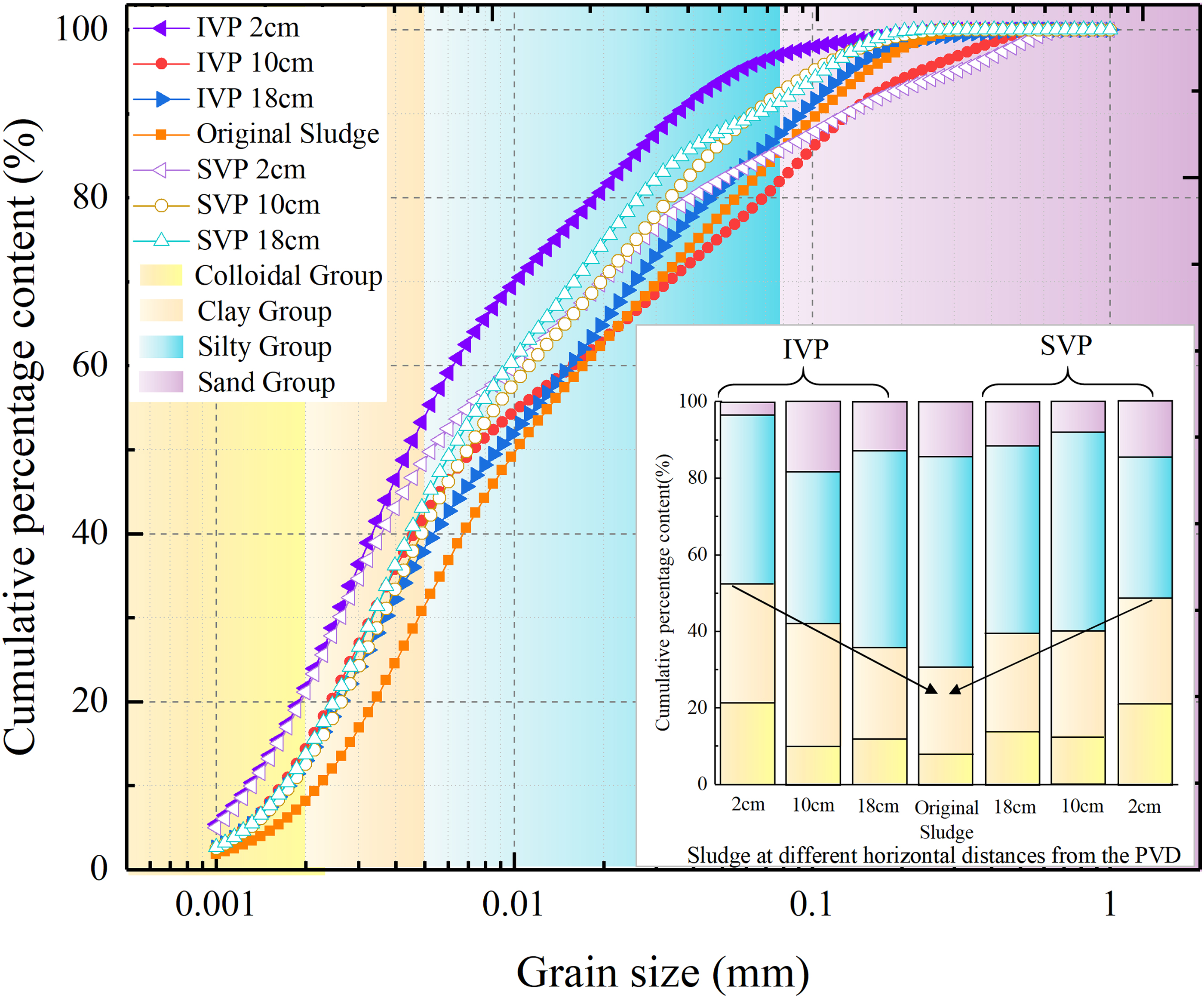
Grain size distributions of the sludge at different horizontal distances from the PVD.
Figure 6 shows that in the range of 2–18 cm in the horizontal distance from the PVDs, the amounts of the clay group in the sludges of the two experiments were higher than the amount of the original sludge, and the contents of the clay group decreased with increases in the horizontal distance from the PVDs. This phenomenon indicates that the clay particles gradually converged toward the PVDs in the radial direction with the drainage consolidation of the sludge. These agglomerated clay particles usually form a clogging area near the drain plate; this area is also called the clogging zone and is characterized by local denseness and low permeability (Bao et al., 2014; Lei et al., 2017; Wang et al., 2018; Yuan et al., 2018). Clogging can lead to poor consolidation of the sludge outside the zone. Therefore, the moisture content of the sludge is higher and the UCS is lower in the range away from the PVDs.
The range of the clogging zone caused by vacuum preloading has been studied by some researchers. Xu et al. (2020) carried out a series of vacuum preloading model tests and demonstrated that a clogging zone was formed around the PVDs in the early stage of the improvement with conventional vacuum preloading, and the boundary of the clogging zone was ∼0.2–0.4 of the boundary radius. In this experiment, the accumulation area of clay particles is mainly in the clogging zone mentioned above. However, the law of clay particle accumulation near the PVDs was more prominent under IVP than under SVP, and the clay content around the PVDs was significantly higher under IVP than that under SVP. It makes the permeability of the sludge near the PVDs under IVP lower than that under SVP. Therefore, the sludge clogging phenomenon near a PVD is more serious under the IVP method. This is due to the sludge treated by the IVP method that has a high vacuum load in the first stage of the experiment. Under the condition of a high vacuum load, most of the clay particles rapidly accumulate toward the PVDs along with the discharge of the pore water. At the beginning of the experiment, the vacuum pressure of the sludge treated by the method of SVP is small, which causes fewer clay particles to aggregate toward the PVDs along with the discharge of the pore water. This law explains that, in the second stage (18–128 h), the total amounts of drainage and sedimentation of sludge treated by the SVP method are higher than those treated by the IVP method. At the same time, this also explains why the moisture content of the sludge near the PVDs in the SVP method experiment is lower than that near the PVDs in the IVP method experiment. As a result, the UCS values of the sludge near the PVDs in the SVP experiment were higher than those in the IVP experiment.
Performance on the removal of metals
Although this study focused on reducing the moisture content and volume of sludge, metal removal is equally important in sludge treatment. Therefore, the metal removal efficiency is also considered. After vacuum preloading treatment, the amounts of soluble salts and metal ions in the sludge decreased. The results are shown in Table 2.
The Content of Various Ions in Sludge After the Experiments
IVP, initial vacuum preloading; SVP, step vacuum preloading.
Table 2 shows that the total amounts of soluble salts, mainly Cl− and Na+, in the original sludge were relatively higher than after treatment. The electrolyte solubility in the pore solution of the original sludge is high, which inhibits the electric double layer on the surface of the sediment particles. At this point, the repulsion between the particles is weakened, the attraction is increased, and flocculation is promoted. To improve the drainage and consolidation efficiency of the sludge, it was held for 24 h before the experiment began.
During the process of vacuum consolidation, the action of drainage will cause the migration of soluble salts and metal ions. According to the new “Discharge standard of pollutants for municipal wastewater treatment plant” (2002) in China, it can be known that the contents of various heavy metal elements in the treated sludge are not beyond the standard, which meets the requirements of environmental protection for safe landfill disposal. Table 2 also shows that when the sludge is under an alkaline environment, the Cl− anions are more likely to migrate than SO42−, and in the presence of oxygen, the Ca2+ cations are more likely to migrate than Fe2+. However, the amount of Fe2+, Mn2+, Co2+, and Ni2+ in the sludge did not change significantly when the sludge was treated with the vacuum preloading experiment without adding an agent. Because these metal ions produce insoluble precipitates under alkaline conditions, this makes it difficult for them to be discharged from the sludge along with the discharge of the pore water. Therefore, in future research, we will explore the metal migration rule in the sludge under vacuum preloading treatment after adding agents. Furthermore, the relationship between the migration law of the soluble salts in the sludge and the vacuum load is not clear, and this is a problem to be studied in the future.
Conclusions
After treatment, the dissolved salt content of the sediment gradually decreased, the moisture content gradually decreased, and the strength of soil gradually increased. The physical and mechanical properties of the sludge were improved, and the consolidation effect was uniform.
Vacuum preloading can effectively reduce the moisture content and solid phase volume of the sludge discharged from an in situ soil washing plant, and the volume of treated sludge only accounts for 39.6% of the original volume.
The law of clay particle accumulation near the PVDs was more prominent under IVP than under SVP. As a result, the clogging effect is more obvious near the PVDs of the IVP experiment.
The high clay content in the sludge led to clogging around the PVDs during the vacuum preloading experiments. Under a large vacuum pressure gradient, the migration of clay components formed a clogging zone near the PVDs.
Under alkaline conditions, the Cl− anions are more likely to migrate than SO42−, and Ca2+ is more likely to migrate than Fe2+ in the vacuum preloading experiments. In further research, the removal of metal ions will be studied in detail. In addition, the improvement of this method will be specially used to study the removal of metal ions from the sludge.
Footnotes
Author Disclosure Statement
No competing financial interests exist.
Funding Information
The authors are grateful for the financial support for the study presented in this article from the National Natural Science Foundation of China (Grant No. 41772303), Natural Science Foundation of Shanghai (Grant No. 17ZR1410100), Shanghai Sailing Program (Grant No. 19YF1415500), and National Key R&D Program of China (2019YFC1520500).