




Abstract
A new modified walnut shell (TWNS) was synthesized through sequentially reacting the walnut shell (WNS) with thionyl chloride and triethylamine, and it was applied to adsorb Reactive Brilliant Blue (RB-19) from dye wastewater. In the range of 288 to 308 K, the isotherms, thermodynamics, and kinetics of RB-19 adsorption onto TWNS were investigated. The isothermal experimental data have a good correlation with the Langmuir isotherm model, and the theoretical maximum monolayer adsorption capacity of TWNS was 258.59 mg/g at 288 K. The kinetic data of RB-19 adsorption onto TWNS accorded with the pseudo-second-order model. The diffusion mechanism of RB-19 adsorption onto TWNS was studied by Weber and Morris intraparticle diffusion equation and Boyd and Reichenberg model, and the results showed the adsorption is primarily controlled by membrane diffusion. The thermodynamic calculation results demonstrated that the adsorption process of RB-19 onto TWNS is a spontaneous, exothermic, and favorable process. Moreover, the recycled TWNS retains high adsorption capacity after four cycles.
Introduction
Over the past few decades, a large amount of industrial wastewater has been discharged into the environment, which has harmed the lives of humans, animals, and plants (Altınışık et al., 2010; Qiu et al., 2017). Reactive dyes are generally applied in the textile chemical industry due to their broad color spectrum, bright color, and excellent performance (Qiu et al., 2017; Ahmed et al., 2020). During the dyeing process, up to 50% of the reactive dyes may still not be fixed on the fibers and eventually cause serious water pollution (Ayed et al., 2007). According to reports, reactive dyes are highly toxic carcinogens and mutagens. If the wastewater containing the dye is discharged without prior treatment, it will have an adverse effect on the surrounding ecosystem (Ayed et al., 2007; Ahmed et al., 2020). Therefore, it is essential to remove dyes from wastewater. Traditional treatment methods include flocculation (Wang et al., 2011), ion exchange, membrane filtration (Ciardelli et al., 2000), chemical oxidation/reduction (Thangamani et al., 2011), physical adsorption, and biological methods. Among these methods, the adsorption method has attracted much attention on account of its high efficiency, reliability, and ease of operation. Activated carbon is a common adsorbent, but the cost of use is high, and it is necessary to find low-cost adsorbents with good adsorption effect to replace activated carbon (Ali and Gupta, 2007). Recently, many studies have focused on finding more effective and more inexpensive adsorbents from biological wastes (forestry and agricultural residues and by-products). Renewable resource biological wastes, such as orange peel (Vieira et al., 2009), pine needle (Deniz and Karaman, 2011), apple pomace (Robinson et al., 2002), almond shell (Deniz, 2013), peanut hull (Gong, et al., 2005), and sugarcane bagasse (Orlando et al., 2003), have been considerably utilized in wastewater treatment as low-cost bio-adsorbents.
Walnut shell (WNS) has the characteristics of richness and low cost, and it is widely used to remove pollutants in water bodies. Many researchers use modified WNSs to deal with heavy metal ion wastewater (Liu et al., 2019; Georgieva et al., 2020). Zhu et al. (2015) prepared fatty acid modified WNS to adsorb the naphthalene from aqueous medium, and the adsorption capacity is 7.21 mg/g at 298 K in neutral condition. Kang et al. (2018) used WNS-based biochar produced by hydrothermal carbonization to remove malachite green, and the results suggested the maximal adsorption capacity is 166.67 mg/g at 50°C. However, the adsorption capacity of these adsorbents needs to be further improved. As a new type of adsorbent material, adsorbents containing quaternary ammonium groups have high ion exchange capacity and are widely used in wastewater treatment (Ma et al., 2015; Quinlan et al., 2015; Hu et al., 2016). In this article, a new type of modified walnut shell adsorbent (TWNS) was synthesized by introducing quaternary ammonium cationic groups into the WNS cellulose skeleton, and it was used to remove Reactive Brilliant Blue (RB-19) in wastewater. TWNS was characterized by the following methods: scanning electron microscopy (SEM) and Fourier transform infrared spectroscopy (FTIR). The kinetics, isotherms, and thermodynamics of the adsorption were studied to elucidate the adsorption mechanism of RB-19 onto TWNS.
Materials and Methods
Materials and chemicals
WNS was collected from a walnut food processing factory. Thionyl chloride (99%, CAS:7719-09-7) was obtained from Shanghai Aladdin Biochemical Technology Co., Ltd. RB-19 (C22H16N2Na2O11S3, CAS:2508-78-1) was kindly offered by Shanghai Macklin Biochemical Co., Ltd. Triethylamine (99%, CAS:121-44-8) was purchased from Shanghai Aladdin Biochemical Technology Co., Ltd. NaOH (97%, CAS:1310-73-2), HCl (35 wt%, CAS:7647-01-0), NaCl (99.5%, CAS:7647-14-5), methanol (99.5%, CAS:67-56-1), and N-methyl pyrrolidone (99.5%, CAS:872-50-4) were selecting from Shanghai Titian Scientific Co., Ltd. All of them were used straight without further purification and were analytical-grade reagents.
Preparation of the dye solution
RB-19 (λmax = 598 nm) was used in the research. RB-19 dye standard solution of 100 mg/L concentration was exactly prepared by using distilled water. With further diluting the standard solution, experimental dye solutions of different concentrations were obtained. The concentration of RB-19 was measured by UV-visible spectrophotometer (UV-3802; UNICO). After that, the standard curve of RB-19 UV concentration-absorbance was developed via absorbance measurements.
Preparation of modified WNS (TWNS)
WNS was cleaned by using distilled water and dried thoroughly at 65°C in a vacuum drying oven. Dried WNS was crushed into particles with a 200-mesh size to the further reaction. Ten grams of WNS particles were dealt with 0.10 L of 0.10 mol/L NaOH solution at ambient temperature for 1 h. After filtration, the obtained solid was immersed in 0.10 L of 0.10 mol/L HCl solution at room temperature for 1 h, filtered, washed to neutral with distilled water, and dried at 65°C to obtain the desired particles. Then, the dried particles and 150 mL N-methyl pyrrolidone were added to a 250 mL three-neck flask. Under mechanical stirring, the mixture was heated in a 75°C water bath for 1.5 h. After that, 35 mL of pure thionyl chloride was slowly dripped in the system. The mixture was mechanically stirred, heated, and held at 80°C for 3 h; it was then sequentially washed with NaOH solution (0.1 mol/L) and distilled water around 7, filtered to remove the liquid phase, and dried completely at 60°C. Next, the remains were dispersed in 40 mL triethylamine solution and the mixture was heated at 80°C with mechanical stirring for 12 h. After being filtered, the filter cake was washed successively with methanol and water to remove the residual triethylamine and the final TWNS product was obtained by vacuum drying at 60°C.
Characterization of the TWNS
FTIR spectroscopy analysis was done to identify the presence of the functional group in the product, using a Nicolet MQGNA-IR 550 infrared spectrometer and using the KBr tablet method. The SEM analysis was implemented to observe the surface morphology of the sample before and after treatment through a JEOL JSM-6701F microscope (JAPAN).
Adsorption experiments
The adsorption of RB-19 onto TWNS was studied in batch mode experiments. All adsorption experiments were conducted in 300 mL glass Erlenmeyer flasks, including 0.24 g TWNS with different known initial concentration RB-19 solutions (150 mL), studying the influences of pH and temperature on the adsorption of RB-19. The influence of initial pH on dye absorption was researched under the conditions of the initial solution concentration of 350 mg/L, temperature of 298 K, and pH range of 1–12. The initial pH was monitored by a pH meter (Mettler Toledo FE20) and adjusted by dropping some NaOH solution or HCl solution. The samples were withdrawn at equilibrium, and the absorbance of the residual dye solution was measured. Through the standard curve of RB-19 UV concentration-absorbance, the concentration of dye solutions was calculated.
The pH at the point of zero charge (pHPZC) is a significant feature of the adsorbent, and pHPZC can be measured by the solid addition method (Balistrieri and Murray, 1981; Vieira et al., 2009). Forty milligrams TWNS was added to some 100 mL Erlenmeyer flasks containing 25 mL NaCl solutions (0.1 mol/L) with different initial pH values (pH0). After being shaken, these flasks were placed at room temperature for 48 h, and the final pH value (pHf) of the supernatant was measured. The pH0 is in the range of 1.0–12.0, which can be regulated by dropping a little NaOH solution (0.1 mol/L) or HCl solution (0.1 mol/L). The change between pHf and pH0 (ΔpH = pHf − pH0) was plotted versus pH0, and the abscissa value of the intersection of the curve and the x-axis is pHPZC.
Isotherm and kinetics studies
The isotherm experiment of RB-19 adsorption onto TWNS was implemented in batches by adding 0.24 g TWNS to 150 mL RB-19 solution with various initial concentrations (50–1,000 mg/L) at 288–308 K to measure the equilibrium adsorption capacity. Based on equilibrium experimental data at 288–308 K, thermodynamic parameters were accurately calculated. At adsorption equilibrium, the amount of absorbed dye per unit mass of sorbent (qe, mg/g) was quantified by:
where V (mL) is the solution volume; W (g) represents the amount of the adsorbent. C0 (mg/L) is the initial concentration of the RB-19 solution; Ce (mg/L) is the equilibrium concentration of the RB-19 solution.
The kinetics experiment was carried out in 150 mL of 350 mg/L RB-19 solution with 0.24 g TWNS at pH 1.0 for 30 h. The experiments cited earlier were conducted at three constant temperatures of 288, 298, and 308 K, respectively, and they were sampled at different time points. These samples were diluted and analyzed at 298 K, and all tests were repeated three times. At time t, the amount of dye absorbed per unit mass of adsorbent (qt, mg/g) was calculated as follows:
where Ct (mg/L) represents the RB-19 concentration at time t.
Reusability of TWNS
To investigate the reusability of TWNS, the following experimental operations were carried out. After being washed with distilled water, the absorbed TWNS was desorbed by 50 mL NaOH solution (0.5 mol/L) in a 25°C water bath for 20 h. Then, the TWNS was filtered, washed with distilled water, and soaked in 25 mL dilute HCl solution (0.05 mol/L) for 2 h. After being filtered, the filter cake was washed with distilled water until the filtrate was neutral, dried, and used for the next cycle, successively. This process was repeated five cycles to measure the reusability of TWNS. The regeneration rate (η, %) is calculated as:
where qn and q1 (mg/g) are the adsorption capacities for the nth and first experiments, respectively.
Results and Discussion
Characterization of TWNS
The FTIR spectra of WNS and TWNS are shown in Fig. 1. The large adsorption peak around 3,410 cm−1 relates to the stretching of hydrogen bonds in hydroxyl groups. Another adsorption peak at 2,940 cm−1 is attributed to the stretching of carbon–hydrogen bonds in −CH2 and −CH3. In contrast to WNS, the appearance of sharp adsorption peak at 1,462 cm−1 in TWNS is the stretching vibration of carbon–nitrogen bonds of −N+(C2H5)3Cl− (Anirudhan et al., 2006; Cao et al., 2011). A new adsorption peak around 743 cm−1 is attributed to the stretching vibration of C-Cl bond (Chen et al., 2015), due to the unreacted chlorine. The results indicate that the quaternary ammonium groups are successfully brought to the surface of WNS.

FTIR spectra of WNS
The SEM images in Fig. 2 demonstrate the surface topography of WNS and TWNS. From the Fig. 2, it is clear that compared with WNS, the surface of TWNS has wider and longer ravines and more complex porous structures; in other words, the surface area of TWNS increases, indicating that TWNS is beneficial to adsorption.
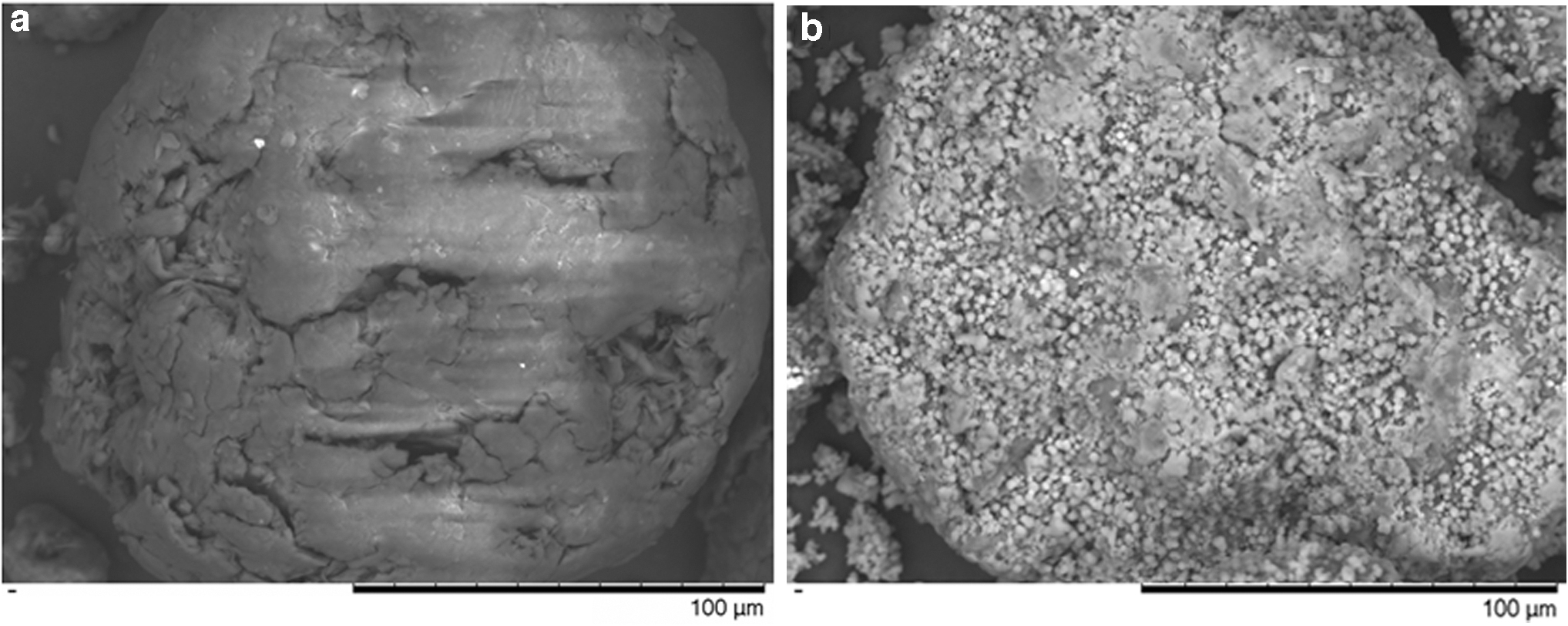
SEM images of
Effect of initial pH of the dye solution on adsorption
The initial pH value of the RB-19 solution is a significant factor affecting the dye adsorption process. The pHPZC of TWNS is around 7.7, which means that if the pH value is lower than 7.7, the TWNS surface presents positive charge, favoring the adsorption of anionic dyes. On the contrary, for pH >7.7, the TWNS surface becomes negatively charged, preventing the attraction of anionic dye molecules. As shown in Fig. 3, with the pH value increasing from 1 to 12, the adsorption capacity decreases from 159.46 to 81.70 mg/g; especially, the adsorption capacity decreases rapidly when pH increases from 7 to 9. The explanation for this phenomenon is as follows. The RB-19 is a reactive dye containing two –SO3H groups per molecule. At a lower pH value, where more positive charge H+ exists, the sulfonic acid groups react with the quaternary amino groups to form TWNS-N+(C2H5)3···SO3−. With the increase of pH value from 1 to 7, the sulfonic group in the solution decreases, which leads to the decrease of the electrostatic interaction between RB-19 molecule and the adsorbent. When pH increases from 7 to 9, according to the pHPZC of TWNS, the TWNS surface changes from positive charge to negative charge, and the electrostatic interaction between TWNS and RB-19 molecules is greatly reduced, which causes the adsorption capacity of TWNS to decrease significantly. Under alkaline conditions, a great quantity of hydroxide ions in the solution will compete with RB-19 molecules for adsorption sites from the surface of the adsorbent, which is unfavorable for the adsorbent to adsorb RB-19 molecules. Therefore, further adsorption experiments were conducted at pH 1.0.
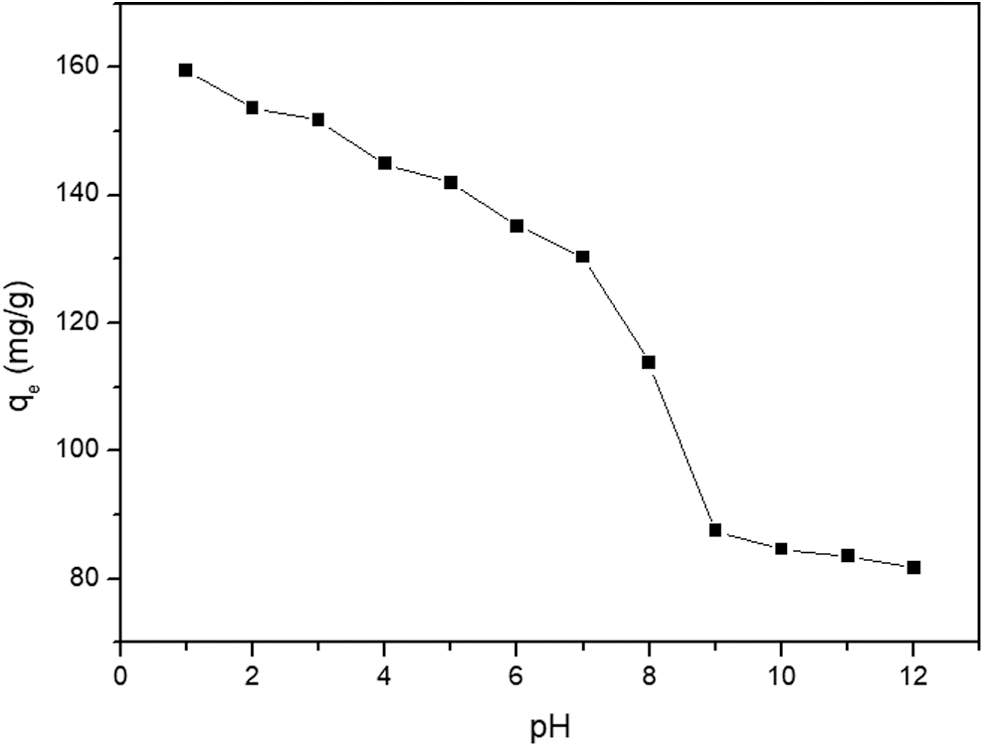
Effect of pH on RB-19 adsorption onto TWNS. RB-19, Reactive Brilliant Blue.
Adsorption isotherms
The experimental data of adsorption isotherms for RB-19 onto TWNS are shown in Fig. 4. Adsorption isotherms models help to comprehend the basic mechanism of the adsorption behaviors. In this study, four models are tested to fit experimental data of adsorption equilibrium.
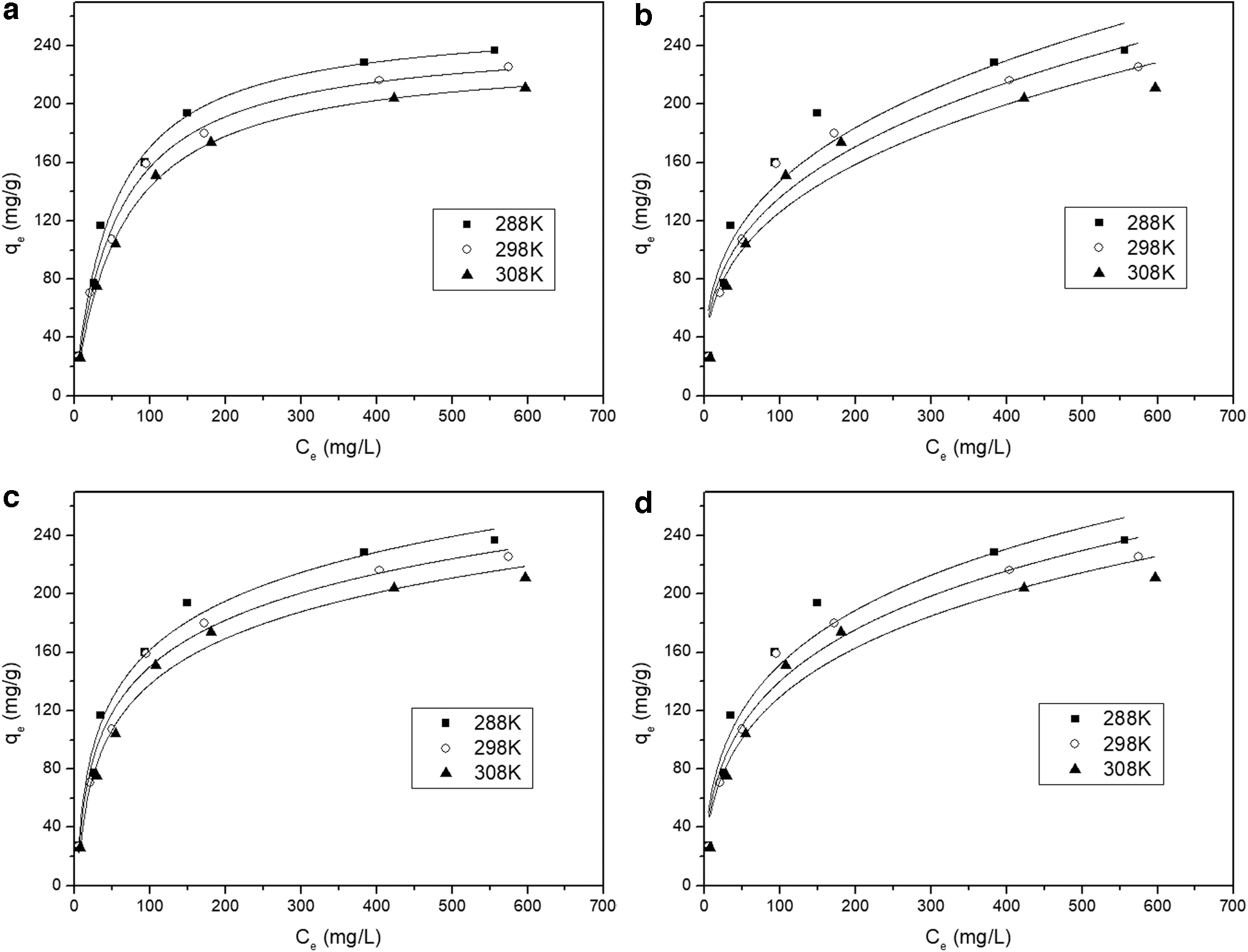
Langmuir isotherm model
The Langmuir isotherm model is:
The definition of the separation factor RL is as follows:
where qm (mg/g) is the maximum adsorption capacity. KL is the Langmuir isotherm constant used to understand whether the adsorption process is favorable or unfavorable, which is relevant to the adsorption activation energy. If 0 < RL < 1, the solution system is beneficial for adsorption; if RL is larger than 1, the adsorption is unfavorable.
The Freundlich isotherm model is:
where n represents the adsorption intensity factor, and KF represents the Freundlich adsorption capacity constant.
The Temkin isotherm model considers the interaction between the adsorbed solutes, and it presumes that the heat of adsorption is linearly negatively correlated with the surface coverage of the adsorbent. It can be expressed as:
with
where T (K) is thermodynamic temperature, KT (L/mg) and BT (mg/g) is the Temkin constant associated to blinding energy and adsorption heat, bT is the adsorption heat of Temkin model, and R (8.314 J/[mol·K]) is the gas constant.
The D-R isotherm model describes the physical and chemical adsorption of porous solid surfaces, and its nonlinear equation is:
with
where qD represents the adsorption capacity obtained by fitting the D-R isotherm model; KD represents the D-R isotherm model invariable; ɛ means the Polanyi potential; and E represents the mean free energy. The value of E can be used to determine whether the adsorption is physical adsorption or chemical adsorption. If E < 8 kJ/mol, the adsorption of RB-19 onto TWNS is physical adsorption; if 8 < E < 16 kJ/mol, the adsorption of RB-19 onto TWNS occurs chemically.
The fitting results of the models mentioned earlier to the adsorption isotherm data of RB-19 onto TWNS are shown in Fig. 4, and the parameters of the models are listed in Table 1. From the results of Langmuir isotherm models, R2 values at different temperatures are 0.9906 (288 K), 0.9950 (298 K), and 0.9987 (308 K), respectively. The Langmuir isotherm models have higher R2 values compared with the Freundlich isotherm model (R2 <0.93), revealing that the adsorption of RB-19 onto TWNS is monolayer adsorption and the maximum adsorption capacity of RB-19 onto TWNS is 258.57 mg/g at 288 K. Moreover, all RL values (0.052–0.562) at different temperatures are between 0 and 1, which proves that the prepared TWNS is favorable for adsorption of RB-19 under the conditions of this study. From Table 2, it is also discovered that the R2 obtained from the Temkin model is around 0.98, which shows that the results of simulation have certain reliability. The bT obtained from the Temkin equation is positive, indicating that the adsorption reaction is exothermic (Hamdaoui, 2006; Yang et al., 2010). It is found from the D-R isotherm model that the E values are 12.33, 12.58, and 12.85 kJ/mol at 288, 298, and 308 K, respectively, which are all in the range of 8 to 16 kJ/mol. These results indicate that the adsorption of RB-19 onto TWNS proceeds chemically.
Isotherm Parameters for RB-19 Adsorption
Conditions: 150 mL RB-19 solution (50–1,000mg/L), 0.24 g TWNS, pH = 1.0.
RB-19, Reactive Brilliant Blue; TWNS, new modified walnut shell.
Maximum Adsorption Capacity for RB-19 Compared with Various Adsorbents
In Table 2, there is a comparative study of different adsorbent used for removing RB-19 from dye wastewater. It is found that the adsorption capacity of TWNS to RB-19 is improved compared with other adsorbents. In particular, the adsorption capacity of TWNS is much larger than that of WNS, which is due to the fact that the surface of TWNS is rich in pores, and the grafted quaternary amino groups have a strong adsorption capacity for RB-19.
Adsorption kinetics
It is important that to comprehend the adsorption mechanism of RB-19 onto TWNS, adsorption kinetics experiments were conducted. Pseudo-first-order (PFO) and pseudo-second-order (PSO) models were tested to fit the experiment data shown in Fig. 5.
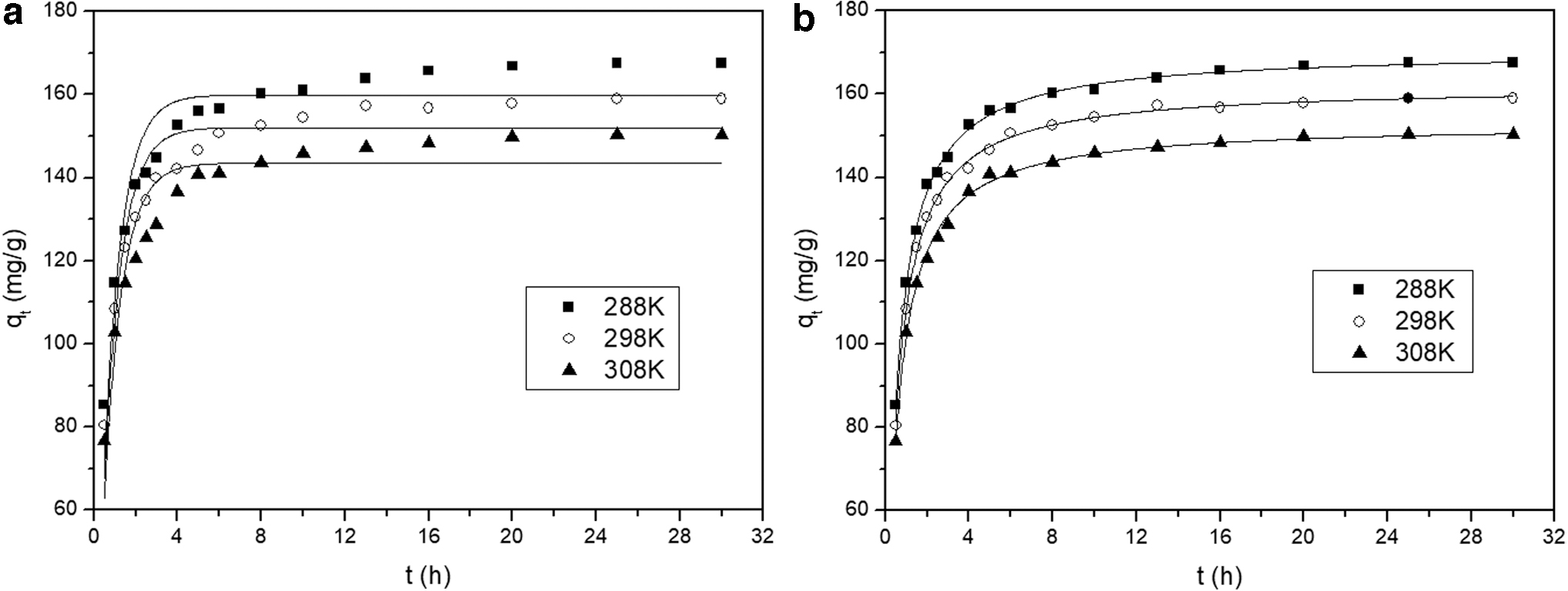
Pseudo-first-order
The expression of the PFO kinetic model is:
where qt (mg/g) is the adsorption capacity at time t; qe (mg/g) is the adsorption capacity at equilibrium. k1 (h−1) is the rate constant, and t (h) is the adsorption time.
The equation of PSO kinetic model is:
where k2 (g/[mg·h]) is the rate constant.
And h0 (g/[mg·h]), the initial adsorption rate, at t → 0 is expressed as:
The simulation results of PFO and PSO models are shown in Fig. 5, respectively. The experimental adsorption capacity at equilibrium qe,exp, the parameters and R2 of the two kinetic models mentioned earlier are shown in Table 3. From Fig. 5 and Table 3, it was found that the PSO kinetic model has a larger correlation coefficient (R2 > 0.99), compared with the PFO kinetic model. Besides, obtained from the PSO kinetic model, the calculated adsorption capacity qe,cal is near the value of qe,exp, which indicates that adsorption of TWNS onto RB-19 is best in accordance with the PSO kinetic model. The values of h0, calculated by Equation (14), decrease with the temperature increase, showing that the RB-19 adsorption onto TWNS is an exothermic process.
Kinetic Parameters for RB-19 Adsorption at 288–308 K
Conditions: 150 mL RB-19 solution (350 mg/L), 0.24 g TWNS, pH = 1.0, 30 h.
Adsorption mechanism
Generally, the process of RB-19 adsorption onto TWNS can be roughly divided into the following four steps: (1) RB-19 molecules are transferred from the solution to the surface of TWNS (membrane diffusion); (2) RB-19 molecules are bound to the outer surface of TWNS; (3) RB-19 is transported in TWNS pores (intra-particle diffusion); and (4) RB-19 is adsorbed on the inner surface of TWNS. In general, steps (2) and (4) are fast; the adsorption process is primarily controlled by intra-particle diffusion, membrane diffusion, or both. Weber and Morris diffusion equation and Boyd and Reichenberg model are performed to fit the adsorption kinetic data.
Weber and Morris model is written by:
where C represents a constant related to the thickness of boundary layers; kid (mg/[g.min0.5]) represents the rate constant related to intraparticle diffusion. If the fitted lines of qt versus t0.5 are straight lines and cross the origin, the rate control step of the adsorption process is intraparticle diffusion; on the contrary, if the above lines are multi-linear or straight lines that do not exceed the origin, the adsorption process is affected by both particle diffusion and membrane diffusion (Vasiliu et al., 2011; Zhen et al., 2013). The plots of qt versus t0.5 for intraparticle diffusion of RB-19 adsorption onto TWNS at different temperatures are shown in Fig. 6. It is found that the process of RB-19 adsorption onto TWNS is divided into three stages and all three straight lines are not across the origin, indicating that the adsorption process of RB-19 onto TWNS is controlled by multiple diffusion mechanisms: membrane diffusion and intraparticle diffusion. In the first stage, RB-19 is adsorbed on the outer surface of TWNS, and membrane diffusion is the rate-control step; in the second stage, the intraparticle diffusion affected the adsorption rate because of the increase in diffusion resistance; the last stage is the equilibrium process, where the adsorption and desorption of RB-19 onto TWNS achieve dynamic balance.
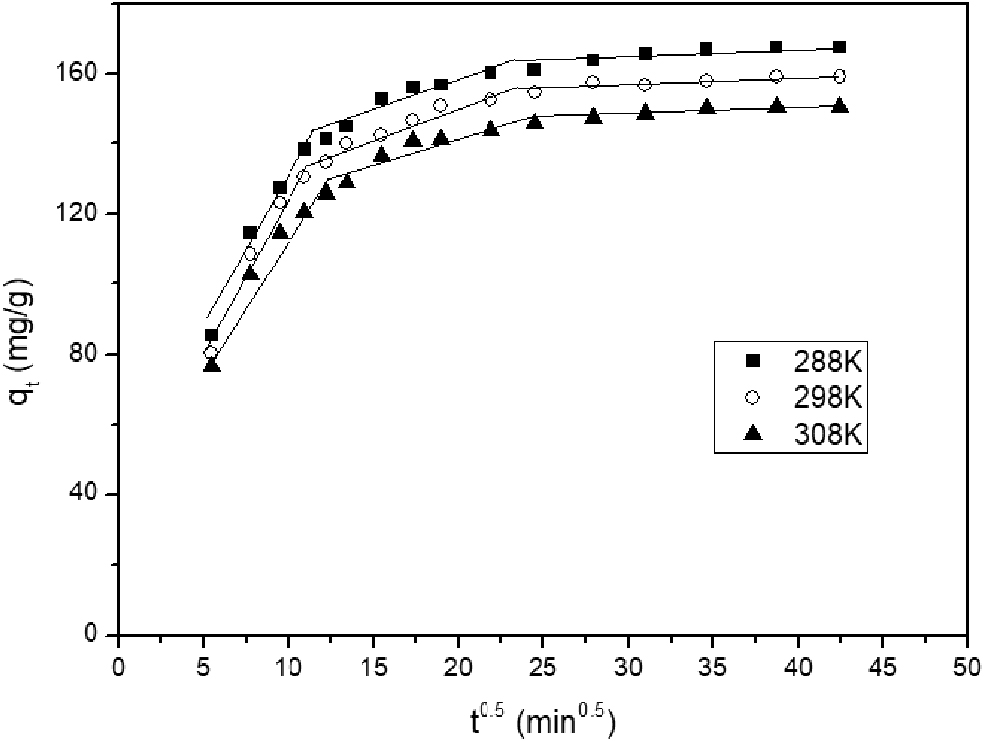
Plots of qt versus t0.5 of RB-19 adsorption onto TWNS at 288–308 K.
Boyd and Reichenberg model is written as:
where n is the infinite series solution (rounded), and B is the time constant. F (t) is calculated as:
The simplified expression of Bt is derived from the internal diffusion mechanism equation, and the value of Bt is obtained within two different F values.
For F = 0–0.85,
For F = 0.85–1,
If the rate control step of the adsorption process is intraparticle diffusion, the value of B should be constant, and the curve of Bt versus t is a straight line through the origin; otherwise, the adsorption process is affected by membrane diffusion (Debnath and Ghosh, 2008). As shown in Fig. 7, the fitted line of Bt versus t is not linear (R2 <0.95), and is not across the origin, suggesting that the process of RB-19 adsorption onto TWNS is controlled by membrane diffusion.
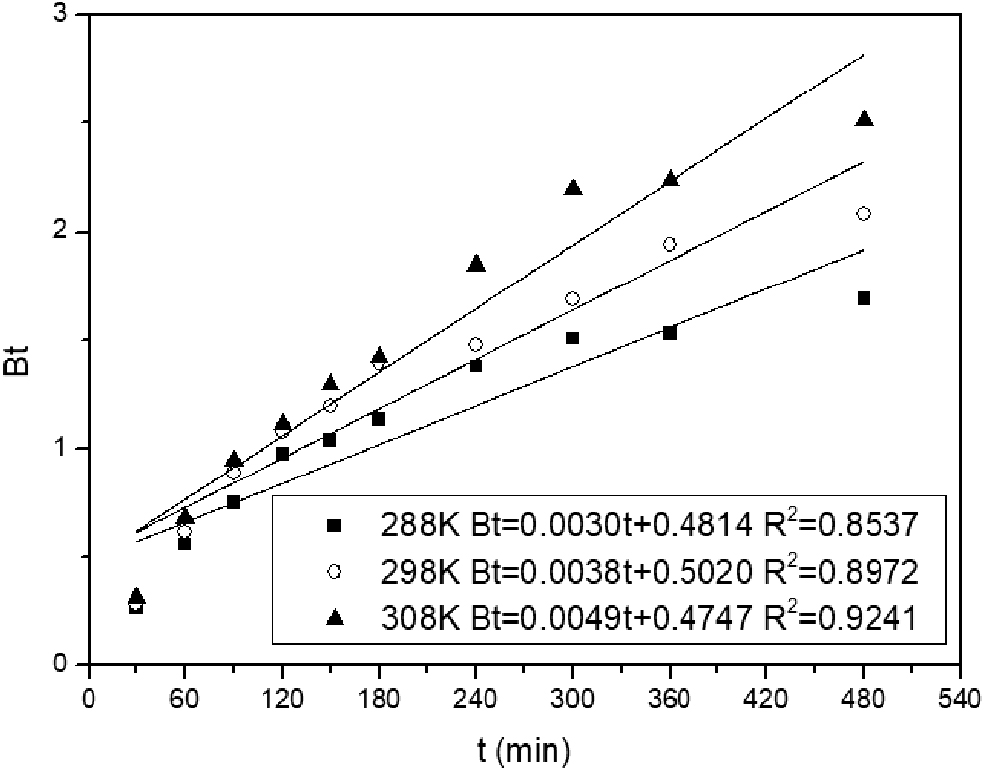
Plots of Bt versus t of RB-19 adsorption onto TWNS at 288–308 K.
Adsorption thermodynamics
The thermodynamic parameters of the RB-19 adsorption were figured out by Van't Hoff equation, which are crucial for evaluating the spontaneity of the adsorption process. The relevant equations are as follows:
where Ce (mg/L) is the equilibrium concentration of RB-19 in the solution and Ces (mg/L) is the equilibrium solid-phase concentration. Kc is the equilibrium partition constant. The values of ΔH and ΔS are calculated from the intercept and slope by plotting ln Kc against 1/T. These thermodynamic parameters are shown in Table 4. The negative value of ΔG indicates the spontaneity and feasibility of the adsorption of RB-19 onto TWNS. The negative value of ΔS reflects the adsorption randomness at the interface decreases during the adsorption process. The negative value of ΔH shows that the adsorption of RB-19 onto TWNS is an exothermic process and reveals that lower temperature is favorable to the adsorption at 288–308 K.
Thermodynamic Parameters of RB-19 Adsorption onto TWNS
Conditions: 150 mL RB-19 solution (350 mg/L), 0.24 g TWNS, pH = 1.0.
Reusability of TWNS
Reusability is one of the important indicators to measure the performance of adsorption materials. The adsorption capacity and regeneration rate (η, %) of the recycled TWNS are shown in Table 5. It is found that the adsorption capacity of TWNS decreases with the increase of the number of cycle utilization. After five cycles, the recycled TWNS remains high adsorption capacity, which is 142.94 mg/g, and the regeneration rate is 89.68%, showing that the TWNS has a good performance of regeneration.
Reusability of TWNS
η means the regeneration rate. Conditions: 150 mL RB-19 solution (350 mg/L), 0.24 g TWNS, pH = 1.0, 298 K.
Conclusions
A new type of adsorbent (TWNS) was synthesized by chemical modification of WNS with thionyl chloride and triethylamine for the removal of RB-19 from aqueous medium. The TWNS was characterized through FTIR spectroscopy and SEM. The effect of initial pH on adsorption was discussed in the range of 1 to 12, and lower initial pH of RB-19 solution favors adsorption. At 288 to 308 K, the Langmuir isotherm model has the best correlation with the adsorption equilibrium data of RB-19 on TWNS, revealing that the adsorption process is favorable and homogeneous. The maximum adsorption capacity is 258.59 mg/g at 288 K. The correlation result of the D-R model to the adsorption equilibrium isotherm data shows that the adsorption process is chemical adsorption. The adsorption kinetics of RB-19 onto TWNS is adequately described by the PSO model. The Boyd and Reichenberg model and intraparticle diffusion model show that membrane diffusion is the main rate-controlling step of the adsorption of RB-19 onto TWNS. The thermodynamic studies suggest that the adsorption is an exothermic and spontaneous process. Moreover, the adsorption capacity of the recovered adsorbent is still 89.68% of the original adsorbent after four cycles. Thus, the study indicates that TWNS is an effective sorbent for removing RB-19 from aqueous solution.
Footnotes
Acknowledgment
The authors also thank Dr. Xu for her assistance with the UV measurements.
Author Disclosure Statement
No competing financial interests exist.
Funding Information
Financial support from the East China University of Science and Technology is greatly acknowledged.