




Abstract
This study presents numerical simulations of fecal coliforms dynamics in Luruaco Lake, located in Atlántico Department, Colombia. The velocity field is obtained through a two-dimensional horizontal (2DH) model of Navier-Stokes equations system. The transport equation of fecal coliforms concentration is provided from a convective-diffusive-reactive equation. The lake's geometry is built through cubic spline and multiblock methods. The discretization method by Finite Differences and the First Order Upwind (FOU) are applied to the 2DH model. The Mark and Cell (MAC) method is used to determine numerically the velocity field of water flow. Numerical simulations are carried out for a 72-h period to understand the influence of fecal coliforms injections from each tributary. From the quantitative analysis of the factors that influence fecal coliforms dynamics, proposals are presented, which aims to reduce contamination of the Luruaco Lake. The numerical simulations show that the best option to improve the water quality of Luruaco Lake is the implementation of two actions, the diversion of the Limón stream to the Negro stream and the installation of a sewage treatment plant at the mouth of the Negro stream. Other less expensive proposals are also presented.
Introduction
Water pollution is a global problem. Luruaco Lake is an example of water body that is affected by pollution. Located in the Atlántico Department, in Colombia, it is used as water source to supply ∼28,000 local residents (Municipio de Luruaco, 2012). The lake is contaminated by organic matter waste, generated mainly by domestic sewage from Luruaco population, which gets in the lake through its tributaries (CRA, 2012, 2014).
Note that the waters of Luruaco Lake have several uses for the Municipality of Luruaco; in addition to human consumption, it is used for crop irrigation systems, pasture and livestock maintenance, fishing activity, and tourism activity, among others. Thus, the waters of Luruaco Lake are used for several intensive uses beyond their capacity, with practices that are not suitable for the ecosystem. An aggravating factor is that Luruaco Lake is located in a dry climate area, normally without rain for 9 months of the year. So, considering that it is the only water reserve around the municipality of Luruaco, considering that there is currently an expansion process of the municipality of Luruaco, mainly toward the mouth of the Limón stream, considering that Luruaco Lake has undergone eutrophication processes in some areas, especially at the mouth of the Limón stream, and considering that there is a marked decrease in fish populations, already reported in previous studies (CRA, 2020), the studies on the maintenance and management of the water quality of Luruaco Lake are of great importance.
There are several water quality indexes (WQIs). The WQI, created in 1970 in the United States by the National Sanitation Foundation (NSF), is one of the most used (Lumb et al., 2011). Nine water quality parameters are used to calculate the WQI-NSF: dissolved oxygen (DO), fecal coliform, pH, biological oxygen demand (BOD5), temperature, total phosphate, nitrate, turbidity, and total solids.
To quantify the level of contamination in Luruaco Lake, we present some water quality parameters. The worst parameters are found at the mouth of the Limón stream, exactly where part of the population of the municipality of Luruaco collects water. Thus, in the 2016–2019 period, the DO measurements showed values between 2.13 and 5.43 mg/L, the suspended solids between 17.9 and 27.9 mg/L, the biological oxygen demand (BOD5) between 3.6 and 5.2 mg/L, and a stable chemical oxygen demand of 25 mg/L (CRA, 2014, 2016, 2020). Finally, the WQI-NFS at Luruaco Lake shows that water quality varies from medium to very bad, depending on the location and the season (CRA, 2020).
The WHO (2017) uses fecal coliform bacteria as indicator of the presence of pathogenic organisms. Thus, local monitoring of the concentration of fecal coliforms is a method to identify the intensity of contamination in lakes (Reckhow and Chapra, 1983; Ouattara et al., 2018).
In this context, the following questions arise: How to improve the quality of the water supplied to the population of the municipality of Luruaco? To answer this question, we must understand some aspects of the hydrodynamic flow at Luruaco Lake. To do this, we must first answer other questions such as How is the hydrodynamic flow at Luruaco Lake? What are the main factors that explain the locations of the most polluted regions on Luruaco Lake? Where are the regions with the highest and lowest pollution on Luruaco Lake? How to use this information to improve the water quality at Luruaco Lake?
In this way, based on experimental measurements, mathematical models can be calibrated to simulate the dynamics of fecal coliforms in lakes, allowing government agencies to create strategies that would improve the water quality in Luruaco Lake.
In this work, the mathematical model in generalized coordinates (Maliska and Raithby, 1984) described the fecal coliform dynamics on the lake's surface, taking into account the water velocity fields obtained from hydrodynamic model (Pardo et al., 2012; Romeiro et al., 2017). About the transport model, it was given by a convective-diffusive-reactive equation (Romeiro et al., 2011; Saita et al., 2017).
The construction of Luruaco Lake geometry took into account its real characteristics. The irregular contour was described by cubic splines, while the interior of the lake was described by the multiblock method. These procedures created a computational grid that adjusts best to the type of geometry (Pardo et al., 2012; Romeiro et al., 2017).
To have the mathematical model simulated computationally, the discretization of equations was carried out through the finite difference method. Given the dynamic complexity generated by the nonlinear terms of the hydrodynamic model, we used the First Order Upwind (FOU) method and the Mark and Cell (MAC) method to solve the hydrodynamic model (Mckee et al., 2008).
The results obtained in this study allowed us to understand how some factors influence the dynamics of fecal coliforms in the lake, among which we highlight the influence of tributaries and the existence of hydrodynamic vortices. Thus, from the numerical simulations, it was possible to elaborate four management proposals for Luruaco Lake.
The Luruaco Lake
The Luruaco Lake is located in the Department of Atlántico, Colombia, more precisely between the coordinates 10° 16′ and 11° 04′ north latitudes and 74° 43′ and 75° 16′ west longitudes. It occupies an area of 420 hectares with an average depth of 5 m, and a volume of ∼2.5 × 10⁶ m3 (CRA, 2014). Situated at 31 m of altitude, the region's climate is tropical, with temperatures between 24°C and 28°C, prevailing the hot and dry climate throughout the year (CRA, 2012).
Luruaco Lake belongs to the Canal del Dique basin and is supplied by three tributaries, the Mateo stream, the Negro stream, and the Limón stream (CRA, 2012). The canal that connects Luruaco Lake to San Juan del Tocágua Lake, due to the difference of altitude, serves as effluent of the Luruaco Lake, as shown in the Fig. 1.
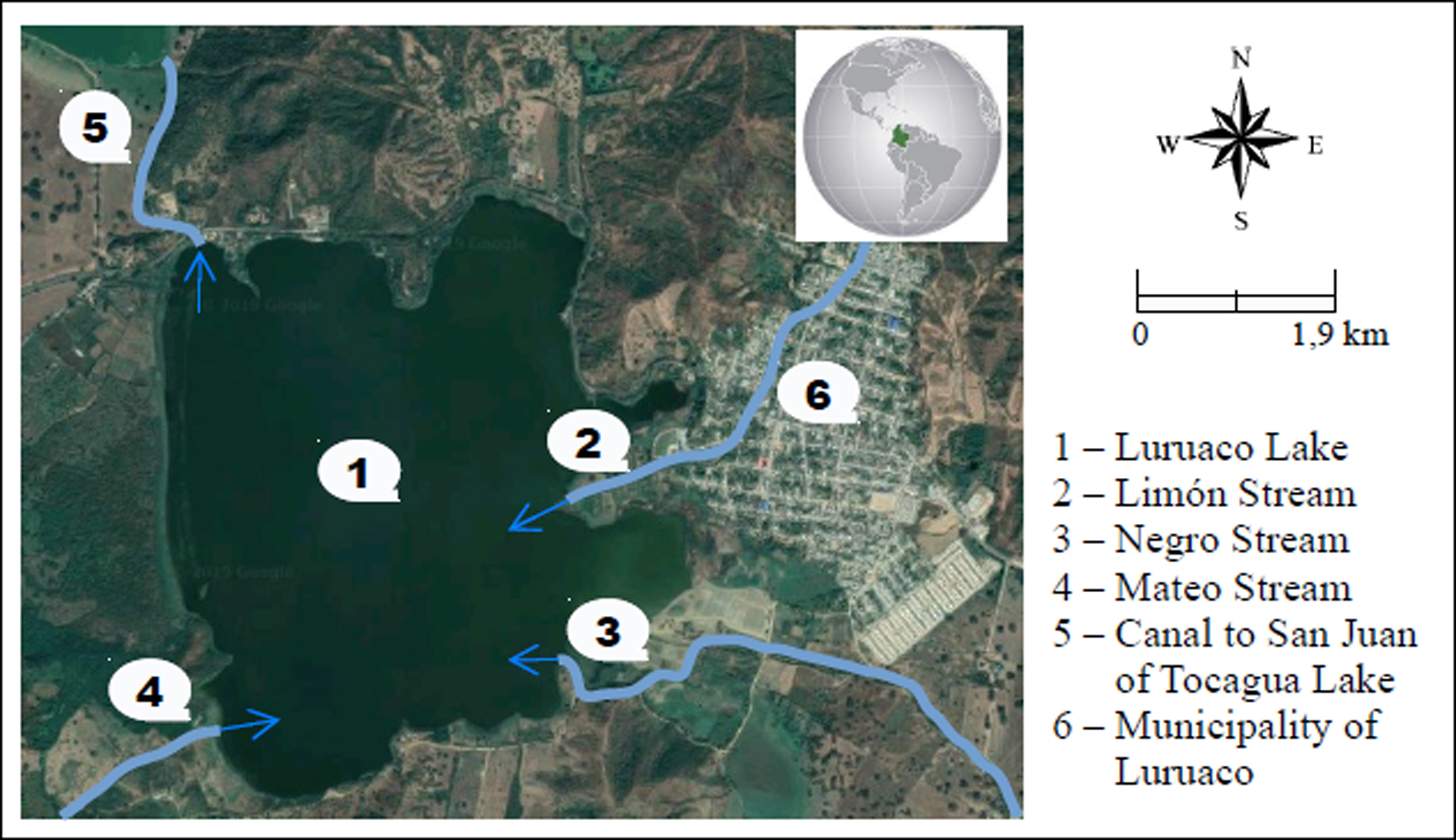
Localization of Luruaco Lake and tributaries (Limón, Negro, Mateo). Font: Google Maps/Author.
Close to the east shore of the lake is situated the municipality of Luruaco with about 28,000 inhabitants. The residents of the municipality use the lake for fishing, tourism, agriculture, and livestock, but the main utility of the lake is the supply of water for consumption by the population. (Municipio de Luruaco, 2012).
The lake suffers from pollution, mainly from domestic sewage generated by the municipality of Luruaco, which is injected in the lake without proper treatment (CRA, 2012). In this sense, it is important to analyze the dynamics and concentrations of fecal coliforms in Luruaco Lake, since such concentrations are used as a biological parameter in the evaluation of water quality (Ashbolt et al., 2001).
Development of Mathematical and Numerical Model
About the irregular geometry of the lake, it is constructed in (ξ,η) generalized coordinates (Maliska and Raithby, 1984). The coordinates of the points on the lake border are collected using WebPlotDigitizer software from Google Maps photos (Rohatgi, 2018). Later, the points are interpolated through the cubic spline method. The grid is constructed using the multiblock method. These procedures create a computational grid that best fits the type of geometry, without requiring complex computer calculations (Pardo et al., 2012; Romeiro et al., 2017; Saita et al., 2017).
The water flow of Luruaco Lake is laminar (low declivity and the small volume of input water compared with water volume of the Lake), so that a two-dimensional horizontal hydrodynamic model represents it appropriately. Considering that the fluid (water) is incompressible, in hydrostatic equilibrium, and Newtonian type, the variations of density and viscosity are not significant. It is also considered that the transport of fecal coliforms in the lake is passive, that is, the coliforms do not significantly modify the water flow, allowing the velocity field (obtained through a hydrodynamic model) to be calculated separately from the transport model of fecal coliforms. It is also assumed that the external forces (wind, evaporation, etc.) are not expressive and that there are no variations in the Lake's boundary. So, the water velocity field is obtained by means of a hydrodynamic model given by the equation for mass conservation [Eq. (1)] and by the Navier-Stokes Equations (2) and (3) in generalized coordinates (ξ,η,τ) below:
where u(ξ,η,τ) and v(ξ,η,τ) are the components of the velocity vector of water flow, p is the pressure, ρ and ν are constants representing the density and kinetic viscosity of the water, respectively. The terms U(ξ,η,τ) and V(ξ,η,τ) are the components of contravariant velocities (Pardo et al., 2012; Romeiro et al., 2017; Saita et al., 2017). The quantity
With the water velocity field obtained from the system [Eqs. (1)–(3)], it is possible to find the concentration of fecal coliforms given by the transport model [Eq. (4)], where C = C(ξ,η,τ) represents the concentration of fecal coliforms. The K and D constants represent the decay rate and the diffusion coefficient of fecal coliforms, equal in the ξ and η directions (Pardo et al., 2012; Romeiro et al., 2017; Saita et al., 2017).
Note that in mathematical modeling, the spatial variables (x, y) are transformed into generalized spatial variable coordinates (ξ,η), while the temporal variable t is not transformed, so that t = τ.
In numerical model, the Equations (1)–(4) are discretized by means of finite differences method (FDM). The discretization of derivatives of the mass conservation Equation (1) was performed by central differences. In the Navier-Stokes Equations (2) and (3) and in the transport Equation (4), the temporal terms were discretized by progressive differences, while the pressure, diffusion, and convective terms were discretized by centered differences (Thomas, 1995; Pardo et al., 2012; Cirilo et al., 2018).
On the contrary, the convective terms have nonlinearity. The accuracy of the results obtained from the numerical solutions depends on the choice of the convection scheme. The upwind scheme can be used for this purpose. This approach is done according with the sign of local convection speed. In this work, we use the FOU scheme (Courant et al., 1952; Cirilo et al., 2018), which is stable unconditionally and produces a diffusive effect, which usually smooths the solution.
Finally, note that the flow at Luruaco Lake happens for a low Reynolds number. So, the FOU scheme is a reasonable choice to be used in the approximation of the convective terms.
Initial and Boundary Condition
Next, initial and boundary conditions are imposed for numerical model developed in Development of Mathematical and Numerical Model section. The continuous injection of water with fecal coliform through the Mateo, Negro, and Limón streams is considered. The drainage of the Luruaco Lake is made through the canal that connects it to the San Juan del Tocágua Lake (Fig. 1).
On the hydrodynamic model [Eqs. (1)−(3)], it is considered that the water flow has Reynolds number, Re = 555, a value that characterizes the flow of water in the Luruaco Lake. The Reynolds number is a dimensionless parameter given by Re = v L/ν, where v is a speed that characterizes the flow of water in the Luruaco Lake, L is a length that characterizes the flow of water in the Luruaco Lake, and ν is the kinetic viscosity of the water. For Luruaco Lake, we have the following values: ν = 1.0 × 10⁻⁶ m2/s, which is the kinetic viscosity of the water at 20°C; L = 2 m, which is the average width of the streams that supply Luruaco Lake; and v = 2.77 × 10⁻⁴ m/s = 1.0 m/h that characterizes the flow of water in the Luruaco Lake (Chapra, 2008).
About the diffusion coefficient D and decay coefficient K of fecal coliforms, they are considered constant throughout the lake. To simulate the molecular and large scale diffusion phenomena involved in fecal coliforms transport in Luruaco Lake, the appropriate value for the effective diffusion coefficient is D = 3.6 m2/h (Saita et al., 2017). For decay coefficient of fecal coliforms, the appropriate value is K = 0.02 h−1 (Chapra, 2008; Romeiro et al., 2011, 2017; Liu et al., 2015).
In addition, the initial and boundary conditions for the numerical model are considered:
Initial condition for the hydrodynamic model: We performed simulations starting from a null velocity and pressure fields. Boundary condition for the hydrodynamic model: For t > 0, it is considered that velocity of water flow is null throughout its boundary, except in the entrances and exit of the lake, where Neumann's boundary conditions are considered. In relationship to the pressure field, it is considered a gradient of 10% between entrance pressure and exit pressure of Luruaco Lake. Initial condition for the fecal coliform transport model: For t = 0, the fecal coliform concentration field is null. Boundary condition for fecal coliform transport model: For t > 0, it is considered that at the entrances of Luruaco Lake there are continuous constant injections of fecal coliforms over a period of 72 h, to reach steady state. In each simulation, these values will be indicated.
Numerical Simulations
In this section, the dynamics of fecal coliforms will be qualitatively analyzed. It is important to highlight that the objective of these simulations is not to offer accurate values of local fecal coliform concentration, but we want to present the influence of each factor considered in the modeling (water velocity field, streams, and lake geometry) on the fecal coliform dynamics in the lake.
The computational code is developed in Fortran 90 language. The hydrodynamic model [Eqs. (1)–(3)] is calculated using MAC method, generating the velocity field of water flow (Cirilo et al., 2018). The MAC method was formulated by Harlow and Welch (Amsden and Harlow, 1970). This method has the advantage of permitting the simulation of different types of flows (Mckee et al., 2008; Patil and Tiwari, 2009; Santos et al., 2012). With this methodology, any deduction of moving marker particles associated with the method was disregarded, which results in the simplification of numerical calculations. Furthermore, it is considered displaced mesh, where the variables are stored in different positions. The displaced storage for the components of the velocity vector and pressure has a positive impact on the numerical calculation, due to the fact that reduces numerical instability (Amsden and Harlow, 1970).
Simulation of fecal coliform injection through the three entrances (streams) is then performed separately, which allowed us to analyze the impact of each stream on lake pollution. Finally, we present the simulation with the injection of fecal coliforms by the three tributaries, simultaneously. From these results, it is possible to develop management proposals for the discharge of sewage in the lake.
Velocity field of water flow
We performed simulations over a 72-h period to reach steady state. Under the conditions presented in Initial and Boundary Condition section, the steady water flow is simulated, as can be seen in Fig. 2.
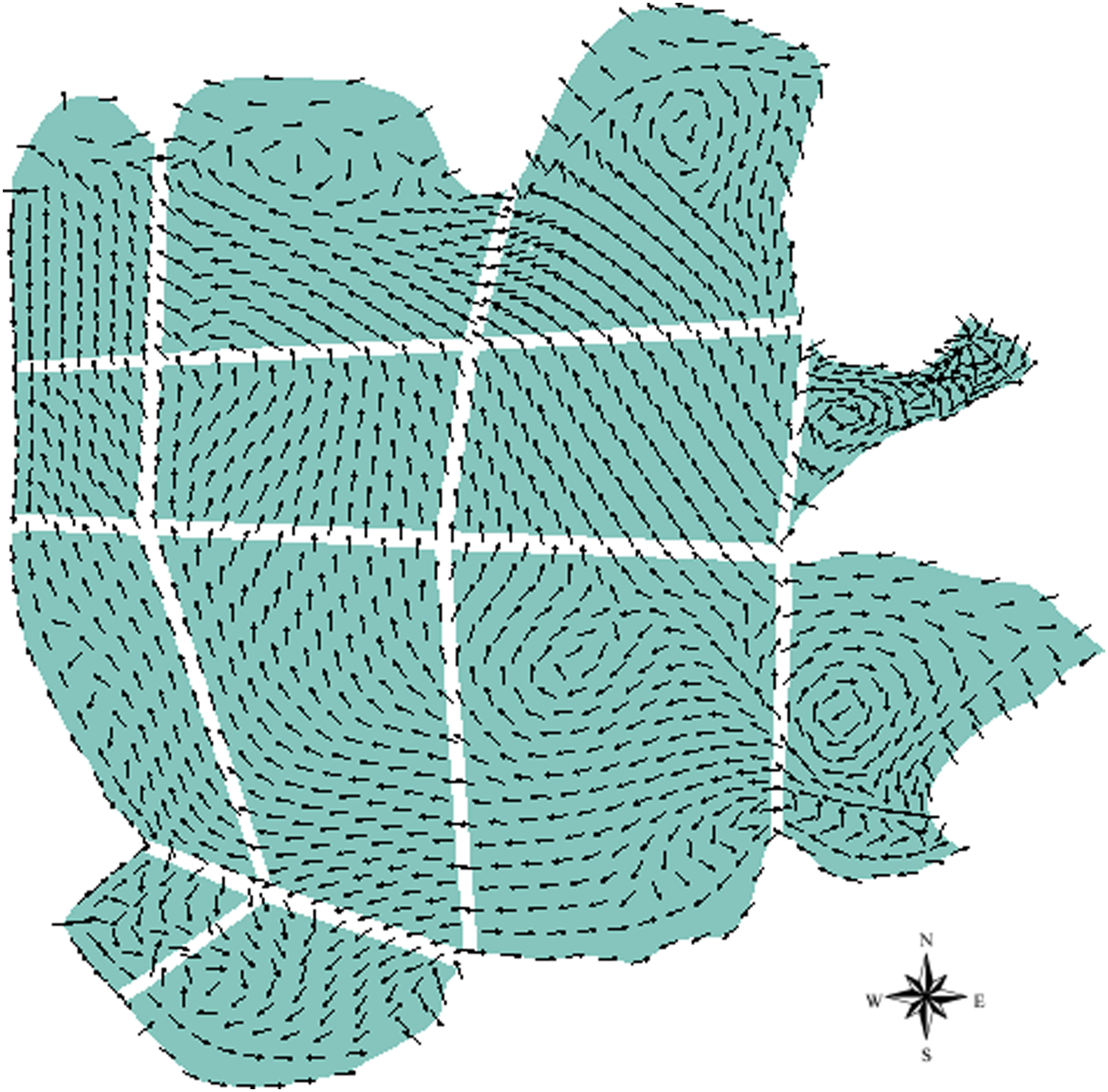
Stationary water flow obtained by numerical simulation for Luruaco Lake using Reynolds number Re = 555. Font: Author.
On the grid independence analysis and a time independence analysis for the numerical solution, this work is a just extension of the code presented in Cirilo et al. (2018). There we introduced the mathematical details about the MAC method simplified and its grid's independence of numerical analysis. The agreements among results obtained in Cirilo et al. (2018) and those in the literature were shown. In this work we use the same methodology and rigor to the choice of parameters such as time lapse, total number of grid nodes, and numerical error of the discrete pressure equation.
Finally, the multiblock method divided the computational grid in 13 blocks. The boundary conditions between the blocks provide the representation of the flow in the total lake area (Saita et al., 2017). In Fig. 2, it is possible to observe the formation of vortices in several regions of the lake, increasing the flow in some points. On the contrary, as in the “arm” to the east of the lake, the vortex formed at its entrance makes it difficult for water to enter its interior, so that this region has little water renewal.
Contamination by Mateo stream
In this simulation, the water injection is continuous through the three tributaries (streams), maintaining the same velocity field obtained in the Velocity Field of Water Flow section. On the contrary, the fecal coliforms are injected only through the Mateo stream located to the southwest of the lake. In this simulation, C1 = 100 MPN/100 mL is the fecal coliforms concentration injected, where MPN is most probable number. Figure 3 shows the dynamics of contamination by fecal coliforms due to the Mateo stream.
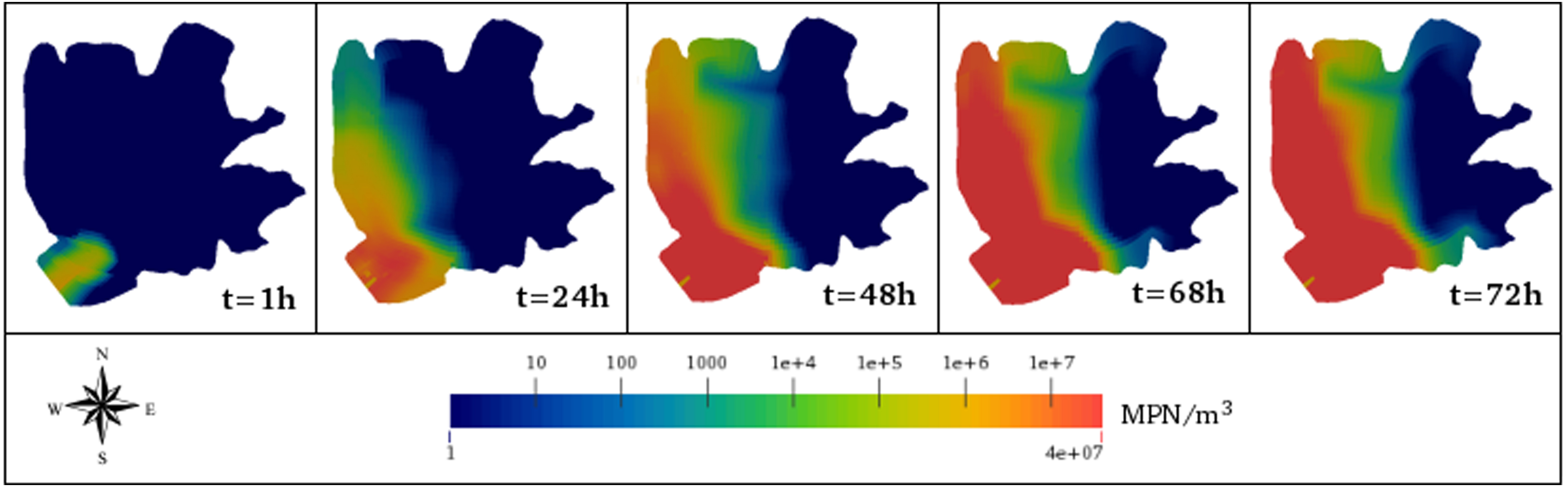
Simulation of fecal coliform injection into Luruaco Lake through the Mateo stream (C1 = 100 MPN/100 mL) using Reynolds number Re = 555, diffusion coefficient D = 3.6 m2/h and decay coefficient K = 0.02 h−1. Font: Author.
Due to the velocity field and the location of Mateo stream, fecal coliforms tend to focus on the west region of the lake, then being drained out of Luruaco Lake by the canal to San Juan of Tocagua Lake (Fig. 1). Another factor that influences the dynamics of fecal coliforms is the decay property K = 0.02 h−1. This characteristic is being considered in the transport model of fecal coliforms [Eq. (4)]. The decay explains the fact that fecal coliforms do not spread throughout the lake.
Therefore, considering only the injection of fecal coliforms by the Mateo stream, it is clear that the lake region is close to the municipality of Luruaco, where there is more water capture for human consumption, does not present high levels of concentration of fecal coliforms due to this affluent.
Contamination by Negro stream
In this simulation, the water injection is continuous through the three tributaries (streams), maintaining the same velocity field analyzed in the Velocity Field of Water Flow section. On the contrary, the fecal coliforms are injected only through the Negro stream located to the southeast of Luruaco Lake. In this simulation, C2 = 100 MPN/100 mL is the fecal coliforms concentration injected. Figure 4 shows the dynamics of contamination by fecal coliform due to the Negro stream.
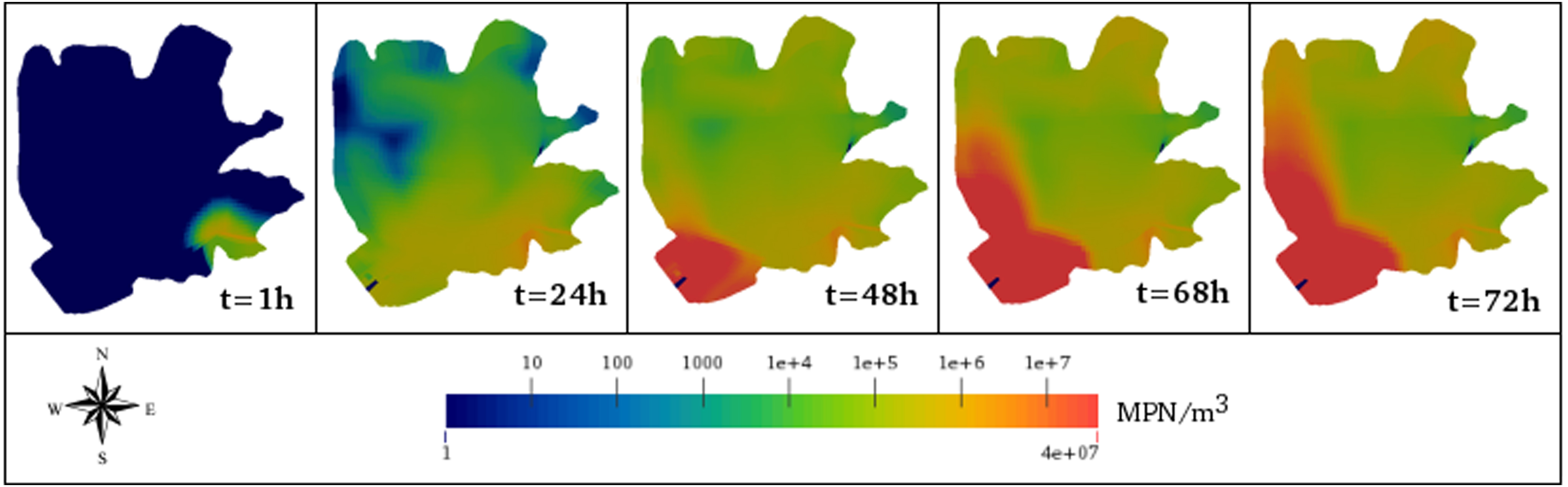
Simulation of fecal coliform injection into Luruaco Lake through the Negro stream (C2 = 100 MPN/100 mL) using Reynolds number Re = 555, diffusion coefficient D = 3.6 m2/h, and decay coefficient K = 0.02 h−1. Font: Author.
In the simulation, it is observed that, contrary to the pattern observed for contamination due to the Mateo stream, the fecal coliforms spread over the entire length of the lake. This dynamics occurs due to the influence of vortices in the velocity field that intensify the spread of fecal coliforms. The existence of a vortex near the entrance to the Negro stream causes fecal coliforms to flow mainly to the region near the Mateo river and then to the exit of the Lake Luruaco. The Fig. 4 shows a high concentration of fecal coliforms in the southwest of the lake.
Contamination by Limón stream
The Limón stream runs through the municipality of Luruaco and receives more sewage than the Negro and Mateo streams (CRA, 2012). In this simulation, C3 = 500 MPN/100 mL is the fecal coliforms concentration injected. Figure 5 shows the dynamics of contamination by fecal coliform due to the Limón stream.
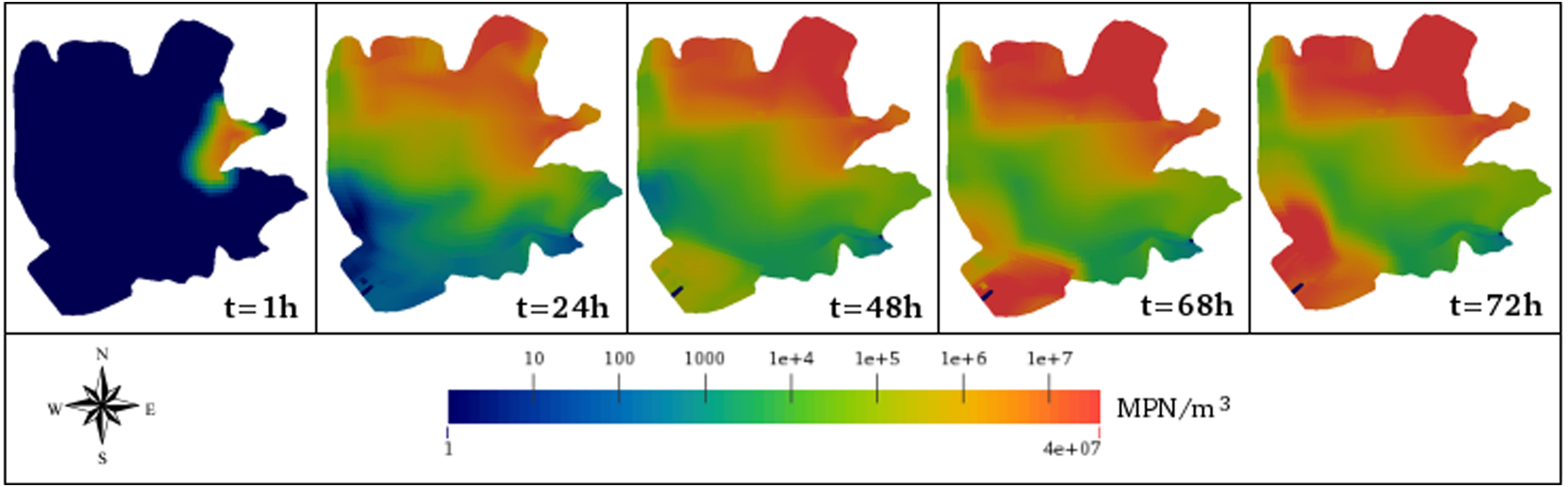
Simulation of fecal coliform injection into Luruaco Lake through the Limón stream (C3 = 500 MPN/100 mL) using Reynolds number Re = 555, diffusion coefficient D = 3.6 m2/h, and decay coefficient K = 0.02 h−1. Font: Author.
Again, the influence of the field of velocity in the dynamics can be seen. Vortices spread fecal coliforms throughout the lake, especially to the north and southwest regions of the lake. Note that the southeast region of the lake is the least affected region.
Contamination by Mateo, Negro, and Limón streams
The previous dynamics of fecal coliform concentrations analyzed the influence of each stream in Luruaco Lake contamination, separately. The simulations showed different behaviors for each stream. The following simulation aims to analyze the real dynamics of fecal coliforms in the lake, when there is injection through the three streams, Mateo, Negro, and Limón, simultaneously. Consider the previous fecal coliform injections: C1 = 100 MPN/100 mL by Mateo stream, C2 = 100 MPN/100 mL by Negro stream, and C3 = 500 MPN/100 mL by Limón stream. Figure 6 shows the fecal coliform concentrations in Luruaco Lake due to Mateo, Negro, and Limón streams.

Simulation of fecal coliforms injection into Luruaco Lake through the Mateo (C1 = 100 MPN/100 mL), Negro (C2 = 100 MPN/100 mL), and Limón (C3 = 500 MPN/100 mL) streams, simultaneously, using Reynolds number Re = 555, diffusion coefficient D = 3.6 m2/h, and decay coefficient K = 0.02 h−1. Font: Author.
Note that the characteristics of the simulations seen in Contamination by Mateo Stream, Contamination by Negro Stream, and Contamination by Limón Stream sections are present in this simulation. Figure 6 shows that the central and southeast regions have the lowest concentrations of fecal coliforms, indicating that in the current scenario, these regions can provide water with less risk to the health of the population. This result is the basis of our proposal for sewage management to improve the water quality that supplies the municipality of Luruaco.
Proposals for the Management of Sewage from Tributaries
Through simulations, it is possible to qualitatively analyze the dynamics and characteristics that influence fecal coliform concentrations in Luruaco Lake. It can be seen that the geometry of the lake, the streams and vortices, and the conditions imposed on the model influence the simulations. For example, even if we inject a low concentration of fecal coliforms through the Negro stream, the vortices tend to spread it, and in the stationary situation, there will be high concentration of fecal coliforms in the southwest region of the lake. This is a pattern that occurs in Figs. 4 and 6, a consequence of the vortices in the southeast and central regions of the lake. Below, we present our proposals. We emphasize that economic, technical, topological, and environmental viability studies, among others, must be carried out to verify the impacts resulting from these proposals.
Proposal 1: divert the waters of the Limón stream to the Negro stream and install a sewage treatment plant at the mouth of the Negro stream
From the results above, we note that the elimination of fecal coliform discharges by the Limón and Negro streams would generate pollution in Luruaco Lake qualitatively similar to that shown in Fig. 3, when only the Mateo stream pollutes the lake. This scenario predicts that the water in the east sector of Luruaco Lake, where the municipality of Luruaco is installed, would have very low concentrations of fecal coliforms. This is our best proposal for the management of the sewage discharged in Luruaco Lake.
In addition, this proposal is also a solution for the future sanitation of the municipality. Currently, there is an expansion process in the municipality of Luruaco, mainly toward the mouth of the Limón stream. This growth in the municipality will increase the discharge of sewage in the Limón stream and, consequently, the pollution in the Luruaco Lake. In this scenario of expansion of the municipality, this proposal presents the best present and future solution for the management of sewage in Luruaco Lake.
Proposal 2: divert the waters of the Limón and Negro streams to the Mateo stream
The second proposal is an alternative to the construction of a sewage treatment plant. This proposal would generate a scenario of pollution by fecal coliforms in Luruaco Lake qualitatively similar to proposal 1. In this scenario, numerical simulations confirm that pollution by fecal coliforms in Luruaco Lake is qualitatively similar to that shown in Fig. 3. As in the first proposal, the water in the east sector of Luruaco Lake, where the municipality of Luruaco is installed, would have very low concentrations of fecal coliforms.
Proposal 3: install a sewage treatment plant at the mouth of the Negro stream
The third proposal is based on the fact that the pollution injected by the Negro stream pollutes more the region of the mouth of the Limón stream than the reverse situation, that is, the pollution caused by the Limón stream in the mouth of the Negro stream, see Figs. 4 and 5. In this context, our third proposal for sewage management is the installation of a single sewage treatment plant at the mouth of the Negro River. Figure 7 shows the fecal coliform concentrations in Luruaco Lake due to our third proposal. Comparing the simulations presented in Figs. 6 and 7, the improvement of the water quality of Luruaco Lake in the southeast and central regions is clearly observed.

Proposal 3. Simulation of fecal coliform injection into Luruaco Lake through the Mateo (C1 = 100 MPN/100 mL) and Limón (C3 = 500 MPN/100 mL) streams, simultaneously, using Reynolds number Re = 555, diffusion coefficient D = 3.6 m2/h, and decay coefficient K = 0.02 h−1. Font: Author.
Proposal 4: divert the waters of the Negro stream to the Mateo stream
The fourth proposal is also an alternative to the construction of a sewage treatment plant. It consists of diverting the Negro stream to the Mateo stream. The numerical simulations show that in this scenario the concentrations of fecal coliforms in Luruaco Lake are qualitatively similar to those shown in Fig. 7. Similarly to the third proposal, it also allows for an improvement in the water quality of the southeast sector of Luruaco Lake.
Conclusion
In this study, the numerical simulations aimed to obtain a better understanding of the dynamics of fecal coliforms in Luruaco Lake, and thus allow government agencies to create strategies to improve the water quality of Luruaco Lake. We emphasize that all proposals require studies of economic viability, technical viability, topographic viability, and on environmental and ecological impacts, among other studies.
The municipality of Luruaco has only 3% of residences served by a sewage network. Therefore, almost all of the wastewater of the municipality's residences is discharged in pits and in the Limón stream. Regarding contamination by fecal coliforms by the Negro and Mateo streams, it is essentially due to the feces of cattle and sheep. The regions surrounding these streams are areas of intensive agricultural and livestock activities. There is no management of animal excrement. The concentrations of fecal coliforms in the Negro and Mateo streams are similar.
Through the simulations performed in Numerical Simulations section, we were able to understand how some factors influence the dynamics of fecal coliforms in the lake, among which we highlight the influence of tributaries, the existence of hydrodynamic vortices, and the conditions imposed on the model. Thus, the analysis of the results showed us which regions of Luruaco Lake have the highest risk of contamination. In the current scenario, the southeast region of Luruaco Lake has the lowest concentrations of fecal coliforms.
On the contrary, the lake region near the mouth of the Limón stream is the main source of water for residents of the municipality of Luruaco. However, the simulation showed that the concentration of fecal coliforms in this region is high, increasing the risk of contamination of the population. So, in the current scenario, we suggest that water collection by the inhabitants of the municipality of Luruaco be carried out on the arm of the lake located between the Limón and Negro streams, where the numerical simulations showed the lowest contamination by fecal coliforms (Fig. 8).

Simulations of fecal coliform concentration at Luruaco Lake using Reynolds number Re = 555, diffusion coefficient D = 3.6 m2/h, and decay coefficient K = 0.02 h−1. Current scenario: injection of fecal coliforms through the Mateo, Negro, and Limón streams, simultaneously. Proposal 1 and 2: injection of fecal coliforms only through the Mateo stream. Proposal 3 and 4: injection of fecal coliforms through the Mateo and Limón streams, simultaneously. Font: Author.
Following, we suggested some proposals for the management of the sewage that is discharged in Luruaco Lake. The best sewage management simulated in Proposals for the Management of Sewage from Tributaries section proposes that the Limón stream be diverted to the Negro stream and that a single sewage treatment plant be installed at the mouth of the Negro stream (Proposal 1). In this scenario, numerical simulations show that the east region of Luruaco Lake would present very low contamination by fecal coliforms, as can be seen in Fig. 8.
On the contrary, Proposal 1 may not be economically viable, due to the costs of installing and maintaining a sewage treatment plant, so we present Proposal 2 (divert the waters of the Limón and Negro streams to the Mateo stream). It is an alternative to the first proposal. This proposal generates a scenario of pollution by fecal coliforms in Luruaco Lake qualitatively similar to the first proposal.
Another proposal, the third proposal, is to install a single sewage treatment plant at the mouth of the Negro stream. In Fig. 8, we see a big difference in water quality due to proposals 1 and 3. On the contrary, comparing Proposal 3 with the current scenario, it appears that there is a certain improvement in water quality, especially in the southeastern sector of the lake.
The fourth proposal (divert the waters of the Negro streams to the Mateo stream) is an alternative to the third proposal. The numerical simulations show that, in this scenario, the concentrations of fecal coliforms in Luruaco Lake are qualitatively similar to those presented in the third proposal.
Finally, regarding the scalability aspect of this work, we comment that a similar mathematical and computational model presented in this work could be applied to the other water bodies. From this, analogous studies could be made as well.
Footnotes
Acknowledgment
This work is dedicated in memory of Luis Carlos Gutierrez Moreno, who died on April 15, 2021 due to Covid-19.
Author Disclosure Statement
The authors disclose no financial conflicts of interest.
Funding Information
This project was supported by Universidade Estadual de Londrina (UEL) and Coordenação de Aperfeiçoamento de Pessoal de Nível Superior (CAPES). The author T.M.S. thanks CAPES for the scholarship granted.