




Abstract
Enhancement of water evaporation using carbon-based solar absorbers has been gaining acceptance for its potential use in solar-driven water desalination. The evaporation rate can be increased by using these materials as either a floating suspension or as particles dispersed in water. Although several materials have been proposed for the purpose of increasing the rate of water evaporation, there is still a need to develop low-cost materials that exhibit strong solar absorbance with the purpose of providing freshwater to rural and low-income communities. Biochar is a carbon-rich material, obtained from the thermochemical conversion of biomass. Although it is mainly used as an organic amendment for soil, in this study, its potential utilization as a low-cost solar absorber is analyzed. Two pyrolytic biochars are investigated, that is, Ponderosa pine from forest waste, and walnut shell from the agricultural sector. Measured solar absorptivity values were >92% at 1 g/L dispersion concentration, whereas the transmittance of light was <1% for a 10 mm path length. Controlled indoor experiments with a solar simulator resulted in evaporation rates between 1 and 1.1 kg/m2-h, which are significantly higher than for pure water. Biochar was found to be more economical than some of the other carbon materials analyzed in the literature, thus, opening an opportunity for feasible use in low-cost solar stills.
Introduction
Biochar is obtained by heating biomass in complete absence, or with very limited amount of air. The growing crisis of freshwater scarcity in rural and low-income communities provides an opportunity to use biochar to enhance water evaporation in applications such as low-cost desalination. Water desalination with solar stills is one of the most inexpensive ways of providing clean drinking water for small-scale requirements of <200 m3/day (Kalogirou, 2005). However, because of the poor solar absorption properties of water, performance enhancing modifications, such as adding a black surface at the bottom of the water basin, are commonly implemented.
A radically different approach to increase water evaporation rate is to utilize a dispersion of solar-absorbing particles to generate localized heat near the free surface of the water. This approach takes advantage of the photothermal conversion effect. Figure 1a provides the conventional approach used in solar stills, where a black surface is located at the bottom of the water basin. Sunlight travels through the water and reaches the bottom of the basin and heats up the bottom plate. As the temperature of the bottom plate increases, convective currents are formed and heat is dissipated in the entire volume of water, increasing its temperature and augmenting its rate of evaporation. The red line provides a representation of the temperature distribution along the depth of the water basin. Figure 1b shows the effect of carbon particles suspended in water. The energy from the sun is absorbed by the particles close to the top surface. Localized heat increases the temperature of the water near the surface, effectively increasing the rate of evaporation. Almost all the sun light is absorbed within a few millimeters from the surface, thus, no black surface at the bottom of the basin is needed. A similar effect can be obtained by having solar-absorbing materials floating on the surface of the water. Solar absorption near the surface of solar stills increases the freshwater productivity rate by ∼30% to 40% over the conventional black bottom paint (Elango et al., 2015; Sharshir et al., 2017; Sahota et al., 2020).
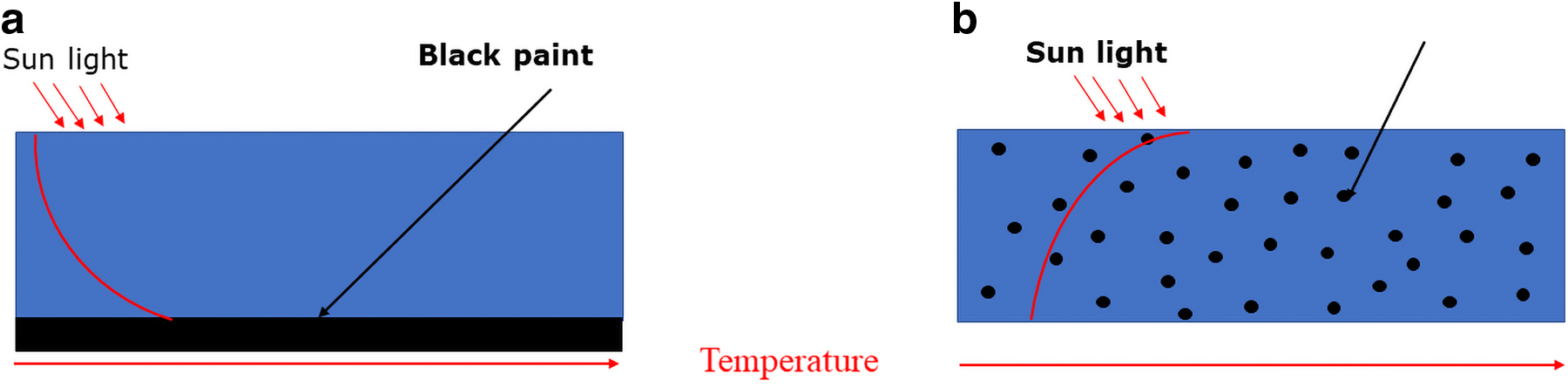
Water evaporation enhancement.
Although several materials, such as gold nanoparticles, titanium nitride, and titanium oxide, have been found to be effective in photothermal conversion, carbon materials are preferable because of their lower cost compared with expensive plasmons (Zeiny et al., 2018). Various forms of carbon nanofluid dispersions such as graphene, graphene oxide (GO), carbon nanotubes (CNT), and activated carbon, have also been investigated by research groups (Neumann et al., 2013; Ni et al., 2015; Liu et al., 2018; Ulset et al., 2018; Ghafurian et al., 2019a, 2019b; Wang et al., 2016). The evaporation rate is dependent on volume concentration, solar intensity, and other controlling factors (Hota and Diaz, 2019). Increasing the particle concentration reduces the optical depth and induces strong localized heating near the top surface of the water (Hota and Diaz, 2020). Similarly, to generate localized heat at the evaporating surface, floating absorbers have also been developed, either as a single layer or as a bilayer floating structure with a solar absorber coating at the top. Some examples of carbon-based floating solar absorbers are exfoliated graphite, activated carbon fiber felt, and carbonized wood (Ghasemi et al., 2014; Li et al., 2018b; Zhu et al., 2019; Ghafurian et al., 2020). Typical evaporation rates observed under 1 sun when using these materials range between 1 and 1.3 kg/m2-h.
Biochar has been used in the past for wastewater treatment (Hugging et al., 2016; Manyuchi et al., 2018; Kearns et al., 2020, 2021). It can be produced as biomass co-product from sustainable sources like algae (Hwang et al., 2016). Yang et al., (2019) demonstrated a bilayer structure with biochar made from algae bloom. They observed evaporation rates between 1.1 and 1.3 kg/m2-h. In a similar study, Li et al. (2018a) showed that biochar floating absorbers fabricated using the doctor blading method could produce steam in a solar autoclave at almost 121°C within 2 min in contrast to pure water steam generation, which takes more than 16 min. However, the long-term stability and degradation of bilayered materials is not yet available. Although the authors mentioned biochar to be a low-cost material, the actual cost analysis was not performed. In this study, biochar is proposed and analyzed for efficient solar water evaporation as both, volumetric dispersion and floating absorber with no support structure. Experimental results are compared against a mathematical model previously developed by the authors. In addition, a cost analysis is performed and compared with other forms of carbon materials available in literature. For solar-still based desalination, biochar can significantly increase freshwater productivity while keeping the capital cost of the system relatively low. In rural regions, this has the potential to increase access to freshwater as this is a prevalent concern in many developing regions [Mihelcic et al., 2017; United Nations Children's Fund (UNICEF) and World Health Organization, 2019].
Materials and Methods
Two types of biochar, Ponderosa pine (PP) (Pinus Ponderosa) and walnut shells (WS) (Juglans), were selected for the analysis, owing to their availability from forest and agricultural waste. Commercially available PP biochar was procured, where in the production process, the PP biomass was pyrolyzed at temperatures ∼750°C to 800°C. On the contrary, WS were procured from a local farm, where the feedstock was subject to a heating rate of ∼30°C/min and then maintained at 500°C for 45 min.
The biochar samples were dried in a gravity convection oven at 120°C. The PP biochar was smaller in size with shavings of sizes between 1 and 3 mm, whereas the WS biochar was a larger irregular sample with sizes varying from 5 to 15 mm. For powder characterization, the samples were initially crushed with an agate mortar and pestle and then passed through a #325 mesh sieve (<44 μm). These samples were then further grinded in a planetary ball mill for 24 h (Lyu et al., 2018). From the dynamic light scattering analysis, the size of the crushed particles obtained was between 853 ± 85 nm for PP and 813 ± 84 nm for WS particles.
Property characterization
An ultimate analysis was performed for these two types of biochar to obtain the C, H, N, S, and O composition following the procedures described in ASTM-D5373 and ASTM-D3177 standards. Table 1 shows that both samples yielded >75% of carbon fraction (by weight), 9.5% of oxygen for PP and 13.7% for WS, 2.43% of hydrogen for PP and 3.48% for WS, and a very small percentage of sulfur. A probable reason for the higher carbon content and lower fraction of hydrogen, oxygen, and nitrogen could be the higher pyrolysis temperature used for processing the PP biochar (Fan et al., 2019) compared with WS. It is noted that inorganic elements were also present in the samples, as was also noted in Chintala et al. (2013).
Ultimate Analysis of Ponderosa Pine and Walnut Shells Biochars
PP, Ponderosa pine; WS, walnut shells.
To analyze the structure of the samples a 13C-NMR spectrum was obtained using an Agilent T3 probe with standard 22 μL volume and 3.2 mm zirconia rotors with an Agilent DD2 console to determine the chemical nature of the biochar samples. Samples were spun at 7143 Hz and maintained at a nominal temperature of 20°C. 13C chemical shifts were referenced to tetramethylsilane as 0 ppm using a solid adamantine sample at 38.5 ppm. Figure 2a provides the 13C-NMR shift of both PP and WS biochars. The pyrolytic conditions resulted in both samples being predominantly aromatic (Jiang et al., 2017). The 127–128 ppm peaks correspond to aromatic C-H and 147 ppm bump corresponds to aromatic C-O. Of interest, some C = O groups (≈182 ppm), alkyl (aliphatic) groups (<90 ppm), and some carbons assigned to cellulose (72 ppm) were also detected (Link et al., 2008; Brewer et al., 2009). The literature suggests that aromatic biochars are hydrophobic in nature (Chintala et al., 2014). Hydrophobicity allows biochar to float on water and allows vapor to seep through the particle pores. Primarily, hydrophobic biochar can be used as a solar absorber material in a bilayered floating structure with low density and low conductivity, attached to a hydrophilic structure acting as a water transport channel (Gao et al., 2019).
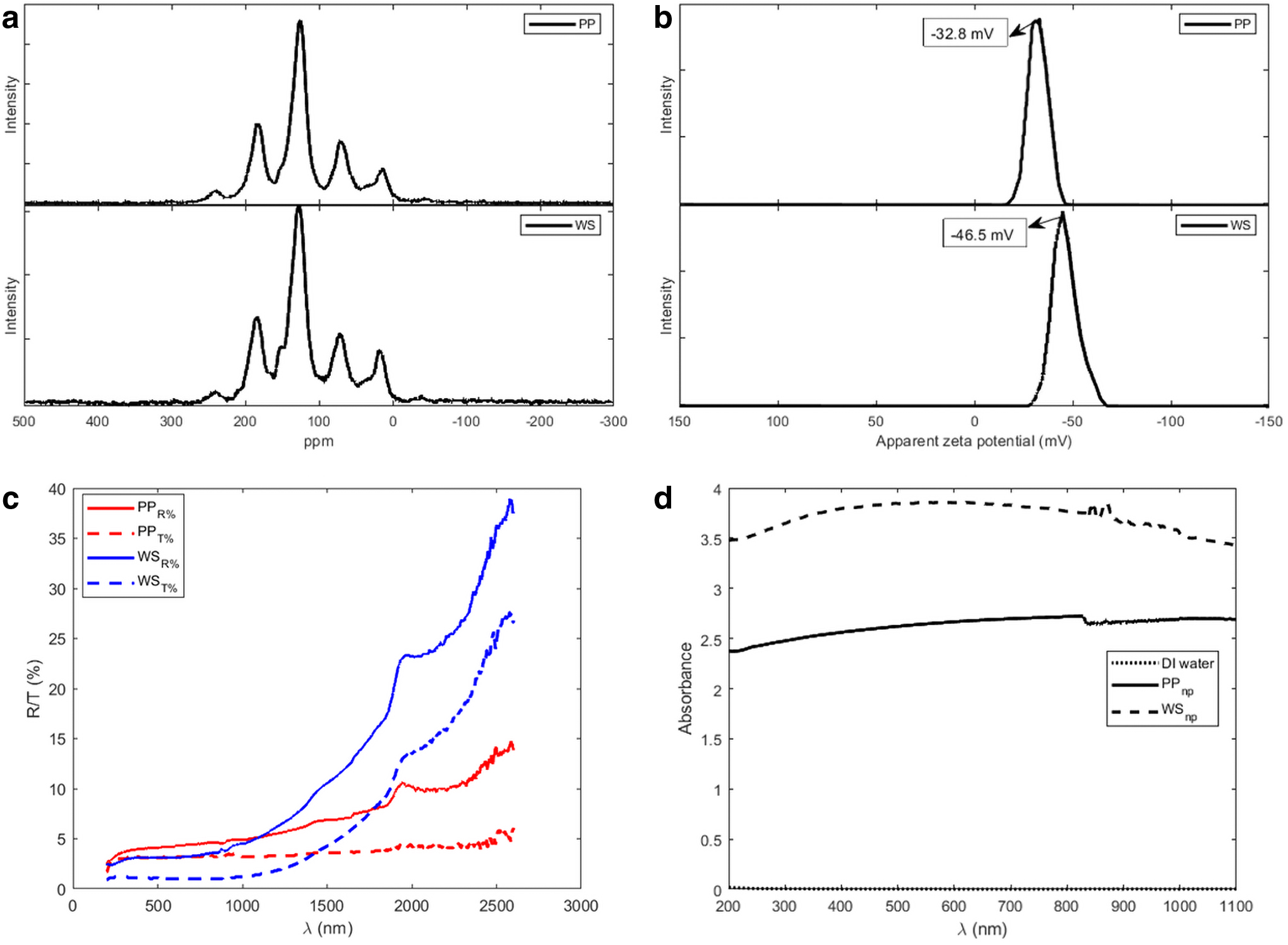
Biochar properties.
Biochar bulk (tap), envelope (geometric), and true (skeleton) densities were also measured to determine if the samples can be used as a single floating structure on water and/or as a dispersion in powder form. True (skeleton) density, which is the solid density of a particle, was measured by helium pycnometry in an Ultrapyc 1200e instrument. The values measured were 1622.4 kg/m3 for PP and 1414.6 kg/m3 for WS, respectively. Higher solid density in PP is partly because of higher pyrolysis conditions compared with WS. Further increase in pyrolysis temperature results in solid density close to that of graphite (Jäger et al., 1998). Geometry (envelope) density measured by mercury intrusion porosimetry (MIP) technique from an ultra-low pressure of 4.3 kPa (340 μm pore size) to 412 kPa (3.6 nm pore size). For both PP and WS samples, the envelope densities were 211.5 and 631.4 kg/m3, respectively. MIP also gives information on the pore content, that is, porosity and specific surface area. Higher porosity and surface area implies that there is more surface for water to evaporate; these higher surface areas are beneficial for increased water evaporation.
The theoretical porosity (φ) of the biochar calculated from true density (ρt) and geometry density (ρg) according to the equation
Zeta potential measurement is a powerful technique to measure the stability of the particle dispersion (Gaikwad et al., 2019). The biochar samples were tested on a Malvern ZetaSizer Nano ZS instrument equipped with a 4 mW HeNe laser operating at 632.8 nm and a scattering detector at 173°. Figure 2b provides the zeta potential curves for both PP (PPnp) and WS (WSnp) dispersions. The zeta potential of PPnp was −32.8 mV with a standard deviation of 4.76 mV. The corresponding apparent zeta potential of WSnp and its standard deviation were −46.5 and 6.4 mV, respectively. A zeta potential greater than |±30| mV is known to have a good stability (Gumustas et al., 2017), whereas a minimum value of ±20 mV is desirable (Gupta and Trivedi, 2018). Both samples show a good degree of stability in dispersion form. Good stability implies that the particles will continue to be dispersed and will not agglomerate at the bottom of the water basin. Therefore, the results show good characteristics of the biochar material for evaporation enhancement.
Optical characterization
Biochar is inherently black in appearance and hence lends to strong solar absorption. The reflectance and transmittance were measured in a Shimadzu 3600 UV-Vis-NIR spectrophotometer. For use as a floating absorber, the particle was coated on a glass substrate using an integrated sphere, where the reflectance (R%) and transmittance (T%) were measured in the range between 200 and 2500 nm. The absorbance of the liquid dispersion was measured in the same instrument with deionized (DI) water as the reference. Using a substrate, in this case, is similar to having a bilayered coating absorber structure, where the biochar is coated on the top of a porous insulating layer to improve water evaporation.
The reflectance and transmittance of the PP and WS samples are given in Fig. 2c, where the combined weighted reflectance and transmittance were <8% and 5% for PP and WS samples, respectively. The subscripts “R” and “T” represent reflectance and transmittance, respectively. This implied that the weighted solar absorptance was 92% and 95% for the PP and WS samples.
When used as a solid dispersion in fluid, the entire fluid column contributes to an efficient trapping (attenuation) of solar light. Strong heat localization and enhanced surface temperatures can be obtained as the light attenuation depth is made small compared with the fluid column depth. Figure 2d provides the absorbance of the dispersion system at biochar mass concentration of 1 g/L. Water has low attenuation coefficient between 200 and 1100 nm and hence the strength of absorbance (or decay of light transmission) is very low. Adding biochar increases the optical quality for strong photothermal conversion. As observed, for a path length of 10 mm, the average absorbance for PPnp and WSnp samples is 2.6 and 3.7, respectively, indicating a total transmittance of 0.25% and 0.02%, respectively, which translates into solar light absorptance within 10 mm between 99.75% and 99.98%, respectively. It was observed that increasing concentration results in strong heat localization at the top of the fluid column generating high temperatures, thereby increasing the evaporation rate (Hota and Diaz, 2019).
Increasing the pyrolysis temperature increases the absorption coefficient property of the material (Jäger et al., 1998). Weber and Quicker (2018) propose that increasing the treatment temperatures >500°C results in loss of hydrophobicity as nonpolar functional groups decrease in intensity as opposed to developing polar groups. However, previous published works have shown that higher pyrolysis temperature relates to lower dispersion stability (Yuan et al., 2011; Hong et al., 2019) and thus very high pyrolysis temperature might be ineffective or even detrimental for the proposed application. In addition, very high dispersion concentration could lead to particle agglomeration thereby reducing dispersion stability (Ghafurian et al., 2019b). It is thus important to determine the optimum pyrolysis conditions for high quality of biochar (high carbon content), yet stable in dispersion form.
Experimental setup
A set of experiments was performed under controlled indoor conditions using a 1000 W halogen lamp as a solar simulator. The height was adjusted such that 1 kW/m2 irradiance was incident on the samples. In the case of dispersions, the concentration was set at 1 g/L, and in the case of floating particles, 5 g of particles was sufficient to cover the entire water surface. DI water was also used for comparison purposes. The mass loss of water from these samples was recorded from a 42-mm diameter and 15-mm deep Petri dish under ambient conditions of 21°C ± 1°C and 35% relative humidity. A schematic of the experimental setup is given in Fig. 3. A 0.1 mg precision analytical balance was used to measure the loss of water owing to evaporation. Temperature and relative humidity sensors were used to measure ambient conditions and a calibrated type-J thermocouple was used to measure the water temperature. The hourly evaporation rate was calculated as:

Experimental setup.
where M is the mass of water evaporated at time (t) and A is the surface area of the container. Furthermore, the evaporation efficiency was calculated as
where, hfg is the latent heat of vaporization and I is the incident energy. The uncertainty of measurement R(x,y,z,…) is calculated according to the error propagation principle as:

This type of expression was used to calculate the error propagation of the evaporation rate and evaporation efficiency.
Mathematical model
A mathematical model developed by Hota and Diaz (2019, 2020) was used to compare the results of the experimental tests and to predict the performance conditions of 1 sun (1 kW/m2) with air mass 1.5 spectrum. The model was developed so that, for the DI water and the biochar dispersion system, the light is absorbed within the fluid column and in the case of floating absorber, the incident energy is absorbed at the surface. The evaporation heat flux was calculated at the water surface.
For a dispersion system, the governing heat and mass balance equations take the following form (Hota and Diaz, 2019, 2020):
For the evaporating surface:

For the bulk volume:

where, m is the evaporation mass flux of water (kg/m2-s), q is the rate of volumetric heat generation owing to solar absorption in the dispersion-fluid system. This can be calculated by the simplified form of the Beer-Lambert law, given as:
where, y is the optical depth of light penetration, and βext is the extinction coefficient of the dispersion-fluid system. The extinction coefficient can be calculated by the widely used Mie theory.
In the case of floating structures, a simplified form of evaporation from the surface proposed by Ni et al. (2016) is utilized:
whereas for bulk volume, Equation (2) is used. The property α is the solar absorptivity of the material. The thermal conductivity for the surface material used is 0.3 W/m-K, assuming this as the weighted average of the water filled porous biochar (Weber and Quicker, 2018).
Results and Discussion
The measured mass loss of water under the solar simulator is given in Fig. 4a, where it is seen that within 1 h, ∼4.3 g of water evaporated from the container for the case of floating biochar. This is a minor improvement in the rate of evaporation with respect to pure water. On the contrary, for the biochar dispersion, ∼5.8 g of water evaporated during the same amount of time.

Experimental and simulation results.
The mathematical model was used to simulate the evaporation rate of water (kg/m2) for 1 h of exposure to the light, using the spectrum of the halogen-lamp solar simulator. The results were compared with the experimental results, as given in Fig. 4b, whereas the respective surface temperature profile is given in Fig. 4c. It is observed that the numerical simulations trace the experimental results well for the evaporation rate, except for a deviation that occurs after 1800 s in the case of dispersions. There is a larger deviation with respect to the surface temperature change with respect to time, although the general trend is captured by the simulations. It is to be taken into account that the optical constants for activated carbon (which is 99% carbon) were used for the simulations because the optical constants for biochar are not currently available. However, one of the major differences is that the model does not account for the natural convection effects in the water. Convective currents will mix the water in the entire volume, effectively lowering the temperature near the surface, and therefore lowering the evaporation rate, as given in Fig. 4b and c. For the case of floating biochar particles, it can be seen that the evaporation rate of water is lower than that of dispersions and the surface temperature for the dispersion is higher than for the floating biochar particles.
To analyze the effect of the water depth, another set of experiments and simulations were performed with a 55-mm deep flask, as given in Fig. 4d, where it can be seen that the simulation results closely trace the experimental evaporation data points. The measured evaporation rate of pure water after 1 h ranged between 0.77 ± 0.02 kg/m2-h (Petri dish) and 0.6 kg/m2-h (flask). With floating particles, the observed evaporation rate was 0.8 ± 0.01 kg/m2-h (Petri dish) and 0.75 kg/m2-h (flask), whereas for the dispersions, the evaporation rate was 0.97 ± 0.03 kg/m2-h (Petri dish) and 0.85 kg/m2-h (flask). The corresponding evaporation efficiencies were 51.3% for DI water, 53.7% for floating particles, and 64.7% for biochar dispersions in the Petri dish. The maximum calculated uncertainty in evaporation efficiency was 3.83%. One of the reasons for the low enhancement rate observed could be owing to the peak of the halogen lamp spectrum being close to the NIR region, where water has good absorption properties. The significance of adding biochar dispersions in water is to enhance the photothermal conversion in the UV and visible spectrum of the solar energy.
As the developed model provides a close resemblance of the experimental results, to verify the performance of the added carbon particles with respect to the solar spectrum, a numerical simulation was performed using air mass 1.5 solar spectrum to estimate the enhancement in evaporation rate of water, as is given in Fig. 5. As expected, because DI water is almost transparent in the majority of solar spectrum, the steady-state evaporation rate of water is only ∼0.2 kg/m2-h, whereas for the floating particles, it is 0.95 kg/m2-h and with the dispersions, the evaporation rate is 1.08 kg/m2-h, which shows very good evaporation enhancement capabilities of these materials. The evaporation efficiency is only 13.3% for DI water under the solar spectrum, whereas for floating particles it is 63.3%, and 72% for biochar dispersions. The evaporation efficiency for floating particles is slightly lower than in other studies involving biochar, perhaps because the effective thermal conductivity of biochar is higher than the bilayered structures that are made of low-conductivity porous floating materials.
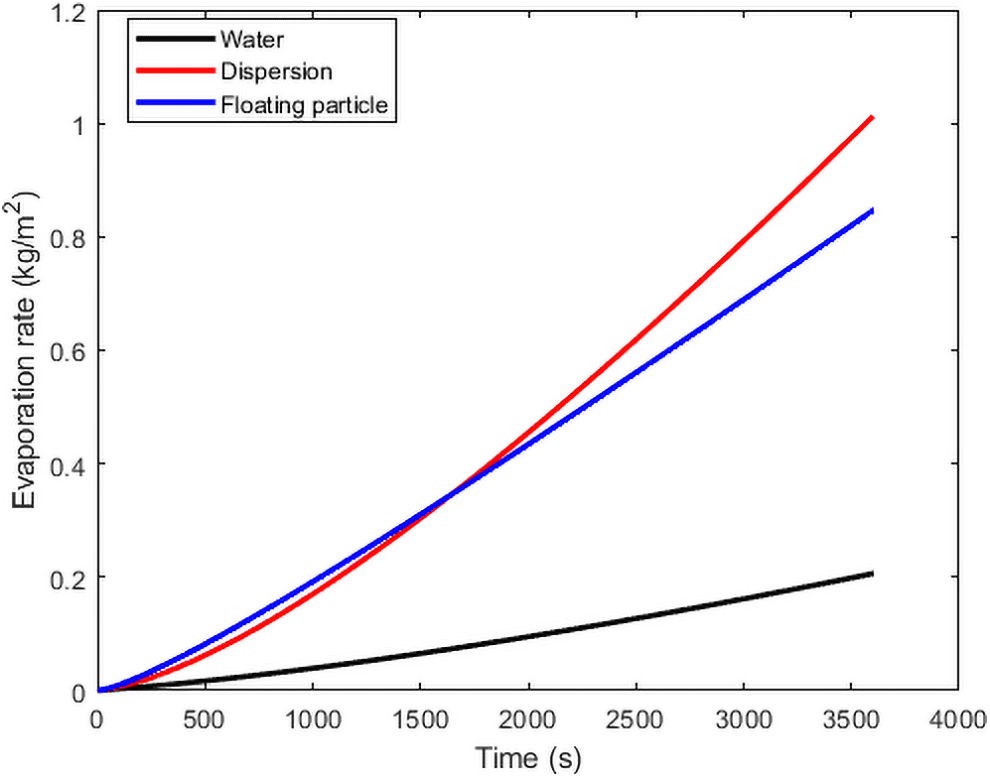
Evaporation rate of water for DI water, floating particles, and particle dispersions.
Cost analysis
The cost of the biochar used in this study was $1.3/kg. The cost of crushed biochar from the calculations presented by Lyu et al. (2018) is $7.18/kg (batch calculations). The cost of biochar for evaporating 1 L of water per hour was calculated and compared with other forms of carbon materials found in the literature, such as carbon-wood system (C-wood system) (Luo et al., 2018; Yu et al., 2019), carbonized towel-gourd sponges (CTGS) (Shan et al., 2020), CNT-dyed cotton fabric (C+CNT+F) (Kou et al., 2019), carbon black on paper with expanded polystyrene foam insulation (CB+P+EPS) (Liu et al., 2017), multiwall carbon nanotubes (MWCNT), single-wall carbon nanotubes (SWCNT), and GO (Ghafurian et al., 2019a, 2019b).
The cost comparison analysis for 1 L per hour of water evaporation for both the floating and volumetric dispersions of biochar (WS) against other carbon-based solar absorber materials published in the literature is given in Fig. 6. For floating particles, walnut shell (WSp) results in a water evaporation cost of only $1.13 for 1 L of water evaporated per hour. Although the cost analysis of algae bloom-based biochar was not mentioned in Yang et al. (2019), the cost of evaporating 1 L of water per hour is expected to be around the same value as obtained here (Chakraborty et al., 2020). The cost of water obtained from carbonized wood is $1.52/L, and for CTGS (Shan et al., 2020) it is $2.61/L. With floating composite structures made of carbon-based materials, the cost of evaporation is $2.72/L for C+CNT+F, and $1.44/L for CB+P+EPS. In the case of volumetric dispersions, the cost of evaporation with biochar (WSnp) is expected to be $1.33/L, which is significantly lower than other researched materials such as MWCNT, SWCNT, and GO, which have a cost of $10.01/L, $372.16/L, and $1665.17/L, respectively. It can be noted that the cost of crushing the biochar could be further reduced in large-scale production, and so the cost of evaporation could be lower than what is reported here.
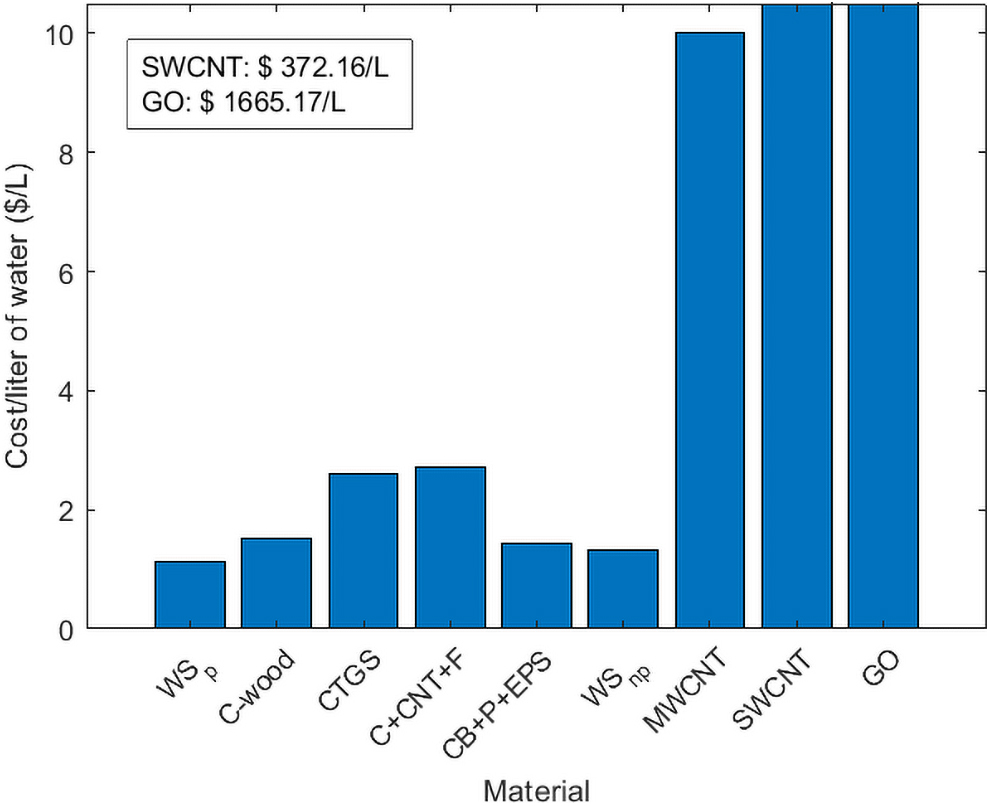
Cost comparison analysis of biochar floating and dispersions against other carbon-based materials published in the literature.
The estimated cost of actual biochar is expected to be only ∼$150/ton. If an additional cost of $150/ton is added for crushing, then the water output of a solar still is expected to increase by >60% under normal 1 sun solar energy with <5% increase in system cost. Therefore, biochar presents a feasible alternative to low-cost water evaporation enhancement that can be applied to inexpensive desalination systems such as solar stills.
Conclusions
Biochar has been analyzed and found to be a low-cost carbon material that has the potential to be used as an efficient solar absorber, enhancing water evaporation using solar energy. The properties characterization showed biochar to have >75% carbon in its composition and has the ability to form stable dispersions in water. The solar absorptivity is >92%, which is similar to some of the other solar absorbers being investigated in the literature. In dispersion form, the solar light transmittance is <1% for a 10-mm light travel path with only 1 g/L concentration. The evaporation rate of water with biochar in water is of the order of 1–1.1 kg/m2-h, which is significantly higher than for pure water. The cost of biochar as solar absorber for similar rates of water evaporation is significantly lower than for other carbon materials that have been investigated for this application.
Footnotes
Acknowledgments
The authors thank Dr. David Rice (NMR facility, UC Merced) and Dr. Lynette Cegelski from Stanford University for help with C-NMR spectroscopy. Support extended by Dr. Yue Wang, Dr. Robert Jordan, and Dr. Sarah Kurtz for optical characterization is highly appreciated. The authors also thank Professors Linda Hirst, James Palko, and Min Hwan Lee for providing access to their laboratory equipment.
Author Disclosure Statement
The authors declare that they have no known financial interests or personal relationships that could have influenced the work reported in this article.
Funding Information
Significant portion of the work was supported with funding from California Energy Commission contract # GFO-16-503 and USDA NIFA contract #2-15-67021-24117. Support and feedback by Dr. Edbertho Leal-Quiros and Dr. Sankha Banerjee from California State University at Fresno for characterization recommendations is appreciated.