







Abstract
The anaerobic ammonium oxidation (Anammox) process can effectively treat the landfill leachate. However, the influences of complex components in landfill leachate on anammox bacteria were insufficiently understood. In this study, the single and combined influences of salinity and humic acid on the anammox process were investigated. The results showed that the initial nitrogen removal performance and the specific anammox activity in the salinity/humic acid group were lower than that of the single salinity or humic acid group. The simulation results of modified Boltzmann model showed that the median recovery time of the salinity/humic acid group was 18.82 days, which was 7.84 days longer than that of the salinity group alone. The reduction of electron transport system (ETS) activity might be the main reason for the deterioration of anammox activity. The ETS activity of the salinity/humic acid group was lower than that of the humic acid group or the salinity group, and was only 31.09% of the control group. The coexistence of salinity and humic acid resulted in the decrease of S = O and C–O functional groups, which related to the expression of electron transport enzymes and then disturbed seriously the ETS activity of anammox sludge.
Introduction
Landfill leachate contains high concentrations of organic matter, ammonia, inorganic salts, heavy metals, and xenobiotics (Abuabdou et al., 2020; Luo et al., 2020). The organic matter mainly includes easily degradable volatile organic acids and refractory humic acid (Iskander et al., 2018). In mature landfills, the content of humic acid accounts for 60% of the organic matter (Artiola-Fortuny and Fuller, 1982), and the concentration of ammonia nitrogen can be as high as 150–5500 mg/L (Renou et al., 2008; Luo et al., 2020). Because of biodegradation and evaporation accumulation, the nutrient elements in the mature landfill leachate are imbalanced, which is manifested by low carbon to nitrogen (C/N) ratio and high content of refractory organic matter (Kulikowska and Klimiuk, 2008).
As reported, the C/N ratio of mature landfill leachate is <3 (Miao et al., 2016). The C/N ratio >6 in the denitrification reaction is sufficient for nitrogen removal and a C/N ratio <4 has been regarded as carbon source deficiency (Renou et al., 2008). Therefore, the traditional denitrification process not only has high energy consumption, but also requires the addition of carbon source, which greatly increases the cost of wastewater treatment.
Anaerobic ammonium oxidation (Anammox) is a novel denitrification process, in which microorganisms use
Recently, the researches on the anammox process treating landfill leachate mainly focused on the nitrogen removal performance and organic matter (Miao et al., 2016; Phan et al., 2017). The influence of various complex components in landfill leachate (such as salts and humic acid) on anammox bacteria has not attracted enough attention.
As known, humic acid is a kind of refractory organic substances, which contains many active functional groups, such as carboxyl groups, quinone groups, phenolic hydroxyl groups, alcoholic hydroxyl groups, and ketones (Yang et al., 2014). According to Kraiem's study, the anammox activity would be affected with the humic acid of 70 mg/L, and the anammox activity decreased to 57% when the concentration of humic acid was 200 mg/L. The main reason was that humic acid promoted heterotrophic denitrifying bacteria to be the dominant bacteria, which competed with anammox bacteria, then inhibited the growth of anammox bacteria (Kraiem et al., 2019).
High salinity would cause a sharp increase in osmotic pressure, induce cell decomposition, and inhibit microbial growth and enzymatic actions, which might change the biochemical characteristics of sludge and the microbial community structure (Huang et al., 2018). Anammox bacteria could improve salinity tolerance through gradual acclimation to the salt change (Jin et al., 2011), but the inhibitory effect on the anammox bacteria would exert if salinity concentration exceeding a certain range. Moreover, there is not only high salinity but also high humic acid in the landfill leachate; it still faces serious challenges in actual project that treated the landfill leachate by anammox process. The current researches were more focused on the effect of single humic acid or salinity on the anammox system. However, the influences of the combined salinity and humic acid on anammox bacteria were still a lack of understanding.
The aims of this study were to investigate the influence of combined salinity and humic acid on the performance of nitrogen removal and the anammox activity, to reveal the recovery kinetics of anammox activity after the inhibition conditions, to analyze the combined effects of salinity and humic acid on the anammox bacteria, and to provide more knowledge for the anammox treatment of landfill leachate.
Materials and Methods
Inoculated sludge and synthetic wastewater
In the experiment, the inoculated anammox sludge was taken from the sequencing batch anammox reactor, which has been operating stably for 2 years in the laboratory. The concentration of mixed liquor suspended solid (MLSS) and mixed liquid volatile suspended solids (MLVSS) was 3.46 ± 0.27 and 2.65 ± 0.33 g/L, respectively. The specific anammox activity (SAA) of the inoculated anammox sludge was 37.96 ± 0.36 mg
Experimental design
The experiment was carried out in the serum bottles. The effective volume was 0.2 L and 50% supernatant (100 mL) was exchanged daily by injectors. The hydraulic retention time was 48 h. The compositions of the exchanged solution were sodium acetate, humic acid, nitrite, ammonia, and medium solution, as given in Table 1. The nitrogen gas (purity of 99.99%) was purged through the headspace. The serum bottles were placed in an air bath shaker with the temperature of 35°C and the speed of 150 rpm. R0 was the control group, R1 was the salinity group, R2 was the humic acid group, and R3 was the salinity/humic acid group. The experimental operating parameters are given in Table 1.
The Compositions of the Influent Solution
In the first stage (0–25 days), the molar ratio of nitrite to ammonia was 1.32:1 and the concentrations of nitrite and ammonia were 132 and 100 mg/L, respectively. To reduce the accumulation of nitrite, which is caused by the inhibition of salinity and humic acid, the molar ratio of influent nitrite and ammonia was reduced to 1:1. The concentrations of nitrite and ammonia were both 100 mg/L in the second stage (26–60 days) and the third stage (61–72 days). In the fourth stage, the ratio of nitrite to ammonia was adjusted back to 1.32:1, and the concentration of nitrite and ammonia was 100 and 132 mg/L, respectively.
In the first and second stages, the salinity (NaCl) concentrations in R1 and R3 were both 1 g/L, and the concentrations of humic acid in R2 and R3 were both 50 mg/L. In the third and fourth stage, the salinity (NaCl) concentrations in R1 and R3 were increased to 5 g/L, and the concentrations of humic acid in R2 and R3 were increased to 200 mg/L. The concentrations of NaCl and humic acid were defined as the mass concentrations in the influent solution.
Other analytical methods
The effluent samples were taken from the serum bottles daily to determine the concentration of
The EPS were extracted by cationic resin method (Frølund et al., 1996). The polysaccharide and protein in EPS were measured by phenol-sulfuric acid method (Masuko et al., 2005) and a modified version of the Lowry method (Komsa-Penkova et al., 1996), respectively. In addition, the supernatant of the extracted EPS was freeze-dried (−80°C) in a freeze dryer (BT2KXL; SP Inc., USA) for 24 h, and then the infrared spectroscopy determination was performed with a Fourier transform infrared spectrometer (FTIR spectrometer; Bruker, Germany) (Fang et al., 2018). The ETS activity of sludge was analyzed by the 2-para (iodo-phenyl)-3(nitrophenyl)-5(phenyl) tetrazoliumchloride method, which referred to the previous study (Wang et al., 2016).
Recovery kinetic model and data calculation
Recovery kinetic model
Kinetic models are widely used to simulate processes of the microbial reaction. At present, the recovery kinetic models applicable to anammox reactors mainly include modified Logistic model (modified L-model), modified Boltzmann model (modified B-model) (Jin et al., 2013b), and modified Gompertz model (modified G-model) (Wang and Wan, 2009). Origin 2018 (Origin Lab Corp., USA) was used for data fitting of the model in this study.
Data calculation
At end of every stage, the supernatant was taken from serum bottles to determine the SAA and the relative anammox activity (RAA). The SAA of sludge in the reactor is calculated based on the conversion rate of ammonia and the concentration of sludge. The samples were analyzed hourly.
where SAA represents the SAA of sludge (
Y represents the concentration of the sludge in the reactor (g MLVSS/L).
Δt represents the reaction time (days).
The influence of salinity and humic acid on the anammox activity is expressed as the RAA, which is calculated according to Equation (2).
where SAA i represents the SAA value of each group at each stage;
SAA o represents the SAA value of the control group at each stage.
The experimental data were analyzed by Origin 2018 and the significance test was conducted by the one-way analysis of variance at the level of 0.05.
Results and Discussions
Influence of salinity/humic acid on the nitrogen removal performance of anammox process treating landfill leachate
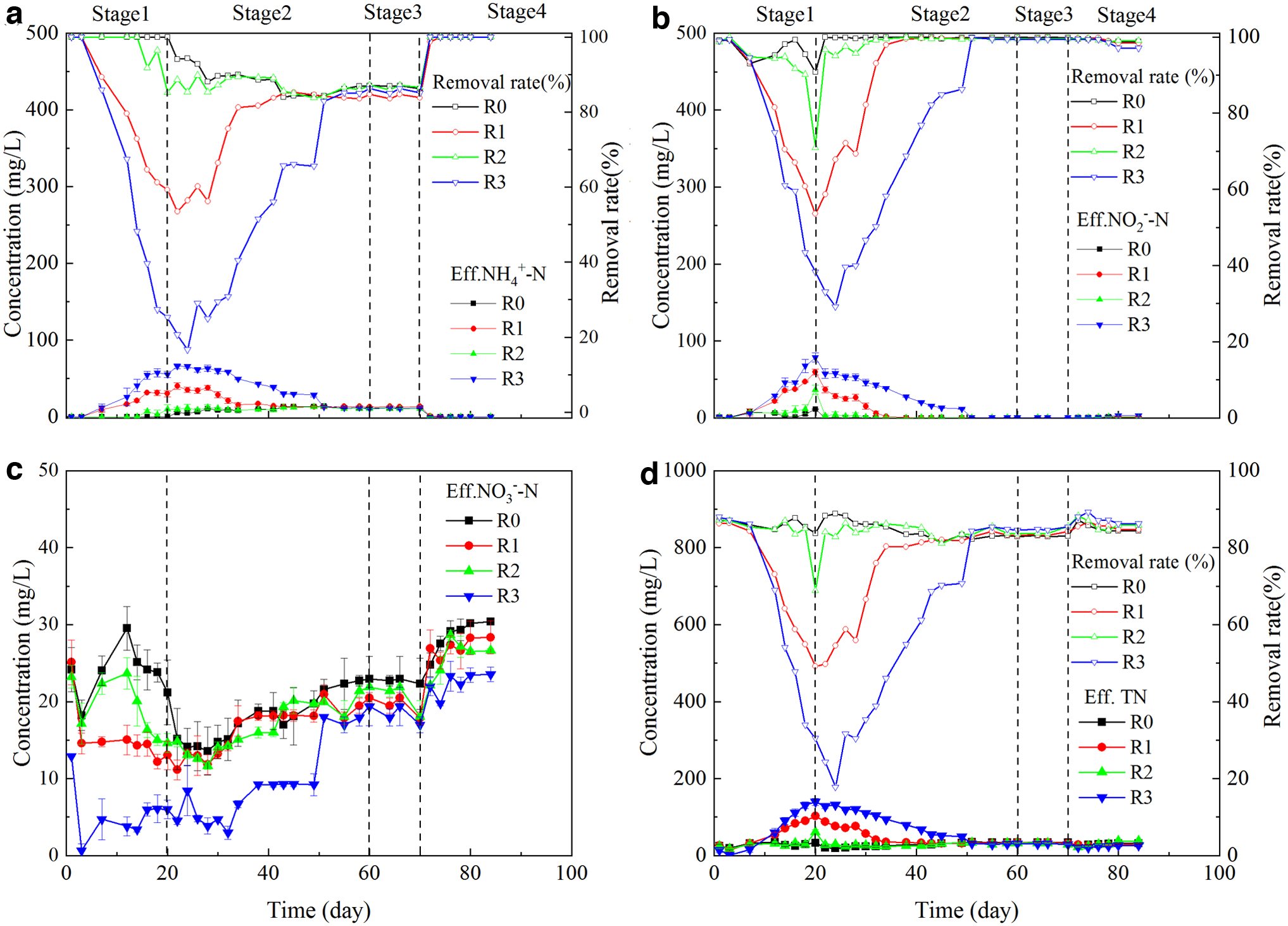
The influence of salinity/humic acid on the nitrogen removal performance of anammox process treating landfill leachate is given in Fig. 1. In stage 1 (0–20 days), the salinity (NaCl) concentrations in R1 and R3 were both 1 g/L, and the concentrations of humic acid in R2 and R3 were both 50 mg/L.
The influence of salinity/humic acid on the nitrogen removal performance of anammox process treating landfill leachate:
As given in Fig. 1, when salinity and humic acid existed in the anammox reactors, anammox bacteria was sensitive to these conditions and the performance of nitrogen removal was affected (Jin et al., 2012). The nitrogen removal performance in R1 group (salinity), R2 group (humic acid), and R3 group (salinity/humic acid) were all worse than R0 group (control group). The performance of R3 group was the worst. On the 20th day, the total nitrogen removal rate (NRR) of R0, R1, R2, and R3 group was 83.71%, 49.21%, 68.87%, and 30.54%, respectively. The results indicated that salinity and humic acid exerted a stress inhibitory effect on anammox bacteria.
At the end of the first stage, the nitrite of R1, R2, and R3 group began to accumulate. Nitrite is a potential inhibiting compound (Lotti et al., 2012). As reported previously, nitrite is strongly inhibitive when the concentration was low as 5 mg/(N·L) (Wett, 2007) and 40 mg/(N·L) (Fux, 2003). To avoid the inhibition of high concentration of nitrite on the anammox bacteria, in the second stage (21–60 days), the molar ratio of influent nitrite to ammonia was reduced to 1:1, and the concentration of nitrite and ammonia was both 100 mg/L. It could be seen that in the second stage, the concentration of nitrite in the effluent began to decrease, and the NRR in anammox reactors began to gradually recover.
It was worth noting that in the R2 group (humic acid group), the removal rates of
A total of 50 mg/L of humic acid had little effect on the nitrogen removal in the anammox system, and the nitrogen removal was 68.87% and the NRR was recovery after 2 days. The total NRR in R1 group (salinity group) was 49.21% and gradually recovered after 14 days. The total NRR in R3 group (humic acid/salinity group) was 30.54% and needed 31 days to recover to the control level, which was 17 days longer than that of R1 group. This result indicated that humic acid had little influence on the NRR in the anammox system, but when humic acid coexisted with salinity (31 days), the inhibitory effect was far greater than that of the single salinity (14 days) or humic acid (2 days). It meant that a synergistic inhibition was exerted when salinity and humic acid coexisted in the anammox reactor.
As known, humic acid contains carboxylic, phenolic, ketonic, aromatic, and aliphatic groups, and so on, and interacted with both living and nonliving matter (Steinberg et al. 2008). Humic acid might interact with salinity, disturb the electron transport process of microorganisms, and then generate a more inhibitory effect on anammox bacteria.
In stage 3 (61–70 days), the total NRRs of R0, R1, R2, and R3 were 82.98 ± 0.08%, 83.50 ± 0.49%, 84.17 ± 0.95%, and 84.85 ± 0.37%, respectively. It indicated that the anammox bacteria had a certain tolerance to salinity and humic acid after the previous adaptation period, and the NRR in the system remained stable. In stage 4 (71–80 days), the concentrations of salinity and humic acid were maintained at 5 g/L and 200 mg/L, respectively, and the ratio of ammonia to nitrite was adjusted to 1:1.32. The total NRR of R0, R1, R2, and R3 remained 85.13 ± 1.08%, 85.48 ± 0.76%, 86.08 ± 1.42%, and 87.33 ± 1.15%, respectively. The inhibition of salinity and humic acid on nitrogen removal performance in anammox process were recovered, and the anammox bacteria had a certain tolerance to salinity and humic acid.
The total NRR of R1, R2, and R3 were higher than the control group (R0) at stages 3 and 4. Huang et al. (2021) reported that salinity changes impelled the dynamics of anammox bacteria and the symbiotic bacteria favored the dominance of salt-adapted anammox bacteria. Furthermore, the anammox performance was enhanced at proper fulvic acid concentration that potentially was owing to the interaction between some heterotrophic bacteria and anammox bacteria (Zhang et al., 2020). The similar result was also obtained when the anammox bacteria were exposed to proper concentration of humic acid and salinity. However, the synergistic inhibition at the initial stage, which was caused by the coexistence of salinity and humic acid in anammox reactor, would not be ignored.
Influence of salinity/humic acid on the SAA of sludge
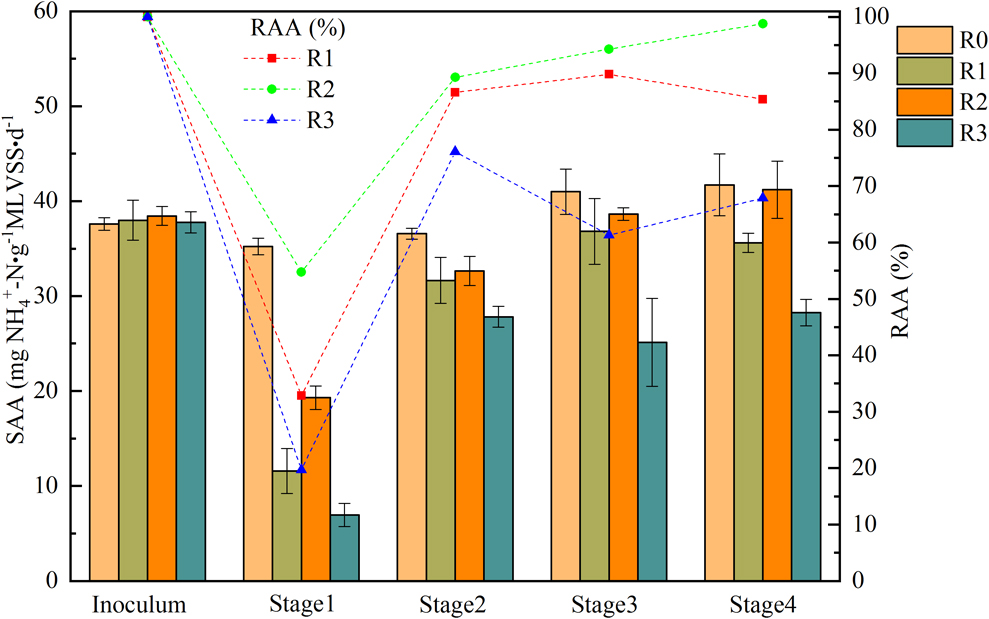
The effect of salinity and humic acid on the SAA of sludge is given in Fig. 2. In stage 1, because the anammox bacteria have not been adapted to the conditions with salinity and humic acid, the SAA of sludge was severely inhibited. The SAA of R1 group decreased to 11.58 ± 2.36 mg
The influence of salinity/humic acid on the SAA of sludge. MLVSS, mixed liquid volatile suspended solids; RAA, relative anammox activity; SAA, specific anammox activity.
In the R3 group, which existed in two inhibitory factors at the same time, the activity of anammox bacteria was severely inhibited. The SAA of sludge decreased to 6.96 ± 1.22 mg
In the second stage, as the anammox bacteria began to adapt to the conditions of salinity and humic acid, the anammox activity gradually recovered. On the 60th day, the SAA of sludge in R1, R2, and R3 returned to 31.66 ± 2.43, 32.65 ± 1.54, and 27.83 ± 1.10 mg
In the fourth stage, the SAA of R1, R2, and R3 was 35.62 ± 1.01, 41.20 ± 3.02, and 28.27 ± 1.38 mg
As reported previously, a salt concentration of 45 g/L would reversibly inhibit anammox bacteria (Kartal et al., 2006), because high salinity inhibited the expression of hydrophilic functional groups on the surface of anammox sludge, and high content of Na+ hindered the combination of metal ions and EPS (Fang et al., 2018). In addition, humic acid competed with anammox bacteria for electrons and then affected the anammox activity (Fang et al., 2018). Therefore, when salinity and humic acid existed at the same time, the anammox bacteria were subject to the two superimposed inhibitions, and the electrons transfer system of anammox bacteria was significantly disturbed.
Recovery kinetic analysis of anammox process after salinity/humic acid inhibition
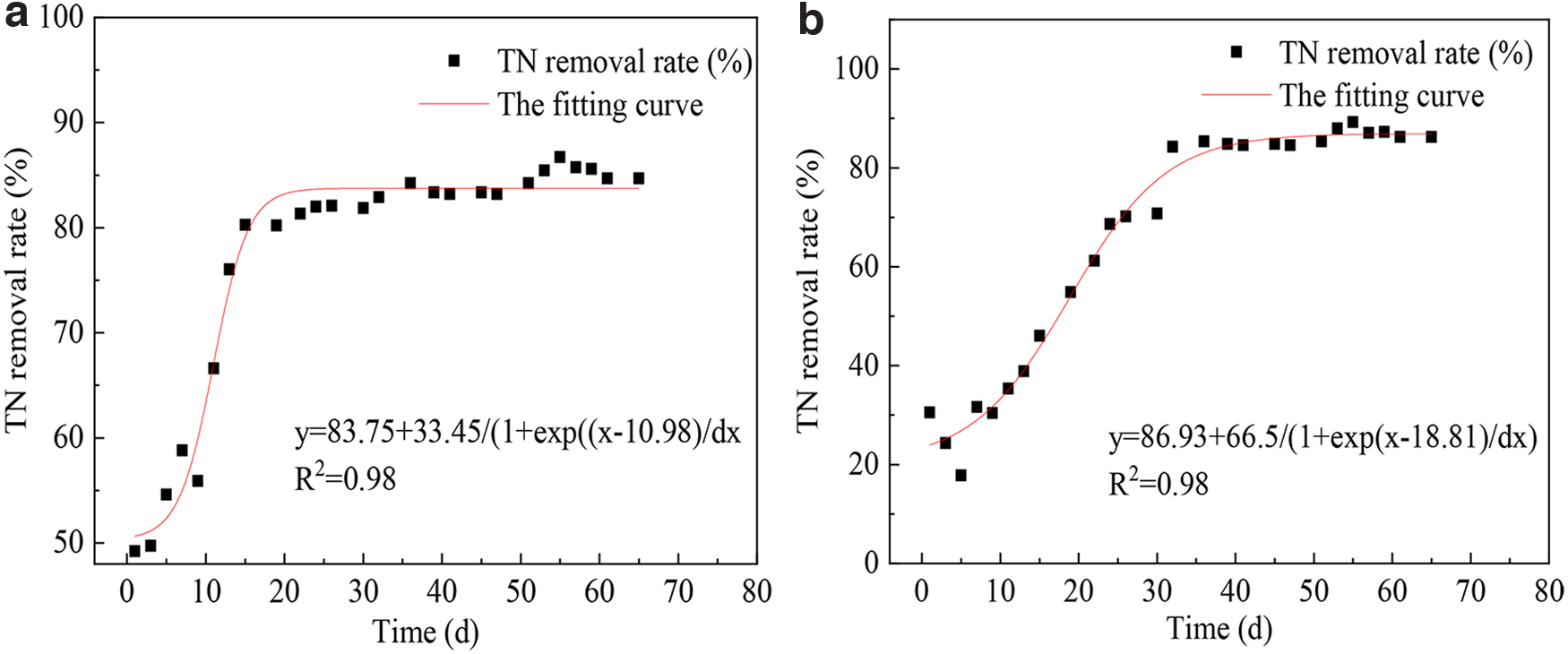
As discussed previously, the SAA and the NRR in R1 and R3 group were severely inhibited in the first stage (Fig. 3). Humic acid had little effect on anammox process, whereas the coexistence of salinity and humic acid had the most serious inhibition on the nitrogen removal and the SAA. Therefore, the influence of humic acid on the salinity-containing anammox reactor was mainly focused in this section. The modified Boltzmann model (modified B-model), the modified Logistic model (modified L-model), and the modified Gompertz model (modified G-model) were used to simulate the recovery kinetics of anammox process (Jin et al., 2013a).
Recovery kinetics simulation curves of anammox process after salinity and humic acid inhibition:
As given in Table 2, all three models had a high correlation coefficient and R2 were all >0.95, indicating that the model parameters can reflect actual states. The modified B-model had the highest correlation, and the correlation coefficients of R1 and R3 group could reach 0.98. Moreover, the relative error of NRRmax of R1 and R3 group between the modified Boltzmann model and the true value was the smallest, which was 2.97% and 1.01%, respectively. Therefore, the modified B-model was the most propitious to simulate the recovery kinetics of anammox process after inhibition of salinity and humic acid. The result was consistent with a previous study that the modified B-model was more suitable for the recovery of anammox process (Jin et al., 2013b).
Fitted Parameters of Mathematical Modes of Anammox Process after Salinity and Humic Acid Inhibition
max, maximum; min, minimum; NRR, nitrogen removal rate.
According to the results of the modified B-model, the median recovery time tc of R1 and R3 group was 10.98 and 18.82 days, respectively. The result suggested that it needed more time to restore the anammox activity in R3 group and implied that a synergistic inhibitory effect of salinity and humic acid would prolong the recovery time of the anammox activity. The coexistence of humic acid made it worse to restore the anammox activity in salinity-containing anammox system, which had been inhibited by salinity. The reason might be that the humic acid affected the expression of key genes, which related to signal transduction and stimulated the abundance of hzs and hdh, the two important enzymes in anammox reaction (Meng et al., 2019). Therefore, it might affect the secretion of EPS of anammox bacteria or ETS when salinity and humic acid coexisted in the anammox process.
Influence of salinity/humic acid on EPS of sludge
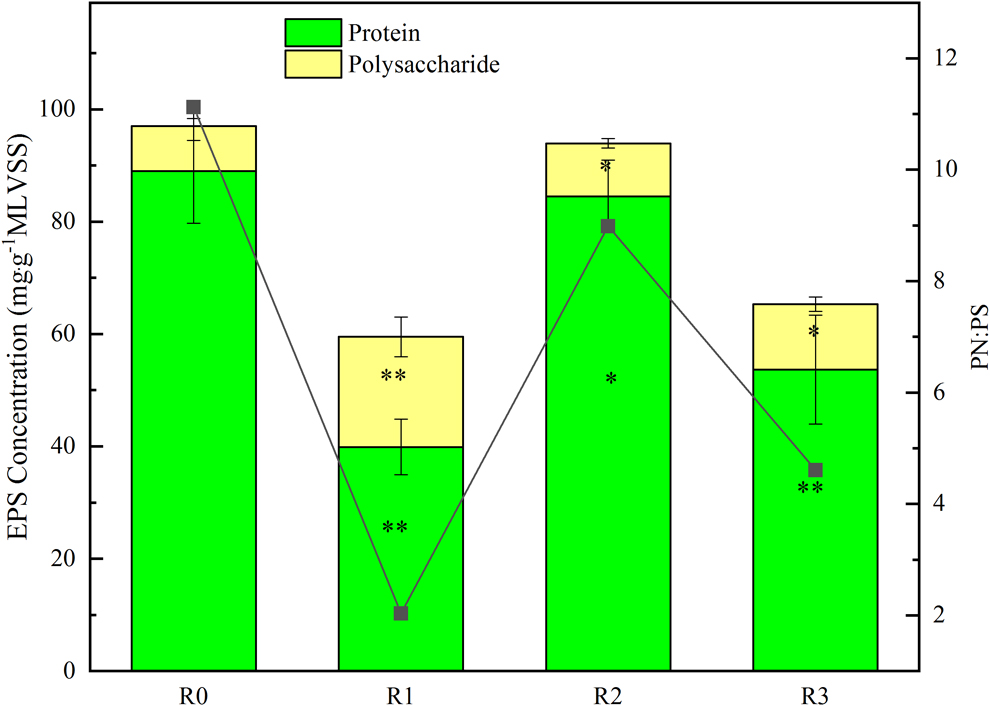
EPS were the macromolecule polymers that were secreted by bacteria and wrapped around outside the cells. The main components of EPS are protein and polysaccharide (Sheng et al., 2010; Guo et al., 2016). The EPS was exacted at the stable period of the fourth stage (86 days), and the concentrations of protein and polysaccharide are given in Fig. 4. The protein concentrations of EPS in R0, R1, R2, and R3 groups was 89.02 ± 9.32, 39.89 ± 4.97, 84.52 ± 6.44, and 53.66 ± 9.69 mg/g MLVSS, respectively. The corresponding polysaccharide concentration was 8.00 ± 2.60, 19.61 ± 3.54, 9.41 ± 0.85, and 11.64 ± 1.27 mg/g MLVSS, respectively. Moreover, the corresponding PN:PS was 11.12, 2.03, 8.99, and 4.61, respectively. Compared with the control group, the total amount of EPS in R1 group was significantly reduced, and the protein content in EPS was reduced by 55.19%, indicating that salinity significantly reduced the protein of EPS of anammox sludge (p = 0.001 < 0.05).
The influence of salinity/humic acid on the EPS of sludge. EPS, extracellular polymeric substances. *not significant and ** significant values compared to the control group.
It was worth noting that the polysaccharide content of the R1 group was 2.45 times that of the R0 group, indicating that salinity stimulated the secretion of polysaccharides in EPS. The result was consistent with the previous study, which reported that as the salinity concentration gradually increased from 0 to 30 g/L, the protein in EPS was reduced by 40.8%, and the polysaccharide in EPS was increased by 7.1 times (Fang et al., 2018). The reason might be that salinity could promote the generation of C–OH (C–O–C) functional groups and inhibited the production of C = O functional groups, which were the important components in protein and polysaccharide in EPS (Fang et al., 2018). The variation of polysaccharide content was related to the change of enzyme activity in the polysaccharide synthesis pathway (Wang et al., 2013). In addition, polysaccharide molecules contained many polar functional groups, which had strong water-binding capacity (Corsino et al., 2017). Under high osmotic pressure conditions caused by salinity, the increase of polysaccharide content could reduce the loss of water from cells to resist external osmotic pressure (Fang et al., 2018).
The total EPS content of the R0 group and the R2 group was very close, which was 97.02 ± 11.67 and 93.93 ± 5.9 mg/g MLVSS, respectively. It indicated that humic acid had no obvious effect on the secretion of EPS in anammox system. The result was consistent with the effect of humic acid on the nitrogen removal performance as mentioned in the Influence of Salinity/Humic Acid on the Nitrogen Removal Performance of Anammox Process Treating Landfill Leachate section.
It was worth noting that there was subtle change in the composition of EPS in the R3 group. As shown, humic acid had little effect on the composition of EPS. But compared with the R1 group (salinity group), the total EPS in R3 group (salinity/humic acid group) increased by 9.75%, the protein in EPS increased by 34.53%, and the polysaccharide in EPS decreased by 40.63%, indicating that coexistence of salinity and humic acid in anammox reactor impacted the components of EPS. However, the variation of EPS components was not consistent with the results of the nitrogen removal performance and the SAA of sludge, which implied the synergistic inhibition of salinity and humic acid was not caused by the change of EPS.
Influence of salinity/humic acid on the ETS activity of sludge and functional groups of extracted EPS
The ETS activity of sludge is a common method for evaluating biological activity of sludge. ETS activity could reveal the degree of inhibition of the electron transport processes including enzyme activity during microbial respiration (Blenkinsopp, 1990). The ETS activity was determined at the stable period of the fourth stage (86 days). According to Fig. 5, the ETS activities of R0, R1, R2, and R3 group were 11.63 ± 2.15, 6.72 ± 0.67, 9.64 ± 2.73, and 3.61 ± 0.80 μg/mg MLSS/h, respectively. Compared with the control group (R0), the ETS activity of the salinity group (R1) and the humic acid group (R2) were reduced by 42.19% and 17.09%, respectively. The results indicated that salinity and humic acid had an inhibitory effect on the electron transfer activity of anammox sludge, and the inhibitory effect of salinity was more serious.
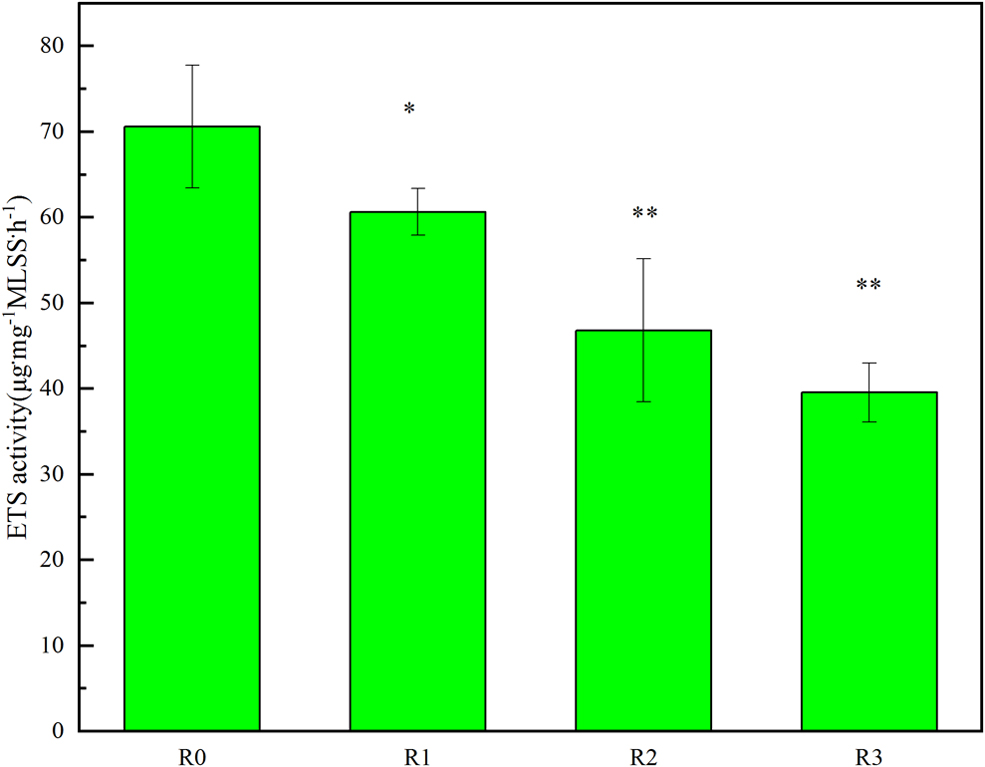
The influence of salinity/humic acid on the ETS activity of sludge. ETS, electron transport system; MLSS, mixed liquor suspended solid. *not significant and ** significant values compared to the control group.
The ETS activity of the salinity/humic acid group (R3) was decreased most significantly, and the ETS activity was only 31.09% of the control group. The coupling of salinity and humic acid had a synergistic inhibition on the ETS activity of sludge. The result was consistent with the nitrogen removal performance and the SAA of sludge in anammox reactor. The ETS activity of anammox sludge was significantly reduced with the coexistence of salinity and humic acid. This might be owing to the fact that humic acid interfered with certain enzyme systems involved in electron transport, thereby affecting the ETS activity. Because of the complex chemical structures of humic acid, such as carboxylic, phenolic, ketonic, aromatic, and aliphatic groups (Sheng et al., 2010), it would influence the enzymes by electrostatic force, covalent bond, and sweep flocculation (Liu et al., 2015), which might impact the activity of ETS (Zimmerman, 1981).
For example, heme c, which is an important component of the enzymes in anammox bacteria and serves as an electron carrier for cytochrome c in the redox process (Kartal and Keltjens, 2016), was decreased with increase of salinity concentration (Wang et al., 2019). When salinity and humic acid existed in anammox reactor at the same time, heme c would be decreased, which resulted in cytochrome c decrease and the referred enzymes would be disturbed by humic acid. Therefore, the electron transfer system maybe interfered severely in salinity/humic acid group.
FTIR spectroscopy was used to provide clues to the functional groups in the extracted EPS (Wang et al., 2020). As given in Fig. 6, FTIR spectra of every group is different from others, indicating that salinity and humic acid both had an effect on the functional groups of the extracted EPS. Compared with the control group (R0 group), the existence of salinity resulted in a strong absorption at 1650 cm−1, which was associated with the C = O functional groups (Wang et al., 2020). It indicated that the salinity promoted the increase of C = O functional groups, which might be one of the main reasons for the increase of polysaccharides in EPS with the existence of salinity in anammox reactor.
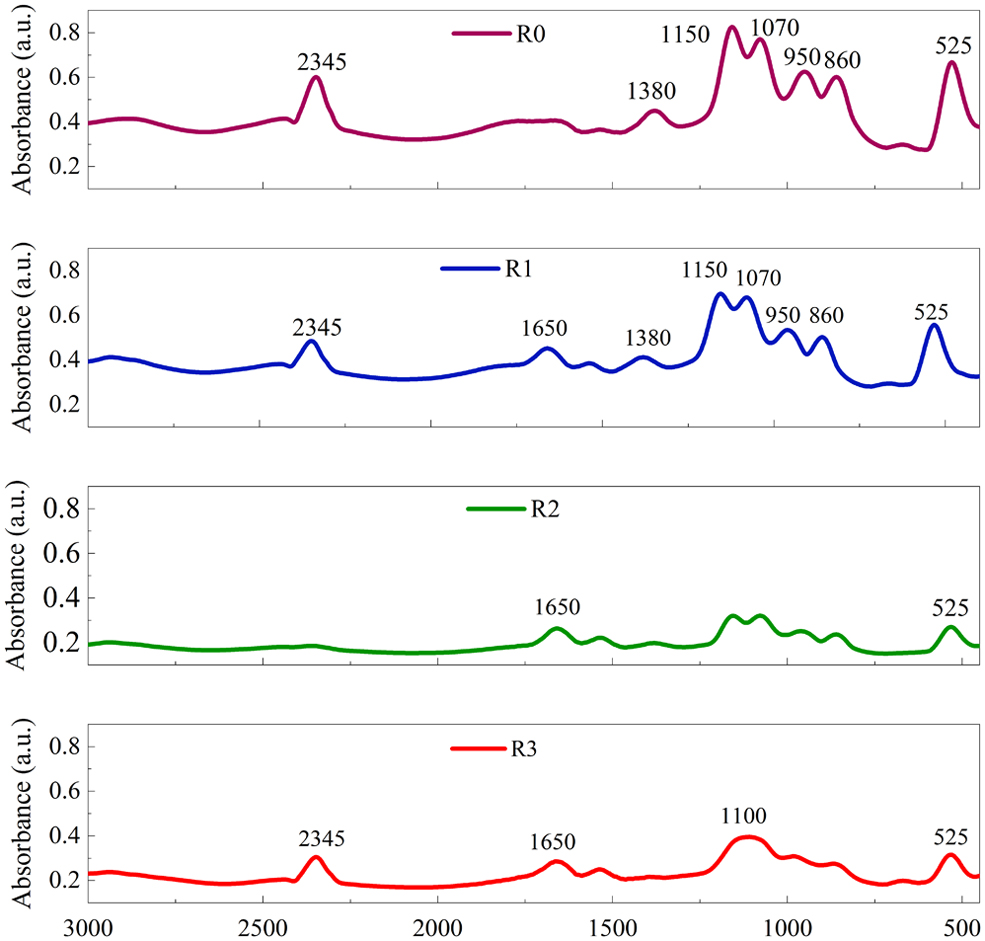
FTIR spectra variation of EPS with salinity and humic acid in anammox reactor. FTIR, Fourier transform infrared spectrometer.
Compared with the control group (R0 group) and the salinity group (R1 group), the absorption peaks at 2345 and 1380 cm−1 disappeared and the absorption peaks at 860–1150 cm−1 was significantly weakened in the humic acid group (R2 group). The results indicated that humic acid had a strong impact on the functional groups of the EPS in the anammox reactor. From the spectrum, it showed that the absorption peak at 1380 cm−1 disappeared and a broad region of absorption between 860 and 1150 cm−1 was weakened in the salinity/humic acid group (R3 group). As reported, 1380 cm−1 was related to functional group of COO− (Wang et al., 2020), 835–848 cm−1 were related to functional groups of S = O and C–O–S in sulfated polysaccharides (Du et al., 2018). These functional groups are the main components of enzymes that were related to the electron transport activity.
With the coexistence of salinity and humic acid, the enzyme activity responsible for the electron transporting system was disturbed, which resulted in the decrease of the nitrogen removal and the SAA, and also prolonged the recovery time of anammox activity.
Conclusion
Salinity could significantly affect the nitrogen removal performance and the SAA, whereas humic acid had little effect on these performances. When salinity and humic acid coexisted in anammox reactor, a synergistic inhibition was exerted on the nitrogen removal performance and the SAA. The reduction of ETS activity might the main reason for the deterioration of nitrogen removal performance. It caused the disappearance of the functional groups of the electron-transporting enzymes when salinity and humic acid coexisted in anammox reactor. The coexistence of salinity and humic acid prolonged the recovery time of the anammox activity, and then the stability of anammox process was weakened.
Footnotes
Author Disclosure Statement
No competing financial interests exist.
Funding Information
This study was supported by the Fundamental Research Funds for the National Science Foundation of China (U19A20108, 51878232) and Key Project of Science and Technology in Anhui Province (1801041130).