




Abstract
In the ecological environment, oxytetracycline hydrochloride accumulates seriously and the main source is the discharge of mariculture wastewater. Bismuth oxide was found to do well in removing oxytetracycline hydrochloride, but the photocatalyst only responded to ultraviolet light strongly. In this article, copper oxide was introduced into bismuth oxide to enhance the response to visible light and inhibit the recombination rate of photogenerated electrons and holes. As single factor tests and orthogonal tests showed, with introducing copper oxide, the catalytic efficiency of bismuth oxide based photocatalyst for oxytetracycline hydrochloride was significantly improved. The reaction condition was converted from ultraviolet light to visible light, which was the improvement on energy saving and environmental protection. With the optimized conditions, the degradation efficiency of the catalyst was 99.70%. In addition, the cycle stability and reaction mechanism of the catalyst were discussed. After three times of recycling, the degradation efficiency was still more than 90%.
Introduction
Industrial aquaculture is a rapidly developing industry. To prevent or reduce the risk of diseases and promote fish growth, antibiotics (especially oxytetracycline hydrochloride) are often used in fish cultures (Liu et al., 2019; Chhabilal et al., 2017; Yu et al., 2018). On the other hand, antibiotics are often overused in aquacultures (Chen, 2020) while a large amount of these agents are not used by the target animals, being just directly discharged into the aquaculture water along with the fish's excretions (Zhang et al., 2014). Moreover, these tetracycline-based antibiotics are one of the major antibiotic pollutant sources in China's waters (Han et al., 2020). The stability of antibiotics is usually high, and it is difficult to be degraded in the natural environment. Microorganisms have been in the environment of low concentration antibiotics for a long time, and their drug resistance is enhanced and the expression of resistance genes is induced (Osińska et al., 2020). Twenty-eight tetracycline-resistant genes were found in human beings, animals, and environmental microecology, and the coverage rate of human was over 75%. Pollution with tetracycline antibiotics could have many ecological hazards and became a major environmental problem (Zhang et al., 2020a). Although studies on oxytetracycline contamination in aquaculture wastewaters are rarely reported, efficient, clean, and energy-saving methods are urgently needed to degrade these pollutants.
In recent years, nanostructured photocatalysts were widely used to degrade organic pollutants, such as TiO2, ZnO, and ZnS (Onkani et al., 2020; Zhang et al., 2020b; Shirzad et al., 2017). Bi2O3 is a photocatalytic semiconductor material with high catalytic activity, narrow band gap (2.8 eV), and high stability, and showed excellent photocatalytic activity under UV light (Shirzad et al., 2014; Samarghandi et al., 2014; Narendhran et al., 2020). However, visible light-driven photocatalytic processes could be more convenient pathways for aquaculture wastewater treatments. Besides the band gap value, the (specific) surface area could affect the degradation efficiency because only a sufficiently high contact area can guarantee pollutant's efficient degradation (Fan, 2015). Based on the above considerations, copper oxide was doped into bismuth oxide photocatalyst by coprecipitation.
Introducing other ions is the main means to expanding the light response range, reducing the electron hole recombination rate, changing the micro morphology, and eventually improving the activity of photocatalysts (Sin et al., 2014; Fu and Zhang, 2019). In our previous studies, copper oxide had enhanced the photocatalytic activity of zinc oxide composite photocatalyst toward degrading pollution (Zeng et al., 2019b). Thus, in this study, copper oxide was doped into bismuth oxide to treat oxytetracycline hydrochloride in mariculture wastewaters for the first time. The band gap of CuO is around 1.7 eV, and the energy level structure could interact with Bi2O3 to absorb visible light efficiently, improving the photocatalytic activity of Bi2O3 the composite. CuO/Bi2O3 composite photocatalyst was expected to effectively degrade antibiotic pollutants to provide a theoretical basis for photocatalytic technology to treat and degrade pollutants in the environment.
Experimental Section
Materials and preparation of CuO/Bi2O3 photocatalysts
Cu(NO3)2·3H2O, Bi(NO3)3·5H2O, H2O2, CH3CH2OH, nitric acid, and NaOH were analytical pure, and purchased from Liaoning Quanruire agent Co. Ltd and Tianjin KeMiou Chemical Reagent Co. Ltd.
Coprecipitation is an effective method to prepare nanocomposites (Rodney et al., 2020). CuO was doped into Bi2O3 in this way. The brief preparation process is shown in Fig. 1. Bi(NO3)3·5H2O (4.84 g, 0.01 mol) was dissolved in dilute nitric acid solution and stirred for 10 min. Then different molar ratios (Bi3+/Cu2+ = 10:1, 10:2, 10:3, 10:4, 10:5, and 10:6) of Cu(NO3)2·3H2O was mixed in line with the test requirements. The mixture was stirred until the solute was completely dissolved. The solution should be stirred for 30 min and standed for 30 min, after NaOH (4 M) solution was dropped slowly. To remove impurities, the mixture was washed three times each with anhydrous ethanol and deionized water. After drying for 12 h, the CuO/Bi2O3 composite photocatalysts precursor was obtained. The same method was applied to the preparation of Bi2O3 photocatalysts precursor for comparison.

Formation process of CuO/Bi2O3 photocatalysts.
The catalyst samples were characterized by XRD, EDS, SEM, and UV-vis to analyze the crystal structure, composite morphology, element content, and the photo utilization ability of the photocatalyst.
Measurement of photocatalytic activity
In the self-made light reaction box, fluorescent lamps (20 w) were used to provide the irradiation with visible light. About 0.02 g of the calcined catalyst was scattered in 50 mL simulated aquaculture wastewater (the seawater sample was taken from Heishijiao sea waters, Dalian, Liaoning Province, China, and the content of oxytetracycline hydrochloride in unit solution was 0.02 g).
UV-Vis spectrophotometry is a quantitative, qualitative, and structural analysis method. It is based on the absorption characteristics of valence electrons to electromagnetic radiation with wavelength of 200–7760 nm in material analysis. Considering its advantages of strong regularity, good reproducibility, low cost, and good sensitivity, UV-Vis spectrophotometry was selected as the measurement and analysis method. During the reaction, 2 mL of suspensions were taken to evaluate the photocatalytic efficiency. The concentration of oxytetracycline hydrochloride in the reaction mixture was determined by UV-Vis spectrophotometer at 275 nm.
To further explore the factors influencing the semiconductor's catalytic activity and the optimization conditions, six factors (doping ratio, calcination temperature, dosage, concentration of H2O2, initial oxytetracycline hydrochloride concentration, and illumination time) were selected for horizontal and orthogonal experiments. The reactions are set as Table 1. The samples were denoted as C10, C20, C30, C40, C50, and C60 with the ratio of Bi:Cu of 10:1, 10:2, 10:3, 10:4, 10:5, and 10:6, respectively.
Experimental Conditions
Results and Discussion
Characterization of the catalyst samples
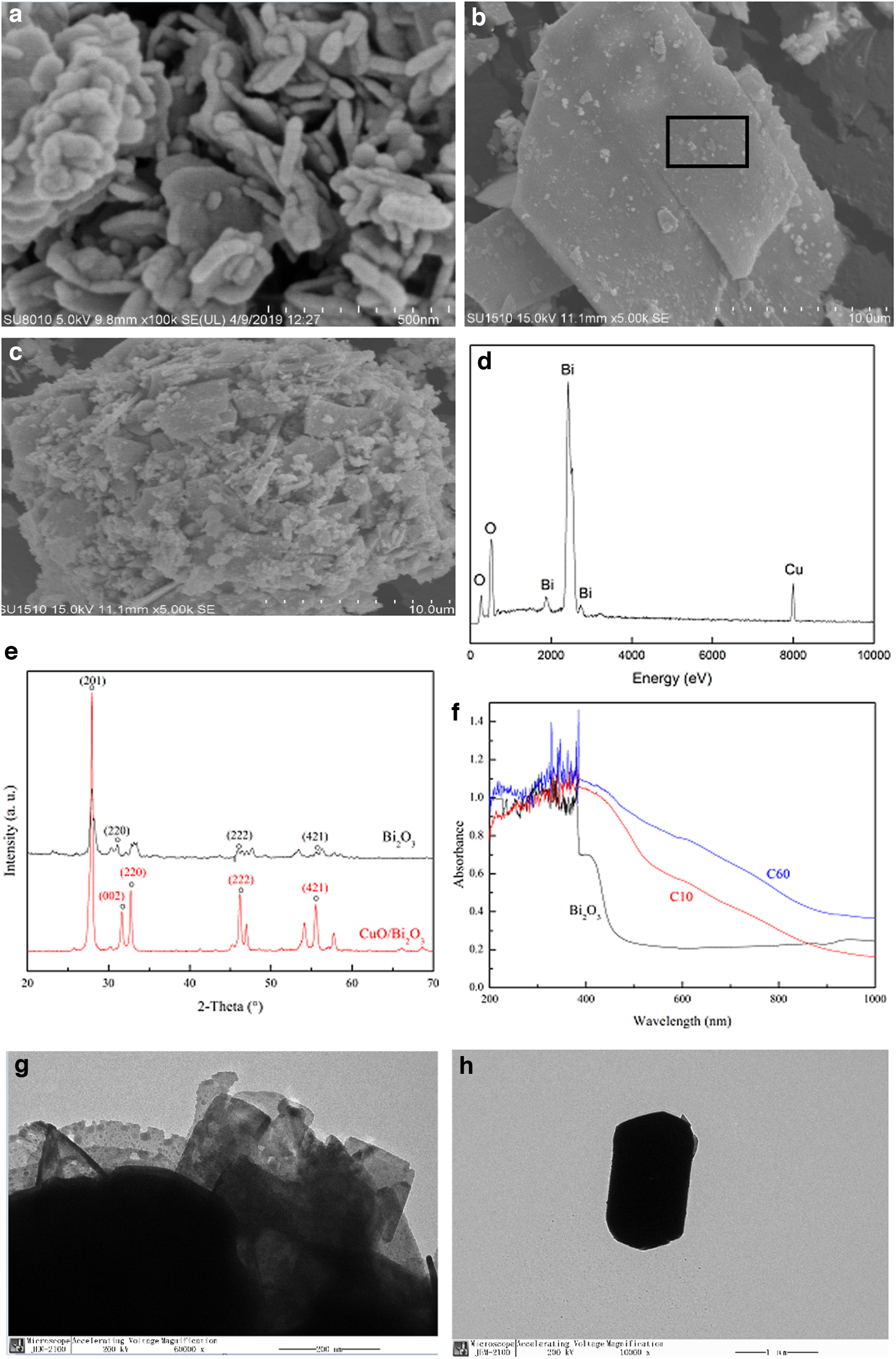
The SEM images of pure Bi2O3, C10, and C60 at the optimum calcining temperature are shown in Fig. 2.The panoramic morphology of pure Bi2O3 is shown in Fig. 2a. The nanometer pure Bi2O3 photocatalysts were irregular in size and shape, ranging from 40 nm to 200 nm. The interlaced accumulation of nanoparticles led to limited space gaps in the aggregates. Figure 2b shows the morphology characteristics of C10. The microstructure of Bi2O3 is affected by calcination temperature. The special morphology of nano chips was formed at 300°C and 400°C respectively (Jing, 2011). Independent copper oxide particles can hardly be found in Fig. 2b. Instead, they blended evenly into the flaky B surface to form a tight composite state. For further comparison, C60 was characterized by SEM, as shown in Fig. 2c. A particle stack about 10 microns in diameter was clustered in group Bi2O3. And a lot of copper oxide particles in the Bi2O3 gap. The EDS characterization results of C10 are shown in Fig. 2d. The peaks of Cu, Bi, and O can be observed obviously.
SEM images of
The XRD results of Bi2O3 and C10 are compared in Fig. 2e. For the pure Bi2O3, the apparent diffraction peaks can be indexed to Tetragonal Crystal system, and at 2θ = 27.95°, 32.69°, 46.22°, 55.49°correspond to (201), (220), (222) planes of Bi2O3 (JCPDS file no.00-027-0050). The remaining nonobvious peaks are also consistent with Bi2O3 standard card. The crystal form of C10 was the same as pure Bi2O3. All the diffraction peaks of Bi2O3 can be observed in the C10 sample, indicating that the crystal structure of Bi2O3 was stable and not affected by CuO. The diffraction peak of CuO was not detected, while the diffraction peaks of Bi7.38Cu0.62O11.69 were detected at 2θ = 31.76°, 32.72°,46.24°, 55.52°, which were consistent with (002), (220), (222), (421) planes of Bi7.38Cu0.62O11.69 (JCPDS file no.00-049-1765). The disappearance of CuO can be explained by the emergence of new compounds. The main feature of Bi2O3 was not destroyed. The same conclusion can be proved by SEM. The particle sizes of Bi2O3 and C10 were 56.42 nm and 37.88 nm, respectively, according to Scherrer formula. They can be thought of as nanomaterials.
Photoutilization ability is an important factor affecting photocatalytic performance (Vicente et al., 2020). To illustrate this, Bi2O3, C10, and C60 were characterized by UV diffuse reflectance spectroscopy, as shown in Fig. 2f. As can be seen, among three photocatalysts had strong absorption capacity for UV light. However, at the wavelength of 380 nm, the absorption curve of pure Bi2O3 decreased sharply. And finally in the visible light wavelength range of absorbance continued to be low, around 0.2. On the contrary, both the composite photocatalysts showed obvious advantages in the visible region. The absorption rate of C10 was more than three times that of pure Bi2O3. C60 was even better. The result shows that the introduction of CuO extends the absorption range of photocatalysts from ultraviolet to visible light. The band gap energies of Bi2O3 and C10 were computed separately to be 2.8 eV and 1.9 eV. The decrease of band gap was due to the effect of dopant, which was positive in the utilization of photon energy.
Figure 2g shows the TEM micrograph of C10, which is consistent with the SEM observation in terms of morphology and size. TEM images confirmed that Bi2O3 was lamellar in appearance. The Bi2O3 cells in this state gradually matured and were better inlaid by CuO (Fig. 2h). The spherical CuO nanostructures with 10–30 nm were embedded in the structure of Bi2O3 nanosheets. The TEM images showed that the synthesized C10 had an improved high crystal structure, which could be necessary for enhanced photocatalytic efficiency.
Photocatalytic activity
Single factor
The activity of photocatalyst is shown as the ability to degrade pollutants, which is affected by both internal and external factors. To explore the catalytic performance of composite photocatalyst more comprehensively, six possible factors were selected for the experiment, including doping ratio, calcination temperature, dosage, concentration of H2O2, initial oxytetracycline·HCl concentration, and exposure time.
As shown in Fig. 3a, the removal rate of Bi2O3 to oxytetracycline hydrochloride was 10.11% in the visible light. Ion ratio of C10 was the best one. With this, the degradation efficiency of the composite catalyst was 91.22%. As shown in Fig. 2f, the absorption band of the catalyst was red shifted by doping CuO. The energy of visible light was better absorbed and utilized. However, too many copper ions cannot effectively combine with Bi2O3, but aggregation occurs. And they are negative for the utilization of catalyst surface area. The interface between photocatalyst and pollutant is an important condition of photocatalysis (Zeng et al., 2019a). Therefore, with the increase of doping amount, the effective contact area decreases due to stacking, which leads to the decrease of degradation rate. On the other hand, by increasing the content of Cu2+ the removal rate of oxytetracycline hydrochloride decreased suddenly. The microstructure of Bi2O3 was changed by introducing CuO, but CuO maintained the crystal cell structure only, and the band gap of CuO was only 1.7 eV so that the removal rate reduced. Therefore, with the increase of CuO the effective contact area decreased due to stacking, which lead to the decrease of degradation efficiency.

Bi2O3 and C10 were compared in terms of calcination temperature, catalyst dosage, concentration of H2O2, initial concentration of oxytetracycline·HCl and exposure time. They can be found in Fig. 3b– f. Among them, the light environment of Bi2O3 was visible light and ultraviolet light, and C10 was visible light, which was based on the better consideration of pure photocatalyst for UV absorption. Obviously, among all the five factors, the order of degradation efficiency of photocatalyst was C10 (visible light) > Bi2O3 (ultraviolet light) > Bi2O3 (visible light). Combined with Fig. 2f, the reason was that Bi2O3 had better absorption effect under UV light, and the doped photocatalyst showed better absorption performance in the visible light wavelength range. There are two reasons why the degradation efficiency of Bi2O3 under the strong UV light was still lower than that of C10 under visible light. On the one hand, the structural characteristics of C10 were clear flakes, Bi7.38Cu0.62O11.69 grew on the surface of Bi2O3 in a scattered way, and there was little particle aggregation (Fig. 2a and b). However, the microstructure of Bi2O3 was disordered and dense. A good contact interface provides a better micro reaction environment for the catalytic reaction with pollutants (Yi and Bo, 2020). On the other hand, the photogenerated electron hole pair recombination ratio is also important, affecting the photocatalytic performance. The ability defect of Bi2O3 (ultraviolet light) may also be affected by high recombination rate. At the same time, literature show that doping metal oxides can restrain the composite ratio between electrons and holes (Soumitra et al., 2020; Jarosław et al., 2020).
As shown in Fig. 3b, the best calcination temperature of C10 (visible light) was 350°C, and the degradation efficiency was 91.38%. The degradation performance of the catalyst was the best after Bi2O3 (ultraviolet light) and Bi2O3 (visible light) were calcined at 450°C. The pollutants were degraded with efficiency of 28.62% and 13.45% respectively. The change of the optimal calcination temperature of Bi2O3 after doping was essentially determined by the change of the microscopic morphology of itself. As Fig. 2a and b have shown, when the temperature was 350°C, the microscopic morphology of Bi2O3 presented block-like shapes with different sizes. Compared with the lamellae calcined at 400°C, this particle form was more densely distributed, and it was conducive to contact with pollutant ions and catalytic reaction. However, the smooth flake was more conducive to CuO binding, so that Bi7.38Cu0.62O11.69 has enough space to grow separately. When the calcination temperature of CuO/Bi2O3 was higher than 350°C, oxytetracycline hydrochloride's removal rate decreased. With the increase of temperature, the CuO crystal cell develops quickly, and the dominant cell structure of Bi2O3 was destroyed. The band gap structure of CuO/Bi2O3 composite photocatalyst was changed to form a defect energy level. The photocatalytic activity of CuO/Bi2O3 composite photocatalyst decreased, possibly because of the increasing composite ratio between electrons and holes. Therefore, the composite photocatalyst's best catalytic efficiency was shown when the calcination temperature was set to 350°C. Compared with other bismuth-based photocatalysts, higher degradation efficiency can be achieved at lower calcination temperatures and less illumination time.
The effect of catalyst dosage is shown in Fig. 3c. In simulated aquaculture wastewater solution with pollutant concentration of 0.02 g/L, the optimal dosage of C10 (visible light) was 0.005 g and the degradation efficiency was 94.37%. The optimal dosage of Bi2O3 (ultraviolet light) and Bi2O3 (visible light) was 0.03 g. The degradation efficiency was 31.79% and 17.22%, respectively. The addition of catalyst reflects its photocatalytic performance. The stronger the photocatalytic performance, larger the pollutant load per unit amount of photocatalyst, which can be illustrated by the comparison of the two catalysts. With the increase of C10 (visible light), the degradation efficiency decreased slightly. Its microscopic morphology can provide theoretical basis, as shown in Fig. 2b. Bi7.38Cu0.62O11.69 was grown on the surface of sheet Bi2O3 in C10. As the amount of catalysts increased, the possibility of particle collision and aggregation increased and the photocatalytic performance was adversely affected. The characteristics of low dosage and high efficiency of composite photocatalyst are in line with the practical application requirements.
The influence of the concentration of H2O2 on the catalytic effect is shown in Fig. 3d. In the photocatalytic process, H2O2 is often used as an electron trapping agent. Photogenerated electrons are captured by H2O2 to separate electron hole pairs and improve photocatalytic efficiency (Zeng et al., 2019a). The reason is that oxygen can form superoxide radical in the photocatalytic process. This is because oxygen can form superoxide radicals in photocatalysis. Superoxide ions are more oxidizing. H2O2 can decompose to form oxygen and hydroxyl radical. Both of them can improve the catalyst activity. The concentration of H2O2 was 0.3 g/L, and the catalytic efficiency of C10 (visible light) was 90.72%. The photocatalytic degradation efficiency did not change significantly with the increase of H2O2. Because it is the photocatalytic material itself that determines the photocatalytic performance. Excessive H2O2 can even inhibit the catalytic effect.
The relationship between the concentration of oxytetracycline hydrochloride and the degradation efficiency of the catalyst is shown in Fig. 3e. Considering the characteristics of large amount of water and low pollutant concentration of the actual mariculture wastewater, the pollutant concentration was limited to a low range of 0.01–0.035 g/L in this test. The concentration of antibiotics was 0.01 g/L, degradation efficiency of C10 was 96.20%, Bi2O3 (ultraviolet light) was 60.00%, and Bi2O3 (visible light) was 19.00%. Among them, when the concentration increased to 0.035 g/L, the degradation rate of Bi2O3 (ultraviolet light) and Bi2O3 (visible light) decreased to 0.003% and 0%, respectively. C10 (visible light) had a better load of pollutants, still above 80%.
The degradation efficiency of catalyst is affected by illumination time as shown in Fig. 3f. In this study, a catalyst with low dosage, high degradation rate, and less time is expected. C10 fits this. The concentration of pollutant was 0.02 g/L and illumination time of natural light was 0.5 h, the degradation efficiency can reach more than 85%, and the average degradation rate was 285.8 μg/min. With sufficient light, the degradation efficiency reached more than 90%.
Orthogonal text
According to the results of single factor texts, an orthogonal experiment of six factors and five levels was set to explore the interaction between single factor variables. The results are shown in Table 2. Under visible light, the optimal conditions for the photocatalytic degradation of oxytetracycline hydrochloride by CuO/Bi2O3 composite photocatalyst were as follows: calcination temperature of 350°C, calcination time of 2 h, dosage of 1.4 g/L, concentration of H2O2 of 0.4 g/L, initial concentration of antibiotics of 0.01 g/L, and illumination time of 3 h. The composite photocatalyst was recovered for cyclic tests with the optimized conditions. The results of the three experiments were 96.15%, 92.77%, and 90.18%, respectively.
Results of Orthogonal Experiments
Cost analysis
The raw material of CuO/Bi2O3 composite photocatalyst was copper nitrate trihydrate. The price of analytical pure grade was 38000 yuan/t, and that of industrial pure grade was 490 yuan/t. The content of antibiotics was 20 g/L. The production cost of industrial grade was 1906 yuan, and the cost of water treatment was 0.23445 yuan/t. CuO/Bi2O3 photocatalyst was suitable for practical production because of its suitable price and excellent catalytic ability.
Possible photocatalytic mechanism
Analysis on activity content for oxytetracycline hydrochloride removal
According to literature (Liu et al., 2019; Yu et al., 2018), many main active substances played an important role in photocatalytic reaction, including hvb+, •OH, and the photogenerated electrons. Different scavengers were used to quench the active component, and then the effect of the component on the catalytic efficiency can be analyzed. In this work, isopropanol and acetonitrile were added to reaction as •OH scavengers, sodium sulfide (Na2S) and methanol were added as scavengers of hvb+, and silver particles (Ag) were used to quench photogenerated electrons.(Jarosław et al., 2020) As a result, the reaction of oxytetracycline hydrochloride degradation could be inhibited. The lower the degradation efficiency greater the quenching effect of the active components (Zhu et al., 2020).
Figure 4 shows that oxytetracycline hydrochloride's removal rate reduced from 98.54% to 47.03% after adding isopropanol to the photocatalytic reaction, reflecting hydroxyl groups' participation in the catalytic mechanism. However, when methanol, sodium sulfide, or silver were added, the removal rate was modified to 89.73%, 88.66%, and 90.18%, respectively, revealing that hvb+ and the photogenerated electrons contributed to the oxytetracycline hydrochloride degradation. Besides, for the solvent, acetonitrile was selected as an extremely stable molecule instead of water to identify the involvement of •OH or hvb+. The nonaqueous medium eliminated the function of hydroxyl groups shaped in the pores of water during oxidation. The results explained that the reaction was significantly inhibited without water in the solution. Furthermore, the hydroxyl radicals were the best ones for removing oxytetracycline hydrochloride.

Effects of different scavengers on degradation of oxytetracycline hydrochloride.
Function of introducing CuO on reaction mechanism
The experimental conclusions and dependent literature (Liu et al., 2019; Yu et al., 2018; Soumitra et al., 2020) proposed a hypothetical mechanism for CuO/Bi2O3 composite photocatalyst enhancement (Fig. 5). The electrons (ecb−) were aroused by photon energy to the conduction band of Bi2O3, staying hvb+ on the valence band. CuO partially filled with f-orbitals in Bi2O3 can efficiently capture the electron. In the meantime, the recombination rate of hvb+ was also affected and decreased. Because of the instability of Cu2+ ions in reduced, the ecb− was easy to move. The O2 molecules get electrons for boosting •O2− arising and converting to active •OH. These results indicated that CuO could be used as an active carrier trap and promoter to shift ecb−. The degradation mechanism of CuO/Bi2O3 composite photocatalyst can be expressed as (Soumitra et al., 2020):

Possible photocatalytic mechanism of CuO/Bi2O3.
At the moment, for photogenerated hvb+ captured, the water molecules adsorbed and the hydroxide species surface-bounded, continuous charge transfer took place on the micro surface of the photocatalyst. Then active •OH was generated.
All in all, the separation of carriers was mainly because of capture properties of CuO in the composite. Subsequently, the production of •OH was promoted for removing oxytetracycline hydrochloride, and the activity of CuO/Bi2O3 was improved even more.
Conclusions
In summary, in this study, by introducing CuO particles on the surface of Bi2O3 through metal oxide doping, CuO/Bi2O3 photocatalyst with superior photocatalytic performance was prepared. It was applied to treat oxytetracycline hydrochloride pollution in mariculture wastewater for the first time. The important factors affecting photocatalytic performance were confirmed and the optimized conditions were obtained by orthogonal experiment. CuO/Bi2O3 composite photocatalysts with different Bi3+/Cu2+ molar ratios were successfully prepared by chemical coprecipitation method. The effect of different Bi3+/Cu2+ molar ratio, calcination temperature, dosage of CuO/Bi2O3, hydrogen peroxide concentration, initial antibiotic concentration, and exposure time on the degradation of antibiotics were studied. The optimum conditions were obtained by orthogonal experiment.
According to the characterization results of CuO/Bi2O3 by XRD, SEM, EDS, and TEM, it was concluded that CuO/Bi2O3 composite photocatalyst was relatively pure and the average particle size of C10 was 37.88 nm. The band gap of C10 was 1.9 eV.
The optimal conditions were as follows: calcination temperature of 350°C, calcination time of 2 h, dosage of 1.4 g/L, H2O2 of 0.4 g/L, concentration of antibiotics of 0.01 g/L, and exposure time under visible light of 3 h.
The composite photocatalyst was recovered for cyclic tests with the optimized conditions. The results of the three experiments were 96.15%, 92.77%, and 90.18%, respectively.
Under visible light, CuO/Bi2O3 composite photocatalyst showed good stability and applicability in seawater environment. It can effectively degrade oxytetracycline hydrochloride in mariculture wastewater and has good practical value.
Footnotes
Acknowledgments
We sincerely thank the State Oceanic Administration People's Republic of China (201305002), Liaoning Science and Technology Public Welfare Fund (20170002), Science Foundation of Department of Ocean and Fisheries of Liaoning Province (201733), and Department of Science and Technology of Liaoning (2016LD0105) for their financial support of this study.
Funding Information
Product research and development of oil spill monitoring equipment and research and development integration and demonstration of decision support technology for post disaster disposal. Marine research and special funds public service sectors of the State Oceanic Administration People's Republic of China, 201305002; Research and development and application of high efficiency solar photocatalytic treatment of seafood deep processing wastewater. Liaoning science and public welfare research fund project, 20170002; Research and application of high efficiency solar photocatalytic treatment technology for aquaculture wastewater. Scientific research project of Liaoning Provincial Department of marine fisheries, 201733. Application of TGA and FT-IR in nano catalyst preparation and application research. Science program project of Liaoning science and Technology Department, 2016lD0105.