




Abstract
Natural water quality is continuously diminishing with human intervention and poses a major threat to the ecosystem. The present work investigated the treatment of contaminated lake water using a 40 kHz frequency cavitational reactor. The total colony count present in raw water was 1,300 ± 150 CFU with initial chemical oxygen demand (COD) of 100 ± 30 mg/L. The synergy of cavitation with a catalyst (titanium dioxide [TiO2]) and ozonation was studied. The comparative performance was analyzed by comparing individual and synergic effects. The combined effects of a catalyst with cavitation have shown the maximum removal of the microbial count and COD. Techno-economic feasibility analysis confirmed that the synergy of a catalyst with cavitation results in the maximum reduction in microbial count and COD. The percentage removal of coliform such as Enterobacter, Salmonella, and Escherichia coli (catalyst concentration: 25.0 μM/L and treatment time: 20 min) was 90.8, 92.6, and 100, respectively, with COD removal of 71.6%. Enhanced results may be obtained due to an increase in the cavitational effect in the presence of a solid catalyst. The synergy of cavitation with TiO2 enhanced the microbial removal rate by 45.8% compared to the individual effect. Investigation confirms that synergy effects produced from ultrasound and catalyst were highly beneficial for reducing microbial count from raw water with a substantial COD reduction.
Introduction
Wetlands are an essential water resource for human beings. More than 7% of the earth's surface is covered with lake water and provides ∼45% water for biological productivity with benefits of $20 trillion per year. However, in India, wetlands are disappearing with rapid industrial, agricultural, and residential growth (Ho et al., 2009; Wang et al., 2014; Lu et al., 2019). Moreover, continuous discharge of pollutants in wetland has a severe problem on the natural biodegradability of lake water (Khan et al. 2006; Wang et al., 2014).
Perennial Lake “Ramgarh Taal” is the sixth largest lake of India situated in Gorakhpur city, Uttar Pradesh, India. A few decades back, it was a significant source of potable water and fishing activities. It consists of flora and fauna (Srivastava, 1967), angiosperm diversity (Sharma and Alok, 2013), and rich resource for hydrophytic vegetation (Sahai and Sinha, 1969). However, beneficial microbial species were diminishing due to the continuous discharge of solid and liquid pollutants and reduced lake area from 8 to 6.9 km2 (Srivastava, 1962; Singh and Upadhyay, 2012). An elevated increase in the concentration of pesticides (Srivastava and Narain, 1985; Mamta and Singh, 2017) and concentration of heavy metals (Singh and Upadhyay, 2012) lowered the quality water index (Baranwal et al., 2015). Few studies reported physicochemical analysis such as, dissolved oxygen, biological oxygen demand, chemical oxygen demand (COD), nitrate, phosphate, and pathogenic microorganism of lake water (Saha, 2013; Singh and Upadhyay, 2012). However, more investigations are needed on the treatment of lake water. The intensified techniques based on cavitation, ultraviolet-C, and so on may be helpful to enhance the rate of treatment with a substantial reduction of the operational cost of the process. Few studies reported on the disinfection of polluted lake water using micro-ozone, permanganate, and ferrate techniques (Buschini et al., 2004; Hu et al., 2018).
Conventional disinfection processes have many limitations, such as removing harmful microorganisms/pathogens from water is not possible. In addition, it results in secondary solid waste during the disinfection process (Jyoti and Pandit, 2004b; Hu et al., 2018). Advanced oxidation processes (AOPs) such as ozonation, ultraviolet (UV), and ultrasound (US) can overcome the limitations associated with the conventional process (Jyoti and Pandit, 2004a; Khan et al., 2006; Kruithof et al., 2007). A study on ozone pretreated water from Tai Lake, China, observed a reduction in the chlorine requirement by 62–63% (Wang et al., 2014). Operational cost ozonation can be overcome by UV-based technologies (wavelength: 30 mJ/cm2) (Khan et al., 2006; Kruithof et al., 2007; Ho et al., 2009). UV has several limitations, including frequent lamp replacement, regrowth of microorganisms after treatment, and not beneficial water containing a high concentration of natural organic matter (Jyoti and Pandit, 2003; Dadjour et al., 2005; Lu et al., 2019).
US-assisted disinfection can overcome limitations associated with other oxidation processes (Drakopoulou et al., 2009; Vajnhandl et al., 2015). Extreme conditions of temperature and pressure produced from US interaction with water are helpful for several physical and chemical transformations (Dadjour et al., 2006; Khan et al., 2006; Naddeo et al., 2014; Sheng et al., 2015). These effects are also highly beneficial for cell wall rupture and complete oxidation of carbohydrates (Li and Buckin, 2016; Lu et al., 2019). Efficacy of US can be further enhanced using additives/catalysts, such as titanium dioxide (TiO2), H2O2, Cl2O, and so on, and combination with other oxidation processes, such as UV, O3, and so on (Gogate, 2017; Mahulkar et al., 2009). Therefore, it is interesting to study the treatment of lake/natural/surface water disinfection using combined effects of US with other AOPs or catalysts.
The present work investigated the disinfection of lake water using a cavitational reactor. Disinfection studies were performed using the individual and combined effect of US with TiO2 and ozone. Removal of microorganisms present in water was monitored by measuring the total coliform and other microbial species counts. American public health association (APHA) guidelines were followed for performing experiments and analysis.
Materials and Methods
Study area-Ramgarh Lake
Ramgarh Lake is situated in Gorakhpur, Uttar Pradesh, India, on the Rapti River flood plain on the left bank. One of the primary surface water resources for Gorakhpur city is spread over a 7.5 km2 area with a perimeter of 14.1 km. Position of Ramgarh Lake North to South is 26°44′ 54.03″ N, and 83°24′ 35.32″ E to 26°42′ 25.25″ N and 83°24′ 48.91″ E and East to West is 26°43′ 55.53″ N, and 83°25′ 03.25″ E to 26°44′ 38.45″ N and 83°23′ 09.47″ E. Lake area varies from 14 to 22 km2 with a change in season from summer to monsoon. The lake has a maximum water depth reported of 4.5 m with a catchment area of 11,500 hectares and a capacity of 7.36 × 10⁶ m3 (Baranwal et al., 2015). Samples were taken at five locations in September 2020. The sample location was selected close to the human population near the vicinity of the lake and entry point of discharge treated sewage wastewater treatment plant. Water samples were taken from 1 m below the surface water to avoid high algal concentrations. In addition, physicochemical and microbial analysis of untreated water was performed. The marginal deviation was observed at a different location (Table 1). The total colony count present in raw water from the lake was 1300 ± 150 CFU.
Analysis of Untreated Water
COD, chemical oxygen demand; DO, dissolved oxygen.
Materials
TiO2 (98% laboratory reagent [LR] grade, Assay: ≥99.0%, water-solubility ≤0.5%, solubility in dilute hydrochloric acid ≤0.5%, Arsenic: ≤0.0005%, Iron: ≤0.005%, Lead: ≤0.001%, Antimony: ≤0.01%, Zinc: ≤0.005%, Pb: ≤0.002%), silver sulfate (analytical reagent [AR] grade 99.0%) Rankem, sulfuric acid (Molychem AR grade 98%), potassium dichromate (Molychem AR grade 99.99%), mercury sulfate (Molychem AR grade 98%), and alkali-iodide-azide reagent (NaOH HiMedia AR grade 98%, NaI Molychem 99.5%, NaN3 Molychem 99.5%) were procured from local supplier M/s Eastern Scientific Emporium (Gorakhpur, India). The ozone generator (Make: Say, Model: GL-3188) with a maximum power of 10 W and an ozone output of 6.7 mg/min was used to produce ozone. HiMedia HiCrome™ Chromatic Coliform Agar (CCA M1991I) was purchased from HiMedia to enumerate Enterobacter, Escherichia coli, and Salmonella. All colonies present in the dish signify total coliform (Fig. 1). Double distilled water was obtained from the water distillation unit at University.

Chromatic Coliform Agar (CCA M1991I).
Experimental setup
Sonication bath (Labman LMUC-3) of 2.5 L capacity (Size: 240 × 140 × 100 mm3), 100 W ultrasonic power, and 40 kHz frequency was used for understanding the effects of US on microbial deactivation. The three magnetostrictive or piezoelectric transducers were located at the bottom of the bath. These are arranged at equidistance in triangular geometry. The bath calorimetric analysis was performed, and maximum efficiency was observed (38.5%) at an optimized bath (2 L) volume. All the experiments were performed using an optimum volume of 2 L. The aluminum cooling coil was placed inside the bath to maintain a constant temperature. All experiments were performed in the dark by covering the bath with a black sheet. A magnetic stirrer (Make: Remi, Model: RMS1150) was used to analyze the effect of a catalyst on microbial disinfection, and constant stirring was maintained.
Experimental protocol
Experiments were performed with and without the addition of catalysts. Before the start of the investigation, the ultrasonic bath was cleaned with alcohol and dried. Lake water (2 L) was poured into the bath and allowed to sonicate. The bath temperature was maintained at 25°C ± 3°C by passing cooling water through the aluminum coil placed in the bath. The effect of catalysts was studied by adding the known quantities of catalysts. The catalyst influence on microbial inactivation was analyzed with the known TiO2 addition in 2 L of lake water. Constant stirring was maintained to avoid the settling of solid particles. A controlled study was performed using bacterially contaminated water of E. coli. A known bacterial culture was added in 2 L volume of double distilled sterilized water to attend bacterial concentration ∼4.0 × 10³ to 4.2 × 10³ CFU/mL (Sharma and Alok, 2013).
The ozone stock solution was prepared by purging ozone in a known quantity of distilled water in 30 min. The Iodometric method was followed to measure the concentration of ozone (Jyoti and Pandit, 2004a). A known amount of a concentrated solution of ozone is added to lake water. Samples were withdrawn at regular intervals of time to monitor the progress of microbial inactivation. Drawn samples were quenched immediately in an ice bath to kill microbial disinfection activity, followed by microbial analysis.
Analysis
Physiochemical parameters such as pH, TDS, Alkalinity, resistivity, and temperature were measured using a multiparameter water quality meter (Make: Labman, Model: LMMP-30). The Winkler method was followed for the quantification of DO (APHA, 2017). The photometric method was used to measure COD (Lovibond MD 200 COD analyzer). Two stock solutions were prepared to measure COD. Stock solution-1 was mixture of 10.216 g K2Cr2O7+167 mL of H2SO4+33.3 g of HgSO4. Stock solution-2 was prepared by mixing 5.5 g AgSO4 with H2SO4. A measure of 1.5 mL of stock solution-1, 3.5 mL of stock solution 2, and 3 mL of water sample was added in COD bottles. Prepared samples were digested in Lovibond Thermoreactor RD 125 for 120 min at 150°C. COD of digested samples was measured using Lovibond MD 200 COD photometer.
Microbial analysis was performed using the spread plate method. The analysis protocol of APHA (2017) was followed. First, all glassware and equipment were sterilized at 120°C at 15–20 atm for 20–25 min in an autoclave (SSI-001A; Swastik Scientific). The sample handling and preparation were performed in a laminar flow cabinet (SSI-HFL3; Swastik Scientific) to avoid contamination and associated risk. The laminar flow cabinet was cleaned with 70% alcohol and kept ideal for 2 h before conducting any cabinet activity. Of the CCA, 30.92 g was dissolved in 1,000 mL of distilled water, followed by a heating solution to 95°C ± 3°C. Agar solution was allowed to cool to 40°C ± 2°C and poured into a petri dish for further cooling. Prepared Petri dishes containing agar were used for microbial analysis. Sample withdrawn from the experiment was diluted 10 times with disinfection-free distilled water and spread over prepared petri dishes by L shape spreader. Prepared petri dishes were kept in an incubator (SSI-020; Swastik Scientific) for 24 h at 37°C ± 0.5°C. Grown colonies were counted manually and identified using blue, pink-red, and colorless shiny colors. Blue colonies represent E. coli, pink to red colonies represent Enterobacteria, and colorless shiny colonies represent Salmonella. The sample colony grown after incubation has been shown in Fig. 1. CCA medium agar contains three chromogenic substrates. The enzyme β-
Results and Discussion
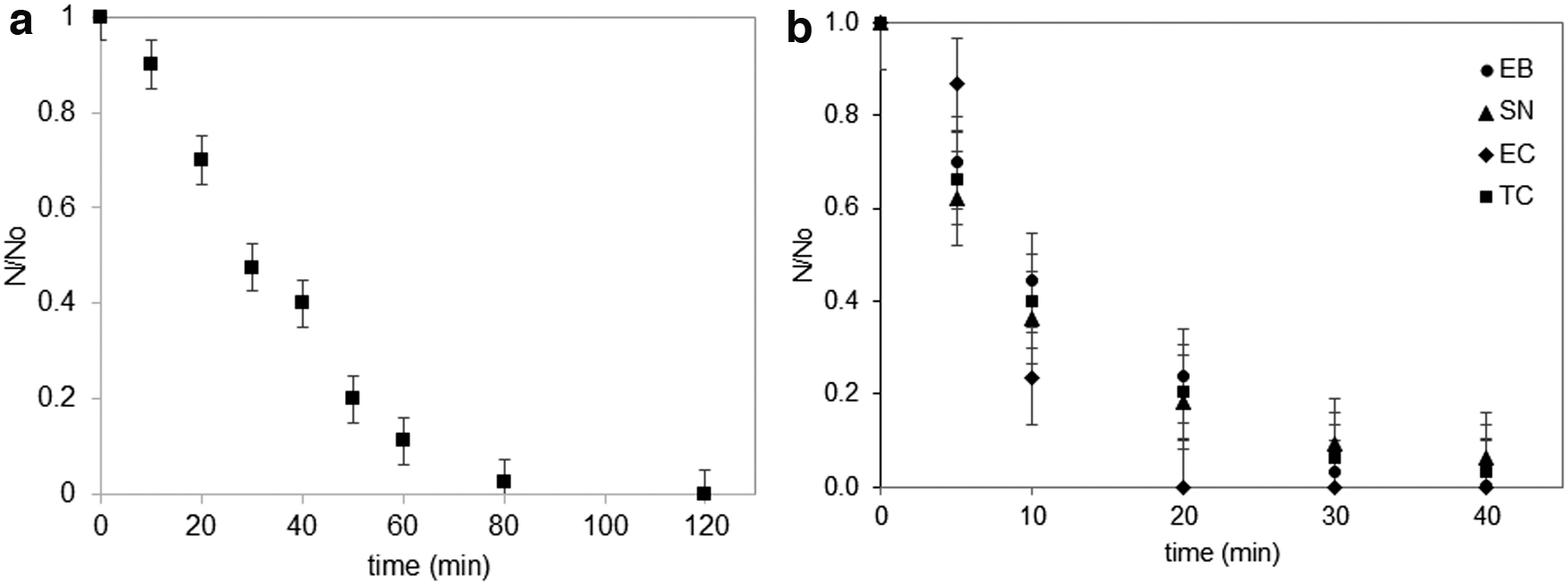
Cell wall rupture is a widely accepted mechanism for cell disruption to get the desired microbial inactivation. Several US effects such as (1) high shear stress/high-pressure conditions, (2) shock waves, (3) microjet velocities, and (4) pressure impulse generated from collapsing cavities are highly beneficial for microbial disinfection (Jyoti and Pandit, 2003, 2004b). Rupturing of the cell wall is dependent on several cavitational reactor operational parameters such as frequency and power intensity. In addition, the formation and interaction of •OH radical production during cavitation are highly beneficial for the complete disintegration of the cell wall and oxidation of carbohydrate release after cell wall rupture (Jyoti and Pandit, 2001, 2004a). A control experiment was performed to analyze the effect of US on removing E. coli concentration. It was decreasing exponentially with respective time (Fig. 2a). The maximum removal of E. coli concentration observed for 80 min treatment (97.6%) and a further increase in treatment have shown a marginal effect on removing E. coli concentration. This analysis confirms that the US wave plays a significant role in the inactivation of microbial concentration.
Effect of US frequency
The energy associated with a sound wave is beneficial for various physical and chemical transformations. There are many driving factors for enhancing acoustic cavitation effects, such as frequency and intensity of US (Naddeo et al., 2014; Li and Buckin, 2016). The frequency above human hearing frequency (>16 kHz) creates violent cavitating conditions and is helpful in water disinfection (Ziembowicz et al., 2017; Fetyan and Attia, 2020). Therefore, it is interesting to understand the effect of US on the disinfection of water.
Experiments were performed using US effects on polluted lake water disinfection, and results are shown in Fig. 2b. It has been observed that the removal of microorganisms increased with treatment time from 0 to 30 min, with a further increase in time from 30 to 40 min which has shown a marginal effect on enhancing microorganism removal. Total coliform removal after 40 min of treatment was 96%. The results were further analyzed on the complete removal of E. coli, Enterobacter, and Salmonella. Complete removal of E. coli was observed in 20 min of treatment time, and ∼100% Enterobacter removed in 40 min, whereas total removal of Salmonella was not observed. Microbial disinfection or cell rupture is dependent on the strength of cell wall strength/thickness. The thickness of gram-negative bacteria, such as E. coli, Enterobacter, and Salmonella, is in the range of 20–80 nm. Physical and chemical effects produced from the US, such as shock waves and microwave streaming, are beneficial for breaking the cell wall of gram-negative bacteria (Drakopoulou et al., 2009; Vajnhandl et al., 2015). It has been reported that US with a frequency of 40 kHz and power of 100 W produces a shock wave range of 0.1–0.8 W/cm2 (Jyoti and Pandit, 2004b; Antoniadis et al., 2007). These shock waves are sufficient for breaking the cell wall of gram-negative bacteria. Cavity/bubble collapse near the solid surface/cell wall of bacteria produces very high liquid jets with a velocity range of 200–300 m/s and damage cell wall (Jyoti and Pandit, 2003; Mahulkar et al., 2009). Other physicochemical effects such as acoustic shockwave, emission of light, and sound also contribute to water disinfection (Vajnhandl et al., 2015).
The findings in the present work were consistent with the reported literature. The complete removal of the E. coli population (initial count: 105–106) from municipal wastewater treatment was obtained in 20 and 40 min for low (24 kHz) and high (80 kHz) frequency of the US, respectively. This study compared the removal of E. coli from synthetic and municipal wastewater and observed that synthetic wastewater treatment required more time than municipal wastewater (Antoniadis et al., 2007; Ziembowicz et al., 2017). Feasibility analysis of the treatment of Bacillus sustilis and E. coli. using low and high frequency observed that the low frequency helped reduce the total microbial count from water. However, the frequency has shown a lesser effect on removing Bacillus sustilis, and the maximum reduction of E. coli was obtained in 5 min at 817 kHz frequency (Vajnhandl et al., 2015).
Effect of TiO2
TiO2 has several germicidal effects with significant advantage formation of high concentration of hydroxyl (•OH) and oxidizing radicals. It is dependent on electrons and hole pair generation in the conduction and valence band, respectively (Khan et al., 2006; Lu et al., 2019). Therefore, the formation of such highly reactive species is beneficial to damage the microbial cell wall and change the function/structural order of microbial activity (Ho et al., 2009). In addition, the synergy of US and TiO2 may help to enhance the rate of inactivation of microorganisms.
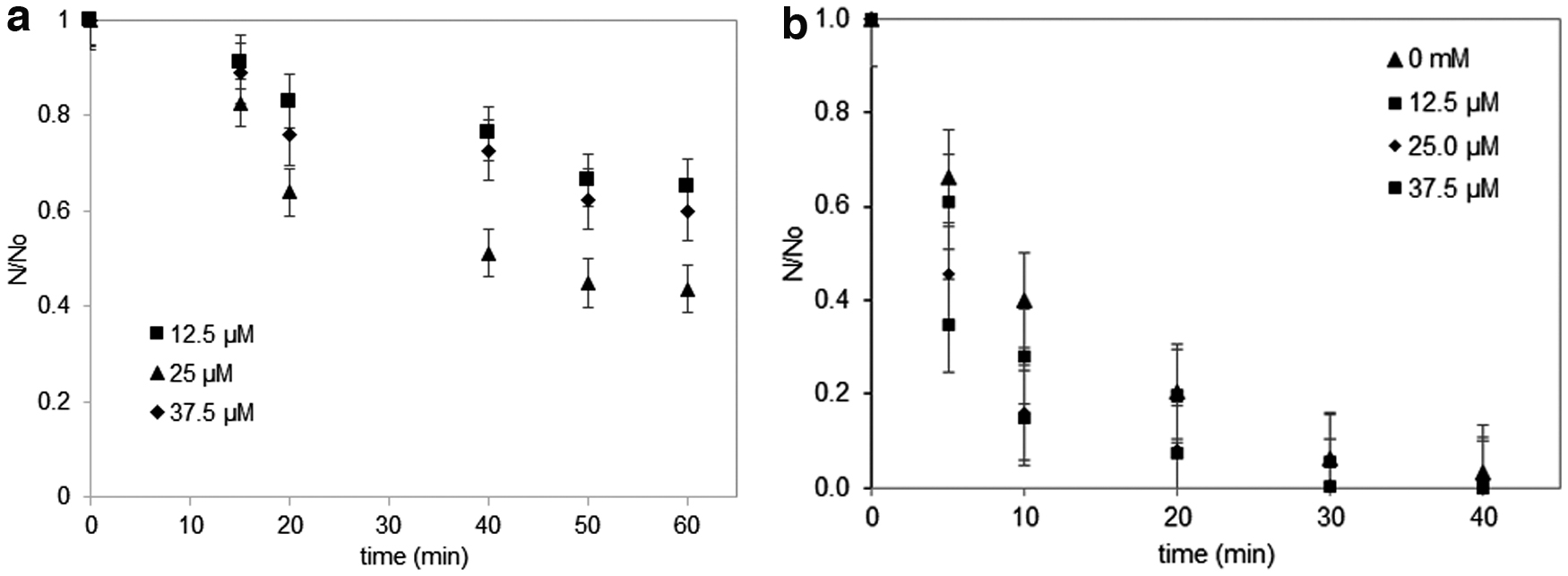
Experiments were performed to analyze the effect of TiO2 on microbial inactivation, and results are shown in Fig. 3a. The maximum coliform removal was 36.1% ± 3.2% for a concentration of TiO2 25.0 μM/L for 20 min treatment. Intensified experiments were performed to study the combined effects of US with varying concentrations of TiO2, and results are shown in Fig. 3b. It has been observed that the combined effect of TiO2 and US has several benefits for the increasing rate of removal of total coliform and much higher compared to the individual effect of US and TiO2. The total coliform removal was increasing with an increase in the concentration of TiO2 from 12.5 to 25 μM. A high TiO2 concentration of 37.5 μM has a marginal effect on removing total coliform, and 25 μM TiO2 concentration was found to be optimum. At optimum loading of TiO2, the time required for complete removal of Enterobacter, Salmonella, and E. coli was 40, 30, and 10 min, respectively. It was much lower than the individual effect of the US alone. The activities on the TiO2 surface enhanced the concentration of hydroxyl radicals, which helps to increase the disinfection rate (Mahulkar et al., 2009; Sheng et al., 2015). Tiny particles of TiO2 provide additional sites for nuclei of bubble formation for increasing cavitational activities. (Naddeo et al., 2014). The combined use of TiO2 with the US helps increase the stability of TiO2 or overcome the shortcoming associated with TiO2, such as fast recombination of holes and electron pairs (Khan et al., 2006). However, the higher loading TiO2 has shown a detrimental effect on the inactivation of microorganisms. Lower cavitational activity may result from acoustic wave scattering in the presence of solid particles (Mahulkar et al., 2009; Mamta and Singh, 2017).
It has been reported that titanium peroxide (TiO3) formation took place on the TiO2 surface using combined effects of hydroxyl radical and US irradiation. The stability of TiO3 is much higher than TiO2 to enhance the oxidation and microbial disinfection rate (Lu et al., 2019). It may be due to the sonoluminescence effect produced from the excitation of TiO2 in the ultrasonic system (Dadjour et al., 2005; Farshbaf Dadjour et al., 2006; Ho et al., 2009). The single bubble sonoluminescence involves the intense UV to activate the TiO2 photocatalyst surface (Khan et al., 2006; Lu et al., 2019), and mechanism of formation of hydroxyl radicals is like activation of TiO2 using UV irradiation [Eqs. (1) to (6)].
The findings were consistent with the reported work on the removal of E. coli from water. Dadjour et al. (2006) experimented on treating Legionella pneumophila using the US and combined effects of US with TiO2 and Al2O3 (Dadjour et al., 2006). The cell concentration reduction with US effect was 18%. It was increased by three times in the presence of 1 g/mL of TiO2, which was much higher than Al2O3 (Dadjour et al., 2005). With the addition of 2 g/L of TiO2, the complete removal of E. coli. was obtained in 10 min. The performance of TiO2 was much better than the Al2O3 catalyst (Dadjour et al., 2005).
Effect of O3
Efficacy of the US with ozone may help enhance cavitational events and result in a higher water disinfection rate (Jyoti and Pandit, 2001, 2004a; Mahulkar et al., 2009). The physical effects of the US are highly beneficial for the removal of the mass transfer limitation ozonation process. The US prevents the bubble formation from a coalescence of ozone purging, increasing the oxidation potential (Jyoti and Pandit, 2003; Ho et al., 2009).
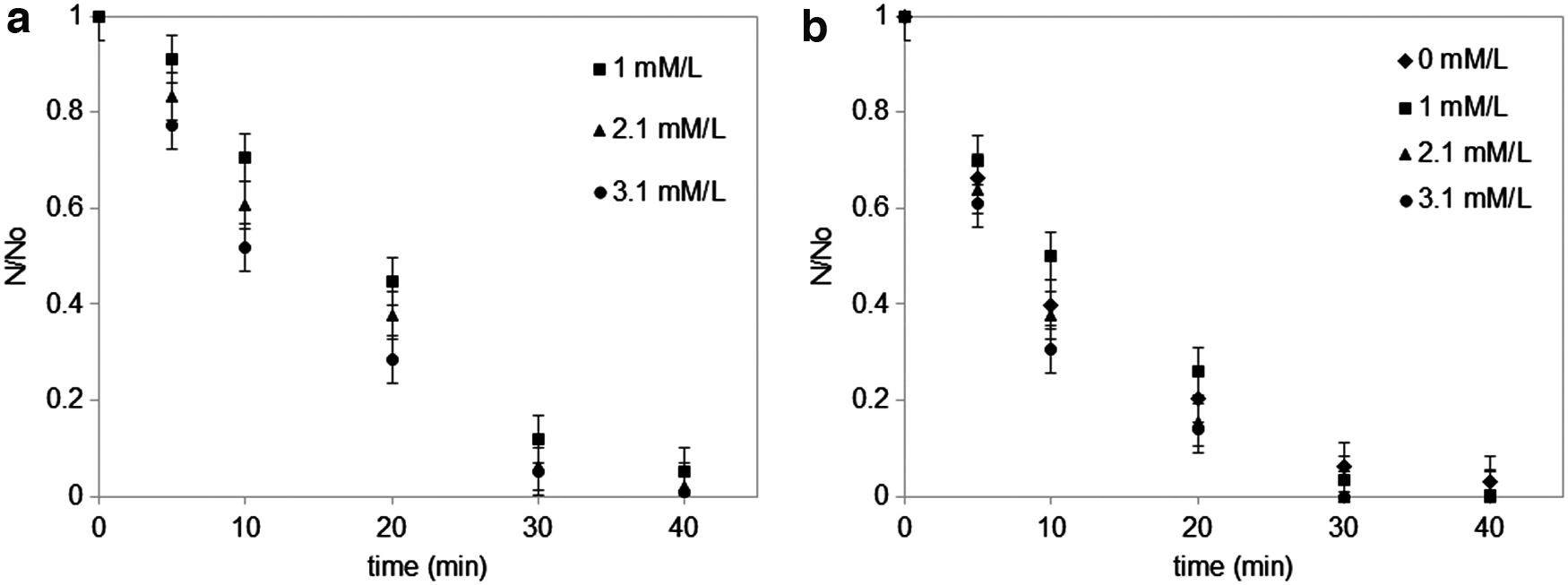
The experiments were performed by varying ozone concentration (1 to 3 mM) and combining US and ozone. The results have been shown in Fig. 4a and b for the individual ozone and combined effect. It has been observed that the total number of colony removal for all three methods was nearly the same and marginally higher for the combined effect of US and ozone. The combined effect of US and ozone was useful for removing all microbial colonies in 30 min of treatment. The complete removal of colonies was not observed for the individual effect of US and ozone in 30 min. The complete removal of E. coli was observed for combination and ozonation effects, and the time required for the same was 5 and 10 min, respectively. The time needed for complete removal of Enterobacter and Salmonella is 30 min for a combined effect of ozone and US. It may be due to the faster decomposition of ozone and emulsification of oxidants with targeted compound. Jyoti and Pandit (2004a) reported nearly 55% decomposition/mixing of ozone in water. The US application with ozone increased the ozone decomposition rate in water to 75–80% (Jyoti and Pandit, 2004a). Marginally higher disinfection was observed for ozonation compared to the US effect alone. Ozone is considered a powerful oxidizing agent and beneficial for enhancing microbial disinfection (Jyoti and Pandit, 2001, 2003). The radicals formed from ozonation may further oxidize the organic compound present in the microbial cell membrane. Physical effects of US, such as micro-emulsification and acoustic streaming, are beneficial for removing the mass transfer barrier in the microbial disinfection process and enhanced the interaction between the microbial cell wall and oxidants (Jyoti and Pandit, 2004a; Ho et al., 2009). Ozone is easily soluble in water, and US reduces the physical limitations/barriers between the oxidants produced from ozone and microorganisms. It decays rapidly to produce oxygen and hydroxyl (superoxide) radical (OHo) (Jyoti and Pandit, 2001, 2004b; Chand et al., 2007). The overall reaction is given by Equation (7):
The ozone reaction pathway consists of three parts initiation, propagation, and termination. Initiation is shown by Equations (8) and (9).
Radical chain reactions:
Termination of reaction is dependent on the concentration of organic and inorganic compounds present in water. These compounds react with OHo and inactive secondary radicals, which cannot inhibit O2o− or HO2o. Termination reaction occurs in the presence of carbonate and bicarbonate ions. Combining two radicals such as OHo and HO2o can terminate the reaction chain cycle [Eqs. (15) to (17)].
The disinfection studies on borewell water using combined ozone effects with US observed 100% killing of total coliform present in water. The rate of removal of microorganisms was much higher than compared to other hybrid techniques such as H2O2 and US, sodium hypochlorite and US, and so on (Jyoti and Pandit, 2004a). The complete removal of heterotrophic plate count bacteria, total coliforms, fecal coliforms, and fecal streptococci was observed from borewell water for a combined effect of US and O3 (4 mg/L) in 15 min. The complete removal of the pathogen was not observed for the effect of ozone and hydrodynamic cavitation alone. The combined effect of hydrodynamic cavitation and ozone was also found to enhance the complete removal of the pathogen (Jyoti and Pandit, 2004a). Another study on the synergy of cavitational effect produced from liquid whistle reactor and ozone on the removal of E. coli (initial concentration 108 to 109 CFU/mL) was found to be useful for 75% removal of E. coli from water in 3 h. The combined use of cavitation with ozone was cost-effective for microbial disinfection (Chand et al., 2007).
Comparative performance of the disinfection process
Disinfection was investigated using an individual effect of US and a combined effect of US with catalyst (TiO2 loading) and ozone. It has been observed that maximum removal of microorganisms was obtained in 20 min treatment, and percentage removal of microorganism is shown in Table 2. The total coliform removal was maximum for the combined effect of TiO2 and US. Total coliform removal was nearly the same for the effect of US and the combined effect of US and ozone. The least reduction was observed for the ozone loading. The complete removal of Enterobacter removal was observed for the combined effect of US and TiO2. The contribution of oxidizing radicals on removing organic/other compounds was analyzed by measuring the COD. The initial COD value is shown in Table 1, and COD removal after 20 min of treatment is shown in Table 2. It has been observed that the oxidizing radical produce from a catalyst, oxidant, cavitational activity, and the combined effect of a catalyst with US has shown a considerable effect on the removal of COD. It has been observed that the individual effect of US has shown a marginal effect on COD removal (51.5% ± 4.7%). The combined effect of ozone and US resulted in maximum COD removal (75.7% ± 7.1%). COD removal from polluted lake water depends on organic matter (0.9–1.2%). Conventional biological processes consisting of indigenous microorganisms such as Chlamydomonas sp., Scenedesmus sp., microalgae species, and so on help to reduce COD (organic matter) and other water quality metrics (Fito and Alemu, 2019). Most of the studies observed 24–240 h of time for COD removal. Longer treatment time has many issues such as high sludge generation, smelling, and so on (Gogate et al., 2020). The individual and combined effect of US with catalyst/oxidants is incredibly useful to overcome the mass transfer limitation involved in conventional biological processes and reduce the process time requirement. Another advantage of AOP is that it provides an additional supply of oxidizing radicals to oxidize organic matter present in water and enhance the COD removal rate (Gupta and Thakur, 2015; Gogate et al., 2020).
Optimized Results (After 20 Min Treatment)
TiO2, titanium dioxide; US, ultrasound.
The kinetics of disinfection was studied using the pseudo-first-order kinetic model. The disappearance of microorganisms present in lake water is related to the number of oxidants or hydroxyl radicals present in water. The concentration of hydroxyl radicals depends on cavitational activities produced from sound energy interaction with an aqueous liquid (Chand et al., 2007; Chakinala et al., 2017). These activities increased in the presence of oxidants and catalysts. The excess concentration of hydroxyl radicals is required than the concentration of microorganisms present in water. The rate of disappearance of microorganisms occurred in a bulk concentration of hydroxyl radicals, and the order of reaction tends to be considered pseudo-order kinetics (Dadjour et al., 2006; Drakopoulou et al., 2009). The disinfection kinetic rate constant was calculated from Equation (18). The removal rate was calculated from the best-fit curve method (Jyoti and Pandit, 2004a; Mahulkar et al., 2009). The kinetic rate equation for disinfection of microorganisms is expressed as:
where
k: kinetic disinfection rate constant, min−1
C: microbial concentration at any time
n: exponent (consider as 1 for pseudo-first-order kinetic)
The combined effect of TiO2 and US has shown the maximum disinfection rate and increase with the concentration of TiO2. Rate of E. coli removal was maximum compared to Enterobacter and Salmonella. US effects were beneficial for the maximum reduction of E. coli. With the addition of TiO2, the rate of E. coli was increased by 12.5% compared to the US effect. The individual effect of TiO2 and ozone was not sufficient for enhancing the rate of removal of E. coli. Combination of US with ozone increases the rate of E. coli removal by 83.6%. Additional experiments were performed to understand the synergy of US, catalyst, and ozone. Experiments were performed at an optimized catalyst concentration (25 μM/L) and ozone (2.1 mM/L). The marginal increase in disinfection rate was observed compared to the combined effect of US with a catalyst (Table 3), whereas the disinfection rate was much higher compared to the combined effects of US and ozone. Results were further analyzed based on the pseudo-first-order kinetic rate constant. It has been observed that the rate of inactivation of Enterobacter, Salmonella, E. coli, and total coliform was marginally higher for a combined effect of US and catalyst. Results confirm that the synergy of US and catalyst was beneficial for enhancing the inactivation of microorganisms.
Pseudo-First-Order Kinetic Rate Constant, k × 10−2 min−1
A synergy of catalyst/oxidants with US was further analyzed based on the synergy coefficient and calculated using Equation (19). Index exceeding 1 indicates that the combined process performance is more than the additive effect (Chakinala et al., 2017; Gogate, 2017). It has been observed that the synergy of TiO2 and US favors the disinfection rate compared to the combined effects of oxidants or oxidants+TiO2. The synergy coefficient was 1.7, 0.4, and 0.7 for combining the effect of US with TiO2, O3, and TiO2+O3. Thus, it confirms that the synergy of TiO2 with US favors the disinfection.
A similar trend was observed for the reduction of Enterobacter and Salmonella. Chemical and physical effects associated with US were beneficial for enhancing the rate of microbial disinfection. The elevated temperature and pressure conditions attained inside the bubble at the collapsing stage are conducive for diminishing the mass transfer limitation between the microbial cell wall boundaries and oxidizing radicals (Khan et al., 2006; Lu et al., 2019). The oxidants formed after the bubble collapse contributed to the oxidation of molecules released after the cell wall rupture.
The analysis of the percentage removal of microorganisms and the rate of killing of microorganisms confirms that the synergic effect of TiO2 was beneficial for enhancing the microorganism removal rate and observed a promising option for disinfection (Jyoti and Pandit, 2004b; Chand et al., 2007). It may be due to higher cavitational events that occur in the presence of TiO2 and provides additional nucleation sites for bubble formation. Shock waves and pitting effects produced from US helped to maintain the active surface area of TiO2 (Chakinala et al., 2017; Gogate, 2017). More oxidizing radicals produced from the combined effects of TiO2 and US result in higher microbial disinfection (Antoniadis et al., 2007; Ho et al., 2009). Thus, a synergy of TiO2 and US combined effect can be a promising option for the disinfection of lake water (Chakinala et al., 2017). However, substantial efforts are needed for scale-up aspects of the cavitational reactor and depend on several factors.
Maintaining uniform cavitational activities plays a crucial role in enhancing the hydroxyl reactor concentration. Combining a cavitational reactor with other advanced oxidation is highly beneficial for improving oxidants/hydroxyl radicals' concentration (Chand et al., 2007). However, very few studies reported on scale-up aspects of the cavitational reactor for microbial disinfection. Ozonix is a commercial reactor based on the combined effects of electrochemical, ozonation, and hydrodynamic cavitation and is tested for treating more than 3 billion L of industrial water at various locations/industrial bases in the United States. This reactor helped remove 96.5% acid-producing bacteria and 97.5% sulfate-producing bacteria. The patented ozonix chemical-free technology is based on the AOP. The reactor has wide application, including the treated wastewater from shallow ground and petroleum industries. The significant advantage of technology is zero-scale deposition on internal parts of the reactor and that it maintained continuous flowability (Gogate et al., 2014). The scale-up aspects of cavitational reactor microbial disinfection of lake water depend on the following factors (Jyoti and Pandit, 2001; Chand et al., 2007; Chakinala et al., 2017; Gogate, 2017).
(a) The reactor performance depends on the distribution of cavitational activity. It is concentrated near the vicinity of the transducer surface. Hence, understanding the distribution of ultrasonic wave patterns in a reactor is an essential parameter in designing a cavitational reactor.
(b) Development of design strategies to link the theoretical knowledge of acoustic wave patterns in a reactor with experimental results.
(c) Large-scale or higher volume studies are required to understand the high degree of uncertainty in reactors and information in diverse chemical engineering fields, material science, and acoustics.
(d) Understanding the effect of different cavitation reactor geometries on bubble cluster, flow field, and turbulence characteristics.
(e) More investigations are needed on the combined effect of cavitation with advanced oxidation techniques such as hydrodynamic cavitation, electrochemical, ozonation, and oxidizing radicals and catalysts to lower the disinfection cost to maintain a uniform concentration of cavitational activity.
Conclusion
The present study confirms that the combined effect of US with catalyst enhanced the microbial inactivation rate (60–65%). The synergy of combined effects enhanced the cavitational activities and produced the highly reactive radicals for microbial disinfection. Gram-negative bacterial species Enterobacter, Salmonella, and E. coli present in lake water were removed with different removal rates. It may be due to cell wall thickness and the concentration of organic compounds present inside the cell. Complete removal of E. coli was observed using all effects. Nearly complete removal of all microbial count and a substantial reduction in organic loading were observed. Techno-economic analysis confirms that the combined effect of TiO2 with US can be a promising option for treating lake water. The present investigation on Ramgarh Lake water confirmed that a cavitational reactor could be a potential treatment technique for lake water treatment. More studies are required using the hybrid cavitational technique.
Footnotes
Author Disclosure Statement
No competing financial interests exist.
Funding Information
Maharashi Yadav would like to thank Ministry of Human Resource & Development (India) for providing financial assistance for research.